“Overcurrent relay protection on ac
microgrid”
Presented by
Mahdi Hasan
ID: 1802139
Md. Al-Amin
ID: 1802140
What is Overcurrent relay protection?
 An overcurrent relay is a protective device used in
electrical power systems to detect and respond to
excessive current levels in a circuit.
 It is designed to prevent damage to electrical equipment
and to ensure the safety of personnel by interrupting the
power supply when abnormal current conditions occur.
 Overcurrent relay protection operates based on the
principle of measuring the current flowing through a
circuit and comparing it to a pre-determined set point.
Why overcurrent relay protection required?
Overcurrent relay protection is required in AC microgrids for several important reasons.such as
 Fault Detection
 Equipment Protection
 Personnel Safety
 Fault Isolation and System Stability
 Selectivity and Coordination
 Compliance with Standards and Regulations
How the overcurrent relay protection works ?
Here's how overcurrent relay protection typically works in an AC
microgrid, we can categorize into some steps:
1. Current Sensing
2. Fault Detection and Classification
3. Selective Tripping
4. Coordination with Other Protection Devices
5. Inverter Protection
6. Communication and Control
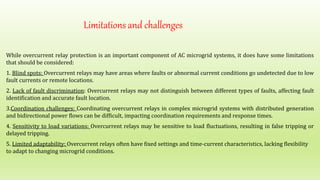
Limitations and challenges
While overcurrent relay protection is an important component of AC microgrid systems, it does have some limitations
that should be considered:
1. Blind spots: Overcurrent relays may have areas where faults or abnormal current conditions go undetected due to low
fault currents or remote locations.
2. Lack of fault discrimination: Overcurrent relays may not distinguish between different types of faults, affecting fault
identification and accurate fault location.
3.Coordination challenges: Coordinating overcurrent relays in complex microgrid systems with distributed generation
and bidirectional power flows can be difficult, impacting coordination requirements and response times.
4. Sensitivity to load variations: Overcurrent relays may be sensitive to load fluctuations, resulting in false tripping or
delayed tripping.
5. Limited adaptability: Overcurrent relays often have fixed settings and time-current characteristics, lacking flexibility
to adapt to changing microgrid conditions.
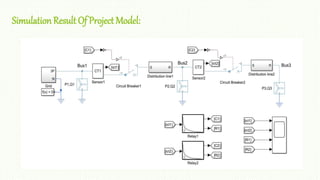
Simulation Result Of Project Model:
Earth & Phase Protection Characteristics Curve
Above these graph shows the earth protection characteristics vs the operating time in seconds and
another is phase protection characteristics vs operating time in second
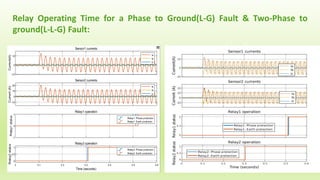
Relay Operating Time for a Phase to Ground(L-G) Fault & Two-Phase to
ground(L-L-G) Fault:
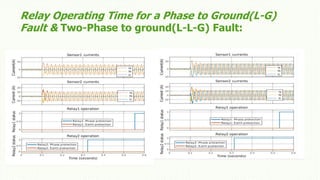
Relay Operating Time for a Phase to Ground(L-G)
Fault & Two-Phase to ground(L-L-G) Fault:
Any Questions?

Overcurrent relay protection on ac microgrid.pptx

  • 1.
    “Overcurrent relay protectionon ac microgrid” Presented by Mahdi Hasan ID: 1802139 Md. Al-Amin ID: 1802140
  • 2.
    What is Overcurrentrelay protection?  An overcurrent relay is a protective device used in electrical power systems to detect and respond to excessive current levels in a circuit.  It is designed to prevent damage to electrical equipment and to ensure the safety of personnel by interrupting the power supply when abnormal current conditions occur.  Overcurrent relay protection operates based on the principle of measuring the current flowing through a circuit and comparing it to a pre-determined set point.
  • 3.
    Why overcurrent relayprotection required? Overcurrent relay protection is required in AC microgrids for several important reasons.such as  Fault Detection  Equipment Protection  Personnel Safety  Fault Isolation and System Stability  Selectivity and Coordination  Compliance with Standards and Regulations
  • 4.
    How the overcurrentrelay protection works ? Here's how overcurrent relay protection typically works in an AC microgrid, we can categorize into some steps: 1. Current Sensing 2. Fault Detection and Classification 3. Selective Tripping 4. Coordination with Other Protection Devices 5. Inverter Protection 6. Communication and Control
  • 5.
    Limitations and challenges Whileovercurrent relay protection is an important component of AC microgrid systems, it does have some limitations that should be considered: 1. Blind spots: Overcurrent relays may have areas where faults or abnormal current conditions go undetected due to low fault currents or remote locations. 2. Lack of fault discrimination: Overcurrent relays may not distinguish between different types of faults, affecting fault identification and accurate fault location. 3.Coordination challenges: Coordinating overcurrent relays in complex microgrid systems with distributed generation and bidirectional power flows can be difficult, impacting coordination requirements and response times. 4. Sensitivity to load variations: Overcurrent relays may be sensitive to load fluctuations, resulting in false tripping or delayed tripping. 5. Limited adaptability: Overcurrent relays often have fixed settings and time-current characteristics, lacking flexibility to adapt to changing microgrid conditions.
  • 6.
    Simulation Result OfProject Model:
  • 7.
    Earth & PhaseProtection Characteristics Curve Above these graph shows the earth protection characteristics vs the operating time in seconds and another is phase protection characteristics vs operating time in second
  • 8.
    Relay Operating Timefor a Phase to Ground(L-G) Fault & Two-Phase to ground(L-L-G) Fault:
  • 9.
    Relay Operating Timefor a Phase to Ground(L-G) Fault & Two-Phase to ground(L-L-G) Fault:
  • 10.