
Internal
Sivasubramaniam Arunachalam
September 09, 2011
Internal
Introduction to EDI
(Electronic Data Interchange)
Internal
Agenda
 Definition
 History
 Message Flow
 Before EDI
 After EDI
 Benefits
 Transmission Mediums
 Transmission Directions
 Transmission Protocols
 Implementation
 Message Formats
Internal
EDI - Definition
 Business Documents
 Electronic Transmission
 Strtucted Data
 Trading Partner to Trading Partner
 Computer to Computer Communication
 Sequence of Messages
 Automate Standard Processes
Internal
History
 Early 1960s
 TDCC
 Private Company Standards
 Private Industry Standards
 Inter Industry Standards (ANSI / ASC)
Internal
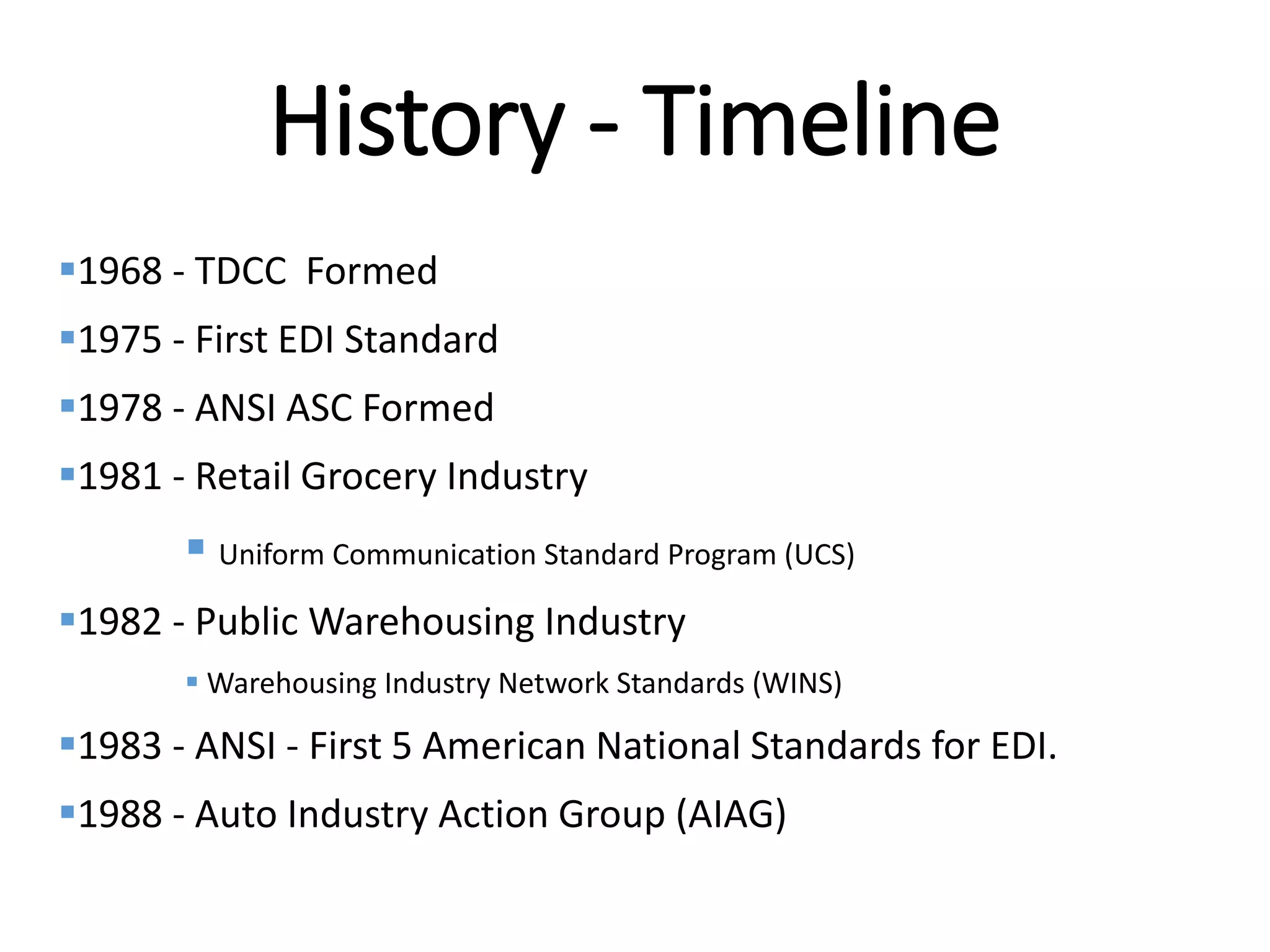
History - Timeline
1968 - TDCC Formed
1975 - First EDI Standard
1978 - ANSI ASC Formed
1981 - Retail Grocery Industry
 Uniform Communication Standard Program (UCS)
1982 - Public Warehousing Industry
 Warehousing Industry Network Standards (WINS)
1983 - ANSI - First 5 American National Standards for EDI.
1988 - Auto Industry Action Group (AIAG)
Internal
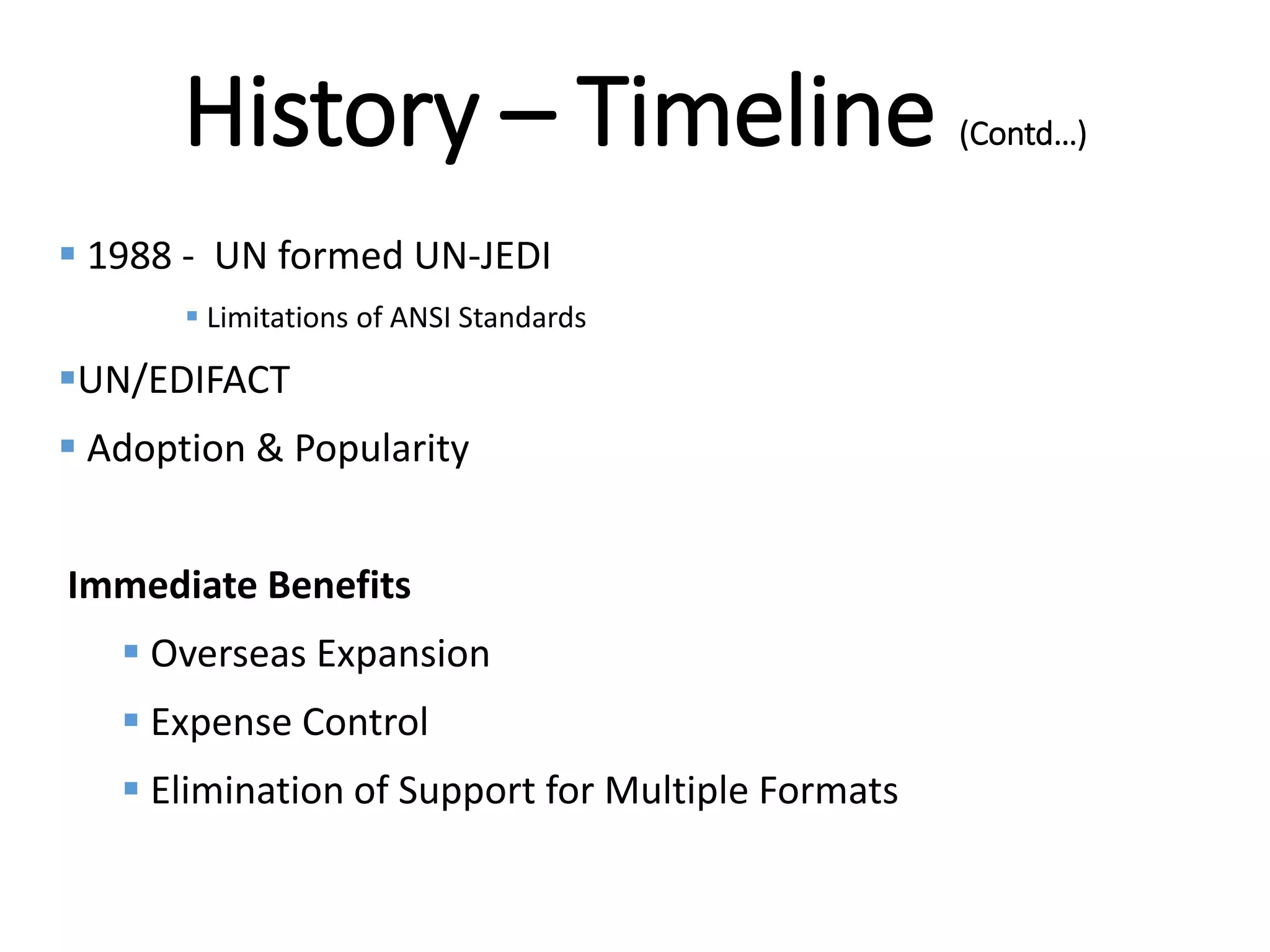
History – Timeline (Contd…)
 1988 - UN formed UN-JEDI
 Limitations of ANSI Standards
UN/EDIFACT
 Adoption & Popularity
Immediate Benefits
 Overseas Expansion
 Expense Control
 Elimination of Support for Multiple Formats
Internal
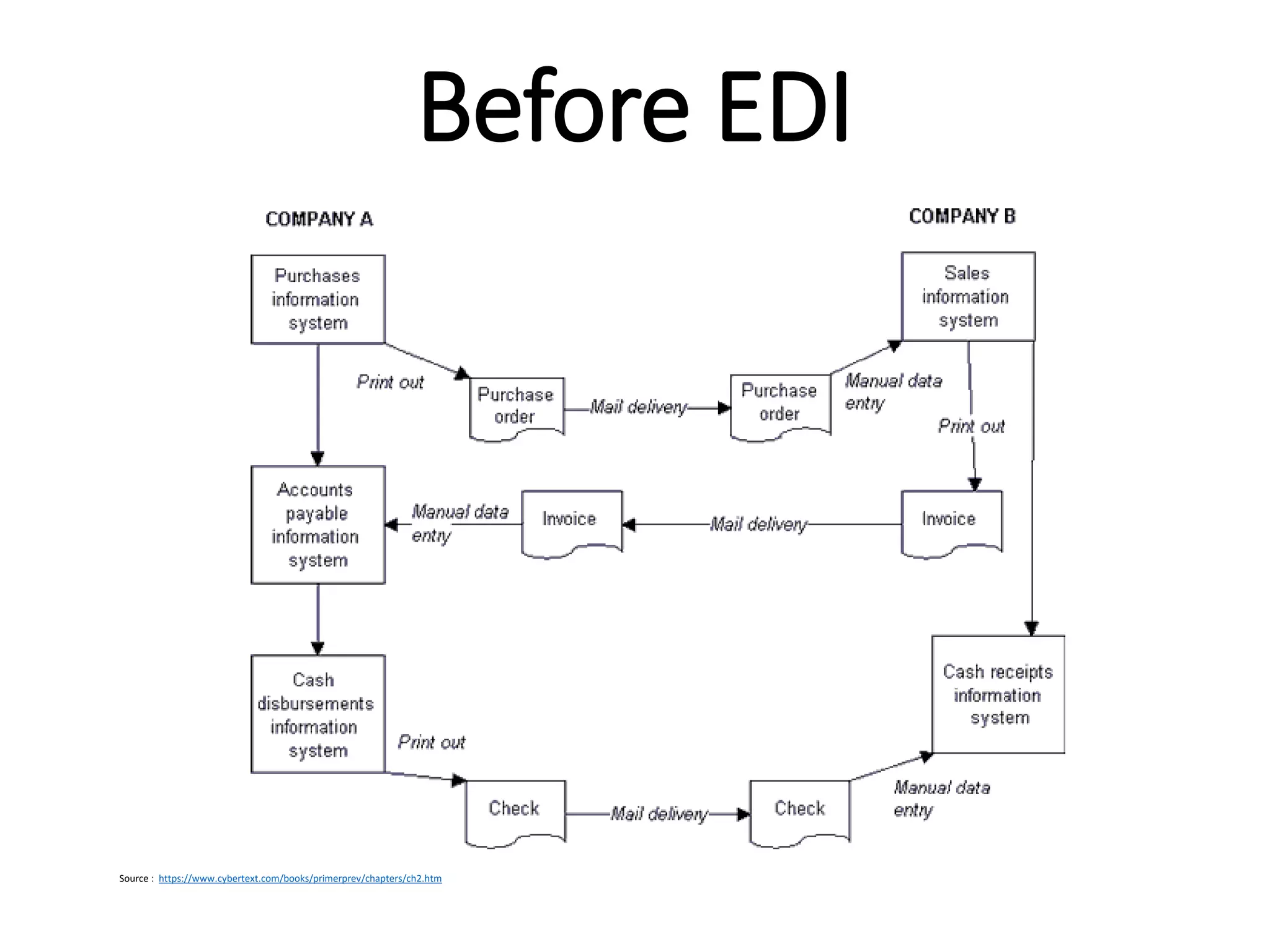
Before EDI
Source : https://www.cybertext.com/books/primerprev/chapters/ch2.htm
Internal
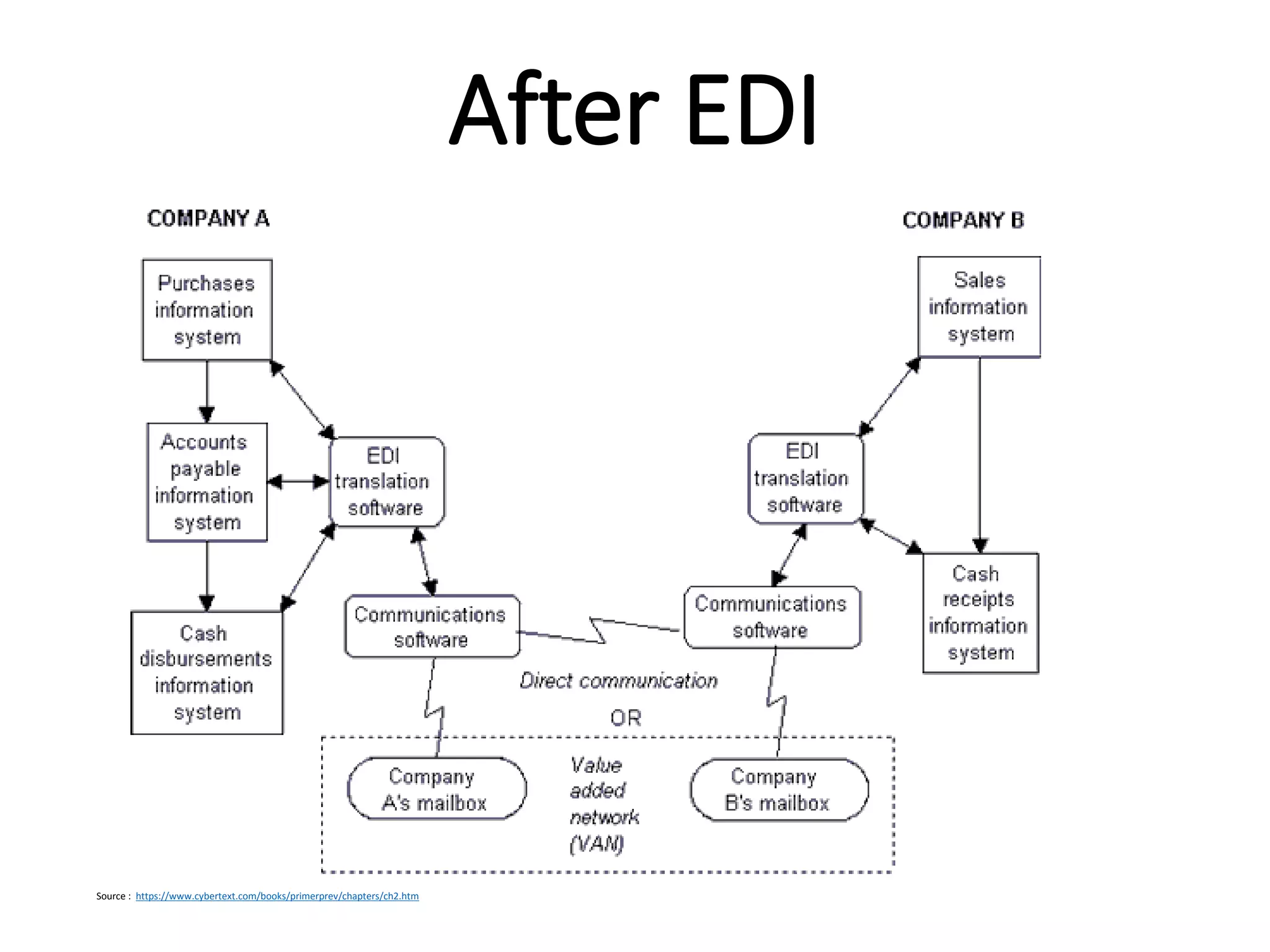
After EDI
Source : https://www.cybertext.com/books/primerprev/chapters/ch2.htm
Internal
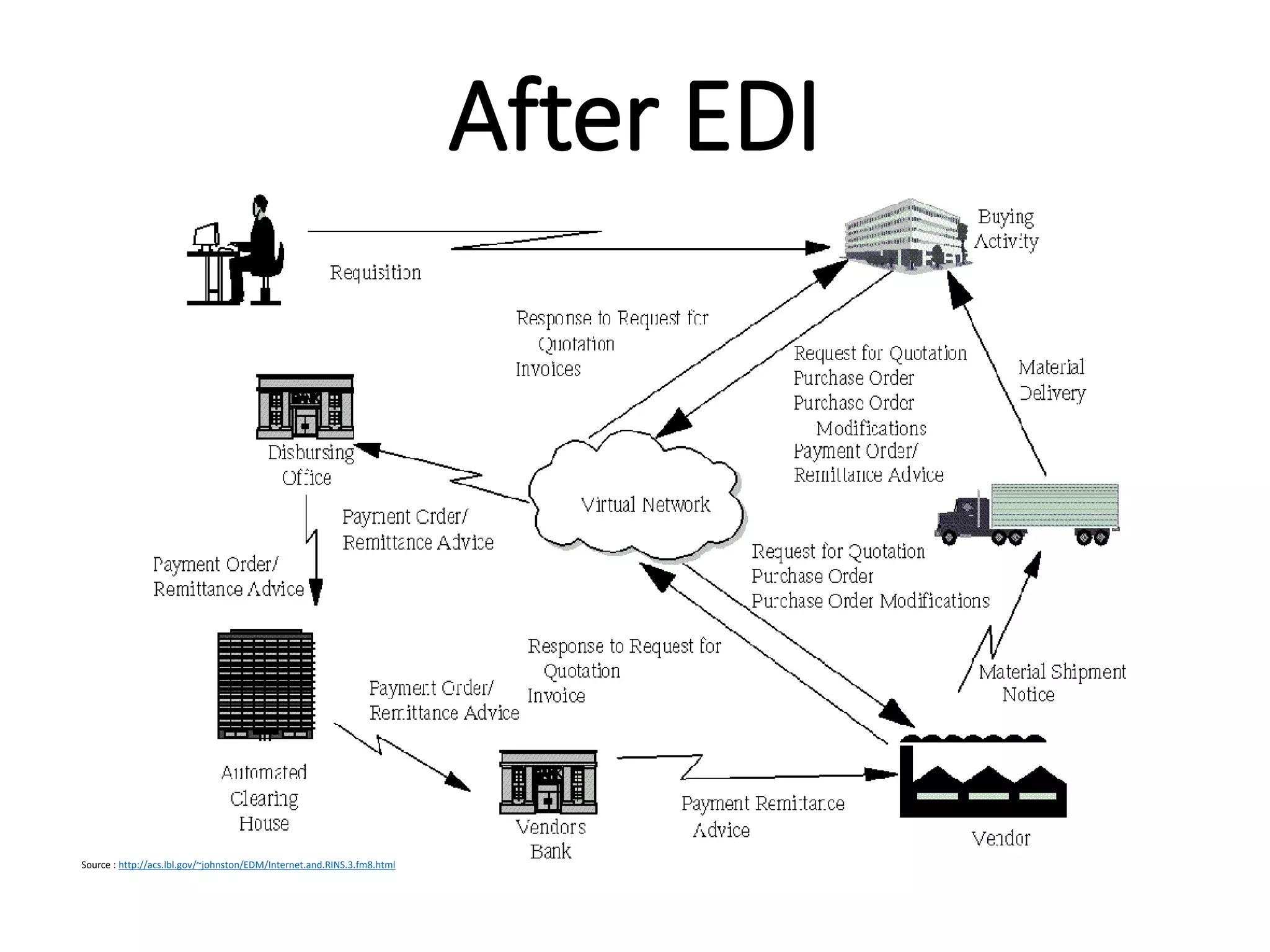
After EDI
Source : http://acs.lbl.gov/~johnston/EDM/Internet.and.RINS.3.fm8.html
Internal
Benefits
 Post office cost
 People cost
 Error cost
Buyer Benefits
 Lower Inventory Levels
 Quick Order Acknowledgement
 Matching and Re-Keying PO and Invoice
Supplier/Seller Benefits
 No problems and delays caused by order entry errors (50)
 Personnel Reductions (70)
 Inventory Reductions
 Improved Cash Flow
Internal
Benefits - Need for Speed
 Seconds instead of Days
 Never put it any Basket for Collection
 Receiver side data is immediately ready for processing
 Different parties process the electronic document
 Low Business Cycle times (competitive edge in any business)
Internal
Benefits - Need for Accuracy
 Electronic data is usually derived from a database
 Data has been subject to prior validation
 Large Size and delivery failure never matters here.
 Even it fails, re-transmission is possible
Internal
Benefits - Cost Savings and Avoidance
 Human handling
 Mailroom Sorting, Circulation, Clerical document preparation
 Data entry at multiple stages
 Paper and it's Transmission Costs
 Paper Cost, Envelopes , Mailing Materials , Courier services
 Telephone calls to confirm
 Paper storage space and it's protection
 Low Error Rates and Low Handling of Error Rates
 Labor to monitor, search and solve the error
 Inventory Reduction
 Low Stock Levels
Internal
Benefits - Improved Operational Efficiency
 For Customers
 Quicker Delivery of Products (competition)
 Better Customer service
 Distributors performance
 Vendor side
 Track Supplier Performance Level
 Track Supplier Stock Level
 Transportation Carrier Performance
Internal
Benefits - Improved Operational Efficiency (Contd…)
 Precise Planning and Execution
 Improved Cash Flow
 Immediate payment
 No Currency Conversion Factors
 Net Discounts
 Audit trials and status tracking
Internal
Transmission Medium - Types
 P2P
 Dial up Line
 Leased Line
VAN
VPN
Web / Mobile
Internal
P2P – Dial Up
 Dial-up line is established just like a normal telephone call
 Sending party makes the call to Receiver & transmits the data
 Batch/Bulk Processing
 Cheaper when the amount of data is low and sporadic
Internal
P2P - Leased Line
 Dedicated Line and expensive
 Amount of transactions is high
 Fairly constant throughout the day
 No dial delay
 No need to batch transactions
Internal
VAN (Value Added Network)
 P2P scheduling problem to trading partners
 Store and Forward Mailbox Service
 Most widely used
 Routing, Storing and Delivering EDI messages
 Delivery Reports
Internal
VAN – How it works
 Trading Partners chooses EDI VAN Provider
 EDI VAN Provider provides mail box for send & receive
 Sender Connects to VAN and sends its EDI
 Sender then disconnects from the service
 Recipient can connect to the network and receive those
transactions from their mailbox
Internal
VAN – Other Features
 Acknowledgements
 To Sender (Messages have been sent successfully)
 To Receiver (New EDI message has arrived in their mailbox)
 Data Backup/Recovery,
 Document Mapping
 Audit trail of all EDI transactions
 Tracking / Recording the trail of a message (on demand)
Internal
VPN
 Public Telecommunications Networks (internet)
 Private Data Communications
 Intranet and extranet(VPN Server to another VPN Server)
 Client/Server model
 Clients -> authenticate, encryption, creating tunnels and managing sessions
 Lower Costs compared to Leased Lines
Internal
Web / Mobile
 Web
 Users will use Web Browsers
 Pre-populated Form
 Security depends on the internet technologies (HTTPS and AS2)
Mobile
 Recent development concentrates on mobiles
 At Least to check the status of the transaction
 Many Challenges (different screen size & different platforms)
Internal
Protocols
 HTTP / HTTPS
 POP3 / SMTP
 SFTP
 OFTP / OFTP2
 WebDAV (Web folders or web share)
 X.400
 EDIINT
AS1
AS2
AS3
AS4
Internal
Protocols – OFTP2
(ODETTE File Transfer Protocol)
• Message encryption and signatures support
• Signed receipts
• Message compression and integrity
• Session authentication
• Session encryption (TLS)
• File restart
• Push / pull operation
• Peer-to-peer or indirect communications
• File compression
•Operates over TCP/IP, X.25/ISDN, native X.25
Internal
OFTP2 vs AS2
• OFTP2 – Push & Pull
• AS 2 - Push
Internal
Transmission Directions
 Inbound
 Outbound
 EDI that tells a warehouse to perform an shipment
 Outbound for Manufacturer
 Inbound for Warehouse computer system
Internal
Transmission Directions – Inbound Processing
P2P, VAN or AS* to EDI Application (Mail Bag)
 Validation of Party
 Authentication
 Authorization
 Valid message
 Structure of the file vs EDI standards
 Individual fields vs standads (ex. PO)
 Create non EDI doc for back end ERP or database or queue
 Conversion / Tranformation to properitry format (Ex: IDoc)
 Can be done by Standard mappings (XSLT or Custom Mapping modules)
Internal
Transmission Directions – Outbound Processing
 Read data from DB (or) From back-end ERP (or) Queue
 Validate message format & individual fields in the given file
 Use Mapper and create EDI Message
 Validate EDI Message
 Send to Trading Partner
 Audit Creation and Interpretation (Depends on the EDI type)
 Technical Acks
 Business Acks
Internal
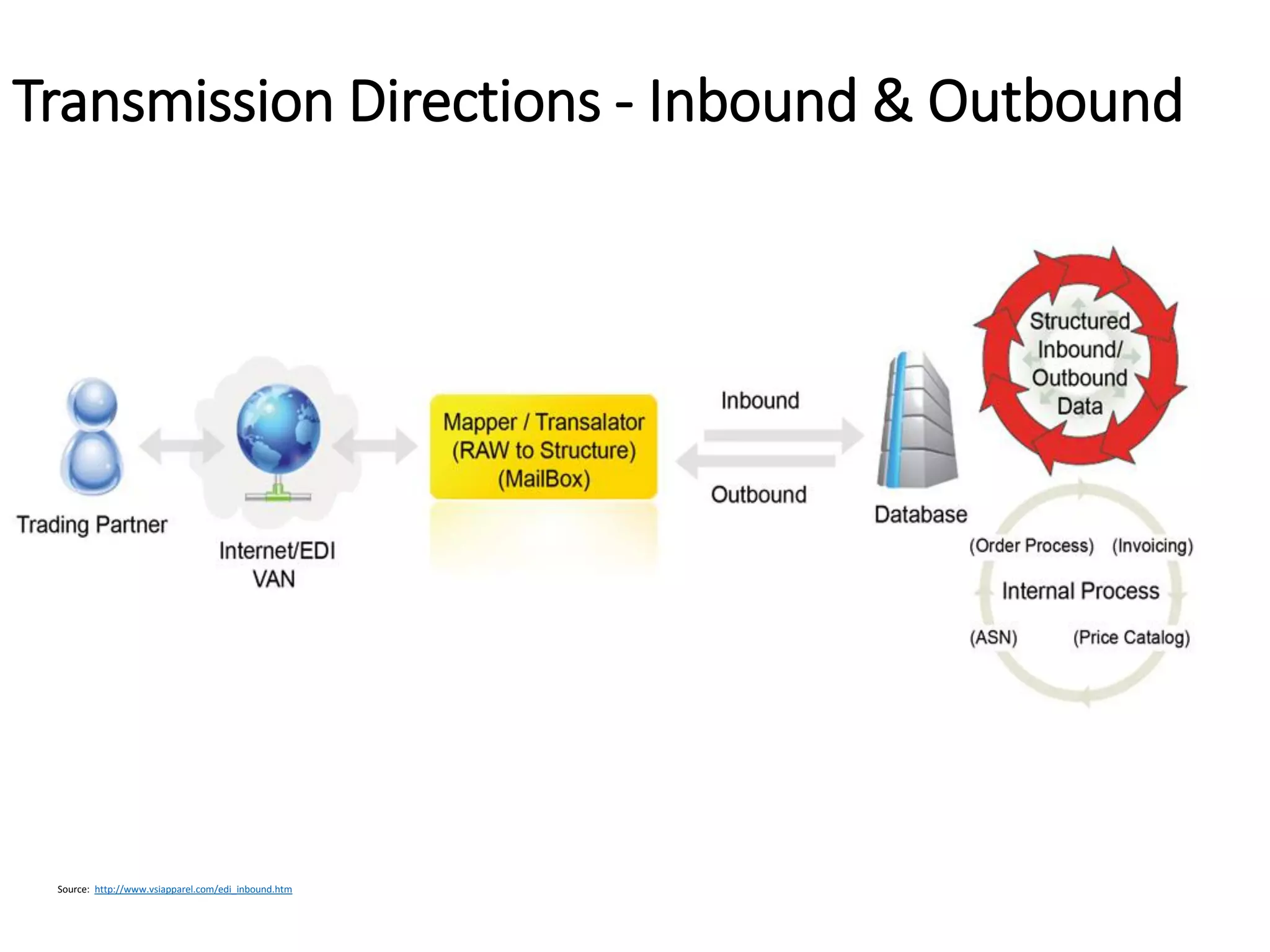
Transmission Directions - Inbound & Outbound
Source: http://www.vsiapparel.com/edi_inbound.htm
Internal
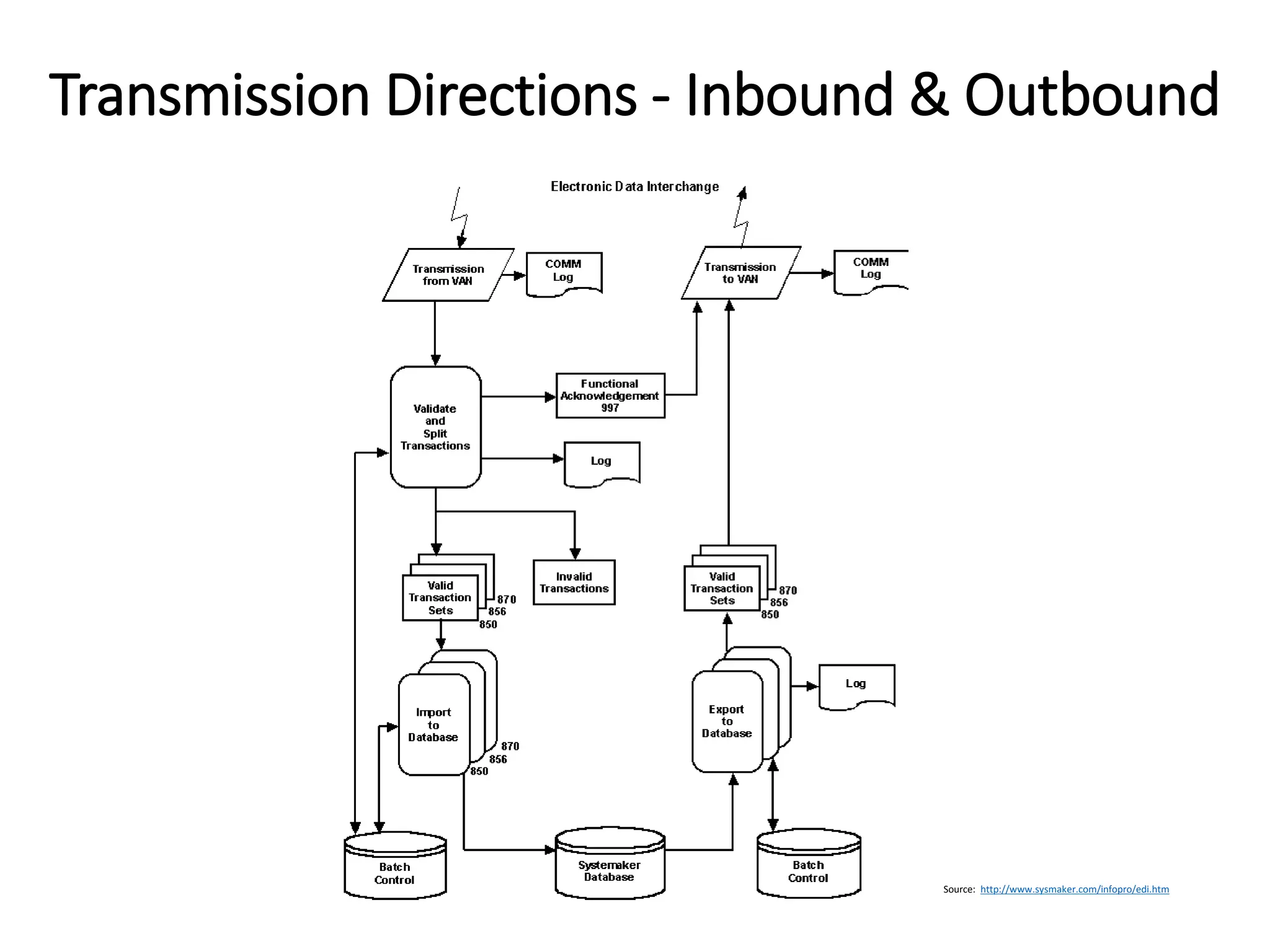
Transmission Directions - Inbound & Outbound
Source: http://www.sysmaker.com/infopro/edi.htm
Internal
Example Transactions
 Purchase Orders
 Invoices
 Shipping Notices
 Export/Import Information
 Carrier-to carrier waybills
 Funds Transfers
 Design Specifications
 Health Insurance Claims
Internal
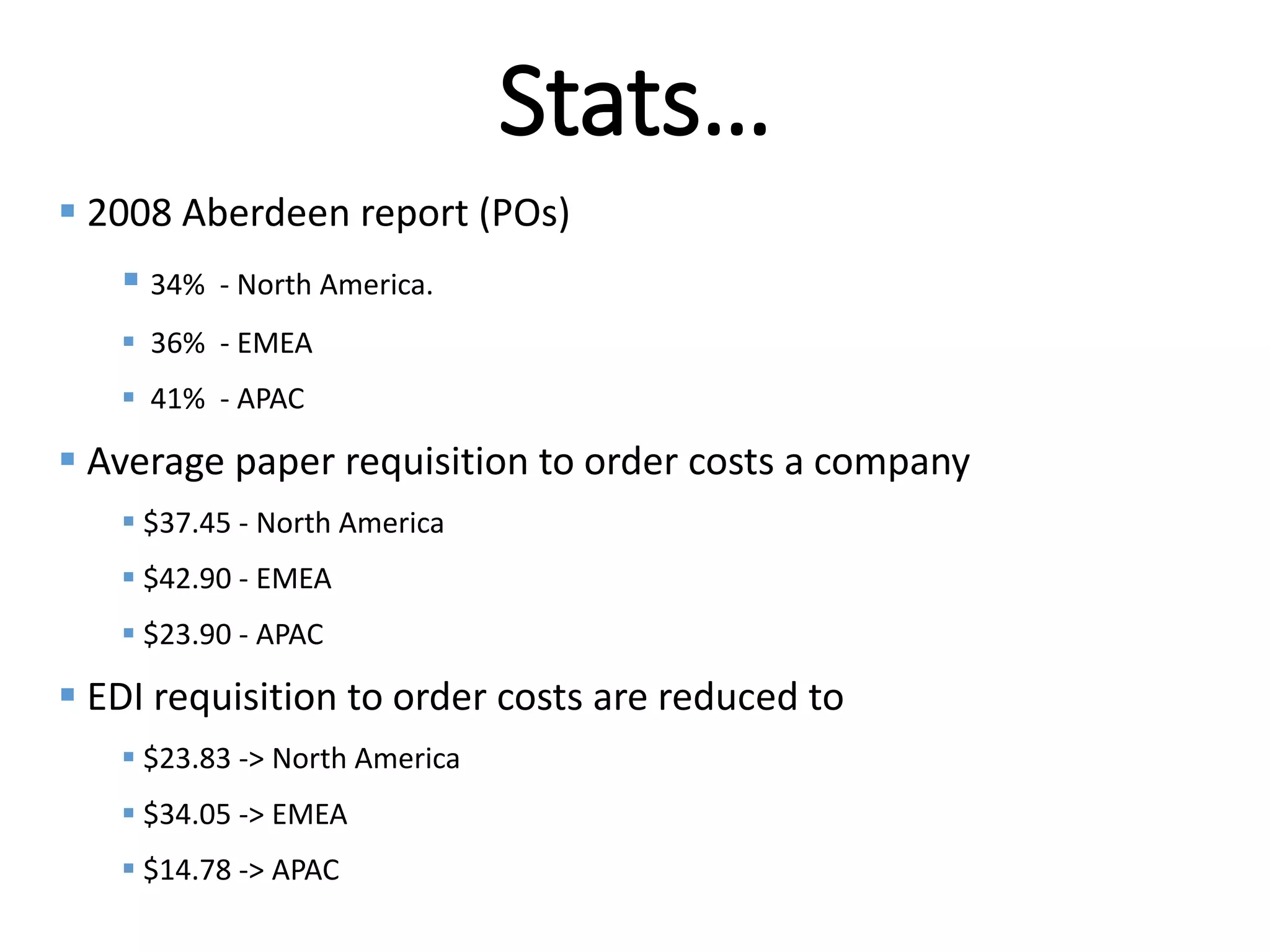
Stats…
 2008 Aberdeen report (POs)
 34% - North America.
 36% - EMEA
 41% - APAC
 Average paper requisition to order costs a company
 $37.45 - North America
 $42.90 - EMEA
 $23.90 - APAC
 EDI requisition to order costs are reduced to
 $23.83 -> North America
 $34.05 -> EMEA
 $14.78 -> APAC
Internal
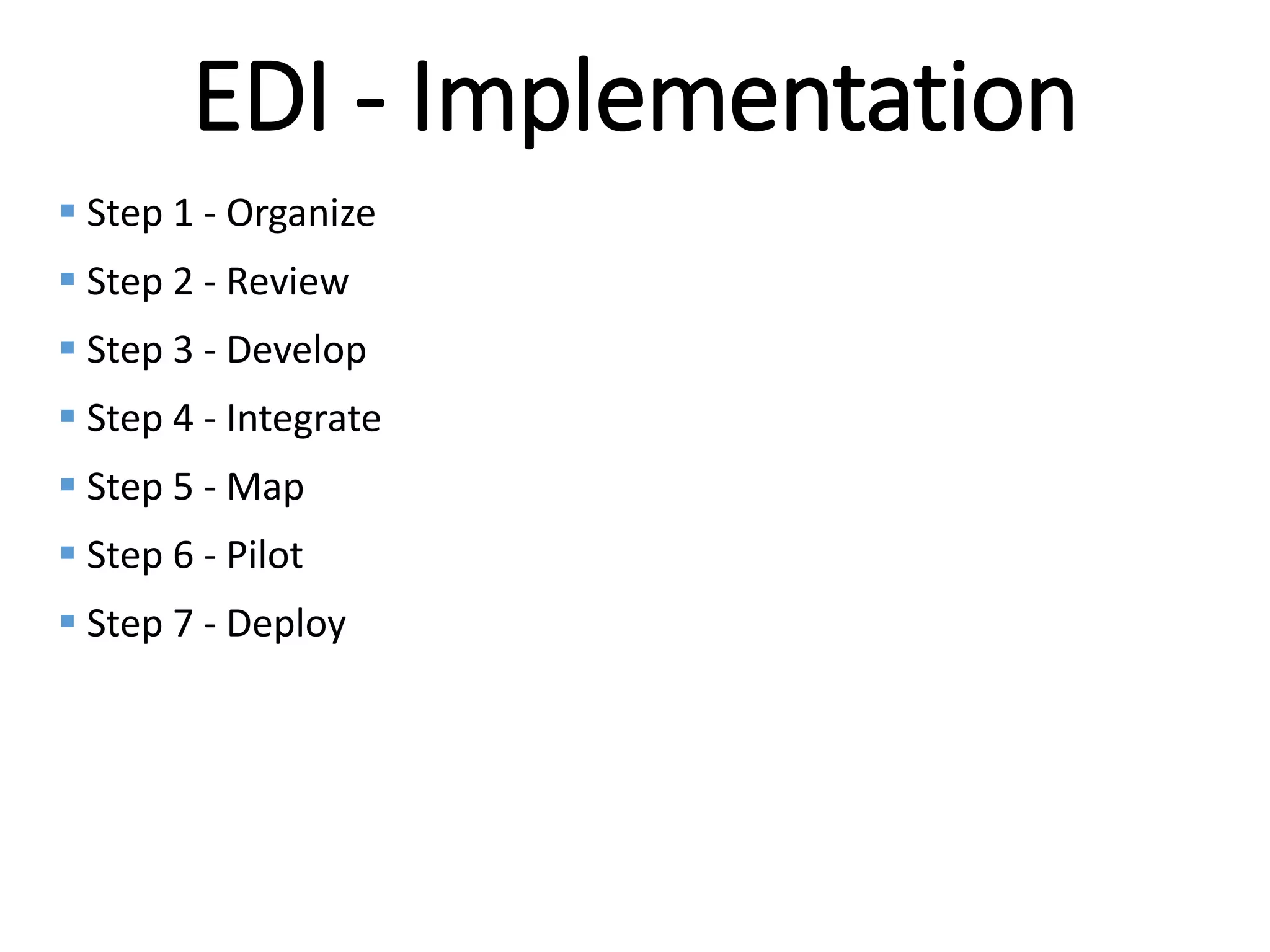
EDI - Implementation
 Step 1 - Organize
 Step 2 - Review
 Step 3 - Develop
 Step 4 - Integrate
 Step 5 - Map
 Step 6 - Pilot
 Step 7 - Deploy
Internal
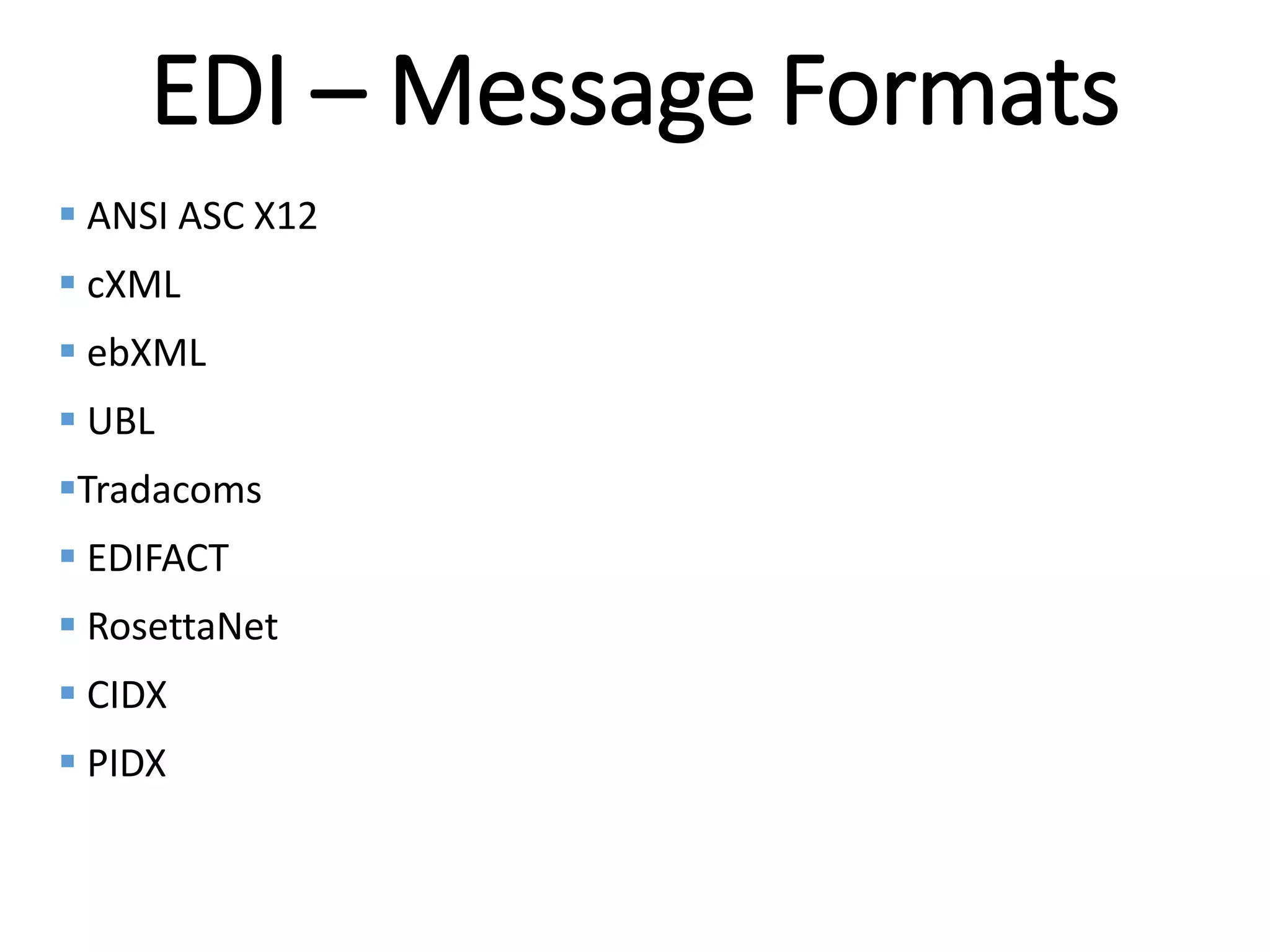
EDI – Message Formats
 ANSI ASC X12
 cXML
 ebXML
 UBL
Tradacoms
 EDIFACT
 RosettaNet
 CIDX
 PIDX
Internal
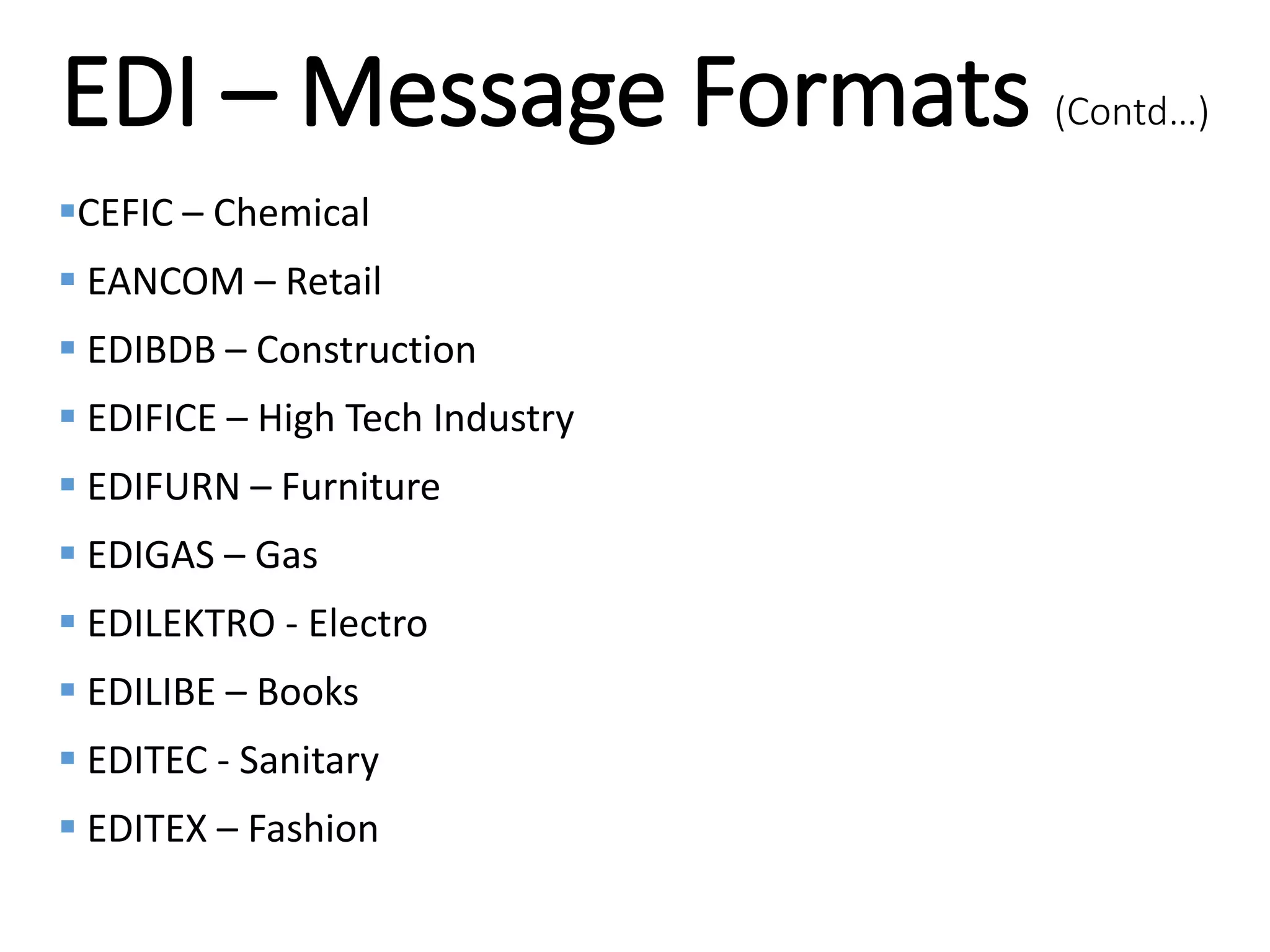
CEFIC – Chemical
 EANCOM – Retail
 EDIBDB – Construction
 EDIFICE – High Tech Industry
 EDIFURN – Furniture
 EDIGAS – Gas
 EDILEKTRO - Electro
 EDILIBE – Books
 EDITEC - Sanitary
 EDITEX – Fashion
EDI – Message Formats (Contd…)
Internal
EDI – Message Formats (Contd…)
 EDIFOR/EDITRANS - Transports & Logistics
 EDIWHEEL - Wheels & Tyres
 ETIS – Telecommunication
 STAR - Standards for Technology in Automotive Retail
 SPEC2000 - Airline Industry
 FORTRAS - Transports & Logistics
Internal
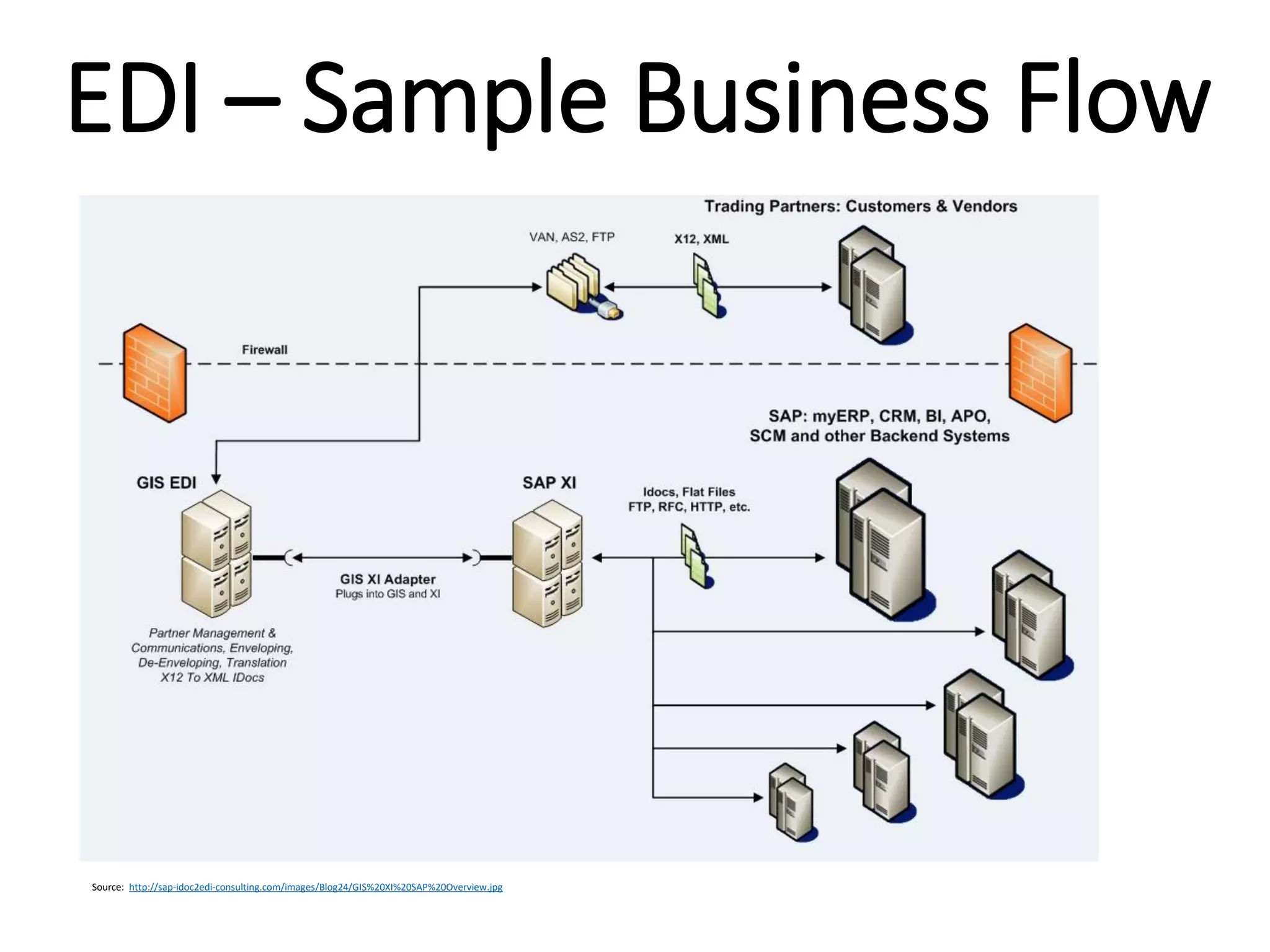
EDI – Sample Business Flow
Source: http://sap-idoc2edi-consulting.com/images/Blog24/GIS%20XI%20SAP%20Overview.jpg
Internal
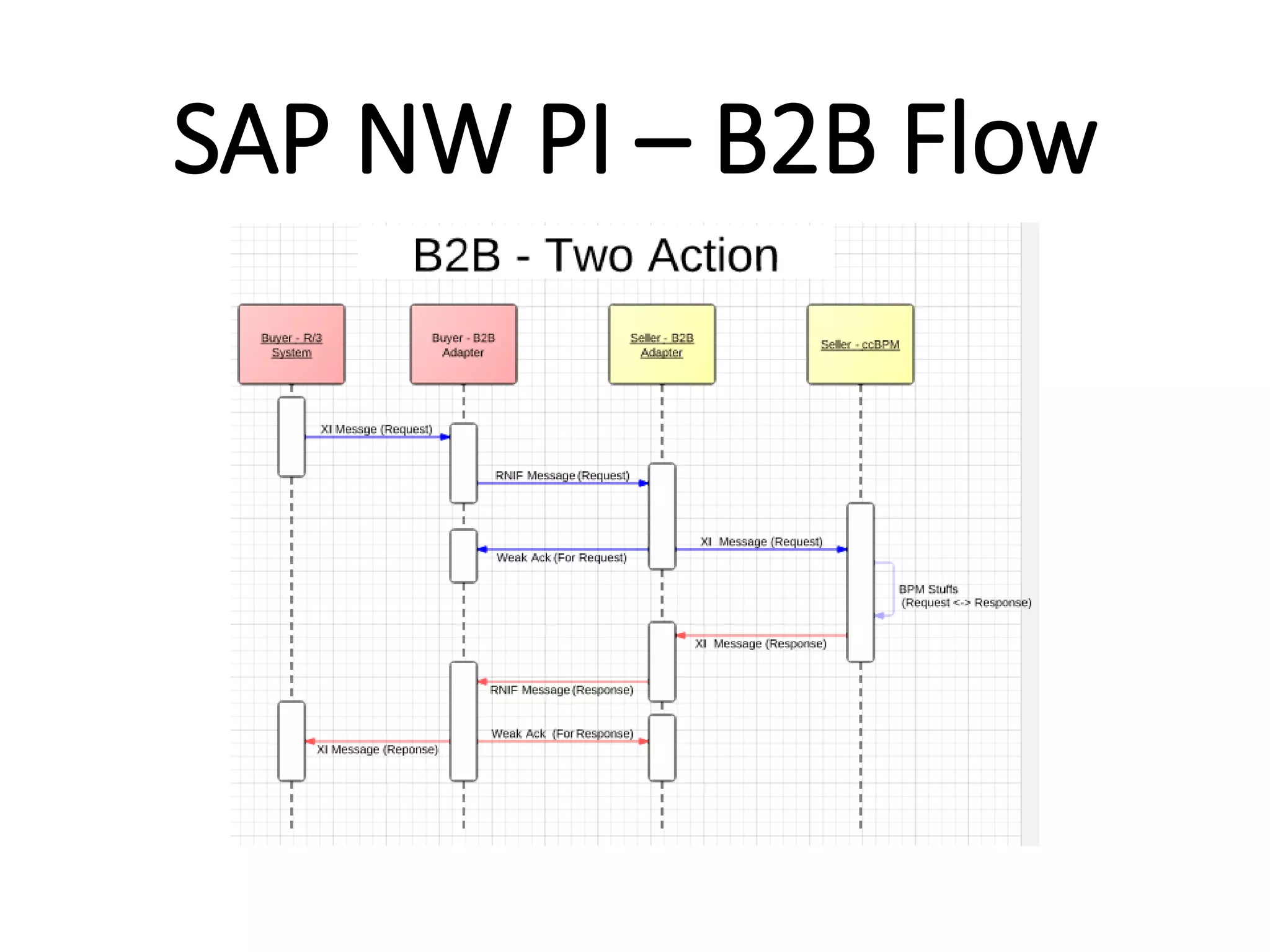
SAP NW PI – B2B Flow
Internal
EDI – Challenges
 Customers
 Committees
 Solution Providers & Partners
Internal
References
http://en.wikipedia.org/wiki/Electronic_data_interchange
http://www.edibasics.co.uk/
http://e.d.i.tripod.com/edi_history.htm
http://www.123edi.com/
http://www.electronic-cash-news.com/2010/concise-timeline-
and-history-of-electronic-data-interchange-edi/
http://rogerclarke.com/EC/EDIIntro.html
Internal
References
http://www.edimatrix.demon.co.uk/history.htm
http://archive.ifla.org/VI/5/reports/rep4/rep4.htm
http://www.covalentworks.com/what-is-edi.asp
http://en.wikipedia.org/wiki/OFTP
https://www.cybertext.com/books/primerprev/chapters/ch2.htm
Internal

Introduction to EDI(Electronic Data Interchange)

  • 1.
    Internal Sivasubramaniam Arunachalam September 09,2011 Internal Introduction to EDI (Electronic Data Interchange)
  • 2.
    Internal Agenda  Definition  History Message Flow  Before EDI  After EDI  Benefits  Transmission Mediums  Transmission Directions  Transmission Protocols  Implementation  Message Formats
  • 3.
    Internal EDI - Definition Business Documents  Electronic Transmission  Strtucted Data  Trading Partner to Trading Partner  Computer to Computer Communication  Sequence of Messages  Automate Standard Processes
  • 4.
    Internal History  Early 1960s TDCC  Private Company Standards  Private Industry Standards  Inter Industry Standards (ANSI / ASC)
  • 5.
    Internal History - Timeline 1968- TDCC Formed 1975 - First EDI Standard 1978 - ANSI ASC Formed 1981 - Retail Grocery Industry  Uniform Communication Standard Program (UCS) 1982 - Public Warehousing Industry  Warehousing Industry Network Standards (WINS) 1983 - ANSI - First 5 American National Standards for EDI. 1988 - Auto Industry Action Group (AIAG)
  • 6.
    Internal History – Timeline(Contd…)  1988 - UN formed UN-JEDI  Limitations of ANSI Standards UN/EDIFACT  Adoption & Popularity Immediate Benefits  Overseas Expansion  Expense Control  Elimination of Support for Multiple Formats
  • 7.
    Internal Before EDI Source :https://www.cybertext.com/books/primerprev/chapters/ch2.htm
  • 8.
    Internal After EDI Source :https://www.cybertext.com/books/primerprev/chapters/ch2.htm
  • 9.
    Internal After EDI Source :http://acs.lbl.gov/~johnston/EDM/Internet.and.RINS.3.fm8.html
  • 10.
    Internal Benefits  Post officecost  People cost  Error cost Buyer Benefits  Lower Inventory Levels  Quick Order Acknowledgement  Matching and Re-Keying PO and Invoice Supplier/Seller Benefits  No problems and delays caused by order entry errors (50)  Personnel Reductions (70)  Inventory Reductions  Improved Cash Flow
  • 11.
    Internal Benefits - Needfor Speed  Seconds instead of Days  Never put it any Basket for Collection  Receiver side data is immediately ready for processing  Different parties process the electronic document  Low Business Cycle times (competitive edge in any business)
  • 12.
    Internal Benefits - Needfor Accuracy  Electronic data is usually derived from a database  Data has been subject to prior validation  Large Size and delivery failure never matters here.  Even it fails, re-transmission is possible
  • 13.
    Internal Benefits - CostSavings and Avoidance  Human handling  Mailroom Sorting, Circulation, Clerical document preparation  Data entry at multiple stages  Paper and it's Transmission Costs  Paper Cost, Envelopes , Mailing Materials , Courier services  Telephone calls to confirm  Paper storage space and it's protection  Low Error Rates and Low Handling of Error Rates  Labor to monitor, search and solve the error  Inventory Reduction  Low Stock Levels
  • 14.
    Internal Benefits - ImprovedOperational Efficiency  For Customers  Quicker Delivery of Products (competition)  Better Customer service  Distributors performance  Vendor side  Track Supplier Performance Level  Track Supplier Stock Level  Transportation Carrier Performance
  • 15.
    Internal Benefits - ImprovedOperational Efficiency (Contd…)  Precise Planning and Execution  Improved Cash Flow  Immediate payment  No Currency Conversion Factors  Net Discounts  Audit trials and status tracking
  • 16.
    Internal Transmission Medium -Types  P2P  Dial up Line  Leased Line VAN VPN Web / Mobile
  • 17.
    Internal P2P – DialUp  Dial-up line is established just like a normal telephone call  Sending party makes the call to Receiver & transmits the data  Batch/Bulk Processing  Cheaper when the amount of data is low and sporadic
  • 18.
    Internal P2P - LeasedLine  Dedicated Line and expensive  Amount of transactions is high  Fairly constant throughout the day  No dial delay  No need to batch transactions
  • 19.
    Internal VAN (Value AddedNetwork)  P2P scheduling problem to trading partners  Store and Forward Mailbox Service  Most widely used  Routing, Storing and Delivering EDI messages  Delivery Reports
  • 20.
    Internal VAN – Howit works  Trading Partners chooses EDI VAN Provider  EDI VAN Provider provides mail box for send & receive  Sender Connects to VAN and sends its EDI  Sender then disconnects from the service  Recipient can connect to the network and receive those transactions from their mailbox
  • 21.
    Internal VAN – OtherFeatures  Acknowledgements  To Sender (Messages have been sent successfully)  To Receiver (New EDI message has arrived in their mailbox)  Data Backup/Recovery,  Document Mapping  Audit trail of all EDI transactions  Tracking / Recording the trail of a message (on demand)
  • 22.
    Internal VPN  Public TelecommunicationsNetworks (internet)  Private Data Communications  Intranet and extranet(VPN Server to another VPN Server)  Client/Server model  Clients -> authenticate, encryption, creating tunnels and managing sessions  Lower Costs compared to Leased Lines
  • 23.
    Internal Web / Mobile Web  Users will use Web Browsers  Pre-populated Form  Security depends on the internet technologies (HTTPS and AS2) Mobile  Recent development concentrates on mobiles  At Least to check the status of the transaction  Many Challenges (different screen size & different platforms)
  • 24.
    Internal Protocols  HTTP /HTTPS  POP3 / SMTP  SFTP  OFTP / OFTP2  WebDAV (Web folders or web share)  X.400  EDIINT AS1 AS2 AS3 AS4
  • 25.
    Internal Protocols – OFTP2 (ODETTEFile Transfer Protocol) • Message encryption and signatures support • Signed receipts • Message compression and integrity • Session authentication • Session encryption (TLS) • File restart • Push / pull operation • Peer-to-peer or indirect communications • File compression •Operates over TCP/IP, X.25/ISDN, native X.25
  • 26.
    Internal OFTP2 vs AS2 •OFTP2 – Push & Pull • AS 2 - Push
  • 27.
    Internal Transmission Directions  Inbound Outbound  EDI that tells a warehouse to perform an shipment  Outbound for Manufacturer  Inbound for Warehouse computer system
  • 28.
    Internal Transmission Directions –Inbound Processing P2P, VAN or AS* to EDI Application (Mail Bag)  Validation of Party  Authentication  Authorization  Valid message  Structure of the file vs EDI standards  Individual fields vs standads (ex. PO)  Create non EDI doc for back end ERP or database or queue  Conversion / Tranformation to properitry format (Ex: IDoc)  Can be done by Standard mappings (XSLT or Custom Mapping modules)
  • 29.
    Internal Transmission Directions –Outbound Processing  Read data from DB (or) From back-end ERP (or) Queue  Validate message format & individual fields in the given file  Use Mapper and create EDI Message  Validate EDI Message  Send to Trading Partner  Audit Creation and Interpretation (Depends on the EDI type)  Technical Acks  Business Acks
  • 30.
    Internal Transmission Directions -Inbound & Outbound Source: http://www.vsiapparel.com/edi_inbound.htm
  • 31.
    Internal Transmission Directions -Inbound & Outbound Source: http://www.sysmaker.com/infopro/edi.htm
  • 32.
    Internal Example Transactions  PurchaseOrders  Invoices  Shipping Notices  Export/Import Information  Carrier-to carrier waybills  Funds Transfers  Design Specifications  Health Insurance Claims
  • 33.
    Internal Stats…  2008 Aberdeenreport (POs)  34% - North America.  36% - EMEA  41% - APAC  Average paper requisition to order costs a company  $37.45 - North America  $42.90 - EMEA  $23.90 - APAC  EDI requisition to order costs are reduced to  $23.83 -> North America  $34.05 -> EMEA  $14.78 -> APAC
  • 34.
    Internal EDI - Implementation Step 1 - Organize  Step 2 - Review  Step 3 - Develop  Step 4 - Integrate  Step 5 - Map  Step 6 - Pilot  Step 7 - Deploy
  • 35.
    Internal EDI – MessageFormats  ANSI ASC X12  cXML  ebXML  UBL Tradacoms  EDIFACT  RosettaNet  CIDX  PIDX
  • 36.
    Internal CEFIC – Chemical EANCOM – Retail  EDIBDB – Construction  EDIFICE – High Tech Industry  EDIFURN – Furniture  EDIGAS – Gas  EDILEKTRO - Electro  EDILIBE – Books  EDITEC - Sanitary  EDITEX – Fashion EDI – Message Formats (Contd…)
  • 37.
    Internal EDI – MessageFormats (Contd…)  EDIFOR/EDITRANS - Transports & Logistics  EDIWHEEL - Wheels & Tyres  ETIS – Telecommunication  STAR - Standards for Technology in Automotive Retail  SPEC2000 - Airline Industry  FORTRAS - Transports & Logistics
  • 38.
    Internal EDI – SampleBusiness Flow Source: http://sap-idoc2edi-consulting.com/images/Blog24/GIS%20XI%20SAP%20Overview.jpg
  • 39.
    Internal SAP NW PI– B2B Flow
  • 40.
    Internal EDI – Challenges Customers  Committees  Solution Providers & Partners
  • 41.
  • 42.
  • 43.