Inquiry Based
 Learning with first
year undergraduates


                       Sheila Webber
          Information School, University of Sheffield
                        October 2011
Inquiry Based Learning (IBL)
• A cluster of related pedagogies in which student inquiry
  or research drives the experience of learning and
  building knowledge (Philippa Levy)
• Students:
    – investigate questions & problems that often are open-ended
    – apply the principles and practices of scholarship or research
      in their academic or professional area
    – explore a knowledge-base actively, critically and creatively
    – participate in building new meaning and knowledge
Levy, P. et al (2010) Sheffield companion to Inquiry Based Learning. University of Sheffield.
http://www.shef.ac.uk/ibl

                                                                                  Sheila Webber, 2011
Teaching 1st years
•   40 students this year, many international
•   BSc Information Management
•   Using face to face, Blackboard, web resources
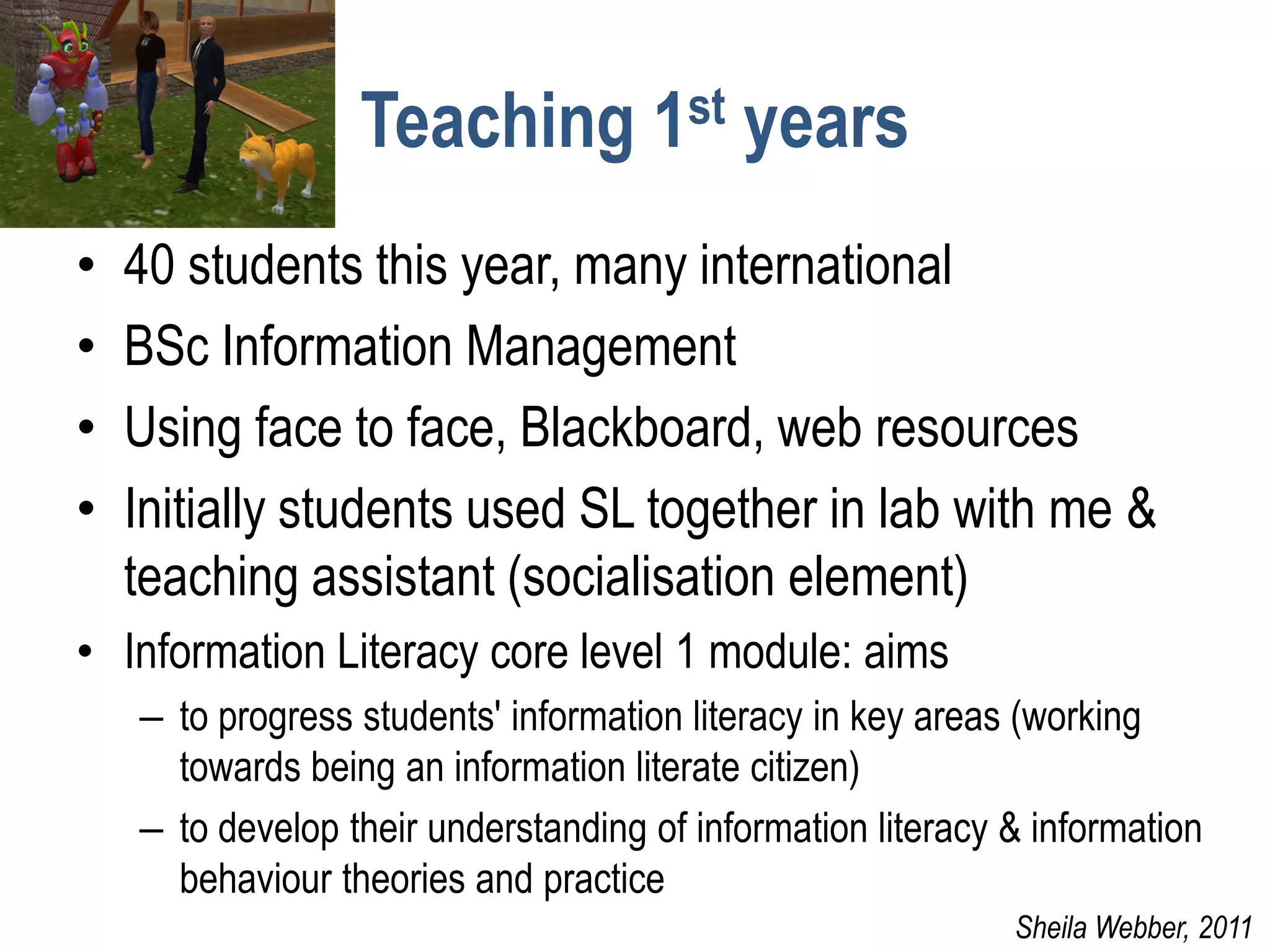
•   Initially students used SL together in lab with me &
    teaching assistant (socialisation element)
• Information Literacy core level 1 module: aims
    – to progress students' information literacy in key areas (working
      towards being an information literate citizen)
    – to develop their understanding of information literacy & information
      behaviour theories and practice
                                                             Sheila Webber, 2011
5th year I’ve done this exercise
• Webber, S. (2010) 3D virtual learning case study.
  University of South Australia.
  http://www.unisanet.unisa.edu.au/3DVLE/siteassets
  /docs/3DVirtual_Case_Study_BScIM.pdf
• Webber, S. (2010) “Investigating modes of student
  inquiry in Second Life as part of a blended
  approach.” International Journal of Virtual and
  Personal Learning Environments, 1 (3), 55-70.
• Some tweaks & changes each year

                                           Sheila Webber, 2011
Rationale for using SL
• 50% coursework: carrying out research interview in
  SL, analysing performance as interviewer +
  analysing transcript
• Access to wider population; internationalisation
• Prompts reflection and comparison with RL
• As information managers, relevant to learn virtual
  world communication skills
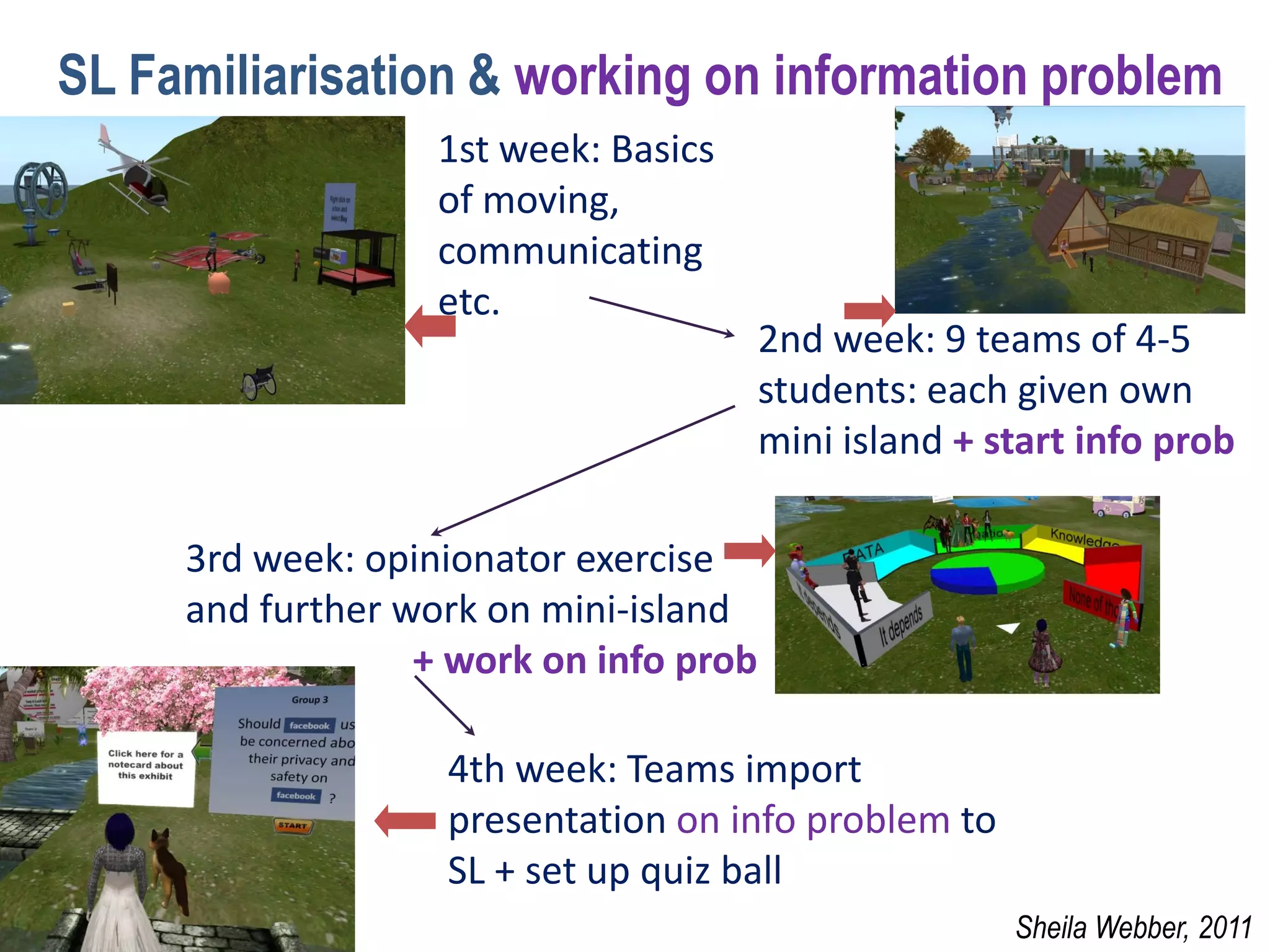
SL Familiarisation & working on information problem
                   1st week: Basics
                   of moving,
                   communicating
                   etc.
                                        2nd week: 9 teams of 4-5
                                        students: each given own
                                        mini island + start info prob

     3rd week: opinionator exercise
     and further work on mini-island
                  + work on info prob

                   4th week: Teams import
                   presentation on info problem to
                   SL + set up quiz ball
                                                       Sheila Webber, 2011
Information problems
• Is the “Google generation” really bad at searching
  for, and evaluating, information?
• How reliable is Wikipedia?
• Should Facebook users be concerned about their
  privacy and safety on Facebook?
• 9 student teams, 3 tackling each problem
• PPT identifies search process and their conclusions
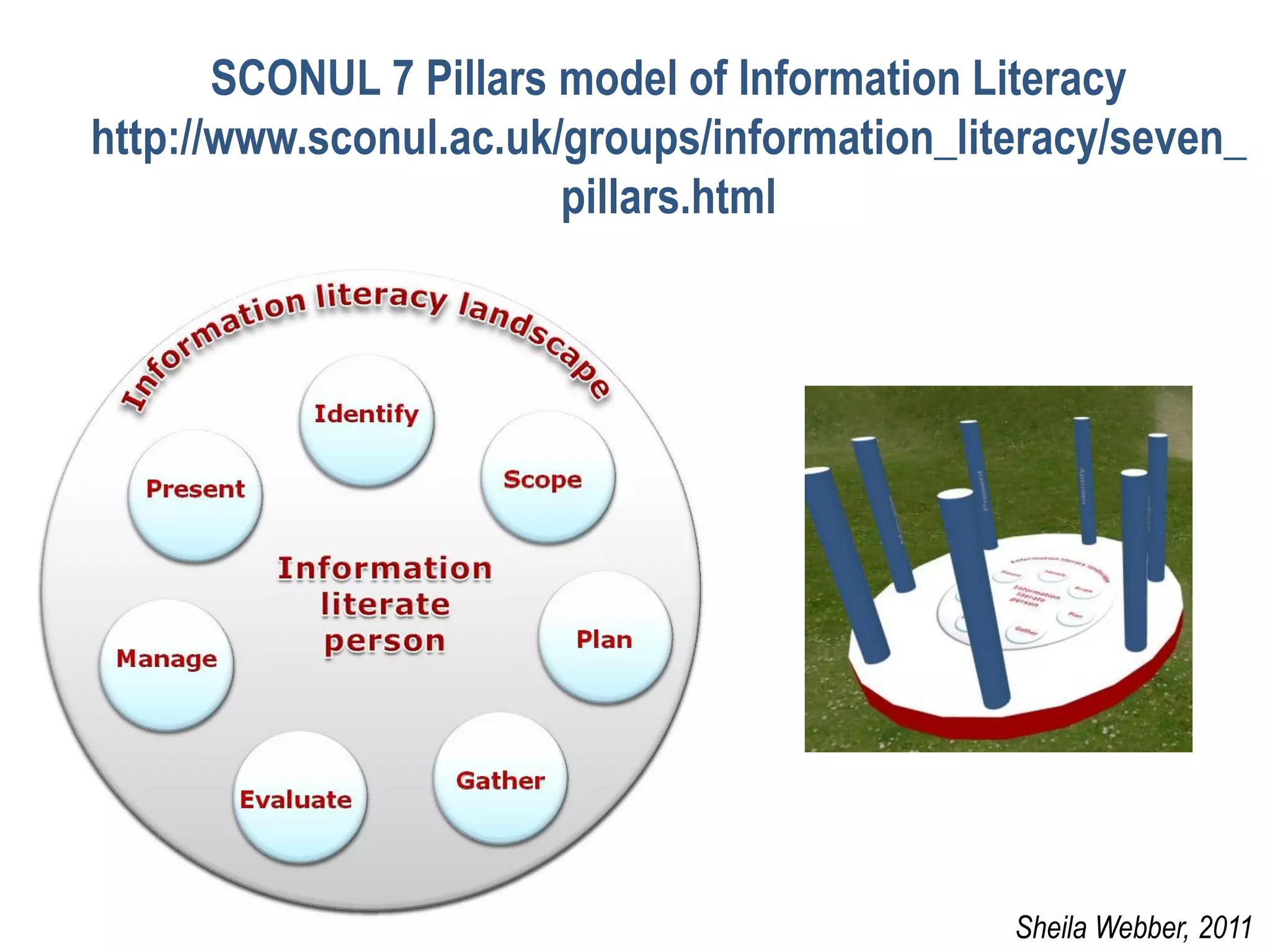
SCONUL 7 Pillars model of Information Literacy
http://www.sconul.ac.uk/groups/information_literacy/seven_
                        pillars.html


                                              Sheila Webber, 2011
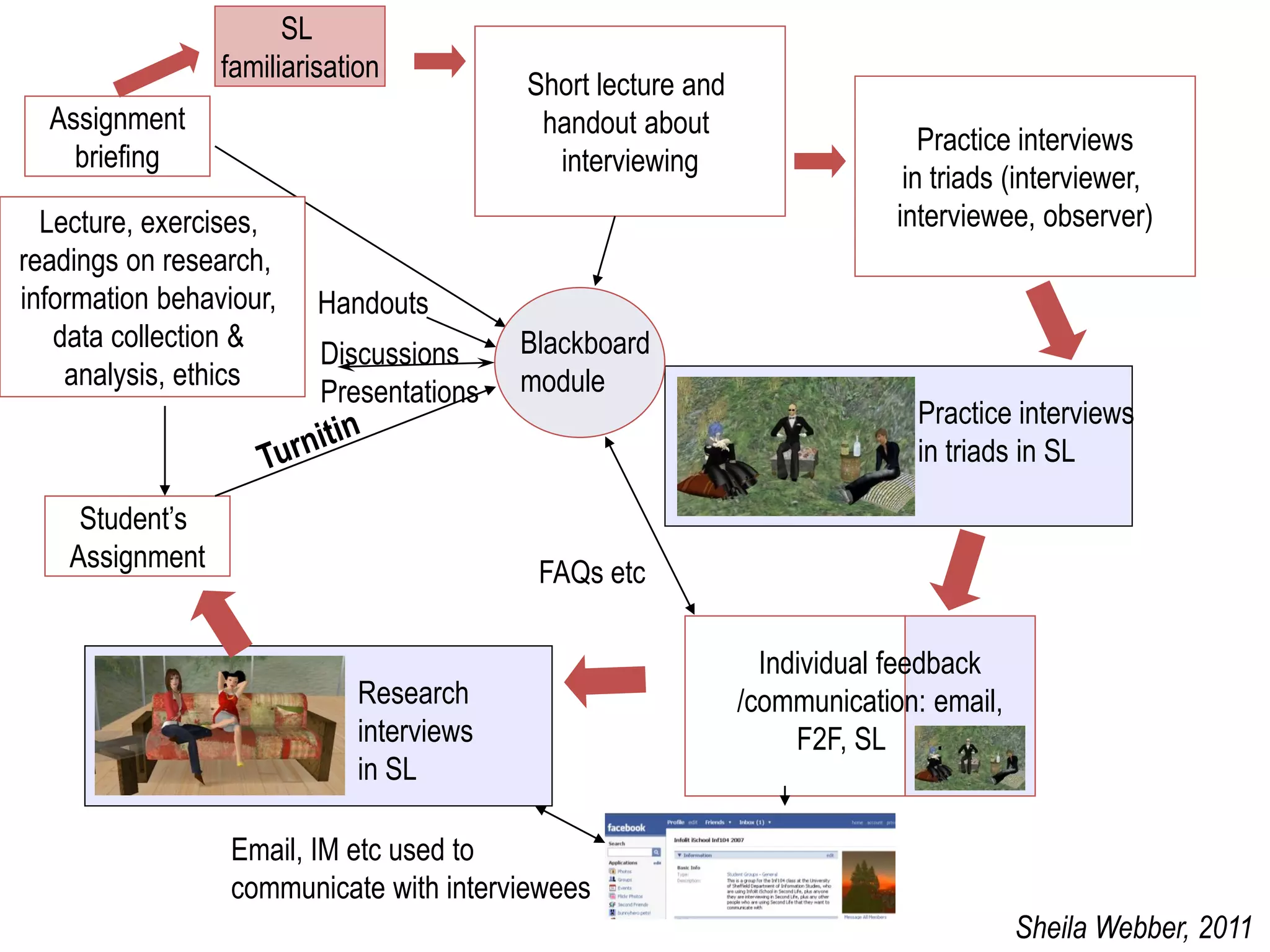
SL
                 familiarisation
                                          Short lecture and
  Assignment                               handout about
                                                                              Practice interviews
    briefing                                interviewing
                                                                            in triads (interviewer,
  Lecture, exercises,                                                      interviewee, observer)
readings on research,
information behaviour,    Handouts
   data collection &                      Blackboard
                          Discussions
    analysis, ethics                      module
                          Presentations
                                                                            Practice interviews
                                                                            in triads in SL

     Student’s
    Assignment                             FAQs etc

                                                                Individual feedback
                             Research                         /communication: email,
                             interviews                            F2F, SL      .
                             in SL

                  Email, IM etc used to
                  communicate with interviewees
                                                                                       Sheila Webber, 2011
10


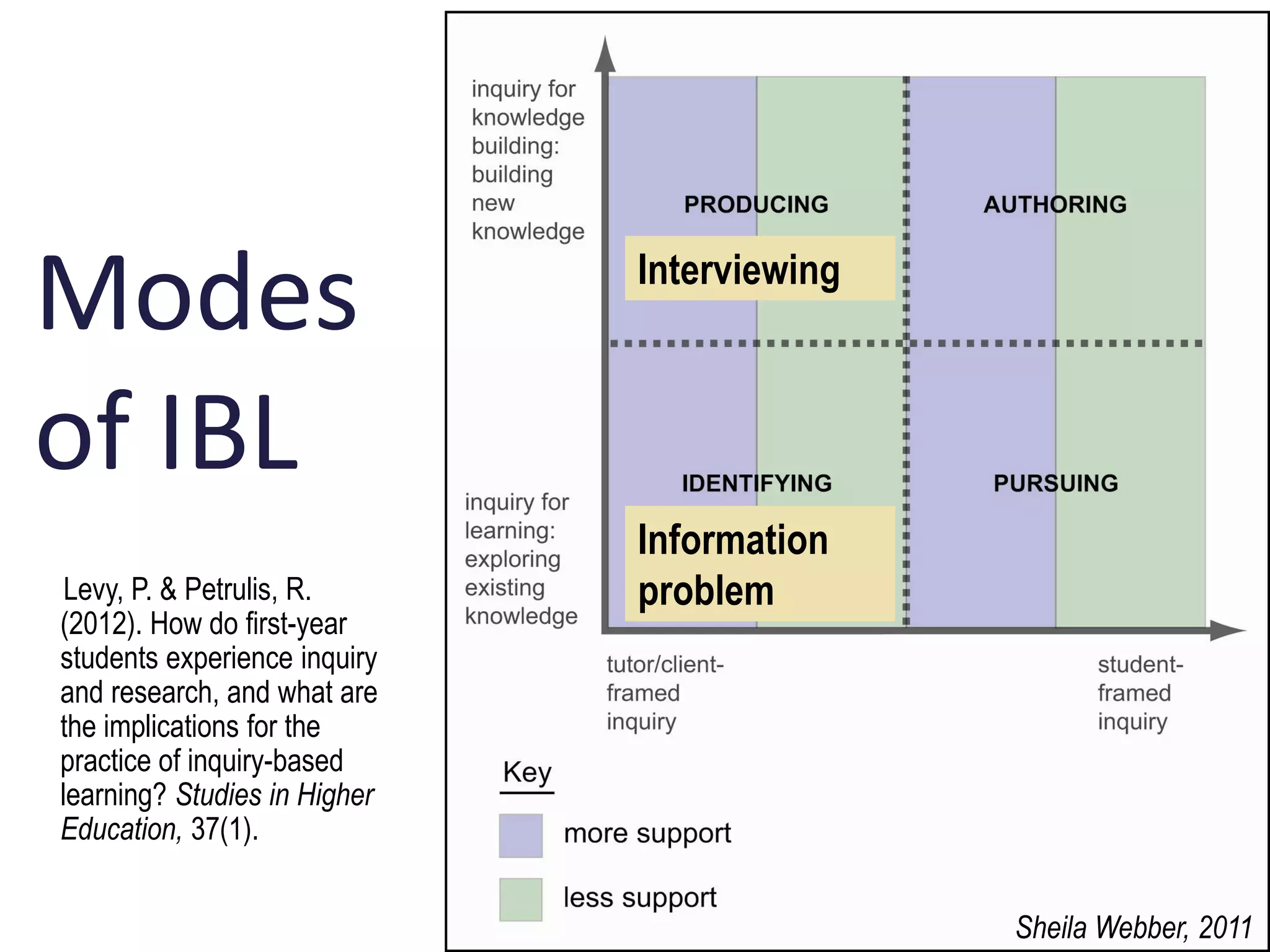
Modes                         Interviewing


of IBL
                              Information
 Levy, P. & Petrulis, R.      problem
(2012). How do first-year
students experience inquiry
and research, and what are
the implications for the
practice of inquiry-based
learning? Studies in Higher
Education, 37(1).


                                             Sheila Webber, 2011
http://information-literacy.blogspot.com/
                          http://www.slideshare.net/sheilawebber/
                          Flickr: http://www.flickr.com/photos/23396182@N00/
                          Netvibes: http://www.netvibes.com/sheilawebber


Sheila Webber
s.webber@shef.ac.uk
Twitter & SL: Sheila Yoshikawa
Off we go!

Inquiry Based Learning with first year undergraduates

  • 1.
    Inquiry Based Learningwith first year undergraduates Sheila Webber Information School, University of Sheffield October 2011
  • 2.
    Inquiry Based Learning(IBL) • A cluster of related pedagogies in which student inquiry or research drives the experience of learning and building knowledge (Philippa Levy) • Students: – investigate questions & problems that often are open-ended – apply the principles and practices of scholarship or research in their academic or professional area – explore a knowledge-base actively, critically and creatively – participate in building new meaning and knowledge Levy, P. et al (2010) Sheffield companion to Inquiry Based Learning. University of Sheffield. http://www.shef.ac.uk/ibl Sheila Webber, 2011
  • 3.
    Teaching 1st years • 40 students this year, many international • BSc Information Management • Using face to face, Blackboard, web resources • Initially students used SL together in lab with me & teaching assistant (socialisation element) • Information Literacy core level 1 module: aims – to progress students' information literacy in key areas (working towards being an information literate citizen) – to develop their understanding of information literacy & information behaviour theories and practice Sheila Webber, 2011
  • 4.
    5th year I’vedone this exercise • Webber, S. (2010) 3D virtual learning case study. University of South Australia. http://www.unisanet.unisa.edu.au/3DVLE/siteassets /docs/3DVirtual_Case_Study_BScIM.pdf • Webber, S. (2010) “Investigating modes of student inquiry in Second Life as part of a blended approach.” International Journal of Virtual and Personal Learning Environments, 1 (3), 55-70. • Some tweaks & changes each year Sheila Webber, 2011
  • 5.
    Rationale for usingSL • 50% coursework: carrying out research interview in SL, analysing performance as interviewer + analysing transcript • Access to wider population; internationalisation • Prompts reflection and comparison with RL • As information managers, relevant to learn virtual world communication skills
  • 6.
    SL Familiarisation &working on information problem 1st week: Basics of moving, communicating etc. 2nd week: 9 teams of 4-5 students: each given own mini island + start info prob 3rd week: opinionator exercise and further work on mini-island + work on info prob 4th week: Teams import presentation on info problem to SL + set up quiz ball Sheila Webber, 2011
  • 7.
    Information problems • Isthe “Google generation” really bad at searching for, and evaluating, information? • How reliable is Wikipedia? • Should Facebook users be concerned about their privacy and safety on Facebook? • 9 student teams, 3 tackling each problem • PPT identifies search process and their conclusions
  • 8.
    SCONUL 7 Pillarsmodel of Information Literacy http://www.sconul.ac.uk/groups/information_literacy/seven_ pillars.html Sheila Webber, 2011
  • 9.
    SL familiarisation Short lecture and Assignment handout about Practice interviews briefing interviewing in triads (interviewer, Lecture, exercises, interviewee, observer) readings on research, information behaviour, Handouts data collection & Blackboard Discussions analysis, ethics module Presentations Practice interviews in triads in SL Student’s Assignment FAQs etc Individual feedback Research /communication: email, interviews F2F, SL . in SL Email, IM etc used to communicate with interviewees Sheila Webber, 2011
  • 10.
    10 Modes Interviewing of IBL Information Levy, P. & Petrulis, R. problem (2012). How do first-year students experience inquiry and research, and what are the implications for the practice of inquiry-based learning? Studies in Higher Education, 37(1). Sheila Webber, 2011
  • 11.
    http://information-literacy.blogspot.com/ http://www.slideshare.net/sheilawebber/ Flickr: http://www.flickr.com/photos/23396182@N00/ Netvibes: http://www.netvibes.com/sheilawebber Sheila Webber s.webber@shef.ac.uk Twitter & SL: Sheila Yoshikawa
  • 12.