NEC 3: Introduction
www.QuiggGolden.com
Introduction
• The rudiments of NEC
• New (No, really quite mature)
• Engineering (No, anything really)
• Contract (No, a contracting system)
www.QuiggGolden.com
A Brief History of NEC
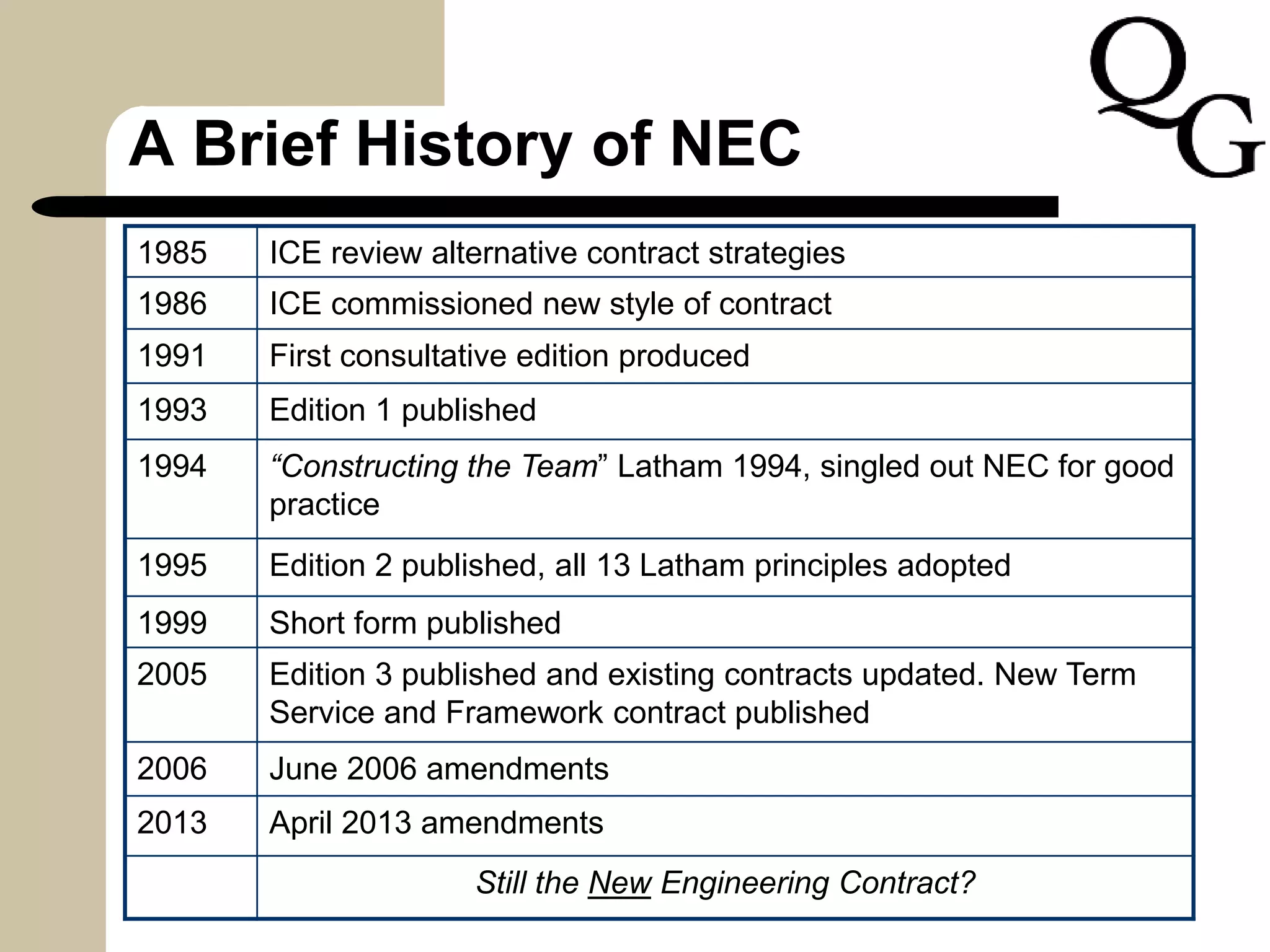
1985 ICE review alternative contract strategies
1986 ICE commissioned new style of contract
1991 First consultative edition produced
1993 Edition 1 published
1994 “Constructing the Team” Latham 1994, singled out NEC for good
practice
1995 Edition 2 published, all 13 Latham principles adopted
1999 Short form published
2005 Edition 3 published and existing contracts updated. New Term
Service and Framework contract published
2006 June 2006 amendments
2013 April 2013 amendments
Still the New Engineering Contract?
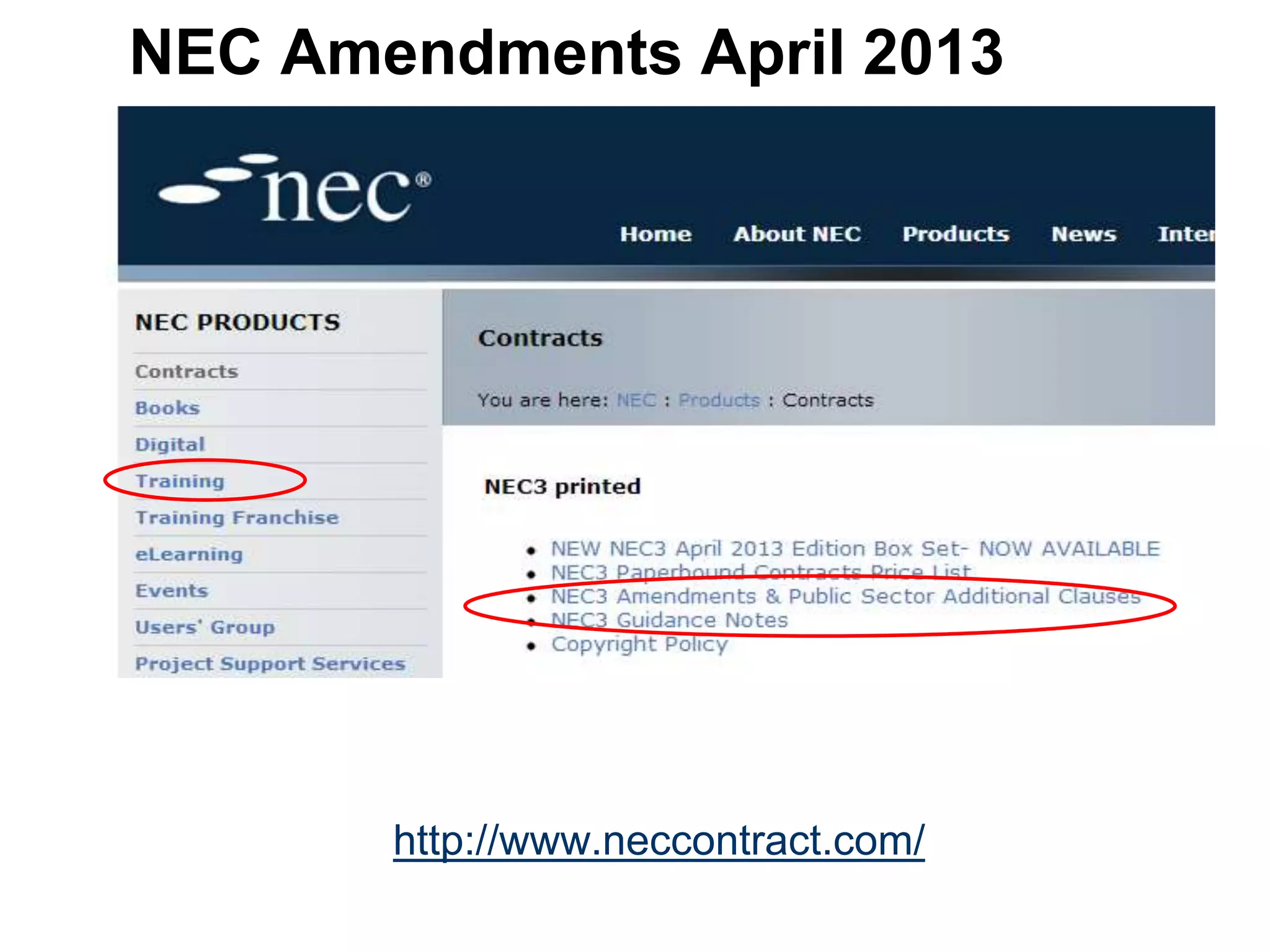
NEC Amendments April 2013
http://www.neccontract.com/
Why the NEC?
• Constructing the Team - Sir Michael Latham
1994
• Rethinking Construction – Sir John Egan
1998
• Achieving Excellence – OGC 2003
• HM Treasury
www.QuiggGolden.com
Basic Characteristics of NEC
• Contractor lead
• Mutual trust and co-operation (edition 2 onwards)
• Good management encouraged (not just rights and obligations)
• Procedure driven
• Programme given HUGE prominence
• Recognising risk and dealing with it as you go rather than
allocating blame afterwards
• Clear and distinct roles for those involved
• Minimises subjective phrases such as fair, reasonable, opinion
www.QuiggGolden.com
Basic Characteristics of NEC
• Modular approach
• Interlocking contracts e.g. Subcontract, PSC, Adjudicator
• Logical contracts (can be described in flow charts)
• Written in simple English (and in the present tense)
• Certainty of actions and outcome
• Flexible approach allows use in multi discipline projects
and a wide range of projects
• Can be used internationally
www.QuiggGolden.com
Using the NEC
• Works well where used properly
• Allows great flexibility in public and private
sectors
• Easy to apportion design responsibility
• Use the main options to decide big issues
such as pricing options
• Tailor with secondary options
www.QuiggGolden.com
The Present Family of NEC Contracts
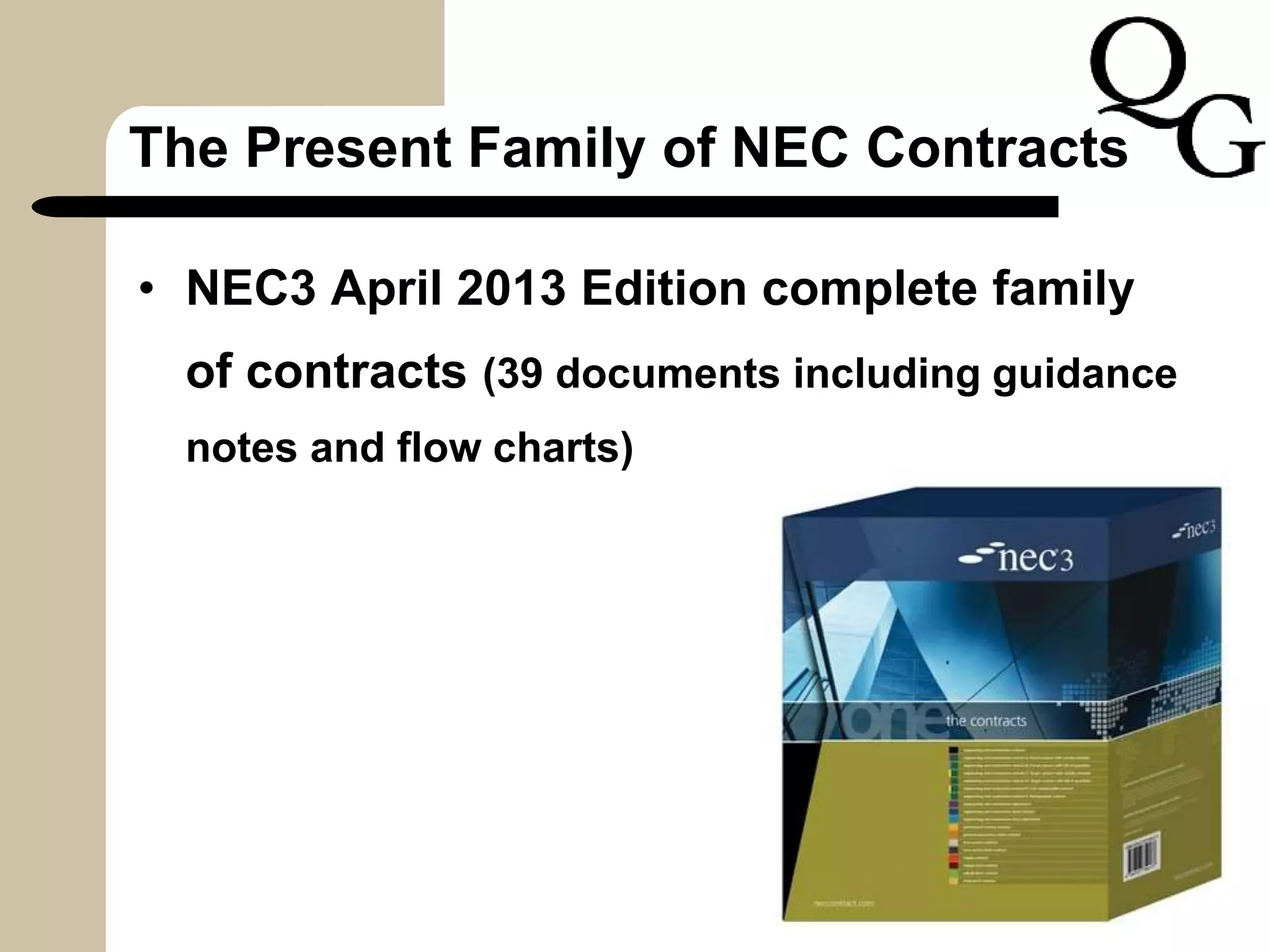
• NEC3 April 2013 Edition complete family
of contracts (39 documents including guidance
notes and flow charts)
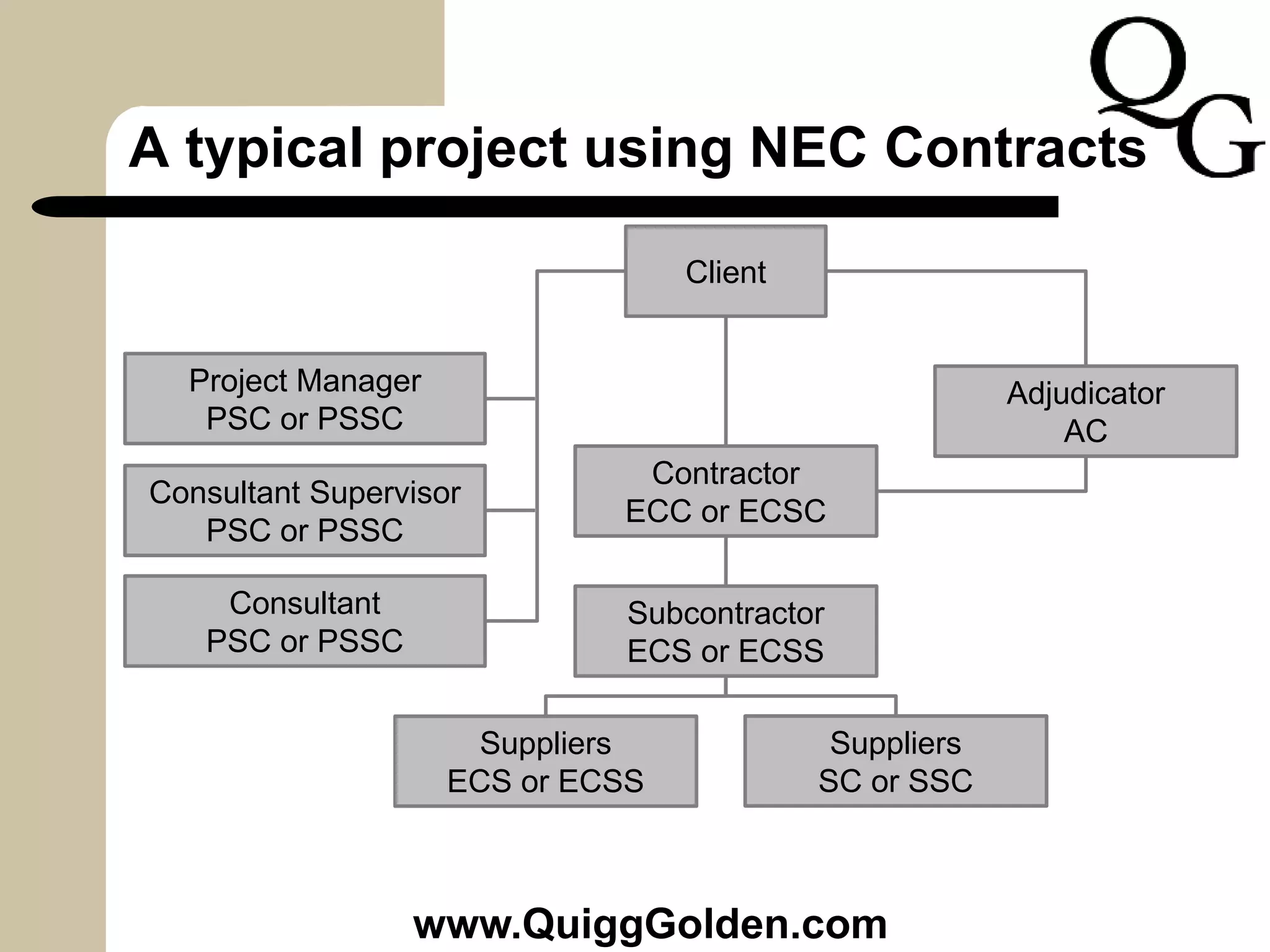
A typical project using NEC Contracts
Client
Project Manager
PSC or PSSC
Consultant Supervisor
PSC or PSSC
Contractor
ECC or ECSC
Subcontractor
ECS or ECSS
Suppliers
ECS or ECSS
Suppliers
SC or SSC
Consultant
PSC or PSSC
Adjudicator
AC
www.QuiggGolden.com
NEC 3:
Main and Secondary Options
and Alternatives
www.QuiggGolden.com
Introduction
• Strategy for choosing the correct contract
• 6 Main Options
• Secondary Option Clauses (X, Y & W)
www.QuiggGolden.com
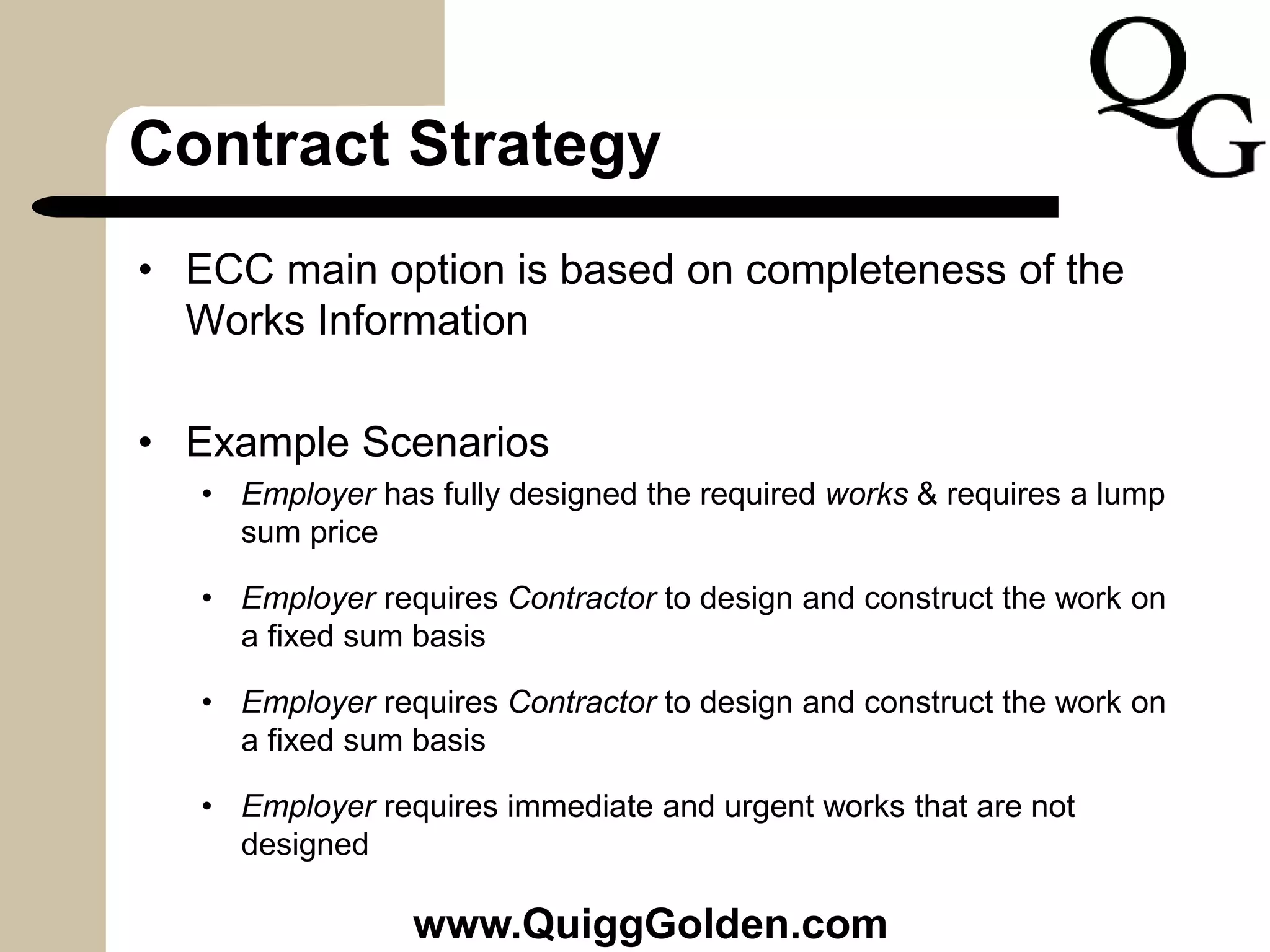
Contract Strategy
• ECC main option is based on completeness of the
Works Information
• Example Scenarios
• Employer has fully designed the required works & requires a lump
sum price
• Employer requires Contractor to design and construct the work on
a fixed sum basis
• Employer requires Contractor to design and construct the work on
a fixed sum basis
• Employer requires immediate and urgent works that are not
designed
www.QuiggGolden.com
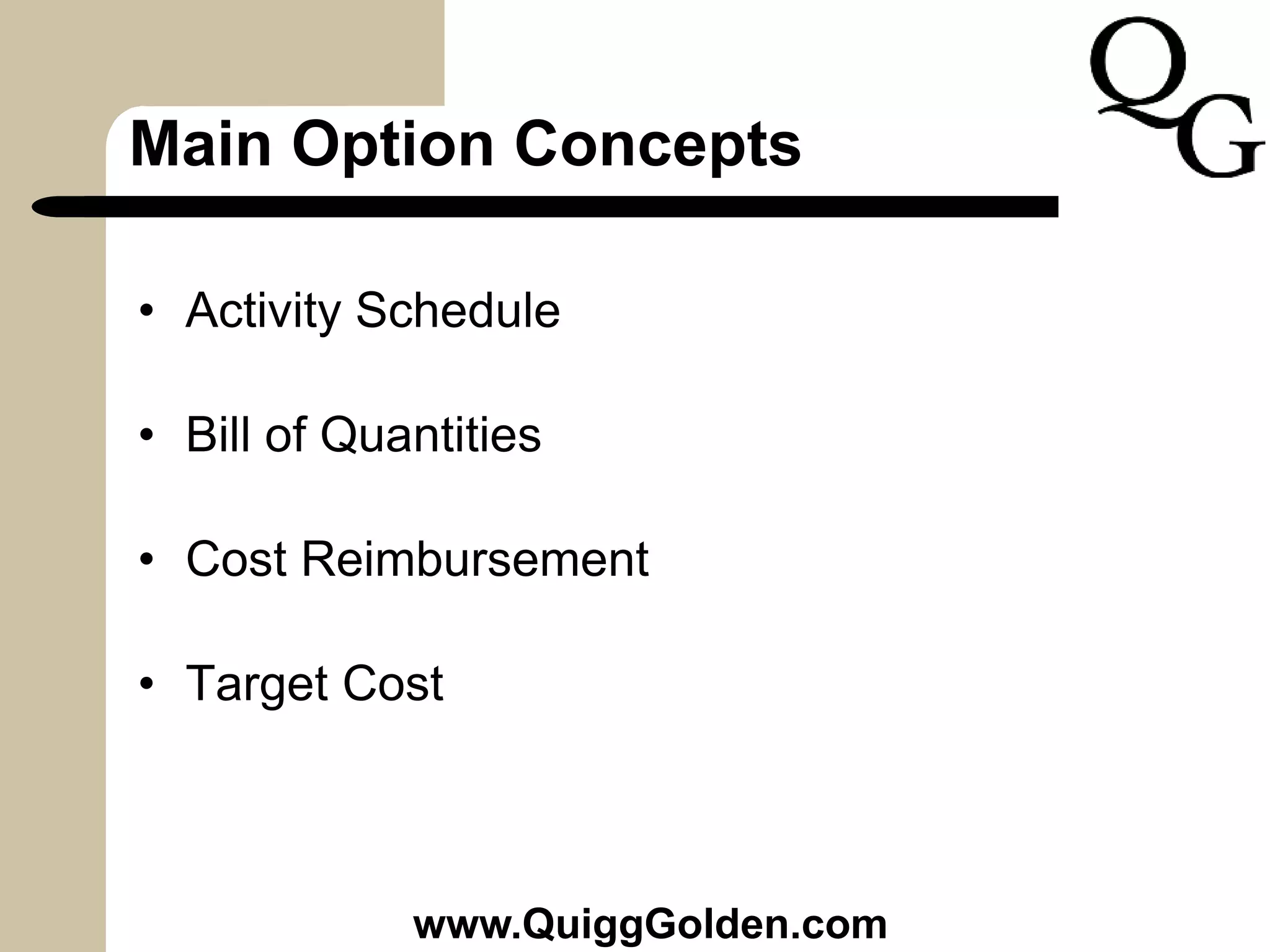
Main Option Concepts
• Activity Schedule
• Bill of Quantities
• Cost Reimbursement
• Target Cost
www.QuiggGolden.com
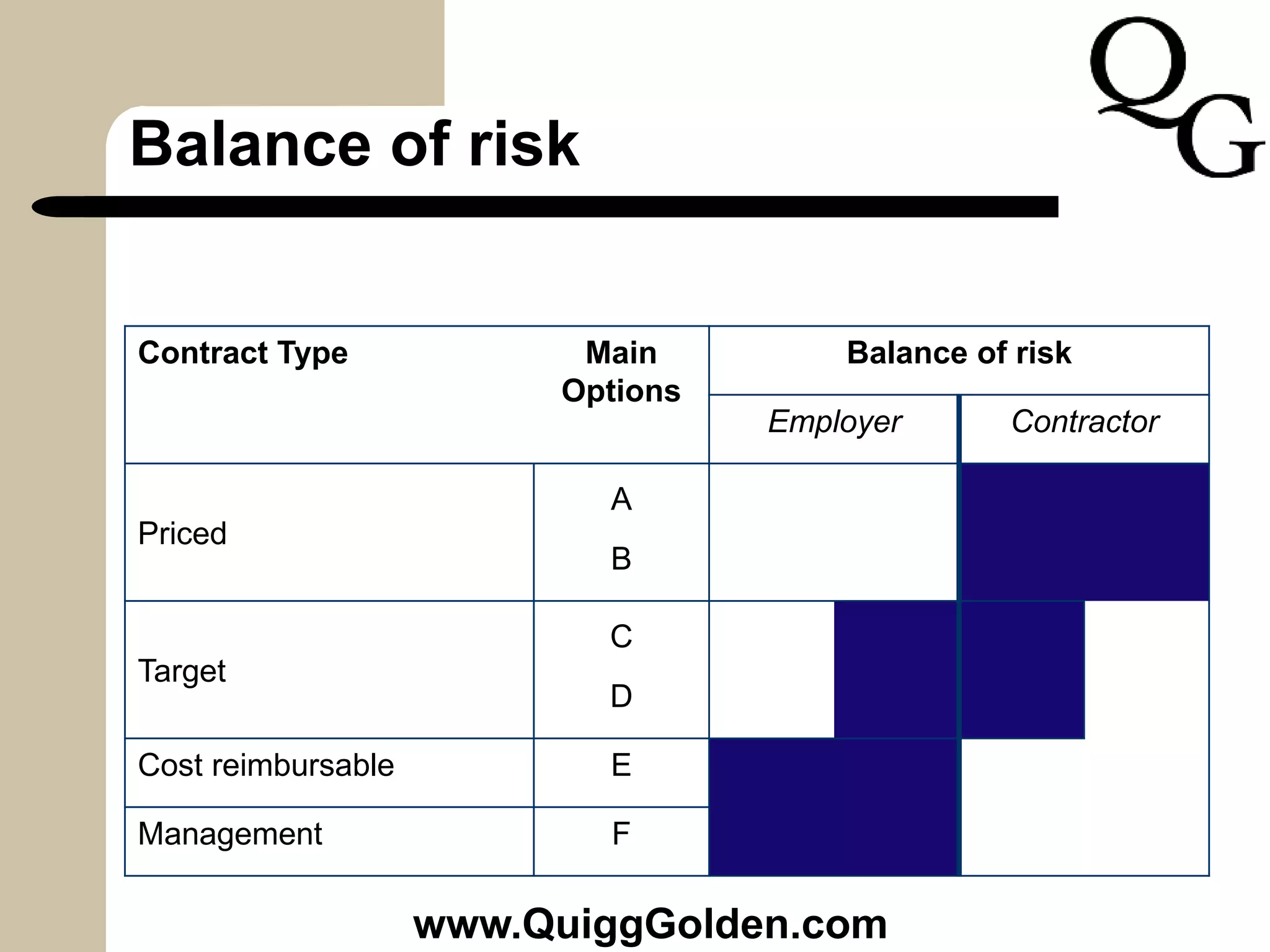
Balance of risk
Contract Type Main
Options
Balance of risk
Employer Contractor
Priced
A
B
Target
C
D
Cost reimbursable E
Management F
www.QuiggGolden.com
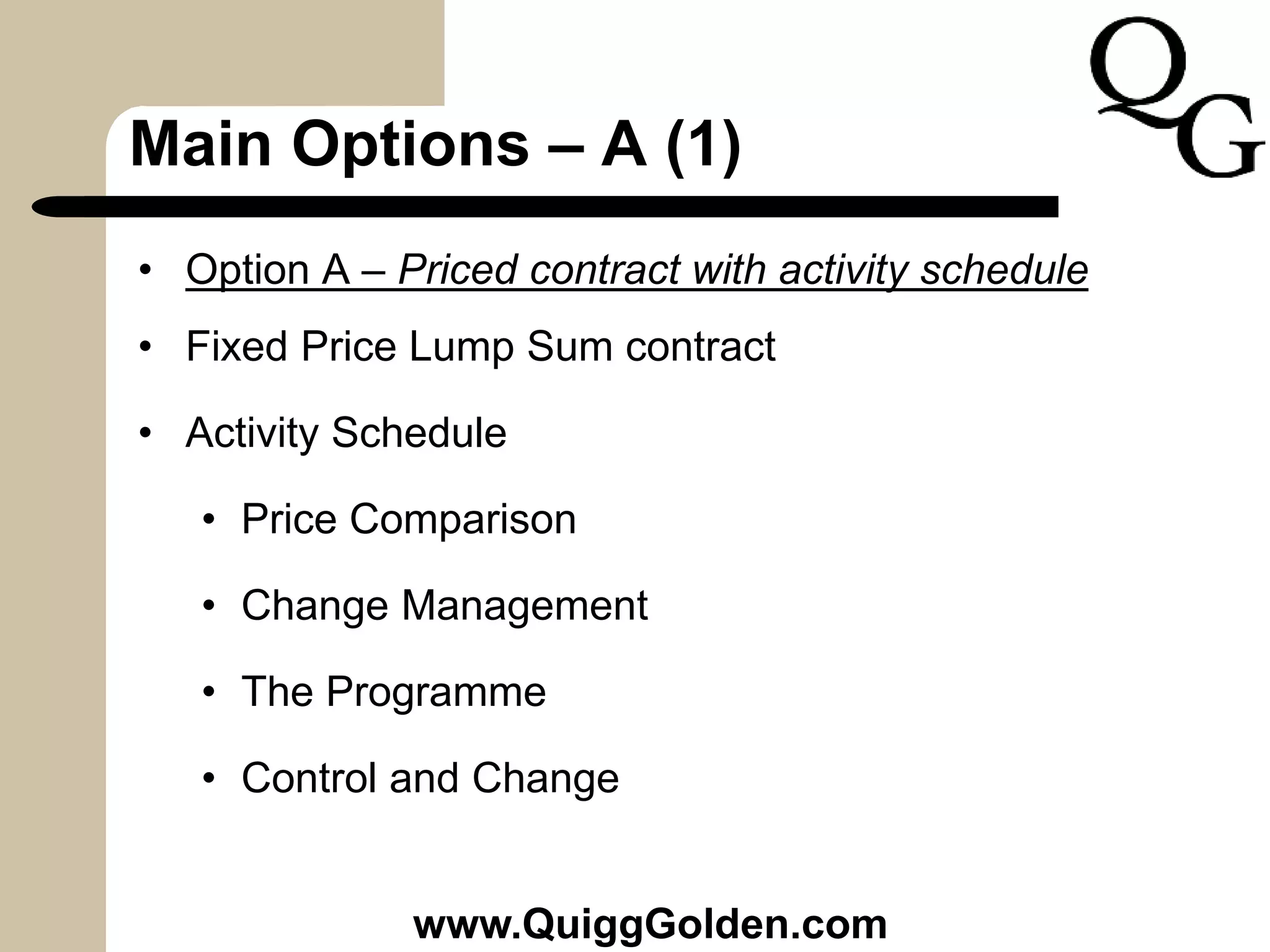
Main Options – A (1)
• Option A – Priced contract with activity schedule
• Fixed Price Lump Sum contract
• Activity Schedule
• Price Comparison
• Change Management
• The Programme
• Control and Change
www.QuiggGolden.com
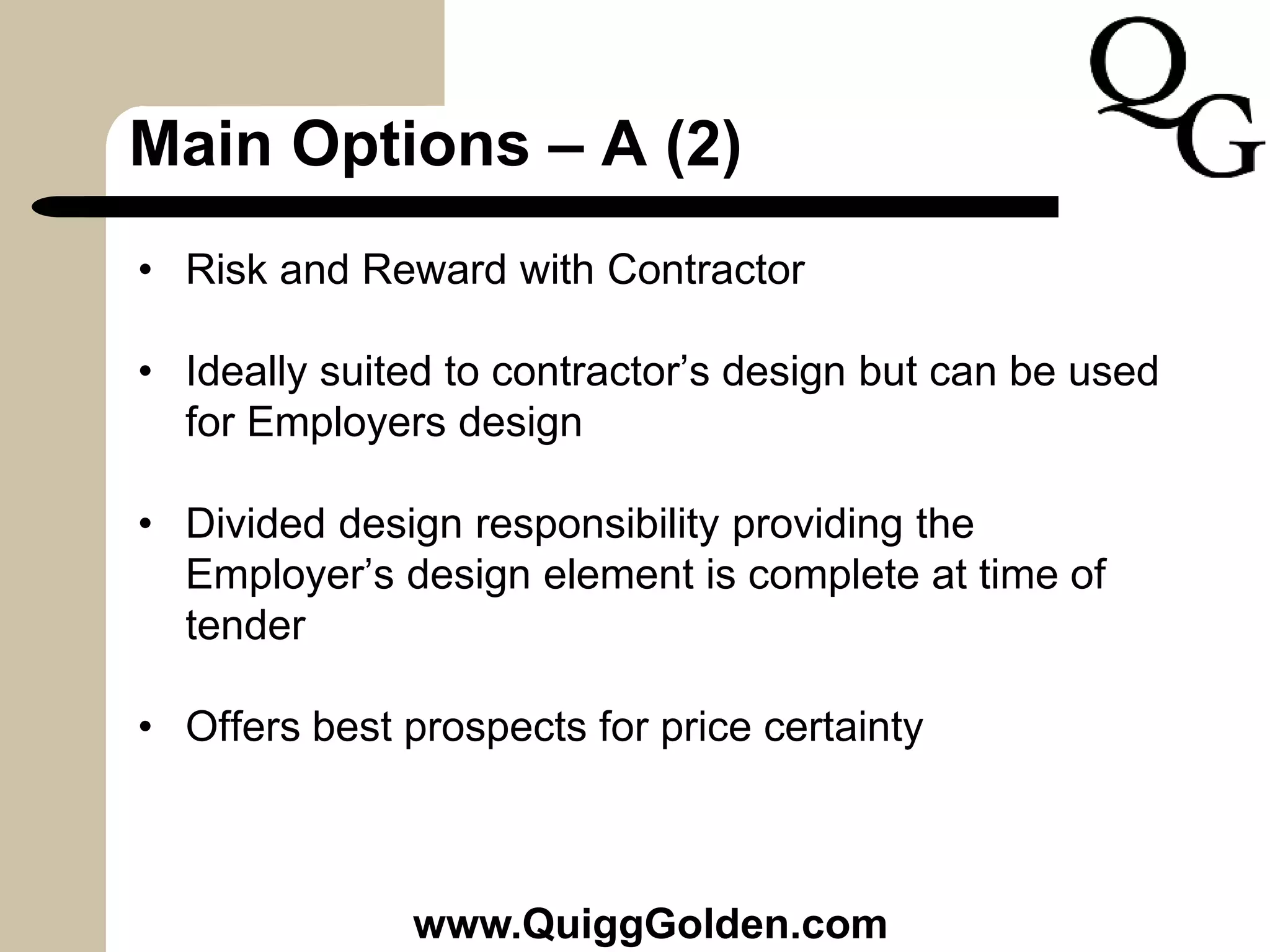
Main Options – A (2)
• Risk and Reward with Contractor
• Ideally suited to contractor’s design but can be used
for Employers design
• Divided design responsibility providing the
Employer’s design element is complete at time of
tender
• Offers best prospects for price certainty
www.QuiggGolden.com
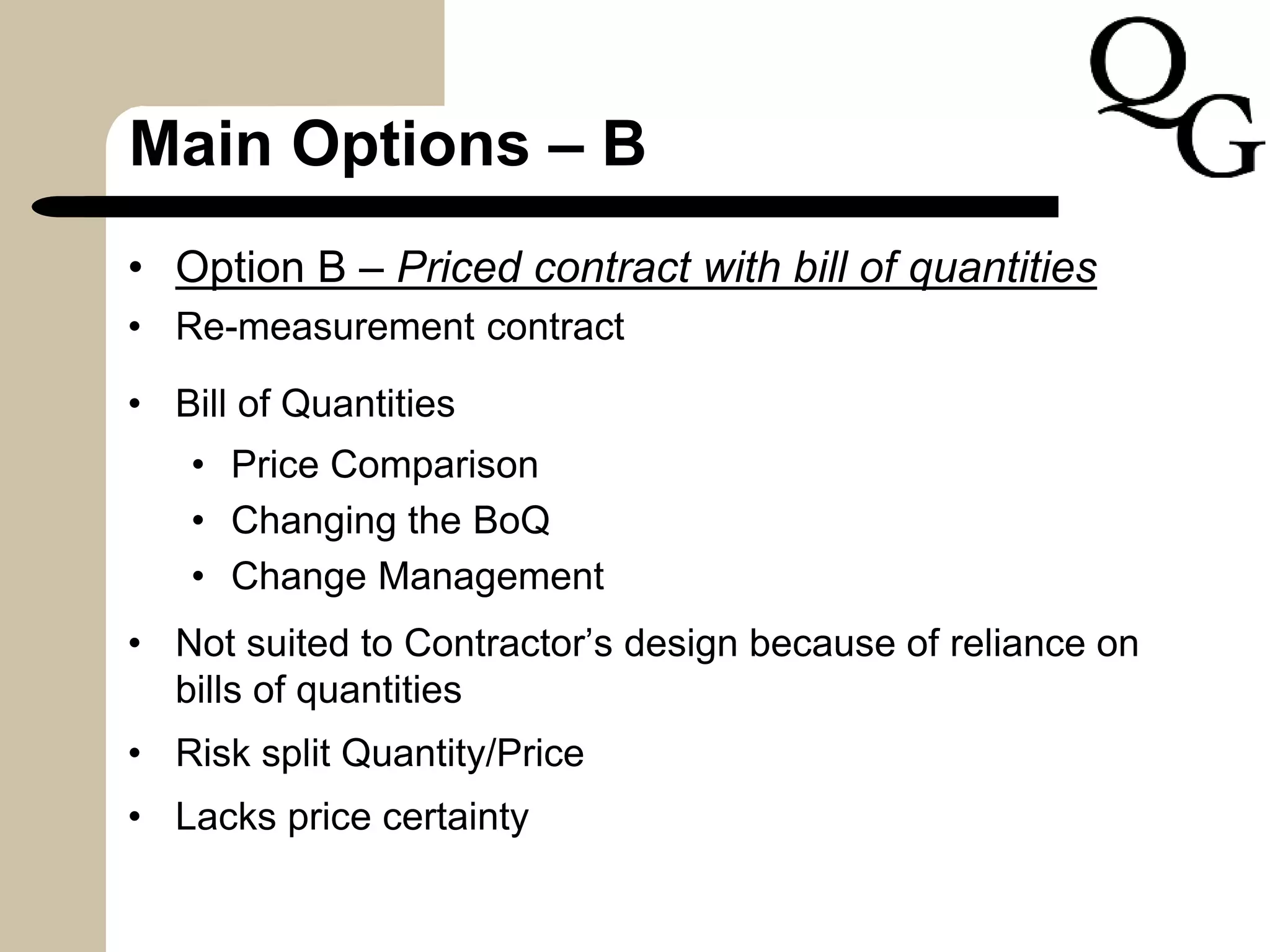
Main Options – B
• Option B – Priced contract with bill of quantities
• Re-measurement contract
• Bill of Quantities
• Price Comparison
• Changing the BoQ
• Change Management
• Not suited to Contractor’s design because of reliance on
bills of quantities
• Risk split Quantity/Price
• Lacks price certainty
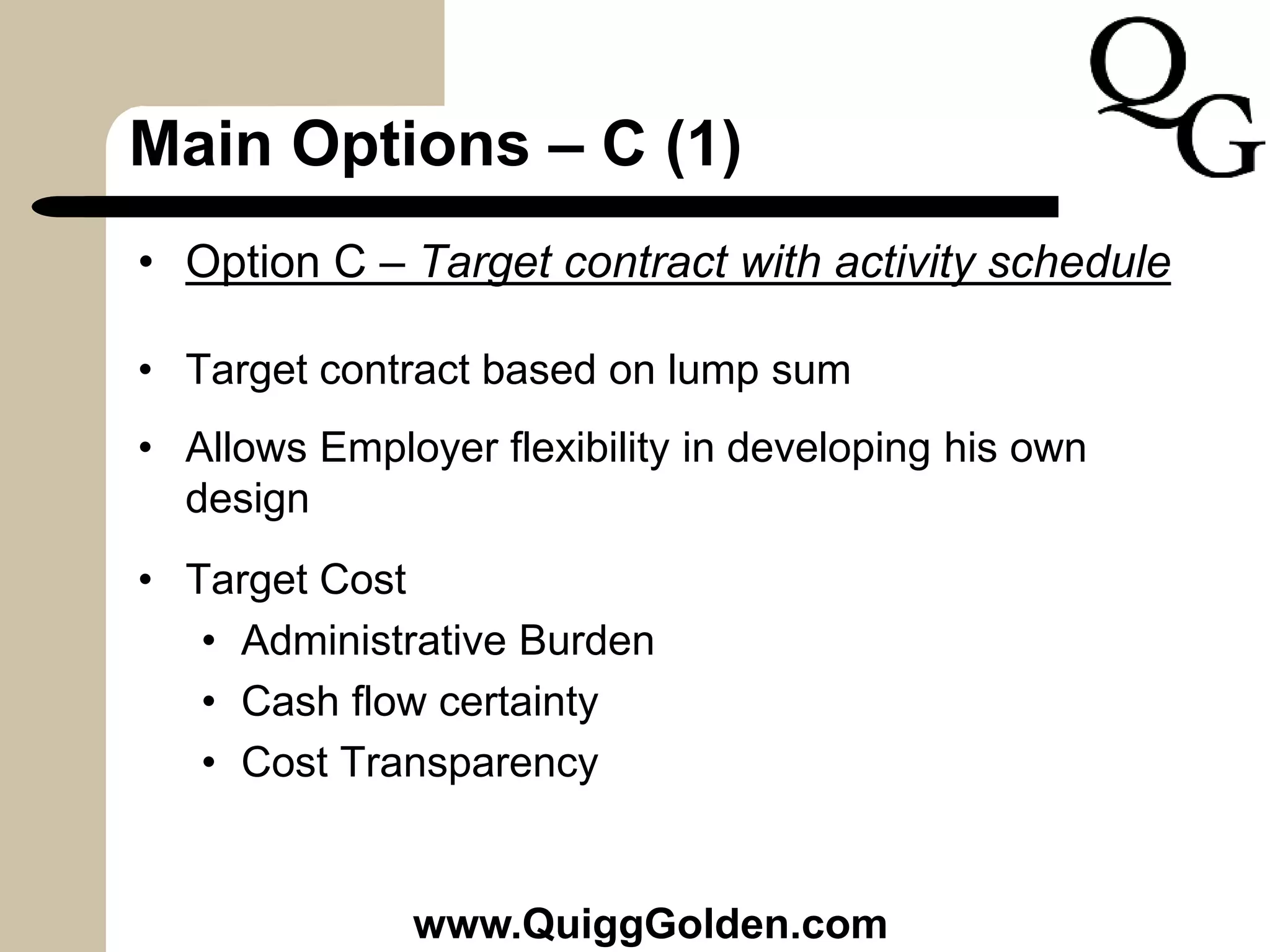
Main Options – C (1)
• Option C – Target contract with activity schedule
• Target contract based on lump sum
• Allows Employer flexibility in developing his own
design
• Target Cost
• Administrative Burden
• Cash flow certainty
• Cost Transparency
www.QuiggGolden.com
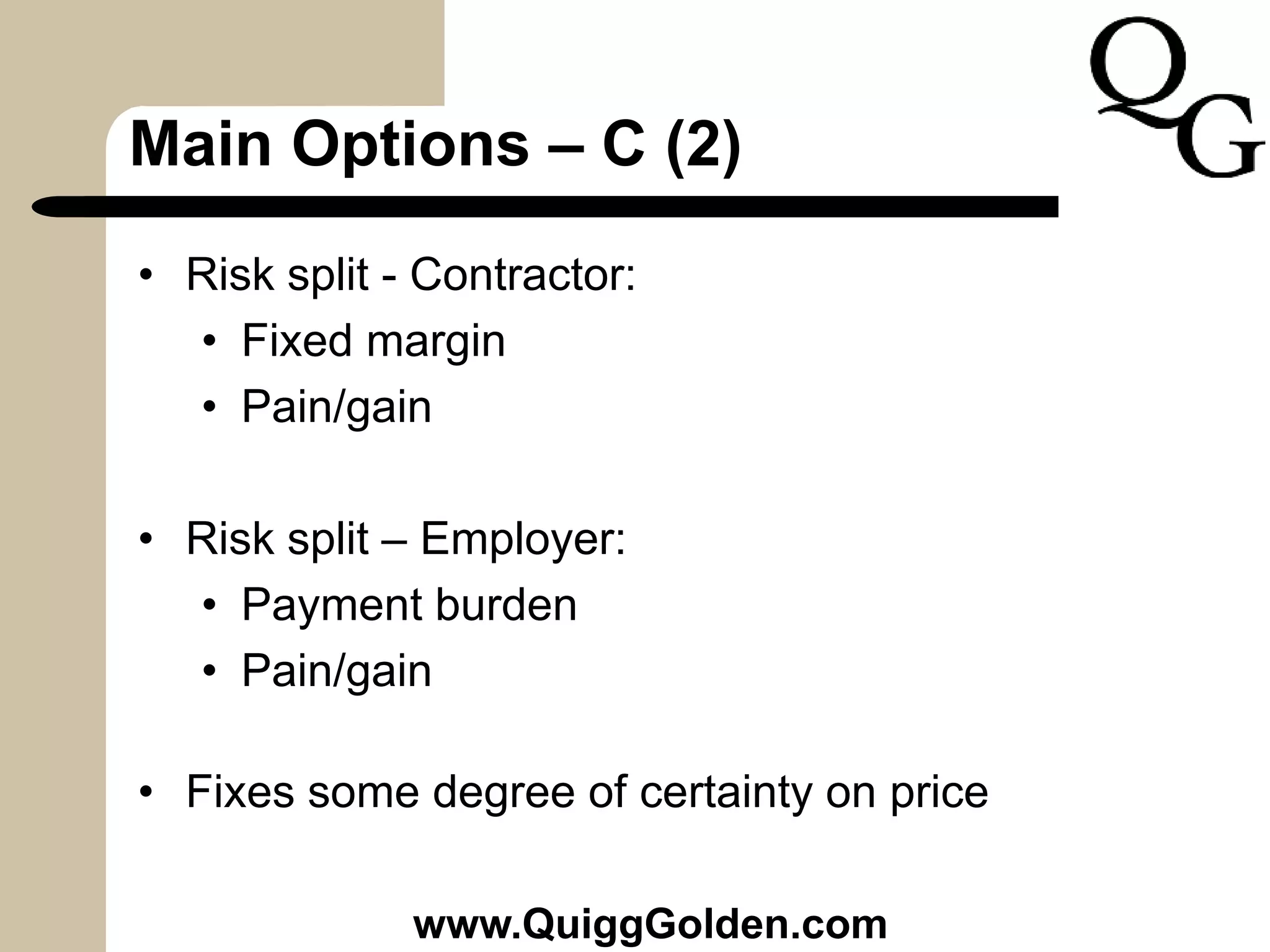
Main Options – C (2)
• Risk split - Contractor:
• Fixed margin
• Pain/gain
• Risk split – Employer:
• Payment burden
• Pain/gain
• Fixes some degree of certainty on price
www.QuiggGolden.com
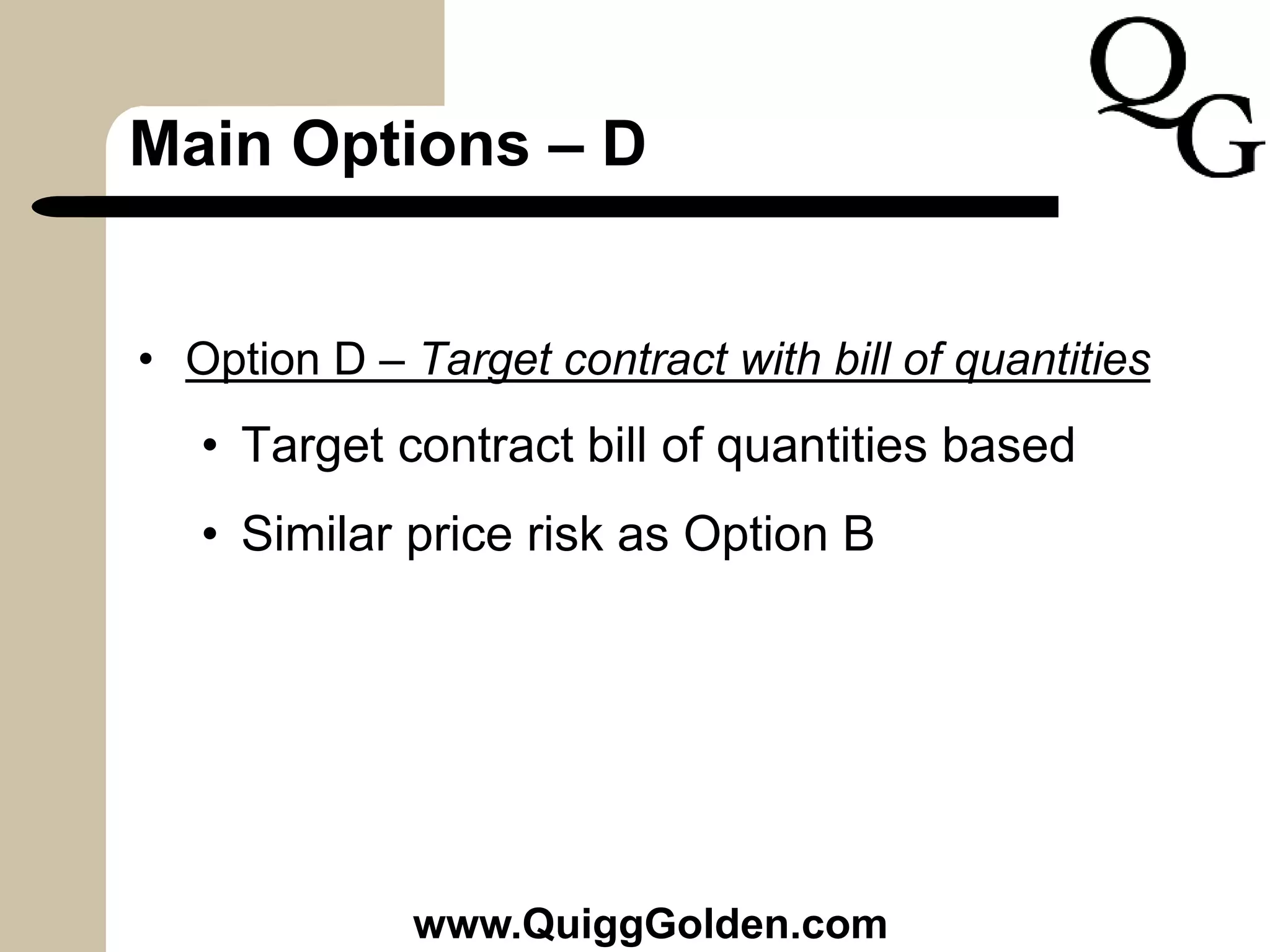
Main Options – D
• Option D – Target contract with bill of quantities
• Target contract bill of quantities based
• Similar price risk as Option B
www.QuiggGolden.com
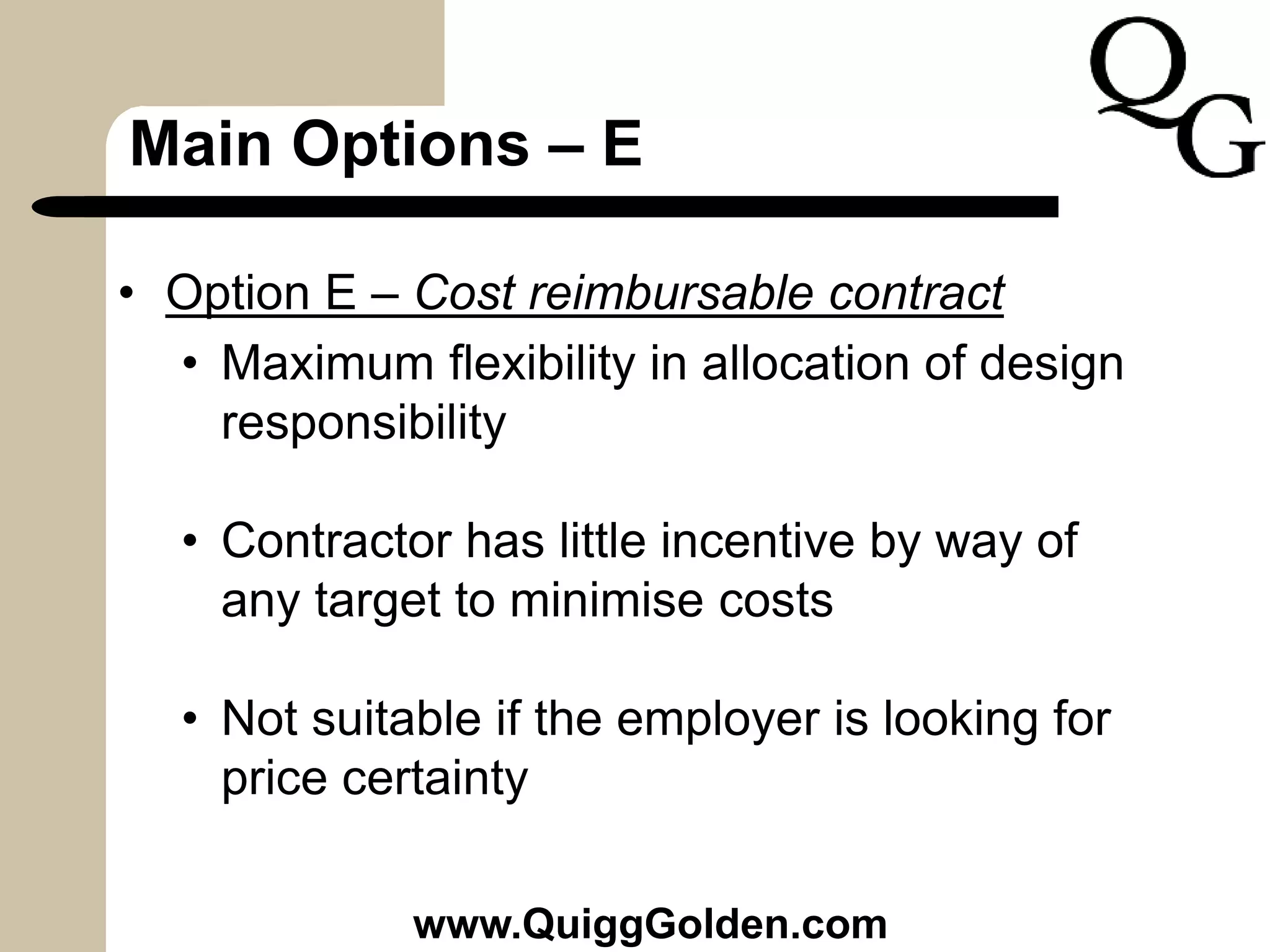
Main Options – E
• Option E – Cost reimbursable contract
• Maximum flexibility in allocation of design
responsibility
• Contractor has little incentive by way of
any target to minimise costs
• Not suitable if the employer is looking for
price certainty
www.QuiggGolden.com
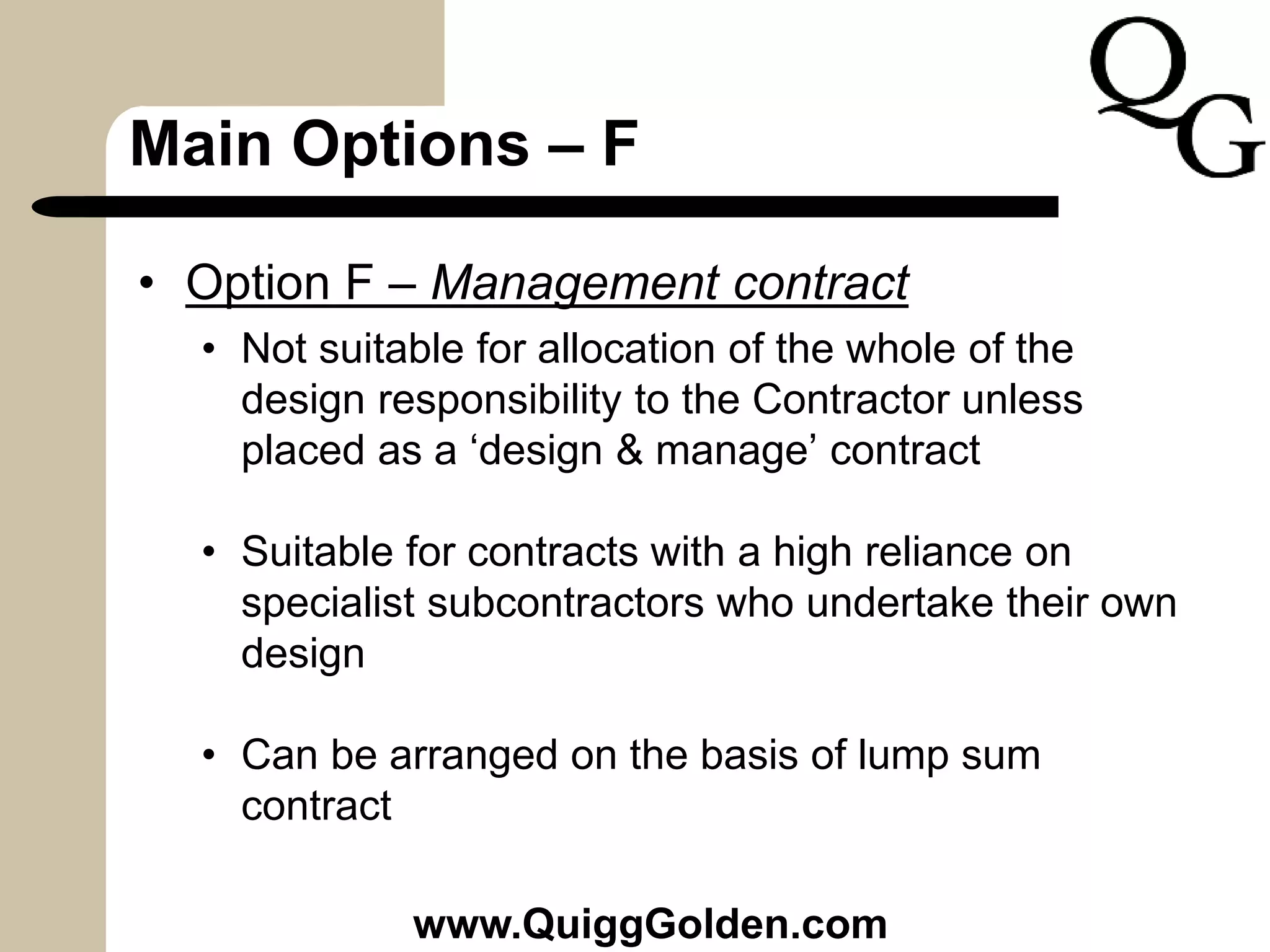
Main Options – F
• Option F – Management contract
• Not suitable for allocation of the whole of the
design responsibility to the Contractor unless
placed as a ‘design & manage’ contract
• Suitable for contracts with a high reliance on
specialist subcontractors who undertake their own
design
• Can be arranged on the basis of lump sum
contract
www.QuiggGolden.com
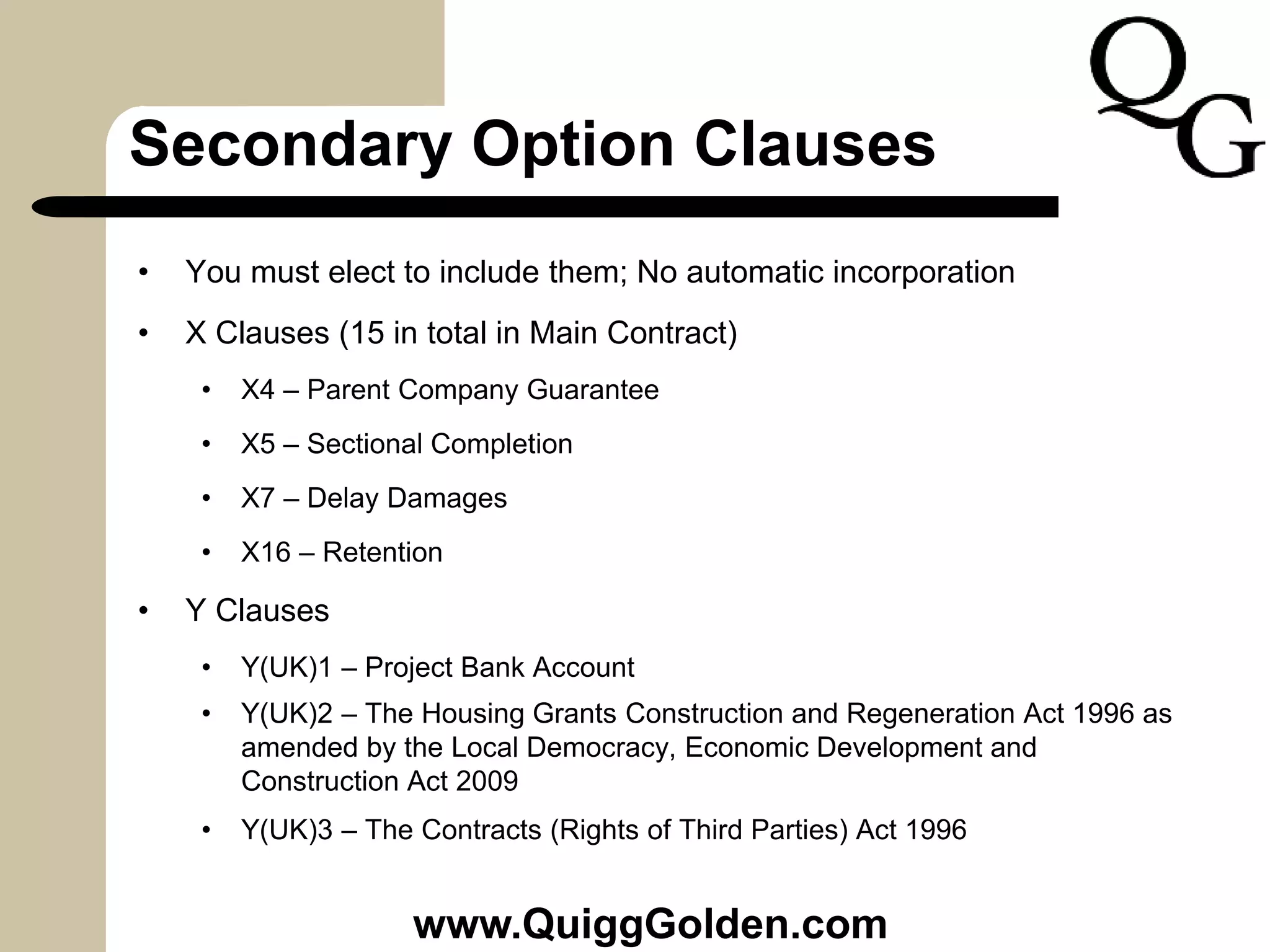
Secondary Option Clauses
• You must elect to include them; No automatic incorporation
• X Clauses (15 in total in Main Contract)
• X4 – Parent Company Guarantee
• X5 – Sectional Completion
• X7 – Delay Damages
• X16 – Retention
• Y Clauses
• Y(UK)1 – Project Bank Account
• Y(UK)2 – The Housing Grants Construction and Regeneration Act 1996 as
amended by the Local Democracy, Economic Development and
Construction Act 2009
• Y(UK)3 – The Contracts (Rights of Third Parties) Act 1996
www.QuiggGolden.com
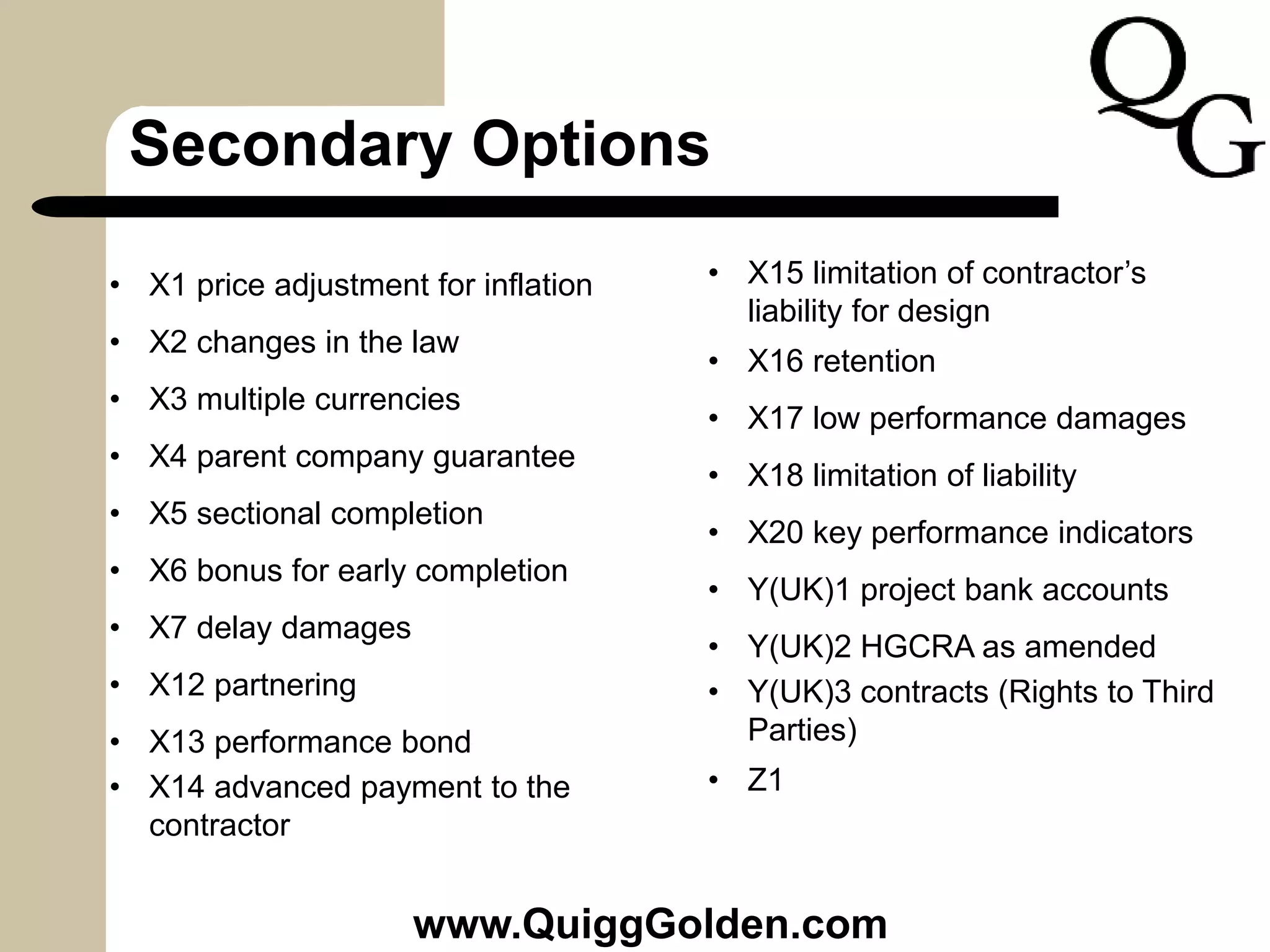
Secondary Options
• X1 price adjustment for inflation
• X2 changes in the law
• X3 multiple currencies
• X4 parent company guarantee
• X5 sectional completion
• X6 bonus for early completion
• X7 delay damages
• X12 partnering
• X13 performance bond
• X14 advanced payment to the
contractor
• X15 limitation of contractor’s
liability for design
• X16 retention
• X17 low performance damages
• X18 limitation of liability
• X20 key performance indicators
• Y(UK)1 project bank accounts
• Y(UK)2 HGCRA as amended
• Y(UK)3 contracts (Rights to Third
Parties)
• Z1
www.QuiggGolden.com
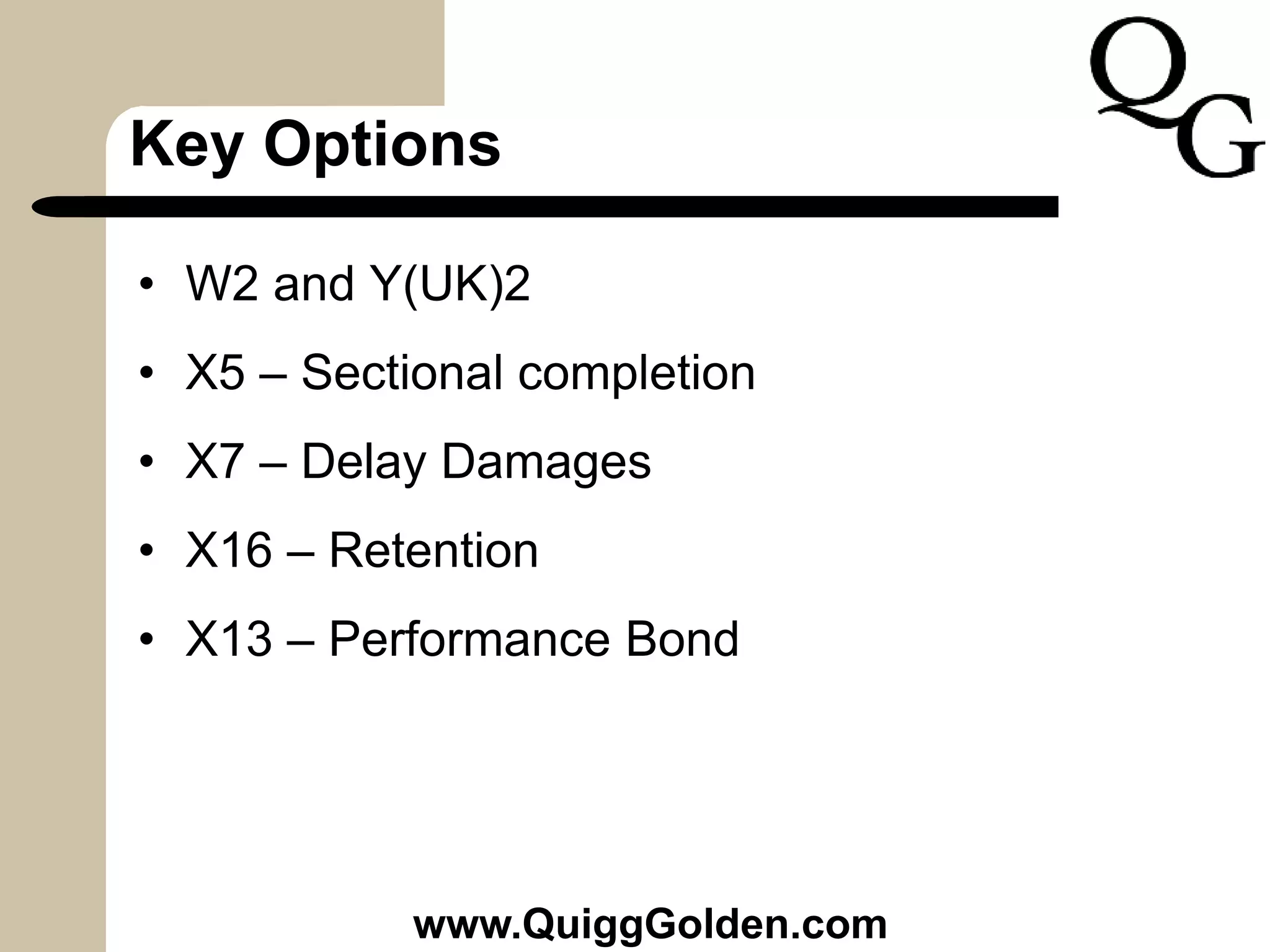
Key Options
• W2 and Y(UK)2
• X5 – Sectional completion
• X7 – Delay Damages
• X16 – Retention
• X13 – Performance Bond
www.QuiggGolden.com
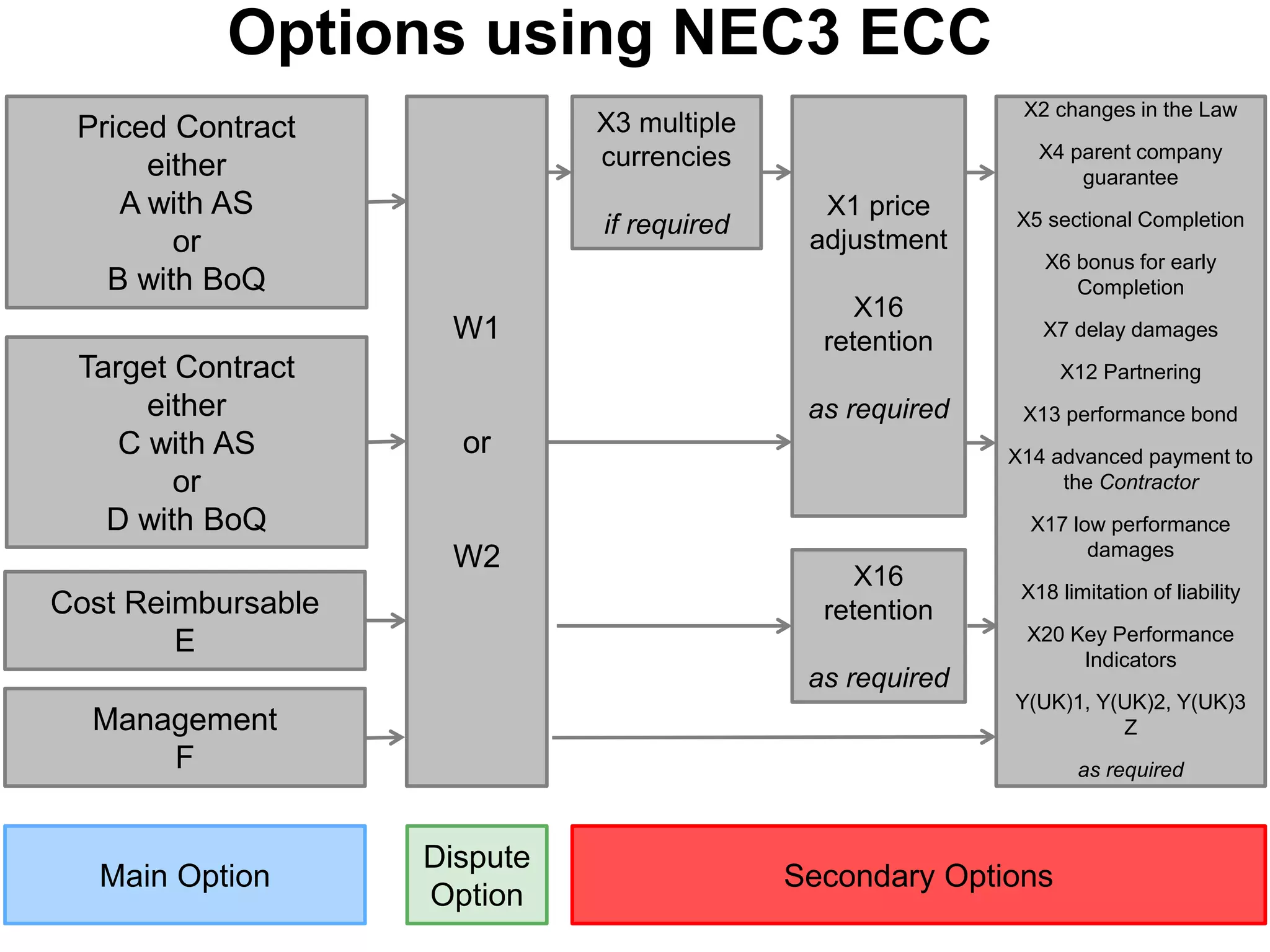
Options using NEC3 ECC
Priced Contract
either
A with AS
or
B with BoQ
Target Contract
either
C with AS
or
D with BoQ
Cost Reimbursable
E
Management
F
W1
or
W2
X3 multiple
currencies
if required
X1 price
adjustment
X16
retention
as required
X2 changes in the Law
X4 parent company
guarantee
X5 sectional Completion
X6 bonus for early
Completion
X7 delay damages
X12 Partnering
X13 performance bond
X14 advanced payment to
the Contractor
X17 low performance
damages
X18 limitation of liability
X20 Key Performance
Indicators
Y(UK)1, Y(UK)2, Y(UK)3
Z
as required
X16
retention
as required
Main Option
Dispute
Option
Secondary Options
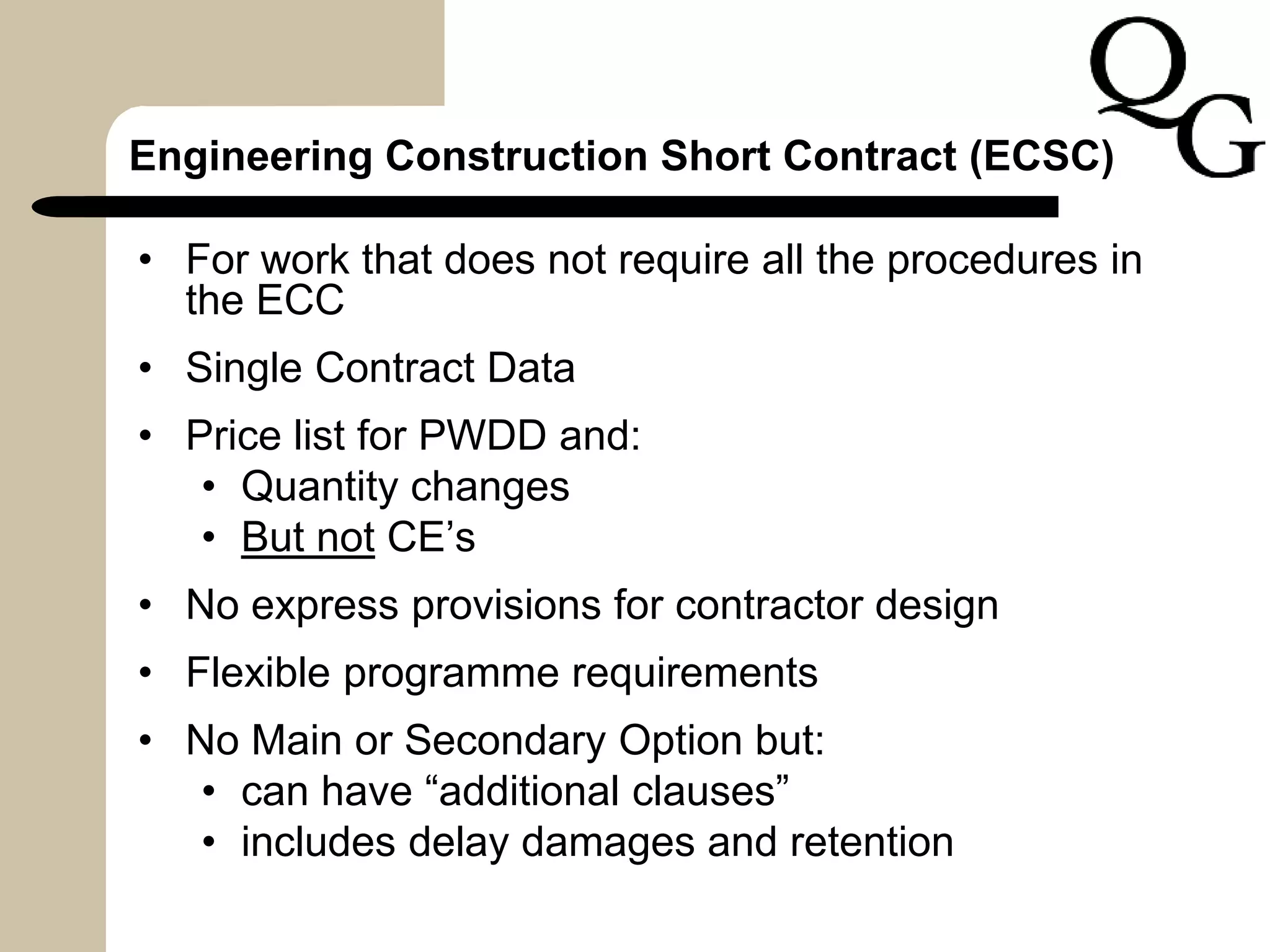
Engineering Construction Short Contract (ECSC)
• For work that does not require all the procedures in
the ECC
• Single Contract Data
• Price list for PWDD and:
• Quantity changes
• But not CE’s
• No express provisions for contractor design
• Flexible programme requirements
• No Main or Secondary Option but:
• can have “additional clauses”
• includes delay damages and retention
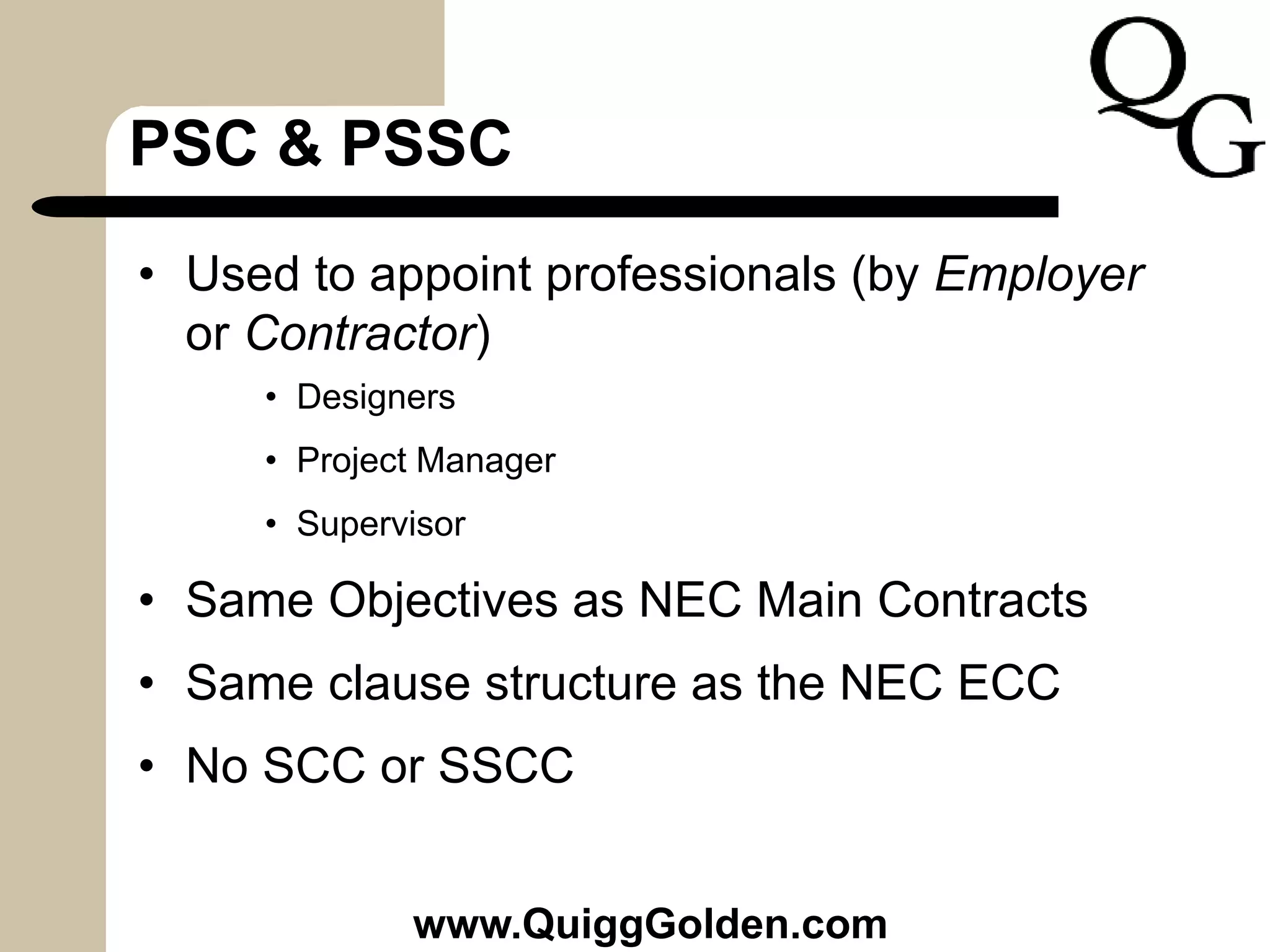
PSC & PSSC
• Used to appoint professionals (by Employer
or Contractor)
• Designers
• Project Manager
• Supervisor
• Same Objectives as NEC Main Contracts
• Same clause structure as the NEC ECC
• No SCC or SSCC
www.QuiggGolden.com
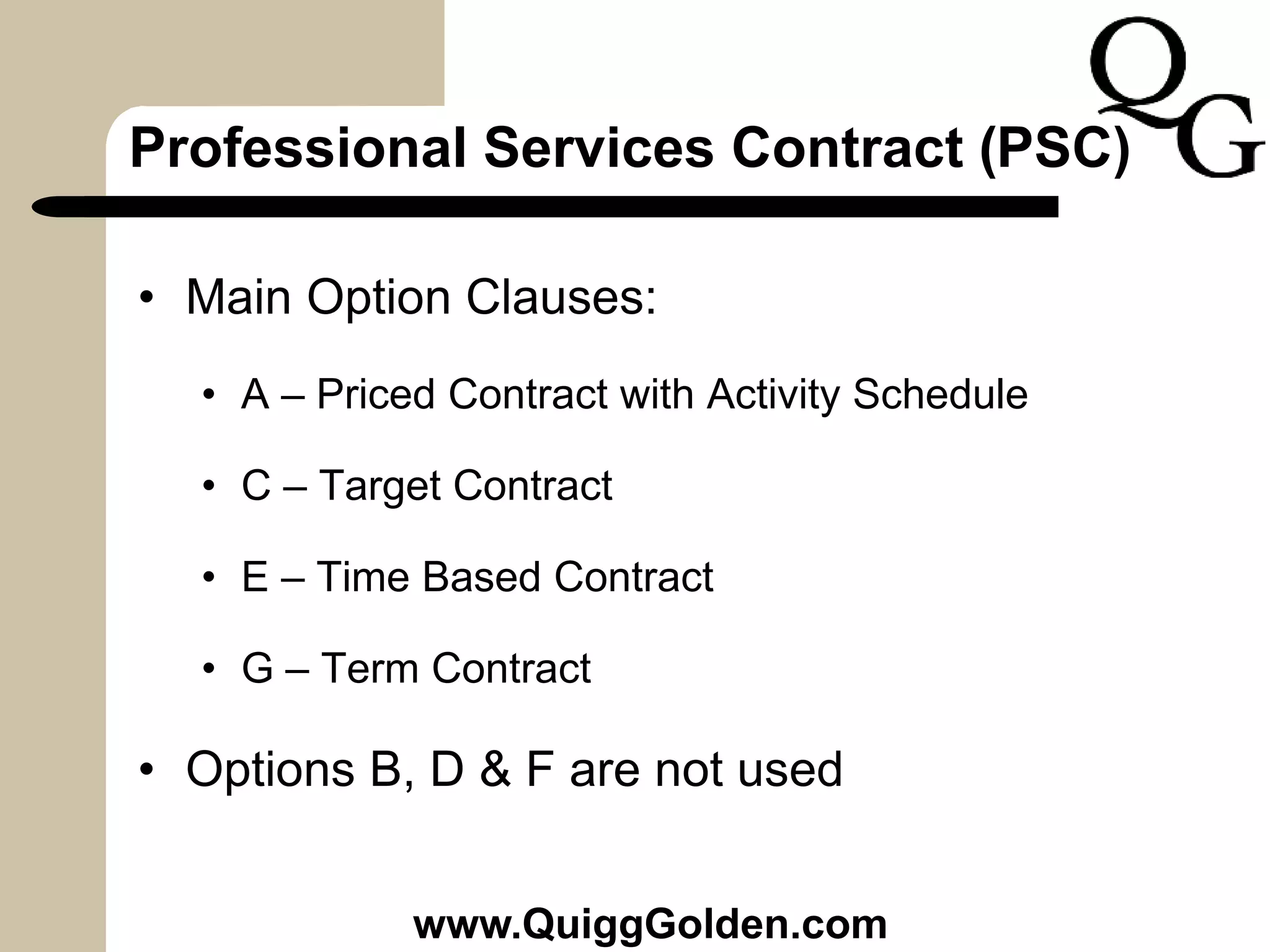
Professional Services Contract (PSC)
• Main Option Clauses:
• A – Priced Contract with Activity Schedule
• C – Target Contract
• E – Time Based Contract
• G – Term Contract
• Options B, D & F are not used
www.QuiggGolden.com
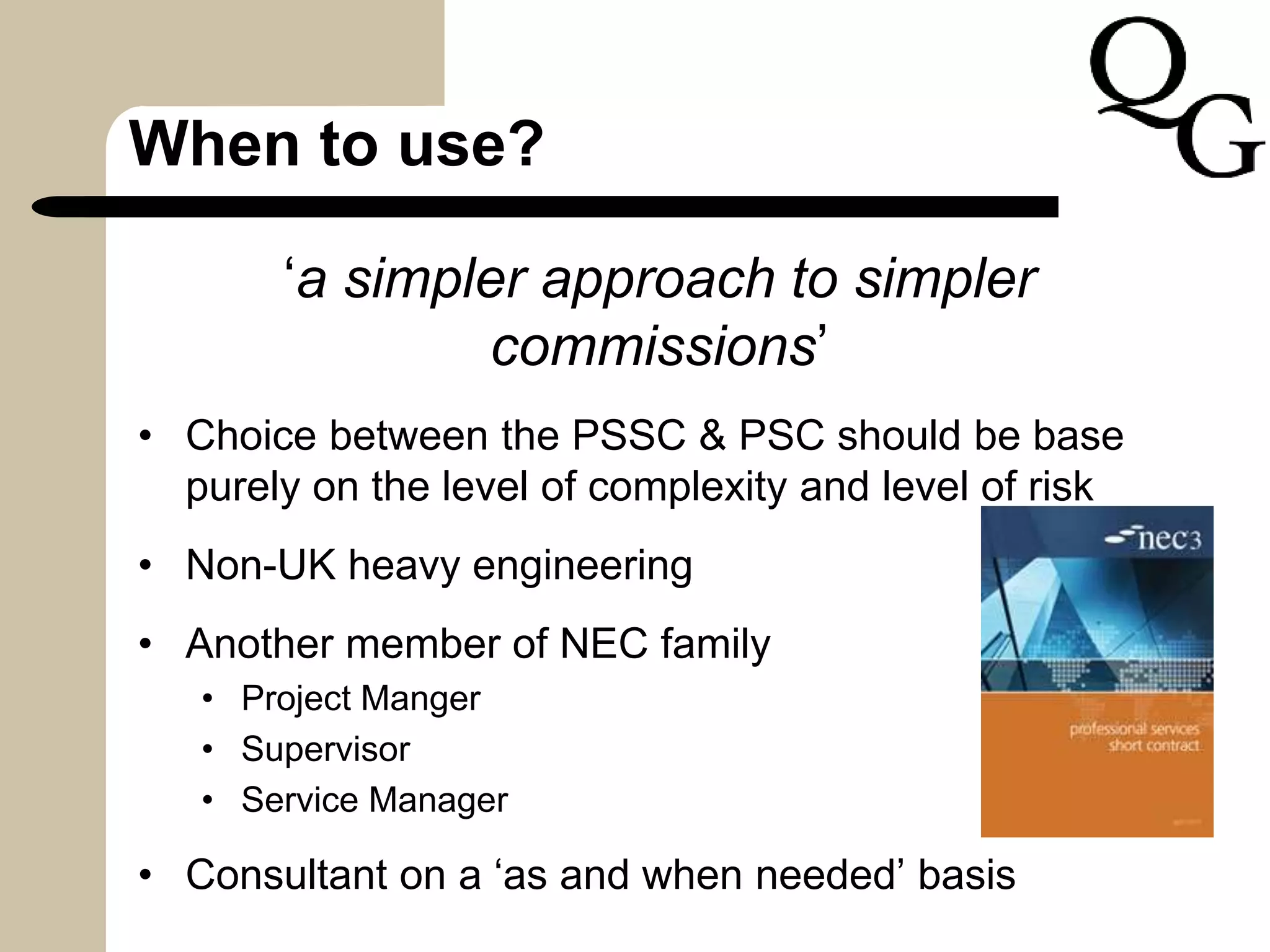
When to use?
‘a simpler approach to simpler
commissions’
• Choice between the PSSC & PSC should be base
purely on the level of complexity and level of risk
• Non-UK heavy engineering
• Another member of NEC family
• Project Manger
• Supervisor
• Service Manager
• Consultant on a ‘as and when needed’ basis
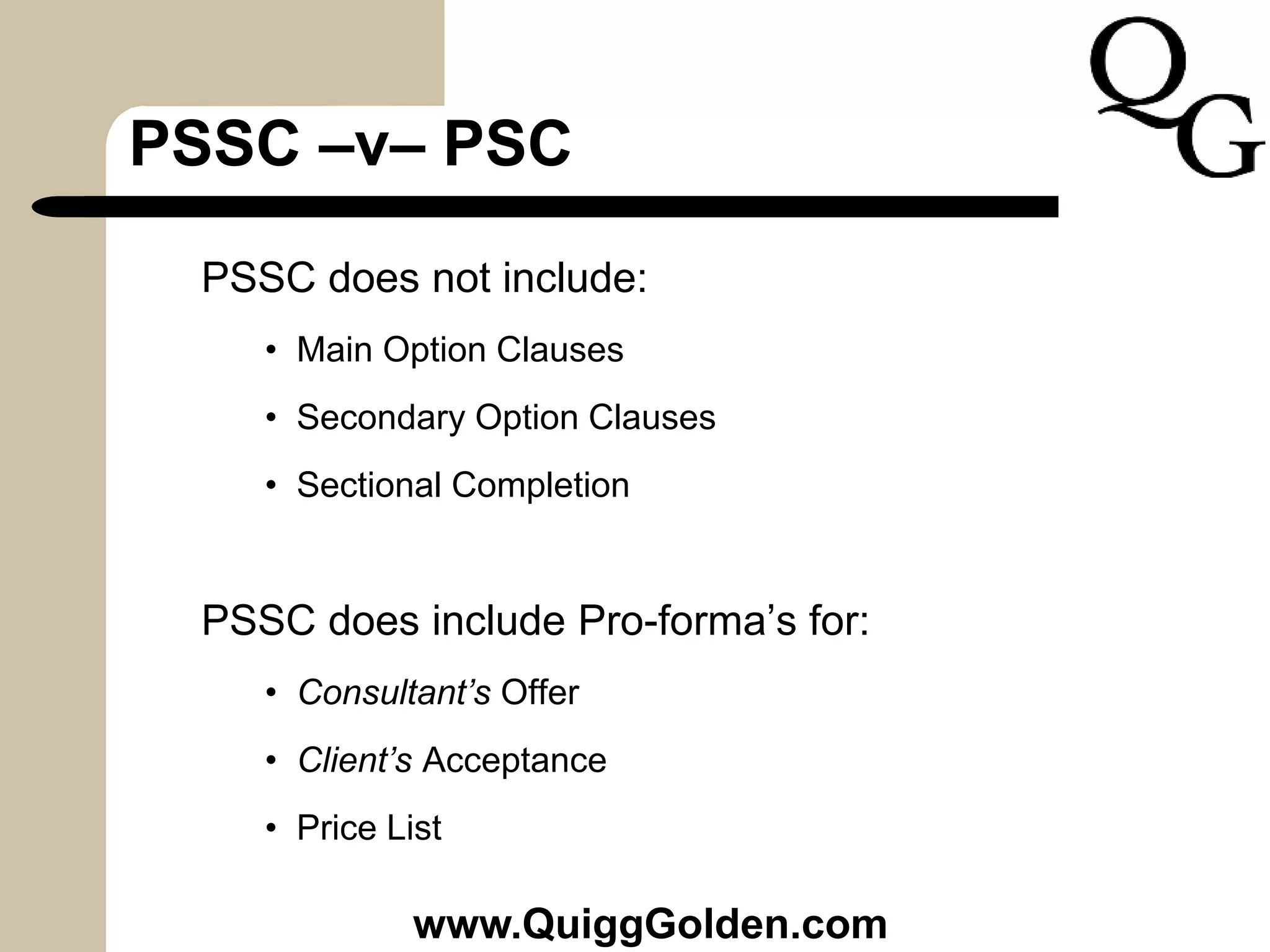
PSSC –v– PSC
PSSC does not include:
• Main Option Clauses
• Secondary Option Clauses
• Sectional Completion
PSSC does include Pro-forma’s for:
• Consultant’s Offer
• Client’s Acceptance
• Price List
www.QuiggGolden.com
www.QuiggGolden.com

Nec3 introduction

  • 1.
  • 2.
    Introduction • The rudimentsof NEC • New (No, really quite mature) • Engineering (No, anything really) • Contract (No, a contracting system) www.QuiggGolden.com
  • 3.
    A Brief Historyof NEC 1985 ICE review alternative contract strategies 1986 ICE commissioned new style of contract 1991 First consultative edition produced 1993 Edition 1 published 1994 “Constructing the Team” Latham 1994, singled out NEC for good practice 1995 Edition 2 published, all 13 Latham principles adopted 1999 Short form published 2005 Edition 3 published and existing contracts updated. New Term Service and Framework contract published 2006 June 2006 amendments 2013 April 2013 amendments Still the New Engineering Contract?
  • 4.
    NEC Amendments April2013 http://www.neccontract.com/
  • 5.
    Why the NEC? •Constructing the Team - Sir Michael Latham 1994 • Rethinking Construction – Sir John Egan 1998 • Achieving Excellence – OGC 2003 • HM Treasury www.QuiggGolden.com
  • 6.
    Basic Characteristics ofNEC • Contractor lead • Mutual trust and co-operation (edition 2 onwards) • Good management encouraged (not just rights and obligations) • Procedure driven • Programme given HUGE prominence • Recognising risk and dealing with it as you go rather than allocating blame afterwards • Clear and distinct roles for those involved • Minimises subjective phrases such as fair, reasonable, opinion www.QuiggGolden.com
  • 7.
    Basic Characteristics ofNEC • Modular approach • Interlocking contracts e.g. Subcontract, PSC, Adjudicator • Logical contracts (can be described in flow charts) • Written in simple English (and in the present tense) • Certainty of actions and outcome • Flexible approach allows use in multi discipline projects and a wide range of projects • Can be used internationally www.QuiggGolden.com
  • 8.
    Using the NEC •Works well where used properly • Allows great flexibility in public and private sectors • Easy to apportion design responsibility • Use the main options to decide big issues such as pricing options • Tailor with secondary options www.QuiggGolden.com
  • 9.
    The Present Familyof NEC Contracts • NEC3 April 2013 Edition complete family of contracts (39 documents including guidance notes and flow charts)
  • 10.
    A typical projectusing NEC Contracts Client Project Manager PSC or PSSC Consultant Supervisor PSC or PSSC Contractor ECC or ECSC Subcontractor ECS or ECSS Suppliers ECS or ECSS Suppliers SC or SSC Consultant PSC or PSSC Adjudicator AC www.QuiggGolden.com
  • 11.
    NEC 3: Main andSecondary Options and Alternatives www.QuiggGolden.com
  • 12.
    Introduction • Strategy forchoosing the correct contract • 6 Main Options • Secondary Option Clauses (X, Y & W) www.QuiggGolden.com
  • 13.
    Contract Strategy • ECCmain option is based on completeness of the Works Information • Example Scenarios • Employer has fully designed the required works & requires a lump sum price • Employer requires Contractor to design and construct the work on a fixed sum basis • Employer requires Contractor to design and construct the work on a fixed sum basis • Employer requires immediate and urgent works that are not designed www.QuiggGolden.com
  • 14.
    Main Option Concepts •Activity Schedule • Bill of Quantities • Cost Reimbursement • Target Cost www.QuiggGolden.com
  • 15.
    Balance of risk ContractType Main Options Balance of risk Employer Contractor Priced A B Target C D Cost reimbursable E Management F www.QuiggGolden.com
  • 16.
    Main Options –A (1) • Option A – Priced contract with activity schedule • Fixed Price Lump Sum contract • Activity Schedule • Price Comparison • Change Management • The Programme • Control and Change www.QuiggGolden.com
  • 17.
    Main Options –A (2) • Risk and Reward with Contractor • Ideally suited to contractor’s design but can be used for Employers design • Divided design responsibility providing the Employer’s design element is complete at time of tender • Offers best prospects for price certainty www.QuiggGolden.com
  • 18.
    Main Options –B • Option B – Priced contract with bill of quantities • Re-measurement contract • Bill of Quantities • Price Comparison • Changing the BoQ • Change Management • Not suited to Contractor’s design because of reliance on bills of quantities • Risk split Quantity/Price • Lacks price certainty
  • 19.
    Main Options –C (1) • Option C – Target contract with activity schedule • Target contract based on lump sum • Allows Employer flexibility in developing his own design • Target Cost • Administrative Burden • Cash flow certainty • Cost Transparency www.QuiggGolden.com
  • 20.
    Main Options –C (2) • Risk split - Contractor: • Fixed margin • Pain/gain • Risk split – Employer: • Payment burden • Pain/gain • Fixes some degree of certainty on price www.QuiggGolden.com
  • 21.
    Main Options –D • Option D – Target contract with bill of quantities • Target contract bill of quantities based • Similar price risk as Option B www.QuiggGolden.com
  • 22.
    Main Options –E • Option E – Cost reimbursable contract • Maximum flexibility in allocation of design responsibility • Contractor has little incentive by way of any target to minimise costs • Not suitable if the employer is looking for price certainty www.QuiggGolden.com
  • 23.
    Main Options –F • Option F – Management contract • Not suitable for allocation of the whole of the design responsibility to the Contractor unless placed as a ‘design & manage’ contract • Suitable for contracts with a high reliance on specialist subcontractors who undertake their own design • Can be arranged on the basis of lump sum contract www.QuiggGolden.com
  • 24.
    Secondary Option Clauses •You must elect to include them; No automatic incorporation • X Clauses (15 in total in Main Contract) • X4 – Parent Company Guarantee • X5 – Sectional Completion • X7 – Delay Damages • X16 – Retention • Y Clauses • Y(UK)1 – Project Bank Account • Y(UK)2 – The Housing Grants Construction and Regeneration Act 1996 as amended by the Local Democracy, Economic Development and Construction Act 2009 • Y(UK)3 – The Contracts (Rights of Third Parties) Act 1996 www.QuiggGolden.com
  • 25.
    Secondary Options • X1price adjustment for inflation • X2 changes in the law • X3 multiple currencies • X4 parent company guarantee • X5 sectional completion • X6 bonus for early completion • X7 delay damages • X12 partnering • X13 performance bond • X14 advanced payment to the contractor • X15 limitation of contractor’s liability for design • X16 retention • X17 low performance damages • X18 limitation of liability • X20 key performance indicators • Y(UK)1 project bank accounts • Y(UK)2 HGCRA as amended • Y(UK)3 contracts (Rights to Third Parties) • Z1 www.QuiggGolden.com
  • 26.
    Key Options • W2and Y(UK)2 • X5 – Sectional completion • X7 – Delay Damages • X16 – Retention • X13 – Performance Bond www.QuiggGolden.com
  • 27.
    Options using NEC3ECC Priced Contract either A with AS or B with BoQ Target Contract either C with AS or D with BoQ Cost Reimbursable E Management F W1 or W2 X3 multiple currencies if required X1 price adjustment X16 retention as required X2 changes in the Law X4 parent company guarantee X5 sectional Completion X6 bonus for early Completion X7 delay damages X12 Partnering X13 performance bond X14 advanced payment to the Contractor X17 low performance damages X18 limitation of liability X20 Key Performance Indicators Y(UK)1, Y(UK)2, Y(UK)3 Z as required X16 retention as required Main Option Dispute Option Secondary Options
  • 28.
    Engineering Construction ShortContract (ECSC) • For work that does not require all the procedures in the ECC • Single Contract Data • Price list for PWDD and: • Quantity changes • But not CE’s • No express provisions for contractor design • Flexible programme requirements • No Main or Secondary Option but: • can have “additional clauses” • includes delay damages and retention
  • 29.
    PSC & PSSC •Used to appoint professionals (by Employer or Contractor) • Designers • Project Manager • Supervisor • Same Objectives as NEC Main Contracts • Same clause structure as the NEC ECC • No SCC or SSCC www.QuiggGolden.com
  • 30.
    Professional Services Contract(PSC) • Main Option Clauses: • A – Priced Contract with Activity Schedule • C – Target Contract • E – Time Based Contract • G – Term Contract • Options B, D & F are not used www.QuiggGolden.com
  • 31.
    When to use? ‘asimpler approach to simpler commissions’ • Choice between the PSSC & PSC should be base purely on the level of complexity and level of risk • Non-UK heavy engineering • Another member of NEC family • Project Manger • Supervisor • Service Manager • Consultant on a ‘as and when needed’ basis
  • 32.
    PSSC –v– PSC PSSCdoes not include: • Main Option Clauses • Secondary Option Clauses • Sectional Completion PSSC does include Pro-forma’s for: • Consultant’s Offer • Client’s Acceptance • Price List www.QuiggGolden.com
  • 33.