A Guide to 
Standard forms of 
Construction Contract 
Outlining Key Characteristics and Components 
Produced for SCALA and the Local Government Task Force by 
Rob Tate Dip Arch. Dip TP. Dip Arb. FCIArb. RIBA 01582 516662 rob.tate@ntlworld.com 
You can contact the Local Government Task Force 
tel 020 7837 8286 or by visiting www.lgtf.org.uk 
You can contact SCALA 
tel 01446 771209 email info@scala.org.uk 
or by visiting www.scala.org.uk
Introduction 
The most brilliant design remains just that, a design, 
unless turned into reality by building operations. Those 
operations generally, and always in the public sector 
context, require a formal agreement which sets out who 
does what for how much, how it should be done, and 
allocates the risk – a contract. The transition from a 
successful design to a successful building requires the 
selection of a contract which reflects the aspirations of 
the Parties and meets the demands of the project. 
An essential skill of a Contract Administrator is the 
selection and management of the building contract. 
For each project, key criteria must be considered and 
risks allocated, before the form of contract is selected. 
That selection can be made from a range of standard 
forms of contract. 
This guide presents a list of the principal standard forms 
of building contract, highlighting significant features. It is 
presented in a “ready reckoner” format as a primer for 
the contract selection process. As such it is not 
exhaustive and is not intended to be a sole source of 
reference when selecting a contract. It is a quick 
reference, a memory jogger, which suggests key criteria 
and risks for consideration, with a broad comparative 
analysis as a start to the selection process. 
The guide is presented in the form of a matrix. The centre 
section of the matrix sets out, in bar chart format, the 
allocation of risk and the weight ascribed to key criteria 
for each contract form. 
Procurement 
In providing a concise primer for contract selection, 
is not appropriate for this guide to address the broader 
issue of procurement. It assumes an understanding of 
procurement and the routes available. 
However, the choice of contract flows from the 
procurement route chosen for the project. The choice 
of procurement route depends on the Client’s required 
balance of time/cost/quality and an analysis of how that 
can be achieved. This is in the context of the Client’s 
other requirements, not least being his required level of 
involvement in the design and construction process and 
the extent to which he may change his mind or wish to 
alter the specification during construction. 
Those considerations promote a useful set of criteria 
for selection of the form of contract. In this guide each 
contract form is summarised in terms of the following 
key criteria: 
• Speed - design and construction 
• Cost certainty 
• Dealing with complexity 
• Client’s involvement 
• Capacity for variations 
• Clarity of remedies 
• Separation of design and management 
The contracts included in this guide cover the principal 
procurement methods: 
• General contracting 
• Design and build 
• Construction management 
• Partnering 
• Management contracting 
Risk 
The formation of a contract involves acceptance of an 
offer, an intention to have a legally binding agreement, 
performance and payment. “Transfer of risk” is often 
referred to but, in reality, the allocation of risk, not its 
transfer, is a major element in any contract. 
The offer includes a proposed allocation of risk, which is 
agreed in making the contract, and the agreed payment 
includes consideration for the risk taken in performance 
of the contract. For example, “price certainty” is bought, 
by paying the contractor to accept the risk of fixing a 
price in a commercial, changing market. 
The degree of risk involved in certain key aspects of 
the project must, therefore, be assessed in respect of 
whether it is more economic for the Employer to take 
a risk or for him to pay the Contractor to take it for him. 
This is an essential consideration in selecting a contract 
form in support of a procurement route which achieves 
“best value”. 
The key risk areas identified in this guide for 
consideration when selecting a contract form are: 
• Default 
• Delay 
• Quality 
In the matrix each contract form is summarised in terms 
of those principal risk areas. 
This guide is not exhaustive and is not intended to be 
a sole source of reference when selecting a contract. 
It is a quick reference providing a broad comparative 
analysis as a way in to the selection process. 
Project managers must make their own assessment of 
each form, particularly in the context of each specific 
project. SCALA disclaims responsibility for decisions 
made on the basis of this guide. 
Published February 2003 
2 3
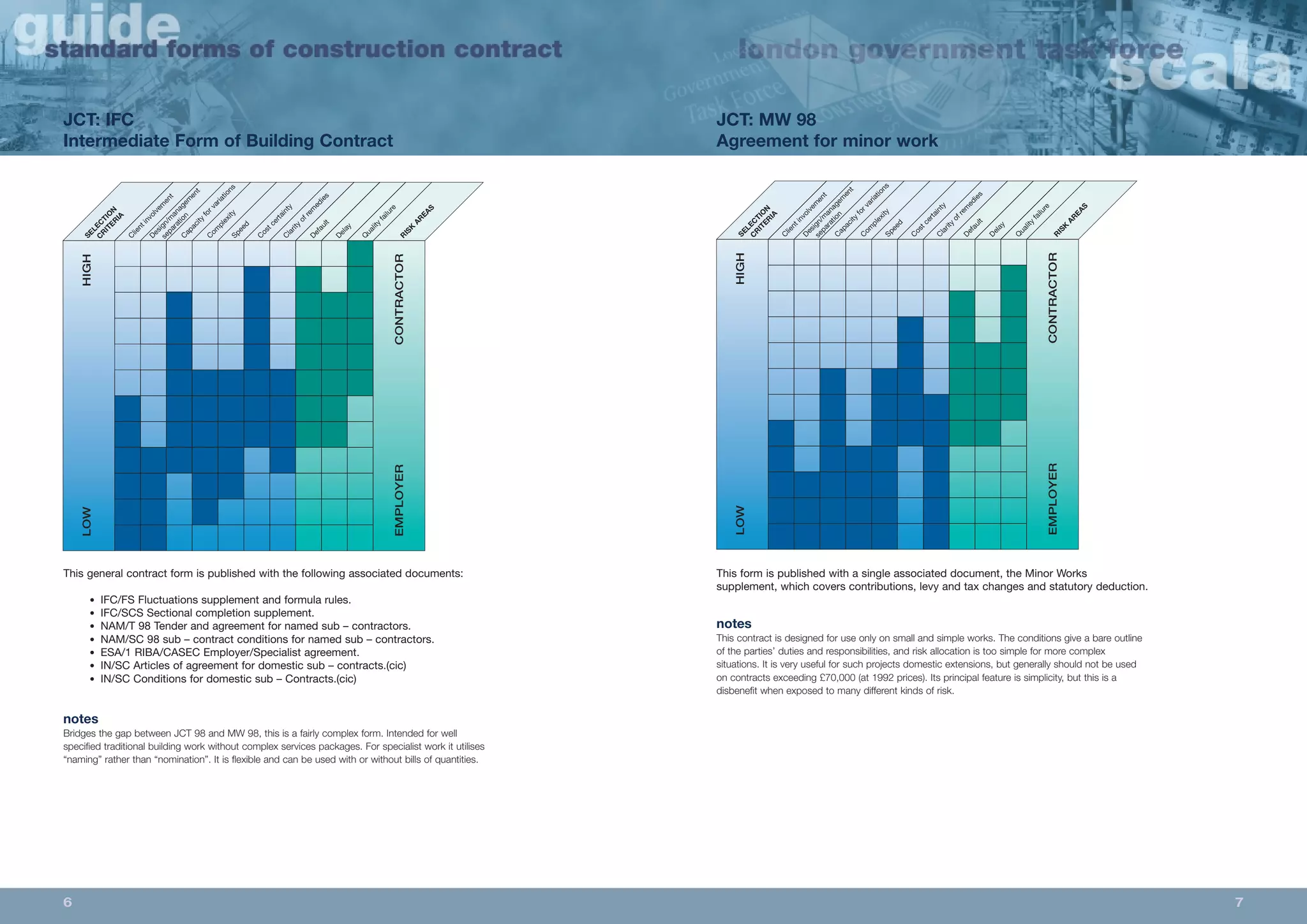
JCT 98: Standard Form Building Contract 
separation 
Capacity for variations 
Complexity 
Speed 
Cost certainty 
Clarity of remedies 
Default 
Delay 
Quality failure 
RISK AREAS 
CRITERIA 
SELECTION 
Client Design/involvement 
management 
LOW HIGH 
EMPLOYER CONTRACTOR 
5 
It is published in six versions – private and local authority versions with and without 
quantities and with approximate quantities. 
It is published with supplements, for the private and local authority versions, covering 
fluctuations, sectional completion and contractor’s design. 
There are nine sub – contract forms designed for use with JCT 98. 
In addition to the forms produced by the JCT, there are forms for domestic 
sub – contracts, including a domestic sub – contractor’s designed portion supplement. 
notes 
A much used standard form which, for many, is an automatic choice and a benchmark. Developed 
over a long period to respond to the needs of general contracting, it is necessarily a complex 
document. It enables a high level of Employer involvement, through the role of Architect/Contract 
Administrator and Quantity Surveyor together with the provisions for variations and nomination of 
sub-contractors by the Employer. 
4 
separation 
Capacity for variations 
Complexity 
Speed 
Cost certainty 
Clarity of remedies 
Default 
Delay 
Quality failure 
RISK AREAS 
CRITERIA 
SELECTION 
Client Design/involvement 
management 
LOW HIGH 
EMPLOYER CONTRACTOR 
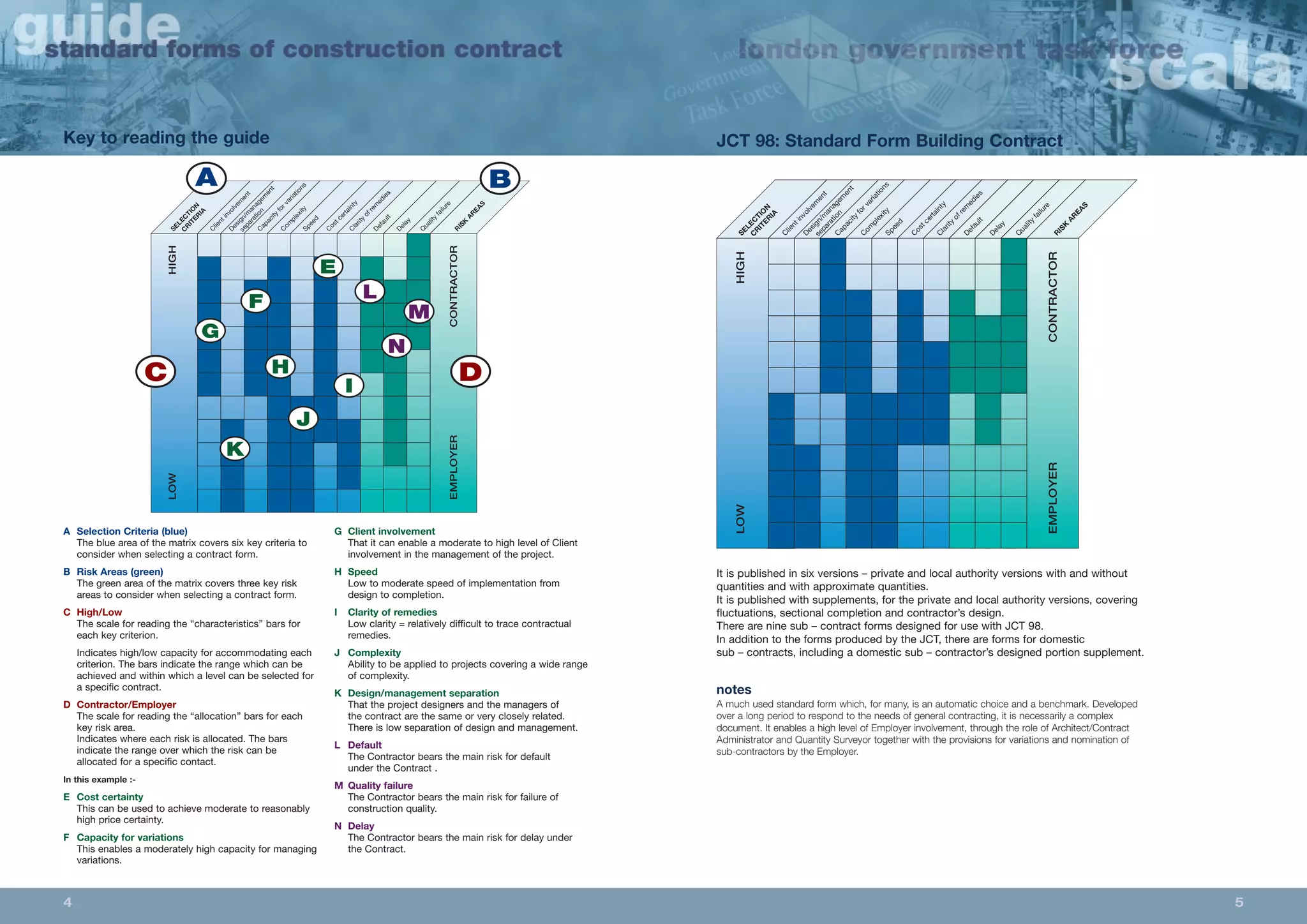
Key to reading the guide 
A Selection Criteria (blue) 
The blue area of the matrix covers six key criteria to 
consider when selecting a contract form. 
B Risk Areas (green) 
The green area of the matrix covers three key risk 
areas to consider when selecting a contract form. 
C High/Low 
The scale for reading the “characteristics” bars for 
each key criterion. 
Indicates high/low capacity for accommodating each 
criterion. The bars indicate the range which can be 
achieved and within which a level can be selected for 
a specific contract. 
D Contractor/Employer 
The scale for reading the “allocation” bars for each 
key risk area. 
Indicates where each risk is allocated. The bars 
indicate the range over which the risk can be 
allocated for a specific contact. 
In this example :- 
E Cost certainty 
This can be used to achieve moderate to reasonably 
high price certainty. 
F Capacity for variations 
This enables a moderately high capacity for managing 
variations. 
G Client involvement 
That it can enable a moderate to high level of Client 
involvement in the management of the project. 
H Speed 
Low to moderate speed of implementation from 
design to completion. 
I Clarity of remedies 
Low clarity = relatively difficult to trace contractual 
remedies. 
J Complexity 
Ability to be applied to projects covering a wide range 
of complexity. 
K Design/management separation 
That the project designers and the managers of 
the contract are the same or very closely related. 
There is low separation of design and management. 
L Default 
The Contractor bears the main risk for default 
under the Contract . 
M Quality failure 
The Contractor bears the main risk for failure of 
construction quality. 
N Delay 
The Contractor bears the main risk for delay under 
the Contract.
JCT: MW 98 
Agreement for minor work 
separation 
Capacity for variations 
Complexity 
Speed 
Cost certainty 
Clarity of remedies 
Default 
Delay 
Quality failure 
RISK AREAS 
CRITERIA 
SELECTION 
Client Design/involvement 
management 
LOW HIGH 
EMPLOYER CONTRACTOR 
This form is published with a single associated document, the Minor Works 
supplement, which covers contributions, levy and tax changes and statutory deduction. 
notes 
This contract is designed for use only on small and simple works. The conditions give a bare outline 
of the parties’ duties and responsibilities, and risk allocation is too simple for more complex 
situations. It is very useful for such projects domestic extensions, but generally should not be used 
on contracts exceeding £70,000 (at 1992 prices). Its principal feature is simplicity, but this is a 
disbenefit when exposed to many different kinds of risk. 
JCT: IFC 
Intermediate Form of Building Contract 
separation 
Capacity for variations 
Complexity 
Speed 
Cost certainty 
Clarity of remedies 
Default 
Delay 
Quality failure 
RISK AREAS 
CRITERIA 
SELECTION 
Client Design/involvement 
management 
LOW HIGH 
EMPLOYER CONTRACTOR 
This general contract form is published with the following associated documents: 
• IFC/FS Fluctuations supplement and formula rules. 
• IFC/SCS Sectional completion supplement. 
• NAM/T 98 Tender and agreement for named sub – contractors. 
• NAM/SC 98 sub – contract conditions for named sub – contractors. 
• ESA/1 RIBA/CASEC Employer/Specialist agreement. 
• IN/SC Articles of agreement for domestic sub – contracts.(cic) 
• IN/SC Conditions for domestic sub – Contracts.(cic) 
notes 
Bridges the gap between JCT 98 and MW 98, this is a fairly complex form. Intended for well 
specified traditional building work without complex services packages. For specialist work it utilises 
“naming” rather than “nomination”. It is flexible and can be used with or without bills of quantities. 
6 7
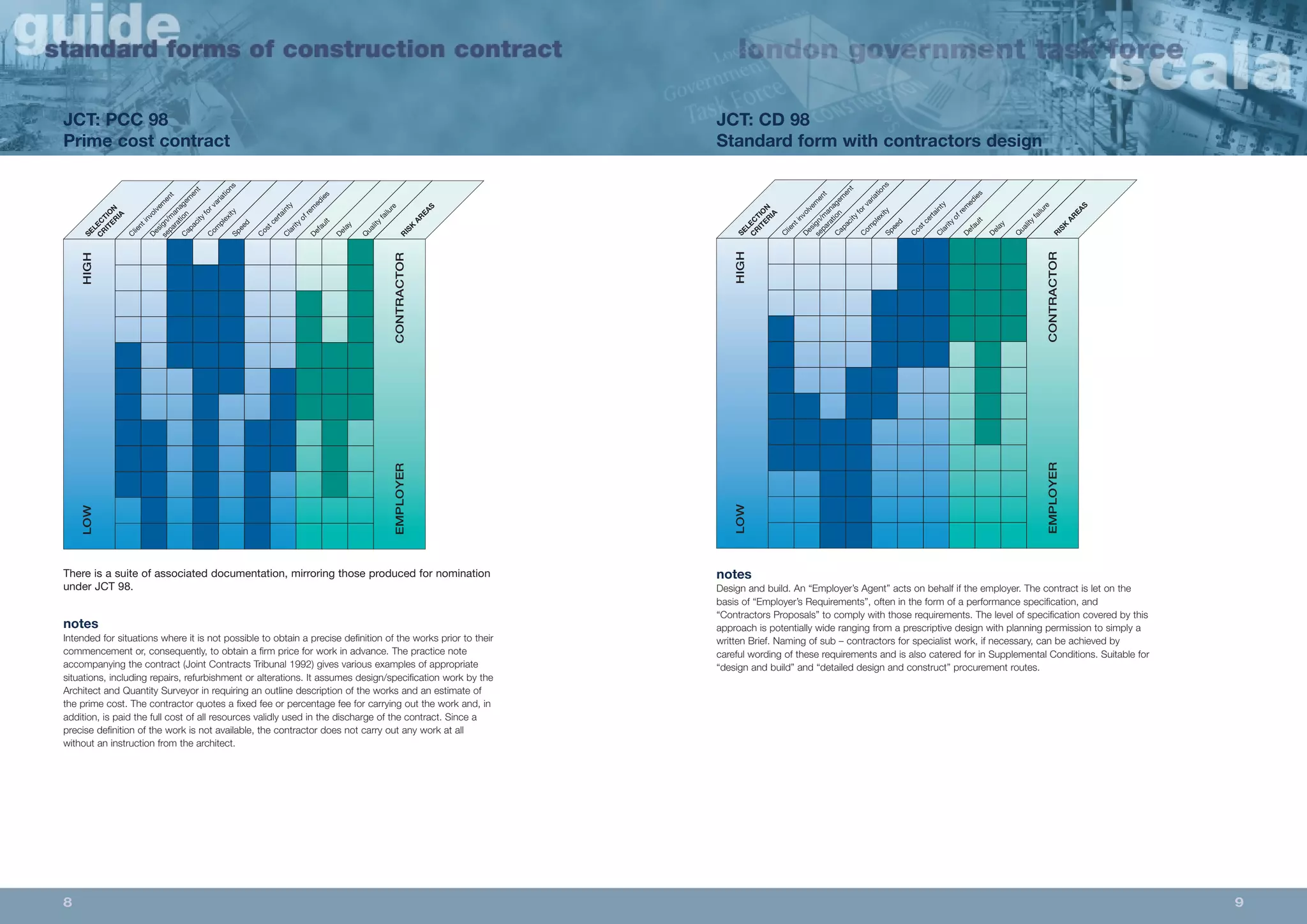
JCT: CD 98 
Standard form with contractors design 
separation 
Capacity for variations 
Complexity 
Speed 
Cost certainty 
Clarity of remedies 
Default 
Delay 
Quality failure 
RISK AREAS 
CRITERIA 
SELECTION 
Client Design/involvement 
management 
LOW HIGH 
EMPLOYER CONTRACTOR 
notes 
Design and build. An “Employer’s Agent” acts on behalf if the employer. The contract is let on the 
basis of “Employer’s Requirements”, often in the form of a performance specification, and 
“Contractors Proposals” to comply with those requirements. The level of specification covered by this 
approach is potentially wide ranging from a prescriptive design with planning permission to simply a 
written Brief. Naming of sub – contractors for specialist work, if necessary, can be achieved by 
careful wording of these requirements and is also catered for in Supplemental Conditions. Suitable for 
“design and build” and “detailed design and construct” procurement routes. 
JCT: PCC 98 
Prime cost contract 
separation 
Capacity for variations 
Complexity 
Speed 
Cost certainty 
Clarity of remedies 
Default 
Delay 
Quality failure 
RISK AREAS 
CRITERIA 
SELECTION 
Client Design/involvement 
management 
LOW HIGH 
EMPLOYER CONTRACTOR 
There is a suite of associated documentation, mirroring those produced for nomination 
under JCT 98. 
notes 
Intended for situations where it is not possible to obtain a precise definition of the works prior to their 
commencement or, consequently, to obtain a firm price for work in advance. The practice note 
accompanying the contract (Joint Contracts Tribunal 1992) gives various examples of appropriate 
situations, including repairs, refurbishment or alterations. It assumes design/specification work by the 
Architect and Quantity Surveyor in requiring an outline description of the works and an estimate of 
the prime cost. The contractor quotes a fixed fee or percentage fee for carrying out the work and, in 
addition, is paid the full cost of all resources validly used in the discharge of the contract. Since a 
precise definition of the work is not available, the contractor does not carry out any work at all 
without an instruction from the architect. 
8 9
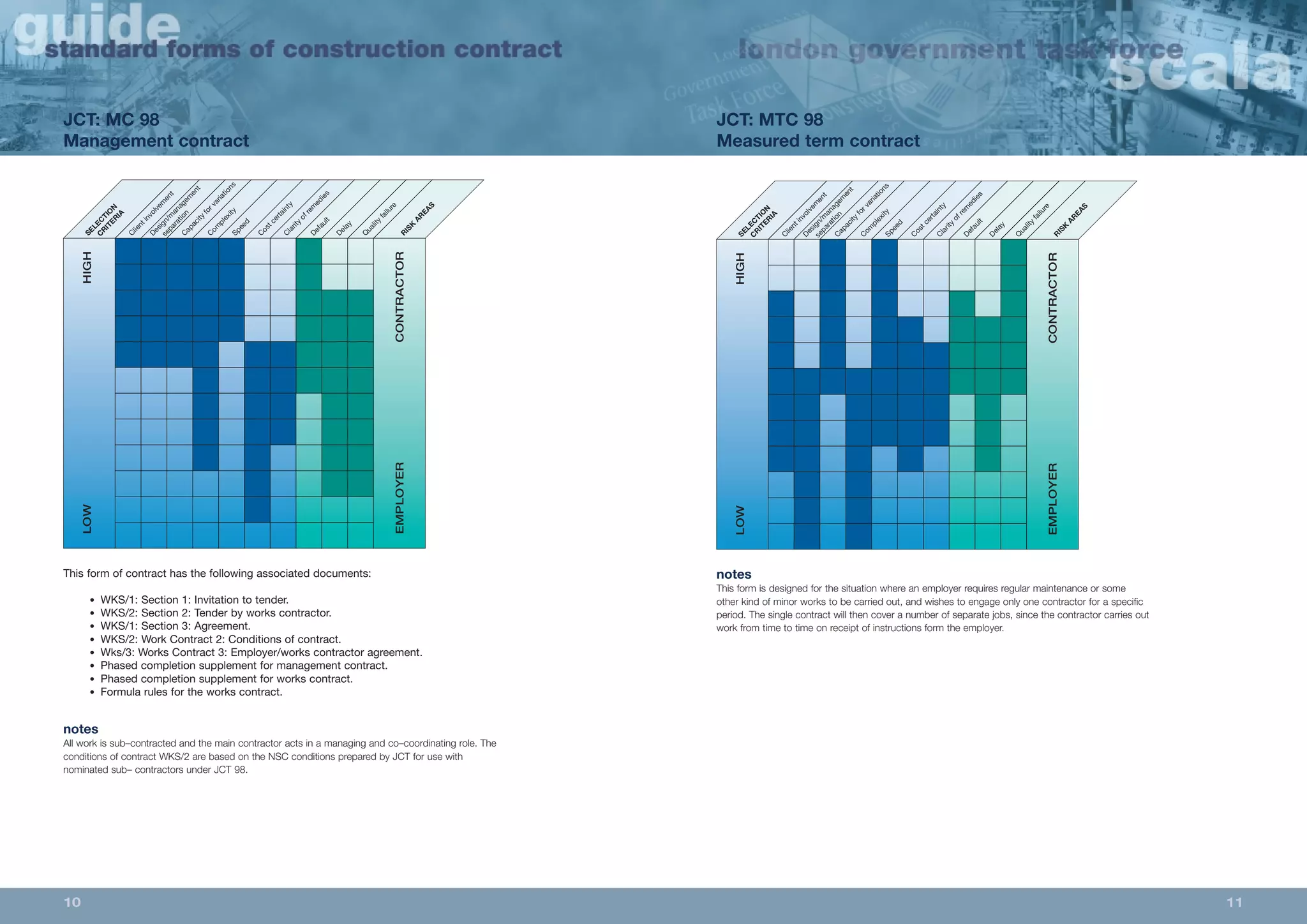
JCT: MTC 98 
Measured term contract 
separation 
Capacity for variations 
Complexity 
Speed 
Cost certainty 
Clarity of remedies 
Default 
Delay 
Quality failure 
RISK AREAS 
CRITERIA 
SELECTION 
Client Design/involvement 
management 
LOW HIGH 
EMPLOYER CONTRACTOR 
notes 
This form is designed for the situation where an employer requires regular maintenance or some 
other kind of minor works to be carried out, and wishes to engage only one contractor for a specific 
period. The single contract will then cover a number of separate jobs, since the contractor carries out 
work from time to time on receipt of instructions form the employer. 
JCT: MC 98 
Management contract 
separation 
Capacity for variations 
Complexity 
Speed 
Cost certainty 
Clarity of remedies 
Default 
Delay 
Quality failure 
RISK AREAS 
CRITERIA 
SELECTION 
Client Design/involvement 
management 
LOW HIGH 
EMPLOYER CONTRACTOR 
This form of contract has the following associated documents: 
• WKS/1: Section 1: Invitation to tender. 
• WKS/2: Section 2: Tender by works contractor. 
• WKS/1: Section 3: Agreement. 
• WKS/2: Work Contract 2: Conditions of contract. 
• Wks/3: Works Contract 3: Employer/works contractor agreement. 
• Phased completion supplement for management contract. 
• Phased completion supplement for works contract. 
• Formula rules for the works contract. 
notes 
All work is sub–contracted and the main contractor acts in a managing and co–coordinating role. The 
conditions of contract WKS/2 are based on the NSC conditions prepared by JCT for use with 
nominated sub– contractors under JCT 98. 
10 11
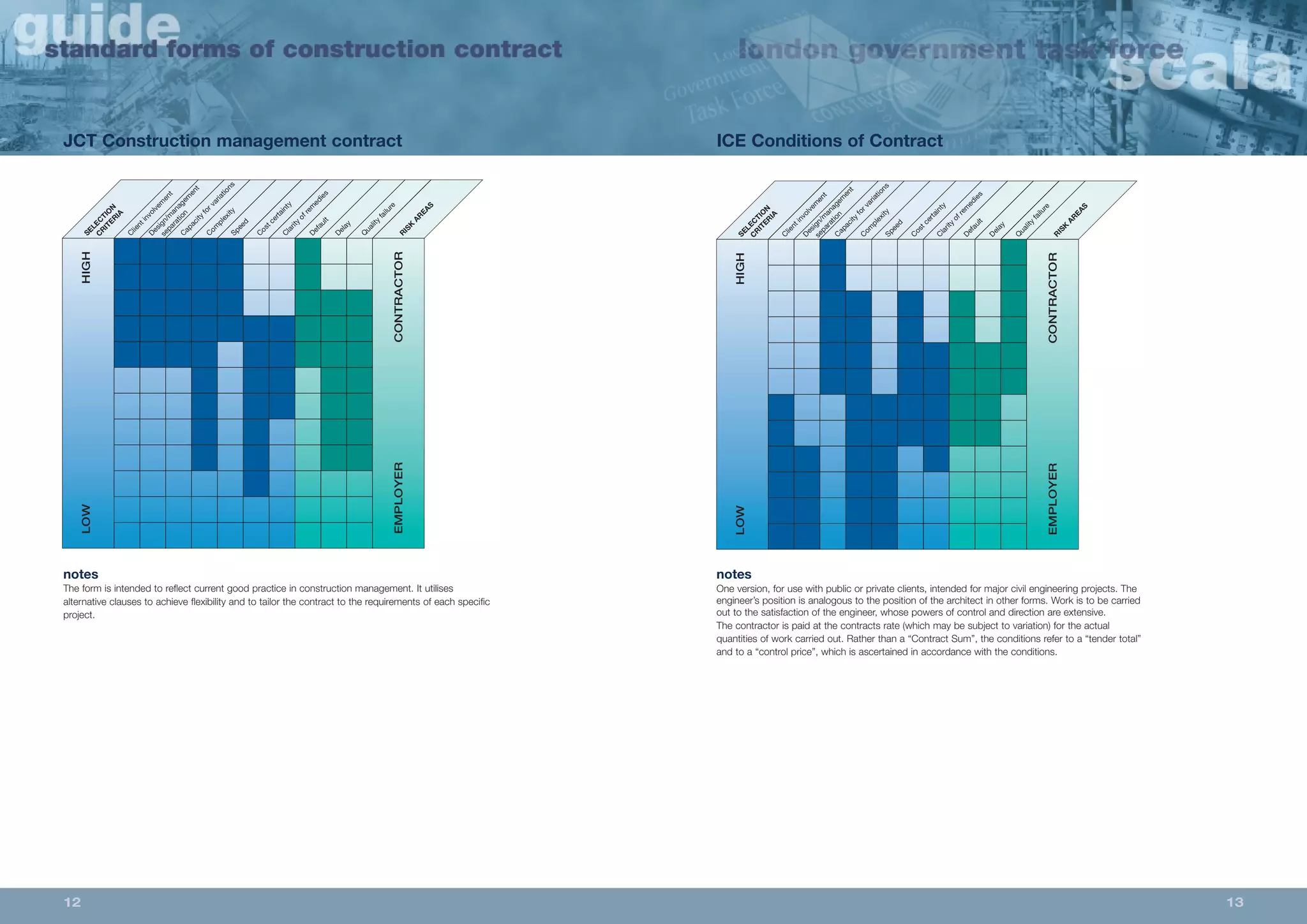
ICE Conditions of Contract 
separation 
Capacity for variations 
Complexity 
Speed 
Cost certainty 
Clarity of remedies 
Default 
Delay 
Quality failure 
RISK AREAS 
CRITERIA 
SELECTION 
Client Design/involvement 
management 
LOW HIGH 
EMPLOYER CONTRACTOR 
notes 
One version, for use with public or private clients, intended for major civil engineering projects. The 
engineer’s position is analogous to the position of the architect in other forms. Work is to be carried 
out to the satisfaction of the engineer, whose powers of control and direction are extensive. 
The contractor is paid at the contracts rate (which may be subject to variation) for the actual 
quantities of work carried out. Rather than a “Contract Sum”, the conditions refer to a “tender total” 
and to a “control price”, which is ascertained in accordance with the conditions. 
JCT Construction management contract 
separation 
Capacity for variations 
Complexity 
Speed 
Cost certainty 
Clarity of remedies 
Default 
Delay 
Quality failure 
RISK AREAS 
CRITERIA 
SELECTION 
Client Design/involvement 
management 
LOW HIGH 
EMPLOYER CONTRACTOR 
notes 
The form is intended to reflect current good practice in construction management. It utilises 
alternative clauses to achieve flexibility and to tailor the contract to the requirements of each specific 
project. 
12 13
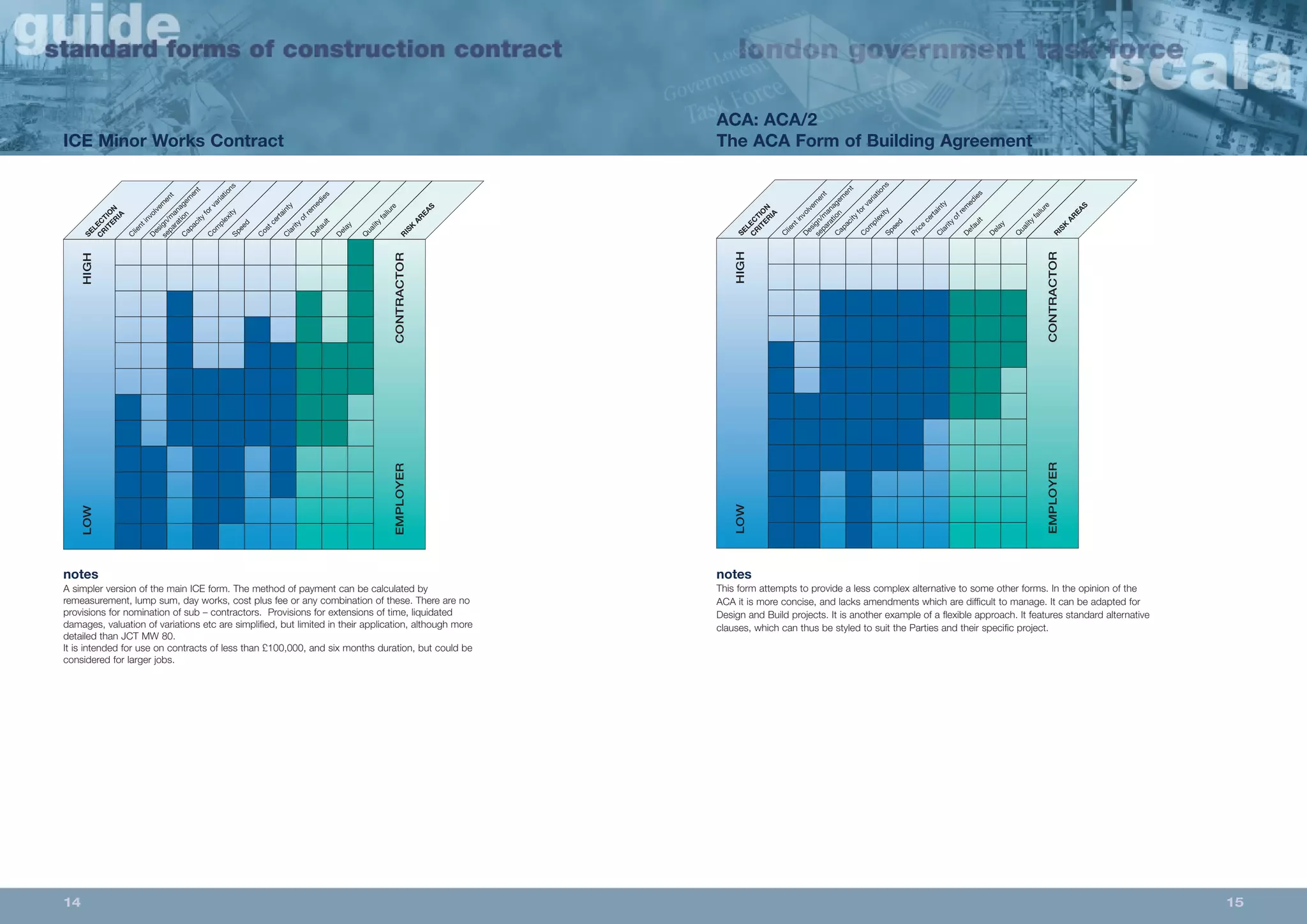
ACA: ACA/2 
The ACA Form of Building Agreement 
separation 
Capacity for variations 
Complexity 
Speed 
Price certainty 
Clarity of remedies 
Default 
Delay 
Quality failure 
RISK AREAS 
CRITERIA 
SELECTION 
Client Design/involvement 
management 
LOW HIGH 
EMPLOYER CONTRACTOR 
notes 
This form attempts to provide a less complex alternative to some other forms. In the opinion of the 
ACA it is more concise, and lacks amendments which are difficult to manage. It can be adapted for 
Design and Build projects. It is another example of a flexible approach. It features standard alternative 
clauses, which can thus be styled to suit the Parties and their specific project. 
ICE Minor Works Contract 
separation 
Capacity for variations 
Complexity 
Speed 
Cost certainty 
Clarity of remedies 
Default 
Delay 
Quality failure 
RISK AREAS 
CRITERIA 
SELECTION 
Client Design/involvement 
management 
LOW HIGH 
EMPLOYER CONTRACTOR 
notes 
A simpler version of the main ICE form. The method of payment can be calculated by 
remeasurement, lump sum, day works, cost plus fee or any combination of these. There are no 
provisions for nomination of sub – contractors. Provisions for extensions of time, liquidated 
damages, valuation of variations etc are simplified, but limited in their application, although more 
detailed than JCT MW 80. 
It is intended for use on contracts of less than £100,000, and six months duration, but could be 
considered for larger jobs. 
14 15
FIDIC Conditions of Contract 
separation 
Capacity for variations 
Complexity 
Speed 
Cost certainty 
Clarity of remedies 
Default 
Delay 
Quality failure 
RISK AREAS 
CRITERIA 
SELECTION 
Client Design/involvement 
management 
LOW HIGH 
EMPLOYER CONTRACTOR 
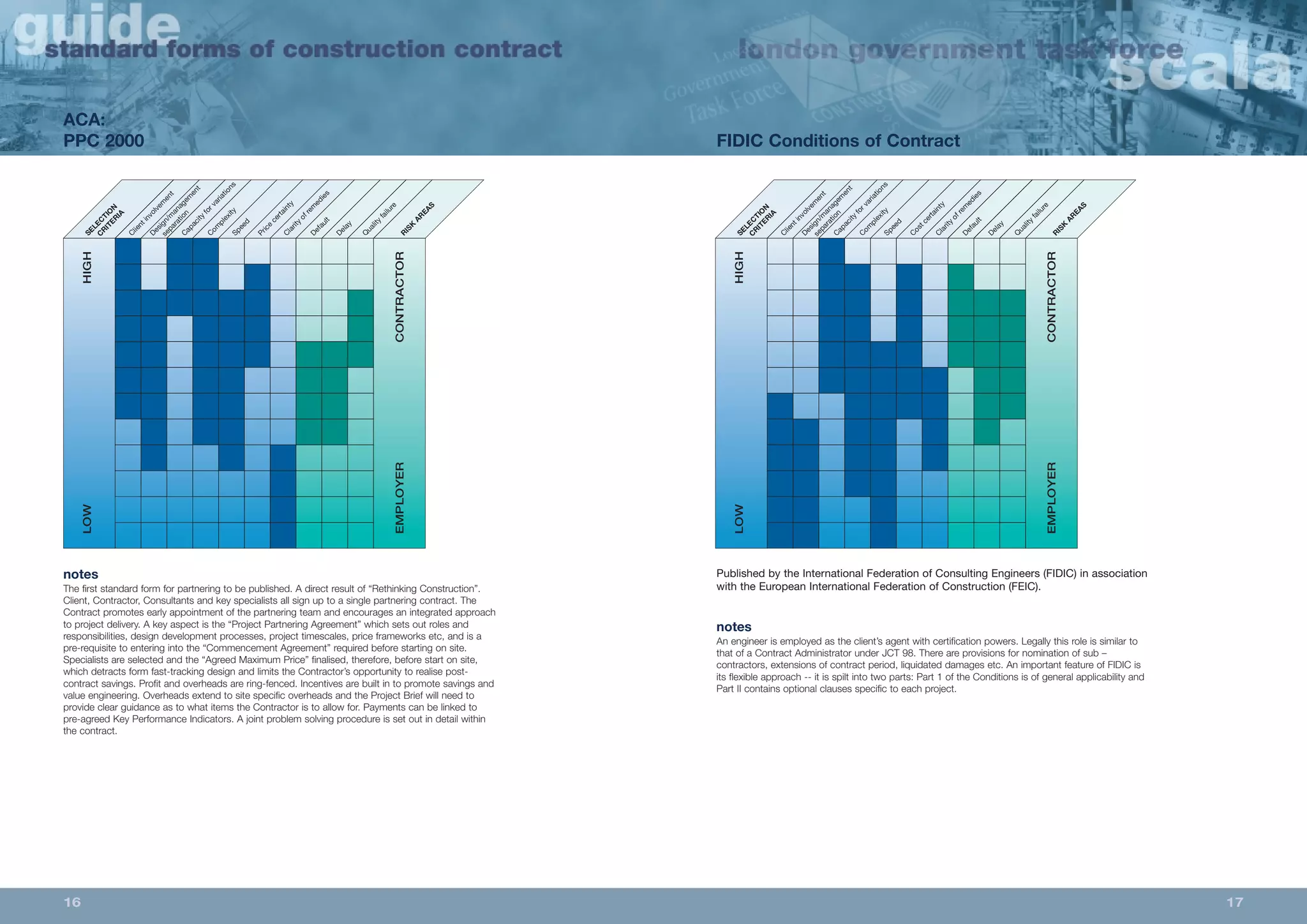
Published by the International Federation of Consulting Engineers (FIDIC) in association 
with the European International Federation of Construction (FEIC). 
notes 
An engineer is employed as the client’s agent with certification powers. Legally this role is similar to 
that of a Contract Administrator under JCT 98. There are provisions for nomination of sub – 
contractors, extensions of contract period, liquidated damages etc. An important feature of FIDIC is 
its flexible approach -- it is spilt into two parts: Part 1 of the Conditions is of general applicability and 
Part II contains optional clauses specific to each project. 
separation 
Capacity for variations 
Complexity 
Speed 
Price certainty 
Clarity of remedies 
Default 
Delay 
Quality failure 
RISK AREAS 
ACA: 
PPC 2000 
CRITERIA 
SELECTION 
Client Design/involvement 
management 
LOW HIGH 
EMPLOYER CONTRACTOR 
notes 
The first standard form for partnering to be published. A direct result of “Rethinking Construction”. 
Client, Contractor, Consultants and key specialists all sign up to a single partnering contract. The 
Contract promotes early appointment of the partnering team and encourages an integrated approach 
to project delivery. A key aspect is the “Project Partnering Agreement” which sets out roles and 
responsibilities, design development processes, project timescales, price frameworks etc, and is a 
pre-requisite to entering into the “Commencement Agreement” required before starting on site. 
Specialists are selected and the “Agreed Maximum Price” finalised, therefore, before start on site, 
which detracts form fast-tracking design and limits the Contractor’s opportunity to realise post-contract 
savings. Profit and overheads are ring-fenced. Incentives are built in to promote savings and 
value engineering. Overheads extend to site specific overheads and the Project Brief will need to 
provide clear guidance as to what items the Contractor is to allow for. Payments can be linked to 
pre-agreed Key Performance Indicators. A joint problem solving procedure is set out in detail within 
the contract. 
16 17
GC/Works/1 (1998): 
Contract for building and civil engineering major works 
separation 
Capacity for variations 
Complexity 
Speed 
Cost certainty 
Clarity of remedies 
Default 
Delay 
Quality failure 
RISK AREAS 
CRITERIA 
SELECTION 
Client Design/involvement 
management 
LOW HIGH 
EMPLOYER CONTRACTOR 
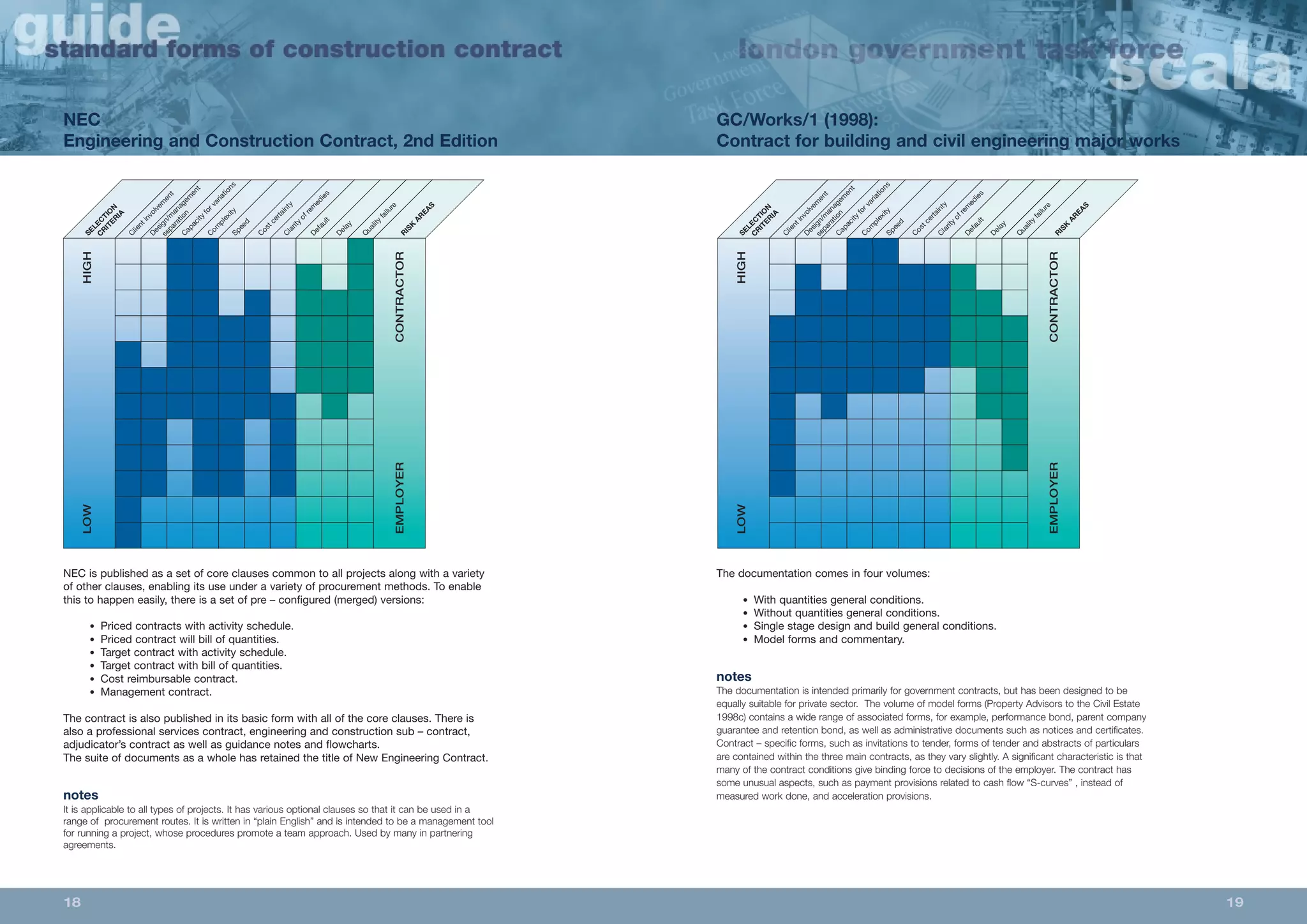
The documentation comes in four volumes: 
• With quantities general conditions. 
• Without quantities general conditions. 
• Single stage design and build general conditions. 
• Model forms and commentary. 
notes 
The documentation is intended primarily for government contracts, but has been designed to be 
equally suitable for private sector. The volume of model forms (Property Advisors to the Civil Estate 
1998c) contains a wide range of associated forms, for example, performance bond, parent company 
guarantee and retention bond, as well as administrative documents such as notices and certificates. 
Contract – specific forms, such as invitations to tender, forms of tender and abstracts of particulars 
are contained within the three main contracts, as they vary slightly. A significant characteristic is that 
many of the contract conditions give binding force to decisions of the employer. The contract has 
some unusual aspects, such as payment provisions related to cash flow “S-curves” , instead of 
measured work done, and acceleration provisions. 
NEC 
Engineering and Construction Contract, 2nd Edition 
separation 
Capacity for variations 
Complexity 
Speed 
Cost certainty 
Clarity of remedies 
Default 
Delay 
Quality failure 
RISK AREAS 
CRITERIA 
SELECTION 
Client Design/involvement 
management 
LOW HIGH 
EMPLOYER CONTRACTOR 
NEC is published as a set of core clauses common to all projects along with a variety 
of other clauses, enabling its use under a variety of procurement methods. To enable 
this to happen easily, there is a set of pre – configured (merged) versions: 
• Priced contracts with activity schedule. 
• Priced contract will bill of quantities. 
• Target contract with activity schedule. 
• Target contract with bill of quantities. 
• Cost reimbursable contract. 
• Management contract. 
The contract is also published in its basic form with all of the core clauses. There is 
also a professional services contract, engineering and construction sub – contract, 
adjudicator’s contract as well as guidance notes and flowcharts. 
The suite of documents as a whole has retained the title of New Engineering Contract. 
notes 
It is applicable to all types of projects. It has various optional clauses so that it can be used in a 
range of procurement routes. It is written in “plain English” and is intended to be a management tool 
for running a project, whose procedures promote a team approach. Used by many in partnering 
agreements. 
18 19

Standard forms lgtf

  • 1.
    A Guide to Standard forms of Construction Contract Outlining Key Characteristics and Components Produced for SCALA and the Local Government Task Force by Rob Tate Dip Arch. Dip TP. Dip Arb. FCIArb. RIBA 01582 516662 rob.tate@ntlworld.com You can contact the Local Government Task Force tel 020 7837 8286 or by visiting www.lgtf.org.uk You can contact SCALA tel 01446 771209 email info@scala.org.uk or by visiting www.scala.org.uk
  • 2.
    Introduction The mostbrilliant design remains just that, a design, unless turned into reality by building operations. Those operations generally, and always in the public sector context, require a formal agreement which sets out who does what for how much, how it should be done, and allocates the risk – a contract. The transition from a successful design to a successful building requires the selection of a contract which reflects the aspirations of the Parties and meets the demands of the project. An essential skill of a Contract Administrator is the selection and management of the building contract. For each project, key criteria must be considered and risks allocated, before the form of contract is selected. That selection can be made from a range of standard forms of contract. This guide presents a list of the principal standard forms of building contract, highlighting significant features. It is presented in a “ready reckoner” format as a primer for the contract selection process. As such it is not exhaustive and is not intended to be a sole source of reference when selecting a contract. It is a quick reference, a memory jogger, which suggests key criteria and risks for consideration, with a broad comparative analysis as a start to the selection process. The guide is presented in the form of a matrix. The centre section of the matrix sets out, in bar chart format, the allocation of risk and the weight ascribed to key criteria for each contract form. Procurement In providing a concise primer for contract selection, is not appropriate for this guide to address the broader issue of procurement. It assumes an understanding of procurement and the routes available. However, the choice of contract flows from the procurement route chosen for the project. The choice of procurement route depends on the Client’s required balance of time/cost/quality and an analysis of how that can be achieved. This is in the context of the Client’s other requirements, not least being his required level of involvement in the design and construction process and the extent to which he may change his mind or wish to alter the specification during construction. Those considerations promote a useful set of criteria for selection of the form of contract. In this guide each contract form is summarised in terms of the following key criteria: • Speed - design and construction • Cost certainty • Dealing with complexity • Client’s involvement • Capacity for variations • Clarity of remedies • Separation of design and management The contracts included in this guide cover the principal procurement methods: • General contracting • Design and build • Construction management • Partnering • Management contracting Risk The formation of a contract involves acceptance of an offer, an intention to have a legally binding agreement, performance and payment. “Transfer of risk” is often referred to but, in reality, the allocation of risk, not its transfer, is a major element in any contract. The offer includes a proposed allocation of risk, which is agreed in making the contract, and the agreed payment includes consideration for the risk taken in performance of the contract. For example, “price certainty” is bought, by paying the contractor to accept the risk of fixing a price in a commercial, changing market. The degree of risk involved in certain key aspects of the project must, therefore, be assessed in respect of whether it is more economic for the Employer to take a risk or for him to pay the Contractor to take it for him. This is an essential consideration in selecting a contract form in support of a procurement route which achieves “best value”. The key risk areas identified in this guide for consideration when selecting a contract form are: • Default • Delay • Quality In the matrix each contract form is summarised in terms of those principal risk areas. This guide is not exhaustive and is not intended to be a sole source of reference when selecting a contract. It is a quick reference providing a broad comparative analysis as a way in to the selection process. Project managers must make their own assessment of each form, particularly in the context of each specific project. SCALA disclaims responsibility for decisions made on the basis of this guide. Published February 2003 2 3
  • 3.
    JCT 98: StandardForm Building Contract separation Capacity for variations Complexity Speed Cost certainty Clarity of remedies Default Delay Quality failure RISK AREAS CRITERIA SELECTION Client Design/involvement management LOW HIGH EMPLOYER CONTRACTOR 5 It is published in six versions – private and local authority versions with and without quantities and with approximate quantities. It is published with supplements, for the private and local authority versions, covering fluctuations, sectional completion and contractor’s design. There are nine sub – contract forms designed for use with JCT 98. In addition to the forms produced by the JCT, there are forms for domestic sub – contracts, including a domestic sub – contractor’s designed portion supplement. notes A much used standard form which, for many, is an automatic choice and a benchmark. Developed over a long period to respond to the needs of general contracting, it is necessarily a complex document. It enables a high level of Employer involvement, through the role of Architect/Contract Administrator and Quantity Surveyor together with the provisions for variations and nomination of sub-contractors by the Employer. 4 separation Capacity for variations Complexity Speed Cost certainty Clarity of remedies Default Delay Quality failure RISK AREAS CRITERIA SELECTION Client Design/involvement management LOW HIGH EMPLOYER CONTRACTOR Key to reading the guide A Selection Criteria (blue) The blue area of the matrix covers six key criteria to consider when selecting a contract form. B Risk Areas (green) The green area of the matrix covers three key risk areas to consider when selecting a contract form. C High/Low The scale for reading the “characteristics” bars for each key criterion. Indicates high/low capacity for accommodating each criterion. The bars indicate the range which can be achieved and within which a level can be selected for a specific contract. D Contractor/Employer The scale for reading the “allocation” bars for each key risk area. Indicates where each risk is allocated. The bars indicate the range over which the risk can be allocated for a specific contact. In this example :- E Cost certainty This can be used to achieve moderate to reasonably high price certainty. F Capacity for variations This enables a moderately high capacity for managing variations. G Client involvement That it can enable a moderate to high level of Client involvement in the management of the project. H Speed Low to moderate speed of implementation from design to completion. I Clarity of remedies Low clarity = relatively difficult to trace contractual remedies. J Complexity Ability to be applied to projects covering a wide range of complexity. K Design/management separation That the project designers and the managers of the contract are the same or very closely related. There is low separation of design and management. L Default The Contractor bears the main risk for default under the Contract . M Quality failure The Contractor bears the main risk for failure of construction quality. N Delay The Contractor bears the main risk for delay under the Contract.
  • 4.
    JCT: MW 98 Agreement for minor work separation Capacity for variations Complexity Speed Cost certainty Clarity of remedies Default Delay Quality failure RISK AREAS CRITERIA SELECTION Client Design/involvement management LOW HIGH EMPLOYER CONTRACTOR This form is published with a single associated document, the Minor Works supplement, which covers contributions, levy and tax changes and statutory deduction. notes This contract is designed for use only on small and simple works. The conditions give a bare outline of the parties’ duties and responsibilities, and risk allocation is too simple for more complex situations. It is very useful for such projects domestic extensions, but generally should not be used on contracts exceeding £70,000 (at 1992 prices). Its principal feature is simplicity, but this is a disbenefit when exposed to many different kinds of risk. JCT: IFC Intermediate Form of Building Contract separation Capacity for variations Complexity Speed Cost certainty Clarity of remedies Default Delay Quality failure RISK AREAS CRITERIA SELECTION Client Design/involvement management LOW HIGH EMPLOYER CONTRACTOR This general contract form is published with the following associated documents: • IFC/FS Fluctuations supplement and formula rules. • IFC/SCS Sectional completion supplement. • NAM/T 98 Tender and agreement for named sub – contractors. • NAM/SC 98 sub – contract conditions for named sub – contractors. • ESA/1 RIBA/CASEC Employer/Specialist agreement. • IN/SC Articles of agreement for domestic sub – contracts.(cic) • IN/SC Conditions for domestic sub – Contracts.(cic) notes Bridges the gap between JCT 98 and MW 98, this is a fairly complex form. Intended for well specified traditional building work without complex services packages. For specialist work it utilises “naming” rather than “nomination”. It is flexible and can be used with or without bills of quantities. 6 7
  • 5.
    JCT: CD 98 Standard form with contractors design separation Capacity for variations Complexity Speed Cost certainty Clarity of remedies Default Delay Quality failure RISK AREAS CRITERIA SELECTION Client Design/involvement management LOW HIGH EMPLOYER CONTRACTOR notes Design and build. An “Employer’s Agent” acts on behalf if the employer. The contract is let on the basis of “Employer’s Requirements”, often in the form of a performance specification, and “Contractors Proposals” to comply with those requirements. The level of specification covered by this approach is potentially wide ranging from a prescriptive design with planning permission to simply a written Brief. Naming of sub – contractors for specialist work, if necessary, can be achieved by careful wording of these requirements and is also catered for in Supplemental Conditions. Suitable for “design and build” and “detailed design and construct” procurement routes. JCT: PCC 98 Prime cost contract separation Capacity for variations Complexity Speed Cost certainty Clarity of remedies Default Delay Quality failure RISK AREAS CRITERIA SELECTION Client Design/involvement management LOW HIGH EMPLOYER CONTRACTOR There is a suite of associated documentation, mirroring those produced for nomination under JCT 98. notes Intended for situations where it is not possible to obtain a precise definition of the works prior to their commencement or, consequently, to obtain a firm price for work in advance. The practice note accompanying the contract (Joint Contracts Tribunal 1992) gives various examples of appropriate situations, including repairs, refurbishment or alterations. It assumes design/specification work by the Architect and Quantity Surveyor in requiring an outline description of the works and an estimate of the prime cost. The contractor quotes a fixed fee or percentage fee for carrying out the work and, in addition, is paid the full cost of all resources validly used in the discharge of the contract. Since a precise definition of the work is not available, the contractor does not carry out any work at all without an instruction from the architect. 8 9
  • 6.
    JCT: MTC 98 Measured term contract separation Capacity for variations Complexity Speed Cost certainty Clarity of remedies Default Delay Quality failure RISK AREAS CRITERIA SELECTION Client Design/involvement management LOW HIGH EMPLOYER CONTRACTOR notes This form is designed for the situation where an employer requires regular maintenance or some other kind of minor works to be carried out, and wishes to engage only one contractor for a specific period. The single contract will then cover a number of separate jobs, since the contractor carries out work from time to time on receipt of instructions form the employer. JCT: MC 98 Management contract separation Capacity for variations Complexity Speed Cost certainty Clarity of remedies Default Delay Quality failure RISK AREAS CRITERIA SELECTION Client Design/involvement management LOW HIGH EMPLOYER CONTRACTOR This form of contract has the following associated documents: • WKS/1: Section 1: Invitation to tender. • WKS/2: Section 2: Tender by works contractor. • WKS/1: Section 3: Agreement. • WKS/2: Work Contract 2: Conditions of contract. • Wks/3: Works Contract 3: Employer/works contractor agreement. • Phased completion supplement for management contract. • Phased completion supplement for works contract. • Formula rules for the works contract. notes All work is sub–contracted and the main contractor acts in a managing and co–coordinating role. The conditions of contract WKS/2 are based on the NSC conditions prepared by JCT for use with nominated sub– contractors under JCT 98. 10 11
  • 7.
    ICE Conditions ofContract separation Capacity for variations Complexity Speed Cost certainty Clarity of remedies Default Delay Quality failure RISK AREAS CRITERIA SELECTION Client Design/involvement management LOW HIGH EMPLOYER CONTRACTOR notes One version, for use with public or private clients, intended for major civil engineering projects. The engineer’s position is analogous to the position of the architect in other forms. Work is to be carried out to the satisfaction of the engineer, whose powers of control and direction are extensive. The contractor is paid at the contracts rate (which may be subject to variation) for the actual quantities of work carried out. Rather than a “Contract Sum”, the conditions refer to a “tender total” and to a “control price”, which is ascertained in accordance with the conditions. JCT Construction management contract separation Capacity for variations Complexity Speed Cost certainty Clarity of remedies Default Delay Quality failure RISK AREAS CRITERIA SELECTION Client Design/involvement management LOW HIGH EMPLOYER CONTRACTOR notes The form is intended to reflect current good practice in construction management. It utilises alternative clauses to achieve flexibility and to tailor the contract to the requirements of each specific project. 12 13
  • 8.
    ACA: ACA/2 TheACA Form of Building Agreement separation Capacity for variations Complexity Speed Price certainty Clarity of remedies Default Delay Quality failure RISK AREAS CRITERIA SELECTION Client Design/involvement management LOW HIGH EMPLOYER CONTRACTOR notes This form attempts to provide a less complex alternative to some other forms. In the opinion of the ACA it is more concise, and lacks amendments which are difficult to manage. It can be adapted for Design and Build projects. It is another example of a flexible approach. It features standard alternative clauses, which can thus be styled to suit the Parties and their specific project. ICE Minor Works Contract separation Capacity for variations Complexity Speed Cost certainty Clarity of remedies Default Delay Quality failure RISK AREAS CRITERIA SELECTION Client Design/involvement management LOW HIGH EMPLOYER CONTRACTOR notes A simpler version of the main ICE form. The method of payment can be calculated by remeasurement, lump sum, day works, cost plus fee or any combination of these. There are no provisions for nomination of sub – contractors. Provisions for extensions of time, liquidated damages, valuation of variations etc are simplified, but limited in their application, although more detailed than JCT MW 80. It is intended for use on contracts of less than £100,000, and six months duration, but could be considered for larger jobs. 14 15
  • 9.
    FIDIC Conditions ofContract separation Capacity for variations Complexity Speed Cost certainty Clarity of remedies Default Delay Quality failure RISK AREAS CRITERIA SELECTION Client Design/involvement management LOW HIGH EMPLOYER CONTRACTOR Published by the International Federation of Consulting Engineers (FIDIC) in association with the European International Federation of Construction (FEIC). notes An engineer is employed as the client’s agent with certification powers. Legally this role is similar to that of a Contract Administrator under JCT 98. There are provisions for nomination of sub – contractors, extensions of contract period, liquidated damages etc. An important feature of FIDIC is its flexible approach -- it is spilt into two parts: Part 1 of the Conditions is of general applicability and Part II contains optional clauses specific to each project. separation Capacity for variations Complexity Speed Price certainty Clarity of remedies Default Delay Quality failure RISK AREAS ACA: PPC 2000 CRITERIA SELECTION Client Design/involvement management LOW HIGH EMPLOYER CONTRACTOR notes The first standard form for partnering to be published. A direct result of “Rethinking Construction”. Client, Contractor, Consultants and key specialists all sign up to a single partnering contract. The Contract promotes early appointment of the partnering team and encourages an integrated approach to project delivery. A key aspect is the “Project Partnering Agreement” which sets out roles and responsibilities, design development processes, project timescales, price frameworks etc, and is a pre-requisite to entering into the “Commencement Agreement” required before starting on site. Specialists are selected and the “Agreed Maximum Price” finalised, therefore, before start on site, which detracts form fast-tracking design and limits the Contractor’s opportunity to realise post-contract savings. Profit and overheads are ring-fenced. Incentives are built in to promote savings and value engineering. Overheads extend to site specific overheads and the Project Brief will need to provide clear guidance as to what items the Contractor is to allow for. Payments can be linked to pre-agreed Key Performance Indicators. A joint problem solving procedure is set out in detail within the contract. 16 17
  • 10.
    GC/Works/1 (1998): Contractfor building and civil engineering major works separation Capacity for variations Complexity Speed Cost certainty Clarity of remedies Default Delay Quality failure RISK AREAS CRITERIA SELECTION Client Design/involvement management LOW HIGH EMPLOYER CONTRACTOR The documentation comes in four volumes: • With quantities general conditions. • Without quantities general conditions. • Single stage design and build general conditions. • Model forms and commentary. notes The documentation is intended primarily for government contracts, but has been designed to be equally suitable for private sector. The volume of model forms (Property Advisors to the Civil Estate 1998c) contains a wide range of associated forms, for example, performance bond, parent company guarantee and retention bond, as well as administrative documents such as notices and certificates. Contract – specific forms, such as invitations to tender, forms of tender and abstracts of particulars are contained within the three main contracts, as they vary slightly. A significant characteristic is that many of the contract conditions give binding force to decisions of the employer. The contract has some unusual aspects, such as payment provisions related to cash flow “S-curves” , instead of measured work done, and acceleration provisions. NEC Engineering and Construction Contract, 2nd Edition separation Capacity for variations Complexity Speed Cost certainty Clarity of remedies Default Delay Quality failure RISK AREAS CRITERIA SELECTION Client Design/involvement management LOW HIGH EMPLOYER CONTRACTOR NEC is published as a set of core clauses common to all projects along with a variety of other clauses, enabling its use under a variety of procurement methods. To enable this to happen easily, there is a set of pre – configured (merged) versions: • Priced contracts with activity schedule. • Priced contract will bill of quantities. • Target contract with activity schedule. • Target contract with bill of quantities. • Cost reimbursable contract. • Management contract. The contract is also published in its basic form with all of the core clauses. There is also a professional services contract, engineering and construction sub – contract, adjudicator’s contract as well as guidance notes and flowcharts. The suite of documents as a whole has retained the title of New Engineering Contract. notes It is applicable to all types of projects. It has various optional clauses so that it can be used in a range of procurement routes. It is written in “plain English” and is intended to be a management tool for running a project, whose procedures promote a team approach. Used by many in partnering agreements. 18 19