Elaine Pullicino
B.Ed. With Computing
What is MIME?
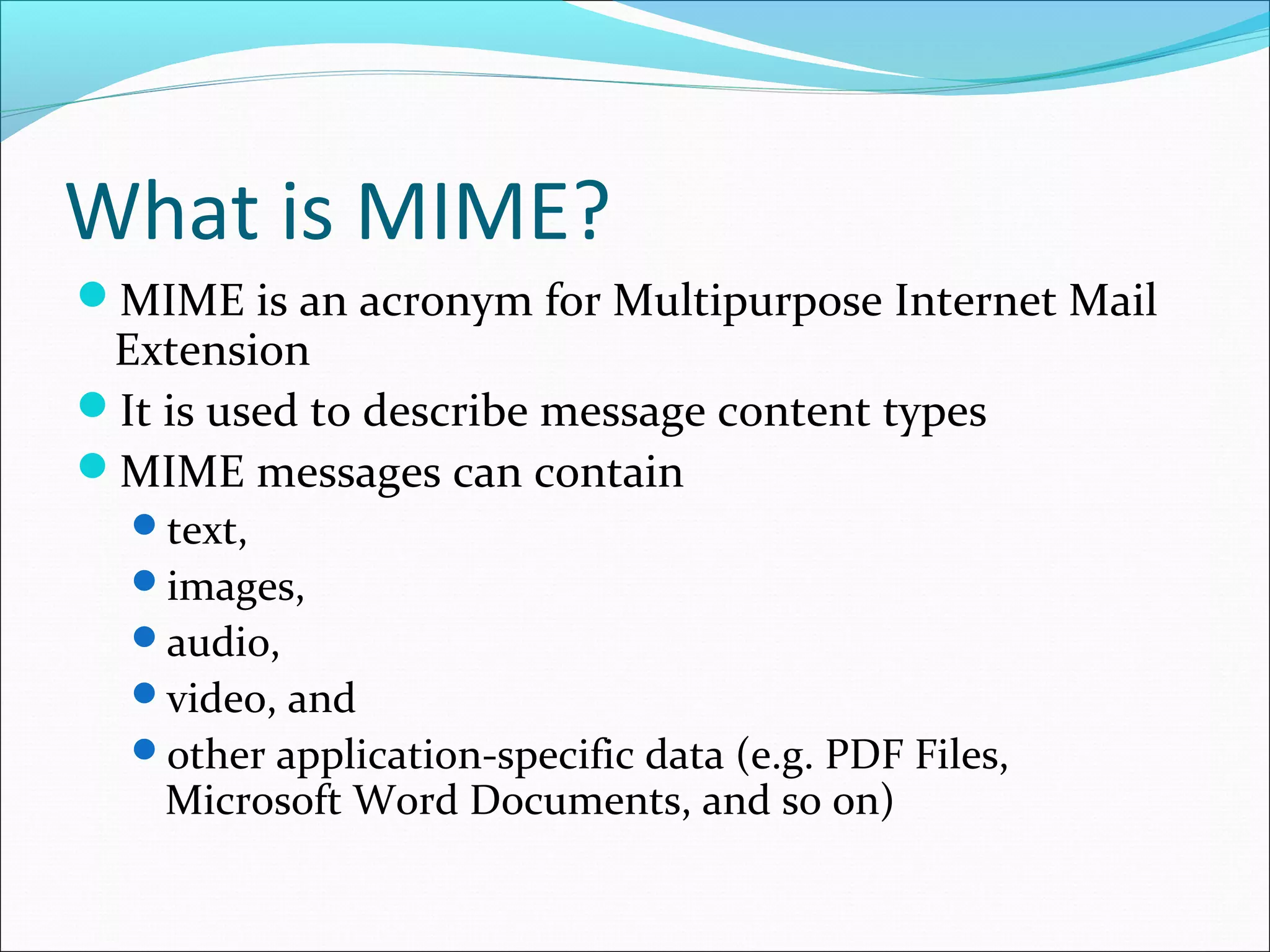
MIME is an acronym for Multipurpose Internet Mail
Extension
It is used to describe message content types
MIME messages can contain
text,
images,
audio,
video, and
other application-specific data (e.g. PDF Files,
Microsoft Word Documents, and so on)
What is it used for?
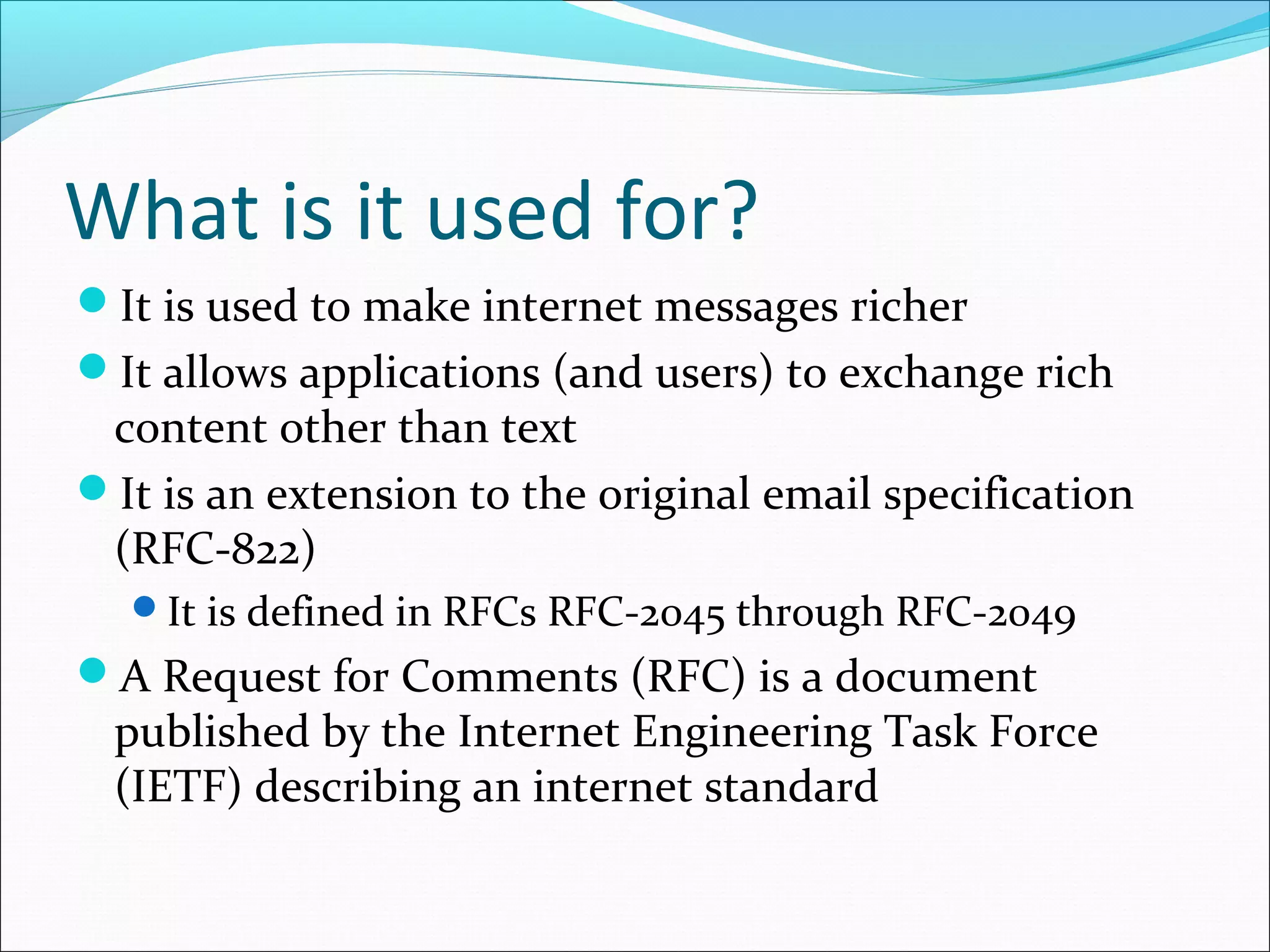
It is used to make internet messages richer
It allows applications (and users) to exchange rich
content other than text
It is an extension to the original email specification
(RFC-822)
It is defined in RFCs RFC-2045 through RFC-2049
A Request for Comments (RFC) is a document
published by the Internet Engineering Task Force
(IETF) describing an internet standard
MIME Format
MIME types are defined using a <type>/<subtype>
[optional parameters] format
Some typical examples are
MIME Type Extension(s)
text/plain txt
application/vnd.ms-excel xls
application/pdf pdf
text/html htm;html
text/css css
How is it used?
MIME is passed as part
of the content type of the
message header
Content-type:
text/plain; charset=“us-
ascii”
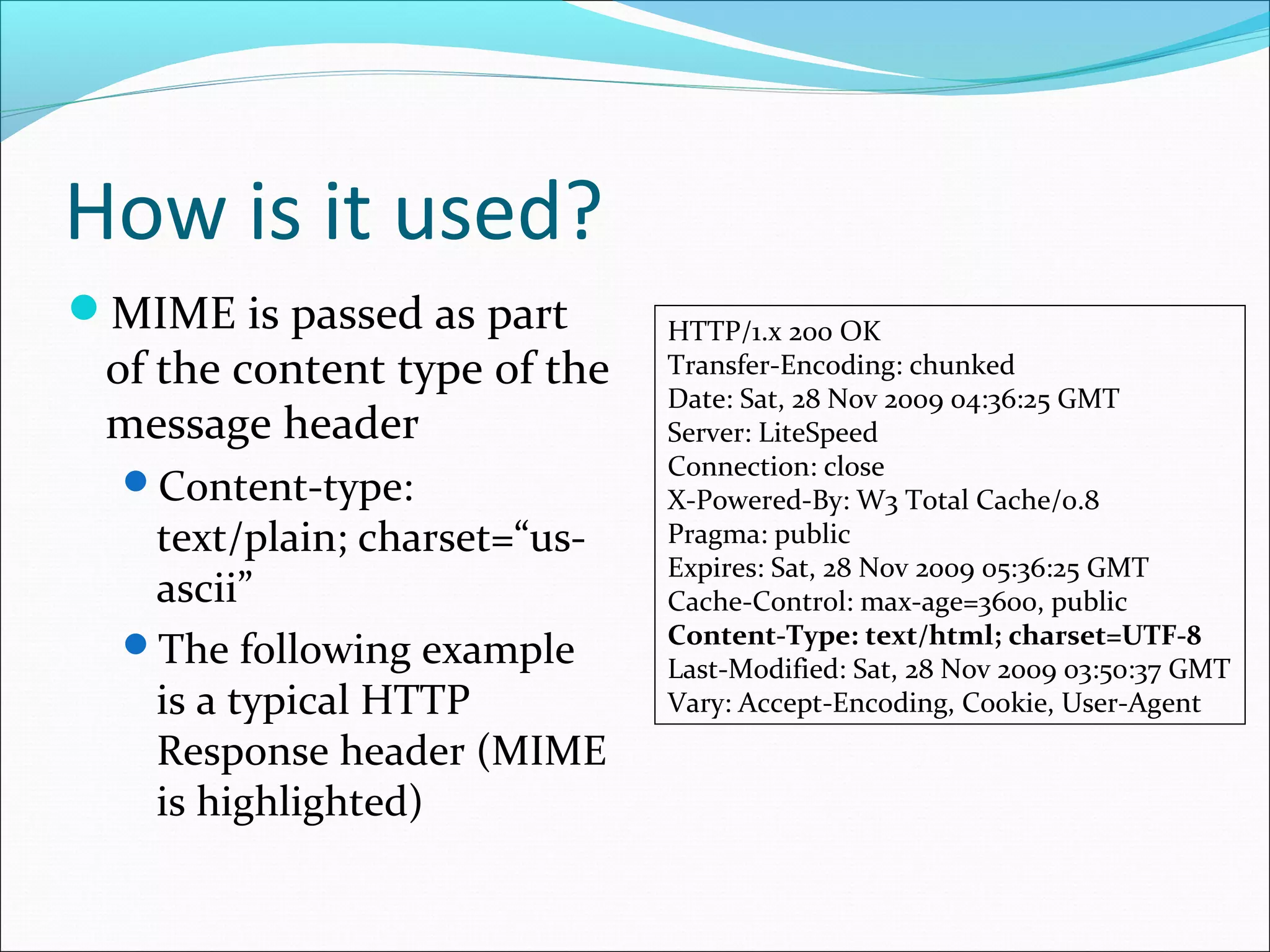
The following example
is a typical HTTP
Response header (MIME
is highlighted)
HTTP/1.x 200 OK
Transfer-Encoding: chunked
Date: Sat, 28 Nov 2009 04:36:25 GMT
Server: LiteSpeed
Connection: close
X-Powered-By: W3 Total Cache/0.8
Pragma: public
Expires: Sat, 28 Nov 2009 05:36:25 GMT
Cache-Control: max-age=3600, public
Content-Type: text/html; charset=UTF-8
Last-Modified: Sat, 28 Nov 2009 03:50:37 GMT
Vary: Accept-Encoding, Cookie, User-Agent
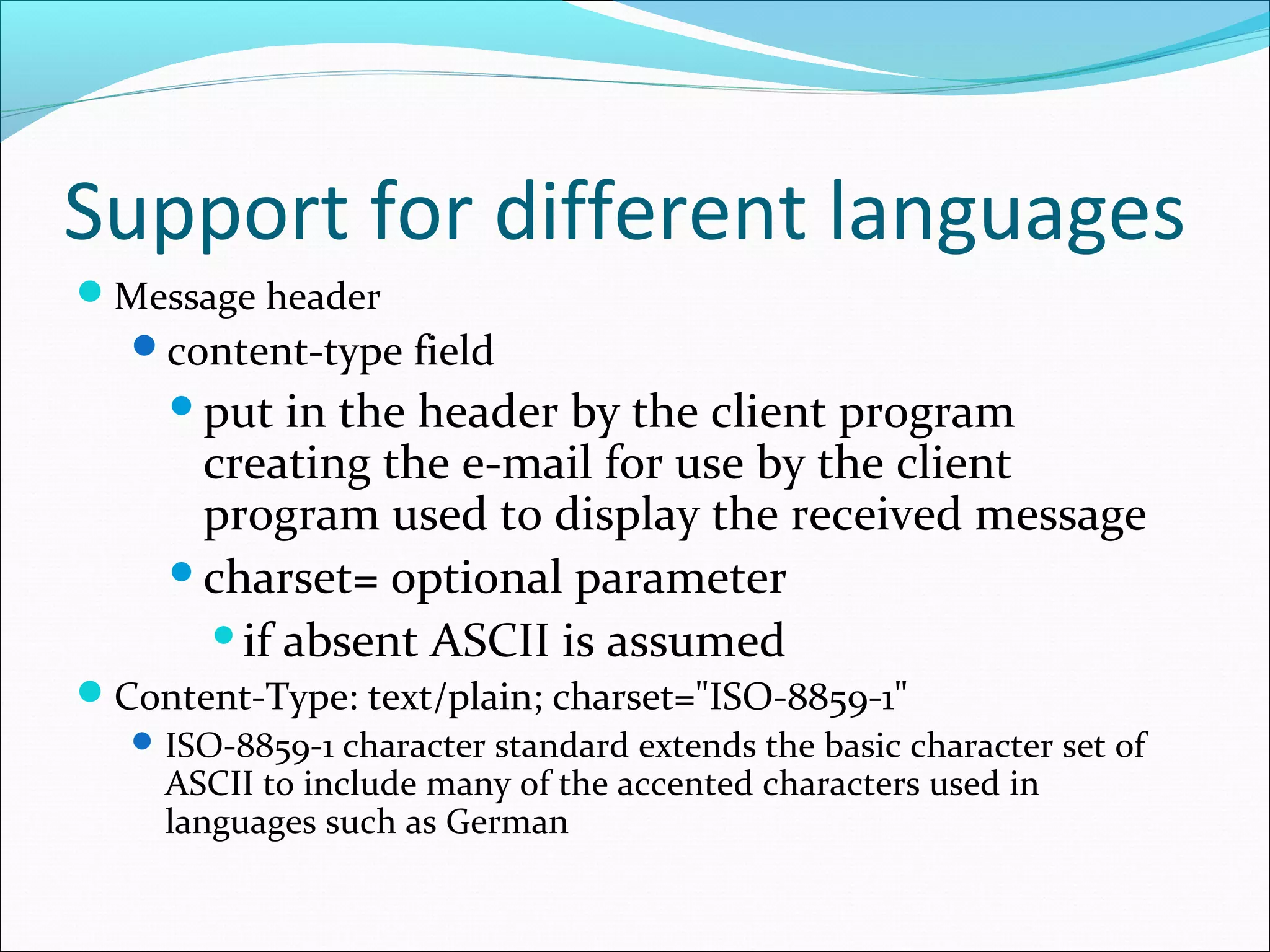
Support for different languages
Message header
content-type field
put in the header by the client program
creating the e-mail for use by the client
program used to display the received message
charset= optional parameter
if absent ASCII is assumed
Content-Type: text/plain; charset="ISO-8859-1"
ISO-8859-1 character standard extends the basic character set of
ASCII to include many of the accented characters used in
languages such as German
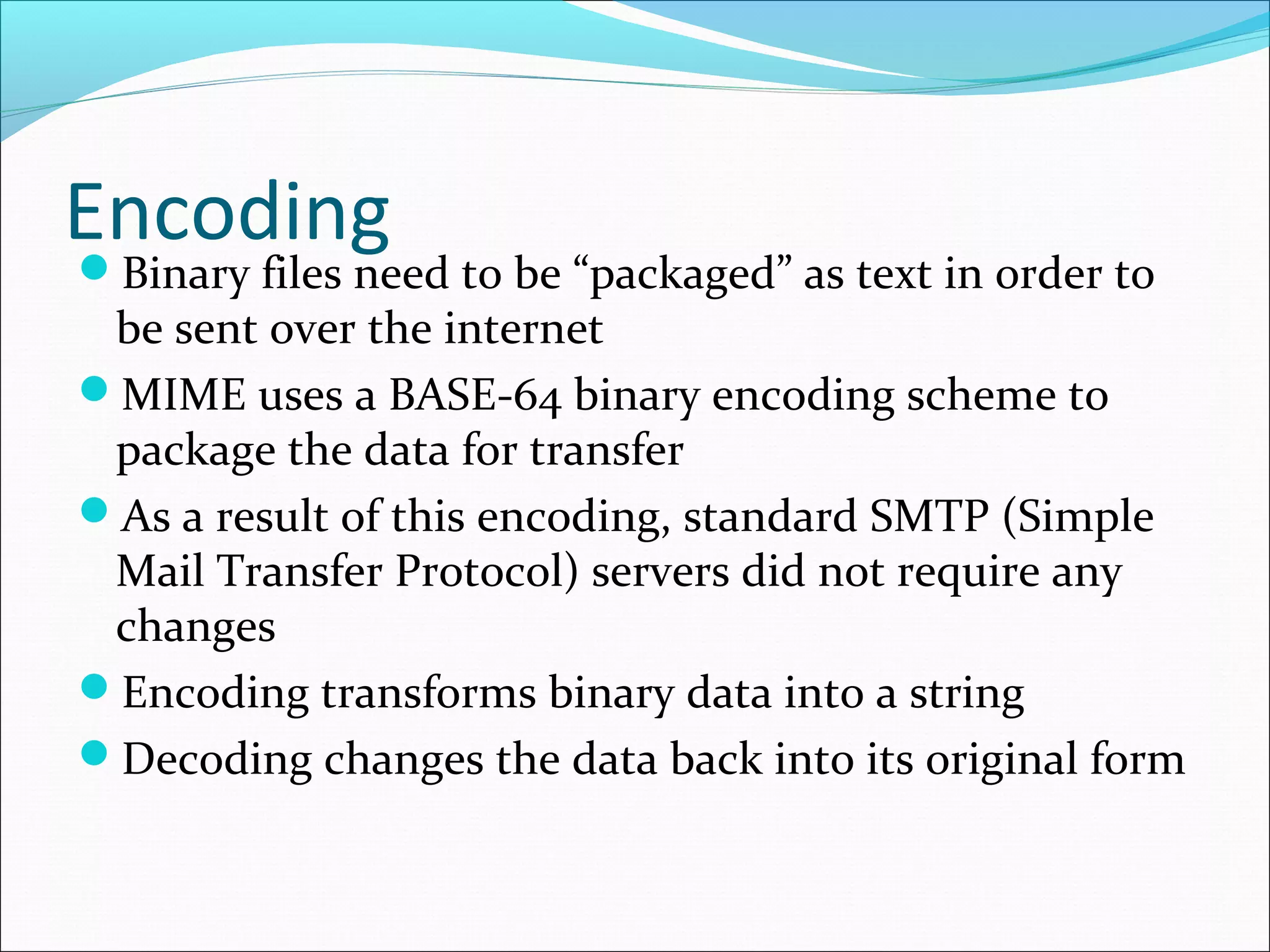
EncodingBinary files need to be “packaged” as text in order to
be sent over the internet
MIME uses a BASE-64 binary encoding scheme to
package the data for transfer
As a result of this encoding, standard SMTP (Simple
Mail Transfer Protocol) servers did not require any
changes
Encoding transforms binary data into a string
Decoding changes the data back into its original form
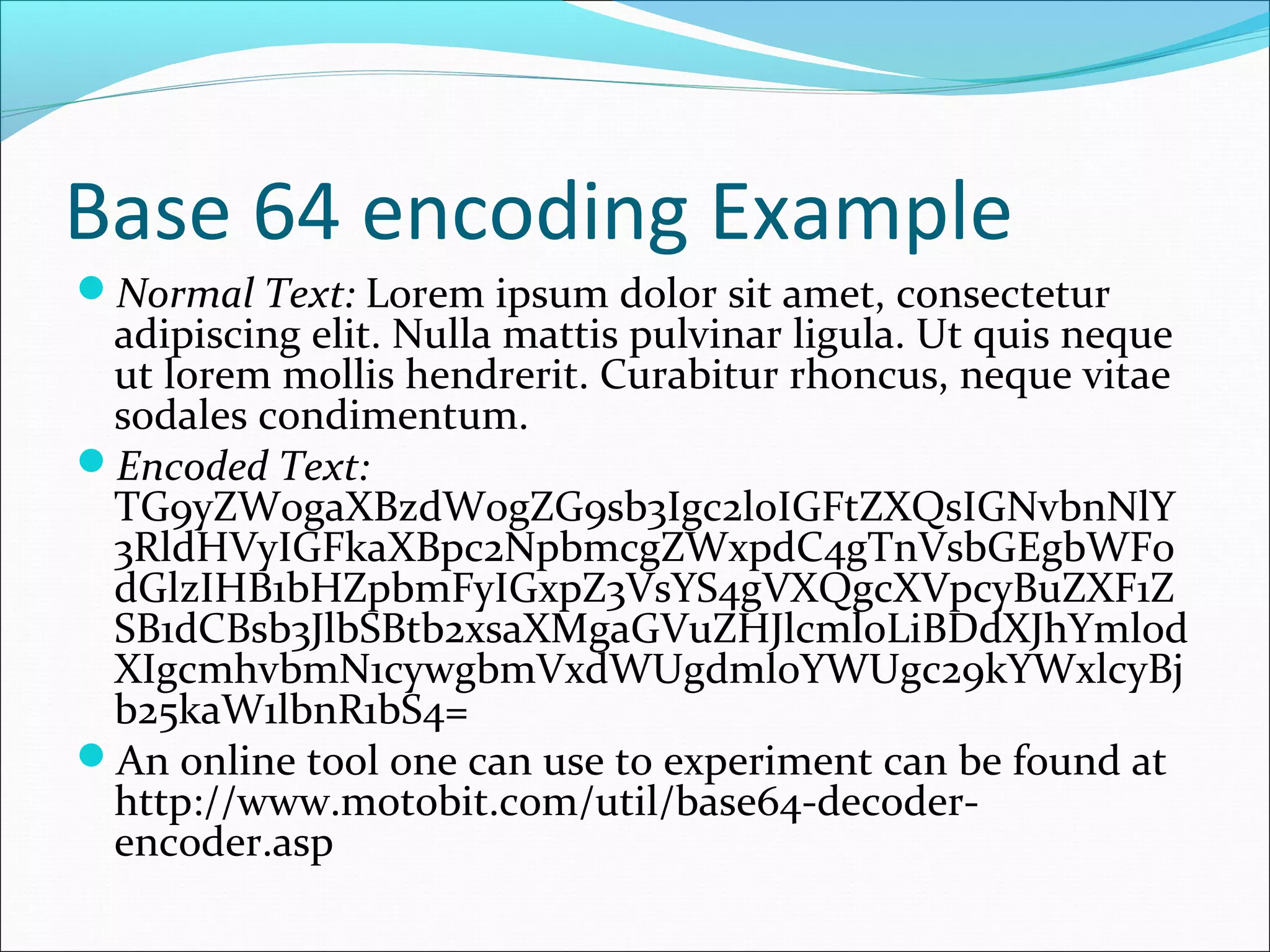
Base 64 encoding Example
Normal Text: Lorem ipsum dolor sit amet, consectetur
adipiscing elit. Nulla mattis pulvinar ligula. Ut quis neque
ut lorem mollis hendrerit. Curabitur rhoncus, neque vitae
sodales condimentum.
Encoded Text:
TG9yZW0gaXBzdW0gZG9sb3Igc2l0IGFtZXQsIGNvbnNlY
3RldHVyIGFkaXBpc2NpbmcgZWxpdC4gTnVsbGEgbWF0
dGlzIHB1bHZpbmFyIGxpZ3VsYS4gVXQgcXVpcyBuZXF1Z
SB1dCBsb3JlbSBtb2xsaXMgaGVuZHJlcml0LiBDdXJhYml0d
XIgcmhvbmN1cywgbmVxdWUgdml0YWUgc29kYWxlcyBj
b25kaW1lbnR1bS4=
An online tool one can use to experiment can be found at
http://www.motobit.com/util/base64-decoder-
encoder.asp
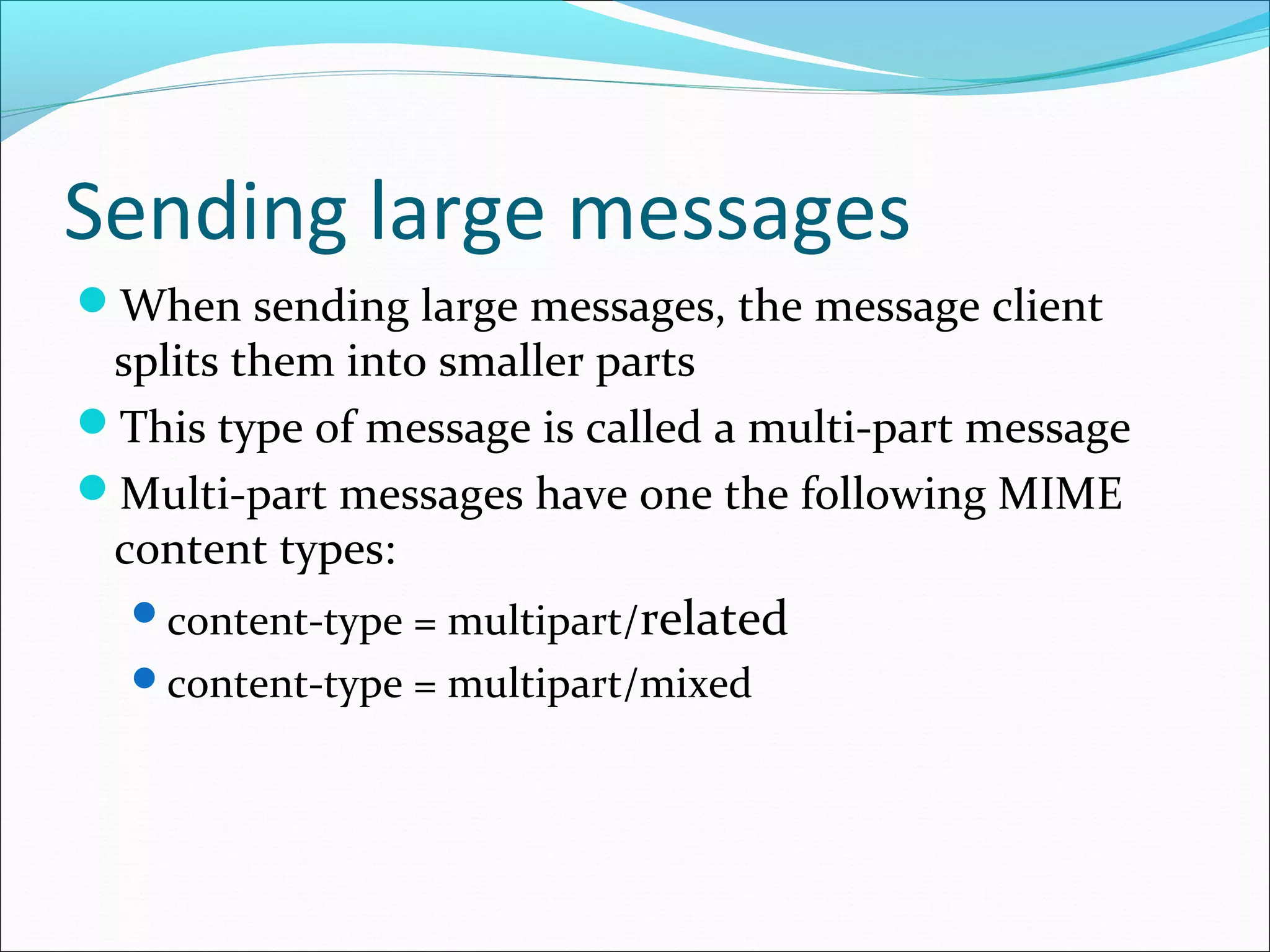
Sending large messages
When sending large messages, the message client
splits them into smaller parts
This type of message is called a multi-part message
Multi-part messages have one the following MIME
content types:
content-type = multipart/related
content-type = multipart/mixed
Further Reading
MIME Reference. In MIME Types. Retrieved from
http://www.w3schools.com/media/media_mimeref.asp
accessed, on 21 December 2010
Borenstein, N & Freed, N. (1996). Multipurpose
Internet Mail Extensions (MIME) Part One: Format of
Internet Message Bodies. Retrieved
fromhttp://tools.ietf.org/html/rfc2045, on 21st
December 2010.
Further Reading
Kozierok, C. M. (2005). TCP/IP Enhanced Electronic
Mail Message Format: Multipurpose Internet Mail
Extensions (MIME). In The TCP/IP Guide. Retrieved
from
http://www.tcpipguide.com/free/t_MIMEContentTyp
eHeaderandDiscreteMediaTypesSubtypes.htm, on 21st
December 2010.
Josefsson, S. (2006). The Base16, Base32, and Base 62
Data Encodings.http://tools.ietf.org/html/rfc4648
accessed on 21st
December 2010.

Mime

  • 1.
  • 2.
    What is MIME? MIMEis an acronym for Multipurpose Internet Mail Extension It is used to describe message content types MIME messages can contain text, images, audio, video, and other application-specific data (e.g. PDF Files, Microsoft Word Documents, and so on)
  • 3.
    What is itused for? It is used to make internet messages richer It allows applications (and users) to exchange rich content other than text It is an extension to the original email specification (RFC-822) It is defined in RFCs RFC-2045 through RFC-2049 A Request for Comments (RFC) is a document published by the Internet Engineering Task Force (IETF) describing an internet standard
  • 4.
    MIME Format MIME typesare defined using a <type>/<subtype> [optional parameters] format Some typical examples are MIME Type Extension(s) text/plain txt application/vnd.ms-excel xls application/pdf pdf text/html htm;html text/css css
  • 5.
    How is itused? MIME is passed as part of the content type of the message header Content-type: text/plain; charset=“us- ascii” The following example is a typical HTTP Response header (MIME is highlighted) HTTP/1.x 200 OK Transfer-Encoding: chunked Date: Sat, 28 Nov 2009 04:36:25 GMT Server: LiteSpeed Connection: close X-Powered-By: W3 Total Cache/0.8 Pragma: public Expires: Sat, 28 Nov 2009 05:36:25 GMT Cache-Control: max-age=3600, public Content-Type: text/html; charset=UTF-8 Last-Modified: Sat, 28 Nov 2009 03:50:37 GMT Vary: Accept-Encoding, Cookie, User-Agent
  • 6.
    Support for differentlanguages Message header content-type field put in the header by the client program creating the e-mail for use by the client program used to display the received message charset= optional parameter if absent ASCII is assumed Content-Type: text/plain; charset="ISO-8859-1" ISO-8859-1 character standard extends the basic character set of ASCII to include many of the accented characters used in languages such as German
  • 7.
    EncodingBinary files needto be “packaged” as text in order to be sent over the internet MIME uses a BASE-64 binary encoding scheme to package the data for transfer As a result of this encoding, standard SMTP (Simple Mail Transfer Protocol) servers did not require any changes Encoding transforms binary data into a string Decoding changes the data back into its original form
  • 8.
    Base 64 encodingExample Normal Text: Lorem ipsum dolor sit amet, consectetur adipiscing elit. Nulla mattis pulvinar ligula. Ut quis neque ut lorem mollis hendrerit. Curabitur rhoncus, neque vitae sodales condimentum. Encoded Text: TG9yZW0gaXBzdW0gZG9sb3Igc2l0IGFtZXQsIGNvbnNlY 3RldHVyIGFkaXBpc2NpbmcgZWxpdC4gTnVsbGEgbWF0 dGlzIHB1bHZpbmFyIGxpZ3VsYS4gVXQgcXVpcyBuZXF1Z SB1dCBsb3JlbSBtb2xsaXMgaGVuZHJlcml0LiBDdXJhYml0d XIgcmhvbmN1cywgbmVxdWUgdml0YWUgc29kYWxlcyBj b25kaW1lbnR1bS4= An online tool one can use to experiment can be found at http://www.motobit.com/util/base64-decoder- encoder.asp
  • 9.
    Sending large messages Whensending large messages, the message client splits them into smaller parts This type of message is called a multi-part message Multi-part messages have one the following MIME content types: content-type = multipart/related content-type = multipart/mixed
  • 10.
    Further Reading MIME Reference.In MIME Types. Retrieved from http://www.w3schools.com/media/media_mimeref.asp accessed, on 21 December 2010 Borenstein, N & Freed, N. (1996). Multipurpose Internet Mail Extensions (MIME) Part One: Format of Internet Message Bodies. Retrieved fromhttp://tools.ietf.org/html/rfc2045, on 21st December 2010.
  • 11.
    Further Reading Kozierok, C.M. (2005). TCP/IP Enhanced Electronic Mail Message Format: Multipurpose Internet Mail Extensions (MIME). In The TCP/IP Guide. Retrieved from http://www.tcpipguide.com/free/t_MIMEContentTyp eHeaderandDiscreteMediaTypesSubtypes.htm, on 21st December 2010. Josefsson, S. (2006). The Base16, Base32, and Base 62 Data Encodings.http://tools.ietf.org/html/rfc4648 accessed on 21st December 2010.