John Gavazzi, PsyD ABPP
       November 1, 2012
   Learning Objectives

   Online Information: Ethics blog and other sites

   Structured information sharing

   Vignette analysis and case discussions
1.   List at least three ethical principles related to APA’s
     code

2.   Compare and contrast positive ethics and risk
     management

3.   Describe the Acculturation Model

4.   Explain one ethical decision-making model

5.   Analyze one ethical vignette by identifying conflicting
     principles
www.papsyblog.org
Where Ethics is More Than a Code and
  Positive Ethics is more than a Slogan
   Ethics Blog

   Self-education

   Connecting with others: Blogs & other sites

   Becoming politically active
   Introduction and Applicability

   Preamble and General Principles
    (Aspirational and based on principle-based ethics)

   Ethical Standards (Enforceable and represent
    minimum standards)
   The ethics code does not include federal laws,
    such as HIPAA
   The ethics code does not include case law, though
    influence is noted
   The ethics code is distinct and separate from
    guidelines approved by the APA Council of
    Representatives

   Quiz Question: How many are there?
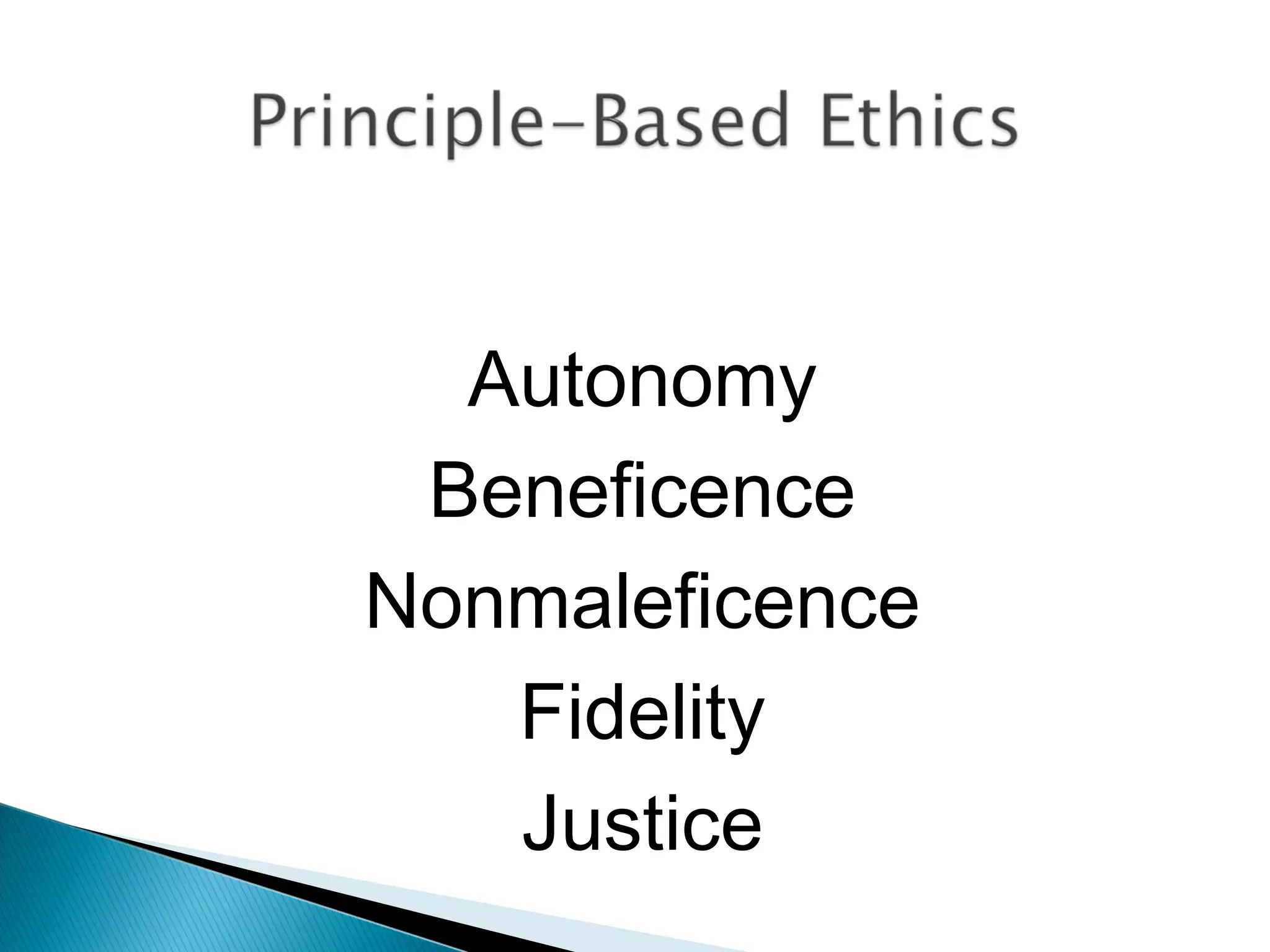
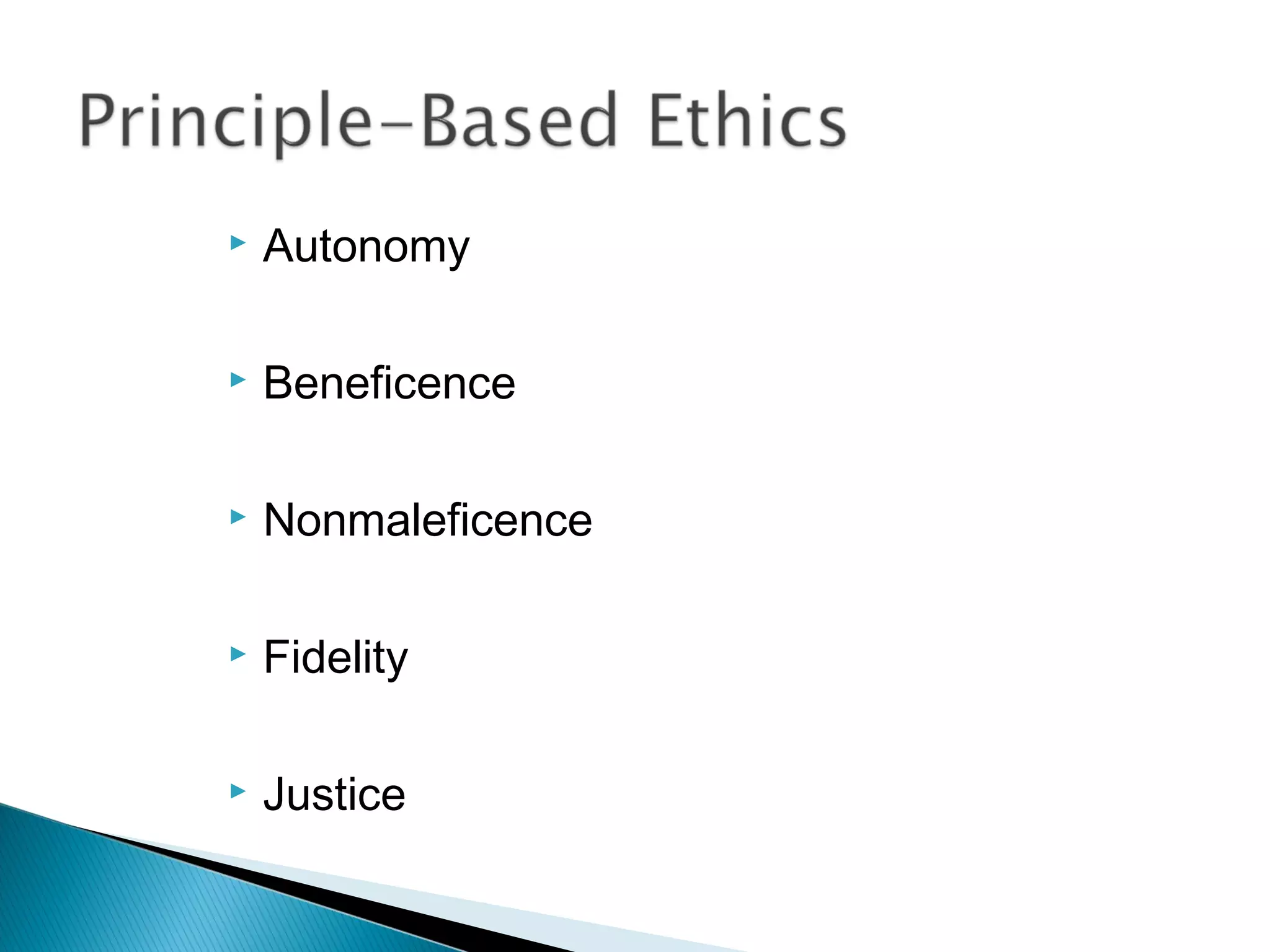
Autonomy
 Beneficence
Nonmaleficence
   Fidelity
   Justice
   Does not mean promoting autonomy (individuation
    or separation)

   Means respecting the autonomous decision
    making ability of the patient
It encompasses freedom of thought and action.
   Individuals are at liberty to behave as they chose.

 - Determining goals in therapy


 - Making life decisions (e.g., marriage, divorce)


 - Scheduling appointments and terminating treatment
   The principle of benefiting others and accepting
    the responsibility to do good underlies the
    profession.

    - Providing the best treatment possible

    - Competency

    - Referring when needed
Basis of foundational standard 2.01

“Psychologists provide services, teach, and conduct
  research with populations and in areas only within
  the boundaries of their competence. . . “
The principle is doing no harm.

 - Demonstrating competence

 - Maintaining appropriate boundaries

 - Not using an experimental technique as the first
 line of treatment

 - Providing benefits, risks, and costs
Foundational Standard 3.04

“Psychologists take reasonable steps to avoid
  harming their clients/patients, students,
  supervisees, research participants, organizational
  clients, and others with whom they work, and to
  minimize harm when it is foreseeable and
  unavoidable.”
This principle refers to being faithful to
 commitments. Fidelity includes promise
 keeping, trustworthiness, and loyalty.

 - Avoiding conflicts of interests that could
 compromise therapy
 - Keeping information confidential
 - Adhering to therapeutic contract (e.g.,
 session length, time, phone contacts, etc.)
Foundational Standard 4.01

“Psychologists have a primary obligation and take
  reasonable precautions to protect confidential
  information.”
Justice primarily refers to treating people fairly and
                        equally.

    In their work-related activities, psychologists do not
  engage in unfair discrimination based on age, gender,
  gender identity, race, ethnicity, culture, national origin,
   religion, sexual orientation, disability, socioeconomic
        status, or any basis proscribed by law. (3.01)
   Ethics as a movement away from the
    punishment and anxiety-producing
    components of ethics

   Fulfill their highest ideals

   A means to help interpret and apply ethics
    standards
 Broadensa psychologist’s
 understanding of ethics in a larger
 context

 Sensitizepsychologists to ethical
 implications of decisions on a daily
 basis
 Heighten
         awareness related to ethics
 beyond our offices

 Assist
      psychologists in balancing
 competing ethical demands
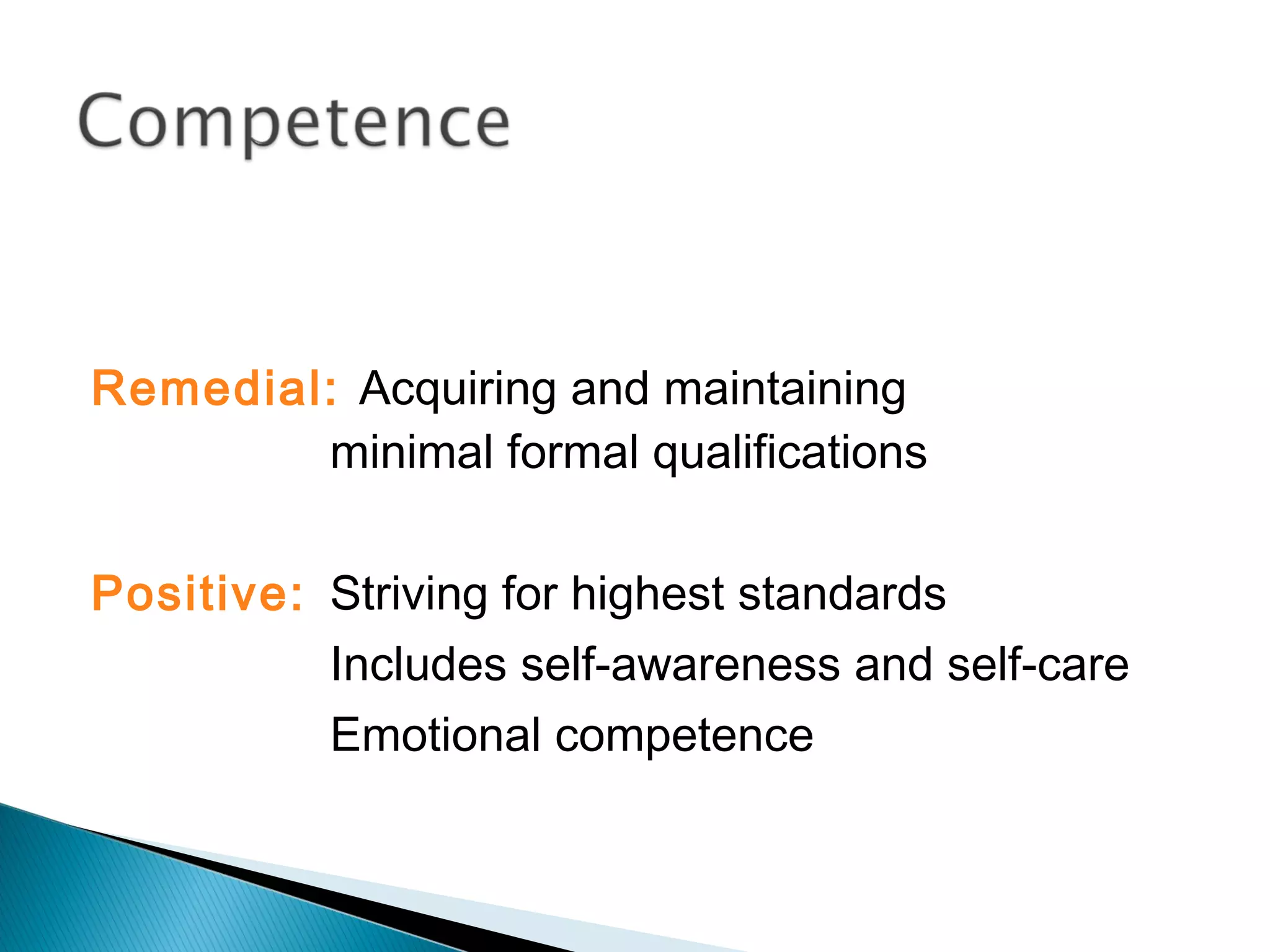
Remedial: Acquiring and maintaining
        minimal formal qualifications

Positive: Striving for highest standards
          Includes self-awareness and self-care
          Emotional competence
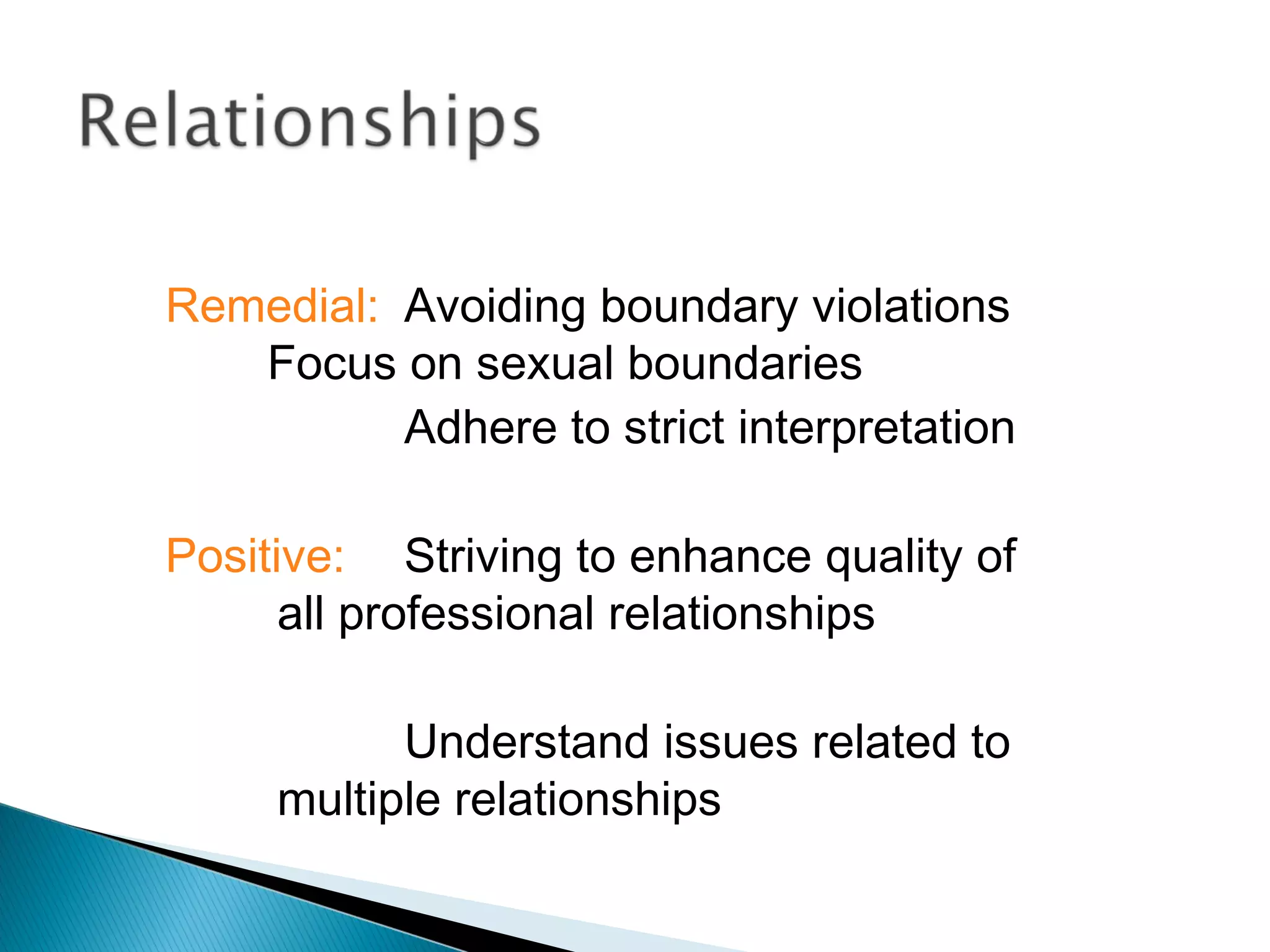
Remedial: Avoiding boundary violations
   Focus on sexual boundaries
          Adhere to strict interpretation

Positive: Striving to enhance quality of
      all professional relationships

           Understand issues related to
     multiple relationships
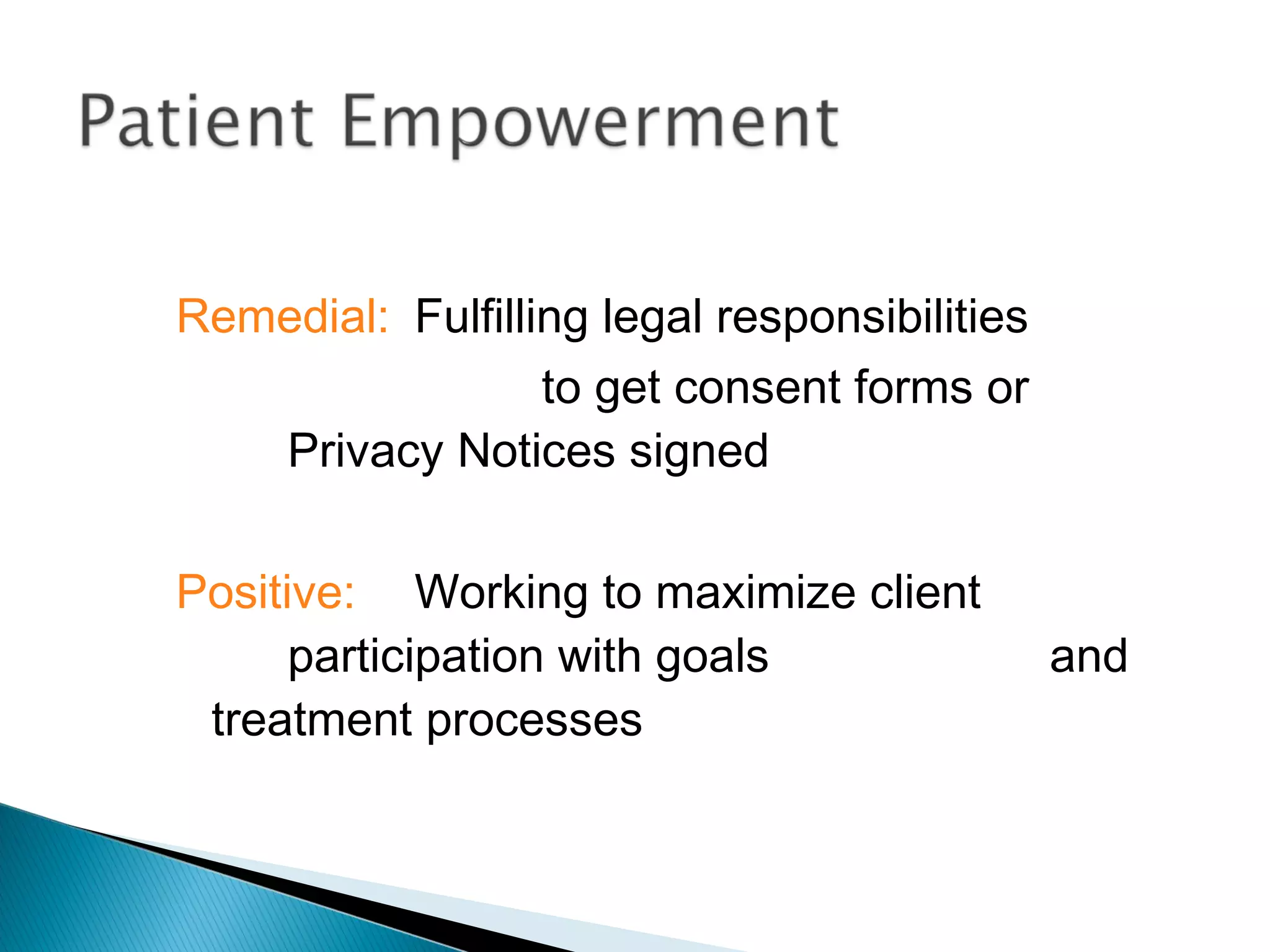
Remedial: Fulfilling legal responsibilities
                  to get consent forms or
   Privacy Notices signed

Positive: Working to maximize client
      participation with goals                and
 treatment processes
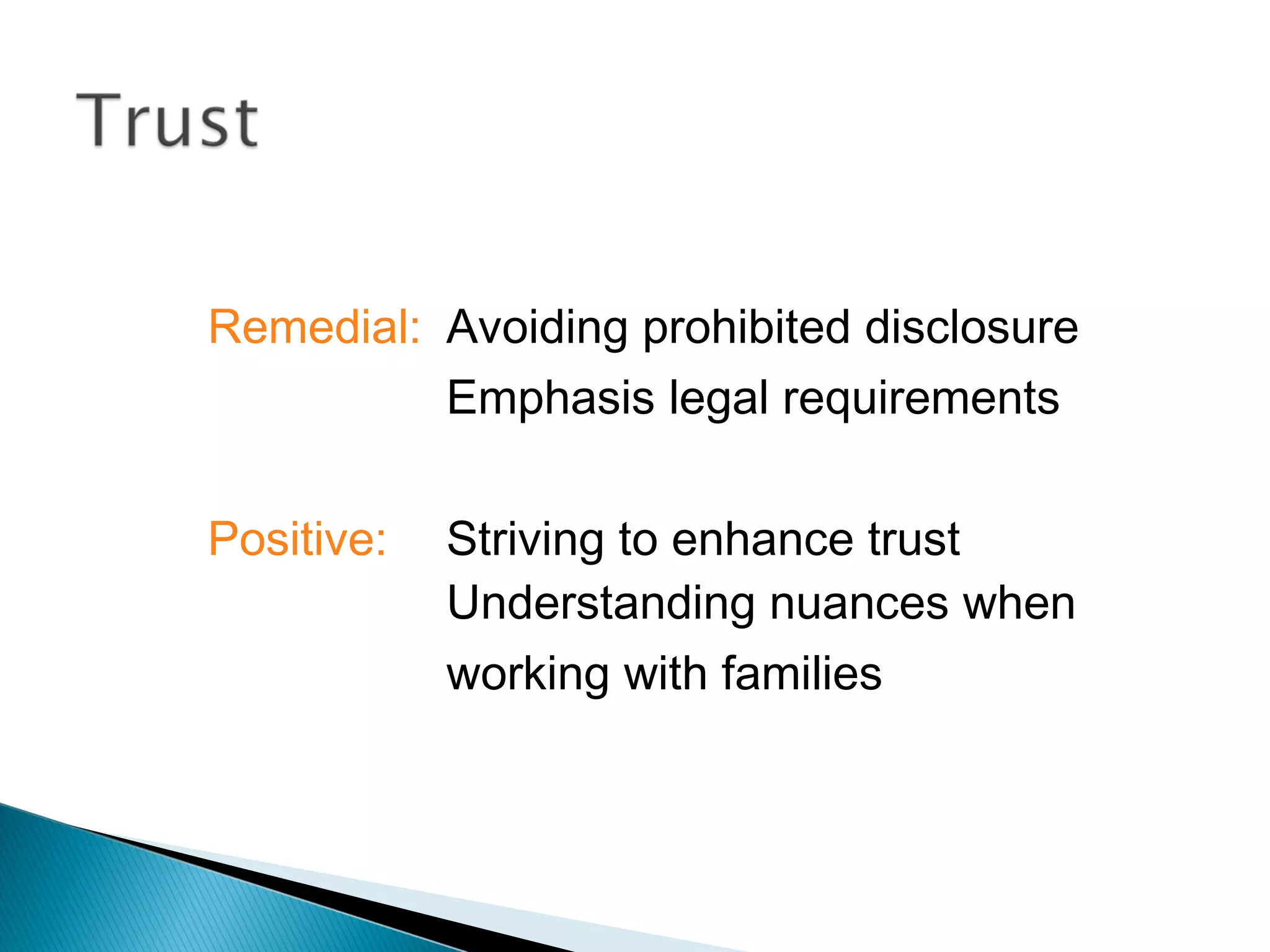
Remedial: Avoiding prohibited disclosure
          Emphasis legal requirements

Positive:   Striving to enhance trust
            Understanding nuances when
            working with families
A process to change the cultural behavior of an
  individual through contact with another culture.
 The process of acculturation occurs when there is
   an adaptation into an organization or society.

The process involves developing relationships with
   those within the culture to learn the traditions,
 rules, roles, and behaviors to become part of that
                 group or community.
   Our system of common beliefs, shared meanings,
    norms and traditions that distinguish psychologists
    as professionals.

   It is a learned set of skills, bases of knowledge
    and ethical beliefs, as described in our ethics
    code.
   Our culture of ethics moves beyond ourselves as
    individual psychologists.

   Expands into our ability to become connected with the
    profession of psychology as well as other
    professionals.

   Our ethical culture “happens” everyday when we relate
    to our patients, peers, or general population.
   Can be a complex process

   Some parts of a psychologist’s behaviors,
    practice, and lifestyle may be easily acculturated;
    while others will not

   Process that may continue throughout the
    education or career as a psychologist
   Ethics Autobiography

   Exploring religious upbringing

   Exploring interpersonal relationships
Meme: a cultural unit (an idea or value or pattern of
 behavior) that is passed from one person to
 another by non-genetic means (as by imitation);

"memes are the cultural counterpart of genes"
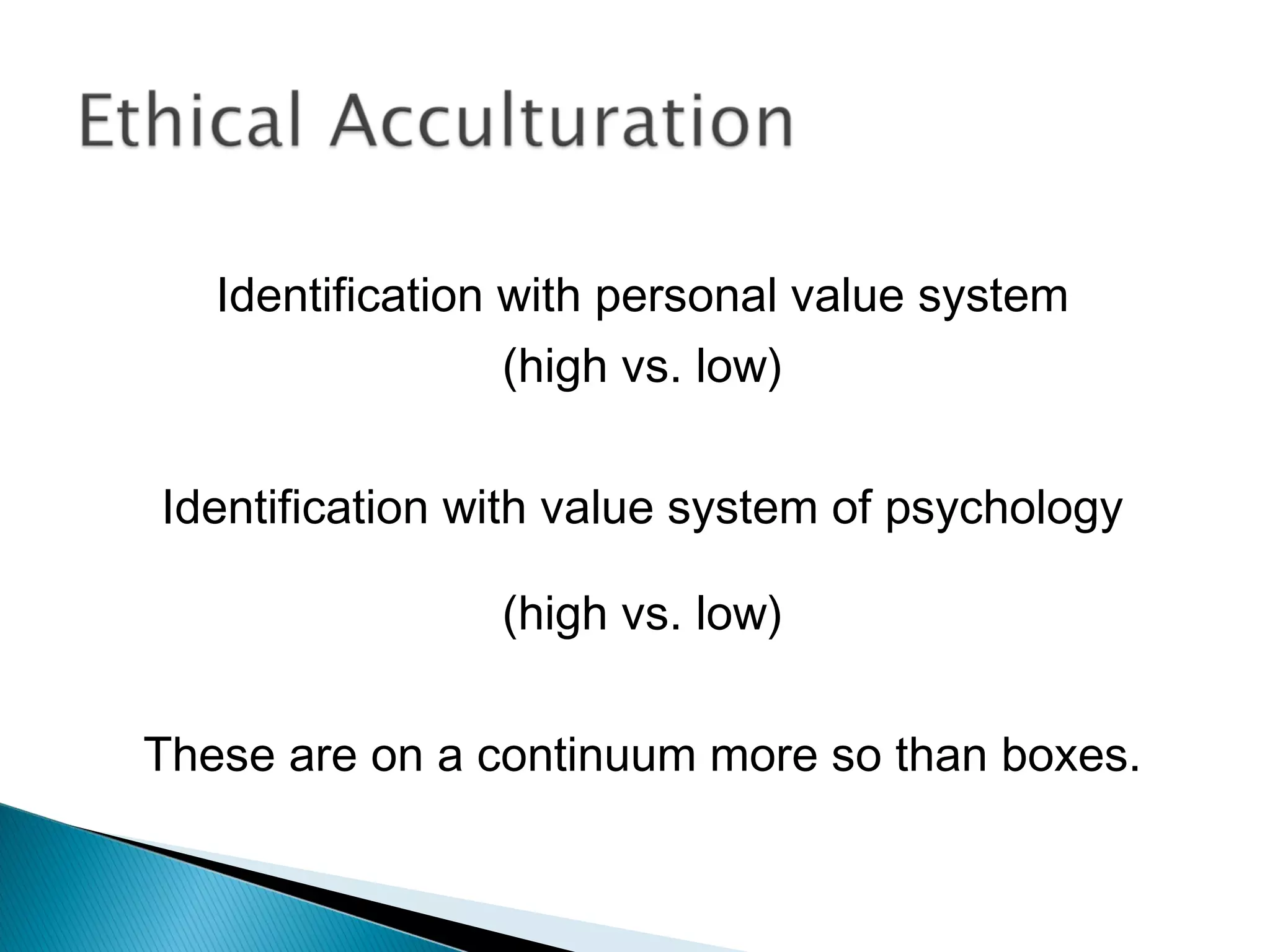
Identification with personal value system
                  (high vs. low)

Identification with value system of psychology

                (high vs. low)

These are on a continuum more so than boxes.
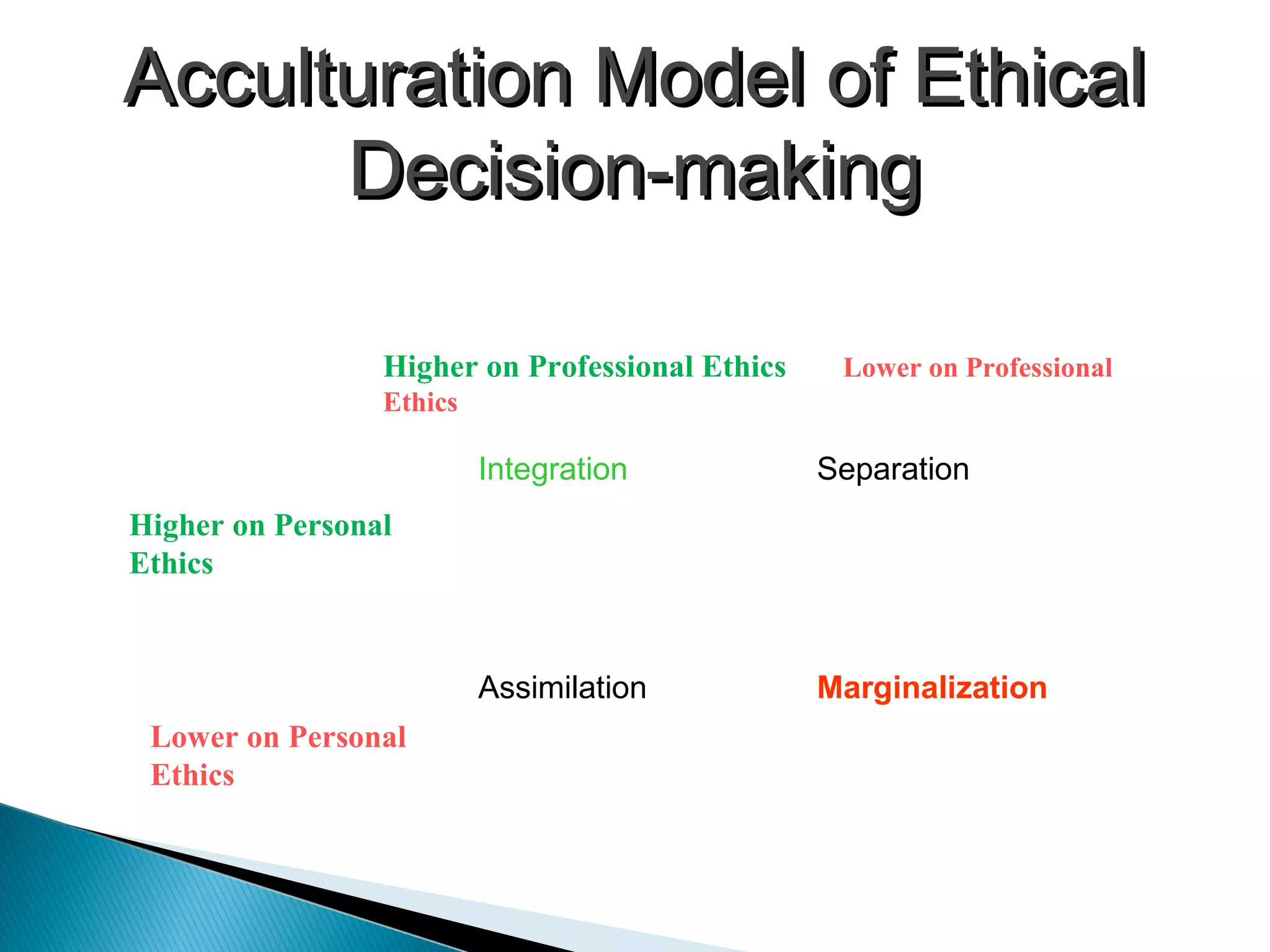
Acculturation Model of Ethical
      Decision-making

                 Higher on Professional Ethics    Lower on Professional
                 Ethics

                          Integration            Separation
Higher on Personal
Ethics


                          Assimilation           Marginalization
 Lower on Personal
 Ethics
Style: Lower focus on professional ethics
       Lower focus on personal ethics

Risks: Greatest risk of harm
       Lack appreciation for ethics
       Motivated by self-interest
       Less concern for patients
Style: Lower focus on professional ethics
       Higher focus on personal ethics

Risks: Compassion overrides good
        professional judgment
       Fail to recognize the unique role    of
 psychologists
Style: Higher focus on professional ethics
       Lower focus on personal ethics


Risks: Developing overly legalistic stance
       Rigidly conforming to individual rules
          while missing broader issues
Style: High focus on professional ethics
       High focus on personal ethics

Reward: Implement values in context of
    professional roles
        Reaching for the ethical ceiling
        Aspirational ethics
Our level of acculturation and our style of ethical
                                 decision-making
   Mandatory “floor”

   Minimum standards adopted by the
    profession

   Focus on the law or standards to protect the
    public
   Overemphasis on regulations and enforceable
    standards

   Incomplete view of ethics

   Ethics is more than just a code
   A means to reduce risk in an uncertain situation

   Decision-making strategies to avert problems or
    liability of the psychologist

   False risk management strategies (memes, such
    as the No Suicide Contract)
   No evidence to indicate that it helps reduce
    suicidal behavior

   Cannot be used an part of an assessment

   Contract implies a legal tool to reduce risk

   May actually harm the therapeutic alliance, not
    promote it
What are some options?
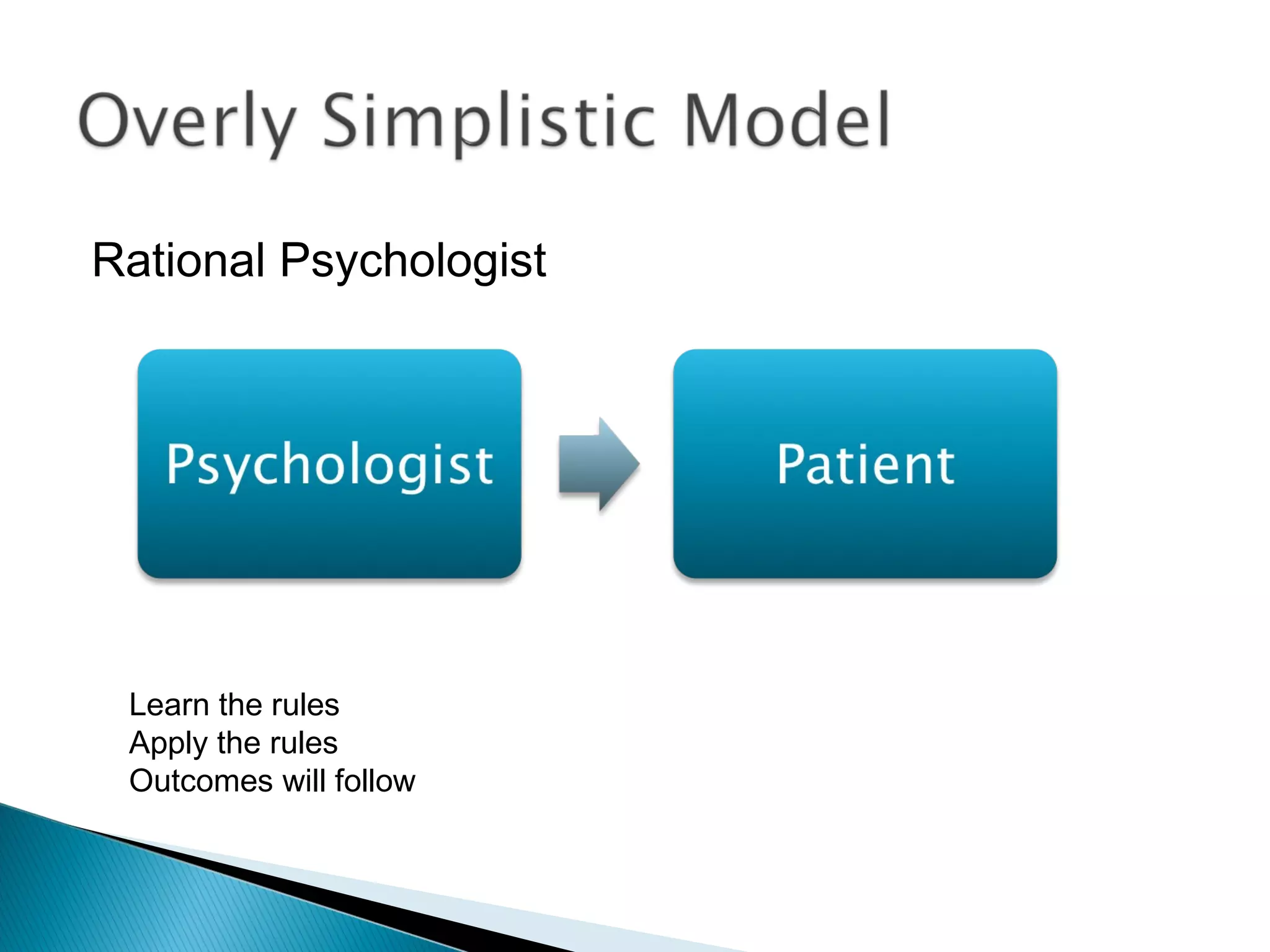
Rational Psychologist


 Learn the rules
 Apply the rules
 Outcomes will follow
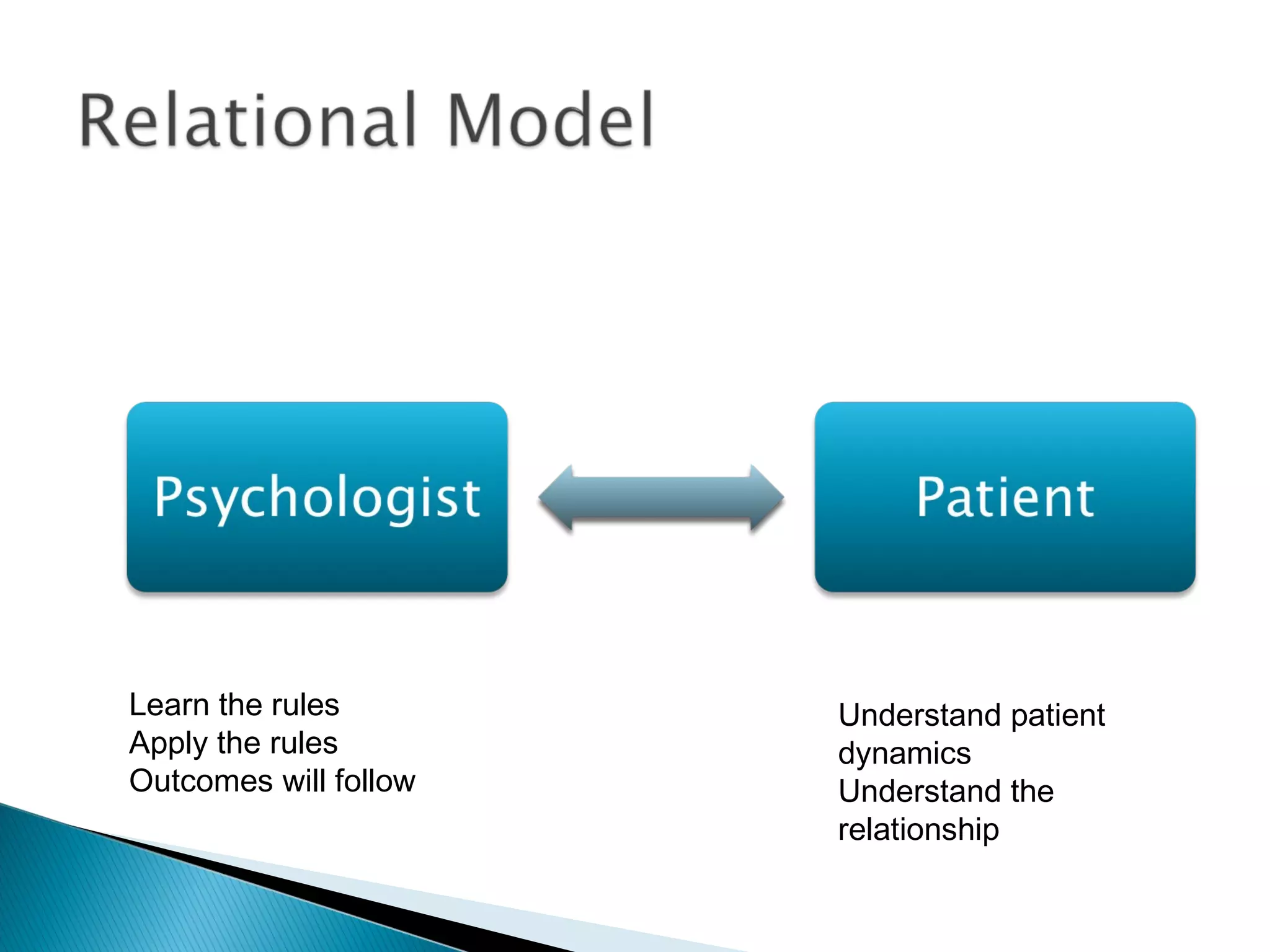
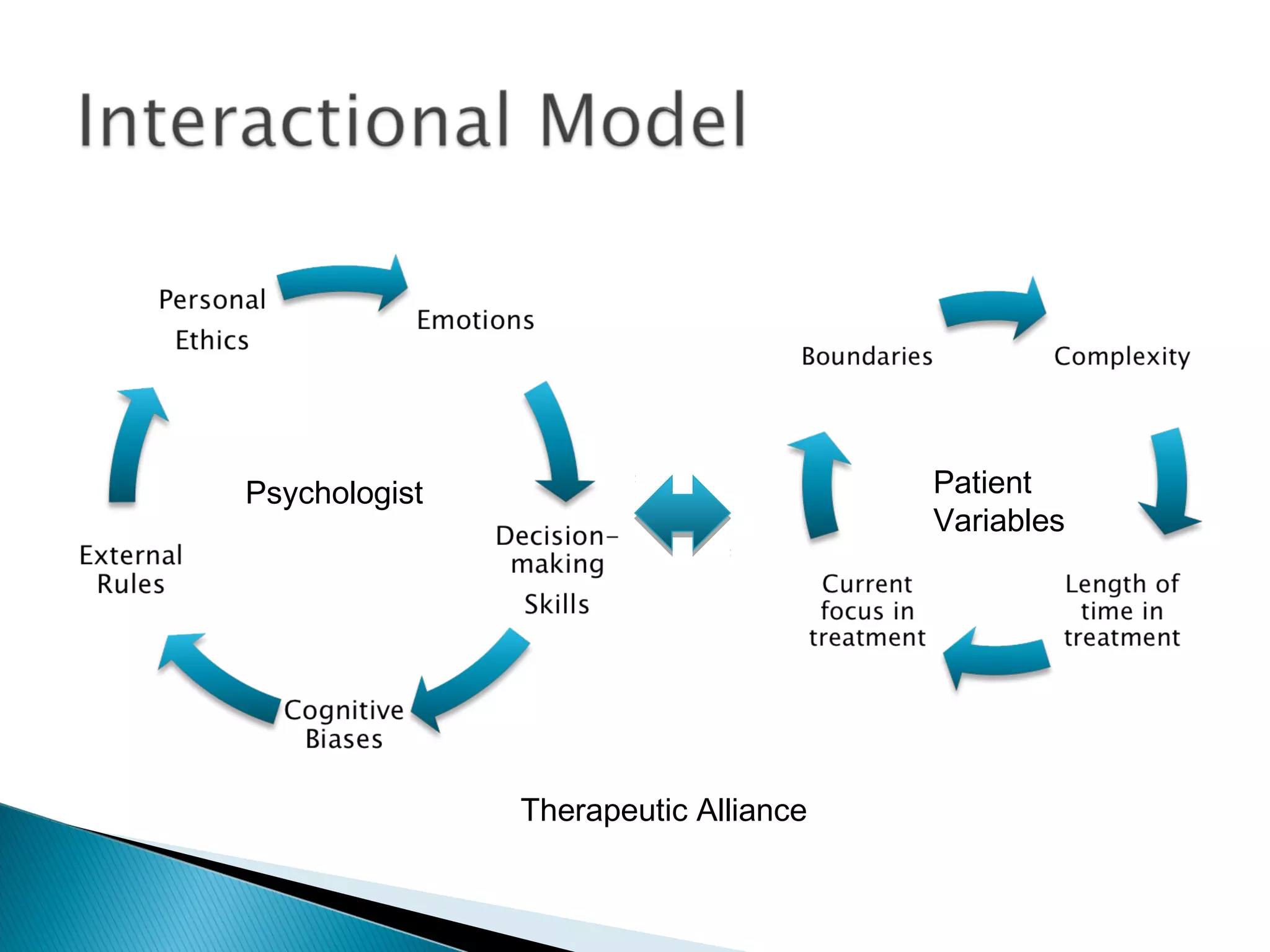
Learn the rules        Understand patient
Apply the rules        dynamics
Outcomes will follow   Understand the
                       relationship
Psychologist                          Patient
                                      Variables


               Therapeutic Alliance
   Looking at how well a psychologist integrates
    his/her values and behaviors into the ethical
    culture of psychology

   Psychology has a set of normative principles and
    behaviors related to ethical behavior and
    appropriate conduct
   APA’s Code of Conduct

   Commonwealth Psychology regulations found in
    the Psychology Law and Practice Act

   Federal Regulations, such as HIPAA

   Court decisions aka case law
The APA Ethical Principles and Code of
    Conduct do not include a model of
        ethical decision-making

Other resources dictate behavior, but do not
  highlight how to work through dilemmas
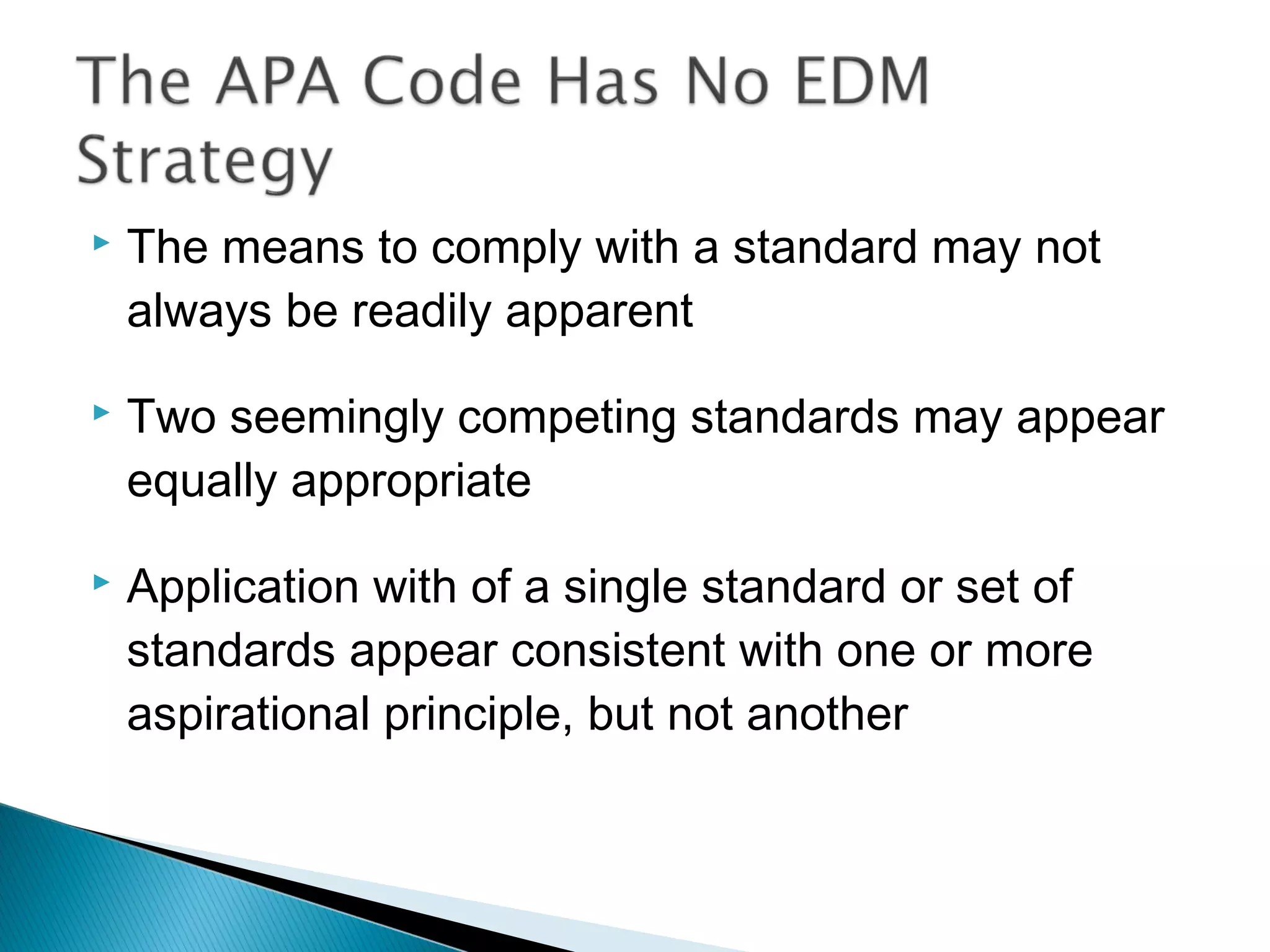
   The means to comply with a standard may not
    always be readily apparent

   Two seemingly competing standards may appear
    equally appropriate

   Application with of a single standard or set of
    standards appear consistent with one or more
    aspirational principle, but not another
   Autonomy

   Beneficence

   Nonmaleficence

   Fidelity

   Justice
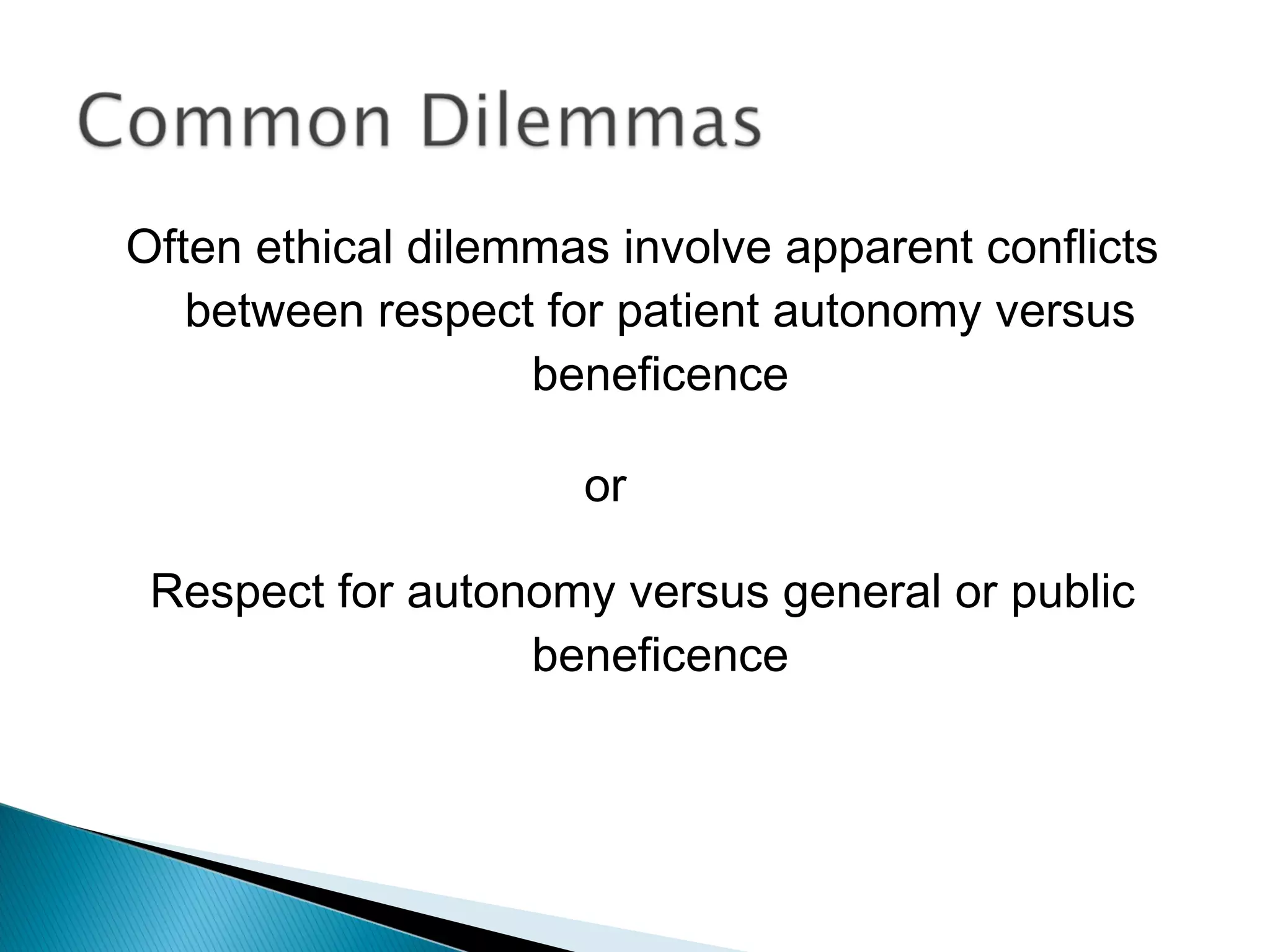
Often ethical dilemmas involve apparent conflicts
   between respect for patient autonomy versus
                   beneficence

                     or

 Respect for autonomy versus general or public
                  beneficence
   Identify the competing ethical principles

   Help to determine which principle has precedence
    and why

   The importance of emotion in ethical decision-
    making and moral judgments
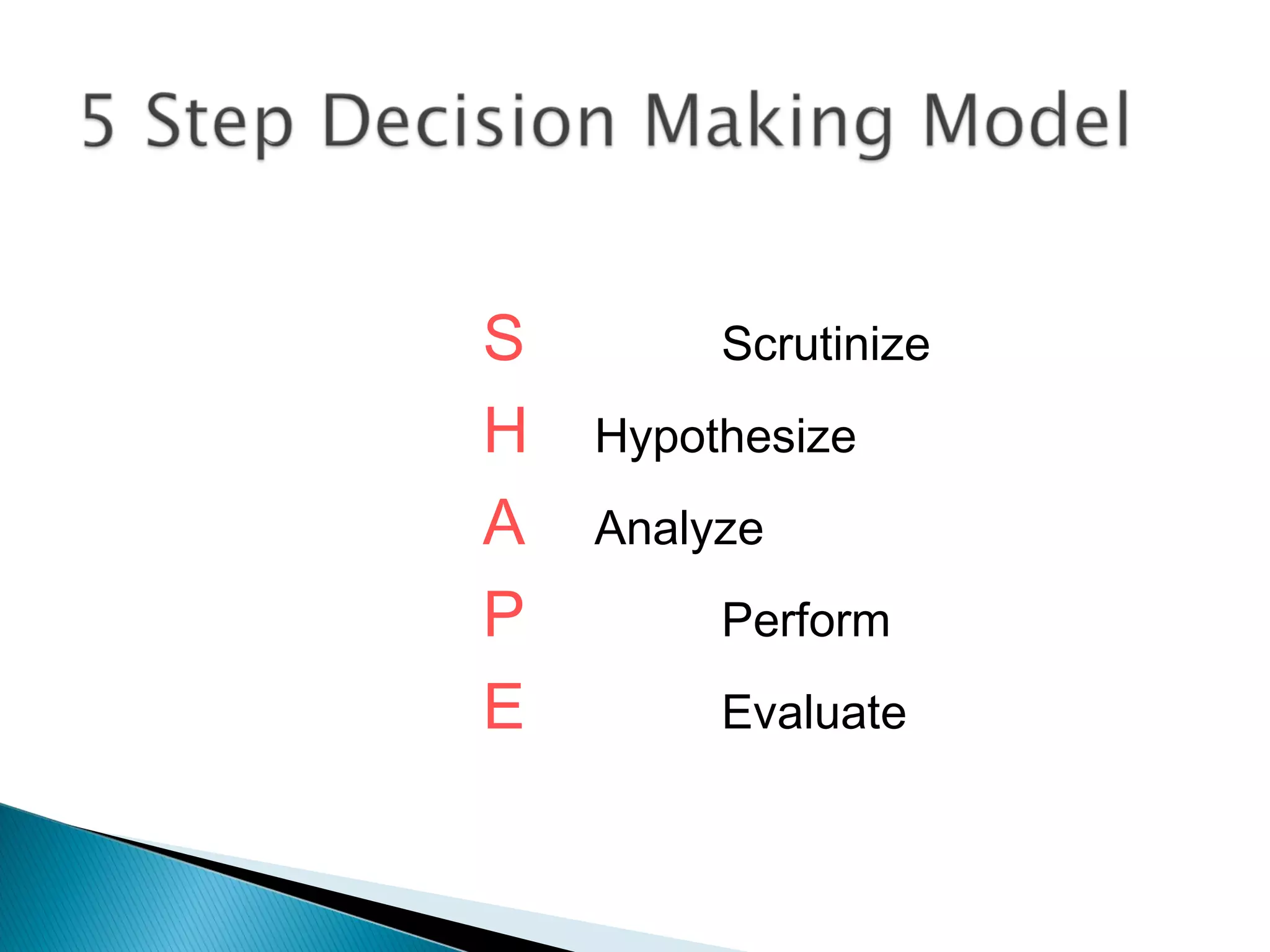
S        Scrutinize
H   Hypothesize
A   Analyze
P        Perform
E        Evaluate
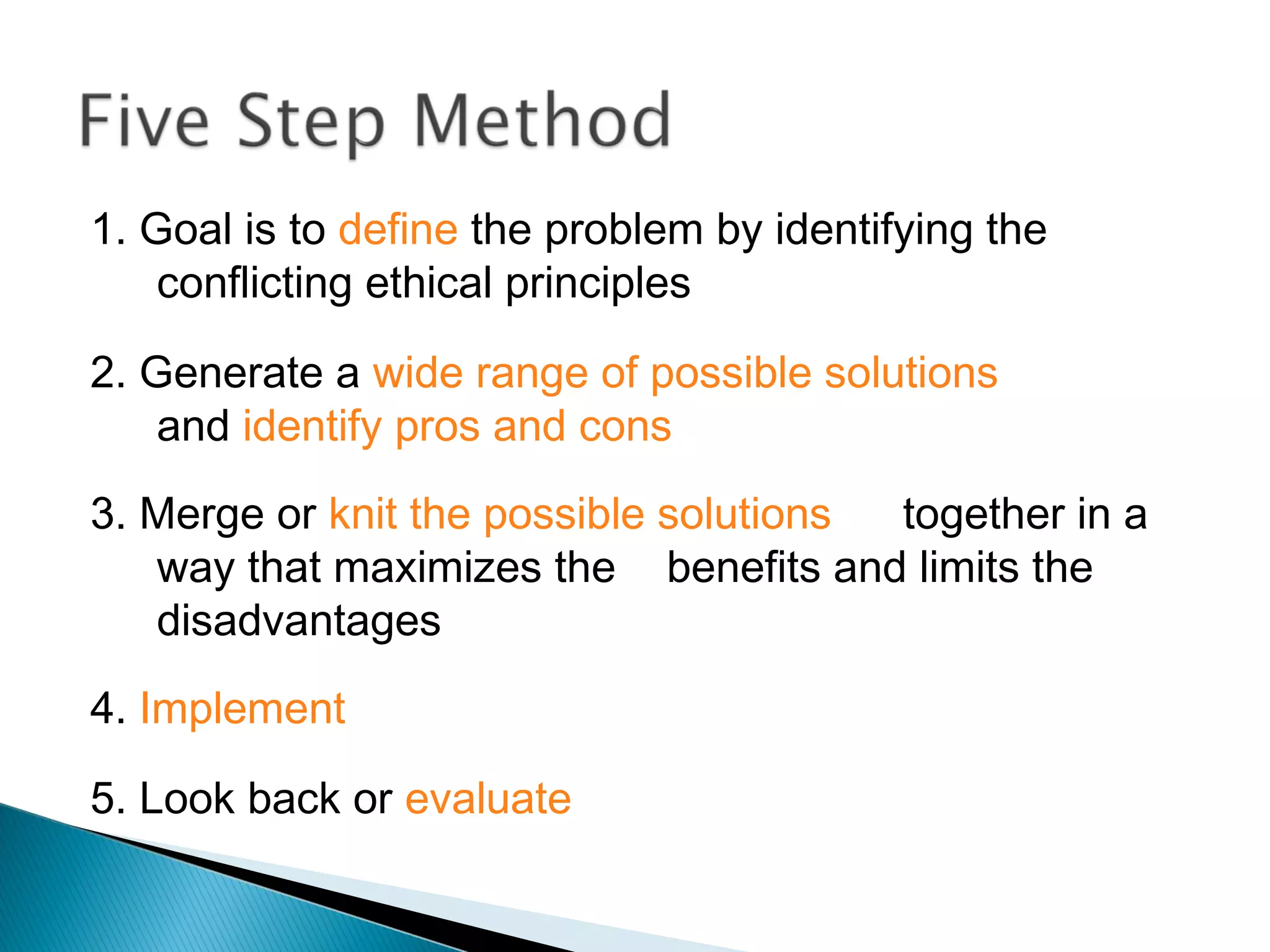
1. Goal is to define the problem by identifying the
    conflicting ethical principles

2. Generate a wide range of possible solutions
    and identify pros and cons
3. Merge or knit the possible solutions together in a
   way that maximizes the benefits and limits the
   disadvantages
4. Implement

5. Look back or evaluate
“integrative framework”

 steps two and three generate solutions that
maximize your personal values within the context
           of your professional role
Avoid dichotomous thinking– either I have to do x or
 y.

For example, either I have to warn the potential
 victim of a threat or I have to protect
 confidentiality.
   Malcolm Gladwell’s book “Blink”

   Jonathan Haidt’s book on Moral Intuition

   Jay Mills article on emotions in ethical decision-
    making
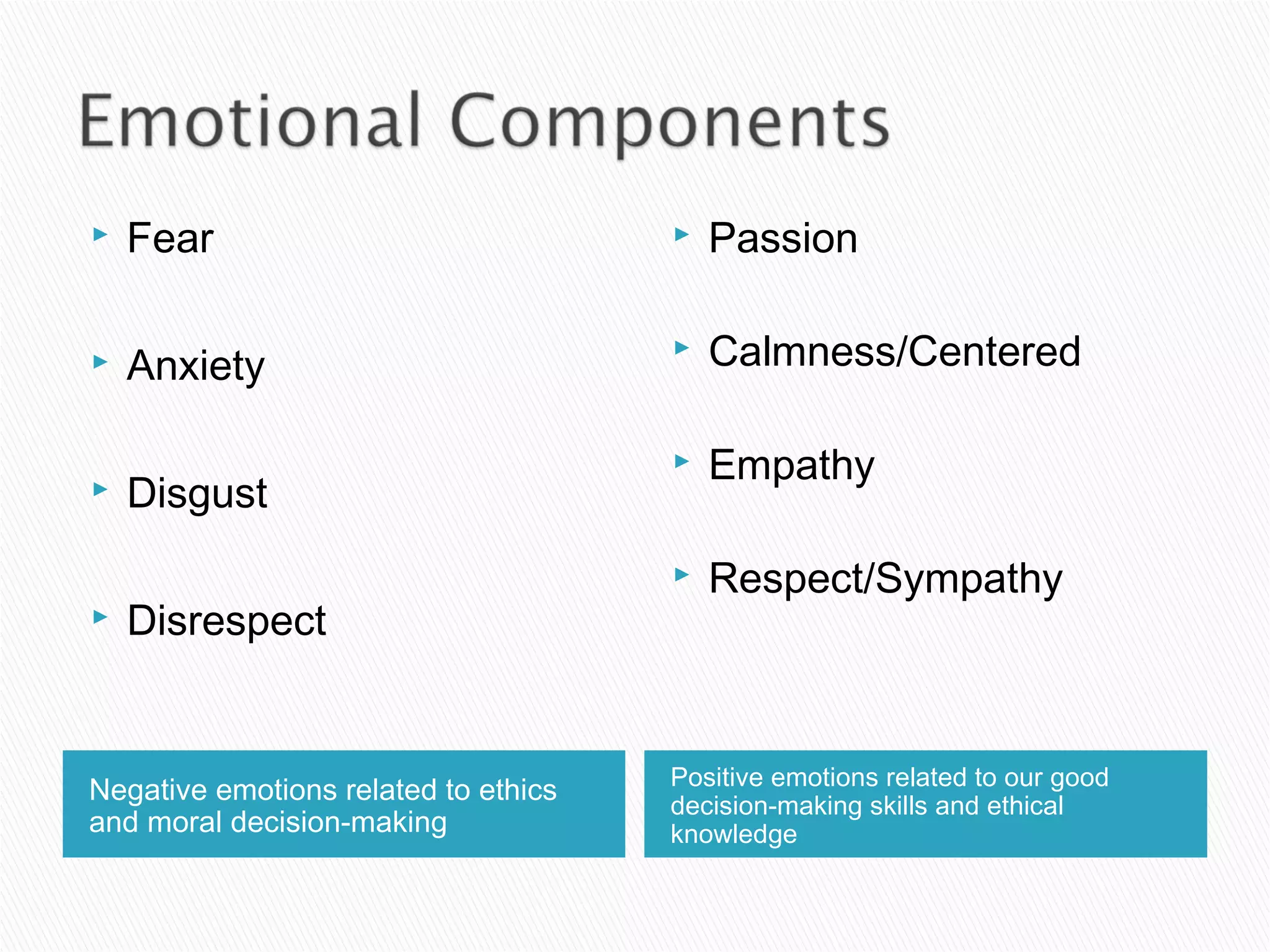
   Fear                                 Passion

   Anxiety
                                         Calmness/Centered

                                         Empathy
   Disgust
                                         Respect/Sympathy
   Disrespect


                                      Positive emotions related to our good
Negative emotions related to ethics   decision-making skills and ethical
and moral decision-making             knowledge
Why do psychologists (still and continue to) have sex
                                  with their patients?
   The Fundamental Attribution Error

   Availability Heuristic

   Trait Negativity Bias

   Confirmation Bias
   Dunning-Kruger Effect: a cognitive bias in which
    unskilled individuals suffer from illusory
    superiority, mistakenly rating their ability as much
    higher than average.

 Poor performers fail to learn from their mistakes.
 And, they fail to internalize direct feedback from

  others.
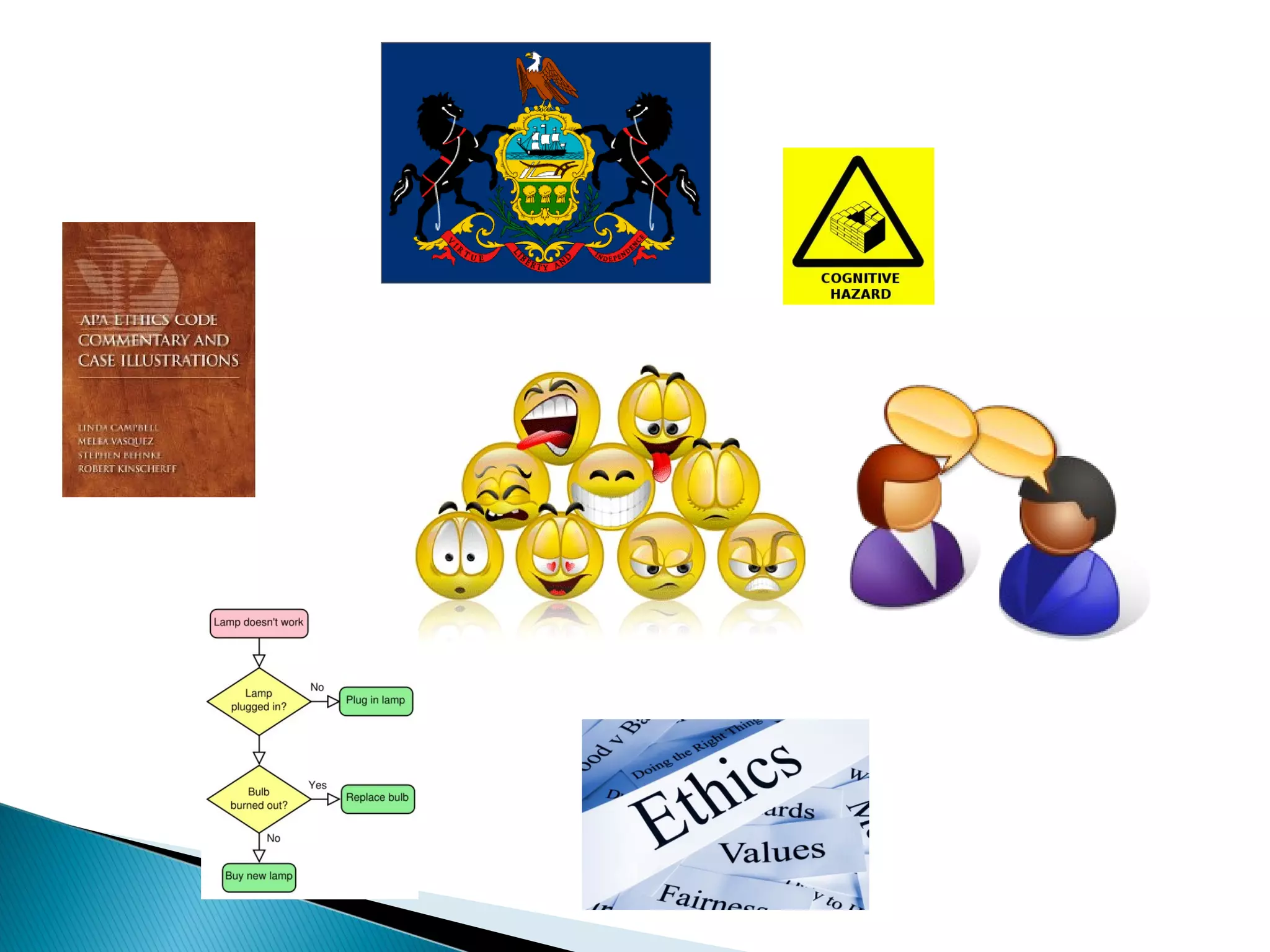
   Knowledge base: APA code, Pennsylvania law,
    regulations
   Become Aware of emotional factors
   Cognitive biases/situational factors
   Outcomes are uncertain
Integrating ethics and values

Integrating ethics and values

  • 1.
    John Gavazzi, PsyDABPP November 1, 2012
  • 2.
    Learning Objectives  Online Information: Ethics blog and other sites  Structured information sharing  Vignette analysis and case discussions
  • 3.
    1. List at least three ethical principles related to APA’s code 2. Compare and contrast positive ethics and risk management 3. Describe the Acculturation Model 4. Explain one ethical decision-making model 5. Analyze one ethical vignette by identifying conflicting principles
  • 4.
    www.papsyblog.org Where Ethics isMore Than a Code and Positive Ethics is more than a Slogan
  • 5.
    Ethics Blog  Self-education  Connecting with others: Blogs & other sites  Becoming politically active
  • 6.
    Introduction and Applicability  Preamble and General Principles (Aspirational and based on principle-based ethics)  Ethical Standards (Enforceable and represent minimum standards)
  • 7.
    The ethics code does not include federal laws, such as HIPAA  The ethics code does not include case law, though influence is noted  The ethics code is distinct and separate from guidelines approved by the APA Council of Representatives  Quiz Question: How many are there?
  • 8.
  • 9.
    Does not mean promoting autonomy (individuation or separation)  Means respecting the autonomous decision making ability of the patient
  • 10.
    It encompasses freedomof thought and action. Individuals are at liberty to behave as they chose. - Determining goals in therapy - Making life decisions (e.g., marriage, divorce) - Scheduling appointments and terminating treatment
  • 11.
    The principle of benefiting others and accepting the responsibility to do good underlies the profession. - Providing the best treatment possible - Competency - Referring when needed
  • 12.
    Basis of foundationalstandard 2.01 “Psychologists provide services, teach, and conduct research with populations and in areas only within the boundaries of their competence. . . “
  • 13.
    The principle isdoing no harm. - Demonstrating competence - Maintaining appropriate boundaries - Not using an experimental technique as the first line of treatment - Providing benefits, risks, and costs
  • 14.
    Foundational Standard 3.04 “Psychologiststake reasonable steps to avoid harming their clients/patients, students, supervisees, research participants, organizational clients, and others with whom they work, and to minimize harm when it is foreseeable and unavoidable.”
  • 15.
    This principle refersto being faithful to commitments. Fidelity includes promise keeping, trustworthiness, and loyalty. - Avoiding conflicts of interests that could compromise therapy - Keeping information confidential - Adhering to therapeutic contract (e.g., session length, time, phone contacts, etc.)
  • 16.
    Foundational Standard 4.01 “Psychologistshave a primary obligation and take reasonable precautions to protect confidential information.”
  • 17.
    Justice primarily refersto treating people fairly and equally. In their work-related activities, psychologists do not engage in unfair discrimination based on age, gender, gender identity, race, ethnicity, culture, national origin, religion, sexual orientation, disability, socioeconomic status, or any basis proscribed by law. (3.01)
  • 18.
    Ethics as a movement away from the punishment and anxiety-producing components of ethics  Fulfill their highest ideals  A means to help interpret and apply ethics standards
  • 19.
     Broadensa psychologist’s understanding of ethics in a larger context  Sensitizepsychologists to ethical implications of decisions on a daily basis
  • 20.
     Heighten awareness related to ethics beyond our offices  Assist psychologists in balancing competing ethical demands
  • 21.
    Remedial: Acquiring andmaintaining minimal formal qualifications Positive: Striving for highest standards Includes self-awareness and self-care Emotional competence
  • 22.
    Remedial: Avoiding boundaryviolations Focus on sexual boundaries Adhere to strict interpretation Positive: Striving to enhance quality of all professional relationships Understand issues related to multiple relationships
  • 23.
    Remedial: Fulfilling legalresponsibilities to get consent forms or Privacy Notices signed Positive: Working to maximize client participation with goals and treatment processes
  • 24.
    Remedial: Avoiding prohibiteddisclosure Emphasis legal requirements Positive: Striving to enhance trust Understanding nuances when working with families
  • 26.
    A process tochange the cultural behavior of an individual through contact with another culture. The process of acculturation occurs when there is an adaptation into an organization or society. The process involves developing relationships with those within the culture to learn the traditions, rules, roles, and behaviors to become part of that group or community.
  • 27.
    Our system of common beliefs, shared meanings, norms and traditions that distinguish psychologists as professionals.  It is a learned set of skills, bases of knowledge and ethical beliefs, as described in our ethics code.
  • 28.
    Our culture of ethics moves beyond ourselves as individual psychologists.  Expands into our ability to become connected with the profession of psychology as well as other professionals.  Our ethical culture “happens” everyday when we relate to our patients, peers, or general population.
  • 29.
    Can be a complex process  Some parts of a psychologist’s behaviors, practice, and lifestyle may be easily acculturated; while others will not  Process that may continue throughout the education or career as a psychologist
  • 30.
    Ethics Autobiography  Exploring religious upbringing  Exploring interpersonal relationships
  • 31.
    Meme: a culturalunit (an idea or value or pattern of behavior) that is passed from one person to another by non-genetic means (as by imitation); "memes are the cultural counterpart of genes"
  • 32.
    Identification with personalvalue system (high vs. low) Identification with value system of psychology (high vs. low) These are on a continuum more so than boxes.
  • 33.
    Acculturation Model ofEthical Decision-making Higher on Professional Ethics Lower on Professional Ethics Integration Separation Higher on Personal Ethics Assimilation Marginalization Lower on Personal Ethics
  • 34.
    Style: Lower focuson professional ethics Lower focus on personal ethics Risks: Greatest risk of harm Lack appreciation for ethics Motivated by self-interest Less concern for patients
  • 35.
    Style: Lower focuson professional ethics Higher focus on personal ethics Risks: Compassion overrides good professional judgment Fail to recognize the unique role of psychologists
  • 36.
    Style: Higher focuson professional ethics Lower focus on personal ethics Risks: Developing overly legalistic stance Rigidly conforming to individual rules while missing broader issues
  • 37.
    Style: High focuson professional ethics High focus on personal ethics Reward: Implement values in context of professional roles Reaching for the ethical ceiling Aspirational ethics
  • 38.
    Our level ofacculturation and our style of ethical decision-making
  • 39.
    Mandatory “floor”  Minimum standards adopted by the profession  Focus on the law or standards to protect the public
  • 40.
    Overemphasis on regulations and enforceable standards  Incomplete view of ethics  Ethics is more than just a code
  • 41.
    A means to reduce risk in an uncertain situation  Decision-making strategies to avert problems or liability of the psychologist  False risk management strategies (memes, such as the No Suicide Contract)
  • 42.
    No evidence to indicate that it helps reduce suicidal behavior  Cannot be used an part of an assessment  Contract implies a legal tool to reduce risk  May actually harm the therapeutic alliance, not promote it
  • 43.
    What are someoptions?
  • 44.
    Rational Psychologist Learnthe rules Apply the rules Outcomes will follow
  • 45.
    Learn the rules Understand patient Apply the rules dynamics Outcomes will follow Understand the relationship
  • 46.
    Psychologist Patient Variables Therapeutic Alliance
  • 47.
    Looking at how well a psychologist integrates his/her values and behaviors into the ethical culture of psychology  Psychology has a set of normative principles and behaviors related to ethical behavior and appropriate conduct
  • 48.
    APA’s Code of Conduct  Commonwealth Psychology regulations found in the Psychology Law and Practice Act  Federal Regulations, such as HIPAA  Court decisions aka case law
  • 49.
    The APA EthicalPrinciples and Code of Conduct do not include a model of ethical decision-making Other resources dictate behavior, but do not highlight how to work through dilemmas
  • 51.
    The means to comply with a standard may not always be readily apparent  Two seemingly competing standards may appear equally appropriate  Application with of a single standard or set of standards appear consistent with one or more aspirational principle, but not another
  • 52.
    Autonomy  Beneficence  Nonmaleficence  Fidelity  Justice
  • 53.
    Often ethical dilemmasinvolve apparent conflicts between respect for patient autonomy versus beneficence or Respect for autonomy versus general or public beneficence
  • 54.
    Identify the competing ethical principles  Help to determine which principle has precedence and why  The importance of emotion in ethical decision- making and moral judgments
  • 55.
    S Scrutinize H Hypothesize A Analyze P Perform E Evaluate
  • 56.
    1. Goal isto define the problem by identifying the conflicting ethical principles 2. Generate a wide range of possible solutions and identify pros and cons 3. Merge or knit the possible solutions together in a way that maximizes the benefits and limits the disadvantages 4. Implement 5. Look back or evaluate
  • 57.
    “integrative framework” stepstwo and three generate solutions that maximize your personal values within the context of your professional role
  • 58.
    Avoid dichotomous thinking–either I have to do x or y. For example, either I have to warn the potential victim of a threat or I have to protect confidentiality.
  • 59.
    Malcolm Gladwell’s book “Blink”  Jonathan Haidt’s book on Moral Intuition  Jay Mills article on emotions in ethical decision- making
  • 60.
    Fear  Passion  Anxiety  Calmness/Centered  Empathy  Disgust  Respect/Sympathy  Disrespect Positive emotions related to our good Negative emotions related to ethics decision-making skills and ethical and moral decision-making knowledge
  • 61.
    Why do psychologists(still and continue to) have sex with their patients?
  • 62.
    The Fundamental Attribution Error  Availability Heuristic  Trait Negativity Bias  Confirmation Bias
  • 63.
    Dunning-Kruger Effect: a cognitive bias in which unskilled individuals suffer from illusory superiority, mistakenly rating their ability as much higher than average.  Poor performers fail to learn from their mistakes.  And, they fail to internalize direct feedback from others.
  • 65.
    Knowledge base: APA code, Pennsylvania law, regulations  Become Aware of emotional factors  Cognitive biases/situational factors  Outcomes are uncertain