General Ethical Principles
Principle A: Beneficence and Nonmaleficence
Psychologists strive to benefit those with whom they work and take care to do no harm. In their
professional actions, psychologists seek to safeguard the welfare and rights of those with whom they
interact professionally and other affected persons, and the welfare of animal subjects of research. When
conflicts occur among psychologists’ obligations or concerns, they attempt to resolve these conflicts in a
responsible fashion that avoids or minimizes harm. Because psychologists’ scientific and professional
judgments and actions may affect the lives of others, they are alert to and guard against personal, financial,
social, organizational, or political factors that might lead to misuse of their influence. Psychologists strive
to be aware of the possible effect of their own physical and mental health on their ability to help those with
whom they work.
Principle B: Fidelity and Responsibility
Psychologists establish relationships of trust with those with whom they work. They are aware of their
professional and scientific responsibilities to society and to the specific communities in which they work.
Psychologists uphold professional standards of conduct, clarify their professional roles and obligations,
accept appropriate responsibility for their behavior, and seek to manage conflicts of interest that could lead
to exploitation or harm. Psychologists consult with, refer to, or cooperate with other professionals and
institutions to the extent needed to serve the best interests of those with whom they work. They are
concerned about the ethical compliance of their colleagues’ scientific and professional conduct.
Psychologists strive to contribute a portion of their professional time for little or no compensation or
personal advantage.
Principle C: Integrity
Psychologists seek to promote accuracy, honesty, and truthfulness in the science, teaching, and practice of
psychology. In these activities psychologists do not steal, cheat, or engage in fraud, subterfuge, or
intentional misrepresentation of fact. Psychologists strive to keep their promises and to avoid unwise or
unclear commitments. In situations in which deception may be ethically justifiable to maximize benefits
and minimize harm, psychologists have a serious obligation to consider the need for, the possible
consequences of, and their responsibility to correct any resulting mistrust or other harmful effects that arise
from the use of such techniques.
Principle D: Justice
Psychologists recognize that fairness and justice entitle all persons to access to and benefit from the
contributions of psychology and to equal quality in the processes, procedures, and services being
conducted by psychologists. Psychologists exercise reasonable judgment and take precautions to ensure
that their potential biases, the boundaries of their competence, and the limitations of their expertise do not
lead to or condone unjust practices.
Principle E: Respect for People’s Rights and Dignity
Psychologists respect the dignity and worth of all people, and the rights of individuals to privacy,
confidentiality, and self-determination. Psychologists are aware that special safeguards may be necessary
to protect the rights and welfare of persons or communities whose vulnerabilities impair autonomous
decision making. Psychologists are aware of and respect cultural, individual, and role differences,
including those based on age, gender, gender identity, race, ethnicity, culture, national origin, religion,
sexual orientation, disability, language, and socioeconomic status, and consider these factors when
working with members of such groups. Psychologists try to eliminate the effect on their work of biases
based on those factors, and they do not knowingly participate in or condone activities of others based upon
such prejudices.
ETHICAL STANDARDS
1. Resolving Ethical Issues
1.01 Misuse of Psychologists’ Work
If psychologists learn of misuse or misrepresentation of their work, they take reasonable steps to correct or
minimize the misuse or misrepresentation.
1.02 Conflicts Between Ethics and Law, Regulations, or Other Governing Legal Authority
If psychologists’ ethical responsibilities conflict with law, regulations, or other governing legal authority,
psychologists clarify the nature of the conflict, make known their commitment to the Ethics Code, and
take reasonable steps to resolve the conflict consistent with the General Principles and Ethical Standards of
the Ethics Code. Under no circumstances may this standard be used to justify or defend violating human
rights.
1.03 Conflicts Between Ethics and Organizational Demands
If the demands of an organization with which psychologists are affiliated or for whom they are working
are in conflict with this Ethics Code, psychologists clarify the nature of the conflict, make known their
commitment to the Ethics Code, and take reasonable steps to resolve the conflict consistent with the
General Principles and Ethical Standards of the Ethics Code. Under no circumstances may this standard
be used to justify or defend violating human rights.
1.04 Informal Resolution of Ethical Violations
When psychologists believe that there may have been an ethical violation by another psychologist, they
attempt to resolve the issue by bringing it to the attention of that individual, if an informal resolution
appears appropriate and the intervention does not violate any confidentiality rights that may be involved.
(See also Standards 1.02, Conflicts Between Ethics and Law, Regulations, or Other Governing Legal
Authority, and 1.03, Conflicts Between Ethics and Organizational Demands.)
1.05 Reporting Ethical Violations
If an apparent ethical violation has substantially harmed or is likely to substantially harm a person or
organization and is not appropriate for informal resolution under Standard 1.04, Informal Resolution of
Ethical Violations, or is not resolved properly in that fashion, psychologists take further action appropriate
to the situation. Such action might include referral to state or national committees on professional ethics,
to state licensing boards, or to the appropriate institutional authorities. This standard does not apply when
an intervention would violate confidentiality rights or when psychologists have been retained to review the
work of another psychologist whose professional conduct is in question. (See also Standard 1.02, Conflicts
Between Ethics and Law, Regulations, or Other Governing Legal Authority.)
1.06 Cooperating With Ethics Committees
Psychologists cooperate in ethics investigations, proceedings, and resulting requirements of the APA or
any affiliated state psychological association to which they belong. In doing so, they address any
confidentiality issues. Failure to cooperate is itself an ethics violation. However, making a request for
deferment of adjudication of an ethics complaint pending the outcome of litigation does not alone
constitute noncooperation.
1.07 Improper Complaints
Psychologists do not file or encourage the filing of ethics complaints that are made with reckless disregard
for or willful ignorance of facts that would disprove the allegation.
1.08 Unfair Discrimination Against Complainants and Respondents
Psychologists do not deny persons employment, advancement, admissions to academic or other programs,
tenure, or promotion, based solely upon their having made or their being the subject of an ethics
complaint. This does not preclude taking action based upon the outcome of such proceedings or
considering other appropriate information.
Ethics in child psychotherapy
Children represent one of the most vulnerable populations and it is the responsibility of the mental health
professional to identify ethical issues and incorporate ethical principles into the practice of psychotherapy.
Children are mostly brought to the clinic by their parents, at times against their will because parents are
genuinely concerned, Since they are mostly not self-referred, therapy with children and adolescents
requires a partnership which is unlike that of a therapist and an adult patient. Work with children involves
an understanding of developmental issues, the varied nature of presentation of disorders, appropriate
management strategies and ethical principles. Thus a practitioner has to integrate the needs of the child,
the family’s objectives in treatment and the developmental level of the child
Respect for Boundaries Children and adolescents need a more personal and revealing mode of
communication. Their growth in therapy is mostly through the relationship experience. Children often ask
about the therapist’s age, marital status, whether they have children and may also give invitations to visit
their homes. Adolescents may ask about personal experiences like substance use or views on controversial
subject. Being ‘neutral’ to these questions means that we neither encourage nor condemn them, but remain
interested. Here it is important to gauge the meaning behind the question. Keeping the therapeutic need
and developmental level in mind, a response that is congruent to the child’s intent behind the questions is
given. This construct of “therapeutic neutrality” helps the therapist secure a position that protects the
therapeutic space for the child. . Tactful and carefully planned therapist self-disclosure can be a natural
part of therapeutic interaction and help in fostering engagement with the child.
Respect for Autonomy Children, by legal definition, are perceived as lacking the necessary competence to
give consent, but they have the psychological capacities to voice assent or dissent (United Nations
Convention on the Rights of the Child 1989)
Rights of Persons With Disabilities Act,
Rights of Persons With Disabilities Act, 2016 (R.P.W.D.) was enacted under the Article 253 of
the Constitution of India read with item No. 13 of the Union List. India has been in a great need
of such an Act as there was no comprehensive law that could define and implement rights of the
persons with disabilities in the country.
he RPWD Act 2016 contains 17 chapters with 102 sections. All these chapters are important to Psychiatrists
while chapters 1,5,10 and 11 hold special importance as the provisions in these chapters are closely associated
with the ethics of physical and mental health professionals.
• This act was passed to fulfill India’s obligation to UNCRPD.
• Draft Bill of this Act was created in 2011
• The Bill was passed by the Rajya Sabha on 14 December 2016 and by Lok Sabha on 17
December 2016
• Rights of Persons With Disabilities Act, 2016 came into effect on 30 December 2016
• It replaced the Persons with Disability (P.w.D.) Act that was enacted way back in 1995
• Number of types of disabilities have been increased from 7 to 21. The Central Government
will have power to add more types of disabilities in this list. At present the list includes:
o Blindness
o Low-vision
o Leprosy Cured persons
o Hearing Impairment (deaf and hard of hearing)
o Locomotor Disability
o Dwarfism
o Intellectual Disability
o Mental Illness
o Autism Spectrum Disorder
o Cerebral Palsy
o Muscular Dystrophy
o Chronic Neurological conditions
o Specific Learning Disabilities
o Multiple Sclerosis
o Speech and Language disability
o Thalassemia
o Hemophilia
o Sickle Cell disease
o Multiple Disabilities including deaf-blindness
o Acid Attack victims
o Parkinson’s disease
o
• In the PwD Act, mental illness was defined as “any mental disorder other than mental
retardation.” The new Act provides a broader definition of mental
illness:“Mental illness means a substantial disorder of
thinking, mood, perception, orientation or memory
that grossly impairs judgment, behaviour, capacity
to recognise reality or ability to meet the ordinary
demands of life, mental conditions associated with the abuse of alcohol and drugs, but does
not include mental retardation which is a condition of arrested or incomplete development of
mind of a person, specially characterised by subnormality of intelligence.
• According to the Act any person who “intentionally insults or intimidates with intent to
humiliate a person with a disability in any place within public view” is punishable with imprisonment.
• To increase the job opportunities of persons with disabilities, the Act has increased the
reservation quota from 3% to 4%. This means that 4% of all vacancies in the government
organizations will be reserved for disabled people.
• Another very important feature of this Act is the provision of special courts in each
district. These special courts will handle cases pertaining to the violation of the rights of P.w.D.
• A large number of children with disabilities do not get proper education in India. This act
proposes that every child with disability gets free education from the age of 6 to 18.
• State Governments will constitute district-level committees to address the local issues of
P.w.D.
• Office of Chief Commissioner and the Office of State Commissioners of Persons with
Disabilities have been given more powers.
• Broad-based Central & State Advisory Boards on Disability are to be set up to serve as
apex policy-making bodies at the Central and State level.
• Victims of acid attacks have been included in the list of P.w.D. Unfortunately, in India,
acid attacks have been on the rise in last few years. Girls and women are often left severely
disfigured/disabled due to such attacks.
• Dwarfism and Muscular Dystrophy have also been included as separate categories of
disability.
Mental Health Care Act 2017 Highlights
• Developed to protect the basic fundamental right of people “Right to live” that comes
under article 21 of constitution.
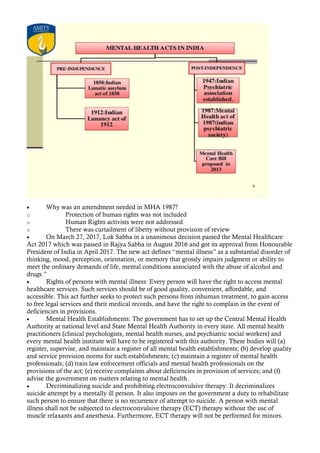
• History of mental health acts in India:
• Why was an amendment needed in MHA 1987?
o Protection of human rights was not included
o Human Rights activists were not addressed
o There was curtailment of liberty without provision of review
• On March 27, 2017, Lok Sabha in a unanimous decision passed the Mental Healthcare
Act 2017 which was passed in Rajya Sabha in August 2016 and got its approval from Honourable
President of India in April 2017. The new act defines “mental illness” as a substantial disorder of
thinking, mood, perception, orientation, or memory that grossly impairs judgment or ability to
meet the ordinary demands of life, mental conditions associated with the abuse of alcohol and
drugs.”
• Rights of persons with mental illness: Every person will have the right to access mental
healthcare services. Such services should be of good quality, convenient, affordable, and
accessible. This act further seeks to protect such persons from inhuman treatment, to gain access
to free legal services and their medical records, and have the right to complain in the event of
deficiencies in provisions.
• Mental Health Establishments: The government has to set up the Central Mental Health
Authority at national level and State Mental Health Authority in every state. All mental health
practitioners (clinical psychologists, mental health nurses, and psychiatric social workers) and
every mental health institute will have to be registered with this authority. These bodies will (a)
register, supervise, and maintain a register of all mental health establishments; (b) develop quality
and service provision norms for such establishments; (c) maintain a register of mental health
professionals; (d) train law enforcement officials and mental health professionals on the
provisions of the act; (e) receive complaints about deficiencies in provision of services; and (f)
advise the government on matters relating to mental health.
• Decriminalizing suicide and prohibiting electroconvulsive therapy: It decriminalizes
suicide attempt by a mentally ill person. It also imposes on the government a duty to rehabilitate
such person to ensure that there is no recurrence of attempt to suicide. A person with mental
illness shall not be subjected to electroconvulsive therapy (ECT) therapy without the use of
muscle relaxants and anesthesia. Furthermore, ECT therapy will not be performed for minors.
• Critical Insight into the Act:
o This act empowers accessibility to mental health services for all. This right is meant
to ensure that services are accessible, affordable, and of good quality. It also mandates the
provision of mental health services be established and available in every district of the country.
However, with already inadequate medical infrastructure at district and subdistrict levels, the
financial burden to be borne by the state governments will be massive unless the central
government allocates a larger portion of the budget to incur the expenditure.
o The concept of advance directive, which gives patients more power to decide
certain aspects of their own treatment, has been picked up from the West. However, unlike
developed countries, local factors such as existing mental health resources and lack of awareness
about mental illness in India have not been taken into account.
o The act also assures free quality treatment for homeless persons or for those
belonging to below poverty line (BPL), even if they do not possess a BPL card. In our country,
where mental illness is considered equal to depression, the obvious financial burden on the
government will be too high.
o The newly introduced decriminalization of suicide is definitely a welcome move.
There could be very much a possibility of misuse of this bill. However, in cases of dowry-related
burning/attempted homicide, this can be twisted as attempted suicide and will not warrant the
needed attention.
o In developing countries like India, persons with mental illness and their situations
are being aggravated by socioeconomic and cultural factors, such as lack of access to healthcare,
superstition, lack of awareness, stigma, and discrimination. The bill does not direct any
provisions to address these factors. The mental healthcare bill does not offer much on prevention
and early intervention.
In the consultation–liaison context, like in any other context, the treatment of children is based on several
principles (Schetky 1995a, b). 1. Do no harm to the child, 2. Do what is in the best interest of the child, 3.
Always strive to protect the privacy of the child’s communications, 4. Respect the child as well as the family
regardless of race, religion, socioeconomic status, education or intellectual level, and 5. Promote and support
the highest level of development and autonomy in the child.
Survivors of sexual violence;
Violence against women is widespread and includes physical, sexual, psychological or emotional abuse and
economic deprivation. Sex-selective abortions, female infanticide, sexual harassment, rape, domestic violence,
trafficking, violence due to sexual orientation, widowhood, old age, disability and HIV infection and rape
during communal and caste conflicts are amongst the varied forms of violence women and girls face, both
within their homes and outside.
The caseworker is the primary holder of the case and provides the woman with emotional support, discusses
the different options she can exercise, explains the legal rights available to her, assesses her needs, documents
case records and coordinates all the services the woman may decide to access. The needs assessment is done
in consultation with the woman, in a non-directive manner, following which she is referred to the in-house
therapist, lawyer and/or career counsellor, to the police, the protection officer, to a shelter home or for
vocational training or employment, depending on the course of action she wishes to take. The caseworker also
follows up the case with all the stakeholders to whom she has referred the woman and accompanies the
woman to the police station and court until the woman is confident to do so herself.
Counselling, whether done by the caseworker or by the therapist, involves parallel processes that need to be
dealt with in order to be ethical and effective. Issues of transference and counter-transference of caseworkers,
as well as conflicts arising out of differences in the personal values of the caseworkers and the organization’s
philosophy are dealt with individually in the mandatory personal counselling sessions of the caseworkers and
collectively in the personal growth sessions with the casework team. So far as the therapist’s counter-
transference issues are concerned, she is trained to deal with it herself or has the option of availing peer
counselling within or outside the organization while keeping the case details confidential.
The laws that deal with sexual violence against women and children in India include the Protection of Children
from Sexual Offences Act 2012 (POCSO; Ministry of Women and Child Development 2012), the Sexual
Harassment of Women at Workplace (Prevention, Prohibition and Redressal) Act (Ministry of Law and Justice
2013a), and the Criminal Law Amendment Act (CLAA; Ministry of Law & Justice 2013b)
Ethical Issues in Working with Couples and Families
Most mental health practitioners of couple and family therapy agree that engaging couples and families in
therapy is a very challenging prospect. Like all therapeutic interactions, the practice of couple and family
therapy is also governed by ethical frameworks. In India, there is no statutory body that specifically regulates
the practice of couple and family therapy
Gambrill (2008), Strom-Gottfried (2008) recommend considering the following factors: • The couples’/families’
interests, rights and values. • The interests and rights of others involved in the situation. • The professional
code of ethics and how this relates to the situation. • Personal values and ethical stance, practice setting,
policies and procedures that relate to the situation. • The legal and licensing regulations and implication of
each intervention decision.
Unlike other countries, in India, in the absence of a statutory body to regulate the practice of couple and
family therapy, practitioners tend to rely on interpretations and adaptations of code of ethics from other
countries as well as on training, experiences with clients and support from peers and colleagues
s. Some of the pertinent areas of ethics to be kept in mind while working with families and couples as seen
from ethics codes in other countries and in India are delineated below.
Competence of Therapist: The therapist must have the necessary qualifications, training and skill. while
working with couples/families, understanding psychological issues in relation to age, life cycle stage of the
couple/family, sexual orientation of the couple and the cultural upbringing of the family members. A
competent therapist should endeavour to update knowledge of current developments in the field and show
sensitivity towards psychosocial nuances in the process of couple/family therapy.
HIstory of Ethics
Meta-ethics is concerned with the epistemology of ethics, posing conceptual questions to define the origins
and limitations of ethical statements and challenging the use of moral predicates. Fundamentally, this is a
branch of philosophy concerned with the inherent existence and man’s understanding of “goodness”, and
addresses this concept through conceptual and epistemological questions. We utilize moral predicates like
“good/evil” and “right/wrong” in association with behavior to define our understanding of the ethical nature
of a given action, relativists conclude that the values we attribute to things are defined dif- ferently, depending
upon the environment of the definer, and so these values cannot be granted absolute meaning. An individual’s
understanding of “right” and “wrong” is true relative to their experience.
NORMATIVE ETHICS- Here the universality of values is accepted and a rational justification for these values is
sought. Normative ethics is concerned with paradigms of ethical behavior and operates in a prescriptive
manner, establishing moral absolutes by which society should live. Virtue ethics focuses on the moral state of
the individual as the source of ethical behavior, rather than compliance to an external code of conduct
Deontological ethics, having its root in the Greek deon, or “duty”, determines moral- ity based on
adherence to rules. eleology, with the Greek root telos meaning “goal”, wherein what is right is determined by
what is good. Here morality is determined by the consequences of action. Right action can be determined as
that which yields the greatest good for the greatest number. The final branch of normative ethics is
pragmatism, which suggests that morality is in a state of constant evolution, in a similar way to scientific
knowledge.
APPLIED ETHICSThe application of ethical theory in practical situations falls under the category of applied
ethics. Unlike meta-ethics, where the aim is to understand the nature of moral concepts, or normative ethics
which explores moral “norms”, the field of applied eth- ics pertains to the use of ethics to mediate real-life
conflicts between what distinct par- ties view as right and wrong.
Moral psychology can refer to one of two fields, the first of which is the study of the development of the
moral choices of the individual over time, and the second is the overlap between psychology and ethics, where
the mind bears relevance to morals.
Descriptive ethics is simply the study of what people do believe or have believed about social morality and
how those beliefs are implemented in action. As a discipline, it relies heavily on sociology and anthropology to
relate the beliefs from variant cul- tural groups, from which one can extrapolate future behavior.
Old Testament (1200–100 BCE)The earliest recorded code of ethics is found in the Tanakh and
Talmud, the sacred scriptures of the Hebrews which were transcribed beginning in 1200 BCE. These writings
document the history of these peoples within a moral context.
Hinduism (100–400 BCE)Hindu literature dates as far back as 1000 BCE, promoting ethics as a means
to moksa, or liberation from the cycle of reincarnation. The ultimate deity in this religion is Brahmin, the
impersonal expression of absolute truth to which all men should aspire. Hinduism assigns four distinct stages
to life, each with increasing moral demands. The Upanishads, the conclusion of the earliest Hindu texts,
express the ultimate goal of life as unity with Brahmin which, it is written, can only be achieved through moral
actions. The Bhagavad Gita is the central ethical text in Hinduism. It portrays a conversa- tion between Lord
Krsna and the warrior Arjuna.
Taoism (800–200 BCE)-This Chinese philosophy is attributed to the philosopher Lao Tzu
and promotes retreat from society as a means of attaining social and personal harmony. According to
Taoists, life ought to be lived in harmony with nature, in simplicity and spontaneity. By this same
principle, good and evil are interdependent; one cannot exist without the other.
Zhuangzi (c. 300 BCE)
Contemporaneously, the philosopher Zhuangzi discounted the alternative philosophies of his contemporaries
in favor of Taoism, upholding the idea that all things exist in balance and therefore no idea can be promoted
over another because of relative nature of experience.
Confucianism (c. 500 BCE)- The concepts of jen and li are central to Confucianism. Humanity or jen
is manifest in the love of others which leads to right behavior. One must not treat others in an unde- sirable
manner. Li, on the other hand, is action in keeping with tradition or rules of con- duct. According to Confucius,
a government is ideally moral, holding in highest regard the interest of the people, which in turn inspires the
citizens to aspire to the moral ideal.
Socrates and Plato (427–347 BCE)Plato expanded the philosophy of Socrates to encompass
why the individual is capable of obtaining the knowledge that will allow man to live justly. The soul is
constantly in the act of reacquiring previous knowledge that has since been forgotten in the human form.
There exist in the universe two influences. First, there are physical objects which are temporal and sensory;
they are a poor basis for knowledge because they appeal to the whims of human senses. Second, there
are the eternal, incorruptible Forms in the universe (i.e., ethics and mathematics); these are the ascetic and
intellectual truths which require self-discipline and denial of sensory pleasure to attain. At the center of
this group is the Form of Good by which all else must be measured.
rehabilitation council of India
The Rehabilitation Council of India (RCI) was set up as a registered society in 1986. On September, 1992
the RCI Act was enacted by Parliament and it became a Statutory Body on 22 June 1993. The Act was
amended by Parliament in 2000 to make it more broadbased. The mandate given to RCI is to regulate and
monitor services given to persons with disability, to standardise syllabi and to maintain a Central
Rehabilitation Register of all qualified professionals and personnel working in the field of Rehabilitation and
Special Education. The Act also prescribes punitive action against unqualified persons delivering services
to persons with disability.
1. The rehabilitation council of India (RCI) was set up as a registered society in 1986.0n
september,1992 the RCI act was enacted by parliament and it become a statutory body on June
1993.The act was amended by parliament in 2000 to make it more broad based.
REHABILITATION COUNCIL OF INDIA
2. 2. The act gave the council the following powers…….. To keep the register of the qualified
professionals who gave training to PWD To give standardize syllabi for PWD To take actions
against persons who offer training to PWD without proper qualifications To provide training to
special Teachers To take away the recognition of the institution which do not provide special
facilities for PWD
3. 3. OBJECTIVES OF RCI To regulate the training policies and programs in the field of rehabilitation
of PWD 1
4. 4. To bring about standardization of training courses for professionals dealing with PWD 2
5. 5. To prescribe minimum standards of education and training of various categories of professionals
dealing with PWD 3
6. 6. To regulate these standards in all training institution uniformly throughout the country 4
7. 7. To recognize institution/organization/ Universities/bachelors degree/PG Diploma/ Certificate
courses in the field of rehabilitation of PWD 5
8. 8. To encourage continuing education in the field of rehabilitation and special education by way of
collaboration with organizations working in the field of disability 6
9. 9. To promote research in rehabilitation and special education.

General ethical principles

  • 1.
    General Ethical Principles PrincipleA: Beneficence and Nonmaleficence Psychologists strive to benefit those with whom they work and take care to do no harm. In their professional actions, psychologists seek to safeguard the welfare and rights of those with whom they interact professionally and other affected persons, and the welfare of animal subjects of research. When conflicts occur among psychologists’ obligations or concerns, they attempt to resolve these conflicts in a responsible fashion that avoids or minimizes harm. Because psychologists’ scientific and professional judgments and actions may affect the lives of others, they are alert to and guard against personal, financial, social, organizational, or political factors that might lead to misuse of their influence. Psychologists strive to be aware of the possible effect of their own physical and mental health on their ability to help those with whom they work. Principle B: Fidelity and Responsibility Psychologists establish relationships of trust with those with whom they work. They are aware of their professional and scientific responsibilities to society and to the specific communities in which they work. Psychologists uphold professional standards of conduct, clarify their professional roles and obligations, accept appropriate responsibility for their behavior, and seek to manage conflicts of interest that could lead to exploitation or harm. Psychologists consult with, refer to, or cooperate with other professionals and institutions to the extent needed to serve the best interests of those with whom they work. They are concerned about the ethical compliance of their colleagues’ scientific and professional conduct. Psychologists strive to contribute a portion of their professional time for little or no compensation or personal advantage. Principle C: Integrity Psychologists seek to promote accuracy, honesty, and truthfulness in the science, teaching, and practice of psychology. In these activities psychologists do not steal, cheat, or engage in fraud, subterfuge, or intentional misrepresentation of fact. Psychologists strive to keep their promises and to avoid unwise or unclear commitments. In situations in which deception may be ethically justifiable to maximize benefits and minimize harm, psychologists have a serious obligation to consider the need for, the possible consequences of, and their responsibility to correct any resulting mistrust or other harmful effects that arise from the use of such techniques. Principle D: Justice Psychologists recognize that fairness and justice entitle all persons to access to and benefit from the contributions of psychology and to equal quality in the processes, procedures, and services being conducted by psychologists. Psychologists exercise reasonable judgment and take precautions to ensure that their potential biases, the boundaries of their competence, and the limitations of their expertise do not lead to or condone unjust practices. Principle E: Respect for People’s Rights and Dignity Psychologists respect the dignity and worth of all people, and the rights of individuals to privacy, confidentiality, and self-determination. Psychologists are aware that special safeguards may be necessary to protect the rights and welfare of persons or communities whose vulnerabilities impair autonomous decision making. Psychologists are aware of and respect cultural, individual, and role differences, including those based on age, gender, gender identity, race, ethnicity, culture, national origin, religion, sexual orientation, disability, language, and socioeconomic status, and consider these factors when working with members of such groups. Psychologists try to eliminate the effect on their work of biases based on those factors, and they do not knowingly participate in or condone activities of others based upon such prejudices. ETHICAL STANDARDS 1. Resolving Ethical Issues 1.01 Misuse of Psychologists’ Work
  • 2.
    If psychologists learnof misuse or misrepresentation of their work, they take reasonable steps to correct or minimize the misuse or misrepresentation. 1.02 Conflicts Between Ethics and Law, Regulations, or Other Governing Legal Authority If psychologists’ ethical responsibilities conflict with law, regulations, or other governing legal authority, psychologists clarify the nature of the conflict, make known their commitment to the Ethics Code, and take reasonable steps to resolve the conflict consistent with the General Principles and Ethical Standards of the Ethics Code. Under no circumstances may this standard be used to justify or defend violating human rights. 1.03 Conflicts Between Ethics and Organizational Demands If the demands of an organization with which psychologists are affiliated or for whom they are working are in conflict with this Ethics Code, psychologists clarify the nature of the conflict, make known their commitment to the Ethics Code, and take reasonable steps to resolve the conflict consistent with the General Principles and Ethical Standards of the Ethics Code. Under no circumstances may this standard be used to justify or defend violating human rights. 1.04 Informal Resolution of Ethical Violations When psychologists believe that there may have been an ethical violation by another psychologist, they attempt to resolve the issue by bringing it to the attention of that individual, if an informal resolution appears appropriate and the intervention does not violate any confidentiality rights that may be involved. (See also Standards 1.02, Conflicts Between Ethics and Law, Regulations, or Other Governing Legal Authority, and 1.03, Conflicts Between Ethics and Organizational Demands.) 1.05 Reporting Ethical Violations If an apparent ethical violation has substantially harmed or is likely to substantially harm a person or organization and is not appropriate for informal resolution under Standard 1.04, Informal Resolution of Ethical Violations, or is not resolved properly in that fashion, psychologists take further action appropriate to the situation. Such action might include referral to state or national committees on professional ethics, to state licensing boards, or to the appropriate institutional authorities. This standard does not apply when an intervention would violate confidentiality rights or when psychologists have been retained to review the work of another psychologist whose professional conduct is in question. (See also Standard 1.02, Conflicts Between Ethics and Law, Regulations, or Other Governing Legal Authority.) 1.06 Cooperating With Ethics Committees Psychologists cooperate in ethics investigations, proceedings, and resulting requirements of the APA or any affiliated state psychological association to which they belong. In doing so, they address any confidentiality issues. Failure to cooperate is itself an ethics violation. However, making a request for deferment of adjudication of an ethics complaint pending the outcome of litigation does not alone constitute noncooperation. 1.07 Improper Complaints Psychologists do not file or encourage the filing of ethics complaints that are made with reckless disregard for or willful ignorance of facts that would disprove the allegation. 1.08 Unfair Discrimination Against Complainants and Respondents Psychologists do not deny persons employment, advancement, admissions to academic or other programs, tenure, or promotion, based solely upon their having made or their being the subject of an ethics complaint. This does not preclude taking action based upon the outcome of such proceedings or considering other appropriate information. Ethics in child psychotherapy
  • 3.
    Children represent oneof the most vulnerable populations and it is the responsibility of the mental health professional to identify ethical issues and incorporate ethical principles into the practice of psychotherapy. Children are mostly brought to the clinic by their parents, at times against their will because parents are genuinely concerned, Since they are mostly not self-referred, therapy with children and adolescents requires a partnership which is unlike that of a therapist and an adult patient. Work with children involves an understanding of developmental issues, the varied nature of presentation of disorders, appropriate management strategies and ethical principles. Thus a practitioner has to integrate the needs of the child, the family’s objectives in treatment and the developmental level of the child Respect for Boundaries Children and adolescents need a more personal and revealing mode of communication. Their growth in therapy is mostly through the relationship experience. Children often ask about the therapist’s age, marital status, whether they have children and may also give invitations to visit their homes. Adolescents may ask about personal experiences like substance use or views on controversial subject. Being ‘neutral’ to these questions means that we neither encourage nor condemn them, but remain interested. Here it is important to gauge the meaning behind the question. Keeping the therapeutic need and developmental level in mind, a response that is congruent to the child’s intent behind the questions is given. This construct of “therapeutic neutrality” helps the therapist secure a position that protects the therapeutic space for the child. . Tactful and carefully planned therapist self-disclosure can be a natural part of therapeutic interaction and help in fostering engagement with the child. Respect for Autonomy Children, by legal definition, are perceived as lacking the necessary competence to give consent, but they have the psychological capacities to voice assent or dissent (United Nations Convention on the Rights of the Child 1989) Rights of Persons With Disabilities Act, Rights of Persons With Disabilities Act, 2016 (R.P.W.D.) was enacted under the Article 253 of the Constitution of India read with item No. 13 of the Union List. India has been in a great need of such an Act as there was no comprehensive law that could define and implement rights of the persons with disabilities in the country. he RPWD Act 2016 contains 17 chapters with 102 sections. All these chapters are important to Psychiatrists while chapters 1,5,10 and 11 hold special importance as the provisions in these chapters are closely associated with the ethics of physical and mental health professionals. • This act was passed to fulfill India’s obligation to UNCRPD. • Draft Bill of this Act was created in 2011 • The Bill was passed by the Rajya Sabha on 14 December 2016 and by Lok Sabha on 17 December 2016 • Rights of Persons With Disabilities Act, 2016 came into effect on 30 December 2016 • It replaced the Persons with Disability (P.w.D.) Act that was enacted way back in 1995 • Number of types of disabilities have been increased from 7 to 21. The Central Government will have power to add more types of disabilities in this list. At present the list includes: o Blindness o Low-vision o Leprosy Cured persons o Hearing Impairment (deaf and hard of hearing) o Locomotor Disability o Dwarfism o Intellectual Disability o Mental Illness o Autism Spectrum Disorder o Cerebral Palsy o Muscular Dystrophy o Chronic Neurological conditions o Specific Learning Disabilities
  • 4.
    o Multiple Sclerosis oSpeech and Language disability o Thalassemia o Hemophilia o Sickle Cell disease o Multiple Disabilities including deaf-blindness o Acid Attack victims o Parkinson’s disease o • In the PwD Act, mental illness was defined as “any mental disorder other than mental retardation.” The new Act provides a broader definition of mental illness:“Mental illness means a substantial disorder of thinking, mood, perception, orientation or memory that grossly impairs judgment, behaviour, capacity to recognise reality or ability to meet the ordinary demands of life, mental conditions associated with the abuse of alcohol and drugs, but does not include mental retardation which is a condition of arrested or incomplete development of mind of a person, specially characterised by subnormality of intelligence. • According to the Act any person who “intentionally insults or intimidates with intent to humiliate a person with a disability in any place within public view” is punishable with imprisonment. • To increase the job opportunities of persons with disabilities, the Act has increased the reservation quota from 3% to 4%. This means that 4% of all vacancies in the government organizations will be reserved for disabled people. • Another very important feature of this Act is the provision of special courts in each district. These special courts will handle cases pertaining to the violation of the rights of P.w.D. • A large number of children with disabilities do not get proper education in India. This act proposes that every child with disability gets free education from the age of 6 to 18. • State Governments will constitute district-level committees to address the local issues of P.w.D. • Office of Chief Commissioner and the Office of State Commissioners of Persons with Disabilities have been given more powers. • Broad-based Central & State Advisory Boards on Disability are to be set up to serve as apex policy-making bodies at the Central and State level. • Victims of acid attacks have been included in the list of P.w.D. Unfortunately, in India, acid attacks have been on the rise in last few years. Girls and women are often left severely disfigured/disabled due to such attacks. • Dwarfism and Muscular Dystrophy have also been included as separate categories of disability. Mental Health Care Act 2017 Highlights • Developed to protect the basic fundamental right of people “Right to live” that comes under article 21 of constitution. • History of mental health acts in India:
  • 5.
    • Why wasan amendment needed in MHA 1987? o Protection of human rights was not included o Human Rights activists were not addressed o There was curtailment of liberty without provision of review • On March 27, 2017, Lok Sabha in a unanimous decision passed the Mental Healthcare Act 2017 which was passed in Rajya Sabha in August 2016 and got its approval from Honourable President of India in April 2017. The new act defines “mental illness” as a substantial disorder of thinking, mood, perception, orientation, or memory that grossly impairs judgment or ability to meet the ordinary demands of life, mental conditions associated with the abuse of alcohol and drugs.” • Rights of persons with mental illness: Every person will have the right to access mental healthcare services. Such services should be of good quality, convenient, affordable, and accessible. This act further seeks to protect such persons from inhuman treatment, to gain access to free legal services and their medical records, and have the right to complain in the event of deficiencies in provisions. • Mental Health Establishments: The government has to set up the Central Mental Health Authority at national level and State Mental Health Authority in every state. All mental health practitioners (clinical psychologists, mental health nurses, and psychiatric social workers) and every mental health institute will have to be registered with this authority. These bodies will (a) register, supervise, and maintain a register of all mental health establishments; (b) develop quality and service provision norms for such establishments; (c) maintain a register of mental health professionals; (d) train law enforcement officials and mental health professionals on the provisions of the act; (e) receive complaints about deficiencies in provision of services; and (f) advise the government on matters relating to mental health. • Decriminalizing suicide and prohibiting electroconvulsive therapy: It decriminalizes suicide attempt by a mentally ill person. It also imposes on the government a duty to rehabilitate such person to ensure that there is no recurrence of attempt to suicide. A person with mental illness shall not be subjected to electroconvulsive therapy (ECT) therapy without the use of muscle relaxants and anesthesia. Furthermore, ECT therapy will not be performed for minors.
  • 6.
    • Critical Insightinto the Act: o This act empowers accessibility to mental health services for all. This right is meant to ensure that services are accessible, affordable, and of good quality. It also mandates the provision of mental health services be established and available in every district of the country. However, with already inadequate medical infrastructure at district and subdistrict levels, the financial burden to be borne by the state governments will be massive unless the central government allocates a larger portion of the budget to incur the expenditure. o The concept of advance directive, which gives patients more power to decide certain aspects of their own treatment, has been picked up from the West. However, unlike developed countries, local factors such as existing mental health resources and lack of awareness about mental illness in India have not been taken into account. o The act also assures free quality treatment for homeless persons or for those belonging to below poverty line (BPL), even if they do not possess a BPL card. In our country, where mental illness is considered equal to depression, the obvious financial burden on the government will be too high. o The newly introduced decriminalization of suicide is definitely a welcome move. There could be very much a possibility of misuse of this bill. However, in cases of dowry-related burning/attempted homicide, this can be twisted as attempted suicide and will not warrant the needed attention. o In developing countries like India, persons with mental illness and their situations are being aggravated by socioeconomic and cultural factors, such as lack of access to healthcare, superstition, lack of awareness, stigma, and discrimination. The bill does not direct any provisions to address these factors. The mental healthcare bill does not offer much on prevention and early intervention. In the consultation–liaison context, like in any other context, the treatment of children is based on several principles (Schetky 1995a, b). 1. Do no harm to the child, 2. Do what is in the best interest of the child, 3. Always strive to protect the privacy of the child’s communications, 4. Respect the child as well as the family regardless of race, religion, socioeconomic status, education or intellectual level, and 5. Promote and support the highest level of development and autonomy in the child. Survivors of sexual violence; Violence against women is widespread and includes physical, sexual, psychological or emotional abuse and economic deprivation. Sex-selective abortions, female infanticide, sexual harassment, rape, domestic violence, trafficking, violence due to sexual orientation, widowhood, old age, disability and HIV infection and rape during communal and caste conflicts are amongst the varied forms of violence women and girls face, both within their homes and outside. The caseworker is the primary holder of the case and provides the woman with emotional support, discusses the different options she can exercise, explains the legal rights available to her, assesses her needs, documents
  • 7.
    case records andcoordinates all the services the woman may decide to access. The needs assessment is done in consultation with the woman, in a non-directive manner, following which she is referred to the in-house therapist, lawyer and/or career counsellor, to the police, the protection officer, to a shelter home or for vocational training or employment, depending on the course of action she wishes to take. The caseworker also follows up the case with all the stakeholders to whom she has referred the woman and accompanies the woman to the police station and court until the woman is confident to do so herself. Counselling, whether done by the caseworker or by the therapist, involves parallel processes that need to be dealt with in order to be ethical and effective. Issues of transference and counter-transference of caseworkers, as well as conflicts arising out of differences in the personal values of the caseworkers and the organization’s philosophy are dealt with individually in the mandatory personal counselling sessions of the caseworkers and collectively in the personal growth sessions with the casework team. So far as the therapist’s counter- transference issues are concerned, she is trained to deal with it herself or has the option of availing peer counselling within or outside the organization while keeping the case details confidential. The laws that deal with sexual violence against women and children in India include the Protection of Children from Sexual Offences Act 2012 (POCSO; Ministry of Women and Child Development 2012), the Sexual Harassment of Women at Workplace (Prevention, Prohibition and Redressal) Act (Ministry of Law and Justice 2013a), and the Criminal Law Amendment Act (CLAA; Ministry of Law & Justice 2013b) Ethical Issues in Working with Couples and Families Most mental health practitioners of couple and family therapy agree that engaging couples and families in therapy is a very challenging prospect. Like all therapeutic interactions, the practice of couple and family therapy is also governed by ethical frameworks. In India, there is no statutory body that specifically regulates the practice of couple and family therapy Gambrill (2008), Strom-Gottfried (2008) recommend considering the following factors: • The couples’/families’ interests, rights and values. • The interests and rights of others involved in the situation. • The professional code of ethics and how this relates to the situation. • Personal values and ethical stance, practice setting, policies and procedures that relate to the situation. • The legal and licensing regulations and implication of each intervention decision. Unlike other countries, in India, in the absence of a statutory body to regulate the practice of couple and family therapy, practitioners tend to rely on interpretations and adaptations of code of ethics from other countries as well as on training, experiences with clients and support from peers and colleagues s. Some of the pertinent areas of ethics to be kept in mind while working with families and couples as seen from ethics codes in other countries and in India are delineated below. Competence of Therapist: The therapist must have the necessary qualifications, training and skill. while working with couples/families, understanding psychological issues in relation to age, life cycle stage of the couple/family, sexual orientation of the couple and the cultural upbringing of the family members. A competent therapist should endeavour to update knowledge of current developments in the field and show sensitivity towards psychosocial nuances in the process of couple/family therapy. HIstory of Ethics Meta-ethics is concerned with the epistemology of ethics, posing conceptual questions to define the origins and limitations of ethical statements and challenging the use of moral predicates. Fundamentally, this is a branch of philosophy concerned with the inherent existence and man’s understanding of “goodness”, and addresses this concept through conceptual and epistemological questions. We utilize moral predicates like “good/evil” and “right/wrong” in association with behavior to define our understanding of the ethical nature of a given action, relativists conclude that the values we attribute to things are defined dif- ferently, depending upon the environment of the definer, and so these values cannot be granted absolute meaning. An individual’s understanding of “right” and “wrong” is true relative to their experience.
  • 8.
    NORMATIVE ETHICS- Herethe universality of values is accepted and a rational justification for these values is sought. Normative ethics is concerned with paradigms of ethical behavior and operates in a prescriptive manner, establishing moral absolutes by which society should live. Virtue ethics focuses on the moral state of the individual as the source of ethical behavior, rather than compliance to an external code of conduct Deontological ethics, having its root in the Greek deon, or “duty”, determines moral- ity based on adherence to rules. eleology, with the Greek root telos meaning “goal”, wherein what is right is determined by what is good. Here morality is determined by the consequences of action. Right action can be determined as that which yields the greatest good for the greatest number. The final branch of normative ethics is pragmatism, which suggests that morality is in a state of constant evolution, in a similar way to scientific knowledge. APPLIED ETHICSThe application of ethical theory in practical situations falls under the category of applied ethics. Unlike meta-ethics, where the aim is to understand the nature of moral concepts, or normative ethics which explores moral “norms”, the field of applied eth- ics pertains to the use of ethics to mediate real-life conflicts between what distinct par- ties view as right and wrong. Moral psychology can refer to one of two fields, the first of which is the study of the development of the moral choices of the individual over time, and the second is the overlap between psychology and ethics, where the mind bears relevance to morals. Descriptive ethics is simply the study of what people do believe or have believed about social morality and how those beliefs are implemented in action. As a discipline, it relies heavily on sociology and anthropology to relate the beliefs from variant cul- tural groups, from which one can extrapolate future behavior. Old Testament (1200–100 BCE)The earliest recorded code of ethics is found in the Tanakh and Talmud, the sacred scriptures of the Hebrews which were transcribed beginning in 1200 BCE. These writings document the history of these peoples within a moral context. Hinduism (100–400 BCE)Hindu literature dates as far back as 1000 BCE, promoting ethics as a means to moksa, or liberation from the cycle of reincarnation. The ultimate deity in this religion is Brahmin, the impersonal expression of absolute truth to which all men should aspire. Hinduism assigns four distinct stages to life, each with increasing moral demands. The Upanishads, the conclusion of the earliest Hindu texts, express the ultimate goal of life as unity with Brahmin which, it is written, can only be achieved through moral actions. The Bhagavad Gita is the central ethical text in Hinduism. It portrays a conversa- tion between Lord Krsna and the warrior Arjuna. Taoism (800–200 BCE)-This Chinese philosophy is attributed to the philosopher Lao Tzu and promotes retreat from society as a means of attaining social and personal harmony. According to Taoists, life ought to be lived in harmony with nature, in simplicity and spontaneity. By this same principle, good and evil are interdependent; one cannot exist without the other. Zhuangzi (c. 300 BCE) Contemporaneously, the philosopher Zhuangzi discounted the alternative philosophies of his contemporaries in favor of Taoism, upholding the idea that all things exist in balance and therefore no idea can be promoted over another because of relative nature of experience. Confucianism (c. 500 BCE)- The concepts of jen and li are central to Confucianism. Humanity or jen is manifest in the love of others which leads to right behavior. One must not treat others in an unde- sirable manner. Li, on the other hand, is action in keeping with tradition or rules of con- duct. According to Confucius, a government is ideally moral, holding in highest regard the interest of the people, which in turn inspires the citizens to aspire to the moral ideal. Socrates and Plato (427–347 BCE)Plato expanded the philosophy of Socrates to encompass why the individual is capable of obtaining the knowledge that will allow man to live justly. The soul is constantly in the act of reacquiring previous knowledge that has since been forgotten in the human form. There exist in the universe two influences. First, there are physical objects which are temporal and sensory;
  • 9.
    they are apoor basis for knowledge because they appeal to the whims of human senses. Second, there are the eternal, incorruptible Forms in the universe (i.e., ethics and mathematics); these are the ascetic and intellectual truths which require self-discipline and denial of sensory pleasure to attain. At the center of this group is the Form of Good by which all else must be measured. rehabilitation council of India The Rehabilitation Council of India (RCI) was set up as a registered society in 1986. On September, 1992 the RCI Act was enacted by Parliament and it became a Statutory Body on 22 June 1993. The Act was amended by Parliament in 2000 to make it more broadbased. The mandate given to RCI is to regulate and monitor services given to persons with disability, to standardise syllabi and to maintain a Central Rehabilitation Register of all qualified professionals and personnel working in the field of Rehabilitation and Special Education. The Act also prescribes punitive action against unqualified persons delivering services to persons with disability. 1. The rehabilitation council of India (RCI) was set up as a registered society in 1986.0n september,1992 the RCI act was enacted by parliament and it become a statutory body on June 1993.The act was amended by parliament in 2000 to make it more broad based. REHABILITATION COUNCIL OF INDIA 2. 2. The act gave the council the following powers…….. To keep the register of the qualified professionals who gave training to PWD To give standardize syllabi for PWD To take actions against persons who offer training to PWD without proper qualifications To provide training to special Teachers To take away the recognition of the institution which do not provide special facilities for PWD 3. 3. OBJECTIVES OF RCI To regulate the training policies and programs in the field of rehabilitation of PWD 1 4. 4. To bring about standardization of training courses for professionals dealing with PWD 2 5. 5. To prescribe minimum standards of education and training of various categories of professionals dealing with PWD 3 6. 6. To regulate these standards in all training institution uniformly throughout the country 4 7. 7. To recognize institution/organization/ Universities/bachelors degree/PG Diploma/ Certificate courses in the field of rehabilitation of PWD 5 8. 8. To encourage continuing education in the field of rehabilitation and special education by way of collaboration with organizations working in the field of disability 6 9. 9. To promote research in rehabilitation and special education.