
MACHINE LEARNING

             Hidden Markov Models
                         VU H. Pham
                     phvu@fit.hcmus.edu.vn


                 Department of Computer Science

                      Dececmber 6th, 2010


08/12/2010             Hidden Markov Models       1
Contents
• Introduction

• Markov Chain

• Hidden Markov Models


 08/12/2010       Hidden Markov Models   2
Introduction
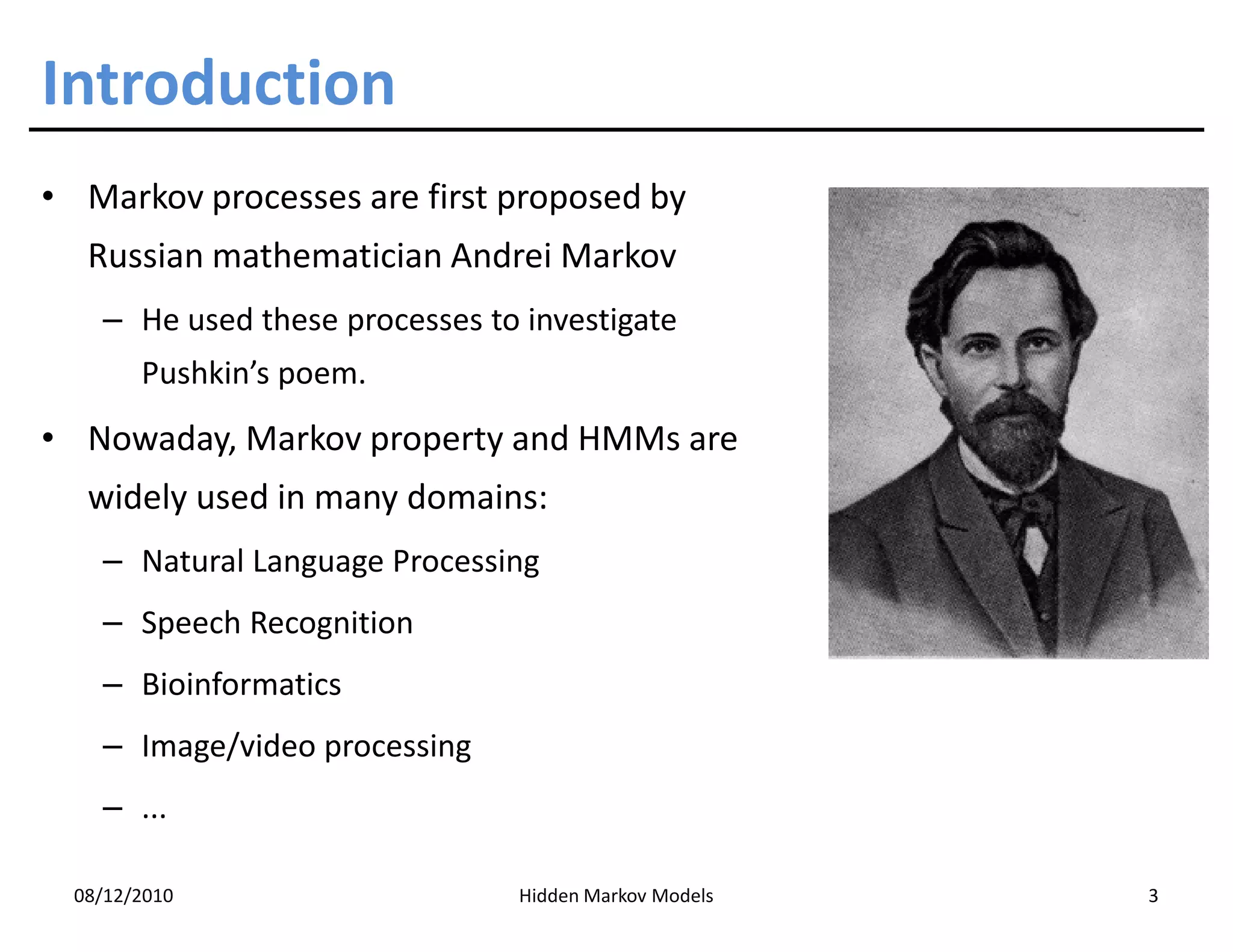
• Markov processes are first proposed by
   Russian mathematician Andrei Markov
    – He used these processes to investigate
        Pushkin’s poem.
• Nowaday, Markov property and HMMs are
   widely used in many domains:
    – Natural Language Processing
    – Speech Recognition
    – Bioinformatics
    – Image/video processing
    – ...

  08/12/2010                    Hidden Markov Models   3
Markov Chain
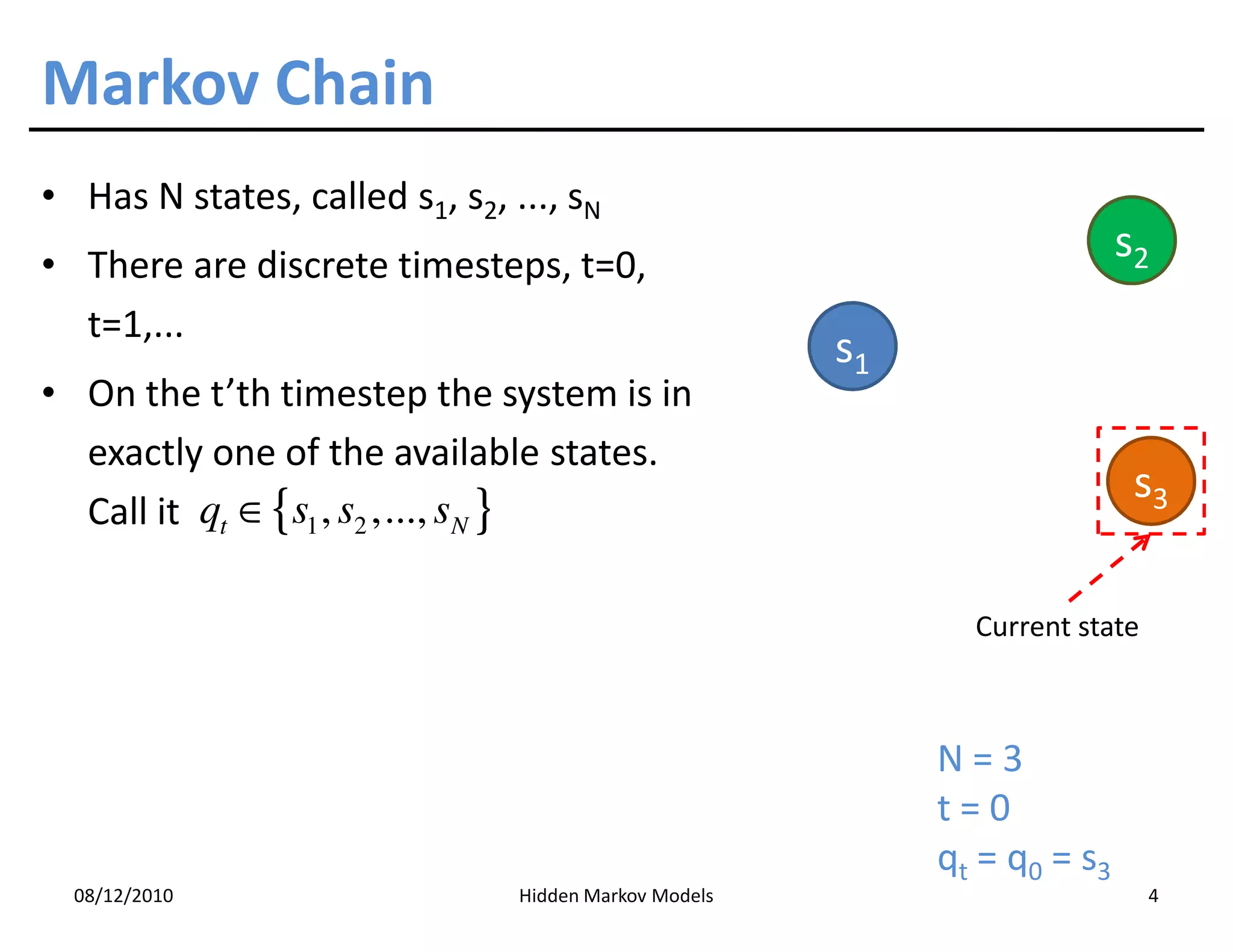
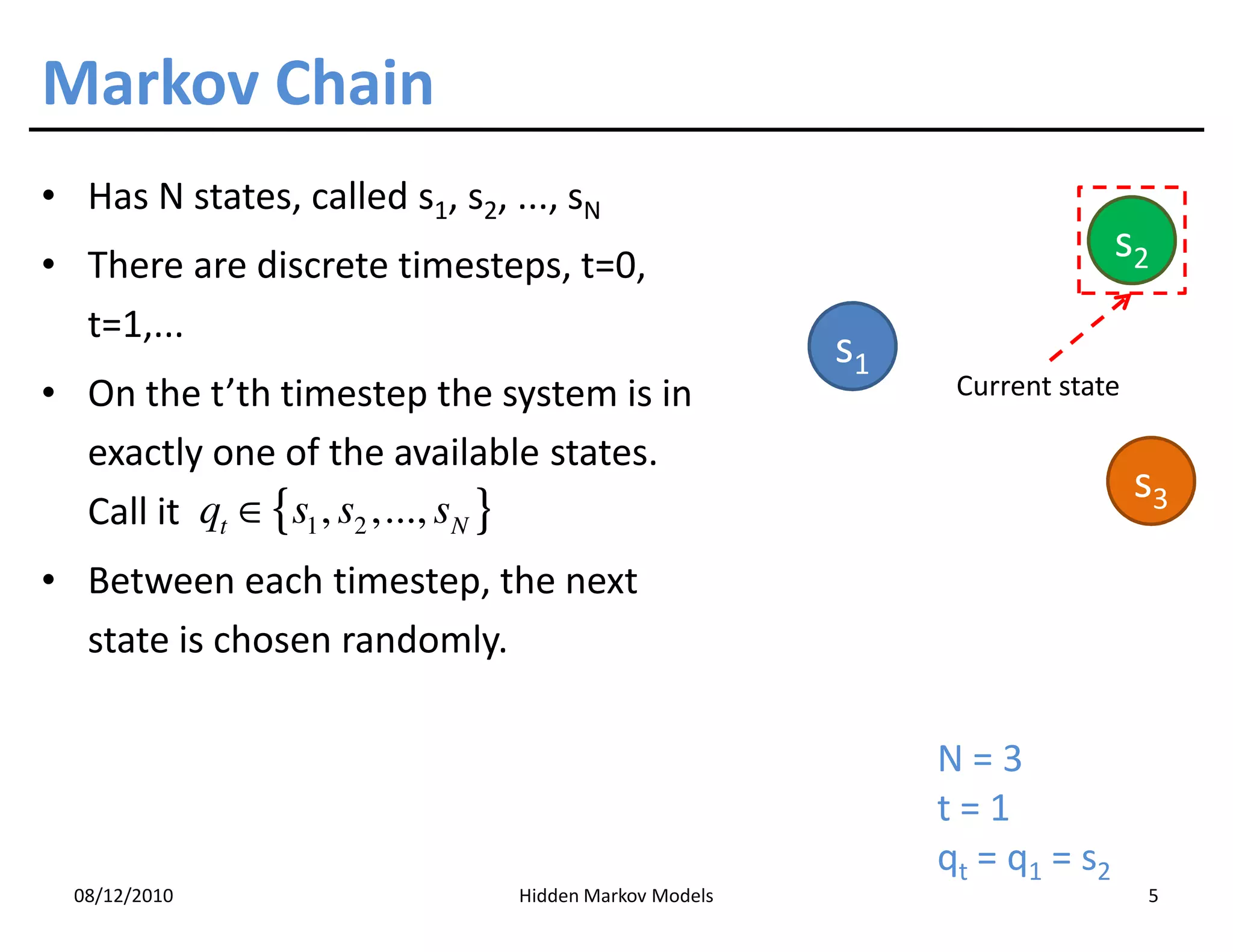
• Has N states, called s1, s2, ..., sN
• There are discrete timesteps, t=0,
                                                                             s2
  t=1,...
                                                       s1
• On the t’th timestep the system is in
  exactly one of the available states.
                                                                              s3
  Call it qt ∈ {s1 , s2 ,..., sN }

                                                               Current state


                                                            N=3
                                                            t=0
                                                            q t = q 0 = s3
  08/12/2010                    Hidden Markov Models                           4
Markov Chain
• Has N states, called s1, s2, ..., sN
• There are discrete timesteps, t=0,
                                                                             s2
  t=1,...
                                                       s1
• On the t’th timestep the system is in                      Current state

  exactly one of the available states.
                                                                              s3
  Call it qt ∈ {s1 , s2 ,..., sN }
• Between each timestep, the next
  state is chosen randomly.

                                                            N=3
                                                            t=1
                                                            q t = q 1 = s2
  08/12/2010                    Hidden Markov Models                          5
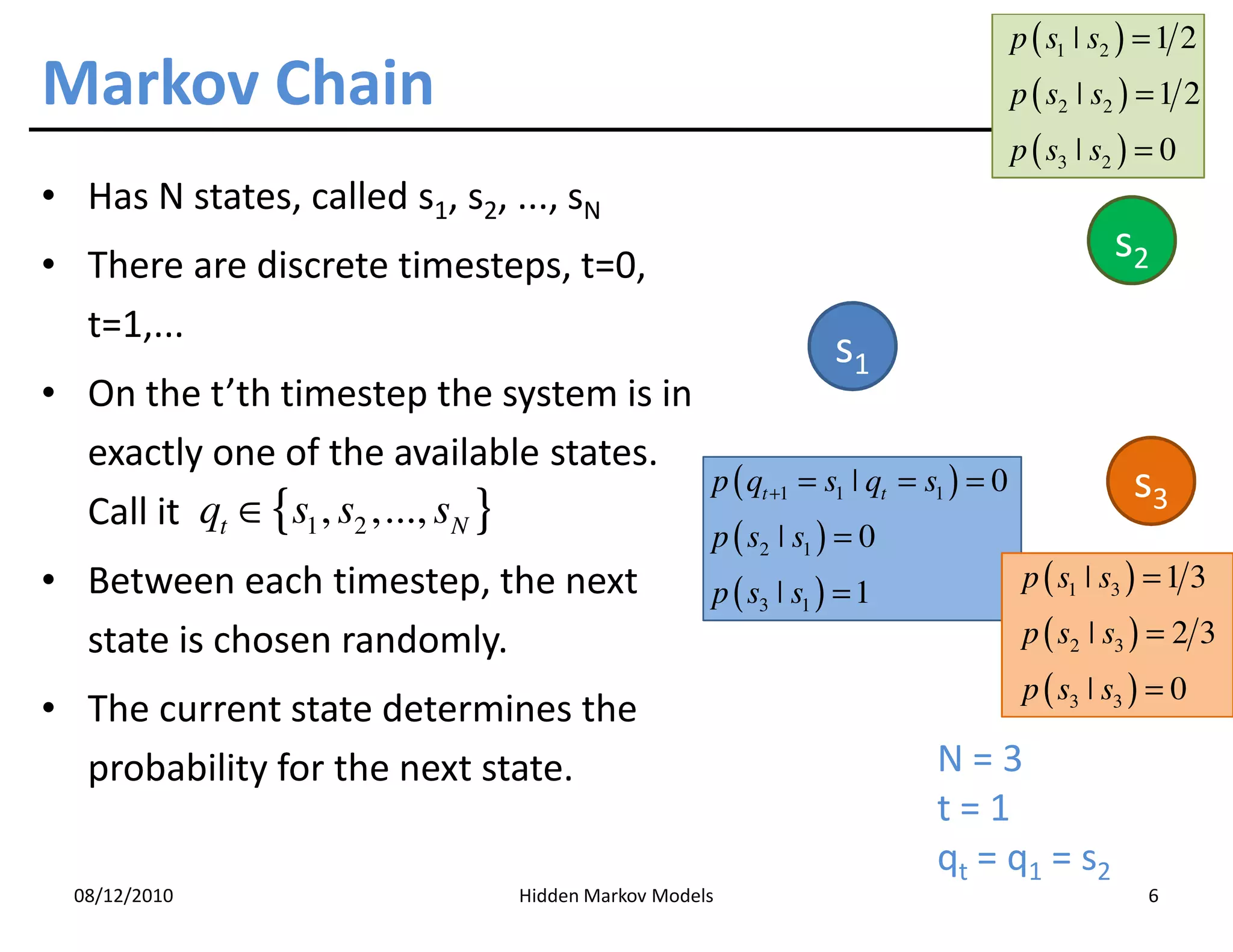
p ( s1 ˚ s2 ) = 1 2
Markov Chain                                                                  p ( s2 ˚ s2 ) = 1 2
                                                                              p ( s3 ˚ s2 ) = 0
• Has N states, called s1, s2, ..., sN
• There are discrete timesteps, t=0,
                                                                                          s2
  t=1,...
                                                                  s1
• On the t’th timestep the system is in
  exactly one of the available states.
                                        p ( qt +1 = s1 ˚ qt = s1 ) = 0                     s3
  Call it qt ∈ {s1 , s2 ,..., sN }
                                                     p ( s2 ˚ s1 ) = 0
• Between each timestep, the next                    p ( s3 ˚ s1 ) = 1         p ( s1 ˚ s3 ) = 1 3
  state is chosen randomly.                                                    p ( s2 ˚ s3 ) = 2 3
                                                                               p ( s3 ˚ s3 ) = 0
• The current state determines the
  probability for the next state.                                        N=3
                                                                         t=1
                                                                         q t = q 1 = s2
  08/12/2010                      Hidden Markov Models                                      6
p ( s1 ˚ s2 ) = 1 2
Markov Chain                                                                    p ( s2 ˚ s2 ) = 1 2
                                                                                p ( s3 ˚ s2 ) = 0
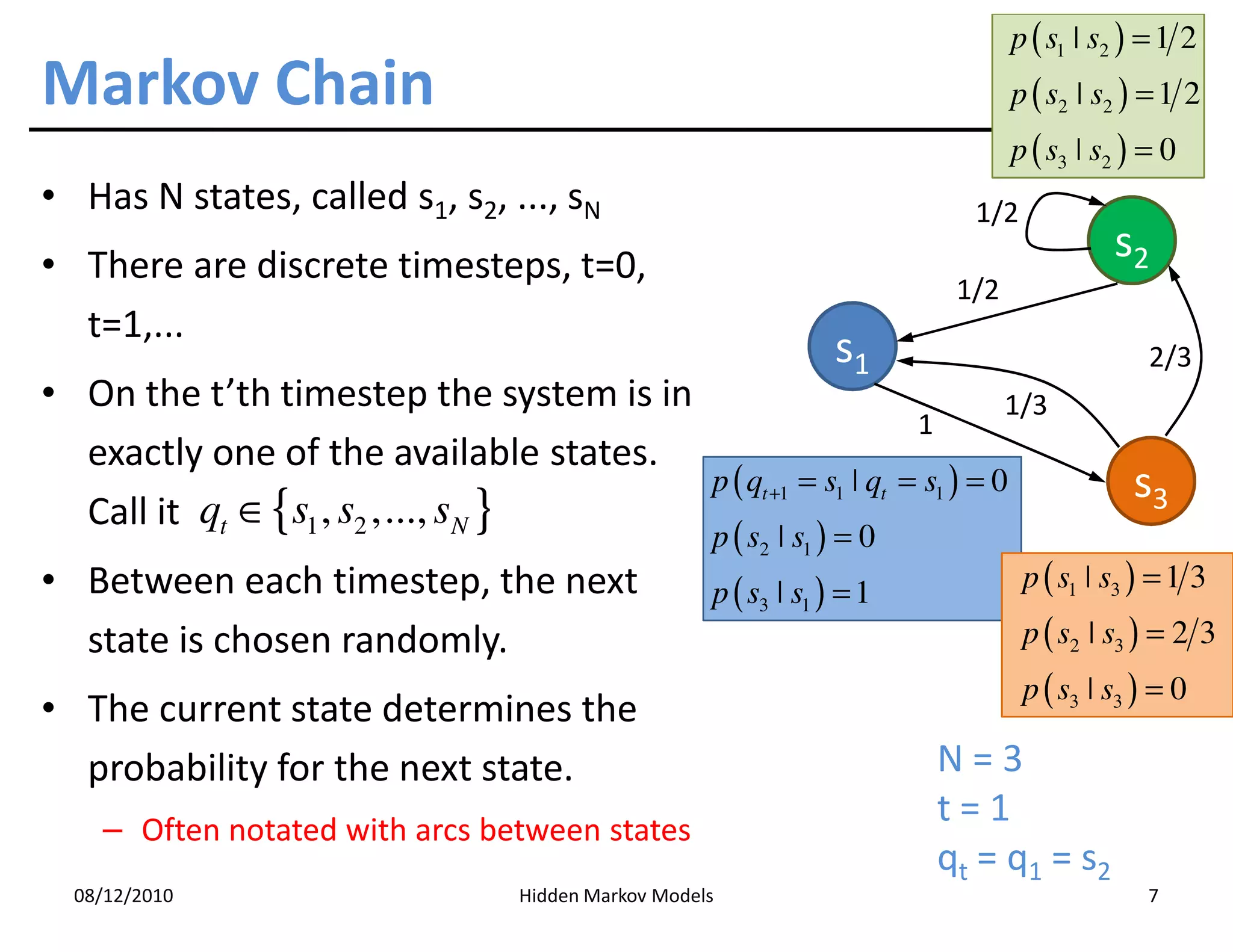
• Has N states, called s1, s2, ..., sN                                      1/2
• There are discrete timesteps, t=0,
                                                                                           s2
                                                                          1/2
  t=1,...
                                                                  s1                           2/3
• On the t’th timestep the system is in                               1/3
                                                             1
  exactly one of the available states.
                                        p ( qt +1 = s1 ˚ qt = s1 ) = 0                       s3
  Call it qt ∈ {s1 , s2 ,..., sN }
                                                     p ( s2 ˚ s1 ) = 0
• Between each timestep, the next                    p ( s3 ˚ s1 ) = 1            p ( s1 ˚ s3 ) = 1 3
  state is chosen randomly.                                                       p ( s2 ˚ s3 ) = 2 3
                                                                                  p ( s3 ˚ s3 ) = 0
• The current state determines the
  probability for the next state.                                        N=3
    – Often notated with arcs between states
                                                                         t=1
                                                                         q t = q 1 = s2
  08/12/2010                      Hidden Markov Models                                         7
p ( s1 ˚ s2 ) = 1 2
Markov Property                                                                            p ( s2 ˚ s2 ) = 1 2
                                                                                           p ( s3 ˚ s2 ) = 0
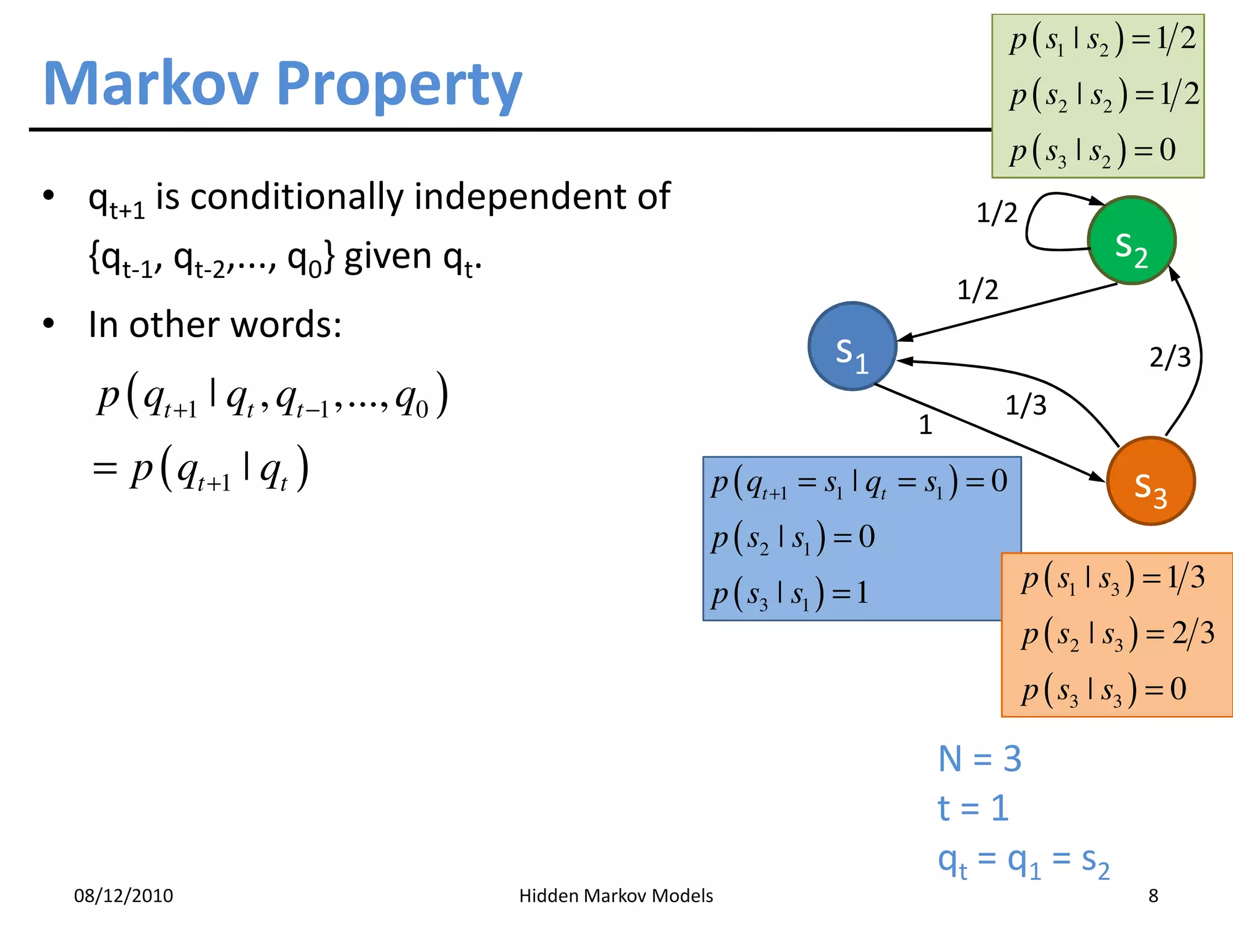
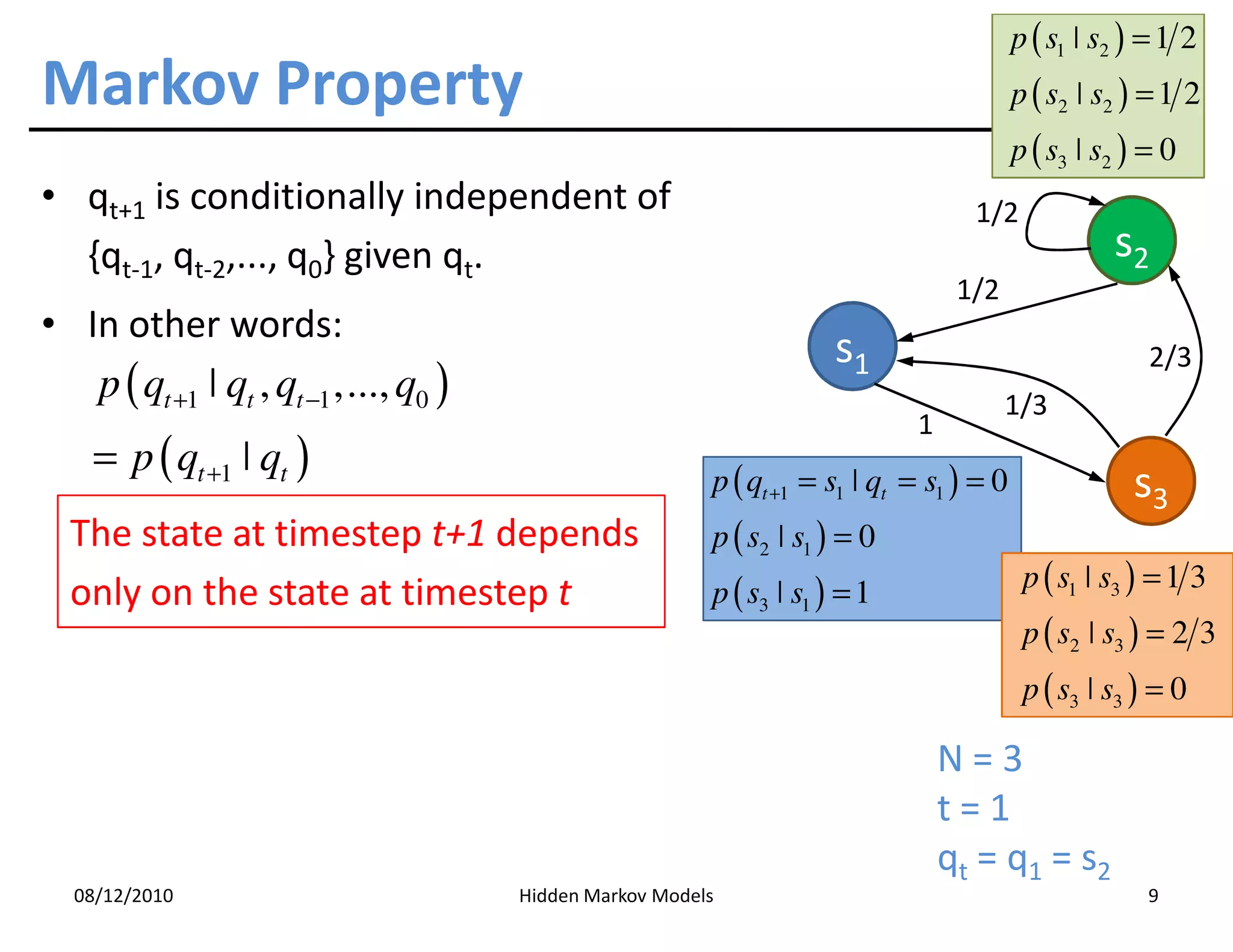
• qt+1 is conditionally independent of                                               1/2
  {qt-1, qt-2,..., q0} given qt.                                                                     s2
                                                                                   1/2
• In other words:
                                                                       s1                                2/3
   p ( qt +1 ˚ qt , qt −1 ,..., q0 )                                                     1/3
                                                                              1
   = p ( qt +1 ˚ qt )                                     p ( qt +1 = s1 ˚ qt = s1 ) = 0               s3
                                                          p ( s2 ˚ s1 ) = 0
                                                          p ( s3 ˚ s1 ) = 1                 p ( s1 ˚ s3 ) = 1 3
                                                                                            p ( s2 ˚ s3 ) = 2 3
                                                                                            p ( s3 ˚ s3 ) = 0

                                                                                  N=3
                                                                                  t=1
                                                                                  q t = q 1 = s2
 08/12/2010                            Hidden Markov Models                                              8
p ( s1 ˚ s2 ) = 1 2
Markov Property                                                                            p ( s2 ˚ s2 ) = 1 2
                                                                                           p ( s3 ˚ s2 ) = 0
• qt+1 is conditionally independent of                                               1/2
  {qt-1, qt-2,..., q0} given qt.                                                                     s2
                                                                                   1/2
• In other words:
                                                                       s1                                2/3
   p ( qt +1 ˚ qt , qt −1 ,..., q0 )                                                     1/3
                                                                              1
    = p ( qt +1 ˚ qt )                                    p ( qt +1 = s1 ˚ qt = s1 ) = 0               s3
  The state at timestep t+1 depends                       p ( s2 ˚ s1 ) = 0
                                                          p ( s3 ˚ s1 ) = 1                 p ( s1 ˚ s3 ) = 1 3
  only on the state at timestep t
                                                                                            p ( s2 ˚ s3 ) = 2 3
                                                                                            p ( s3 ˚ s3 ) = 0

                                                                                  N=3
                                                                                  t=1
                                                                                  q t = q 1 = s2
  08/12/2010                           Hidden Markov Models                                              9
p ( s1 ˚ s2 ) = 1 2
Markov Property                                                                            p ( s2 ˚ s2 ) = 1 2
                                                                                           p ( s3 ˚ s2 ) = 0
• qt+1 is conditionally independent of                                               1/2
  {qt-1, qt-2,..., q0} given qt.                                                                     s2
                                                                                   1/2
• In other words:
                                                                       s1                                2/3
   p ( qt +1 ˚ qt , qt −1 ,..., q0 )                                                     1/3
                                                                              1
    = p ( qt +1 ˚ qt )                                    p ( qt +1 = s1 ˚ qt = s1 ) = 0               s3
  The state at timestep t+1 depends                       p ( s2 ˚ s1 ) = 0
                                                          p ( s3 ˚ s1 ) = 1                 p ( s1 ˚ s3 ) = 1 3
  only on the state at timestep t
                                                                                            p ( s2 ˚ s3 ) = 2 3
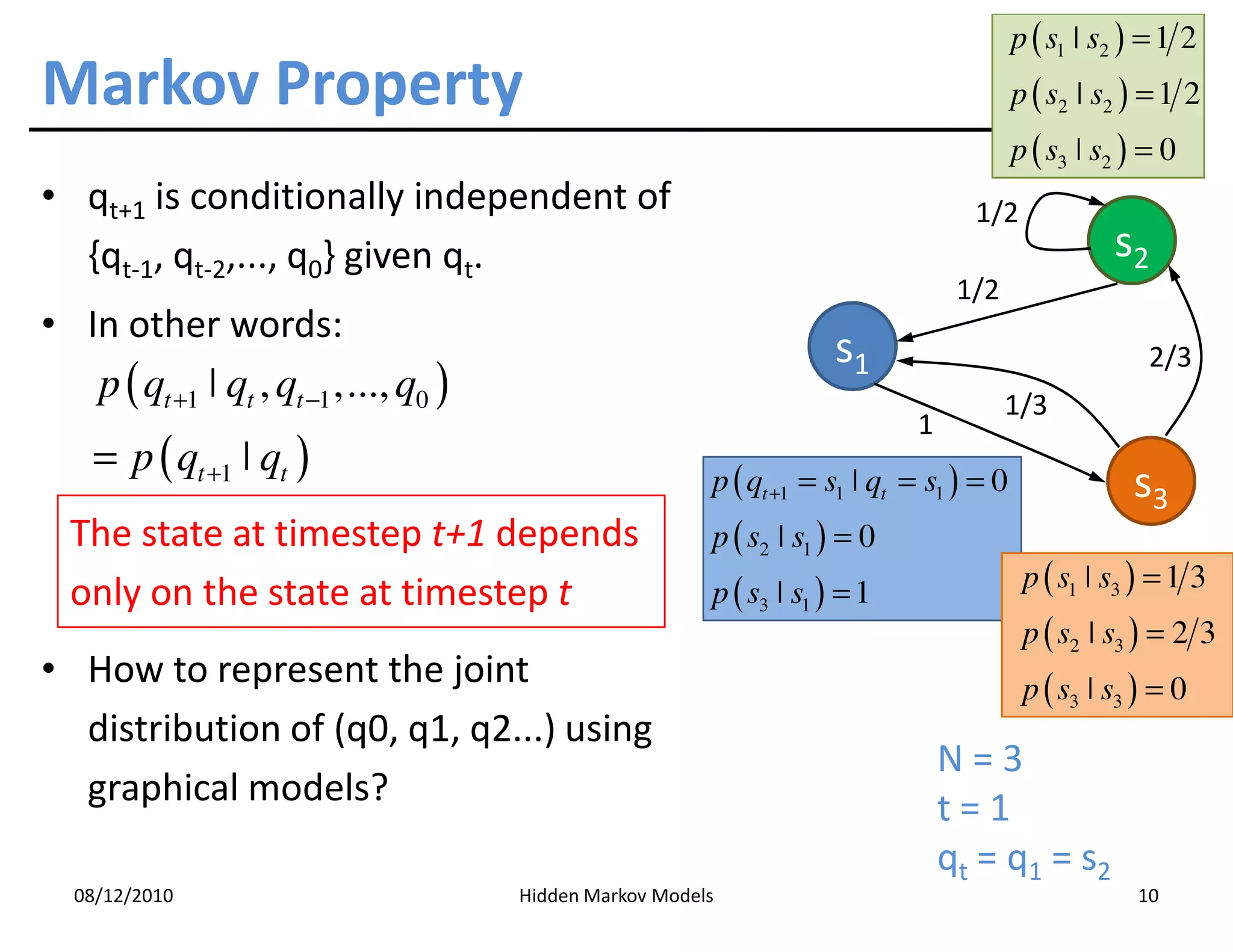
• How to represent the joint                                                                p ( s3 ˚ s3 ) = 0
  distribution of (q0, q1, q2...) using
                                                                                  N=3
  graphical models?                                                               t=1
                                                                                  q t = q 1 = s2
  08/12/2010                           Hidden Markov Models                                             10
p ( s1 ˚ s2 ) = 1 2
Markov Property                                                                          p ( s2 ˚ s2 ) = 1 2

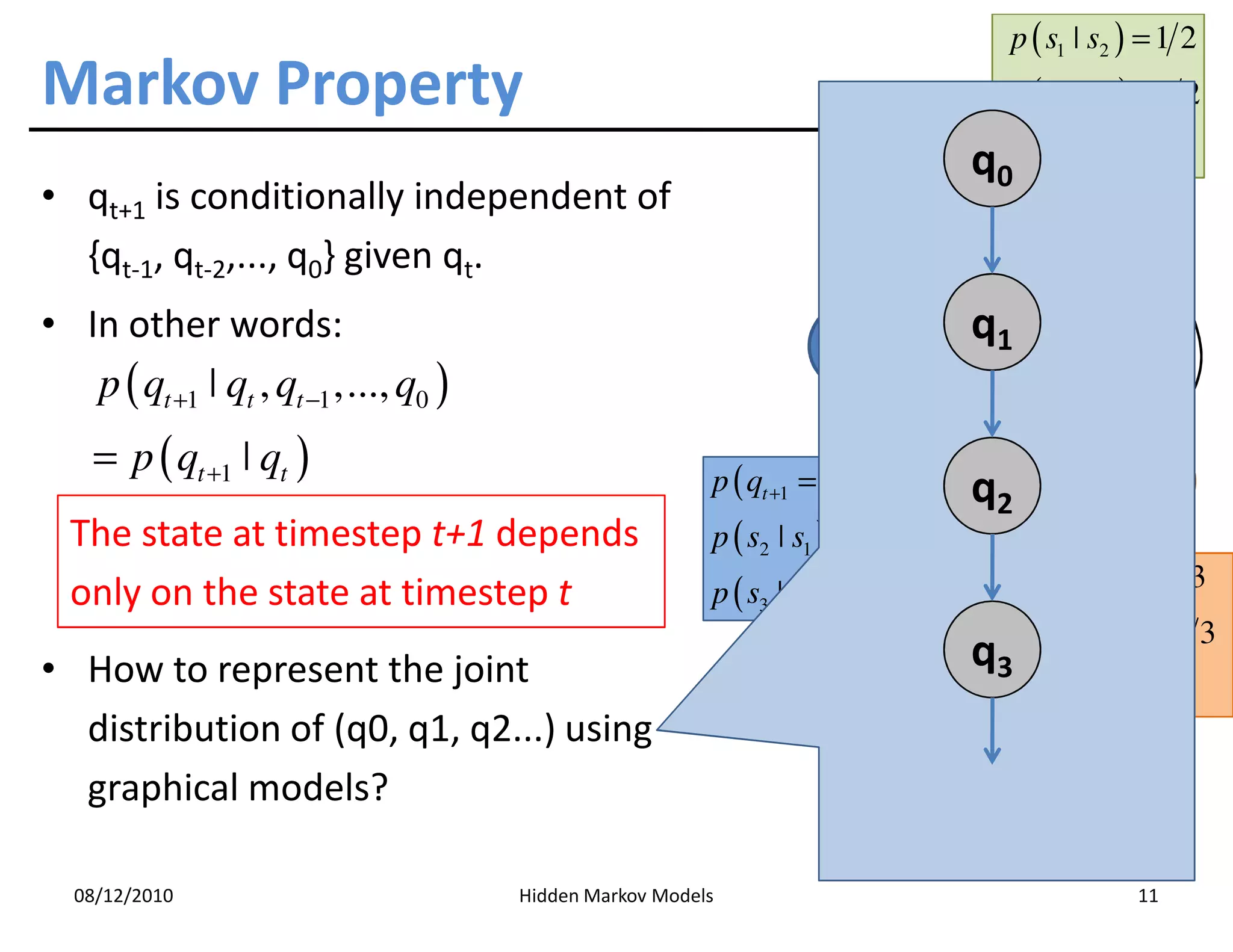
                                                                                    q0p ( s    3   ˚ s2 ) = 0
• qt+1 is conditionally independent of                                               1/2
  {qt-1, qt-2,..., q0} given qt.                                                                         s2
                                                                                   1/2
• In other words:                                                                   q1
                                                                       s1                                   1/3
   p ( qt +1 ˚ qt , qt −1 ,..., q0 )                                                     1/3
                                                                              1
    = p ( qt +1 ˚ qt )                                    p ( qt +1 = s1 ˚ qt = s1 ) = 0
                                                                                     q2                    s3
  The state at timestep t+1 depends                       p ( s2 ˚ s1 ) = 0
                                                          p ( s3 ˚ s1 ) = 1                p ( s1 ˚ s3 ) = 1 3
  only on the state at timestep t
• How to represent the joint                                                        q3 p ( s       2   ˚ s3 ) = 2 3
                                                                                           p ( s3 ˚ s3 ) = 0
  distribution of (q0, q1, q2...) using
                                                                                  N=3
  graphical models?                                                               t=1
                                                                                  q t = q 1 = s2
  08/12/2010                           Hidden Markov Models                                                11
Markov chain
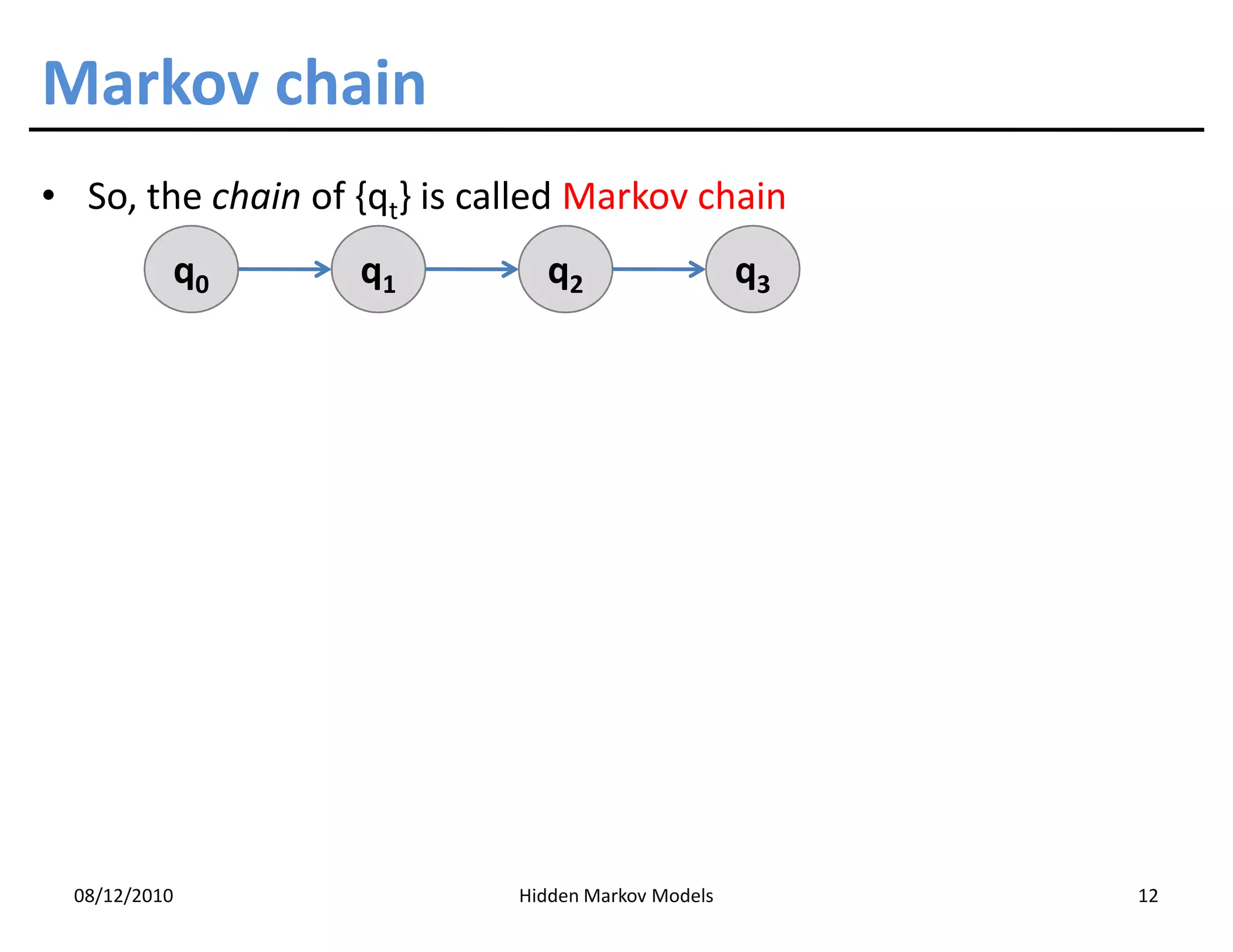
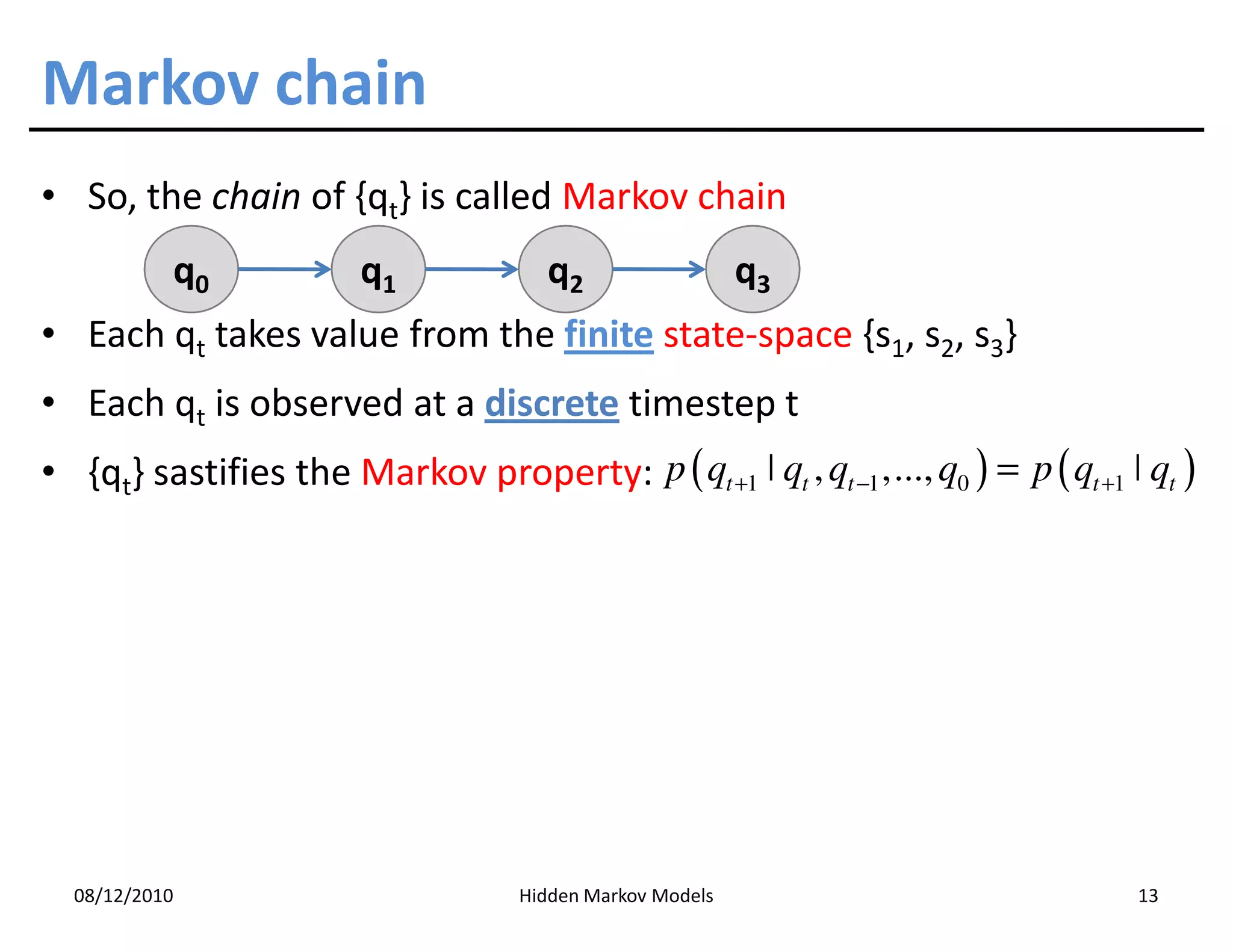
• So, the chain of {qt} is called Markov chain
           q0      q1          q2                   q3


  08/12/2010                 Hidden Markov Models        12
Markov chain
• So, the chain of {qt} is called Markov chain
           q0           q1             q2                   q3
• Each qt takes value from the finite state-space {s1, s2, s3}
• Each qt is observed at a discrete timestep t
• {qt} sastifies the Markov property: p ( qt +1 ˚ qt , qt −1 ,..., q0 ) = p ( qt +1 ˚ qt )


  08/12/2010                         Hidden Markov Models                            13
Markov chain
• So, the chain of {qt} is called Markov chain
           q0                  q1                q2                   q3
• Each qt takes value from the finite state-space {s1, s2, s3}
• Each qt is observed at a discrete timestep t
• {qt} sastifies the Markov property: p ( qt +1 ˚ qt , qt −1 ,..., q0 ) = p ( qt +1 ˚ qt )
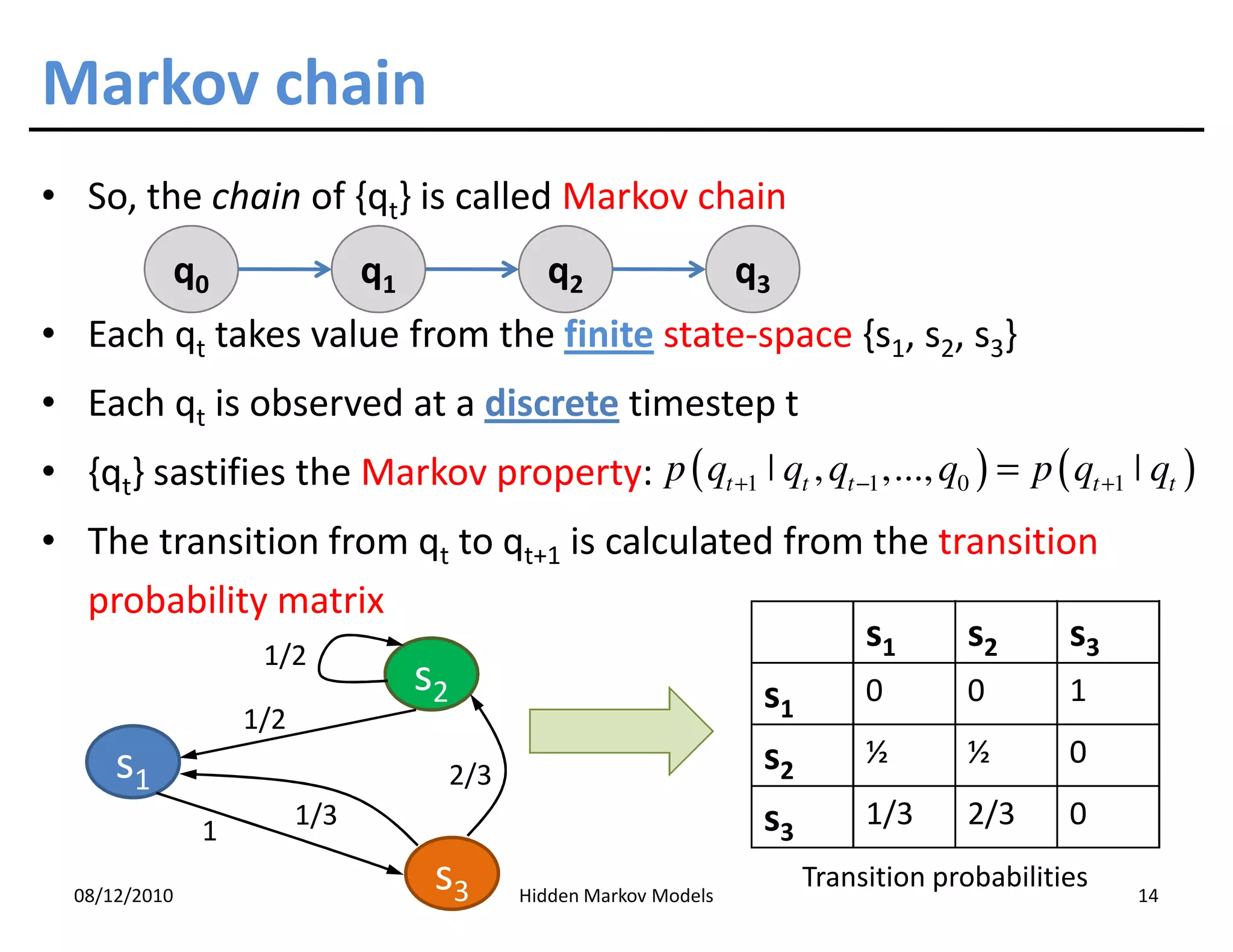
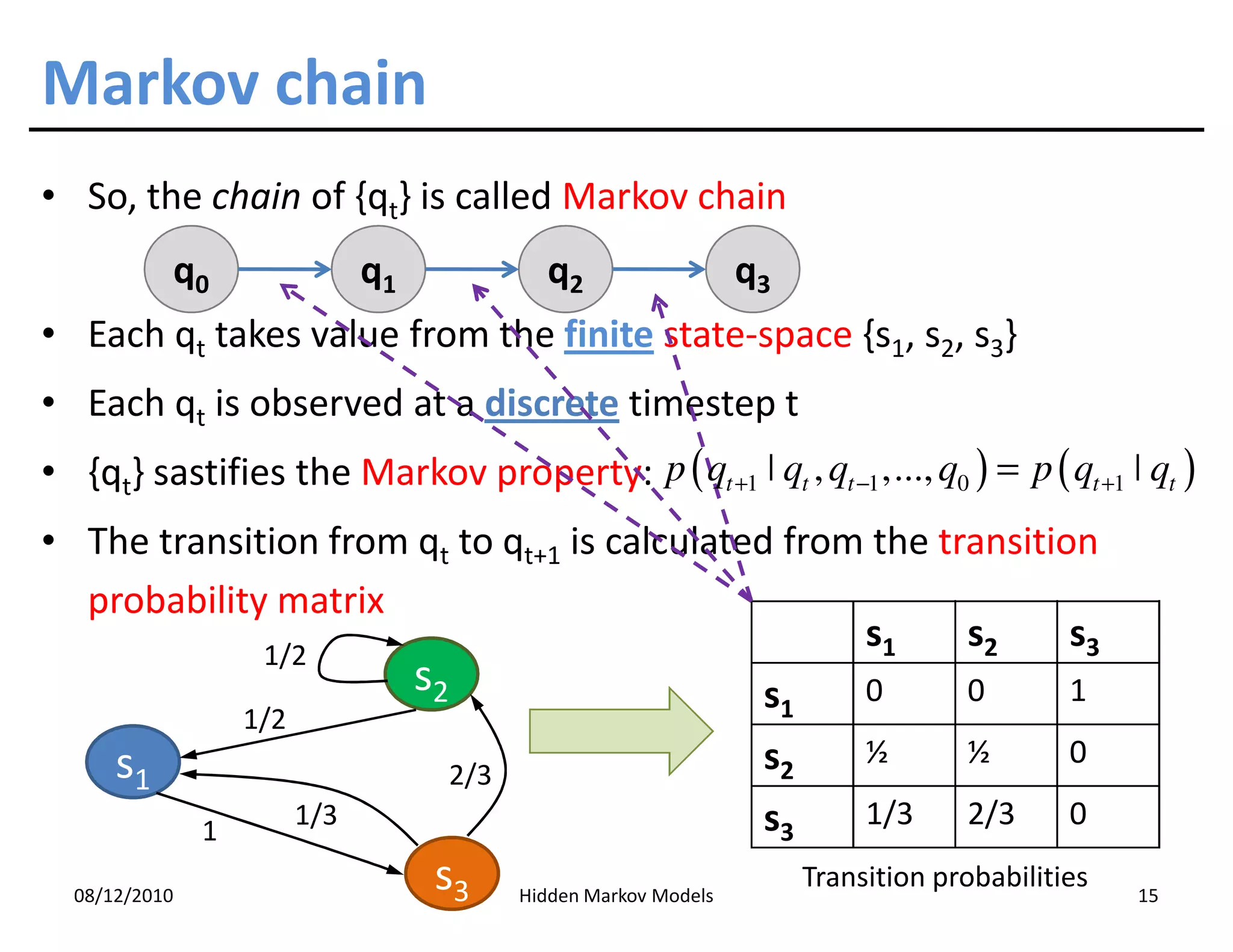
• The transition from qt to qt+1 is calculated from the transition
  probability matrix
             1/2
                                                   s1     s2     s3
                                    s2                                 s1        0       0        1
                   1/2
      s1                                                               s2        ½       ½        0
                                         2/3
               1
                         1/3                                           s3        1/3     2/3      0

  08/12/2010
                                     s3        Hidden Markov Models
                                                                            Transition probabilities
                                                                                                       14
Markov chain
• So, the chain of {qt} is called Markov chain
           q0                  q1                q2                   q3
• Each qt takes value from the finite state-space {s1, s2, s3}
• Each qt is observed at a discrete timestep t
• {qt} sastifies the Markov property: p ( qt +1 ˚ qt , qt −1 ,..., q0 ) = p ( qt +1 ˚ qt )
• The transition from qt to qt+1 is calculated from the transition
  probability matrix
             1/2
                                                   s1     s2     s3
                                    s2                                 s1        0       0        1
                   1/2
      s1                                                               s2        ½       ½        0
                                         2/3
               1
                         1/3                                           s3        1/3     2/3      0

  08/12/2010
                                     s3        Hidden Markov Models
                                                                            Transition probabilities
                                                                                                       15
Markov Chain – Important property
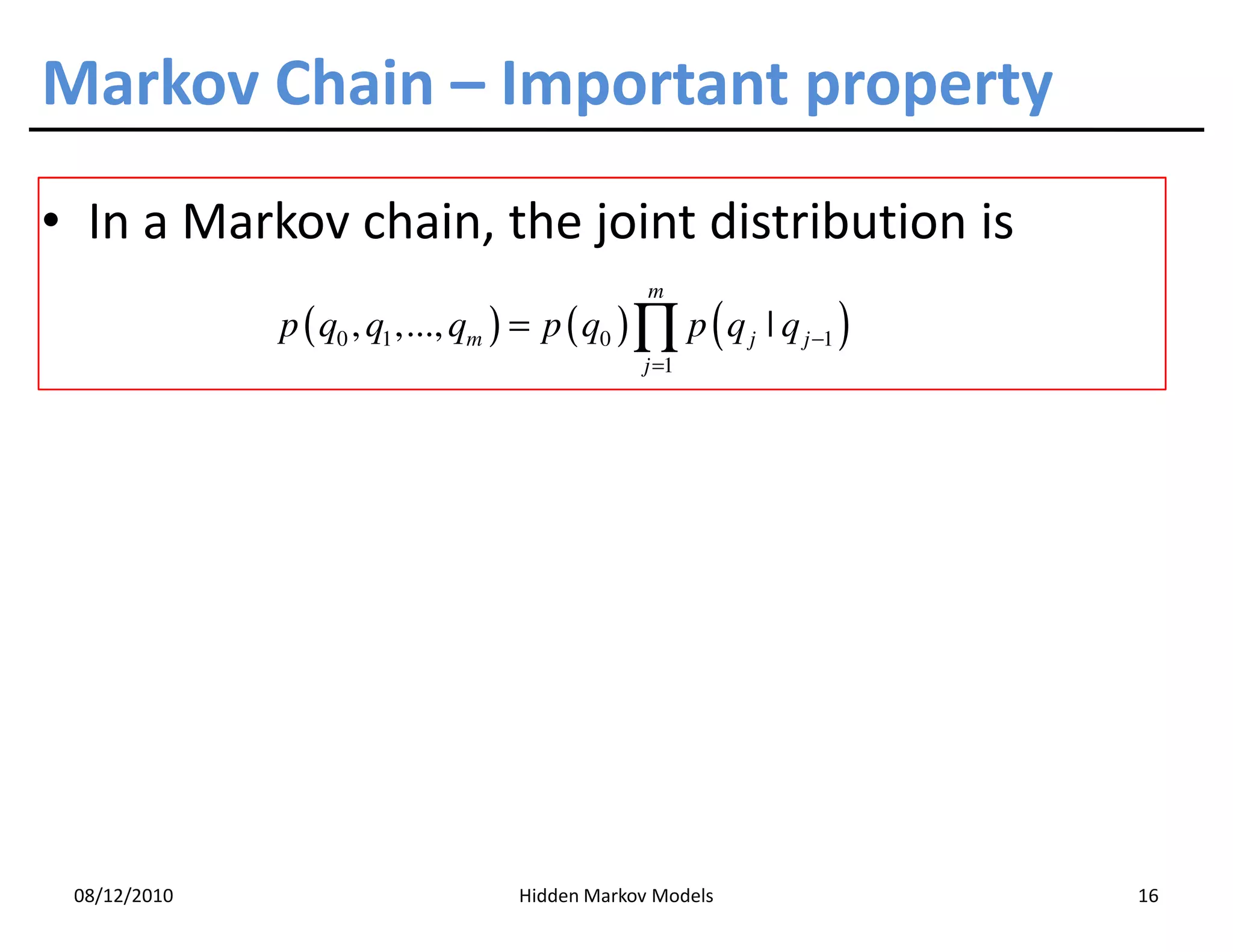
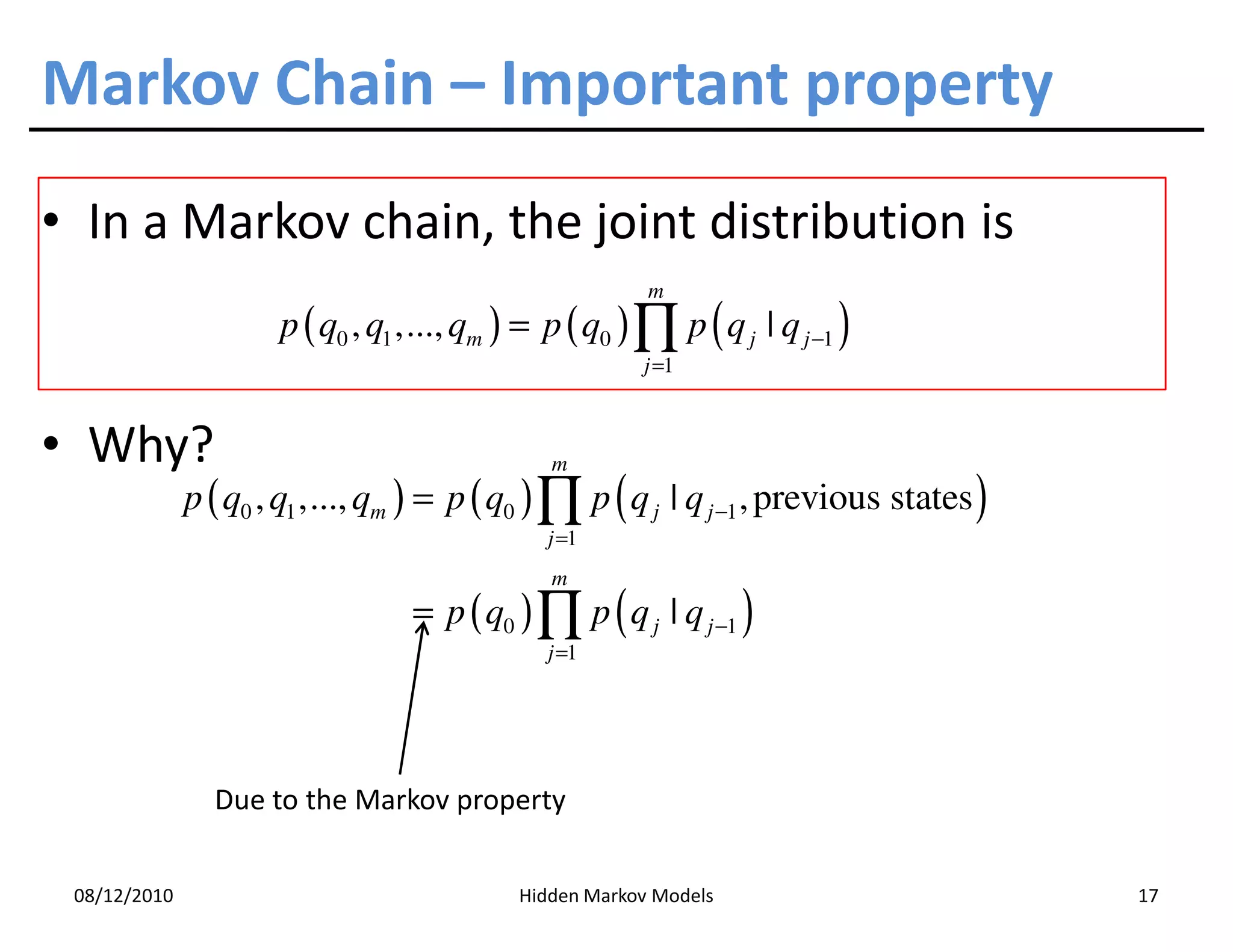
• In a Markov chain, the joint distribution is
                                                 m
              p ( q0 , q1 ,..., qm ) = p ( q0 ) ∏ p ( q j | q j −1 )
                                                j =1


 08/12/2010                         Hidden Markov Models               16
Markov Chain – Important property
• In a Markov chain, the joint distribution is
                                                         m
                      p ( q0 , q1 ,..., qm ) = p ( q0 ) ∏ p ( q j | q j −1 )
                                                        j =1


• Why?                                         m
              p ( q0 , q1 ,..., qm ) = p ( q0 ) ∏ p ( q j | q j −1 , previous states )
                                               j =1
                                               m
                                  = p ( q0 ) ∏ p ( q j | q j −1 )
                                               j =1


                Due to the Markov property


 08/12/2010                                 Hidden Markov Models                         17
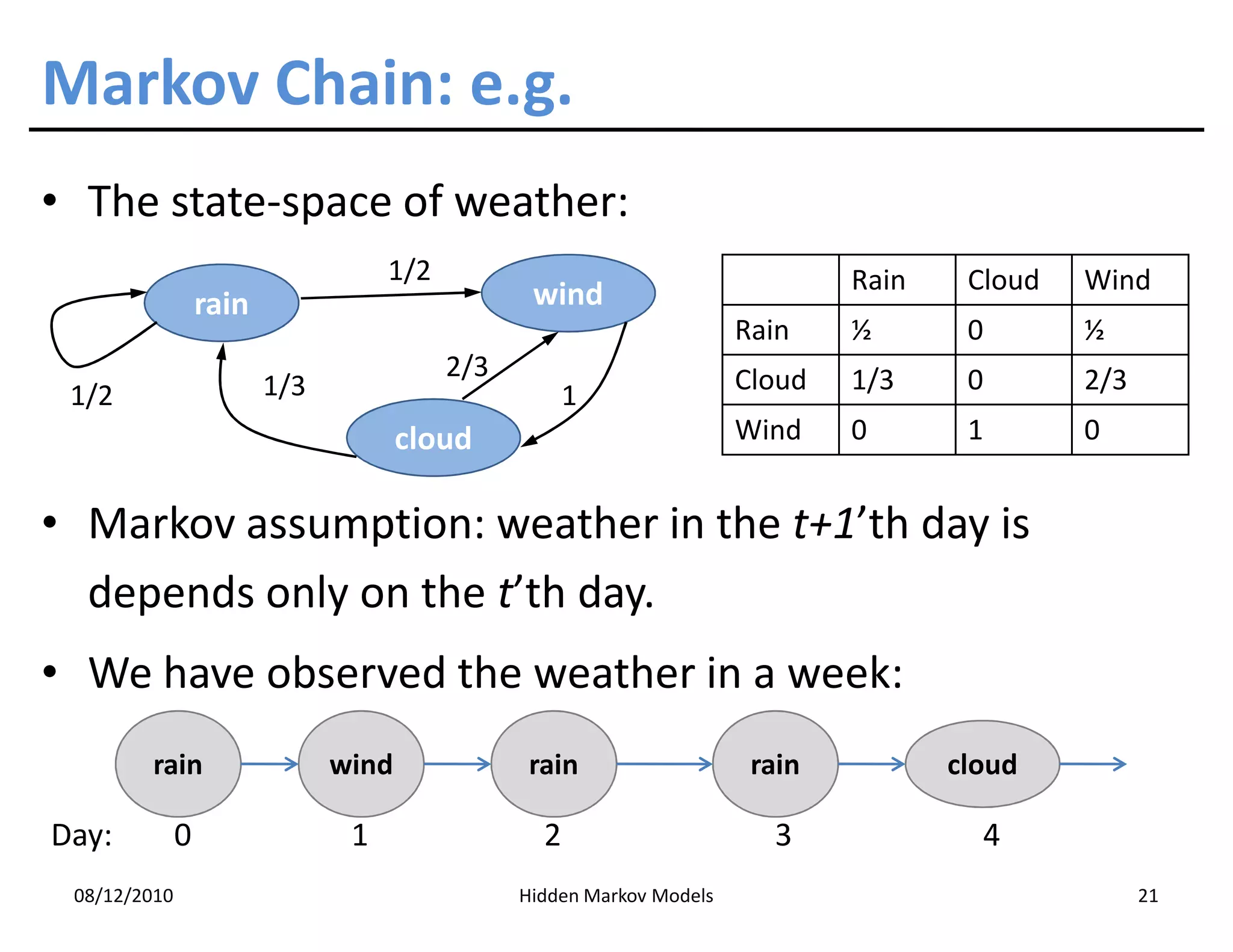
Markov Chain: e.g.
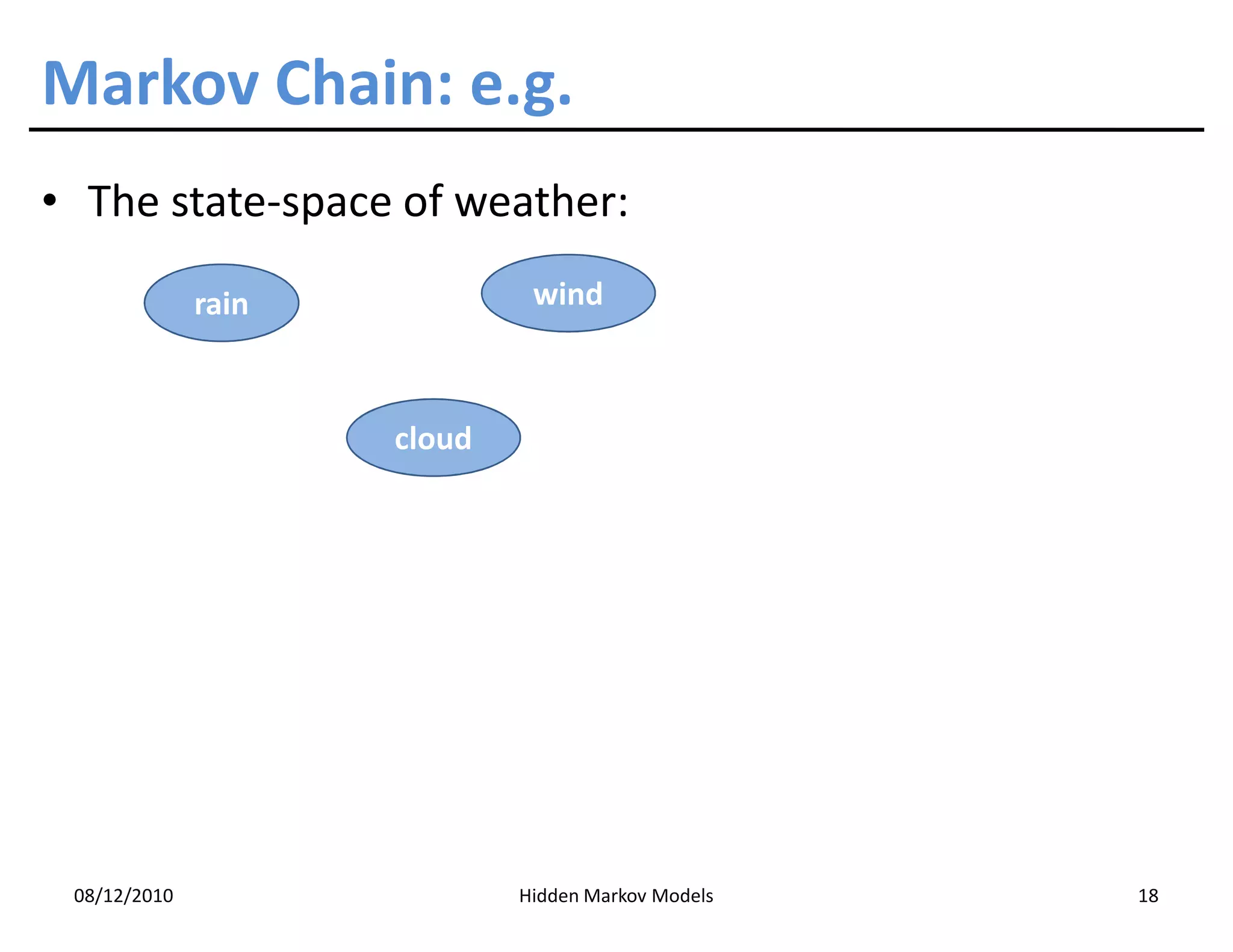
• The state-space of weather:

              rain            wind


                     cloud


 08/12/2010                  Hidden Markov Models   18
Markov Chain: e.g.
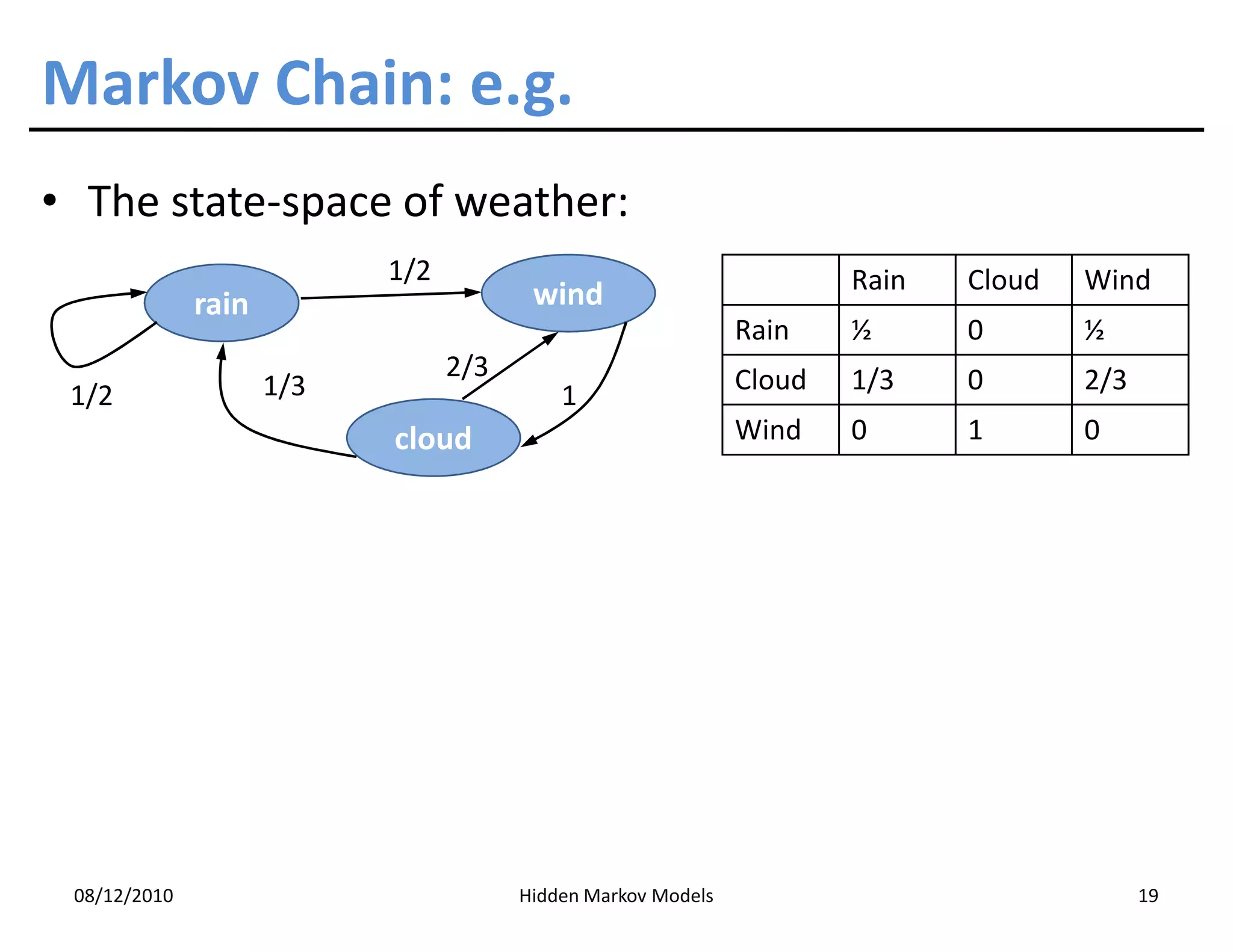
• The state-space of weather:
                           1/2                                        Rain   Cloud   Wind
              rain                      wind
                                                              Rain    ½      0       ½
                                 2/3                          Cloud   1/3    0       2/3
 1/2                 1/3                   1
                           cloud                              Wind    0      1       0


 08/12/2010                            Hidden Markov Models                                19
Markov Chain: e.g.
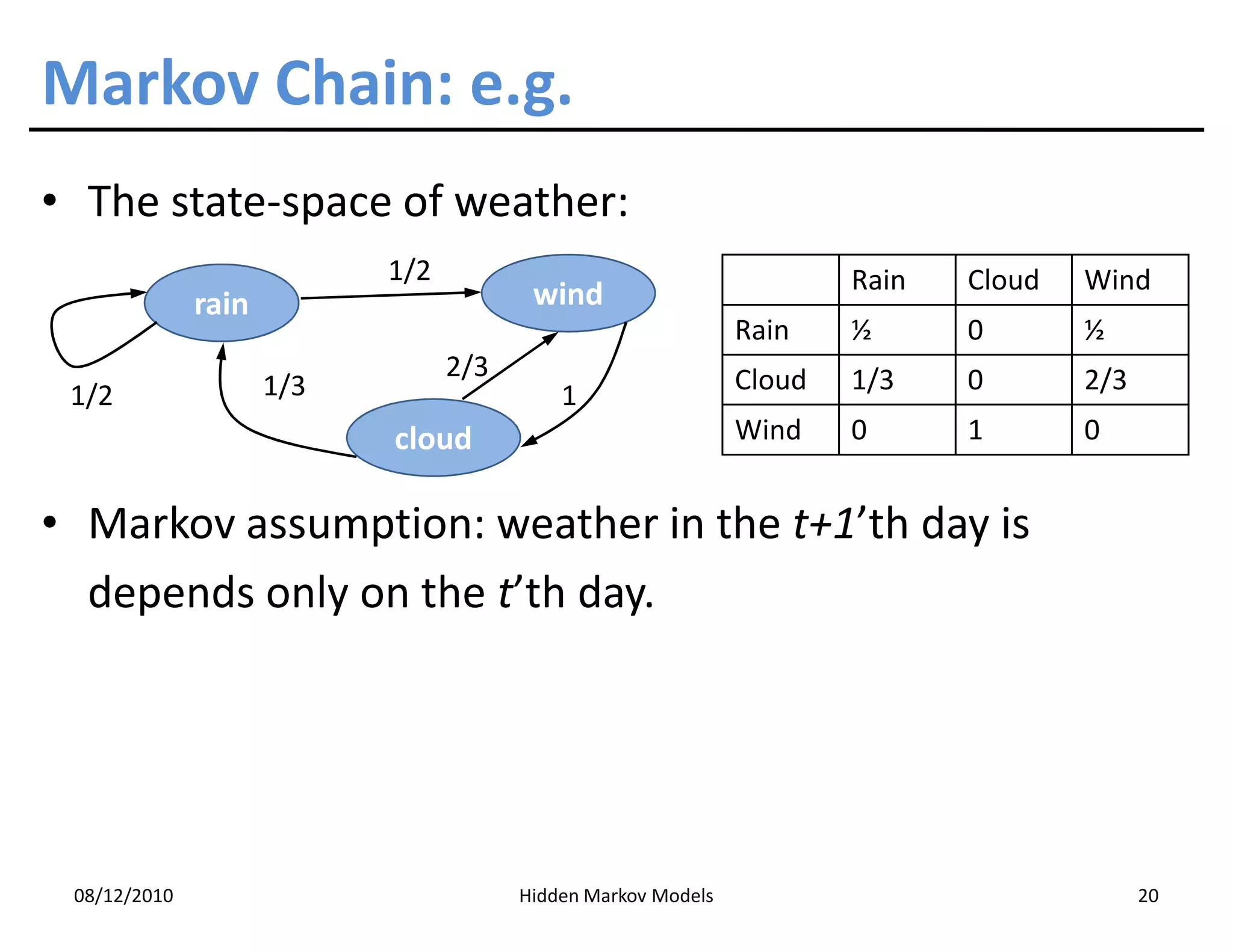
• The state-space of weather:
                           1/2                                        Rain   Cloud   Wind
              rain                      wind
                                                              Rain    ½      0       ½
                                 2/3                          Cloud   1/3    0       2/3
 1/2                 1/3                   1
                           cloud                              Wind    0      1       0


• Markov assumption: weather in the t+1’th day is
  depends only on the t’th day.


 08/12/2010                            Hidden Markov Models                                20
Markov Chain: e.g.
• The state-space of weather:
                                    1/2                                        Rain    Cloud   Wind
                  rain                           wind
                                                                       Rain    ½       0       ½
                                          2/3                          Cloud   1/3     0       2/3
 1/2                     1/3                          1
                                      cloud                            Wind    0       1       0


• Markov assumption: weather in the t+1’th day is
  depends only on the t’th day.
• We have observed the weather in a week:
        rain                   wind              rain                   rain          cloud

Day:          0                 1                 2                      3              4
 08/12/2010                                     Hidden Markov Models                                 21
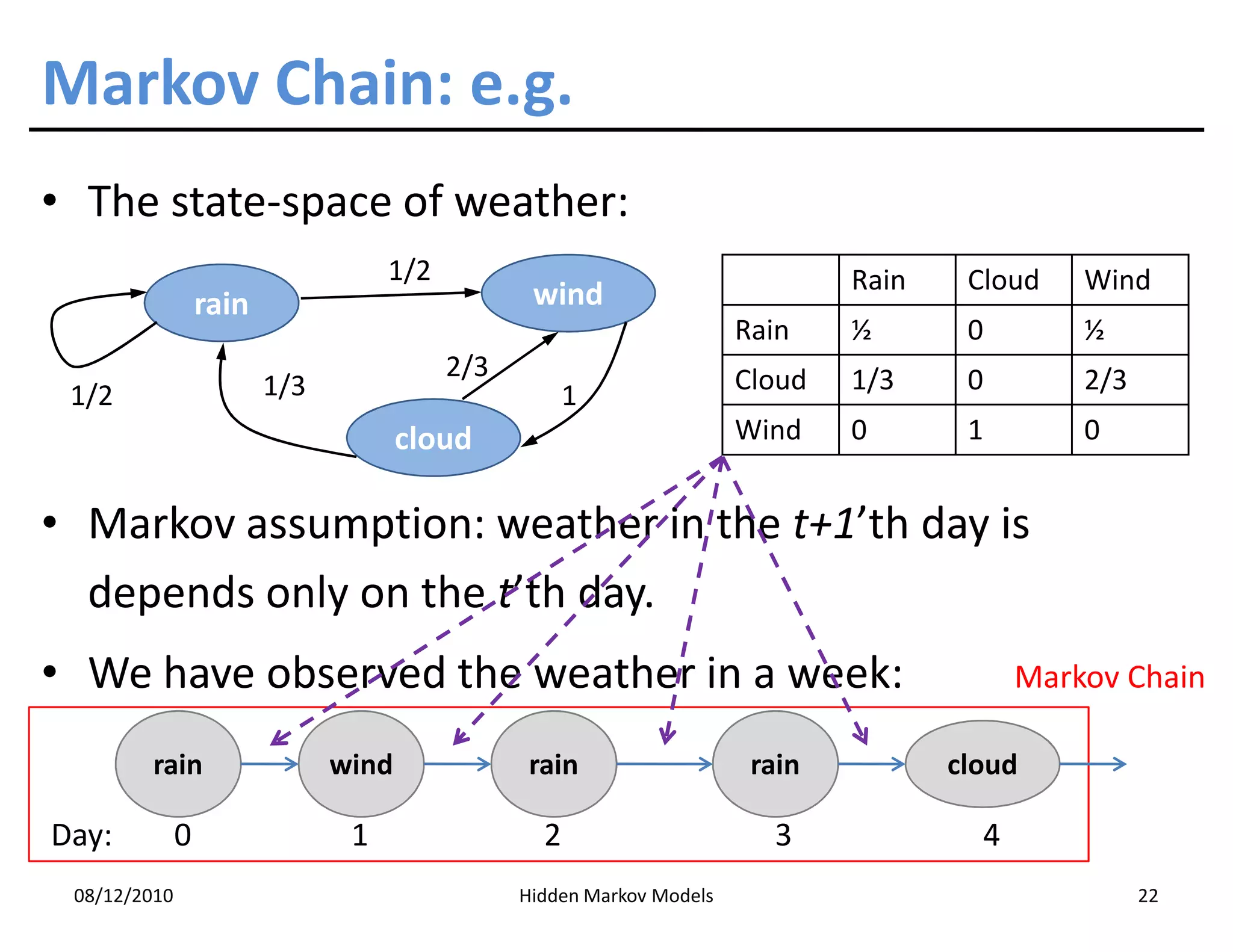
Markov Chain: e.g.
• The state-space of weather:
                                    1/2                                        Rain    Cloud    Wind
                  rain                           wind
                                                                       Rain    ½       0        ½
                                          2/3                          Cloud   1/3     0        2/3
 1/2                     1/3                          1
                                      cloud                            Wind    0       1        0


• Markov assumption: weather in the t+1’th day is
  depends only on the t’th day.
• We have observed the weather in a week:                                                   Markov Chain

        rain                   wind              rain                   rain          cloud

Day:          0                 1                 2                      3              4
 08/12/2010                                     Hidden Markov Models                                  22
Contents
• Introduction

• Markov Chain

• Hidden Markov Models


 08/12/2010       Hidden Markov Models   23
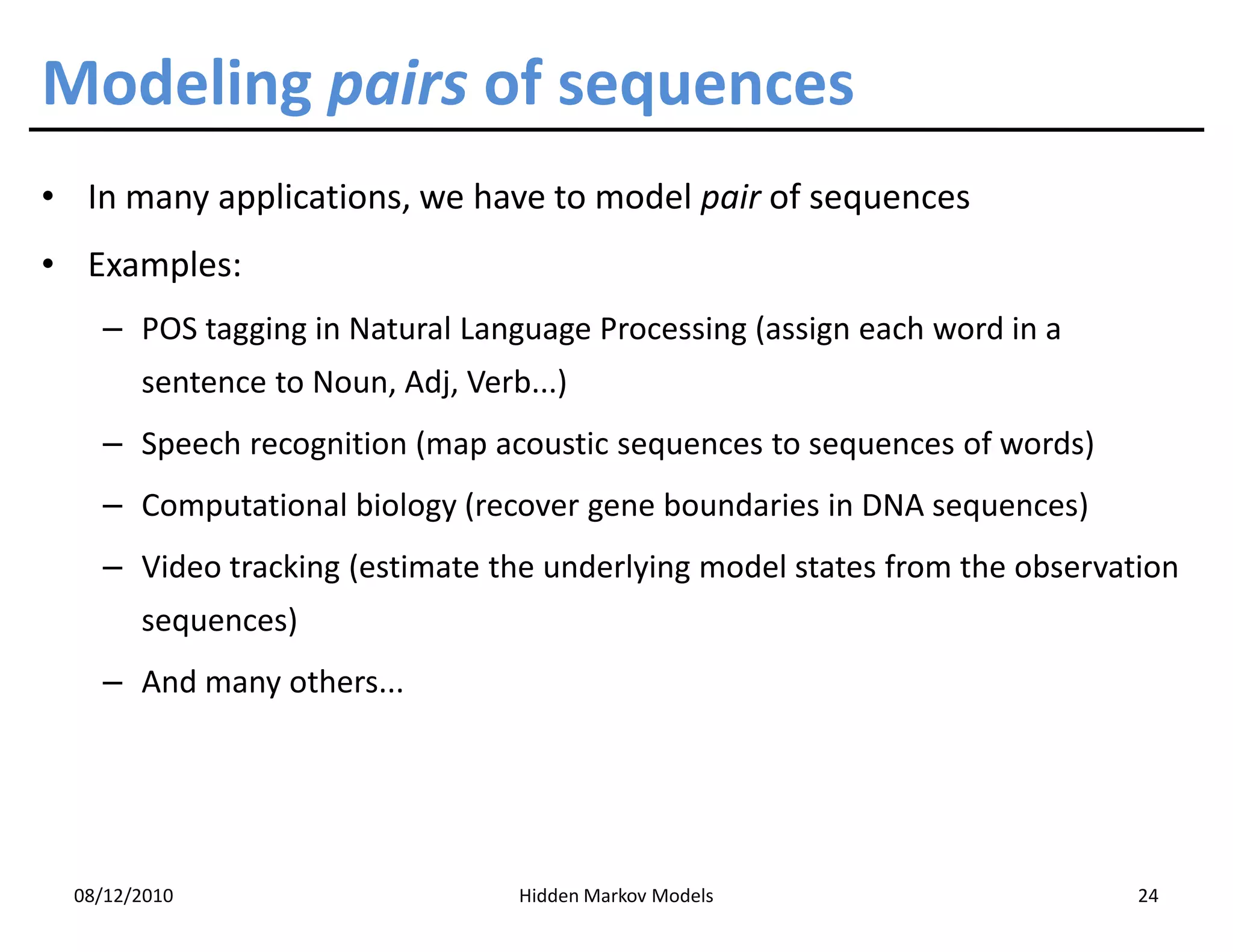
Modeling pairs of sequences
• In many applications, we have to model pair of sequences
• Examples:
    – POS tagging in Natural Language Processing (assign each word in a
        sentence to Noun, Adj, Verb...)
    – Speech recognition (map acoustic sequences to sequences of words)
    – Computational biology (recover gene boundaries in DNA sequences)
    – Video tracking (estimate the underlying model states from the observation
        sequences)
    – And many others...


  08/12/2010                       Hidden Markov Models                     24
Probabilistic models for sequence pairs
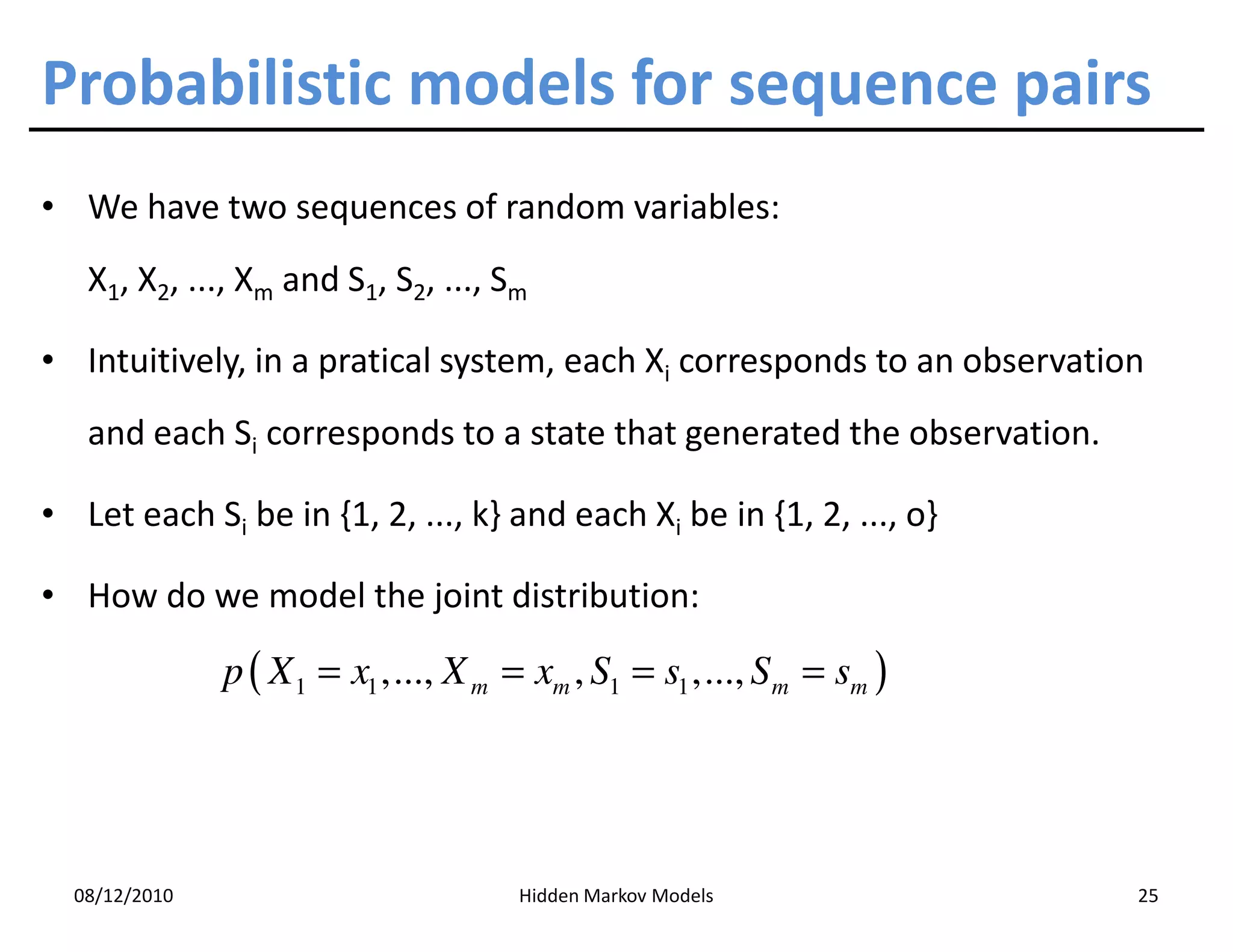
• We have two sequences of random variables:
   X1, X2, ..., Xm and S1, S2, ..., Sm

• Intuitively, in a pratical system, each Xi corresponds to an observation
   and each Si corresponds to a state that generated the observation.

• Let each Si be in {1, 2, ..., k} and each Xi be in {1, 2, ..., o}

• How do we model the joint distribution:

               p ( X 1 = x1 ,..., X m = xm , S1 = s1 ,..., S m = sm )


  08/12/2010                           Hidden Markov Models              25
Hidden Markov Models (HMMs)
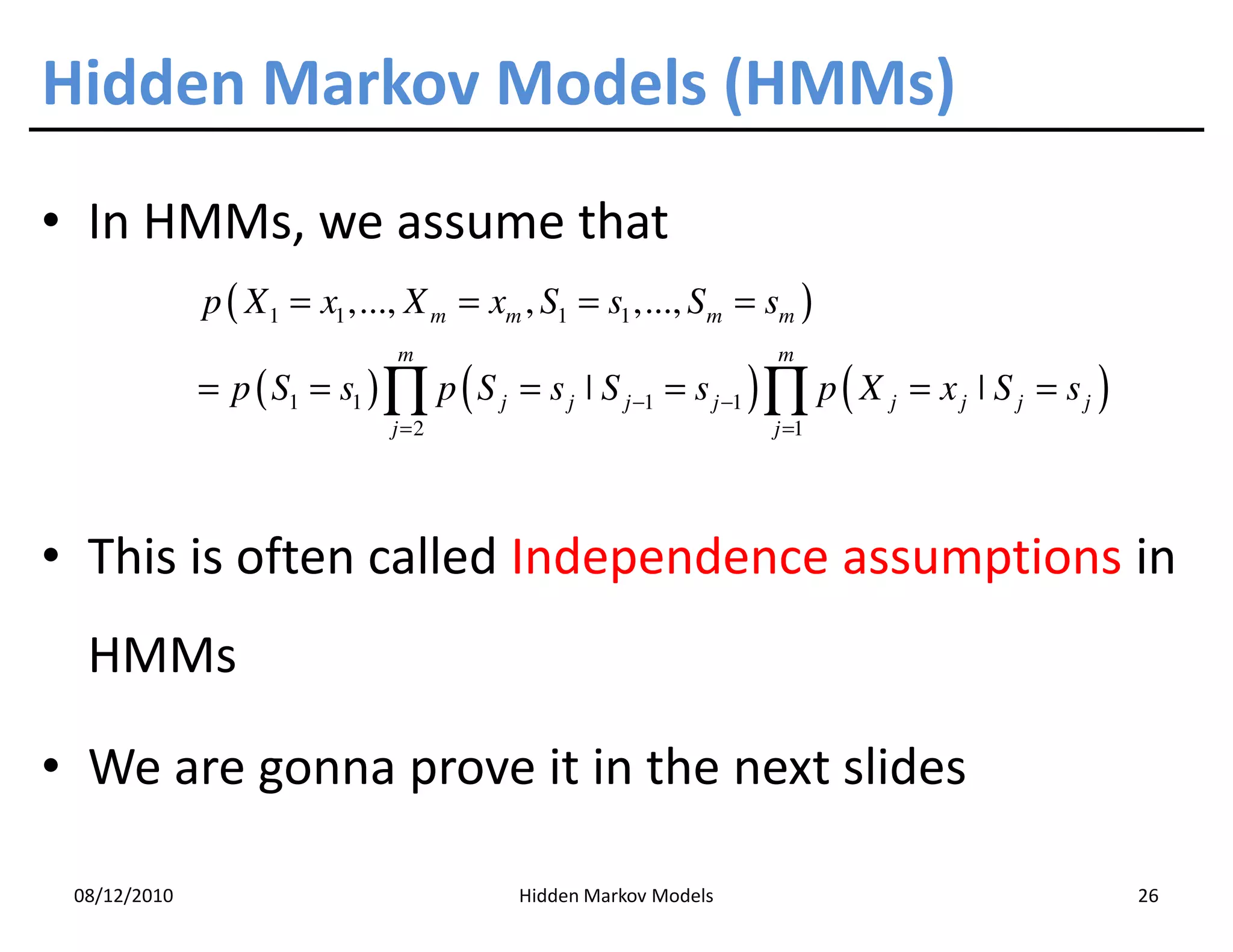
• In HMMs, we assume that
              p ( X 1 = x1 ,..., X m = xm , S1 = s1 ,..., Sm = sm )
                               m                                 m
              = p ( S1 = s1 ) ∏ p ( S j = s j ˚ S j −1 = s j −1 ) ∏ p ( X j = x j ˚ S j = s j )
                               j =2                              j =1


• This is often called Independence assumptions in
  HMMs

• We are gonna prove it in the next slides

 08/12/2010                               Hidden Markov Models                                    26
Independence Assumptions in HMMs [1]
                                 p ( ABC ) = p ( A | BC ) p ( BC ) = p ( A | BC ) p ( B ˚ C ) p ( C )
• By the chain rule, the following equality is exact:
          p ( X 1 = x1 ,..., X m = xm , S1 = s1 ,..., S m = sm )
         = p ( S1 = s1 ,..., S m = sm ) ×
          p ( X 1 = x1 ,..., X m = xm ˚ S1 = s1 ,..., S m = sm )

• Assumption 1: the state sequence forms a Markov chain
                                                           m
         p ( S1 = s1 ,..., S m = sm ) = p ( S1 = s1 ) ∏ p ( S j = s j ˚ S j −1 = s j −1 )
                                                           j =2


  08/12/2010                            Hidden Markov Models                                 27
Independence Assumptions in HMMs [2]
• By the chain rule, the following equality is exact:
               p ( X 1 = x1 ,..., X m = xm ˚ S1 = s1 ,..., S m = sm )
                  m
               = ∏ p ( X j = x j ˚ S1 = s1 ,..., Sm = sm , X 1 = x1 ,..., X j −1 = x j −1 )
                  j =1

• Assumption 2: each observation depends only on the underlying
   state
                p ( X j = x j ˚ S1 = s1 ,..., Sm = sm , X 1 = x1 ,..., X j −1 = x j −1 )
                = p( X j = xj ˚ S j = sj )
• These two assumptions are often called independence
   assumptions in HMMs

  08/12/2010                              Hidden Markov Models                                28
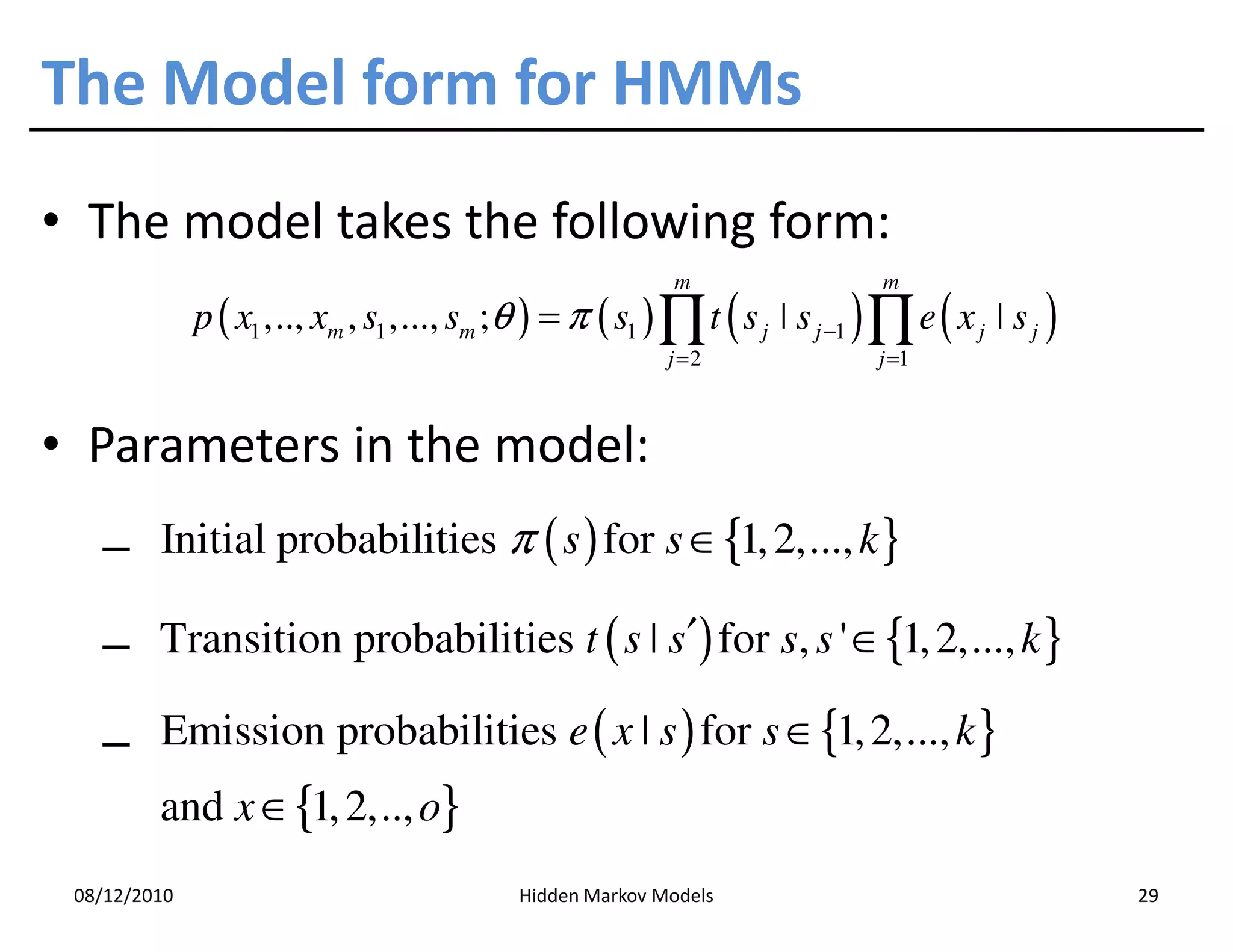
The Model form for HMMs
• The model takes the following form:
                                                            m                   m
              p ( x1 ,.., xm , s1 ,..., sm ;θ ) = π ( s1 ) ∏ t ( s j ˚ s j −1 ) ∏ e ( x j ˚ s j )
                                                            j =2               j =1


• Parameters in the model:
   – Initial probabilities π ( s ) for s ∈ {1, 2,..., k }

   – Transition probabilities t ( s ˚ s′ ) for s, s ' ∈ {1, 2,..., k }

   – Emission probabilities e ( x ˚ s ) for s ∈ {1, 2,..., k }
         and x ∈ {1, 2,.., o}
 08/12/2010                                  Hidden Markov Models                                   29
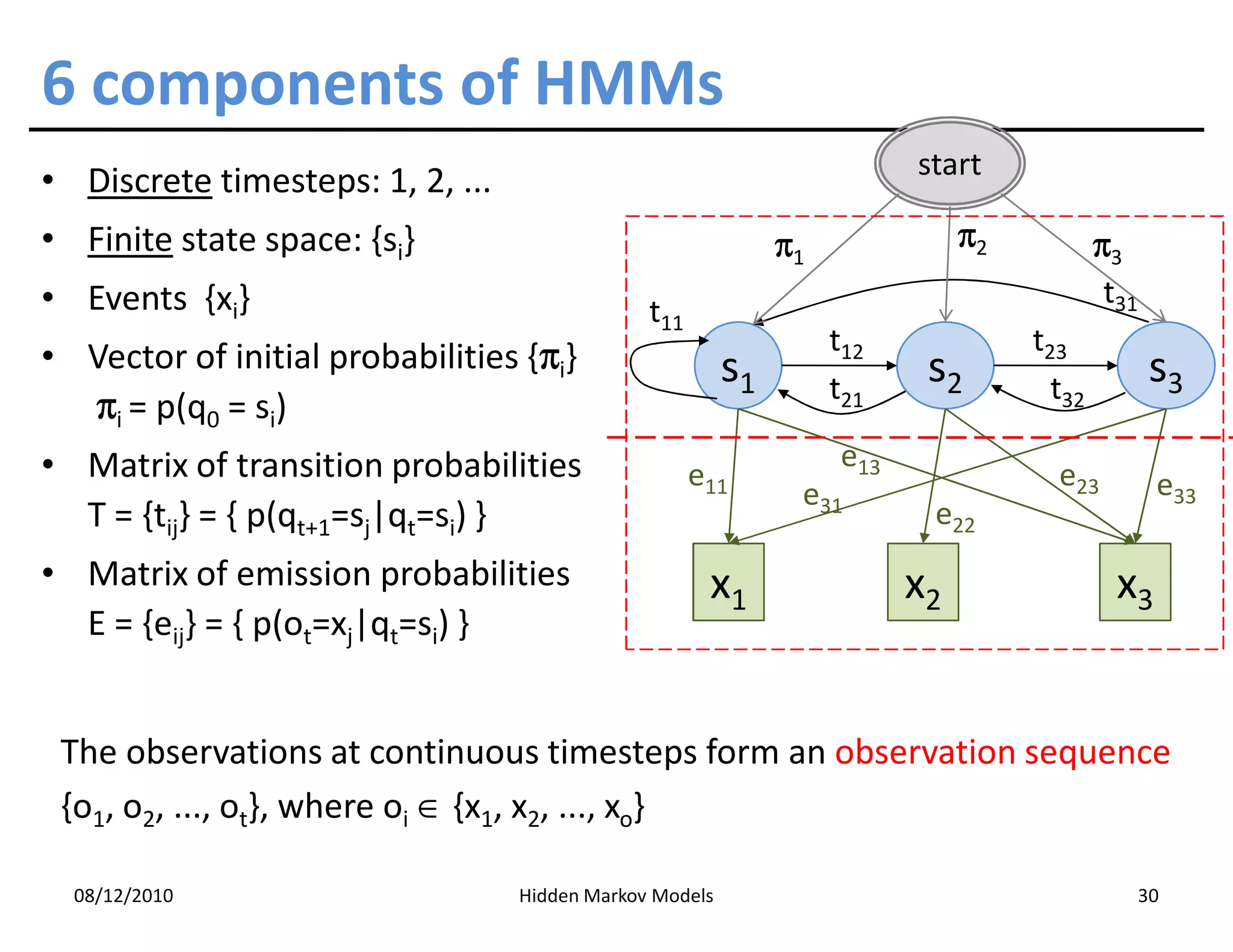
6 components of HMMs
                                                                         start
• Discrete timesteps: 1, 2, ...
• Finite state space: {si}                                    π1              π2           π3
• Events {xi}                                                                               t31
                                               t11
                                                                   t12             t23
                                   π
• Vector of initial probabilities {πi}                   s1               s2                       s3
                                                                   t21               t32
  πi = p(q0 = si)
• Matrix of transition probabilities                               e13
                                                     e11                             e23           e33
                                                               e31
  T = {tij} = { p(qt+1=sj|qt=si) }                                        e22
• Matrix of emission probabilities                    x1                 x2                  x3
  E = {eij} = { p(ot=xj|qt=si) }


 The observations at continuous timesteps form an observation sequence
 {o1, o2, ..., ot}, where oi ∈ {x1, x2, ..., xo}

  08/12/2010                      Hidden Markov Models                                            30
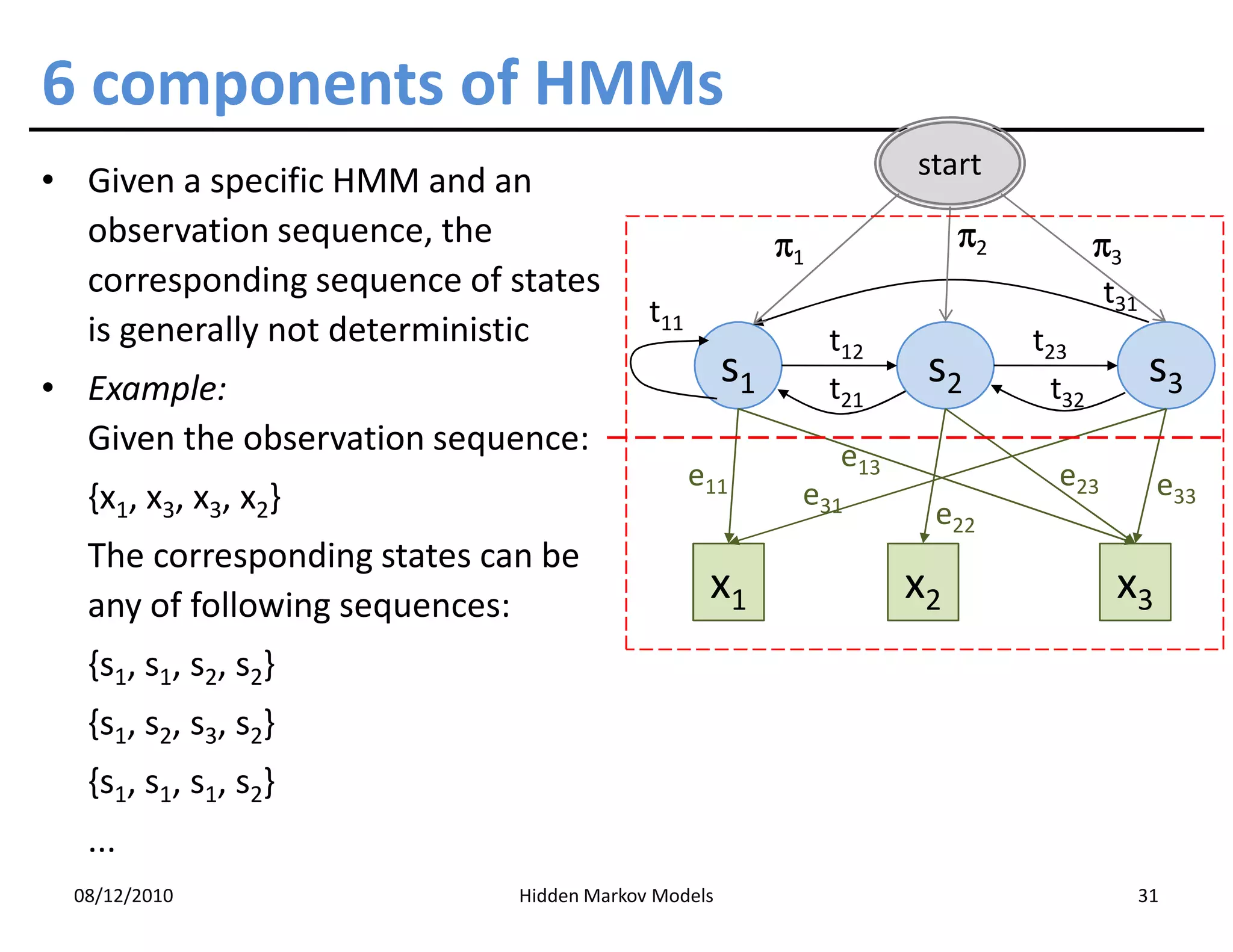
6 components of HMMs
                                                                    start
• Given a specific HMM and an
  observation sequence, the                              π1              π2           π3
  corresponding sequence of states                                                     t31
                                          t11
  is generally not deterministic                              t12             t23
• Example:                                          s1        t21
                                                                     s2         t32
                                                                                              s3
  Given the observation sequence:                             e13
                                                e11                             e23           e33
  {x1, x3, x3, x2}                                        e31
                                                                     e22
  The corresponding states can be
  any of following sequences:
                                                 x1                 x2                  x3
  {s1, s1, s2, s2}
  {s1, s2, s3, s2}
  {s1, s1, s1, s2}
  ...
 08/12/2010                  Hidden Markov Models                                            31
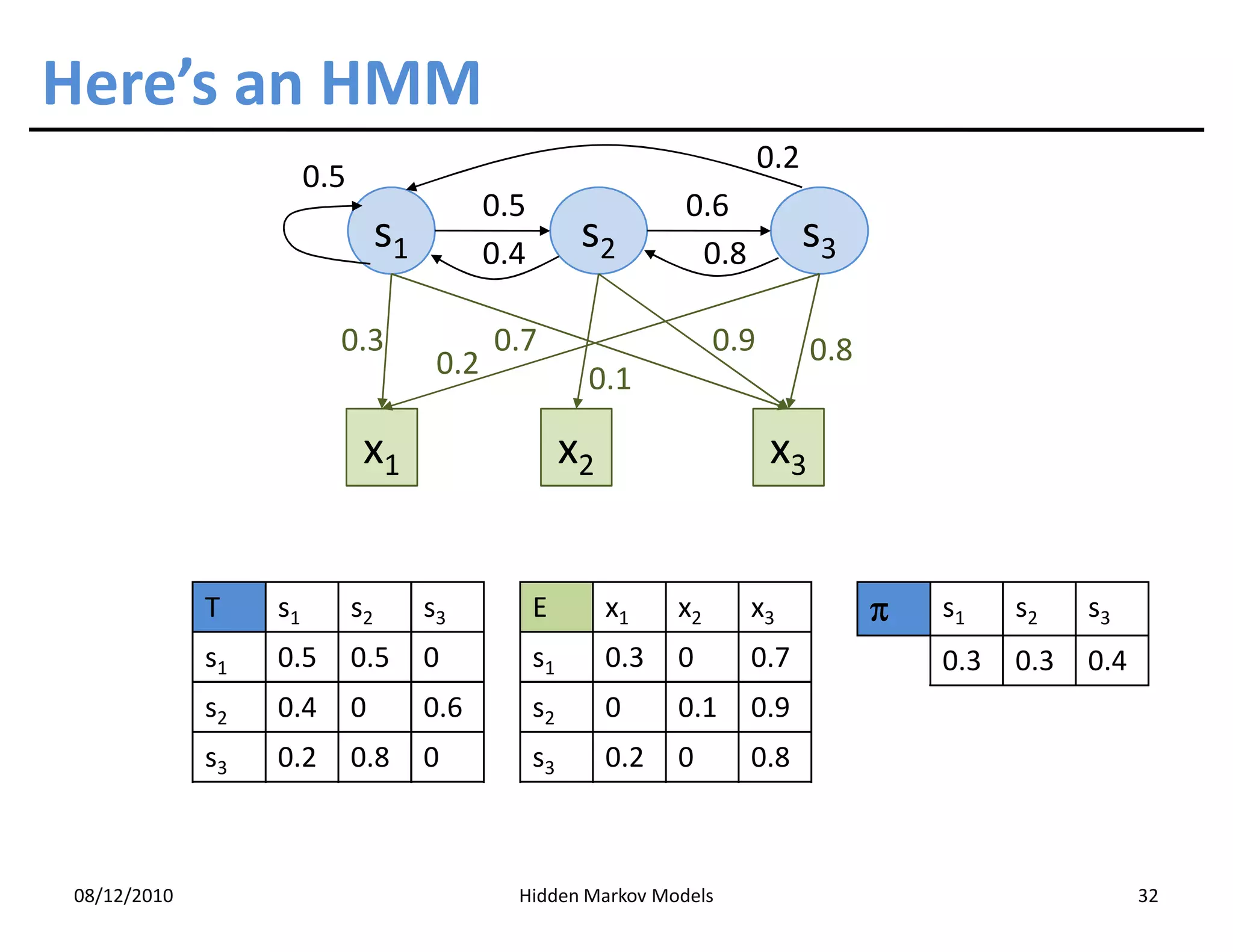
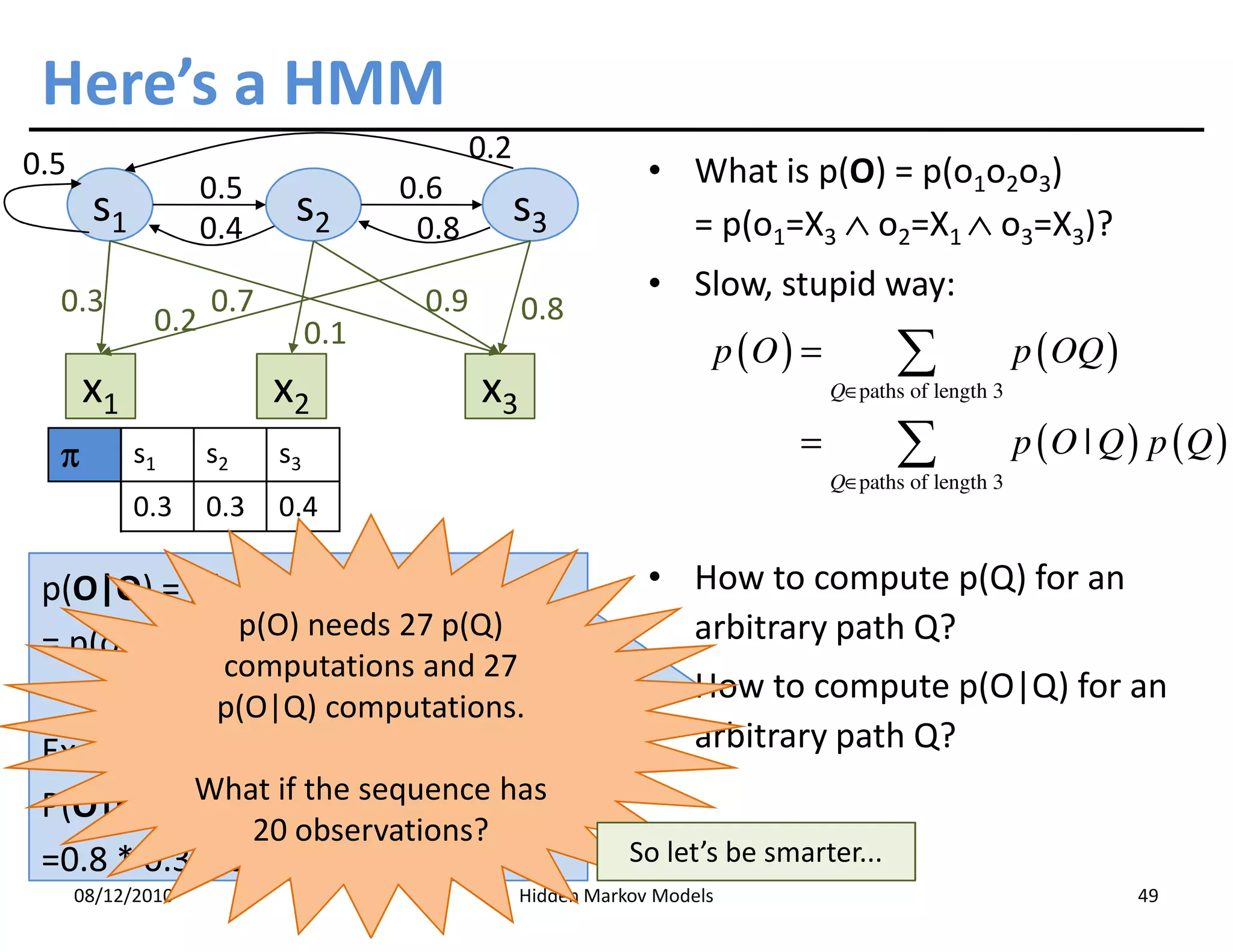
Here’s an HMM
                                                                               0.2
                       0.5
                                              0.5                   0.6
                                  s1          0.4
                                                          s2         0.8
                                                                                     s3

                         0.3                  0.7                        0.9         0.8
                                        0.2               0.1

                              x1                         x2                    x3


             T    s1         s2        s3           E         x1    x2     x3              π   s1    s2    s3
             s1   0.5        0.5       0            s1        0.3   0      0.7                 0.3   0.3   0.4
             s2   0.4        0         0.6          s2        0     0.1    0.9
             s3   0.2        0.8       0            s3        0.2   0      0.8


08/12/2010                                      Hidden Markov Models                                             32
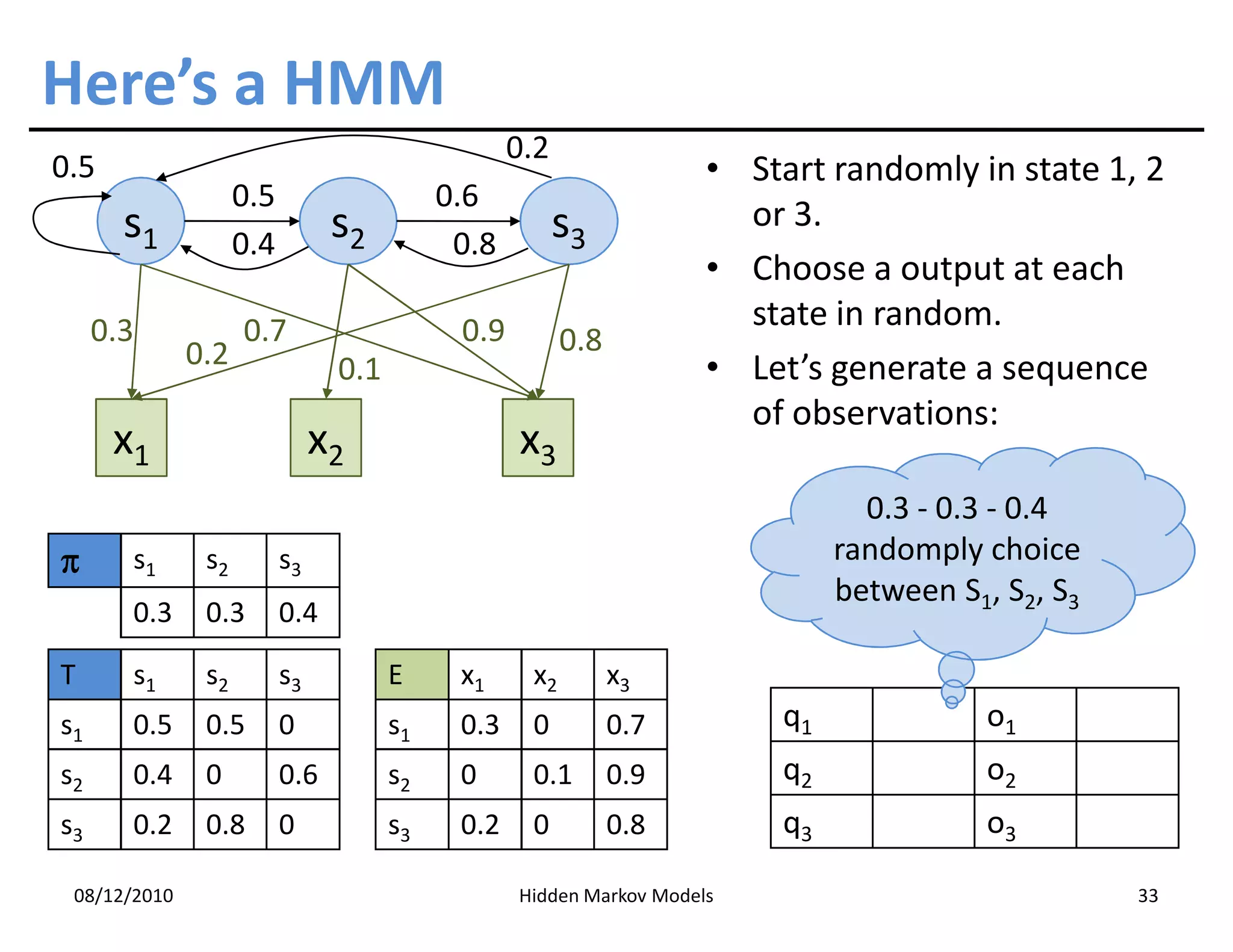
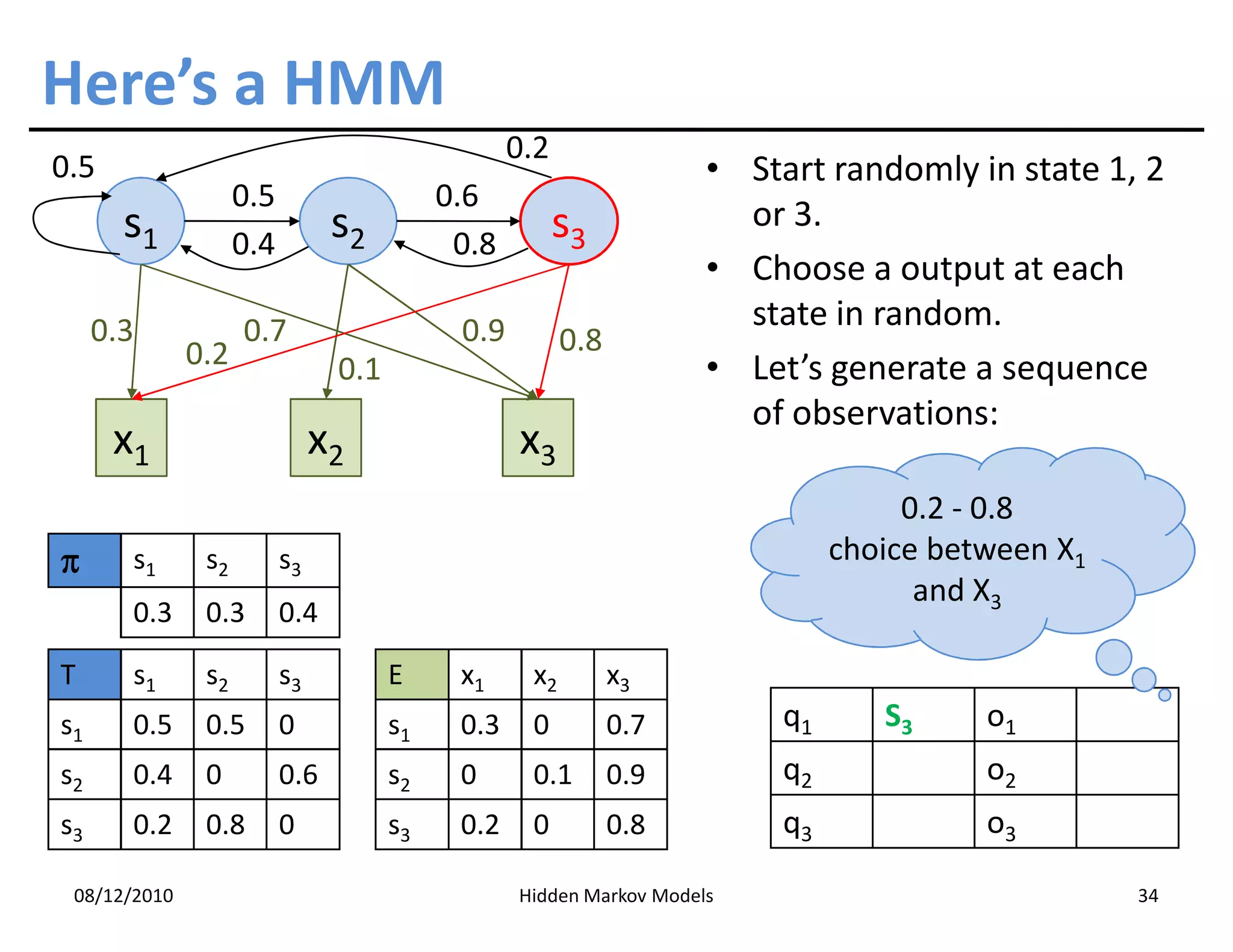
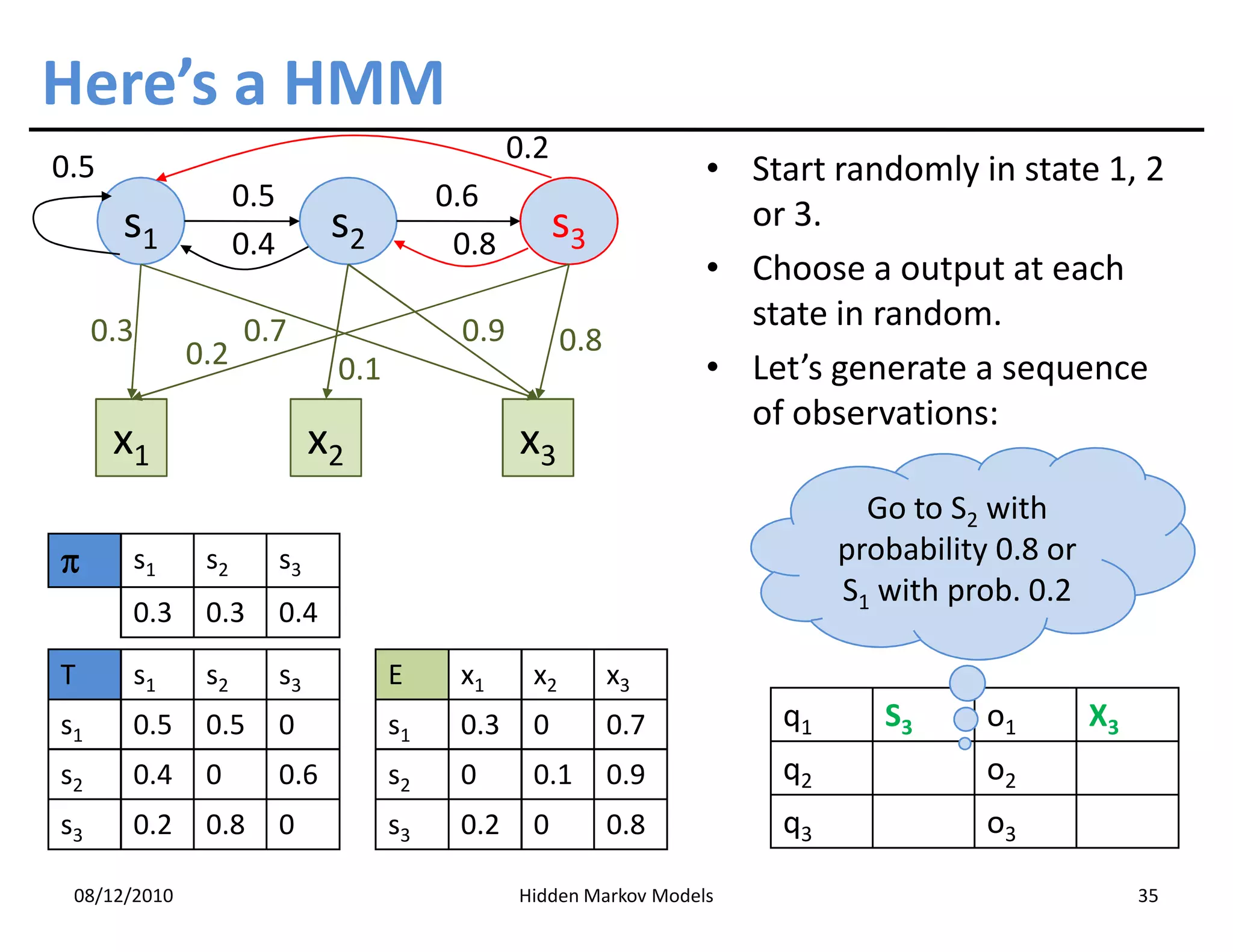
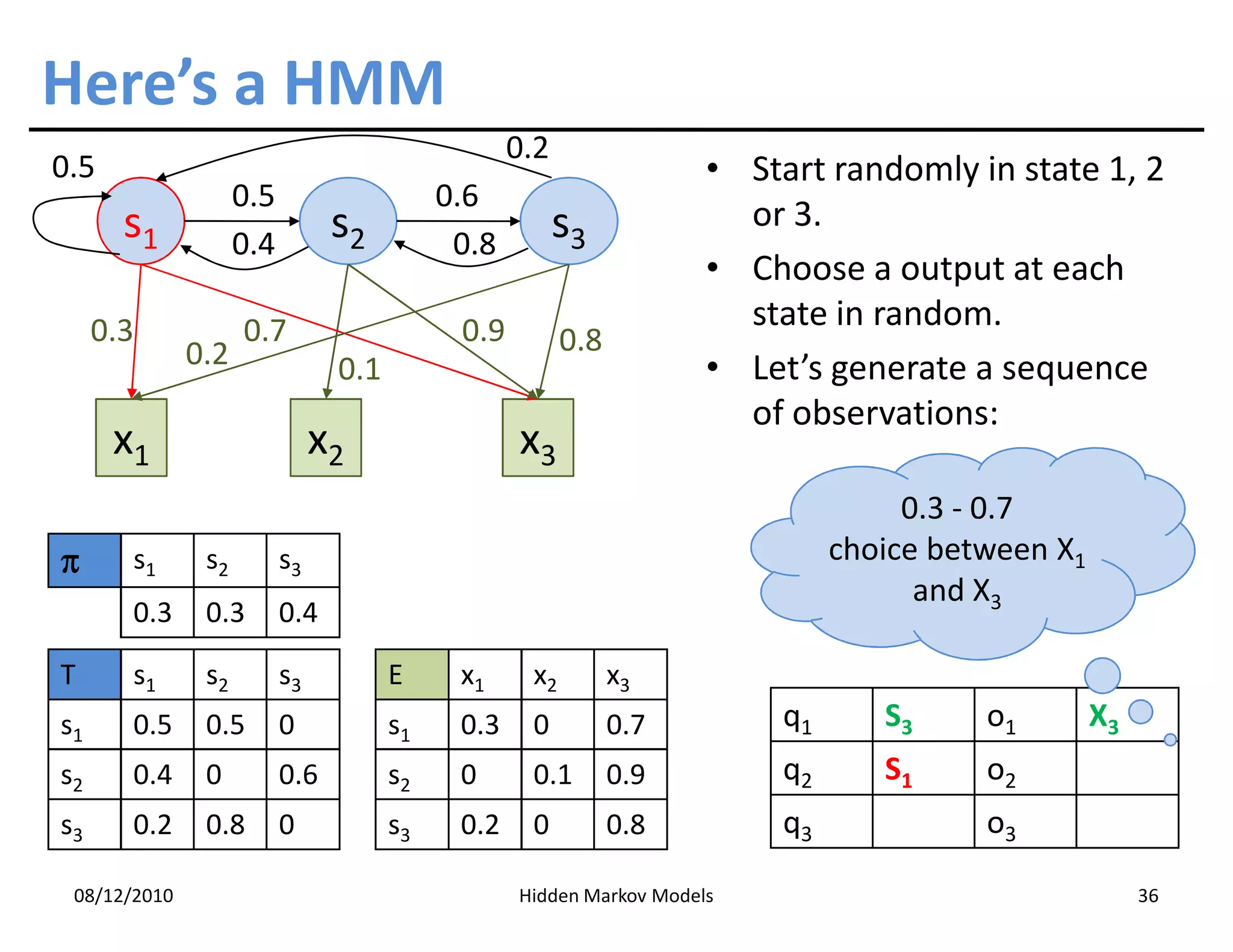
Here’s a HMM
                                                  0.2
0.5                                                                  • Start randomly in state 1, 2
                    0.5                    0.6
       s1                       s2                      s3             or 3.
                    0.4                     0.8
                                                                     • Choose a output at each
     0.3            0.7                     0.9                        state in random.
              0.2                                       0.8
                                0.1                                  • Let’s generate a sequence
                                                                       of observations:
      x1                       x2                 x3
                                                                                 0.3 - 0.3 - 0.4
π      s1      s2         s3                                                   randomply choice
                                                                               between S1, S2, S3
       0.3     0.3        0.4

T      s1      s2         s3          E     x1     x2         x3
s1     0.5     0.5        0           s1    0.3    0          0.7         q1              o1
s2     0.4     0          0.6         s2    0      0.1        0.9         q2              o2
s3     0.2     0.8        0           s3    0.2    0          0.8         q3              o3

 08/12/2010                                       Hidden Markov Models                              33
Here’s a HMM
                                                  0.2
0.5                                                                  • Start randomly in state 1, 2
                    0.5                    0.6
       s1                       s2                      s3             or 3.
                    0.4                     0.8
                                                                     • Choose a output at each
     0.3            0.7                     0.9                        state in random.
              0.2                                       0.8
                                0.1                                  • Let’s generate a sequence
                                                                       of observations:
      x1                       x2                 x3
                                                                                    0.2 - 0.8
π      s1      s2         s3                                                   choice between X1
                                                                                     and X3
       0.3     0.3        0.4

T      s1      s2         s3          E     x1     x2         x3
s1     0.5     0.5        0           s1    0.3    0          0.7         q1      S3     o1
s2     0.4     0          0.6         s2    0      0.1        0.9         q2             o2
s3     0.2     0.8        0           s3    0.2    0          0.8         q3             o3

 08/12/2010                                       Hidden Markov Models                             34
Here’s a HMM
                                                  0.2
0.5                                                                  • Start randomly in state 1, 2
                    0.5                    0.6
       s1                       s2                      s3             or 3.
                    0.4                     0.8
                                                                     • Choose a output at each
     0.3            0.7                     0.9                        state in random.
              0.2                                       0.8
                                0.1                                  • Let’s generate a sequence
                                                                       of observations:
      x1                       x2                 x3
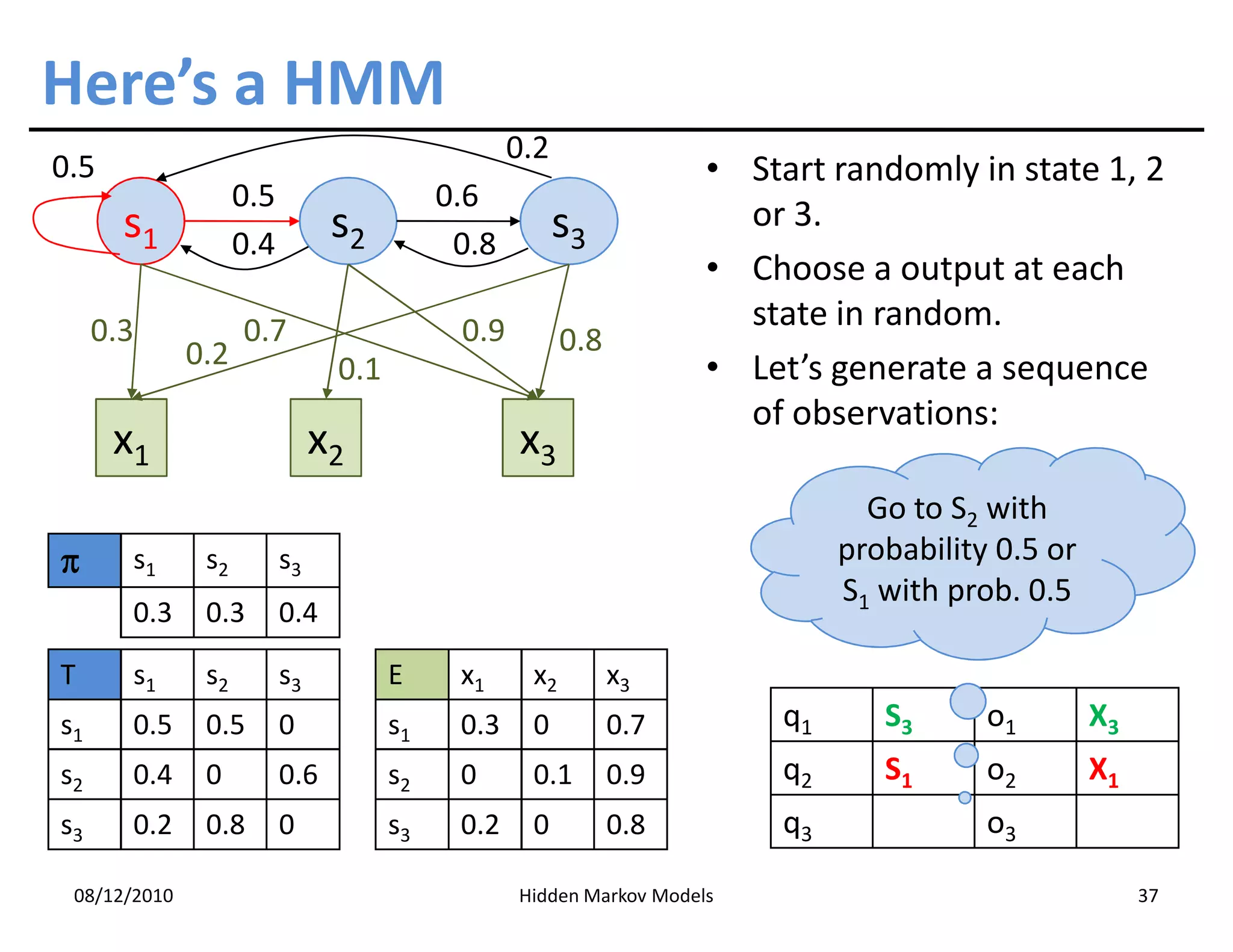
                                                                                 Go to S2 with
π      s1      s2         s3                                                   probability 0.8 or
                                                                               S1 with prob. 0.2
       0.3     0.3        0.4

T      s1      s2         s3          E     x1     x2         x3
s1     0.5     0.5        0           s1    0.3    0          0.7         q1      S3      o1        X3
s2     0.4     0          0.6         s2    0      0.1        0.9         q2              o2
s3     0.2     0.8        0           s3    0.2    0          0.8         q3              o3

 08/12/2010                                       Hidden Markov Models                                   35
Here’s a HMM
                                                  0.2
0.5                                                                  • Start randomly in state 1, 2
                    0.5                    0.6
       s1                       s2                      s3             or 3.
                    0.4                     0.8
                                                                     • Choose a output at each
     0.3            0.7                     0.9                        state in random.
              0.2                                       0.8
                                0.1                                  • Let’s generate a sequence
                                                                       of observations:
      x1                       x2                 x3
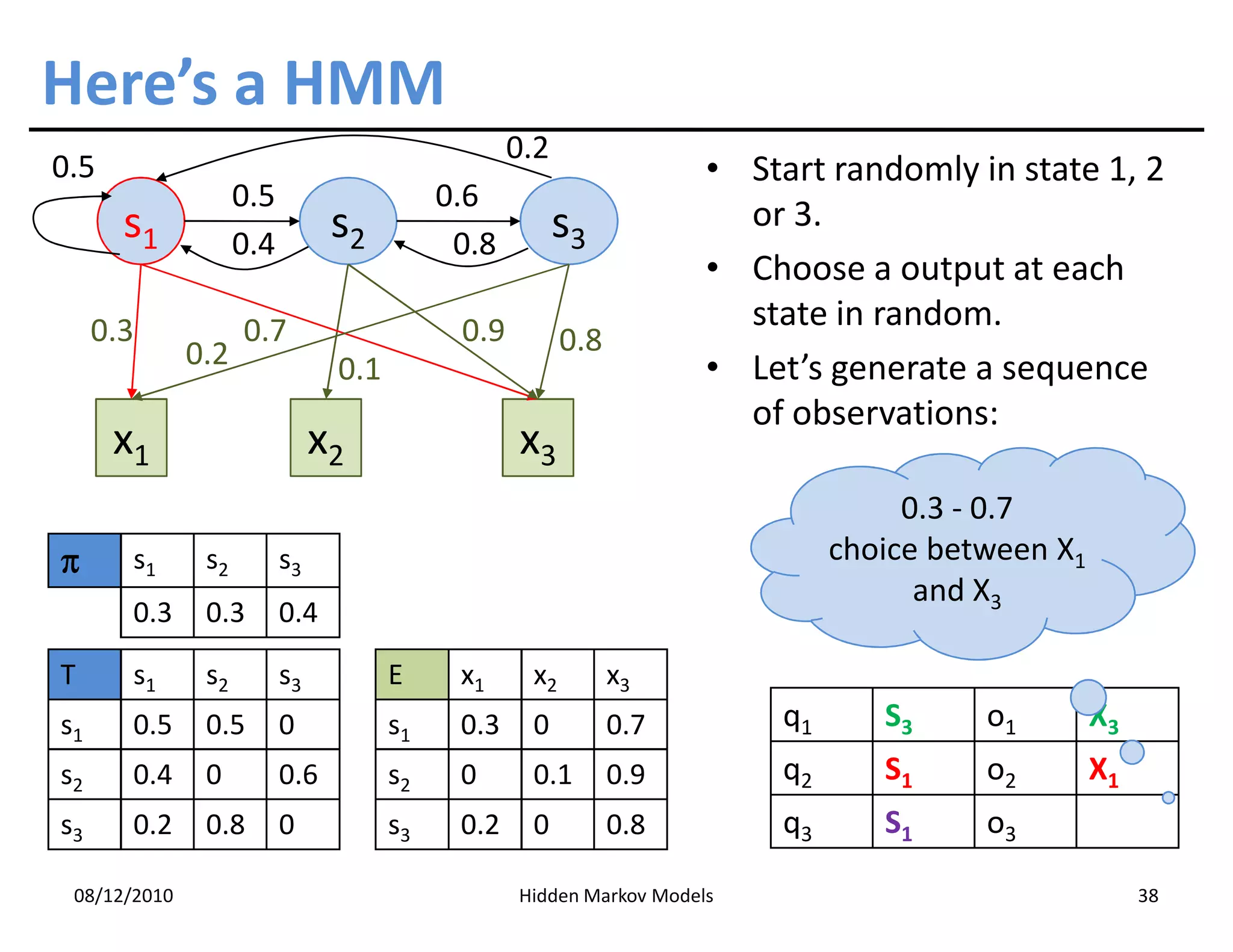
                                                                                    0.3 - 0.7
π      s1      s2         s3                                                   choice between X1
                                                                                     and X3
       0.3     0.3        0.4

T      s1      s2         s3          E     x1     x2         x3
s1     0.5     0.5        0           s1    0.3    0          0.7         q1      S3     o1        X3
s2     0.4     0          0.6         s2    0      0.1        0.9         q2      S1     o2
s3     0.2     0.8        0           s3    0.2    0          0.8         q3             o3

 08/12/2010                                       Hidden Markov Models                                  36
Here’s a HMM
                                                  0.2
0.5                                                                  • Start randomly in state 1, 2
                    0.5                    0.6
       s1                       s2                      s3             or 3.
                    0.4                     0.8
                                                                     • Choose a output at each
     0.3            0.7                     0.9                        state in random.
              0.2                                       0.8
                                0.1                                  • Let’s generate a sequence
                                                                       of observations:
      x1                       x2                 x3
                                                                                 Go to S2 with
π      s1      s2         s3                                                   probability 0.5 or
                                                                               S1 with prob. 0.5
       0.3     0.3        0.4

T      s1      s2         s3          E     x1     x2         x3
s1     0.5     0.5        0           s1    0.3    0          0.7         q1      S3      o1        X3
s2     0.4     0          0.6         s2    0      0.1        0.9         q2      S1      o2        X1
s3     0.2     0.8        0           s3    0.2    0          0.8         q3              o3

 08/12/2010                                       Hidden Markov Models                                   37
Here’s a HMM
                                                  0.2
0.5                                                                  • Start randomly in state 1, 2
                    0.5                    0.6
       s1                       s2                      s3             or 3.
                    0.4                     0.8
                                                                     • Choose a output at each
     0.3            0.7                     0.9                        state in random.
              0.2                                       0.8
                                0.1                                  • Let’s generate a sequence
                                                                       of observations:
      x1                       x2                 x3
                                                                                    0.3 - 0.7
π      s1      s2         s3                                                   choice between X1
                                                                                     and X3
       0.3     0.3        0.4

T      s1      s2         s3          E     x1     x2         x3
s1     0.5     0.5        0           s1    0.3    0          0.7         q1      S3     o1        X3
s2     0.4     0          0.6         s2    0      0.1        0.9         q2      S1     o2        X1
s3     0.2     0.8        0           s3    0.2    0          0.8         q3      S1     o3

 08/12/2010                                       Hidden Markov Models                                  38
Here’s a HMM
                                                  0.2
0.5                                                                  • Start randomly in state 1, 2
                    0.5                    0.6
       s1                       s2                      s3             or 3.
                    0.4                     0.8
                                                                     • Choose a output at each
     0.3            0.7                     0.9                        state in random.
              0.2                                       0.8
                                0.1                                  • Let’s generate a sequence
                                                                       of observations:
      x1                       x2                 x3
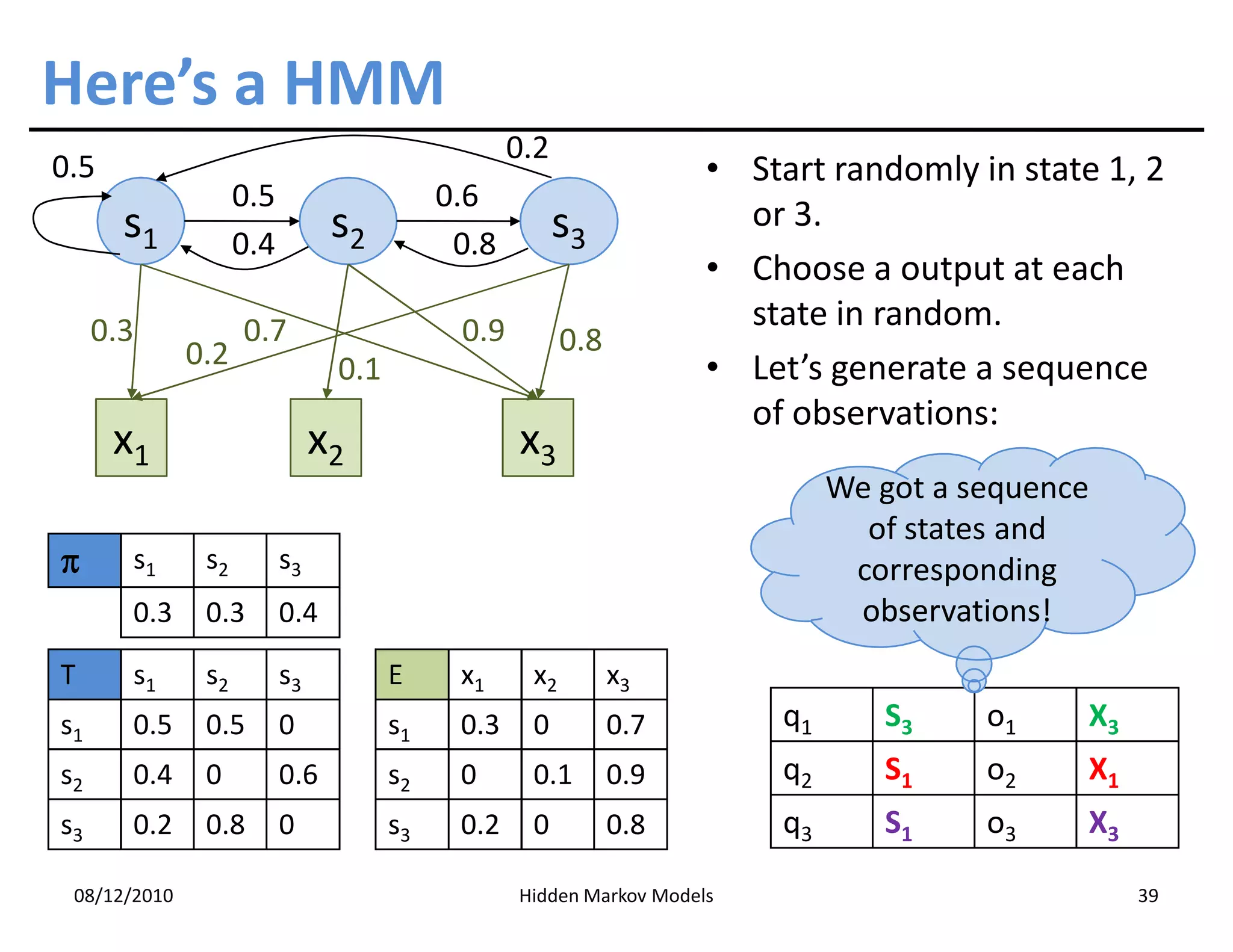
                                                                               We got a sequence
                                                                                 of states and
π      s1      s2         s3                                                    corresponding
       0.3     0.3        0.4                                                   observations!
T      s1      s2         s3          E     x1     x2         x3
s1     0.5     0.5        0           s1    0.3    0          0.7         q1      S3     o1    X3
s2     0.4     0          0.6         s2    0      0.1        0.9         q2      S1     o2    X1
s3     0.2     0.8        0           s3    0.2    0          0.8         q3      S1     o3    X3

 08/12/2010                                       Hidden Markov Models                              39
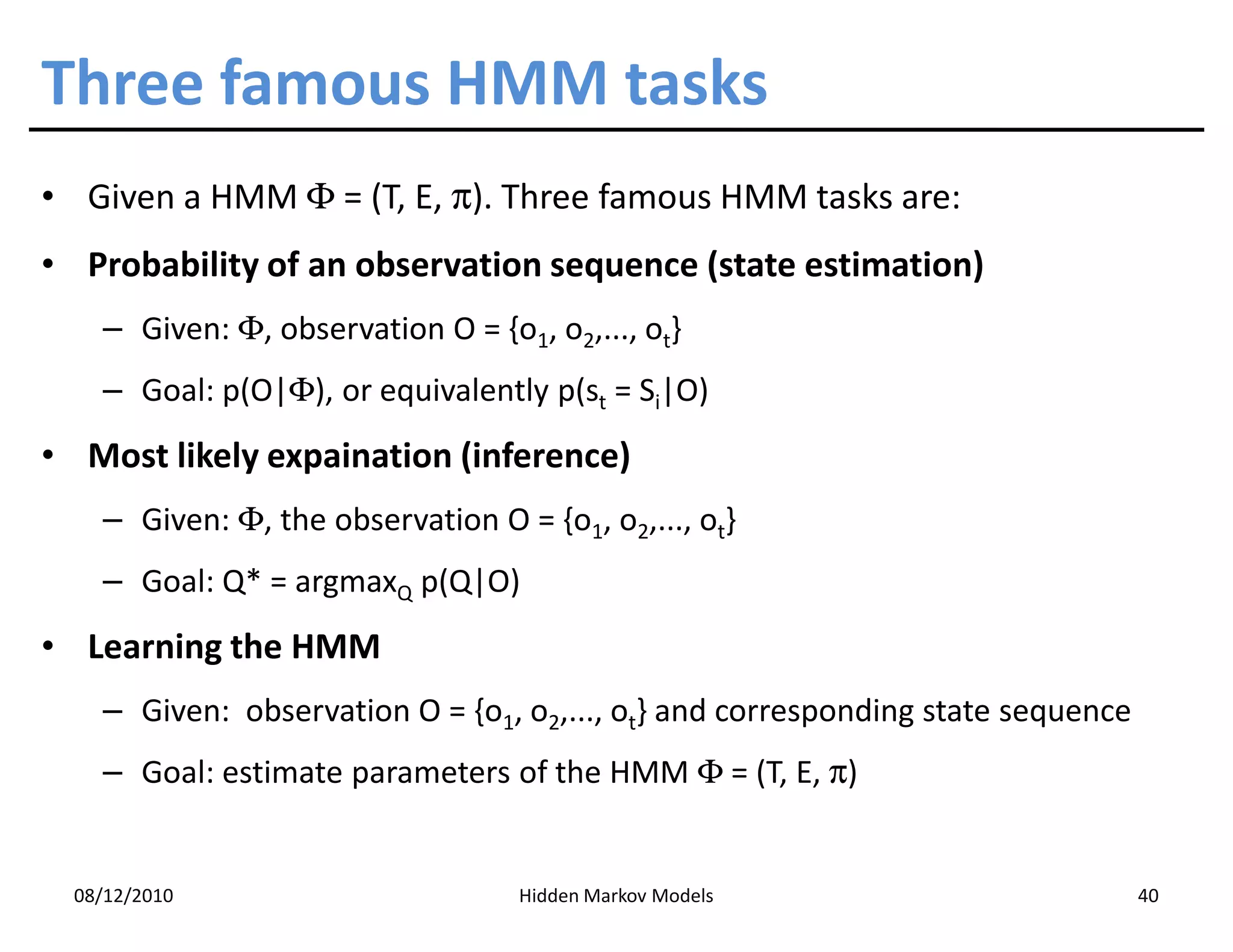
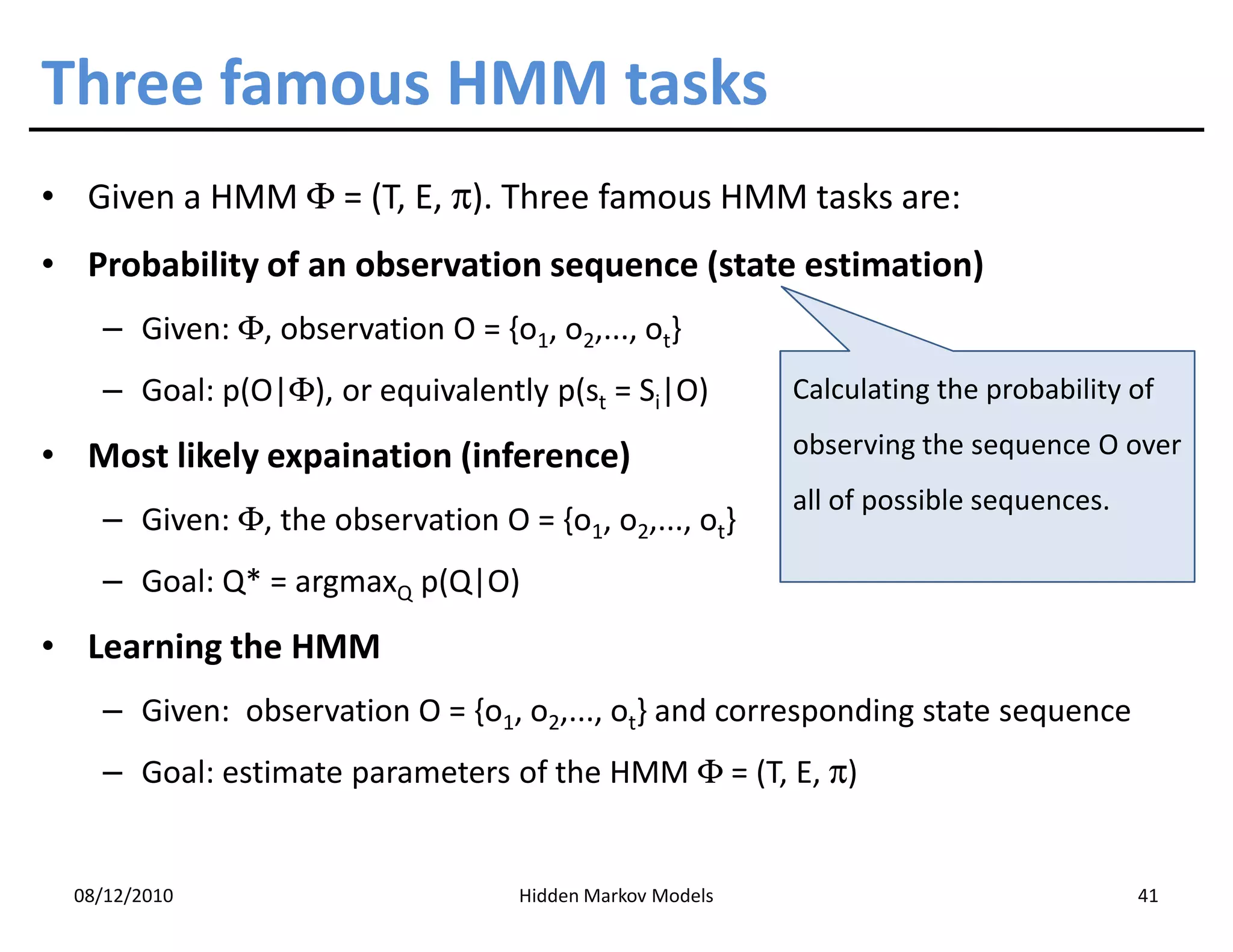
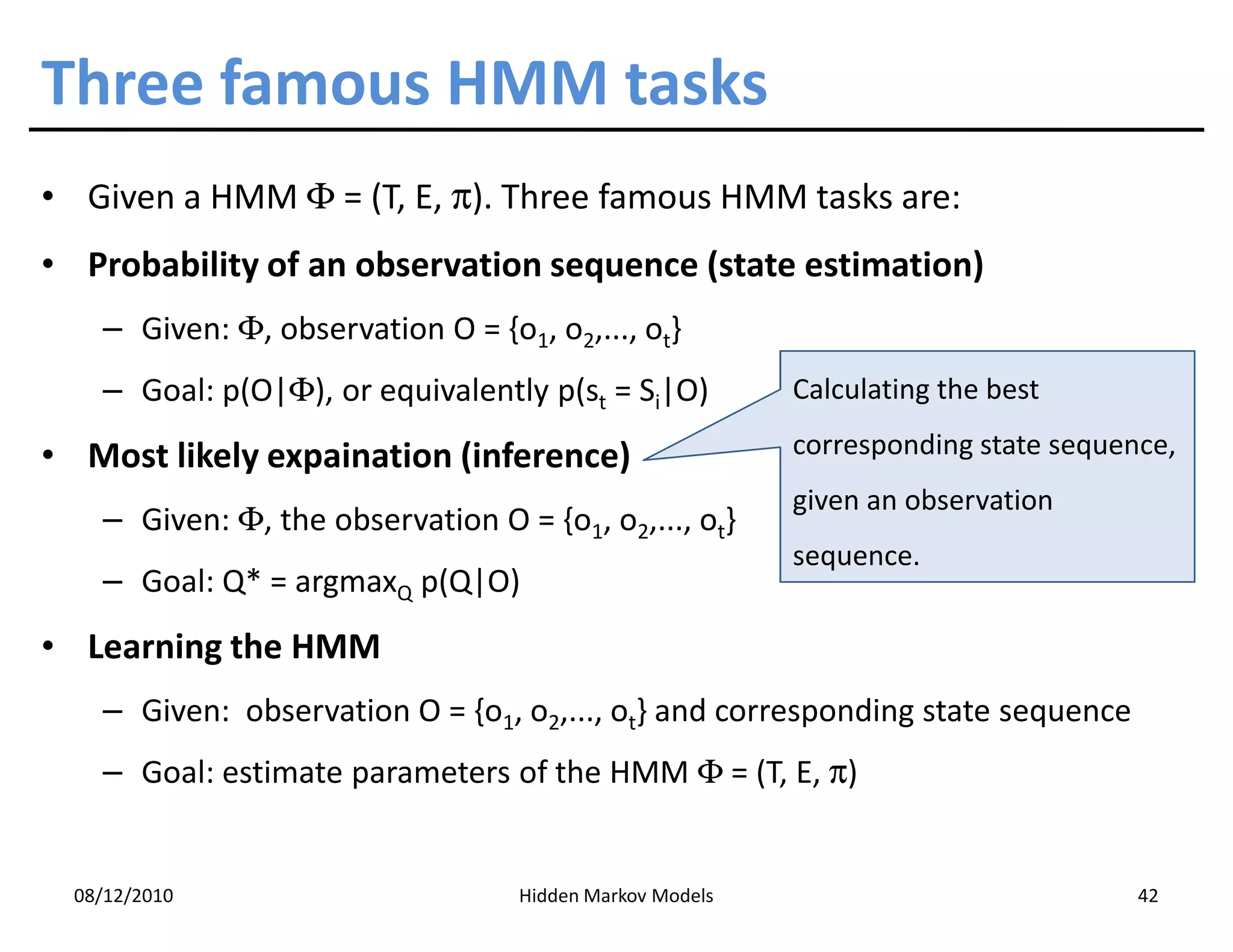
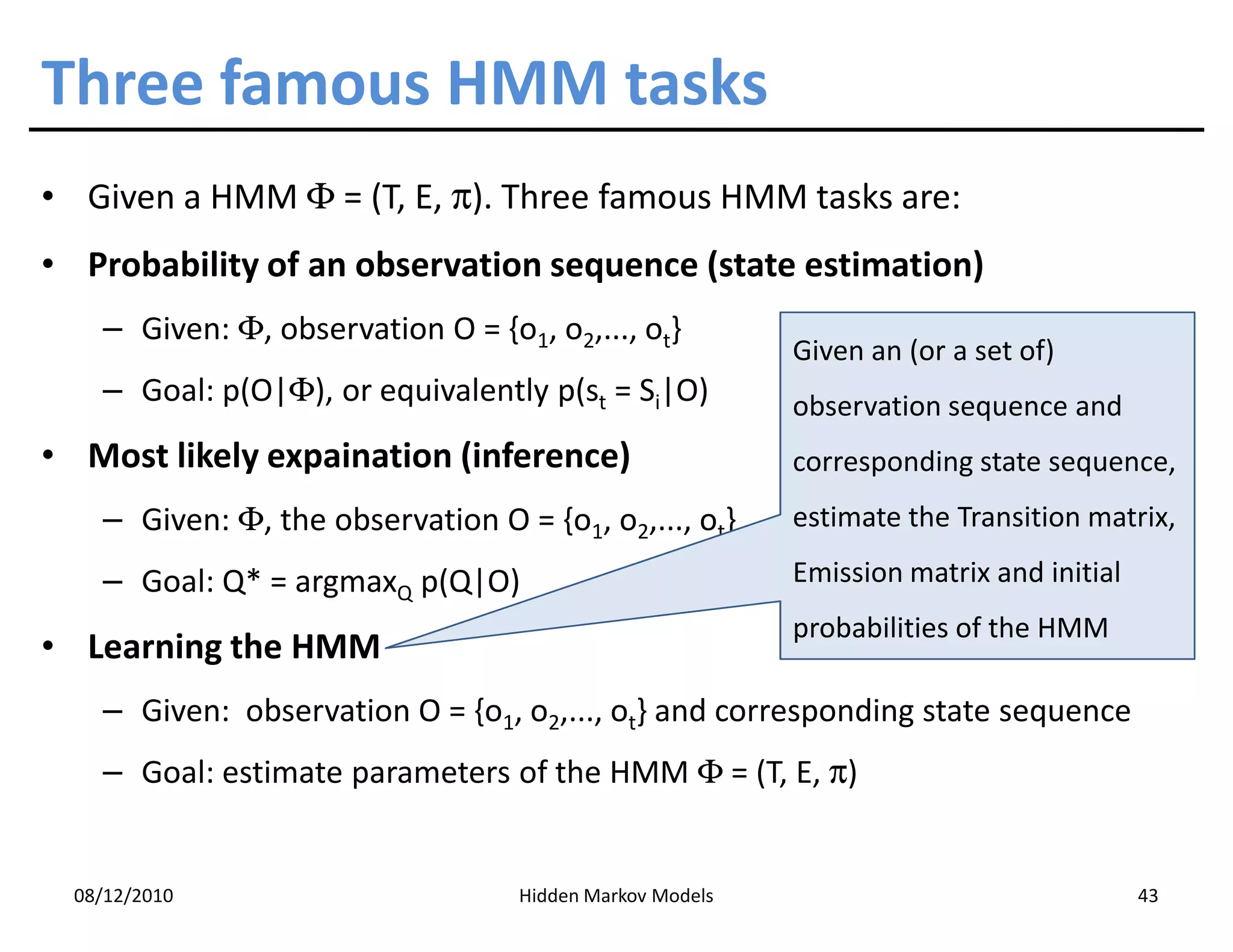
Three famous HMM tasks
• Given a HMM Φ = (T, E, π). Three famous HMM tasks are:
• Probability of an observation sequence (state estimation)
    – Given: Φ, observation O = {o1, o2,..., ot}
    – Goal: p(O|Φ), or equivalently p(st = Si|O)
• Most likely expaination (inference)
    – Given: Φ, the observation O = {o1, o2,..., ot}
    – Goal: Q* = argmaxQ p(Q|O)
• Learning the HMM
    – Given: observation O = {o1, o2,..., ot} and corresponding state sequence
    – Goal: estimate parameters of the HMM Φ = (T, E, π)


  08/12/2010                       Hidden Markov Models                          40
Three famous HMM tasks
• Given a HMM Φ = (T, E, π). Three famous HMM tasks are:
• Probability of an observation sequence (state estimation)
    – Given: Φ, observation O = {o1, o2,..., ot}
    – Goal: p(O|Φ), or equivalently p(st = Si|O)          Calculating the probability of

• Most likely expaination (inference)                     observing the sequence O over
                                                          all of possible sequences.
    – Given: Φ, the observation O = {o1, o2,..., ot}
    – Goal: Q* = argmaxQ p(Q|O)
• Learning the HMM
    – Given: observation O = {o1, o2,..., ot} and corresponding state sequence
    – Goal: estimate parameters of the HMM Φ = (T, E, π)


  08/12/2010                       Hidden Markov Models                                41
Three famous HMM tasks
• Given a HMM Φ = (T, E, π). Three famous HMM tasks are:
• Probability of an observation sequence (state estimation)
    – Given: Φ, observation O = {o1, o2,..., ot}
    – Goal: p(O|Φ), or equivalently p(st = Si|O)          Calculating the best

• Most likely expaination (inference)                     corresponding state sequence,
                                                          given an observation
    – Given: Φ, the observation O = {o1, o2,..., ot}
                                                          sequence.
    – Goal: Q* = argmaxQ p(Q|O)
• Learning the HMM
    – Given: observation O = {o1, o2,..., ot} and corresponding state sequence
    – Goal: estimate parameters of the HMM Φ = (T, E, π)


  08/12/2010                       Hidden Markov Models                             42
Three famous HMM tasks
• Given a HMM Φ = (T, E, π). Three famous HMM tasks are:
• Probability of an observation sequence (state estimation)
    – Given: Φ, observation O = {o1, o2,..., ot}
                                                          Given an (or a set of)
    – Goal: p(O|Φ), or equivalently p(st = Si|O)          observation sequence and
• Most likely expaination (inference)                     corresponding state sequence,
    – Given: Φ, the observation O = {o1, o2,..., ot}      estimate the Transition matrix,

    – Goal: Q* = argmaxQ p(Q|O)                           Emission matrix and initial
                                                          probabilities of the HMM
• Learning the HMM
    – Given: observation O = {o1, o2,..., ot} and corresponding state sequence
    – Goal: estimate parameters of the HMM Φ = (T, E, π)


  08/12/2010                       Hidden Markov Models                                 43
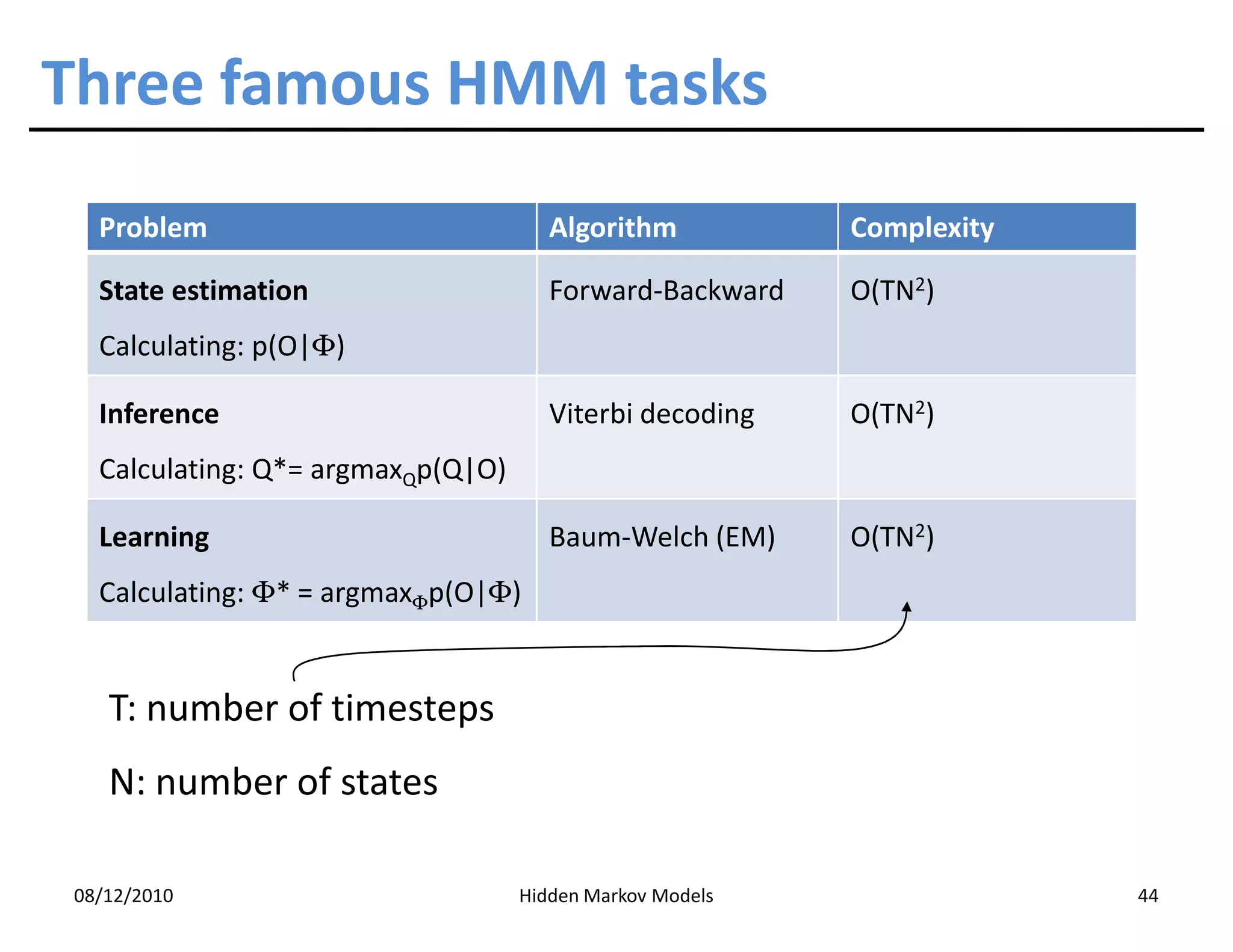
Three famous HMM tasks
  Problem                             Algorithm           Complexity

  State estimation                    Forward-Backward    O(TN2)
  Calculating: p(O|Φ)

  Inference                           Viterbi decoding    O(TN2)
  Calculating: Q*= argmaxQp(Q|O)

  Learning                            Baum-Welch (EM)     O(TN2)
  Calculating: Φ* = argmaxΦp(O|Φ)


   T: number of timesteps
   N: number of states

08/12/2010                         Hidden Markov Models                44
The Forward-Backward Algorithm
• Given: Φ = (T, E, π), observation O = {o1, o2,..., ot}

• Goal: What is p(o1o2...ot)

• We can do this in a slow, stupid way
   – As shown in the next slide...


 08/12/2010              Hidden Markov Models         45
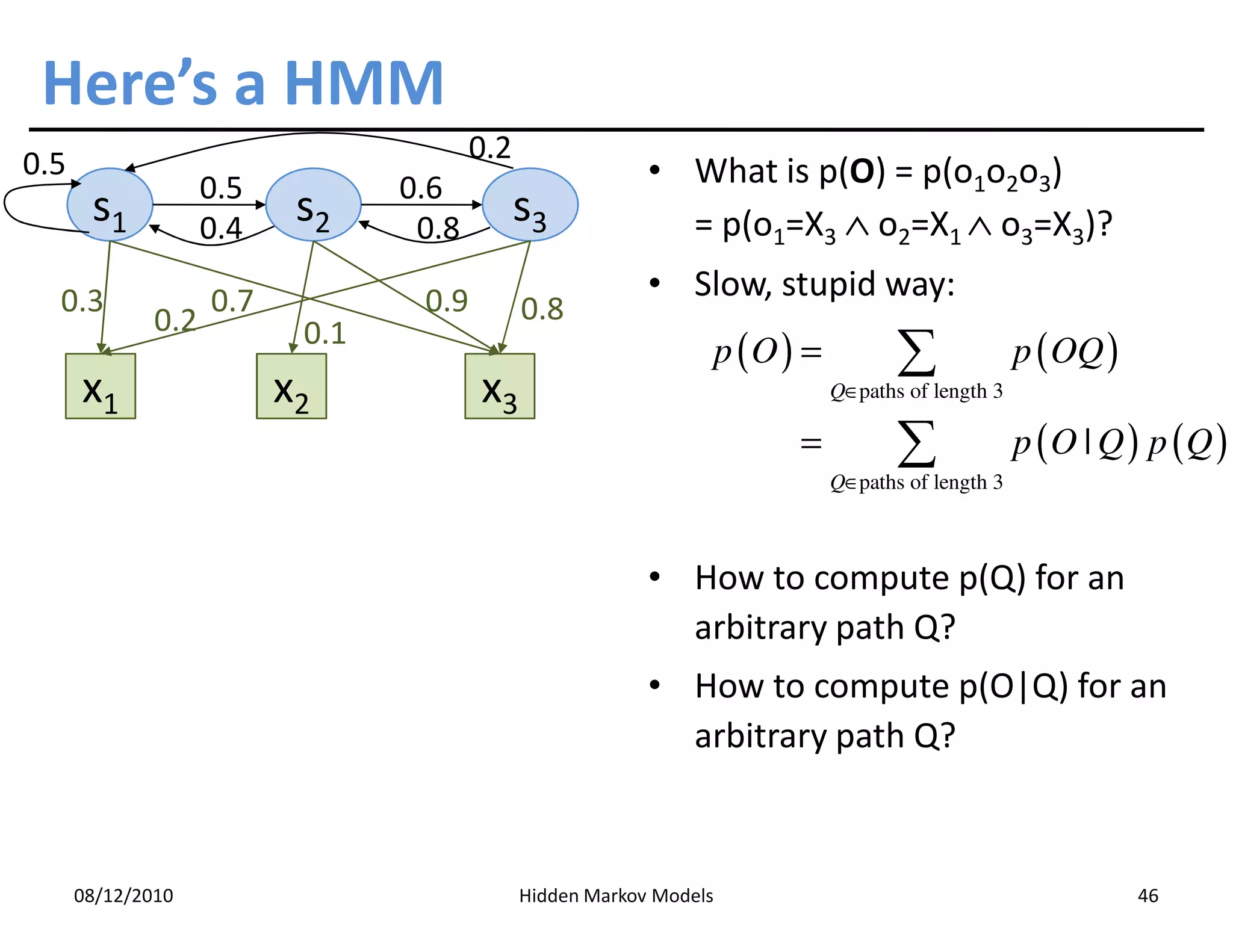
Here’s a HMM
0.5                                     0.2
                    0.5          0.6                       • What is p(O) = p(o1o2o3)
       s1           0.4
                           s2     0.8
                                              s3             = p(o1=X3 ∧ o2=X1 ∧ o3=X3)?

  0.3               0.7           0.9                      • Slow, stupid way:
              0.2                             0.8
                           0.1
                                                                     p (O ) =          ∑              p ( OQ )
      x1                  x2            x3                                      Q∈paths of length 3

                                                                           =           ∑              p (O | Q ) p (Q )
                                                                                Q∈paths of length 3
                                                                                Q∈


                                                           • How to compute p(Q) for an
                                                             arbitrary path Q?
                                                           • How to compute p(O|Q) for an
                                                             arbitrary path Q?


      08/12/2010                              Hidden Markov Models                                               46
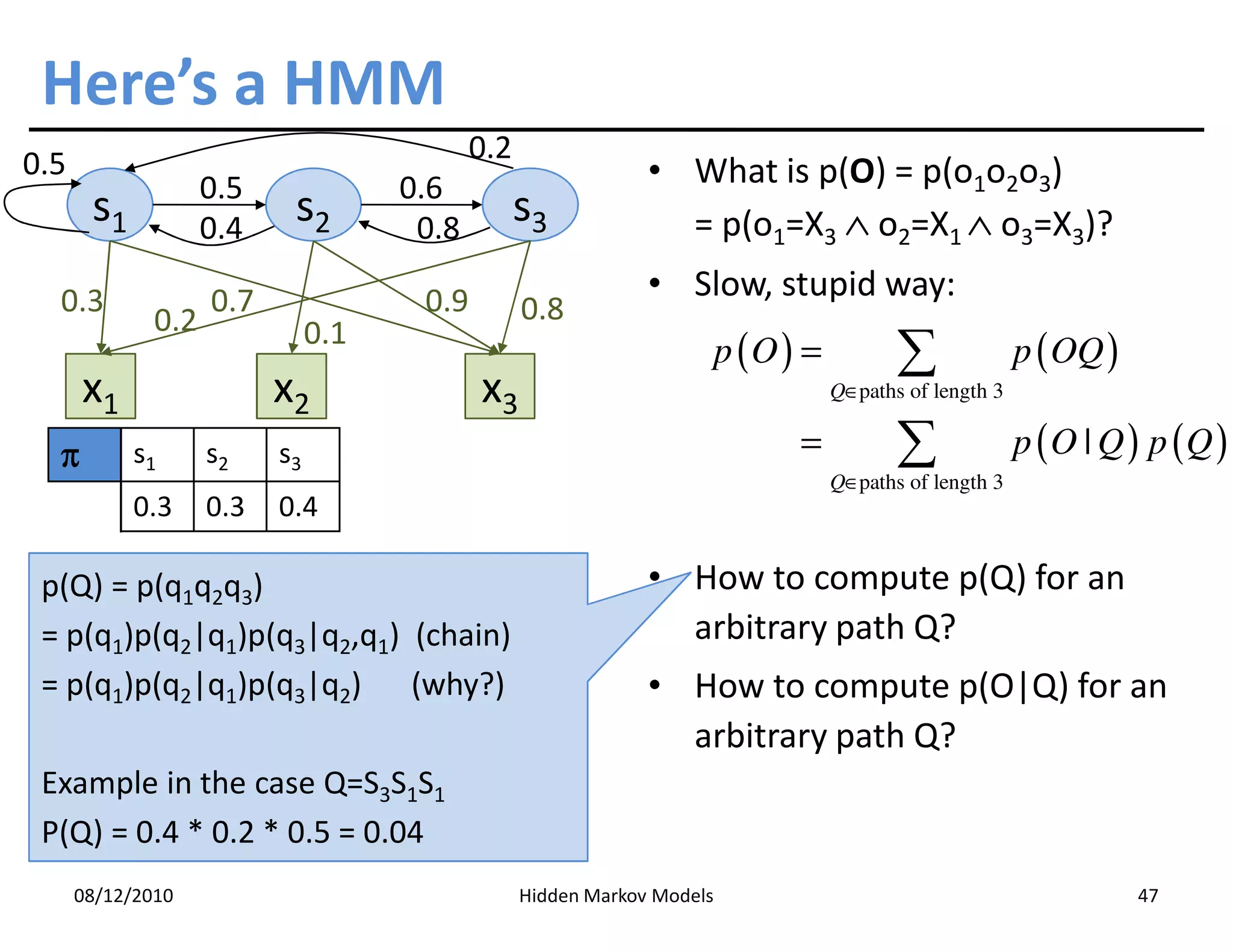
Here’s a HMM
0.5                                         0.2
                    0.5              0.6                       • What is p(O) = p(o1o2o3)
       s1           0.4
                           s2         0.8
                                                  s3             = p(o1=X3 ∧ o2=X1 ∧ o3=X3)?

  0.3               0.7               0.9                      • Slow, stupid way:
              0.2                                 0.8
                               0.1
                                                                         p (O ) =          ∑              p ( OQ )
      x1                  x2                x3                                      Q∈paths of length 3


  π         s1      s2    s3                                                   =           ∑              p (O | Q ) p (Q )
                                                                                    Q∈paths of length 3
                                                                                    Q∈
            0.3     0.3   0.4

 p(Q) = p(q1q2q3)                                              • How to compute p(Q) for an
 = p(q1)p(q2|q1)p(q3|q2,q1) (chain)                              arbitrary path Q?
 = p(q1)p(q2|q1)p(q3|q2) (why?)                                • How to compute p(O|Q) for an
                                                                 arbitrary path Q?
 Example in the case Q=S3S1S1
 P(Q) = 0.4 * 0.2 * 0.5 = 0.04
      08/12/2010                                  Hidden Markov Models                                               47
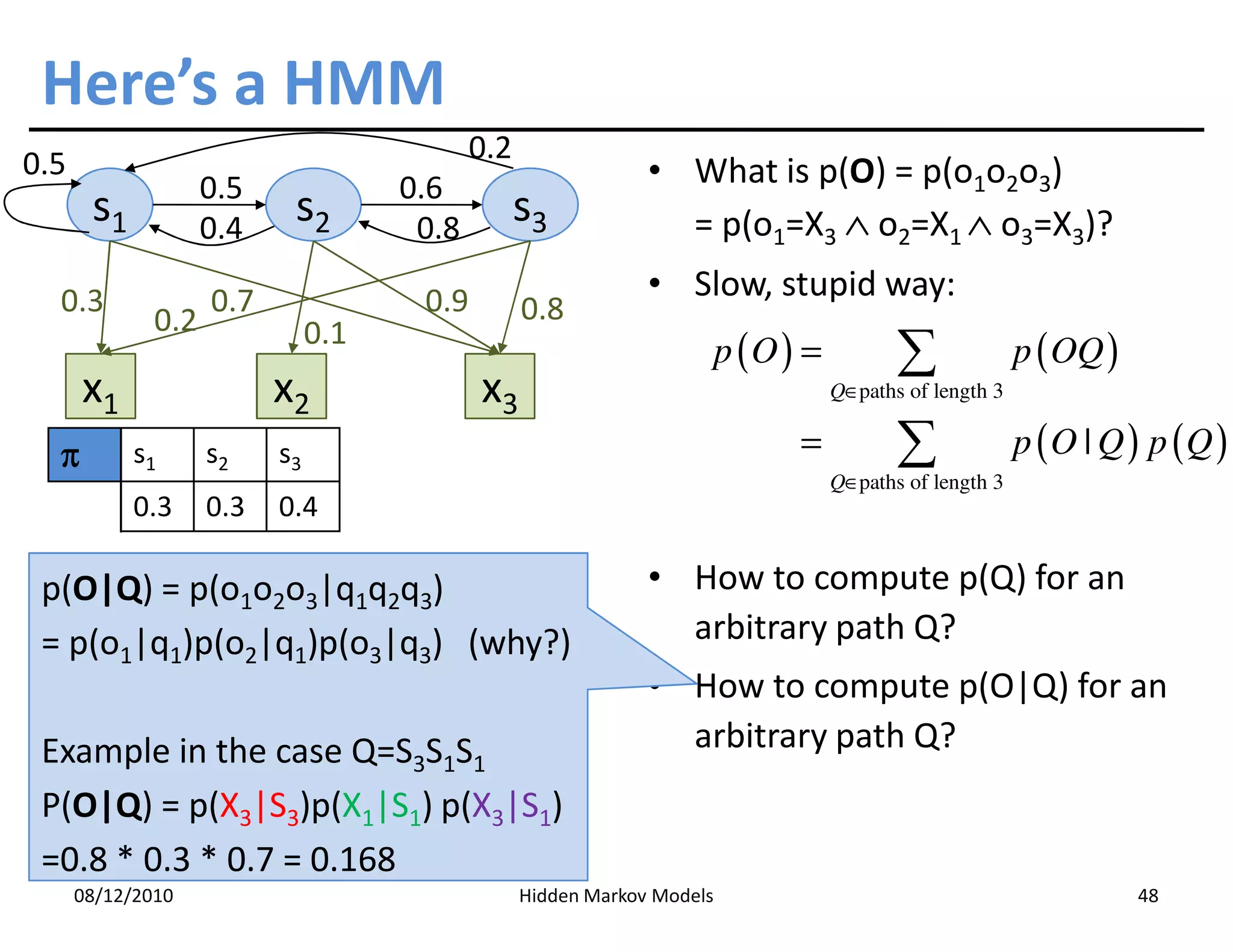
Here’s a HMM
0.5                                         0.2
                    0.5              0.6                       • What is p(O) = p(o1o2o3)
       s1           0.4
                           s2         0.8
                                                  s3             = p(o1=X3 ∧ o2=X1 ∧ o3=X3)?

  0.3               0.7               0.9                      • Slow, stupid way:
              0.2                                 0.8
                               0.1
                                                                         p (O ) =          ∑              p ( OQ )
      x1                  x2                x3                                      Q∈paths of length 3


  π         s1      s2    s3                                                   =           ∑              p (O | Q ) p (Q )
                                                                                    Q∈paths of length 3
                                                                                    Q∈
            0.3     0.3   0.4

 p(O|Q) = p(o1o2o3|q1q2q3)                                     • How to compute p(Q) for an
 = p(o1|q1)p(o2|q1)p(o3|q3) (why?)                               arbitrary path Q?
                                                               • How to compute p(O|Q) for an
 Example in the case Q=S3S1S1                                    arbitrary path Q?
 P(O|Q) = p(X3|S3)p(X1|S1) p(X3|S1)
 =0.8 * 0.3 * 0.7 = 0.168
      08/12/2010                                  Hidden Markov Models                                               48
Here’s a HMM
0.5                                         0.2
                    0.5              0.6                       • What is p(O) = p(o1o2o3)
       s1           0.4
                           s2         0.8
                                                  s3             = p(o1=X3 ∧ o2=X1 ∧ o3=X3)?

  0.3               0.7               0.9                      • Slow, stupid way:
              0.2                                 0.8
                               0.1
                                                                         p (O ) =          ∑              p ( OQ )
      x1                  x2                x3                                      Q∈paths of length 3


  π         s1      s2    s3                                                   =           ∑              p (O | Q ) p (Q )
                                                                                    Q∈paths of length 3
                                                                                    Q∈
            0.3     0.3   0.4

 p(O|Q) = p(o1o2o3|q1q2q3)                                     • How to compute p(Q) for an
              p(O) needs 27 p(Q)                                 arbitrary path Q?
 = p(o1|q1)p(o2|q1)p(o3|q3) (why?)
                     computations and 27
                                                               • How to compute p(O|Q) for an
                     p(O|Q) computations.
 Example in the case Q=S3S1S1                                    arbitrary path Q?
 P(O|Q) = p(X3|S3)p(Xsequence3has )
           What if the
                       1|S1) p(X |S1
                20 observations?
 =0.8 * 0.3 * 0.7 = 0.168                                    So let’s be smarter...
      08/12/2010                                  Hidden Markov Models                                               49
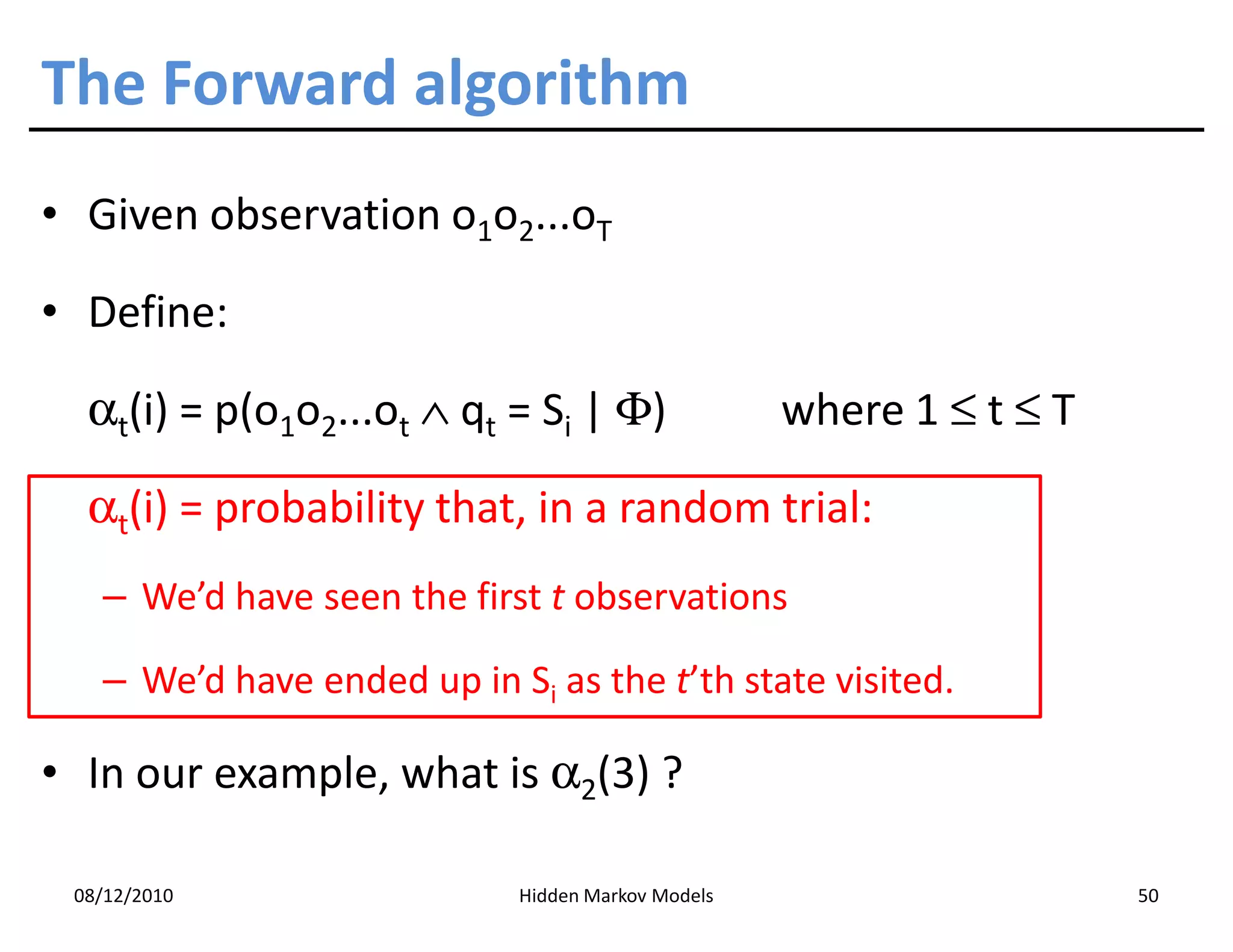
The Forward algorithm
• Given observation o1o2...oT

• Define:

  αt(i) = p(o1o2...ot ∧ qt = Si | Φ)               where 1 ≤ t ≤ T

  αt(i) = probability that, in a random trial:
   – We’d have seen the first t observations

   – We’d have ended up in Si as the t’th state visited.

• In our example, what is α2(3) ?

 08/12/2010                 Hidden Markov Models                     50

Hidden Markov Models

  • 1.
    MACHINE LEARNING Hidden Markov Models VU H. Pham phvu@fit.hcmus.edu.vn Department of Computer Science Dececmber 6th, 2010 08/12/2010 Hidden Markov Models 1
  • 2.
    Contents • Introduction • MarkovChain • Hidden Markov Models 08/12/2010 Hidden Markov Models 2
  • 3.
    Introduction • Markov processesare first proposed by Russian mathematician Andrei Markov – He used these processes to investigate Pushkin’s poem. • Nowaday, Markov property and HMMs are widely used in many domains: – Natural Language Processing – Speech Recognition – Bioinformatics – Image/video processing – ... 08/12/2010 Hidden Markov Models 3
  • 4.
    Markov Chain • HasN states, called s1, s2, ..., sN • There are discrete timesteps, t=0, s2 t=1,... s1 • On the t’th timestep the system is in exactly one of the available states. s3 Call it qt ∈ {s1 , s2 ,..., sN } Current state N=3 t=0 q t = q 0 = s3 08/12/2010 Hidden Markov Models 4
  • 5.
    Markov Chain • HasN states, called s1, s2, ..., sN • There are discrete timesteps, t=0, s2 t=1,... s1 • On the t’th timestep the system is in Current state exactly one of the available states. s3 Call it qt ∈ {s1 , s2 ,..., sN } • Between each timestep, the next state is chosen randomly. N=3 t=1 q t = q 1 = s2 08/12/2010 Hidden Markov Models 5
  • 6.
    p ( s1˚ s2 ) = 1 2 Markov Chain p ( s2 ˚ s2 ) = 1 2 p ( s3 ˚ s2 ) = 0 • Has N states, called s1, s2, ..., sN • There are discrete timesteps, t=0, s2 t=1,... s1 • On the t’th timestep the system is in exactly one of the available states. p ( qt +1 = s1 ˚ qt = s1 ) = 0 s3 Call it qt ∈ {s1 , s2 ,..., sN } p ( s2 ˚ s1 ) = 0 • Between each timestep, the next p ( s3 ˚ s1 ) = 1 p ( s1 ˚ s3 ) = 1 3 state is chosen randomly. p ( s2 ˚ s3 ) = 2 3 p ( s3 ˚ s3 ) = 0 • The current state determines the probability for the next state. N=3 t=1 q t = q 1 = s2 08/12/2010 Hidden Markov Models 6
  • 7.
    p ( s1˚ s2 ) = 1 2 Markov Chain p ( s2 ˚ s2 ) = 1 2 p ( s3 ˚ s2 ) = 0 • Has N states, called s1, s2, ..., sN 1/2 • There are discrete timesteps, t=0, s2 1/2 t=1,... s1 2/3 • On the t’th timestep the system is in 1/3 1 exactly one of the available states. p ( qt +1 = s1 ˚ qt = s1 ) = 0 s3 Call it qt ∈ {s1 , s2 ,..., sN } p ( s2 ˚ s1 ) = 0 • Between each timestep, the next p ( s3 ˚ s1 ) = 1 p ( s1 ˚ s3 ) = 1 3 state is chosen randomly. p ( s2 ˚ s3 ) = 2 3 p ( s3 ˚ s3 ) = 0 • The current state determines the probability for the next state. N=3 – Often notated with arcs between states t=1 q t = q 1 = s2 08/12/2010 Hidden Markov Models 7
  • 8.
    p ( s1˚ s2 ) = 1 2 Markov Property p ( s2 ˚ s2 ) = 1 2 p ( s3 ˚ s2 ) = 0 • qt+1 is conditionally independent of 1/2 {qt-1, qt-2,..., q0} given qt. s2 1/2 • In other words: s1 2/3 p ( qt +1 ˚ qt , qt −1 ,..., q0 ) 1/3 1 = p ( qt +1 ˚ qt ) p ( qt +1 = s1 ˚ qt = s1 ) = 0 s3 p ( s2 ˚ s1 ) = 0 p ( s3 ˚ s1 ) = 1 p ( s1 ˚ s3 ) = 1 3 p ( s2 ˚ s3 ) = 2 3 p ( s3 ˚ s3 ) = 0 N=3 t=1 q t = q 1 = s2 08/12/2010 Hidden Markov Models 8
  • 9.
    p ( s1˚ s2 ) = 1 2 Markov Property p ( s2 ˚ s2 ) = 1 2 p ( s3 ˚ s2 ) = 0 • qt+1 is conditionally independent of 1/2 {qt-1, qt-2,..., q0} given qt. s2 1/2 • In other words: s1 2/3 p ( qt +1 ˚ qt , qt −1 ,..., q0 ) 1/3 1 = p ( qt +1 ˚ qt ) p ( qt +1 = s1 ˚ qt = s1 ) = 0 s3 The state at timestep t+1 depends p ( s2 ˚ s1 ) = 0 p ( s3 ˚ s1 ) = 1 p ( s1 ˚ s3 ) = 1 3 only on the state at timestep t p ( s2 ˚ s3 ) = 2 3 p ( s3 ˚ s3 ) = 0 N=3 t=1 q t = q 1 = s2 08/12/2010 Hidden Markov Models 9
  • 10.
    p ( s1˚ s2 ) = 1 2 Markov Property p ( s2 ˚ s2 ) = 1 2 p ( s3 ˚ s2 ) = 0 • qt+1 is conditionally independent of 1/2 {qt-1, qt-2,..., q0} given qt. s2 1/2 • In other words: s1 2/3 p ( qt +1 ˚ qt , qt −1 ,..., q0 ) 1/3 1 = p ( qt +1 ˚ qt ) p ( qt +1 = s1 ˚ qt = s1 ) = 0 s3 The state at timestep t+1 depends p ( s2 ˚ s1 ) = 0 p ( s3 ˚ s1 ) = 1 p ( s1 ˚ s3 ) = 1 3 only on the state at timestep t p ( s2 ˚ s3 ) = 2 3 • How to represent the joint p ( s3 ˚ s3 ) = 0 distribution of (q0, q1, q2...) using N=3 graphical models? t=1 q t = q 1 = s2 08/12/2010 Hidden Markov Models 10
  • 11.
    p ( s1˚ s2 ) = 1 2 Markov Property p ( s2 ˚ s2 ) = 1 2 q0p ( s 3 ˚ s2 ) = 0 • qt+1 is conditionally independent of 1/2 {qt-1, qt-2,..., q0} given qt. s2 1/2 • In other words: q1 s1 1/3 p ( qt +1 ˚ qt , qt −1 ,..., q0 ) 1/3 1 = p ( qt +1 ˚ qt ) p ( qt +1 = s1 ˚ qt = s1 ) = 0 q2 s3 The state at timestep t+1 depends p ( s2 ˚ s1 ) = 0 p ( s3 ˚ s1 ) = 1 p ( s1 ˚ s3 ) = 1 3 only on the state at timestep t • How to represent the joint q3 p ( s 2 ˚ s3 ) = 2 3 p ( s3 ˚ s3 ) = 0 distribution of (q0, q1, q2...) using N=3 graphical models? t=1 q t = q 1 = s2 08/12/2010 Hidden Markov Models 11
  • 12.
    Markov chain • So,the chain of {qt} is called Markov chain q0 q1 q2 q3 08/12/2010 Hidden Markov Models 12
  • 13.
    Markov chain • So,the chain of {qt} is called Markov chain q0 q1 q2 q3 • Each qt takes value from the finite state-space {s1, s2, s3} • Each qt is observed at a discrete timestep t • {qt} sastifies the Markov property: p ( qt +1 ˚ qt , qt −1 ,..., q0 ) = p ( qt +1 ˚ qt ) 08/12/2010 Hidden Markov Models 13
  • 14.
    Markov chain • So,the chain of {qt} is called Markov chain q0 q1 q2 q3 • Each qt takes value from the finite state-space {s1, s2, s3} • Each qt is observed at a discrete timestep t • {qt} sastifies the Markov property: p ( qt +1 ˚ qt , qt −1 ,..., q0 ) = p ( qt +1 ˚ qt ) • The transition from qt to qt+1 is calculated from the transition probability matrix 1/2 s1 s2 s3 s2 s1 0 0 1 1/2 s1 s2 ½ ½ 0 2/3 1 1/3 s3 1/3 2/3 0 08/12/2010 s3 Hidden Markov Models Transition probabilities 14
  • 15.
    Markov chain • So,the chain of {qt} is called Markov chain q0 q1 q2 q3 • Each qt takes value from the finite state-space {s1, s2, s3} • Each qt is observed at a discrete timestep t • {qt} sastifies the Markov property: p ( qt +1 ˚ qt , qt −1 ,..., q0 ) = p ( qt +1 ˚ qt ) • The transition from qt to qt+1 is calculated from the transition probability matrix 1/2 s1 s2 s3 s2 s1 0 0 1 1/2 s1 s2 ½ ½ 0 2/3 1 1/3 s3 1/3 2/3 0 08/12/2010 s3 Hidden Markov Models Transition probabilities 15
  • 16.
    Markov Chain –Important property • In a Markov chain, the joint distribution is m p ( q0 , q1 ,..., qm ) = p ( q0 ) ∏ p ( q j | q j −1 ) j =1 08/12/2010 Hidden Markov Models 16
  • 17.
    Markov Chain –Important property • In a Markov chain, the joint distribution is m p ( q0 , q1 ,..., qm ) = p ( q0 ) ∏ p ( q j | q j −1 ) j =1 • Why? m p ( q0 , q1 ,..., qm ) = p ( q0 ) ∏ p ( q j | q j −1 , previous states ) j =1 m = p ( q0 ) ∏ p ( q j | q j −1 ) j =1 Due to the Markov property 08/12/2010 Hidden Markov Models 17
  • 18.
    Markov Chain: e.g. •The state-space of weather: rain wind cloud 08/12/2010 Hidden Markov Models 18
  • 19.
    Markov Chain: e.g. •The state-space of weather: 1/2 Rain Cloud Wind rain wind Rain ½ 0 ½ 2/3 Cloud 1/3 0 2/3 1/2 1/3 1 cloud Wind 0 1 0 08/12/2010 Hidden Markov Models 19
  • 20.
    Markov Chain: e.g. •The state-space of weather: 1/2 Rain Cloud Wind rain wind Rain ½ 0 ½ 2/3 Cloud 1/3 0 2/3 1/2 1/3 1 cloud Wind 0 1 0 • Markov assumption: weather in the t+1’th day is depends only on the t’th day. 08/12/2010 Hidden Markov Models 20
  • 21.
    Markov Chain: e.g. •The state-space of weather: 1/2 Rain Cloud Wind rain wind Rain ½ 0 ½ 2/3 Cloud 1/3 0 2/3 1/2 1/3 1 cloud Wind 0 1 0 • Markov assumption: weather in the t+1’th day is depends only on the t’th day. • We have observed the weather in a week: rain wind rain rain cloud Day: 0 1 2 3 4 08/12/2010 Hidden Markov Models 21
  • 22.
    Markov Chain: e.g. •The state-space of weather: 1/2 Rain Cloud Wind rain wind Rain ½ 0 ½ 2/3 Cloud 1/3 0 2/3 1/2 1/3 1 cloud Wind 0 1 0 • Markov assumption: weather in the t+1’th day is depends only on the t’th day. • We have observed the weather in a week: Markov Chain rain wind rain rain cloud Day: 0 1 2 3 4 08/12/2010 Hidden Markov Models 22
  • 23.
    Contents • Introduction • MarkovChain • Hidden Markov Models 08/12/2010 Hidden Markov Models 23
  • 24.
    Modeling pairs ofsequences • In many applications, we have to model pair of sequences • Examples: – POS tagging in Natural Language Processing (assign each word in a sentence to Noun, Adj, Verb...) – Speech recognition (map acoustic sequences to sequences of words) – Computational biology (recover gene boundaries in DNA sequences) – Video tracking (estimate the underlying model states from the observation sequences) – And many others... 08/12/2010 Hidden Markov Models 24
  • 25.
    Probabilistic models forsequence pairs • We have two sequences of random variables: X1, X2, ..., Xm and S1, S2, ..., Sm • Intuitively, in a pratical system, each Xi corresponds to an observation and each Si corresponds to a state that generated the observation. • Let each Si be in {1, 2, ..., k} and each Xi be in {1, 2, ..., o} • How do we model the joint distribution: p ( X 1 = x1 ,..., X m = xm , S1 = s1 ,..., S m = sm ) 08/12/2010 Hidden Markov Models 25
  • 26.
    Hidden Markov Models(HMMs) • In HMMs, we assume that p ( X 1 = x1 ,..., X m = xm , S1 = s1 ,..., Sm = sm ) m m = p ( S1 = s1 ) ∏ p ( S j = s j ˚ S j −1 = s j −1 ) ∏ p ( X j = x j ˚ S j = s j ) j =2 j =1 • This is often called Independence assumptions in HMMs • We are gonna prove it in the next slides 08/12/2010 Hidden Markov Models 26
  • 27.
    Independence Assumptions inHMMs [1] p ( ABC ) = p ( A | BC ) p ( BC ) = p ( A | BC ) p ( B ˚ C ) p ( C ) • By the chain rule, the following equality is exact: p ( X 1 = x1 ,..., X m = xm , S1 = s1 ,..., S m = sm ) = p ( S1 = s1 ,..., S m = sm ) × p ( X 1 = x1 ,..., X m = xm ˚ S1 = s1 ,..., S m = sm ) • Assumption 1: the state sequence forms a Markov chain m p ( S1 = s1 ,..., S m = sm ) = p ( S1 = s1 ) ∏ p ( S j = s j ˚ S j −1 = s j −1 ) j =2 08/12/2010 Hidden Markov Models 27
  • 28.
    Independence Assumptions inHMMs [2] • By the chain rule, the following equality is exact: p ( X 1 = x1 ,..., X m = xm ˚ S1 = s1 ,..., S m = sm ) m = ∏ p ( X j = x j ˚ S1 = s1 ,..., Sm = sm , X 1 = x1 ,..., X j −1 = x j −1 ) j =1 • Assumption 2: each observation depends only on the underlying state p ( X j = x j ˚ S1 = s1 ,..., Sm = sm , X 1 = x1 ,..., X j −1 = x j −1 ) = p( X j = xj ˚ S j = sj ) • These two assumptions are often called independence assumptions in HMMs 08/12/2010 Hidden Markov Models 28
  • 29.
    The Model formfor HMMs • The model takes the following form: m m p ( x1 ,.., xm , s1 ,..., sm ;θ ) = π ( s1 ) ∏ t ( s j ˚ s j −1 ) ∏ e ( x j ˚ s j ) j =2 j =1 • Parameters in the model: – Initial probabilities π ( s ) for s ∈ {1, 2,..., k } – Transition probabilities t ( s ˚ s′ ) for s, s ' ∈ {1, 2,..., k } – Emission probabilities e ( x ˚ s ) for s ∈ {1, 2,..., k } and x ∈ {1, 2,.., o} 08/12/2010 Hidden Markov Models 29
  • 30.
    6 components ofHMMs start • Discrete timesteps: 1, 2, ... • Finite state space: {si} π1 π2 π3 • Events {xi} t31 t11 t12 t23 π • Vector of initial probabilities {πi} s1 s2 s3 t21 t32 πi = p(q0 = si) • Matrix of transition probabilities e13 e11 e23 e33 e31 T = {tij} = { p(qt+1=sj|qt=si) } e22 • Matrix of emission probabilities x1 x2 x3 E = {eij} = { p(ot=xj|qt=si) } The observations at continuous timesteps form an observation sequence {o1, o2, ..., ot}, where oi ∈ {x1, x2, ..., xo} 08/12/2010 Hidden Markov Models 30
  • 31.
    6 components ofHMMs start • Given a specific HMM and an observation sequence, the π1 π2 π3 corresponding sequence of states t31 t11 is generally not deterministic t12 t23 • Example: s1 t21 s2 t32 s3 Given the observation sequence: e13 e11 e23 e33 {x1, x3, x3, x2} e31 e22 The corresponding states can be any of following sequences: x1 x2 x3 {s1, s1, s2, s2} {s1, s2, s3, s2} {s1, s1, s1, s2} ... 08/12/2010 Hidden Markov Models 31
  • 32.
    Here’s an HMM 0.2 0.5 0.5 0.6 s1 0.4 s2 0.8 s3 0.3 0.7 0.9 0.8 0.2 0.1 x1 x2 x3 T s1 s2 s3 E x1 x2 x3 π s1 s2 s3 s1 0.5 0.5 0 s1 0.3 0 0.7 0.3 0.3 0.4 s2 0.4 0 0.6 s2 0 0.1 0.9 s3 0.2 0.8 0 s3 0.2 0 0.8 08/12/2010 Hidden Markov Models 32
  • 33.
    Here’s a HMM 0.2 0.5 • Start randomly in state 1, 2 0.5 0.6 s1 s2 s3 or 3. 0.4 0.8 • Choose a output at each 0.3 0.7 0.9 state in random. 0.2 0.8 0.1 • Let’s generate a sequence of observations: x1 x2 x3 0.3 - 0.3 - 0.4 π s1 s2 s3 randomply choice between S1, S2, S3 0.3 0.3 0.4 T s1 s2 s3 E x1 x2 x3 s1 0.5 0.5 0 s1 0.3 0 0.7 q1 o1 s2 0.4 0 0.6 s2 0 0.1 0.9 q2 o2 s3 0.2 0.8 0 s3 0.2 0 0.8 q3 o3 08/12/2010 Hidden Markov Models 33
  • 34.
    Here’s a HMM 0.2 0.5 • Start randomly in state 1, 2 0.5 0.6 s1 s2 s3 or 3. 0.4 0.8 • Choose a output at each 0.3 0.7 0.9 state in random. 0.2 0.8 0.1 • Let’s generate a sequence of observations: x1 x2 x3 0.2 - 0.8 π s1 s2 s3 choice between X1 and X3 0.3 0.3 0.4 T s1 s2 s3 E x1 x2 x3 s1 0.5 0.5 0 s1 0.3 0 0.7 q1 S3 o1 s2 0.4 0 0.6 s2 0 0.1 0.9 q2 o2 s3 0.2 0.8 0 s3 0.2 0 0.8 q3 o3 08/12/2010 Hidden Markov Models 34
  • 35.
    Here’s a HMM 0.2 0.5 • Start randomly in state 1, 2 0.5 0.6 s1 s2 s3 or 3. 0.4 0.8 • Choose a output at each 0.3 0.7 0.9 state in random. 0.2 0.8 0.1 • Let’s generate a sequence of observations: x1 x2 x3 Go to S2 with π s1 s2 s3 probability 0.8 or S1 with prob. 0.2 0.3 0.3 0.4 T s1 s2 s3 E x1 x2 x3 s1 0.5 0.5 0 s1 0.3 0 0.7 q1 S3 o1 X3 s2 0.4 0 0.6 s2 0 0.1 0.9 q2 o2 s3 0.2 0.8 0 s3 0.2 0 0.8 q3 o3 08/12/2010 Hidden Markov Models 35
  • 36.
    Here’s a HMM 0.2 0.5 • Start randomly in state 1, 2 0.5 0.6 s1 s2 s3 or 3. 0.4 0.8 • Choose a output at each 0.3 0.7 0.9 state in random. 0.2 0.8 0.1 • Let’s generate a sequence of observations: x1 x2 x3 0.3 - 0.7 π s1 s2 s3 choice between X1 and X3 0.3 0.3 0.4 T s1 s2 s3 E x1 x2 x3 s1 0.5 0.5 0 s1 0.3 0 0.7 q1 S3 o1 X3 s2 0.4 0 0.6 s2 0 0.1 0.9 q2 S1 o2 s3 0.2 0.8 0 s3 0.2 0 0.8 q3 o3 08/12/2010 Hidden Markov Models 36
  • 37.
    Here’s a HMM 0.2 0.5 • Start randomly in state 1, 2 0.5 0.6 s1 s2 s3 or 3. 0.4 0.8 • Choose a output at each 0.3 0.7 0.9 state in random. 0.2 0.8 0.1 • Let’s generate a sequence of observations: x1 x2 x3 Go to S2 with π s1 s2 s3 probability 0.5 or S1 with prob. 0.5 0.3 0.3 0.4 T s1 s2 s3 E x1 x2 x3 s1 0.5 0.5 0 s1 0.3 0 0.7 q1 S3 o1 X3 s2 0.4 0 0.6 s2 0 0.1 0.9 q2 S1 o2 X1 s3 0.2 0.8 0 s3 0.2 0 0.8 q3 o3 08/12/2010 Hidden Markov Models 37
  • 38.
    Here’s a HMM 0.2 0.5 • Start randomly in state 1, 2 0.5 0.6 s1 s2 s3 or 3. 0.4 0.8 • Choose a output at each 0.3 0.7 0.9 state in random. 0.2 0.8 0.1 • Let’s generate a sequence of observations: x1 x2 x3 0.3 - 0.7 π s1 s2 s3 choice between X1 and X3 0.3 0.3 0.4 T s1 s2 s3 E x1 x2 x3 s1 0.5 0.5 0 s1 0.3 0 0.7 q1 S3 o1 X3 s2 0.4 0 0.6 s2 0 0.1 0.9 q2 S1 o2 X1 s3 0.2 0.8 0 s3 0.2 0 0.8 q3 S1 o3 08/12/2010 Hidden Markov Models 38
  • 39.
    Here’s a HMM 0.2 0.5 • Start randomly in state 1, 2 0.5 0.6 s1 s2 s3 or 3. 0.4 0.8 • Choose a output at each 0.3 0.7 0.9 state in random. 0.2 0.8 0.1 • Let’s generate a sequence of observations: x1 x2 x3 We got a sequence of states and π s1 s2 s3 corresponding 0.3 0.3 0.4 observations! T s1 s2 s3 E x1 x2 x3 s1 0.5 0.5 0 s1 0.3 0 0.7 q1 S3 o1 X3 s2 0.4 0 0.6 s2 0 0.1 0.9 q2 S1 o2 X1 s3 0.2 0.8 0 s3 0.2 0 0.8 q3 S1 o3 X3 08/12/2010 Hidden Markov Models 39
  • 40.
    Three famous HMMtasks • Given a HMM Φ = (T, E, π). Three famous HMM tasks are: • Probability of an observation sequence (state estimation) – Given: Φ, observation O = {o1, o2,..., ot} – Goal: p(O|Φ), or equivalently p(st = Si|O) • Most likely expaination (inference) – Given: Φ, the observation O = {o1, o2,..., ot} – Goal: Q* = argmaxQ p(Q|O) • Learning the HMM – Given: observation O = {o1, o2,..., ot} and corresponding state sequence – Goal: estimate parameters of the HMM Φ = (T, E, π) 08/12/2010 Hidden Markov Models 40
  • 41.
    Three famous HMMtasks • Given a HMM Φ = (T, E, π). Three famous HMM tasks are: • Probability of an observation sequence (state estimation) – Given: Φ, observation O = {o1, o2,..., ot} – Goal: p(O|Φ), or equivalently p(st = Si|O) Calculating the probability of • Most likely expaination (inference) observing the sequence O over all of possible sequences. – Given: Φ, the observation O = {o1, o2,..., ot} – Goal: Q* = argmaxQ p(Q|O) • Learning the HMM – Given: observation O = {o1, o2,..., ot} and corresponding state sequence – Goal: estimate parameters of the HMM Φ = (T, E, π) 08/12/2010 Hidden Markov Models 41
  • 42.
    Three famous HMMtasks • Given a HMM Φ = (T, E, π). Three famous HMM tasks are: • Probability of an observation sequence (state estimation) – Given: Φ, observation O = {o1, o2,..., ot} – Goal: p(O|Φ), or equivalently p(st = Si|O) Calculating the best • Most likely expaination (inference) corresponding state sequence, given an observation – Given: Φ, the observation O = {o1, o2,..., ot} sequence. – Goal: Q* = argmaxQ p(Q|O) • Learning the HMM – Given: observation O = {o1, o2,..., ot} and corresponding state sequence – Goal: estimate parameters of the HMM Φ = (T, E, π) 08/12/2010 Hidden Markov Models 42
  • 43.
    Three famous HMMtasks • Given a HMM Φ = (T, E, π). Three famous HMM tasks are: • Probability of an observation sequence (state estimation) – Given: Φ, observation O = {o1, o2,..., ot} Given an (or a set of) – Goal: p(O|Φ), or equivalently p(st = Si|O) observation sequence and • Most likely expaination (inference) corresponding state sequence, – Given: Φ, the observation O = {o1, o2,..., ot} estimate the Transition matrix, – Goal: Q* = argmaxQ p(Q|O) Emission matrix and initial probabilities of the HMM • Learning the HMM – Given: observation O = {o1, o2,..., ot} and corresponding state sequence – Goal: estimate parameters of the HMM Φ = (T, E, π) 08/12/2010 Hidden Markov Models 43
  • 44.
    Three famous HMMtasks Problem Algorithm Complexity State estimation Forward-Backward O(TN2) Calculating: p(O|Φ) Inference Viterbi decoding O(TN2) Calculating: Q*= argmaxQp(Q|O) Learning Baum-Welch (EM) O(TN2) Calculating: Φ* = argmaxΦp(O|Φ) T: number of timesteps N: number of states 08/12/2010 Hidden Markov Models 44
  • 45.
    The Forward-Backward Algorithm •Given: Φ = (T, E, π), observation O = {o1, o2,..., ot} • Goal: What is p(o1o2...ot) • We can do this in a slow, stupid way – As shown in the next slide... 08/12/2010 Hidden Markov Models 45
  • 46.
    Here’s a HMM 0.5 0.2 0.5 0.6 • What is p(O) = p(o1o2o3) s1 0.4 s2 0.8 s3 = p(o1=X3 ∧ o2=X1 ∧ o3=X3)? 0.3 0.7 0.9 • Slow, stupid way: 0.2 0.8 0.1 p (O ) = ∑ p ( OQ ) x1 x2 x3 Q∈paths of length 3 = ∑ p (O | Q ) p (Q ) Q∈paths of length 3 Q∈ • How to compute p(Q) for an arbitrary path Q? • How to compute p(O|Q) for an arbitrary path Q? 08/12/2010 Hidden Markov Models 46
  • 47.
    Here’s a HMM 0.5 0.2 0.5 0.6 • What is p(O) = p(o1o2o3) s1 0.4 s2 0.8 s3 = p(o1=X3 ∧ o2=X1 ∧ o3=X3)? 0.3 0.7 0.9 • Slow, stupid way: 0.2 0.8 0.1 p (O ) = ∑ p ( OQ ) x1 x2 x3 Q∈paths of length 3 π s1 s2 s3 = ∑ p (O | Q ) p (Q ) Q∈paths of length 3 Q∈ 0.3 0.3 0.4 p(Q) = p(q1q2q3) • How to compute p(Q) for an = p(q1)p(q2|q1)p(q3|q2,q1) (chain) arbitrary path Q? = p(q1)p(q2|q1)p(q3|q2) (why?) • How to compute p(O|Q) for an arbitrary path Q? Example in the case Q=S3S1S1 P(Q) = 0.4 * 0.2 * 0.5 = 0.04 08/12/2010 Hidden Markov Models 47
  • 48.
    Here’s a HMM 0.5 0.2 0.5 0.6 • What is p(O) = p(o1o2o3) s1 0.4 s2 0.8 s3 = p(o1=X3 ∧ o2=X1 ∧ o3=X3)? 0.3 0.7 0.9 • Slow, stupid way: 0.2 0.8 0.1 p (O ) = ∑ p ( OQ ) x1 x2 x3 Q∈paths of length 3 π s1 s2 s3 = ∑ p (O | Q ) p (Q ) Q∈paths of length 3 Q∈ 0.3 0.3 0.4 p(O|Q) = p(o1o2o3|q1q2q3) • How to compute p(Q) for an = p(o1|q1)p(o2|q1)p(o3|q3) (why?) arbitrary path Q? • How to compute p(O|Q) for an Example in the case Q=S3S1S1 arbitrary path Q? P(O|Q) = p(X3|S3)p(X1|S1) p(X3|S1) =0.8 * 0.3 * 0.7 = 0.168 08/12/2010 Hidden Markov Models 48
  • 49.
    Here’s a HMM 0.5 0.2 0.5 0.6 • What is p(O) = p(o1o2o3) s1 0.4 s2 0.8 s3 = p(o1=X3 ∧ o2=X1 ∧ o3=X3)? 0.3 0.7 0.9 • Slow, stupid way: 0.2 0.8 0.1 p (O ) = ∑ p ( OQ ) x1 x2 x3 Q∈paths of length 3 π s1 s2 s3 = ∑ p (O | Q ) p (Q ) Q∈paths of length 3 Q∈ 0.3 0.3 0.4 p(O|Q) = p(o1o2o3|q1q2q3) • How to compute p(Q) for an p(O) needs 27 p(Q) arbitrary path Q? = p(o1|q1)p(o2|q1)p(o3|q3) (why?) computations and 27 • How to compute p(O|Q) for an p(O|Q) computations. Example in the case Q=S3S1S1 arbitrary path Q? P(O|Q) = p(X3|S3)p(Xsequence3has ) What if the 1|S1) p(X |S1 20 observations? =0.8 * 0.3 * 0.7 = 0.168 So let’s be smarter... 08/12/2010 Hidden Markov Models 49
  • 50.
    The Forward algorithm •Given observation o1o2...oT • Define: αt(i) = p(o1o2...ot ∧ qt = Si | Φ) where 1 ≤ t ≤ T αt(i) = probability that, in a random trial: – We’d have seen the first t observations – We’d have ended up in Si as the t’th state visited. • In our example, what is α2(3) ? 08/12/2010 Hidden Markov Models 50