Downloaded 49 times

![VOICED OR NOT?
Either voiced or unvoiced – if it has pitch or not
[feel your throat to know the difference]
z vs. s
b vs. p
d vs. t](https://image.slidesharecdn.com/consonants-diction2011-111117085149-phpapp01/75/Consonants-and-Singing-4-2048.jpg)


![PLOSIVES
The airflow is prevented from passing through the mouth or
nose and is suddenly released
Pairs of consonants that are only differentiated by their
voicing:
[p] and [b]
[t] and [d]
[k] and [g]](https://image.slidesharecdn.com/consonants-diction2011-111117085149-phpapp01/75/Consonants-and-Singing-7-2048.jpg)
![PLOSIVES
[p] and [b]
WHERE?????
[t] and [d]
WHERE?????
[k] and [g]
WHERE?????](https://image.slidesharecdn.com/consonants-diction2011-111117085149-phpapp01/75/Consonants-and-Singing-8-2048.jpg)
![PLOSIVES
[p] and [b]
BI-LABIAL
[t] and [d]
ALVEOLAR
[k] and [g]
VELAR](https://image.slidesharecdn.com/consonants-diction2011-111117085149-phpapp01/75/Consonants-and-Singing-9-2048.jpg)

![[b]
Sound in context: back, about, web
Spellings: best
1. But who may abide the day of his coming
2. We are climbing Jacob’s ladder
3. Brett burned Brian’s buttered breakfast biscuits](https://image.slidesharecdn.com/consonants-diction2011-111117085149-phpapp01/75/Consonants-and-Singing-11-2048.jpg)
![[p]
Sound in context: push, depend, stop
Spellings: pest
1. The everlasting Father, the Prince of Peace
2. Oh the deep, deep love of Jesus
3. Perky Patty picks pretty pink posies](https://image.slidesharecdn.com/consonants-diction2011-111117085149-phpapp01/75/Consonants-and-Singing-12-2048.jpg)
![[d]
Sound in context: deaf, widow, sad
Spellings: done
1. And the ears of the deaf unstopped
2. O Sacred Head, now wounded
3. Doleful David disavows dapper Dan’s disclaimer](https://image.slidesharecdn.com/consonants-diction2011-111117085149-phpapp01/75/Consonants-and-Singing-13-2048.jpg)
![[t]
Sound in context: took, seated, bright
Spellings: ton, kissed
1. O thou that tellest good tidings to Zion
2. Comfort, comfort ye my people
3. Tiny tots attain terribly tattered mittens](https://image.slidesharecdn.com/consonants-diction2011-111117085149-phpapp01/75/Consonants-and-Singing-14-2048.jpg)
![[g]
Sound in context: give, begun, big
Spellings: ghost, got
1. Glory to God in the highest
2. God of grace and God of glory
3. Good girls get great gag gifts](https://image.slidesharecdn.com/consonants-diction2011-111117085149-phpapp01/75/Consonants-and-Singing-15-2048.jpg)
![[k]
Sound in context: cost, become, walk
Spellings: cot, chorus, sick, keep, unique
1. Speak ye comfortably to Jerusalem, and cry unto her
2. Come, all Christians, be committeed
3. Ken’s calm cow comforted Kathie’s kicking, crying calves
Common problem: substitution of unvoiced [k] for voiced
[g]. “Vigor” should now sound like “vicar”](https://image.slidesharecdn.com/consonants-diction2011-111117085149-phpapp01/75/Consonants-and-Singing-16-2048.jpg)
![FRICATIVES (WALL, 161)
A fricative consonant is one in which the air flow is partially
interrupted as it passes through the vocal tract, thus producing
a noisy sound. Because they can be sustained, they are called
continuants. There are four pairs of cognates plus [h].
[v] vs. [f]
[ð] vs [ɵ]
[z] vs [s]
[ʒ] vs [ʃ]
[h]](https://image.slidesharecdn.com/consonants-diction2011-111117085149-phpapp01/75/Consonants-and-Singing-17-2048.jpg)
![REMEMBERING THE
MIDDLE NAME
[v] vs. [f] voiced or unvoiced labio-dental fricative
[ð] vs [ɵ] voiced or unvoiced dental fricative
[z] vs [s] voiced or unvoiced alveolar ridge fricative
[ʒ] vs [ʃ] voiced or unvoiced palatal fricative](https://image.slidesharecdn.com/consonants-diction2011-111117085149-phpapp01/75/Consonants-and-Singing-18-2048.jpg)
![[h]
Voiced or Unvoiced?
Place of articulation:
Manner of articulation](https://image.slidesharecdn.com/consonants-diction2011-111117085149-phpapp01/75/Consonants-and-Singing-19-2048.jpg)
![[h]
Voiced or Unvoiced?
Place of articulation: ɡlottis
Manner of articulation: fricative
Common problems: over aspiration; pushing too much air
through the glottis, resulting in breathiness.](https://image.slidesharecdn.com/consonants-diction2011-111117085149-phpapp01/75/Consonants-and-Singing-20-2048.jpg)
![NASALS
Three nasal consonants:
[m]
[n]
[ŋ]](https://image.slidesharecdn.com/consonants-diction2011-111117085149-phpapp01/75/Consonants-and-Singing-21-2048.jpg)
![[m]
Voiced or Unvoiced?
Place of articulation:
Manner of articulation](https://image.slidesharecdn.com/consonants-diction2011-111117085149-phpapp01/75/Consonants-and-Singing-22-2048.jpg)
![[m]
Voiced or Unvoiced?
Place of articulation: Bilabial
Manner of articulation: Nasal
Common Problems: Insufficient nasal resonance. The [m]
sound should be well hummed up through the nose in speech
and singing. Also – inadequate duration. (causes muffledness)](https://image.slidesharecdn.com/consonants-diction2011-111117085149-phpapp01/75/Consonants-and-Singing-23-2048.jpg)
![[n]
Voiced or Unvoiced?
Place of articulation:
Manner of articulation](https://image.slidesharecdn.com/consonants-diction2011-111117085149-phpapp01/75/Consonants-and-Singing-24-2048.jpg)
![[n]
Voiced or Unvoiced?
Place of articulation: alveolar
Manner of articulation: nasal
Common problems: insufficient nasal resonance;
inadequate duration](https://image.slidesharecdn.com/consonants-diction2011-111117085149-phpapp01/75/Consonants-and-Singing-25-2048.jpg)
![[ŋ]
It has a name: [ɛŋ]
Voiced or Unvoiced?
Place of articulation:
Manner of articulation](https://image.slidesharecdn.com/consonants-diction2011-111117085149-phpapp01/75/Consonants-and-Singing-26-2048.jpg)
![[ŋ]
Voiced or Unvoiced?
Place of articulation: back of tonɡue and soft palate (VELAR)
Manner of articulation: Nasal
Common problems: insufficient nasal resonance;
inadequate duration; substitution of [n] for [ŋ]](https://image.slidesharecdn.com/consonants-diction2011-111117085149-phpapp01/75/Consonants-and-Singing-27-2048.jpg)
![Words with [ŋ]
(see Wall, p. 157)
Hanging [hæŋ ɪŋ]
Singing [sɪŋ ɪŋ]
Long [lɔŋ]
Finger [fɪŋ ɡər]
Single [sɪŋ ɡəl]
Bank [bæŋk]
Drunk [drʌŋk]](https://image.slidesharecdn.com/consonants-diction2011-111117085149-phpapp01/75/Consonants-and-Singing-28-2048.jpg)

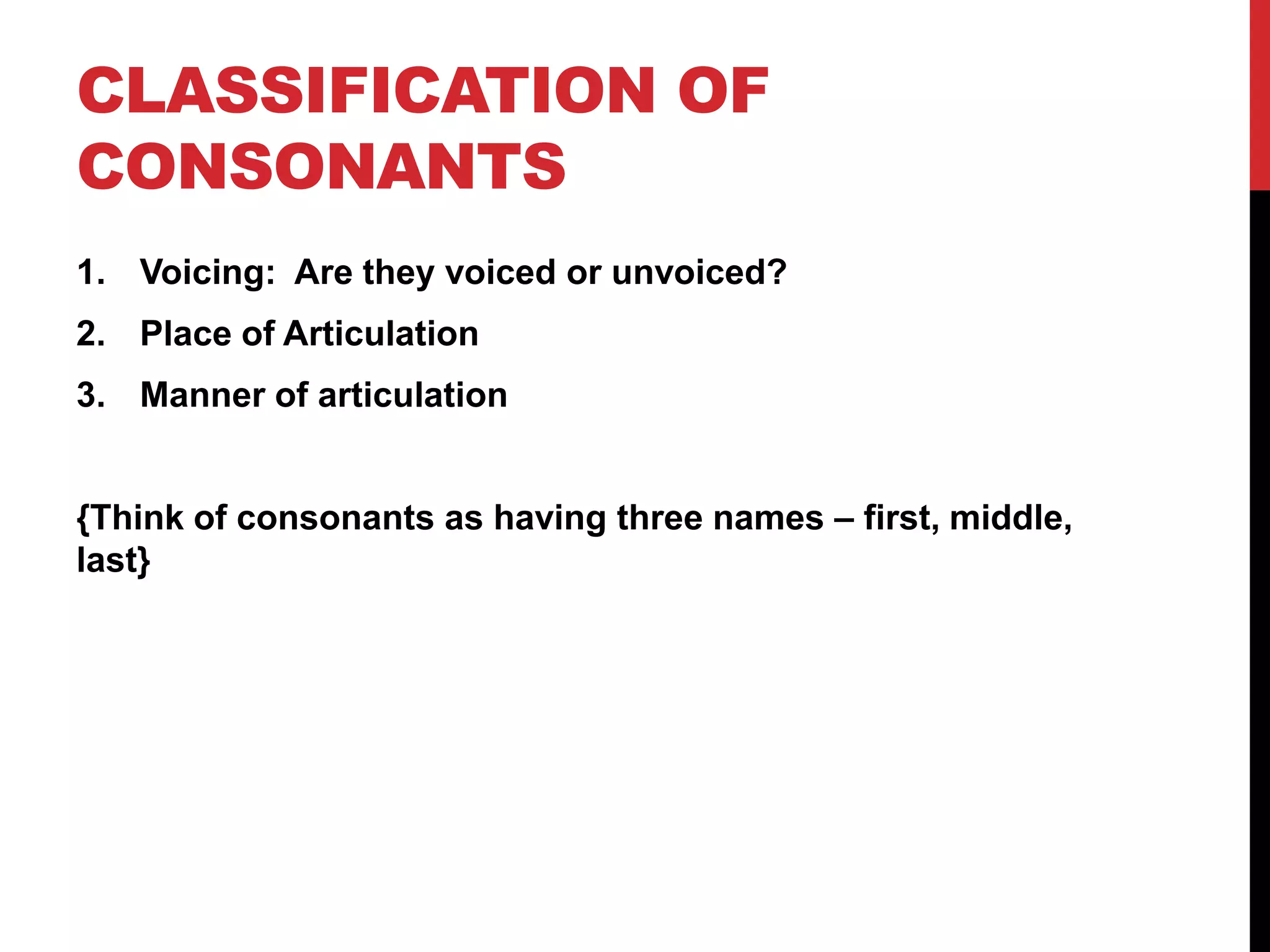
1. Consonants are sounds that interfere with the flow of breath and can be classified based on voicing, place of articulation, and manner of articulation. 2. The key consonants are classified as plosives [p, b, t, d, k, g], fricatives [v, f, θ, ð, z, s, ʒ, ʃ, h], and nasals [m, n, ŋ]. 3. Common problems include insufficient nasal resonance, inadequate duration of sounds, and substitution of one sound for another. Precise articulation of consonants is important for clear diction.


