TaLC 2008  What do annotators annotate?  An analysis of language teachers’ corpus pedagogical annotation José M. Alcaraz Pascual Pérez-Paredes  Universidad de Murcia, Spain
TaLC 08 Workshop What do annotators annotate? An analysis of language teachers’ corpus pedagogical annotation In this presentation José M. Alcaraz Pascual Pérez-Paredes  Universidad de Murcia, Spain
In this presentation Setting the scenario of our research: pedagogical annotation Research methodology: case study Results Discussion
Using a corpus…. Widdowson (2003:102) raises a very interesting issue when he uses Michael McCarthy’s remark that using a corpus is not just “ dumping large loads of corpus material wholesale into the classroom ”, and goes on to state: “What, then, it is a matter of?”
Setting the scenario Using language corpora in the language corpora: indirect and direct applications As Römer (forthcoming) puts it, while  indirect approaches  “centres on the impact of corpus evidence on syllabus design [...] and is concerned with corpus access by researchers”,  direct approaches  are “more teacher and learner-oriented”.
Setting the scenario In the two approaches we can appreciate that corpus-based linguistic research is predominant and, therefore, applications to other fields are possible but, positively,  did not motivate the design of the original corpus .
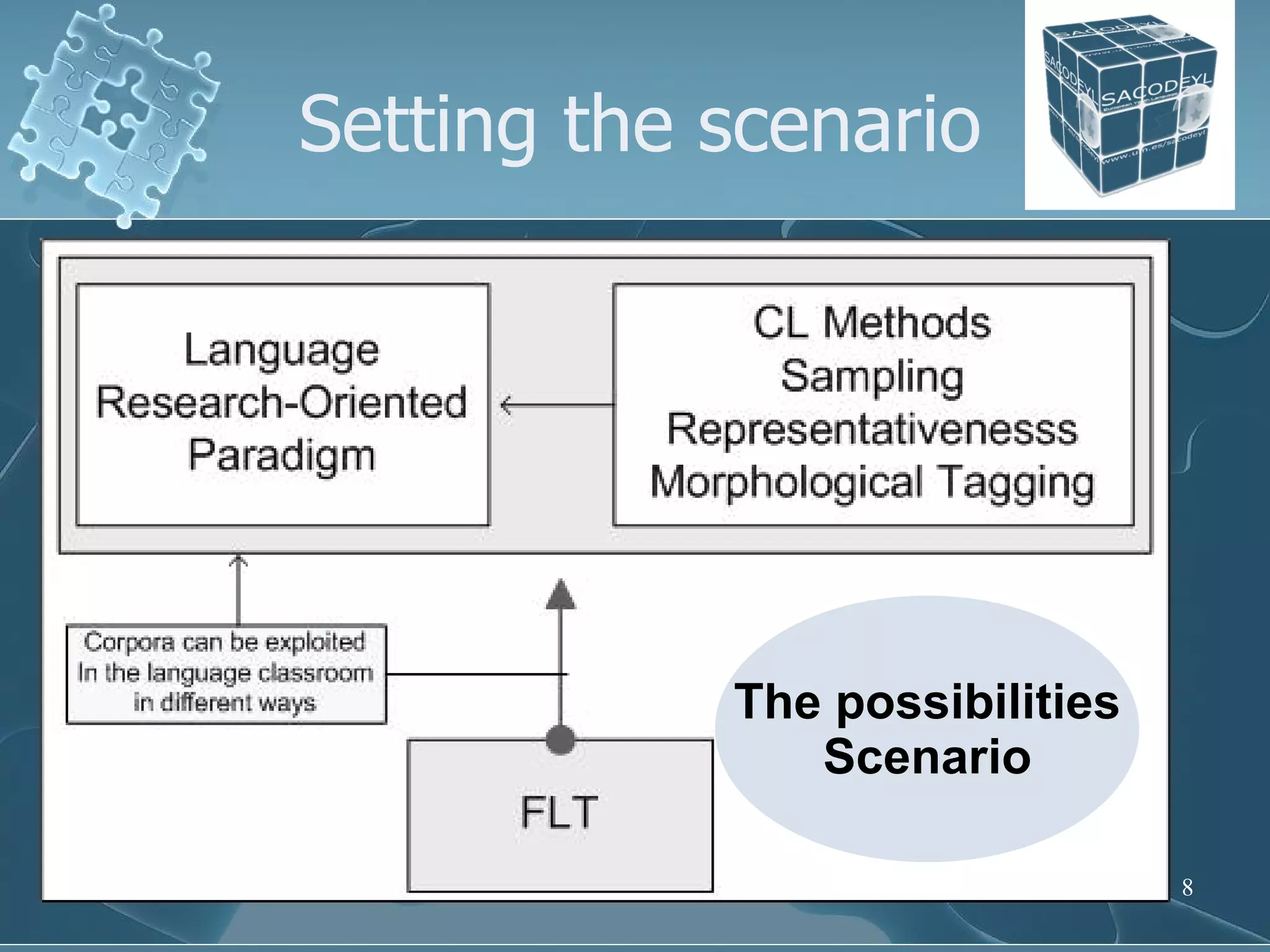
Setting the scenario Both direct and indirect approaches belong to what we may call the  possibilities scenario . This is characterized by the  effort  of language educators and researchers to  apply  existing work in the language research-oriented paradigm to the wealth of resources that can be used in FLT.
Setting the scenario The possibilities Scenario
Setting the scenario Pérez-Paredes (2007): limitations to the adaptation of general, principled corpora to the language classroom. High cognitive demand  which is put on the learner.  In this context, the learner will have to interpret  accumulative concordance lines , which are usually extracted from texts of a  very different nature  and, for most learners,  totally unrelated  to their learning experiences.
Setting the scenario This poses a high demand on learners, who are urged to  refine their search  precisely because of the  complexity  that is presented before their eyes in terms of genres and language.  Learners will have to  discriminate  what is relevant and what is not in terms of language use and weigh down the influence of the  context  and  cotext  in the results.
Setting the scenario Bernardini (2004) sees a very significant potential in discovery learning, but she is cautious about the  technological   limitations  and, even more important, about the  training  and  background  of  students .
Setting the scenario These complex analyses are  difficult  to  implement  in  mainstream  language teaching and learning, where there is a high pressure on communicative goals and not so much on mastering the complexities of the lexico-grammatical interface.
Setting the scenario There must be some room for  topic-driven corpora  (Braun 2007) that are geared towards the  integration  of  corpus-based  materials and general,  mainstream  language  learning , especially secondary education language learning.
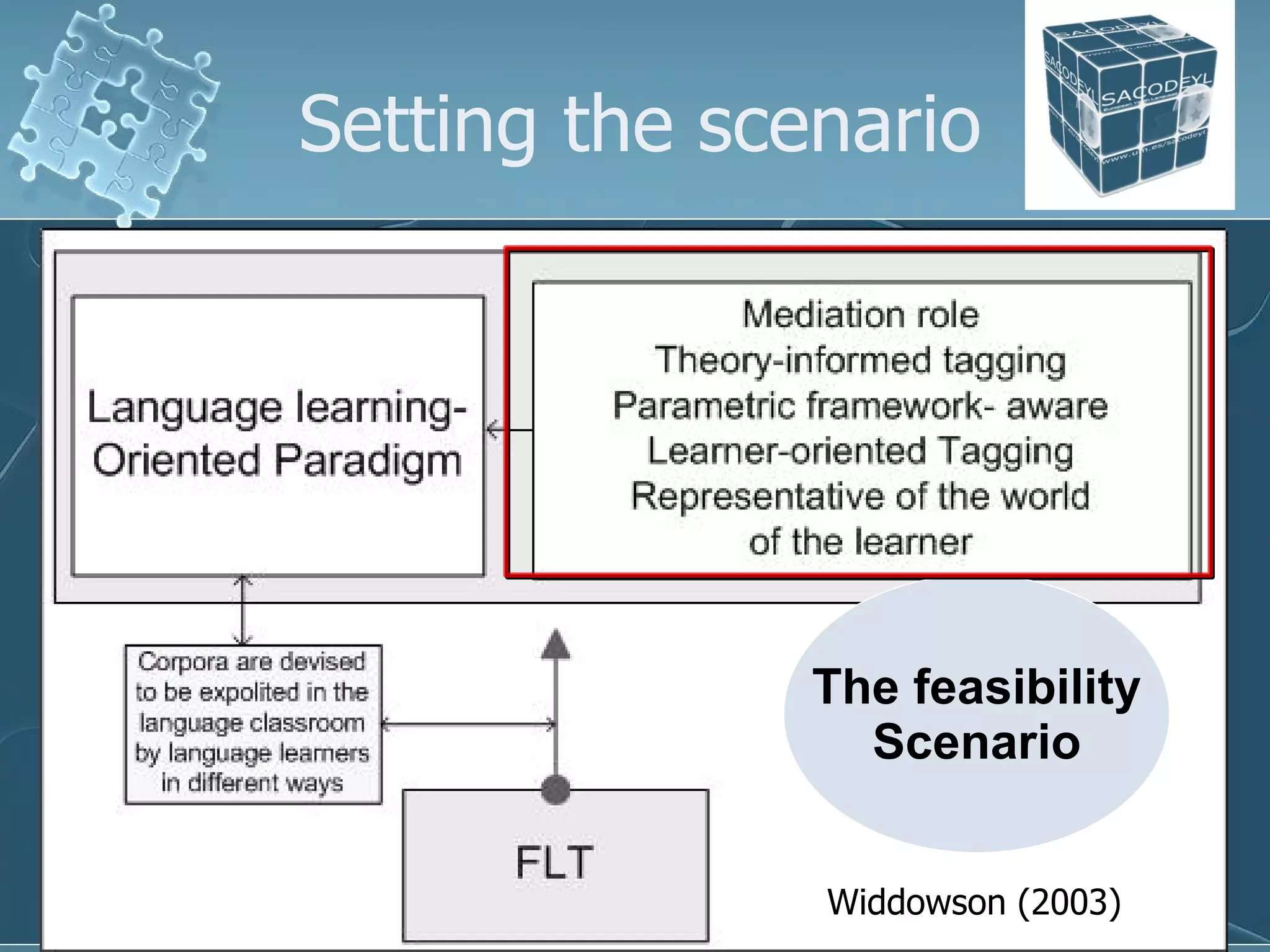
Setting the scenario Teacher-led,  pedagogical   annotation  of resources may play a significant role in  bringing  language corpora to the language classroom. If we want  learners  to become  discoverers  and researchers, it may make sense to think of  teachers  as  guides  and  pathfinders .
Setting the scenario The feasibility Scenario Widdowson (2003)
Setting the scenario We believe that when teachers become annotators it is more  feasible  to put language corpora resources to  good ,  realistic  and  authentic   use  in the language classroom. SACODEYL
Setting the scenario
Setting the scenario If pedagogic annotation is to play an active role in bringing corpora to the mainstream, non-tertiary education language classroom, we need to develop a  deeper   understanding  of  how   teachers   annotate  a corpus.
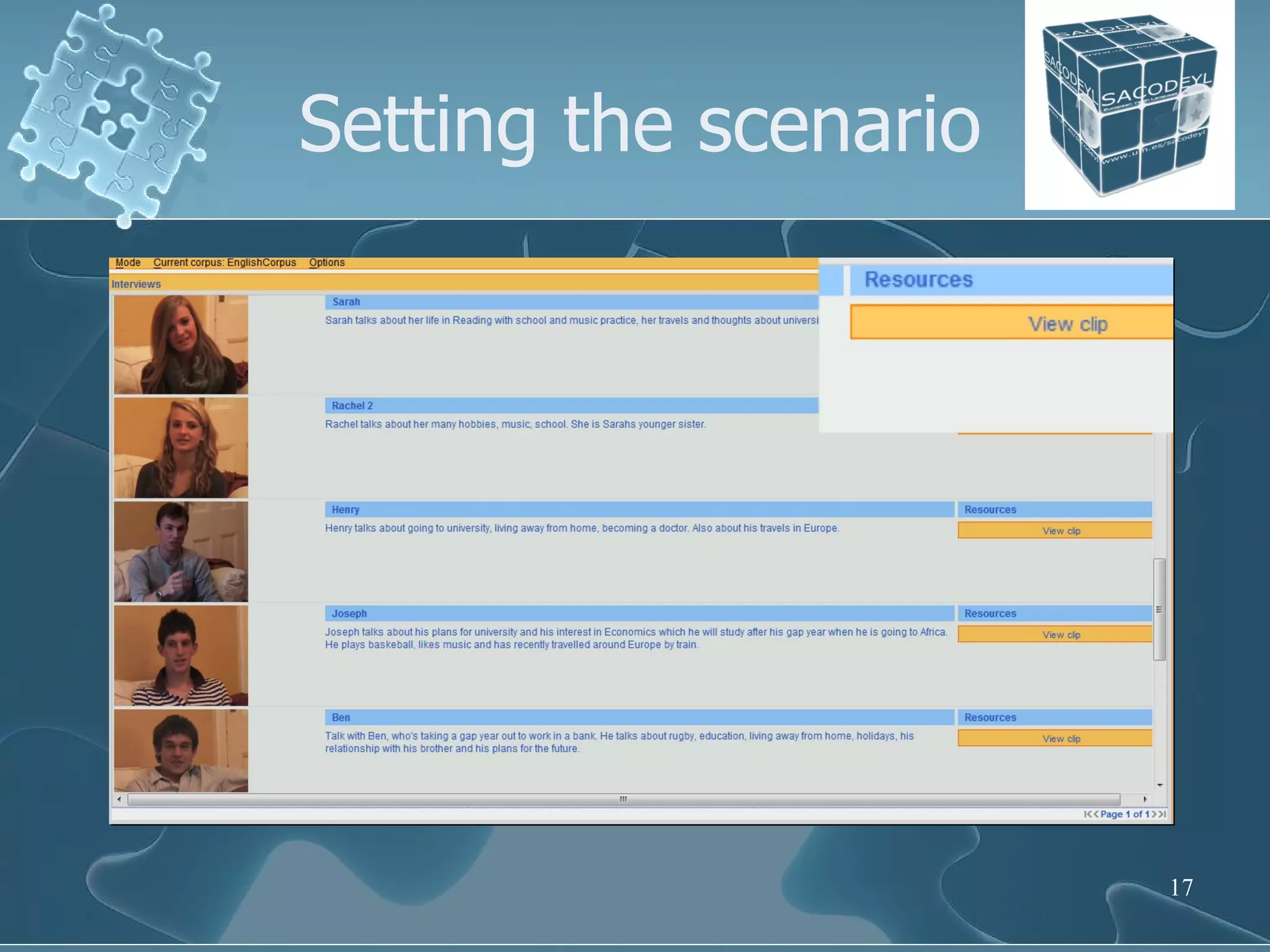
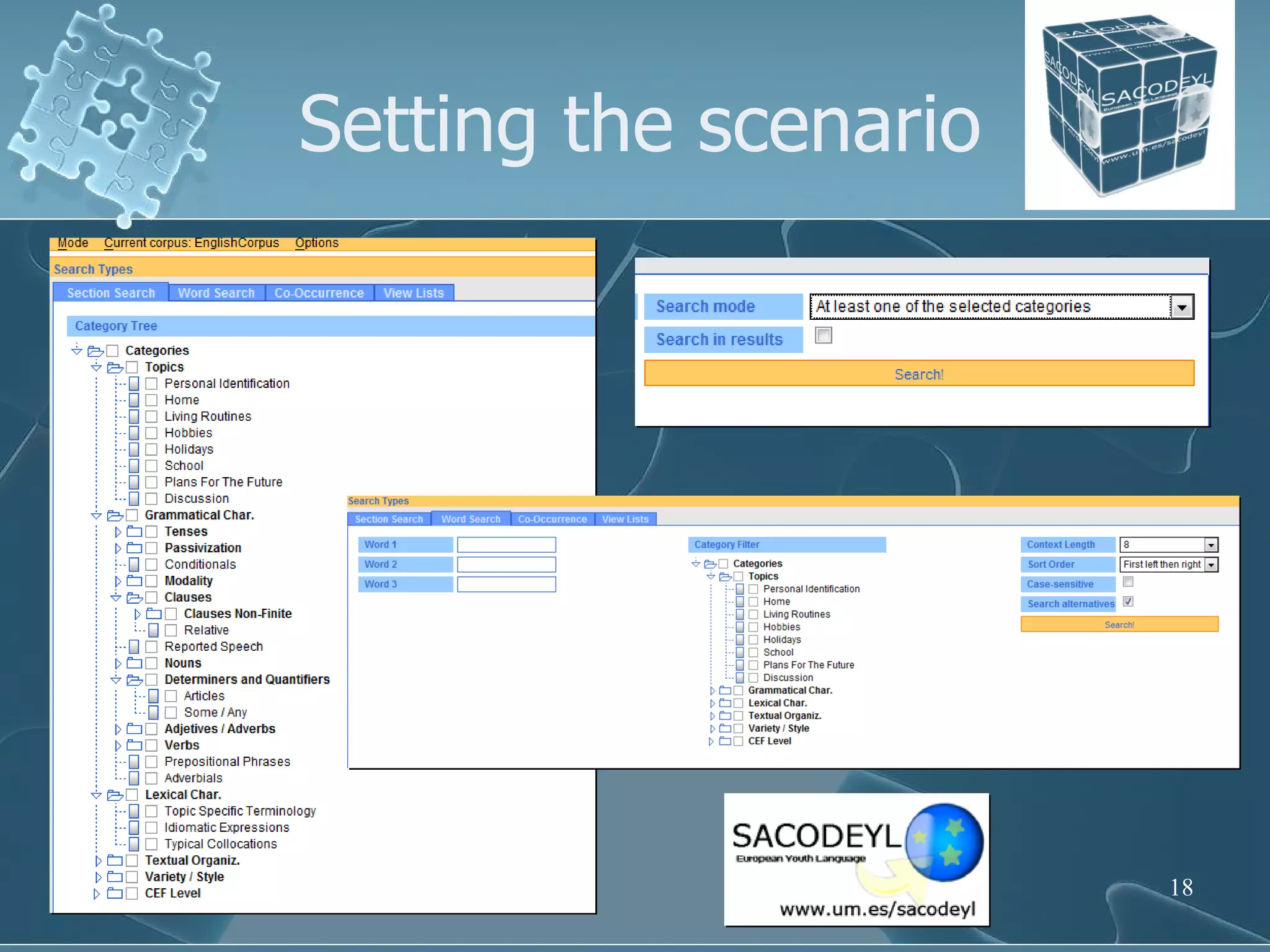
Setting the scenario This is only possible if real FLT teachers are  confronted  with the annotation process itself and are given a hands-on, practical framework that makes this possible. In order to provide teachers with such a framework, we have made use of the tools and products developed under the SACODEYL initiative.
Our research:aim To gain insight into both quantitative and qualitative data that will inform our process of analysis on the ways in which FLT teachers annotate a corpus.
Our research Case study methodology
Our research
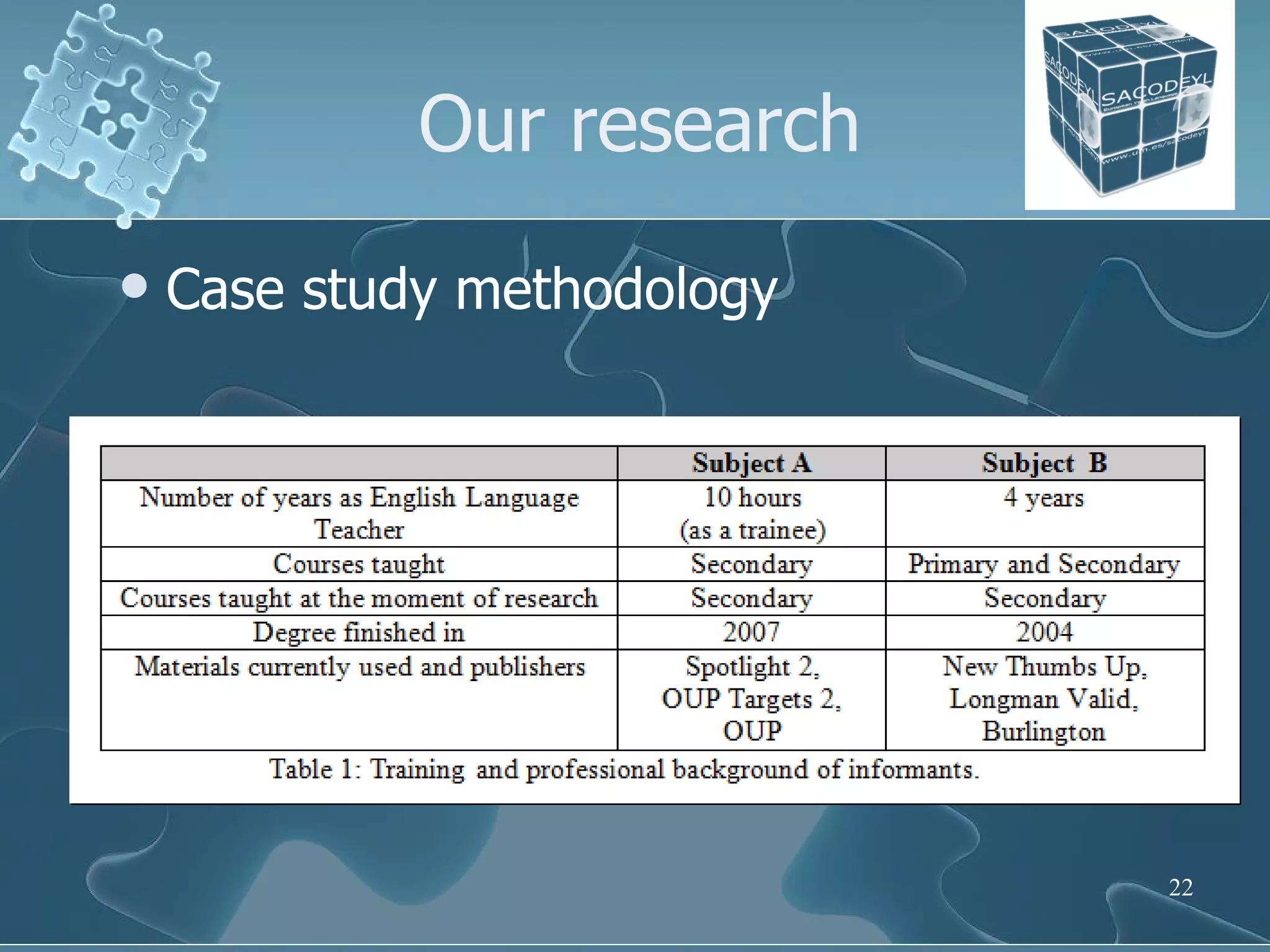
Our research Research conditions:  training  + annotation
Our research 90-minute training session Subjects introduced to the rationale behind corpus linguistics, the role of annotation in corpus linguistics and the relevance of annotation in the context of pedagogically-relevant corpora. After this, they were shown a video tutorial of SACODEYL Annotator. Finally, the individuals were given the task on which we have based our research. The two teachers were invited to annotate those aspects which they considered of pedagogical relevance for the learning/teaching of English as foreign language in Spain. They were prompted to watch a fragment of the corpus first and were given a full transcript of it. Although they were already familiar with the notion of section (Braun 2005, 2006, Pérez-Paredes et Al. 2007), they were told again that the fragment they were going to annotate had been divided into segments that had been considered by the corpus compilers as being of pedagogic relevance. Apart from this, they were  given total freedom  as to what to annotate and the categories of annotation to apply or even create.
Our research They were presented with a basic framework for the annotation of the English SACODEYL corpus that comprised 6 major categories: topics, grammatical characteristics, lexical characteristics, textual organization, variety and style and CEF level for the section.
Our research Both teachers read the same instructions and, particularly, both were made aware of the  similarities  between annotating with a view on the language classroom and the creation of FLT materials.
Our research After a 10-minute break, both individuals were given 90 minutes to annotate the same fragment of the English corpus of SACODEYL on different laptops. The resulting  annotated XML text  was retrieved from each computer and the annotation processed for further analysis.
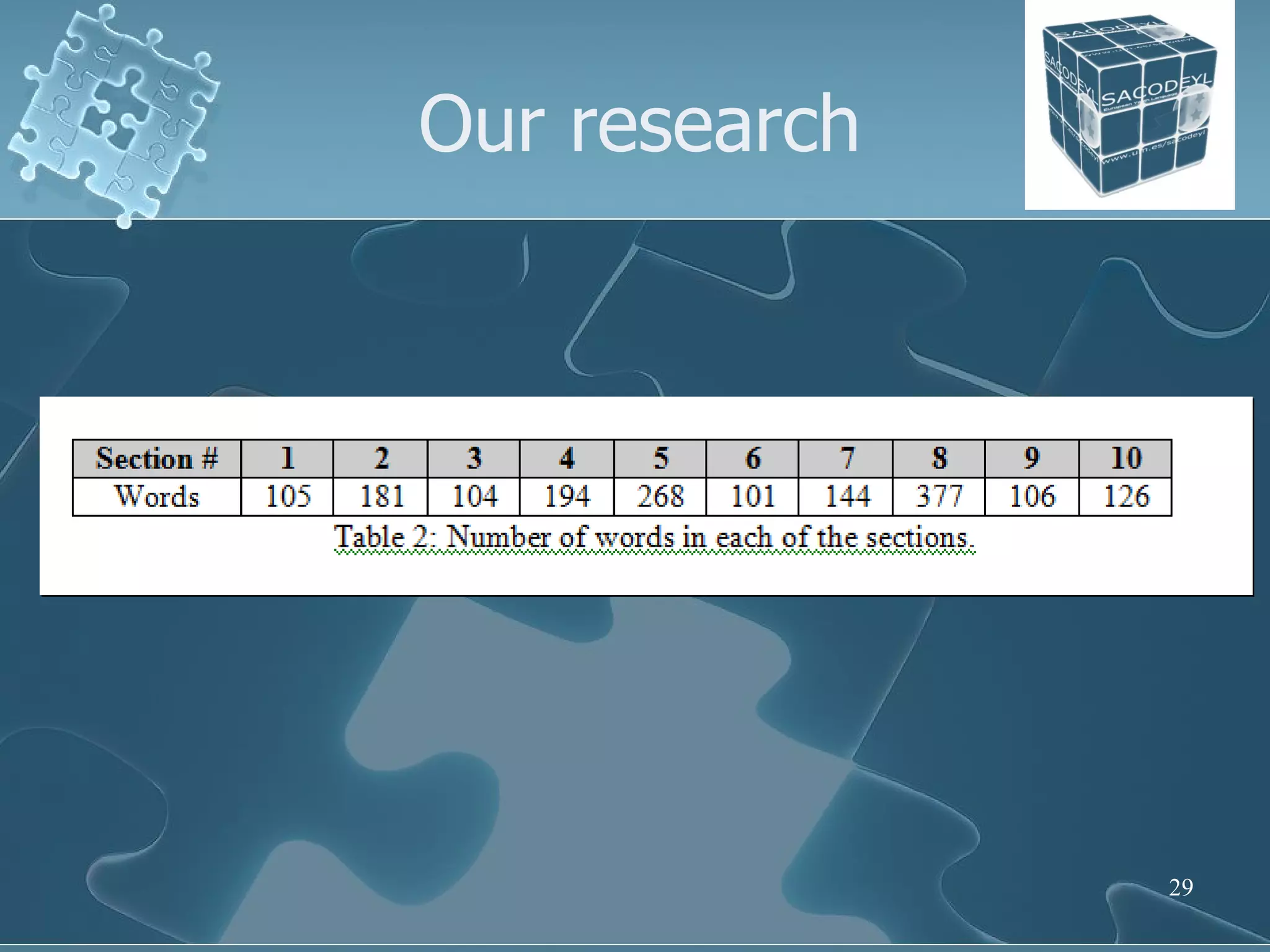
Our research
Results
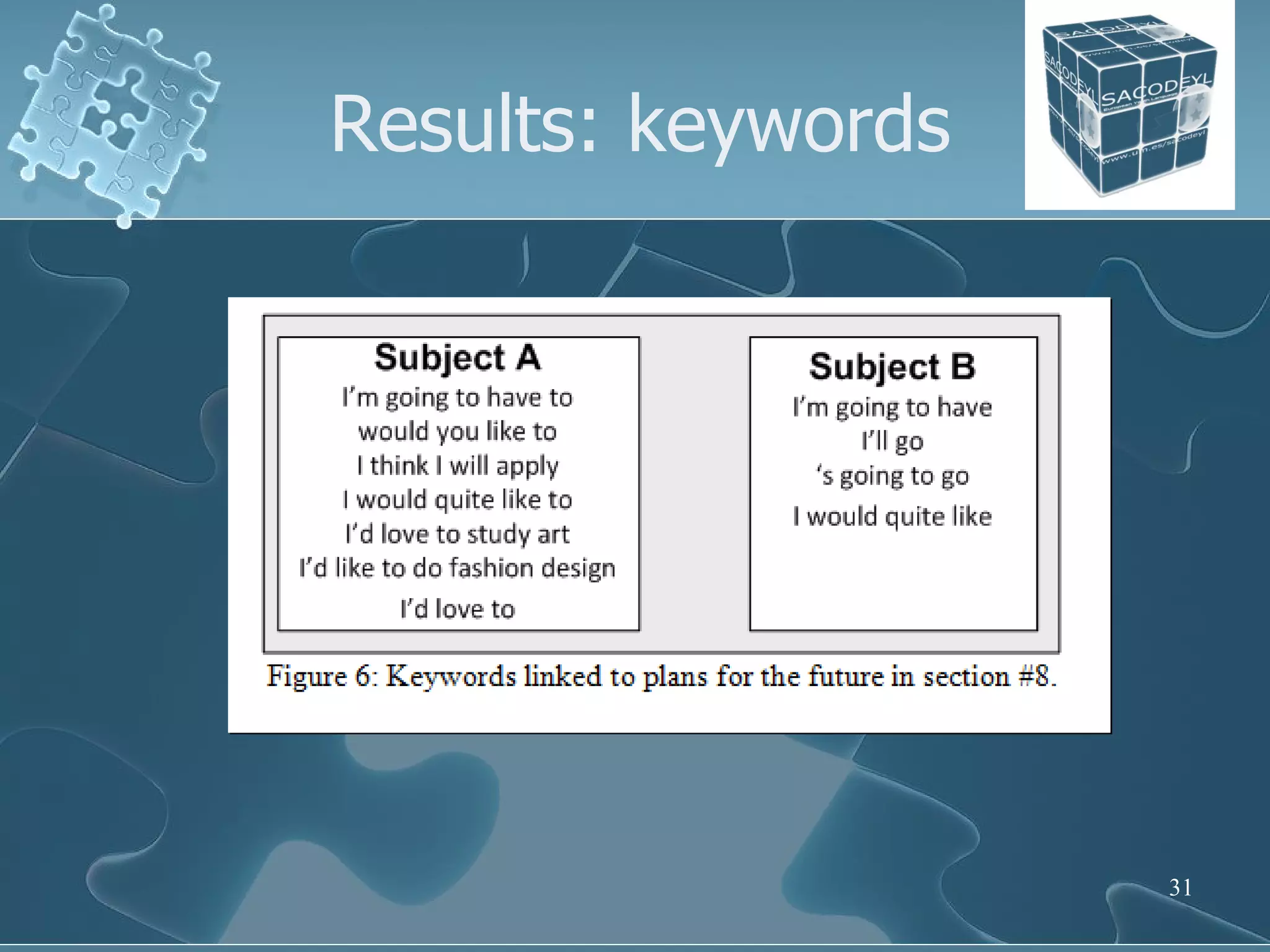
Results: keywords
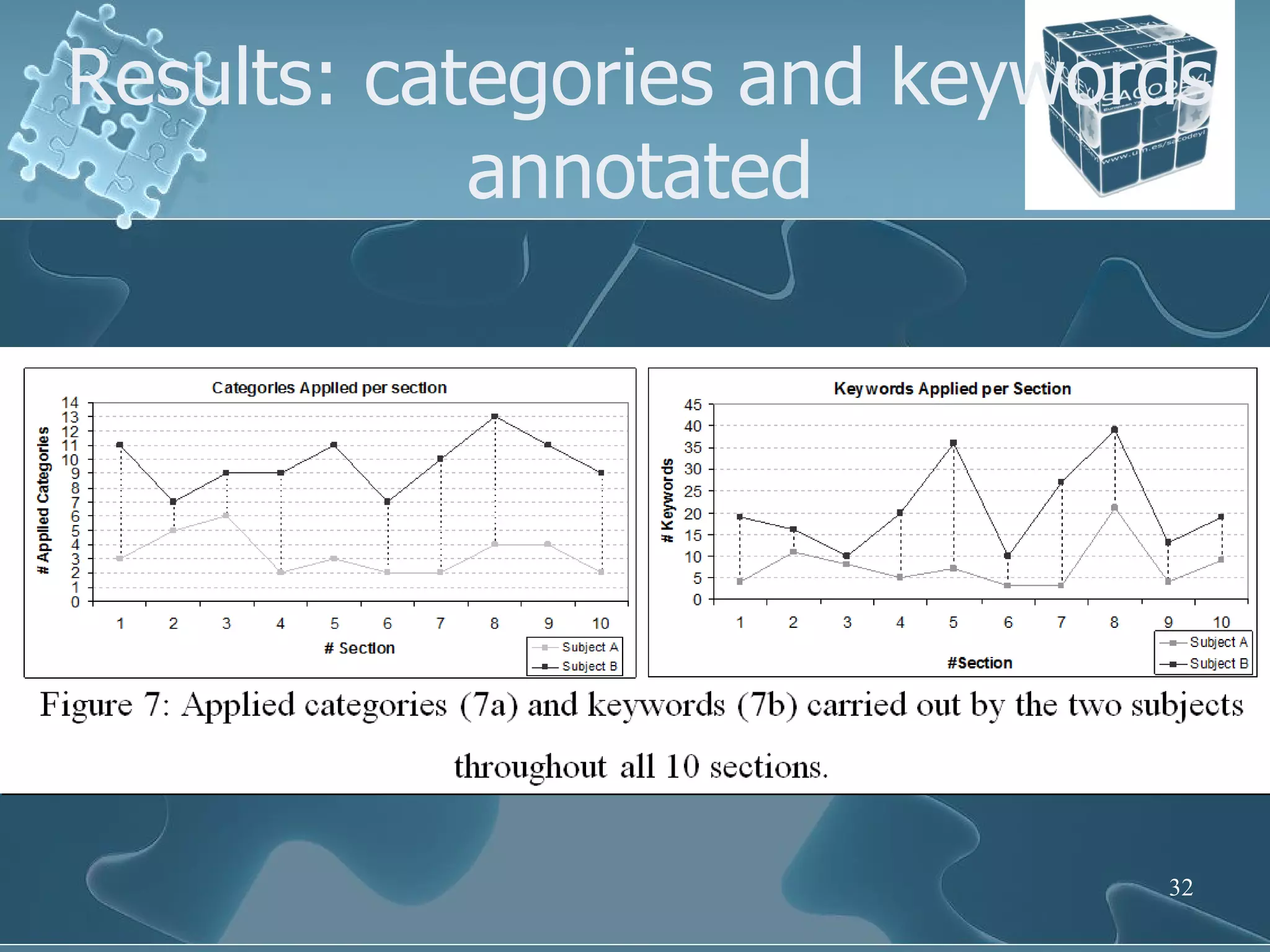
Results: categories and keywords annotated
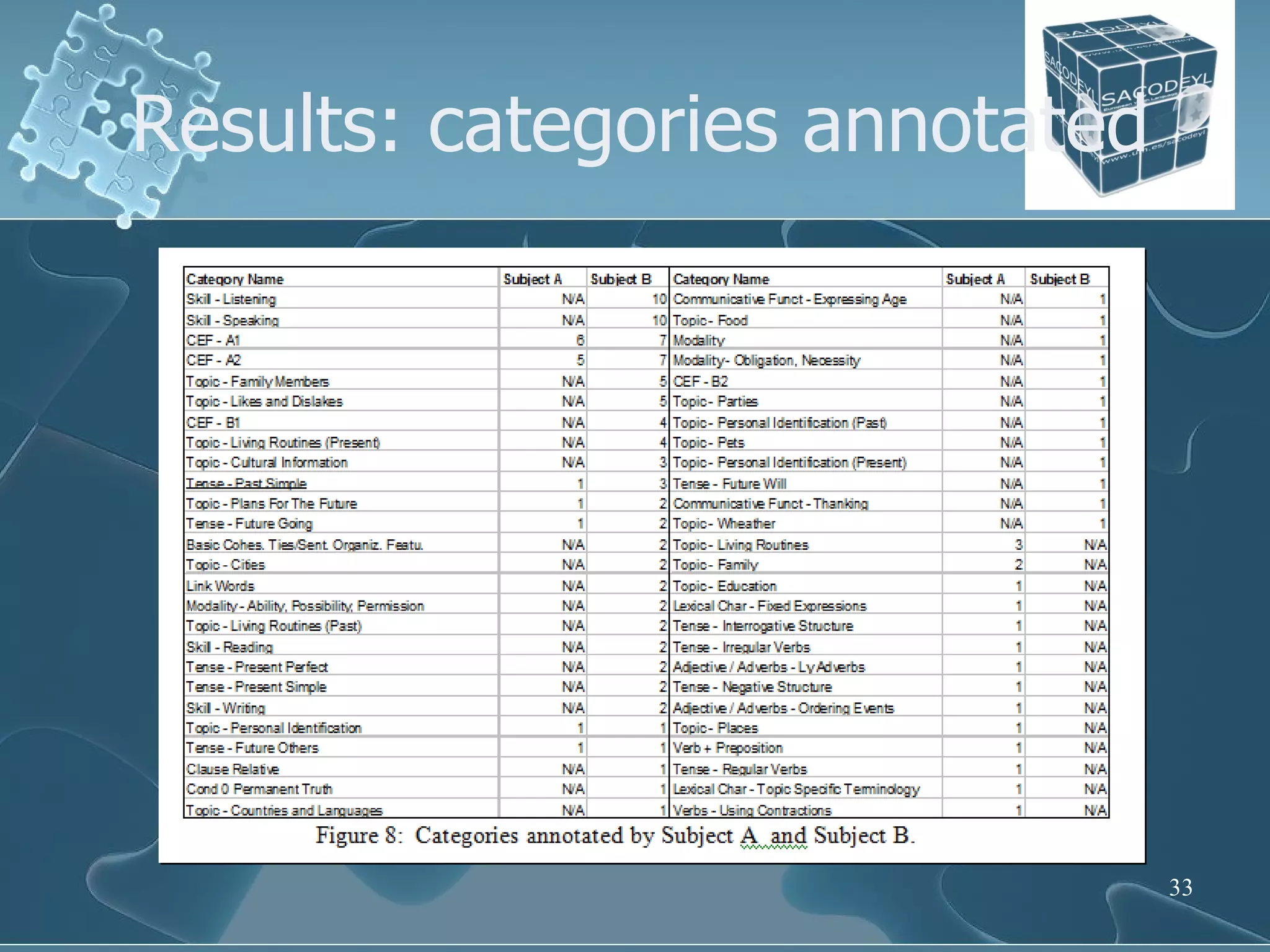
Results: categories annotated
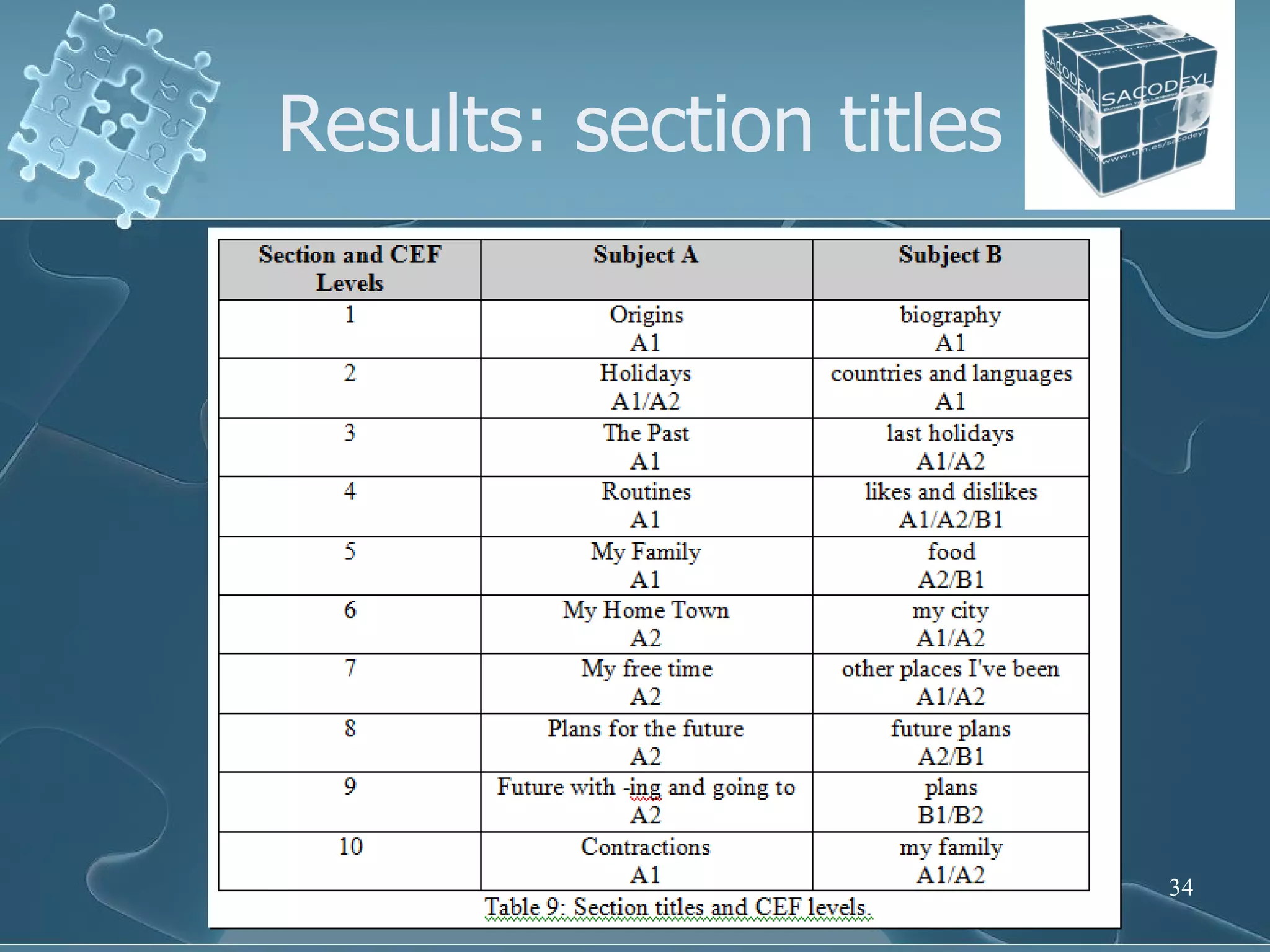
Results: section titles
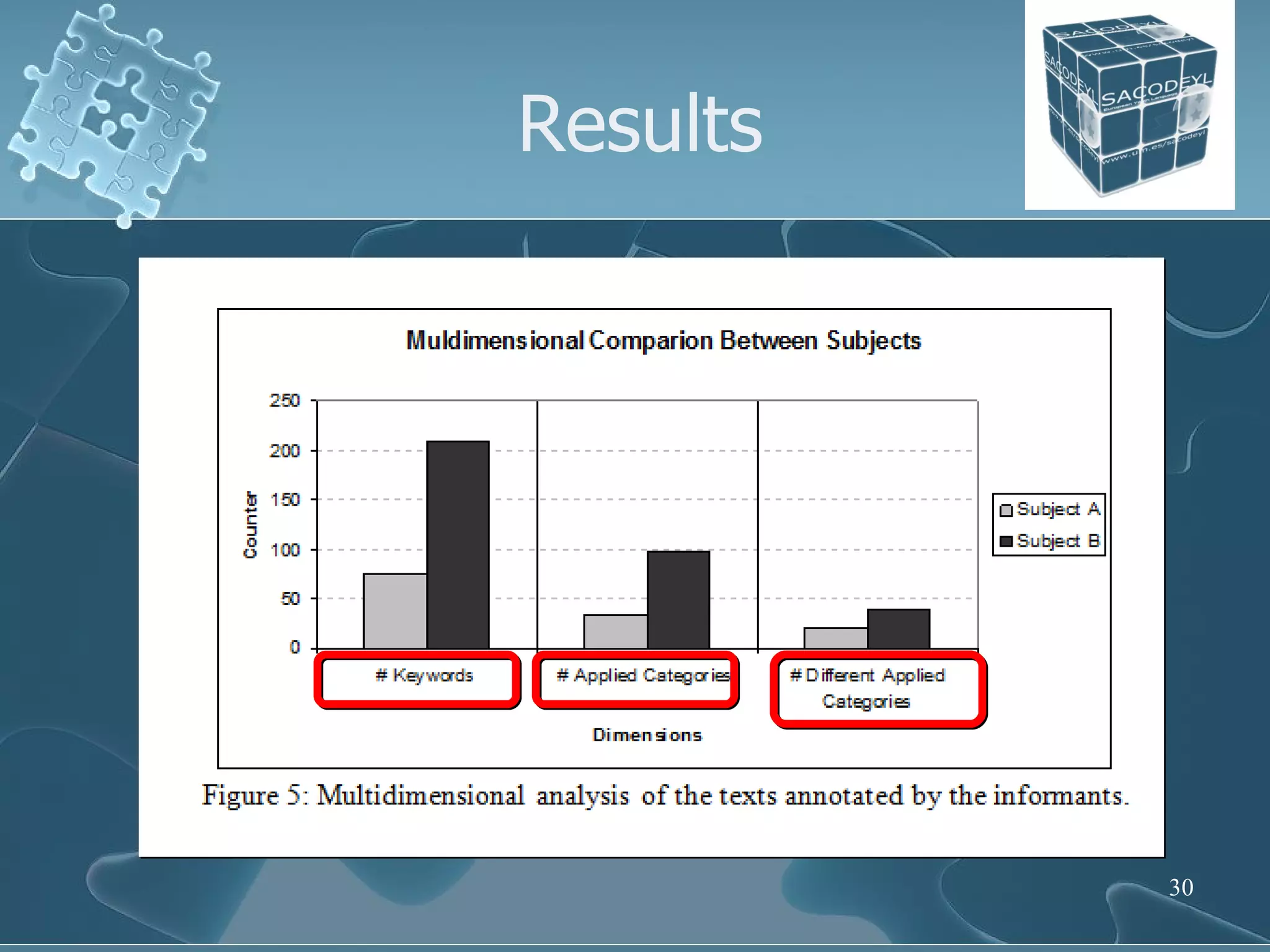
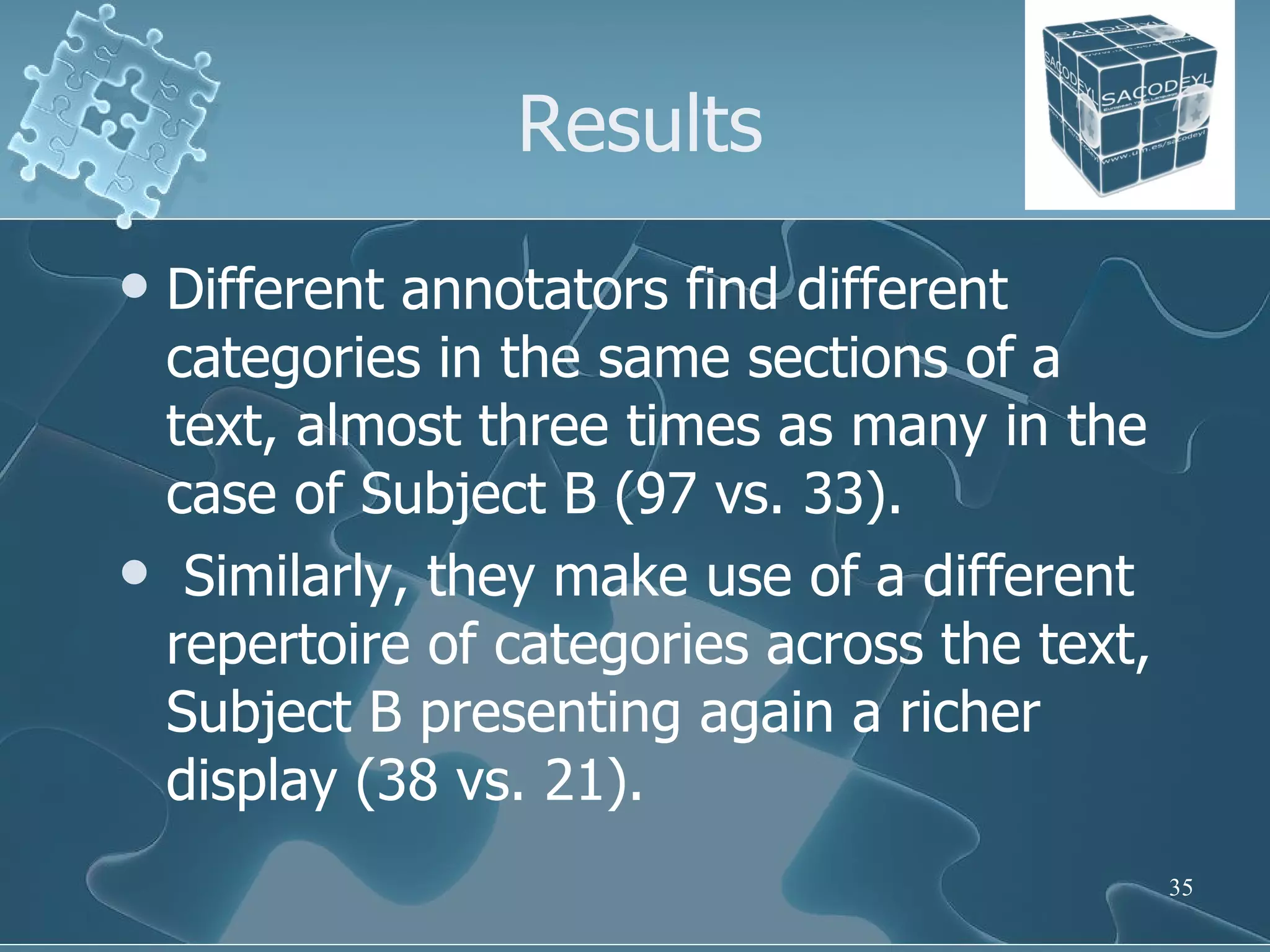
Results Different annotators find different categories in the same sections of a text, almost three times as many in the case of Subject B (97 vs. 33). Similarly, they make use of a different repertoire of categories across the text, Subject B presenting again a richer display (38 vs. 21).
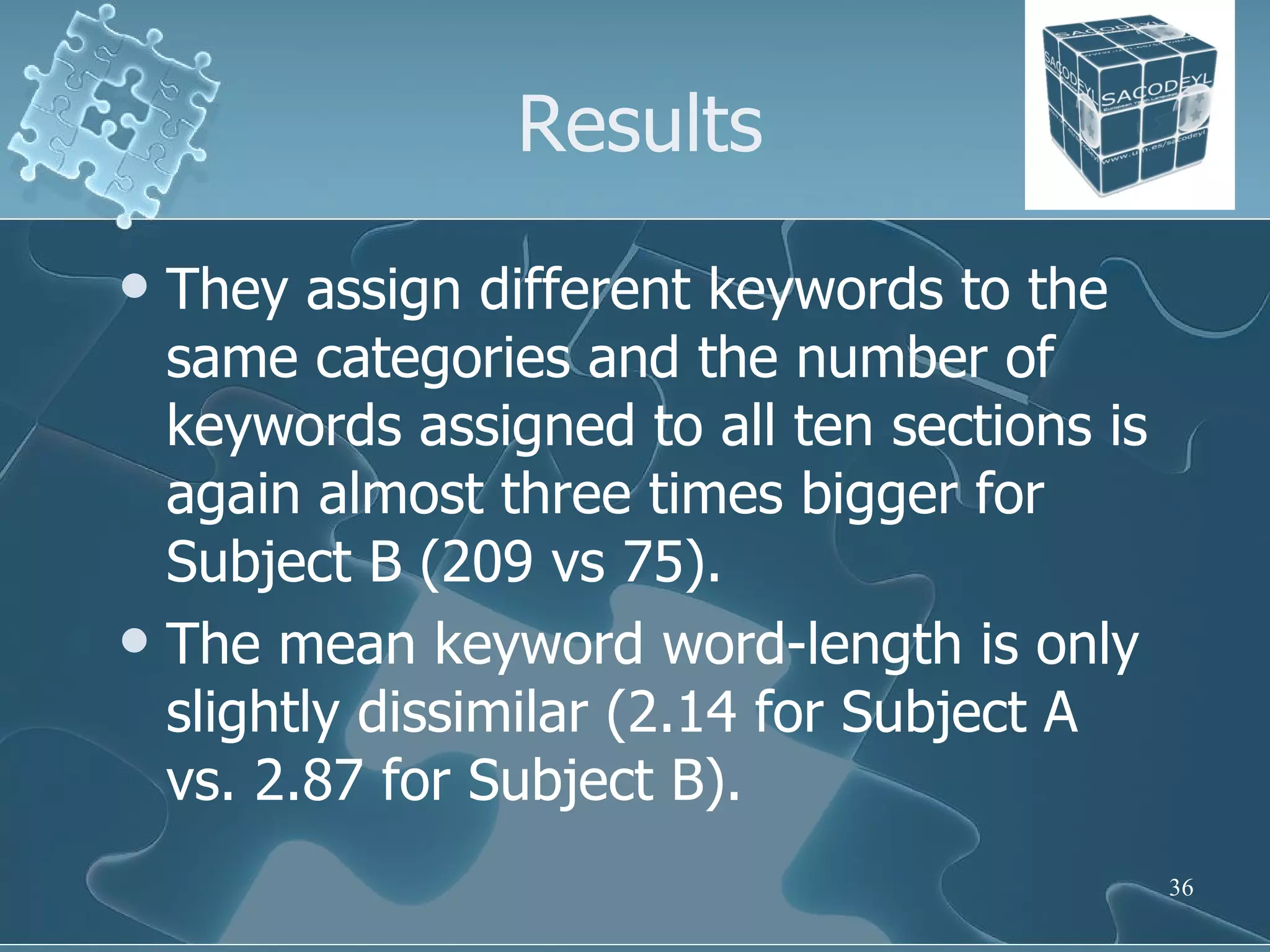
Results They assign different keywords to the same categories and the number of keywords assigned to all ten sections is again almost three times bigger for Subject B (209 vs 75).  The mean keyword word-length is only slightly dissimilar (2.14 for Subject A vs. 2.87 for Subject B).
Discussion Our findings therefore show that the pedagogical annotation of a corpus or a text is greatly influenced by what we may call  idiosyncratic annotation behaviour .  Our case studies point out to the fact that the more experienced teacher is a more prolific annotator, but this view is rather simplistic and may override other interesting findings.
Discussion The annotation behaviour of a teacher in our feasibility scenario is influenced by a very rich  parametric framework .
Discussion Our research shows that there is agreement on the annotation when the object of the annotation process is  norm-referenced . A good example of this is the  CEF Levels , where both annotators found the text sections of similar level for further exploitation in language learning.
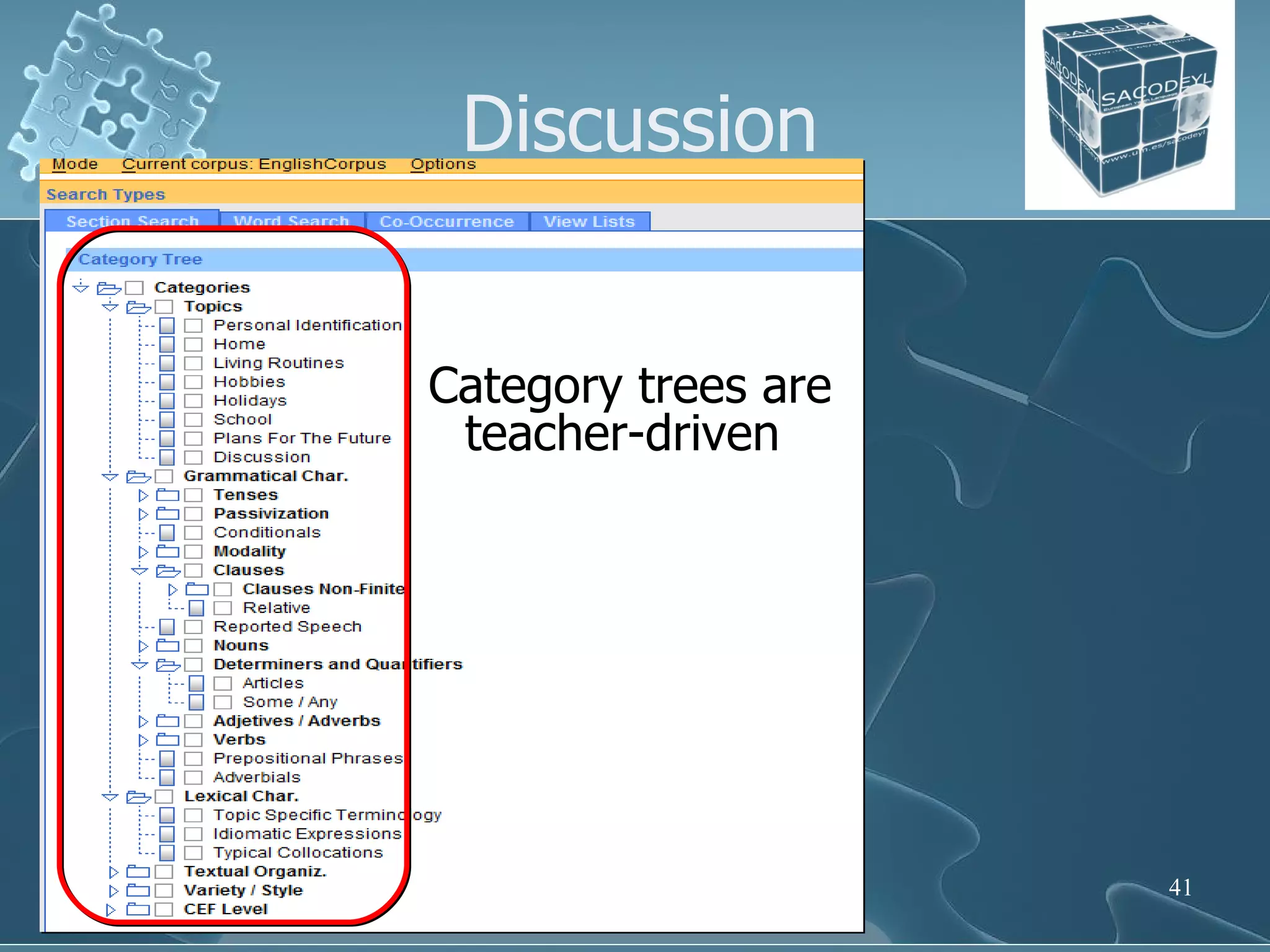
Discussion The resulting  taxonomy   trees  are a  reflection of the pedagogy  of a given annotator, while the resulting annotated text is a  projection of that particular pedagogy  which integrates the  mediation role  played by the annotator/teacher in her interaction with the variables that condition her teaching.
Discussion Category trees are teacher-driven
Discussion The mediation role in the feasibility scenario is therefore conditioned by the annotator’s representation of the learners she is tagging for and the uses that a section, text or corpus will be given in that context.
Discussion The data we gathered show that, despite the lack of experience in annotating textual resources, both annotators  created  their own categories in their taxonomy trees, which indicates that they actually took an active role in the assignation of taxonomies.
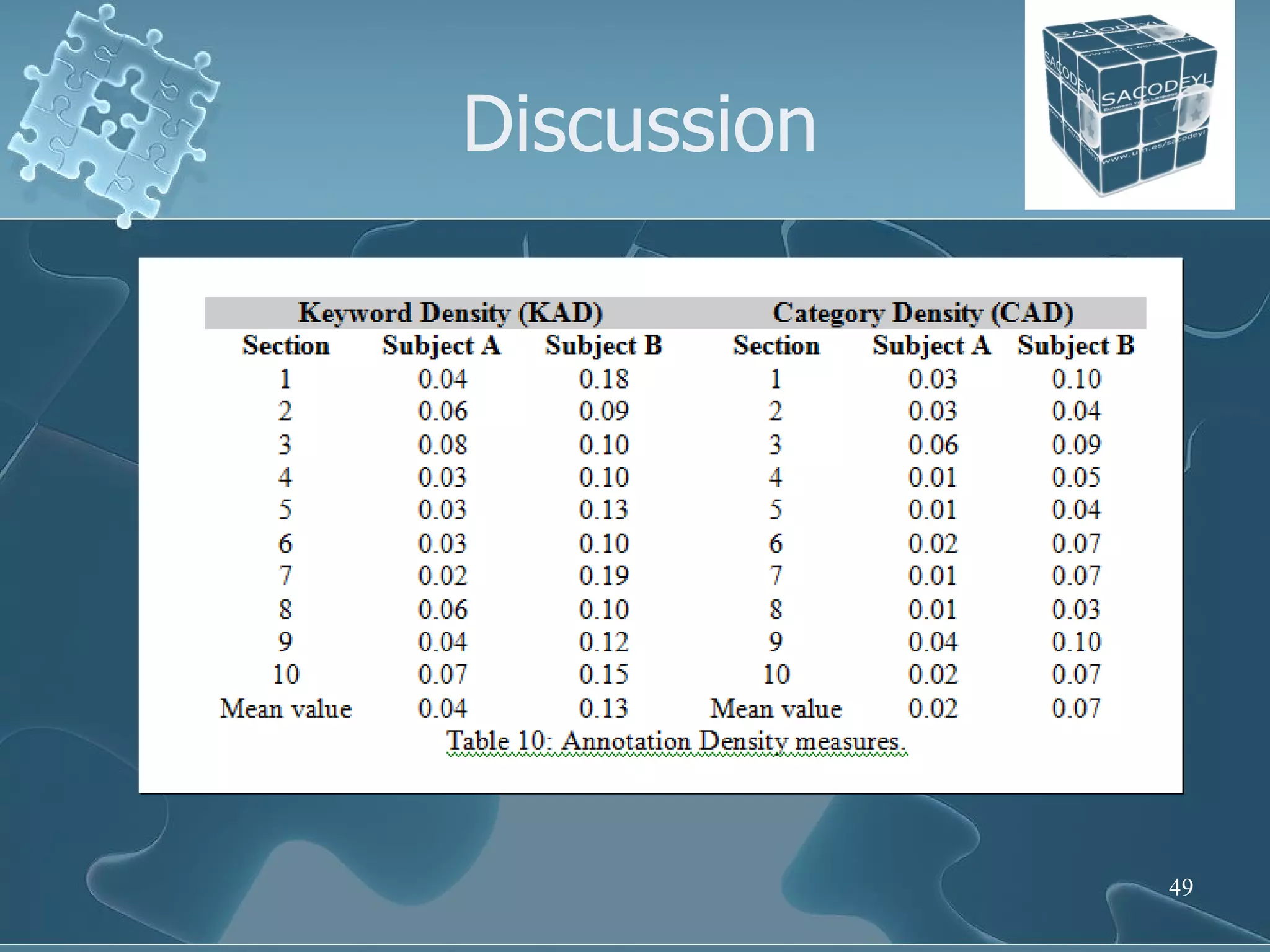
Discussion The section titles provided by both subjects (Table 9) show that sections 3 and 10 represent  different opportunities for language learning , with a traditional grammar focus in the case of Annotator A as opposed to a more topic-oriented bias in Annotator B.
Discussion These case studies indicate that the annotation behaviour of teachers may be highly dissimilar and very idiosyncratic.  Therefore, we believe that this behaviour can be fully understood only if annotation is profiled.
Discussion This profile can be achieved by  combining  some of the  measures  discussed earlier and, in particular, the number of categories applied, the words per section and the number of keywords applied.
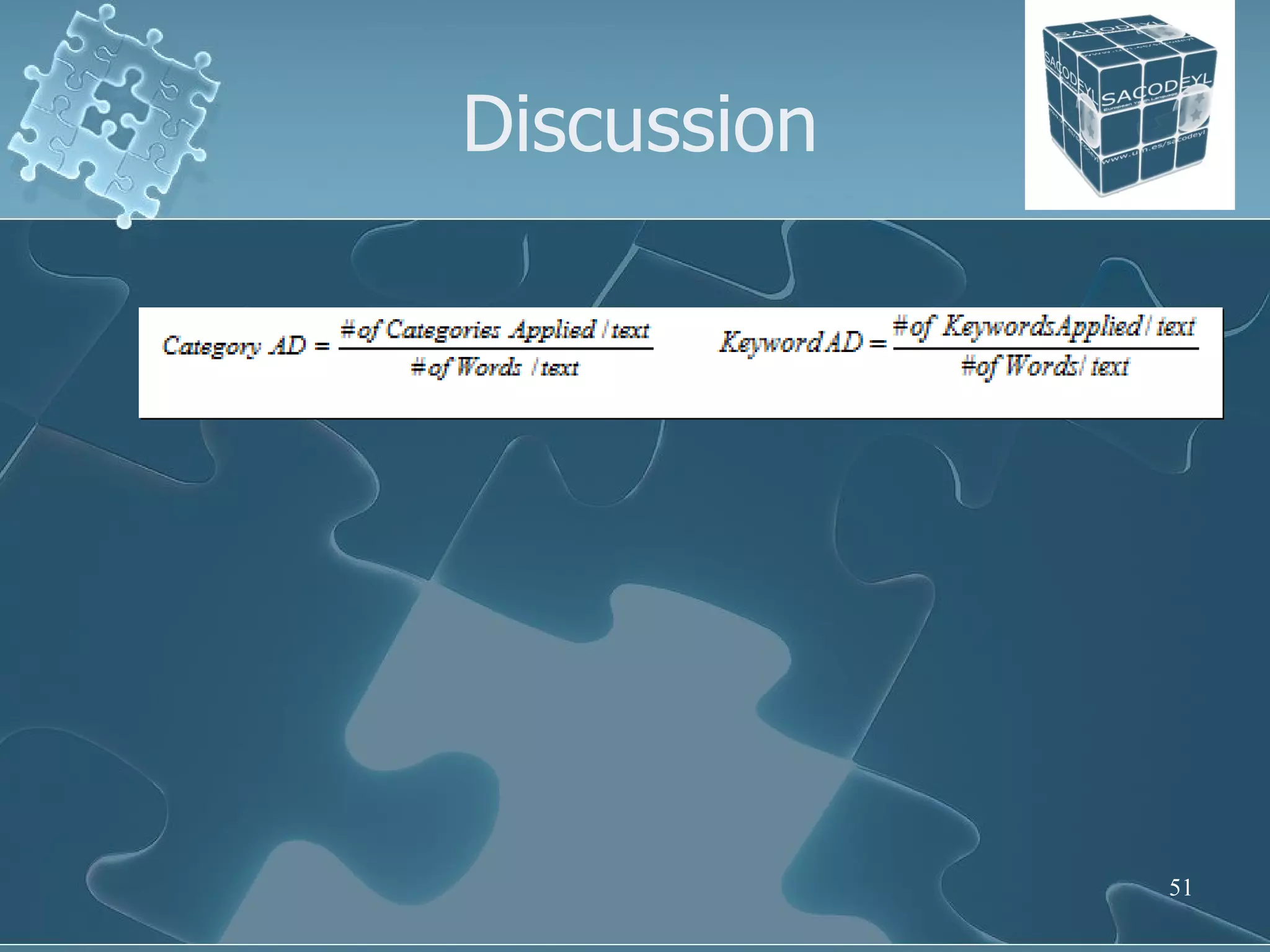
Discussion Thus, we have developed two different Annotation Density (AD) measures:  Category AD   and  Keyword  AD . As it is difficult to establish a comparison among texts of different length, a metric of density can be used to obtain data in which the length of a text does not distort the real sense of the measured value.
Discussion Category AD  offers the  weight  which the annotator has given to the categories in a section, irrespective of the length of this section. In Table 10 we can see that the annotators display double CA density in section #3 as compared to those of section #2. Curiously enough, section #2 is longer than section #3.
Discussion
Discussion Keyword AD  is an analogous metric which focuses on the keywords applied to a section, providing the weight which an annotator has given to keywords in a section irrespective of its length.
Discussion
Discussion These density measures may be a necessary  complement  to understand the pedagogic quality of corpus-based resources in the language classroom and their potential uses by peer teachers in an environment of teacher collaboration.
Discussion This is a very interesting area where the social network values attached to expressions such as  folksonomies or social tagging  (Al-Khalifa and Davies 2006) may converge into the notion of teacher-led pedagogical annotation.
Discussion By  profiling the annotation behaviour  of teachers in this way, we may approach the exploitation of corpus-based resources in an informed way and gain insight into (a) the specific mediation role played by a particular annotator and (b) her annotation behaviour.
Discussion The aim of pedagogical annotation escapes the kind of automatic tag assignation which is found in morphological tagging. The density measures offered above do not point out per se to better annotation habits. On the contrary, they indicate different approaches to annotation.
Discussion Becoming aware of these differences is probably a first step towards a future situation where corpus-based resources are shared by the community of professionals in much the same way as other learning resources are tagged and shared in many other fields.
Discussion But this sharing effort must be  vaccinated against the virus of subjectivity  or, in other words, we must make the effort to recognize that subjective appreciations on the uses of language corpora are part of the mediation role played by teachers in bringing corpus resources to the language classroom.
Discussion The results of our research confirm that pedagogical annotation is  feasible , that the annotation tools that SACODEYL have developed can be used with a very  low learning curve , and that  annotation   behaviour  can be  profiled .
Discussion It will take further research to gain insight into the  ways  in which this profiling may contribute to uses in the language classroom by both learners and teachers. In particular it will be necessary to accomplish further research using a larger group of teachers with a different background and submit their annotations and profiles to the scrutiny of peer teachers .
Discussion Our feasibility scenario is closer to the mediating corpus advocated by Widdowson (2003) than those in the line of the possibilities scenario.  The role of teachers here is crucial.  If teachers become  annotators , language learners may stand a better chance to become  discoverers .
References and further reading Braun, S.  2005. “From pedagogically relevant corpora to authentic language learning contents”,  ReCALL  17/1:47-64. Braun, S.  2006. “ELISA - a pedagogically enriched corpus for language learning purposes”. In  Corpus Technology and Language Pedagogy: New Resources, New Tools, New Methods , Frankfurt M: Peter Lang.  (eds) 25-47. Braun, S.  2007. “Integrating corpus work into secondary education: from data-driven learning to needs-driven corpora”.  ReCALL  19/3: 307-328. Mauranen, A.  2004.” Spoken - general: Spoken corpus for an ordinary learner”. In  How to Use Corpora in Language Teaching , Sinclair, J. McH. (Ed), 89–105. Pérez-Paredes, P. and Alcaraz, J.M.  2009. “Developing annotation solutions for online data-driven learning”. ReCALL,21,1, (Forthcoming). Römer, Ute.  (Forthcoming). “Corpora and Language Teaching”. In  Corpus Linguistics. An International Handbook , Lüdeling, Anke & Merja Kytö (eds.). Berlin: Mouton de Gruyter. Widdowson, H.G . 2003.  Defining issues in English Language Teaching . Oxford: Oxford University Press.
TaLC 2008  What do annotators annotate?  An analysis of language teachers’ corpus pedagogical annotation José M. Alcaraz Pascual Pérez-Paredes  Universidad de Murcia, Spain Thanks!

TALC 2008 - What do annotators annotate? An analysis of language teachers’ corpus pedagogical annotation.

  • 1.
    TaLC 2008 What do annotators annotate? An analysis of language teachers’ corpus pedagogical annotation José M. Alcaraz Pascual Pérez-Paredes Universidad de Murcia, Spain
  • 2.
    TaLC 08 WorkshopWhat do annotators annotate? An analysis of language teachers’ corpus pedagogical annotation In this presentation José M. Alcaraz Pascual Pérez-Paredes Universidad de Murcia, Spain
  • 3.
    In this presentationSetting the scenario of our research: pedagogical annotation Research methodology: case study Results Discussion
  • 4.
    Using a corpus….Widdowson (2003:102) raises a very interesting issue when he uses Michael McCarthy’s remark that using a corpus is not just “ dumping large loads of corpus material wholesale into the classroom ”, and goes on to state: “What, then, it is a matter of?”
  • 5.
    Setting the scenarioUsing language corpora in the language corpora: indirect and direct applications As Römer (forthcoming) puts it, while indirect approaches “centres on the impact of corpus evidence on syllabus design [...] and is concerned with corpus access by researchers”, direct approaches are “more teacher and learner-oriented”.
  • 6.
    Setting the scenarioIn the two approaches we can appreciate that corpus-based linguistic research is predominant and, therefore, applications to other fields are possible but, positively, did not motivate the design of the original corpus .
  • 7.
    Setting the scenarioBoth direct and indirect approaches belong to what we may call the possibilities scenario . This is characterized by the effort of language educators and researchers to apply existing work in the language research-oriented paradigm to the wealth of resources that can be used in FLT.
  • 8.
    Setting the scenarioThe possibilities Scenario
  • 9.
    Setting the scenarioPérez-Paredes (2007): limitations to the adaptation of general, principled corpora to the language classroom. High cognitive demand which is put on the learner. In this context, the learner will have to interpret accumulative concordance lines , which are usually extracted from texts of a very different nature and, for most learners, totally unrelated to their learning experiences.
  • 10.
    Setting the scenarioThis poses a high demand on learners, who are urged to refine their search precisely because of the complexity that is presented before their eyes in terms of genres and language. Learners will have to discriminate what is relevant and what is not in terms of language use and weigh down the influence of the context and cotext in the results.
  • 11.
    Setting the scenarioBernardini (2004) sees a very significant potential in discovery learning, but she is cautious about the technological limitations and, even more important, about the training and background of students .
  • 12.
    Setting the scenarioThese complex analyses are difficult to implement in mainstream language teaching and learning, where there is a high pressure on communicative goals and not so much on mastering the complexities of the lexico-grammatical interface.
  • 13.
    Setting the scenarioThere must be some room for topic-driven corpora (Braun 2007) that are geared towards the integration of corpus-based materials and general, mainstream language learning , especially secondary education language learning.
  • 14.
    Setting the scenarioTeacher-led, pedagogical annotation of resources may play a significant role in bringing language corpora to the language classroom. If we want learners to become discoverers and researchers, it may make sense to think of teachers as guides and pathfinders .
  • 15.
    Setting the scenarioThe feasibility Scenario Widdowson (2003)
  • 16.
    Setting the scenarioWe believe that when teachers become annotators it is more feasible to put language corpora resources to good , realistic and authentic use in the language classroom. SACODEYL
  • 17.
  • 18.
  • 19.
    Setting the scenarioIf pedagogic annotation is to play an active role in bringing corpora to the mainstream, non-tertiary education language classroom, we need to develop a deeper understanding of how teachers annotate a corpus.
  • 20.
    Setting the scenarioThis is only possible if real FLT teachers are confronted with the annotation process itself and are given a hands-on, practical framework that makes this possible. In order to provide teachers with such a framework, we have made use of the tools and products developed under the SACODEYL initiative.
  • 21.
    Our research:aim Togain insight into both quantitative and qualitative data that will inform our process of analysis on the ways in which FLT teachers annotate a corpus.
  • 22.
    Our research Casestudy methodology
  • 23.
  • 24.
    Our research Researchconditions: training + annotation
  • 25.
    Our research 90-minutetraining session Subjects introduced to the rationale behind corpus linguistics, the role of annotation in corpus linguistics and the relevance of annotation in the context of pedagogically-relevant corpora. After this, they were shown a video tutorial of SACODEYL Annotator. Finally, the individuals were given the task on which we have based our research. The two teachers were invited to annotate those aspects which they considered of pedagogical relevance for the learning/teaching of English as foreign language in Spain. They were prompted to watch a fragment of the corpus first and were given a full transcript of it. Although they were already familiar with the notion of section (Braun 2005, 2006, Pérez-Paredes et Al. 2007), they were told again that the fragment they were going to annotate had been divided into segments that had been considered by the corpus compilers as being of pedagogic relevance. Apart from this, they were given total freedom as to what to annotate and the categories of annotation to apply or even create.
  • 26.
    Our research Theywere presented with a basic framework for the annotation of the English SACODEYL corpus that comprised 6 major categories: topics, grammatical characteristics, lexical characteristics, textual organization, variety and style and CEF level for the section.
  • 27.
    Our research Bothteachers read the same instructions and, particularly, both were made aware of the similarities between annotating with a view on the language classroom and the creation of FLT materials.
  • 28.
    Our research Aftera 10-minute break, both individuals were given 90 minutes to annotate the same fragment of the English corpus of SACODEYL on different laptops. The resulting annotated XML text was retrieved from each computer and the annotation processed for further analysis.
  • 29.
  • 30.
  • 31.
  • 32.
    Results: categories andkeywords annotated
  • 33.
  • 34.
  • 35.
    Results Different annotatorsfind different categories in the same sections of a text, almost three times as many in the case of Subject B (97 vs. 33). Similarly, they make use of a different repertoire of categories across the text, Subject B presenting again a richer display (38 vs. 21).
  • 36.
    Results They assigndifferent keywords to the same categories and the number of keywords assigned to all ten sections is again almost three times bigger for Subject B (209 vs 75). The mean keyword word-length is only slightly dissimilar (2.14 for Subject A vs. 2.87 for Subject B).
  • 37.
    Discussion Our findingstherefore show that the pedagogical annotation of a corpus or a text is greatly influenced by what we may call idiosyncratic annotation behaviour . Our case studies point out to the fact that the more experienced teacher is a more prolific annotator, but this view is rather simplistic and may override other interesting findings.
  • 38.
    Discussion The annotationbehaviour of a teacher in our feasibility scenario is influenced by a very rich parametric framework .
  • 39.
    Discussion Our researchshows that there is agreement on the annotation when the object of the annotation process is norm-referenced . A good example of this is the CEF Levels , where both annotators found the text sections of similar level for further exploitation in language learning.
  • 40.
    Discussion The resulting taxonomy trees are a reflection of the pedagogy of a given annotator, while the resulting annotated text is a projection of that particular pedagogy which integrates the mediation role played by the annotator/teacher in her interaction with the variables that condition her teaching.
  • 41.
    Discussion Category treesare teacher-driven
  • 42.
    Discussion The mediationrole in the feasibility scenario is therefore conditioned by the annotator’s representation of the learners she is tagging for and the uses that a section, text or corpus will be given in that context.
  • 43.
    Discussion The datawe gathered show that, despite the lack of experience in annotating textual resources, both annotators created their own categories in their taxonomy trees, which indicates that they actually took an active role in the assignation of taxonomies.
  • 44.
    Discussion The sectiontitles provided by both subjects (Table 9) show that sections 3 and 10 represent different opportunities for language learning , with a traditional grammar focus in the case of Annotator A as opposed to a more topic-oriented bias in Annotator B.
  • 45.
    Discussion These casestudies indicate that the annotation behaviour of teachers may be highly dissimilar and very idiosyncratic. Therefore, we believe that this behaviour can be fully understood only if annotation is profiled.
  • 46.
    Discussion This profilecan be achieved by combining some of the measures discussed earlier and, in particular, the number of categories applied, the words per section and the number of keywords applied.
  • 47.
    Discussion Thus, wehave developed two different Annotation Density (AD) measures: Category AD and Keyword AD . As it is difficult to establish a comparison among texts of different length, a metric of density can be used to obtain data in which the length of a text does not distort the real sense of the measured value.
  • 48.
    Discussion Category AD offers the weight which the annotator has given to the categories in a section, irrespective of the length of this section. In Table 10 we can see that the annotators display double CA density in section #3 as compared to those of section #2. Curiously enough, section #2 is longer than section #3.
  • 49.
  • 50.
    Discussion Keyword AD is an analogous metric which focuses on the keywords applied to a section, providing the weight which an annotator has given to keywords in a section irrespective of its length.
  • 51.
  • 52.
    Discussion These densitymeasures may be a necessary complement to understand the pedagogic quality of corpus-based resources in the language classroom and their potential uses by peer teachers in an environment of teacher collaboration.
  • 53.
    Discussion This isa very interesting area where the social network values attached to expressions such as folksonomies or social tagging (Al-Khalifa and Davies 2006) may converge into the notion of teacher-led pedagogical annotation.
  • 54.
    Discussion By profiling the annotation behaviour of teachers in this way, we may approach the exploitation of corpus-based resources in an informed way and gain insight into (a) the specific mediation role played by a particular annotator and (b) her annotation behaviour.
  • 55.
    Discussion The aimof pedagogical annotation escapes the kind of automatic tag assignation which is found in morphological tagging. The density measures offered above do not point out per se to better annotation habits. On the contrary, they indicate different approaches to annotation.
  • 56.
    Discussion Becoming awareof these differences is probably a first step towards a future situation where corpus-based resources are shared by the community of professionals in much the same way as other learning resources are tagged and shared in many other fields.
  • 57.
    Discussion But thissharing effort must be vaccinated against the virus of subjectivity or, in other words, we must make the effort to recognize that subjective appreciations on the uses of language corpora are part of the mediation role played by teachers in bringing corpus resources to the language classroom.
  • 58.
    Discussion The resultsof our research confirm that pedagogical annotation is feasible , that the annotation tools that SACODEYL have developed can be used with a very low learning curve , and that annotation behaviour can be profiled .
  • 59.
    Discussion It willtake further research to gain insight into the ways in which this profiling may contribute to uses in the language classroom by both learners and teachers. In particular it will be necessary to accomplish further research using a larger group of teachers with a different background and submit their annotations and profiles to the scrutiny of peer teachers .
  • 60.
    Discussion Our feasibilityscenario is closer to the mediating corpus advocated by Widdowson (2003) than those in the line of the possibilities scenario. The role of teachers here is crucial. If teachers become annotators , language learners may stand a better chance to become discoverers .
  • 61.
    References and furtherreading Braun, S. 2005. “From pedagogically relevant corpora to authentic language learning contents”, ReCALL 17/1:47-64. Braun, S. 2006. “ELISA - a pedagogically enriched corpus for language learning purposes”. In Corpus Technology and Language Pedagogy: New Resources, New Tools, New Methods , Frankfurt M: Peter Lang. (eds) 25-47. Braun, S. 2007. “Integrating corpus work into secondary education: from data-driven learning to needs-driven corpora”. ReCALL 19/3: 307-328. Mauranen, A. 2004.” Spoken - general: Spoken corpus for an ordinary learner”. In How to Use Corpora in Language Teaching , Sinclair, J. McH. (Ed), 89–105. Pérez-Paredes, P. and Alcaraz, J.M. 2009. “Developing annotation solutions for online data-driven learning”. ReCALL,21,1, (Forthcoming). Römer, Ute. (Forthcoming). “Corpora and Language Teaching”. In Corpus Linguistics. An International Handbook , Lüdeling, Anke & Merja Kytö (eds.). Berlin: Mouton de Gruyter. Widdowson, H.G . 2003. Defining issues in English Language Teaching . Oxford: Oxford University Press.
  • 62.
    TaLC 2008 What do annotators annotate? An analysis of language teachers’ corpus pedagogical annotation José M. Alcaraz Pascual Pérez-Paredes Universidad de Murcia, Spain Thanks!

Editor's Notes

  • #2 Annotating pedagogy: implementing language teaching and learning-oriented annotation on corpora Pascual Pérez-Paredes and José M. Alcaraz - http://www.um.es/sacodeyl