REST AND MOTION
• Motion is a combined property of an object
under study and the observer.
• Everything in the world is at rest or in
motion.
• There is no meaning of rest and motion
without the viewer.
WHAT IS REST?
• A body is said to be at rest it if does not change its
position with respect to its surroundings.
• For example, The passengers sitting in a moving bus are
said to be at rest with respect to the driver of the same
bus, because their positions do not change with respect
to the driver.
WHAT IS MOTION?
• A body is said to be in motion if it changes its position
with respect to its surroundings.
• For example, The passengers sitting in a moving bus are
said to be in motion with respect to an observer
standing outside the bus.
RELATIVE REST AND MOTION
• Rest and motion are relative terms.
• For example, a passenger sitting in a moving bus
is at rest because he/she is not changing his/her
position with respect to other passengers or
objects in the bus. But to an observer outside the
bus, the passengers and the objects inside the bus
are in motion.
TYPES OF MOTION
• Different objects move differently. Some objects
move in a straight line, some move in a curved
path and some move in other different way.
• There are three types of motion:
i. Translatory motion
ii. Rotatory motion
iii. Vibratory motion
TRANSLATORY MOTION
• In translational motion, a body moves along a straight
line. The line may be straight or curved.
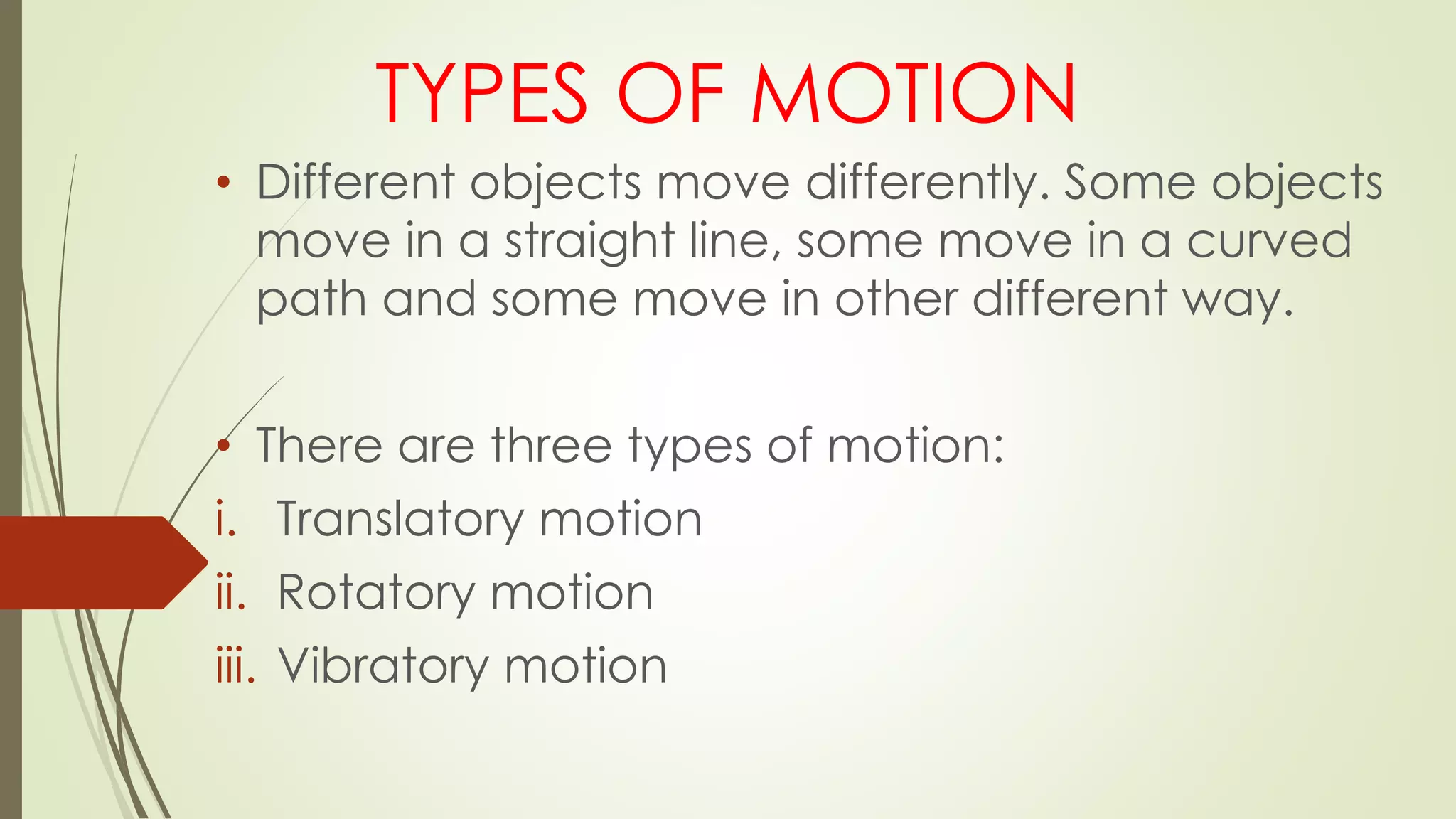
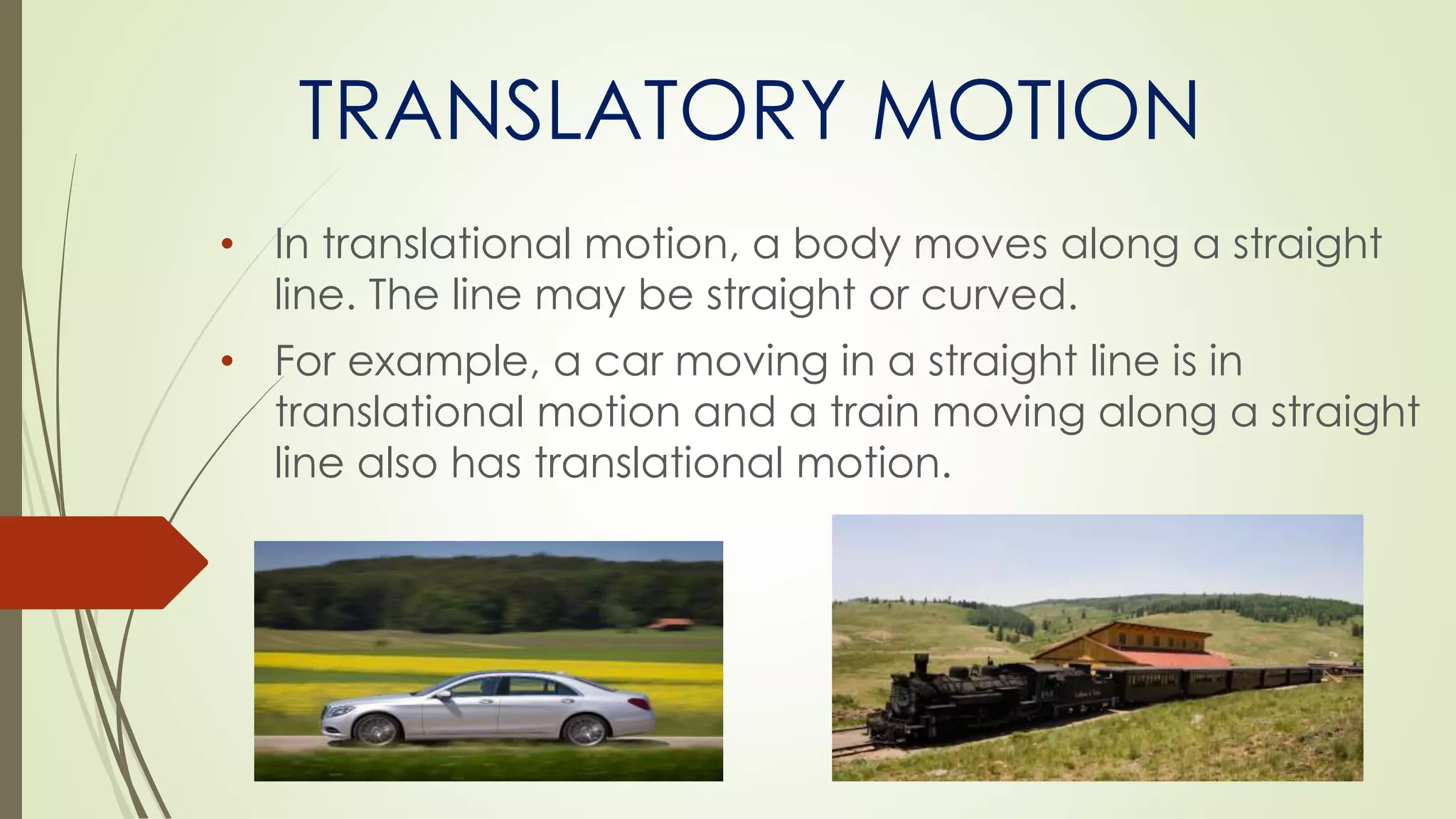
• For example, a car moving in a straight line is in
translational motion and a train moving along a straight
line also has translational motion.
TYPES OF TRANSLATORY MOTION
• There are three types of translatory motion:
i. Linear motion
ii. Circular motion
iii. Random motion
• Linear motion: (if a body moves along a straight line)
Example: aeroplane flying in a straight line.
• Circular motion: (if a body moves in a circular path)
Example: motion of earth around the sun.
• Random motion: (the disordered or irregular motion of an object)
• Example: motion of smoke or dust particles in the air.
ROTATORY MOTION
• The spinning motion of a body about its axis is
called its rotatory motion.
• An axis is a line around which a body rotates.
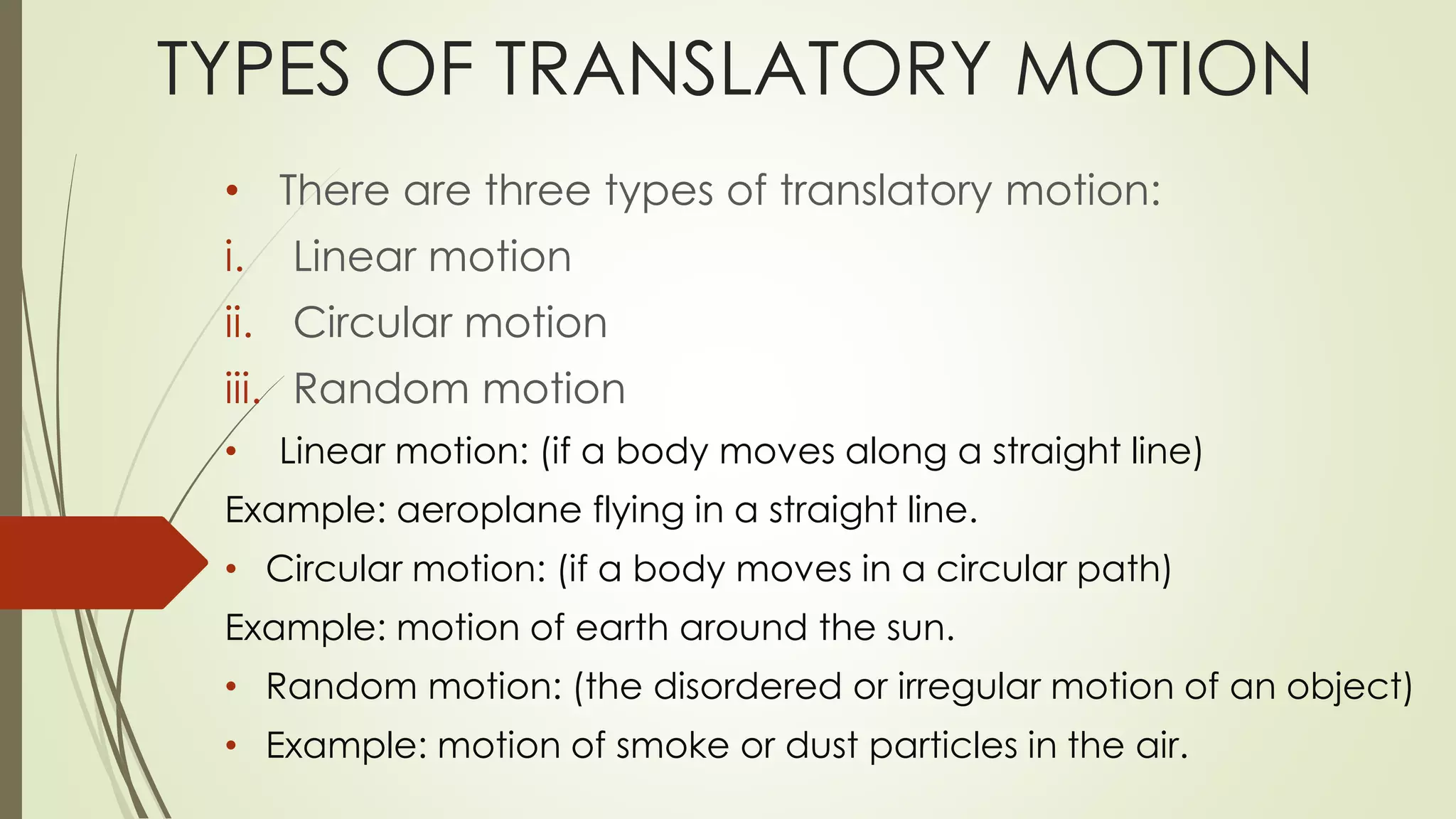
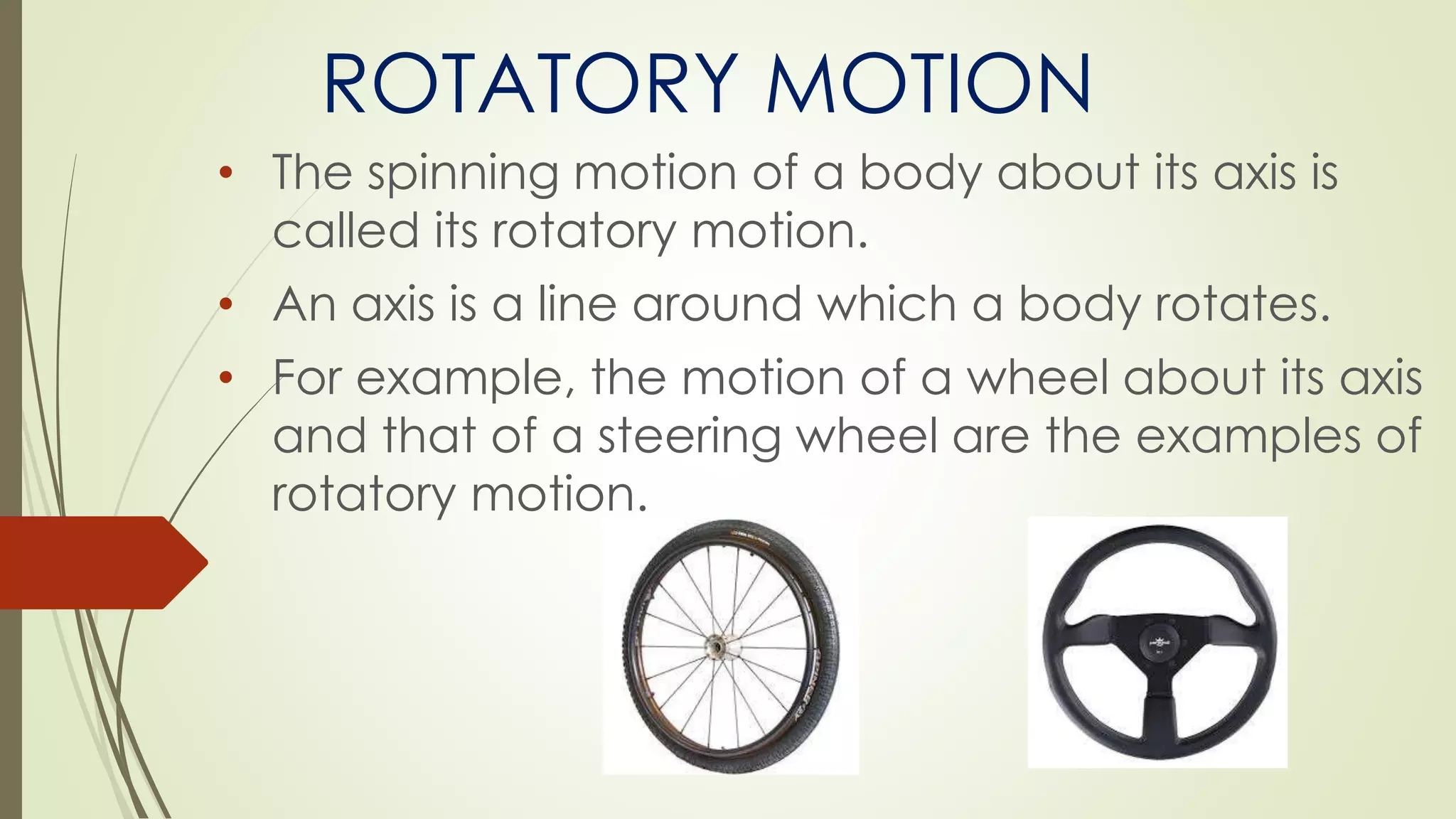
• For example, the motion of a wheel about its axis
and that of a steering wheel are the examples of
rotatory motion.
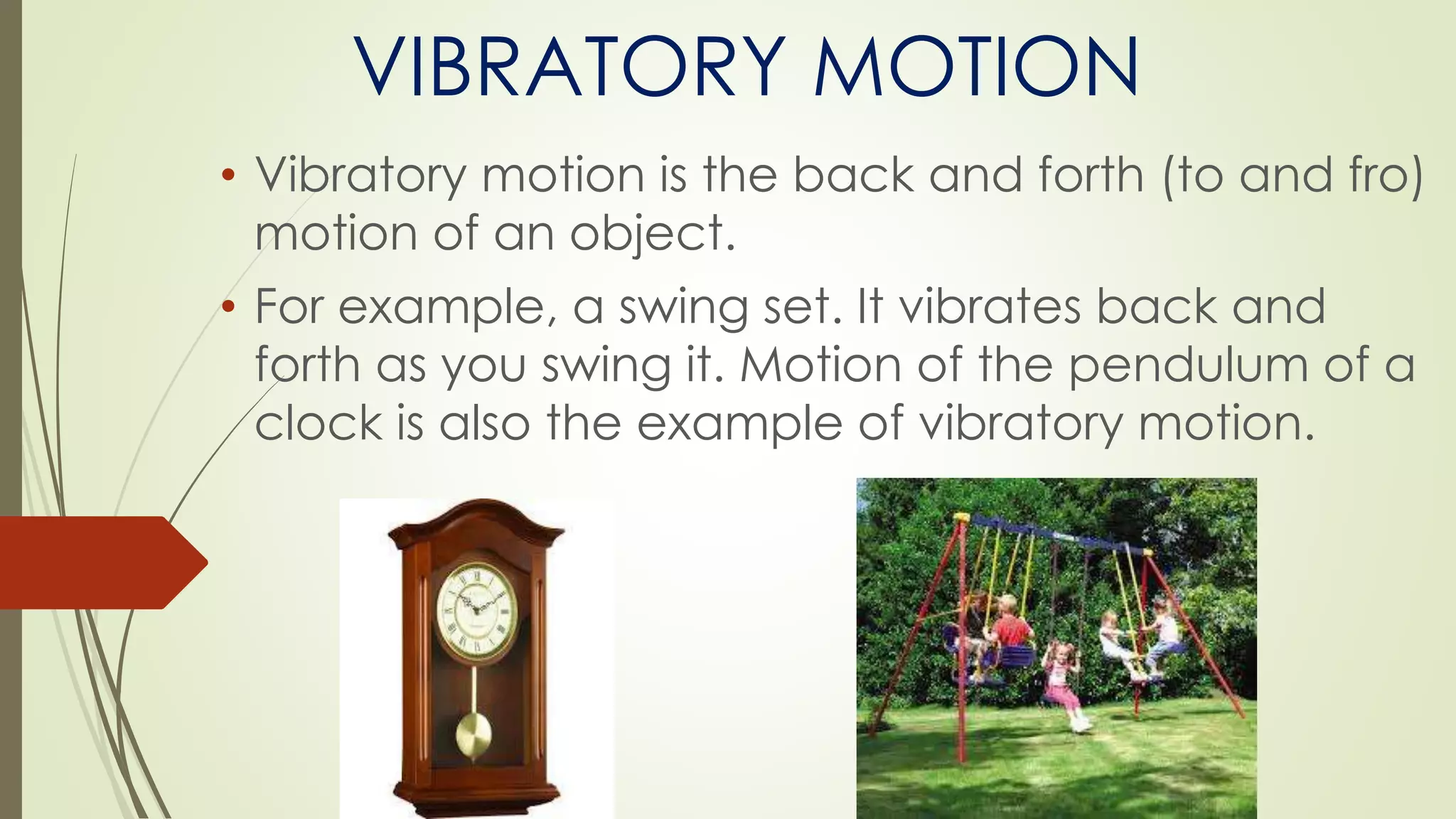
VIBRATORY MOTION
• Vibratory motion is the back and forth (to and fro)
motion of an object.
• For example, a swing set. It vibrates back and
forth as you swing it. Motion of the pendulum of a
clock is also the example of vibratory motion.
PRESENTATION BY:
HOORIA SHAHZAD

Rest and motion ppt

  • 1.
    REST AND MOTION •Motion is a combined property of an object under study and the observer. • Everything in the world is at rest or in motion. • There is no meaning of rest and motion without the viewer.
  • 2.
    WHAT IS REST? •A body is said to be at rest it if does not change its position with respect to its surroundings. • For example, The passengers sitting in a moving bus are said to be at rest with respect to the driver of the same bus, because their positions do not change with respect to the driver.
  • 3.
    WHAT IS MOTION? •A body is said to be in motion if it changes its position with respect to its surroundings. • For example, The passengers sitting in a moving bus are said to be in motion with respect to an observer standing outside the bus.
  • 4.
    RELATIVE REST ANDMOTION • Rest and motion are relative terms. • For example, a passenger sitting in a moving bus is at rest because he/she is not changing his/her position with respect to other passengers or objects in the bus. But to an observer outside the bus, the passengers and the objects inside the bus are in motion.
  • 5.
    TYPES OF MOTION •Different objects move differently. Some objects move in a straight line, some move in a curved path and some move in other different way. • There are three types of motion: i. Translatory motion ii. Rotatory motion iii. Vibratory motion
  • 6.
    TRANSLATORY MOTION • Intranslational motion, a body moves along a straight line. The line may be straight or curved. • For example, a car moving in a straight line is in translational motion and a train moving along a straight line also has translational motion.
  • 7.
    TYPES OF TRANSLATORYMOTION • There are three types of translatory motion: i. Linear motion ii. Circular motion iii. Random motion • Linear motion: (if a body moves along a straight line) Example: aeroplane flying in a straight line. • Circular motion: (if a body moves in a circular path) Example: motion of earth around the sun. • Random motion: (the disordered or irregular motion of an object) • Example: motion of smoke or dust particles in the air.
  • 8.
    ROTATORY MOTION • Thespinning motion of a body about its axis is called its rotatory motion. • An axis is a line around which a body rotates. • For example, the motion of a wheel about its axis and that of a steering wheel are the examples of rotatory motion.
  • 9.
    VIBRATORY MOTION • Vibratorymotion is the back and forth (to and fro) motion of an object. • For example, a swing set. It vibrates back and forth as you swing it. Motion of the pendulum of a clock is also the example of vibratory motion.
  • 10.