Openness and the Disaggregated  Future of Education David Wiley, PhD Department of Instructional Psychology & Technology Brigham Young University
This Is Your 11:20 Wake-up Call Your institution will be irrelevant by 2020
 
 
“ The World is Changed” Galadriel,  Lord of the Rings
It’s Actually Worse (or Better) The World is  Changing
Analog    Digital Music, Phones, TV, Newspapers, Movies, Journals, Communications, Intelligence, Defense
Tethered    Mobile Phones, Internet Access, Employment
Isolated    Connected People, Content, Systems
Generic    Personal Cars, Computers, Mobile Phones

Consuming    Creating Radio / Podcasting, Newspapers / Blogs  Movies / Vodcasting
Closed    Open Software (OSs, Applications),  Data (Weather, GIS), Content (Blogs, Wikis)
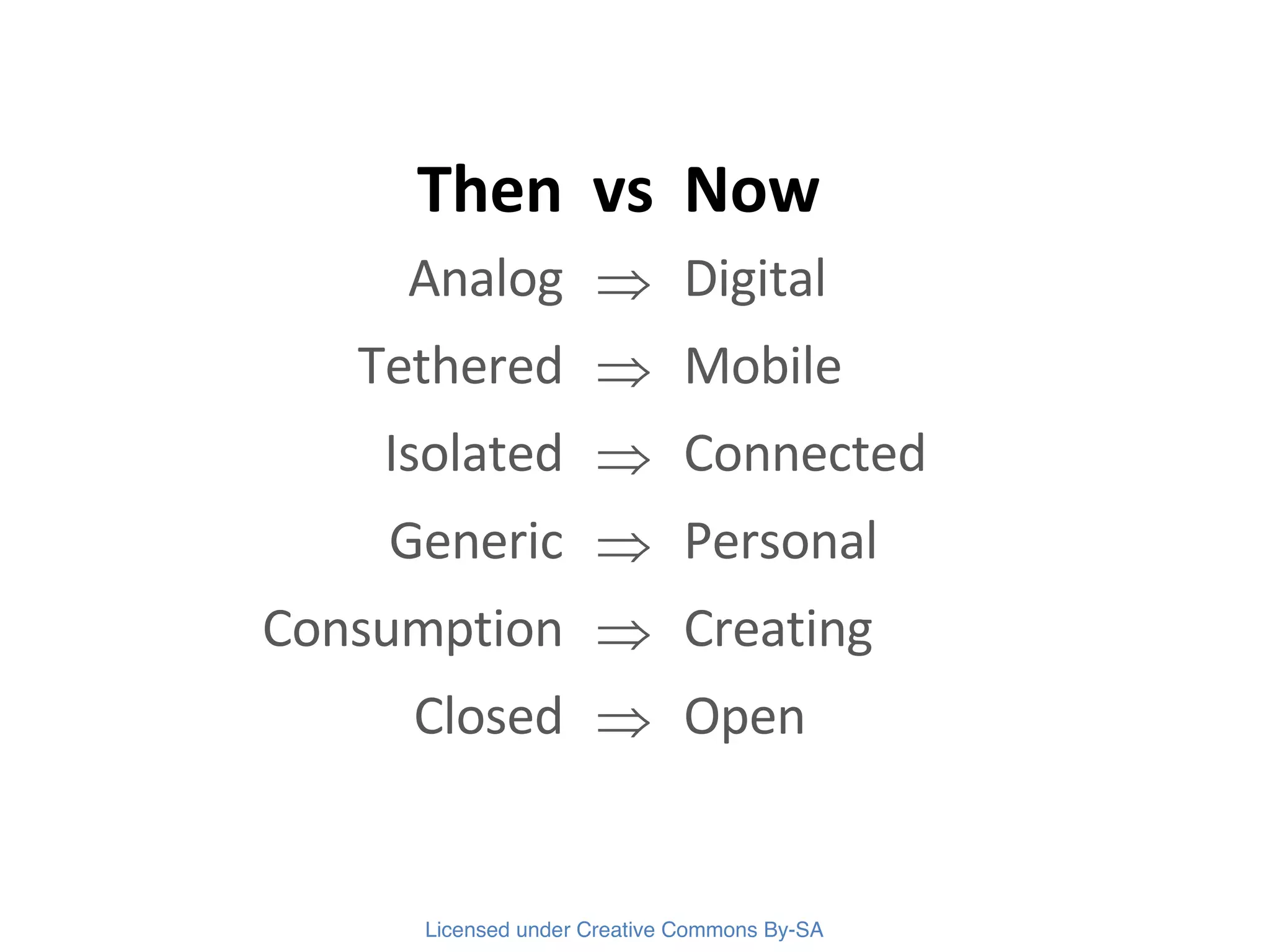
Then vs Now Analog  Digital Tethered  Mobile Isolated  Connected Generic  Personal Consumption  Creating Closed  Open
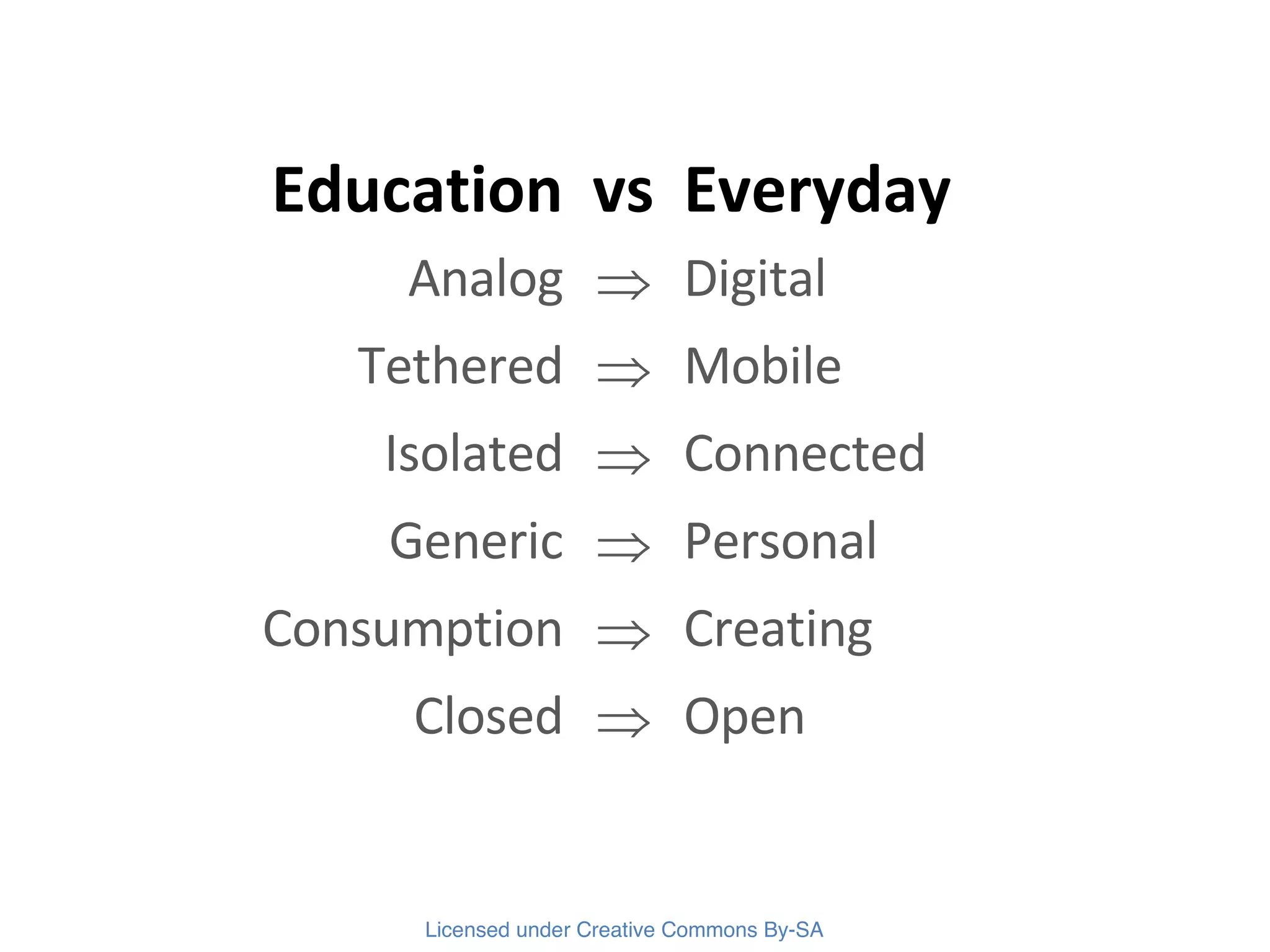
Education vs Everyday Analog  Digital Tethered  Mobile Isolated  Connected Generic  Personal Consumption  Creating Closed  Open
“ Daily Divide” Is a Huge Threat And the wider the disconnect,  the bigger the threat to higher education
But Wait!  We’re  Education! Our historic monopoly is (gratefully) being challenged on almost every front
Why Do Students Come? Content, Support Services  Social Life, Degrees
Content OpenCourseWares, Wikipedia,  Public Library of Science, Arxiv.org, Google Scholar, Flat World Knowledge, etc.
Support Services ChaCha, Yahoo! Answers, RateMyProfessor, Email, Instant Messaging, Twitter, etc.
Social Life Facebook, MySpace, MMOG, iPhone location-aware apps, etc.
Degrees MCSE, RHCE, CCNA
The Monopoly Is Being Busted Everything we provide is now offered by someone else
When Institutions Specialize They usually provide better quality  at a better price
Higher Ed, On the Other Hand 76% increase in cost over 10 years How’s our quality?
 
Industries Failing Everywhere Banks, Insurance, Automobiles Higher Education?
A Bail Out for Higher Ed? Utah 4% cut,  Pennsylvania 5 % cut,  Massachusetts 5 % cut,  Virginia 7 % cut
No Monopoly and No Bail Out How can we innovate to stay relevant?
What About E-learning?
What About E-learning? Quite innovative in 1995!
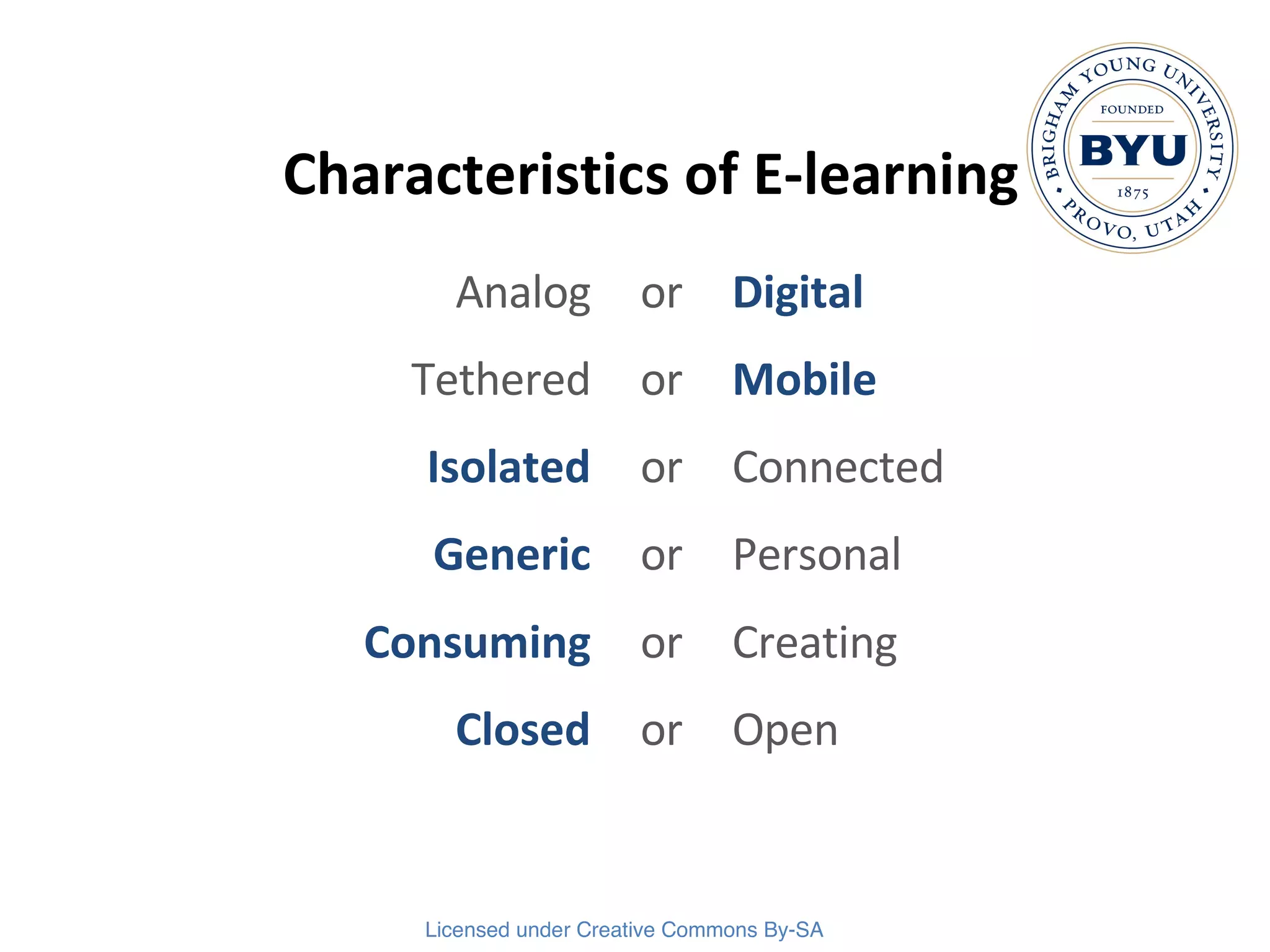
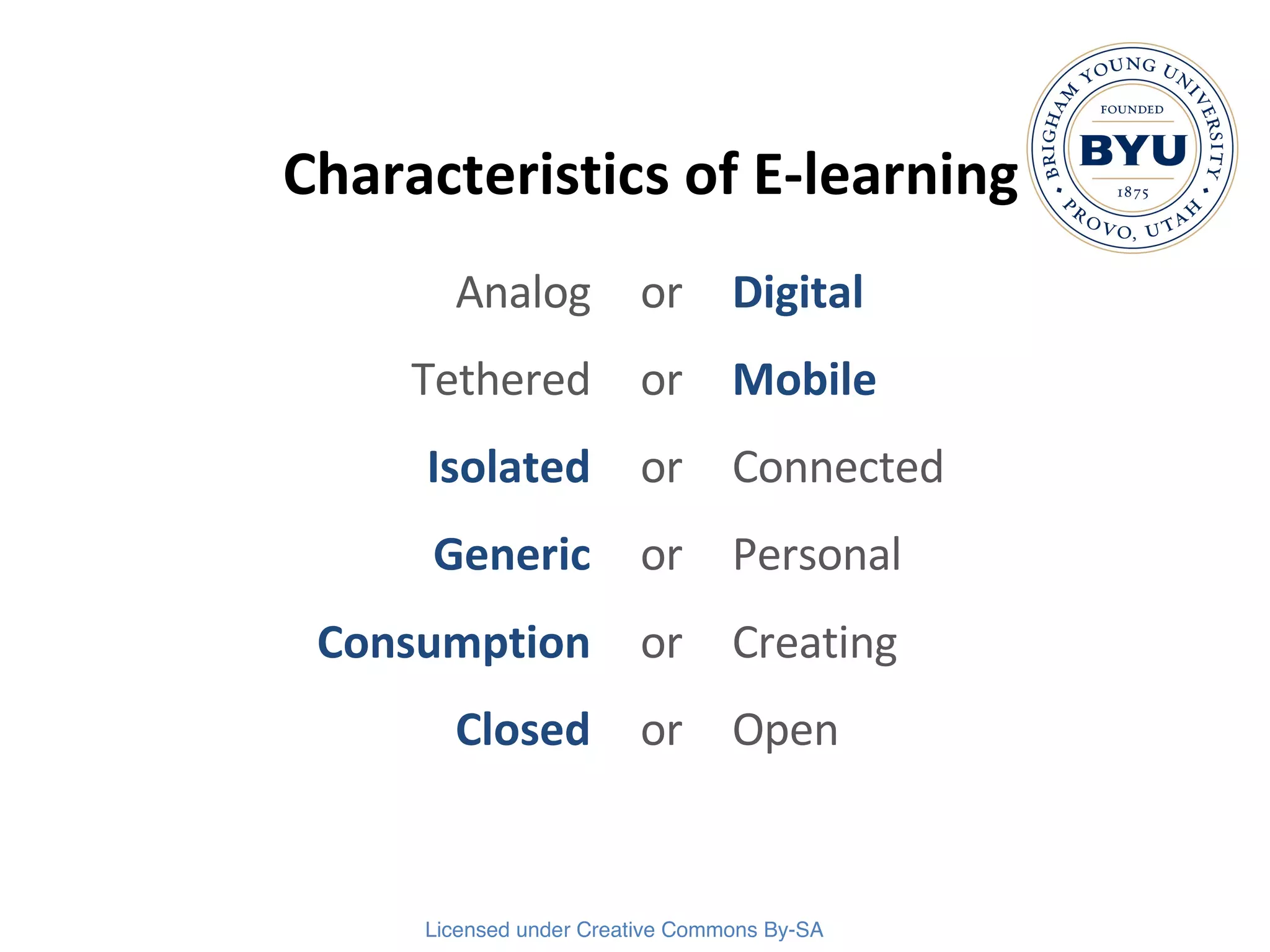
Characteristics of E-learning Analog or Digital Tethered or Mobile Isolated or Connected Generic or Personal Consuming or Creating Closed or Open
We’ve Only Changed the Channel Our pedagogy and philosophy are as just as they’ve always been
The Polo Parable A story about our move to online teaching and learning
Photo by e.dward
Photo by Christopher Henning
We’re Swimming on Horseback And rather proud of ourselves, I must say
Online  is a Different Place The goals of teaching are the same, but the culture and rules in that space  are only  sort of   the same
 
We’re Celebrating the Mass in Latin And our students are expecting charismatic worship with guitars, drums, and “Amen!”s
It’s About Respect Its about valuing culture and designing for it just as we would if teaching in Bangalore, Beijing, or Barcelona
Some Say Learning Has Changed Digital natives or millennials  have brains that function differently
It’s About ATIs In the “aptitude by treatment interaction” literature, the only individual difference that matters is prior knowledge
Openness is the Cornerstone Openness underpins everything interesting happening online and is “what they know”
Why Make Such a Claim? Let’s ask Alexa what the 50 most popular sites on the web are…
Sites Where Anyone Can: Share a video, share a photo, share a blog post, share their personal info, share their ratings, share their files, share their expertise
Characteristics of E-learning Analog or Digital Tethered or Mobile Isolated or Connected Generic or Personal Consumption or Creating Closed or Open
Connecting You can’t connect to something if you don’t have access to it
Personalizing You can’t adapt or localize something if you don’t have the rights to modify it
Creating You won’t be creative if there’s no outlet for your work
How Might We Open Things? Higher Ed needs to figure this out
 
 
Materials Intended for Teachers Teachers only account for 15% of users
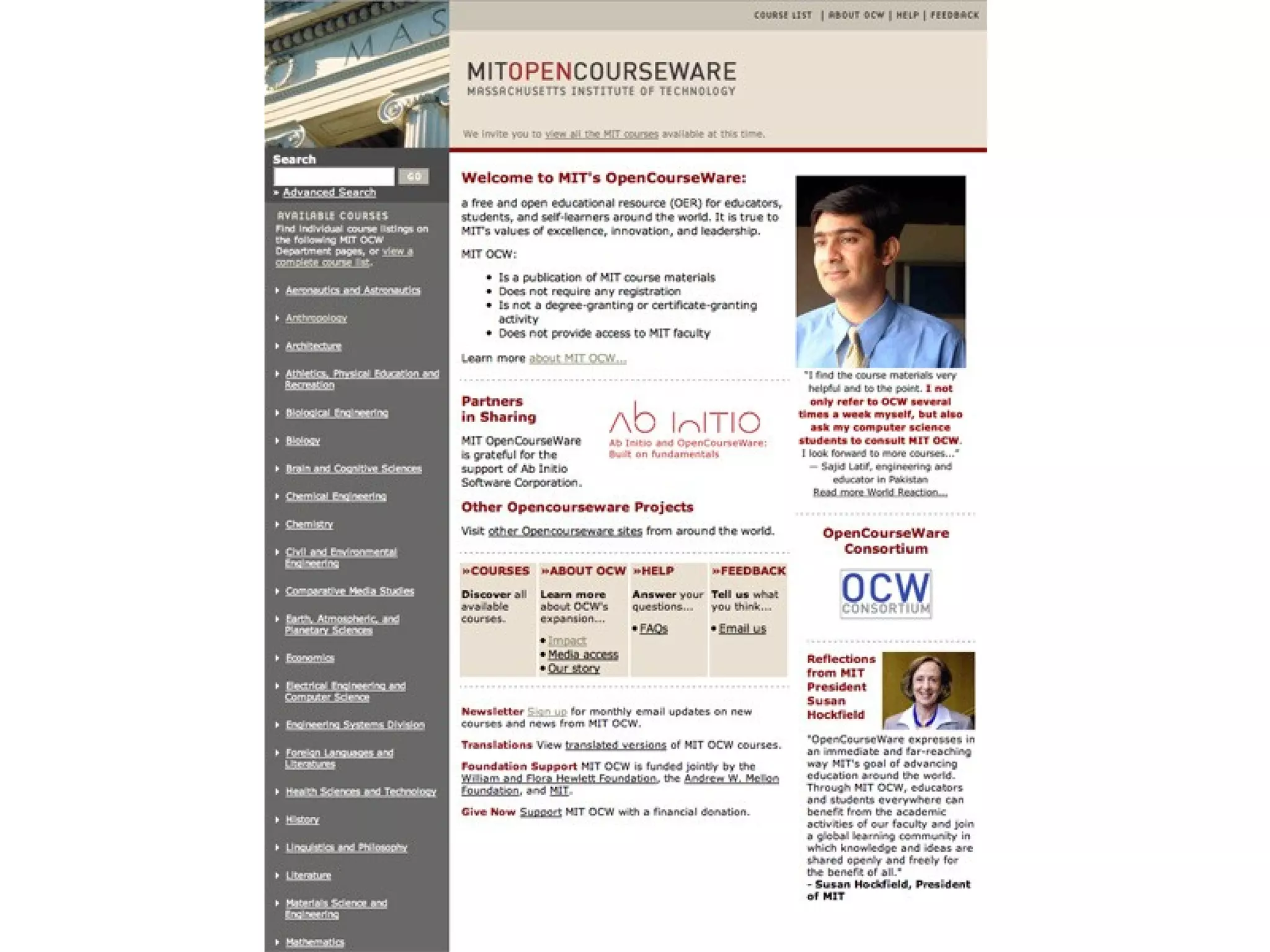
Lecture Notes Courses Around $15k per course
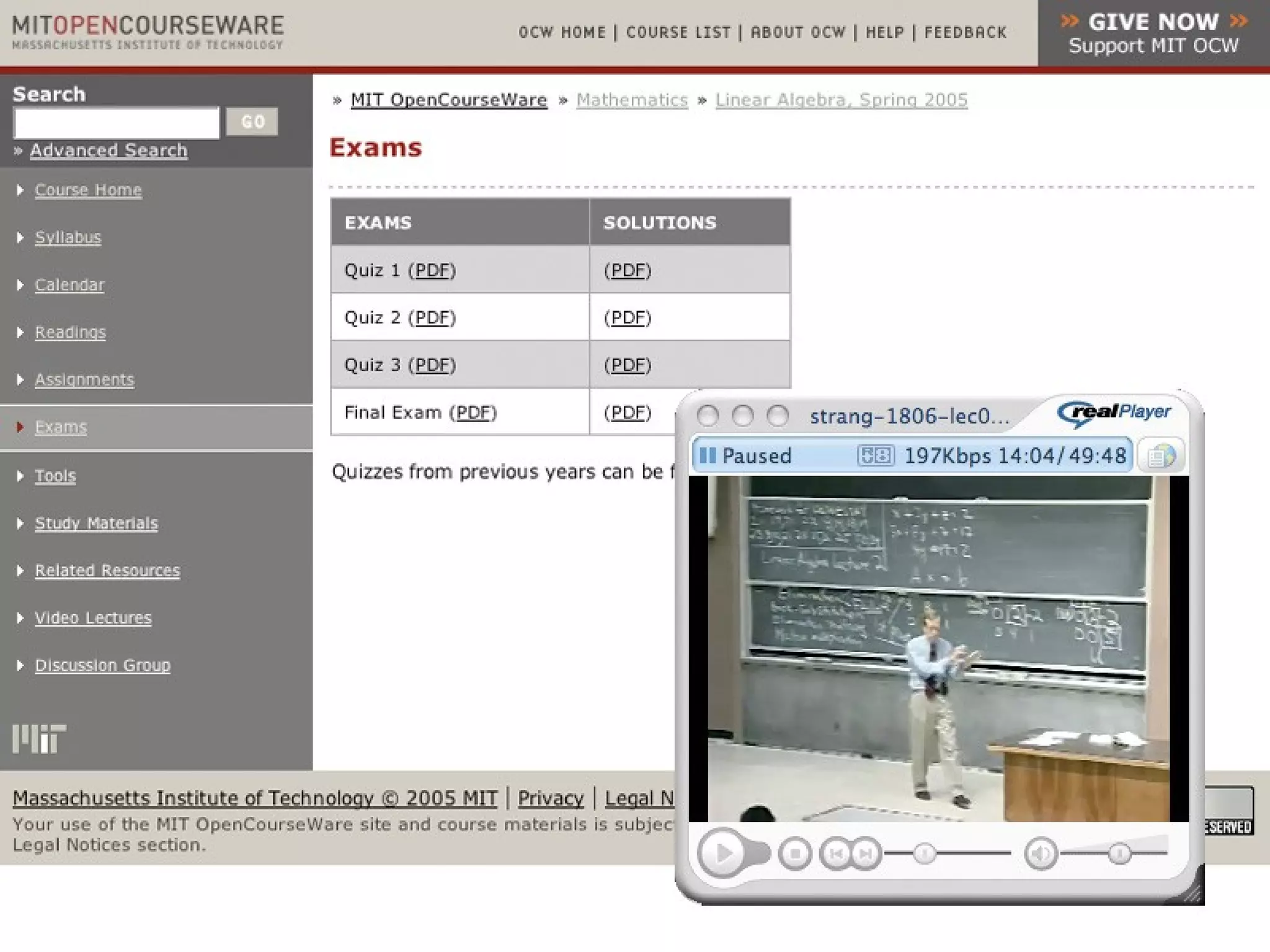
Video-based Courses Around $30k per course
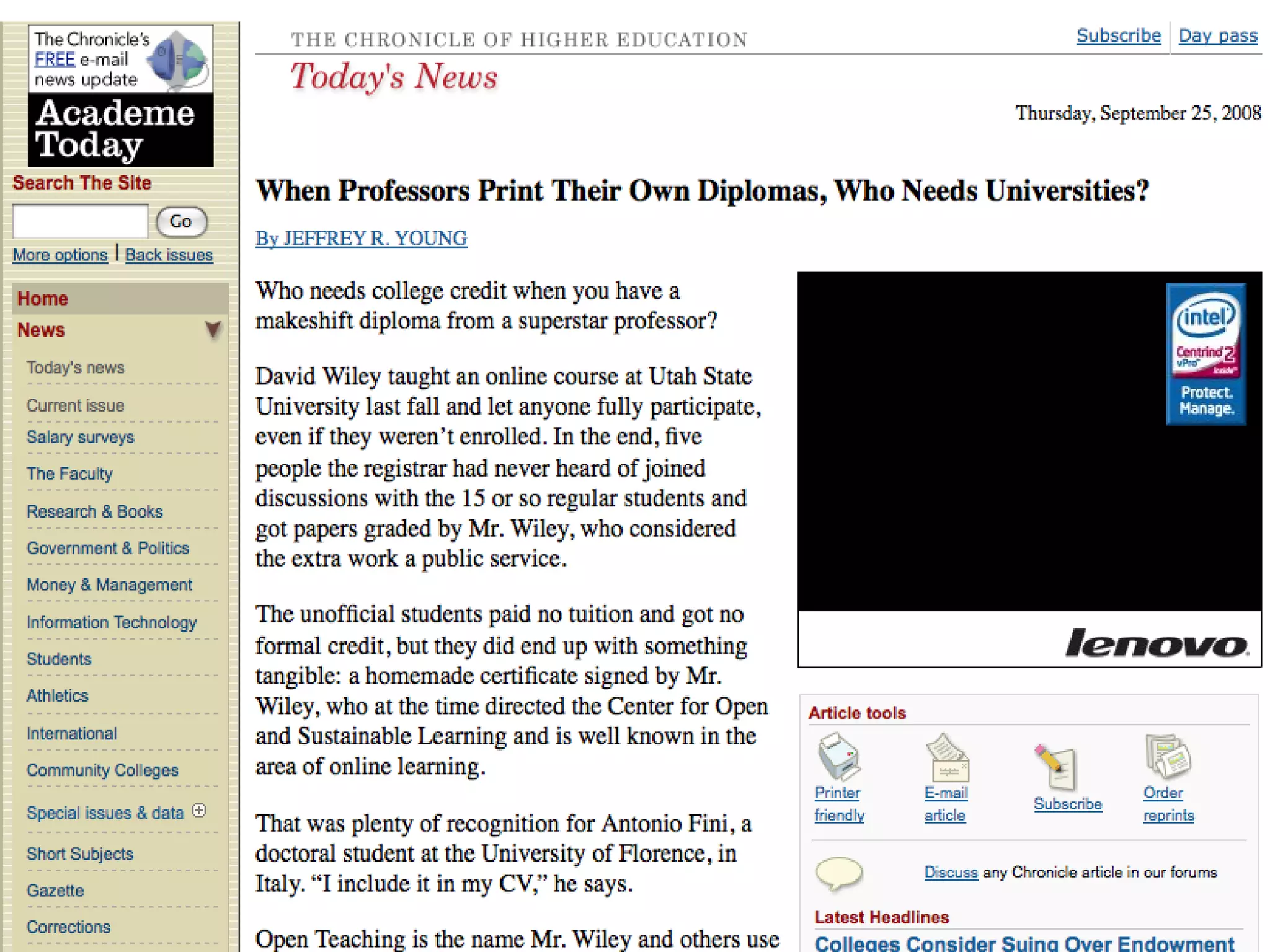
“ Open 1.0” Hundreds of universities around the globe sharing over 6,000 courses (Will you show up on Google?)
Surely There Are Other Ways? Sharing some experiments
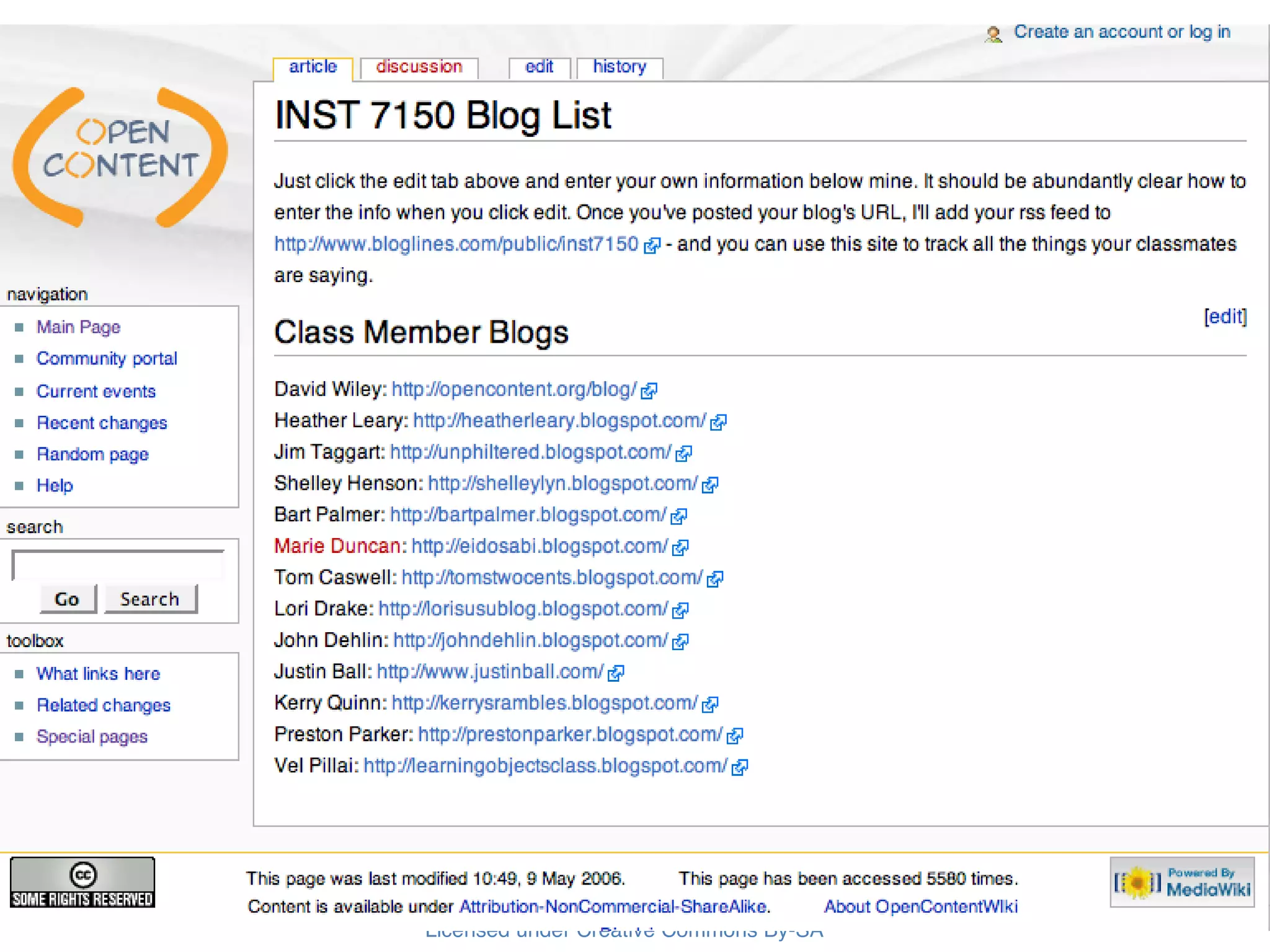
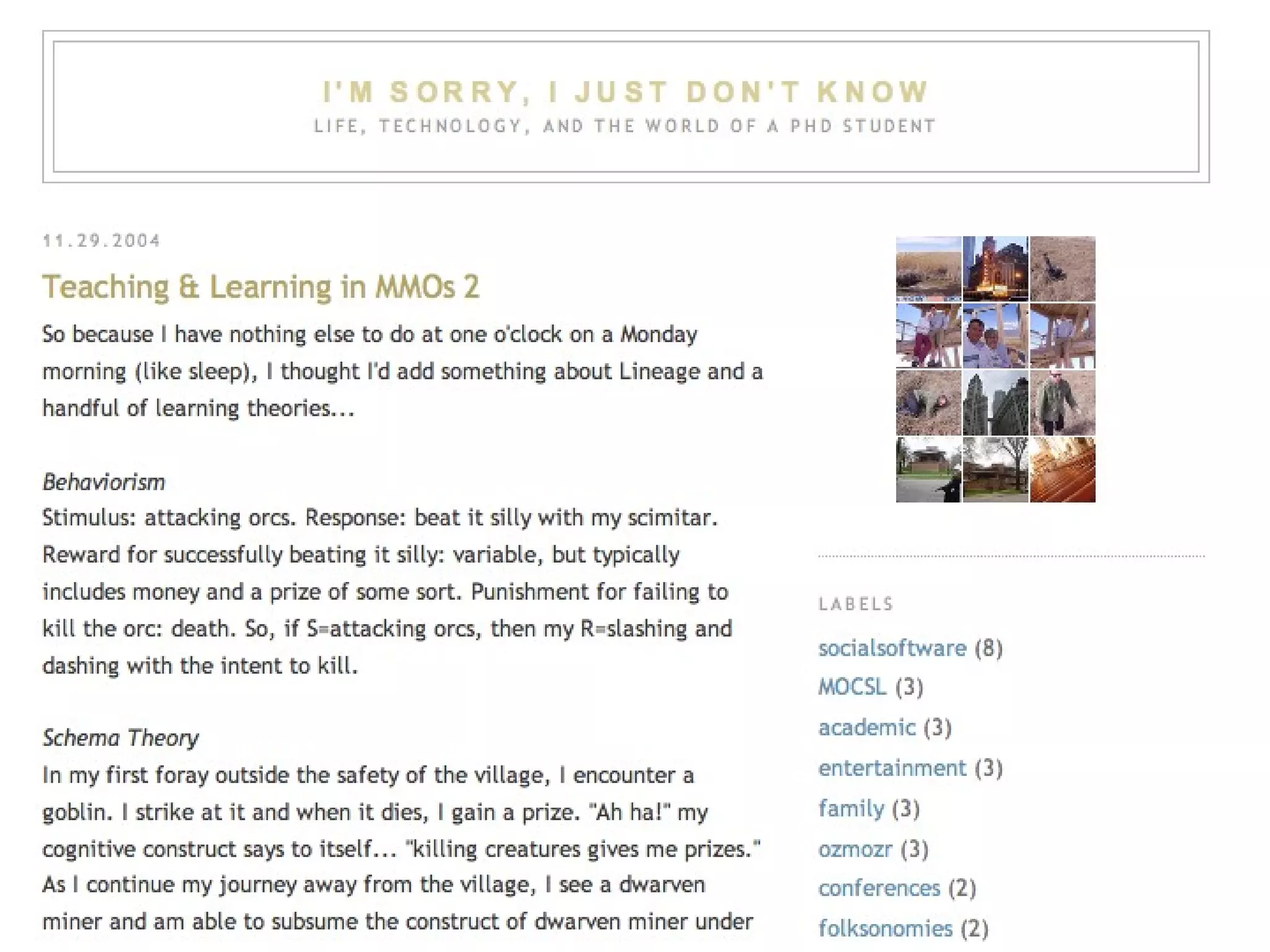
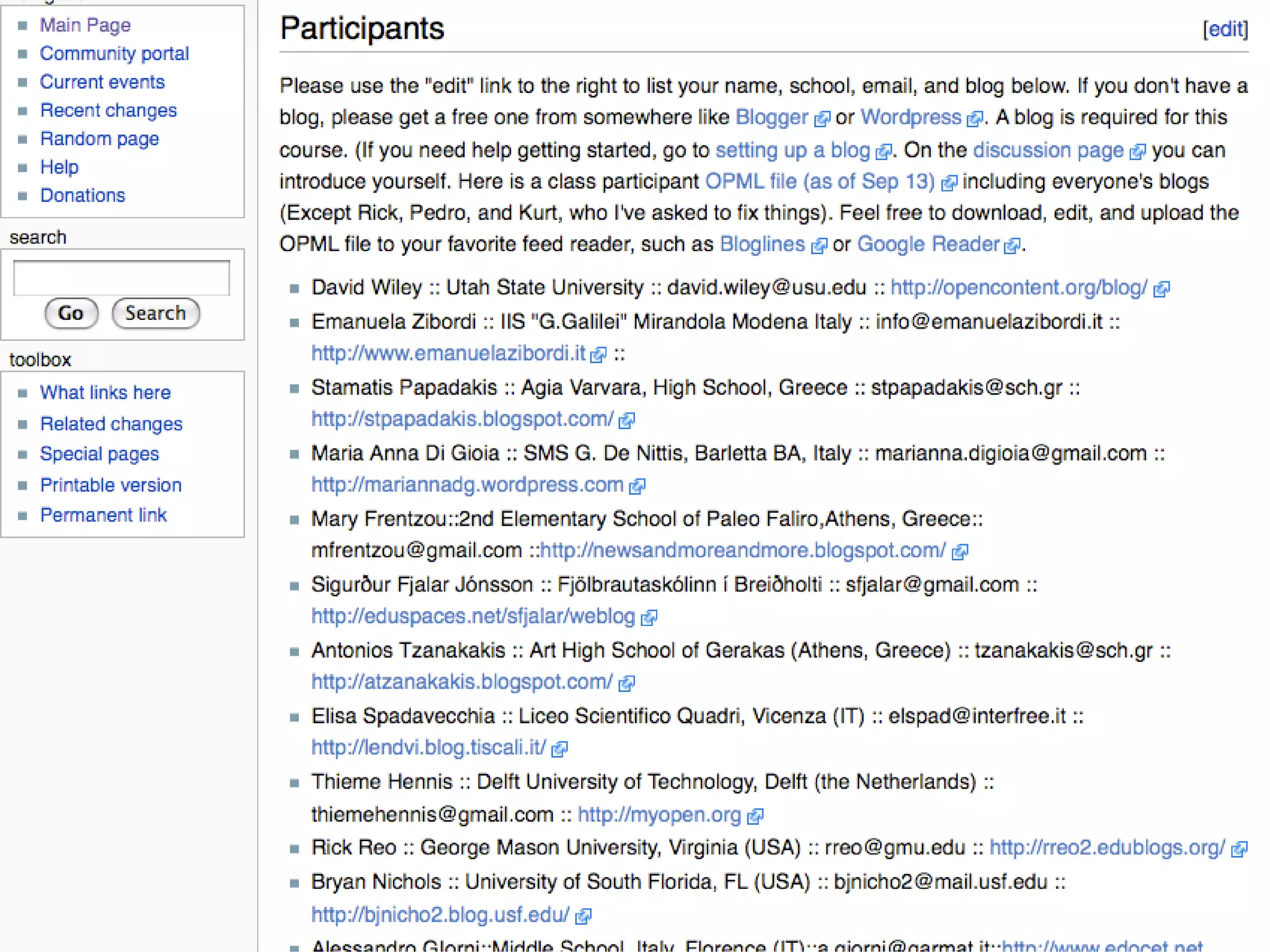
Connecting and Openness Sharing some experiments
 
 
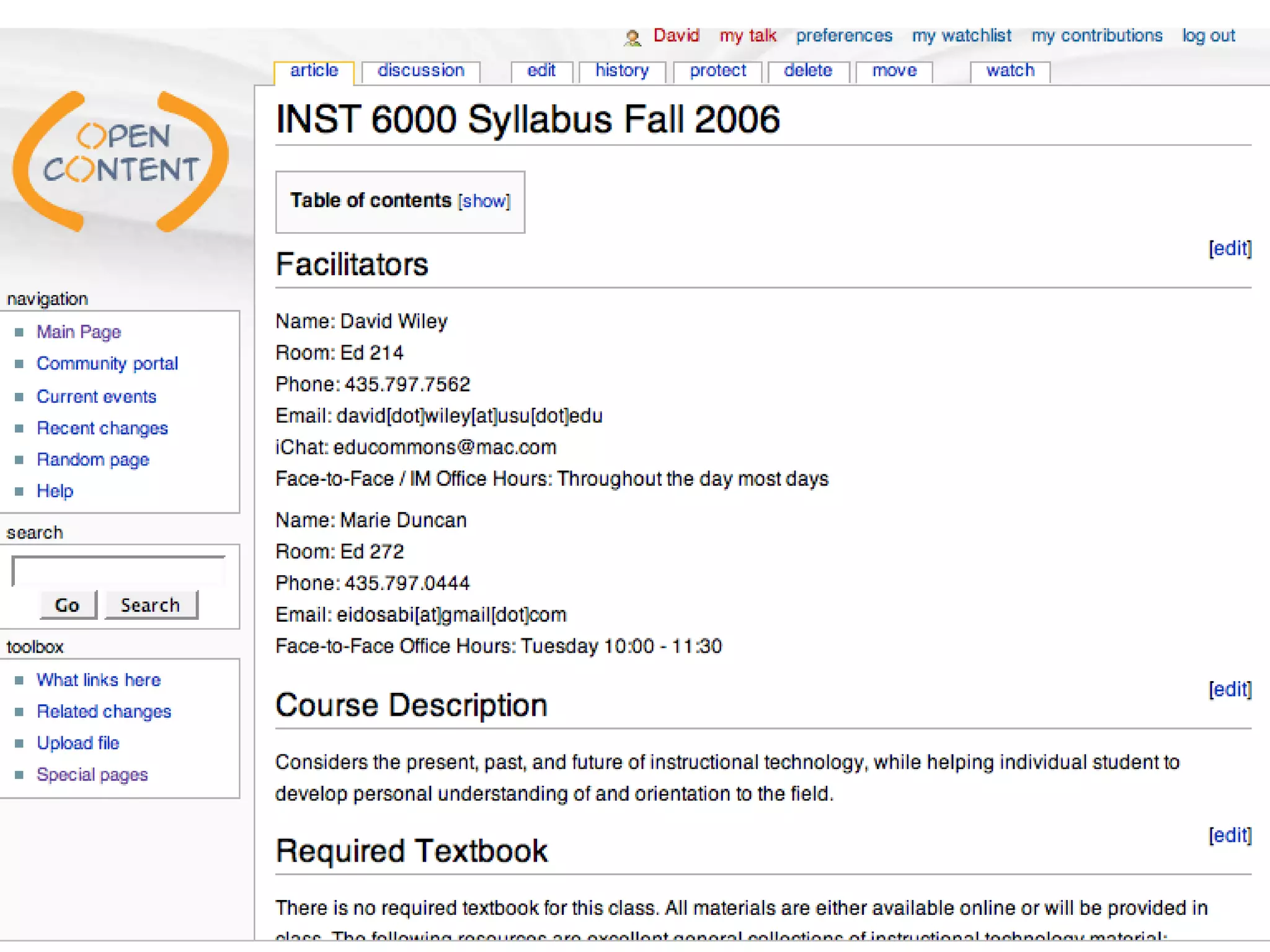
Personalizing and Openness Sharing some experiments
 
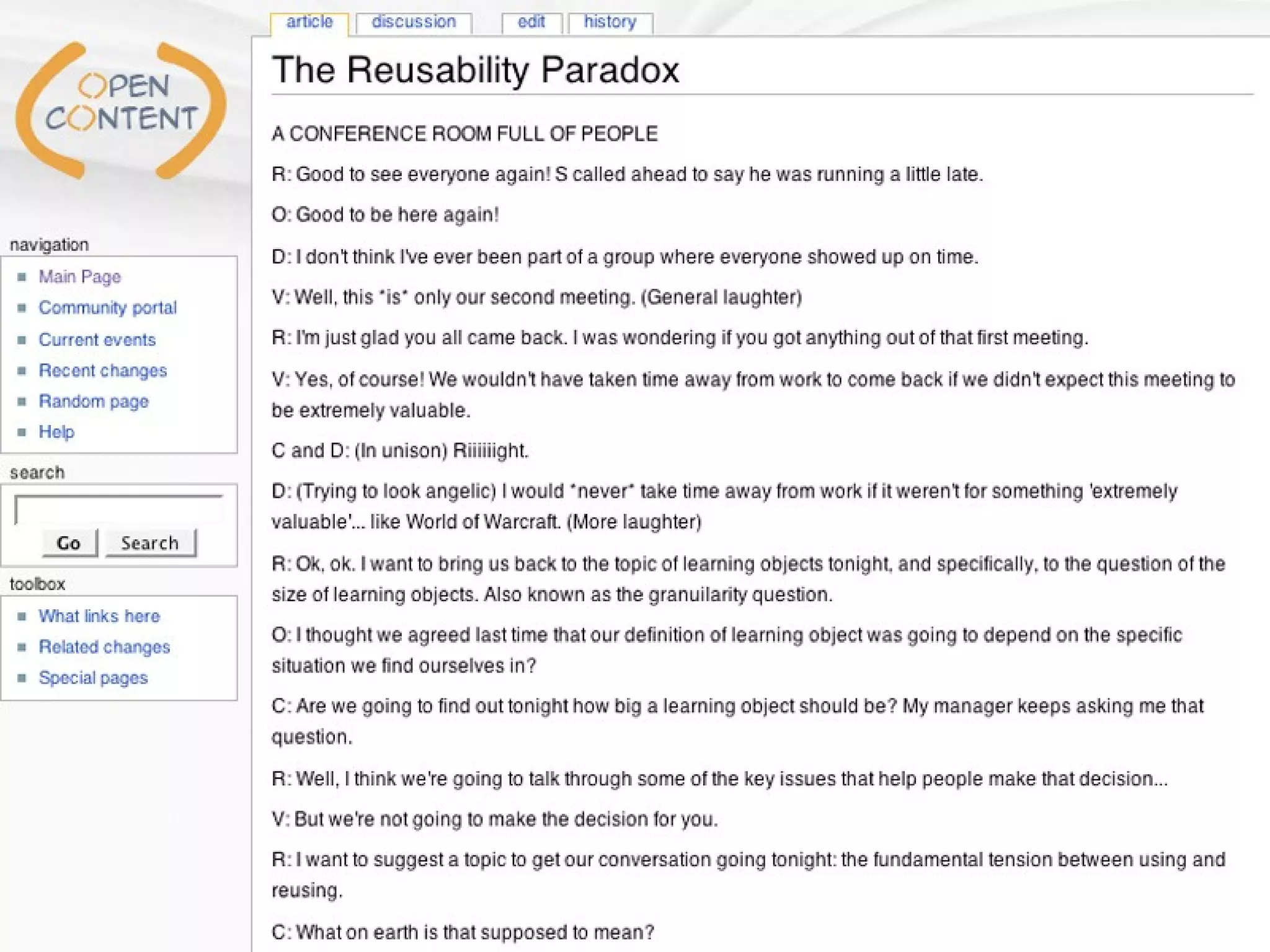
Creating and Openness Sharing some experiments
 
 
Being Even  More  Open Sharing some experiments
 
 
Character Classes Bard  (Master of the lore, history, and politics of the field, know what's “out there”) Artisan  (Has materials production skills in all the necessary Web 1.0 and 2.0 tools like HTML, video sharing, podcasting) Monk  (Master of copyright and licensing arcana and defender of the university brand) Merchant  (Deals with short- and long-term sustainability issues)
Education Will Eventually Be Open And involve connecting, personalizing, and creating - just like everything else does
Will Higher Education Be Open? Can your school find the  institutional will to change?
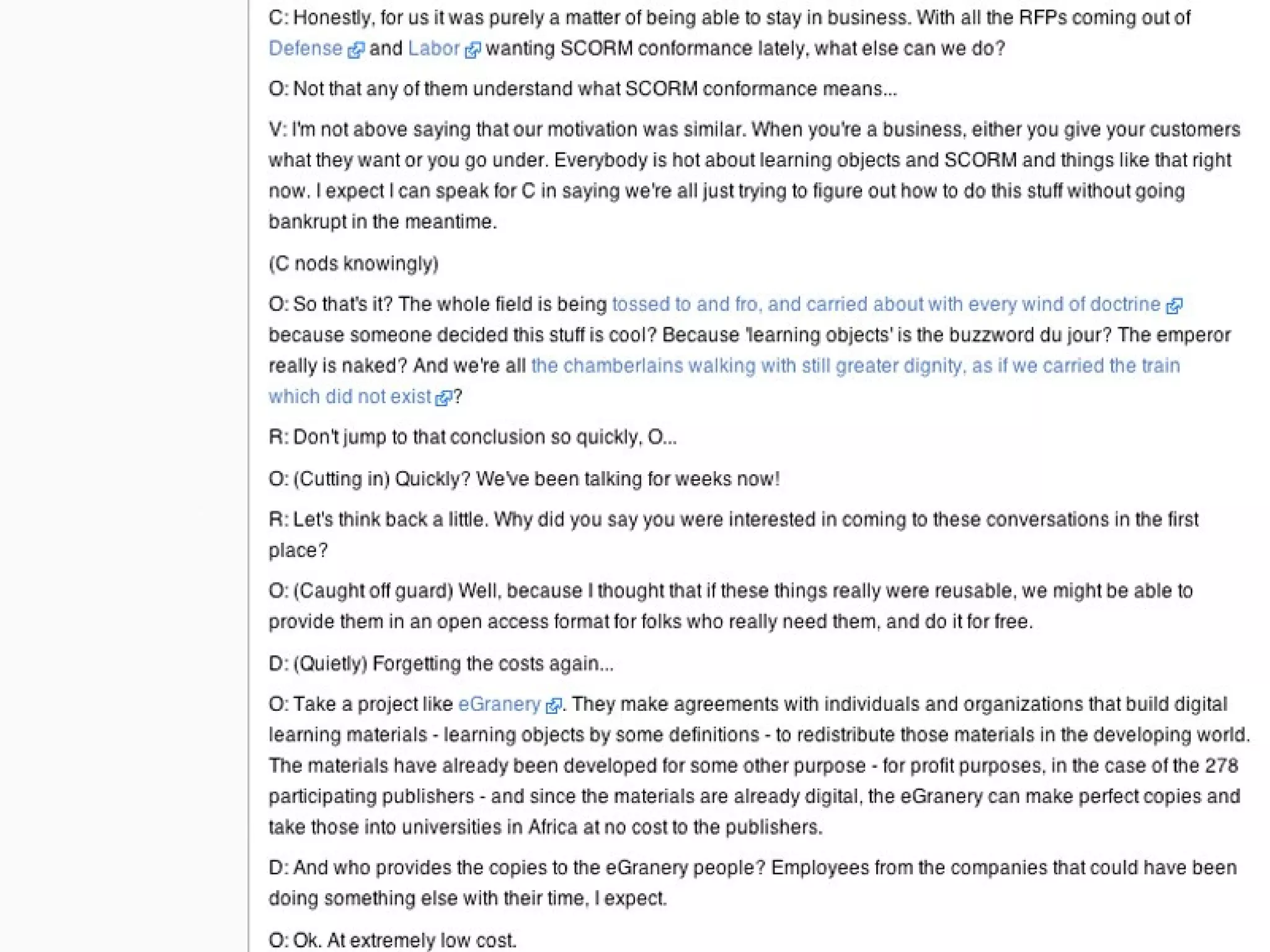
Institutional Disaggregation MIT OpenCourseWare,  Western Governors University
Value of Integration? As compared to “specialized pieces loosely joined”
Not a Technology Problem Look around the Internet – not only do the technologies we need exist, they’re open source
This Is a Policy Problem Higher education is behaving like  the recording and movie industries
Policy To Defend Tradition Rather than innovating
You  Must Engage in Policy Reform Ignoring the growing problem is not a strategy
“ It is not necessary to change. Survival is not mandatory.” W. E. Deming
 
“ You never change things by fighting the existing reality. To change something, build a new model that makes the existing model obsolete.” Buckminster Fuller
Student Learning May Suffer The market will likely meet  students’ increasingly unmet needs
Your Employment Will Suffer When your institution collapses as Googlers find better alternatives
“ The last temptation  is the greatest treason,  To do the right deed  for the wrong reason.” Archbishop Thomas Beckett (T. S. Eliot)
Innovate for the Students To fulfill your sacred trust as a teacher
Thank You! [email_address] http://davidwiley.org/

Openness and the Disaggregated Future of Higher Education

  • 1.
    Openness and theDisaggregated Future of Education David Wiley, PhD Department of Instructional Psychology & Technology Brigham Young University
  • 2.
    This Is Your11:20 Wake-up Call Your institution will be irrelevant by 2020
  • 3.
  • 4.
  • 5.
    “ The Worldis Changed” Galadriel, Lord of the Rings
  • 6.
    It’s Actually Worse(or Better) The World is Changing
  • 7.
    Analog  Digital Music, Phones, TV, Newspapers, Movies, Journals, Communications, Intelligence, Defense
  • 8.
    Tethered  Mobile Phones, Internet Access, Employment
  • 9.
    Isolated  Connected People, Content, Systems
  • 10.
    Generic  Personal Cars, Computers, Mobile Phones
  • 11.
    Consuming  Creating Radio / Podcasting, Newspapers / Blogs Movies / Vodcasting
  • 12.
    Closed  Open Software (OSs, Applications), Data (Weather, GIS), Content (Blogs, Wikis)
  • 13.
    Then vs NowAnalog  Digital Tethered  Mobile Isolated  Connected Generic  Personal Consumption  Creating Closed  Open
  • 14.
    Education vs EverydayAnalog  Digital Tethered  Mobile Isolated  Connected Generic  Personal Consumption  Creating Closed  Open
  • 15.
    “ Daily Divide”Is a Huge Threat And the wider the disconnect, the bigger the threat to higher education
  • 16.
    But Wait! We’re Education! Our historic monopoly is (gratefully) being challenged on almost every front
  • 17.
    Why Do StudentsCome? Content, Support Services Social Life, Degrees
  • 18.
    Content OpenCourseWares, Wikipedia, Public Library of Science, Arxiv.org, Google Scholar, Flat World Knowledge, etc.
  • 19.
    Support Services ChaCha,Yahoo! Answers, RateMyProfessor, Email, Instant Messaging, Twitter, etc.
  • 20.
    Social Life Facebook,MySpace, MMOG, iPhone location-aware apps, etc.
  • 21.
  • 22.
    The Monopoly IsBeing Busted Everything we provide is now offered by someone else
  • 23.
    When Institutions SpecializeThey usually provide better quality at a better price
  • 24.
    Higher Ed, Onthe Other Hand 76% increase in cost over 10 years How’s our quality?
  • 25.
  • 26.
    Industries Failing EverywhereBanks, Insurance, Automobiles Higher Education?
  • 27.
    A Bail Outfor Higher Ed? Utah 4% cut, Pennsylvania 5 % cut, Massachusetts 5 % cut, Virginia 7 % cut
  • 28.
    No Monopoly andNo Bail Out How can we innovate to stay relevant?
  • 29.
  • 30.
    What About E-learning?Quite innovative in 1995!
  • 31.
    Characteristics of E-learningAnalog or Digital Tethered or Mobile Isolated or Connected Generic or Personal Consuming or Creating Closed or Open
  • 32.
    We’ve Only Changedthe Channel Our pedagogy and philosophy are as just as they’ve always been
  • 33.
    The Polo ParableA story about our move to online teaching and learning
  • 34.
  • 35.
  • 36.
    We’re Swimming onHorseback And rather proud of ourselves, I must say
  • 37.
    Online isa Different Place The goals of teaching are the same, but the culture and rules in that space are only sort of the same
  • 38.
  • 39.
    We’re Celebrating theMass in Latin And our students are expecting charismatic worship with guitars, drums, and “Amen!”s
  • 40.
    It’s About RespectIts about valuing culture and designing for it just as we would if teaching in Bangalore, Beijing, or Barcelona
  • 41.
    Some Say LearningHas Changed Digital natives or millennials have brains that function differently
  • 42.
    It’s About ATIsIn the “aptitude by treatment interaction” literature, the only individual difference that matters is prior knowledge
  • 43.
    Openness is theCornerstone Openness underpins everything interesting happening online and is “what they know”
  • 44.
    Why Make Sucha Claim? Let’s ask Alexa what the 50 most popular sites on the web are…
  • 45.
    Sites Where AnyoneCan: Share a video, share a photo, share a blog post, share their personal info, share their ratings, share their files, share their expertise
  • 46.
    Characteristics of E-learningAnalog or Digital Tethered or Mobile Isolated or Connected Generic or Personal Consumption or Creating Closed or Open
  • 47.
    Connecting You can’tconnect to something if you don’t have access to it
  • 48.
    Personalizing You can’tadapt or localize something if you don’t have the rights to modify it
  • 49.
    Creating You won’tbe creative if there’s no outlet for your work
  • 50.
    How Might WeOpen Things? Higher Ed needs to figure this out
  • 51.
  • 52.
  • 53.
    Materials Intended forTeachers Teachers only account for 15% of users
  • 54.
    Lecture Notes CoursesAround $15k per course
  • 55.
  • 56.
    “ Open 1.0”Hundreds of universities around the globe sharing over 6,000 courses (Will you show up on Google?)
  • 57.
    Surely There AreOther Ways? Sharing some experiments
  • 58.
    Connecting and OpennessSharing some experiments
  • 59.
  • 60.
  • 61.
    Personalizing and OpennessSharing some experiments
  • 62.
  • 63.
    Creating and OpennessSharing some experiments
  • 64.
  • 65.
  • 66.
    Being Even More Open Sharing some experiments
  • 67.
  • 68.
  • 69.
    Character Classes Bard (Master of the lore, history, and politics of the field, know what's “out there”) Artisan (Has materials production skills in all the necessary Web 1.0 and 2.0 tools like HTML, video sharing, podcasting) Monk (Master of copyright and licensing arcana and defender of the university brand) Merchant (Deals with short- and long-term sustainability issues)
  • 70.
    Education Will EventuallyBe Open And involve connecting, personalizing, and creating - just like everything else does
  • 71.
    Will Higher EducationBe Open? Can your school find the institutional will to change?
  • 72.
    Institutional Disaggregation MITOpenCourseWare, Western Governors University
  • 73.
    Value of Integration?As compared to “specialized pieces loosely joined”
  • 74.
    Not a TechnologyProblem Look around the Internet – not only do the technologies we need exist, they’re open source
  • 75.
    This Is aPolicy Problem Higher education is behaving like the recording and movie industries
  • 76.
    Policy To DefendTradition Rather than innovating
  • 77.
    You MustEngage in Policy Reform Ignoring the growing problem is not a strategy
  • 78.
    “ It isnot necessary to change. Survival is not mandatory.” W. E. Deming
  • 79.
  • 80.
    “ You neverchange things by fighting the existing reality. To change something, build a new model that makes the existing model obsolete.” Buckminster Fuller
  • 81.
    Student Learning MaySuffer The market will likely meet students’ increasingly unmet needs
  • 82.
    Your Employment WillSuffer When your institution collapses as Googlers find better alternatives
  • 83.
    “ The lasttemptation is the greatest treason, To do the right deed for the wrong reason.” Archbishop Thomas Beckett (T. S. Eliot)
  • 84.
    Innovate for theStudents To fulfill your sacred trust as a teacher
  • 85.
    Thank You! [email_address]http://davidwiley.org/