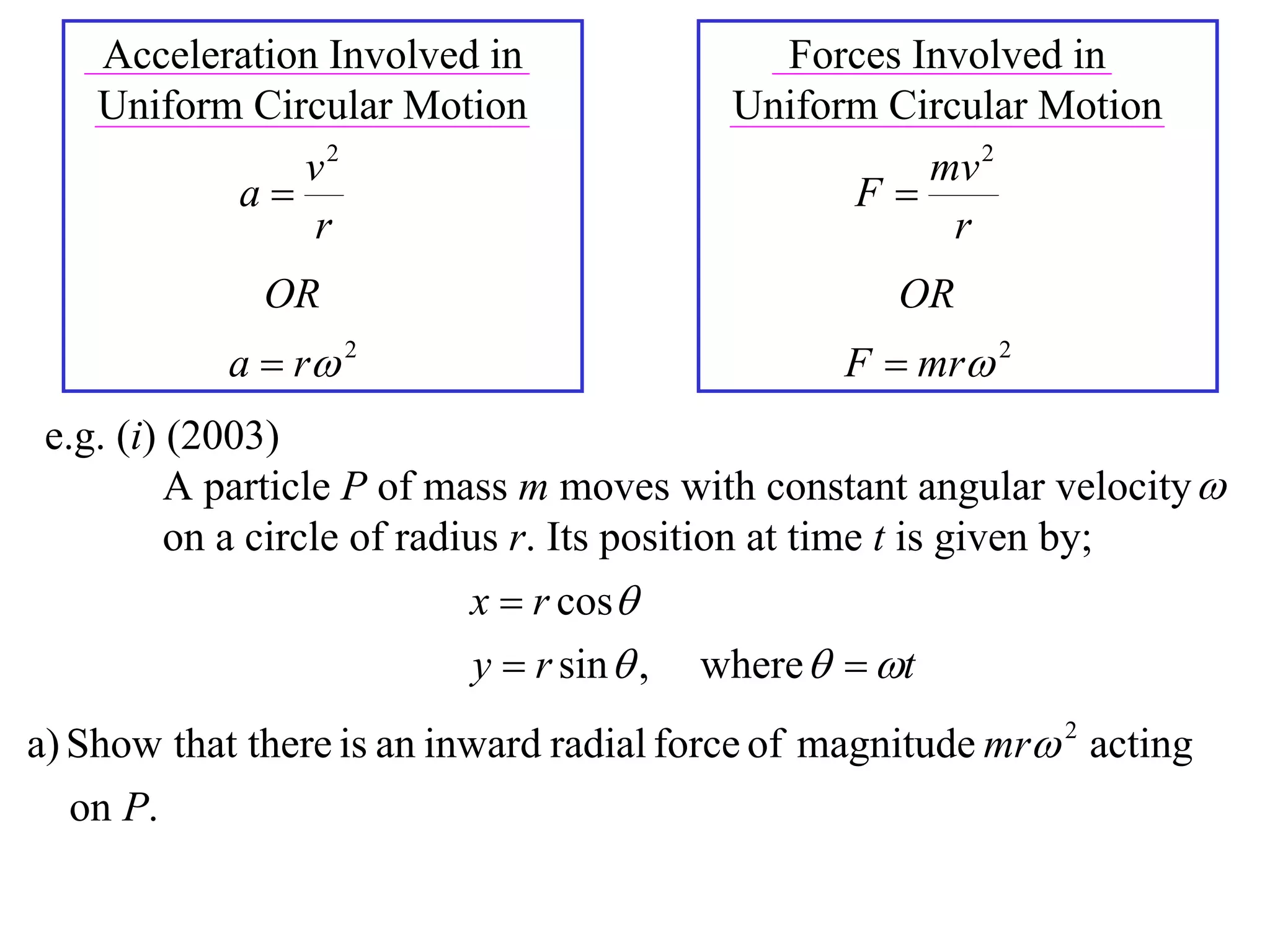
Acceleration with Uniform
     Circular Motion
Acceleration with Uniform
       Circular Motion
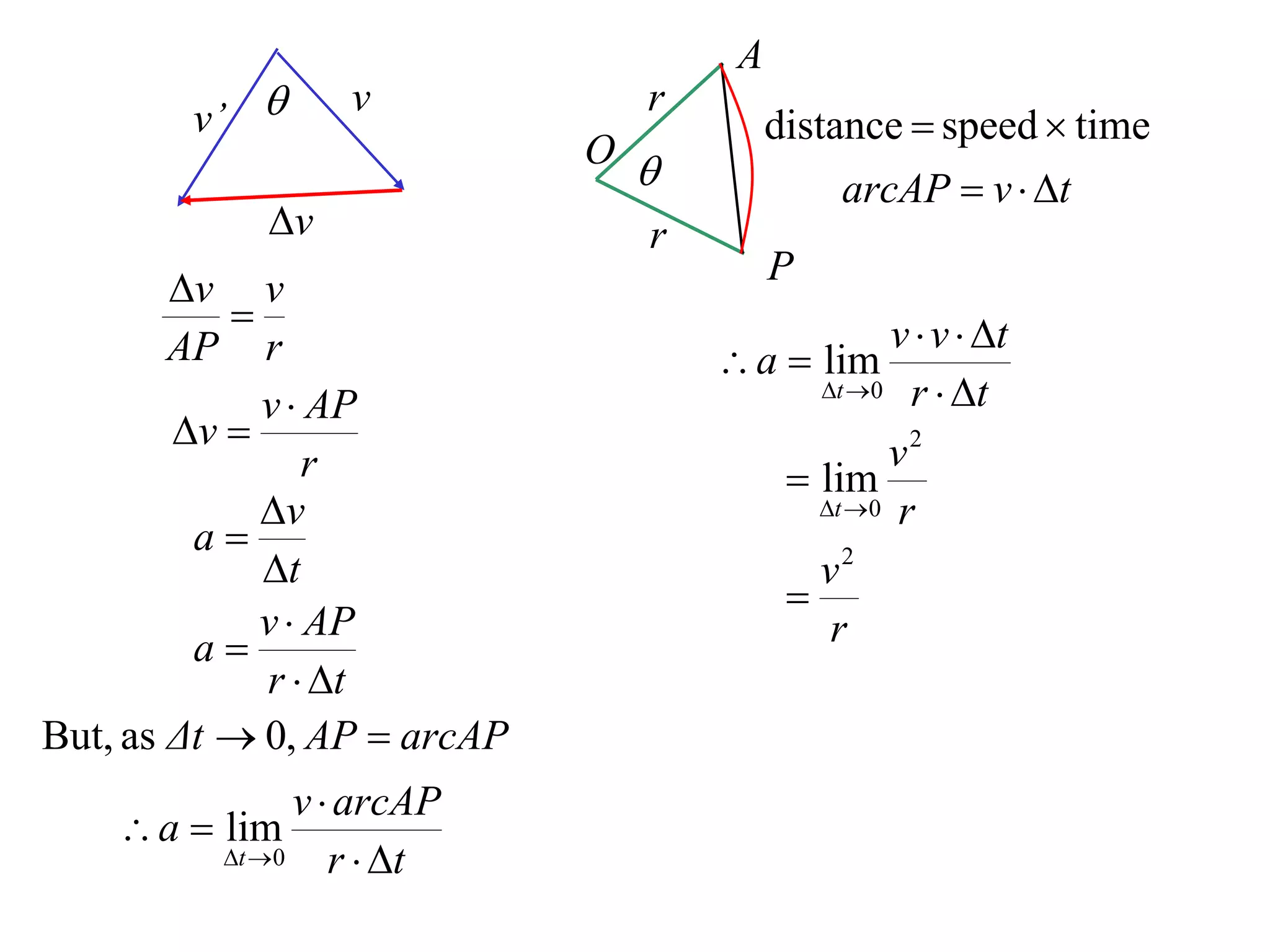
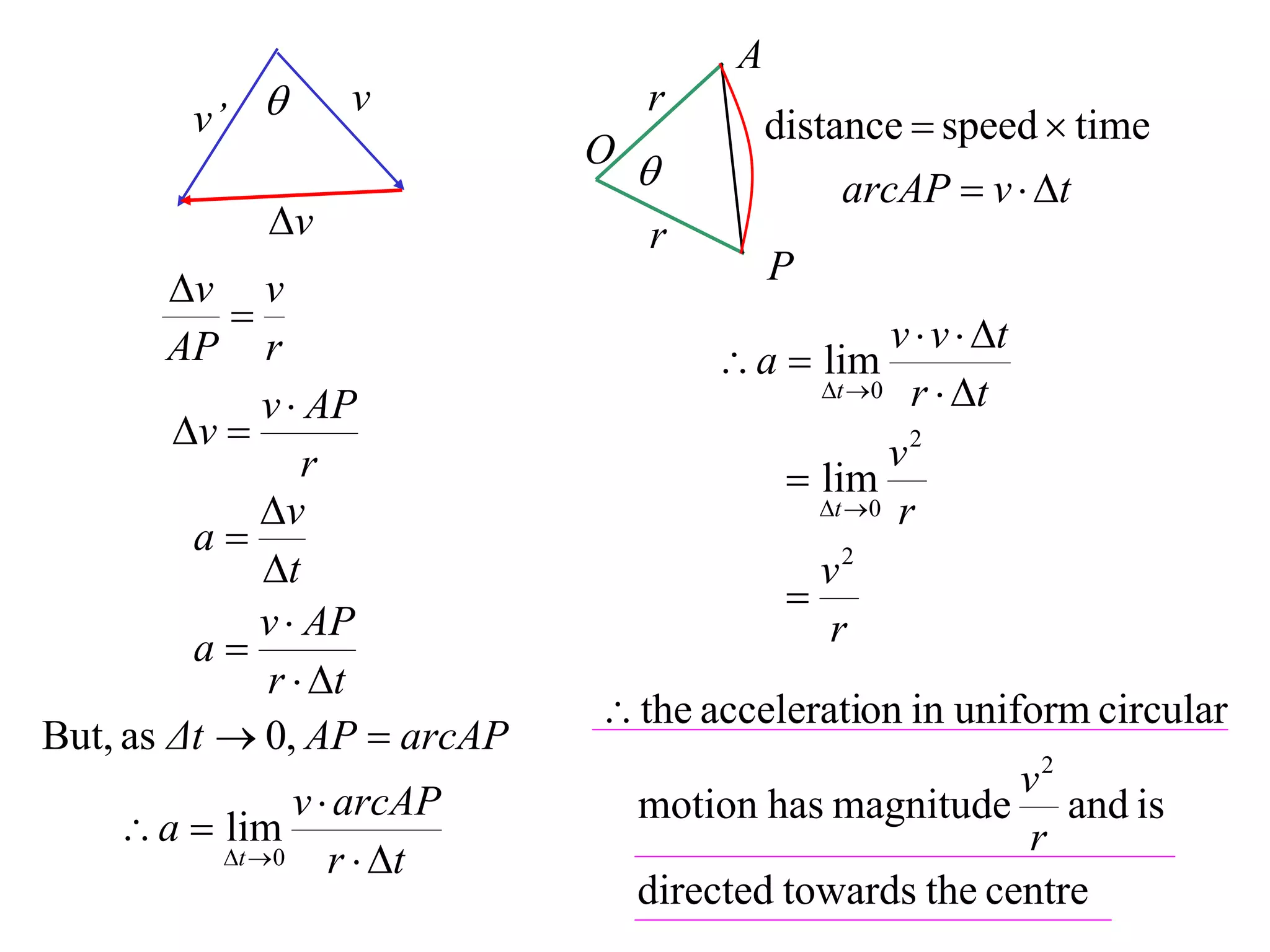
Uniform circular motion is when a particle moves with constant angular
velocity.
Acceleration with Uniform
       Circular Motion
Uniform circular motion is when a particle moves with constant angular
velocity.  the magnitude of the linear velocity will also be constant 
Acceleration with Uniform
       Circular Motion
Uniform circular motion is when a particle moves with constant angular
velocity.  the magnitude of the linear velocity will also be constant 

                   A
             r
         O
Acceleration with Uniform
       Circular Motion
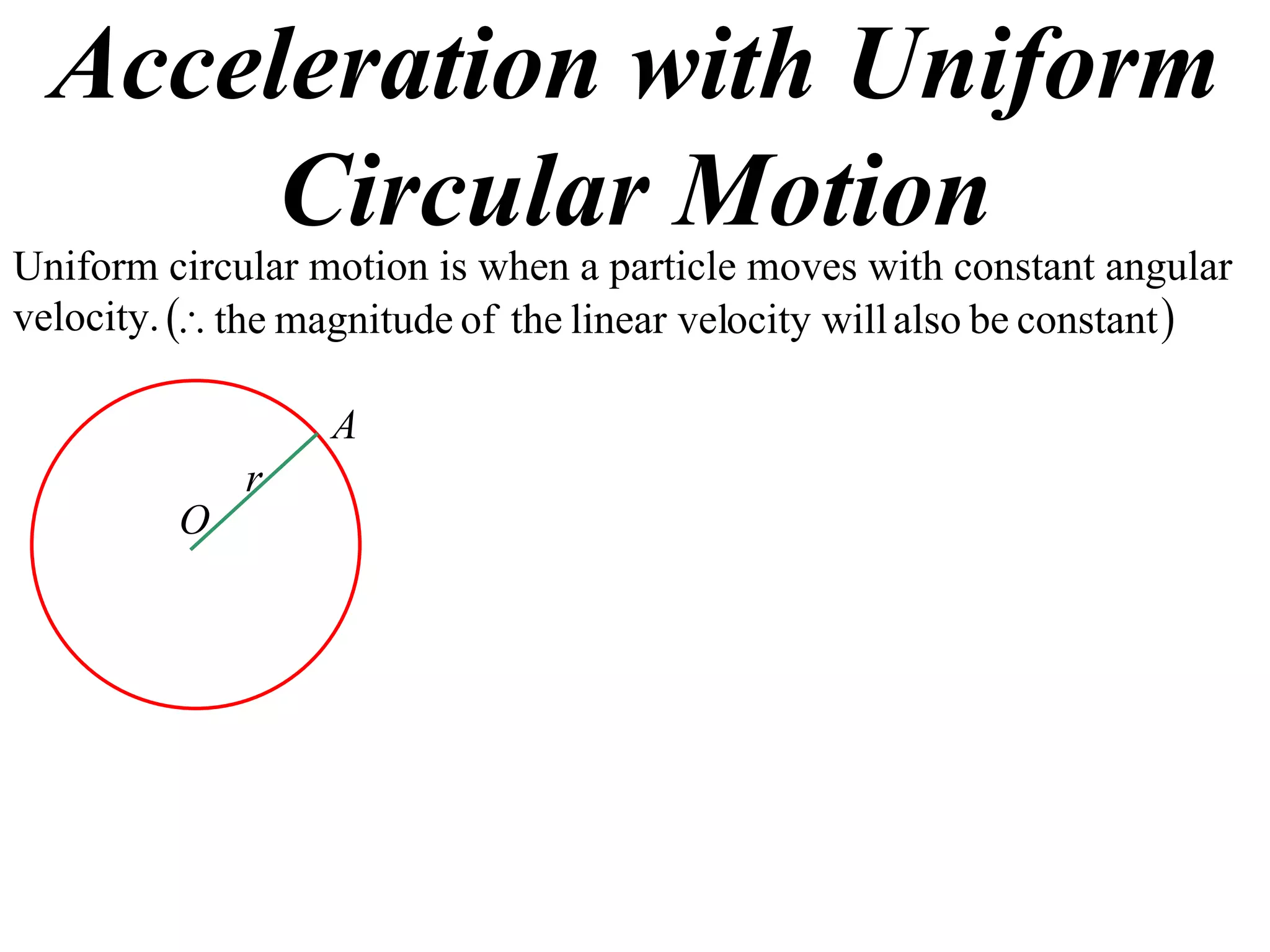
Uniform circular motion is when a particle moves with constant angular
velocity.  the magnitude of the linear velocity will also be constant 

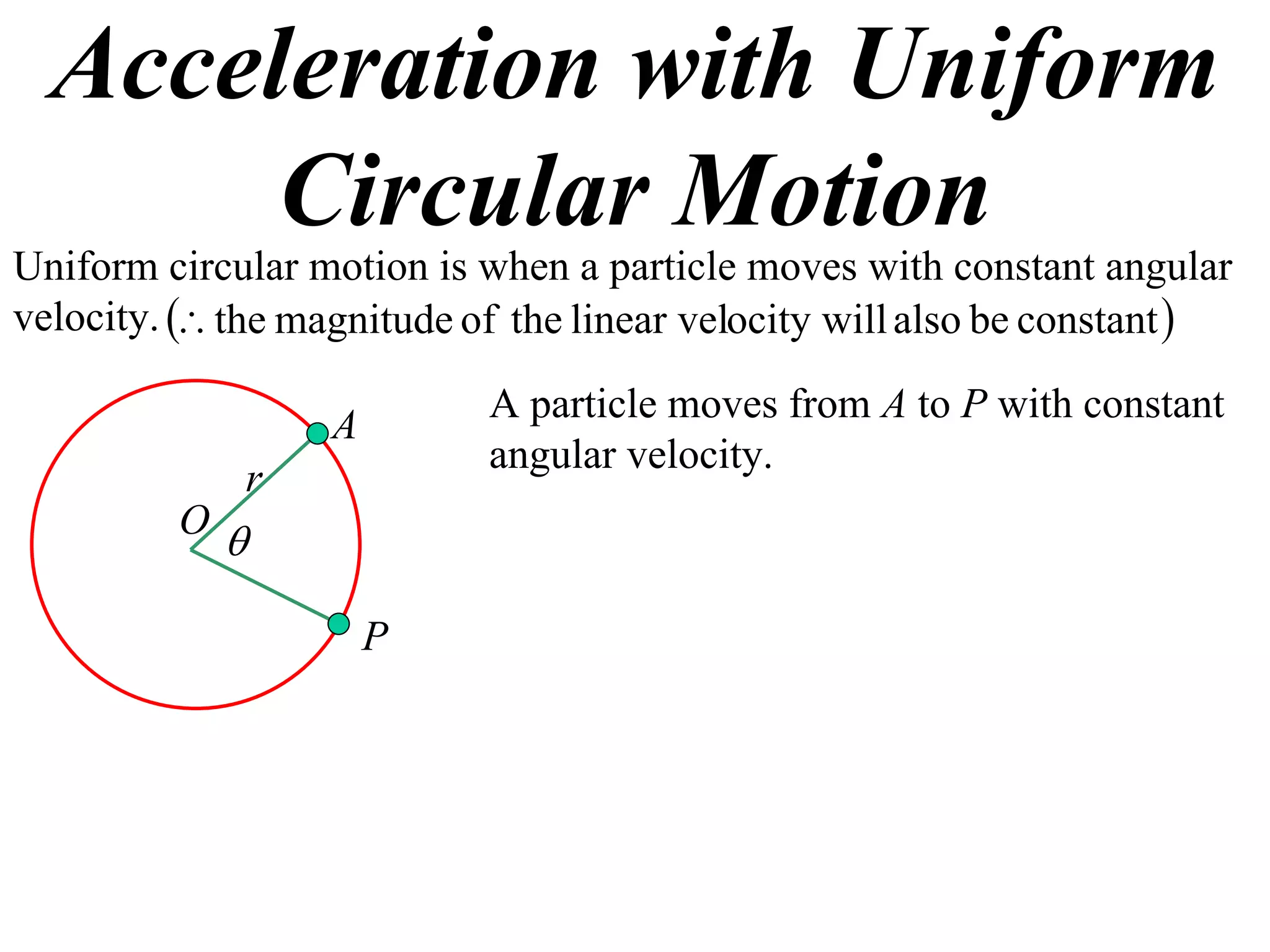
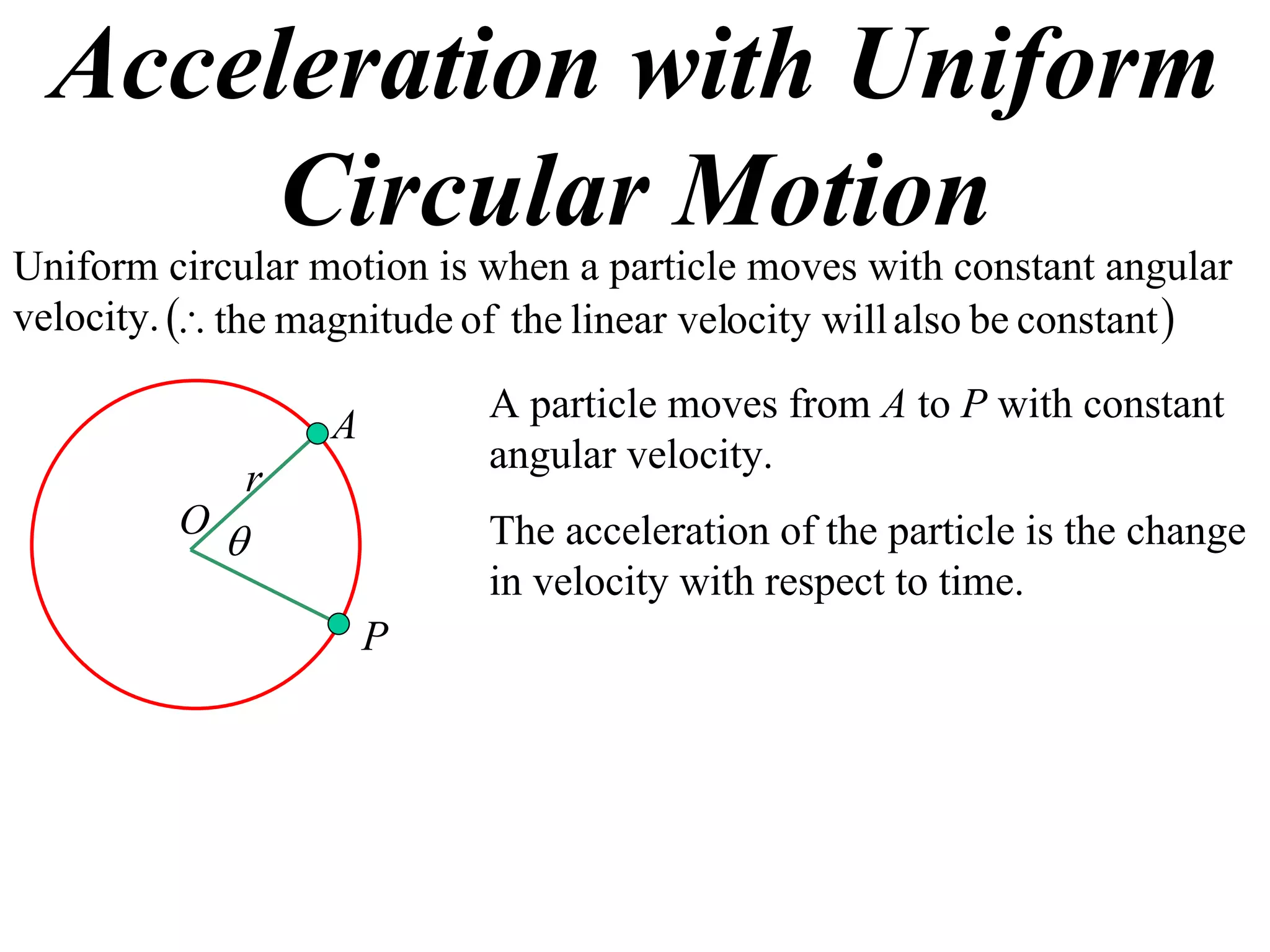
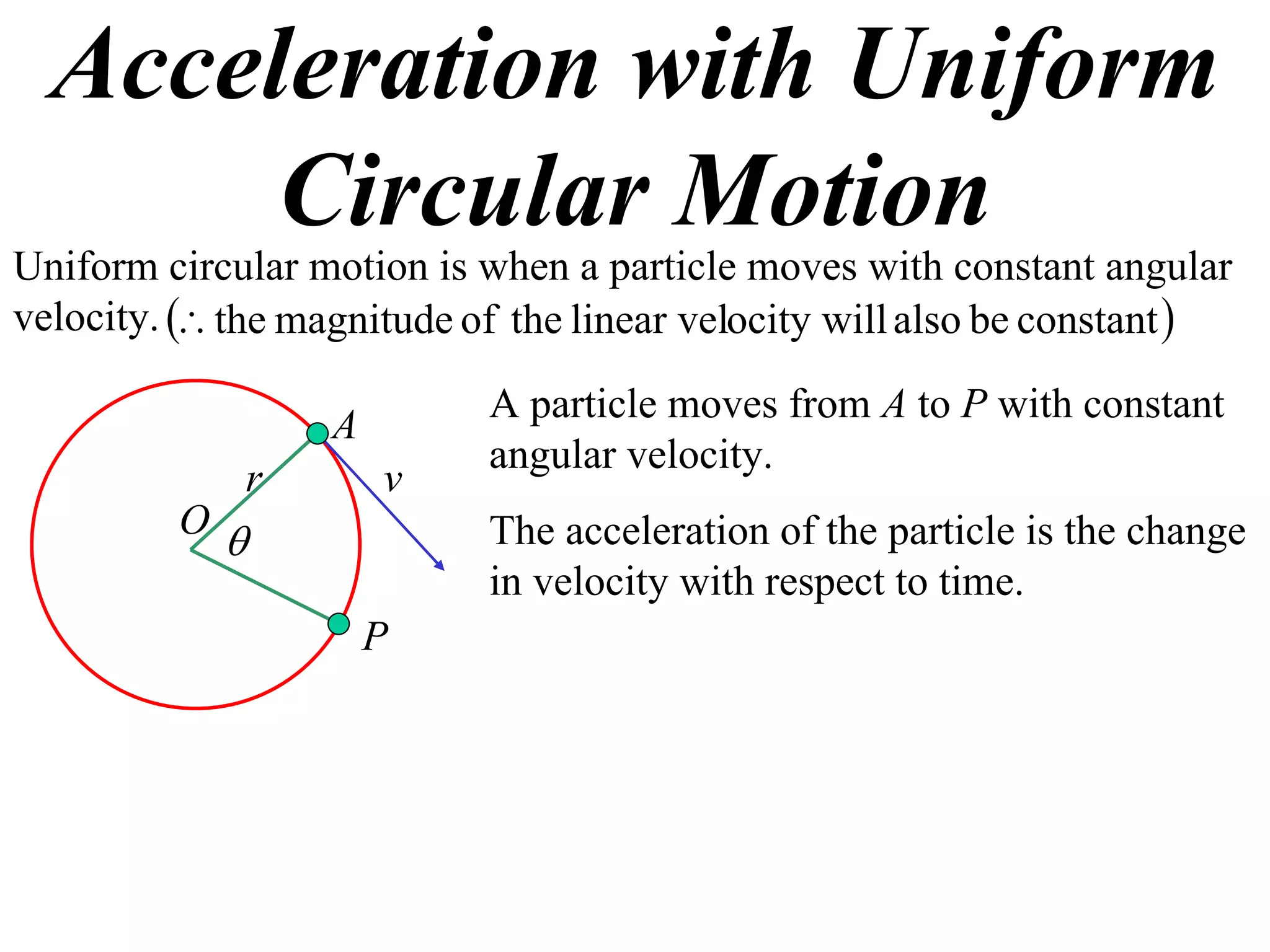
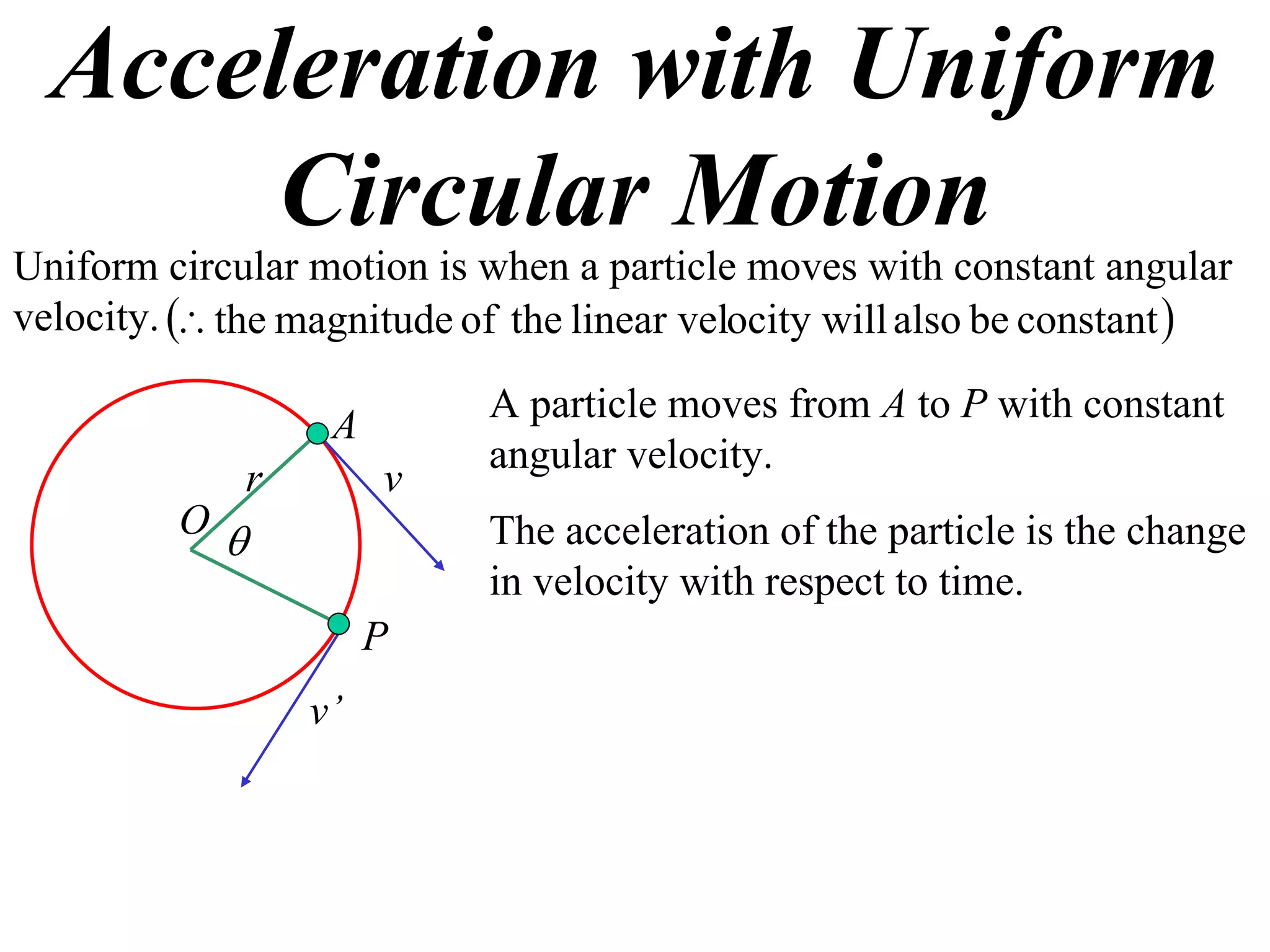
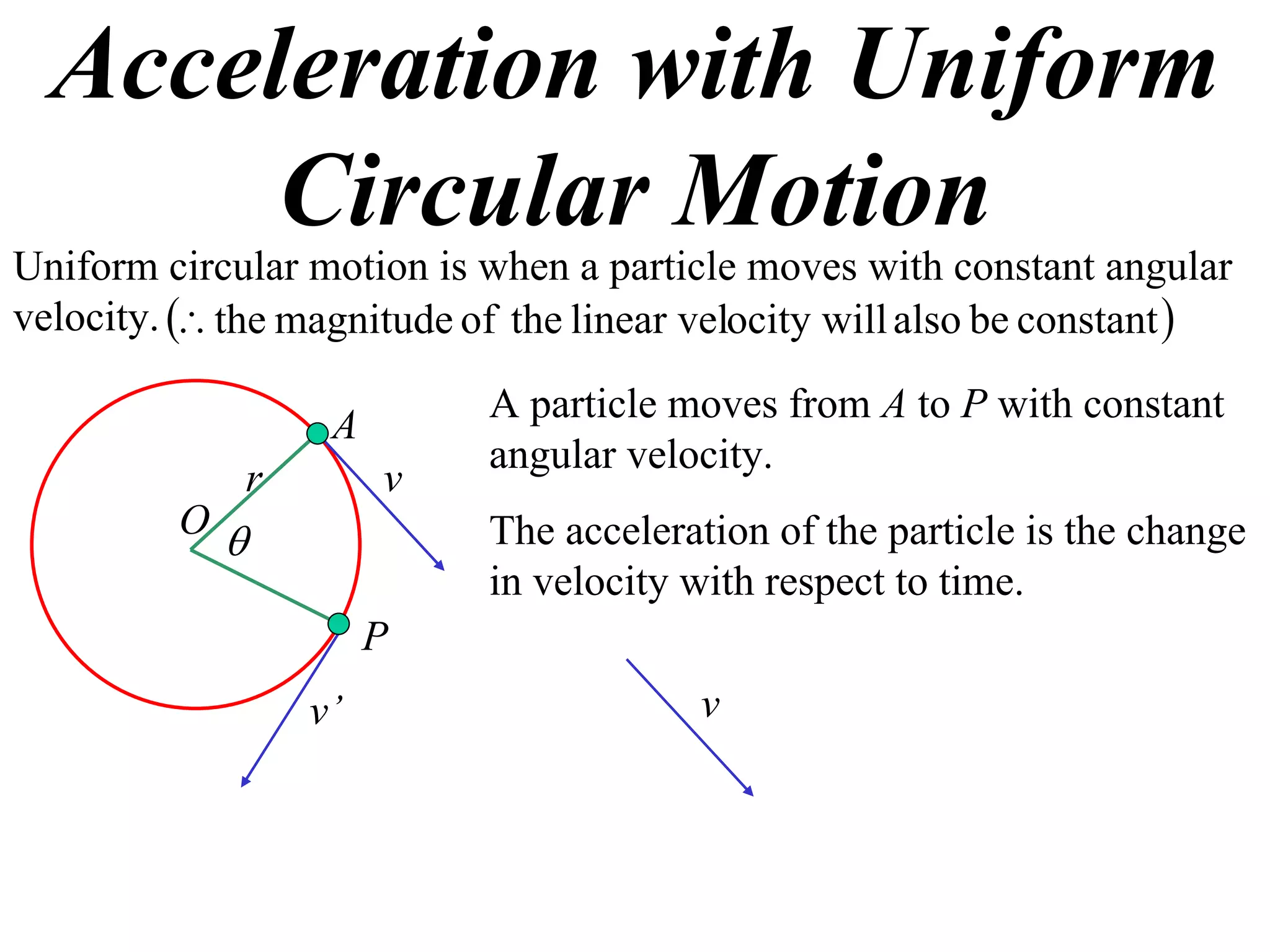
                            A particle moves from A to P with constant
                   A
                            angular velocity.
             r
         O
             

                       P
Acceleration with Uniform
       Circular Motion
Uniform circular motion is when a particle moves with constant angular
velocity.  the magnitude of the linear velocity will also be constant 

                            A particle moves from A to P with constant
                   A
                            angular velocity.
             r
         O
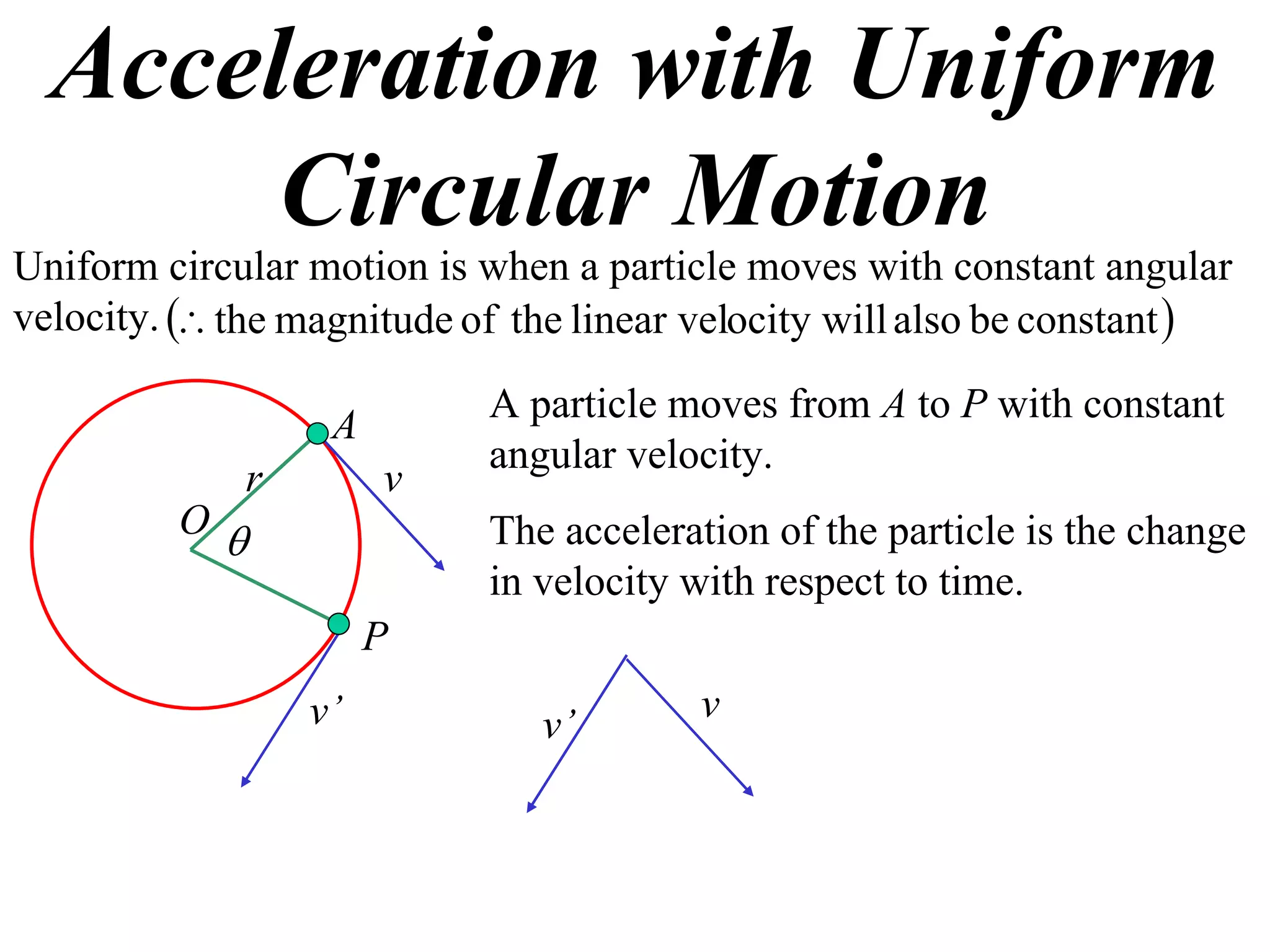
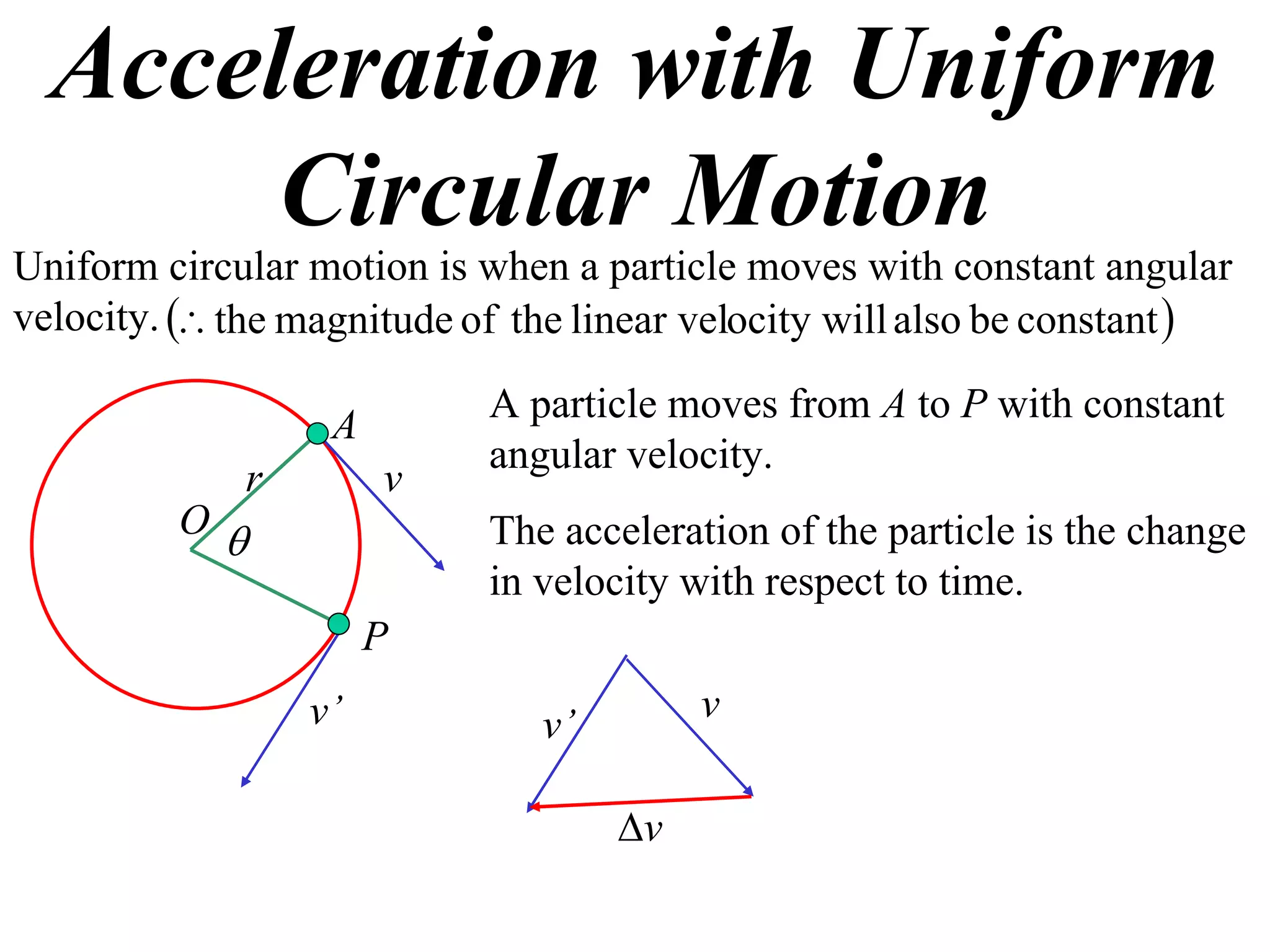
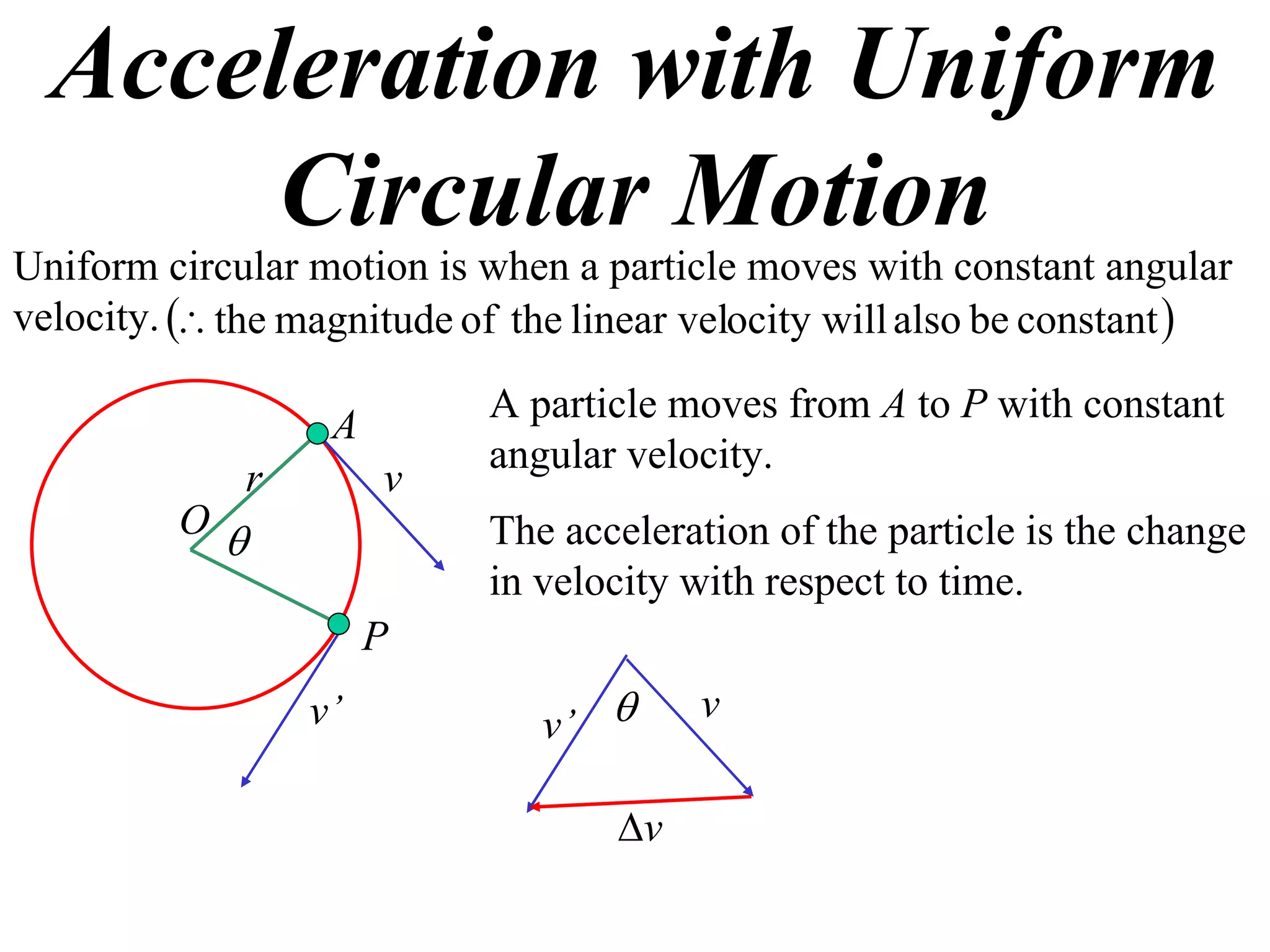
                           The acceleration of the particle is the change
                            in velocity with respect to time.
                       P
Acceleration with Uniform
       Circular Motion
Uniform circular motion is when a particle moves with constant angular
velocity.  the magnitude of the linear velocity will also be constant 

                            A particle moves from A to P with constant
                   A
                            angular velocity.
             r         v
         O
                           The acceleration of the particle is the change
                            in velocity with respect to time.
                       P
Acceleration with Uniform
       Circular Motion
Uniform circular motion is when a particle moves with constant angular
velocity.  the magnitude of the linear velocity will also be constant 

                            A particle moves from A to P with constant
                   A
                            angular velocity.
             r         v
         O
                           The acceleration of the particle is the change
                            in velocity with respect to time.
                       P
                 v’
Acceleration with Uniform
       Circular Motion
Uniform circular motion is when a particle moves with constant angular
velocity.  the magnitude of the linear velocity will also be constant 

                            A particle moves from A to P with constant
                   A
                            angular velocity.
             r         v
         O
                           The acceleration of the particle is the change
                            in velocity with respect to time.
                       P
                 v’                      v
Acceleration with Uniform
       Circular Motion
Uniform circular motion is when a particle moves with constant angular
velocity.  the magnitude of the linear velocity will also be constant 

                            A particle moves from A to P with constant
                   A
                            angular velocity.
             r         v
         O
                           The acceleration of the particle is the change
                            in velocity with respect to time.
                       P
                 v’                      v
                               v’
Acceleration with Uniform
       Circular Motion
Uniform circular motion is when a particle moves with constant angular
velocity.  the magnitude of the linear velocity will also be constant 

                            A particle moves from A to P with constant
                   A
                            angular velocity.
             r         v
         O
                           The acceleration of the particle is the change
                            in velocity with respect to time.
                       P
                 v’                      v
                               v’

                                    v
Acceleration with Uniform
       Circular Motion
Uniform circular motion is when a particle moves with constant angular
velocity.  the magnitude of the linear velocity will also be constant 

                   A        A particle moves from A to P with constant
                            angular velocity.
             r         v
         O
                           The acceleration of the particle is the change
                            in velocity with respect to time.
                       P
                 v’            v’       v

                                    v
Acceleration with Uniform
       Circular Motion
Uniform circular motion is when a particle moves with constant angular
velocity.  the magnitude of the linear velocity will also be constant 

                   A        A particle moves from A to P with constant
                            angular velocity.
             r         v
         O
                           The acceleration of the particle is the change
                            in velocity with respect to time.
                       P

                               v’       v
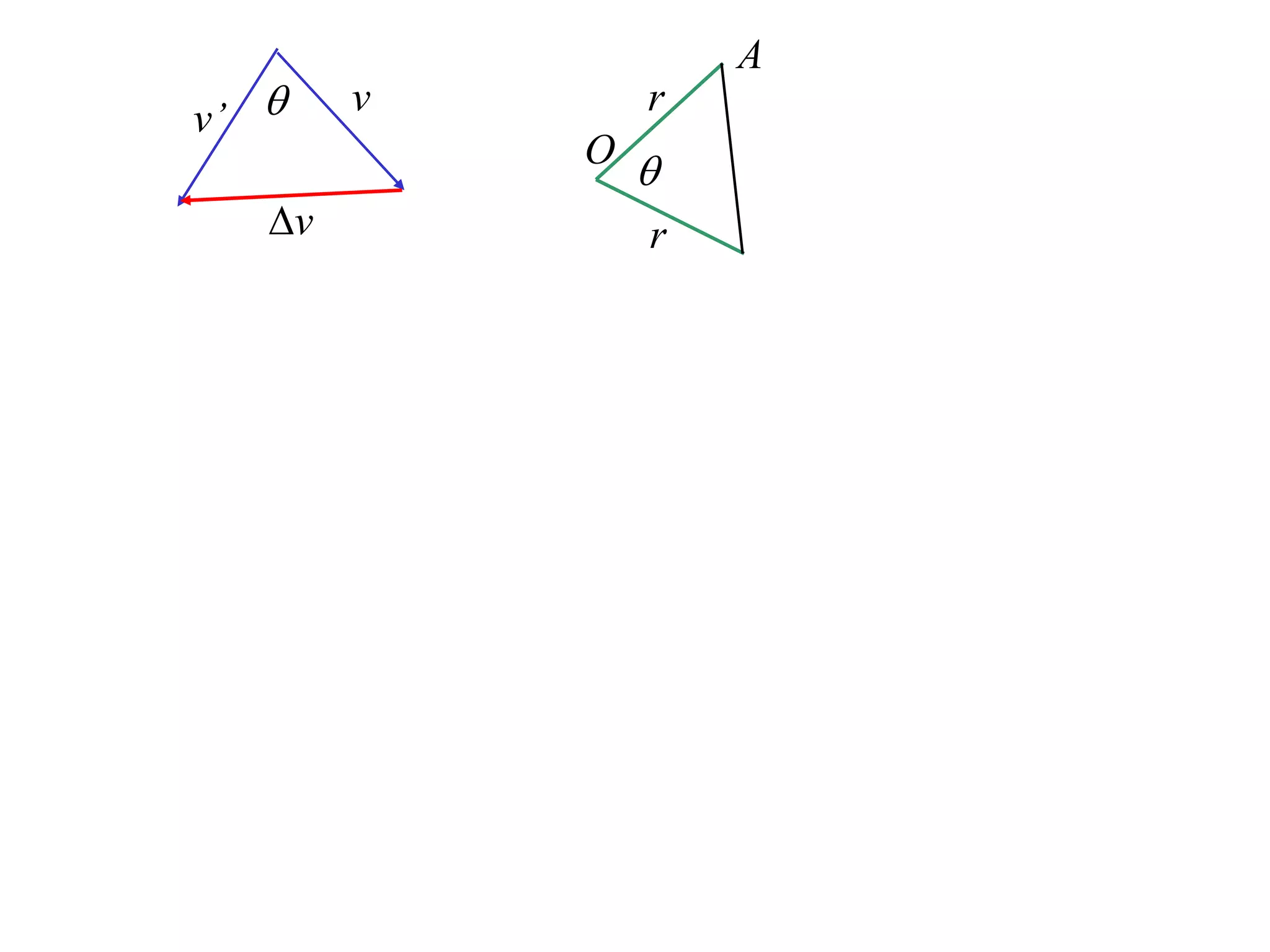
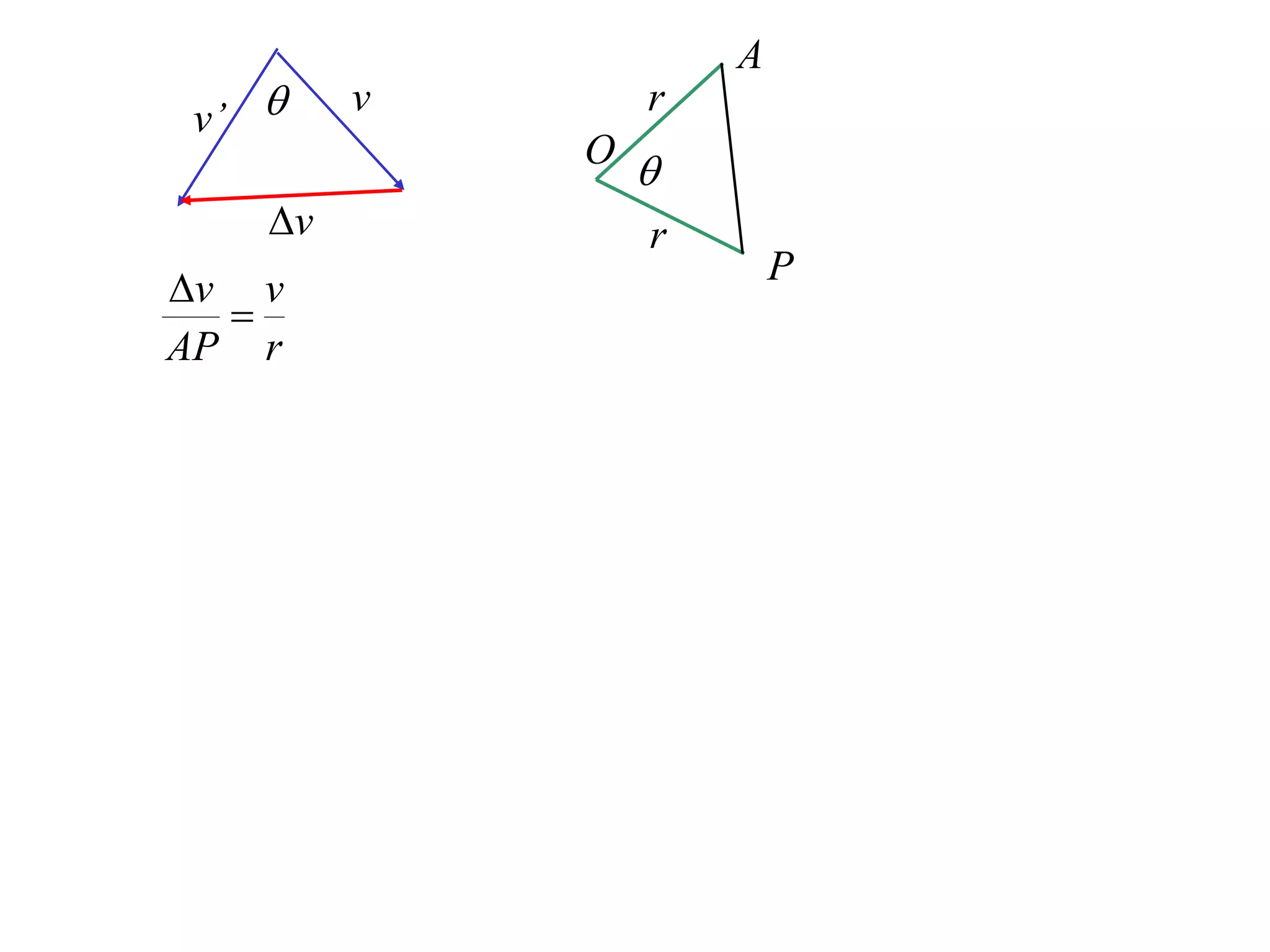
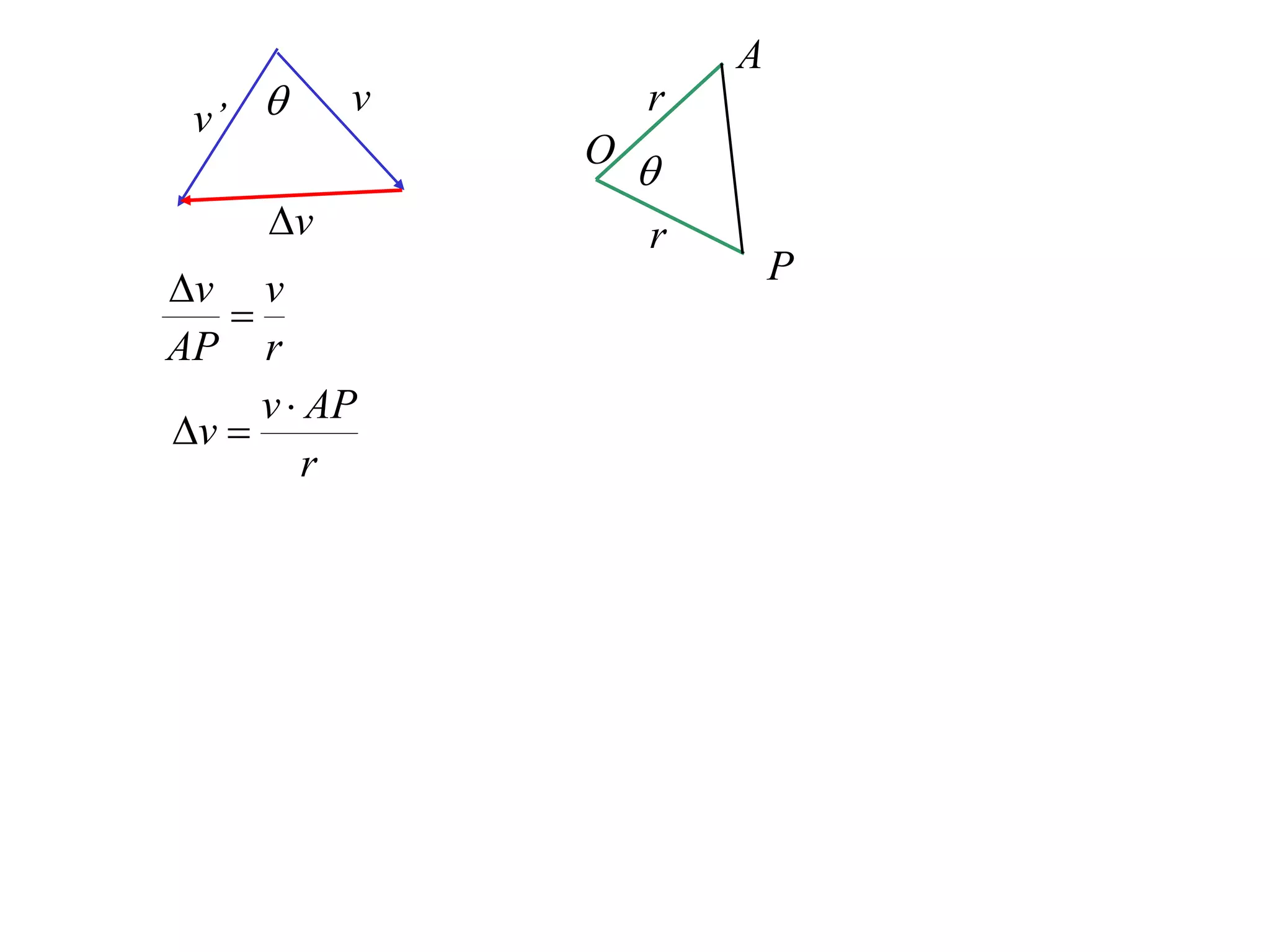
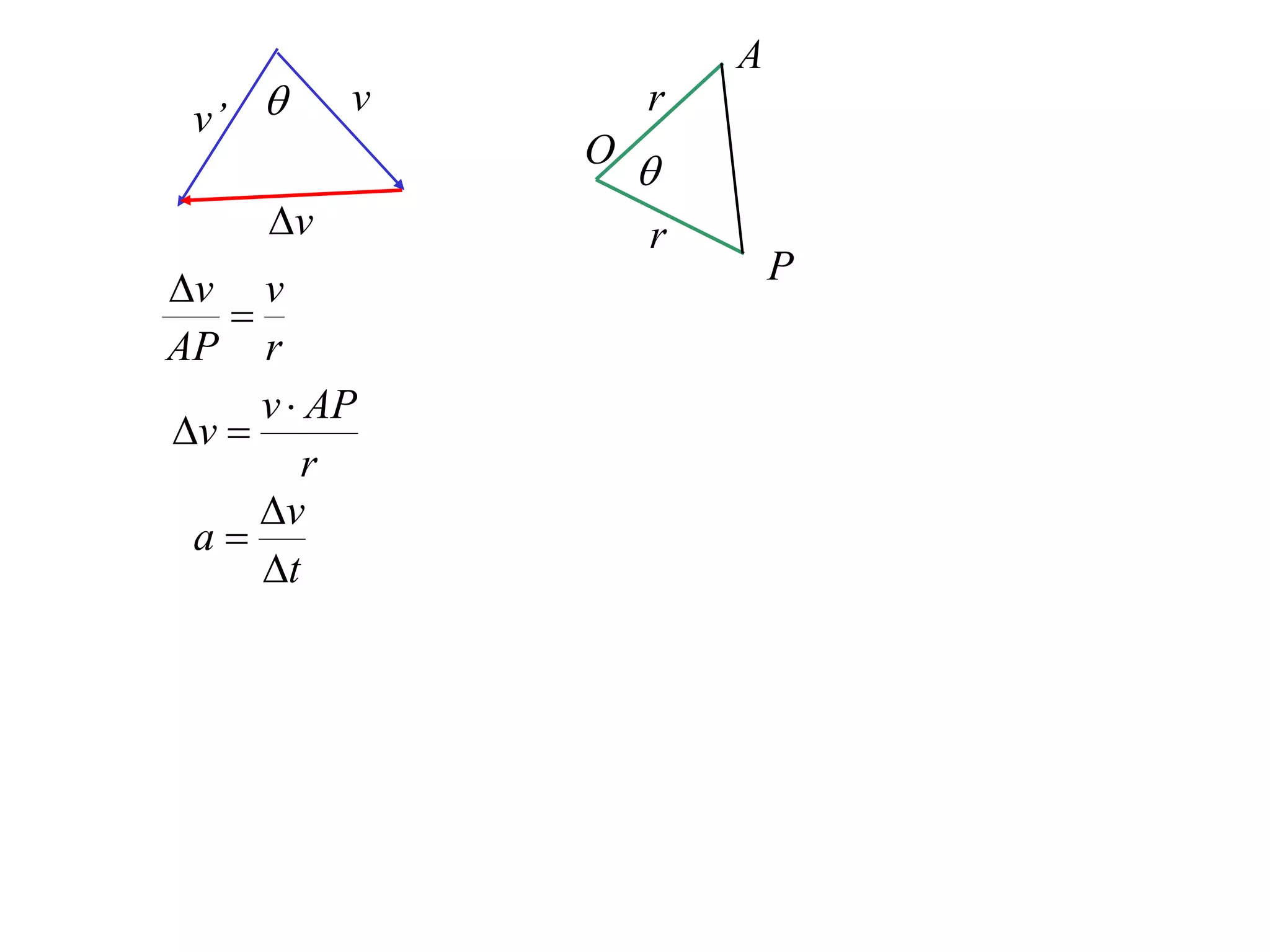
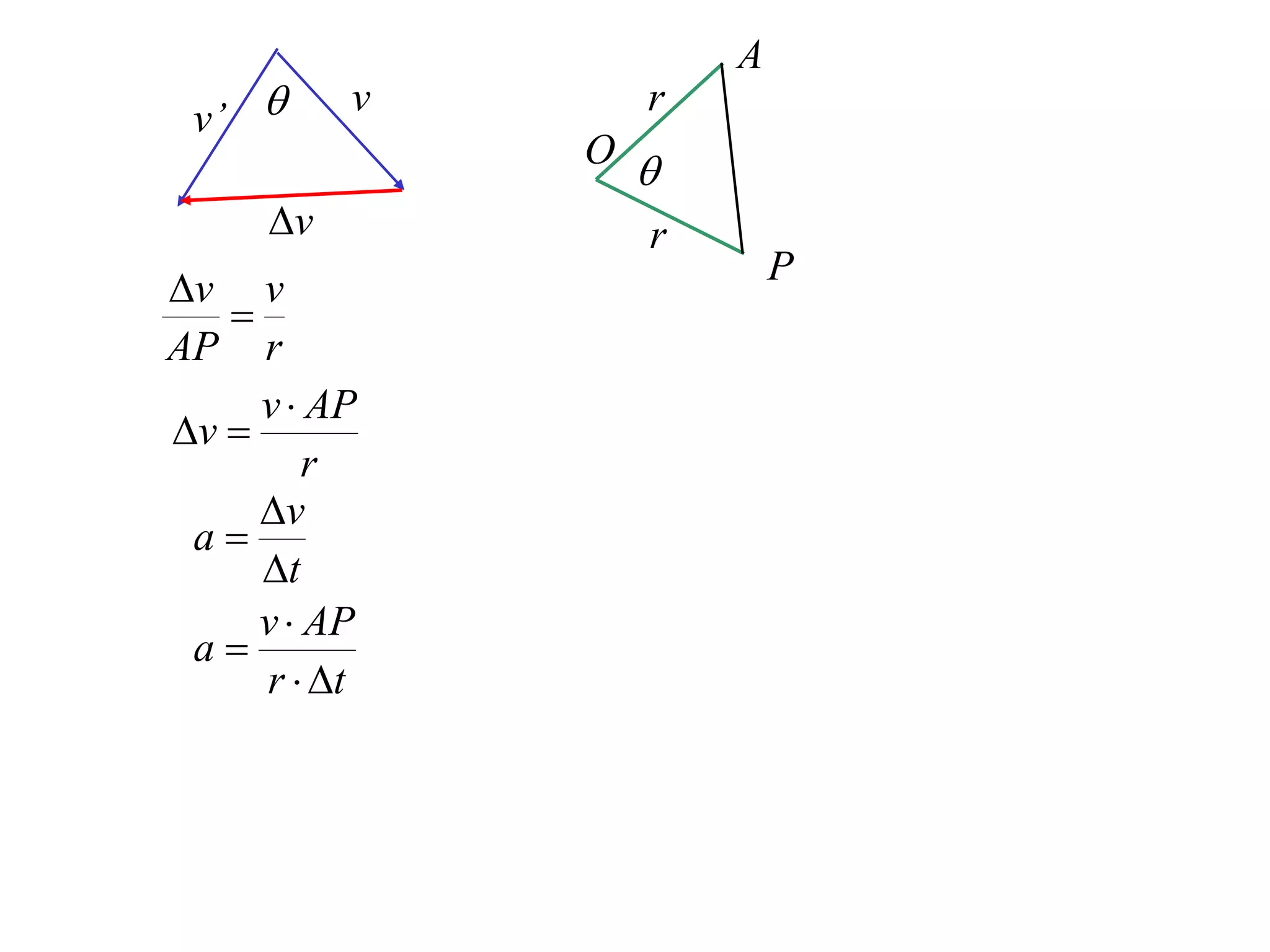
                 v’                            This triangle of vectors
                                               is similar to OAP
                                    v
A
v’ 
        v       r
            O
                
   v           r
A
v’ 
        v       r
            O
                
   v           r
                        P
v v
  
AP r
A
 v’ 
          v       r
              O
                  
     v           r
                          P
v v
   
AP r
     v  AP
v 
        r
A
 v’ 
          v       r
              O
                  
     v           r
                          P
v v
   
AP r
     v  AP
v 
        r
     v
 a
     t
A
 v’ 
          v       r
              O
                  
     v           r
                          P
v v
   
AP r
     v  AP
v 
         r
     v
 a
     t
     v  AP
 a
     r  t
A
        v’ 
                 v               r
                             O
                                 
            v                   r
                                         P
        v v
           
        AP r
             v  AP
        v 
                 r
             v
         a
             t
             v  AP
         a
             r  t
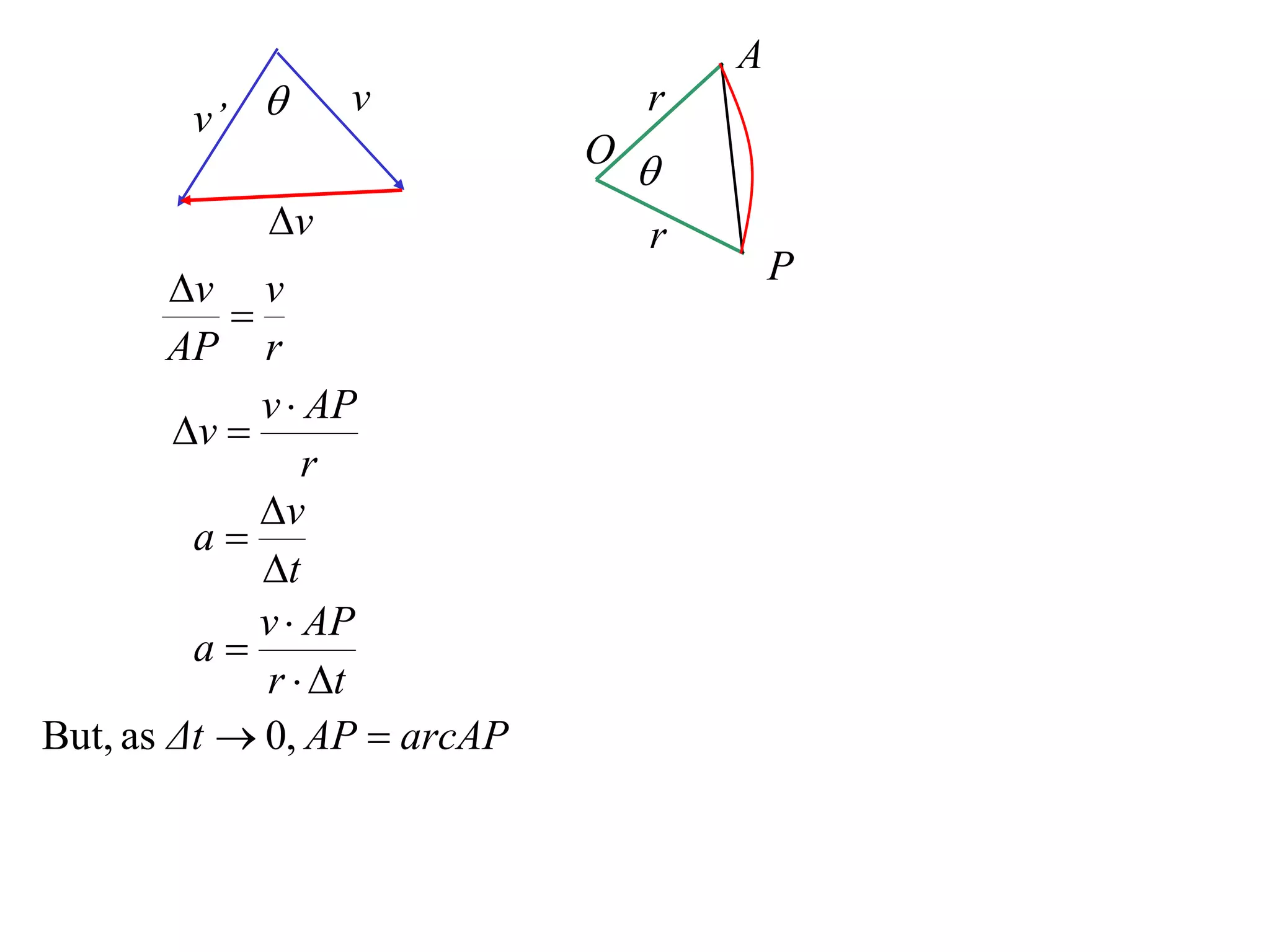
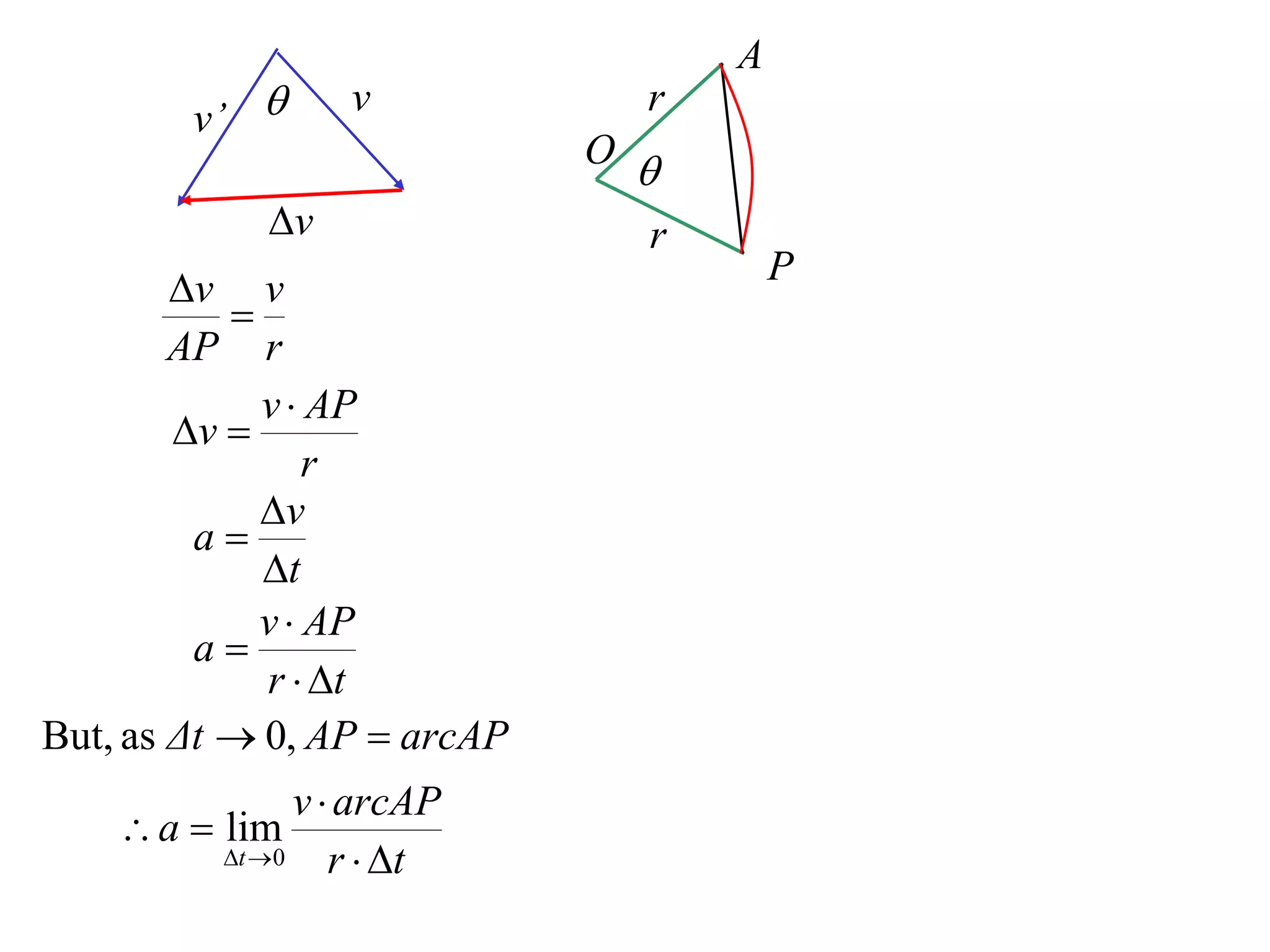
But, as Δt  0, AP  arcAP
A
        v’ 
                   v             r
                             O
                                 
             v                  r
                                         P
        v v
           
        AP r
             v  AP
        v 
                 r
             v
         a
             t
             v  AP
         a
             r  t
But, as Δt  0, AP  arcAP
                v  arcAP
     a  lim
          t 0    r  t
A
        v’ 
                   v             r
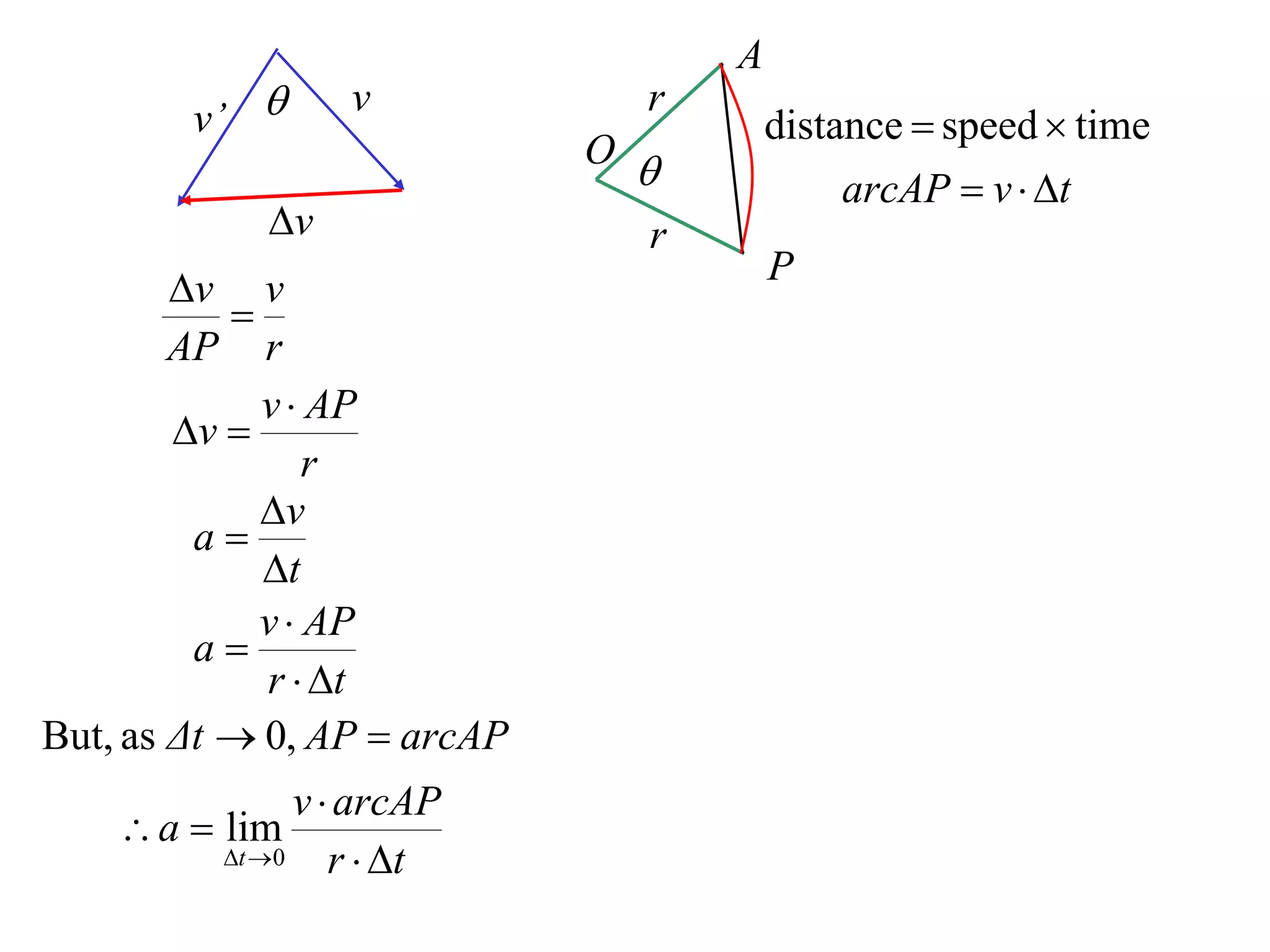
                                         distance  speed  time
                             O
                                             arcAP  v  t
             v                  r
                                         P
        v v
           
        AP r
             v  AP
        v 
                 r
             v
         a
             t
             v  AP
         a
             r  t
But, as Δt  0, AP  arcAP
                v  arcAP
     a  lim
          t 0    r  t
A
        v’        v             r
                                          distance  speed  time
                             O
                                              arcAP  v  t
             v                  r
                                          P
        v v
                                                  v  v  t
        AP r                          a  lim
                                             t 0 r  t
             v  AP
        v 
                 r                                v2
                                            lim
             v                              t 0 r
         a
             t                              v2
                                           
             v  AP                           r
         a
             r  t
But, as Δt  0, AP  arcAP
                v  arcAP
     a  lim
          t 0    r  t
A
        v’        v             r
                                          distance  speed  time
                             O
                                              arcAP  v  t
             v                  r
                                          P
        v v
                                                  v  v  t
        AP r                          a  lim
                                             t 0 r  t
             v  AP
        v 
                 r                                v2
                                            lim
             v                              t 0 r
         a
             t                              v2
                                           
             v  AP                           r
         a
             r  t
                              the acceleration in uniform circular
But, as Δt  0, AP  arcAP
                                                        v2
                v  arcAP        motion has magnitude and is
     a  lim                                           r
          t 0    r  t
                                 directed towards the centre
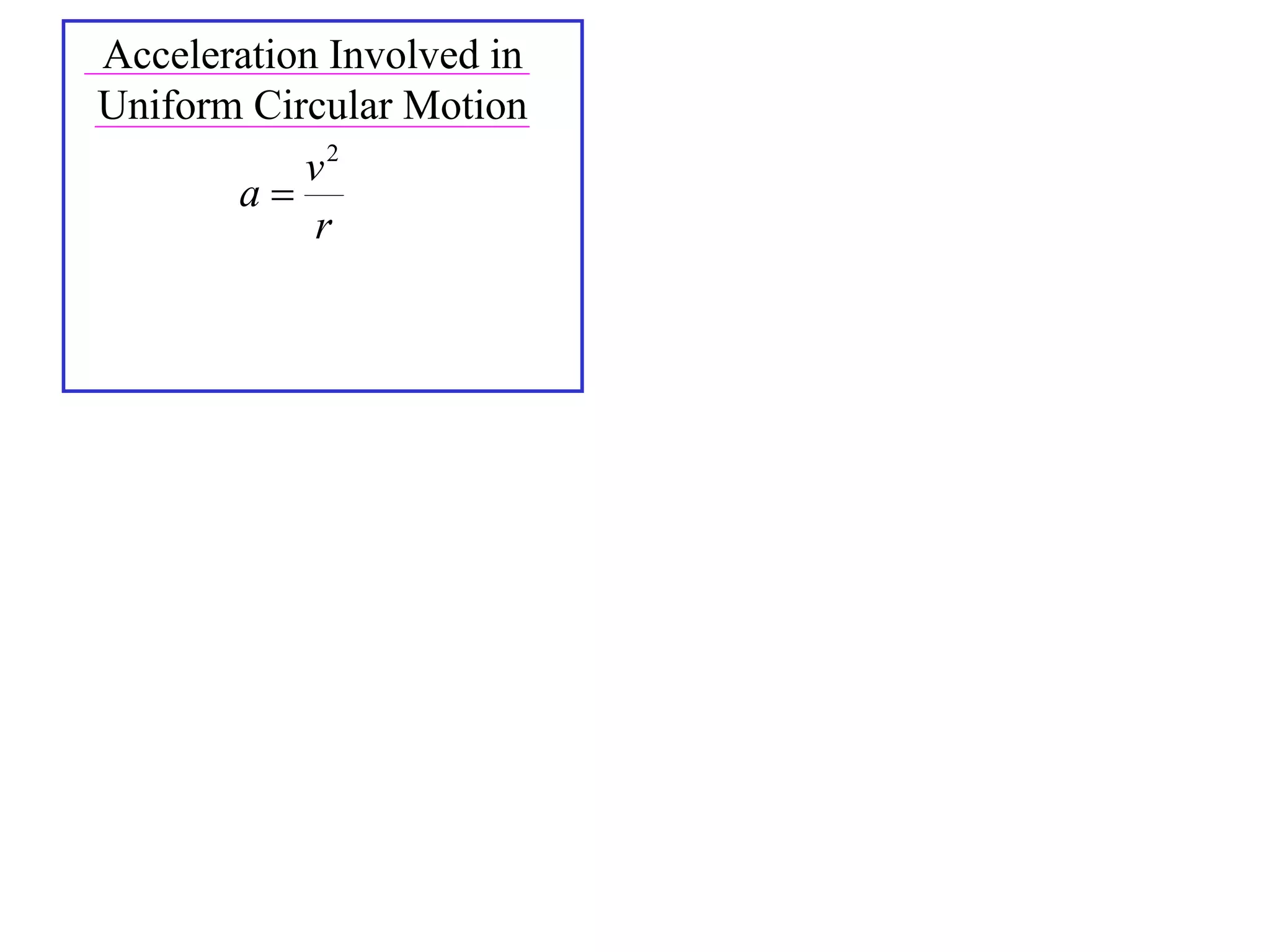
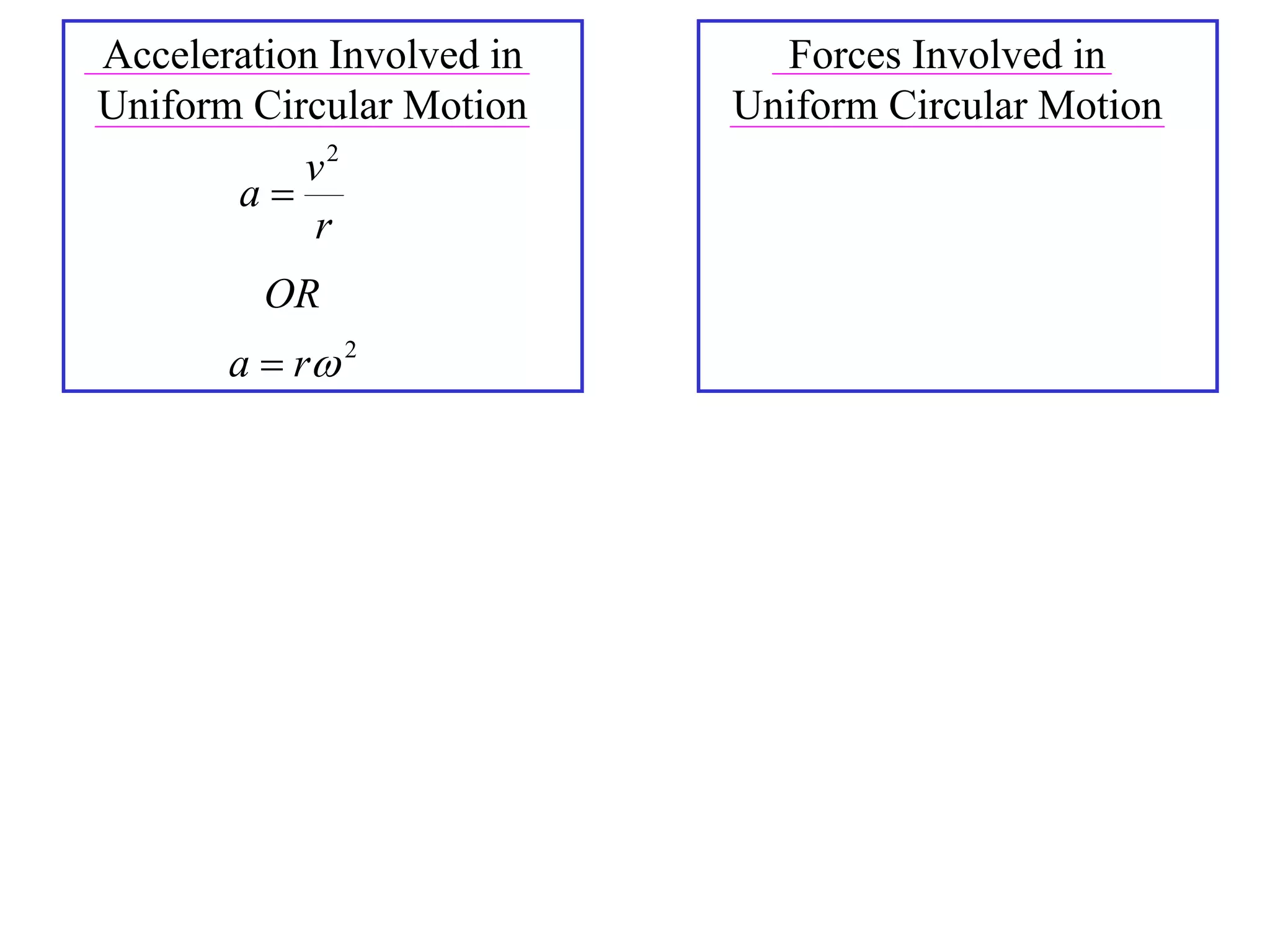
Acceleration Involved in
Uniform Circular Motion
           v2
       a
            r
Acceleration Involved in
Uniform Circular Motion
           v2
       a
            r
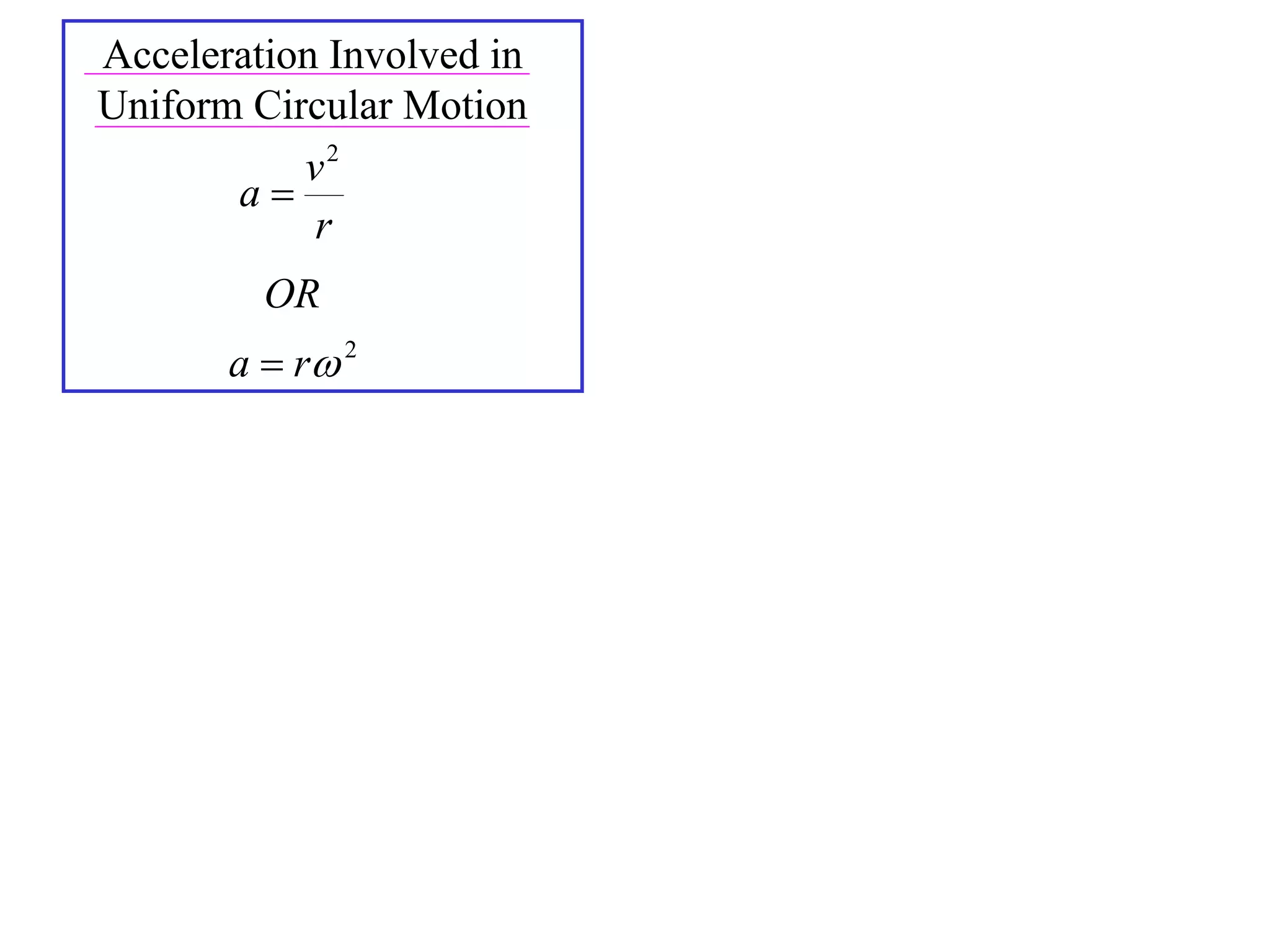
         OR
       a  r 2
Acceleration Involved in     Forces Involved in
Uniform Circular Motion    Uniform Circular Motion
           v2
       a
            r
         OR
       a  r 2
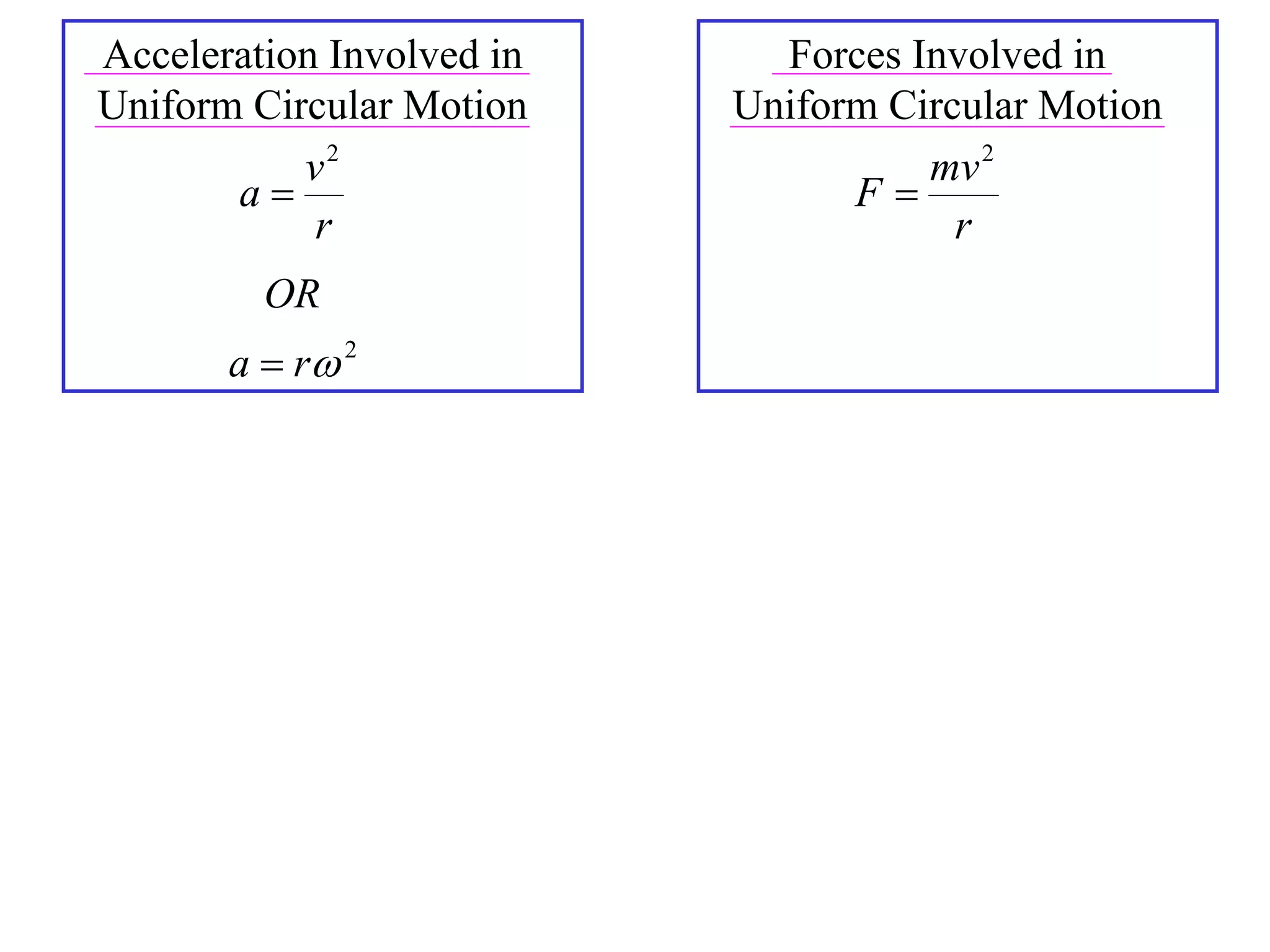
Acceleration Involved in     Forces Involved in
Uniform Circular Motion    Uniform Circular Motion
           v2                        mv 2
       a                        F
            r                          r
         OR
       a  r 2
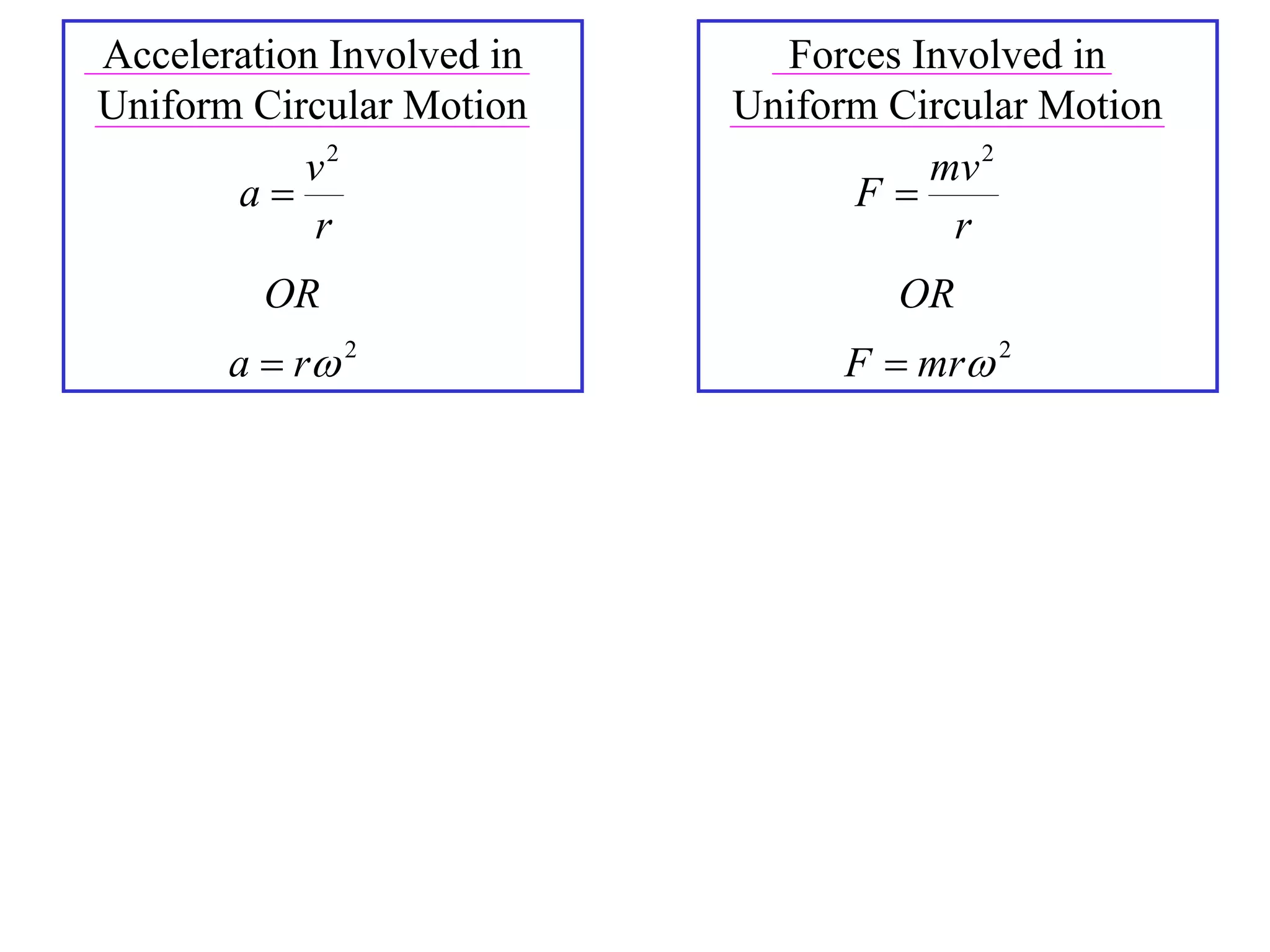
Acceleration Involved in     Forces Involved in
Uniform Circular Motion    Uniform Circular Motion
           v2                        mv 2
       a                        F
            r                          r
         OR                        OR
       a  r 2                  F  mr 2
Acceleration Involved in                 Forces Involved in
   Uniform Circular Motion                Uniform Circular Motion
              v2                                    mv 2
          a                                    F
               r                                      r
             OR                                     OR
          a  r 2                               F  mr 2
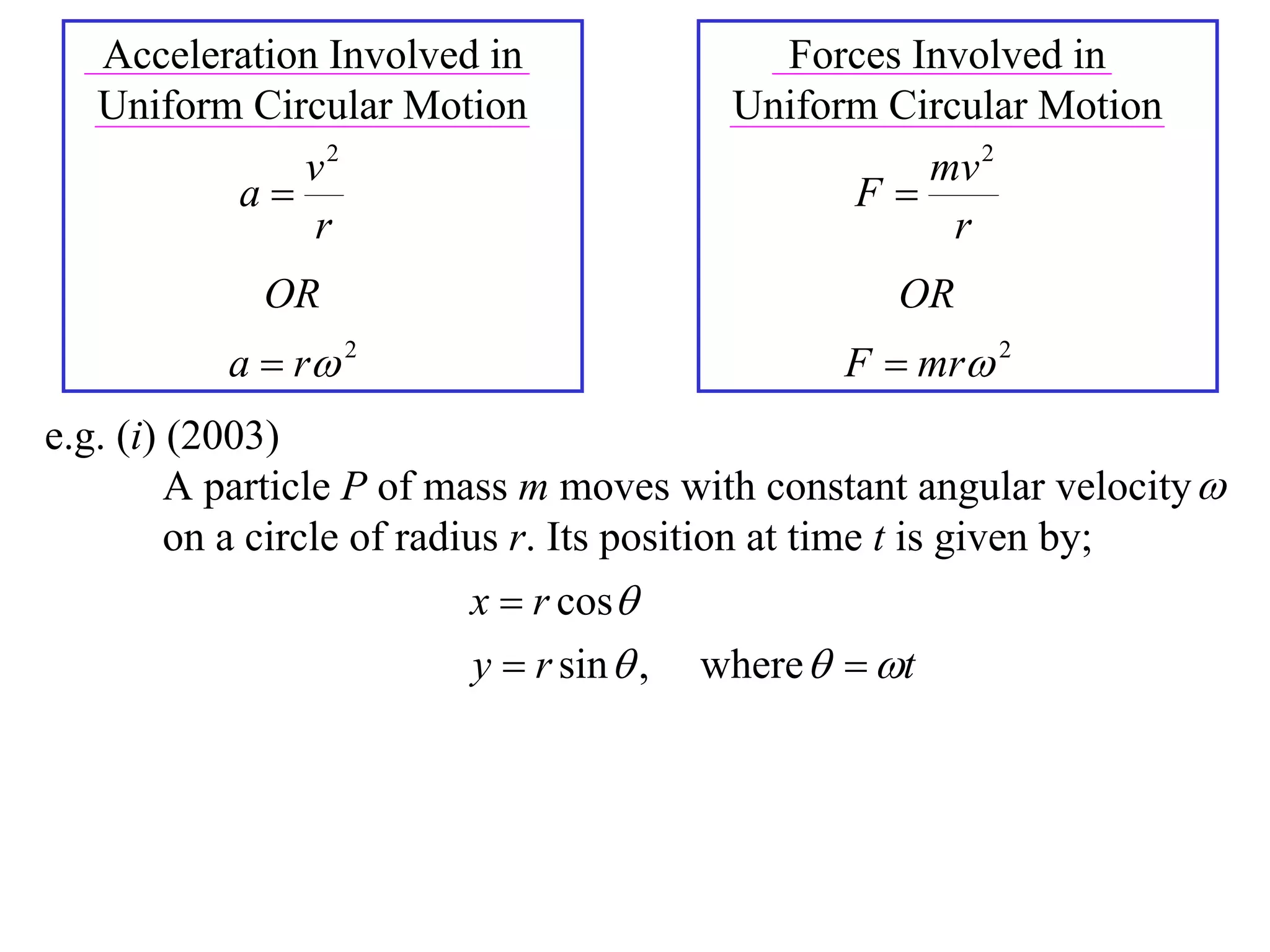
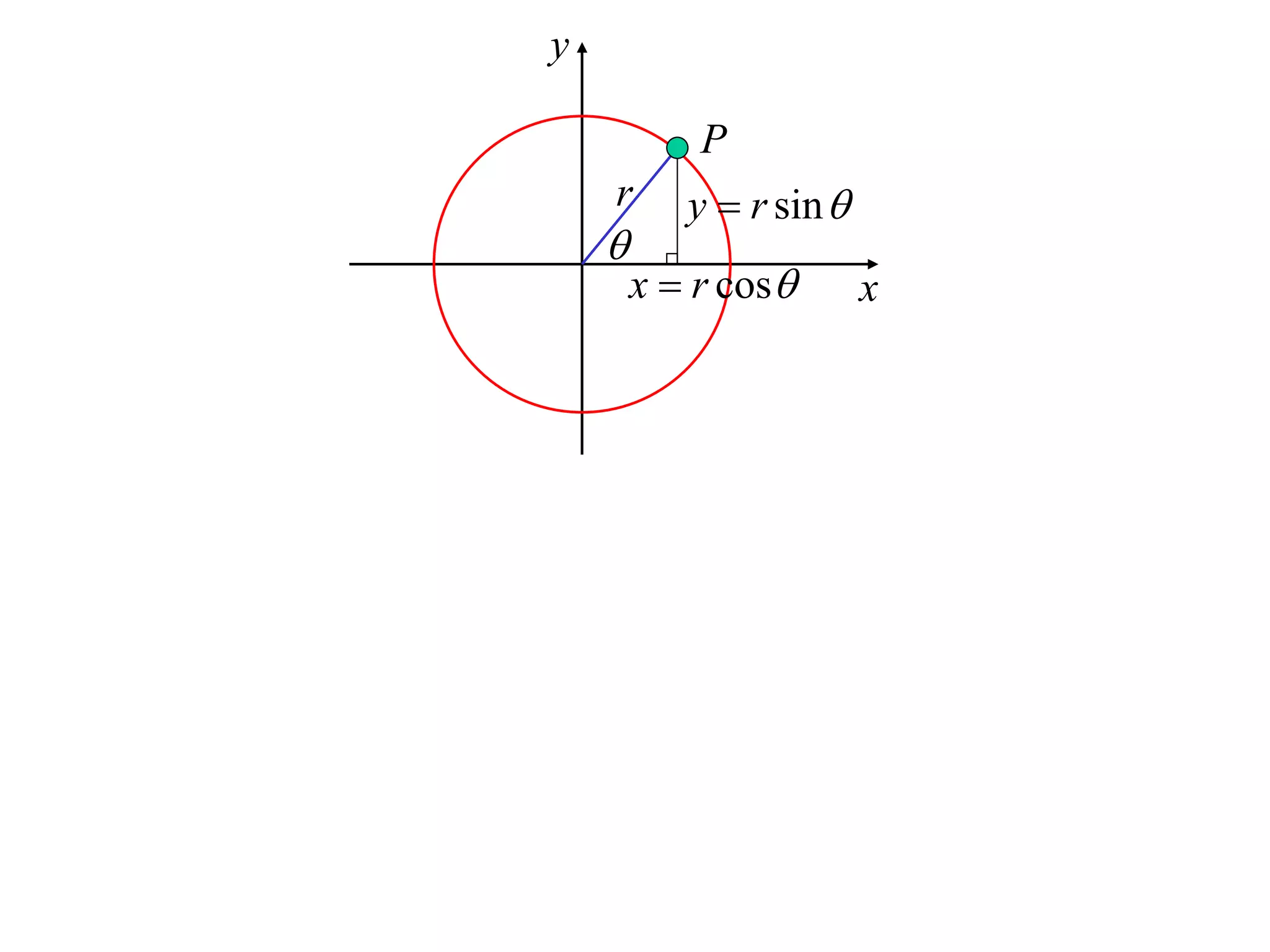
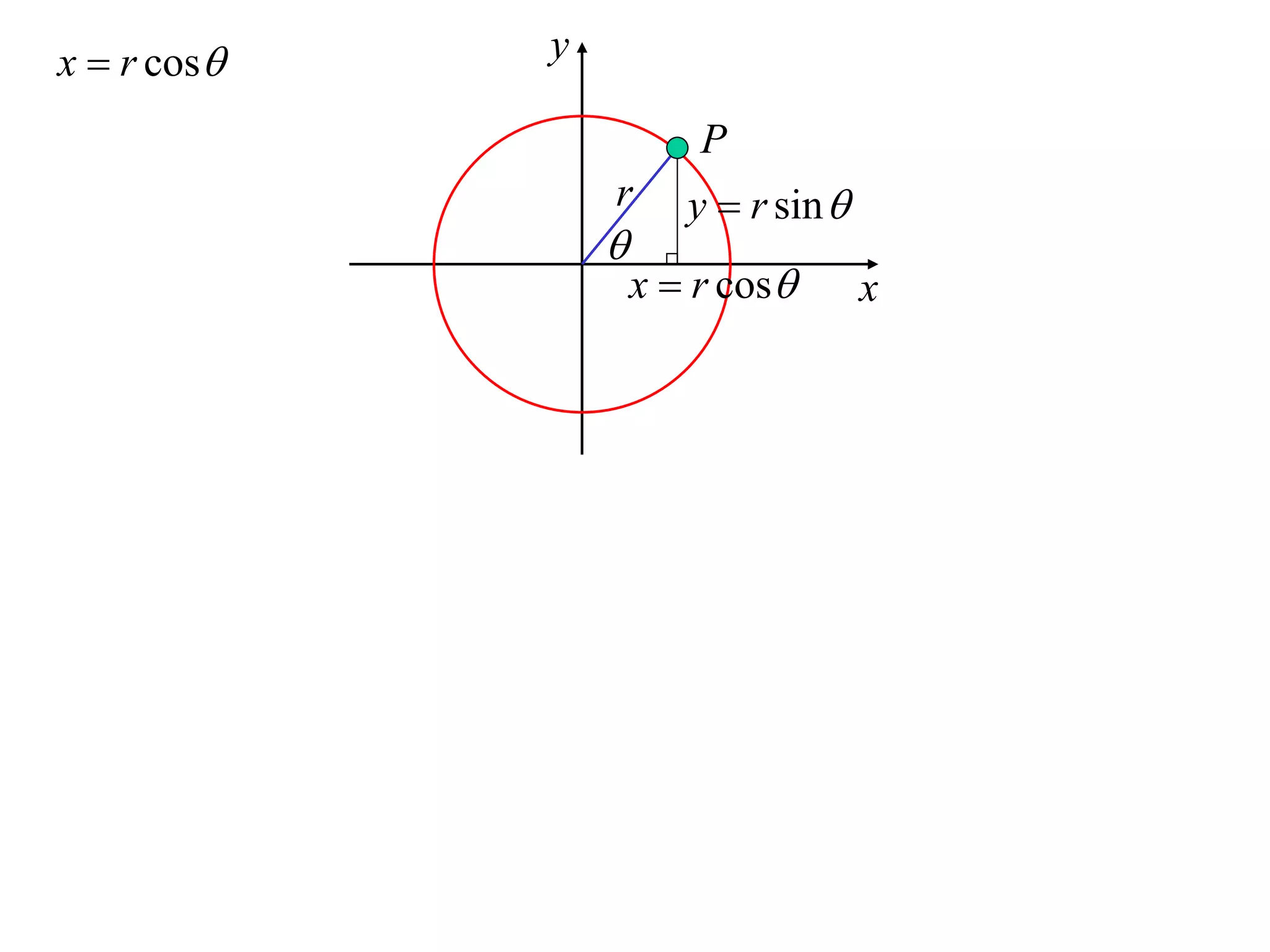
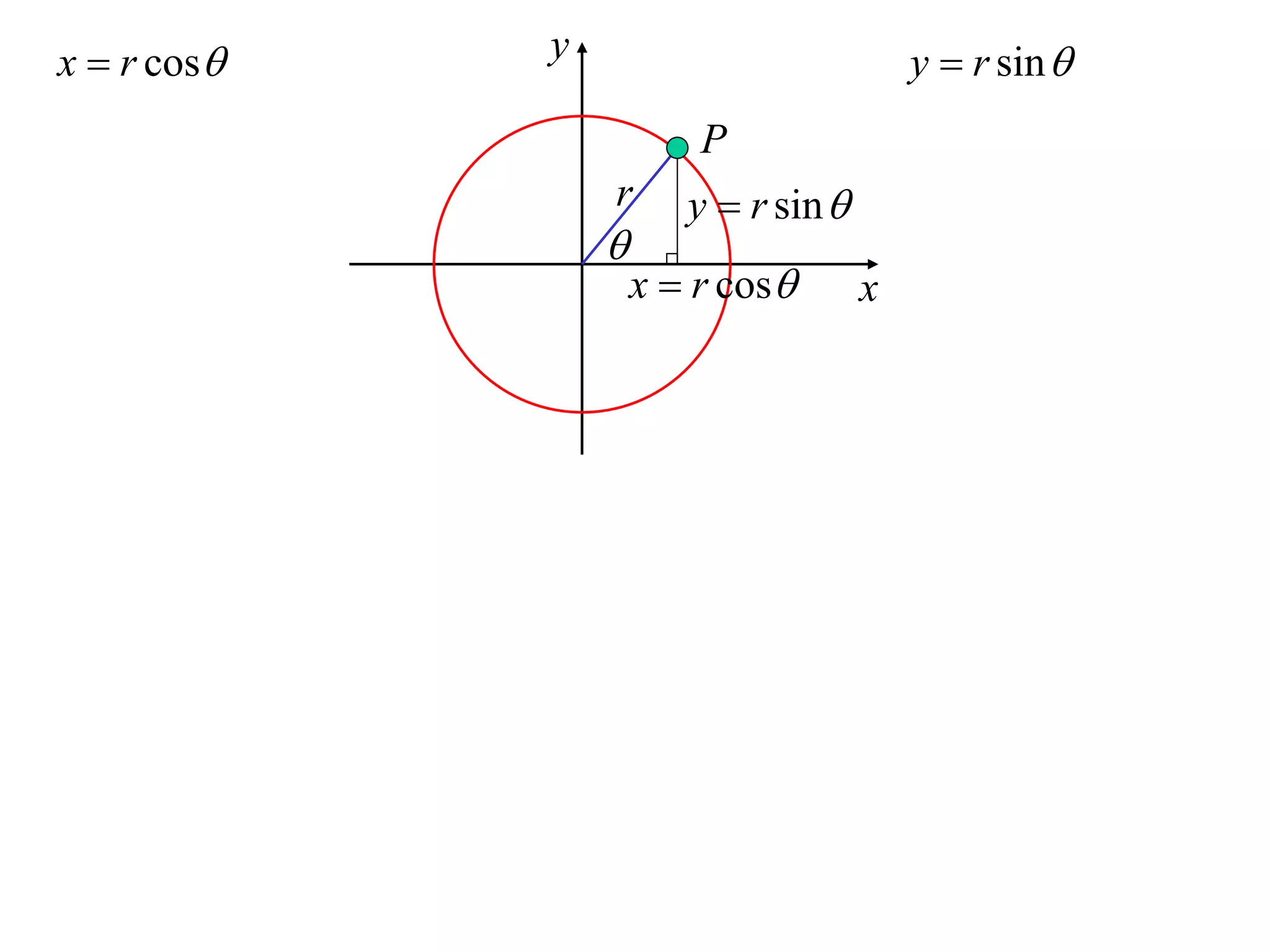
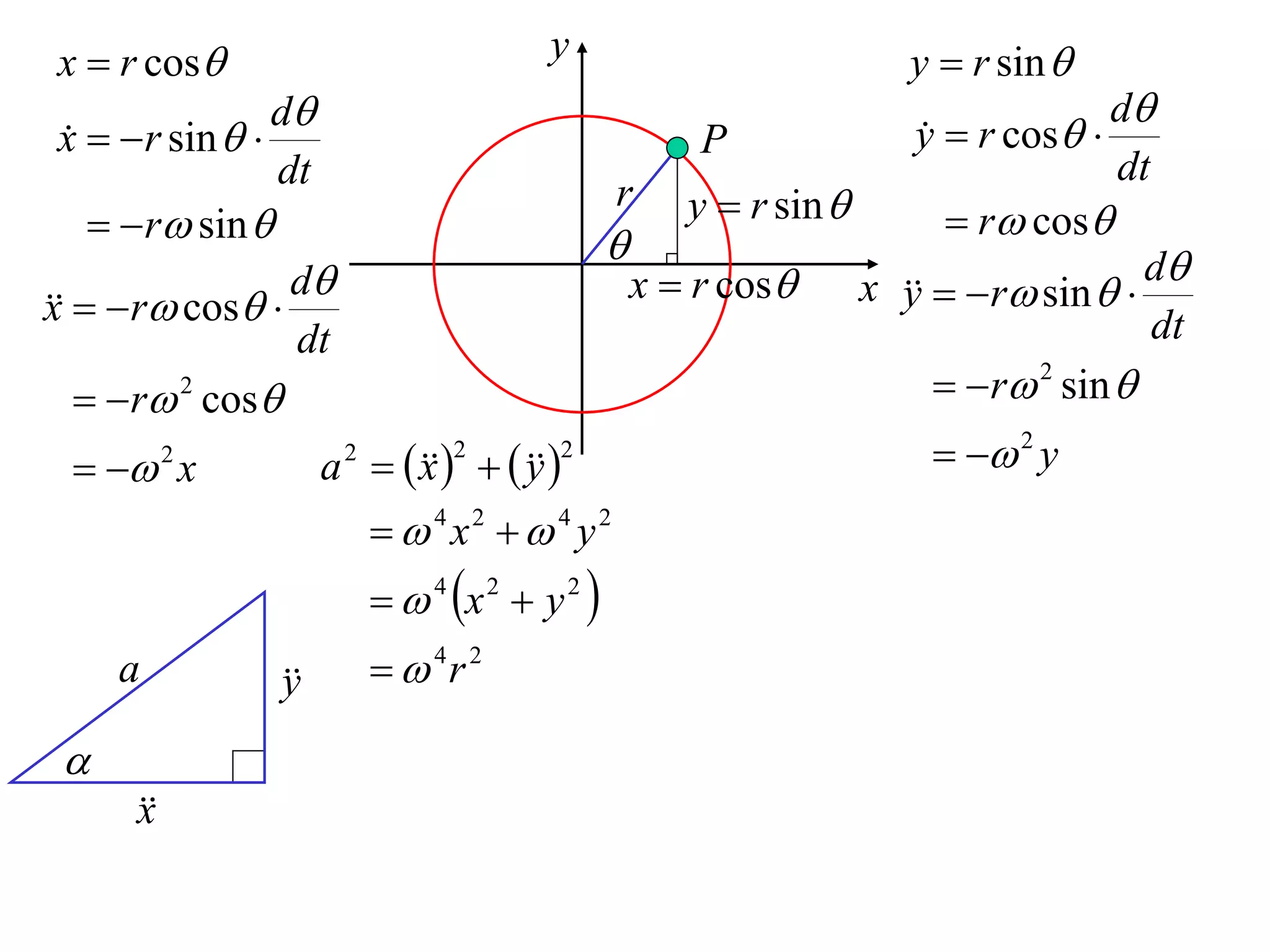
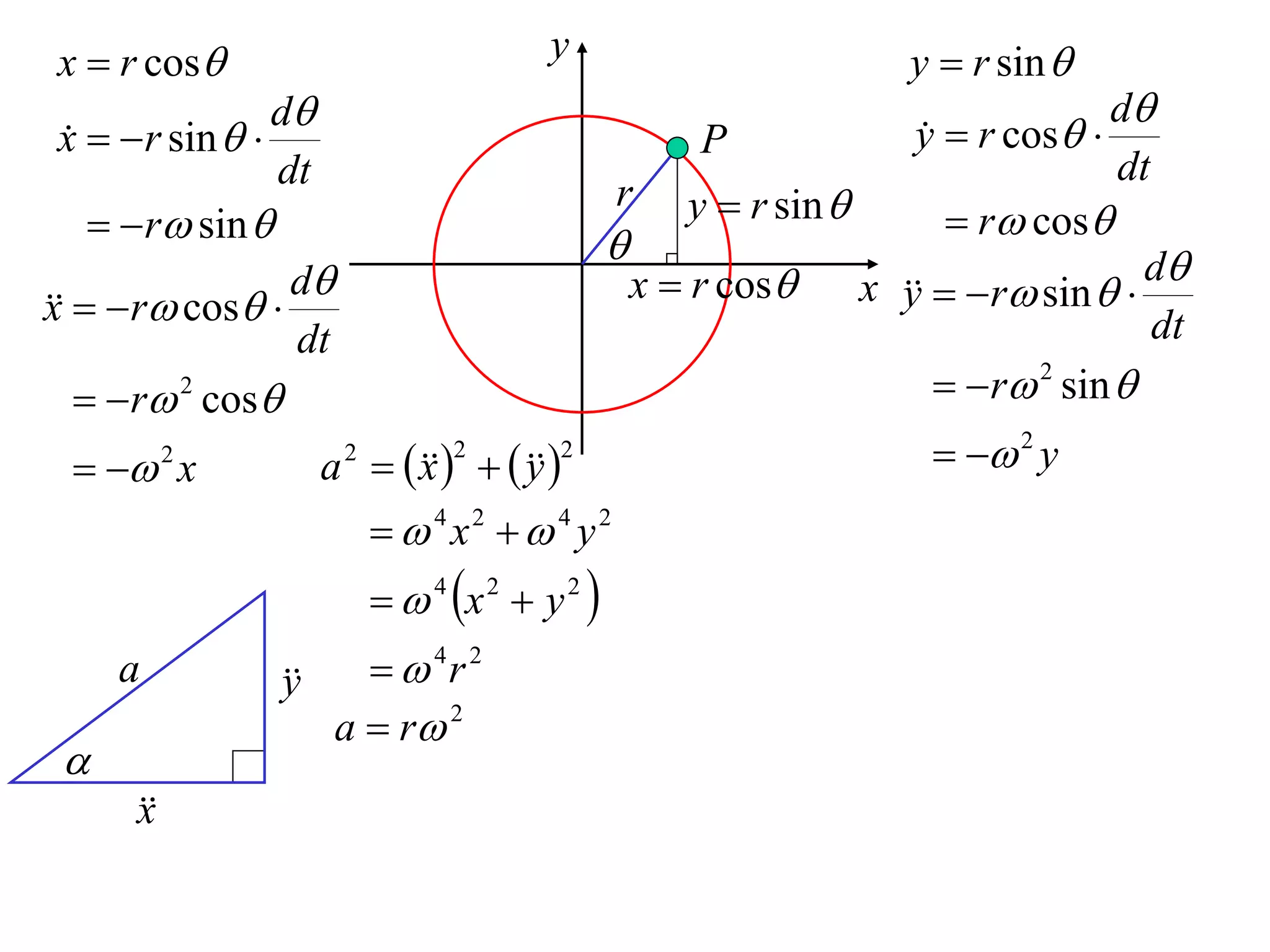
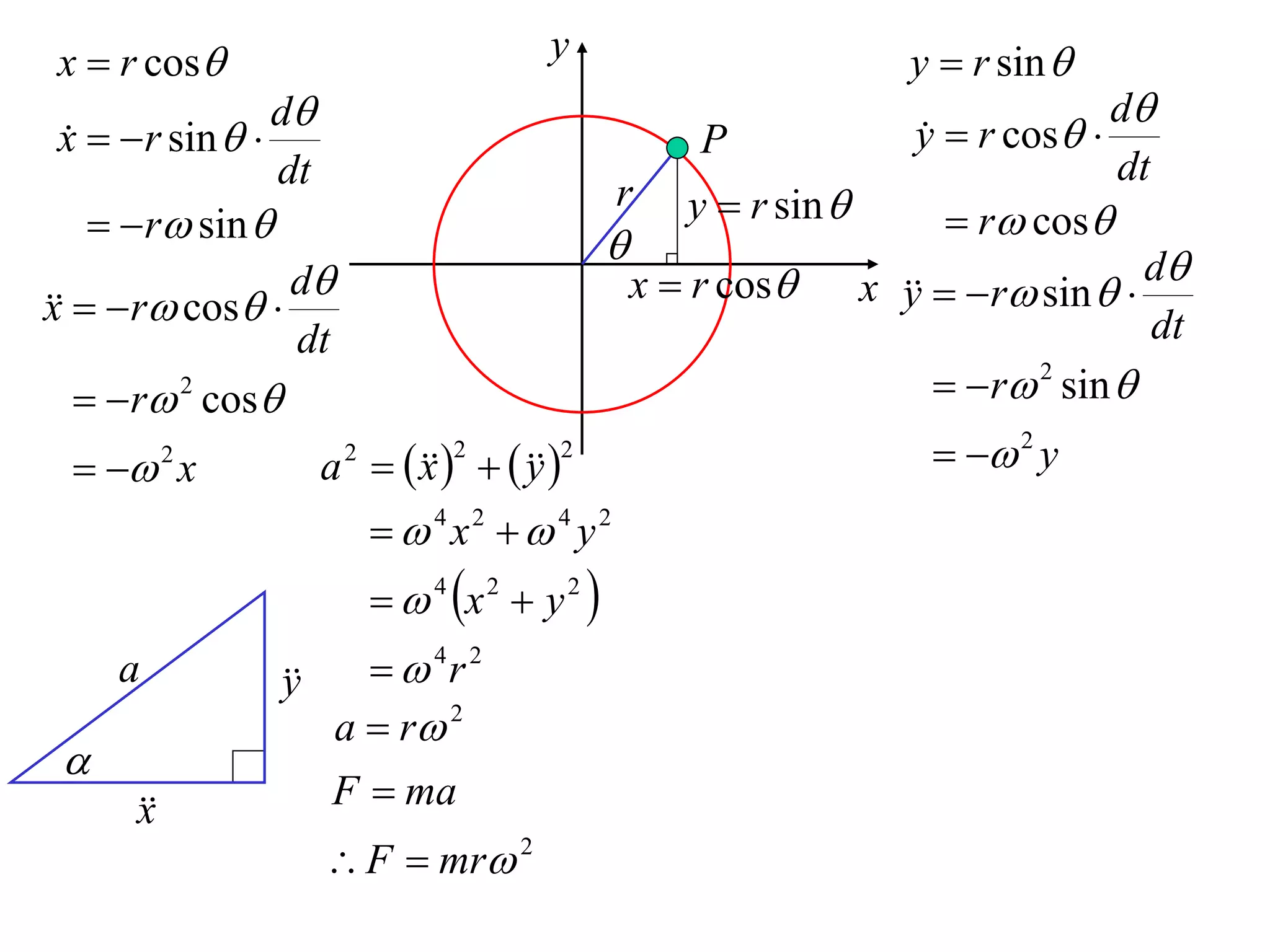
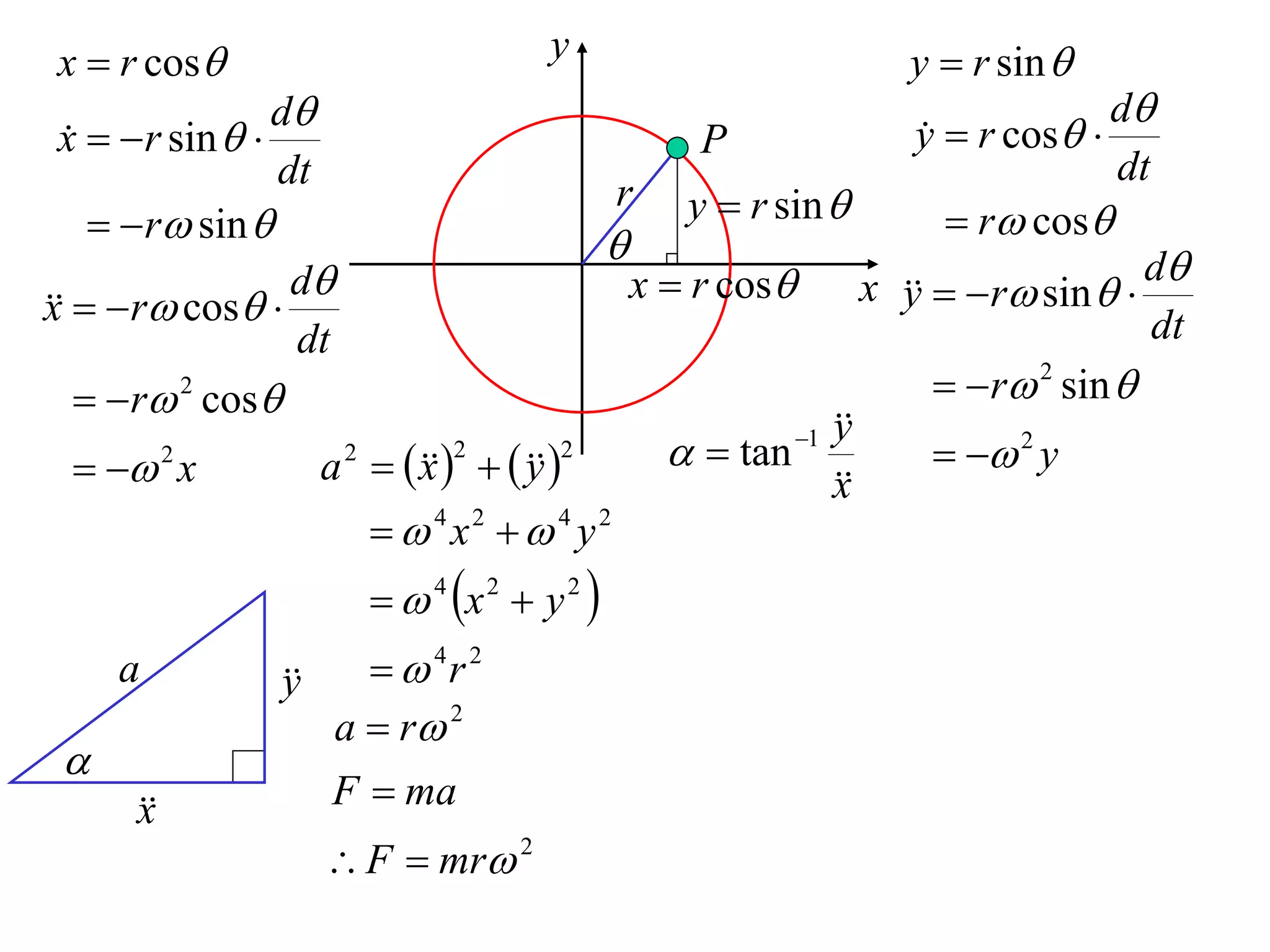
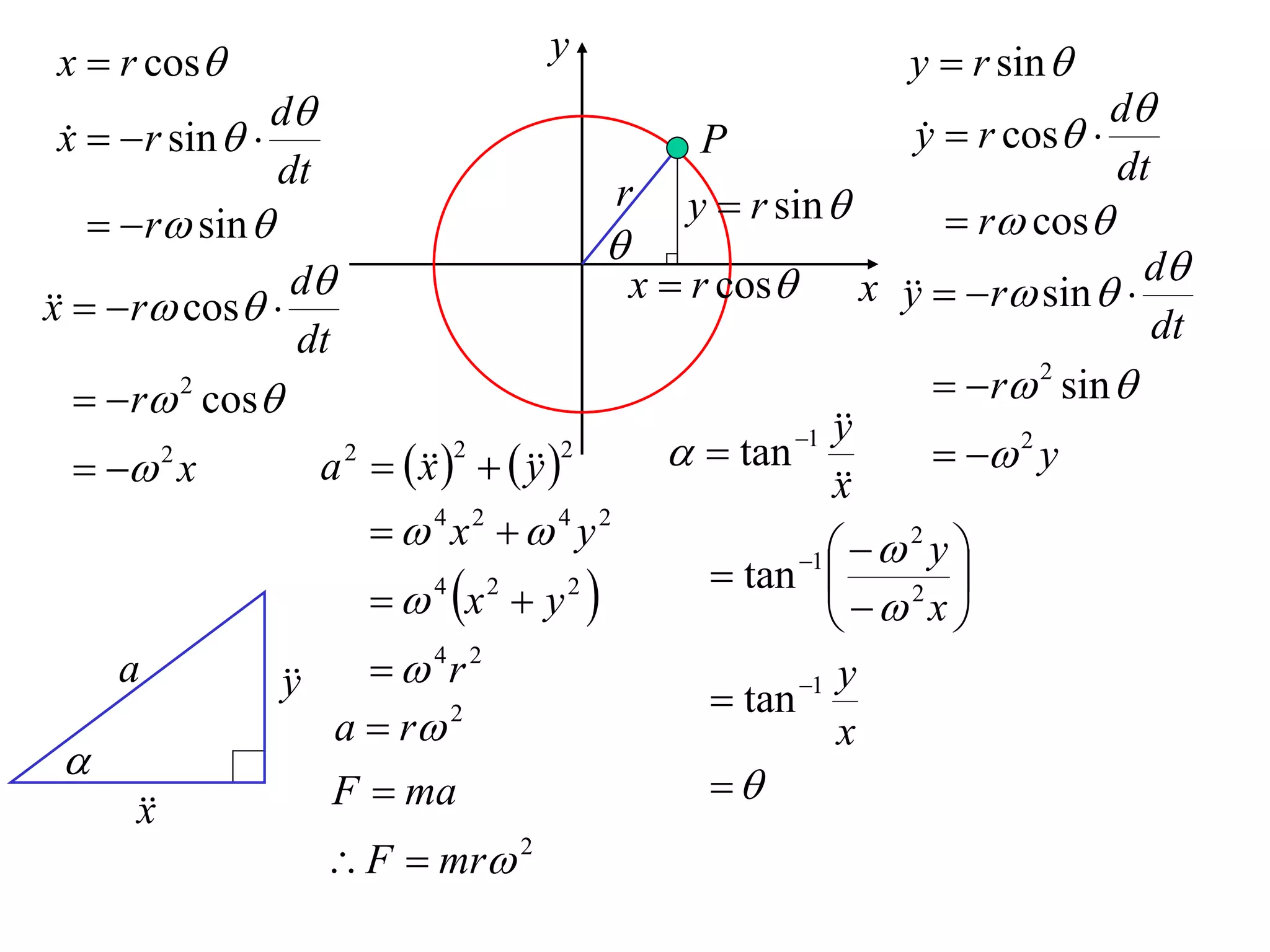
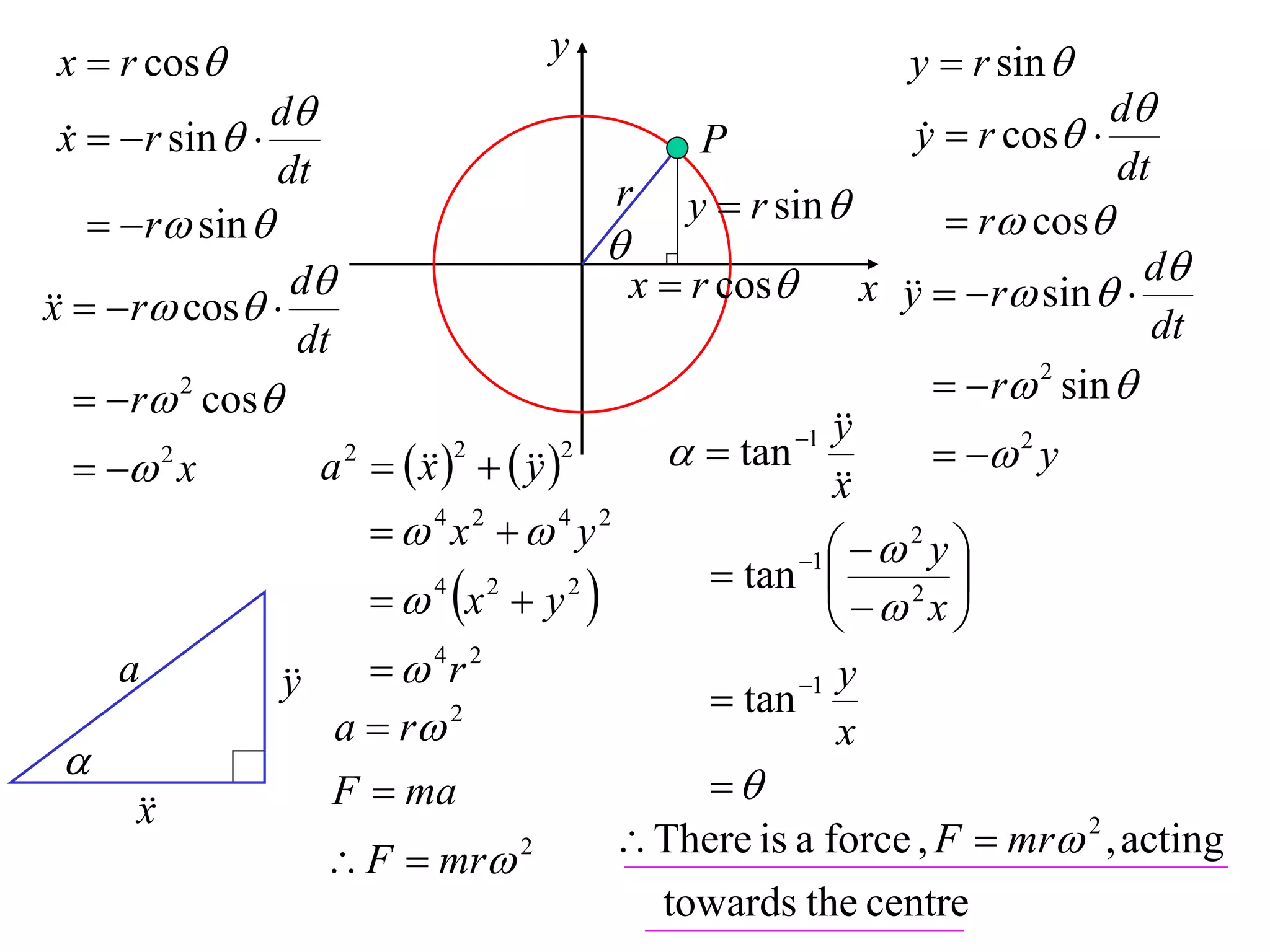
e.g. (i) (2003)
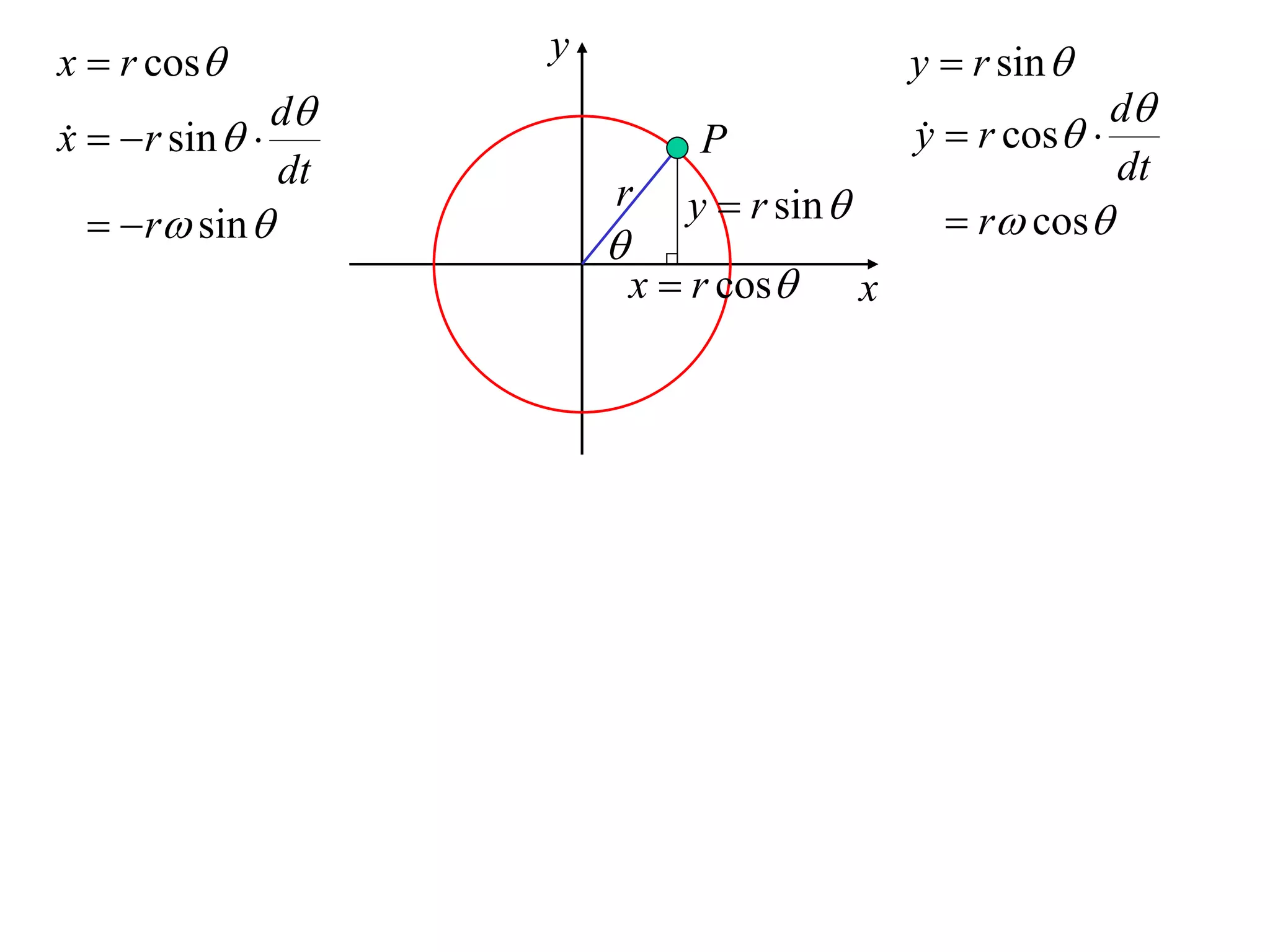
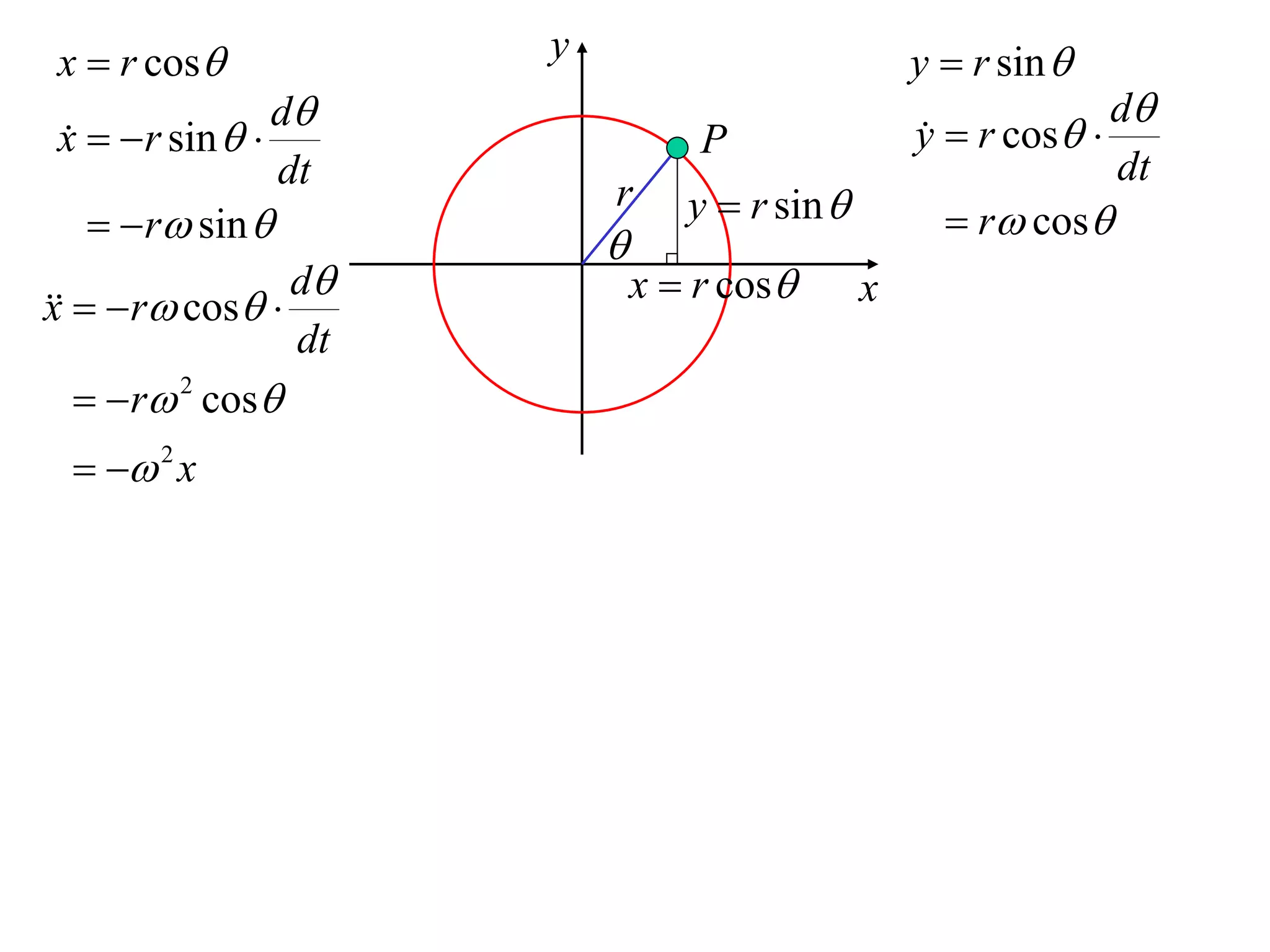
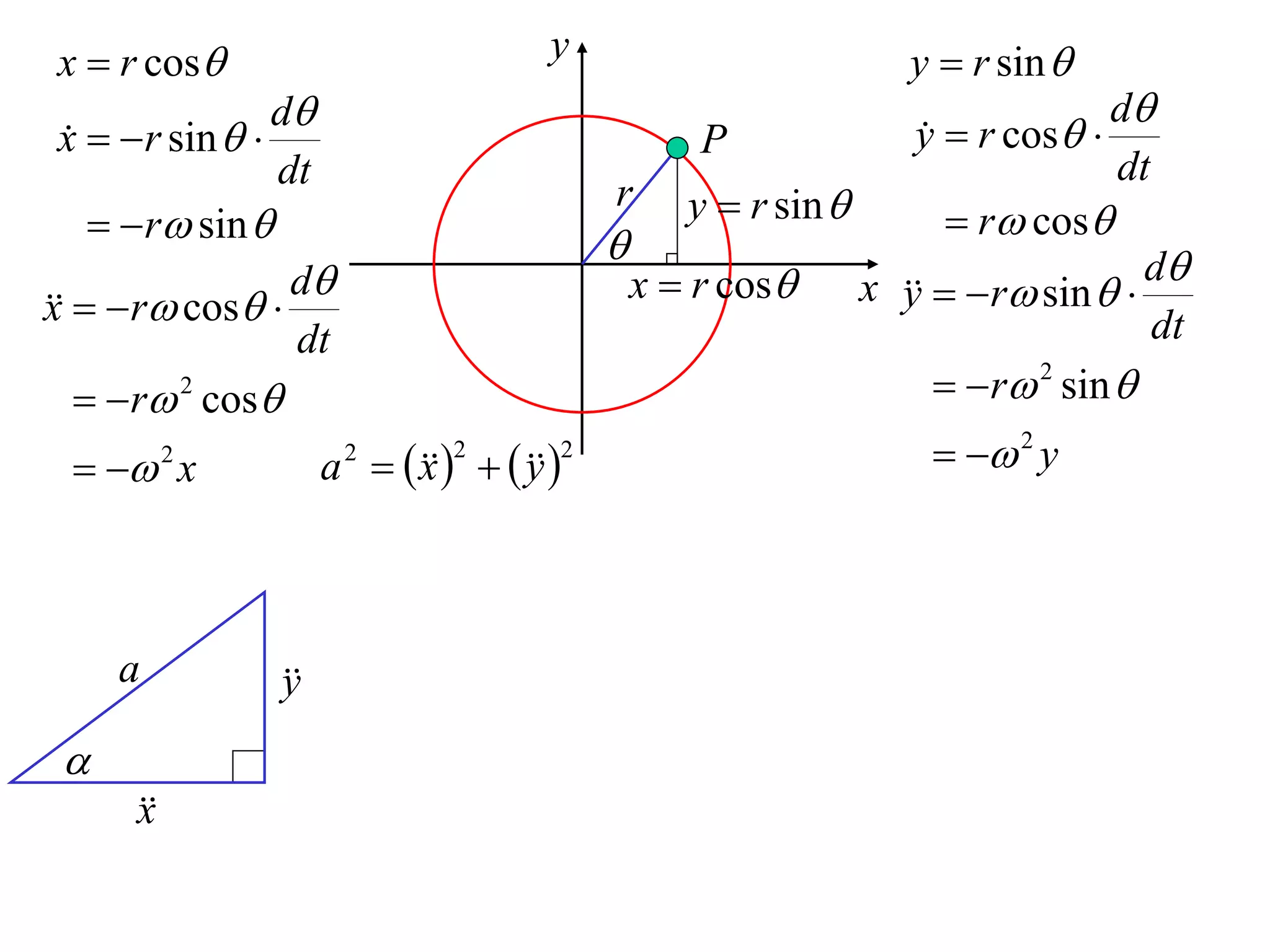
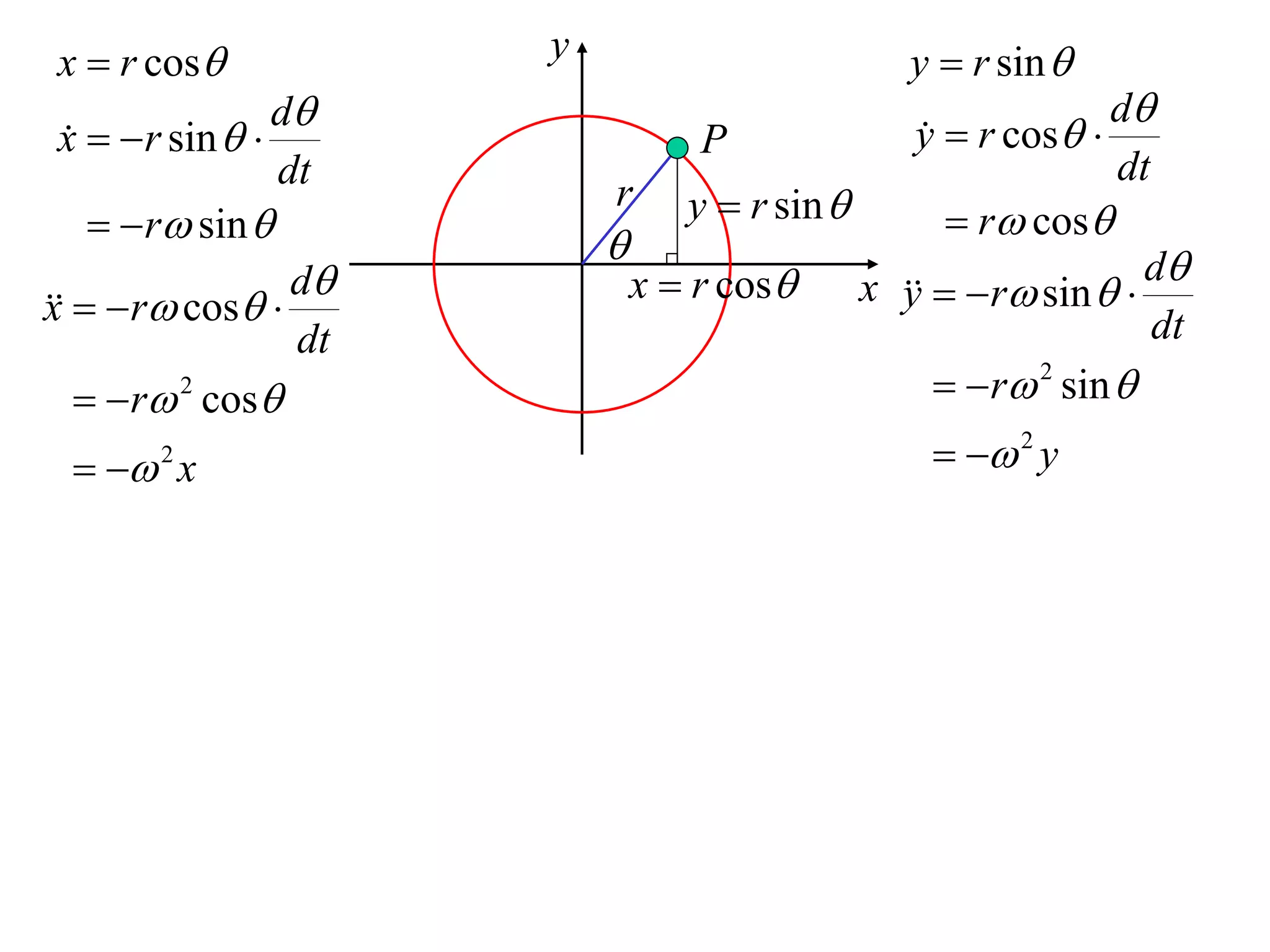
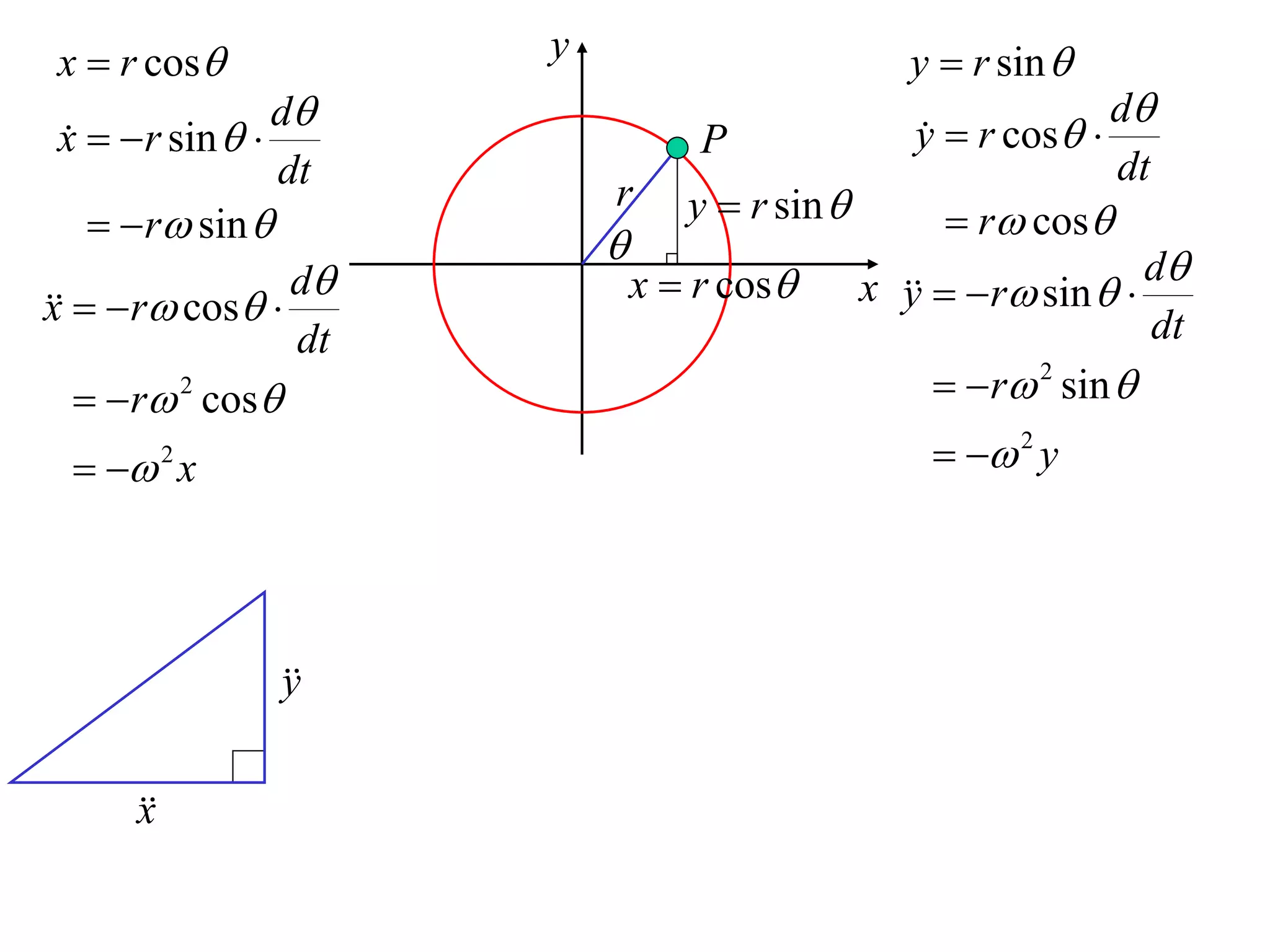
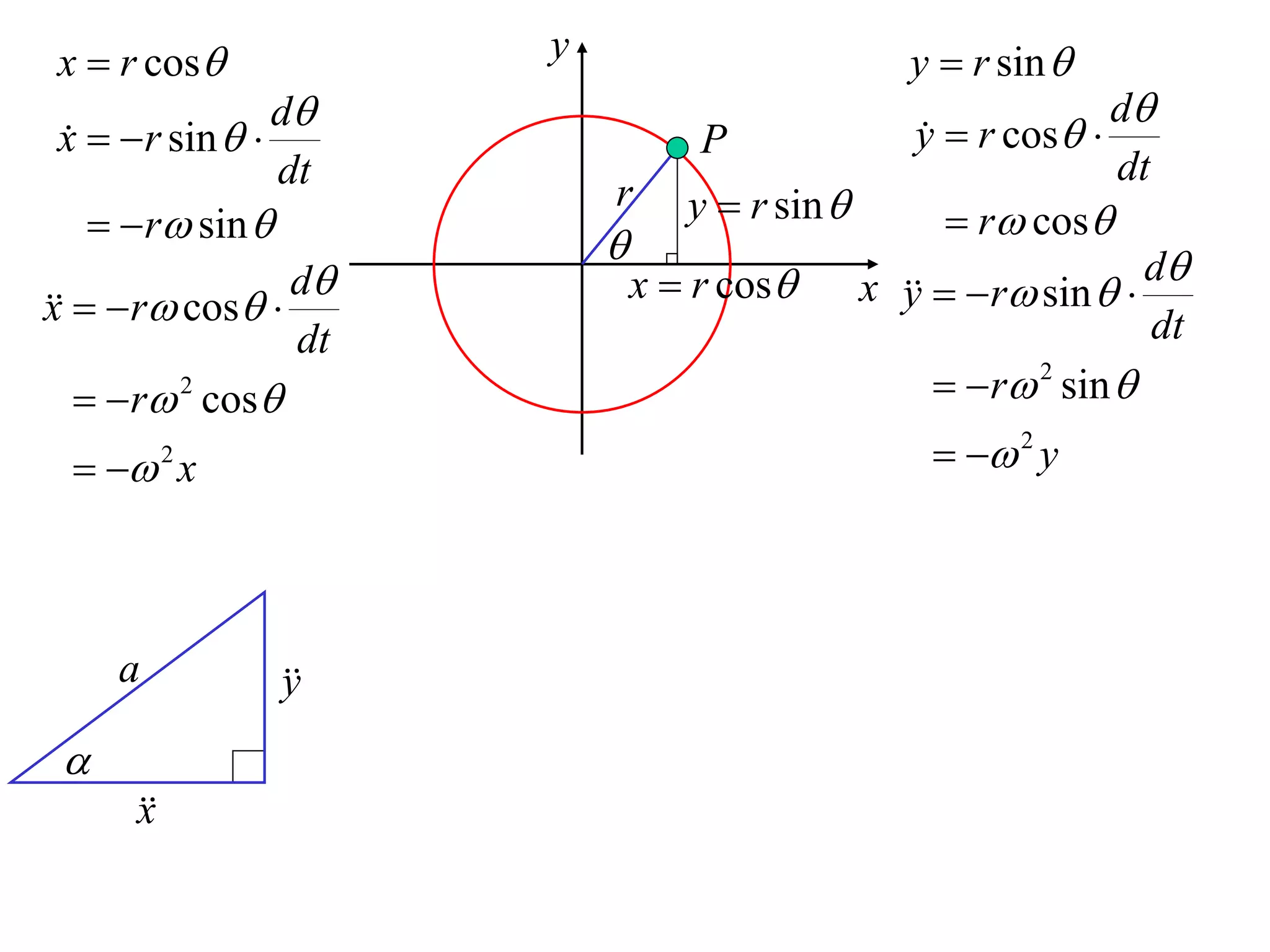
         A particle P of mass m moves with constant angular velocity 
         on a circle of radius r. Its position at time t is given by;
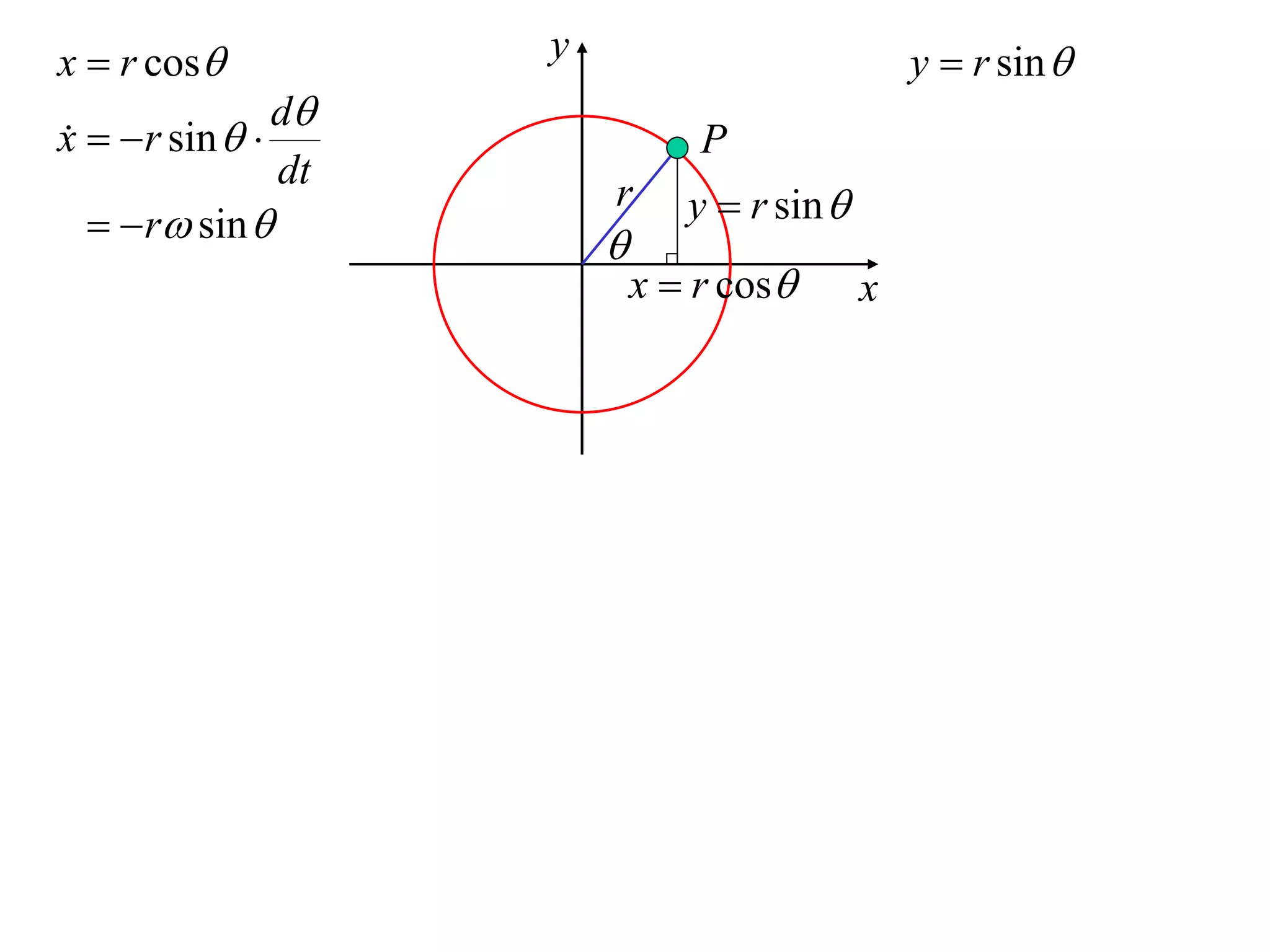
                         x  r cos
                         y  r sin  ,   where   t
Acceleration Involved in                 Forces Involved in
    Uniform Circular Motion                Uniform Circular Motion
               v2                                    mv 2
           a                                    F
                r                                      r
              OR                                     OR
            a  r 2                              F  mr 2
 e.g. (i) (2003)
          A particle P of mass m moves with constant angular velocity 
          on a circle of radius r. Its position at time t is given by;
                          x  r cos
                          y  r sin  ,   where   t
a) Show that there is an inward radial force of magnitude mr 2 acting
   on P.
y

            P
    r      y  r sin 
    
        x  r cos       x
x  r cos   y

                         P
                 r      y  r sin 
                 
                     x  r cos       x
x  r cos   y                            y  r sin 
                         P
                 r      y  r sin 
                 
                     x  r cos       x
x  r cos           y                            y  r sin 
                d
x   r sin  
                                P
                dt
                         r      y  r sin 
    r sin 
                         
                             x  r cos       x
x  r cos           y                            y  r sin 
                d                                               d
x   r sin  
                                P                y  r cos 
                                                  
                dt                                               dt
                         r      y  r sin 
    r sin                                        r cos
                         
                             x  r cos       x
x  r cos            y                            y  r sin 
                 d                                                d
 x   r sin  
                                  P                y  r cos 
                                                    
                 dt                                                dt
                           r      y  r sin 
      r sin                                        r cos
                           
                  d           x  r cos       x
   r cos 
x
                  dt
     r 2 cos
    2 x
x  r cos            y                           y  r sin 
                 d                                               d
 x   r sin  
                                  P               y  r cos 
                                                   
                 dt                                               dt
                           r      y  r sin 
      r sin                                       r cos
                           
   r cos 
x
                  d           x  r cos       x    r sin   d
                                                  y
                  dt                                                dt
     r 2 cos                                       r 2 sin 
    x2                                             2 y
x  r cos            y                           y  r sin 
                 d                                               d
 x   r sin  
                                  P               y  r cos 
                                                   
                 dt                                               dt
                           r      y  r sin 
      r sin                                       r cos
                           
   r cos 
x
                  d           x  r cos       x    r sin   d
                                                  y
                  dt                                                dt
     r 2 cos                                       r 2 sin 
    x   2                                          2 y


                y
                


      x
      
x  r cos            y                           y  r sin 
                 d                                               d
 x   r sin  
                                  P               y  r cos 
                                                   
                 dt                                               dt
                           r      y  r sin 
      r sin                                       r cos
                           
   r cos 
x
                  d           x  r cos       x    r sin   d
                                                  y
                  dt                                                dt
     r 2 cos                                       r 2 sin 
    x   2                                          2 y


     a          y
                
 
      x
      
x  r cos                         y                           y  r sin 
                 d                                                            d
 x   r sin  
                                               P               y  r cos 
                                                                
                 dt                                                            dt
                                        r      y  r sin 
      r sin                                                    r cos
                                        
   r cos 
x
                  d                        x  r cos       x    r sin   d
                                                               y
                  dt                                                             dt
     r 2 cos                                                    r 2 sin 
    x   2
                     a     
                       2
                          x
                             2
                                  y
                                    2                              2 y


     a          y
                
 
      x
      
x  r cos                              y                              y  r sin 
                 d                                                                    d
 x   r sin  
                                                       P               y  r cos 
                                                                        
                 dt                                                                    dt
                                                r      y  r sin 
      r sin                                                            r cos
                                                
   r cos 
x
                  d                                x  r cos       x    r sin   d
                                                                       y
                  dt                                                                     dt
     r 2 cos                                                            r 2 sin 
    x   2
                     a     
                       2
                          x
                                 2
                                  y
                                         2                                 2 y
                             4 x2   4 y2
                             4 x 2  y 2 
     a          y
                           4r 2

 
      x
      
x  r cos                              y                              y  r sin 
                 d                                                                    d
 x   r sin  
                                                       P               y  r cos 
                                                                        
                 dt                                                                    dt
                                                r      y  r sin 
      r sin                                                            r cos
                                                
   r cos 
x
                  d                                x  r cos       x    r sin   d
                                                                       y
                  dt                                                                     dt
     r 2 cos                                                            r 2 sin 
    x   2
                   a     
                       2
                        x       y
                                 2       2                                 2 y
                             4 x2   4 y2
                             4 x 2  y 2 
     a          y
                     4r 2
                   a  r 2
 
      x
      
x  r cos                              y                              y  r sin 
                 d                                                                    d
 x   r sin  
                                                       P               y  r cos 
                                                                        
                 dt                                                                    dt
                                                r      y  r sin 
      r sin                                                            r cos
                                                
   r cos 
x
                  d                                x  r cos       x    r sin   d
                                                                       y
                  dt                                                                     dt
     r 2 cos                                                            r 2 sin 
    x   2
                   a     
                       2
                        x       y
                                 2       2                                 2 y
                             4 x2   4 y2
                             4 x 2  y 2 
     a          y
                     4r 2
                   a  r 2
 
      x
                 F  ma
                    F  mr 2
x  r cos                              y                                 y  r sin 
                 d                                                                       d
 x   r sin  
                                                       P                  y  r cos 
                                                                           
                 dt                                                                       dt
                                                r      y  r sin 
      r sin                                                               r cos
                                                
   r cos 
x
                  d                                x  r cos          x    r sin   d
                                                                          y
                  dt                                                                        dt
     r 2 cos                                                               r 2 sin 
                                                                   y
                                                                   
    x   2
                   a     
                       2
                        x       y
                                 2       2              tan 1              2 y
                                                                   x
                                                                   
                             4 x2   4 y2
                             4 x 2  y 2 
     a          y
                     4r 2
                   a  r 2
 
      x
                 F  ma
                    F  mr 2
x  r cos                              y                                y  r sin 
                 d                                                                      d
 x   r sin  
                                                       P                 y  r cos 
                                                                          
                 dt                                                                      dt
                                                r      y  r sin 
      r sin                                                              r cos
                                                
   r cos 
x
                  d                                x  r cos         x    r sin   d
                                                                         y
                  dt                                                                       dt
     r 2 cos                                                              r 2 sin 
                                                                 y
                                                                 
    x   2
                   a     
                       2
                        x       y
                                 2       2              tan 1          2 y
                                                                 x
                                                                 
                             4 x2   4 y2                       2 y 
                                                         tan 1         
                             4 x 2  y 2                       x 
                                                                      2


     a          y
                     4r 2                                      y
                                                         tan 1
                   a  r 2                                        x
 
                   F  ma                               
      x
      
                    F  mr 2
x  r cos                              y                                y  r sin 
                 d                                                                      d
 x   r sin  
                                                       P                 y  r cos 
                                                                          
                 dt                                                                      dt
                                                r      y  r sin 
      r sin                                                              r cos
                                                
   r cos 
x
                  d                                x  r cos         x    r sin   d
                                                                         y
                  dt                                                                       dt
     r 2 cos                                                              r 2 sin 
                                                                 y
                                                                 
    x   2
                   a     
                       2
                        x       y
                                 2       2              tan 1          2 y
                                                                 x
                                                                 
                             4 x2   4 y2                       2 y 
                                                         tan 1         
                             4 x 2  y 2                       x 
                                                                      2


     a          y
                     4r 2                                      y
                                                         tan 1
                   a  r 2                                        x
 
                   F  ma                            
      x
      
                    F  mr 2                   There is a force , F  mr 2 , acting
                                                  towards the centre
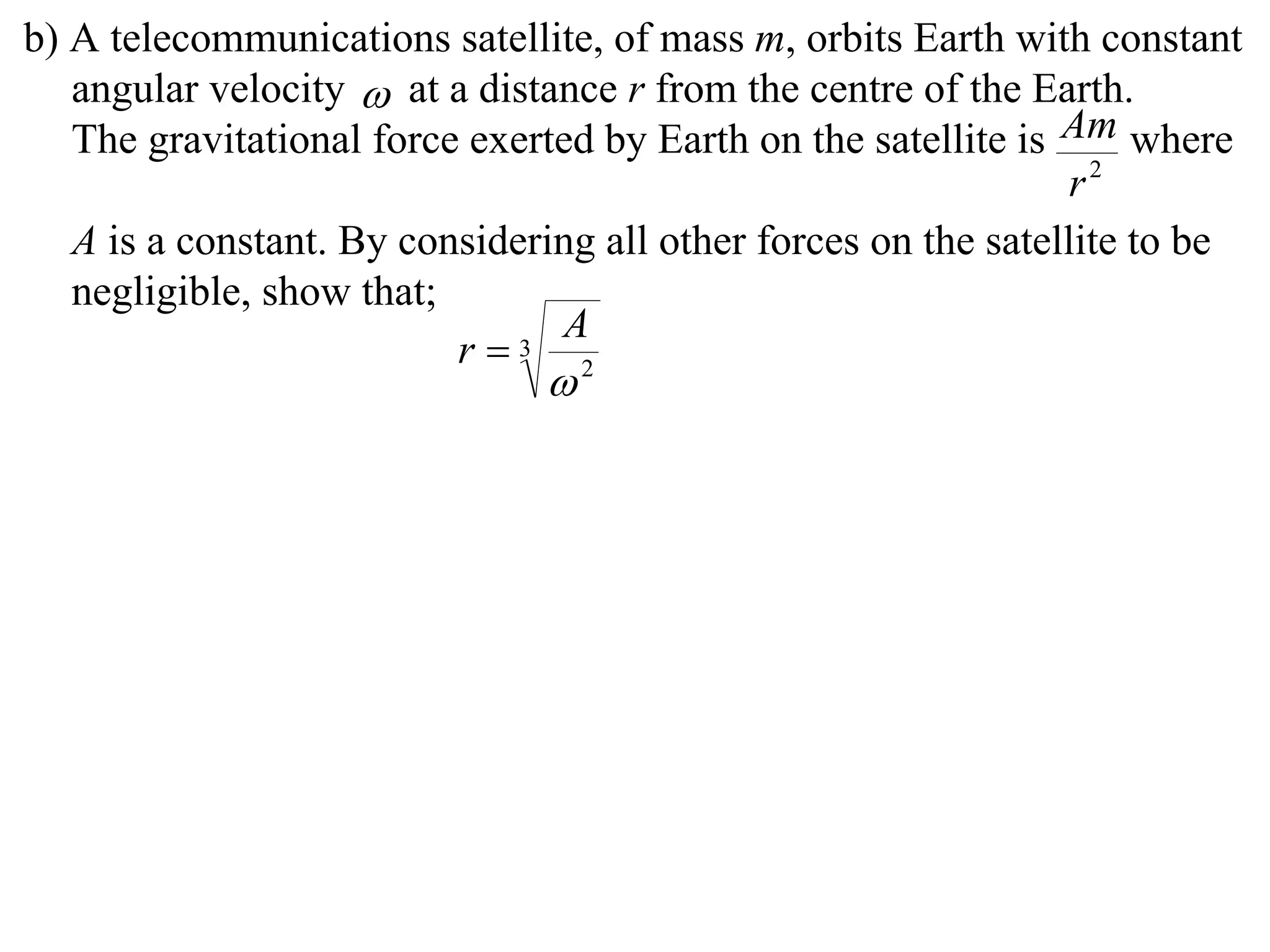
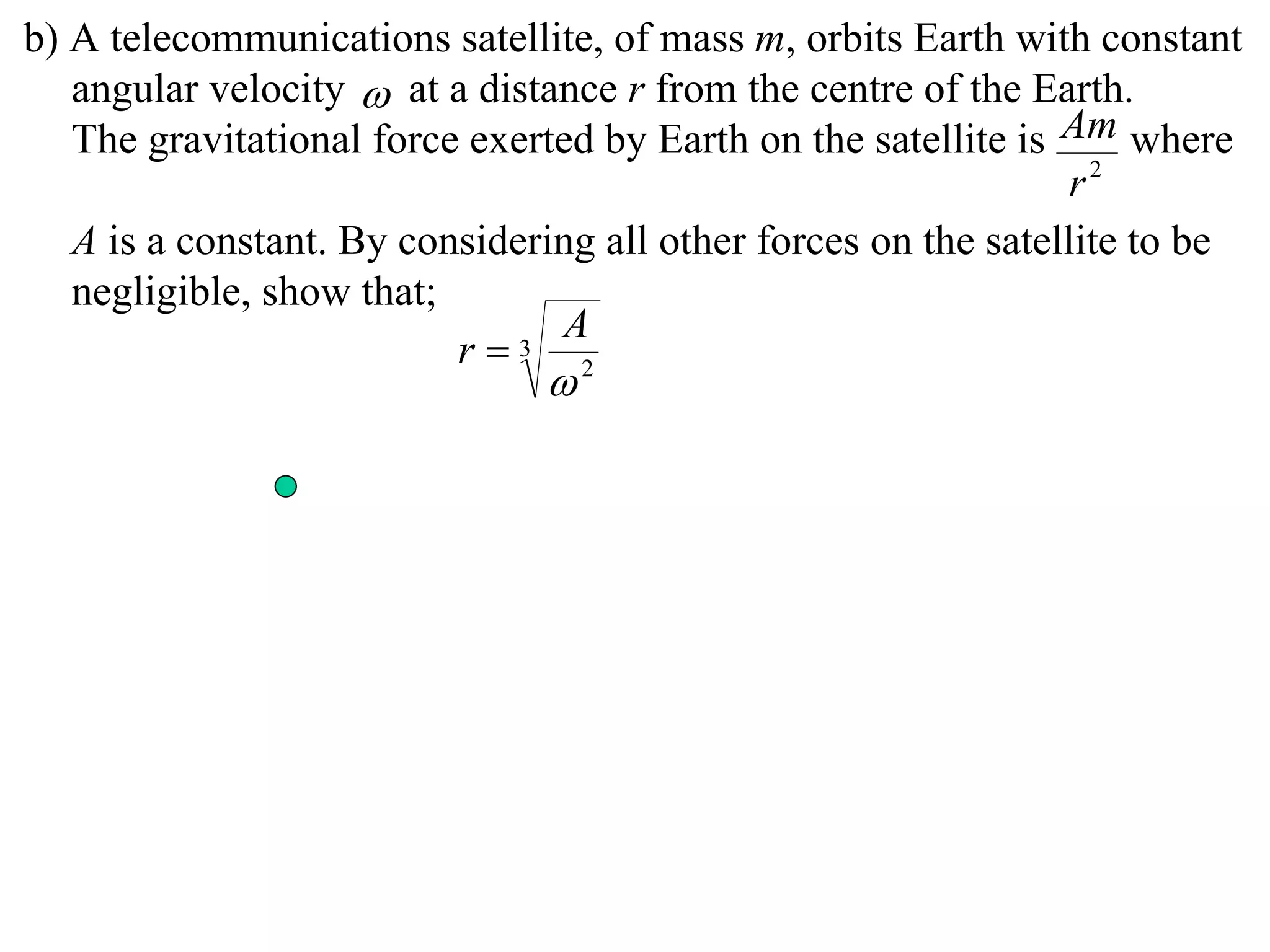
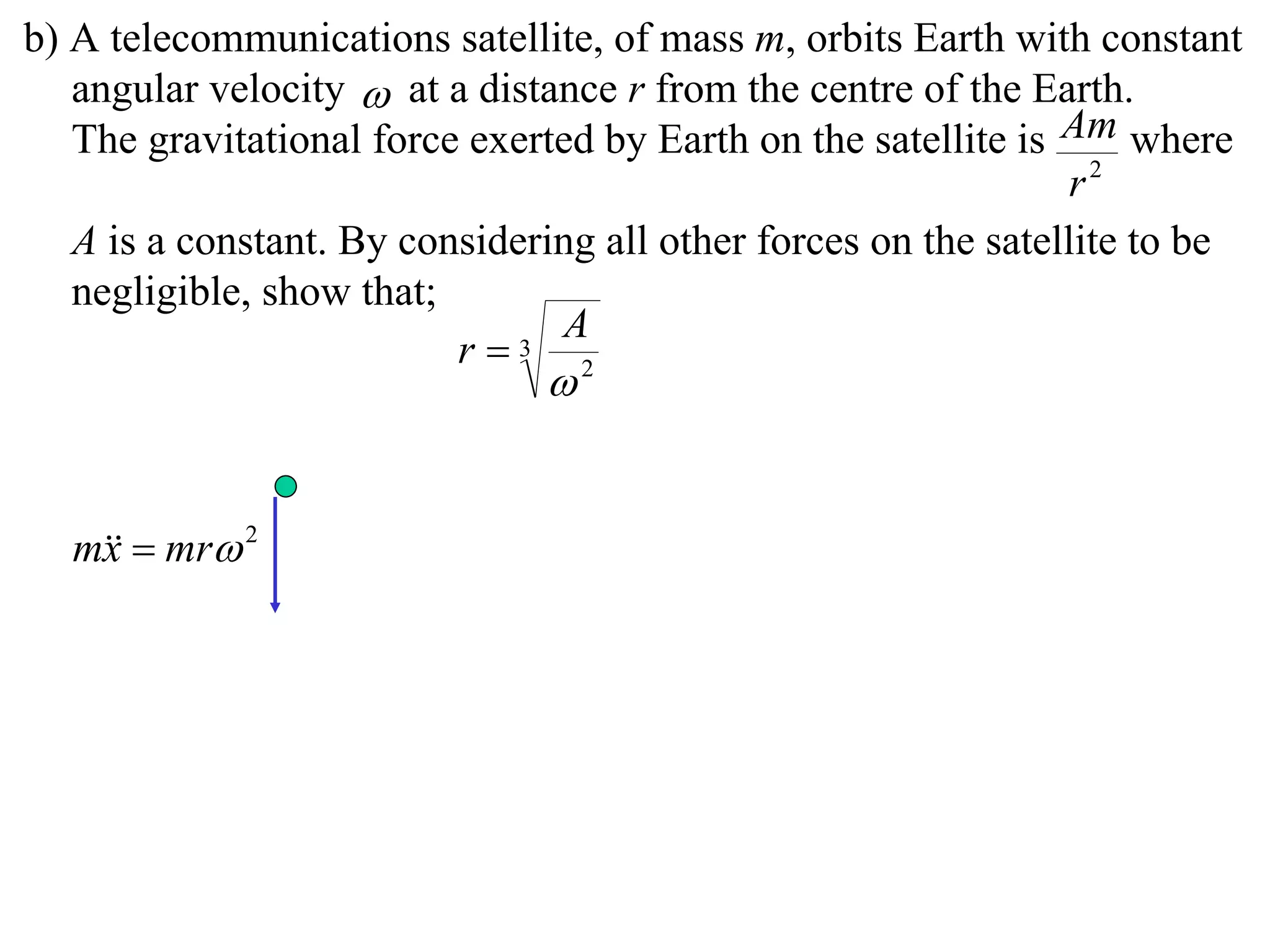
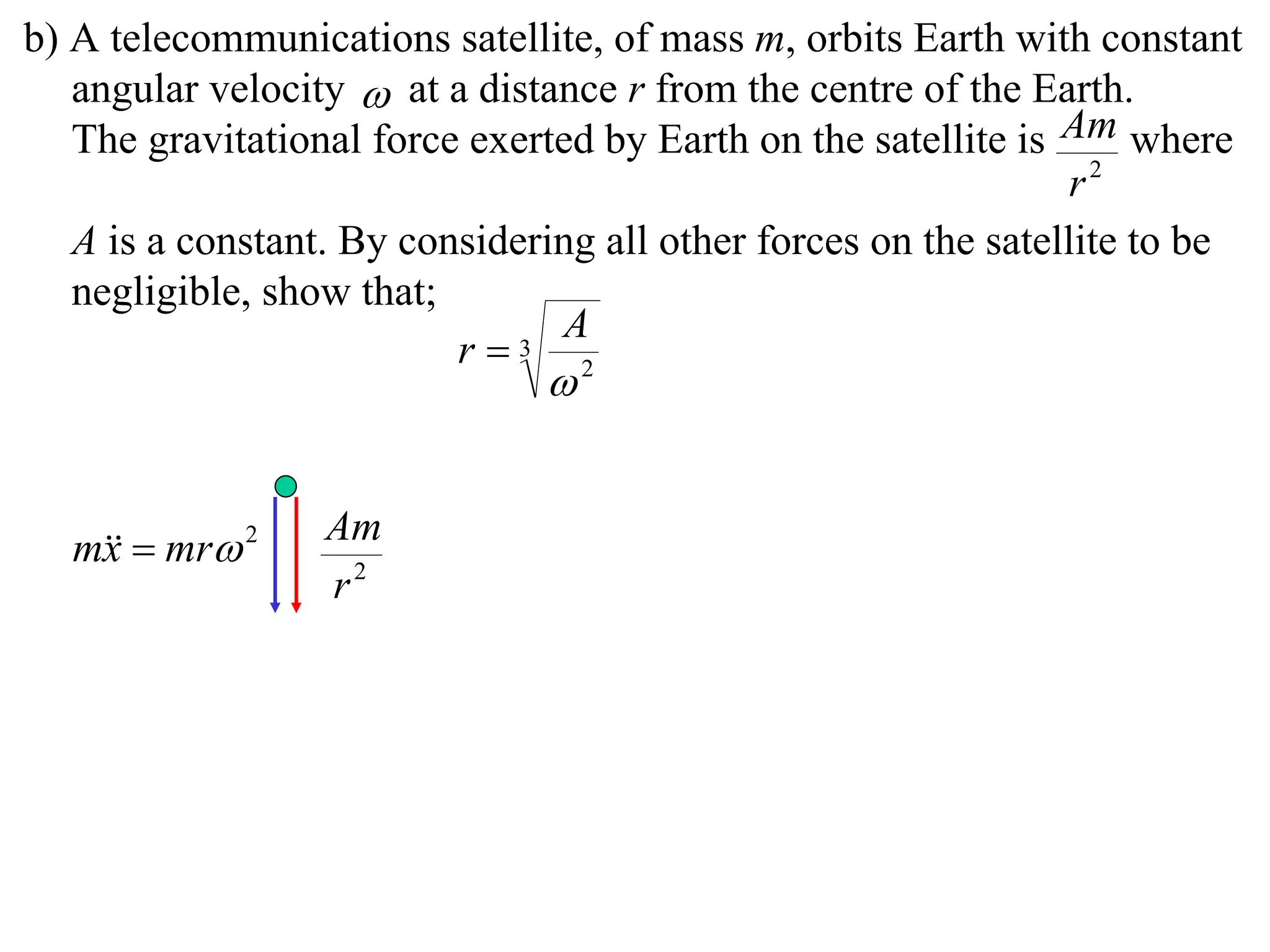
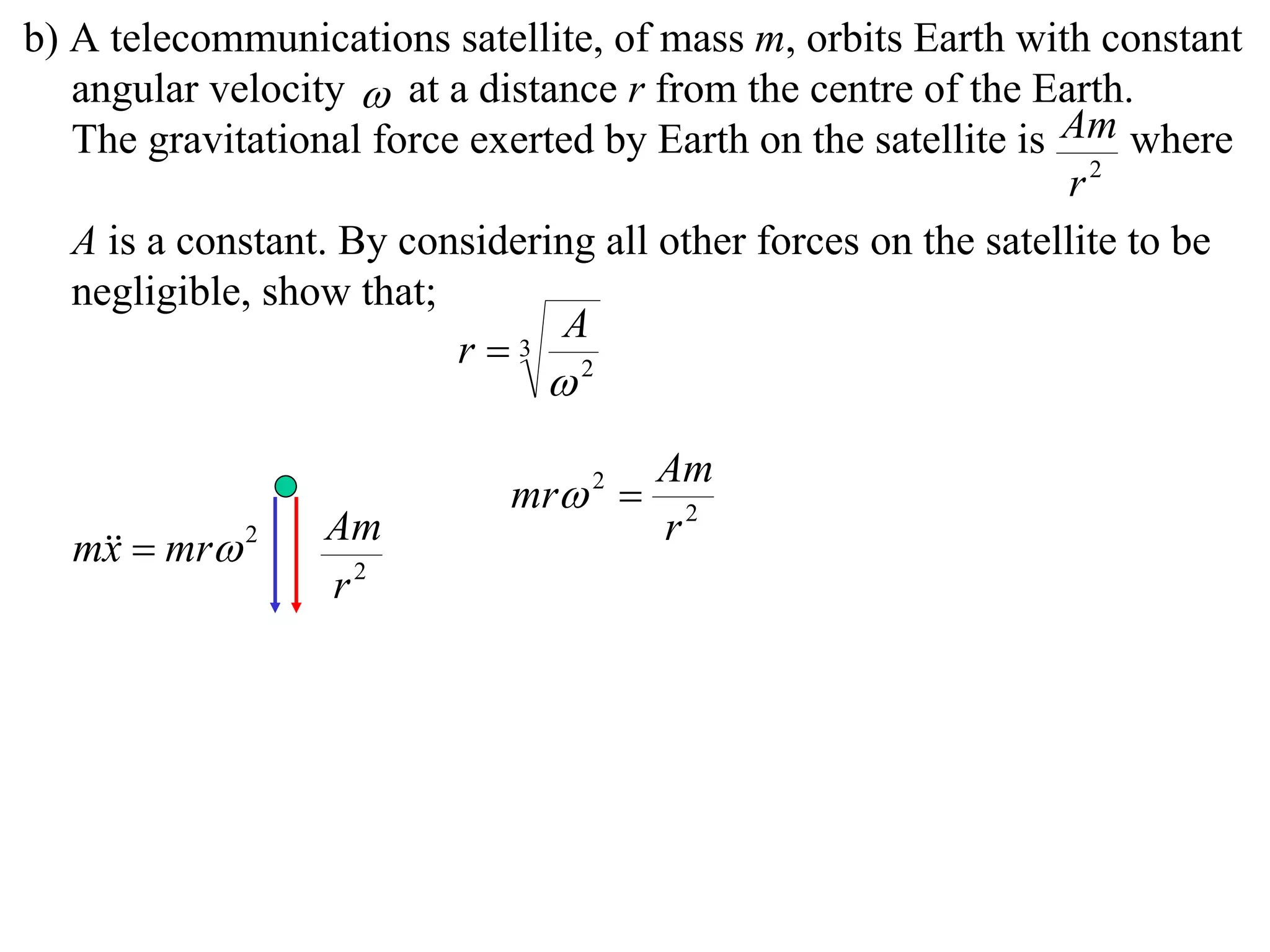
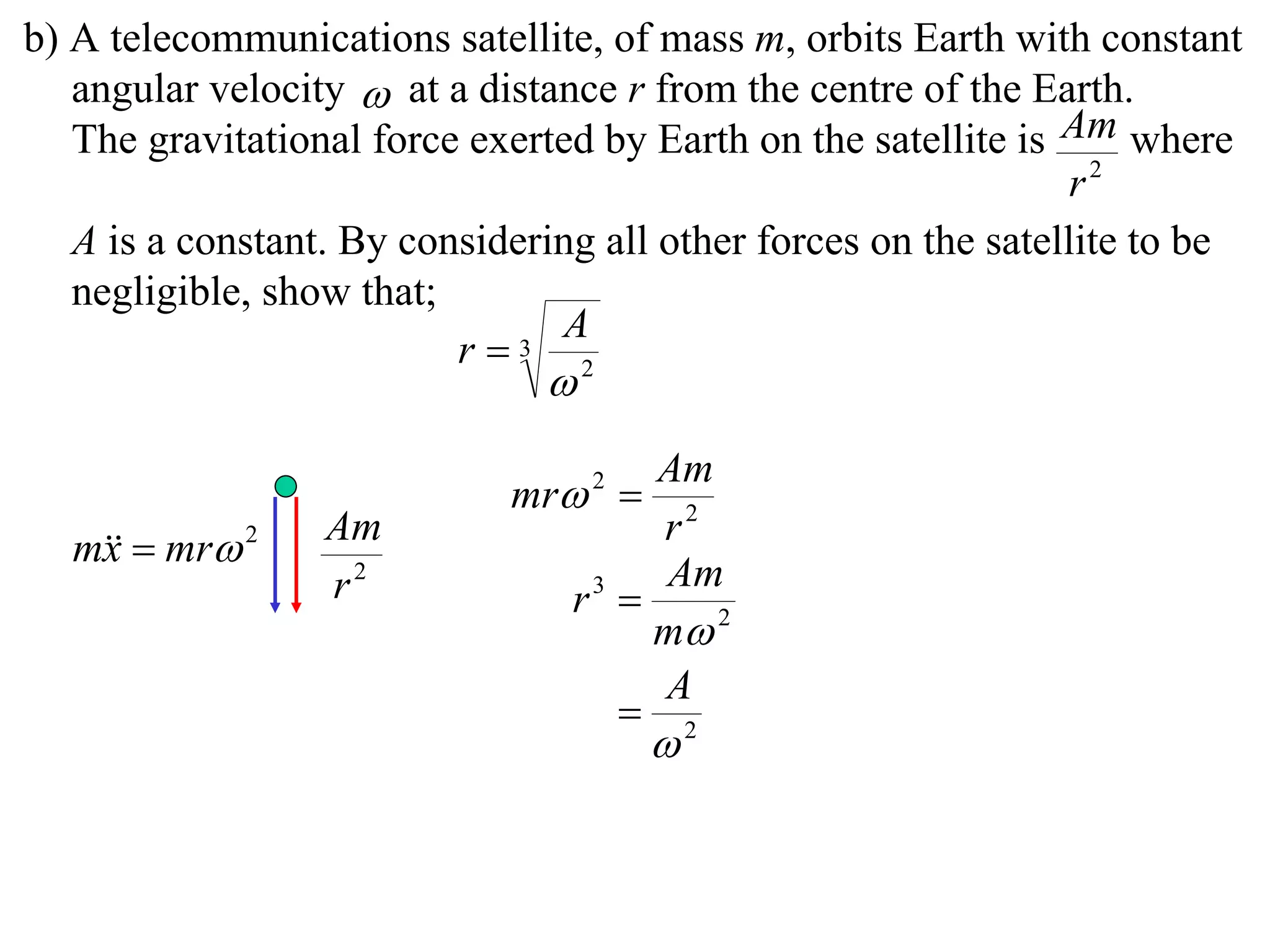
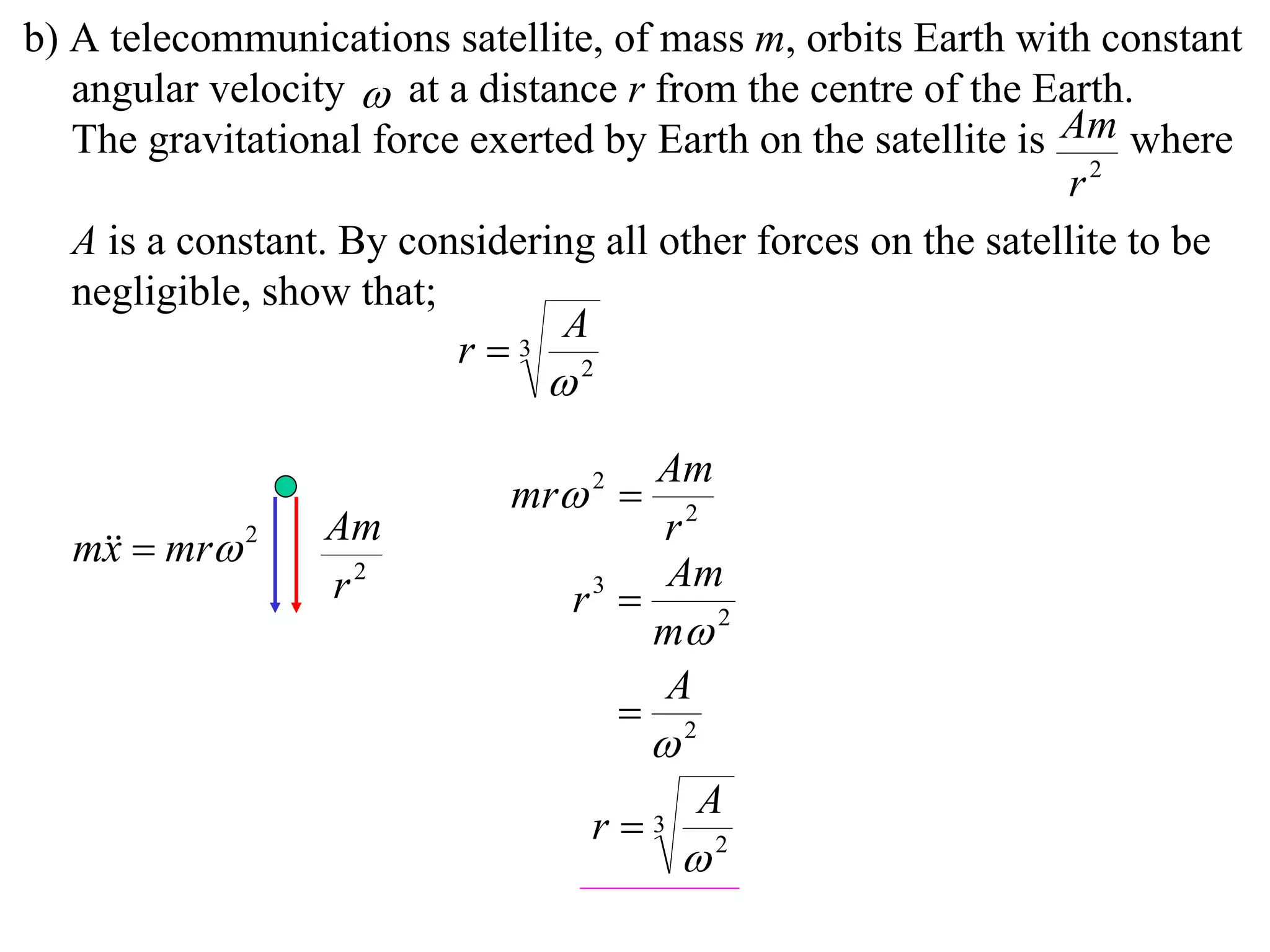
b) A telecommunications satellite, of mass m, orbits Earth with constant
   angular velocity  at a distance r from the centre of the Earth.
   The gravitational force exerted by Earth on the satellite is Am where
                                                                 r2
   A is a constant. By considering all other forces on the satellite to be
   negligible, show that;
                                A
                          r  3
                                2
b) A telecommunications satellite, of mass m, orbits Earth with constant
   angular velocity  at a distance r from the centre of the Earth.
   The gravitational force exerted by Earth on the satellite is Am where
                                                                 r2
   A is a constant. By considering all other forces on the satellite to be
   negligible, show that;
                                A
                          r  3
                                2
b) A telecommunications satellite, of mass m, orbits Earth with constant
   angular velocity  at a distance r from the centre of the Earth.
   The gravitational force exerted by Earth on the satellite is Am where
                                                                 r2
   A is a constant. By considering all other forces on the satellite to be
   negligible, show that;
                                A
                          r  3
                                2


  m  mr 2
   x
b) A telecommunications satellite, of mass m, orbits Earth with constant
   angular velocity  at a distance r from the centre of the Earth.
   The gravitational force exerted by Earth on the satellite is Am where
                                                                 r2
   A is a constant. By considering all other forces on the satellite to be
   negligible, show that;
                                A
                          r  3
                                2


                  Am
  m  mr 2
   x
                  r2
b) A telecommunications satellite, of mass m, orbits Earth with constant
   angular velocity  at a distance r from the centre of the Earth.
   The gravitational force exerted by Earth on the satellite is Am where
                                                                 r2
   A is a constant. By considering all other forces on the satellite to be
   negligible, show that;
                                A
                          r  3
                                2


                                       Am
                             mr 2 
                  Am                   r2
  m  mr 2
   x
                  r2
b) A telecommunications satellite, of mass m, orbits Earth with constant
   angular velocity  at a distance r from the centre of the Earth.
   The gravitational force exerted by Earth on the satellite is Am where
                                                                 r2
   A is a constant. By considering all other forces on the satellite to be
   negligible, show that;
                                A
                          r  3
                                2


                                      Am
                             mr 2 
                  Am                  r2
  m  mr 2
   x
                  r2                  Am
                                 r3 
                                      m 2
                                      A
                                     2
                                       
b) A telecommunications satellite, of mass m, orbits Earth with constant
   angular velocity  at a distance r from the centre of the Earth.
   The gravitational force exerted by Earth on the satellite is Am where
                                                                 r2
   A is a constant. By considering all other forces on the satellite to be
   negligible, show that;
                                A
                          r  3
                                2


                                      Am
                             mr 2 
                  Am                  r2
  m  mr 2
   x
                  r2                  Am
                                 r3 
                                      m 2
                                      A
                                     2
                                       
                                           A
                                   r3
                                           2
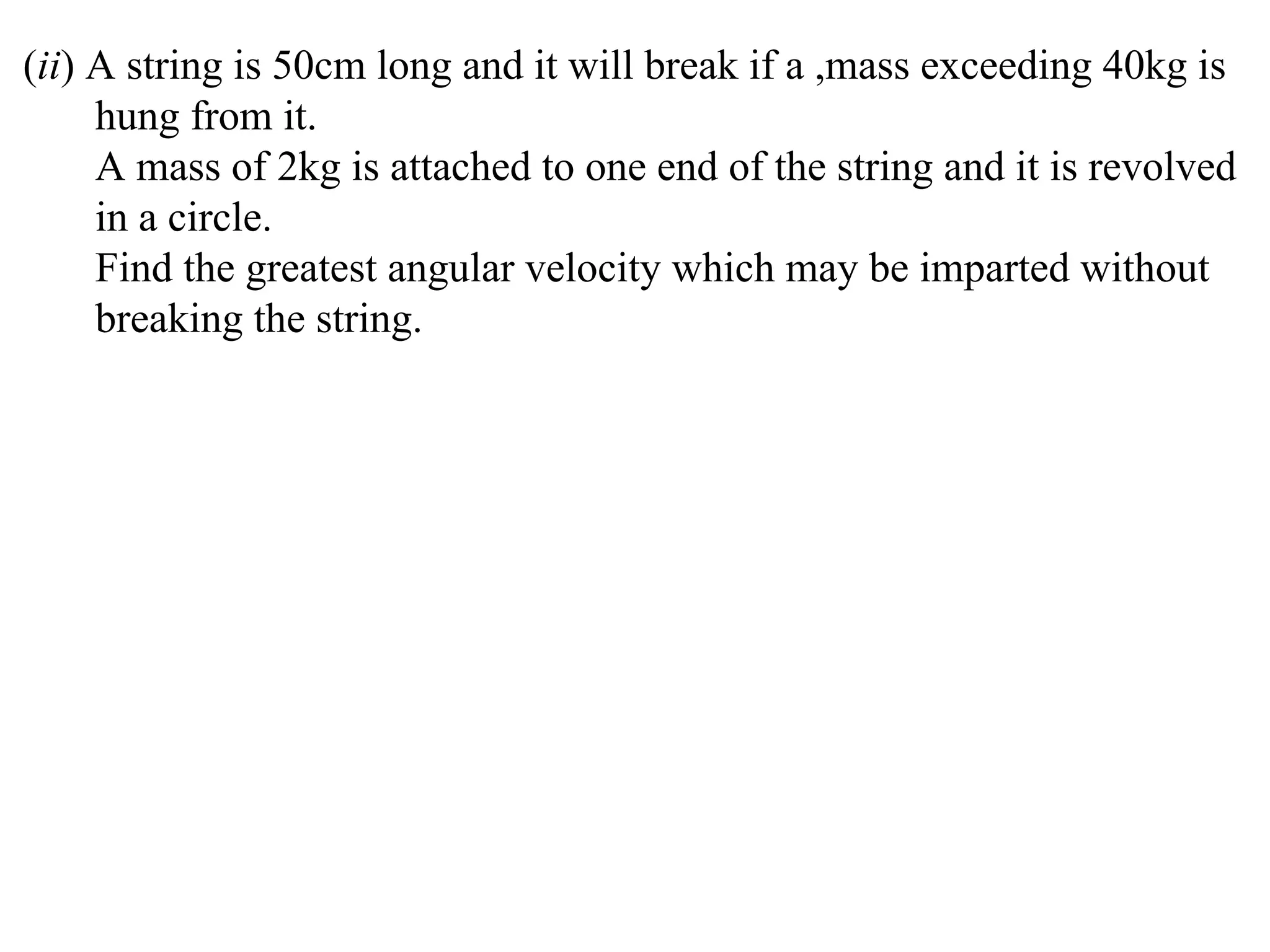
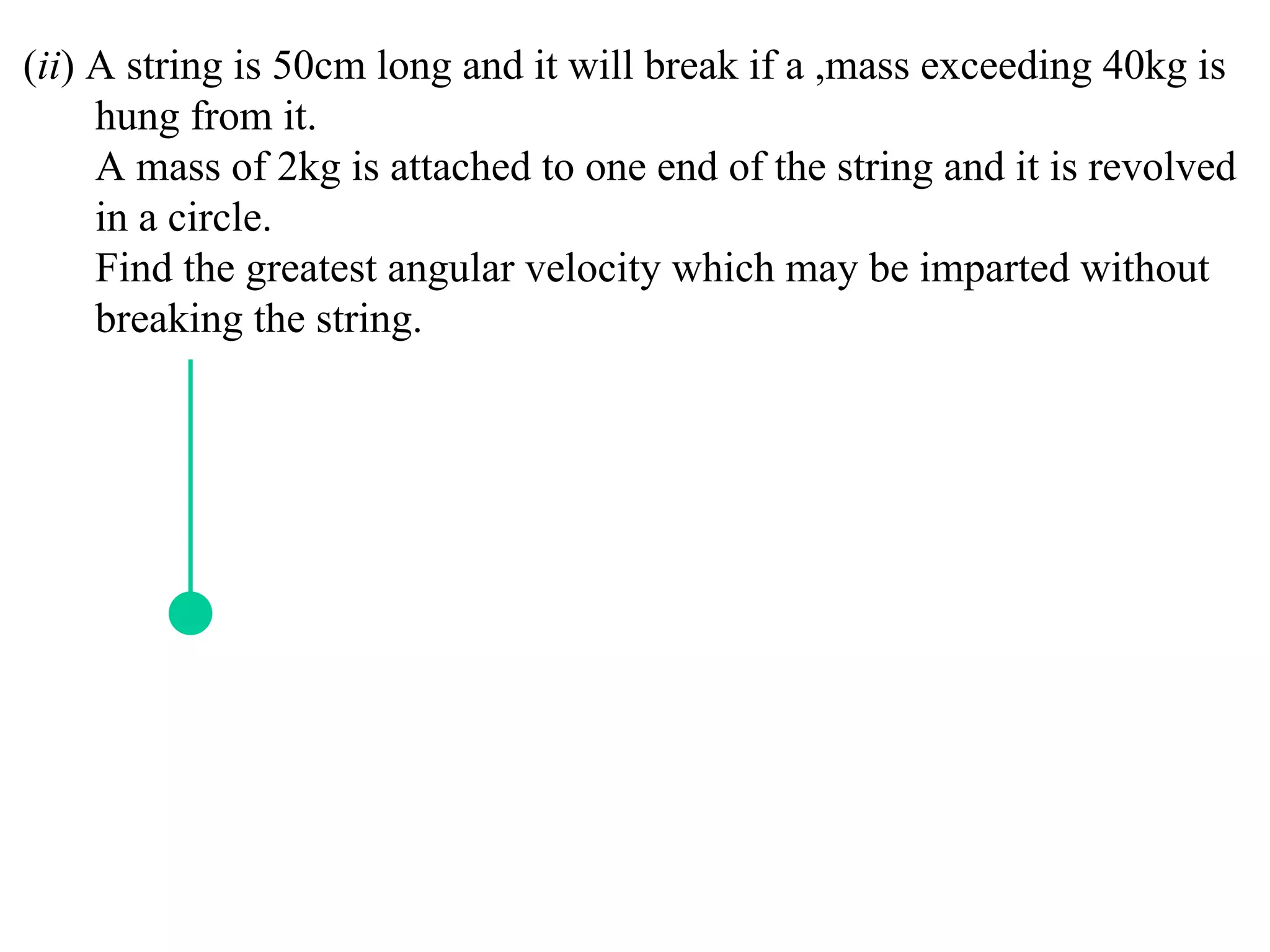
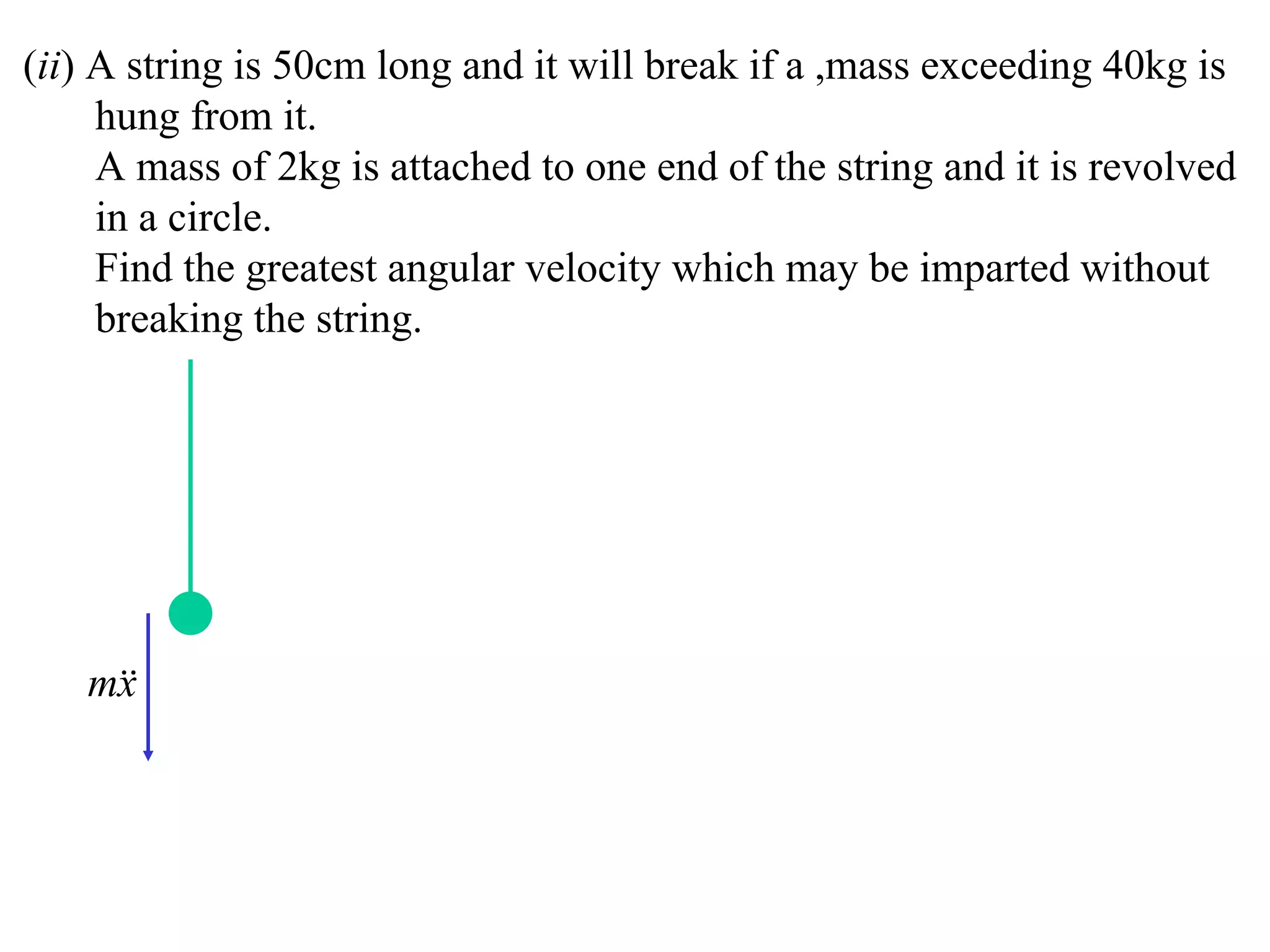
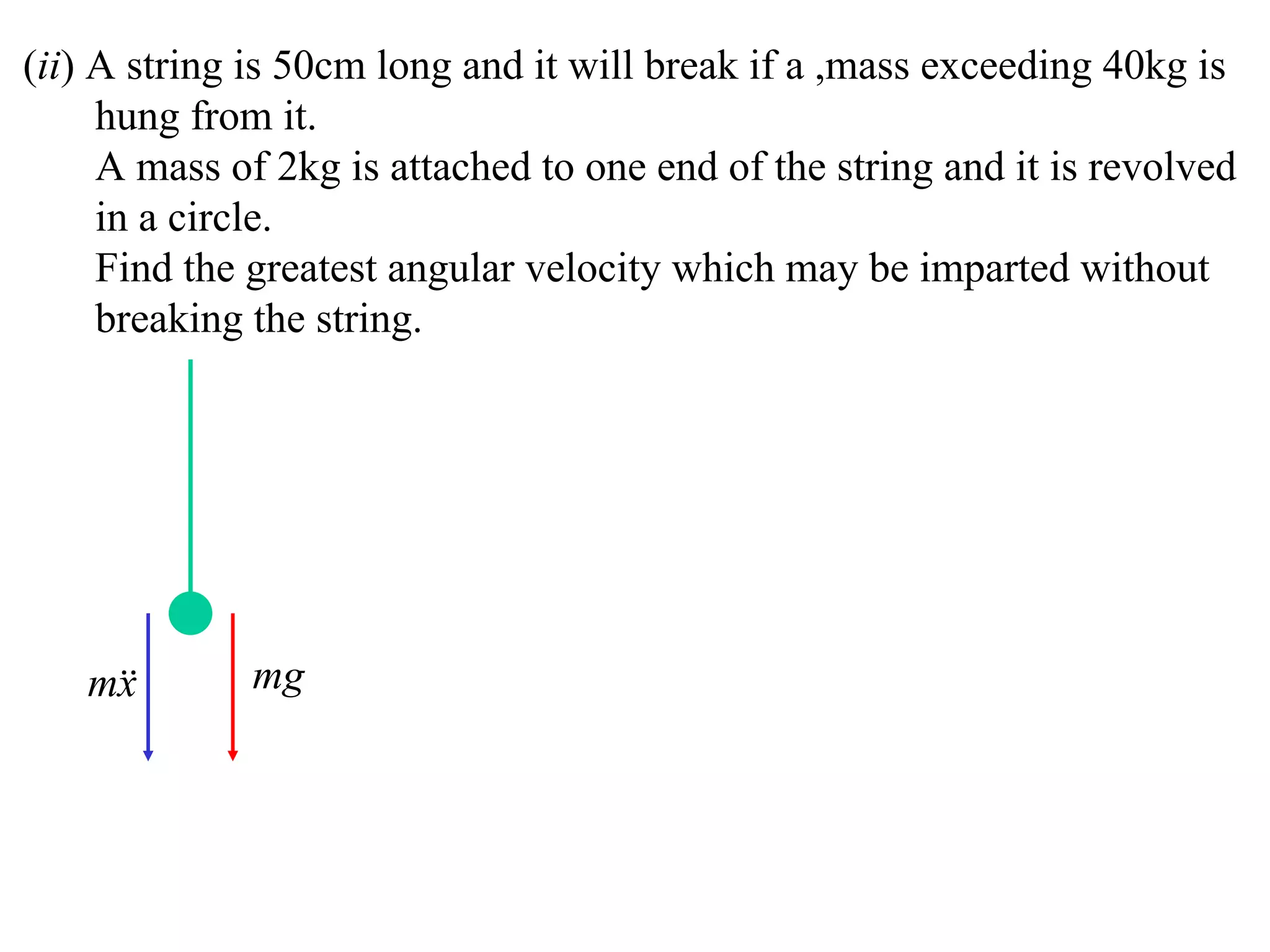
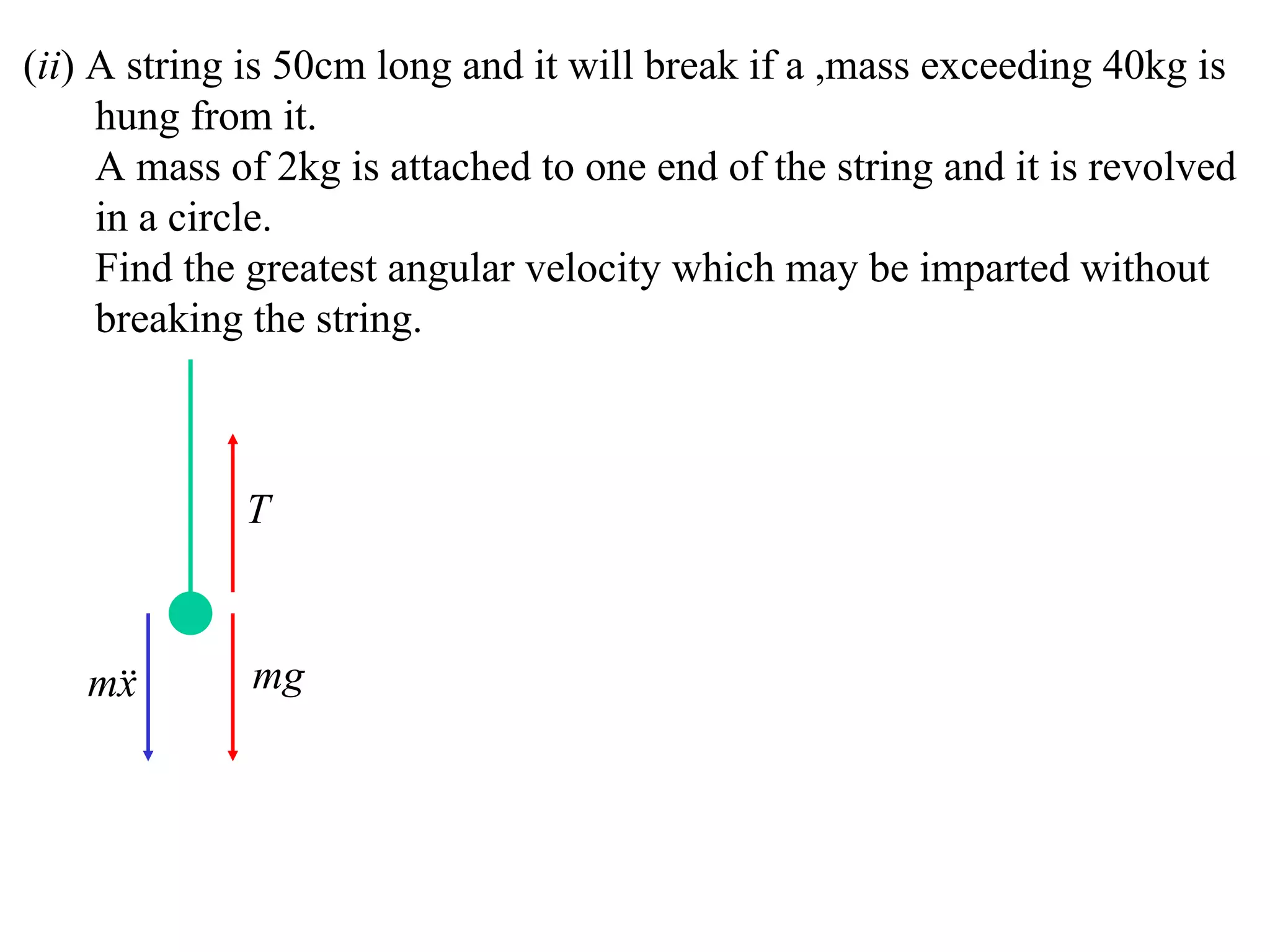
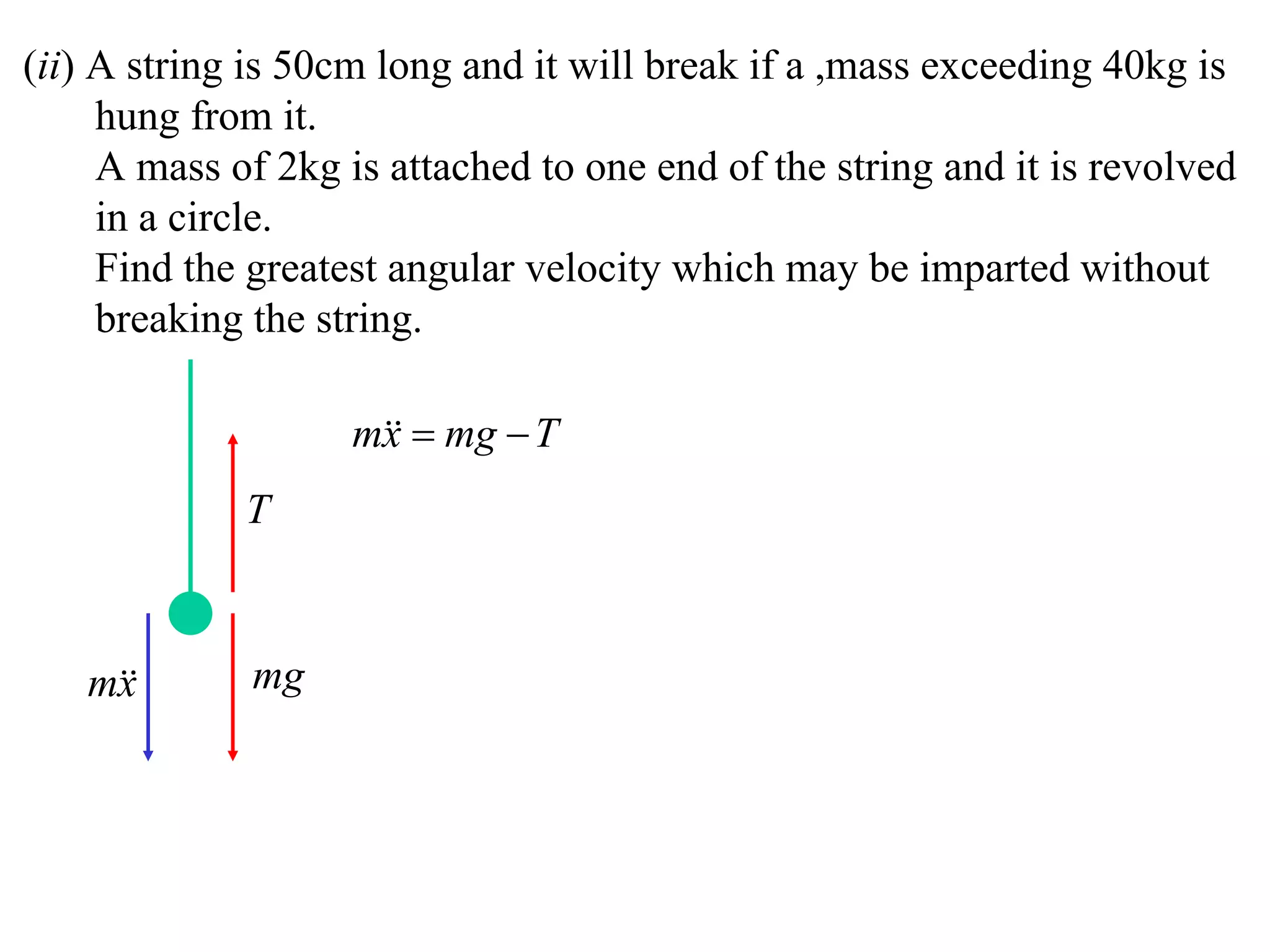
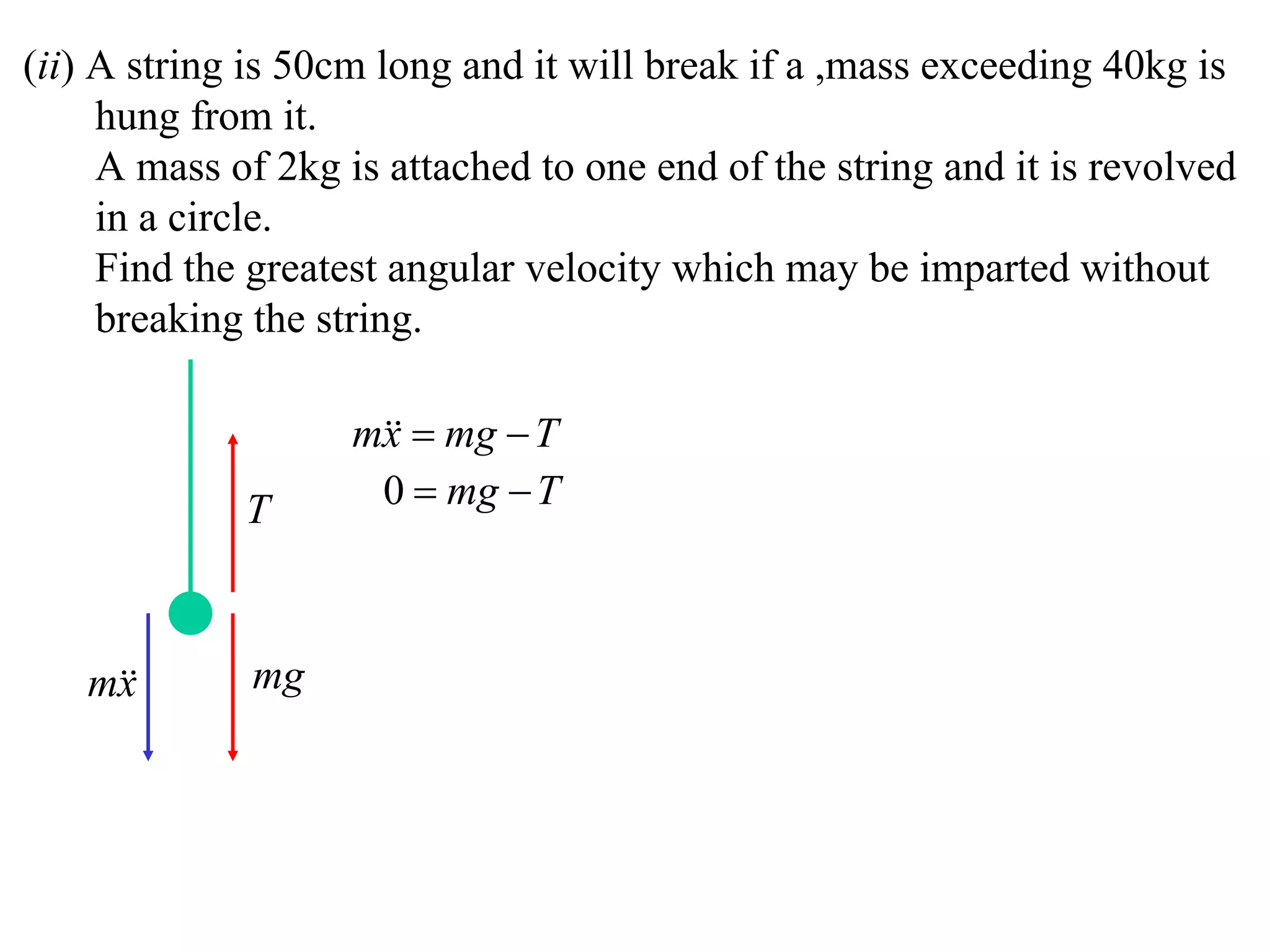
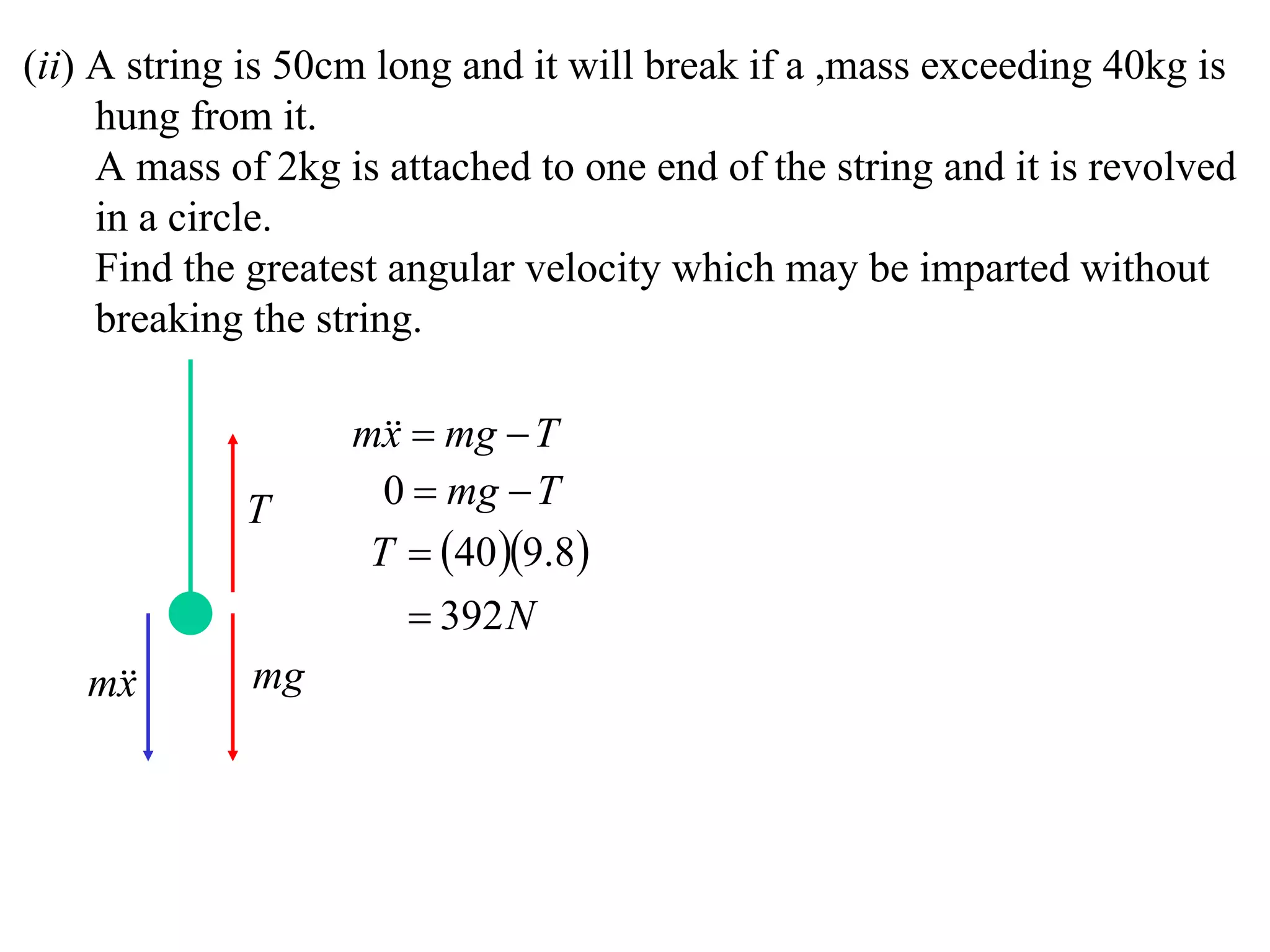
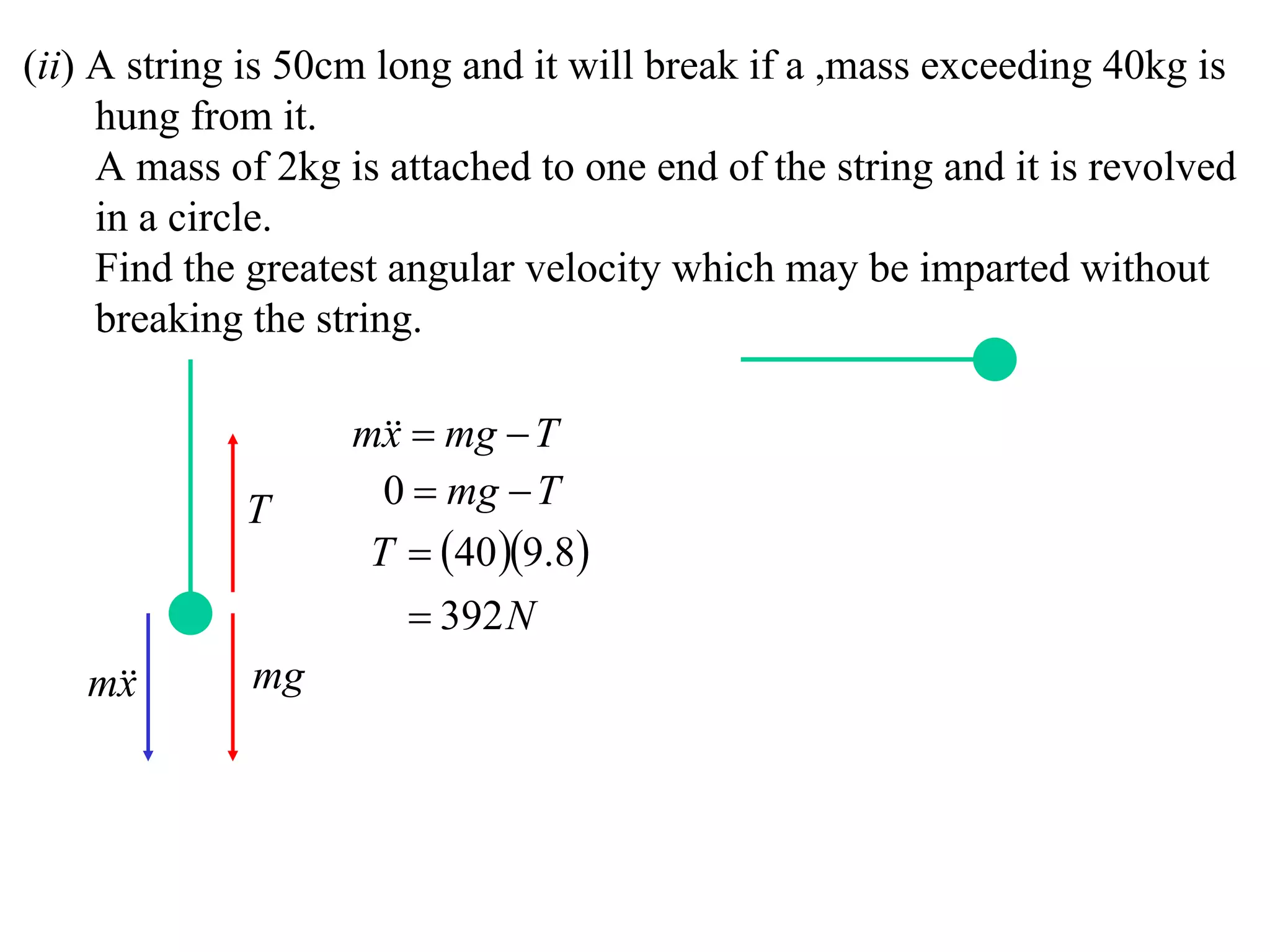
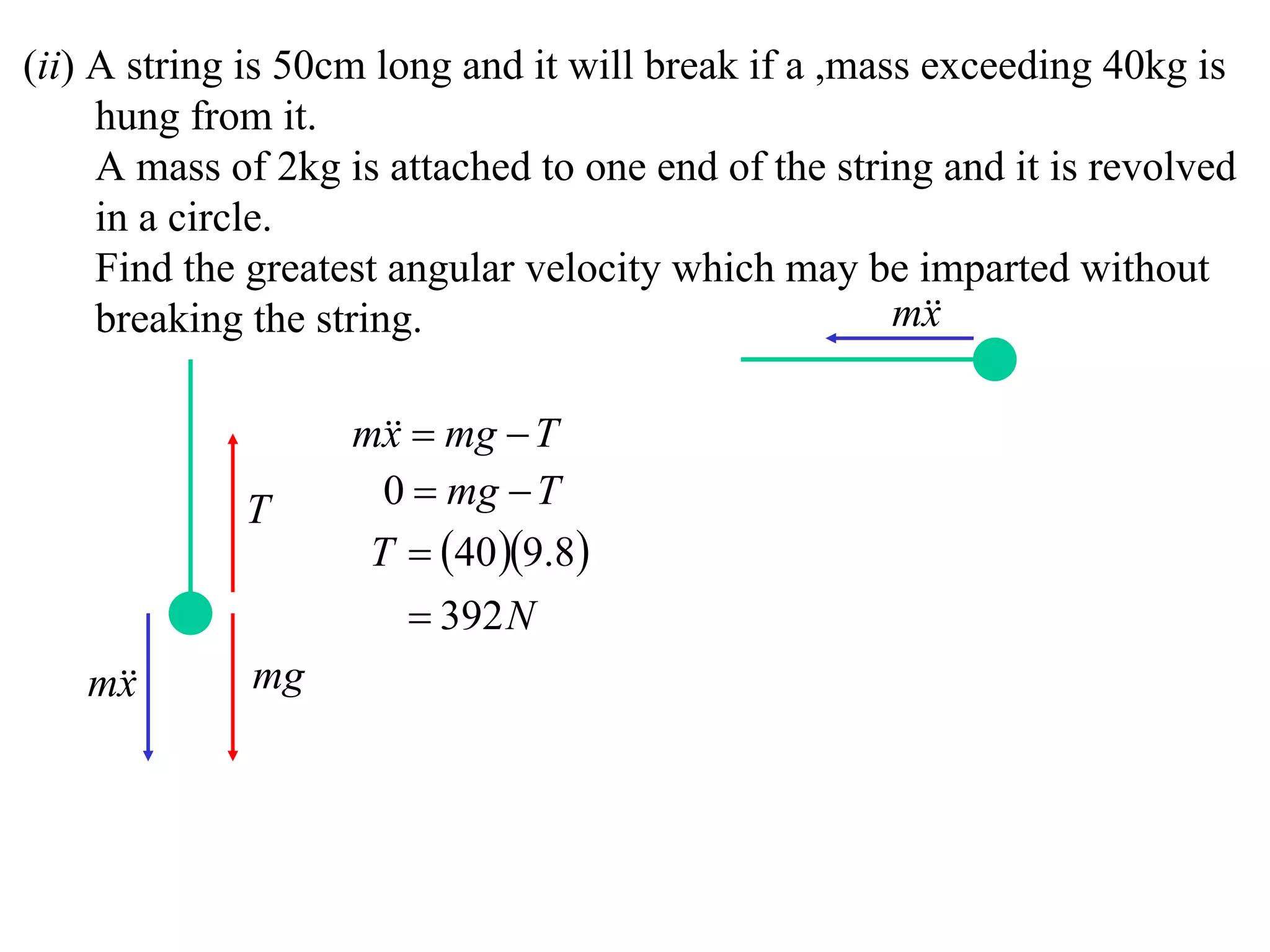
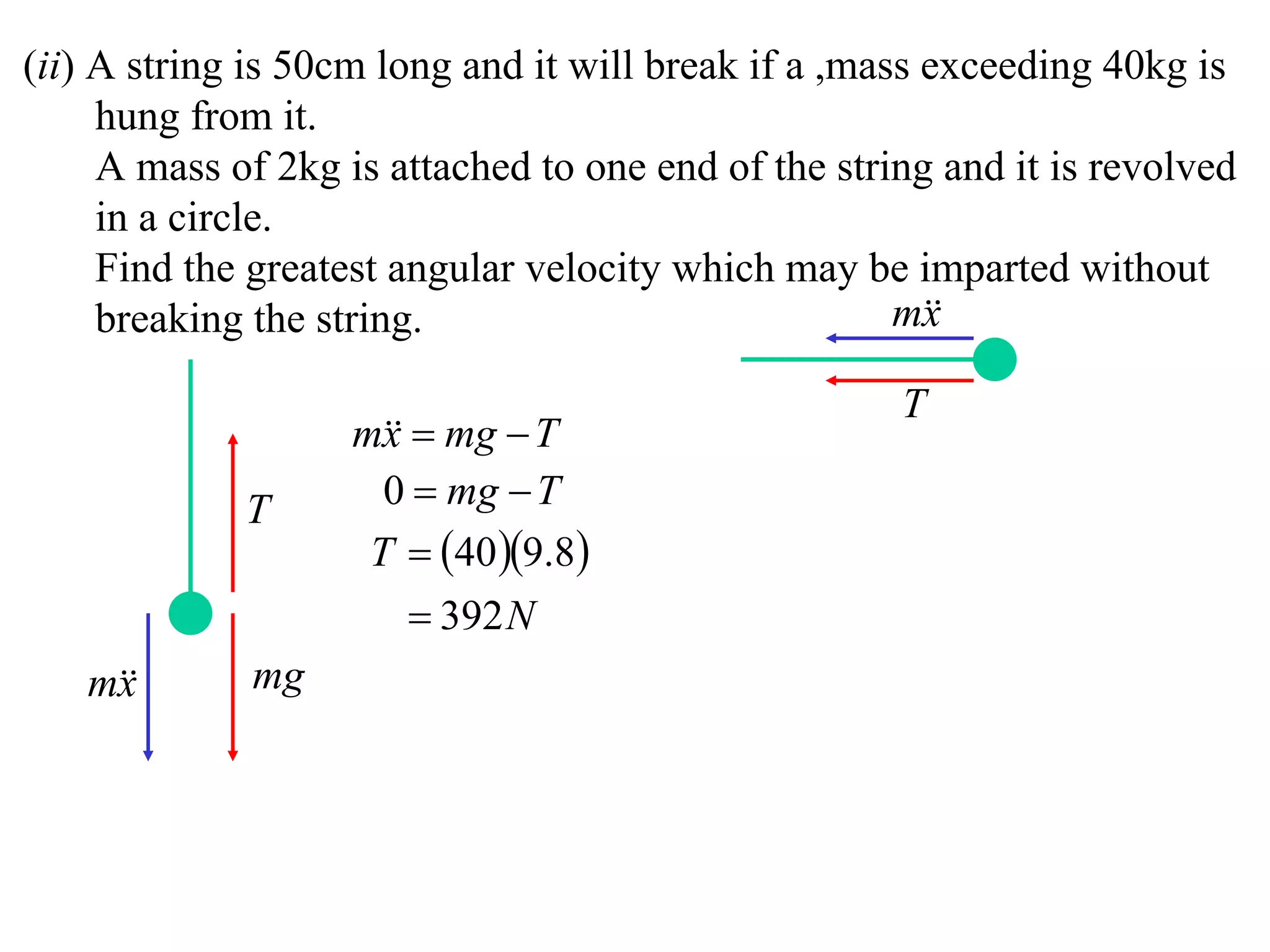
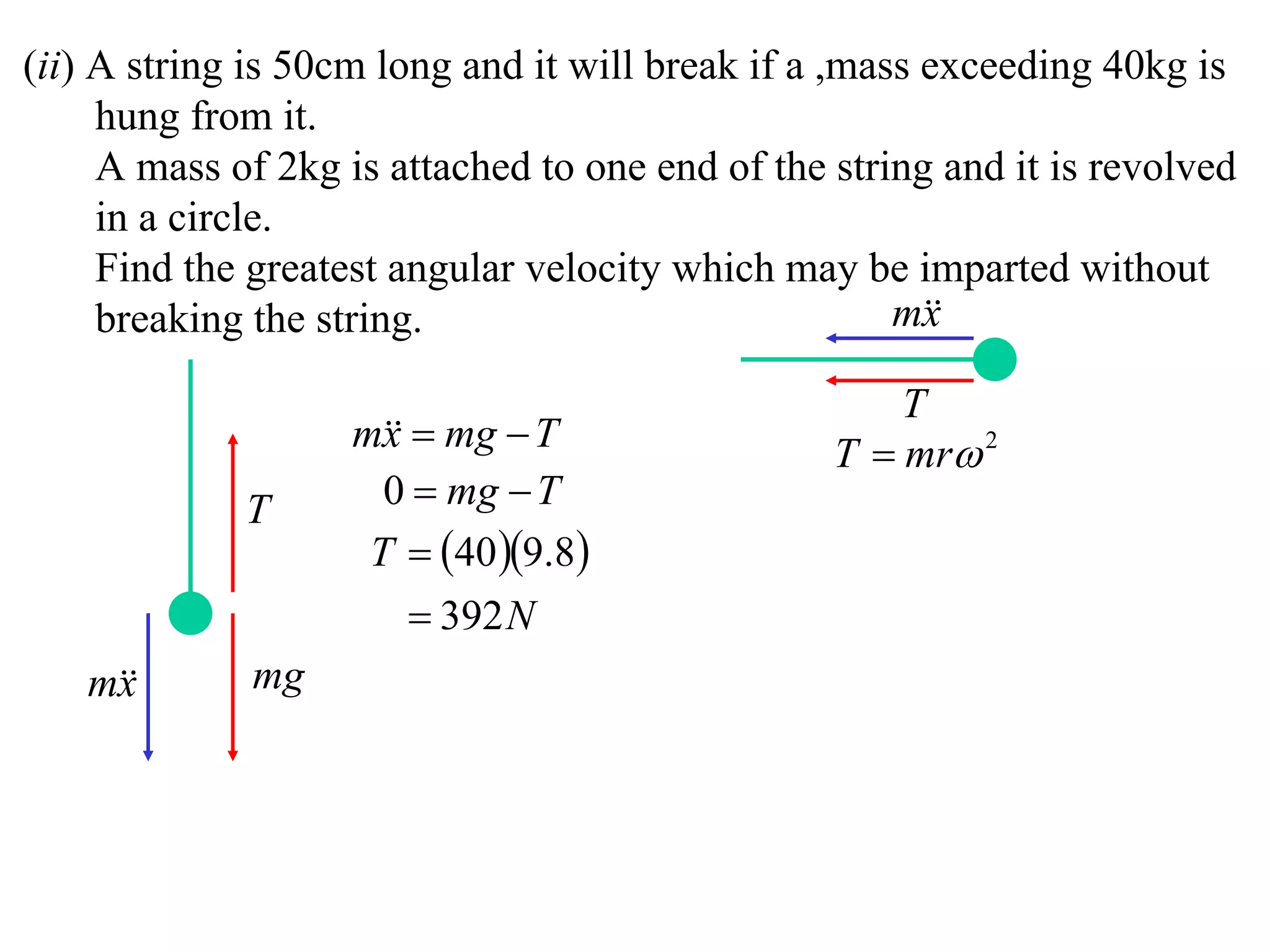
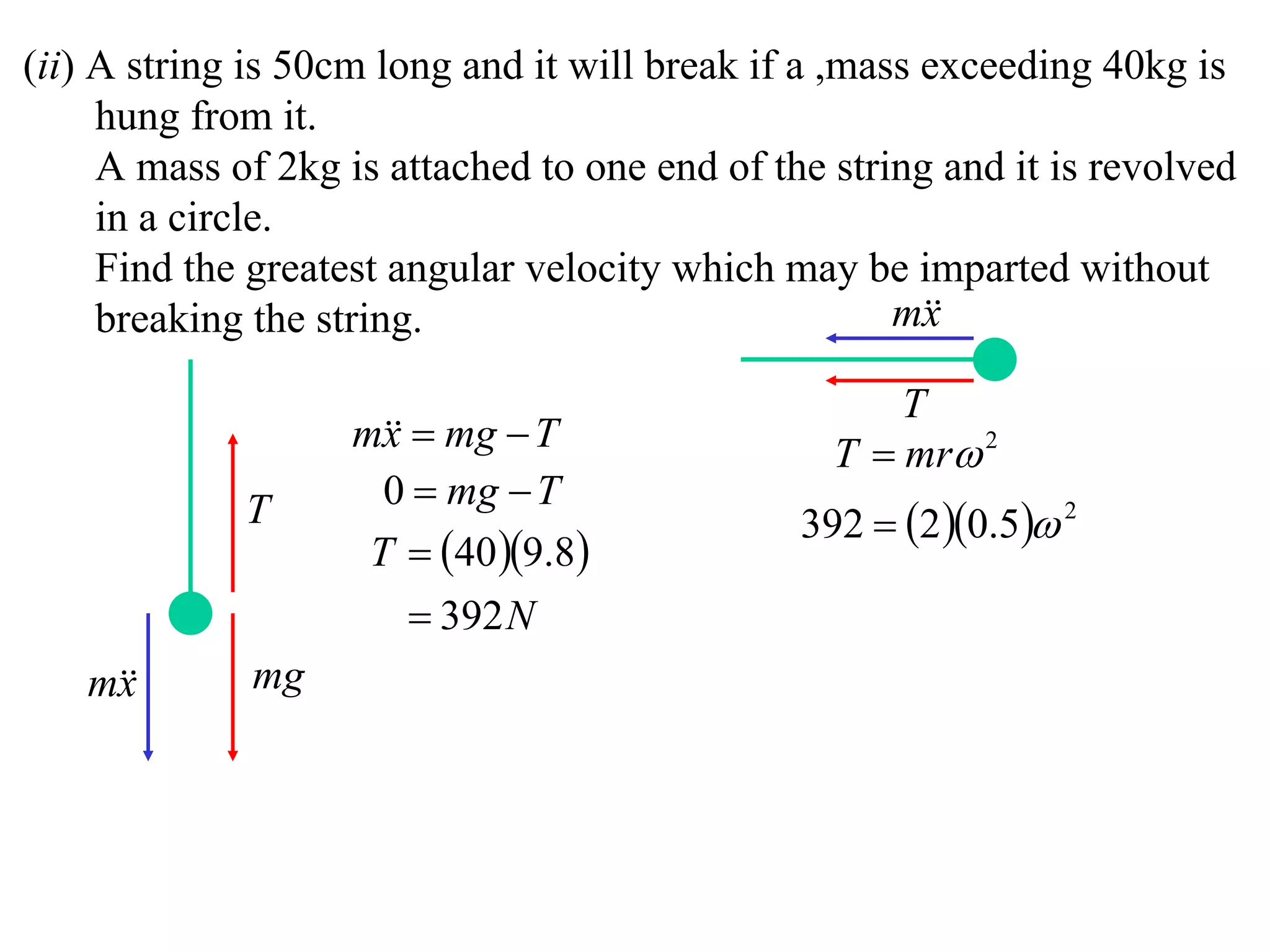
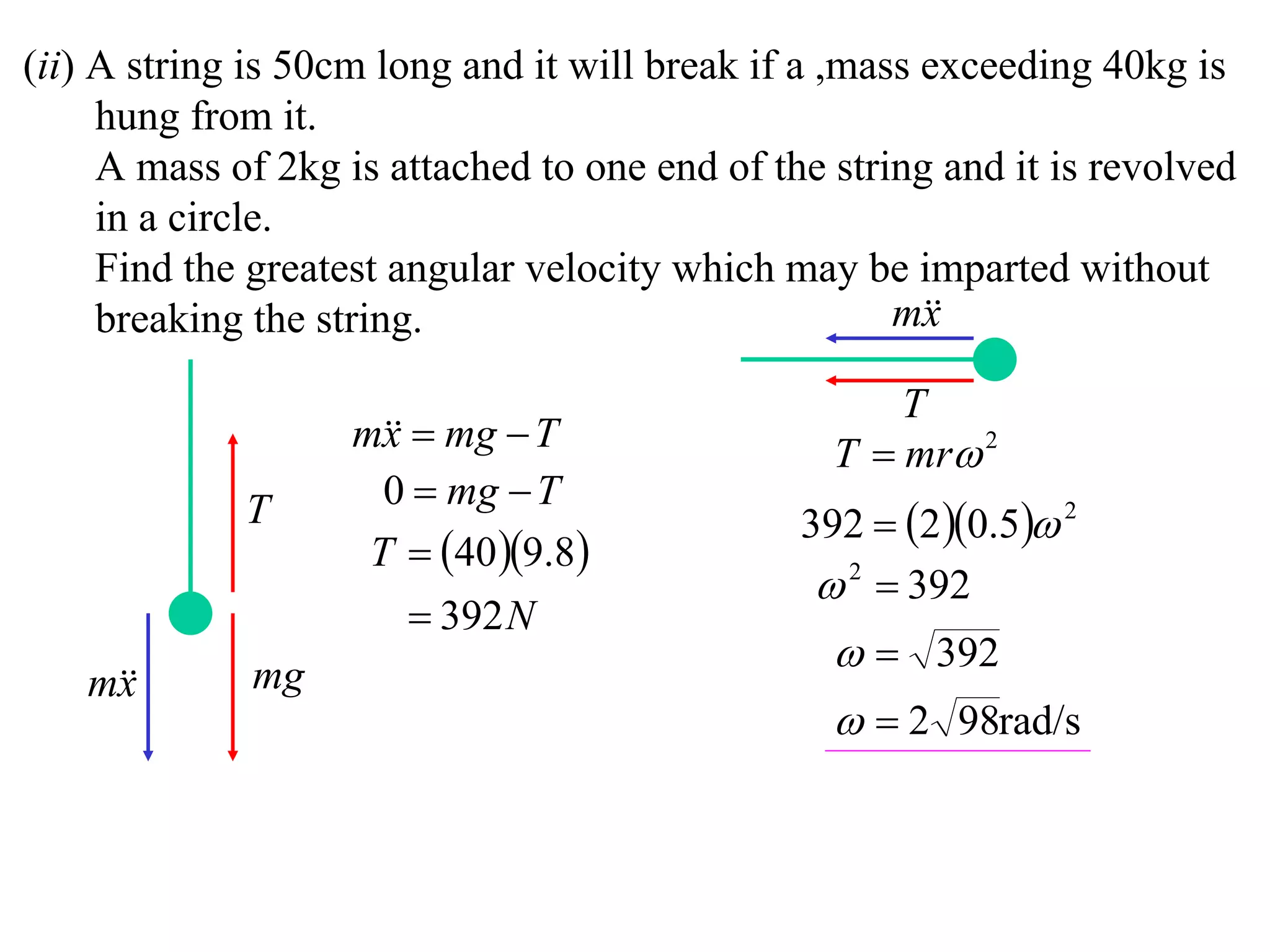
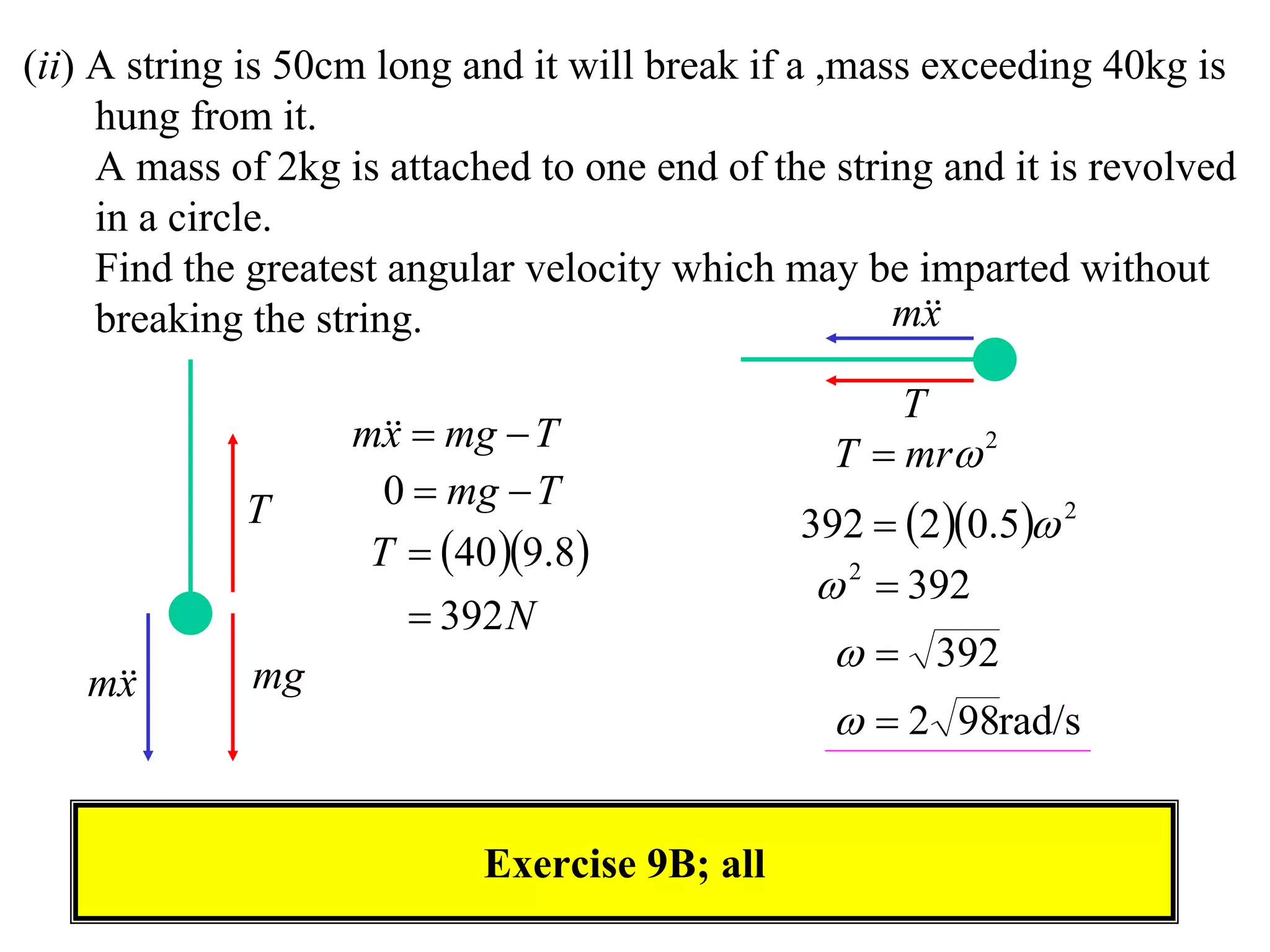
(ii) A string is 50cm long and it will break if a ,mass exceeding 40kg is
     hung from it.
     A mass of 2kg is attached to one end of the string and it is revolved
     in a circle.
     Find the greatest angular velocity which may be imparted without
     breaking the string.
(ii) A string is 50cm long and it will break if a ,mass exceeding 40kg is
     hung from it.
     A mass of 2kg is attached to one end of the string and it is revolved
     in a circle.
     Find the greatest angular velocity which may be imparted without
     breaking the string.
(ii) A string is 50cm long and it will break if a ,mass exceeding 40kg is
     hung from it.
     A mass of 2kg is attached to one end of the string and it is revolved
     in a circle.
     Find the greatest angular velocity which may be imparted without
     breaking the string.


   m
    x
(ii) A string is 50cm long and it will break if a ,mass exceeding 40kg is
     hung from it.
     A mass of 2kg is attached to one end of the string and it is revolved
     in a circle.
     Find the greatest angular velocity which may be imparted without
     breaking the string.


   m
    x        mg
(ii) A string is 50cm long and it will break if a ,mass exceeding 40kg is
     hung from it.
     A mass of 2kg is attached to one end of the string and it is revolved
     in a circle.
     Find the greatest angular velocity which may be imparted without
     breaking the string.


             T


   m
    x        mg
(ii) A string is 50cm long and it will break if a ,mass exceeding 40kg is
     hung from it.
     A mass of 2kg is attached to one end of the string and it is revolved
     in a circle.
     Find the greatest angular velocity which may be imparted without
     breaking the string.

                    m  mg  T
                     x
             T


   m
    x        mg
(ii) A string is 50cm long and it will break if a ,mass exceeding 40kg is
     hung from it.
     A mass of 2kg is attached to one end of the string and it is revolved
     in a circle.
     Find the greatest angular velocity which may be imparted without
     breaking the string.

                    m  mg  T
                     x
             T       0  mg  T


   m
    x        mg
(ii) A string is 50cm long and it will break if a ,mass exceeding 40kg is
     hung from it.
     A mass of 2kg is attached to one end of the string and it is revolved
     in a circle.
     Find the greatest angular velocity which may be imparted without
     breaking the string.

                    m  mg  T
                      x
             T        0  mg  T
                     T  40 9.8
                         392 N
   m
    x        mg
(ii) A string is 50cm long and it will break if a ,mass exceeding 40kg is
     hung from it.
     A mass of 2kg is attached to one end of the string and it is revolved
     in a circle.
     Find the greatest angular velocity which may be imparted without
     breaking the string.

                    m  mg  T
                      x
             T        0  mg  T
                     T  40 9.8
                         392 N
   m
    x        mg
(ii) A string is 50cm long and it will break if a ,mass exceeding 40kg is
     hung from it.
     A mass of 2kg is attached to one end of the string and it is revolved
     in a circle.
     Find the greatest angular velocity which may be imparted without
     breaking the string.                             m
                                                        x

                    m  mg  T
                      x
             T        0  mg  T
                     T  40 9.8
                         392 N
   m
    x        mg
(ii) A string is 50cm long and it will break if a ,mass exceeding 40kg is
     hung from it.
     A mass of 2kg is attached to one end of the string and it is revolved
     in a circle.
     Find the greatest angular velocity which may be imparted without
     breaking the string.                             m
                                                        x

                                                     T
                    m  mg  T
                      x
             T        0  mg  T
                     T  40 9.8
                         392 N
   m
    x        mg
(ii) A string is 50cm long and it will break if a ,mass exceeding 40kg is
     hung from it.
     A mass of 2kg is attached to one end of the string and it is revolved
     in a circle.
     Find the greatest angular velocity which may be imparted without
     breaking the string.                             m
                                                        x

                                                     T
                    m  mg  T
                      x                          T  mr 2
             T        0  mg  T
                     T  40 9.8
                         392 N
   m
    x        mg
(ii) A string is 50cm long and it will break if a ,mass exceeding 40kg is
     hung from it.
     A mass of 2kg is attached to one end of the string and it is revolved
     in a circle.
     Find the greatest angular velocity which may be imparted without
     breaking the string.                             m
                                                        x

                                                     T
                    m  mg  T
                      x                          T  mr 2
                      0  mg  T
             T                                 392  2 0.5 2
                     T  40 9.8
                         392 N
   m
    x        mg
(ii) A string is 50cm long and it will break if a ,mass exceeding 40kg is
     hung from it.
     A mass of 2kg is attached to one end of the string and it is revolved
     in a circle.
     Find the greatest angular velocity which may be imparted without
     breaking the string.                             m
                                                        x

                                                     T
                    m  mg  T
                      x                          T  mr 2
                      0  mg  T
             T                                 392  2 0.5 2
                     T  40 9.8
                                                 2  392
                         392 N
             mg
                                                   392
   m
    x
                                                   2 98rad/s
(ii) A string is 50cm long and it will break if a ,mass exceeding 40kg is
     hung from it.
     A mass of 2kg is attached to one end of the string and it is revolved
     in a circle.
     Find the greatest angular velocity which may be imparted without
     breaking the string.                             m
                                                        x

                                                     T
                    m  mg  T
                      x                          T  mr 2
                      0  mg  T
             T                                 392  2 0.5 2
                     T  40 9.8
                                                 2  392
                         392 N
             mg
                                                   392
   m
    x
                                                   2 98rad/s


                            Exercise 9B; all

X2 t06 04 uniform circular motion (2012)

  • 1.
  • 2.
    Acceleration with Uniform Circular Motion Uniform circular motion is when a particle moves with constant angular velocity.
  • 3.
    Acceleration with Uniform Circular Motion Uniform circular motion is when a particle moves with constant angular velocity.  the magnitude of the linear velocity will also be constant 
  • 4.
    Acceleration with Uniform Circular Motion Uniform circular motion is when a particle moves with constant angular velocity.  the magnitude of the linear velocity will also be constant  A r O
  • 5.
    Acceleration with Uniform Circular Motion Uniform circular motion is when a particle moves with constant angular velocity.  the magnitude of the linear velocity will also be constant  A particle moves from A to P with constant A angular velocity. r O  P
  • 6.
    Acceleration with Uniform Circular Motion Uniform circular motion is when a particle moves with constant angular velocity.  the magnitude of the linear velocity will also be constant  A particle moves from A to P with constant A angular velocity. r O  The acceleration of the particle is the change in velocity with respect to time. P
  • 7.
    Acceleration with Uniform Circular Motion Uniform circular motion is when a particle moves with constant angular velocity.  the magnitude of the linear velocity will also be constant  A particle moves from A to P with constant A angular velocity. r v O  The acceleration of the particle is the change in velocity with respect to time. P
  • 8.
    Acceleration with Uniform Circular Motion Uniform circular motion is when a particle moves with constant angular velocity.  the magnitude of the linear velocity will also be constant  A particle moves from A to P with constant A angular velocity. r v O  The acceleration of the particle is the change in velocity with respect to time. P v’
  • 9.
    Acceleration with Uniform Circular Motion Uniform circular motion is when a particle moves with constant angular velocity.  the magnitude of the linear velocity will also be constant  A particle moves from A to P with constant A angular velocity. r v O  The acceleration of the particle is the change in velocity with respect to time. P v’ v
  • 10.
    Acceleration with Uniform Circular Motion Uniform circular motion is when a particle moves with constant angular velocity.  the magnitude of the linear velocity will also be constant  A particle moves from A to P with constant A angular velocity. r v O  The acceleration of the particle is the change in velocity with respect to time. P v’ v v’
  • 11.
    Acceleration with Uniform Circular Motion Uniform circular motion is when a particle moves with constant angular velocity.  the magnitude of the linear velocity will also be constant  A particle moves from A to P with constant A angular velocity. r v O  The acceleration of the particle is the change in velocity with respect to time. P v’ v v’ v
  • 12.
    Acceleration with Uniform Circular Motion Uniform circular motion is when a particle moves with constant angular velocity.  the magnitude of the linear velocity will also be constant  A A particle moves from A to P with constant angular velocity. r v O  The acceleration of the particle is the change in velocity with respect to time. P v’ v’  v v
  • 13.
    Acceleration with Uniform Circular Motion Uniform circular motion is when a particle moves with constant angular velocity.  the magnitude of the linear velocity will also be constant  A A particle moves from A to P with constant angular velocity. r v O  The acceleration of the particle is the change in velocity with respect to time. P v’  v v’ This triangle of vectors is similar to OAP v
  • 14.
    A v’  v r O  v r
  • 15.
    A v’  v r O  v r P v v  AP r
  • 16.
    A v’  v r O  v r P v v  AP r v  AP v  r
  • 17.
    A v’  v r O  v r P v v  AP r v  AP v  r v a t
  • 18.
    A v’  v r O  v r P v v  AP r v  AP v  r v a t v  AP a r  t
  • 19.
    A v’  v r O  v r P v v  AP r v  AP v  r v a t v  AP a r  t But, as Δt  0, AP  arcAP
  • 20.
    A v’  v r O  v r P v v  AP r v  AP v  r v a t v  AP a r  t But, as Δt  0, AP  arcAP v  arcAP  a  lim t 0 r  t
  • 21.
    A v’  v r distance  speed  time O  arcAP  v  t v r P v v  AP r v  AP v  r v a t v  AP a r  t But, as Δt  0, AP  arcAP v  arcAP  a  lim t 0 r  t
  • 22.
    A v’  v r distance  speed  time O  arcAP  v  t v r P v v  v  v  t AP r  a  lim t 0 r  t v  AP v  r v2  lim v t 0 r a t v2  v  AP r a r  t But, as Δt  0, AP  arcAP v  arcAP  a  lim t 0 r  t
  • 23.
    A v’  v r distance  speed  time O  arcAP  v  t v r P v v  v  v  t AP r  a  lim t 0 r  t v  AP v  r v2  lim v t 0 r a t v2  v  AP r a r  t  the acceleration in uniform circular But, as Δt  0, AP  arcAP v2 v  arcAP motion has magnitude and is  a  lim r t 0 r  t directed towards the centre
  • 24.
    Acceleration Involved in UniformCircular Motion v2 a r
  • 25.
    Acceleration Involved in UniformCircular Motion v2 a r OR a  r 2
  • 26.
    Acceleration Involved in Forces Involved in Uniform Circular Motion Uniform Circular Motion v2 a r OR a  r 2
  • 27.
    Acceleration Involved in Forces Involved in Uniform Circular Motion Uniform Circular Motion v2 mv 2 a F r r OR a  r 2
  • 28.
    Acceleration Involved in Forces Involved in Uniform Circular Motion Uniform Circular Motion v2 mv 2 a F r r OR OR a  r 2 F  mr 2
  • 29.
    Acceleration Involved in Forces Involved in Uniform Circular Motion Uniform Circular Motion v2 mv 2 a F r r OR OR a  r 2 F  mr 2 e.g. (i) (2003) A particle P of mass m moves with constant angular velocity  on a circle of radius r. Its position at time t is given by; x  r cos y  r sin  , where   t
  • 30.
    Acceleration Involved in Forces Involved in Uniform Circular Motion Uniform Circular Motion v2 mv 2 a F r r OR OR a  r 2 F  mr 2 e.g. (i) (2003) A particle P of mass m moves with constant angular velocity  on a circle of radius r. Its position at time t is given by; x  r cos y  r sin  , where   t a) Show that there is an inward radial force of magnitude mr 2 acting on P.
  • 31.
    y P r y  r sin   x  r cos x
  • 32.
    x  rcos y P r y  r sin   x  r cos x
  • 33.
    x  rcos y y  r sin  P r y  r sin   x  r cos x
  • 34.
    x  rcos y y  r sin  d x   r sin    P dt r y  r sin    r sin   x  r cos x
  • 35.
    x  rcos y y  r sin  d d x   r sin    P y  r cos   dt dt r y  r sin    r sin   r cos  x  r cos x
  • 36.
    x  rcos y y  r sin  d d x   r sin    P y  r cos   dt dt r y  r sin    r sin   r cos  d x  r cos x    r cos  x dt   r 2 cos   2 x
  • 37.
    x  rcos y y  r sin  d d x   r sin    P y  r cos   dt dt r y  r sin    r sin   r cos     r cos  x d x  r cos x    r sin   d y dt dt   r 2 cos   r 2 sin    x2   2 y
  • 38.
    x  rcos y y  r sin  d d x   r sin    P y  r cos   dt dt r y  r sin    r sin   r cos     r cos  x d x  r cos x    r sin   d y dt dt   r 2 cos   r 2 sin    x 2   2 y y  x 
  • 39.
    x  rcos y y  r sin  d d x   r sin    P y  r cos   dt dt r y  r sin    r sin   r cos     r cos  x d x  r cos x    r sin   d y dt dt   r 2 cos   r 2 sin    x 2   2 y a y   x 
  • 40.
    x  rcos y y  r sin  d d x   r sin    P y  r cos   dt dt r y  r sin    r sin   r cos     r cos  x d x  r cos x    r sin   d y dt dt   r 2 cos   r 2 sin    x 2 a      2 x 2 y 2   2 y a y   x 
  • 41.
    x  rcos y y  r sin  d d x   r sin    P y  r cos   dt dt r y  r sin    r sin   r cos     r cos  x d x  r cos x    r sin   d y dt dt   r 2 cos   r 2 sin    x 2 a      2 x 2 y 2   2 y   4 x2   4 y2   4 x 2  y 2  a y    4r 2  x 
  • 42.
    x  rcos y y  r sin  d d x   r sin    P y  r cos   dt dt r y  r sin    r sin   r cos     r cos  x d x  r cos x    r sin   d y dt dt   r 2 cos   r 2 sin    x 2 a      2 x y 2 2   2 y   4 x2   4 y2   4 x 2  y 2  a y    4r 2 a  r 2  x 
  • 43.
    x  rcos y y  r sin  d d x   r sin    P y  r cos   dt dt r y  r sin    r sin   r cos     r cos  x d x  r cos x    r sin   d y dt dt   r 2 cos   r 2 sin    x 2 a      2 x y 2 2   2 y   4 x2   4 y2   4 x 2  y 2  a y    4r 2 a  r 2  x  F  ma  F  mr 2
  • 44.
    x  rcos y y  r sin  d d x   r sin    P y  r cos   dt dt r y  r sin    r sin   r cos     r cos  x d x  r cos x    r sin   d y dt dt   r 2 cos   r 2 sin  y    x 2 a      2 x y 2 2   tan 1   2 y x    4 x2   4 y2   4 x 2  y 2  a y    4r 2 a  r 2  x  F  ma  F  mr 2
  • 45.
    x  rcos y y  r sin  d d x   r sin    P y  r cos   dt dt r y  r sin    r sin   r cos     r cos  x d x  r cos x    r sin   d y dt dt   r 2 cos   r 2 sin  y    x 2 a      2 x y 2 2   tan 1   2 y x    4 x2   4 y2   2 y   tan 1     4 x 2  y 2    x  2 a y    4r 2 y  tan 1 a  r 2 x  F  ma  x   F  mr 2
  • 46.
    x  rcos y y  r sin  d d x   r sin    P y  r cos   dt dt r y  r sin    r sin   r cos     r cos  x d x  r cos x    r sin   d y dt dt   r 2 cos   r 2 sin  y    x 2 a      2 x y 2 2   tan 1   2 y x    4 x2   4 y2   2 y   tan 1     4 x 2  y 2    x  2 a y    4r 2 y  tan 1 a  r 2 x  F  ma  x   F  mr 2  There is a force , F  mr 2 , acting towards the centre
  • 47.
    b) A telecommunicationssatellite, of mass m, orbits Earth with constant angular velocity  at a distance r from the centre of the Earth. The gravitational force exerted by Earth on the satellite is Am where r2 A is a constant. By considering all other forces on the satellite to be negligible, show that; A r 3  2
  • 48.
    b) A telecommunicationssatellite, of mass m, orbits Earth with constant angular velocity  at a distance r from the centre of the Earth. The gravitational force exerted by Earth on the satellite is Am where r2 A is a constant. By considering all other forces on the satellite to be negligible, show that; A r 3  2
  • 49.
    b) A telecommunicationssatellite, of mass m, orbits Earth with constant angular velocity  at a distance r from the centre of the Earth. The gravitational force exerted by Earth on the satellite is Am where r2 A is a constant. By considering all other forces on the satellite to be negligible, show that; A r 3  2 m  mr 2 x
  • 50.
    b) A telecommunicationssatellite, of mass m, orbits Earth with constant angular velocity  at a distance r from the centre of the Earth. The gravitational force exerted by Earth on the satellite is Am where r2 A is a constant. By considering all other forces on the satellite to be negligible, show that; A r 3  2 Am m  mr 2 x r2
  • 51.
    b) A telecommunicationssatellite, of mass m, orbits Earth with constant angular velocity  at a distance r from the centre of the Earth. The gravitational force exerted by Earth on the satellite is Am where r2 A is a constant. By considering all other forces on the satellite to be negligible, show that; A r 3  2 Am mr 2  Am r2 m  mr 2 x r2
  • 52.
    b) A telecommunicationssatellite, of mass m, orbits Earth with constant angular velocity  at a distance r from the centre of the Earth. The gravitational force exerted by Earth on the satellite is Am where r2 A is a constant. By considering all other forces on the satellite to be negligible, show that; A r 3  2 Am mr 2  Am r2 m  mr 2 x r2 Am r3  m 2 A  2 
  • 53.
    b) A telecommunicationssatellite, of mass m, orbits Earth with constant angular velocity  at a distance r from the centre of the Earth. The gravitational force exerted by Earth on the satellite is Am where r2 A is a constant. By considering all other forces on the satellite to be negligible, show that; A r 3  2 Am mr 2  Am r2 m  mr 2 x r2 Am r3  m 2 A  2  A r3 2
  • 54.
    (ii) A stringis 50cm long and it will break if a ,mass exceeding 40kg is hung from it. A mass of 2kg is attached to one end of the string and it is revolved in a circle. Find the greatest angular velocity which may be imparted without breaking the string.
  • 55.
    (ii) A stringis 50cm long and it will break if a ,mass exceeding 40kg is hung from it. A mass of 2kg is attached to one end of the string and it is revolved in a circle. Find the greatest angular velocity which may be imparted without breaking the string.
  • 56.
    (ii) A stringis 50cm long and it will break if a ,mass exceeding 40kg is hung from it. A mass of 2kg is attached to one end of the string and it is revolved in a circle. Find the greatest angular velocity which may be imparted without breaking the string. m x
  • 57.
    (ii) A stringis 50cm long and it will break if a ,mass exceeding 40kg is hung from it. A mass of 2kg is attached to one end of the string and it is revolved in a circle. Find the greatest angular velocity which may be imparted without breaking the string. m x mg
  • 58.
    (ii) A stringis 50cm long and it will break if a ,mass exceeding 40kg is hung from it. A mass of 2kg is attached to one end of the string and it is revolved in a circle. Find the greatest angular velocity which may be imparted without breaking the string. T m x mg
  • 59.
    (ii) A stringis 50cm long and it will break if a ,mass exceeding 40kg is hung from it. A mass of 2kg is attached to one end of the string and it is revolved in a circle. Find the greatest angular velocity which may be imparted without breaking the string. m  mg  T x T m x mg
  • 60.
    (ii) A stringis 50cm long and it will break if a ,mass exceeding 40kg is hung from it. A mass of 2kg is attached to one end of the string and it is revolved in a circle. Find the greatest angular velocity which may be imparted without breaking the string. m  mg  T x T 0  mg  T m x mg
  • 61.
    (ii) A stringis 50cm long and it will break if a ,mass exceeding 40kg is hung from it. A mass of 2kg is attached to one end of the string and it is revolved in a circle. Find the greatest angular velocity which may be imparted without breaking the string. m  mg  T x T 0  mg  T T  40 9.8  392 N m x mg
  • 62.
    (ii) A stringis 50cm long and it will break if a ,mass exceeding 40kg is hung from it. A mass of 2kg is attached to one end of the string and it is revolved in a circle. Find the greatest angular velocity which may be imparted without breaking the string. m  mg  T x T 0  mg  T T  40 9.8  392 N m x mg
  • 63.
    (ii) A stringis 50cm long and it will break if a ,mass exceeding 40kg is hung from it. A mass of 2kg is attached to one end of the string and it is revolved in a circle. Find the greatest angular velocity which may be imparted without breaking the string. m x m  mg  T x T 0  mg  T T  40 9.8  392 N m x mg
  • 64.
    (ii) A stringis 50cm long and it will break if a ,mass exceeding 40kg is hung from it. A mass of 2kg is attached to one end of the string and it is revolved in a circle. Find the greatest angular velocity which may be imparted without breaking the string. m x T m  mg  T x T 0  mg  T T  40 9.8  392 N m x mg
  • 65.
    (ii) A stringis 50cm long and it will break if a ,mass exceeding 40kg is hung from it. A mass of 2kg is attached to one end of the string and it is revolved in a circle. Find the greatest angular velocity which may be imparted without breaking the string. m x T m  mg  T x T  mr 2 T 0  mg  T T  40 9.8  392 N m x mg
  • 66.
    (ii) A stringis 50cm long and it will break if a ,mass exceeding 40kg is hung from it. A mass of 2kg is attached to one end of the string and it is revolved in a circle. Find the greatest angular velocity which may be imparted without breaking the string. m x T m  mg  T x T  mr 2 0  mg  T T 392  2 0.5 2 T  40 9.8  392 N m x mg
  • 67.
    (ii) A stringis 50cm long and it will break if a ,mass exceeding 40kg is hung from it. A mass of 2kg is attached to one end of the string and it is revolved in a circle. Find the greatest angular velocity which may be imparted without breaking the string. m x T m  mg  T x T  mr 2 0  mg  T T 392  2 0.5 2 T  40 9.8  2  392  392 N mg   392 m x   2 98rad/s
  • 68.
    (ii) A stringis 50cm long and it will break if a ,mass exceeding 40kg is hung from it. A mass of 2kg is attached to one end of the string and it is revolved in a circle. Find the greatest angular velocity which may be imparted without breaking the string. m x T m  mg  T x T  mr 2 0  mg  T T 392  2 0.5 2 T  40 9.8  2  392  392 N mg   392 m x   2 98rad/s Exercise 9B; all