Chapter 3


Data Description


                   1
Through this chapter you will learn
 Measure of Central tendency
 Measure of Dispersion
 Measure of Position


                                      2
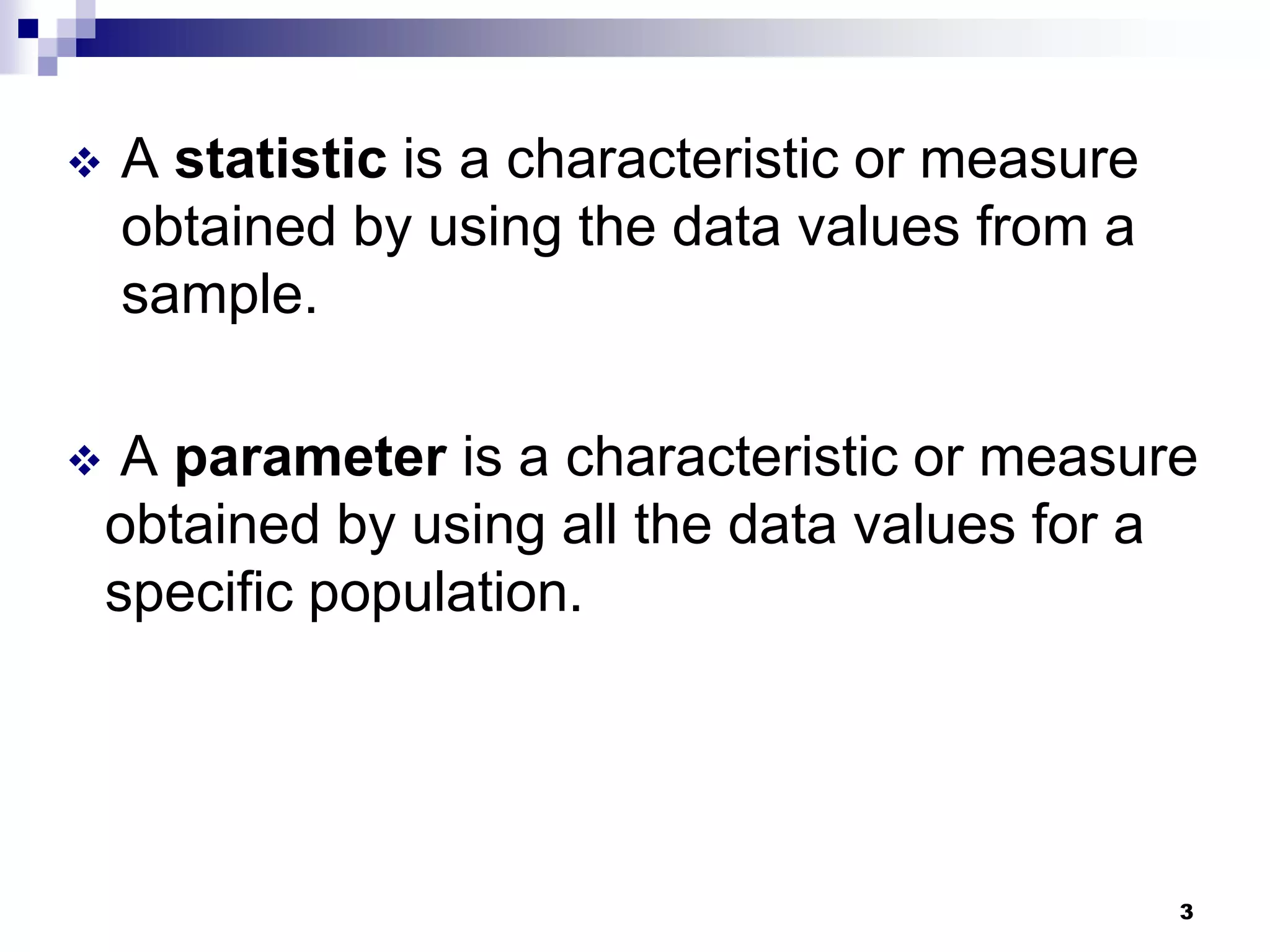
   A statistic is a characteristic or measure
    obtained by using the data values from a
    sample.

    A parameter is a characteristic or measure
    obtained by using all the data values for a
    specific population.


                                                 3
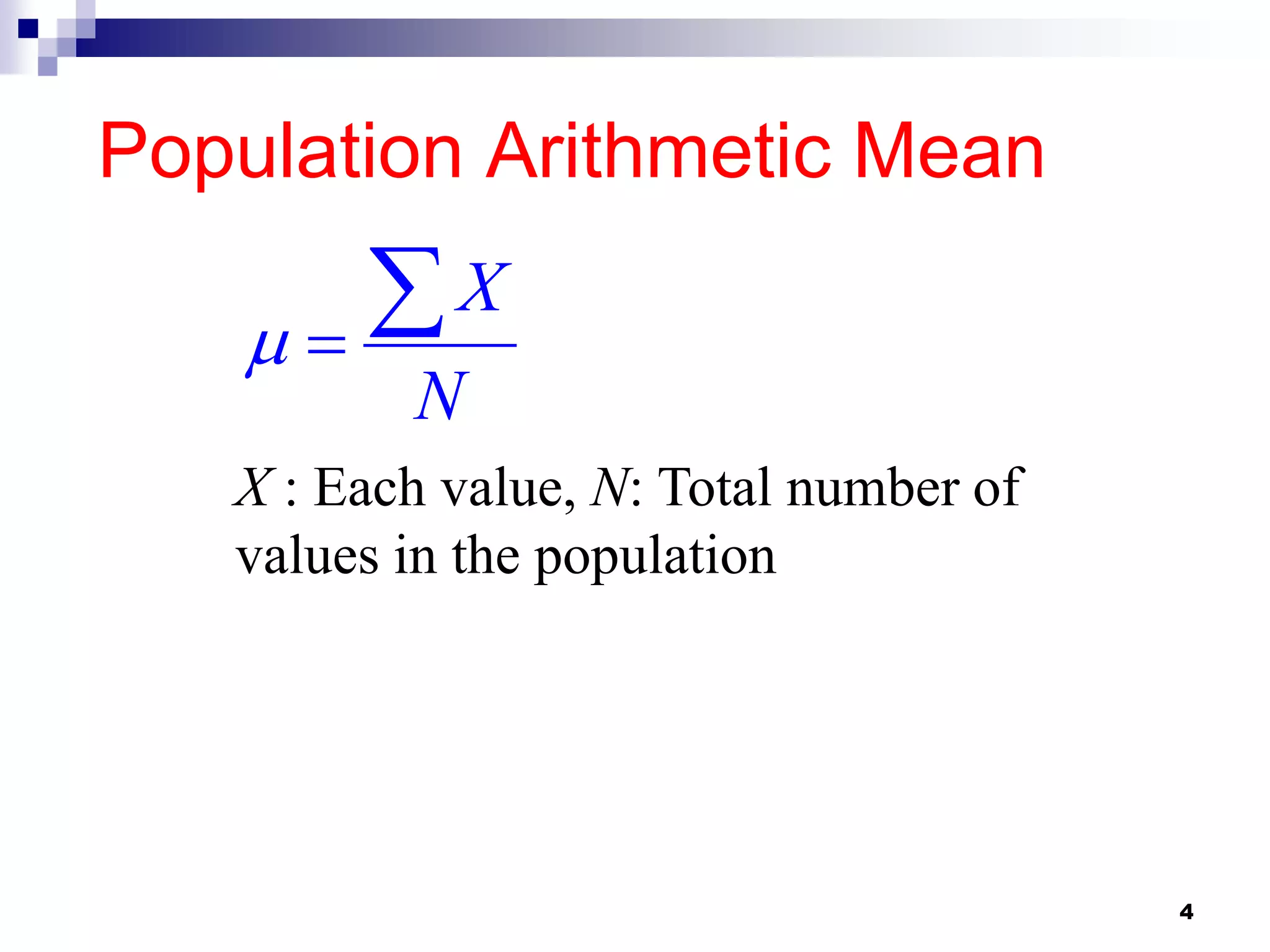
Population Arithmetic Mean

     X
          N
   X : Each value, N: Total number of
   values in the population


                                        4
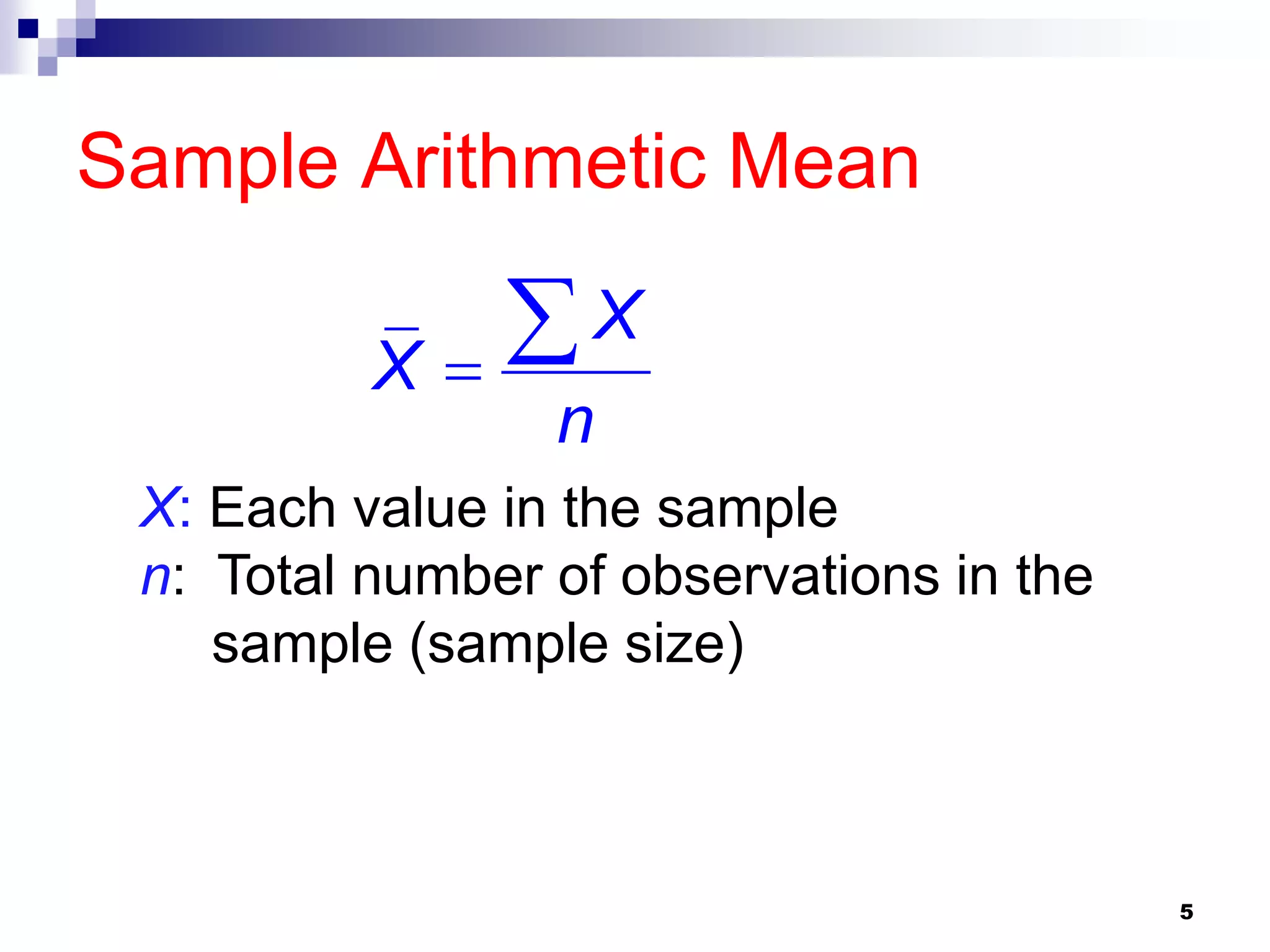
Sample Arithmetic Mean

          X
             X
                 n
 X: Each value in the sample
 n: Total number of observations in the
    sample (sample size)


                                          5
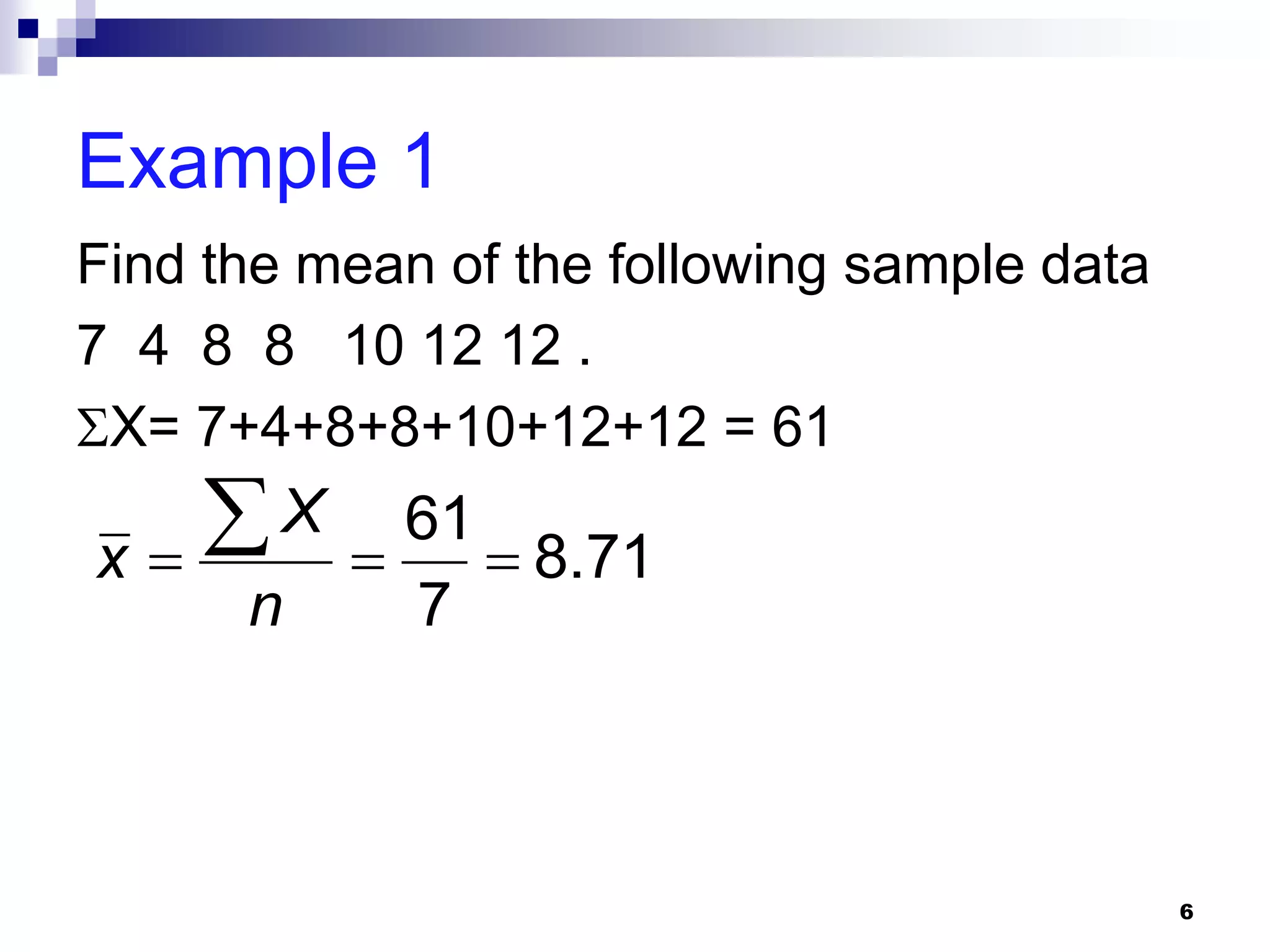
Example 1
Find the mean of the following sample data
7 4 8 8 10 12 12 .
X= 7+4+8+8+10+12+12 = 61

x
    X  61  8.71
      n      7


                                             6
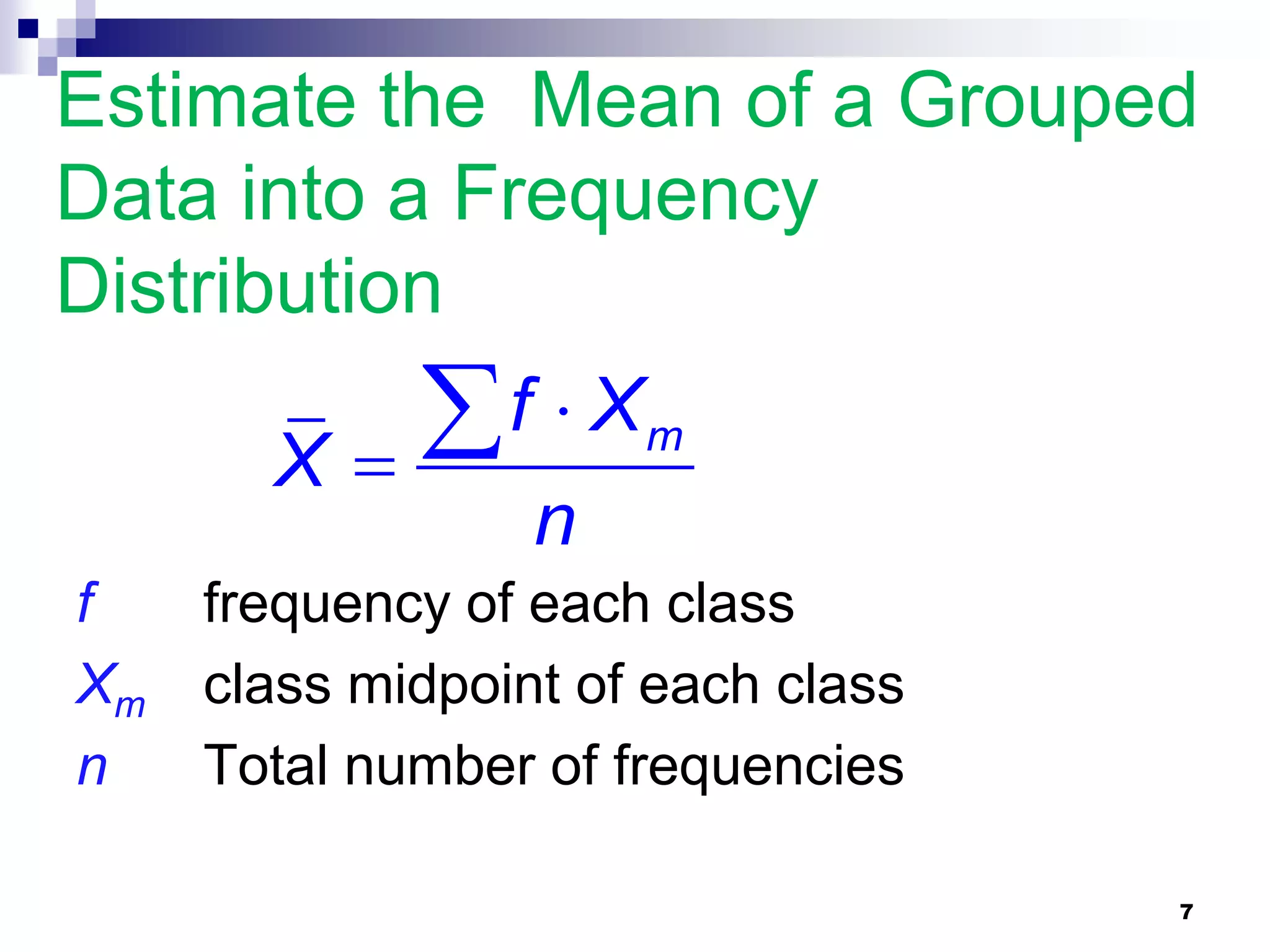
Estimate the Mean of a Grouped
Data into a Frequency
Distribution

       X
          f  X      m

                  n
f    frequency of each class
Xm   class midpoint of each class
n    Total number of frequencies

                                    7
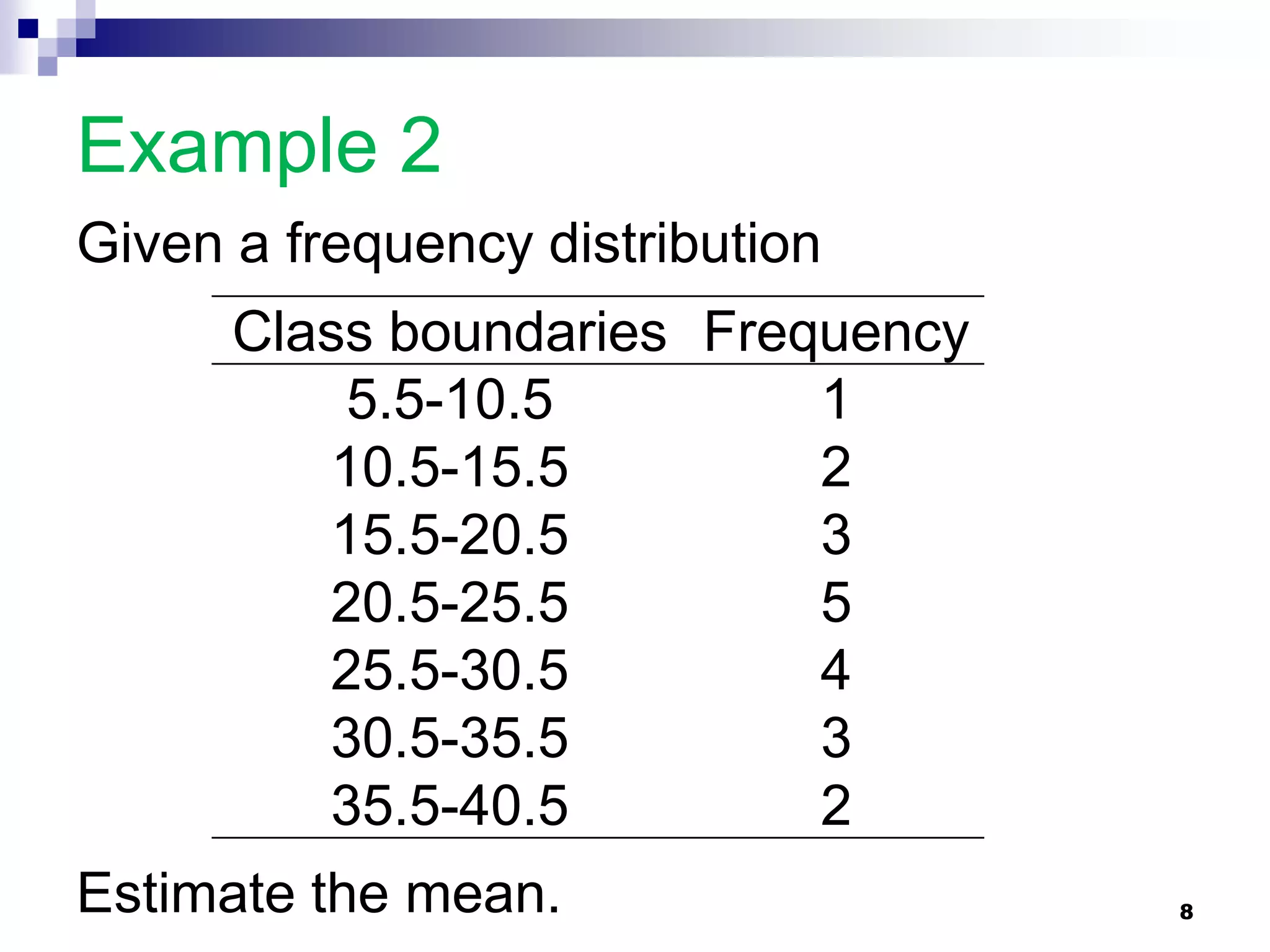
Example 2
Given a frequency distribution
      Class boundaries Frequency
          5.5-10.5         1
         10.5-15.5         2
         15.5-20.5         3
         20.5-25.5         5
         25.5-30.5         4
         30.5-35.5         3
         35.5-40.5         2
Estimate the mean.                 8
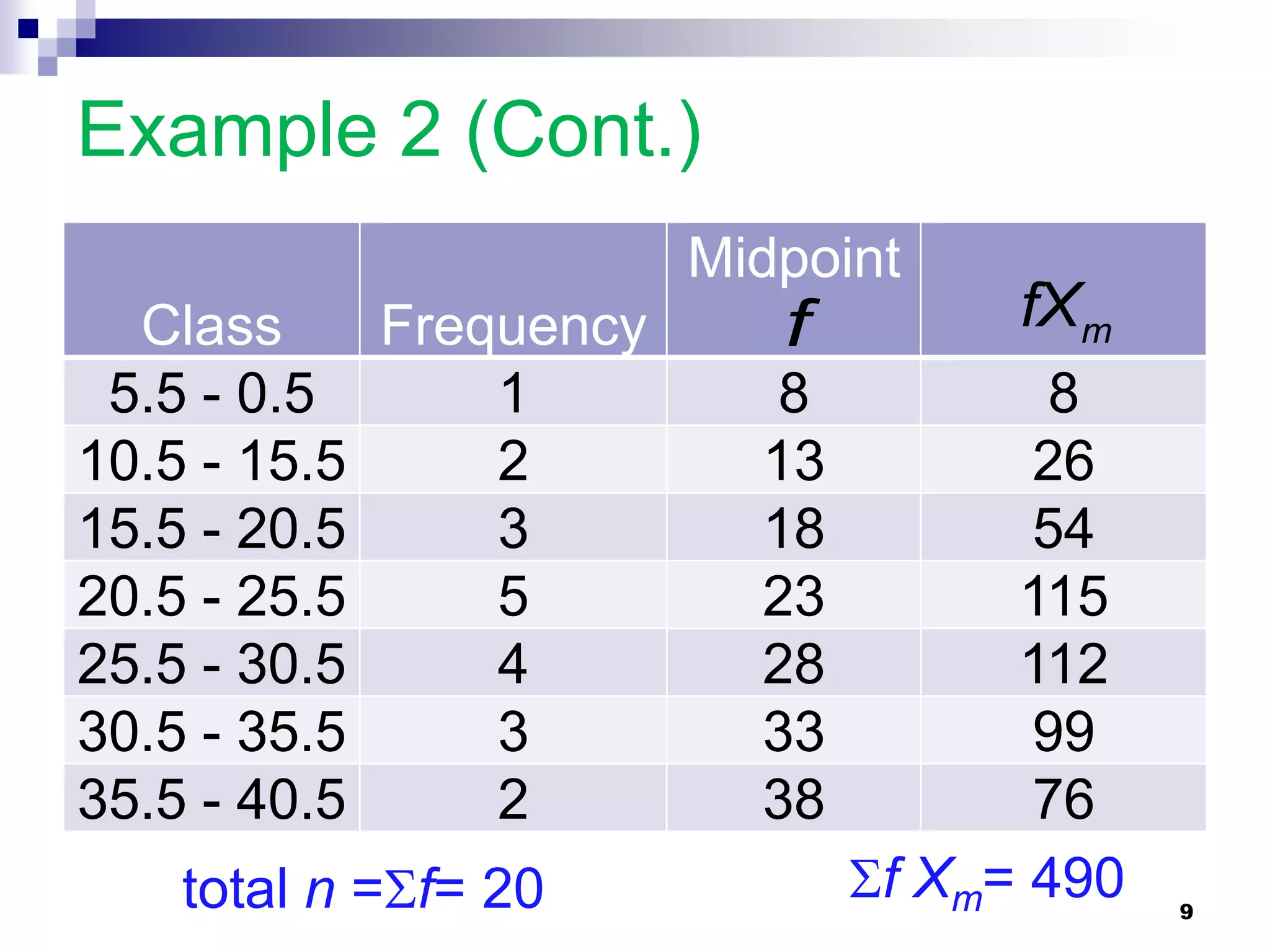
Example 2 (Cont.)
                        Midpoint
  Class     Frequency      f         fXm
 5.5 - 0.5      1         8            8
10.5 - 15.5     2         13          26
15.5 - 20.5     3         18          54
20.5 - 25.5     5         23         115
25.5 - 30.5     4         28         112
30.5 - 35.5     3         33          99
35.5 - 40.5     2         38          76
   total n =f= 20             f Xm= 490   9
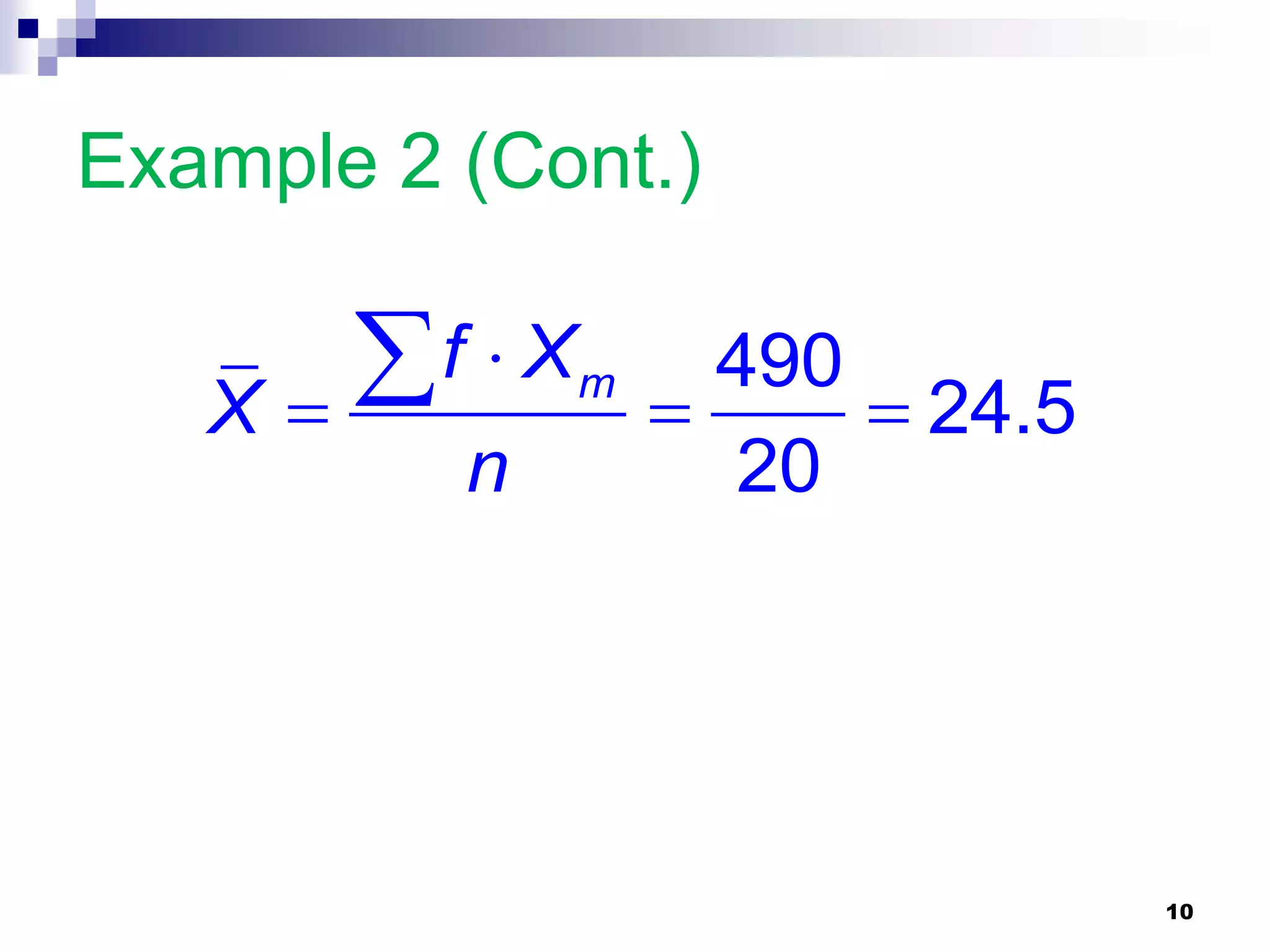
Example 2 (Cont.)


   X
      f  X   m
                   
                     490
                          24.5
          n          20


                                  10
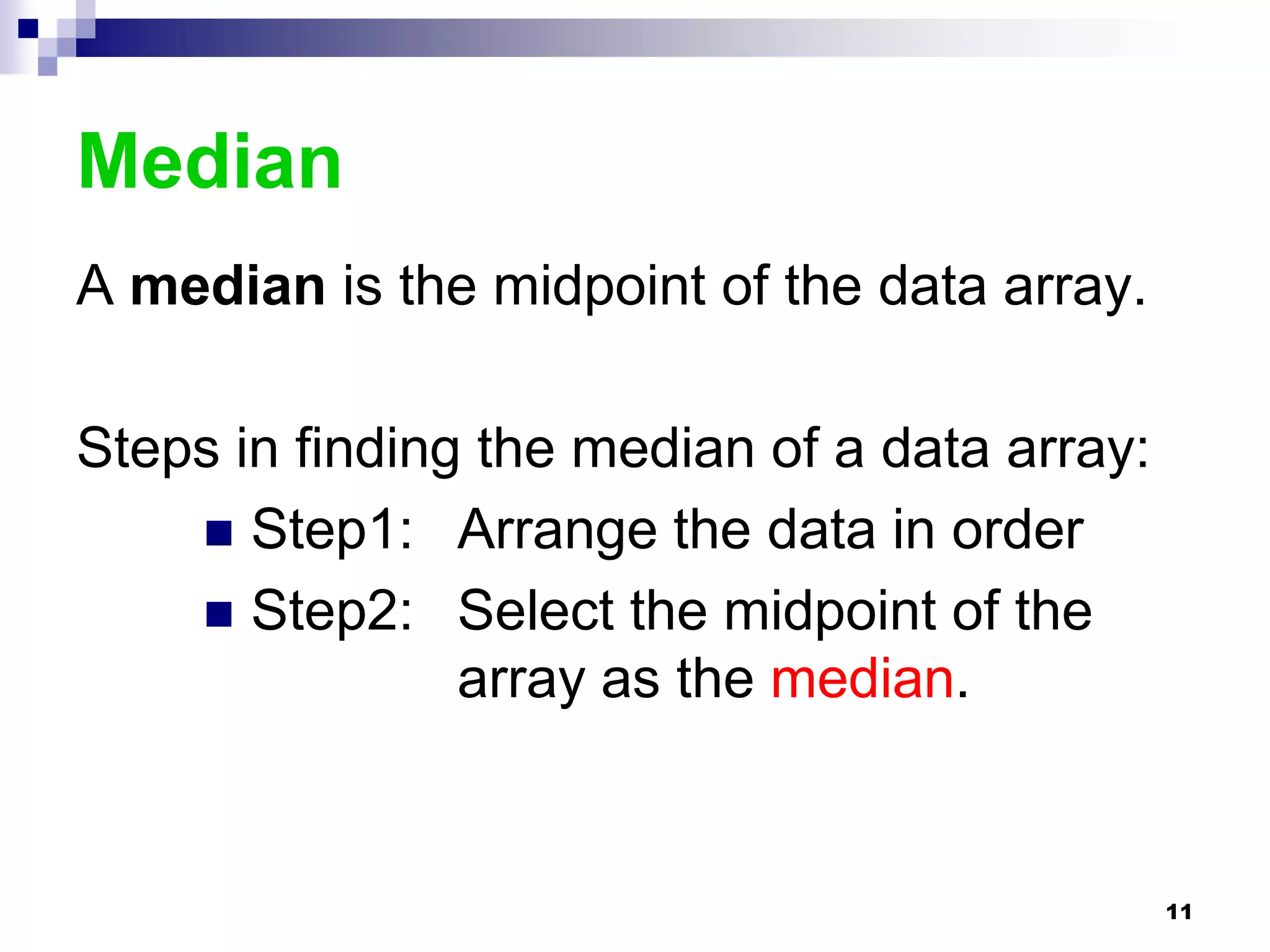
Median
A median is the midpoint of the data array.

Steps in finding the median of a data array:
     Step1: Arrange the data in order
     Step2: Select the midpoint of the
                array as the median.


                                               11
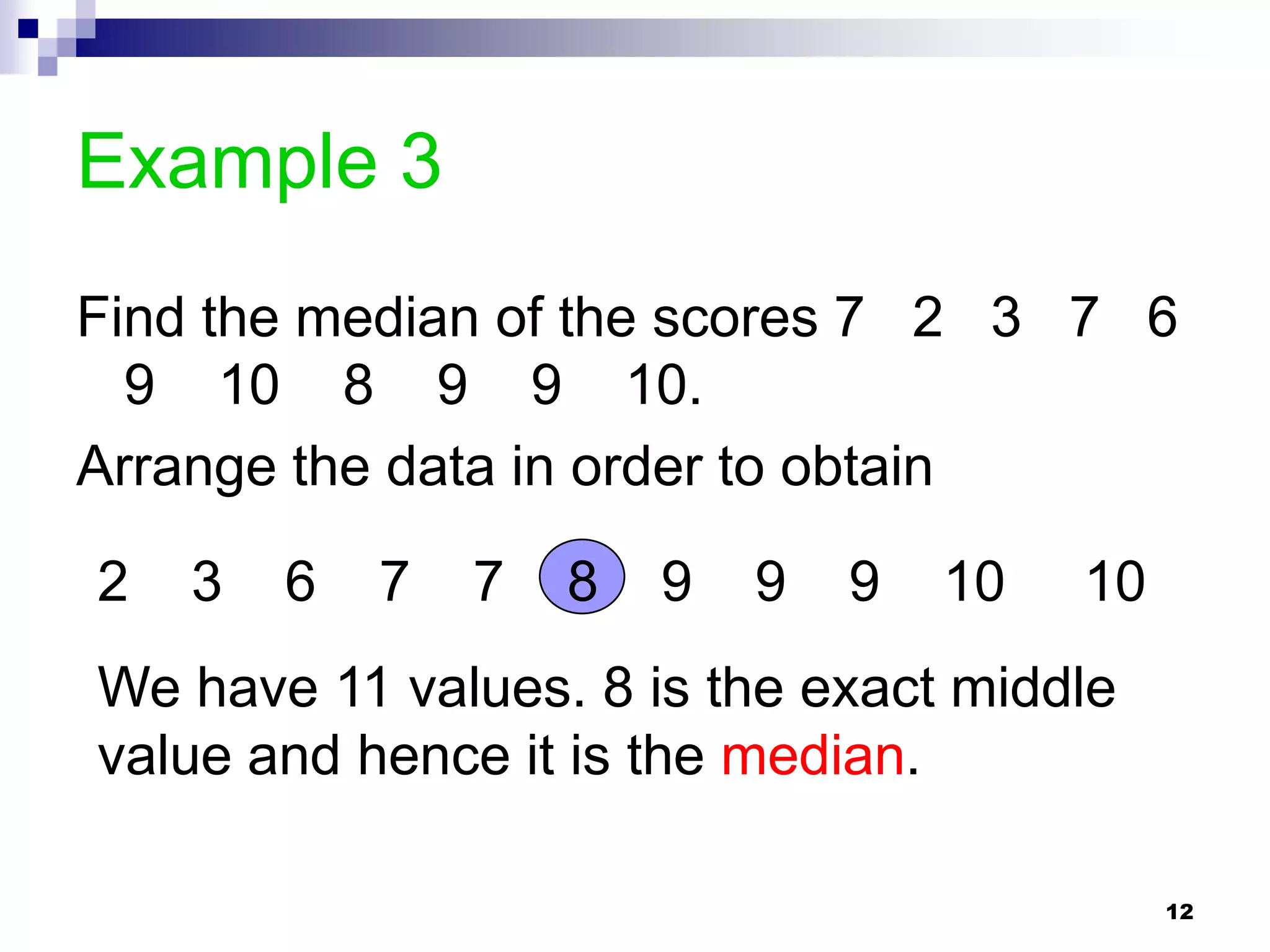
Example 3
Find the median of the scores 7 2 3 7 6
  9 10 8 9 9 10.
Arrange the data in order to obtain

2   3   6   7   7   8   9   9   9   10   10
We have 11 values. 8 is the exact middle
value and hence it is the median.

                                              12
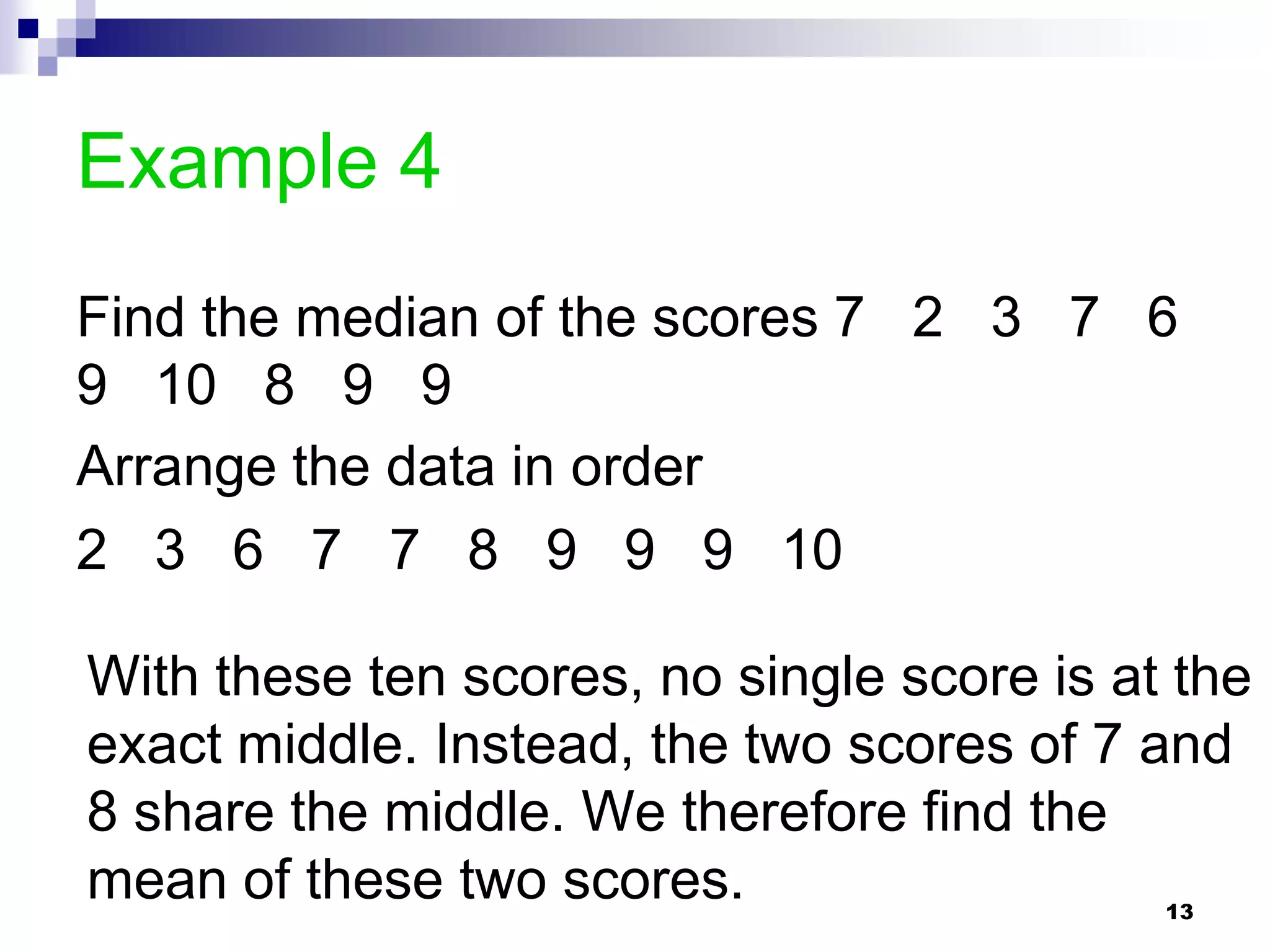
Example 4
Find the median of the scores 7 2 3 7 6
9 10 8 9 9
Arrange the data in order
2 3 6 7 7 8 9 9 9 10

With these ten scores, no single score is at the
exact middle. Instead, the two scores of 7 and
8 share the middle. We therefore find the
mean of these two scores.                   13
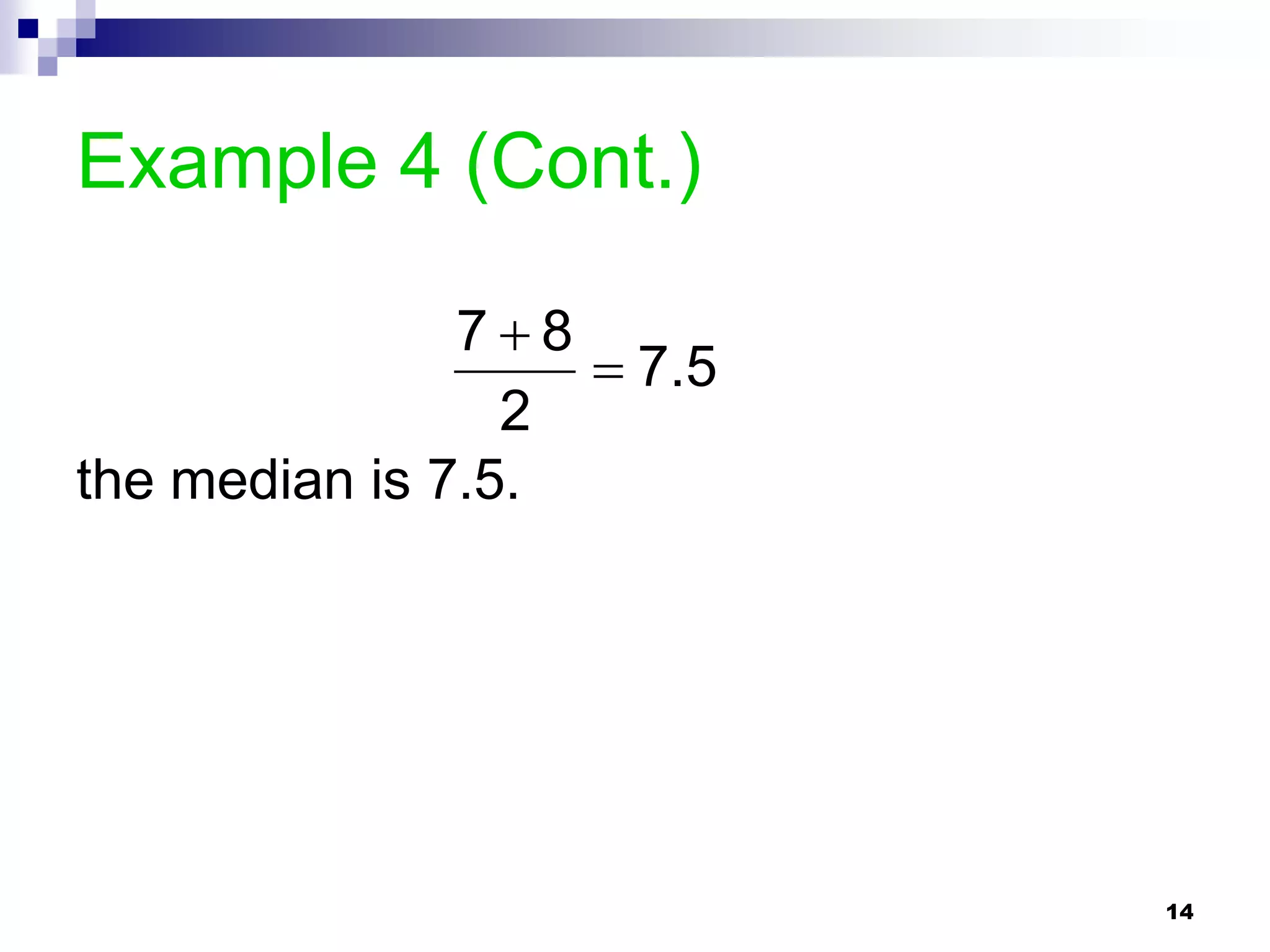
Example 4 (Cont.)

               78
                    7.5
                 2
the median is 7.5.


                           14
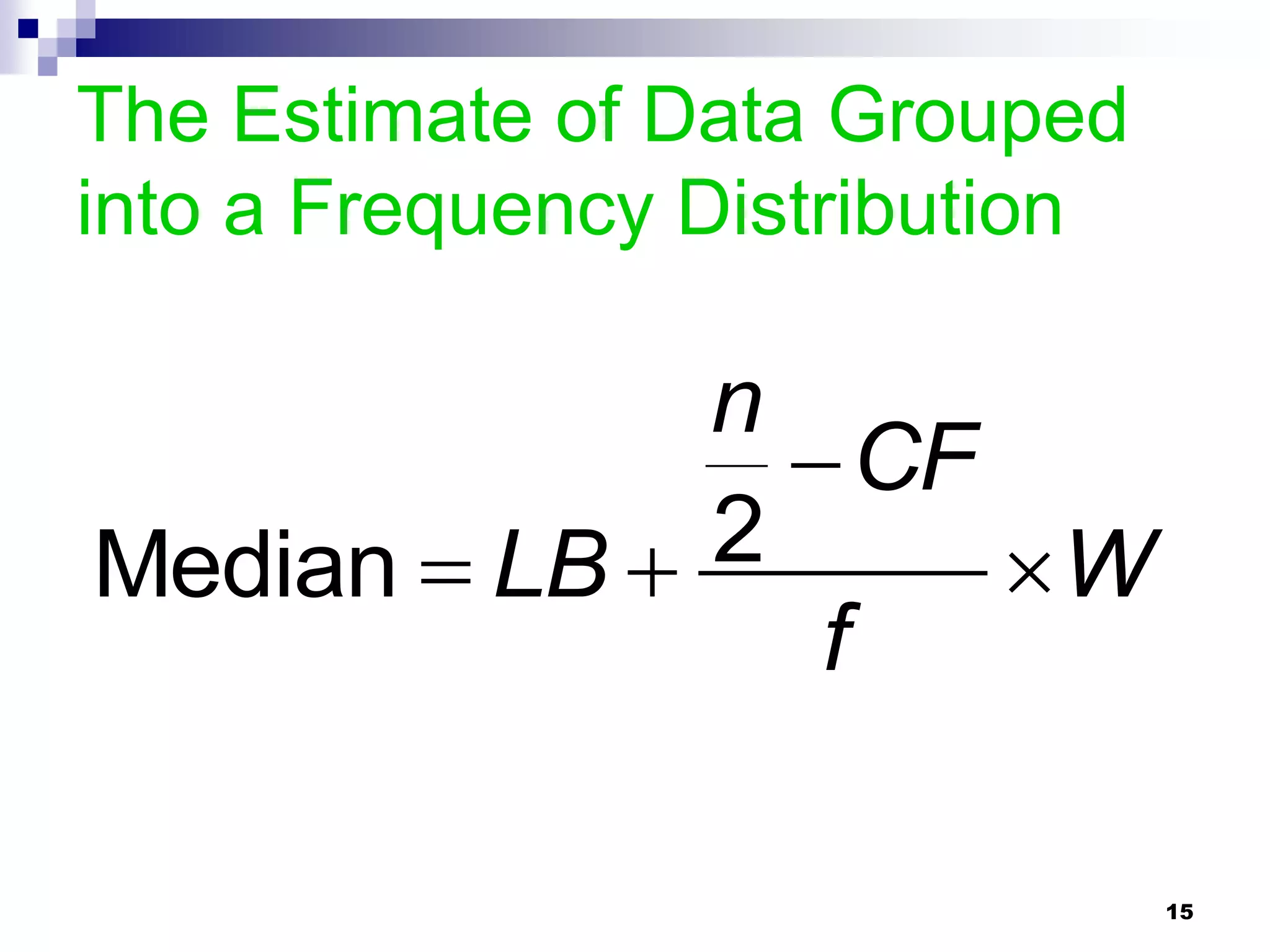
The Estimate of Data Grouped
into a Frequency Distribution

              n
                 CF
Median  LB  2      W
                 f

                                15
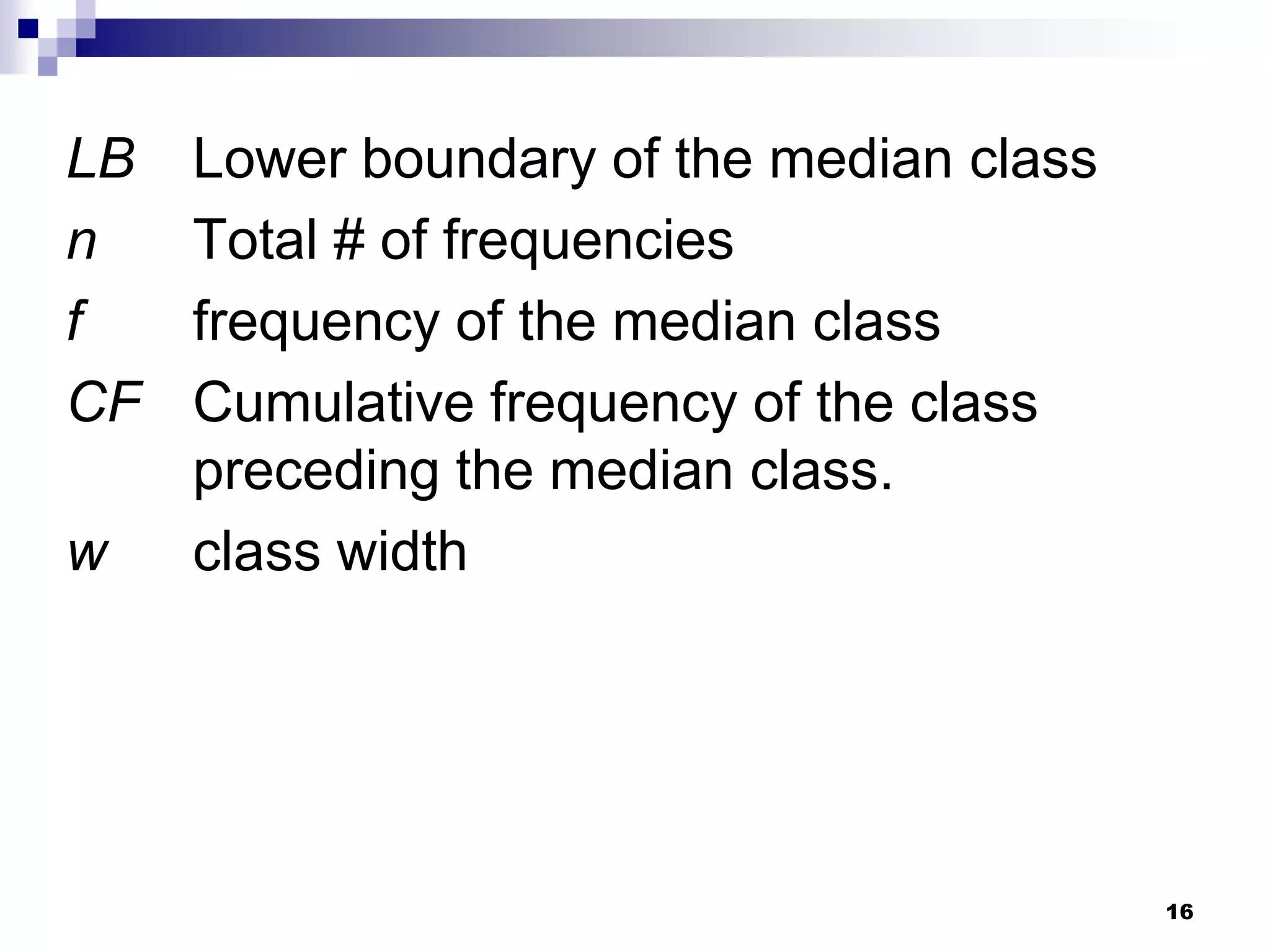
LB   Lower boundary of the median class
n    Total # of frequencies
f    frequency of the median class
CF   Cumulative frequency of the class
     preceding the median class.
w    class width


                                          16
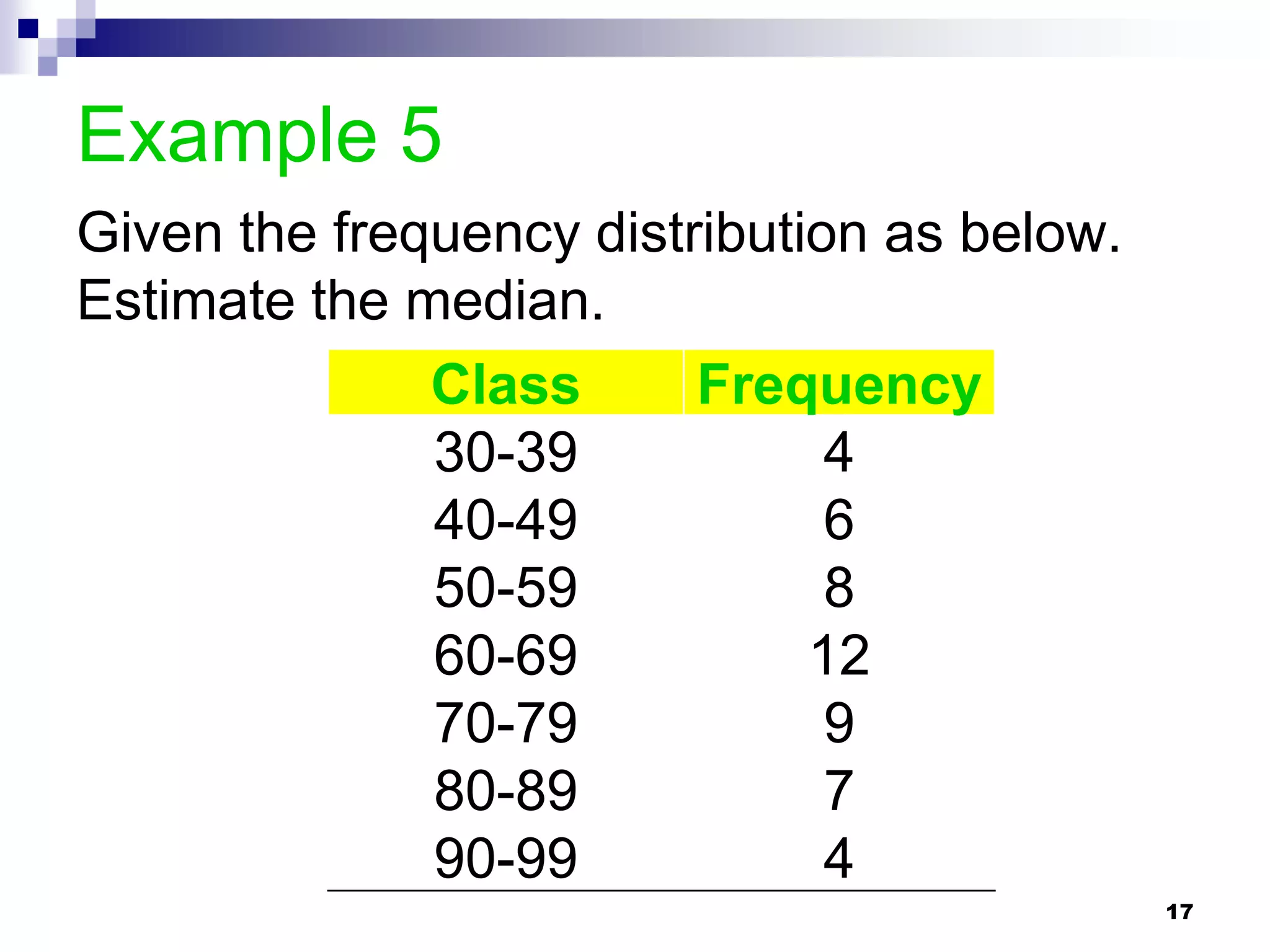
Example 5
Given the frequency distribution as below.
Estimate the median.
              Class      Frequency
              30-39            4
              40-49            6
              50-59            8
              60-69           12
              70-79            9
              80-89            7
              90-99            4
                                             17
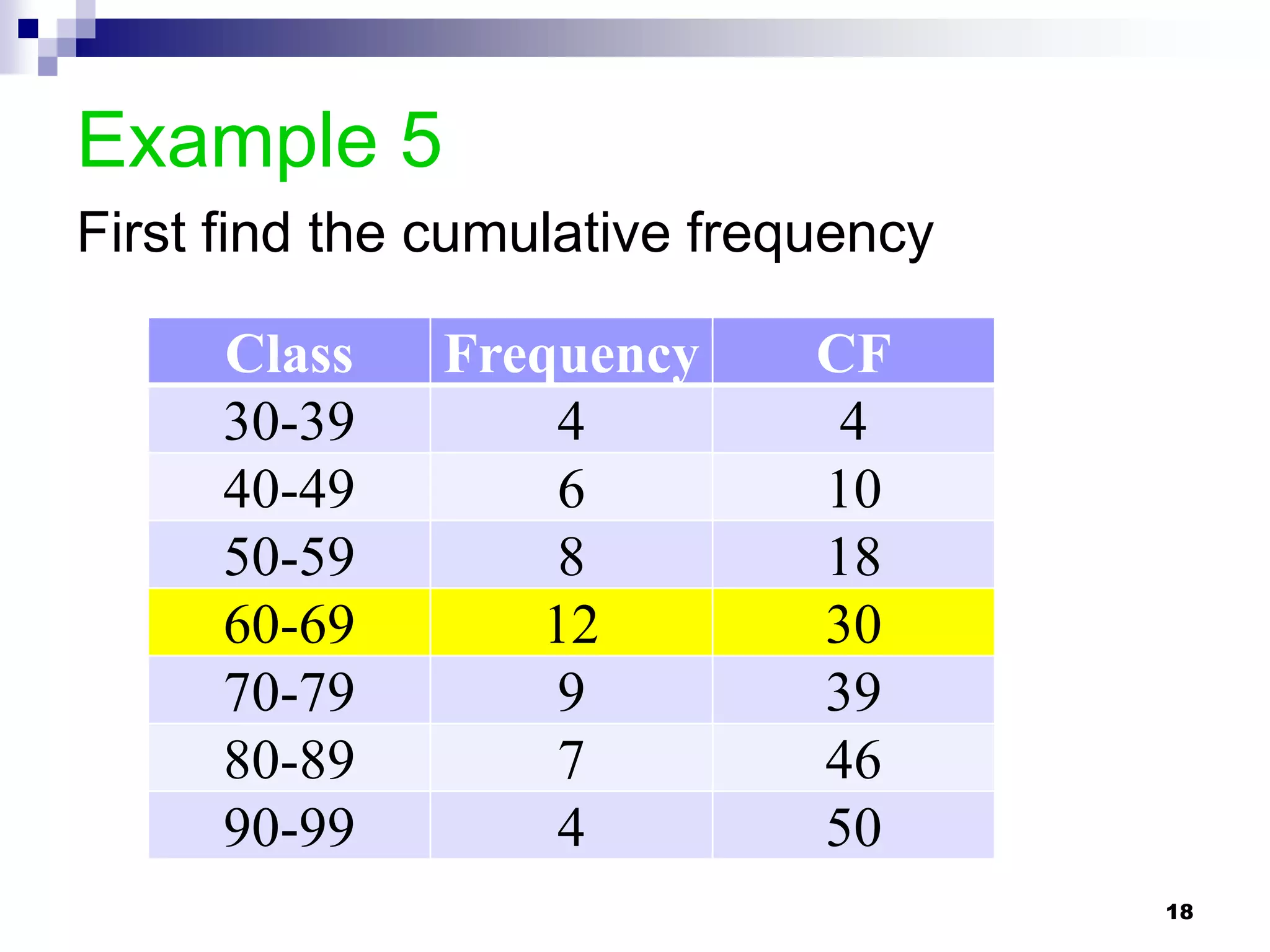
Example 5
First find the cumulative frequency

     Class    Frequency       CF
     30-39         4           4
     40-49         6          10
     50-59         8          18
     60-69        12          30
     70-79         9          39
     80-89         7          46
     90-99         4          50
                                      18
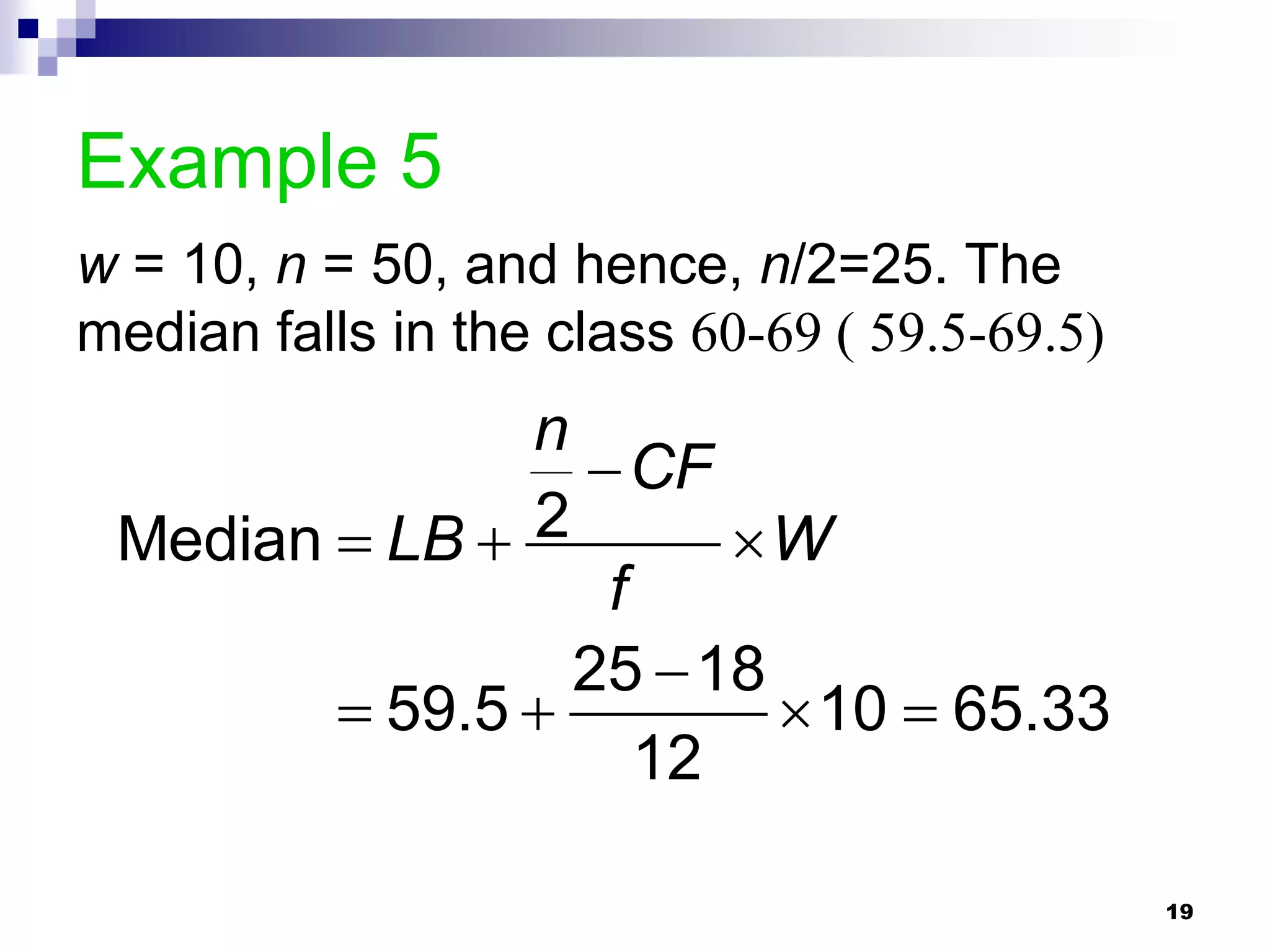
Example 5
w = 10, n = 50, and hence, n/2=25. The
median falls in the class 60-69 ( 59.5-69.5)
               n
                  CF
 Median  LB  2       W
                  f
                 25  18
         59.5           10  65.33
                    12

                                               19
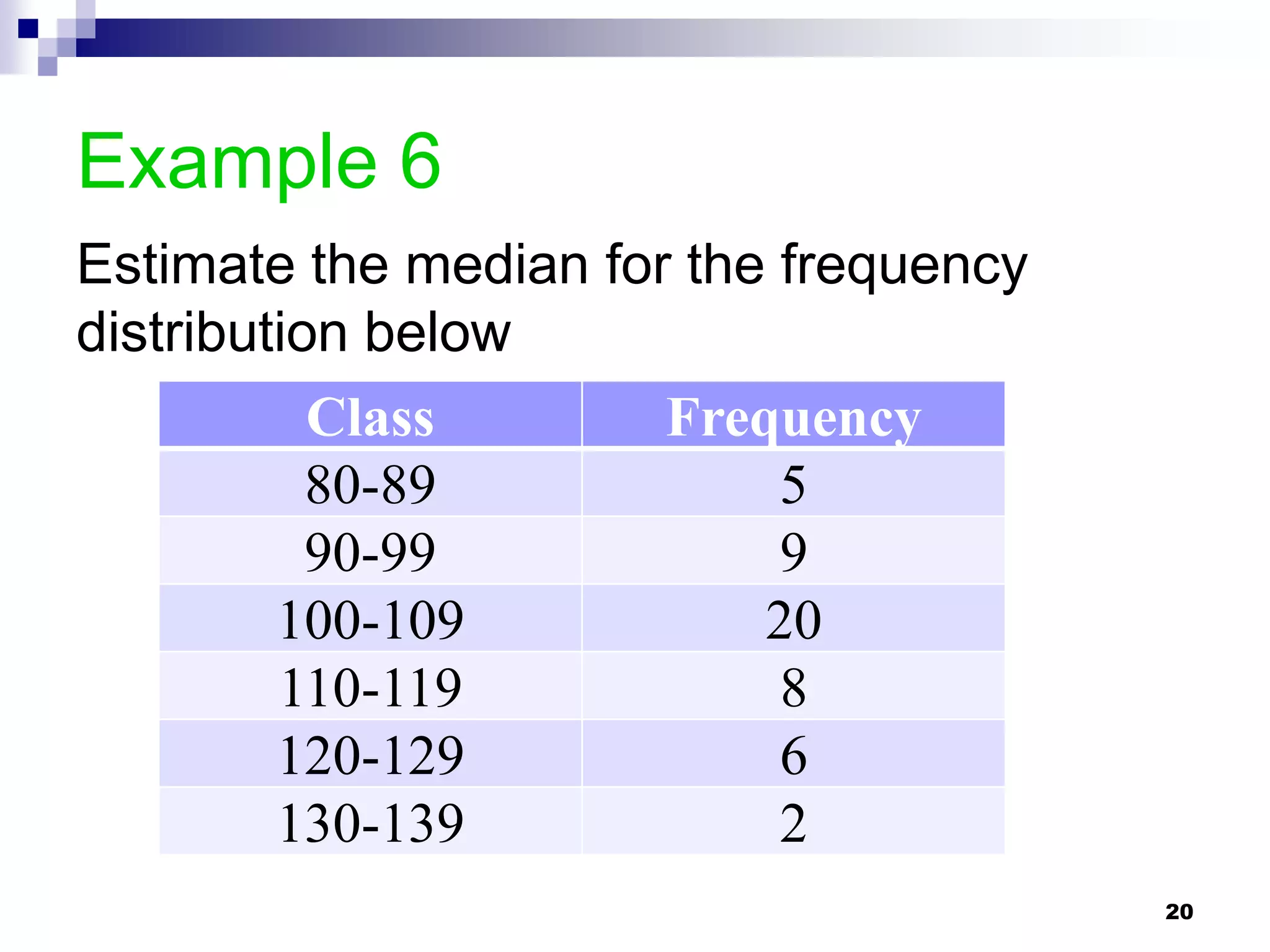
Example 6
Estimate the median for the frequency
distribution below
           Class       Frequency
           80-89            5
           90-99            9
         100-109           20
         110-119            8
         120-129            6
         130-139            2
                                        20
Mode
o   For grouped data into a frequency
    distribution, the estimate of mode can be
    the class midpoint of the modal class ( the
    class with the highest frequency)
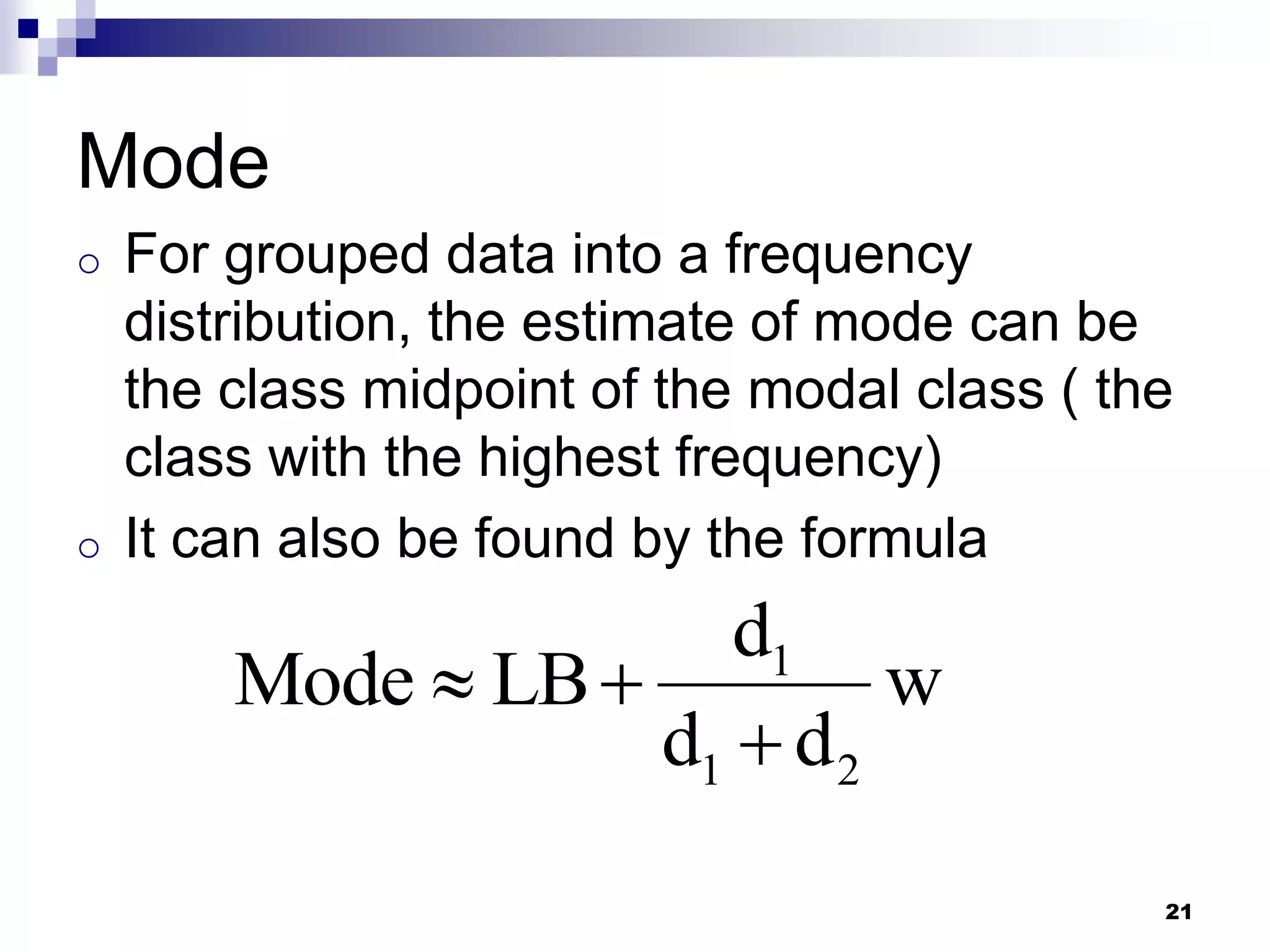
o   It can also be found by the formula
                       d1
        Mode  LB           w
                    d1  d 2
                                              21
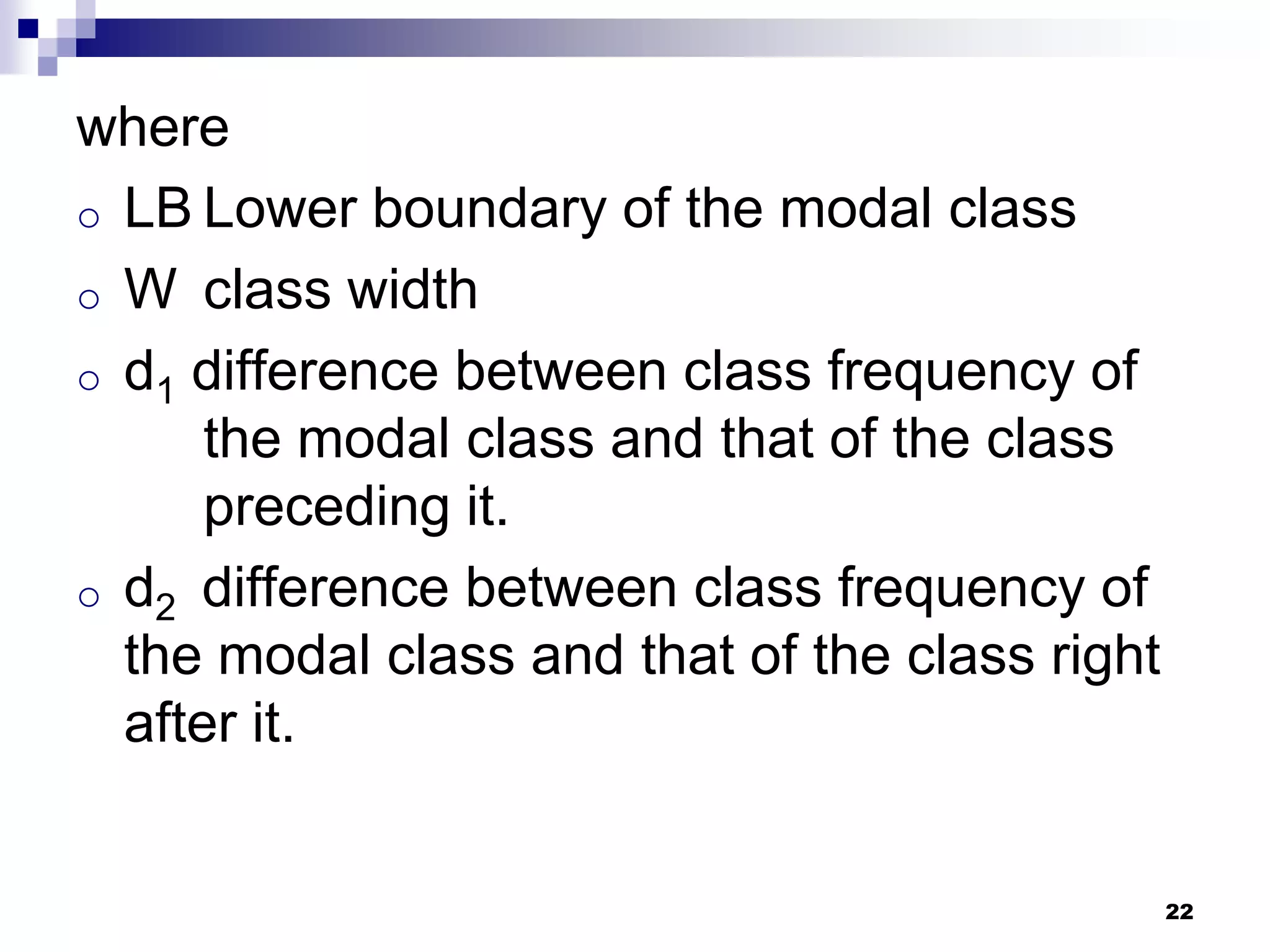
where
o LB Lower boundary of the modal class
o W class width
o d1 difference between class frequency of
      the modal class and that of the class
      preceding it.
o d2 difference between class frequency of
  the modal class and that of the class right
  after it.


                                                22
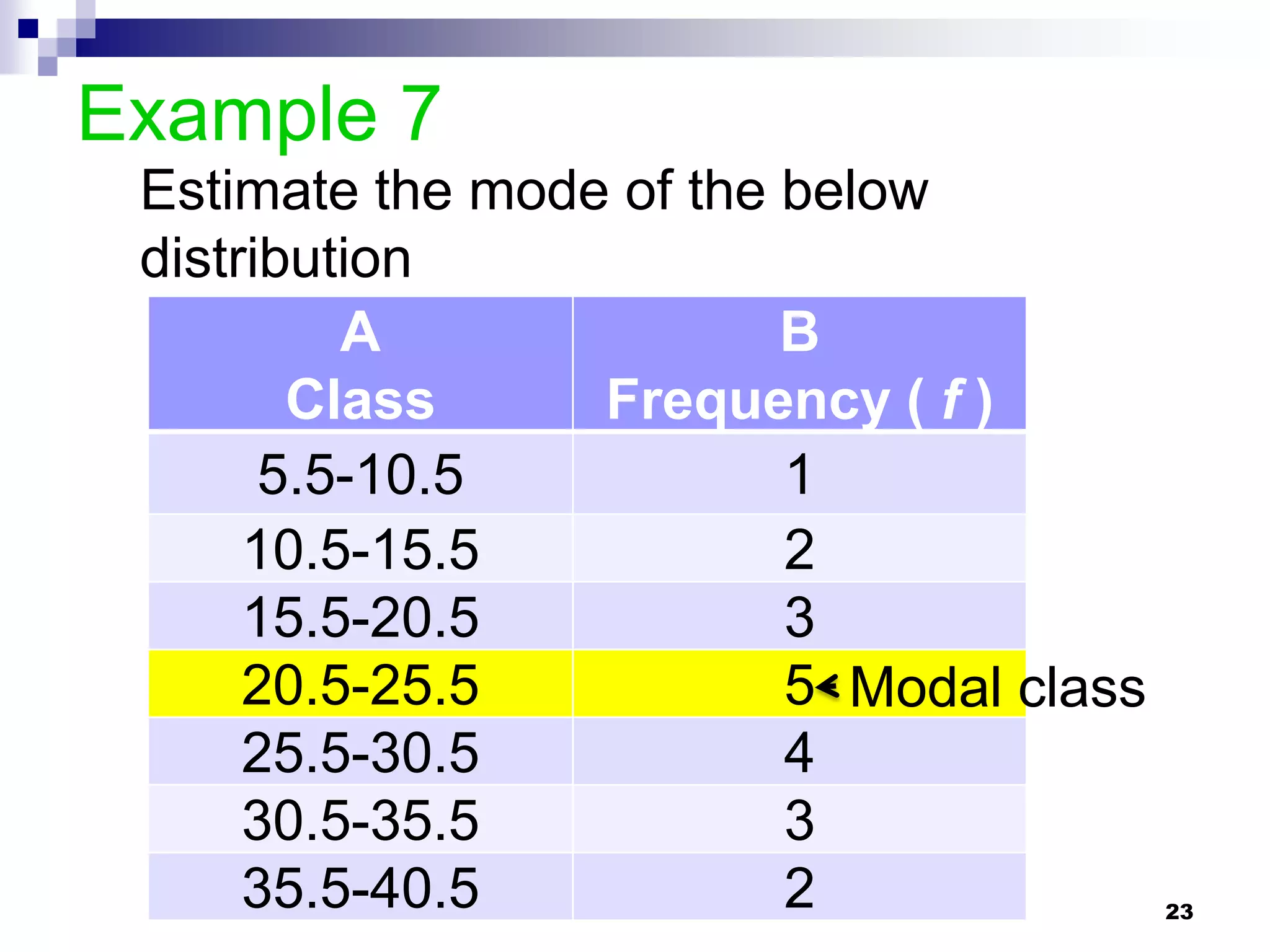
Example 7
 Estimate the mode of the below
 distribution
          A               B
        Class     Frequency ( f )
       5.5-10.5           1
      10.5-15.5           2
      15.5-20.5           3
      20.5-25.5           5 Modal class
      25.5-30.5           4
      30.5-35.5           3
      35.5-40.5           2               23
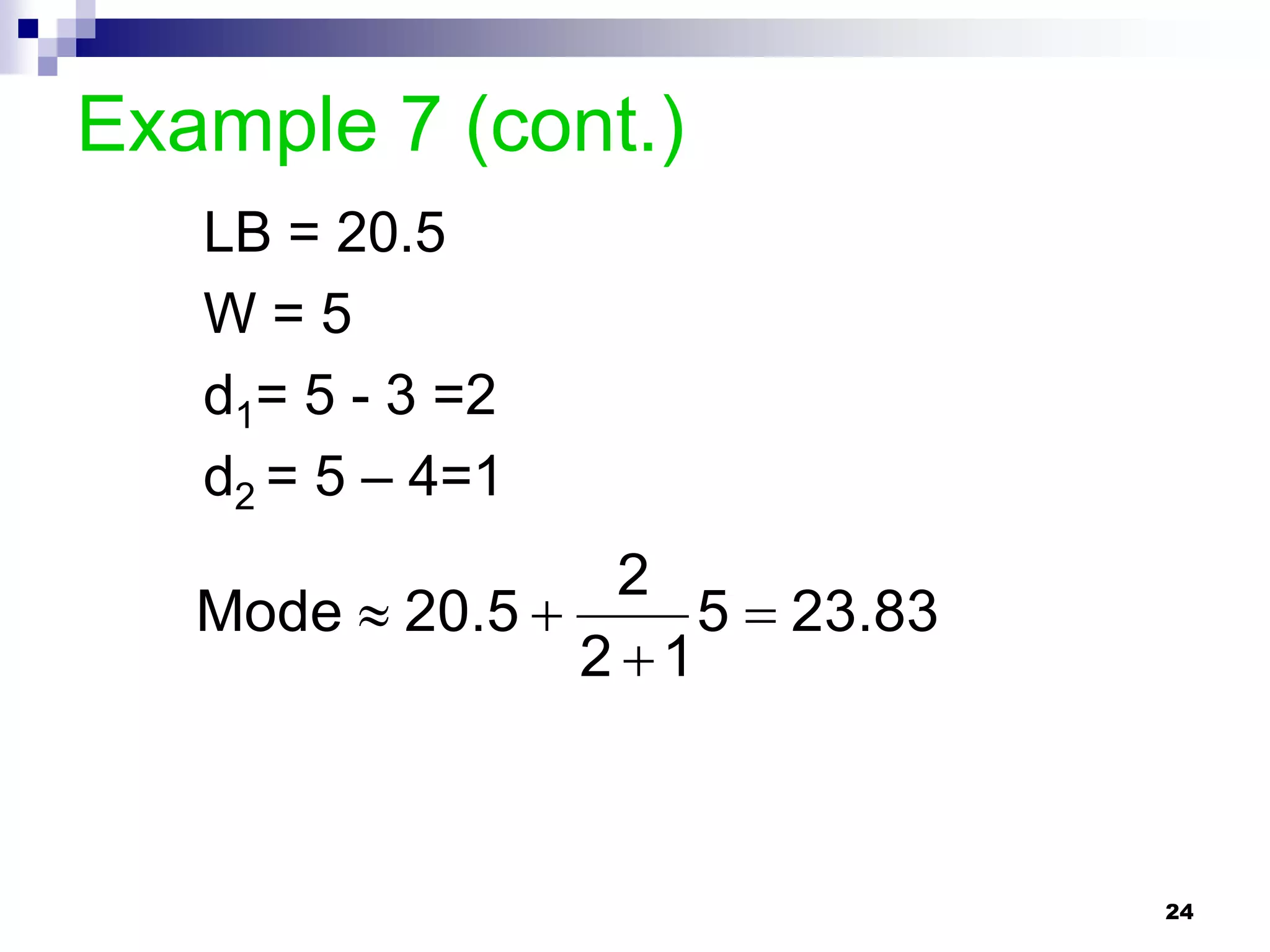
Example 7 (cont.)
   LB = 20.5
   W=5
   d1= 5 - 3 =2
   d2 = 5 – 4=1
                  2
   Mode  20.5       5  23.83
                 2 1


                                  24
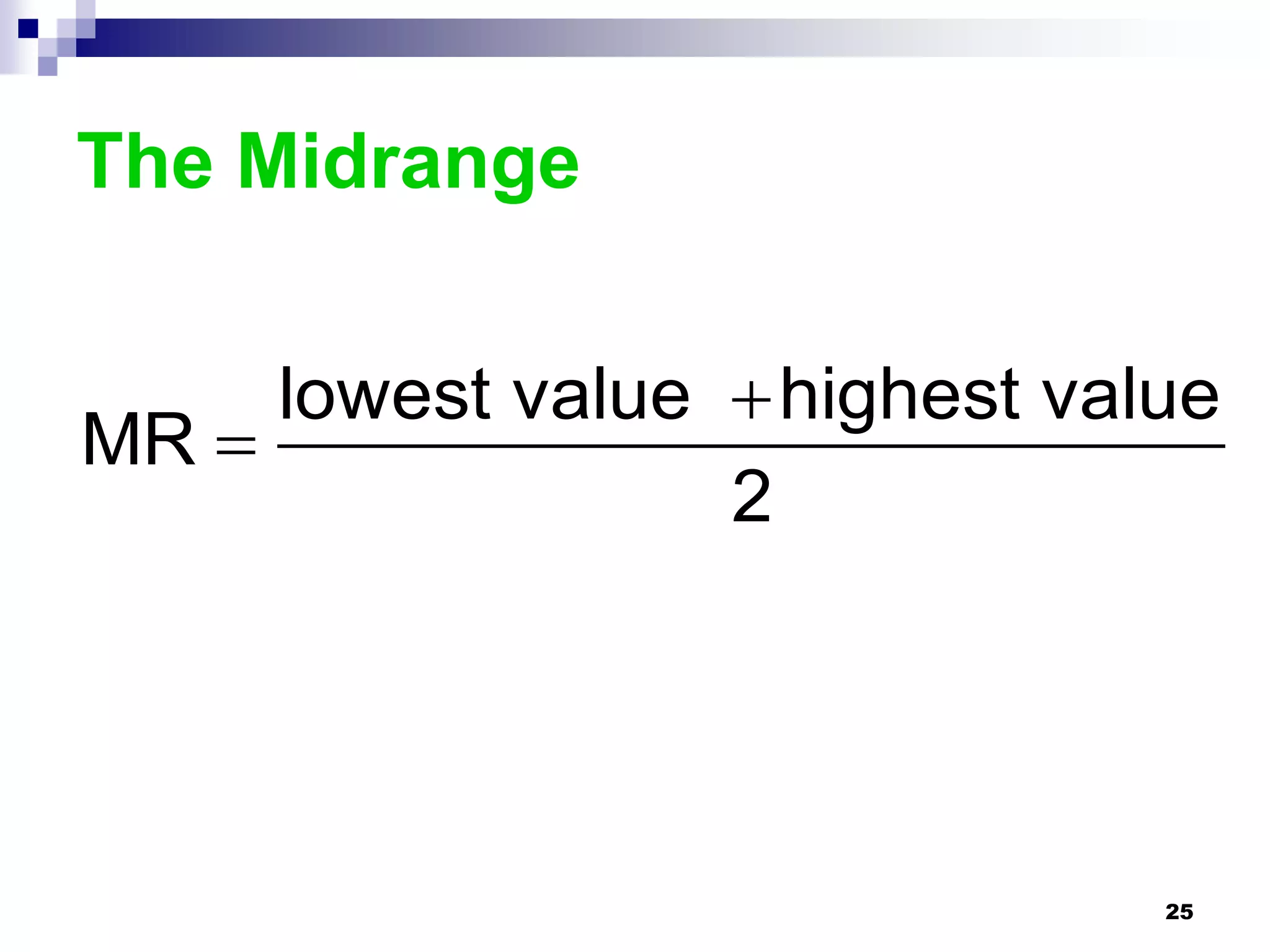
The Midrange

     lowest value  highest value
MR 
                  2


                               25
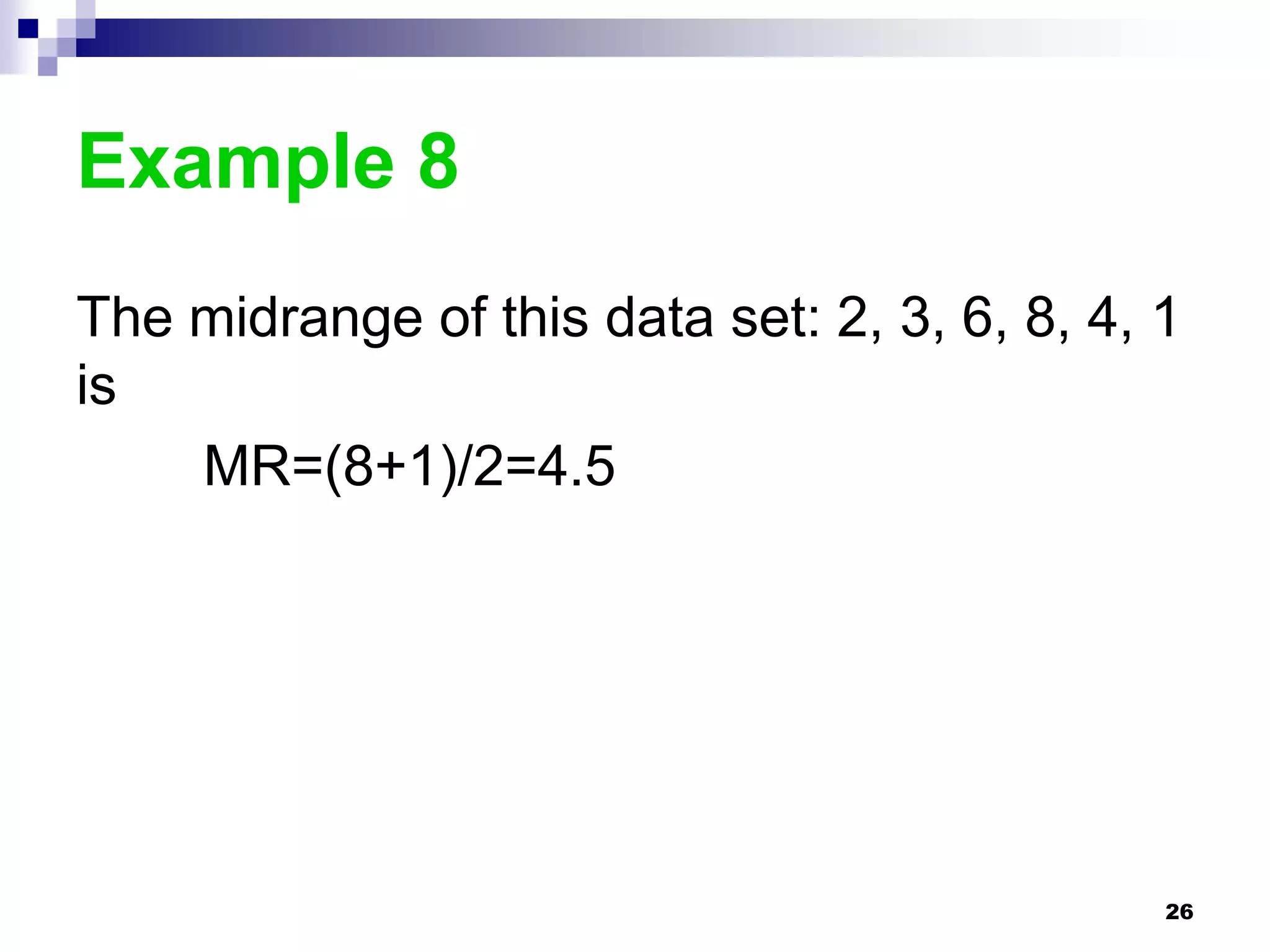
Example 8
The midrange of this data set: 2, 3, 6, 8, 4, 1
is
    MR=(8+1)/2=4.5


                                              26
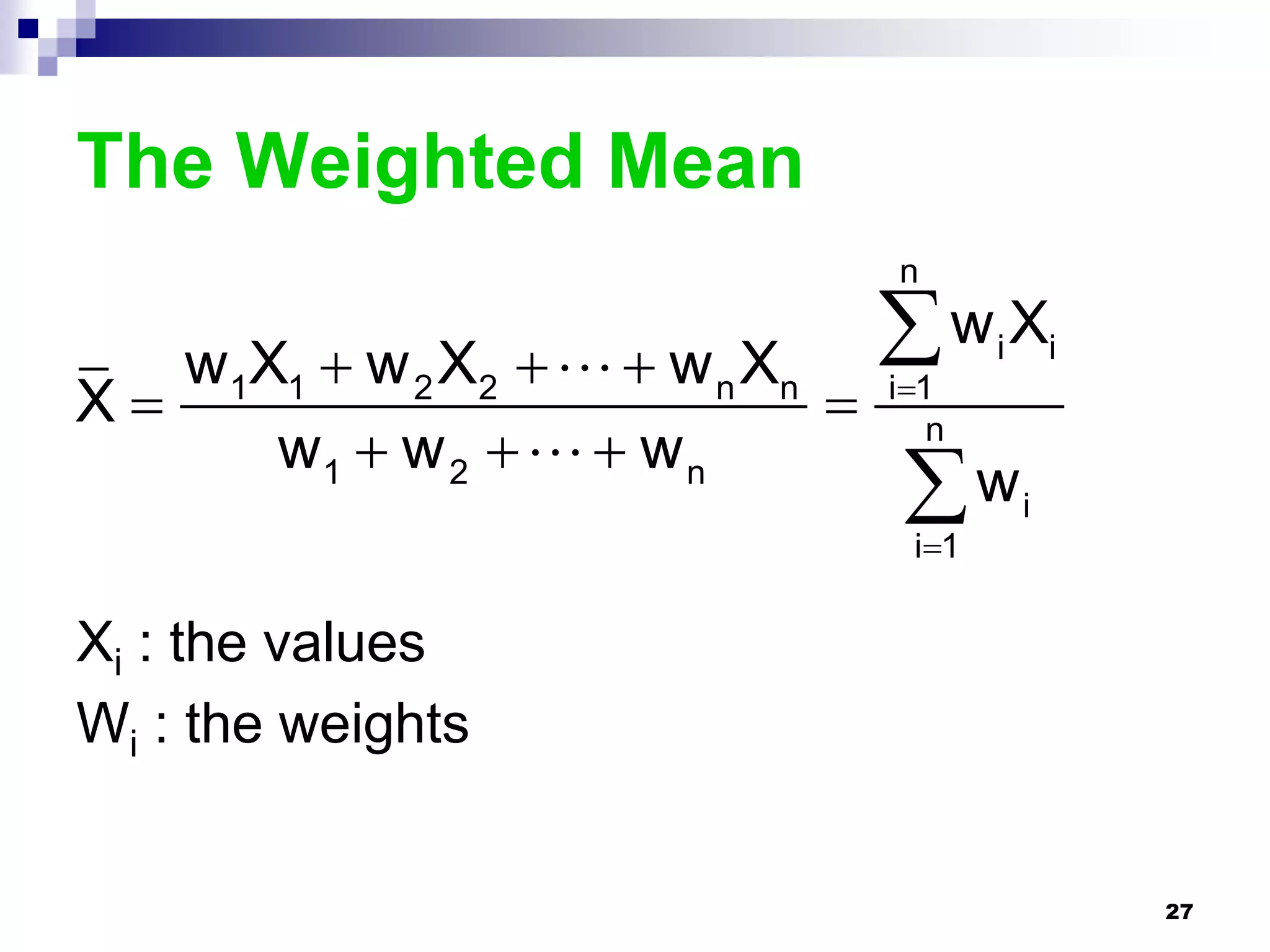
The Weighted Mean
                                  n

   w1X1  w 2 X2    w n Xn     w X   i       i
X                               i1

      w1  w 2    w n             n

                                   w
                                   i1
                                             i


Xi : the values
Wi : the weights


                                                     27
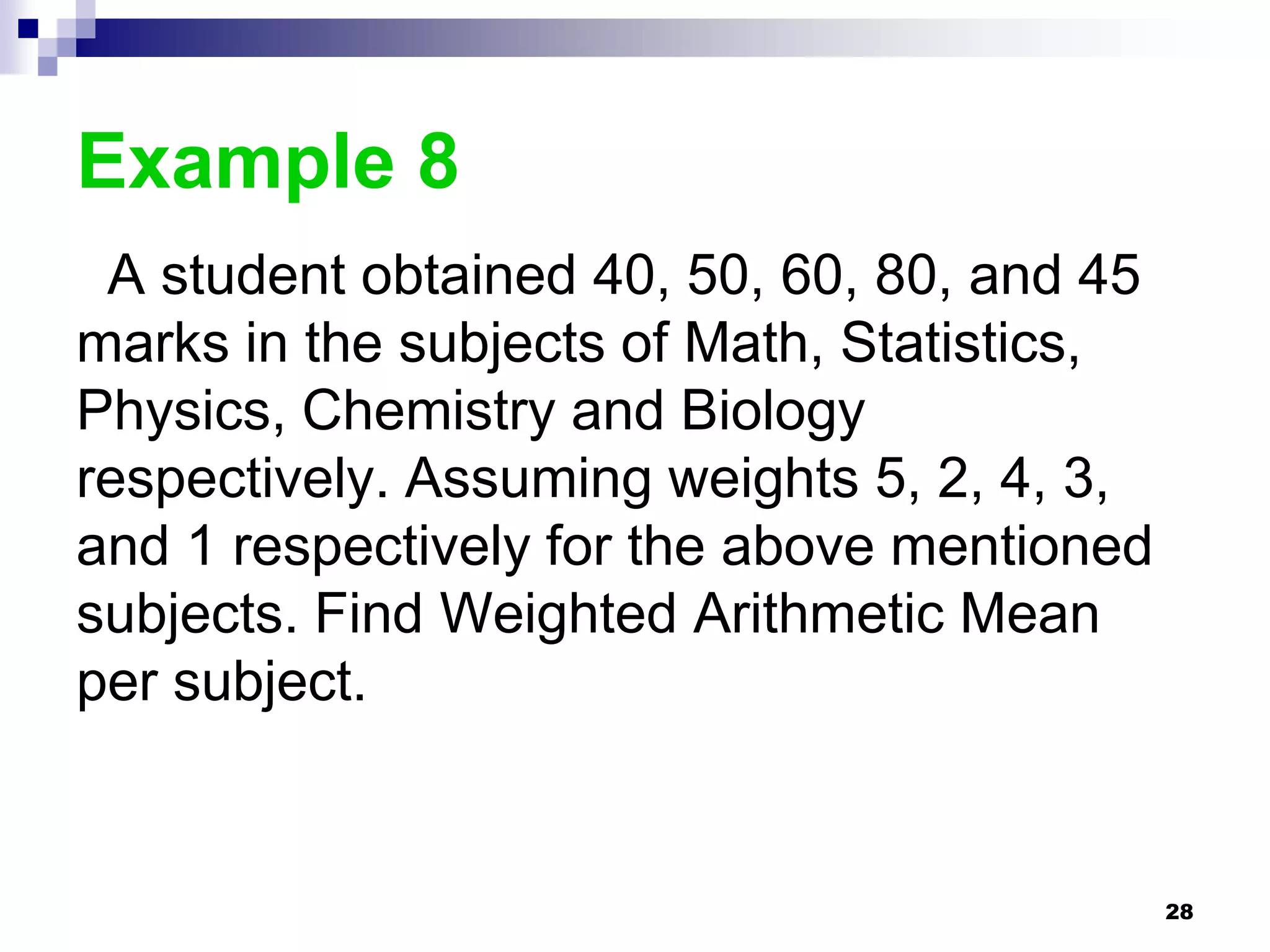
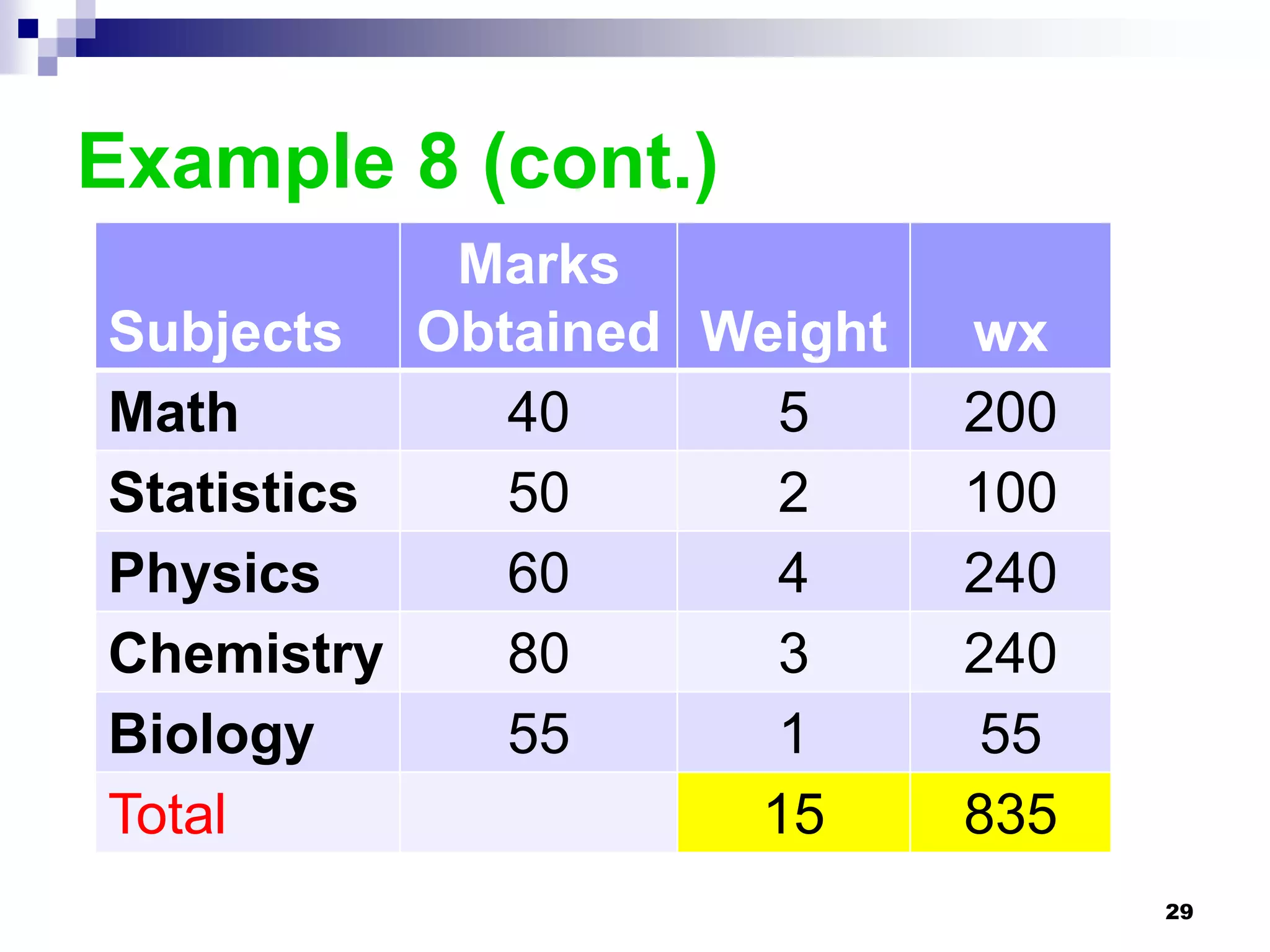
Example 8
 A student obtained 40, 50, 60, 80, and 45
marks in the subjects of Math, Statistics,
Physics, Chemistry and Biology
respectively. Assuming weights 5, 2, 4, 3,
and 1 respectively for the above mentioned
subjects. Find Weighted Arithmetic Mean
per subject.


                                             28
Example 8 (cont.)
           Marks
Subjects Obtained Weight   wx
Math        40      5      200
Statistics  50      2      100
Physics     60      4      240
Chemistry   80      3      240
Biology     55      1       55
Total              15      835
                                 29
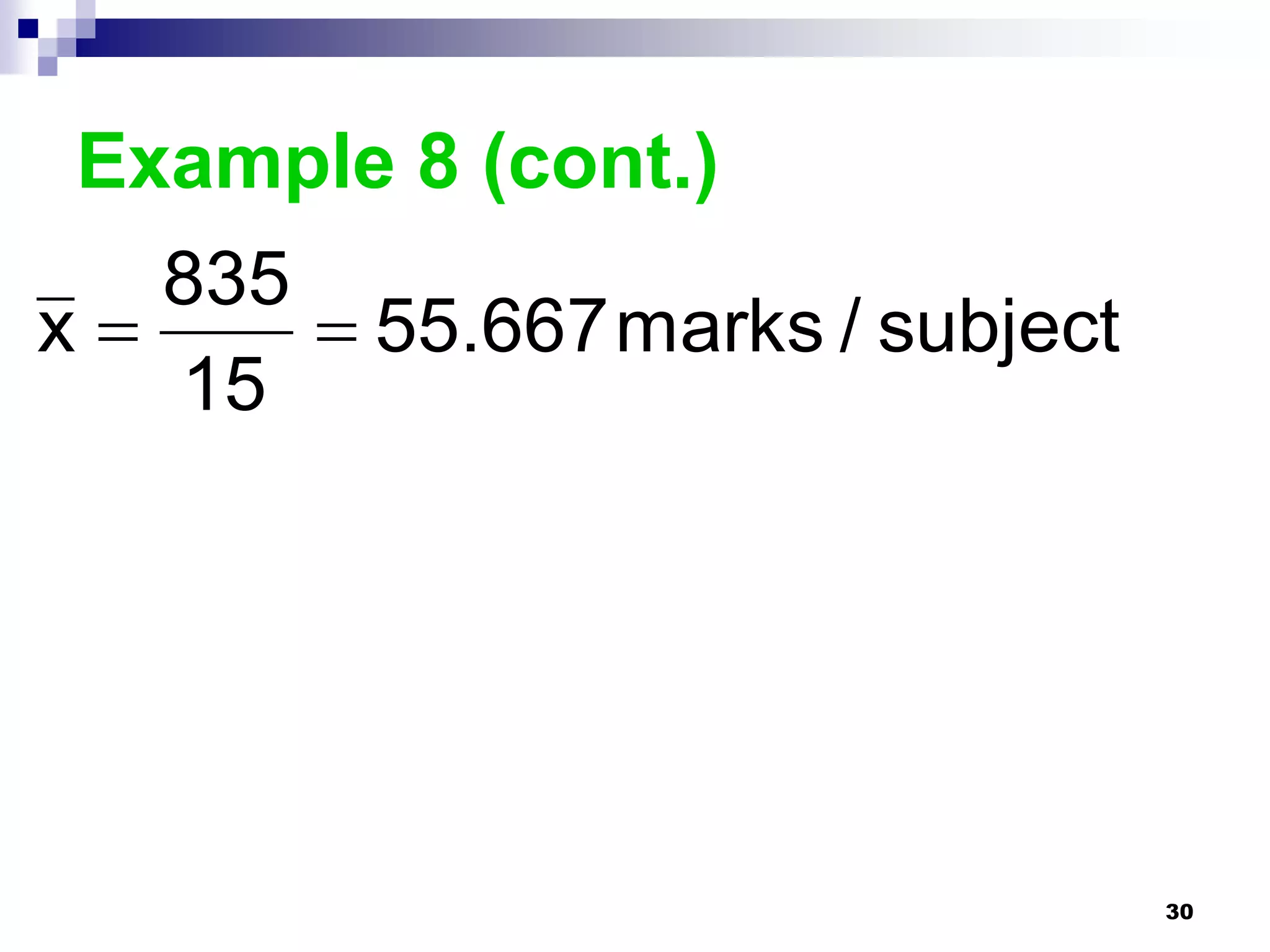
Example 8 (cont.)
   835
x      55.667marks / subject
   15


                                 30
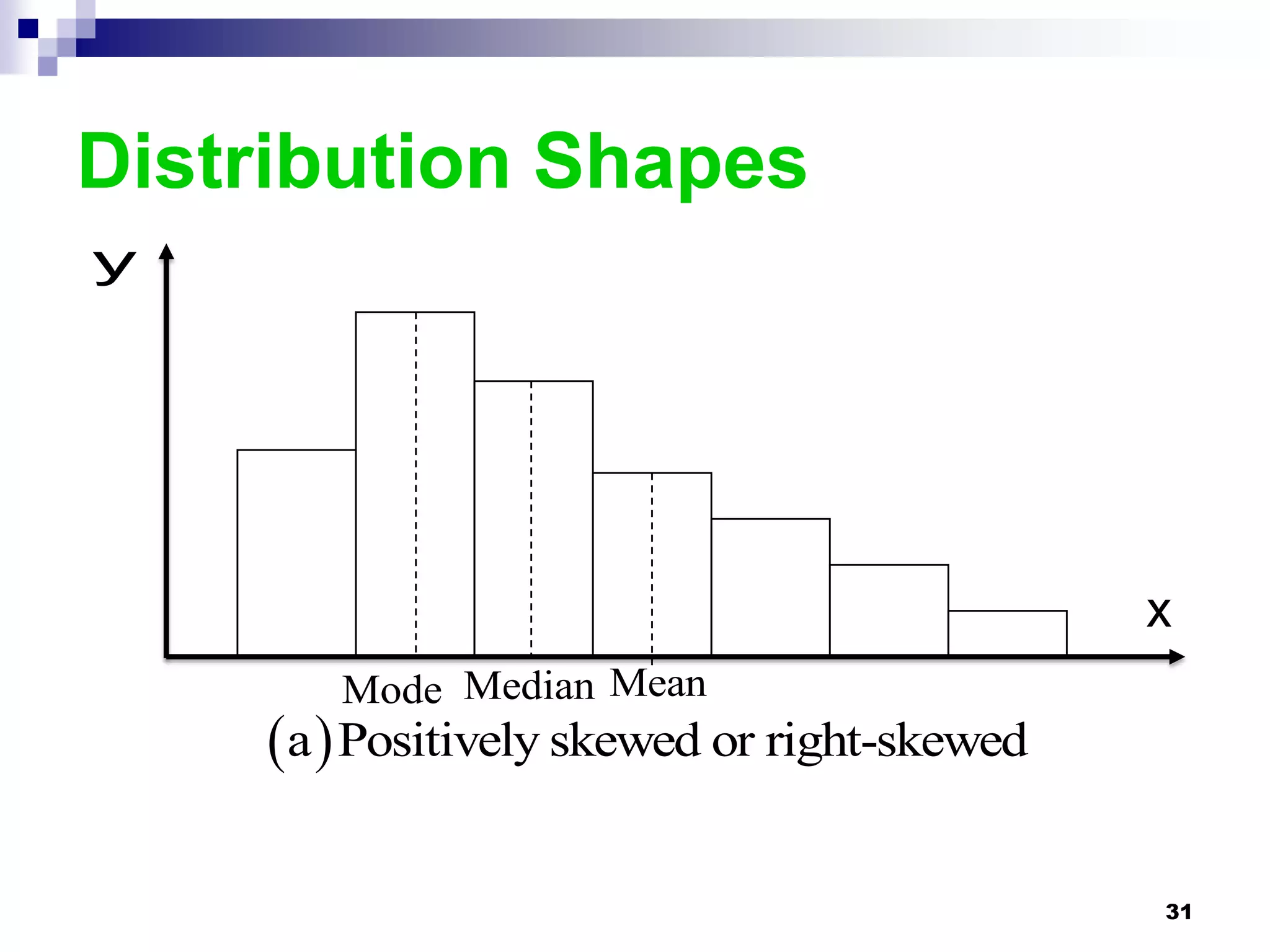
Distribution Shapes
y


                                             x
       Mode Median Mean
    a  Positively skewed or right-skewed

                                             31
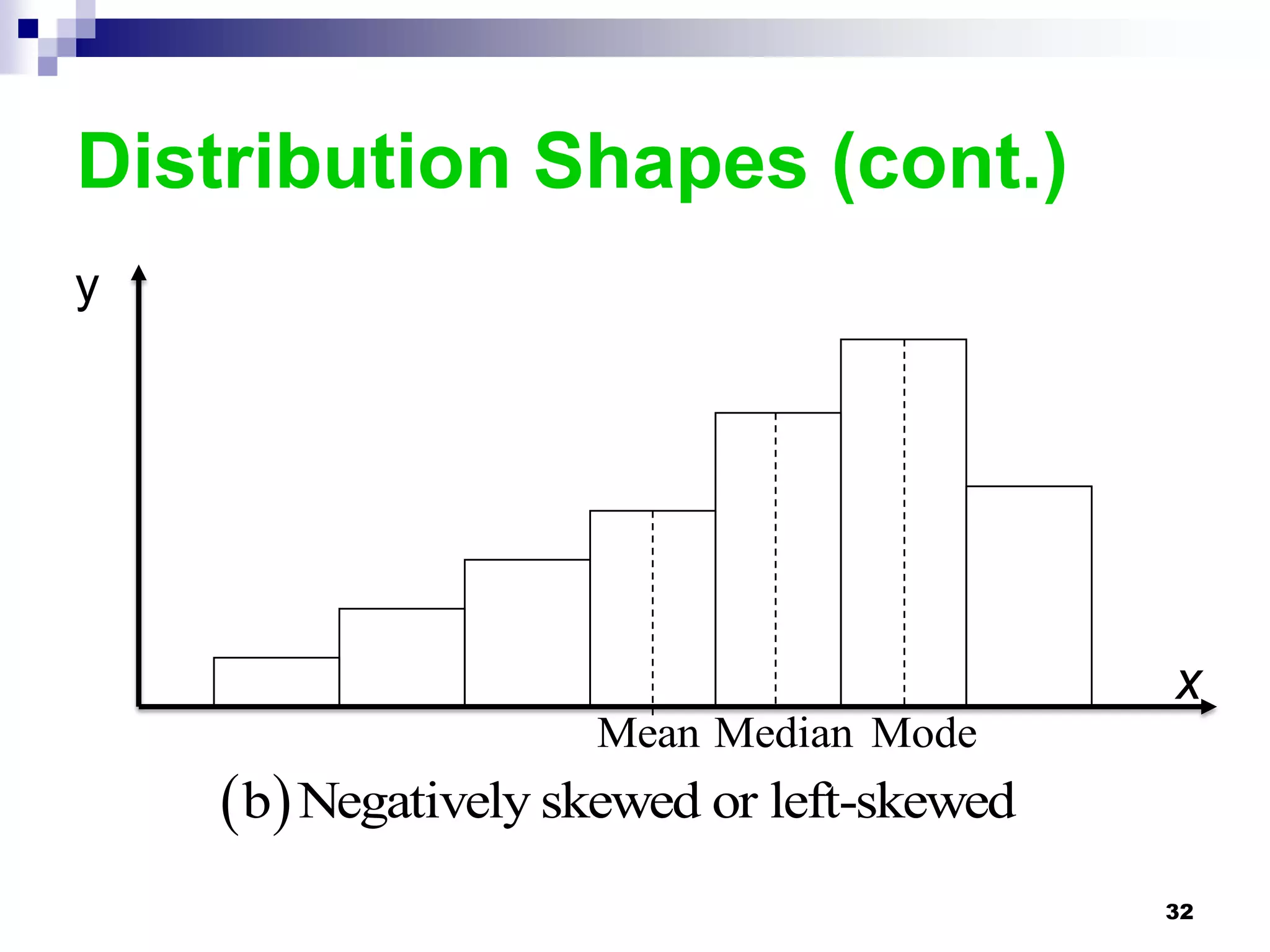
Distribution Shapes (cont.)
y


                                            x
                     Mean Median Mode
     b Negatively skewed or left-skewed
                                            32
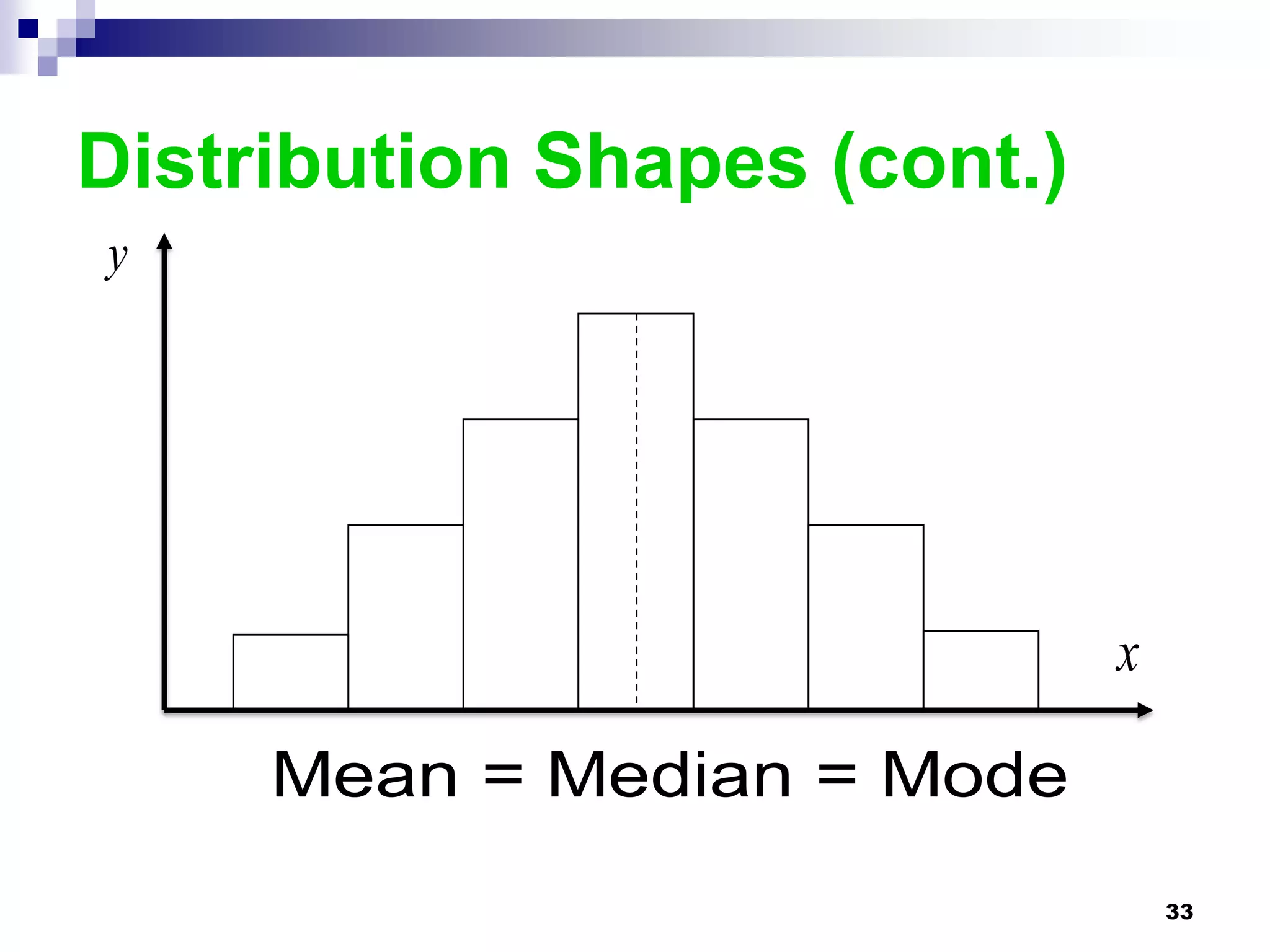
Distribution Shapes (cont.)
y


                              x

     Mean = Median = Mode
                                  33
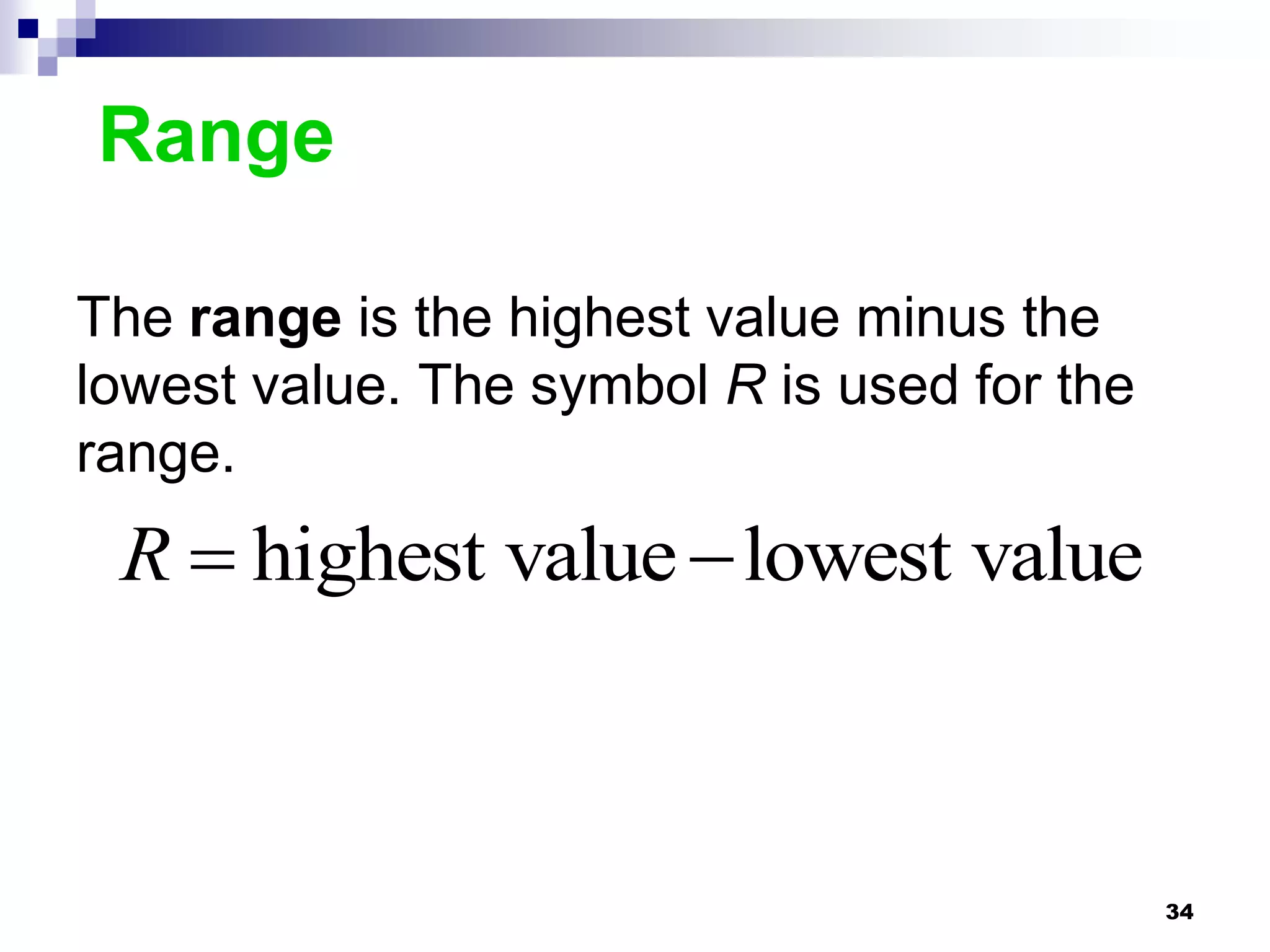
Range

The range is the highest value minus the
lowest value. The symbol R is used for the
range.
 R  highest value  lowest value


                                             34
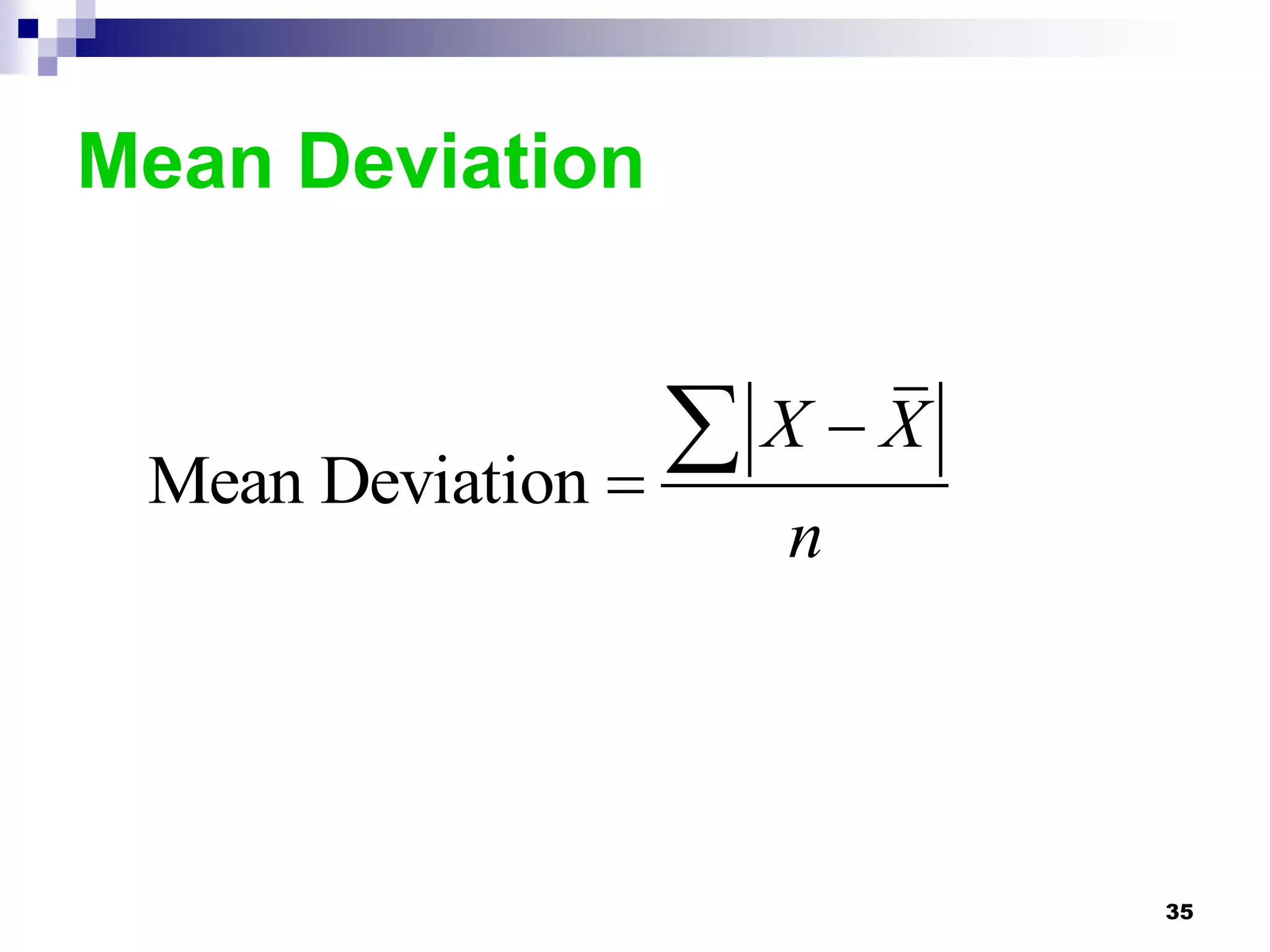
Mean Deviation


 Mean Deviation 
                   X X
                   n


                           35
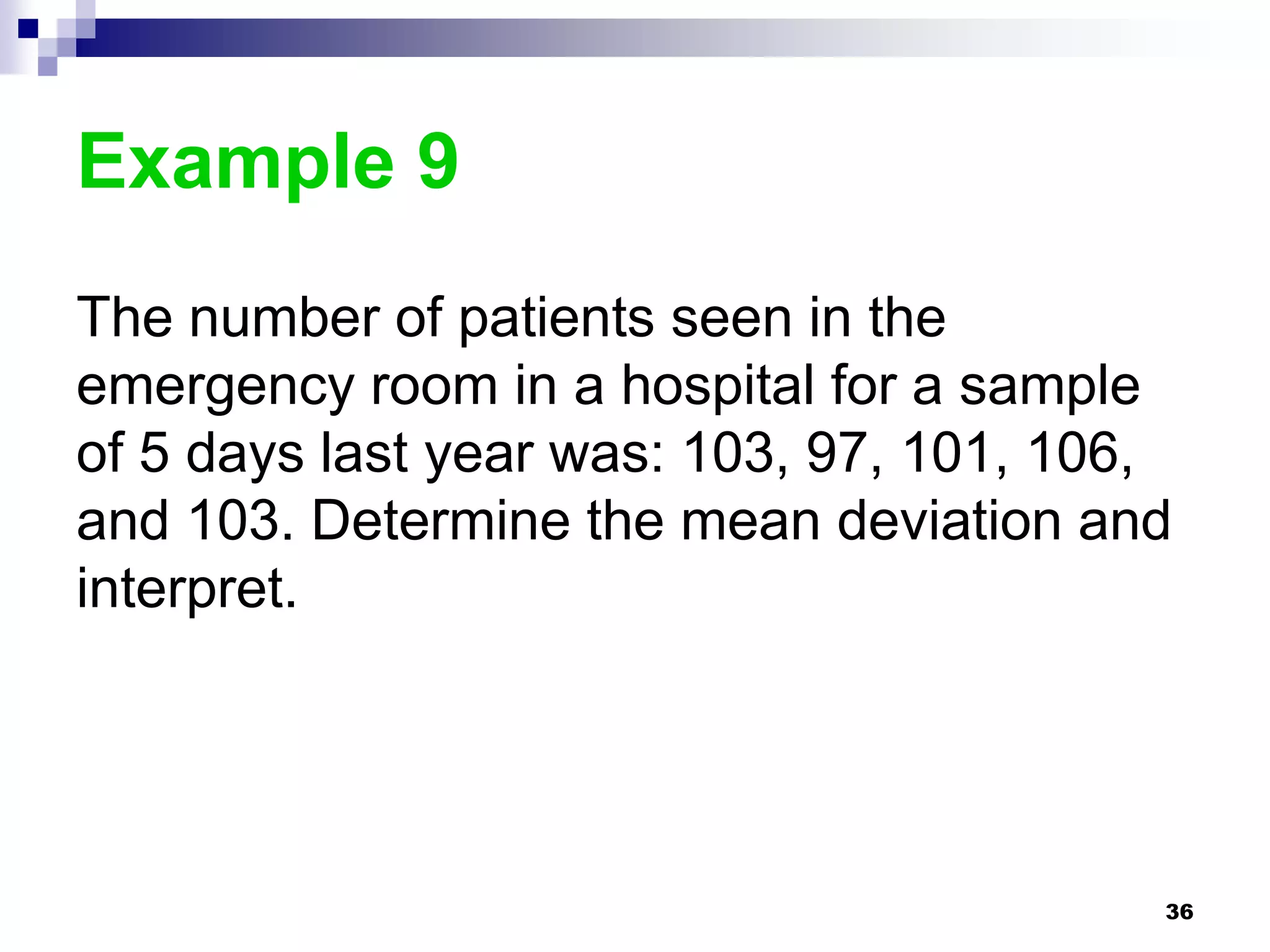
Example 9
The number of patients seen in the
emergency room in a hospital for a sample
of 5 days last year was: 103, 97, 101, 106,
and 103. Determine the mean deviation and
interpret.


                                          36
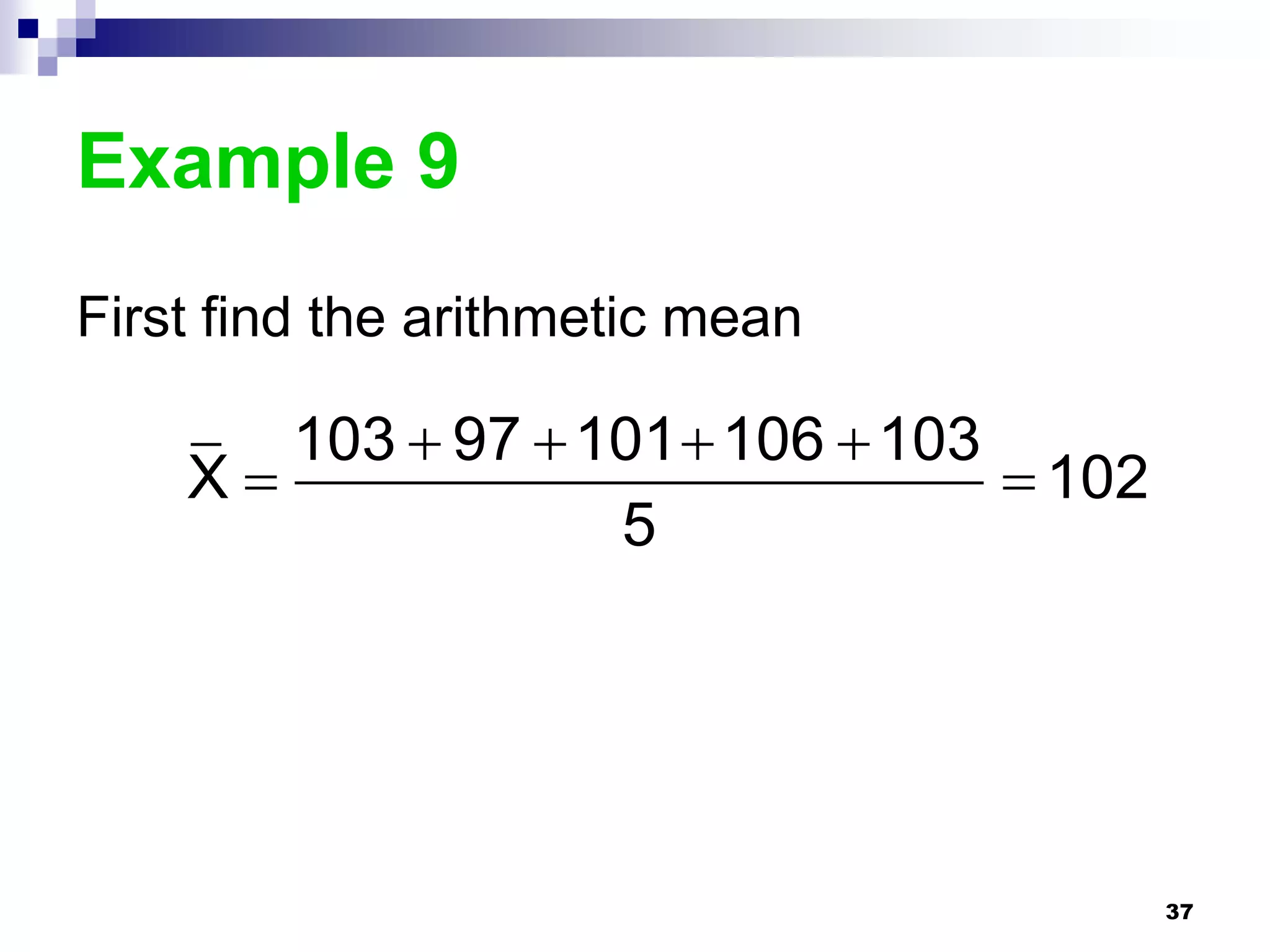
Example 9
First find the arithmetic mean

       103  97  101  106  103
    X                             102
                   5


                                          37
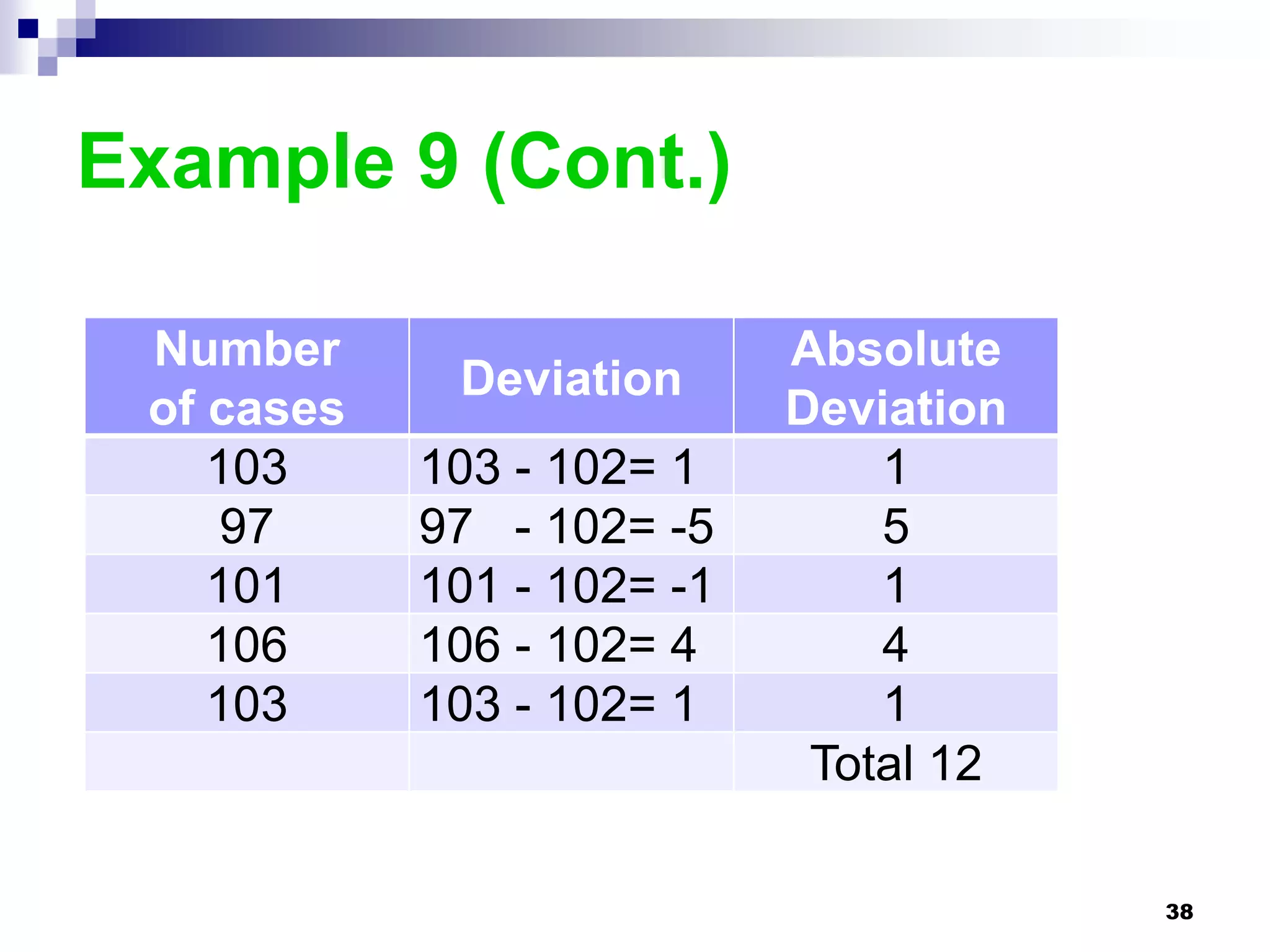
Example 9 (Cont.)

 Number                     Absolute
             Deviation
 of cases                   Deviation
    103     103 - 102= 1        1
     97     97 - 102= -5        5
    101     101 - 102= -1       1
    106     106 - 102= 4        4
    103     103 - 102= 1        1
                             Total 12

                                        38
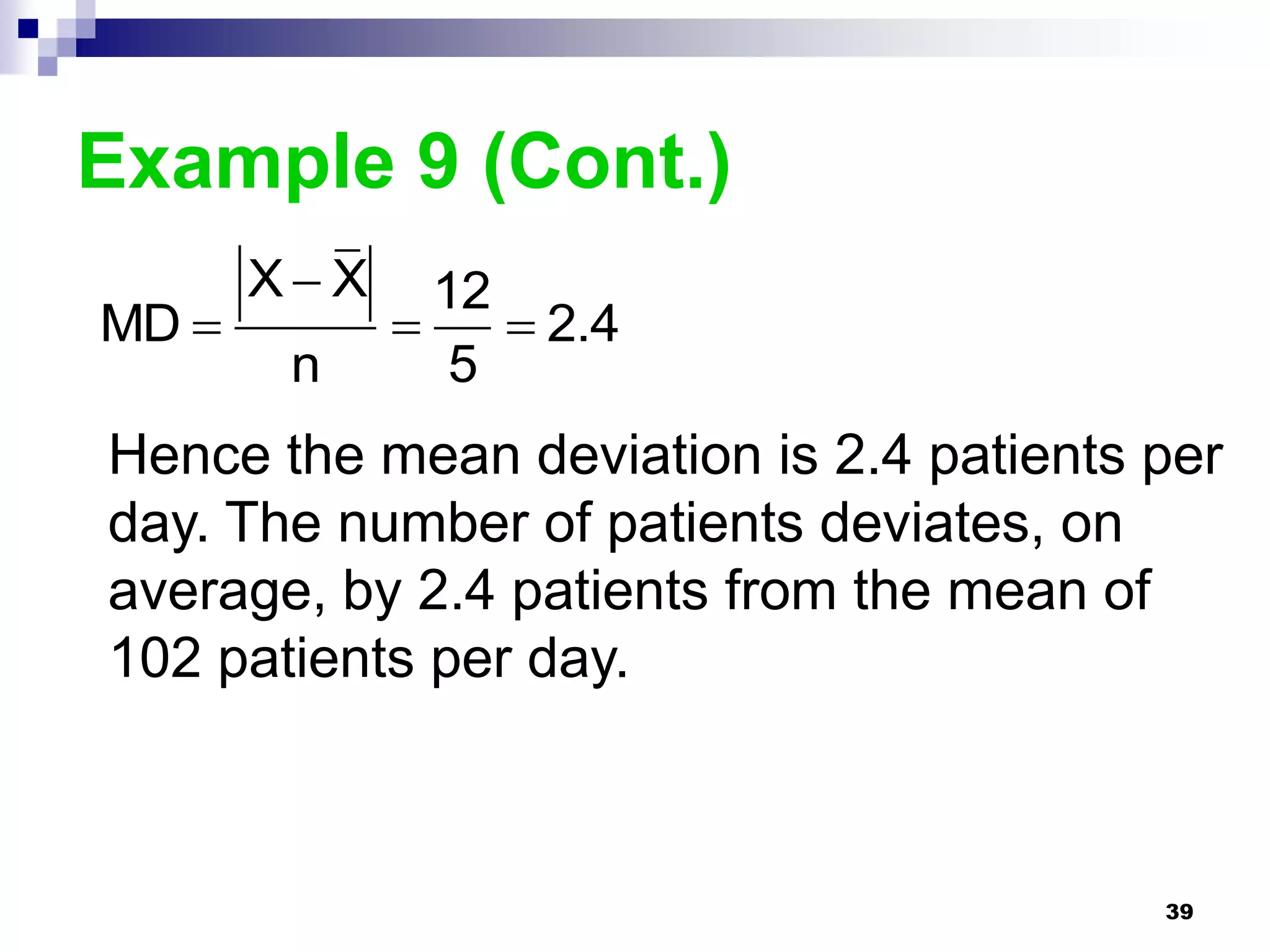
Example 9 (Cont.)
       XX     12
MD               2.4
        n       5
Hence the mean deviation is 2.4 patients per
day. The number of patients deviates, on
average, by 2.4 patients from the mean of
102 patients per day.


                                         39
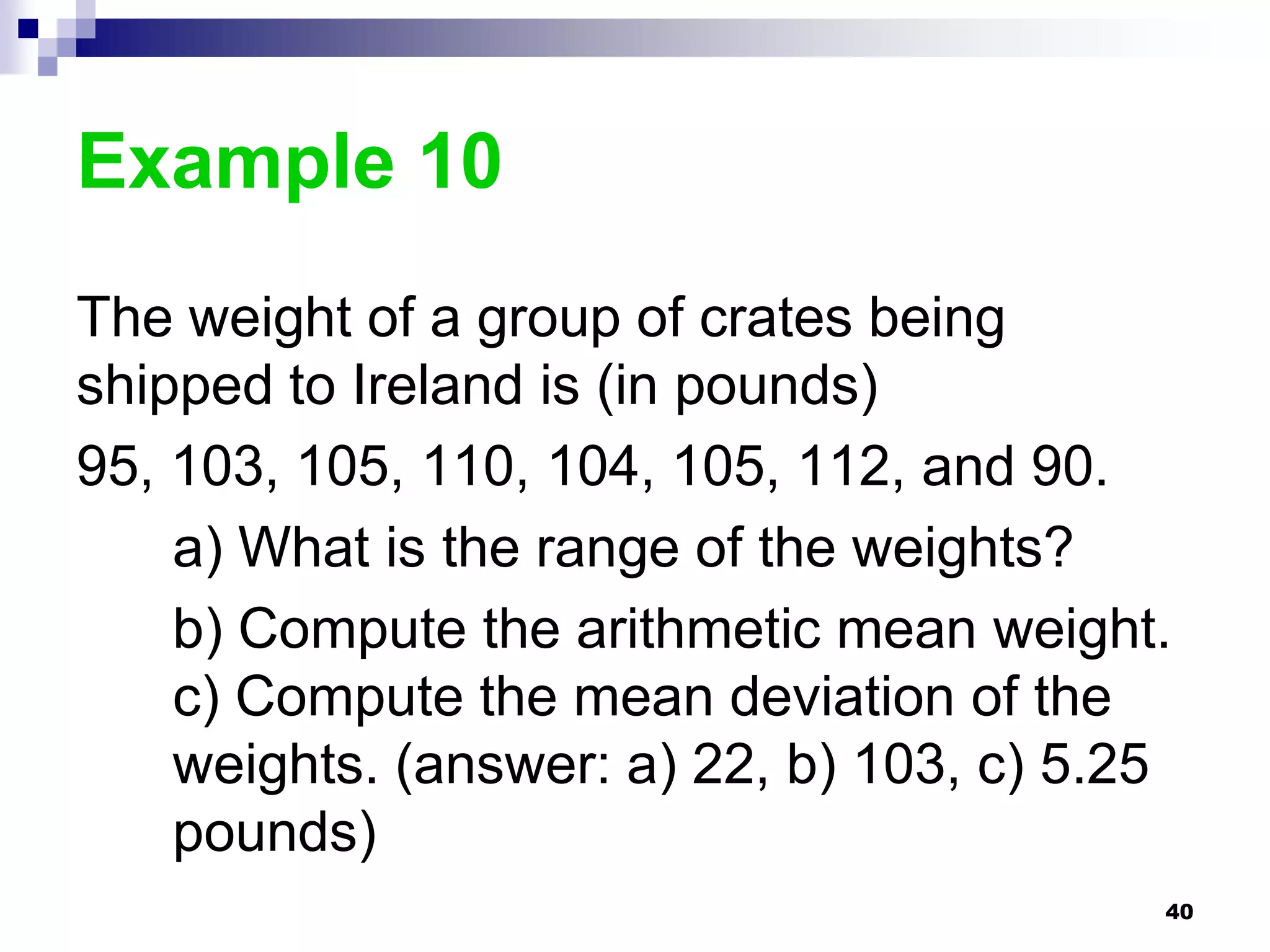
Example 10
The weight of a group of crates being
shipped to Ireland is (in pounds)
95, 103, 105, 110, 104, 105, 112, and 90.
    a) What is the range of the weights?
    b) Compute the arithmetic mean weight.
    c) Compute the mean deviation of the
    weights. (answer: a) 22, b) 103, c) 5.25
    pounds)
                                           40
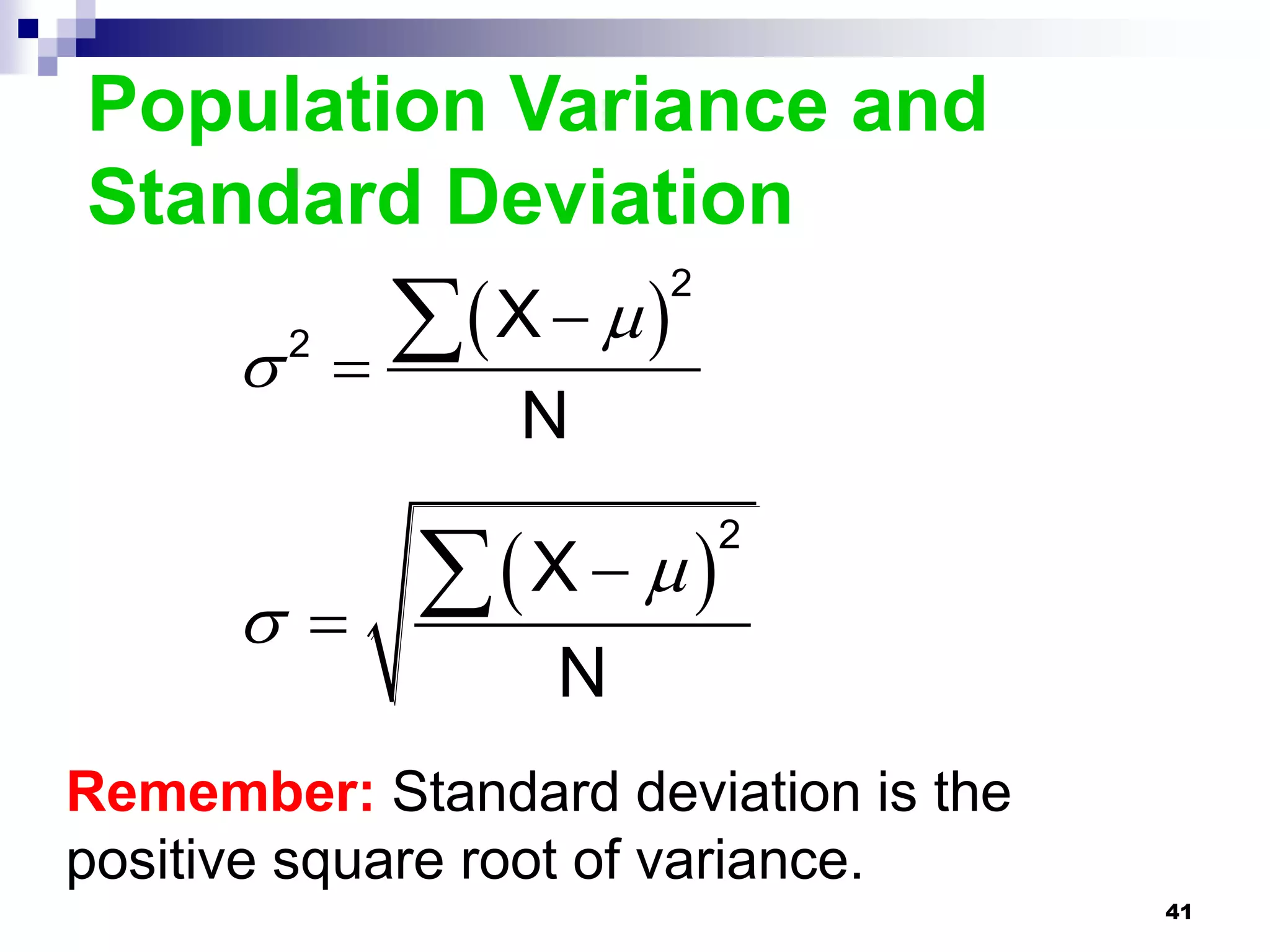
Population Variance and
Standard Deviation
                 X   
                         2

         2
              
                    N

                 X   
                             2

      
                     N
Remember: Standard deviation is the
positive square root of variance.
                                      41
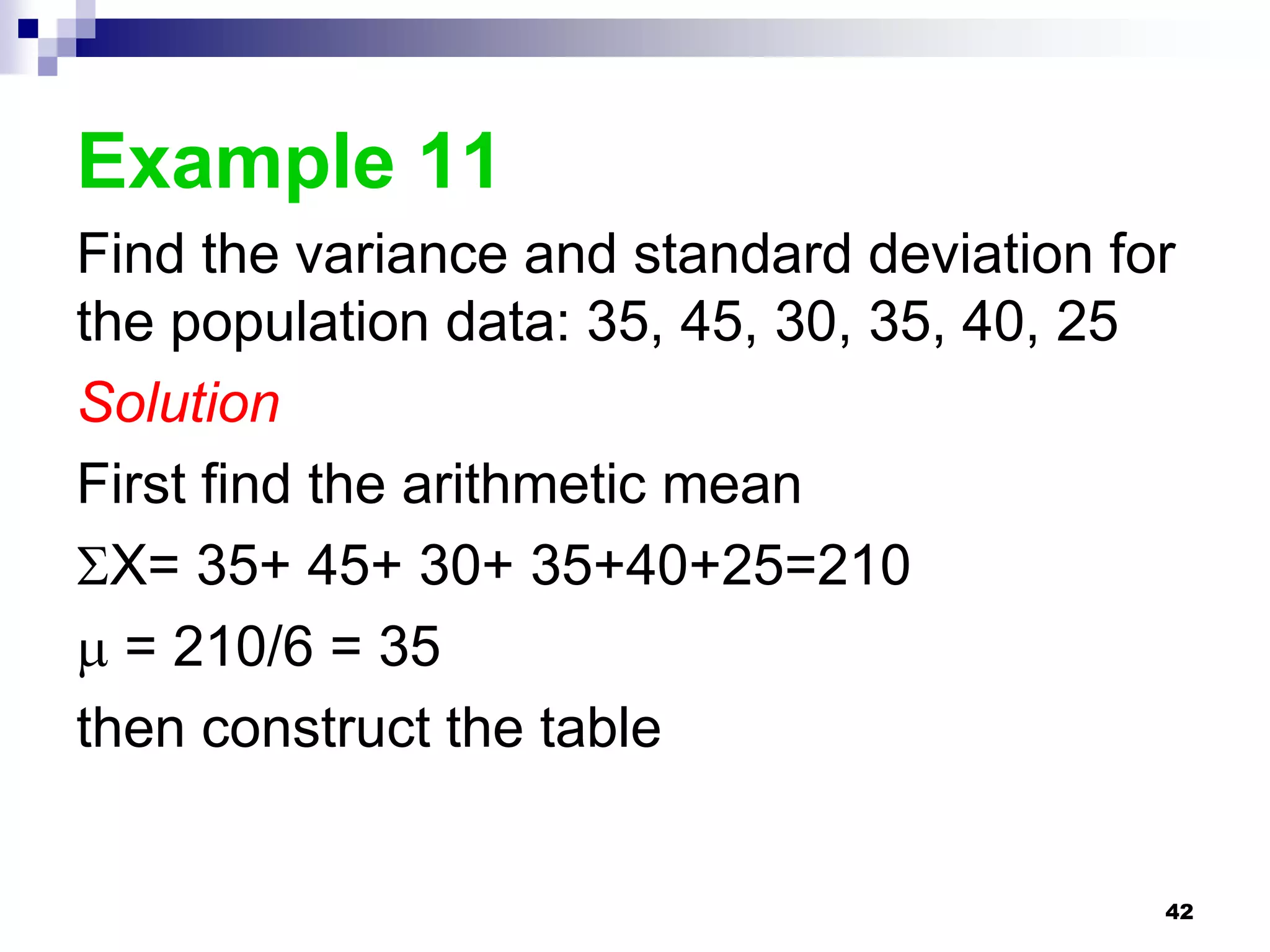
Example 11
Find the variance and standard deviation for
the population data: 35, 45, 30, 35, 40, 25
Solution
First find the arithmetic mean
X= 35+ 45+ 30+ 35+40+25=210
 = 210/6 = 35
then construct the table


                                           42
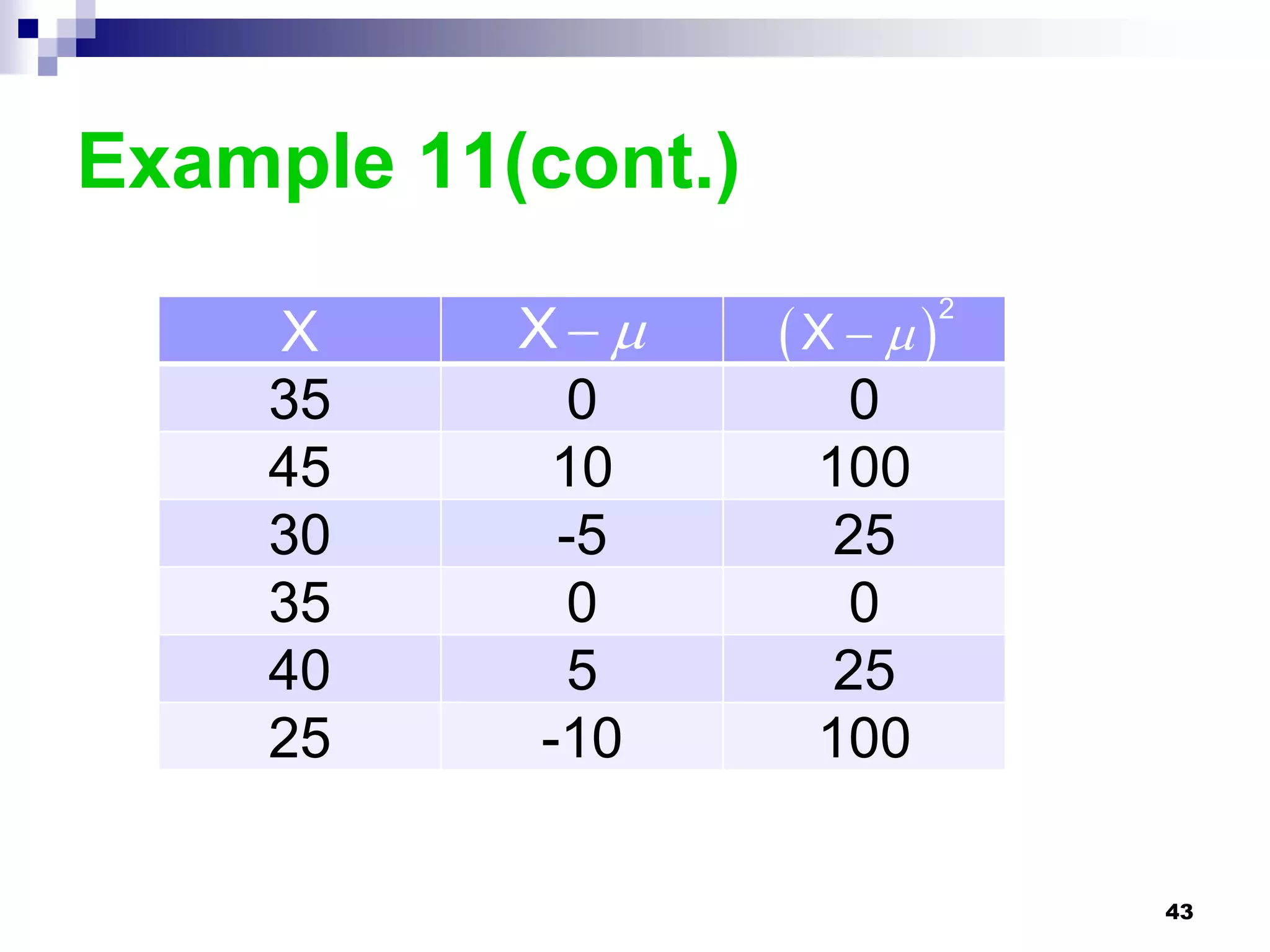
Example 11(cont.)

           X      X  
                              2
    X
    35      0          0
    45      10       100
    30      -5        25
    35      0          0
    40      5         25
    25     -10       100

                                  43
Example 11(cont.)
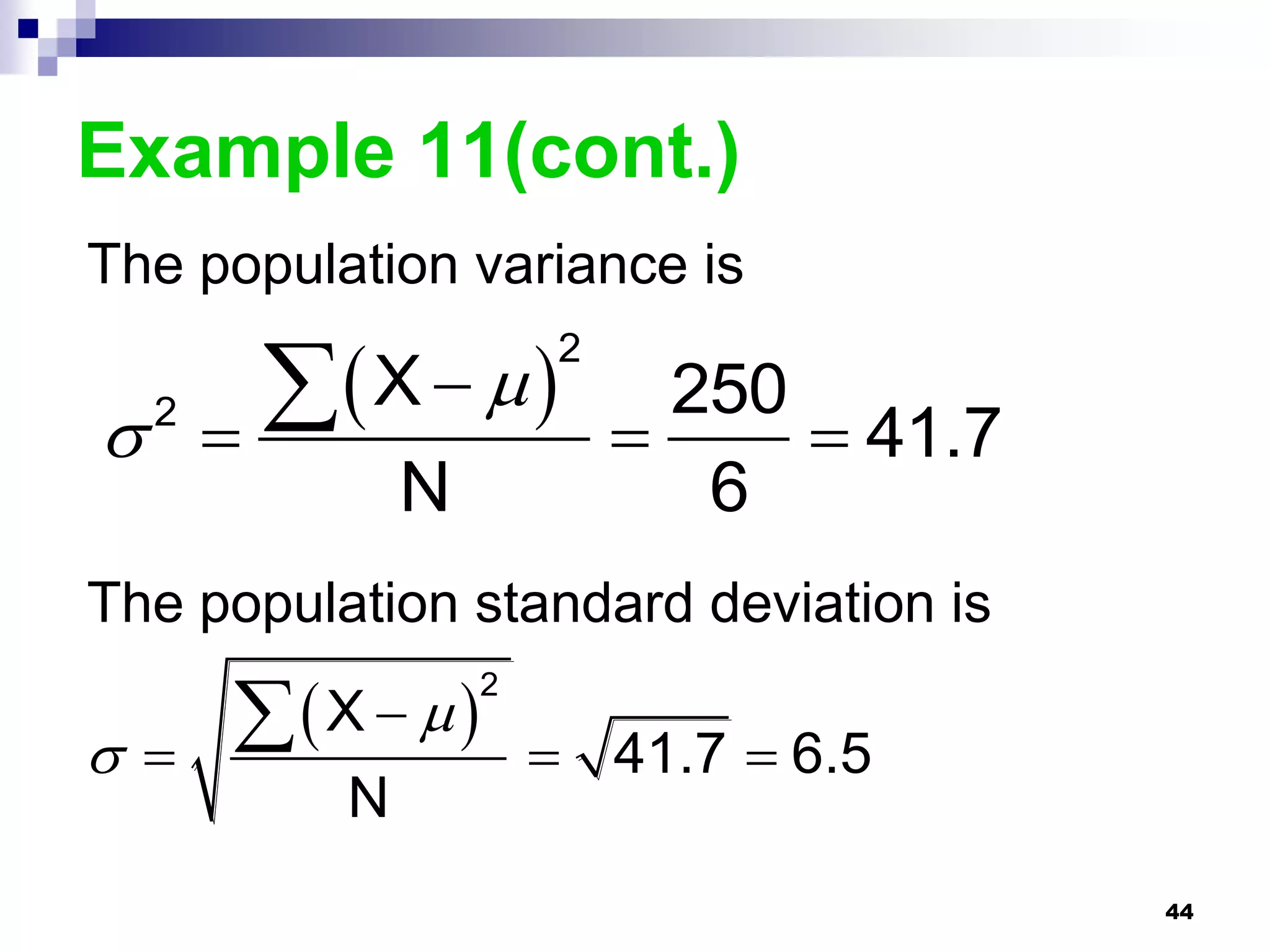
The population variance is

           X   
                          2
                                250
   2
                                   41.7
                 N               6
The population standard deviation is

         X   
                     2

                        41.7  6.5
             N
                                             44
Sample Variance and
Standard Deviation
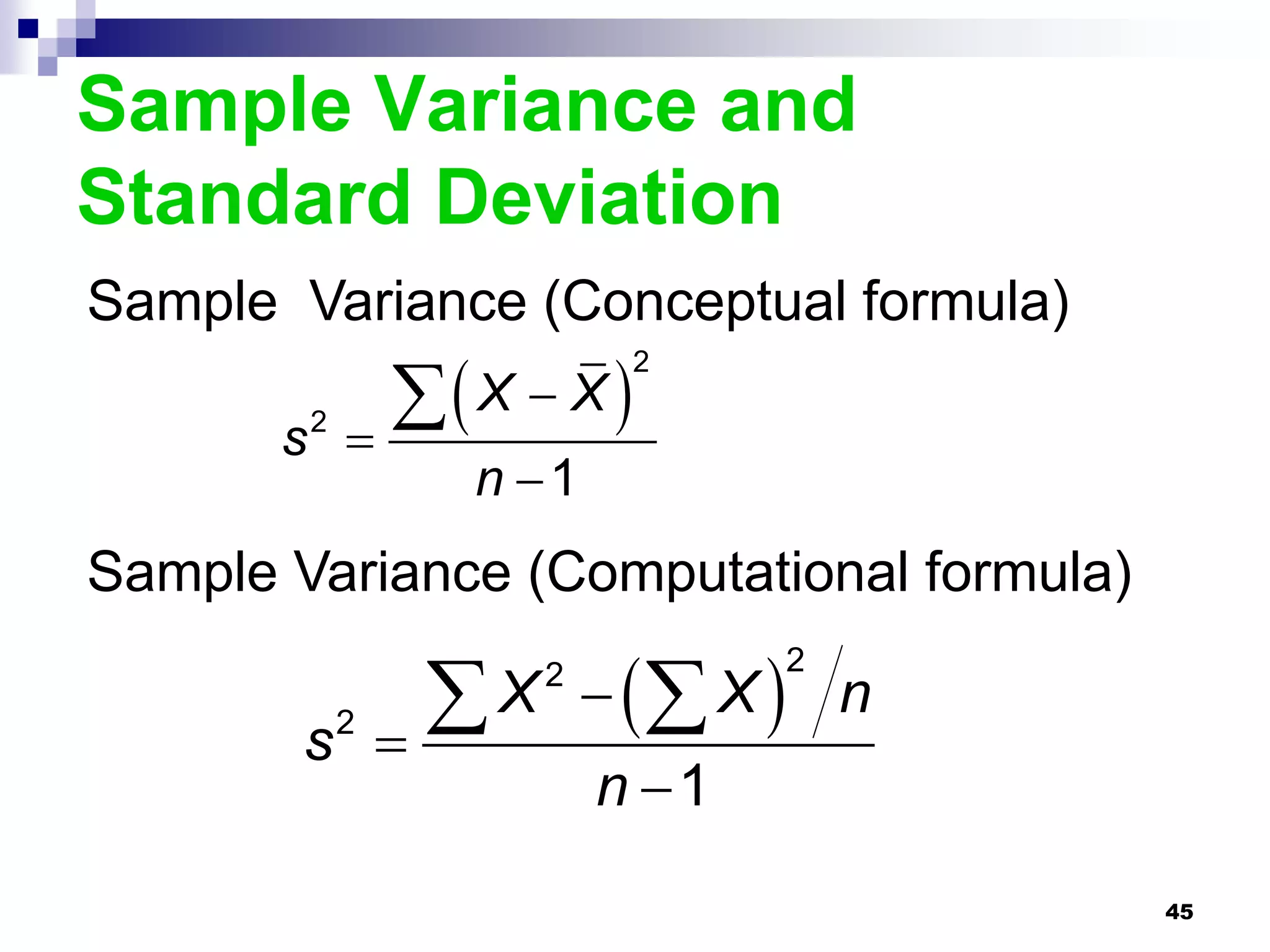
Sample Variance (Conceptual formula)
                  X  X 
                              2

       s   2
               
                    n 1
Sample Variance (Computational formula)

                   X   X 
                       2          2
                                      n
        s2      
                           n 1
                                          45
Sample Variance and
Standard Deviation (Cont.)
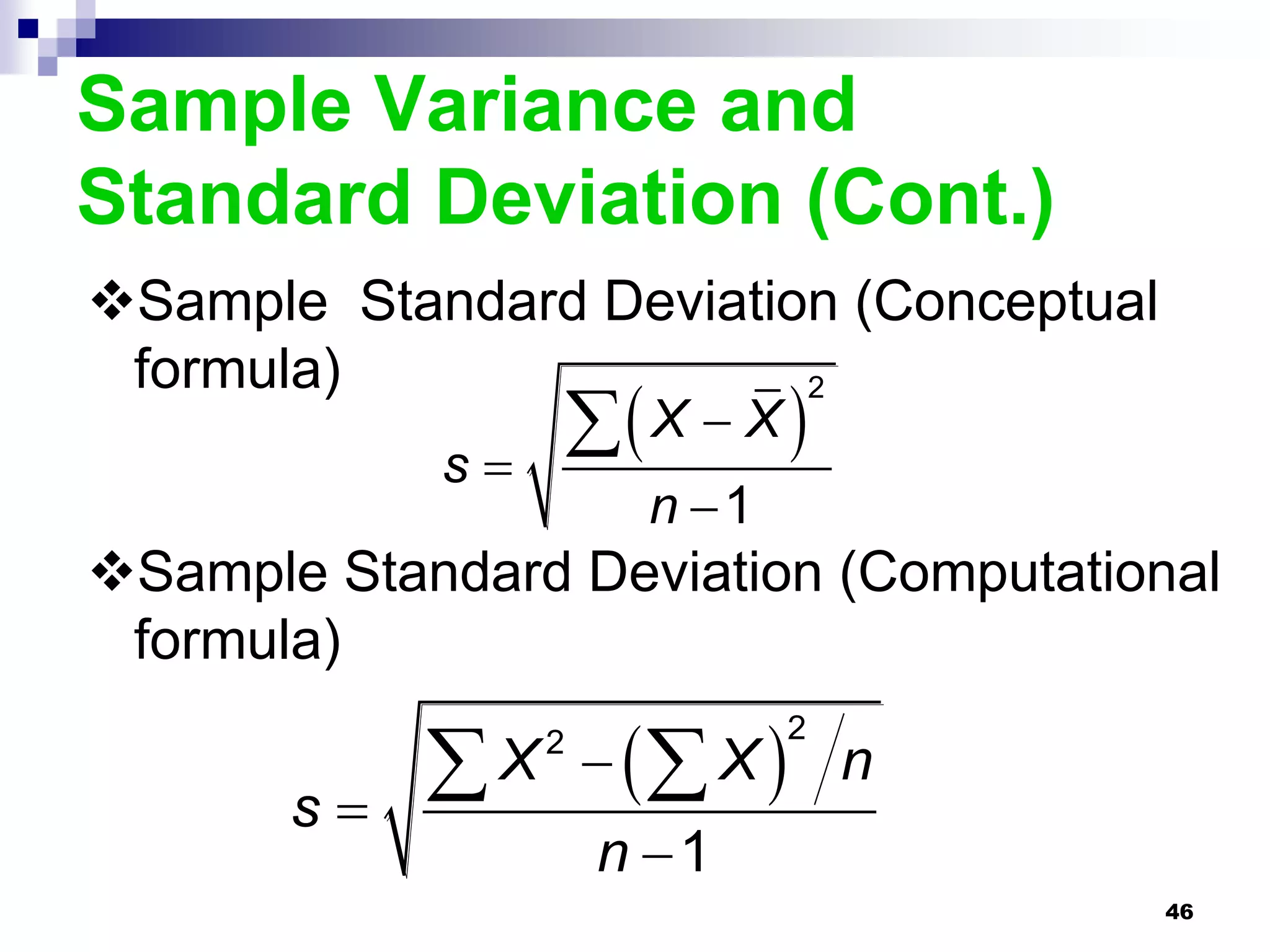
Sample Standard Deviation (Conceptual
 formula)
                      X  X 
                         2

            s
                        n 1
Sample Standard Deviation (Computational
 formula)

             X   X 
                 2             2
                                   n
       s
                      n 1
                                         46
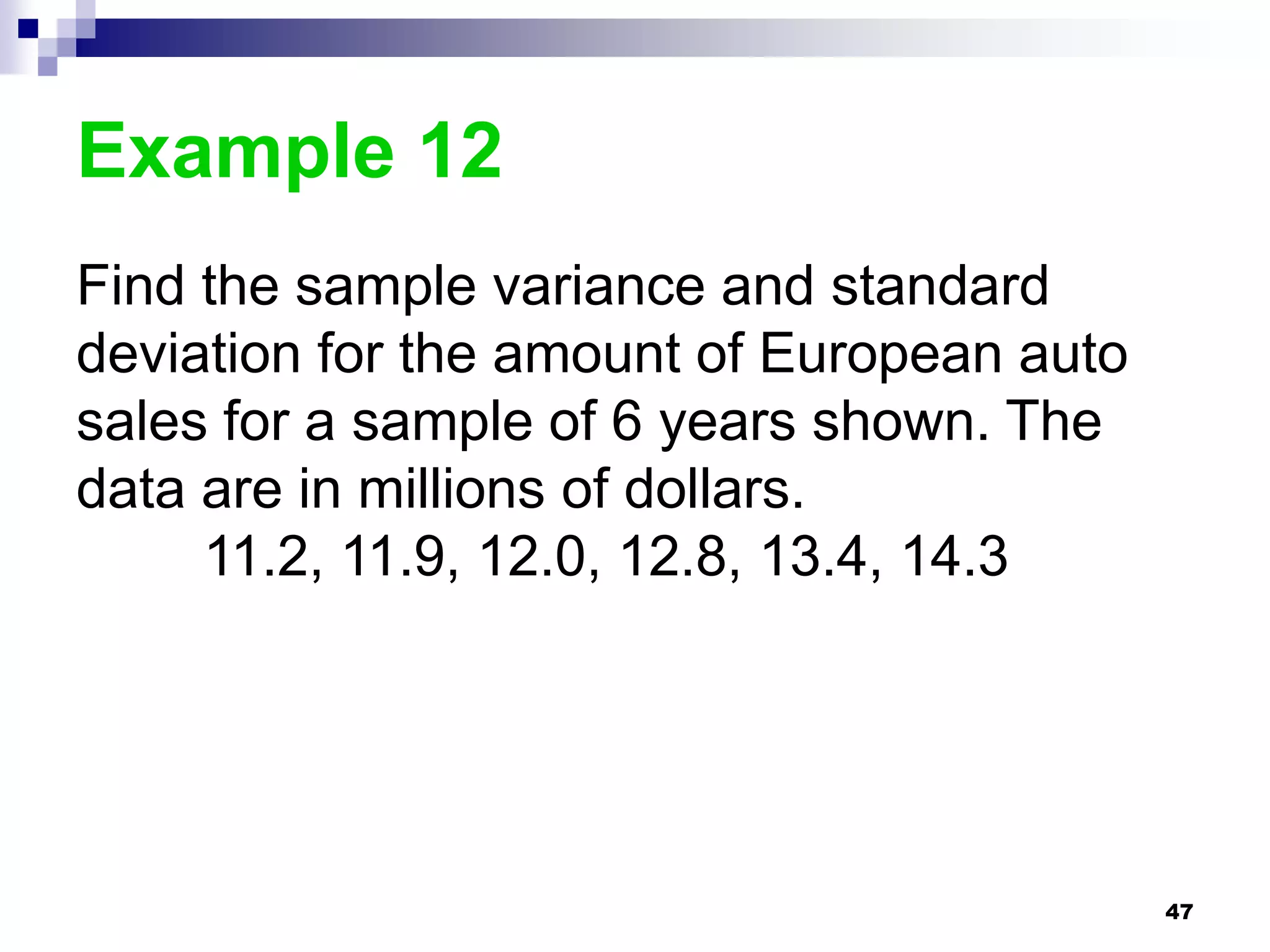
Example 12
Find the sample variance and standard
deviation for the amount of European auto
sales for a sample of 6 years shown. The
data are in millions of dollars.
     11.2, 11.9, 12.0, 12.8, 13.4, 14.3


                                            47
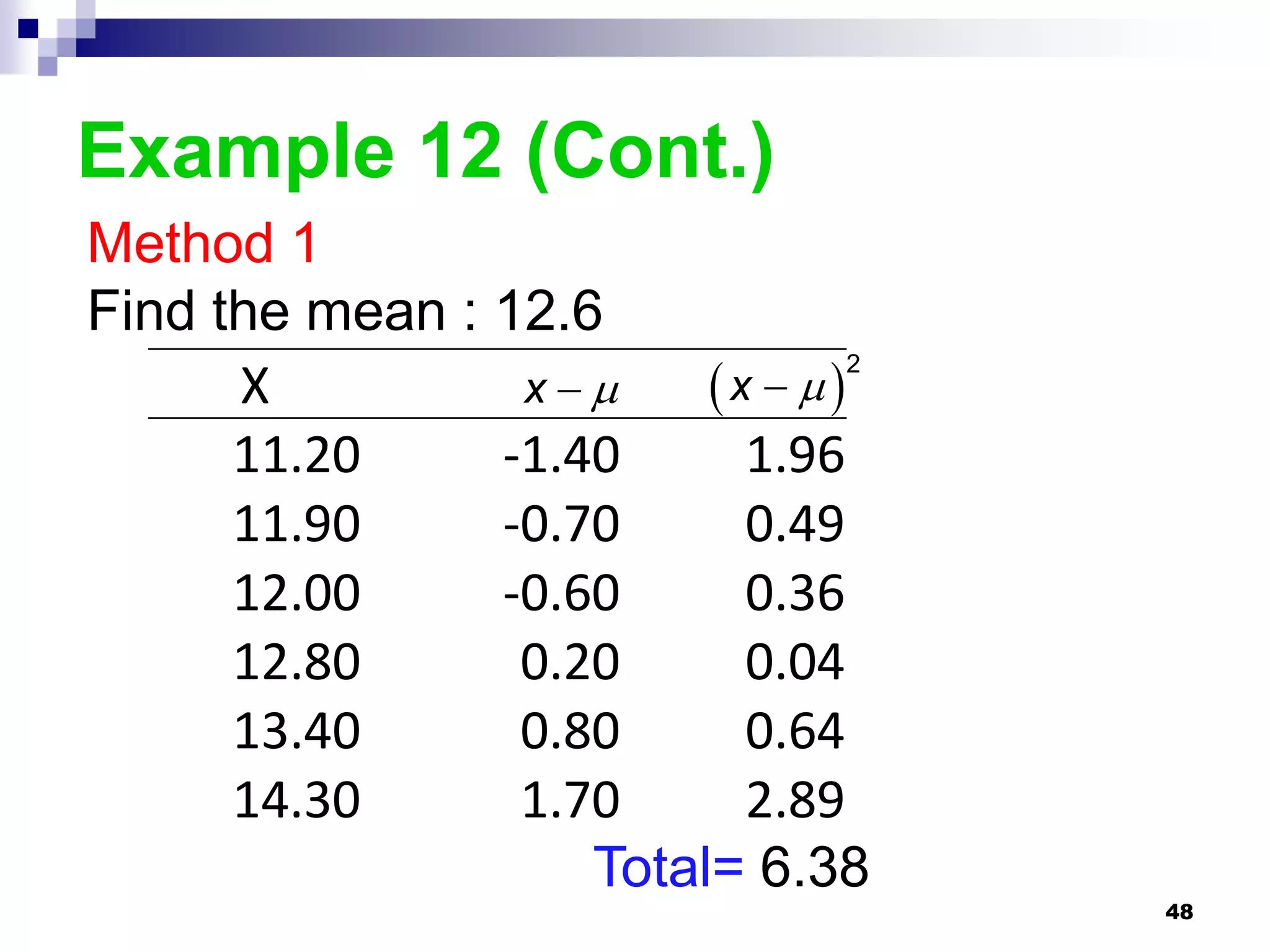
Example 12 (Cont.)
Method 1
Find the mean : 12.6
                         x  
                                 2
      X          x
      11.20     -1.40      1.96
      11.90     -0.70      0.49
      12.00     -0.60      0.36
      12.80      0.20      0.04
      13.40      0.80      0.64
      14.30      1.70      2.89
                    Total= 6.38
                                     48
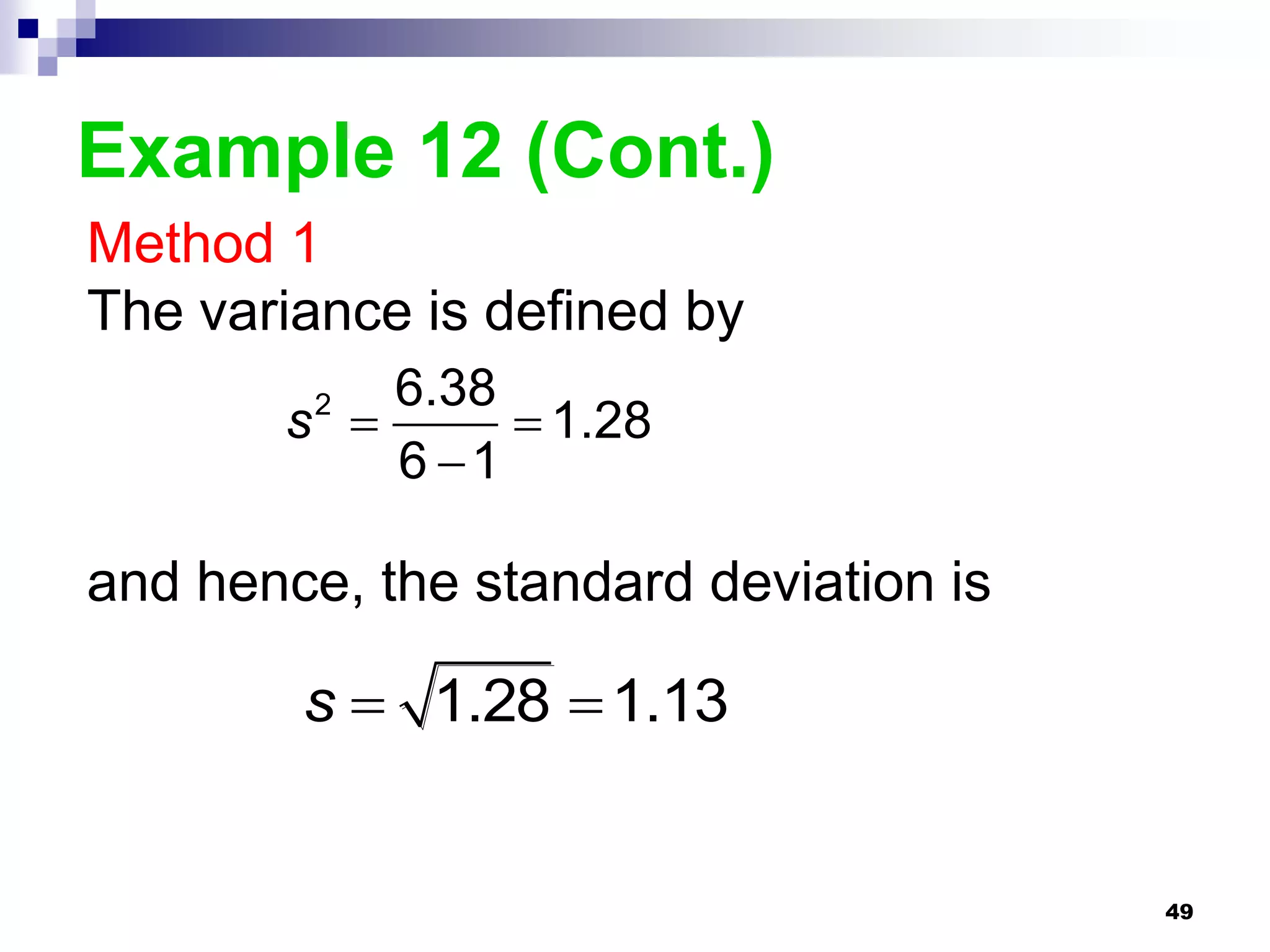
Example 12 (Cont.)
Method 1
The variance is defined by
           6.38
       s 
         2
                 1.28
           6 1

and hence, the standard deviation is

        s  1.28  1.13


                                       49
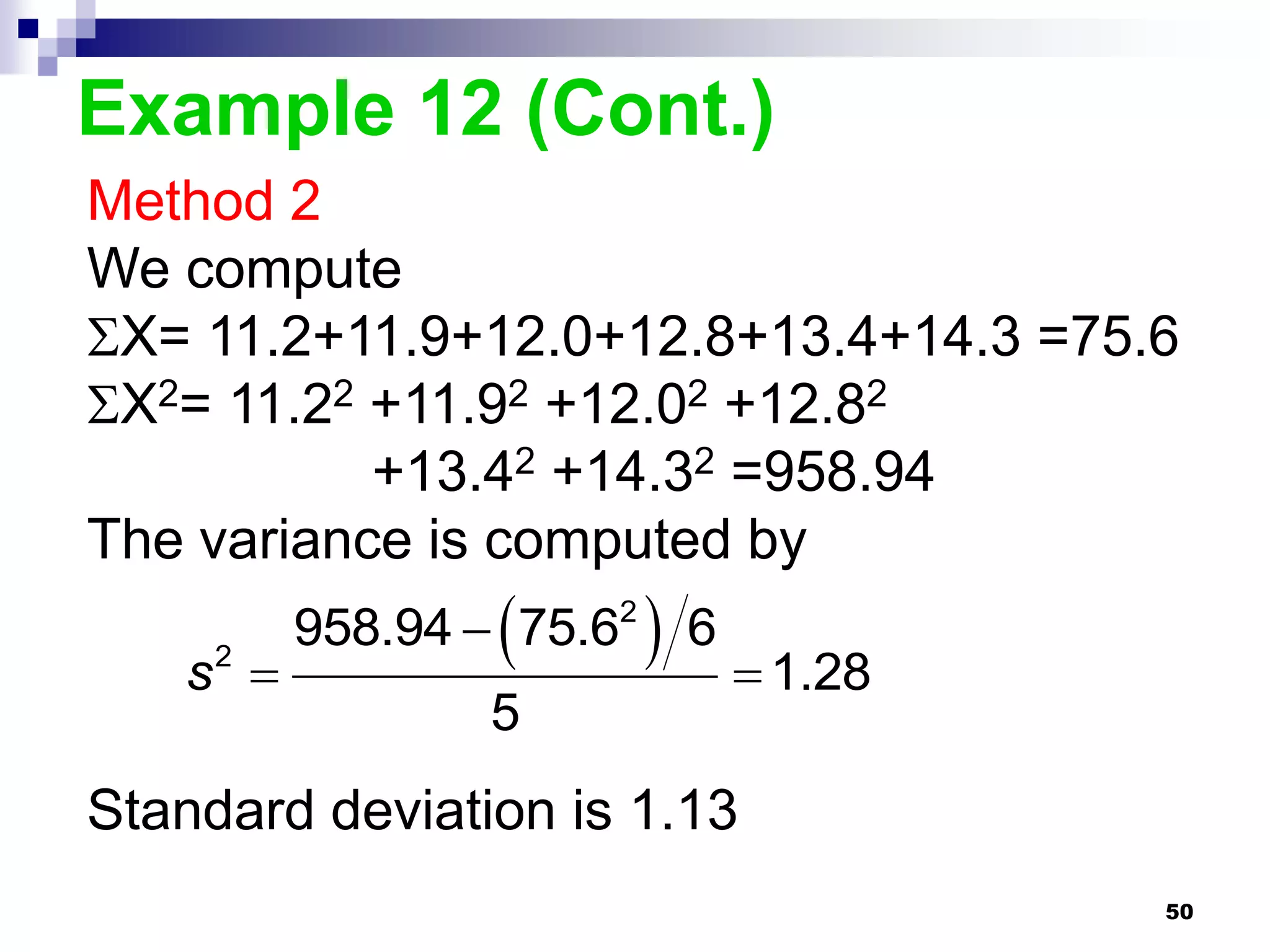
Example 12 (Cont.)
Method 2
We compute
X= 11.2+11.9+12.0+12.8+13.4+14.3 =75.6
X2= 11.22 +11.92 +12.02 +12.82
           +13.42 +14.32 =958.94
The variance is computed by

   s 
     2               
         958.94  75.62 6
                             1.28
                5
Standard deviation is 1.13
                                      50
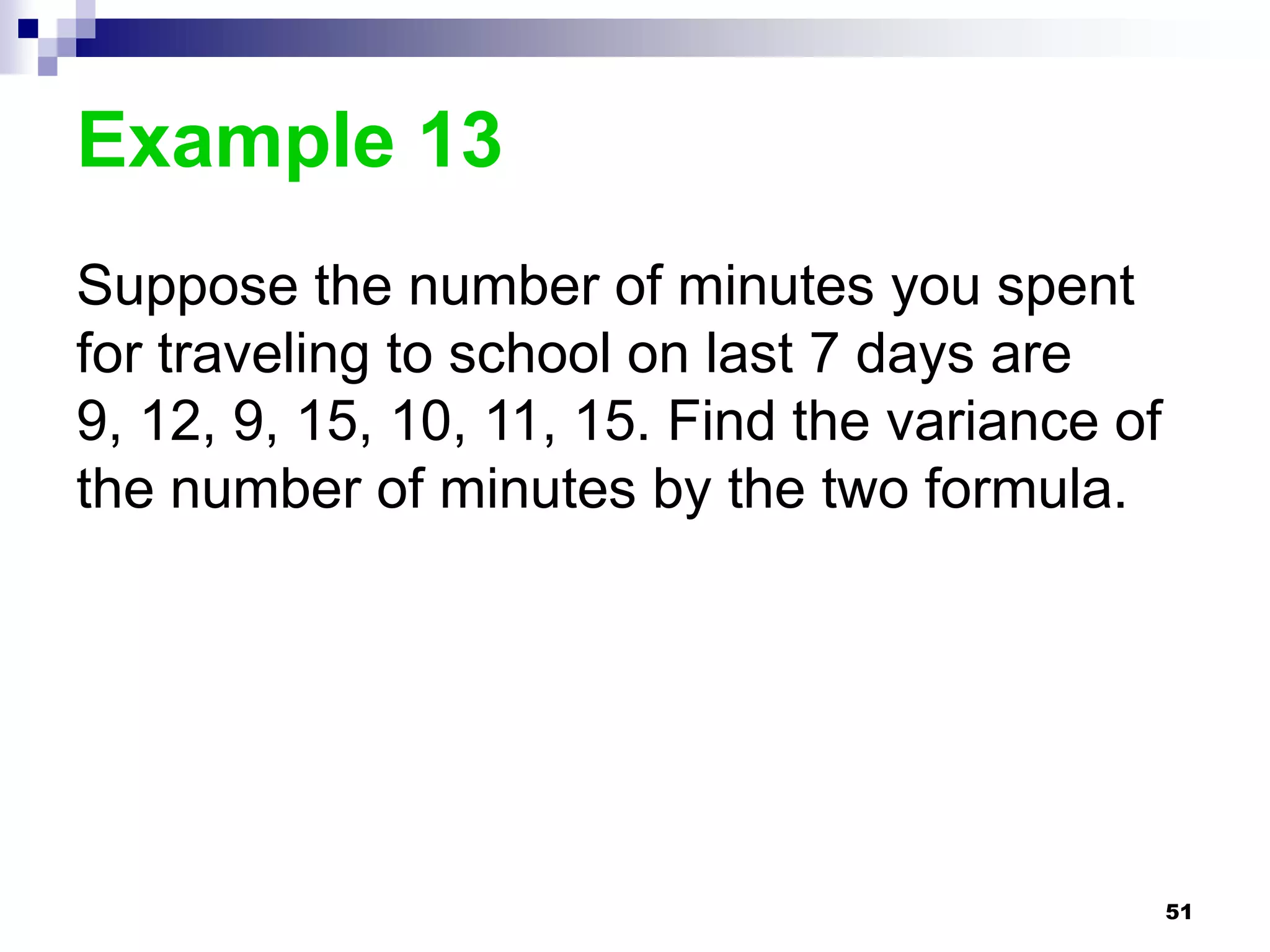
Example 13
Suppose the number of minutes you spent
for traveling to school on last 7 days are
9, 12, 9, 15, 10, 11, 15. Find the variance of
the number of minutes by the two formula.


                                                 51
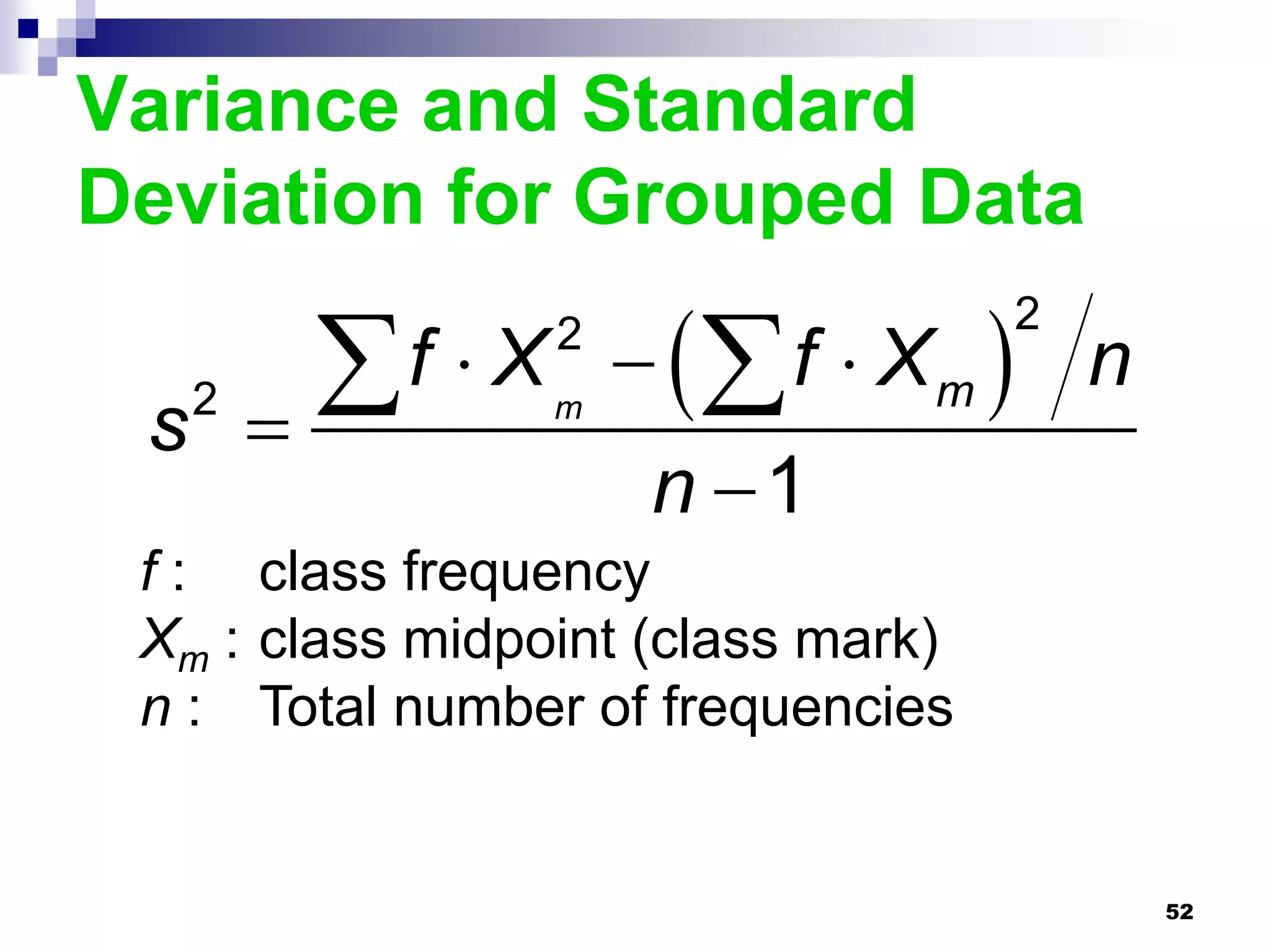
Variance and Standard
Deviation for Grouped Data

           f  X         f  Xm  n
                    2               2

 s   2
                   m

                         n 1
 f : class frequency
 Xm : class midpoint (class mark)
 n : Total number of frequencies


                                          52
Example
Find the variance and the standard deviation
for the frequency distribution of the data
representing the number of miles that 20
runners ran during one week.


                                         53
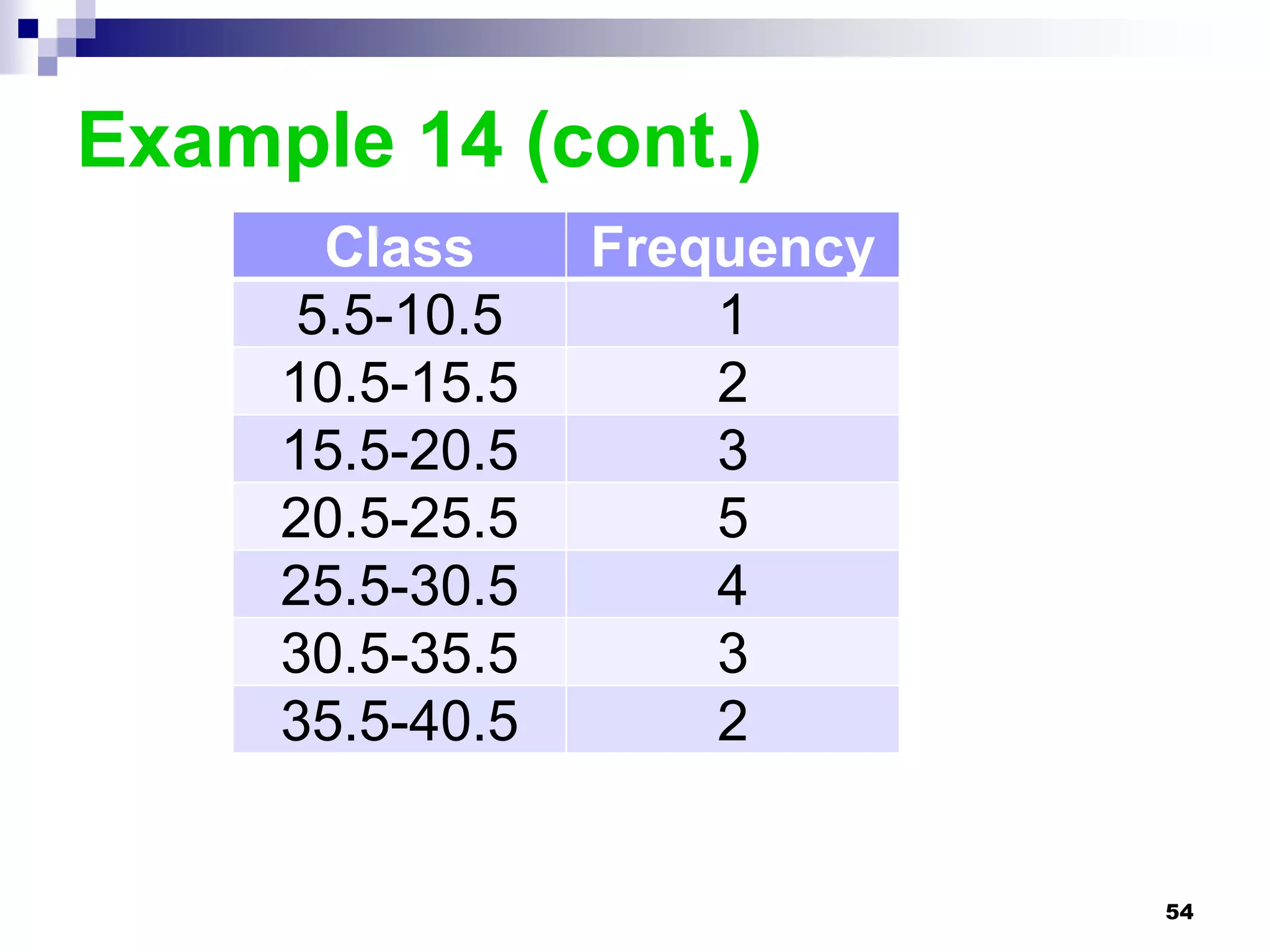
Example 14 (cont.)
      Class      Frequency
     5.5-10.5        1
     10.5-15.5       2
     15.5-20.5       3
     20.5-25.5       5
     25.5-30.5       4
     30.5-35.5       3
     35.5-40.5       2


                             54
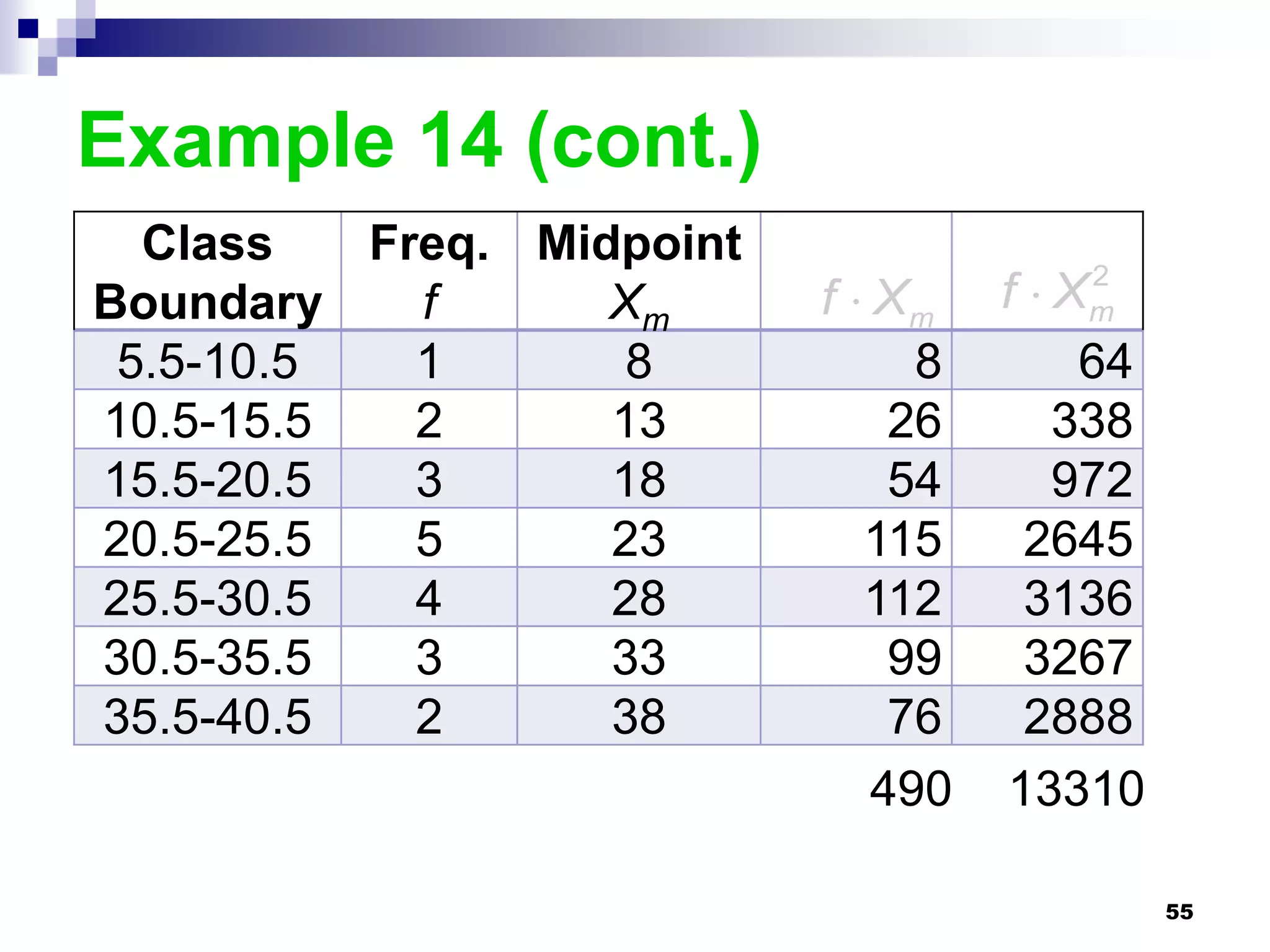
Example 14 (cont.)
  Class   Freq. Midpoint
Boundary    f      Xm      f  Xm  f  Xm2


 5.5-10.5   1       8            8      64
10.5-15.5   2      13           26     338
15.5-20.5   3      18           54     972
20.5-25.5   5      23         115    2645
25.5-30.5   4      28         112    3136
30.5-35.5   3      33           99   3267
35.5-40.5   2      38           76   2888
                               490 13310

                                             55
Example 14 (cont.)
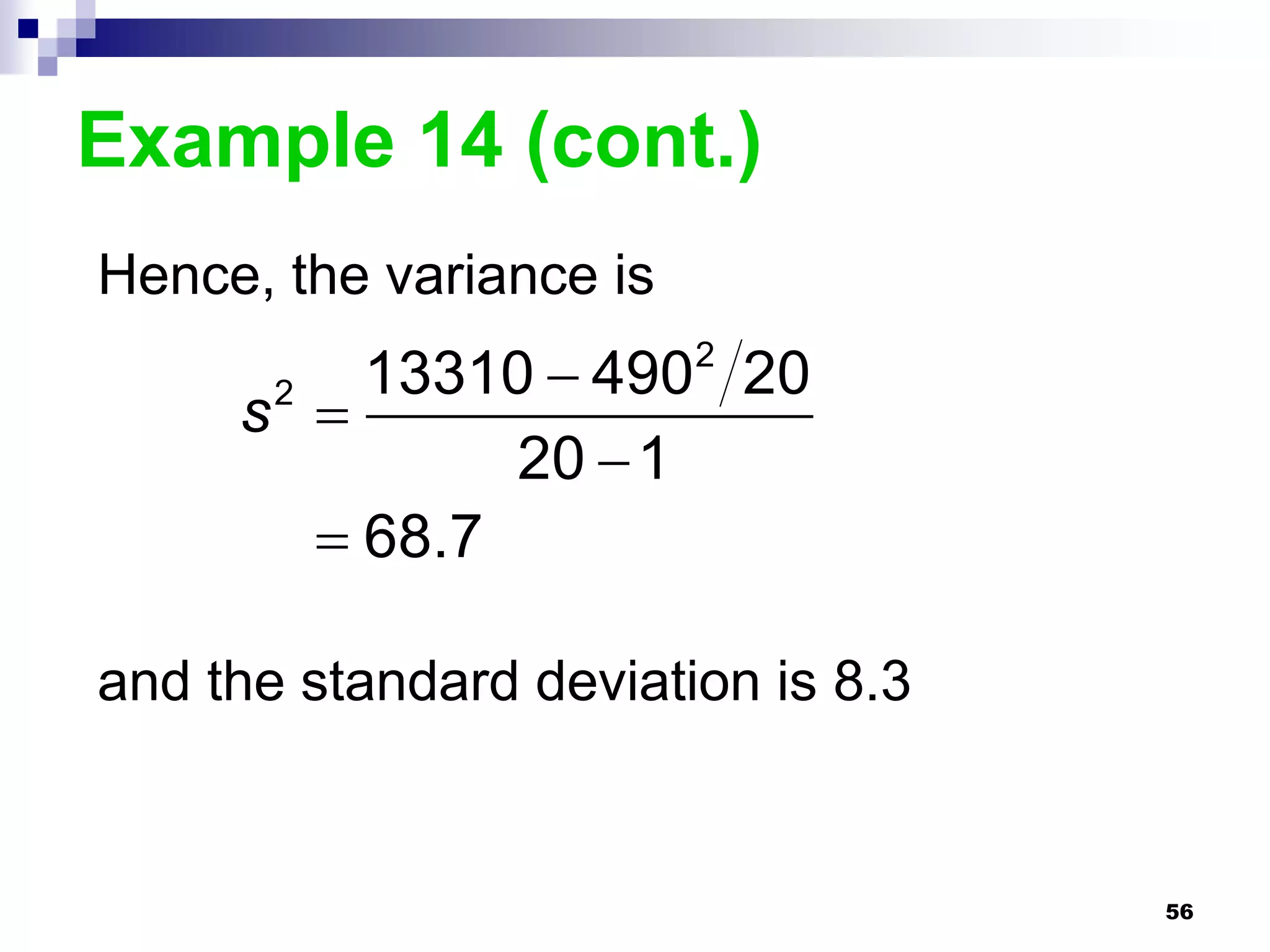
Hence, the variance is
         13310  490 20  2
     s 
       2

              20  1
        68.7

and the standard deviation is 8.3


                                    56
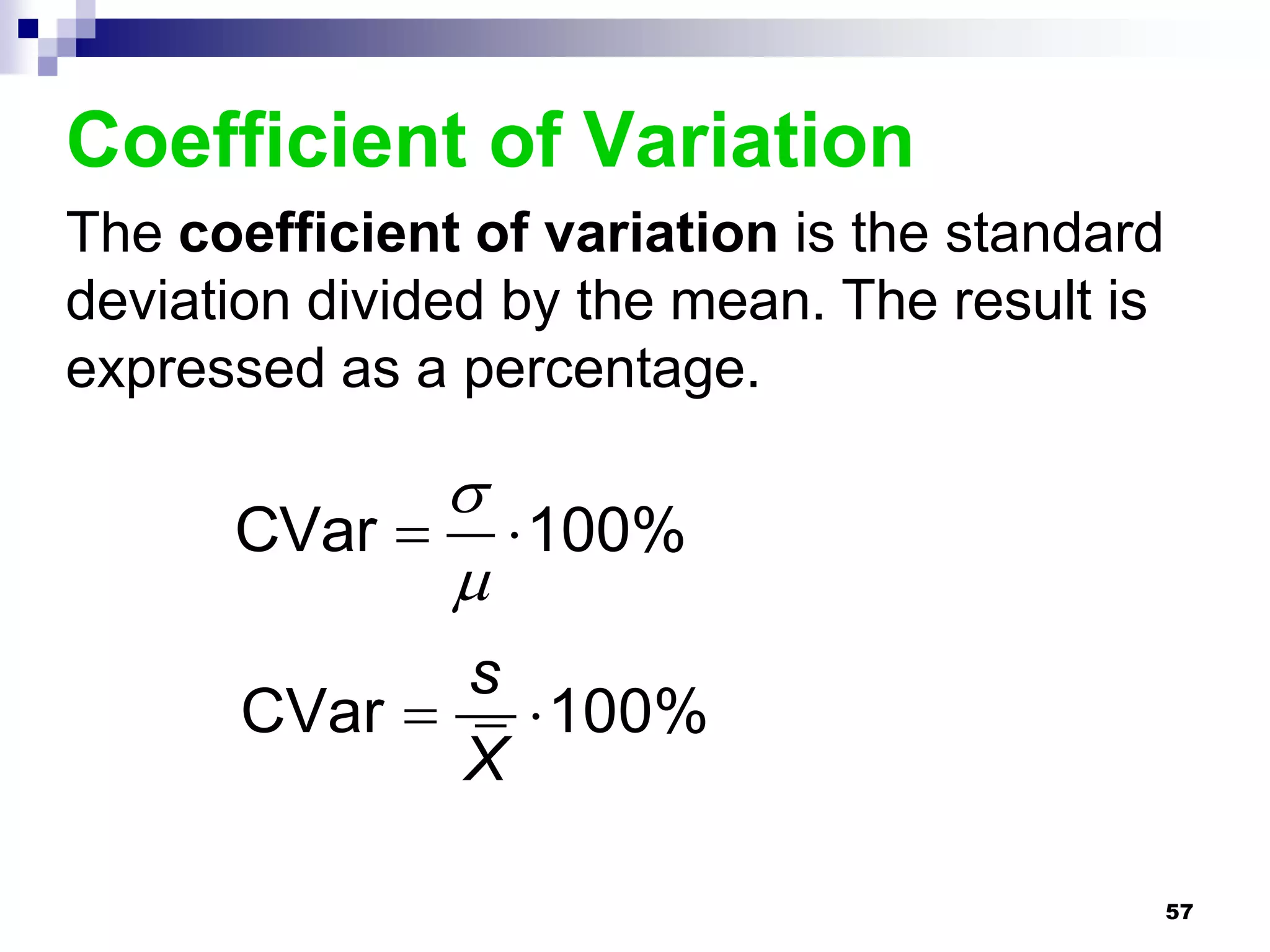
Coefficient of Variation
The coefficient of variation is the standard
deviation divided by the mean. The result is
expressed as a percentage.

            
      CVar   100%
            
            s
      CVar   100%
            X

                                               57
Example 15
The mean of the number of sales of cars over
a 3-month period is 87, and the standard
deviation is 5. The mean of the commissions
is $5225, and the standard deviation is $773.
Compare the variations of the two.


                                           58
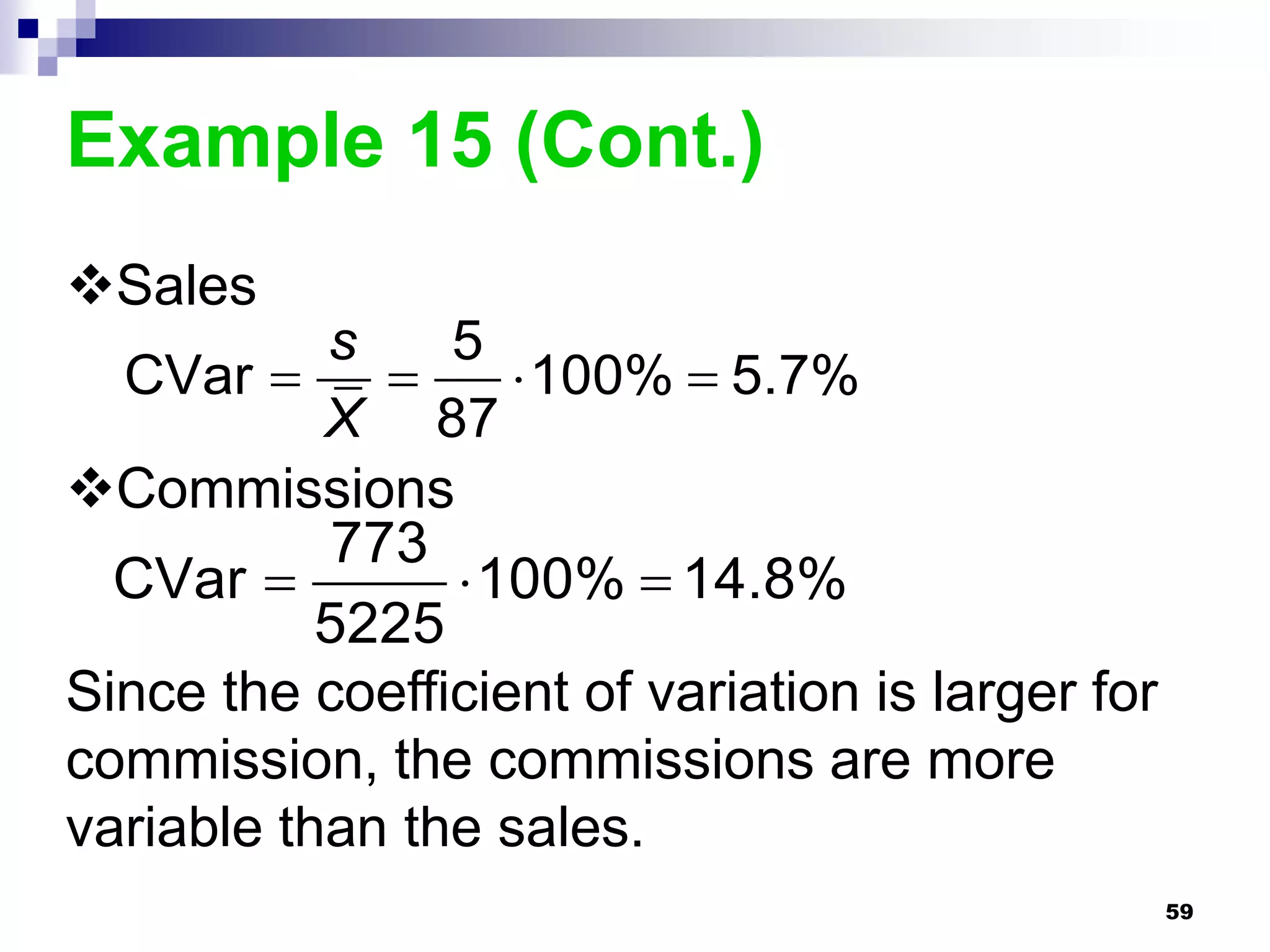
Example 15 (Cont.)
Sales
           s    5
  CVar            100%  5.7%
           X 87
Commissions
           773
  CVar          100%  14.8%
           5225
Since the coefficient of variation is larger for
commission, the commissions are more
variable than the sales.
                                                   59
Example 16
The mean for the number of pages of women’s
fitness magazines is 132, with a variance of 23;
the mean for the number of advertisements of
a sample of women’s fitness magazines is 182,
with a variance of 62. Compare the variances.
(answer: 3.6% pages, 4.3% advertisements)


                                            60
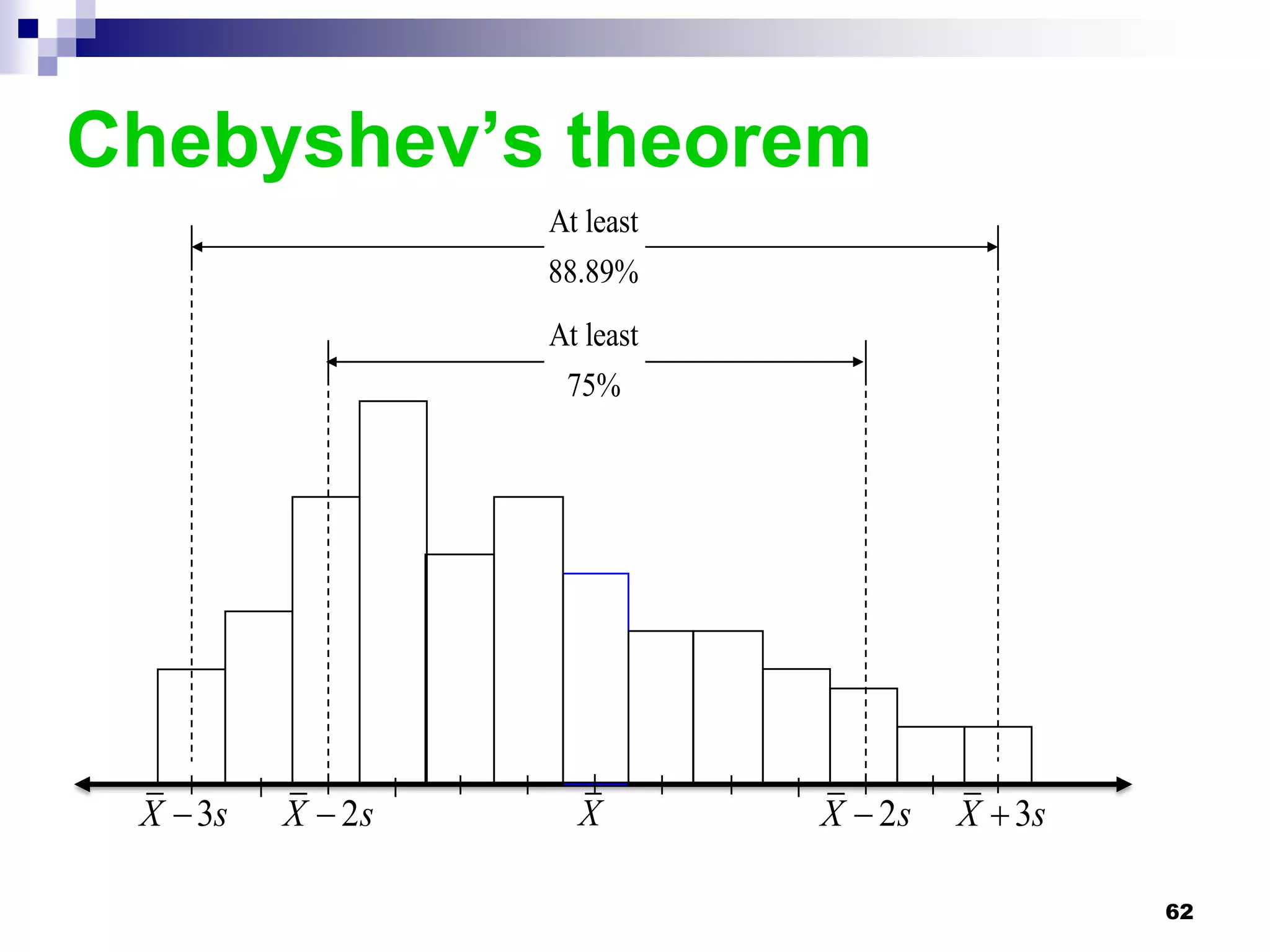
Chebyshev’s theorem
The proportion of values from a data set that
will fall within k standard deviations of the
mean will be at least 1-1/k2, where k is a
number greater than 1 (k is not necessarily an
integer).


                                           61
Chebyshev’s theorem
                   At least
                   88.89%
                   At least
                    75%


 X  3s   X  2s     X        X  2s   X  3s

                                                62
Example 17

The mean price of houses in a certain
neighborhood is $50,000, and the standard
deviation is $10, 000. Find the price range
for which at least 75% of the houses will sell.


                                             63
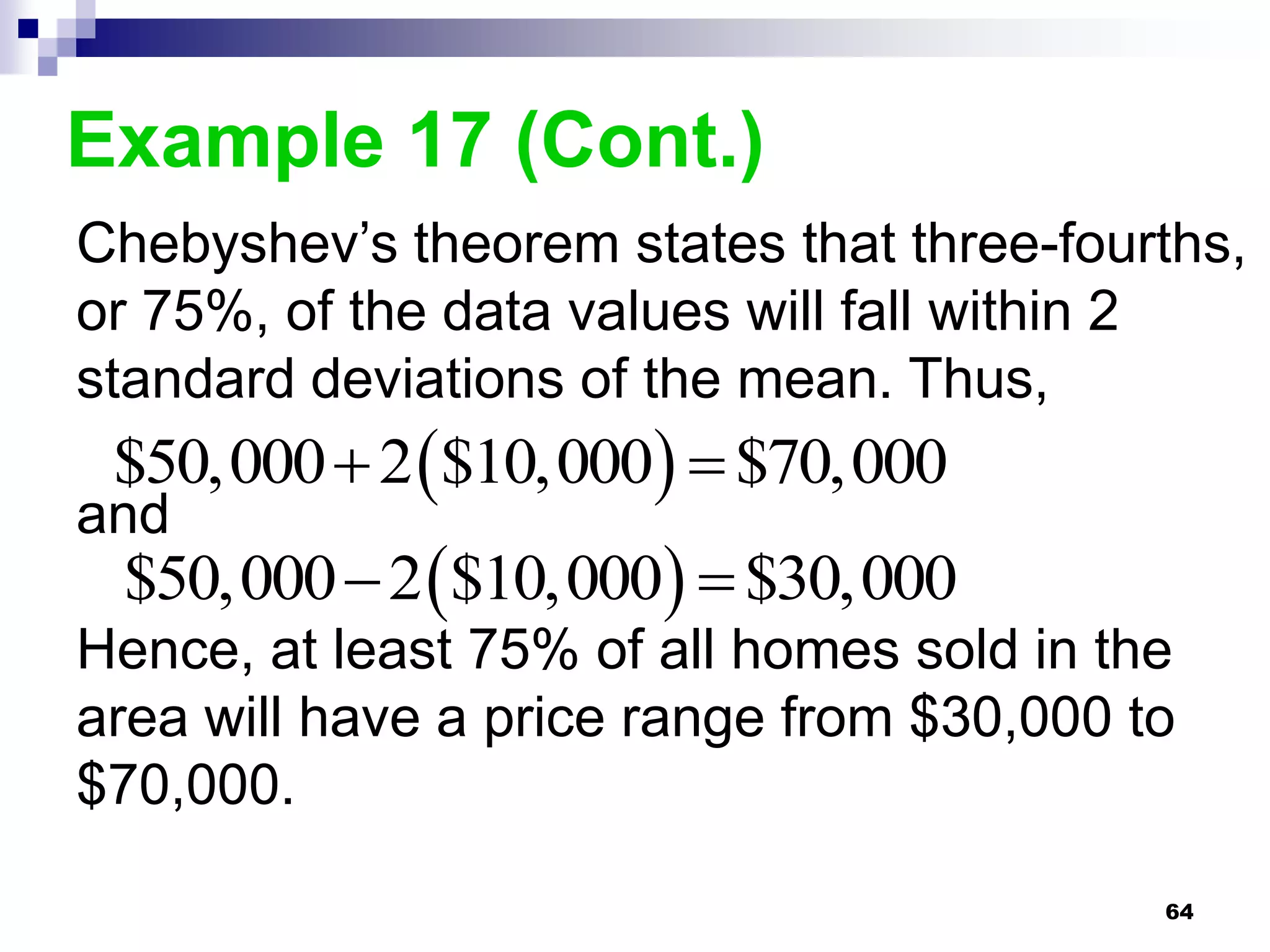
Example 17 (Cont.)
Chebyshev’s theorem states that three-fourths,
or 75%, of the data values will fall within 2
standard deviations of the mean. Thus,
 $50,000  2 $10,000  $70,000
and
 $50,000  2 $10,000  $30,000
Hence, at least 75% of all homes sold in the
area will have a price range from $30,000 to
$70,000.

                                           64
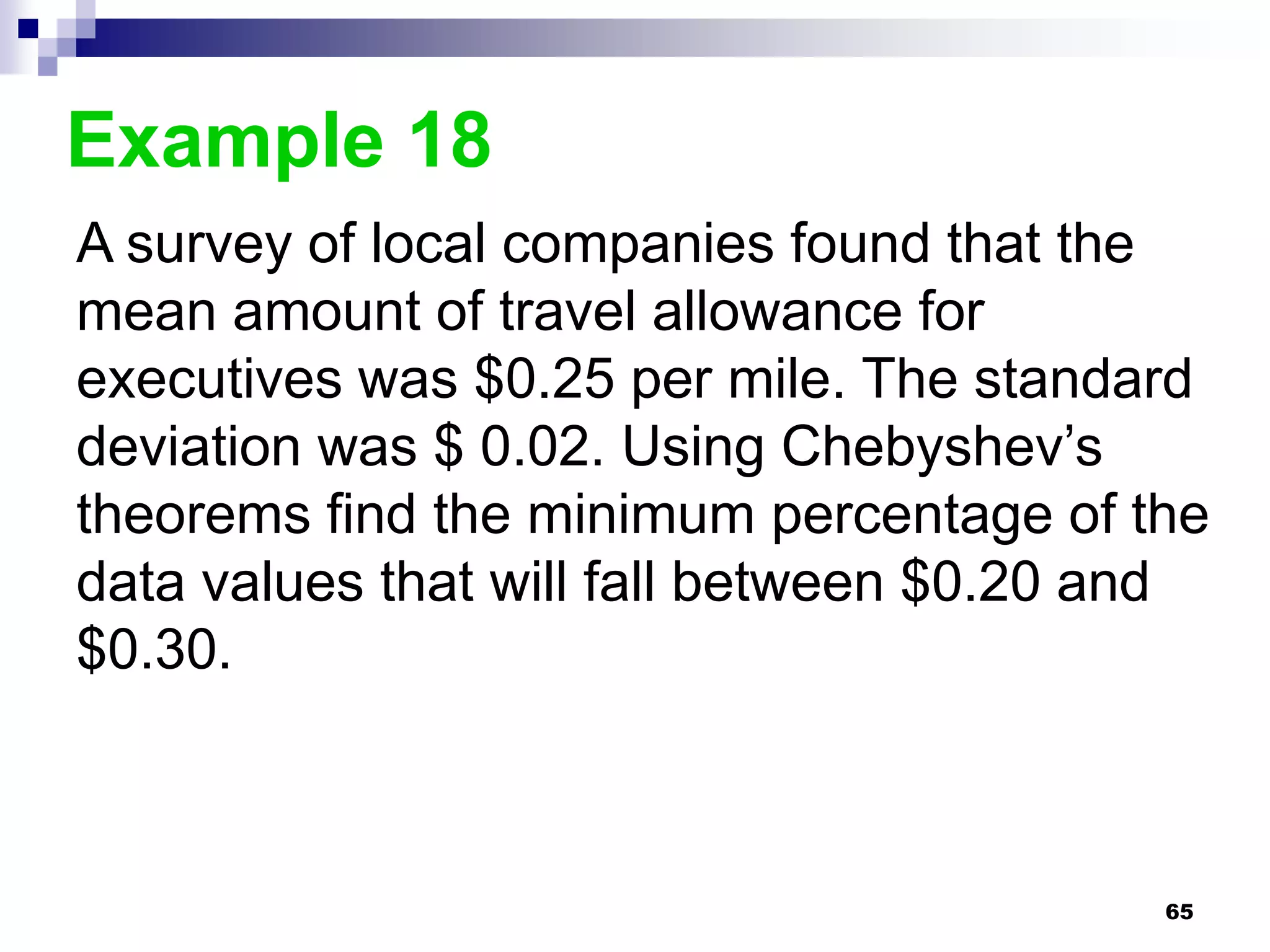
Example 18
A survey of local companies found that the
mean amount of travel allowance for
executives was $0.25 per mile. The standard
deviation was $ 0.02. Using Chebyshev’s
theorems find the minimum percentage of the
data values that will fall between $0.20 and
$0.30.


                                          65
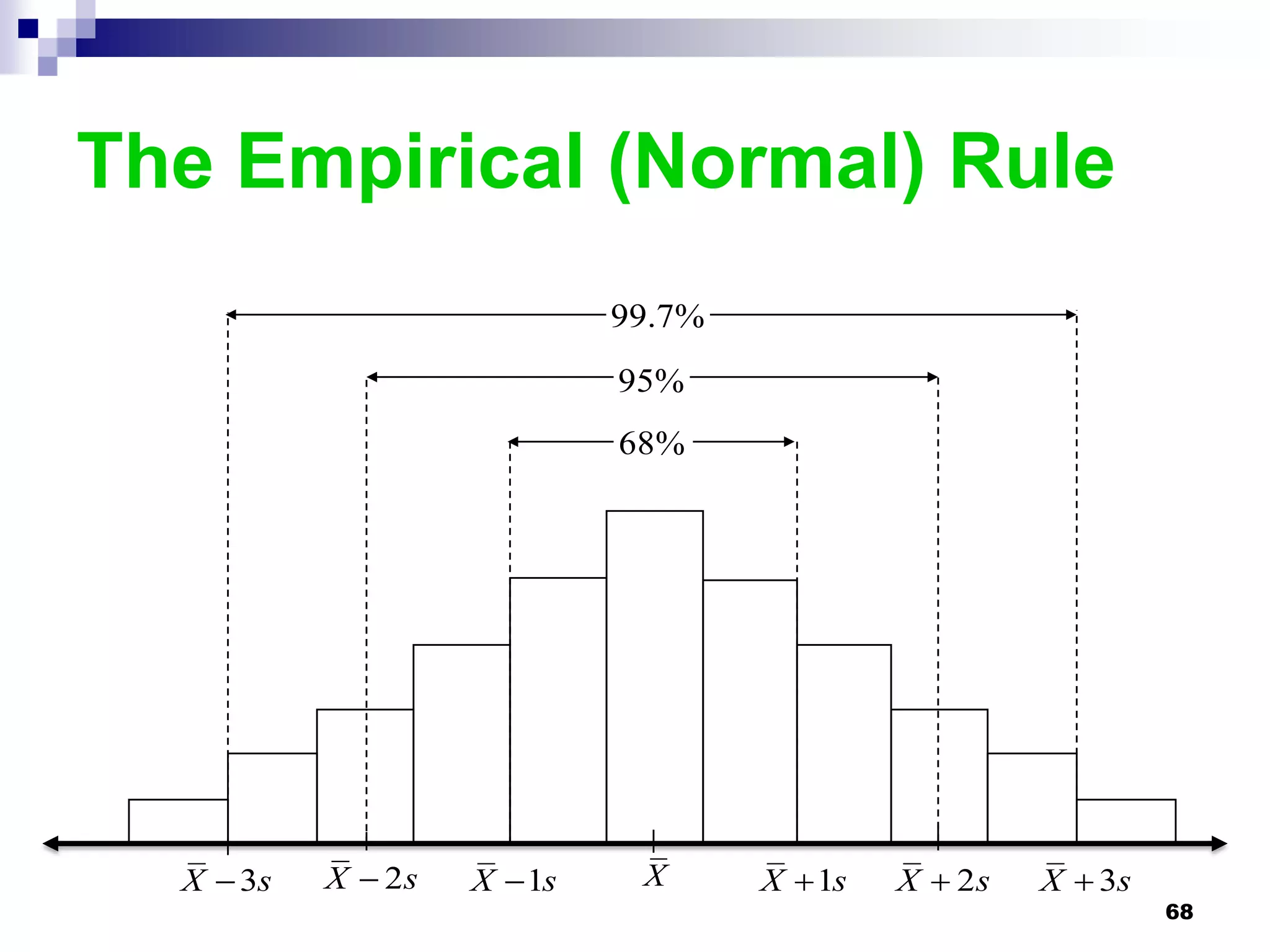
The Empirical (Normal) Rule
Chebyshev’s theorem applies to any
distribution regardless of its shape.
However, when a distribution is bell-shaped
(or what is called normal), the following
statements, which make up the empirical
rule, are true.


                                              66
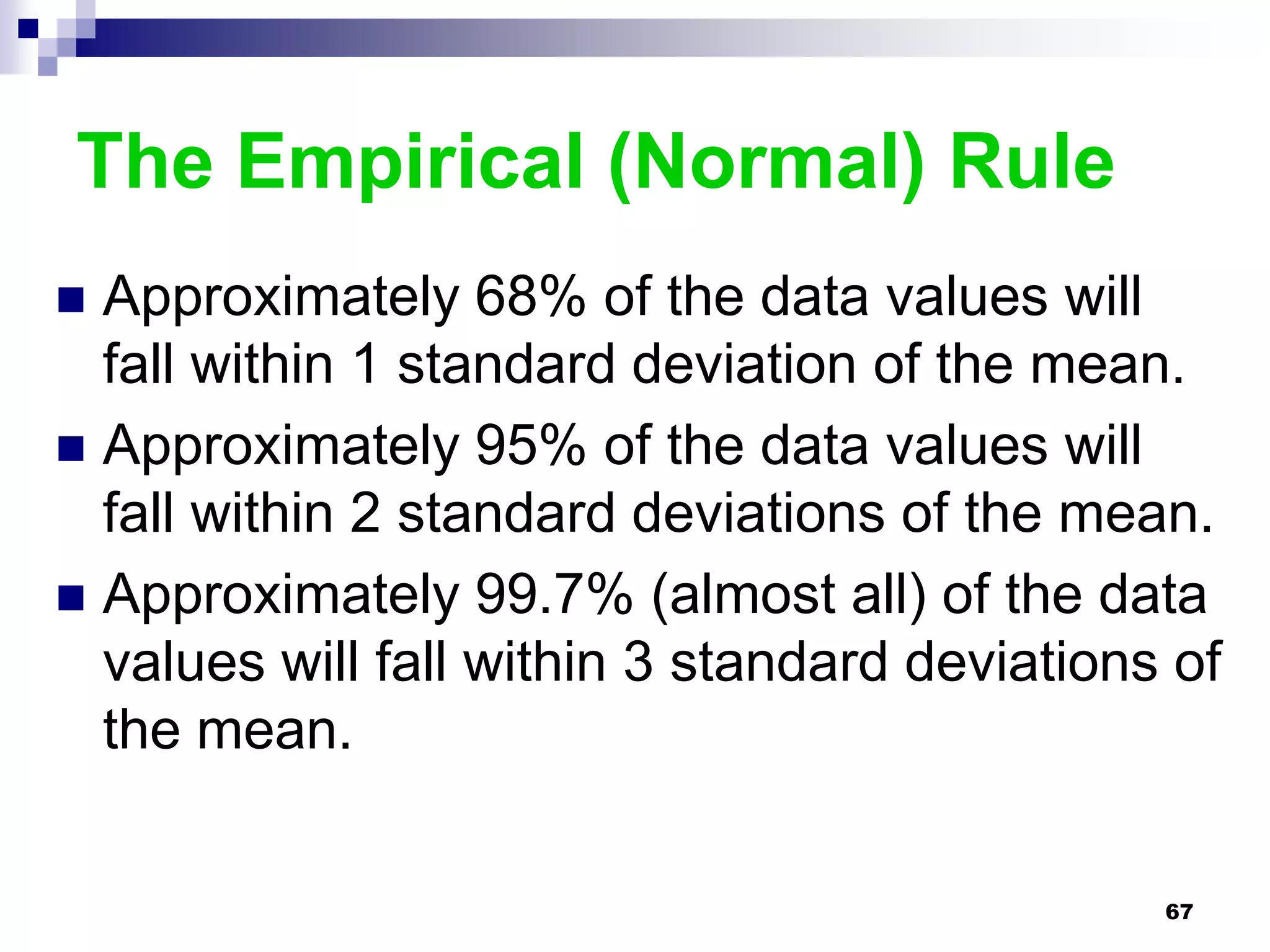
The Empirical (Normal) Rule
 Approximately 68% of the data values will
  fall within 1 standard deviation of the mean.
 Approximately 95% of the data values will
  fall within 2 standard deviations of the mean.
 Approximately 99.7% (almost all) of the data
  values will fall within 3 standard deviations of
  the mean.


                                               67
The Empirical (Normal) Rule
                             99.7%
                             95%
                             68%


  X  3s   X  2s   X  1s    X      X  1s   X  2s   X  3s
                                                                68
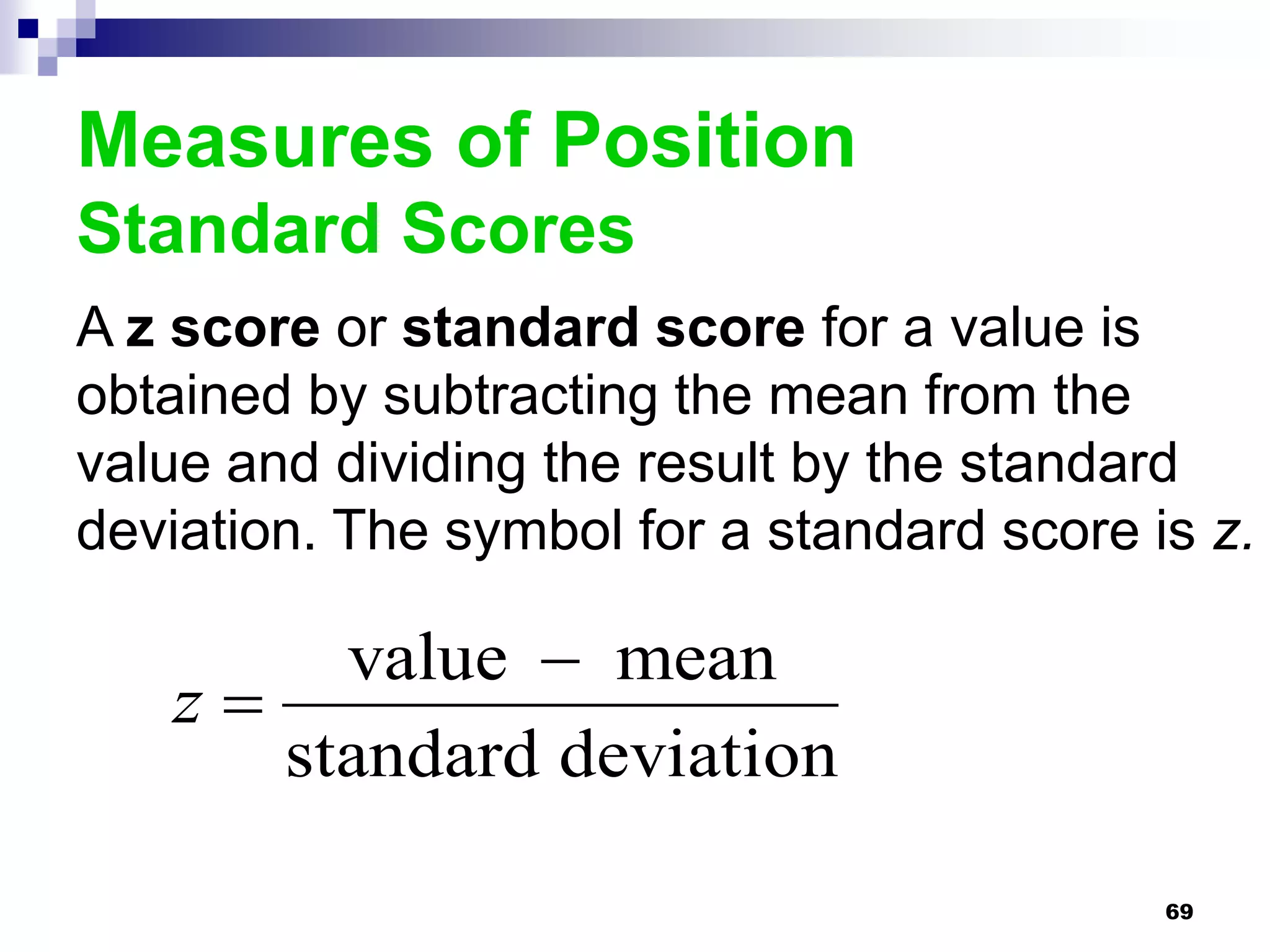
Measures of Position
Standard Scores
A z score or standard score for a value is
obtained by subtracting the mean from the
value and dividing the result by the standard
deviation. The symbol for a standard score is z.

        value  mean
   z
      standard deviation

                                            69
Measures of Position
Standard Scores
The z score represents the number of standard
deviations that a data value falls above or
below the mean.


                                         70
Example 19
A student scored 65 on a calculus test that had
a mean of 50 and a standard deviation of 10;
she scored 30 on a history test with a mean of
25 and a standard deviation of 5. Compare her
relative position on the two tests.


                                           71
Example 19 (Cont.)
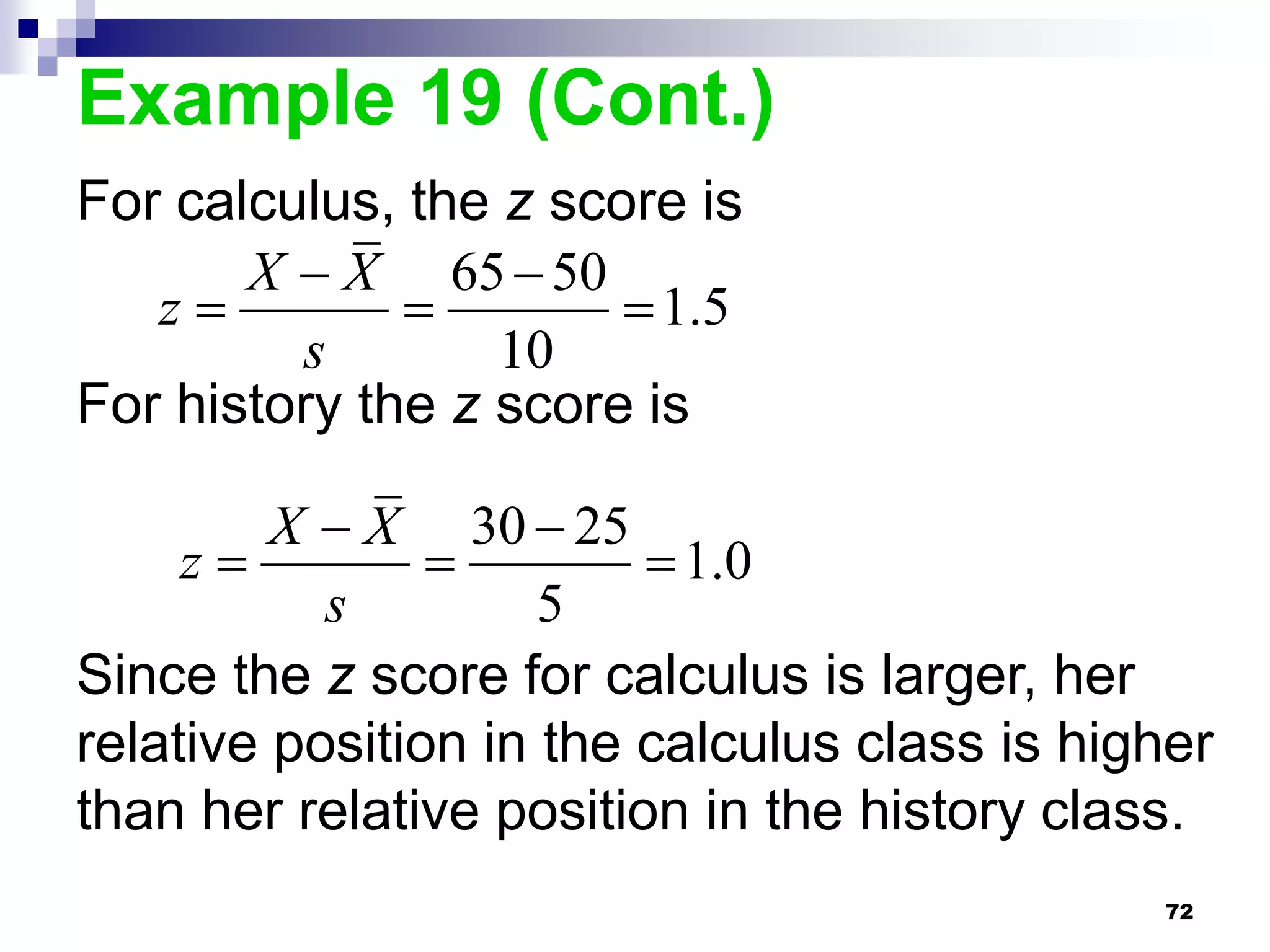
For calculus, the z score is
       X  X 65  50
   z                  1.5
         s        10
For history the z score is

         X  X 30  25
     z                  1.0
           s         5
Since the z score for calculus is larger, her
relative position in the calculus class is higher
than her relative position in the history class.
                                              72
Percentiles
Percentiles divide the data set into 100 equal
groups.

There are several mathematical methods for
computing percentiles for data. These
methods can be used to find approximate
percentile rank of a data value or to find a
data value corresponding to a given
percentile.

                                           73
Find a Percentile Rank
Corresponding to a Value
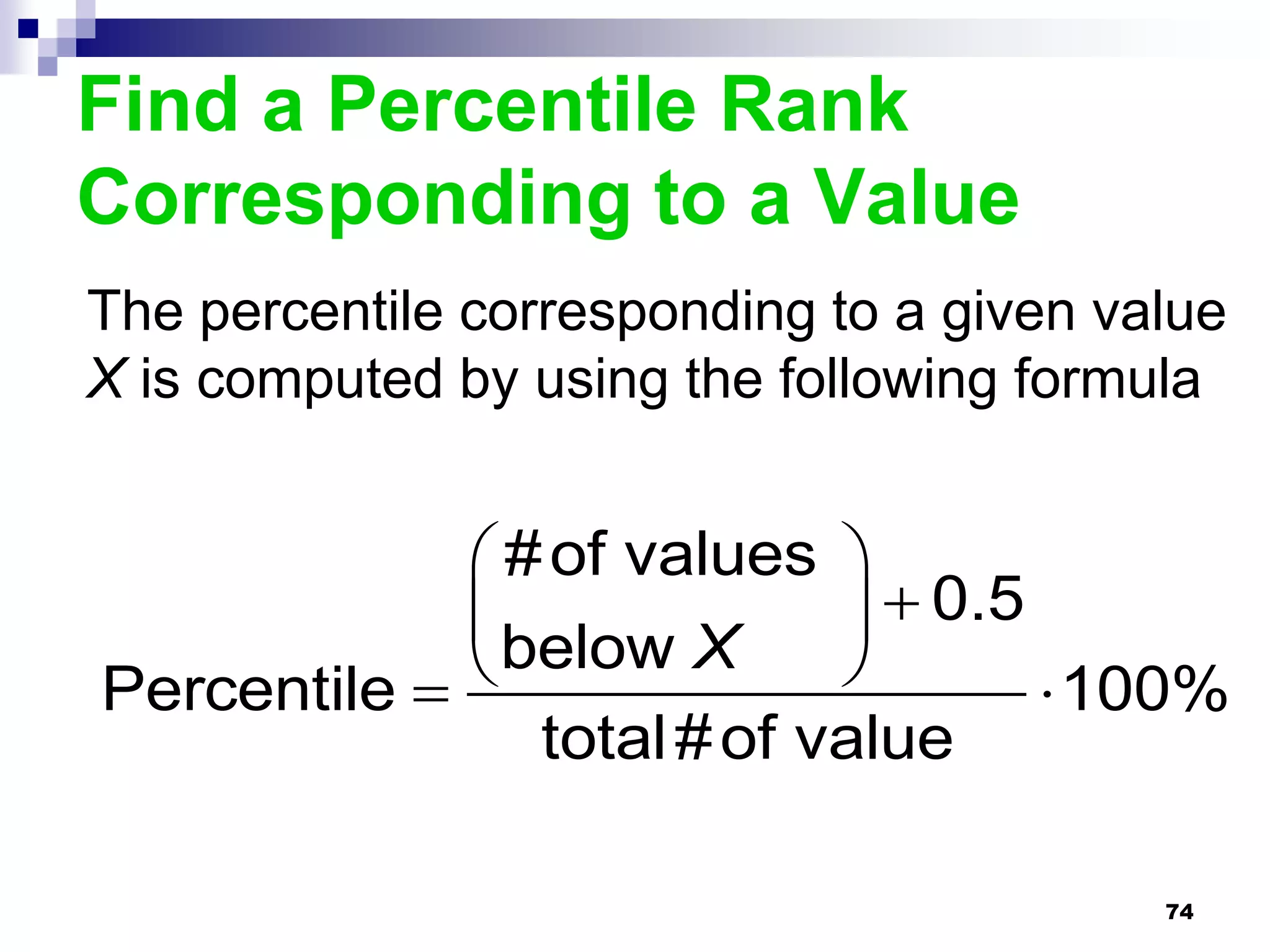
The percentile corresponding to a given value
X is computed by using the following formula


              # of values 
                             0.5
Percentile   below X              100%
                total # of value

                                          74
Example 20

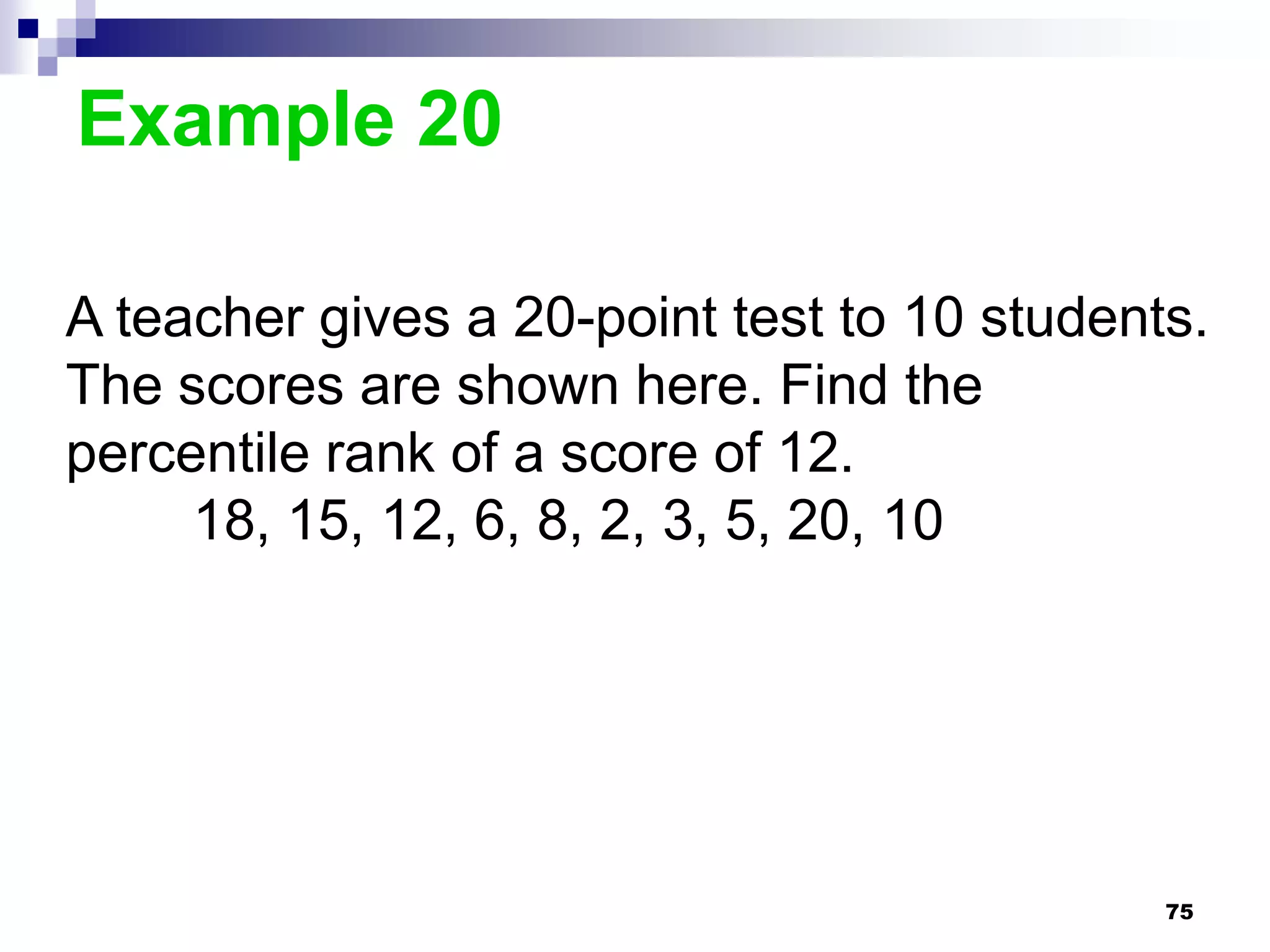
A teacher gives a 20-point test to 10 students.
The scores are shown here. Find the
percentile rank of a score of 12.
     18, 15, 12, 6, 8, 2, 3, 5, 20, 10


                                             75
Example 20 (Cont.)
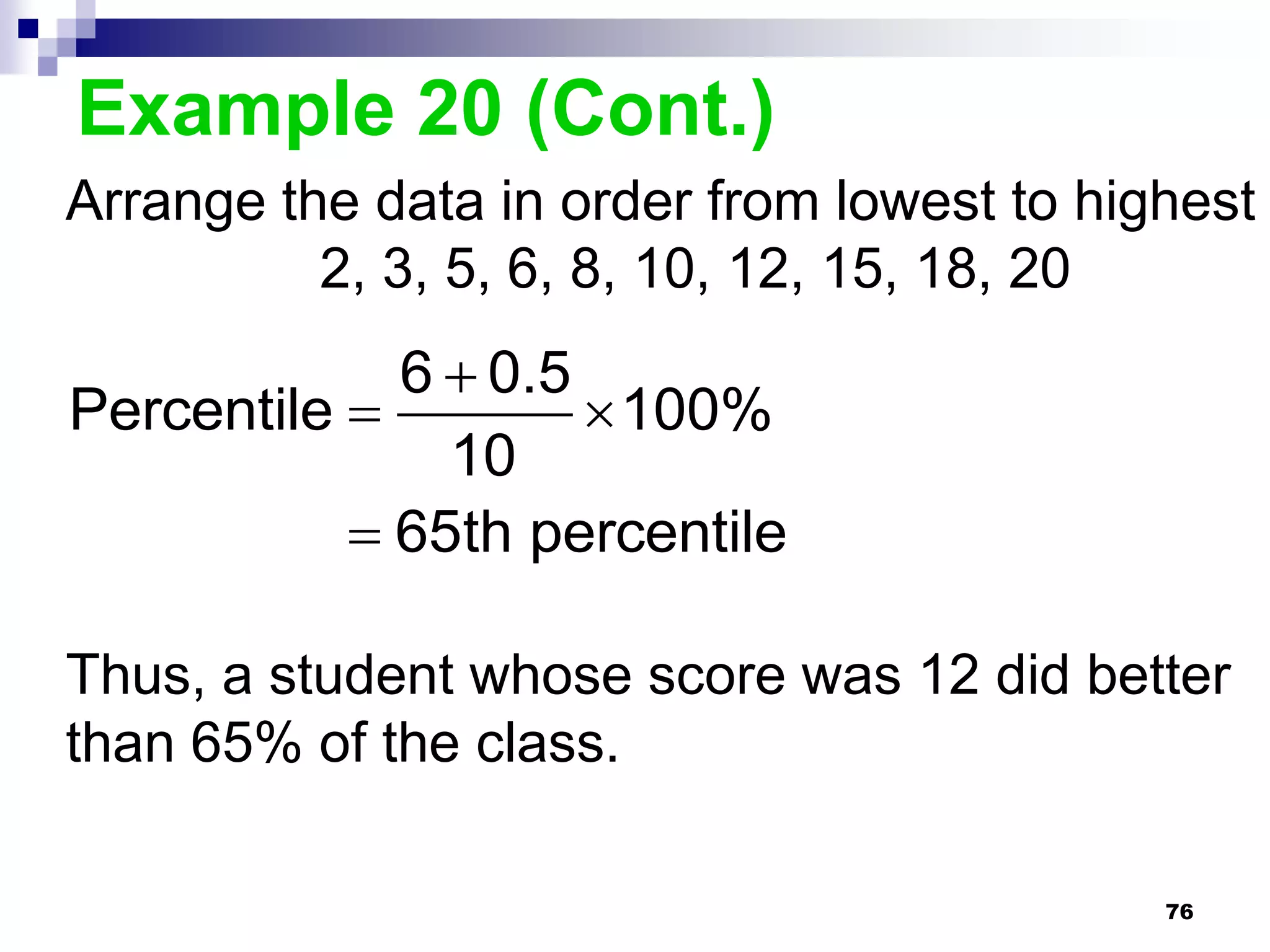
Arrange the data in order from lowest to highest
          2, 3, 5, 6, 8, 10, 12, 15, 18, 20
             6  0.5
Percentile           100%
               10
            65th percentile

Thus, a student whose score was 12 did better
than 65% of the class.

                                            76
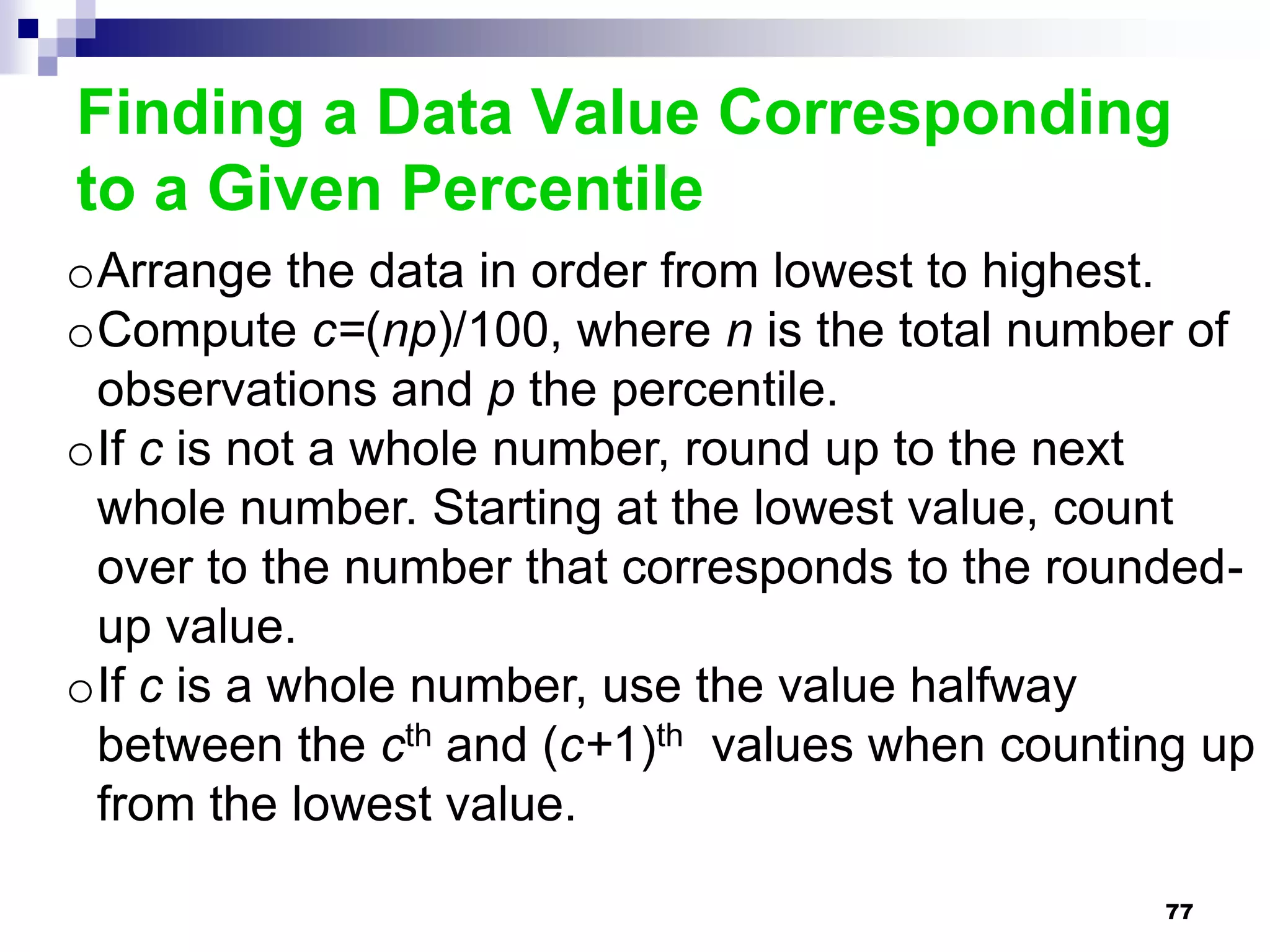
Finding a Data Value Corresponding
to a Given Percentile
oArrange the data in order from lowest to highest.
oCompute c=(np)/100, where n is the total number of
 observations and p the percentile.
oIf c is not a whole number, round up to the next
 whole number. Starting at the lowest value, count
 over to the number that corresponds to the rounded-
 up value.
oIf c is a whole number, use the value halfway
 between the cth and (c+1)th values when counting up
 from the lowest value.

                                                77
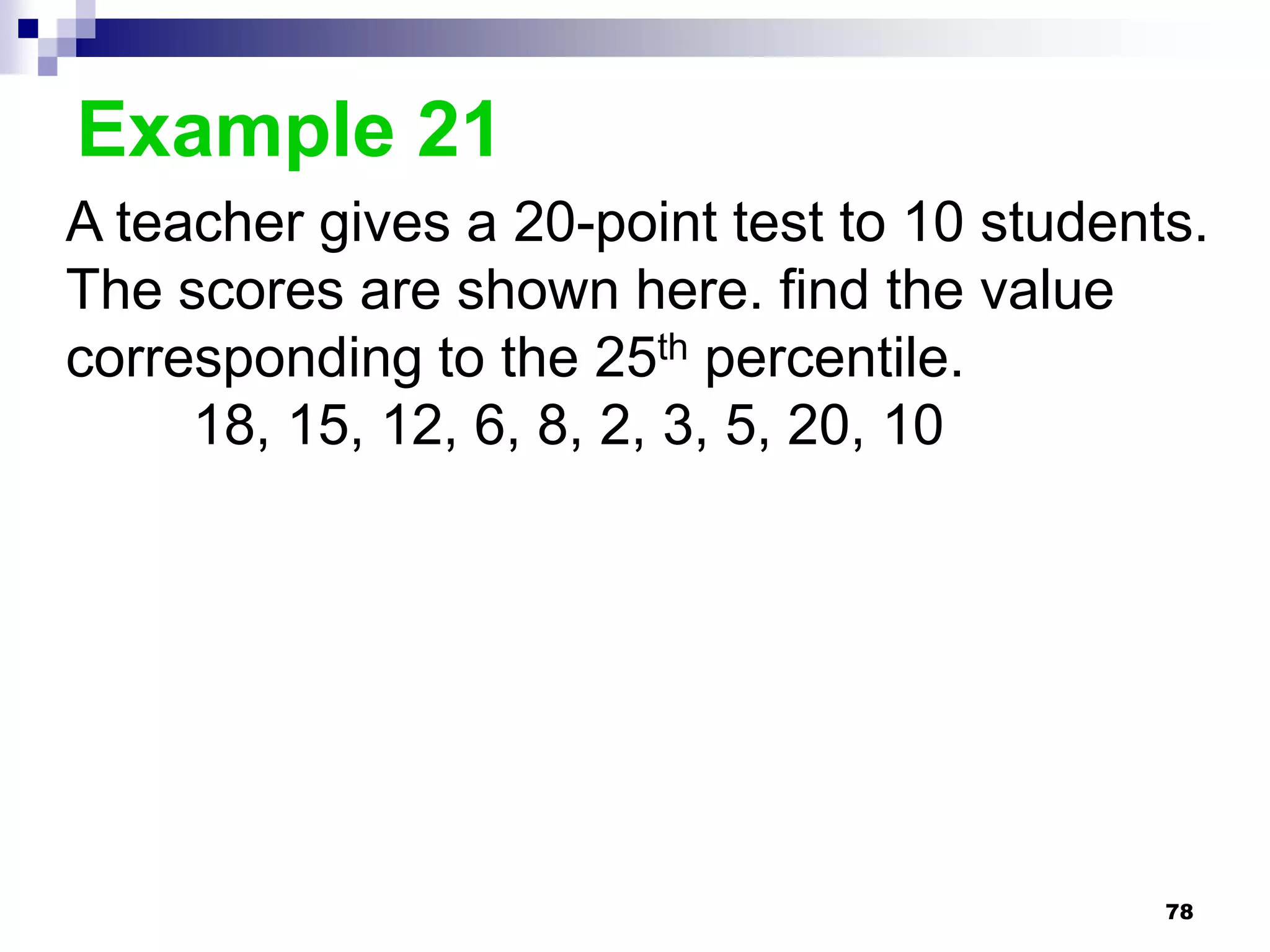
Example 21
A teacher gives a 20-point test to 10 students.
The scores are shown here. find the value
corresponding to the 25th percentile.
     18, 15, 12, 6, 8, 2, 3, 5, 20, 10


                                             78
Example 21 (Cont.)
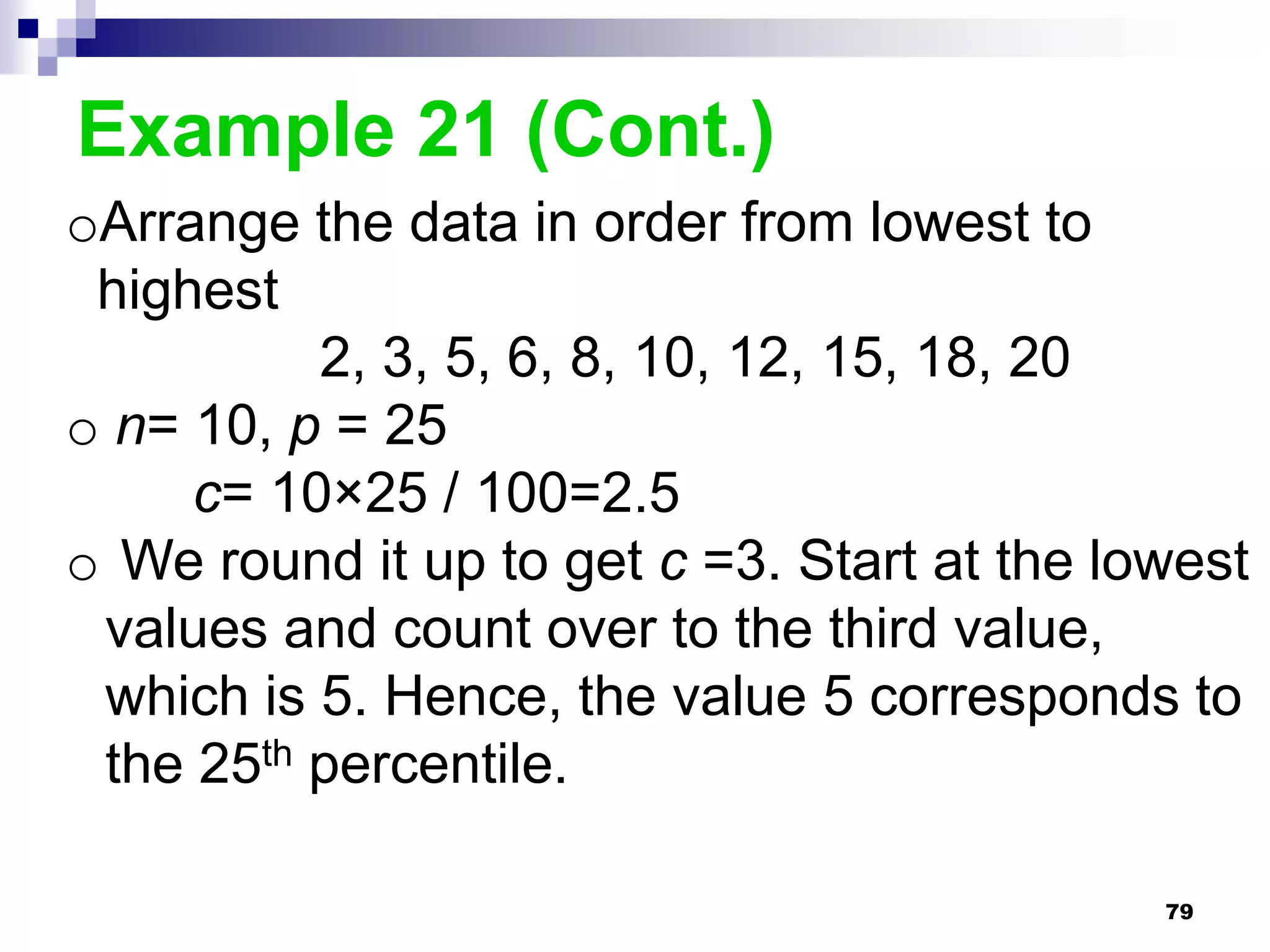
oArrange the data in order from lowest to
 highest
          2, 3, 5, 6, 8, 10, 12, 15, 18, 20
o n= 10, p = 25
     c= 10×25 / 100=2.5
o We round it up to get c =3. Start at the lowest
 values and count over to the third value,
 which is 5. Hence, the value 5 corresponds to
 the 25th percentile.

                                             79
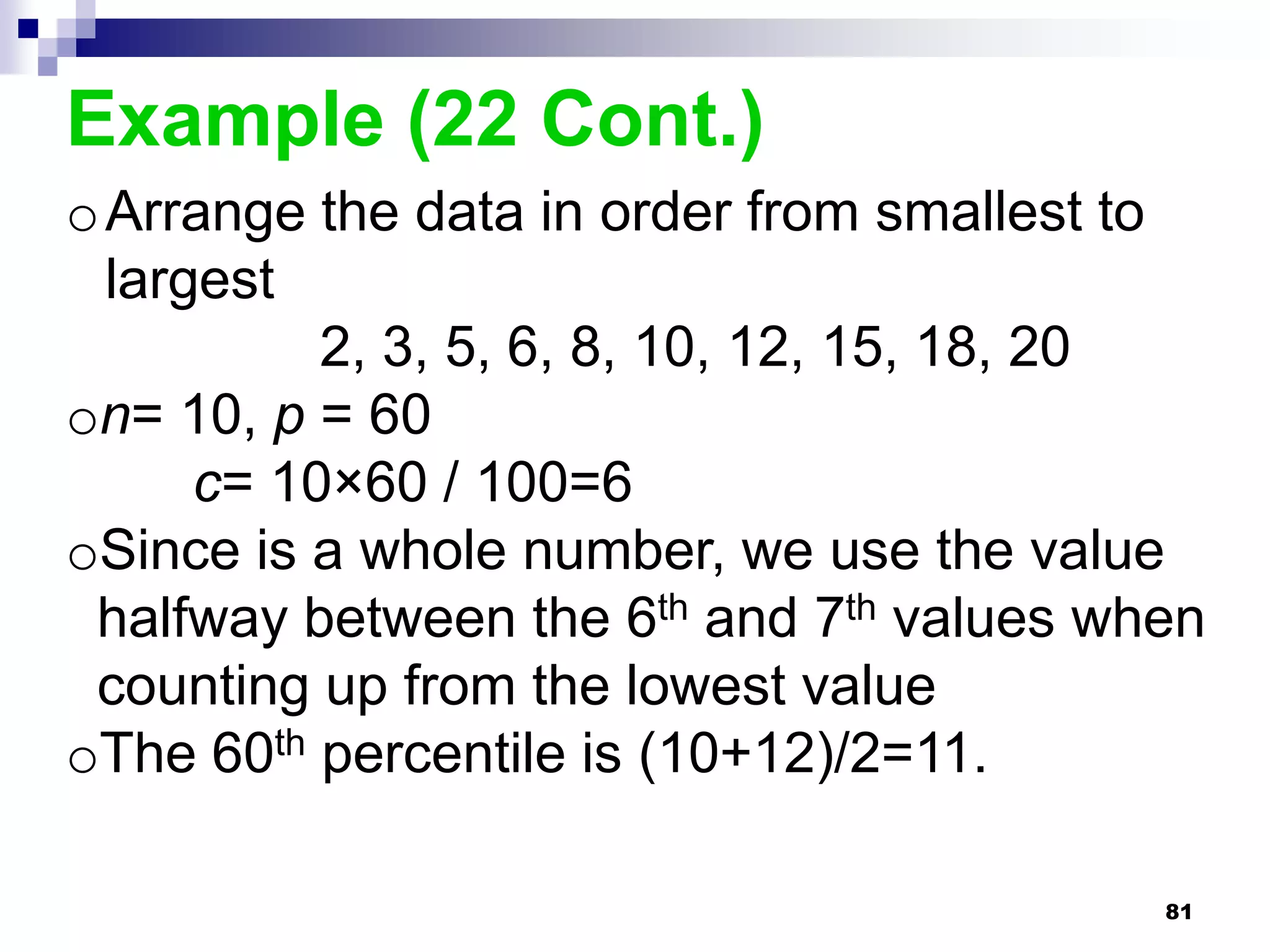
Example 22
A teacher gives a 20-point test to 10 students.
The scores are shown here. find the value
corresponding to the 60th percentile.
     18, 15, 12, 6, 8, 2, 3, 5, 20, 10


                                             80
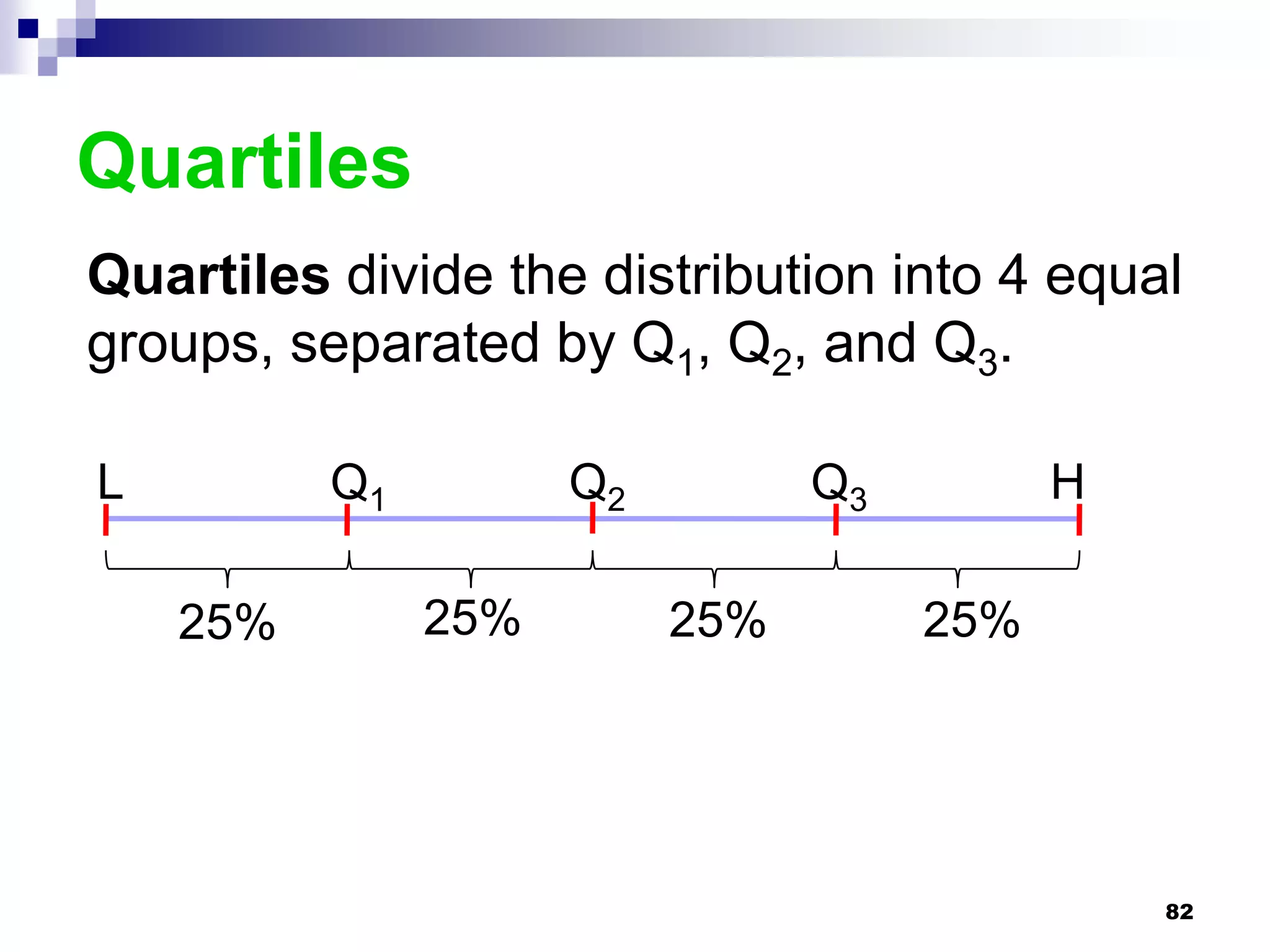
Example (22 Cont.)
o Arrange the data in order from smallest to
  largest
           2, 3, 5, 6, 8, 10, 12, 15, 18, 20
on= 10, p = 60
      c= 10×60 / 100=6
oSince is a whole number, we use the value
 halfway between the 6th and 7th values when
 counting up from the lowest value
oThe 60th percentile is (10+12)/2=11.

                                          81
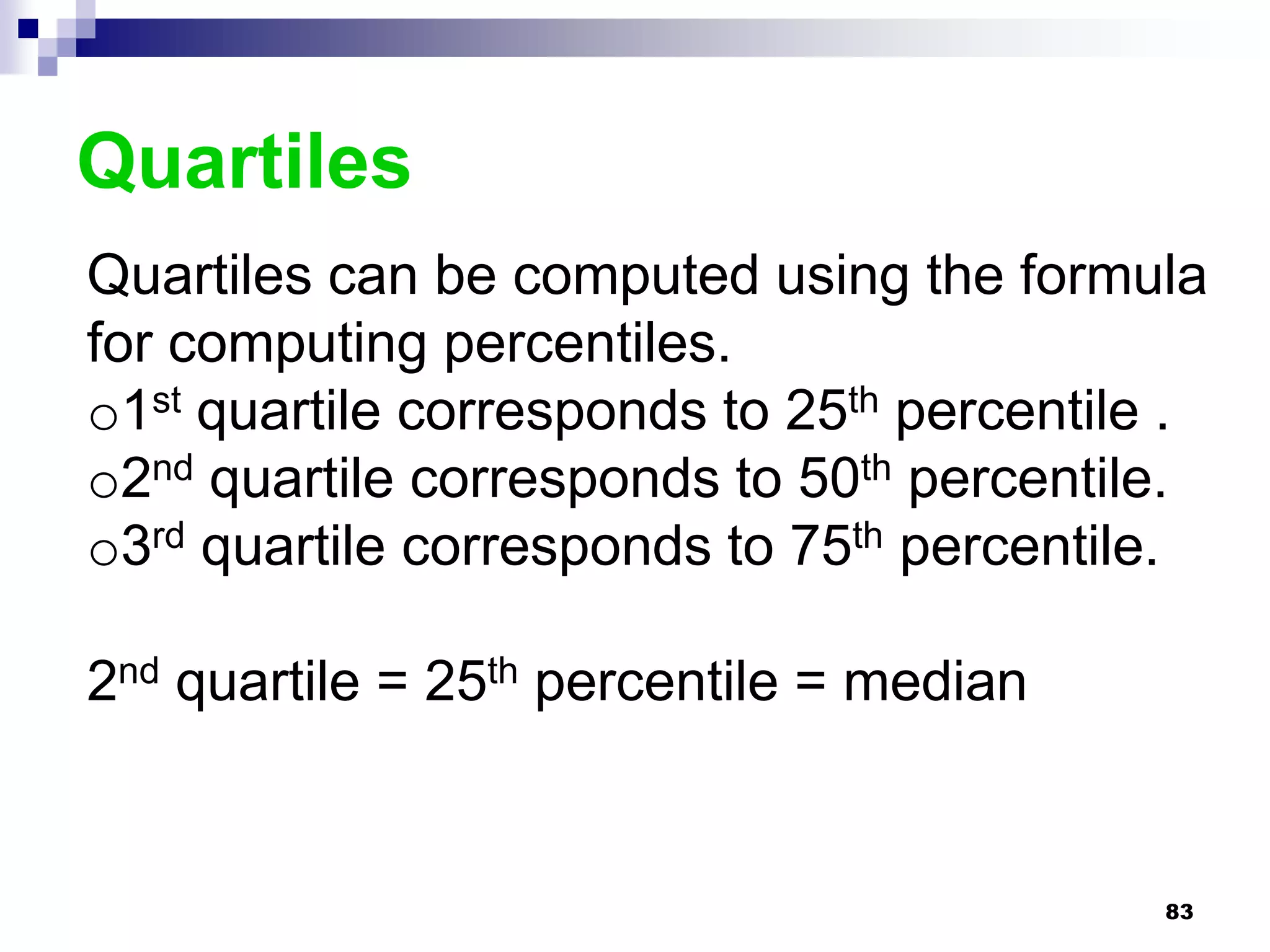
Quartiles
Quartiles divide the distribution into 4 equal
groups, separated by Q1, Q2, and Q3.

L         Q1         Q2         Q3         H

    25%        25%        25%        25%


                                               82
Quartiles
Quartiles can be computed using the formula
for computing percentiles.
o1st quartile corresponds to 25th percentile .
o2nd quartile corresponds to 50th percentile.
o3rd quartile corresponds to 75th percentile.

2nd quartile = 25th percentile = median


                                            83
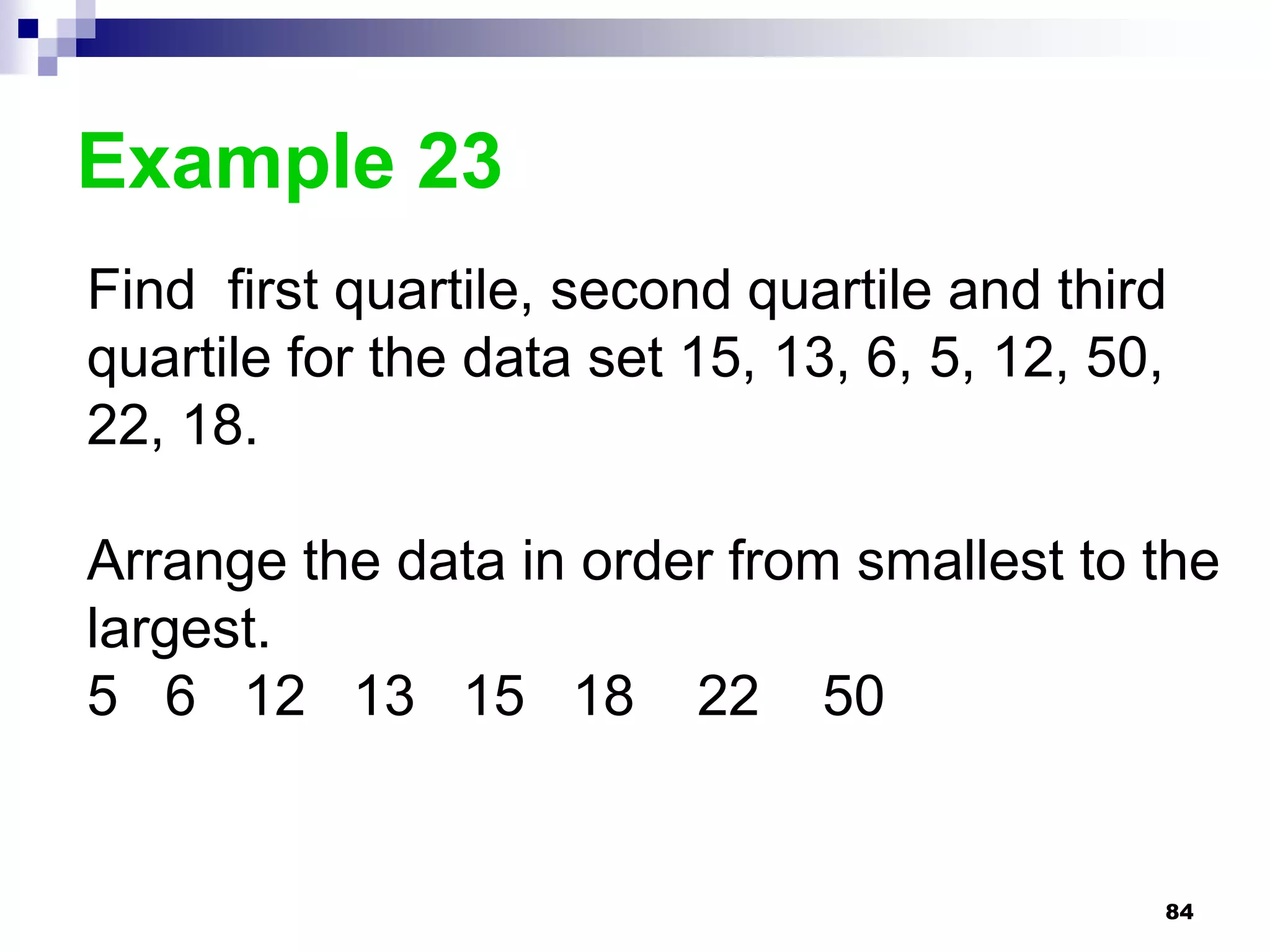
Example 23
Find first quartile, second quartile and third
quartile for the data set 15, 13, 6, 5, 12, 50,
22, 18.

Arrange the data in order from smallest to the
largest.
5 6 12 13 15 18 22 50


                                              84
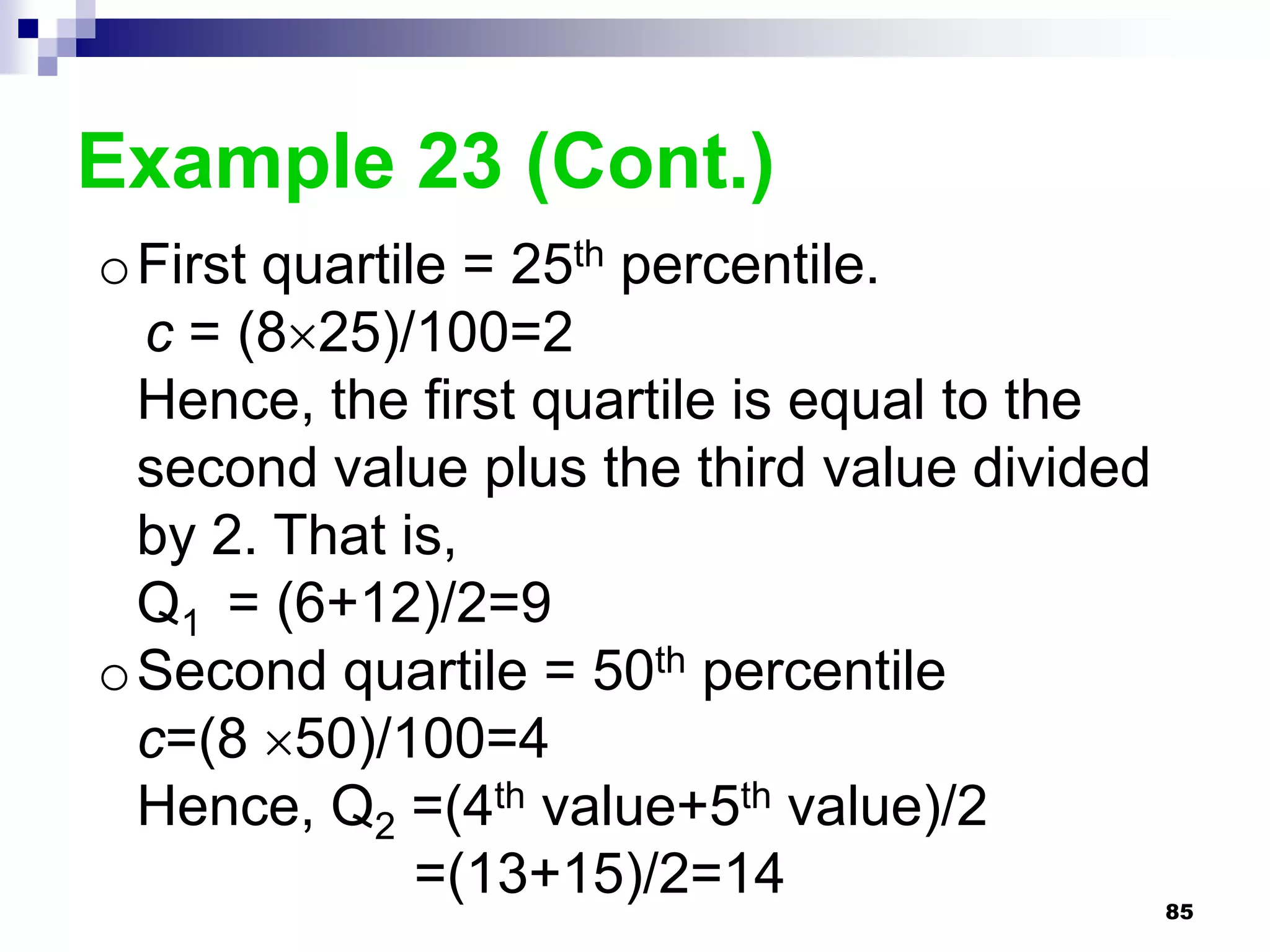
Example 23 (Cont.)
oFirst quartile = 25th percentile.
 c = (825)/100=2
 Hence, the first quartile is equal to the
 second value plus the third value divided
 by 2. That is,
 Q1 = (6+12)/2=9
oSecond quartile = 50th percentile
 c=(8 50)/100=4
 Hence, Q2 =(4th value+5th value)/2
              =(13+15)/2=14                  85
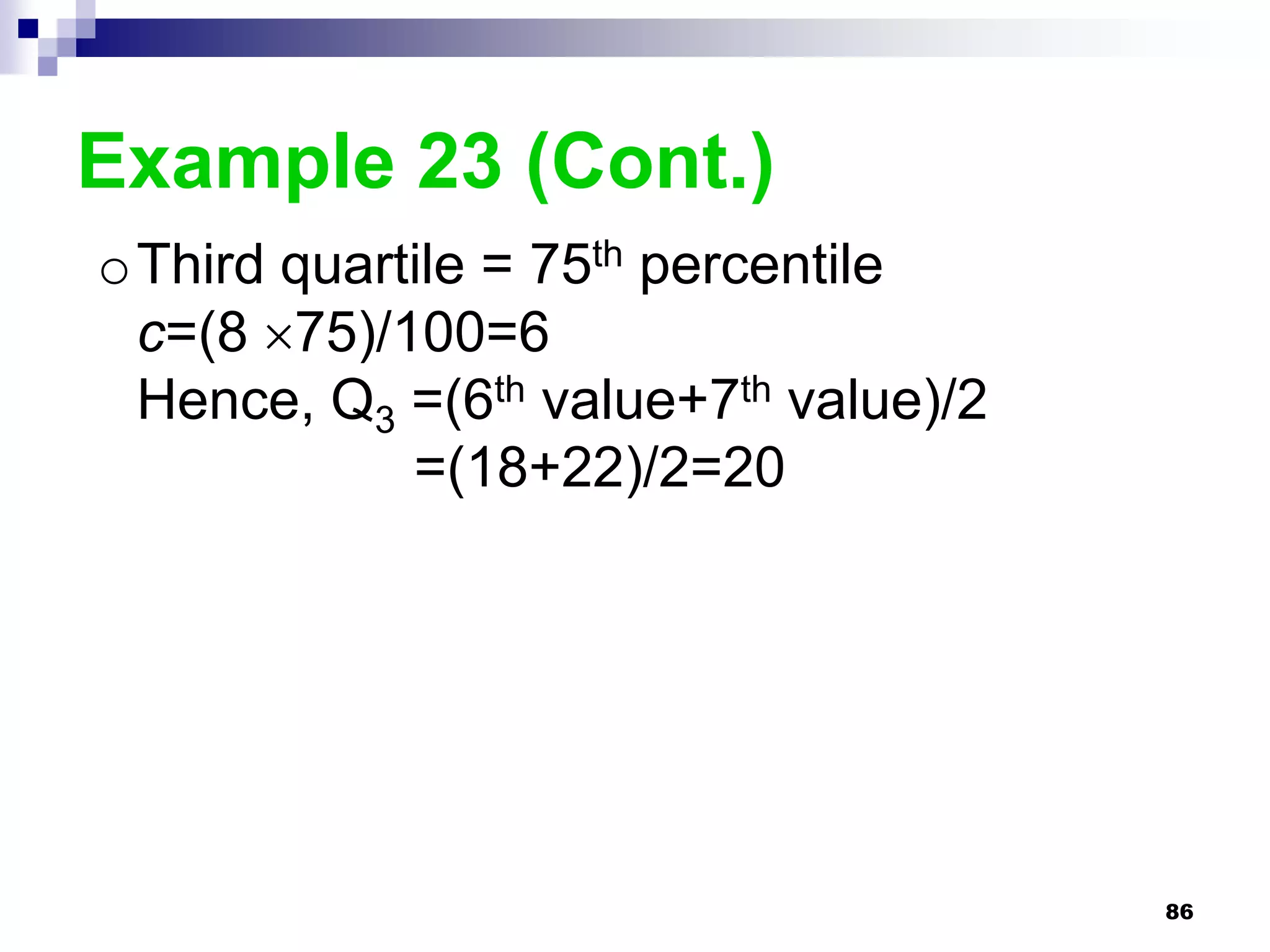
Example 23 (Cont.)
oThird quartile = 75th percentile
 c=(8 75)/100=6
 Hence, Q3 =(6th value+7th value)/2
            =(18+22)/2=20


                                      86
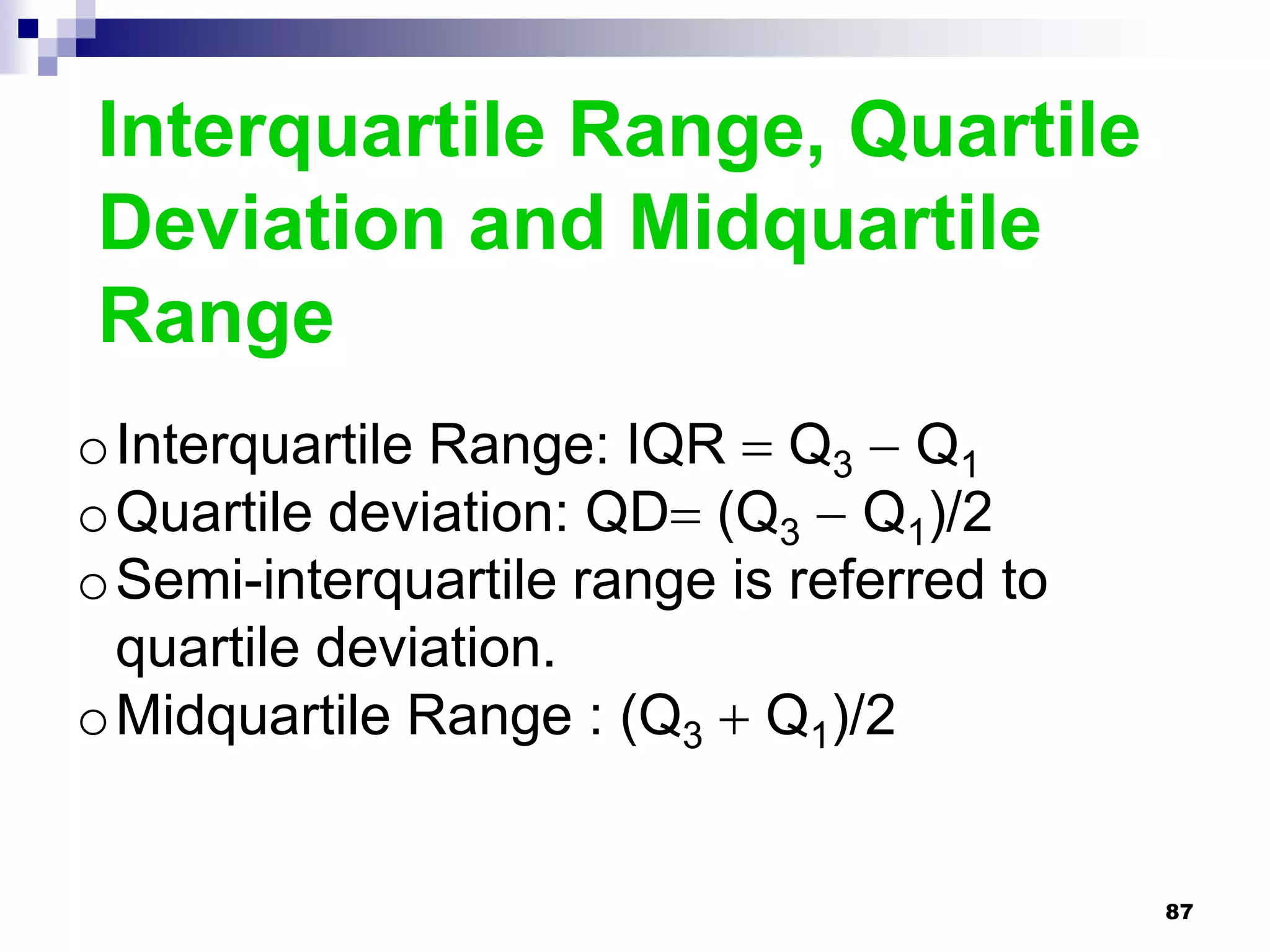
Interquartile Range, Quartile
Deviation and Midquartile
Range
oInterquartile Range: IQR  Q3  Q1
oQuartile deviation: QD (Q3  Q1)/2
oSemi-interquartile range is referred to
 quartile deviation.
oMidquartile Range : (Q3  Q1)/2


                                           87
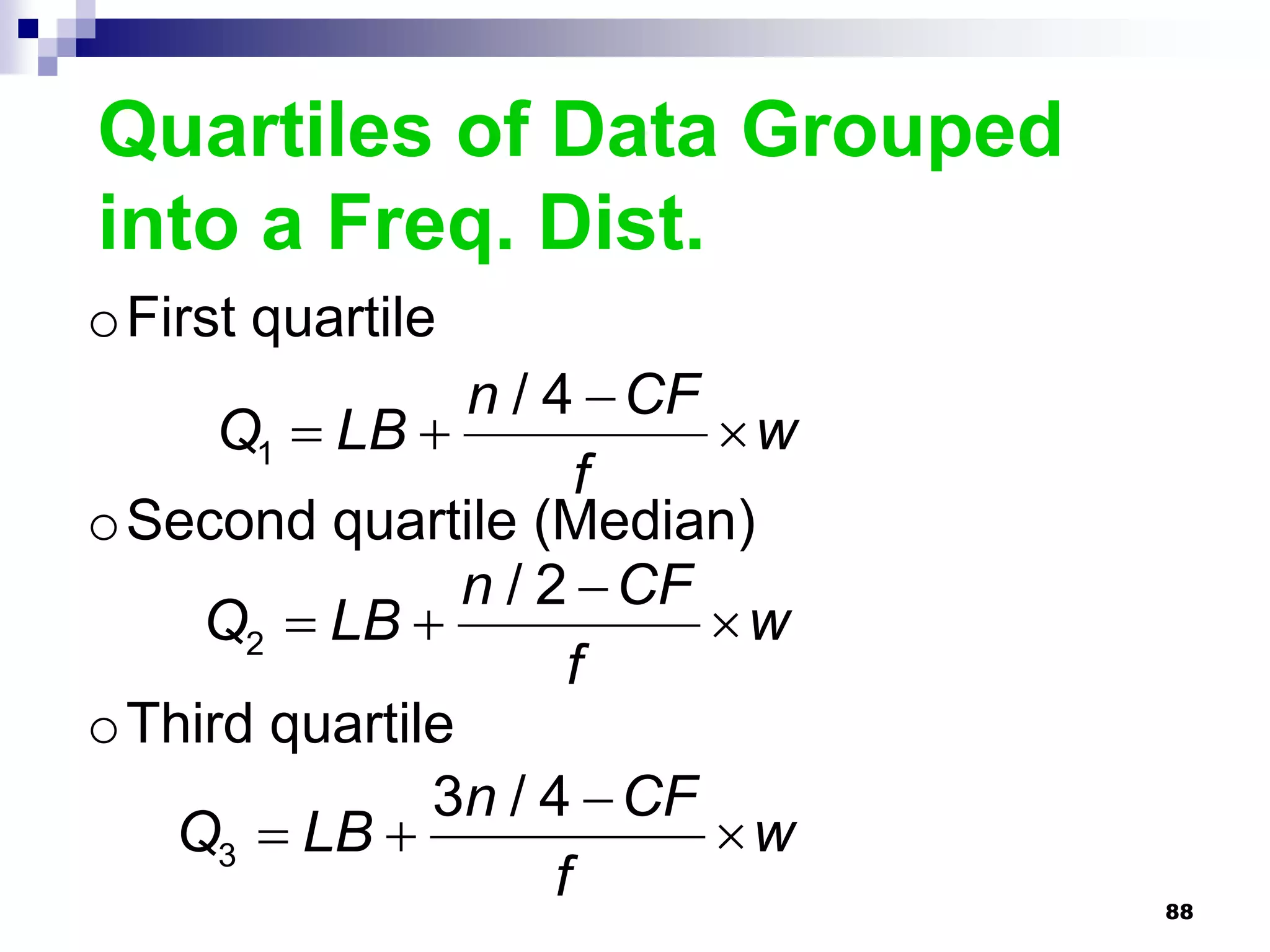
Quartiles of Data Grouped
into a Freq. Dist.
oFirst quartile
                n / 4  CF
     Q1  LB              w
                       f
oSecond quartile (Median)
                n / 2  CF
    Q2  LB               w
                      f
oThird quartile
              3n / 4  CF
  Q3  LB                 w
                     f          88
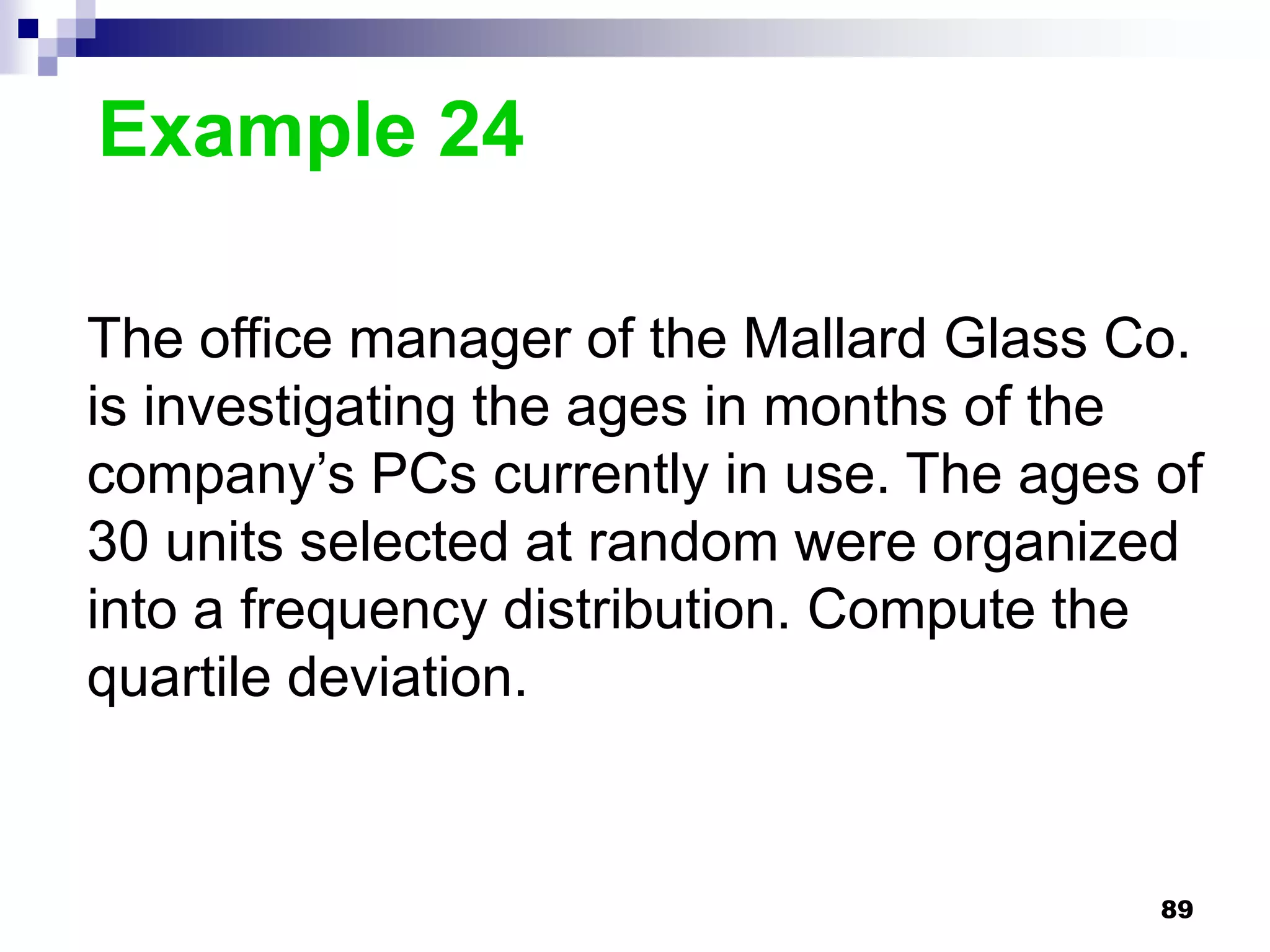
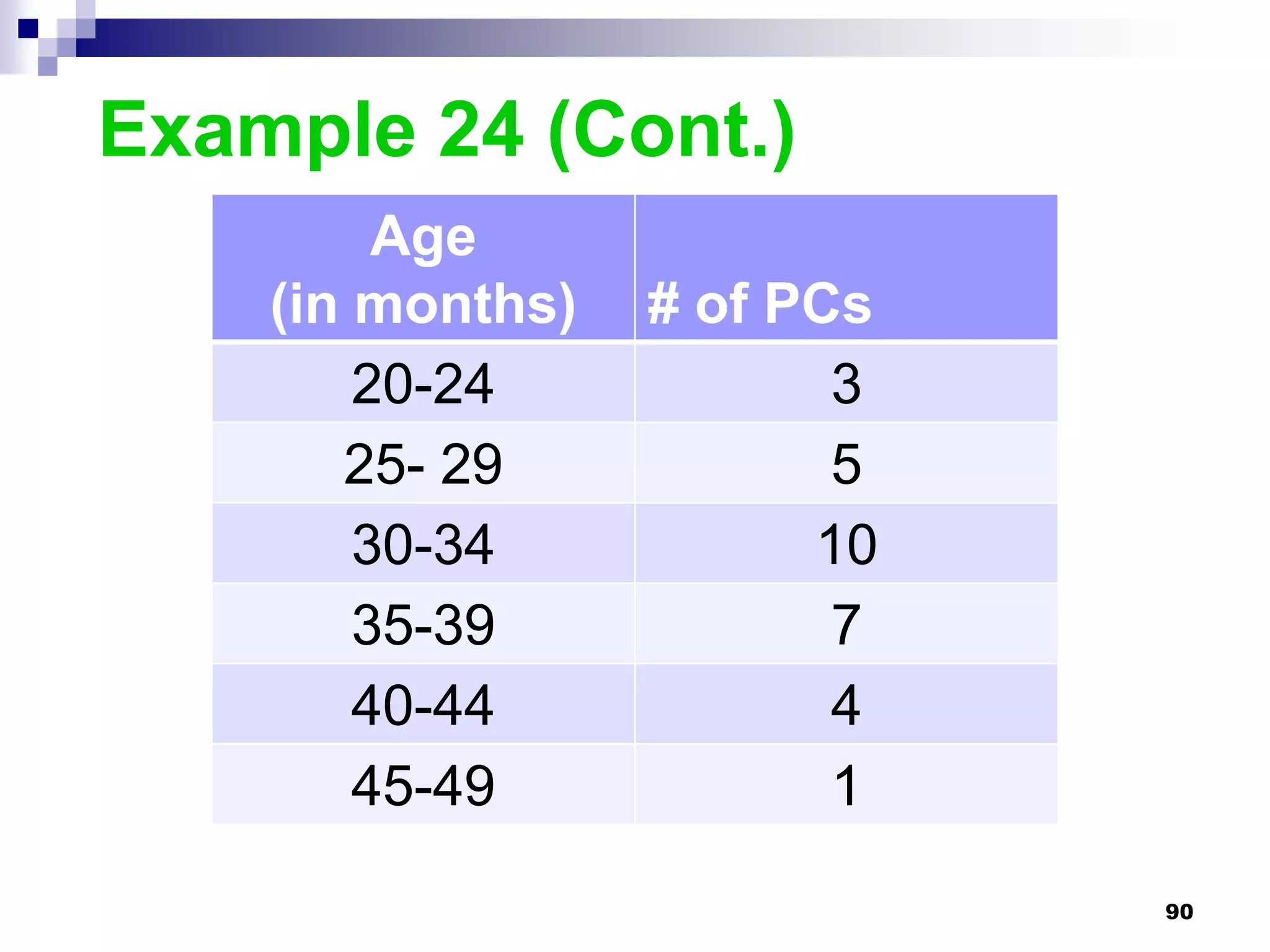
Example 24

The office manager of the Mallard Glass Co.
is investigating the ages in months of the
company’s PCs currently in use. The ages of
30 units selected at random were organized
into a frequency distribution. Compute the
quartile deviation.


                                         89
Example 24 (Cont.)
         Age
    (in months)   # of PCs
        20-24            3
       25- 29            5
        30-34           10
        35-39            7
        40-44            4
        45-49            1

                             90
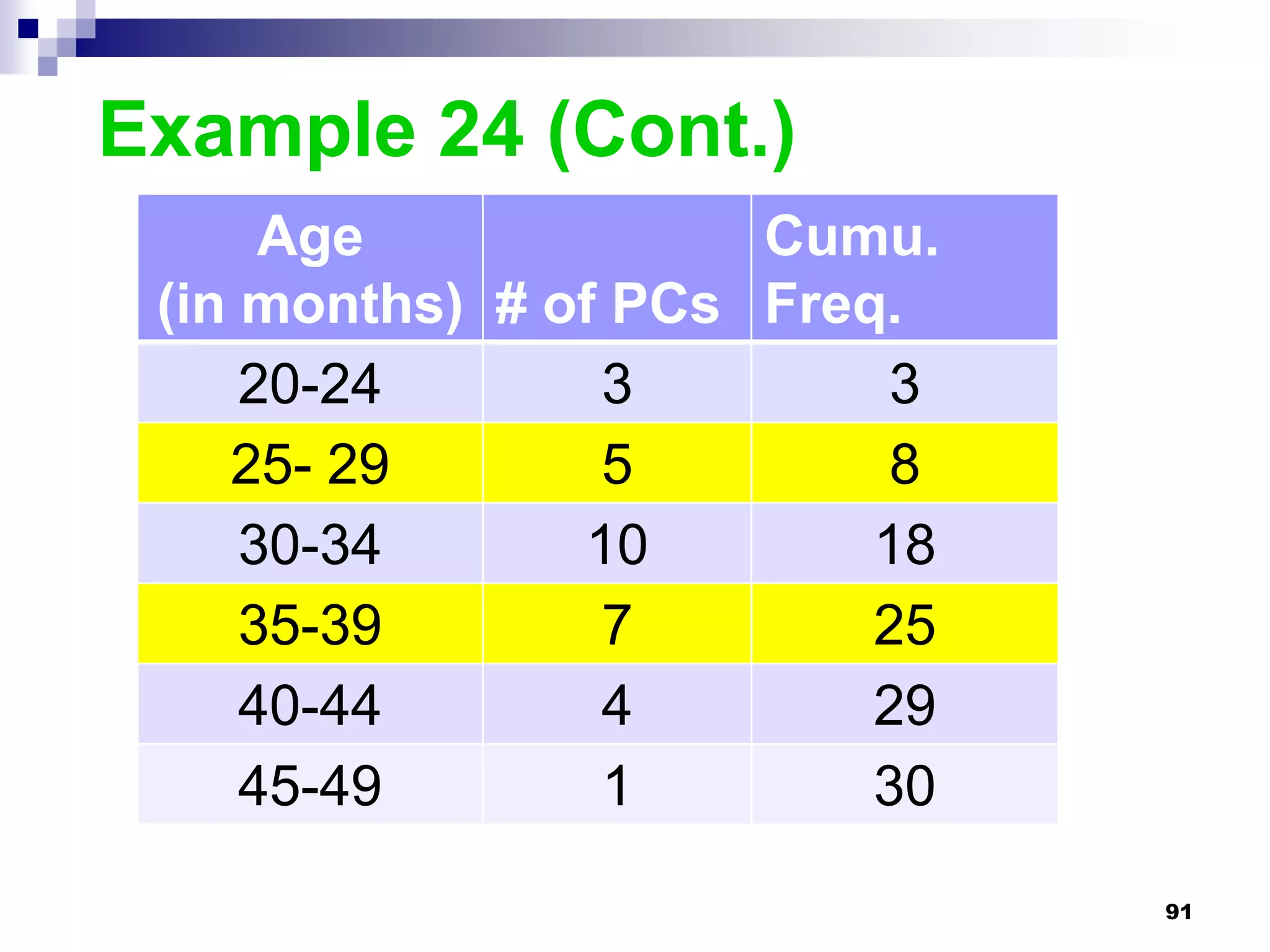
Example 24 (Cont.)
      Age             Cumu.
 (in months) # of PCs Freq.
     20-24       3         3
    25- 29       5         8
     30-34      10        18
     35-39       7        25
     40-44       4        29
     45-49       1        30

                               91
Example 24 (Cont.)
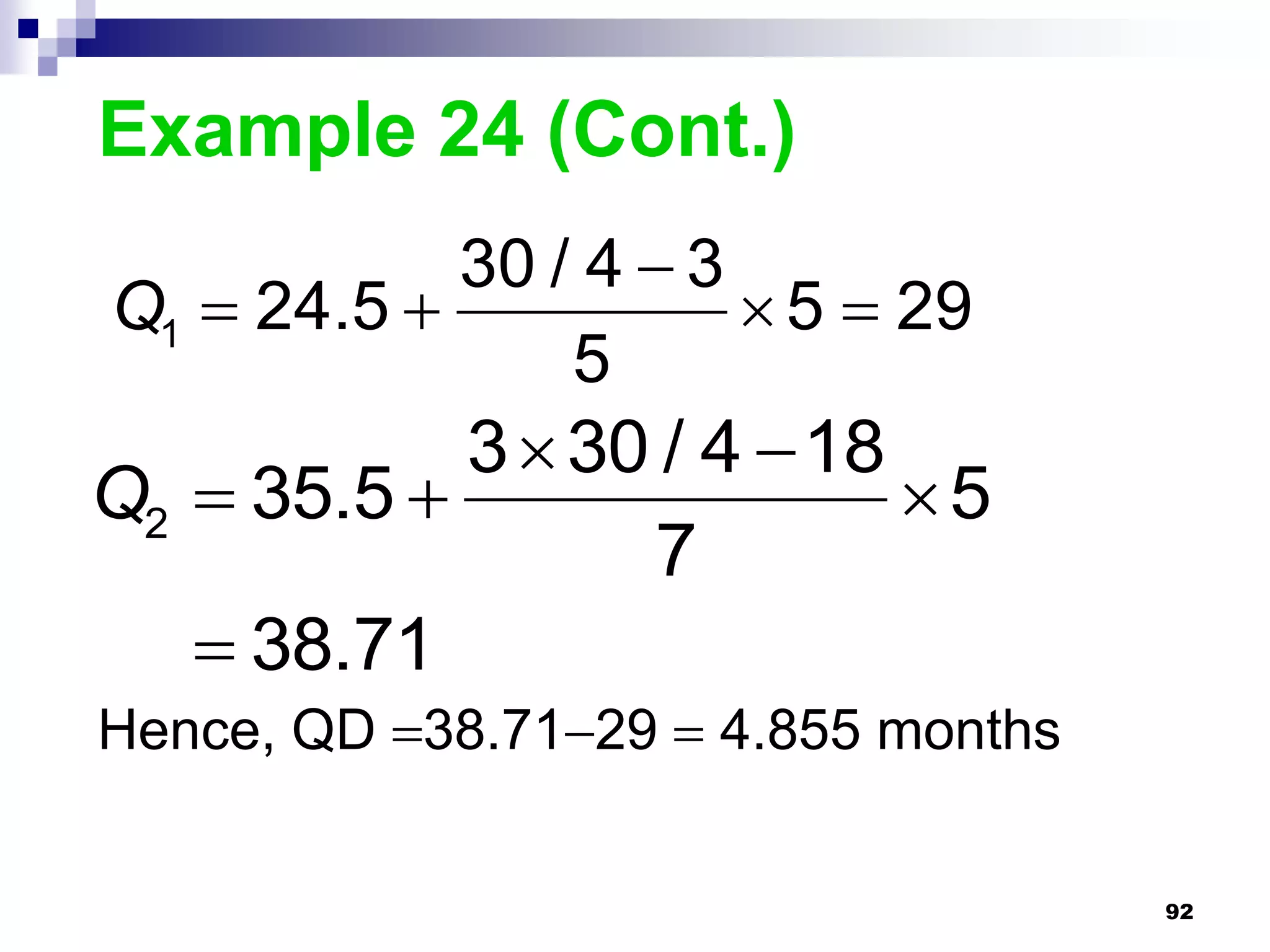
            30 / 4  3
Q1  24.5              5  29
                5
            3  30 / 4  18
Q2  35.5                  5
                  7
    38.71
Hence, QD 38.7129  4.855 months


                                     92
Example 25
The weekly income of a sample of 60 part
time employees of a fast-food restaurant
chain was organized into the following
frequency distribution. Compute the
standard deviation and quartile deviation.


                                             93
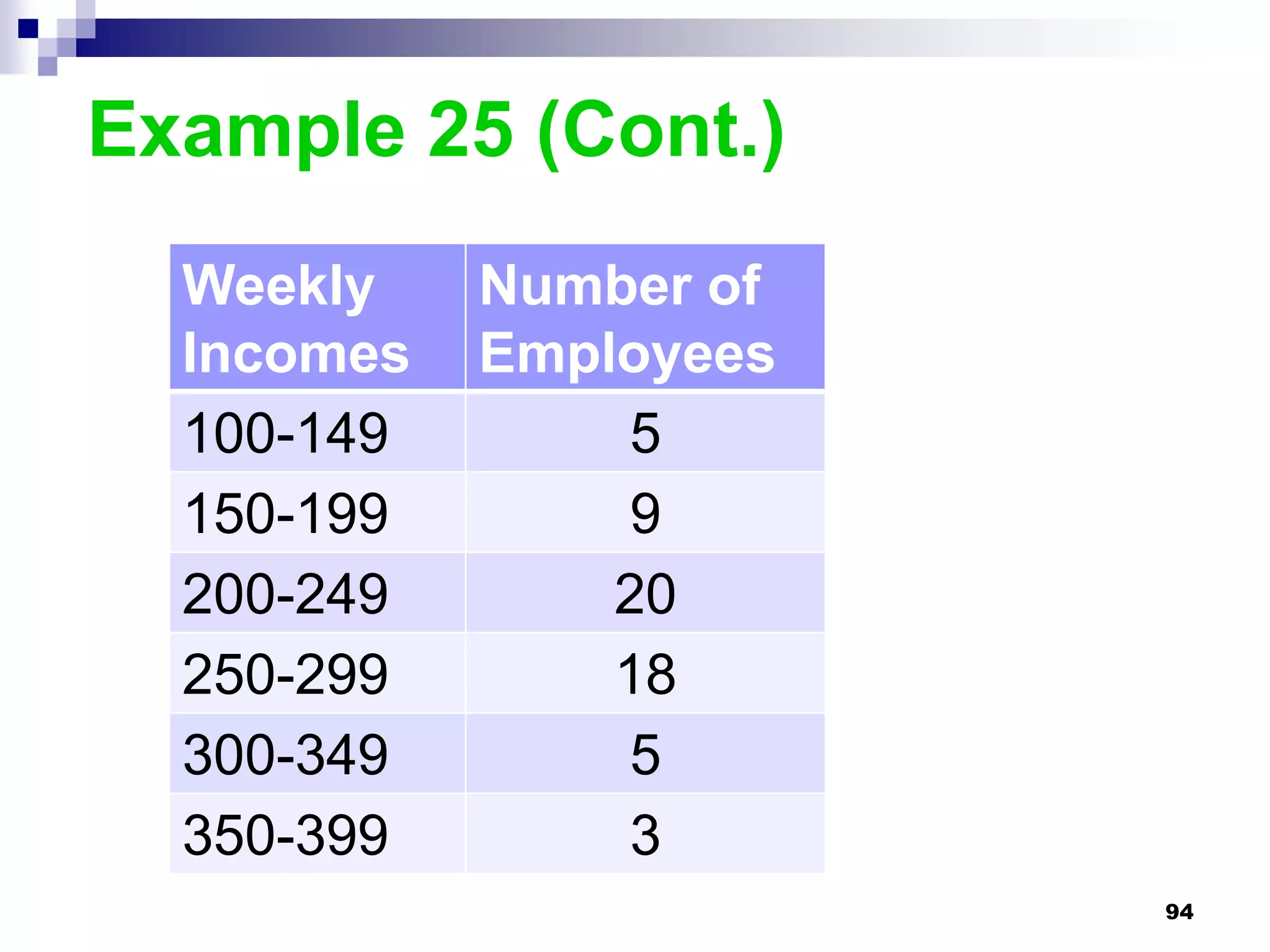
Example 25 (Cont.)
  Weekly    Number of
  Incomes   Employees
  100-149       5
  150-199       9
  200-249       20
  250-299       18
  300-349       5
  350-399       3
                        94
Outliers
 An outlier is an extremely high or an
  extremely low data value when compared
  with the rest of the data values.
 An outlier can strongly affect the mean
  and standard deviation of a variable.
 There are several ways to check a data
  set for outliers. One of which is shown as
  follows:


                                          95
Outliers (Cont.)
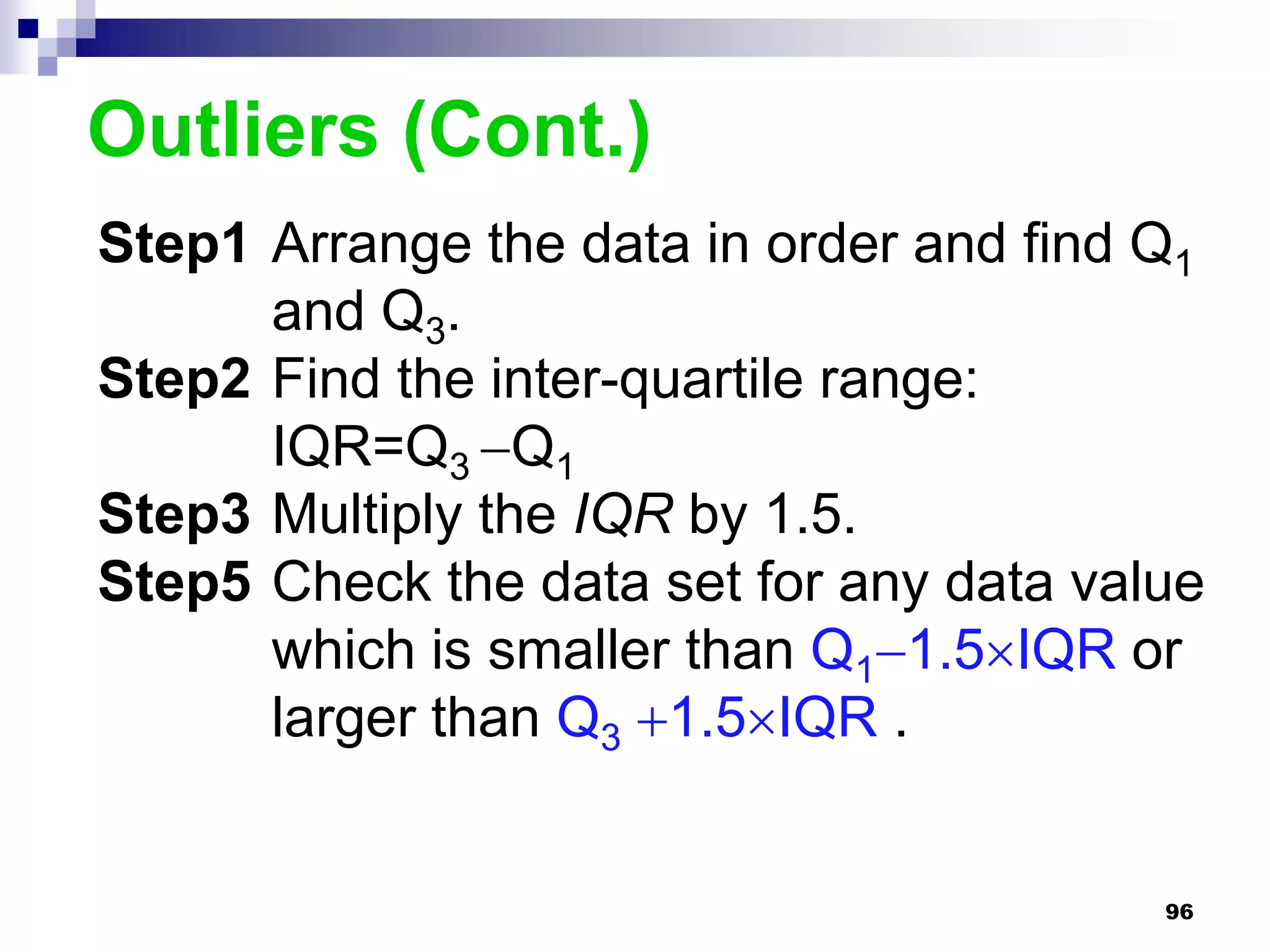
Step1 Arrange the data in order and find Q1
      and Q3.
Step2 Find the inter-quartile range:
      IQR=Q3 Q1
Step3 Multiply the IQR by 1.5.
Step5 Check the data set for any data value
      which is smaller than Q11.5IQR or
      larger than Q3 1.5IQR .


                                         96
Outliers: Example 26
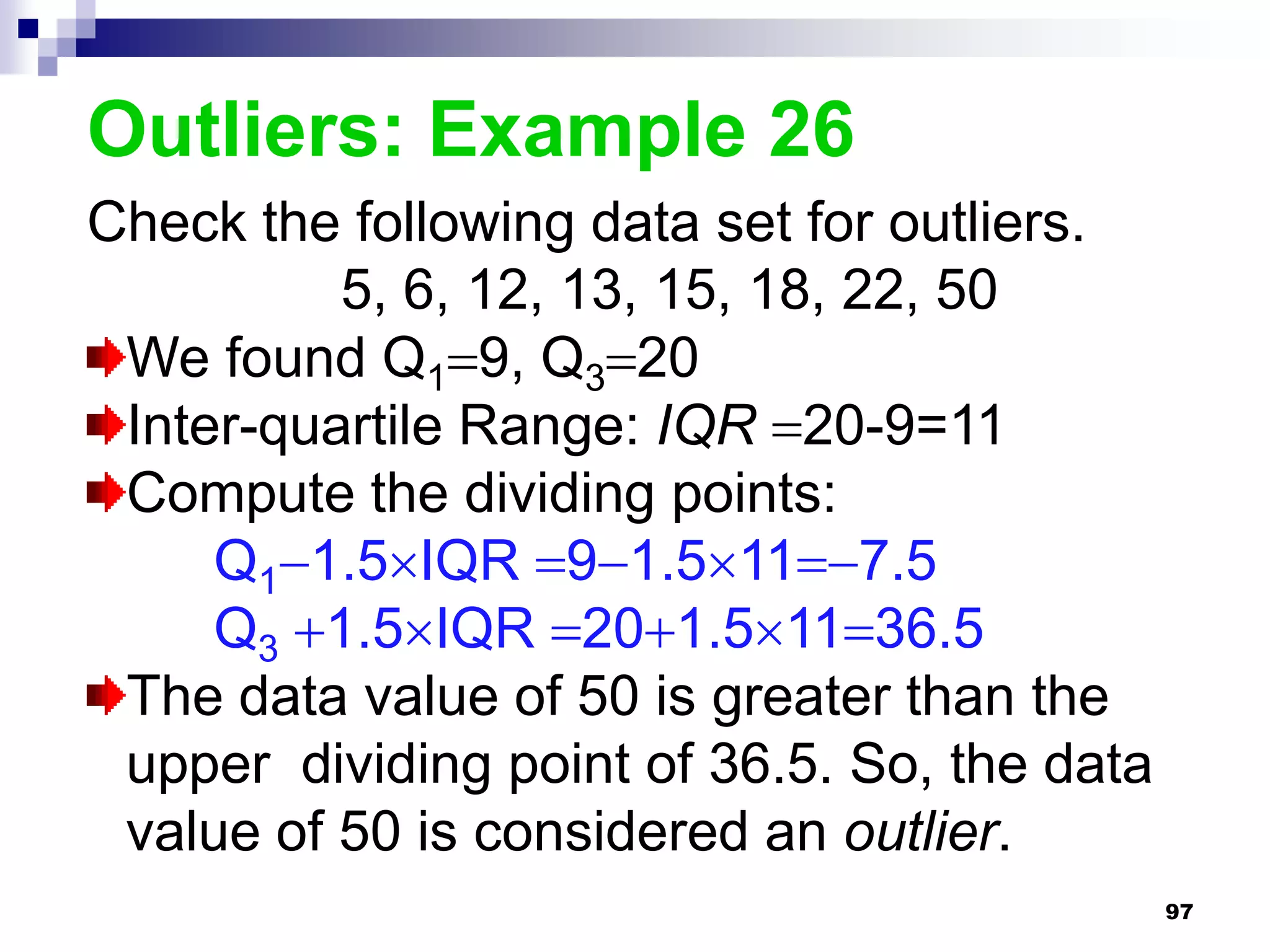
Check the following data set for outliers.
          5, 6, 12, 13, 15, 18, 22, 50
 We found Q19, Q320
 Inter-quartile Range: IQR 20-9=11
 Compute the dividing points:
     Q11.5IQR 91.5117.5
     Q3 1.5IQR 201.51136.5
 The data value of 50 is greater than the
 upper dividing point of 36.5. So, the data
 value of 50 is considered an outlier.
                                              97
Exploratory Data Analysis
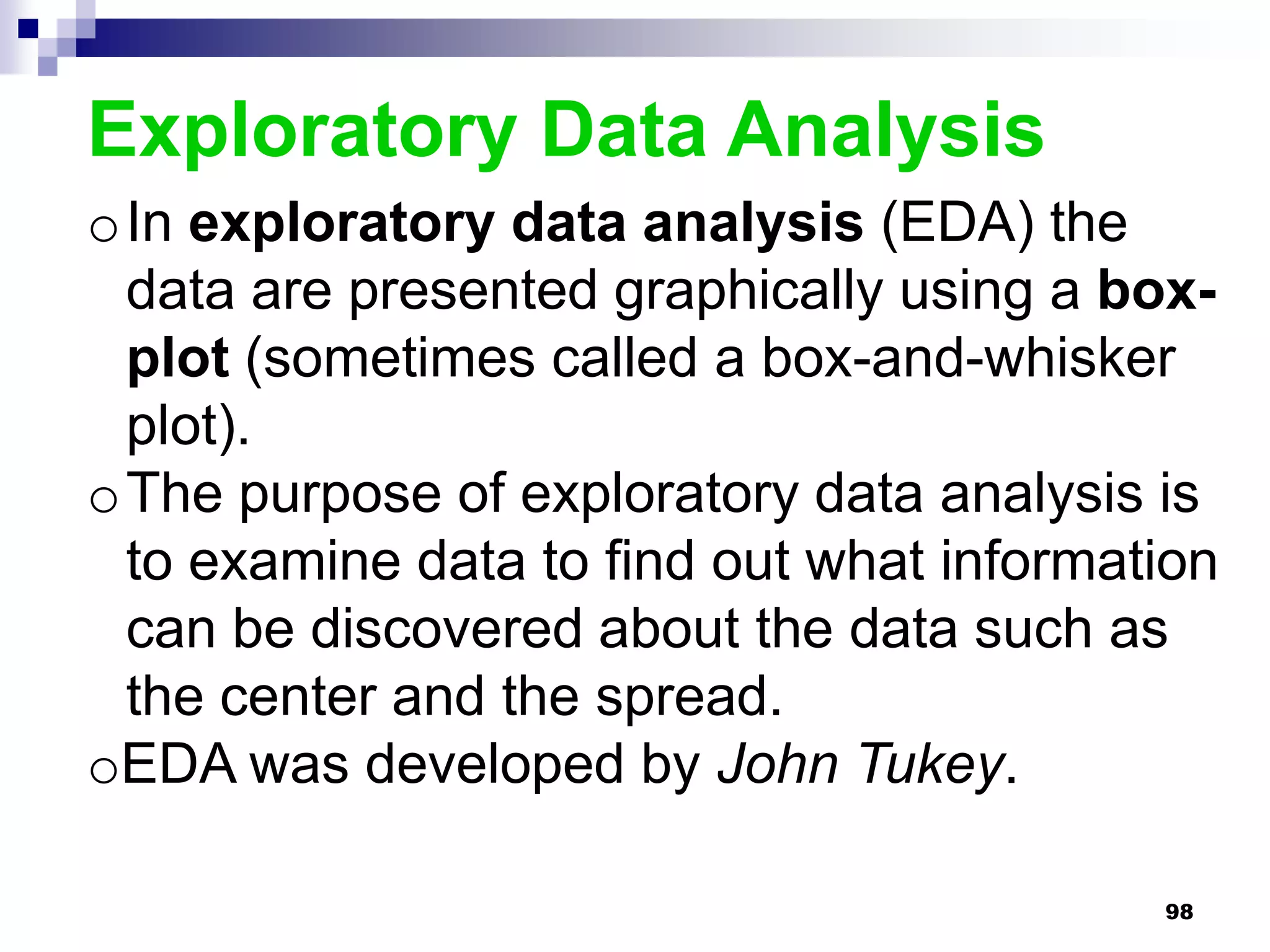
oIn exploratory data analysis (EDA) the
 data are presented graphically using a box-
 plot (sometimes called a box-and-whisker
 plot).
oThe purpose of exploratory data analysis is
 to examine data to find out what information
 can be discovered about the data such as
 the center and the spread.
oEDA was developed by John Tukey.

                                          98
Exploratory Data Analysis
A box plot can be used to graphically
represent the data set. These plots involve five
specific values:
   o The lowest value (i.e., minimum)
   o Q1
   o Median (Q2)
   o Q3
   o The highest value (i.e., maximum)

                                            99
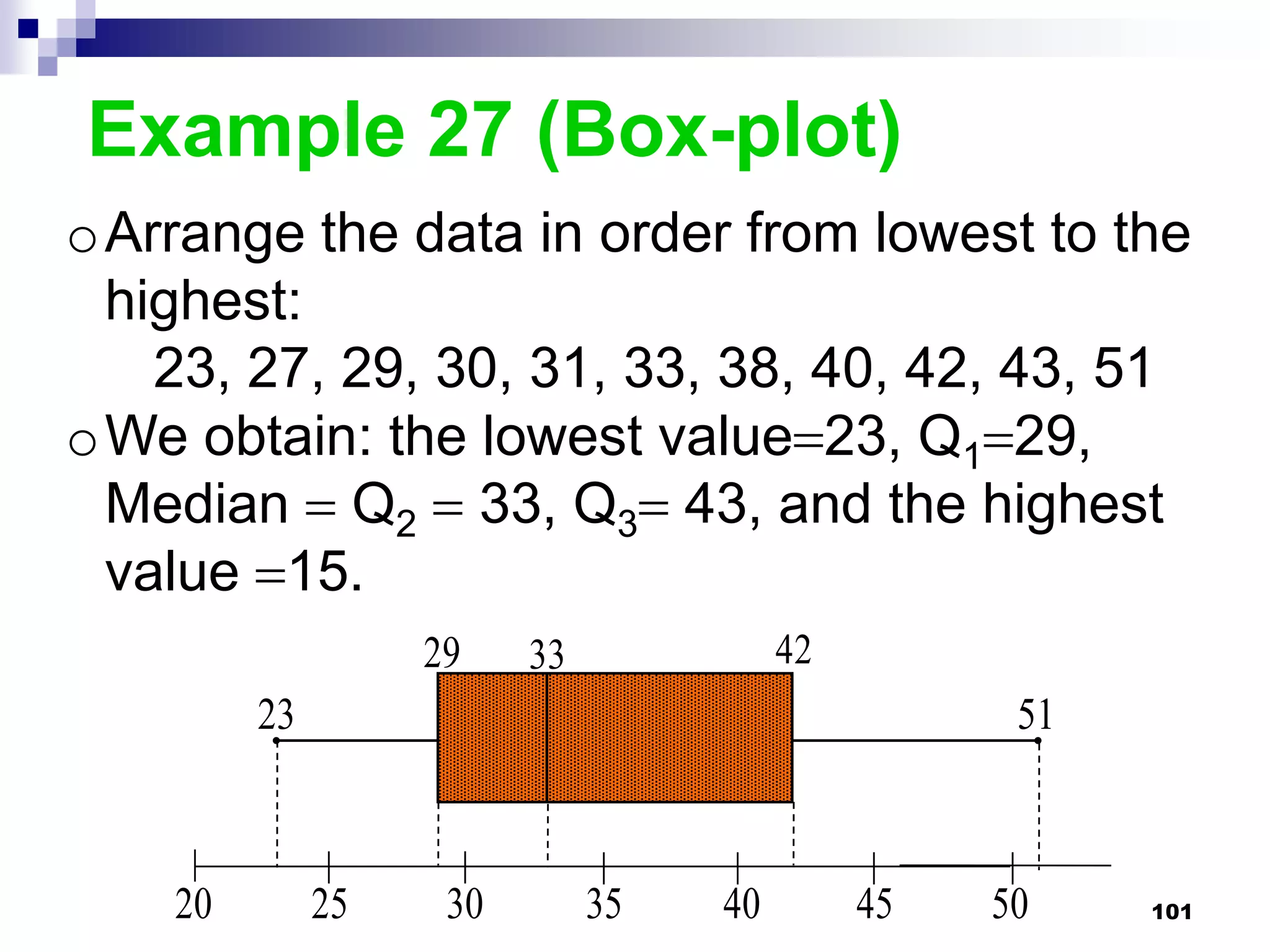
Example 27 (Box-plot)

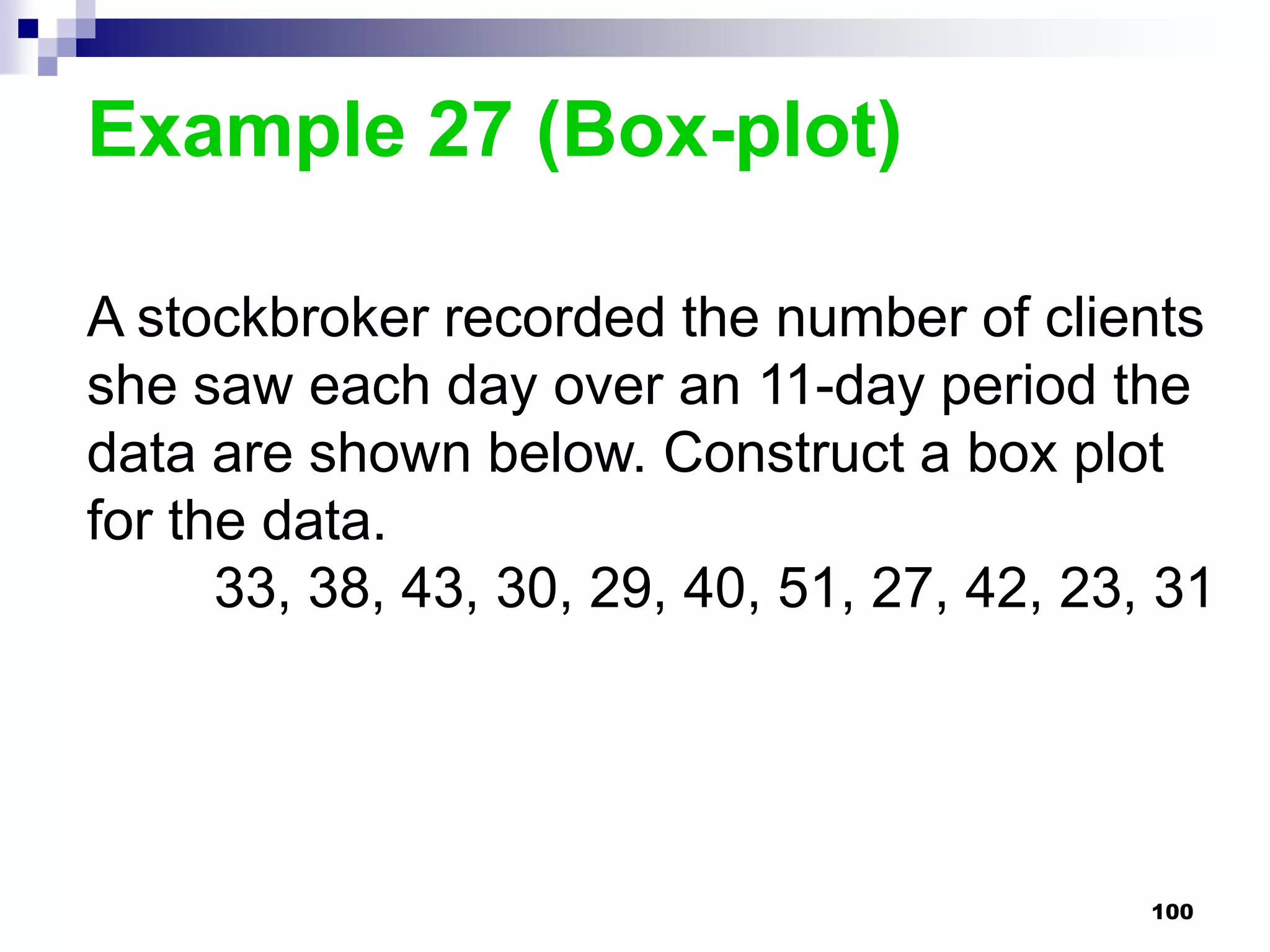
A stockbroker recorded the number of clients
she saw each day over an 11-day period the
data are shown below. Construct a box plot
for the data.
      33, 38, 43, 30, 29, 40, 51, 27, 42, 23, 31


                                             100
Example 27 (Box-plot)
oArrange the data in order from lowest to the
 highest:
   23, 27, 29, 30, 31, 33, 38, 40, 42, 43, 51
oWe obtain: the lowest value23, Q129,
 Median  Q2  33, Q3 43, and the highest
 value 15.
                   29    33             42
         23                                        51


    20        25    30        35   40        45   50    101
THE END!

           102

Chapter 3

  • 1.
  • 2.
    Through this chapteryou will learn  Measure of Central tendency  Measure of Dispersion  Measure of Position 2
  • 3.
    A statistic is a characteristic or measure obtained by using the data values from a sample.  A parameter is a characteristic or measure obtained by using all the data values for a specific population. 3
  • 4.
    Population Arithmetic Mean  X N X : Each value, N: Total number of values in the population 4
  • 5.
    Sample Arithmetic Mean X X n X: Each value in the sample n: Total number of observations in the sample (sample size) 5
  • 6.
    Example 1 Find themean of the following sample data 7 4 8 8 10 12 12 . X= 7+4+8+8+10+12+12 = 61 x  X  61  8.71 n 7 6
  • 7.
    Estimate the Meanof a Grouped Data into a Frequency Distribution X f  X m n f frequency of each class Xm class midpoint of each class n Total number of frequencies 7
  • 8.
    Example 2 Given afrequency distribution Class boundaries Frequency 5.5-10.5 1 10.5-15.5 2 15.5-20.5 3 20.5-25.5 5 25.5-30.5 4 30.5-35.5 3 35.5-40.5 2 Estimate the mean. 8
  • 9.
    Example 2 (Cont.) Midpoint Class Frequency f fXm 5.5 - 0.5 1 8 8 10.5 - 15.5 2 13 26 15.5 - 20.5 3 18 54 20.5 - 25.5 5 23 115 25.5 - 30.5 4 28 112 30.5 - 35.5 3 33 99 35.5 - 40.5 2 38 76 total n =f= 20 f Xm= 490 9
  • 10.
    Example 2 (Cont.) X f  X m  490  24.5 n 20 10
  • 11.
    Median A median isthe midpoint of the data array. Steps in finding the median of a data array:  Step1: Arrange the data in order  Step2: Select the midpoint of the array as the median. 11
  • 12.
    Example 3 Find themedian of the scores 7 2 3 7 6 9 10 8 9 9 10. Arrange the data in order to obtain 2 3 6 7 7 8 9 9 9 10 10 We have 11 values. 8 is the exact middle value and hence it is the median. 12
  • 13.
    Example 4 Find themedian of the scores 7 2 3 7 6 9 10 8 9 9 Arrange the data in order 2 3 6 7 7 8 9 9 9 10 With these ten scores, no single score is at the exact middle. Instead, the two scores of 7 and 8 share the middle. We therefore find the mean of these two scores. 13
  • 14.
    Example 4 (Cont.) 78  7.5 2 the median is 7.5. 14
  • 15.
    The Estimate ofData Grouped into a Frequency Distribution n  CF Median  LB  2 W f 15
  • 16.
    LB Lower boundary of the median class n Total # of frequencies f frequency of the median class CF Cumulative frequency of the class preceding the median class. w class width 16
  • 17.
    Example 5 Given thefrequency distribution as below. Estimate the median. Class Frequency 30-39 4 40-49 6 50-59 8 60-69 12 70-79 9 80-89 7 90-99 4 17
  • 18.
    Example 5 First findthe cumulative frequency Class Frequency CF 30-39 4 4 40-49 6 10 50-59 8 18 60-69 12 30 70-79 9 39 80-89 7 46 90-99 4 50 18
  • 19.
    Example 5 w =10, n = 50, and hence, n/2=25. The median falls in the class 60-69 ( 59.5-69.5) n  CF Median  LB  2 W f 25  18  59.5   10  65.33 12 19
  • 20.
    Example 6 Estimate themedian for the frequency distribution below Class Frequency 80-89 5 90-99 9 100-109 20 110-119 8 120-129 6 130-139 2 20
  • 21.
    Mode o For grouped data into a frequency distribution, the estimate of mode can be the class midpoint of the modal class ( the class with the highest frequency) o It can also be found by the formula d1 Mode  LB  w d1  d 2 21
  • 22.
    where o LB Lowerboundary of the modal class o W class width o d1 difference between class frequency of the modal class and that of the class preceding it. o d2 difference between class frequency of the modal class and that of the class right after it. 22
  • 23.
    Example 7 Estimatethe mode of the below distribution A B Class Frequency ( f ) 5.5-10.5 1 10.5-15.5 2 15.5-20.5 3 20.5-25.5 5 Modal class 25.5-30.5 4 30.5-35.5 3 35.5-40.5 2 23
  • 24.
    Example 7 (cont.) LB = 20.5 W=5 d1= 5 - 3 =2 d2 = 5 – 4=1 2 Mode  20.5  5  23.83 2 1 24
  • 25.
    The Midrange lowest value  highest value MR  2 25
  • 26.
    Example 8 The midrangeof this data set: 2, 3, 6, 8, 4, 1 is MR=(8+1)/2=4.5 26
  • 27.
    The Weighted Mean n w1X1  w 2 X2    w n Xn w X i i X  i1 w1  w 2    w n n w i1 i Xi : the values Wi : the weights 27
  • 28.
    Example 8 Astudent obtained 40, 50, 60, 80, and 45 marks in the subjects of Math, Statistics, Physics, Chemistry and Biology respectively. Assuming weights 5, 2, 4, 3, and 1 respectively for the above mentioned subjects. Find Weighted Arithmetic Mean per subject. 28
  • 29.
    Example 8 (cont.) Marks Subjects Obtained Weight wx Math 40 5 200 Statistics 50 2 100 Physics 60 4 240 Chemistry 80 3 240 Biology 55 1 55 Total 15 835 29
  • 30.
    Example 8 (cont.) 835 x  55.667marks / subject 15 30
  • 31.
    Distribution Shapes y x Mode Median Mean a  Positively skewed or right-skewed 31
  • 32.
    Distribution Shapes (cont.) y x Mean Median Mode  b Negatively skewed or left-skewed 32
  • 33.
    Distribution Shapes (cont.) y x Mean = Median = Mode 33
  • 34.
    Range The range isthe highest value minus the lowest value. The symbol R is used for the range. R  highest value  lowest value 34
  • 35.
    Mean Deviation MeanDeviation   X X n 35
  • 36.
    Example 9 The numberof patients seen in the emergency room in a hospital for a sample of 5 days last year was: 103, 97, 101, 106, and 103. Determine the mean deviation and interpret. 36
  • 37.
    Example 9 First findthe arithmetic mean 103  97  101  106  103 X  102 5 37
  • 38.
    Example 9 (Cont.) Number Absolute Deviation of cases Deviation 103 103 - 102= 1 1 97 97 - 102= -5 5 101 101 - 102= -1 1 106 106 - 102= 4 4 103 103 - 102= 1 1 Total 12 38
  • 39.
    Example 9 (Cont.) XX 12 MD    2.4 n 5 Hence the mean deviation is 2.4 patients per day. The number of patients deviates, on average, by 2.4 patients from the mean of 102 patients per day. 39
  • 40.
    Example 10 The weightof a group of crates being shipped to Ireland is (in pounds) 95, 103, 105, 110, 104, 105, 112, and 90. a) What is the range of the weights? b) Compute the arithmetic mean weight. c) Compute the mean deviation of the weights. (answer: a) 22, b) 103, c) 5.25 pounds) 40
  • 41.
    Population Variance and StandardDeviation  X    2  2  N X    2  N Remember: Standard deviation is the positive square root of variance. 41
  • 42.
    Example 11 Find thevariance and standard deviation for the population data: 35, 45, 30, 35, 40, 25 Solution First find the arithmetic mean X= 35+ 45+ 30+ 35+40+25=210  = 210/6 = 35 then construct the table 42
  • 43.
    Example 11(cont.) X X   2 X 35 0 0 45 10 100 30 -5 25 35 0 0 40 5 25 25 -10 100 43
  • 44.
    Example 11(cont.) The populationvariance is  X    2 250  2    41.7 N 6 The population standard deviation is X    2   41.7  6.5 N 44
  • 45.
    Sample Variance and StandardDeviation Sample Variance (Conceptual formula)  X  X  2 s 2  n 1 Sample Variance (Computational formula)  X   X  2 2 n s2  n 1 45
  • 46.
    Sample Variance and StandardDeviation (Cont.) Sample Standard Deviation (Conceptual formula)  X  X  2 s n 1 Sample Standard Deviation (Computational formula)  X   X  2 2 n s n 1 46
  • 47.
    Example 12 Find thesample variance and standard deviation for the amount of European auto sales for a sample of 6 years shown. The data are in millions of dollars. 11.2, 11.9, 12.0, 12.8, 13.4, 14.3 47
  • 48.
    Example 12 (Cont.) Method1 Find the mean : 12.6 x   2 X x 11.20 -1.40 1.96 11.90 -0.70 0.49 12.00 -0.60 0.36 12.80 0.20 0.04 13.40 0.80 0.64 14.30 1.70 2.89 Total= 6.38 48
  • 49.
    Example 12 (Cont.) Method1 The variance is defined by 6.38 s  2  1.28 6 1 and hence, the standard deviation is s  1.28  1.13 49
  • 50.
    Example 12 (Cont.) Method2 We compute X= 11.2+11.9+12.0+12.8+13.4+14.3 =75.6 X2= 11.22 +11.92 +12.02 +12.82 +13.42 +14.32 =958.94 The variance is computed by s  2   958.94  75.62 6  1.28 5 Standard deviation is 1.13 50
  • 51.
    Example 13 Suppose thenumber of minutes you spent for traveling to school on last 7 days are 9, 12, 9, 15, 10, 11, 15. Find the variance of the number of minutes by the two formula. 51
  • 52.
    Variance and Standard Deviationfor Grouped Data f  X   f  Xm  n 2 2 s 2  m n 1 f : class frequency Xm : class midpoint (class mark) n : Total number of frequencies 52
  • 53.
    Example Find the varianceand the standard deviation for the frequency distribution of the data representing the number of miles that 20 runners ran during one week. 53
  • 54.
    Example 14 (cont.) Class Frequency 5.5-10.5 1 10.5-15.5 2 15.5-20.5 3 20.5-25.5 5 25.5-30.5 4 30.5-35.5 3 35.5-40.5 2 54
  • 55.
    Example 14 (cont.) Class Freq. Midpoint Boundary f Xm f  Xm f  Xm2 5.5-10.5 1 8 8 64 10.5-15.5 2 13 26 338 15.5-20.5 3 18 54 972 20.5-25.5 5 23 115 2645 25.5-30.5 4 28 112 3136 30.5-35.5 3 33 99 3267 35.5-40.5 2 38 76 2888 490 13310 55
  • 56.
    Example 14 (cont.) Hence,the variance is 13310  490 20 2 s  2 20  1  68.7 and the standard deviation is 8.3 56
  • 57.
    Coefficient of Variation Thecoefficient of variation is the standard deviation divided by the mean. The result is expressed as a percentage.  CVar   100%  s CVar   100% X 57
  • 58.
    Example 15 The meanof the number of sales of cars over a 3-month period is 87, and the standard deviation is 5. The mean of the commissions is $5225, and the standard deviation is $773. Compare the variations of the two. 58
  • 59.
    Example 15 (Cont.) Sales s 5 CVar    100%  5.7% X 87 Commissions 773 CVar   100%  14.8% 5225 Since the coefficient of variation is larger for commission, the commissions are more variable than the sales. 59
  • 60.
    Example 16 The meanfor the number of pages of women’s fitness magazines is 132, with a variance of 23; the mean for the number of advertisements of a sample of women’s fitness magazines is 182, with a variance of 62. Compare the variances. (answer: 3.6% pages, 4.3% advertisements) 60
  • 61.
    Chebyshev’s theorem The proportionof values from a data set that will fall within k standard deviations of the mean will be at least 1-1/k2, where k is a number greater than 1 (k is not necessarily an integer). 61
  • 62.
    Chebyshev’s theorem At least 88.89% At least 75% X  3s X  2s X X  2s X  3s 62
  • 63.
    Example 17 The meanprice of houses in a certain neighborhood is $50,000, and the standard deviation is $10, 000. Find the price range for which at least 75% of the houses will sell. 63
  • 64.
    Example 17 (Cont.) Chebyshev’stheorem states that three-fourths, or 75%, of the data values will fall within 2 standard deviations of the mean. Thus, $50,000  2 $10,000  $70,000 and $50,000  2 $10,000  $30,000 Hence, at least 75% of all homes sold in the area will have a price range from $30,000 to $70,000. 64
  • 65.
    Example 18 A surveyof local companies found that the mean amount of travel allowance for executives was $0.25 per mile. The standard deviation was $ 0.02. Using Chebyshev’s theorems find the minimum percentage of the data values that will fall between $0.20 and $0.30. 65
  • 66.
    The Empirical (Normal)Rule Chebyshev’s theorem applies to any distribution regardless of its shape. However, when a distribution is bell-shaped (or what is called normal), the following statements, which make up the empirical rule, are true. 66
  • 67.
    The Empirical (Normal)Rule  Approximately 68% of the data values will fall within 1 standard deviation of the mean.  Approximately 95% of the data values will fall within 2 standard deviations of the mean.  Approximately 99.7% (almost all) of the data values will fall within 3 standard deviations of the mean. 67
  • 68.
    The Empirical (Normal)Rule 99.7% 95% 68% X  3s X  2s X  1s X X  1s X  2s X  3s 68
  • 69.
    Measures of Position StandardScores A z score or standard score for a value is obtained by subtracting the mean from the value and dividing the result by the standard deviation. The symbol for a standard score is z. value  mean z standard deviation 69
  • 70.
    Measures of Position StandardScores The z score represents the number of standard deviations that a data value falls above or below the mean. 70
  • 71.
    Example 19 A studentscored 65 on a calculus test that had a mean of 50 and a standard deviation of 10; she scored 30 on a history test with a mean of 25 and a standard deviation of 5. Compare her relative position on the two tests. 71
  • 72.
    Example 19 (Cont.) Forcalculus, the z score is X  X 65  50 z   1.5 s 10 For history the z score is X  X 30  25 z   1.0 s 5 Since the z score for calculus is larger, her relative position in the calculus class is higher than her relative position in the history class. 72
  • 73.
    Percentiles Percentiles divide thedata set into 100 equal groups. There are several mathematical methods for computing percentiles for data. These methods can be used to find approximate percentile rank of a data value or to find a data value corresponding to a given percentile. 73
  • 74.
    Find a PercentileRank Corresponding to a Value The percentile corresponding to a given value X is computed by using the following formula  # of values     0.5 Percentile   below X   100% total # of value 74
  • 75.
    Example 20 A teachergives a 20-point test to 10 students. The scores are shown here. Find the percentile rank of a score of 12. 18, 15, 12, 6, 8, 2, 3, 5, 20, 10 75
  • 76.
    Example 20 (Cont.) Arrangethe data in order from lowest to highest 2, 3, 5, 6, 8, 10, 12, 15, 18, 20 6  0.5 Percentile   100% 10  65th percentile Thus, a student whose score was 12 did better than 65% of the class. 76
  • 77.
    Finding a DataValue Corresponding to a Given Percentile oArrange the data in order from lowest to highest. oCompute c=(np)/100, where n is the total number of observations and p the percentile. oIf c is not a whole number, round up to the next whole number. Starting at the lowest value, count over to the number that corresponds to the rounded- up value. oIf c is a whole number, use the value halfway between the cth and (c+1)th values when counting up from the lowest value. 77
  • 78.
    Example 21 A teachergives a 20-point test to 10 students. The scores are shown here. find the value corresponding to the 25th percentile. 18, 15, 12, 6, 8, 2, 3, 5, 20, 10 78
  • 79.
    Example 21 (Cont.) oArrangethe data in order from lowest to highest 2, 3, 5, 6, 8, 10, 12, 15, 18, 20 o n= 10, p = 25 c= 10×25 / 100=2.5 o We round it up to get c =3. Start at the lowest values and count over to the third value, which is 5. Hence, the value 5 corresponds to the 25th percentile. 79
  • 80.
    Example 22 A teachergives a 20-point test to 10 students. The scores are shown here. find the value corresponding to the 60th percentile. 18, 15, 12, 6, 8, 2, 3, 5, 20, 10 80
  • 81.
    Example (22 Cont.) oArrange the data in order from smallest to largest 2, 3, 5, 6, 8, 10, 12, 15, 18, 20 on= 10, p = 60 c= 10×60 / 100=6 oSince is a whole number, we use the value halfway between the 6th and 7th values when counting up from the lowest value oThe 60th percentile is (10+12)/2=11. 81
  • 82.
    Quartiles Quartiles divide thedistribution into 4 equal groups, separated by Q1, Q2, and Q3. L Q1 Q2 Q3 H 25% 25% 25% 25% 82
  • 83.
    Quartiles Quartiles can becomputed using the formula for computing percentiles. o1st quartile corresponds to 25th percentile . o2nd quartile corresponds to 50th percentile. o3rd quartile corresponds to 75th percentile. 2nd quartile = 25th percentile = median 83
  • 84.
    Example 23 Find firstquartile, second quartile and third quartile for the data set 15, 13, 6, 5, 12, 50, 22, 18. Arrange the data in order from smallest to the largest. 5 6 12 13 15 18 22 50 84
  • 85.
    Example 23 (Cont.) oFirstquartile = 25th percentile. c = (825)/100=2 Hence, the first quartile is equal to the second value plus the third value divided by 2. That is, Q1 = (6+12)/2=9 oSecond quartile = 50th percentile c=(8 50)/100=4 Hence, Q2 =(4th value+5th value)/2 =(13+15)/2=14 85
  • 86.
    Example 23 (Cont.) oThirdquartile = 75th percentile c=(8 75)/100=6 Hence, Q3 =(6th value+7th value)/2 =(18+22)/2=20 86
  • 87.
    Interquartile Range, Quartile Deviationand Midquartile Range oInterquartile Range: IQR  Q3  Q1 oQuartile deviation: QD (Q3  Q1)/2 oSemi-interquartile range is referred to quartile deviation. oMidquartile Range : (Q3  Q1)/2 87
  • 88.
    Quartiles of DataGrouped into a Freq. Dist. oFirst quartile n / 4  CF Q1  LB  w f oSecond quartile (Median) n / 2  CF Q2  LB  w f oThird quartile 3n / 4  CF Q3  LB  w f 88
  • 89.
    Example 24 The officemanager of the Mallard Glass Co. is investigating the ages in months of the company’s PCs currently in use. The ages of 30 units selected at random were organized into a frequency distribution. Compute the quartile deviation. 89
  • 90.
    Example 24 (Cont.) Age (in months) # of PCs 20-24 3 25- 29 5 30-34 10 35-39 7 40-44 4 45-49 1 90
  • 91.
    Example 24 (Cont.) Age Cumu. (in months) # of PCs Freq. 20-24 3 3 25- 29 5 8 30-34 10 18 35-39 7 25 40-44 4 29 45-49 1 30 91
  • 92.
    Example 24 (Cont.) 30 / 4  3 Q1  24.5   5  29 5 3  30 / 4  18 Q2  35.5  5 7  38.71 Hence, QD 38.7129  4.855 months 92
  • 93.
    Example 25 The weeklyincome of a sample of 60 part time employees of a fast-food restaurant chain was organized into the following frequency distribution. Compute the standard deviation and quartile deviation. 93
  • 94.
    Example 25 (Cont.) Weekly Number of Incomes Employees 100-149 5 150-199 9 200-249 20 250-299 18 300-349 5 350-399 3 94
  • 95.
    Outliers  An outlieris an extremely high or an extremely low data value when compared with the rest of the data values.  An outlier can strongly affect the mean and standard deviation of a variable.  There are several ways to check a data set for outliers. One of which is shown as follows: 95
  • 96.
    Outliers (Cont.) Step1 Arrangethe data in order and find Q1 and Q3. Step2 Find the inter-quartile range: IQR=Q3 Q1 Step3 Multiply the IQR by 1.5. Step5 Check the data set for any data value which is smaller than Q11.5IQR or larger than Q3 1.5IQR . 96
  • 97.
    Outliers: Example 26 Checkthe following data set for outliers. 5, 6, 12, 13, 15, 18, 22, 50 We found Q19, Q320 Inter-quartile Range: IQR 20-9=11 Compute the dividing points: Q11.5IQR 91.5117.5 Q3 1.5IQR 201.51136.5 The data value of 50 is greater than the upper dividing point of 36.5. So, the data value of 50 is considered an outlier. 97
  • 98.
    Exploratory Data Analysis oInexploratory data analysis (EDA) the data are presented graphically using a box- plot (sometimes called a box-and-whisker plot). oThe purpose of exploratory data analysis is to examine data to find out what information can be discovered about the data such as the center and the spread. oEDA was developed by John Tukey. 98
  • 99.
    Exploratory Data Analysis Abox plot can be used to graphically represent the data set. These plots involve five specific values: o The lowest value (i.e., minimum) o Q1 o Median (Q2) o Q3 o The highest value (i.e., maximum) 99
  • 100.
    Example 27 (Box-plot) Astockbroker recorded the number of clients she saw each day over an 11-day period the data are shown below. Construct a box plot for the data. 33, 38, 43, 30, 29, 40, 51, 27, 42, 23, 31 100
  • 101.
    Example 27 (Box-plot) oArrangethe data in order from lowest to the highest: 23, 27, 29, 30, 31, 33, 38, 40, 42, 43, 51 oWe obtain: the lowest value23, Q129, Median  Q2  33, Q3 43, and the highest value 15. 29 33 42 23 51 20 25 30 35 40 45 50 101
  • 102.