
What Is Agile Management?
•
160 likes•73,622 views

About being a manager in an Agile organization

Recommended
Recommended
More Related Content
What's hot
What's hot (20)
Viewers also liked
Viewers also liked (20)
Similar to What Is Agile Management?
Similar to What Is Agile Management? (20)
More from Jurgen Appelo
More from Jurgen Appelo (20)
Recently uploaded
Recently uploaded (20)
What Is Agile Management?
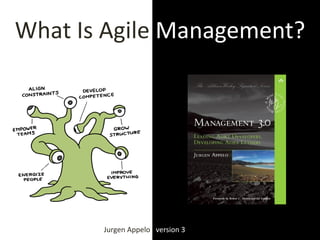
- 1. What Is Agile Management? Jurgen Appelo version 3
- 3. Let’s begin at the beginning...
- 4. Computer Programming Software Engineering Agile Development 1950 1960 1970 1980 1990 2000 2010
- 5. The traditional way of looking at projects
- 6. Split Cost (Resources) in People and Tools Split Scope in Functionality and Quality (suggestion: Scott Ambler) Add a dimension for Process (suggestion: Alistair Cockburn) Add a dimension for (Business) Value (suggestion: Jim Highsmith) http://www.ambysoft.com/essays/brokenTriangle.html http://alistair.cockburn.us/index.php/Process:_the_fourth_dimension http://blog.cutter.com/2009/08/10/beyond-scope-schedule-and-cost-measuring-agile-performance/ Some new insights from Agile gurus
- 7. 1. Value 2. People 3. Functionality 4. Quality 5. Tools 6. Time 7. Process And we get... the 7 dimensions of software projects
- 8. So, what does it mean to be Agile?
- 9. Value embracing change feedback frequent delivery value streams value mappingprioritization increments
- 10. Example: writing a blog to find value through feedback
- 12. Example: using social networks to nurture interaction
- 13. Functionality customer involvement backlogs user stories acceptance criteria minimal marketable features user demos “inch-deep, mile-wide”
- 14. Example: writing a book proposal as a backlog of topics
- 15. Quality technical excellence test-driven development pair programming definition of done refactoring emergent design simplicity
- 16. Example: using checklists as a Definition of Done
- 17. Tools daily builds continuous integration automated testing open offices task boards burn charts version control
- 18. Example: Using simple tools that fit the worker
- 19. Time timeboxes iterations sprints potentially shippable products rolling wave planning sustainable pace release planning
- 20. Example: writing in a timebox to a deadline
- 21. Process stand-up meetings planning poker velocity spikes collective code ownership retrospectives sprint planning
- 22. Example: Figuring out a permission requests process
- 23. Result: A product created in a (more or less) Agile way
- 24. So, how is the rest of the world handling Agile?
- 27. http://www.versionone.com/state_of_agile_development_survey/10/ Managing Changing Priorities1. Improved Project Visibility2. Improved Team Morale3. Accelerated Time to Market4. Increased Productivity5. Enhanced Software Quality6. Simplified Development Process7. Reduced Risk8.
- 30. So, what should managers do to be Agile?
- 31. Manage like a gardener
- 32. The Management 3.0 Model
- 33. View #1: Energize People People are the most important parts of an organization and managers must do all they can to keep people active, creative, and motivated.
- 34. 10 Intrinsic Desires Acceptance The need for approval Curiosity The need to think Power The need for influence of will Honor Being loyal to a group Social Contact / Relatedness The need for friends Idealism / Purpose The need for purpose Status The need for social standing Independence / Autonomy Being an individual Order Or stable environments Competence / Mastery The need to feel capable
- 36. Organize 360 degree evaluations meetings
- 37. View #2: Empower Teams Teams can self-organize, and this requires empowerment, authorization, and trust from management.
- 38. Tell:1. make decision as the manager Sell:2. convince people about decision Consult:3. get input from team before decision Join:4. make decision together with team Advise:5. influence decision made by the team Confirm:6. ask feedback after decision by team Delegate:7. no influence, let team work it out Use the Seven Levels of Authority
- 39. Create an authority board
- 40. View #3: Align Constraints Self-organization can lead to anything, and it’s therefore necessary to protect people and shared resources, and to give people a clear purpose and defined goals.
- 41. Manage emergent and higher goals
- 42. Do not use targets and financial/extrinsic motivation
- 43. View #4: Develop Competence Teams cannot achieve their goals if team members aren’t capable enough, and managers must therefore contribute to the development of competence.
- 44. 1. Self-Development 2. Coaching & Mentoring 3. Training & Certification 4. Culture & Socialization 5. Tools & Infrastructure 6. Supervision & Control 7. Management Use 7 approaches to competency
- 45. 1. Time 2. People 3. Tools 4. Functionality 5. Quality 6. Process 7. Value 1.Individuals 2.Teams 3.Departments 4.BusinessUnits 5.Organization Prevent sub- optimization through metrics
- 46. View #5: Grow Structure Many teams operate within the context of a complex organization, and thus it is important to consider structures that enhance communication .
- 47. Manage the workplace as a network
- 48. Make people’s jobs dynamic
- 49. View #6: Improve Everything People, teams, and organizations need to improve continuously to defer failure for as long as possible.
- 50. Apply 3 three drivers of improvement
- 51. Apply nonlinear improvement 1, 3, 5 Kaizen Gradual improvement 2, 4 Kaikaku Radical improvement
- 52. The Management 3.0 Model
- 53. OK, maybe that was all a bit too much... Just remember these 2 key takeways...
- 54. A software team is a self-organizing system Support it, don’t obstruct it
- 55. Agile managers work the system around the team, not the people in the team
- 56. m30.me/happiness
- 58. http://creativecommons.org/licenses/by-nd/3.0/ This presentation was inspired by the works of many people, and I cannot possibly list them all. Though I did my very best to attribute all authors of texts and images, and to recognize any copyrights, if you think that anything in this presentation should be changed, added or removed, please contact me at jurgen@noop.nl.