Institut für Telematik | Universität zu Lübeck
1
Visible Light Communication
Seminar Kommunikationsstandards
in der Medizintechnik
29. Juni 2010
Christian Pohlmann
2
Outline
 motivation
 history
 technology and modulation
 current standards
 applications
 conclusion and outlook
3
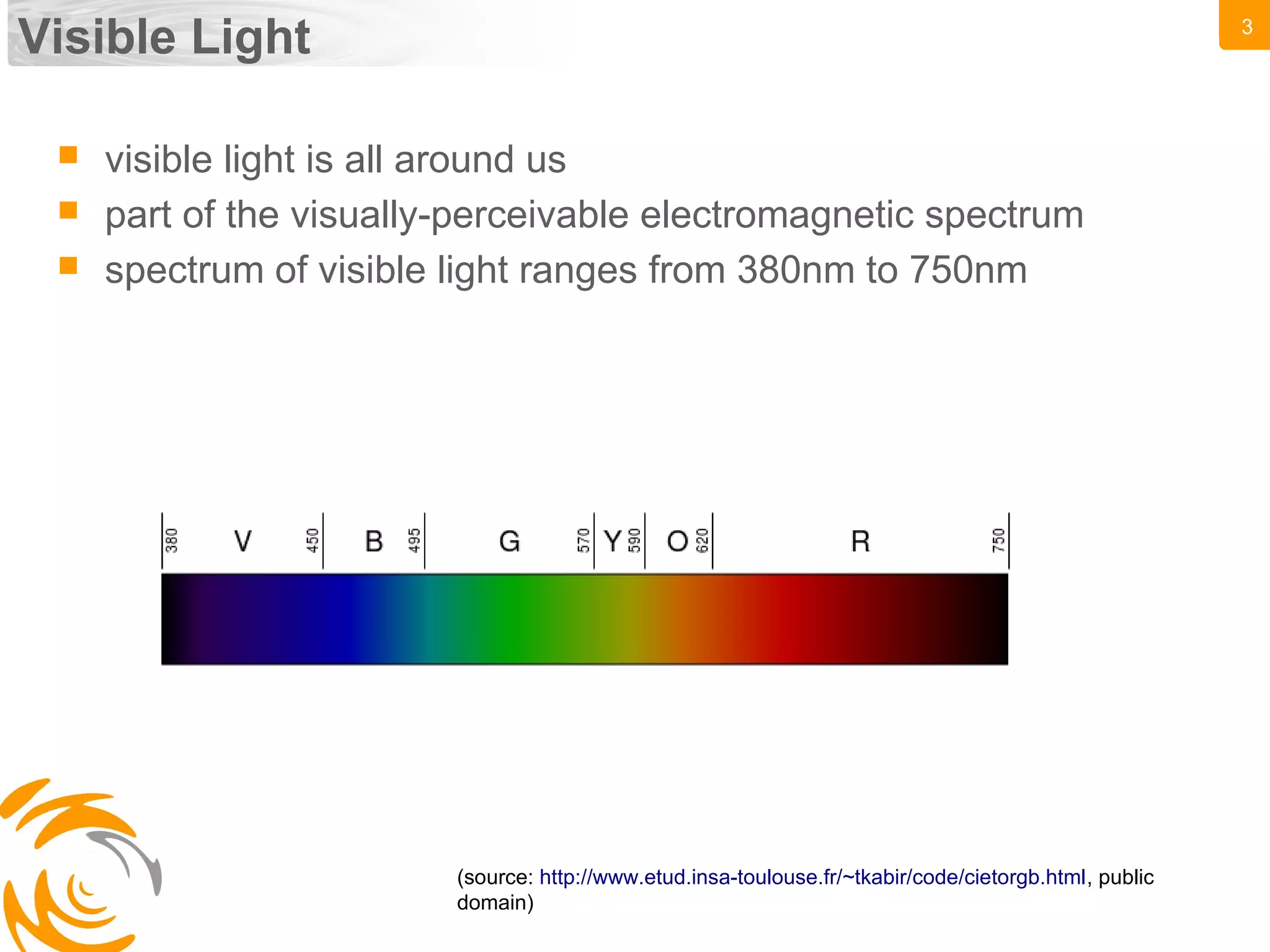
Visible Light
(source: http://www.etud.insa-toulouse.fr/~tkabir/code/cietorgb.html, public
domain)
 visible light is all around us
 part of the visually-perceivable electromagnetic spectrum
 spectrum of visible light ranges from 380nm to 750nm
4
Motivation
 visible light does not cause any health problems
 no EM-interference occurs
 save to use in hospitals
 no expensive patent-license necessary
 no interception because the transmission range is narrowly
confined
 ever-increasing market share of LEDs makes VLC
ubiquitously available
5
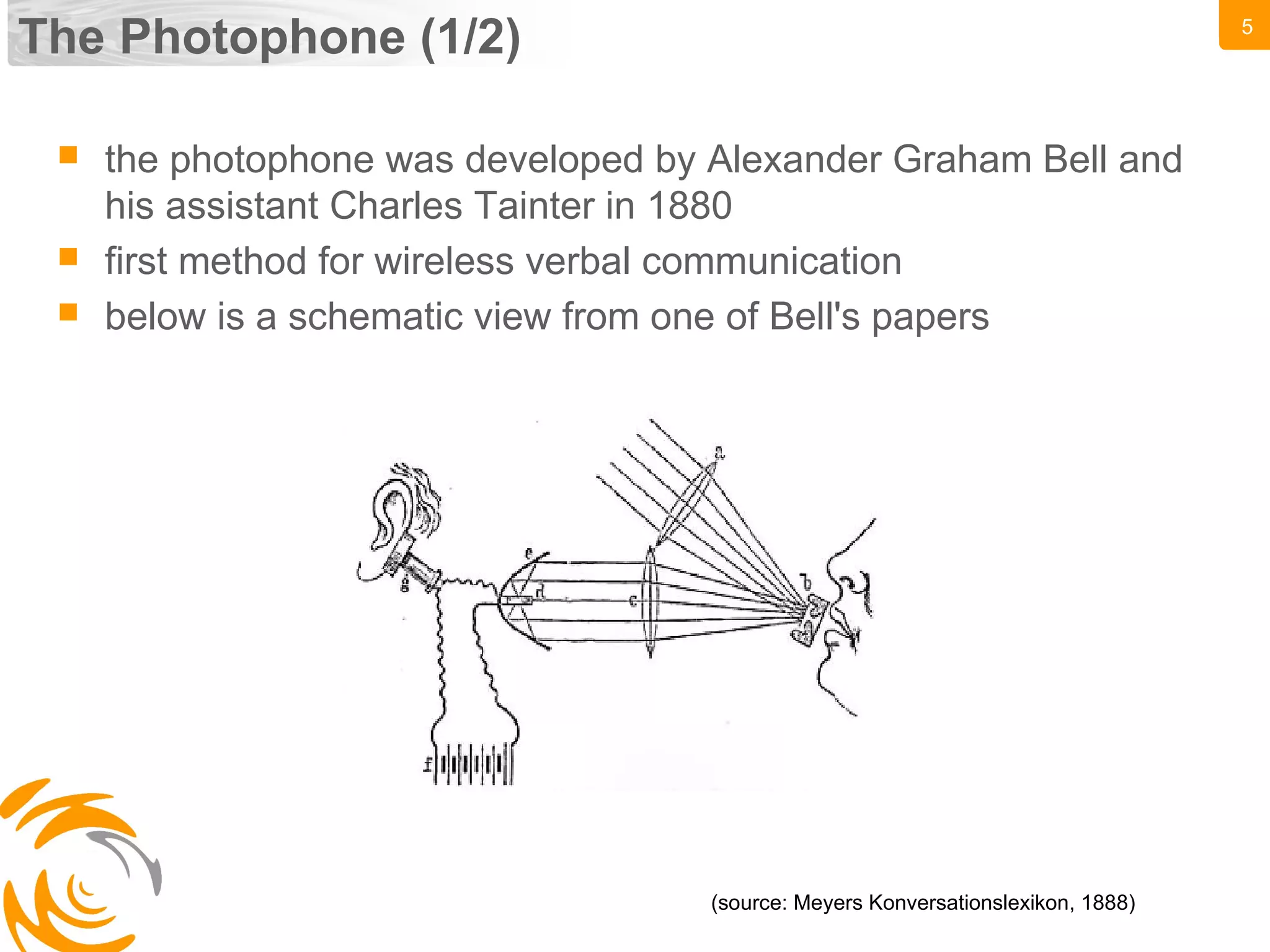
The Photophone (1/2)
(source: Meyers Konversationslexikon, 1888)
 the photophone was developed by Alexander Graham Bell and
his assistant Charles Tainter in 1880
 first method for wireless verbal communication
 below is a schematic view from one of Bell's papers
6
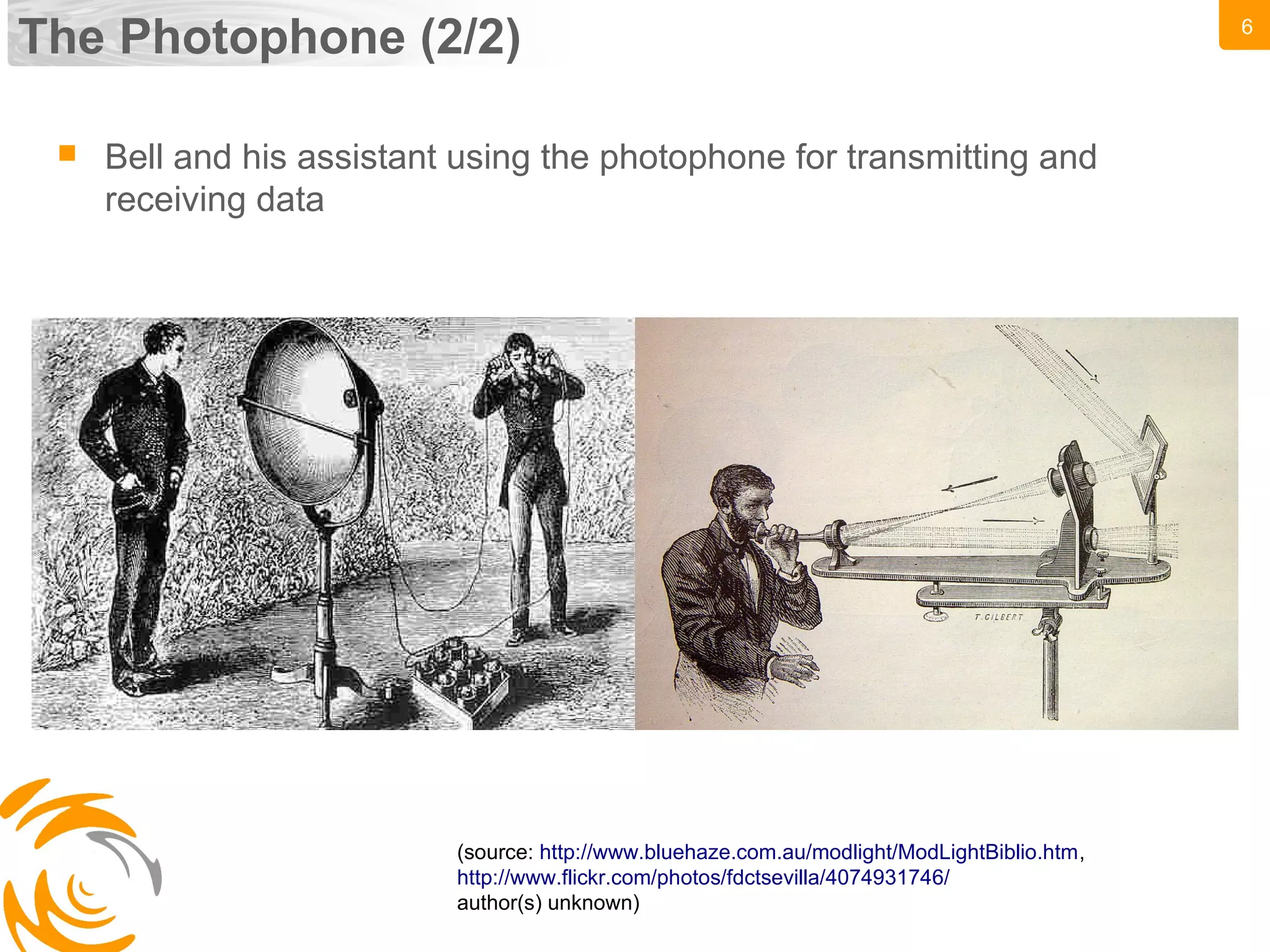
The Photophone (2/2)
(source: http://www.bluehaze.com.au/modlight/ModLightBiblio.htm,
http://www.flickr.com/photos/fdctsevilla/4074931746/
author(s) unknown)
 Bell and his assistant using the photophone for transmitting and
receiving data
7
Visible Light Communications Consortium
 the Visible Light Communication Consortium was established
in 2003 by Japanese tech-companies
 aims to standardize VLC technology
 avoid fragmentation of different protocols and implementations
 two standards are proposed:
 JEITA CP-1221
 JEITA CP-1222
 also tries to raise public awareness for VLC and promote its
applications
 standardization efforts for physical and media access layer are
also done by IEEE 802.15, Task Group 7
8
VLCC Members
 NEC Corporation
 Panasonic Electric Works Co., Ltd
 The Nippon Signal Co., Ltd
 Toshiba Corporation
 Japan Rural Information System Association
 Samsung Electronics Co., Ltd
 NTT DoCoMo, Inc
 Casio Computer Co., Ltd
 Nakagawa Laboratories, Inc.
 Outstanding Technology Co., Ltd
 Sumitomo Mitsui Construction Co., Ltd
 Tamura Corporation
 Sharp Corporation
 Japan Coast Guard
 Comtech 2000 Corporation
 RISE Co., Ltd
 Japan Traffic Management Technology Association
 NHK
9
Technology (1/3)
 every kind of light source could be used as sender
 LEDs are the predominant choice for transmitters
 they can be switched on and off in very short intervals
 receivers
 photodiode receivers
 CCD and CMOS sensors
10
Technology (2/3)
 schematic view of the entire process of transmitting and
receiving data
(source: based on a schematic view shown in [1])
11
Technology (3/3)
 phosphorus LEDs can achieve up to 40 Mbps
 by using RGB LEDs data rates can go up to 100 Mbps
 RCLEDs (resonant cavity LEDs) can achieve data rates up to
500 Mbps
 RCLEDS use Bragg reflectors (which serve as mirrors) to
enhance the emitted light
 they also have increased spectral purity when compared to
conventional LEDs which further improves communication
capabilities
 LEDs are energy-efficient and are becoming increasingly
inexpensive
12
Comparison to other wireless technologies
(source: IEEE VLC Tutorial http://www.ieee802.org/15/pub/TG7.html [2])
13
Data transmission
 modulation (with respect to VLC) is used to transform the data
(given as a sequence of 0s and 1s) into a series of light pulses
 two main alternative modulation schemes:
 sub-carrier pulse position modulation (SC-kPPM):
- data is separated into groups of log k bits each and there is
only a single pulse for each group
 frequency shift keying (FSK):
- signal frequency determines whether or not the currently
transferred bit is 0 or 1
 point of confusion: the frequency of light pulses is modulated, not the
frequency of the light itself
14
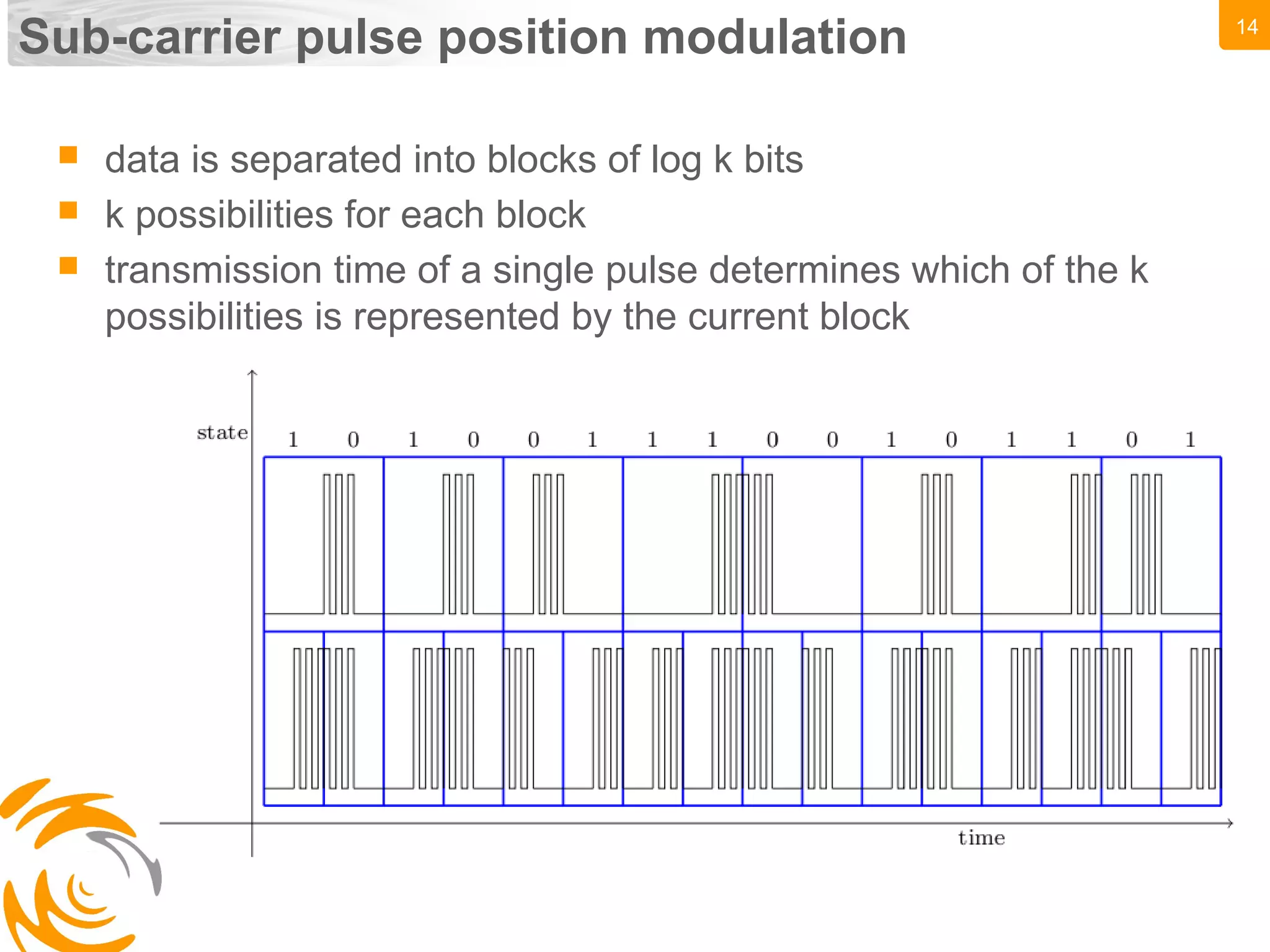
Sub-carrier pulse position modulation
 data is separated into blocks of log k bits
 k possibilities for each block
 transmission time of a single pulse determines which of the k
possibilities is represented by the current block
15
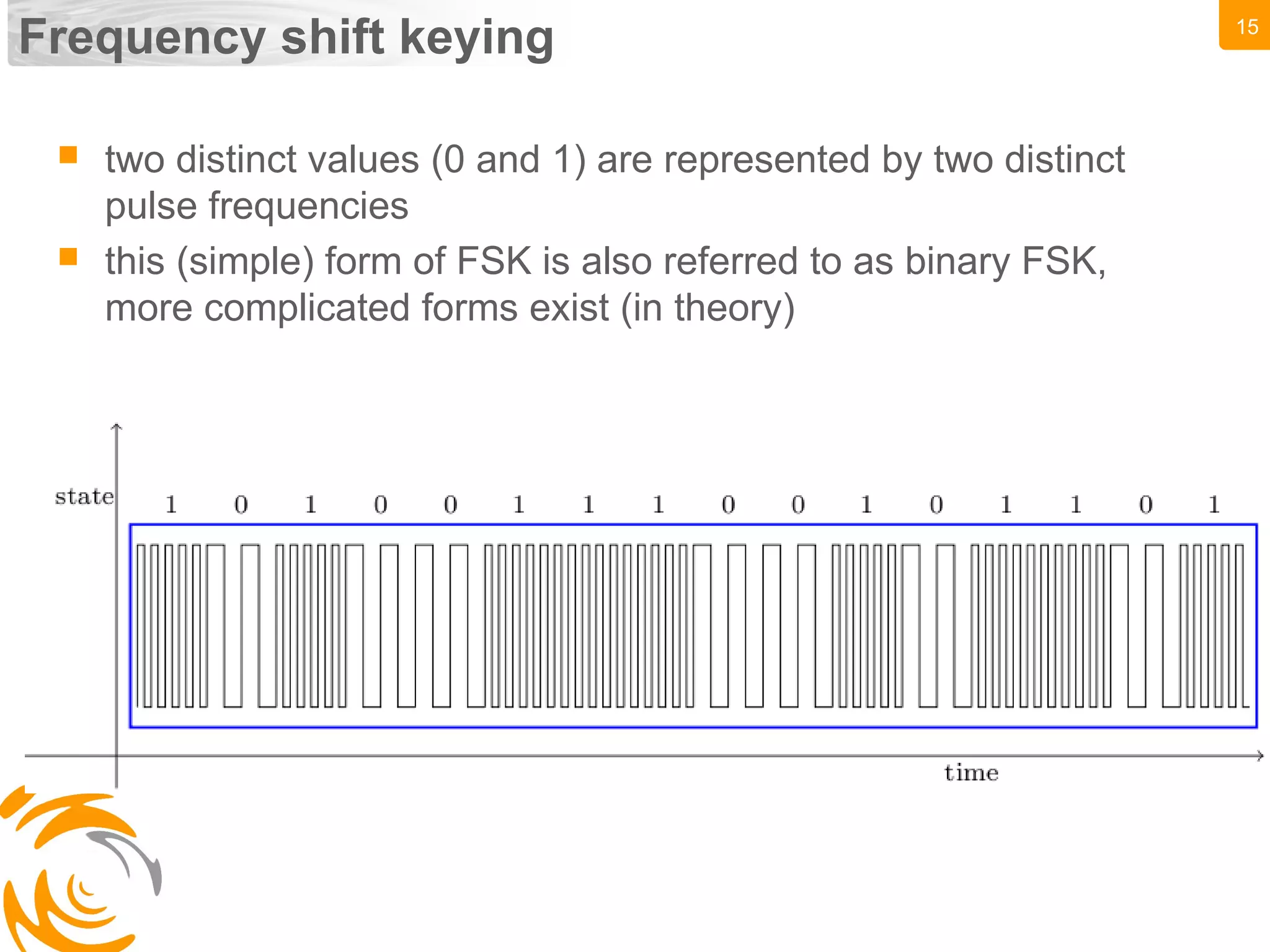
Frequency shift keying
 two distinct values (0 and 1) are represented by two distinct
pulse frequencies
 this (simple) form of FSK is also referred to as binary FSK,
more complicated forms exist (in theory)
16
Standardization efforts
 in 2007, the VLCC proposed two different standards:
 Visible Light Communication System Standard
 Visible Light ID System Standard
 JEITA (Japan Electronics and Information Technology
Industries Association) accepted these standards as JEITA
CP-1221 and JEITA CP-1222
17
JEITA CP-1221 (1/2)
 motivation:
 avoid fragmentation and proprietary protocols
 prevent interference
 light that is used for communication purposes must be within a
range of 380nm to 750nm
 emitted light must be within a particular range with an accuracy
of 1nm
 sub-carrier (SC) modulation is proposed (as opposed to
modulating the frequency of the actual light)
18
JEITA CP-1221 (2/2)
 there are three major frequency ranges:
 range 1 (15 kHz to 40 kHz):
- communication purposes
 range 2 (40kHz to 1 MHz):
- fluorescent lights cannot use this range
- they are too slow and generate too much noise
 range 3 (> 1 MHz):
- should only be used for vast data transmission with special LEDs
19
JEITA CP-1222
 according to Shinichiro Haruyama (vice chairman of the VLCC)
the following recommendations are proposed by JEITA CP-
1222 (see [3] for more details):
 SC frequency: 28.8 kHz
 transmission rate: 4.8 kbps
 modulation: SC-4PPM (chosen to avoid flickering)
 cyclic redundancy checks (CRC) for error detection/correction
20
Localization
 GPS has very limited use indoors because of interference
 VLC can be used for indoor location estimation
 general idea: when light from a source is received, the receiver
must be close to the source
 estimation of current location based on data received from
several light sources (to increase accuracy)
21
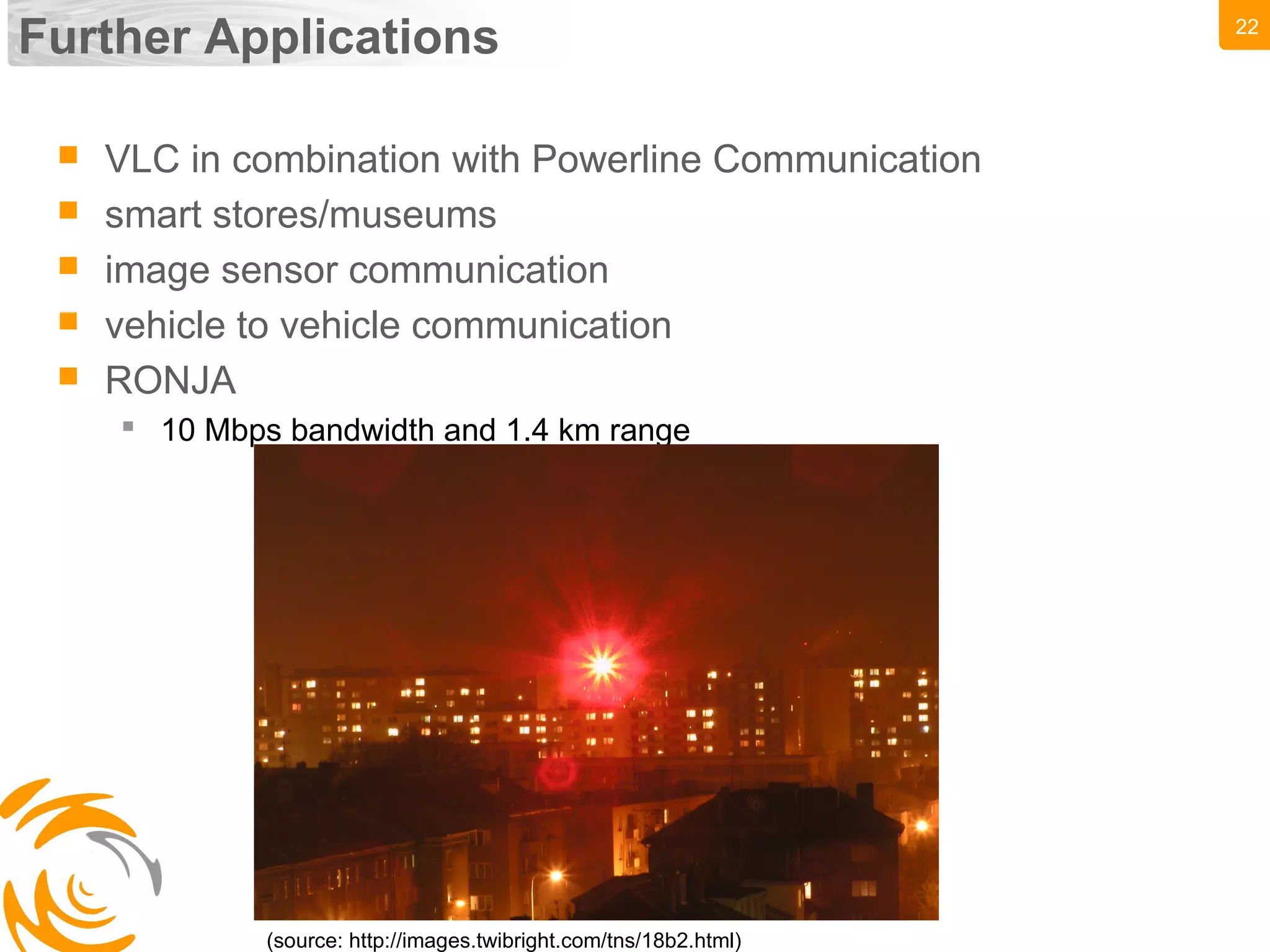
Localization
 light of different sources is projected through a lense onto an image
sensor
 distances to light sources are estimated based on this projection
(source: http://www.youtube.com/watch?v=QEh5f49LsB4)
22
Further Applications
 VLC in combination with Powerline Communication
 smart stores/museums
 image sensor communication
 vehicle to vehicle communication
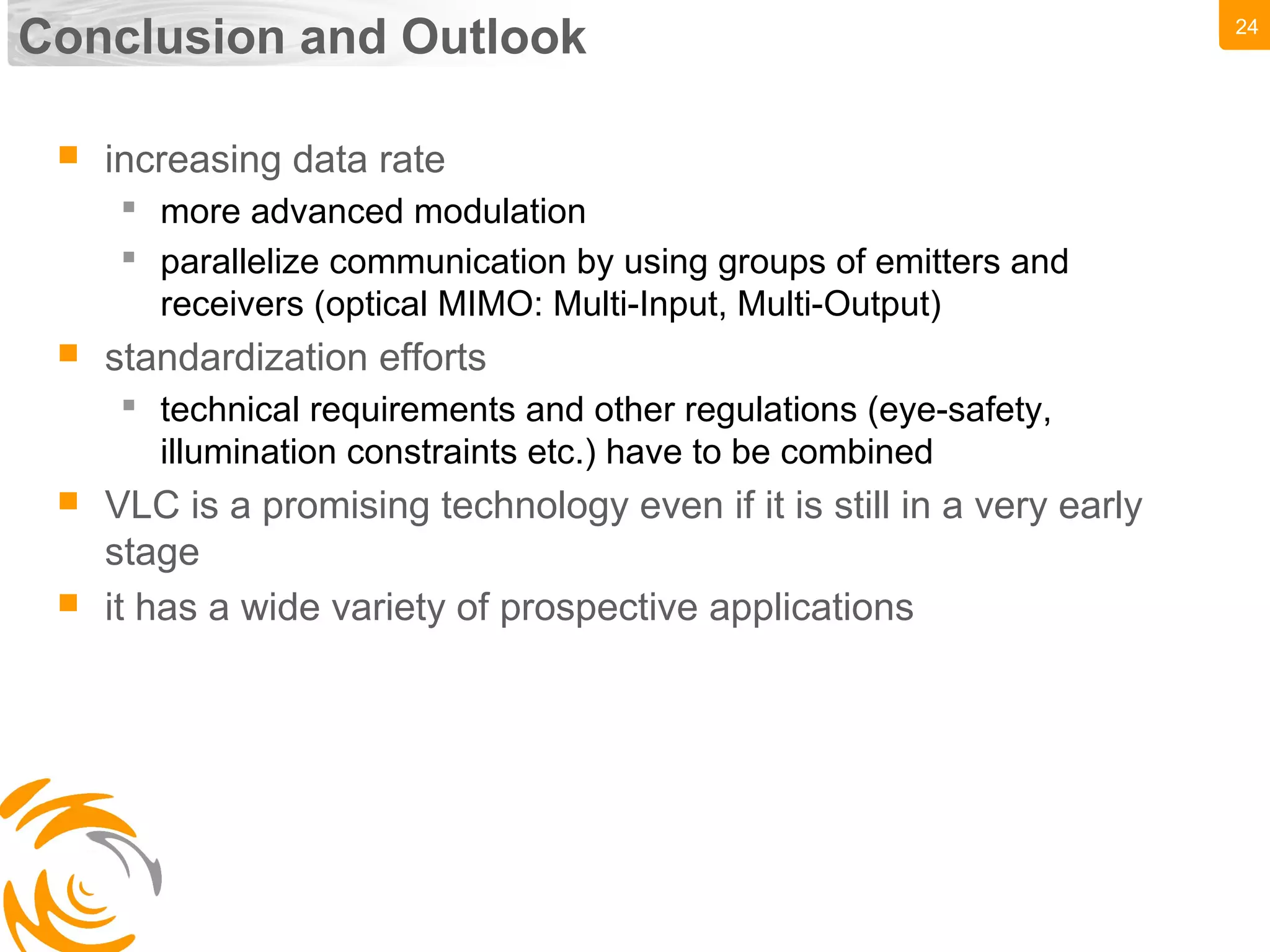
 RONJA
 10 Mbps bandwidth and 1.4 km range
(source: http://images.twibright.com/tns/18b2.html)
23
Providing an uplink
 VLC is a natural broadcast medium
 sending back information to the source is sometimes desired
 there are three major approaches to providing an uplink to the
camera (as discussed in [4]):
 co-locating the light source with a VLC receiver
- advantage: data can be sent back
- drawback: sending light back is costly (energy-wise)
 using a retro-reflector to return incident light
- advantage: data can be sent back from several sources in parallel
- drawback: uplink data rates are rather low using this approach
 fitting the light source with a RF or IR receiver
- advantage: data can be sent back fast
- drawback: no VLC is used, all disadvantages of not using VLC (EM-
interference etc.)
24
Conclusion and Outlook
 increasing data rate
 more advanced modulation
 parallelize communication by using groups of emitters and
receivers (optical MIMO: Multi-Input, Multi-Output)
 standardization efforts
 technical requirements and other regulations (eye-safety,
illumination constraints etc.) have to be combined
 VLC is a promising technology even if it is still in a very early
stage
 it has a wide variety of prospective applications
25
References
 H.Sugiyama, S.Haruyama, M.Nakagawa. Experimental investigation
of modulation method for visible-light communications [1]
 IEEE VLC tutorial (http://www.ieee802.org/15/pub/TG7.html) [2]
 Japan's Visible Light Communications Consortium and Its
Standardization Activities (Shinichiro Haruyama, Ph.D) [3]
 Visible Light Communications: challenges and possibilities: Dominic
C. O’Brien et al. [4]

visible light communication

  • 1.
    Institut für Telematik| Universität zu Lübeck 1 Visible Light Communication Seminar Kommunikationsstandards in der Medizintechnik 29. Juni 2010 Christian Pohlmann
  • 2.
    2 Outline  motivation  history technology and modulation  current standards  applications  conclusion and outlook
  • 3.
    3 Visible Light (source: http://www.etud.insa-toulouse.fr/~tkabir/code/cietorgb.html,public domain)  visible light is all around us  part of the visually-perceivable electromagnetic spectrum  spectrum of visible light ranges from 380nm to 750nm
  • 4.
    4 Motivation  visible lightdoes not cause any health problems  no EM-interference occurs  save to use in hospitals  no expensive patent-license necessary  no interception because the transmission range is narrowly confined  ever-increasing market share of LEDs makes VLC ubiquitously available
  • 5.
    5 The Photophone (1/2) (source:Meyers Konversationslexikon, 1888)  the photophone was developed by Alexander Graham Bell and his assistant Charles Tainter in 1880  first method for wireless verbal communication  below is a schematic view from one of Bell's papers
  • 6.
    6 The Photophone (2/2) (source:http://www.bluehaze.com.au/modlight/ModLightBiblio.htm, http://www.flickr.com/photos/fdctsevilla/4074931746/ author(s) unknown)  Bell and his assistant using the photophone for transmitting and receiving data
  • 7.
    7 Visible Light CommunicationsConsortium  the Visible Light Communication Consortium was established in 2003 by Japanese tech-companies  aims to standardize VLC technology  avoid fragmentation of different protocols and implementations  two standards are proposed:  JEITA CP-1221  JEITA CP-1222  also tries to raise public awareness for VLC and promote its applications  standardization efforts for physical and media access layer are also done by IEEE 802.15, Task Group 7
  • 8.
    8 VLCC Members  NECCorporation  Panasonic Electric Works Co., Ltd  The Nippon Signal Co., Ltd  Toshiba Corporation  Japan Rural Information System Association  Samsung Electronics Co., Ltd  NTT DoCoMo, Inc  Casio Computer Co., Ltd  Nakagawa Laboratories, Inc.  Outstanding Technology Co., Ltd  Sumitomo Mitsui Construction Co., Ltd  Tamura Corporation  Sharp Corporation  Japan Coast Guard  Comtech 2000 Corporation  RISE Co., Ltd  Japan Traffic Management Technology Association  NHK
  • 9.
    9 Technology (1/3)  everykind of light source could be used as sender  LEDs are the predominant choice for transmitters  they can be switched on and off in very short intervals  receivers  photodiode receivers  CCD and CMOS sensors
  • 10.
    10 Technology (2/3)  schematicview of the entire process of transmitting and receiving data (source: based on a schematic view shown in [1])
  • 11.
    11 Technology (3/3)  phosphorusLEDs can achieve up to 40 Mbps  by using RGB LEDs data rates can go up to 100 Mbps  RCLEDs (resonant cavity LEDs) can achieve data rates up to 500 Mbps  RCLEDS use Bragg reflectors (which serve as mirrors) to enhance the emitted light  they also have increased spectral purity when compared to conventional LEDs which further improves communication capabilities  LEDs are energy-efficient and are becoming increasingly inexpensive
  • 12.
    12 Comparison to otherwireless technologies (source: IEEE VLC Tutorial http://www.ieee802.org/15/pub/TG7.html [2])
  • 13.
    13 Data transmission  modulation(with respect to VLC) is used to transform the data (given as a sequence of 0s and 1s) into a series of light pulses  two main alternative modulation schemes:  sub-carrier pulse position modulation (SC-kPPM): - data is separated into groups of log k bits each and there is only a single pulse for each group  frequency shift keying (FSK): - signal frequency determines whether or not the currently transferred bit is 0 or 1  point of confusion: the frequency of light pulses is modulated, not the frequency of the light itself
  • 14.
    14 Sub-carrier pulse positionmodulation  data is separated into blocks of log k bits  k possibilities for each block  transmission time of a single pulse determines which of the k possibilities is represented by the current block
  • 15.
    15 Frequency shift keying two distinct values (0 and 1) are represented by two distinct pulse frequencies  this (simple) form of FSK is also referred to as binary FSK, more complicated forms exist (in theory)
  • 16.
    16 Standardization efforts  in2007, the VLCC proposed two different standards:  Visible Light Communication System Standard  Visible Light ID System Standard  JEITA (Japan Electronics and Information Technology Industries Association) accepted these standards as JEITA CP-1221 and JEITA CP-1222
  • 17.
    17 JEITA CP-1221 (1/2) motivation:  avoid fragmentation and proprietary protocols  prevent interference  light that is used for communication purposes must be within a range of 380nm to 750nm  emitted light must be within a particular range with an accuracy of 1nm  sub-carrier (SC) modulation is proposed (as opposed to modulating the frequency of the actual light)
  • 18.
    18 JEITA CP-1221 (2/2) there are three major frequency ranges:  range 1 (15 kHz to 40 kHz): - communication purposes  range 2 (40kHz to 1 MHz): - fluorescent lights cannot use this range - they are too slow and generate too much noise  range 3 (> 1 MHz): - should only be used for vast data transmission with special LEDs
  • 19.
    19 JEITA CP-1222  accordingto Shinichiro Haruyama (vice chairman of the VLCC) the following recommendations are proposed by JEITA CP- 1222 (see [3] for more details):  SC frequency: 28.8 kHz  transmission rate: 4.8 kbps  modulation: SC-4PPM (chosen to avoid flickering)  cyclic redundancy checks (CRC) for error detection/correction
  • 20.
    20 Localization  GPS hasvery limited use indoors because of interference  VLC can be used for indoor location estimation  general idea: when light from a source is received, the receiver must be close to the source  estimation of current location based on data received from several light sources (to increase accuracy)
  • 21.
    21 Localization  light ofdifferent sources is projected through a lense onto an image sensor  distances to light sources are estimated based on this projection (source: http://www.youtube.com/watch?v=QEh5f49LsB4)
  • 22.
    22 Further Applications  VLCin combination with Powerline Communication  smart stores/museums  image sensor communication  vehicle to vehicle communication  RONJA  10 Mbps bandwidth and 1.4 km range (source: http://images.twibright.com/tns/18b2.html)
  • 23.
    23 Providing an uplink VLC is a natural broadcast medium  sending back information to the source is sometimes desired  there are three major approaches to providing an uplink to the camera (as discussed in [4]):  co-locating the light source with a VLC receiver - advantage: data can be sent back - drawback: sending light back is costly (energy-wise)  using a retro-reflector to return incident light - advantage: data can be sent back from several sources in parallel - drawback: uplink data rates are rather low using this approach  fitting the light source with a RF or IR receiver - advantage: data can be sent back fast - drawback: no VLC is used, all disadvantages of not using VLC (EM- interference etc.)
  • 24.
    24 Conclusion and Outlook increasing data rate  more advanced modulation  parallelize communication by using groups of emitters and receivers (optical MIMO: Multi-Input, Multi-Output)  standardization efforts  technical requirements and other regulations (eye-safety, illumination constraints etc.) have to be combined  VLC is a promising technology even if it is still in a very early stage  it has a wide variety of prospective applications
  • 25.
    25 References  H.Sugiyama, S.Haruyama,M.Nakagawa. Experimental investigation of modulation method for visible-light communications [1]  IEEE VLC tutorial (http://www.ieee802.org/15/pub/TG7.html) [2]  Japan's Visible Light Communications Consortium and Its Standardization Activities (Shinichiro Haruyama, Ph.D) [3]  Visible Light Communications: challenges and possibilities: Dominic C. O’Brien et al. [4]