
Accelerating Mobile Development with
Mobile Enterprise Application Platforms
(MEAP)
Srinath Perera
Director, Research
WSO2 Inc.
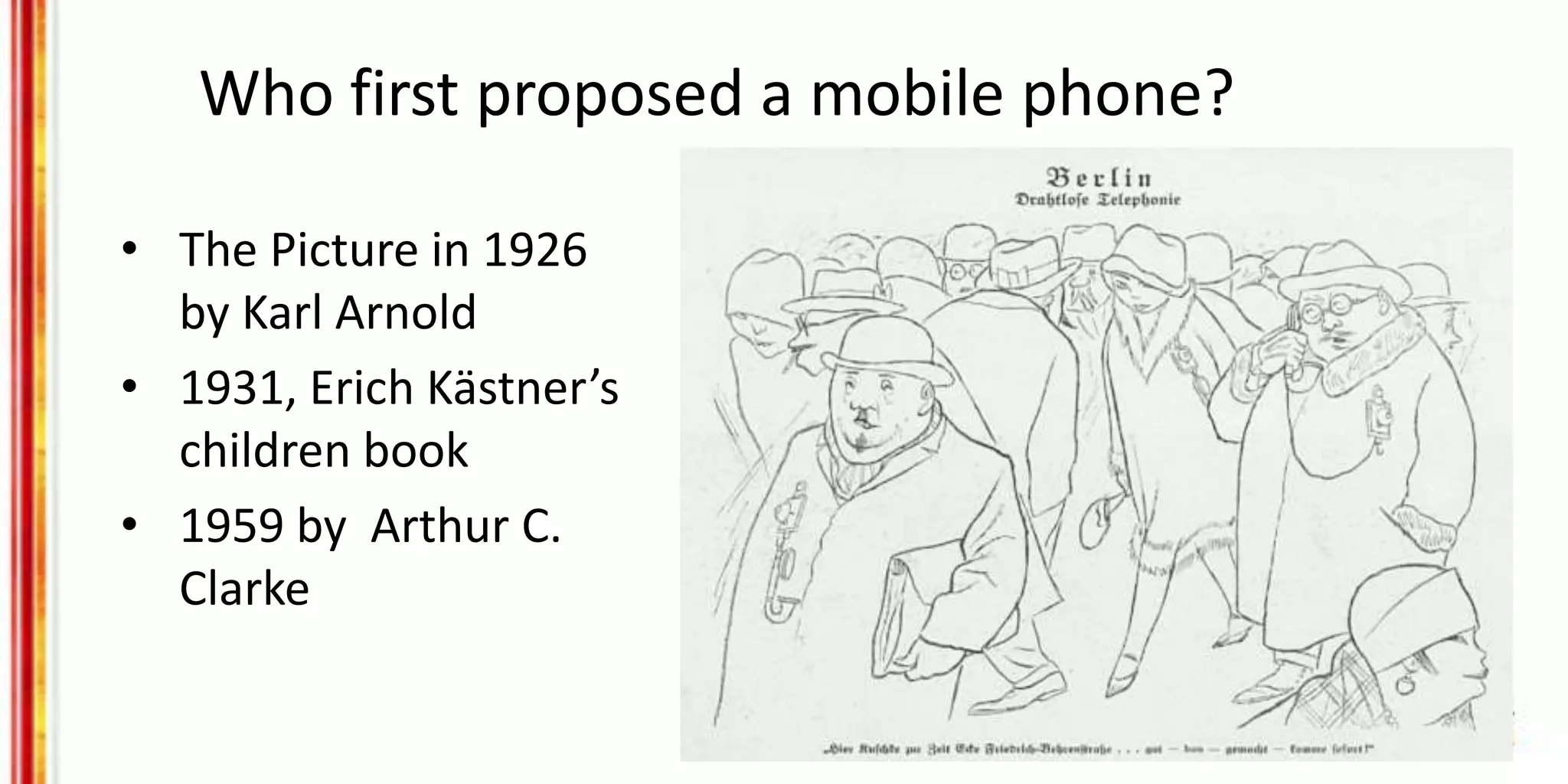
Who first proposed a mobile phone?
• The Picture in 1926
by Karl Arnold
• 1931, Erich Kästner’s
children book
• 1959 by Arthur C.
Clarke
Could you guess who proposed first
mobile App?
“In 1907, Lewis Baumer’s cartoon "Predictions for 1907”
showed a man and a woman in London's Hyde Park
each separately engaged in gambling and dating on
wireless telephony equipment.”
This is before car or Airplane
So after 100 years, where we stand?
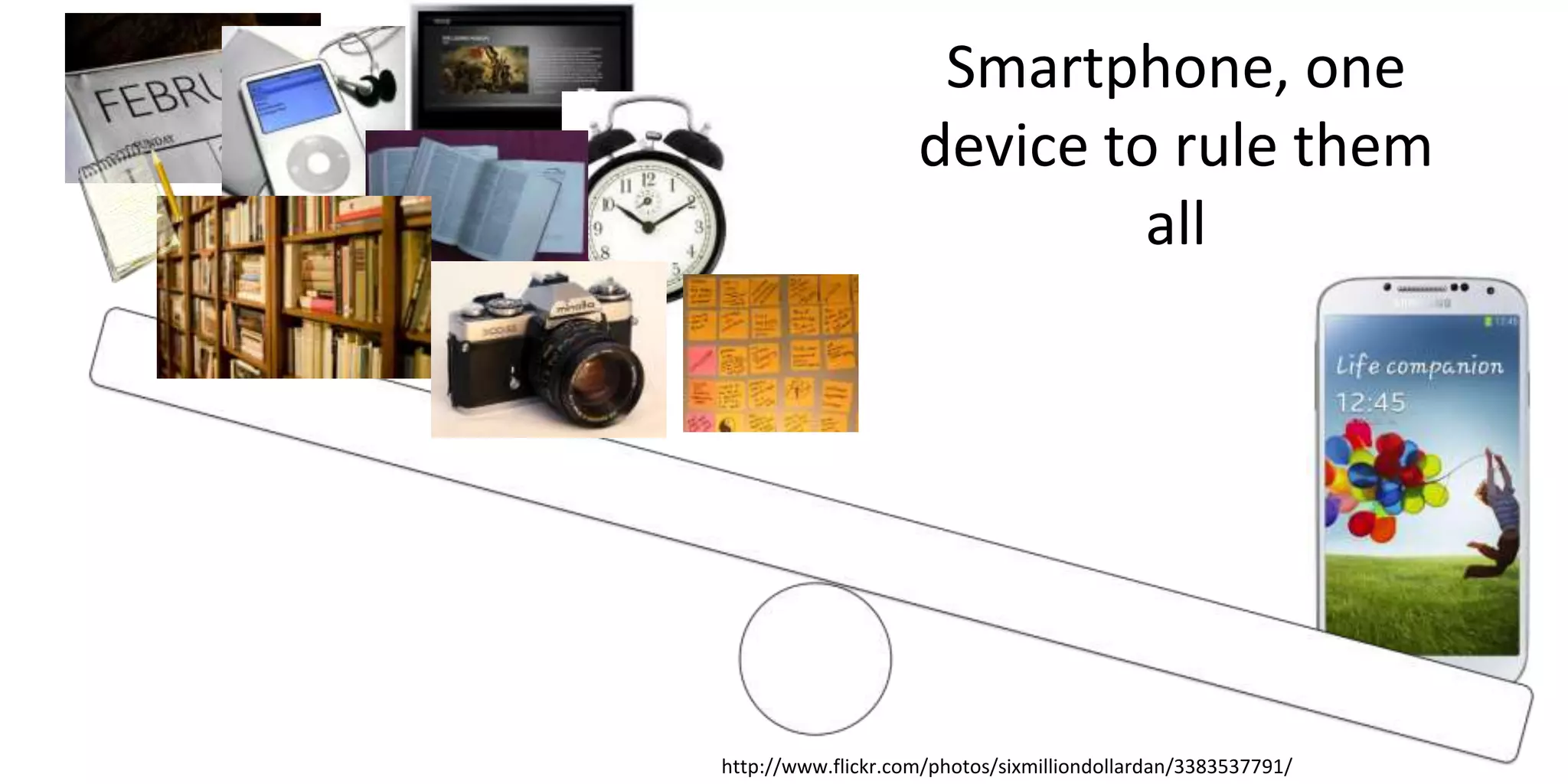
• 7B humans and 6.6 mobile subscribers
(>80%) vs. 2.5B in internet and 1.9B in
social networks
• Mobiles overtaking PC, more traffic
comes from mobile.
• 80% time on phones spent on apps
• Currently 25% are smart phones
• 56% of American adults and 72% of Y
generation own an smart phone
• More than 50% Asians will have a
smartphone by 2015
Smartphone, one
device to rule them
all
http://www.flickr.com/photos/sixmilliondollardan/3383537791/
There is an App for that
• It is Apps that make
the difference
• Overnight millionaire
e.g. Angry Birds (200M in
revenue 2013)
• There is an app for
pretty much everything
• Long tail of Apps
App Economics
• Both Apple and Google Play
stores has close to 1M apps
• Recorded about 10B$ revenue
2013 each (Sri Lanka total export
9B$/ Year )
• 27 and 29 billion apps downloads
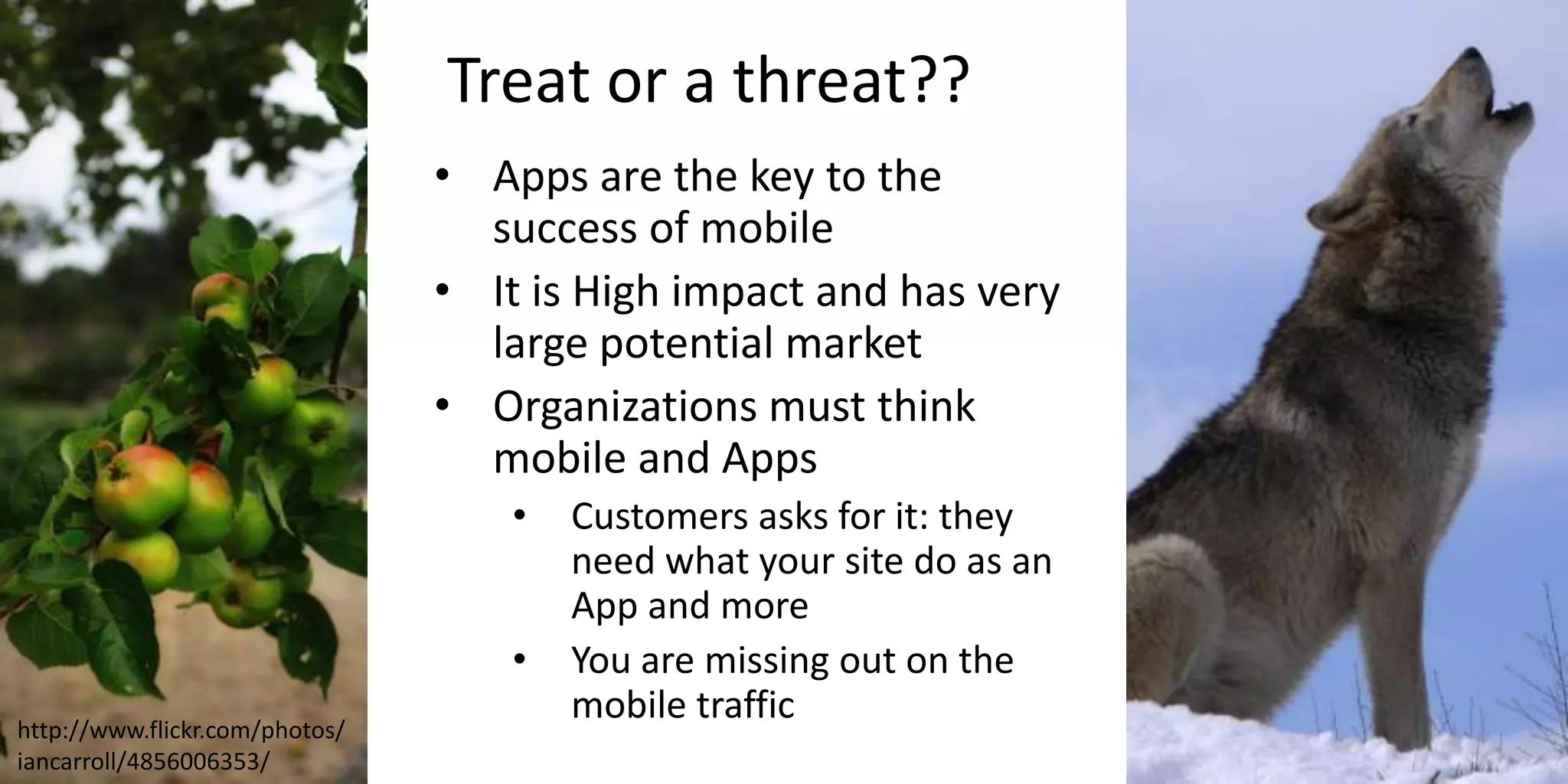
Treat or a threat??
• Apps are the key to the
success of mobile
• It is High impact and has very
large potential market
• Organizations must think
mobile and Apps
• Customers asks for it: they
need what your site do as an
App and more
• You are missing out on the
mobile traffic
http://www.flickr.com/photos/
iancarroll/4856006353/
Soon, you will be
writing mobile
apps!! So what it
take to write them?
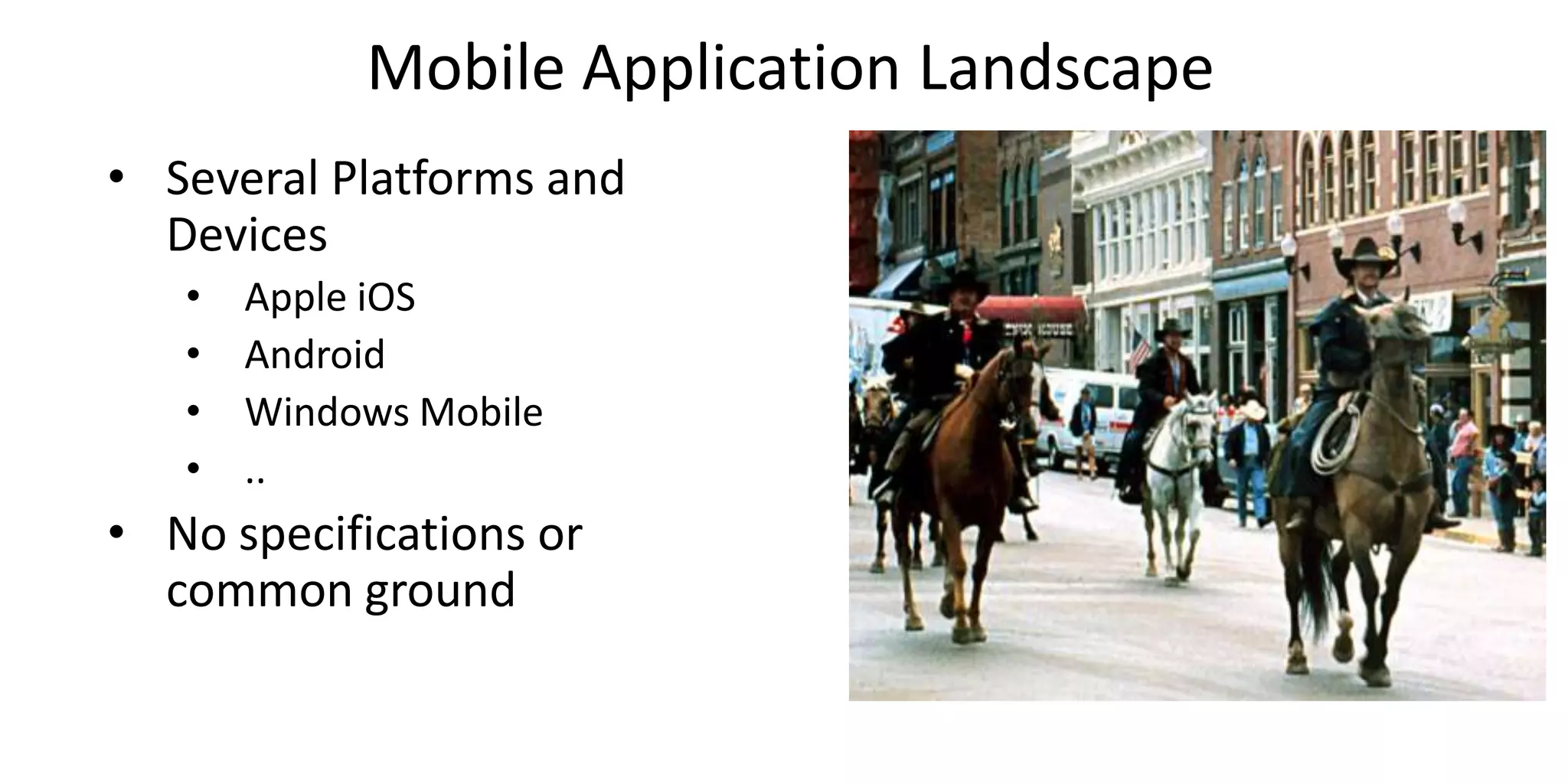
Mobile Application Landscape
• Several Platforms and
Devices
• Apple iOS
• Android
• Windows Mobile
• ..
• No specifications or
common ground
Challenges: Devices and Apps
• Technology (Devices) and OS changes very fast
(multiple times per year. )
• Devices have different screen sizes, input
modes and hardware capabilities.
• Network connectivity and power levels
fluctuate widely in typical usage scenarios.
• New consumer applications regularly extend
and revise the standards for good mobile
applications.
• Each mobile OS has a unique presentation
style, interaction style and software stack.
Challenges: Evolving Apps
• Apps are not write and
dump, you have to maintain/
improve them
• Code and Build
• Rollouts
• Community
• Forums
• Issues
• Sharing and reuse
• Governance
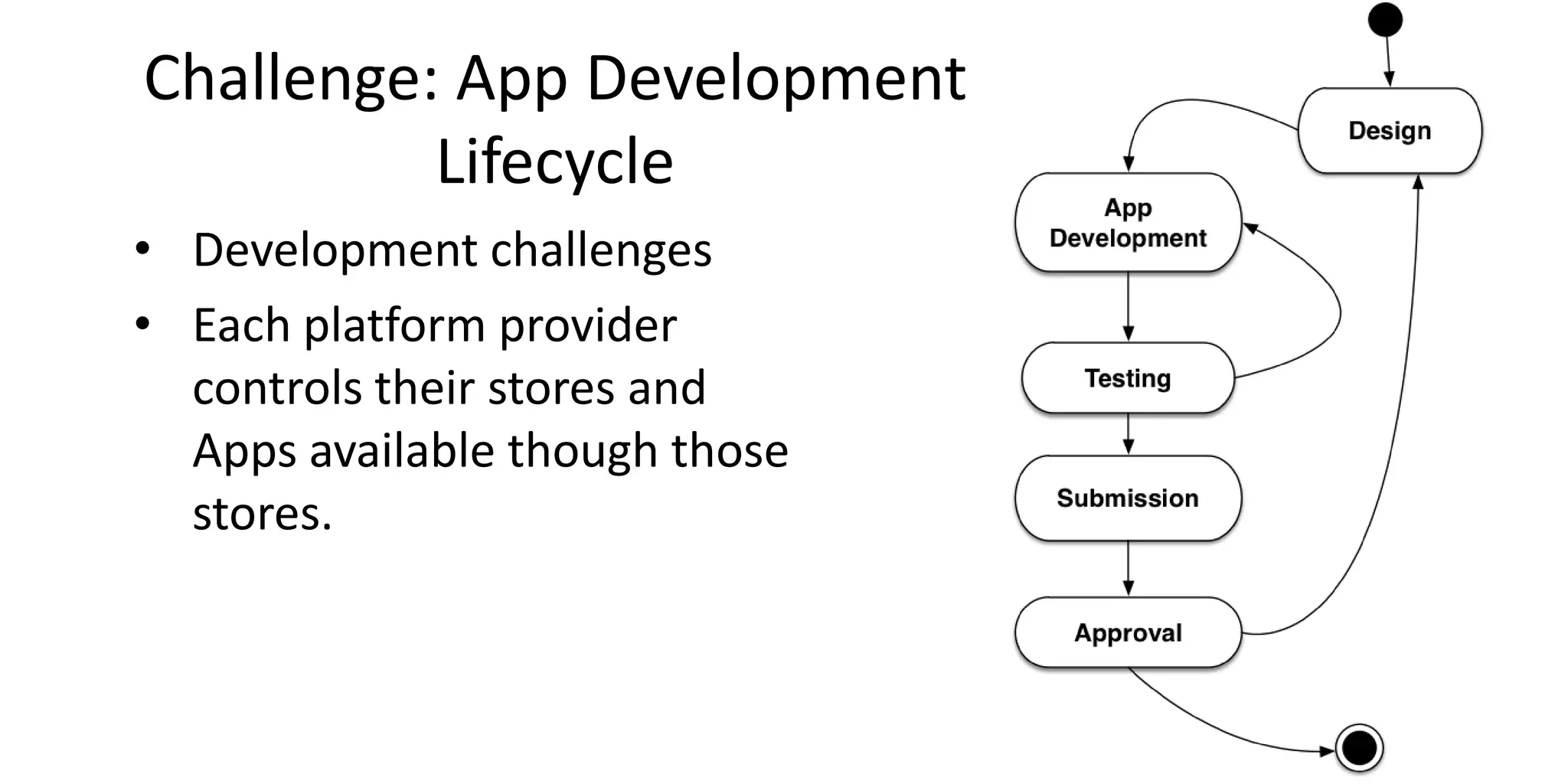
Challenge: App Development
Lifecycle
• Development challenges
• Each platform provider
controls their stores and
Apps available though those
stores.
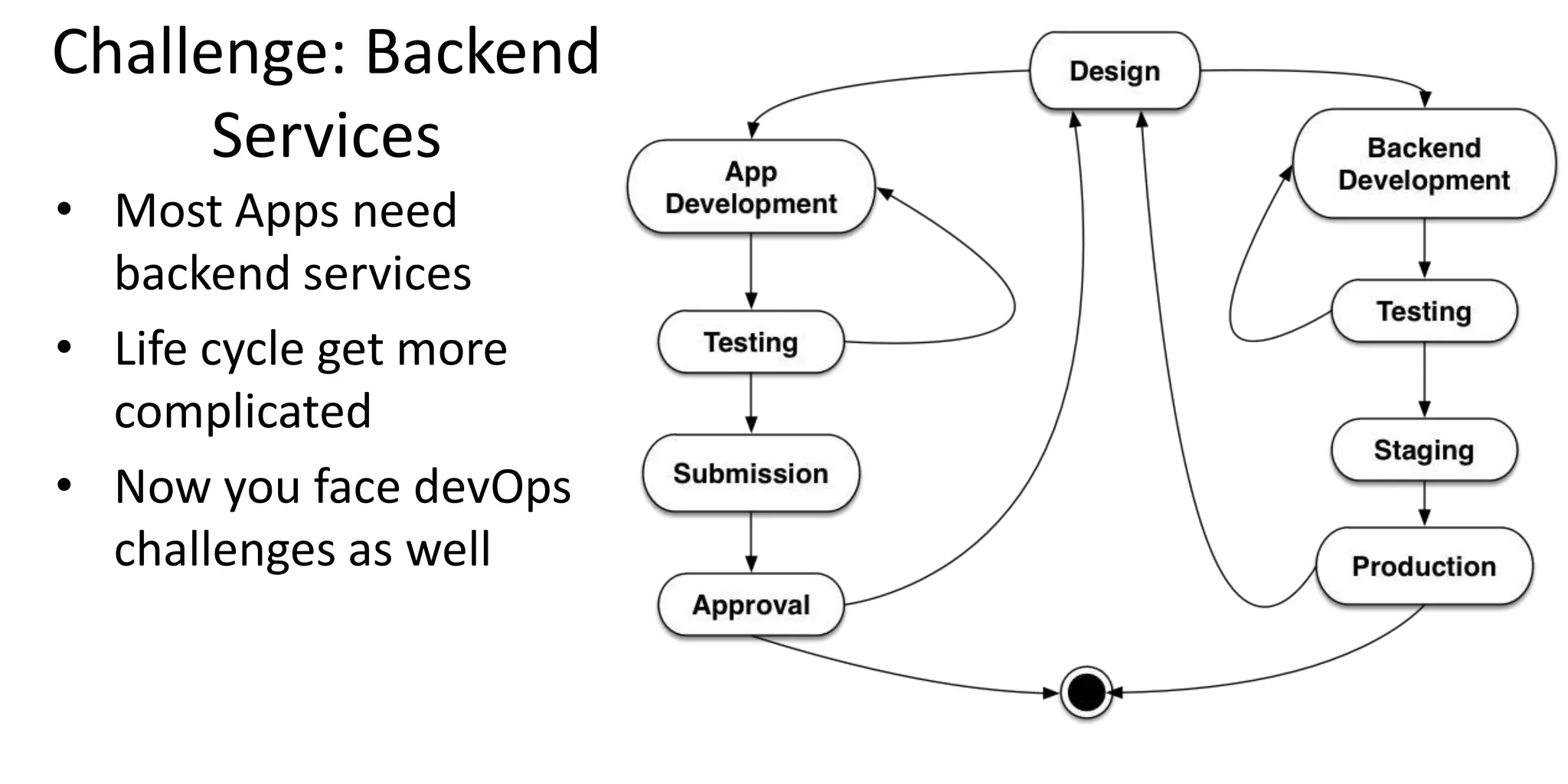
Challenge: Backend
Services
• Most Apps need
backend services
• Life cycle get more
complicated
• Now you face devOps
challenges as well
DevOps Challenges
• High Availability
• Scalability
• Varying load
• Automation
• Recovery (Backup)
• Security Updates
Using WSO2 Products to Build an App
Is that enough?
Mobile Enterprise Application Platform
(MEAP)
• Coined by Gartner 2008 and called “multi-channel
access gateway market”, which was renamed later
• Multi billon dollar market
• Initial goal was write once run anywhere, but now
covering all lifecycle of mobile app development
• Rule of Three
• All concepts must be demonstrated for three platforms.
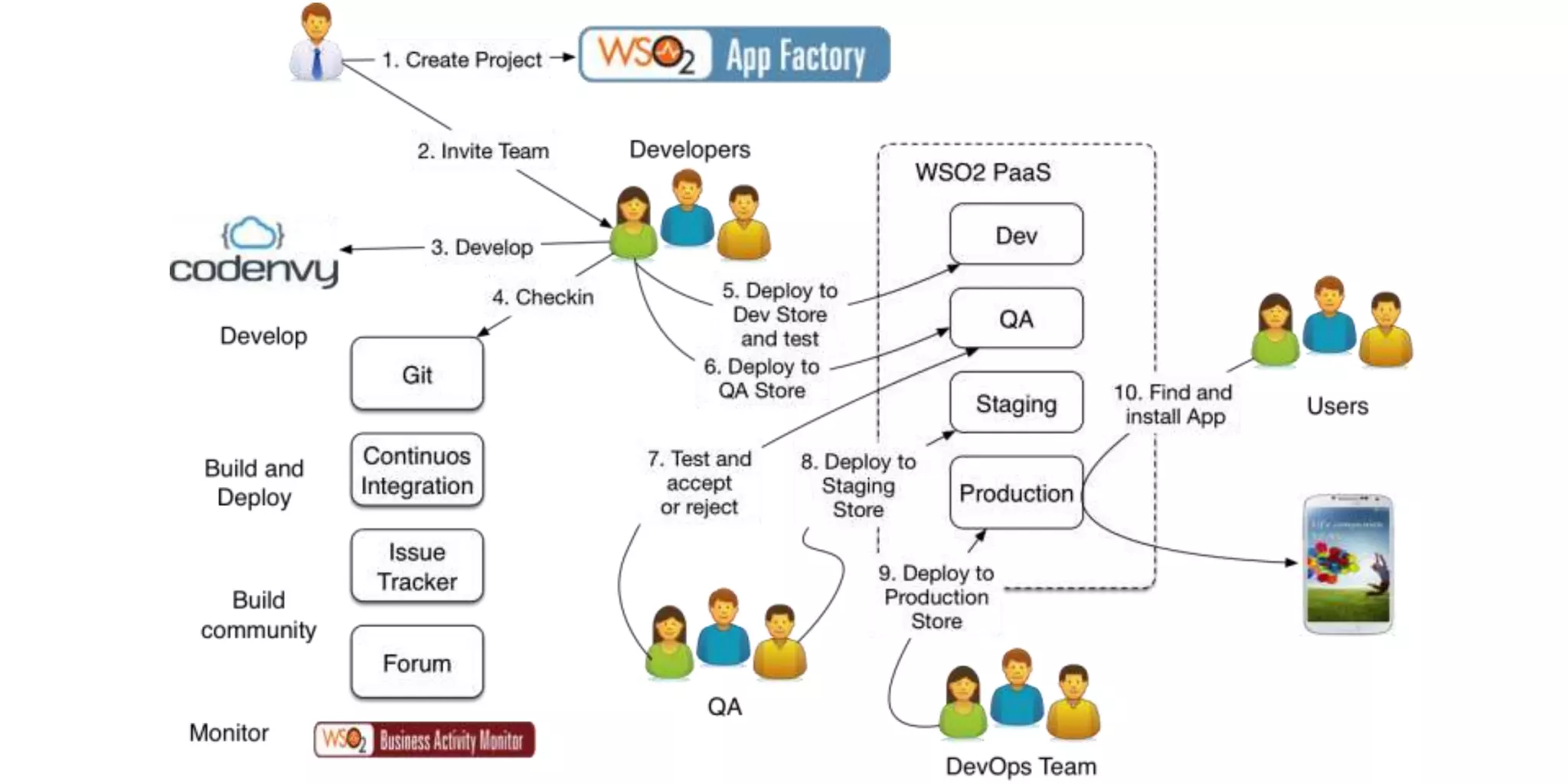
WSO2 MEAP Big Picture
Write Once, Run Everywhere
• Each application platform (IOS, Android, Windows
Mobile ) has its own language
• Three options to write portable apps
1. Hybrid – Write HTML5 code and interpret at via HTML5
interpreter runtime. E.g. PhoneGap(Apache Cordova),
2. HTML5 + JavaScript based UI design SDK e.g. Dojo
Toolkit, YUI Library, jQuery Mobile, Sencha Touch.
3. Write HTML5 + Java script and generate native code – e.g.
Xamerin (c#)/ Appcelerator (java script)
• We start with Android native and option 1, Cordova
http://www.flickr.com/
photos/eschipul/
IDE and Lifecycle Support
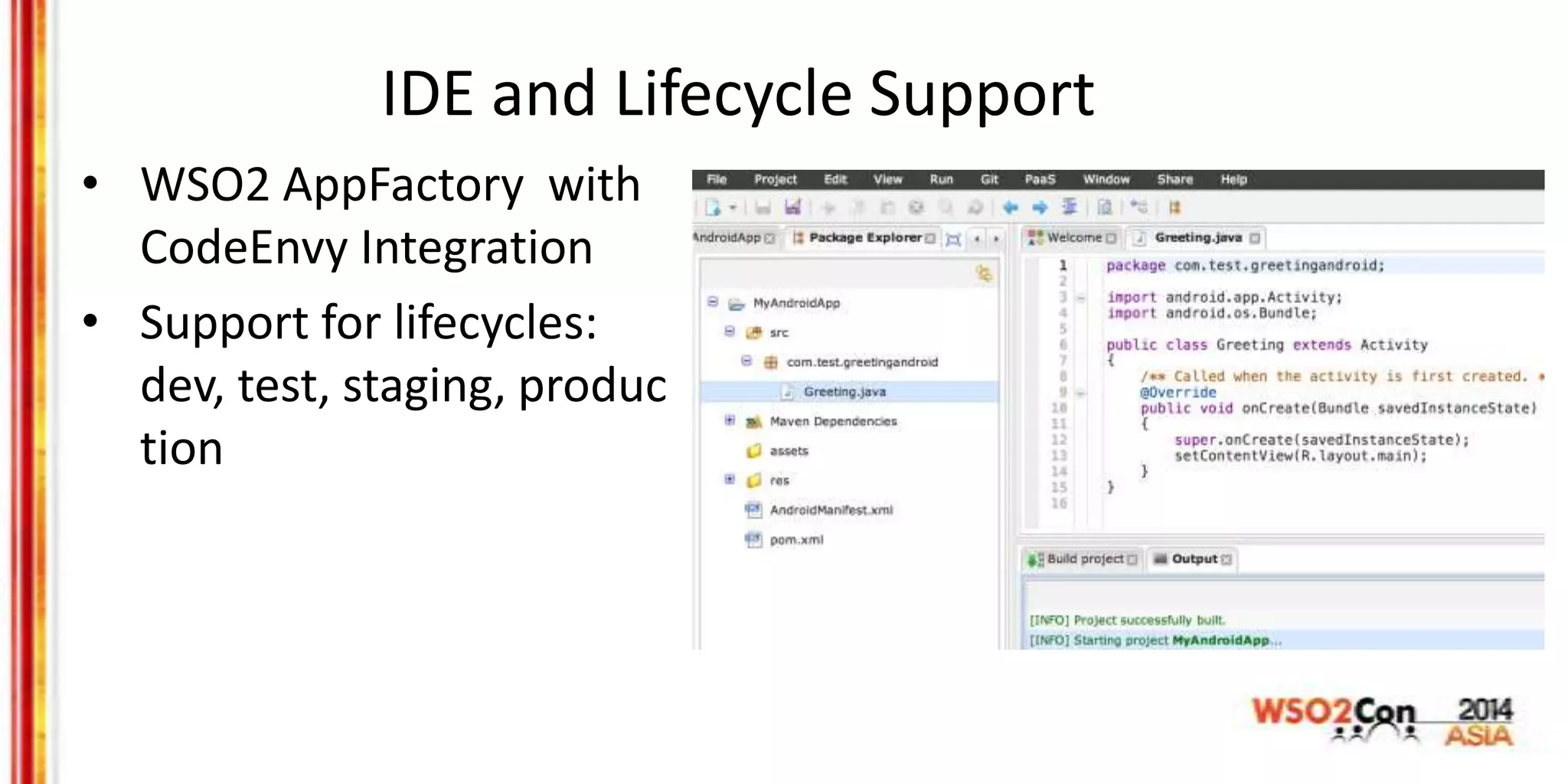
• WSO2 AppFactory with
CodeEnvy Integration
• Support for lifecycles:
dev, test, staging, produc
tion
Backend Services
• Mostly HTTP/ JSON, but other
protocols like MQTT is possible
as well
• Supported via MBaaS
• Three Products: Service Hosting
(AS), service mediation
(ESB), and APIs with inbuilt
mobile services like location
services, messaging services
etc.
• Can run in Cloud in “pay as you
go” fashion with autoscaling http://pixiedoll106.deviantart.com/art/Ballerinas-
Backstage-345476040
Testing
• When built, app goes to
store assigned by the
lifecycle (Dev, QA, Staging,
Production)
• Then tester can download
and test
• We will do a Mobile
emulator by running the
app and showing it in
browser as well.
http://www.flickr.com/photos/juha_riissanen/
MEAP and Analytics
• Support probes and let users
monitor metrics (KPI) about
App development and App
executions and backend
• Powered by WSO2 BAM and
CEP
http://www.flickr.com/photos/isriya/2967310333/
Conclusion
• Mobile Application management
poses several key challenges
• WSO2 MEAP Product as a solution
• Reduce time to Market
• Enhanced Developer experience
• Regulatory compliance
• Increase Reuse
• Visibility
• Shared infrastructure
• Coming in Q3 2014
http://www.flickr.com/photos/jsmoor
man/2298671281/
Accelerating Mobile Development with Mobile Enterprise Application Platforms (MEAP)

Accelerating Mobile Development with Mobile Enterprise Application Platforms (MEAP)

  • 1.
    Accelerating Mobile Developmentwith Mobile Enterprise Application Platforms (MEAP) Srinath Perera Director, Research WSO2 Inc.
  • 2.
    Who first proposeda mobile phone? • The Picture in 1926 by Karl Arnold • 1931, Erich Kästner’s children book • 1959 by Arthur C. Clarke
  • 3.
    Could you guesswho proposed first mobile App? “In 1907, Lewis Baumer’s cartoon "Predictions for 1907” showed a man and a woman in London's Hyde Park each separately engaged in gambling and dating on wireless telephony equipment.” This is before car or Airplane
  • 4.
    So after 100years, where we stand? • 7B humans and 6.6 mobile subscribers (>80%) vs. 2.5B in internet and 1.9B in social networks • Mobiles overtaking PC, more traffic comes from mobile. • 80% time on phones spent on apps • Currently 25% are smart phones • 56% of American adults and 72% of Y generation own an smart phone • More than 50% Asians will have a smartphone by 2015
  • 5.
    Smartphone, one device torule them all http://www.flickr.com/photos/sixmilliondollardan/3383537791/
  • 6.
    There is anApp for that • It is Apps that make the difference • Overnight millionaire e.g. Angry Birds (200M in revenue 2013) • There is an app for pretty much everything • Long tail of Apps
  • 7.
    App Economics • BothApple and Google Play stores has close to 1M apps • Recorded about 10B$ revenue 2013 each (Sri Lanka total export 9B$/ Year ) • 27 and 29 billion apps downloads
  • 8.
    Treat or athreat?? • Apps are the key to the success of mobile • It is High impact and has very large potential market • Organizations must think mobile and Apps • Customers asks for it: they need what your site do as an App and more • You are missing out on the mobile traffic http://www.flickr.com/photos/ iancarroll/4856006353/
  • 9.
    Soon, you willbe writing mobile apps!! So what it take to write them?
  • 10.
    Mobile Application Landscape •Several Platforms and Devices • Apple iOS • Android • Windows Mobile • .. • No specifications or common ground
  • 11.
    Challenges: Devices andApps • Technology (Devices) and OS changes very fast (multiple times per year. ) • Devices have different screen sizes, input modes and hardware capabilities. • Network connectivity and power levels fluctuate widely in typical usage scenarios. • New consumer applications regularly extend and revise the standards for good mobile applications. • Each mobile OS has a unique presentation style, interaction style and software stack.
  • 12.
    Challenges: Evolving Apps •Apps are not write and dump, you have to maintain/ improve them • Code and Build • Rollouts • Community • Forums • Issues • Sharing and reuse • Governance
  • 13.
    Challenge: App Development Lifecycle •Development challenges • Each platform provider controls their stores and Apps available though those stores.
  • 14.
    Challenge: Backend Services • MostApps need backend services • Life cycle get more complicated • Now you face devOps challenges as well
  • 15.
    DevOps Challenges • HighAvailability • Scalability • Varying load • Automation • Recovery (Backup) • Security Updates
  • 17.
    Using WSO2 Productsto Build an App
  • 18.
  • 19.
    Mobile Enterprise ApplicationPlatform (MEAP) • Coined by Gartner 2008 and called “multi-channel access gateway market”, which was renamed later • Multi billon dollar market • Initial goal was write once run anywhere, but now covering all lifecycle of mobile app development • Rule of Three • All concepts must be demonstrated for three platforms.
  • 20.
  • 22.
    Write Once, RunEverywhere • Each application platform (IOS, Android, Windows Mobile ) has its own language • Three options to write portable apps 1. Hybrid – Write HTML5 code and interpret at via HTML5 interpreter runtime. E.g. PhoneGap(Apache Cordova), 2. HTML5 + JavaScript based UI design SDK e.g. Dojo Toolkit, YUI Library, jQuery Mobile, Sencha Touch. 3. Write HTML5 + Java script and generate native code – e.g. Xamerin (c#)/ Appcelerator (java script) • We start with Android native and option 1, Cordova http://www.flickr.com/ photos/eschipul/
  • 23.
    IDE and LifecycleSupport • WSO2 AppFactory with CodeEnvy Integration • Support for lifecycles: dev, test, staging, produc tion
  • 24.
    Backend Services • MostlyHTTP/ JSON, but other protocols like MQTT is possible as well • Supported via MBaaS • Three Products: Service Hosting (AS), service mediation (ESB), and APIs with inbuilt mobile services like location services, messaging services etc. • Can run in Cloud in “pay as you go” fashion with autoscaling http://pixiedoll106.deviantart.com/art/Ballerinas- Backstage-345476040
  • 25.
    Testing • When built,app goes to store assigned by the lifecycle (Dev, QA, Staging, Production) • Then tester can download and test • We will do a Mobile emulator by running the app and showing it in browser as well. http://www.flickr.com/photos/juha_riissanen/
  • 26.
    MEAP and Analytics •Support probes and let users monitor metrics (KPI) about App development and App executions and backend • Powered by WSO2 BAM and CEP http://www.flickr.com/photos/isriya/2967310333/
  • 27.
    Conclusion • Mobile Applicationmanagement poses several key challenges • WSO2 MEAP Product as a solution • Reduce time to Market • Enhanced Developer experience • Regulatory compliance • Increase Reuse • Visibility • Shared infrastructure • Coming in Q3 2014 http://www.flickr.com/photos/jsmoor man/2298671281/