luceneSolr = new
                                LuceneSolr(4.x)

                                Grant Ingersoll
                                CTO, LucidWorks


Confidential © Copyright 2012
Search is dead, long live search


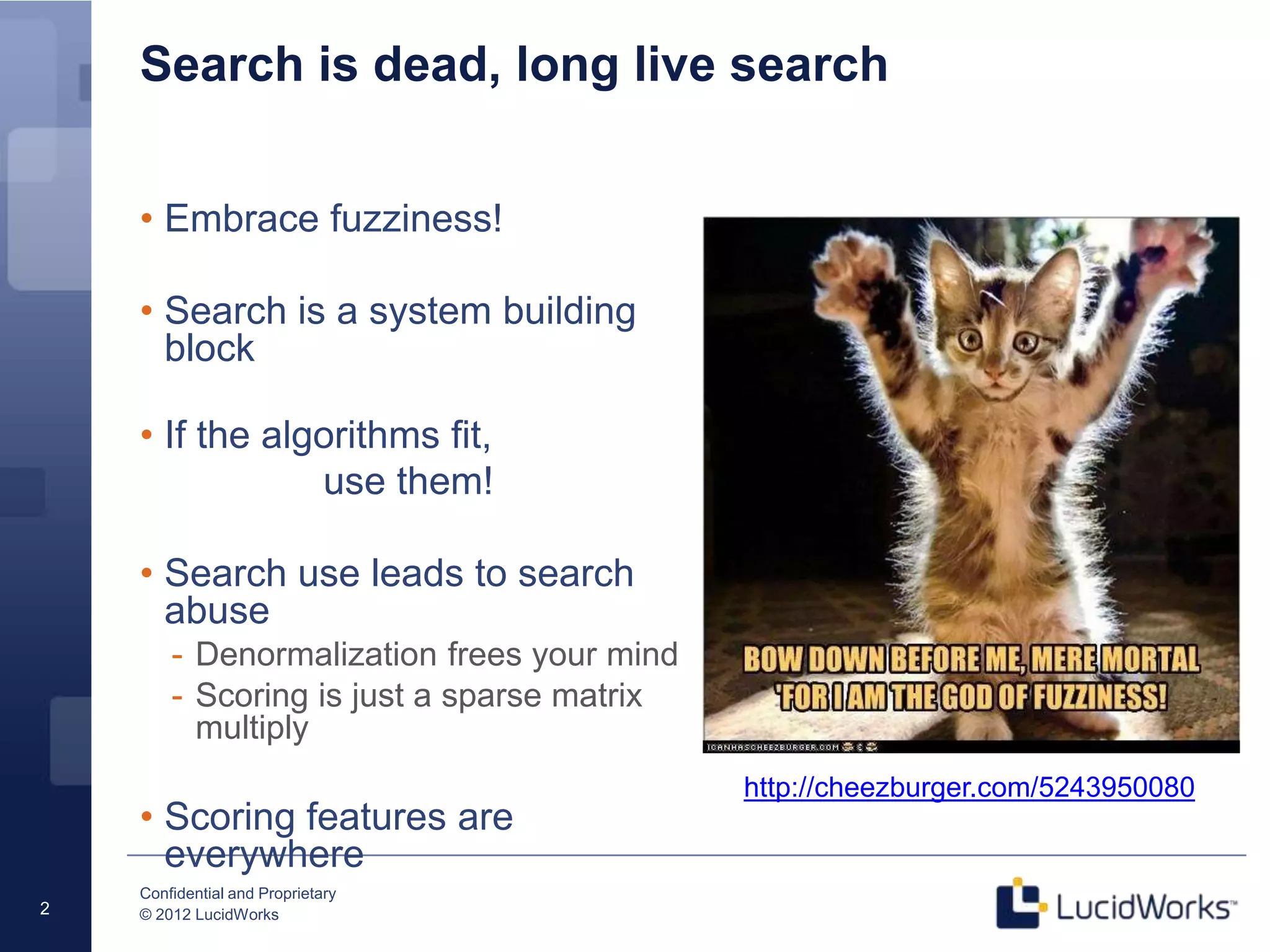
    • Embrace fuzziness!

    • Search is a system building
      block

    • If the algorithms fit,
                use them!

    • Search use leads to search
      abuse
        - Denormalization frees your mind
        - Scoring is just a sparse matrix
          multiply
                                            http://cheezburger.com/5243950080
    • Scoring features are
      everywhere
    Confidential and Proprietary
2   © 2012 LucidWorks
Search (R)evolution


• “T’ain’t your father’s search engine”
    - Non free text usages abound

• NoSQL before NoSQL was cool
    - Many DB-like features


• Flexibility during indexing and scoring

• Finite State Transducers FTW!

• Scale


Confidential and Proprietary
© 2012 LucidWorks
Agenda

• What’s new In Lucene 4?

• What’s new in Solr 4?

• Sneak Peek: what’s ahead?


Confidential and Proprietary
© 2012 LucidWorks
Lucene 4


Confidential © Copyright 2012
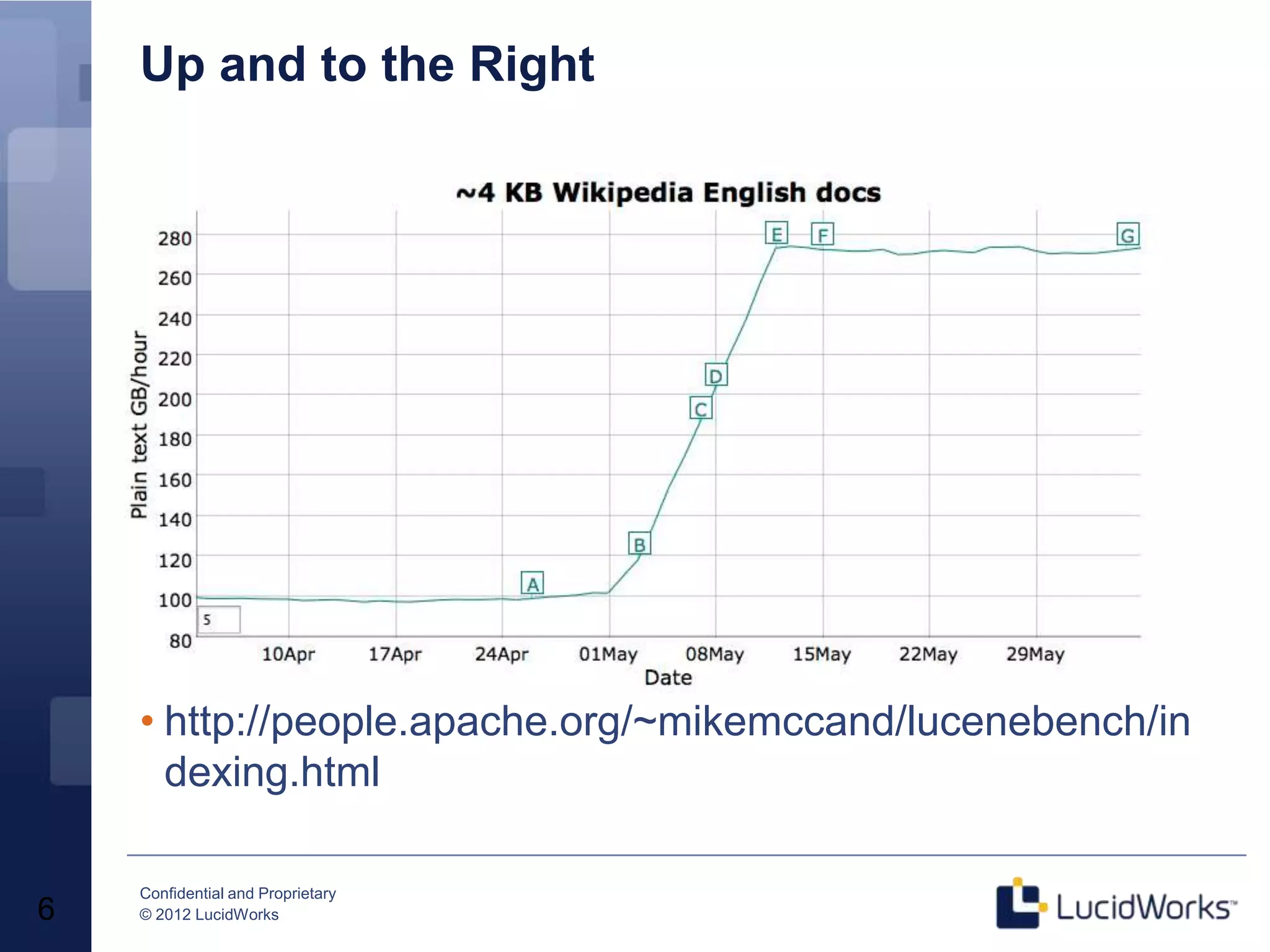
Up and to the Right


    • http://people.apache.org/~mikemccand/lucenebench/in
      dexing.html

    Confidential and Proprietary
6   © 2012 LucidWorks
Lucene: Flexibility

• Flexible Index Formats
    - New posting list codecs: Block, Simple Text, Append (HDFS..),
      etc
    - Pulsing codec: improves performance of primary key searches,
      inlining docs, positions, and payloads, saves disk seeks


• Pluggable Scoring
    - Decoupled from TF/IDF
    - Built in alternatives include BM25 & DFR
          » http://en.wikipedia.org/wiki/Okapi_BM25
          » http://terrier.org/docs/v3.5/dfr_description.html


Confidential and Proprietary
© 2012 LucidWorks
Lucene: Speed and Memory

• Native Near Real Time (NRT) support
    - Per segment
    - FieldCache can be controlled to only load new segments
• Soft commit
    - Faster without fsync, allows quicker update visibility
• DWPT (Document Writer per Thread)
    - Faster more consistent index speed
• Faster fuzzy & wildcard query processing
    - Higher performance searching
• String -> BytesRef
    - Much improved data structure
    - … means less memory and less garbage collection effort

Confidential and Proprietary
© 2012 LucidWorks
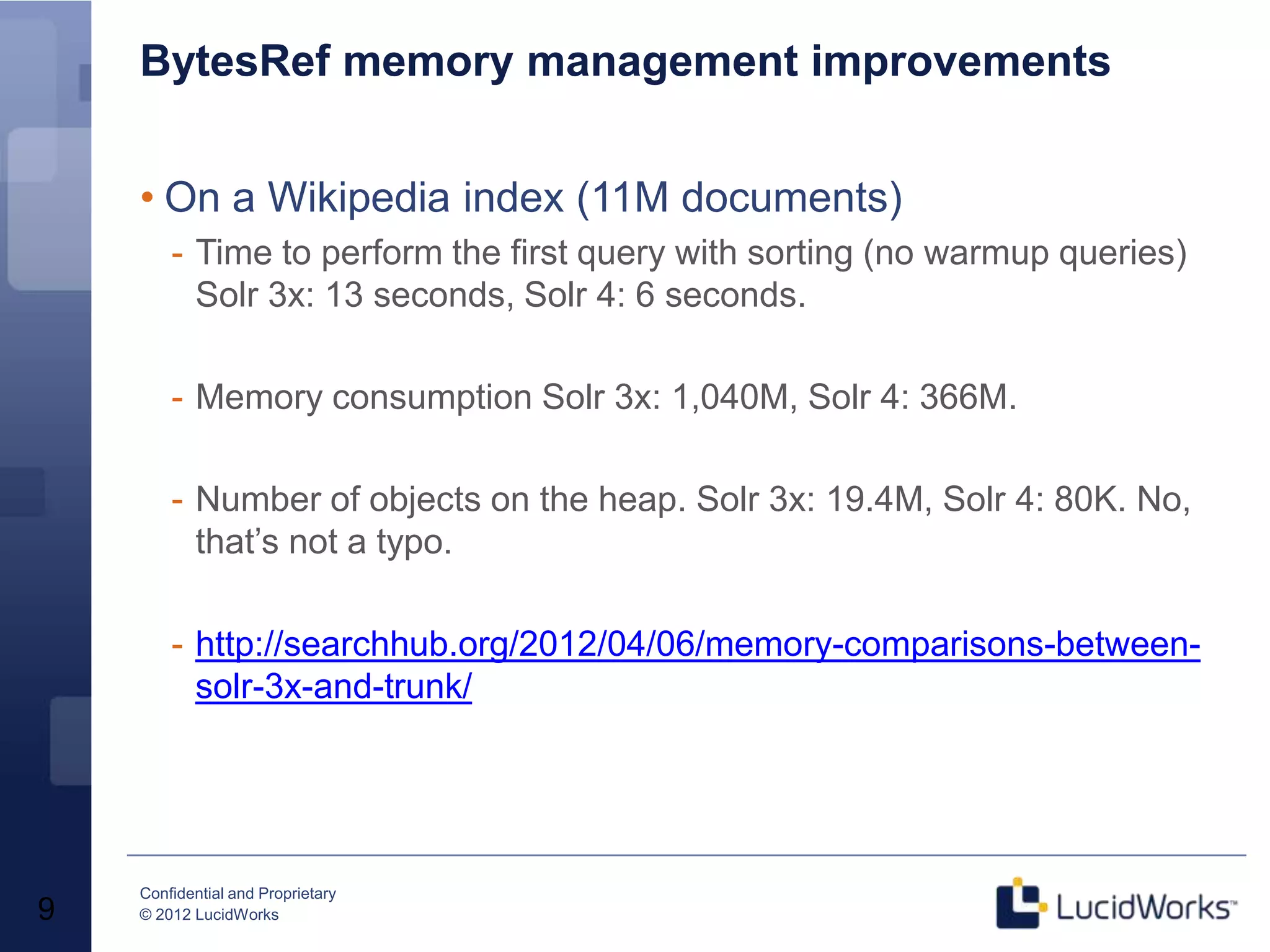
BytesRef memory management improvements


    • On a Wikipedia index (11M documents)
        - Time to perform the first query with sorting (no warmup queries)
          Solr 3x: 13 seconds, Solr 4: 6 seconds.

        - Memory consumption Solr 3x: 1,040M, Solr 4: 366M.

        - Number of objects on the heap. Solr 3x: 19.4M, Solr 4: 80K. No,
          that’s not a typo.

        - http://searchhub.org/2012/04/06/memory-comparisons-between-
          solr-3x-and-trunk/


    Confidential and Proprietary
9   © 2012 LucidWorks
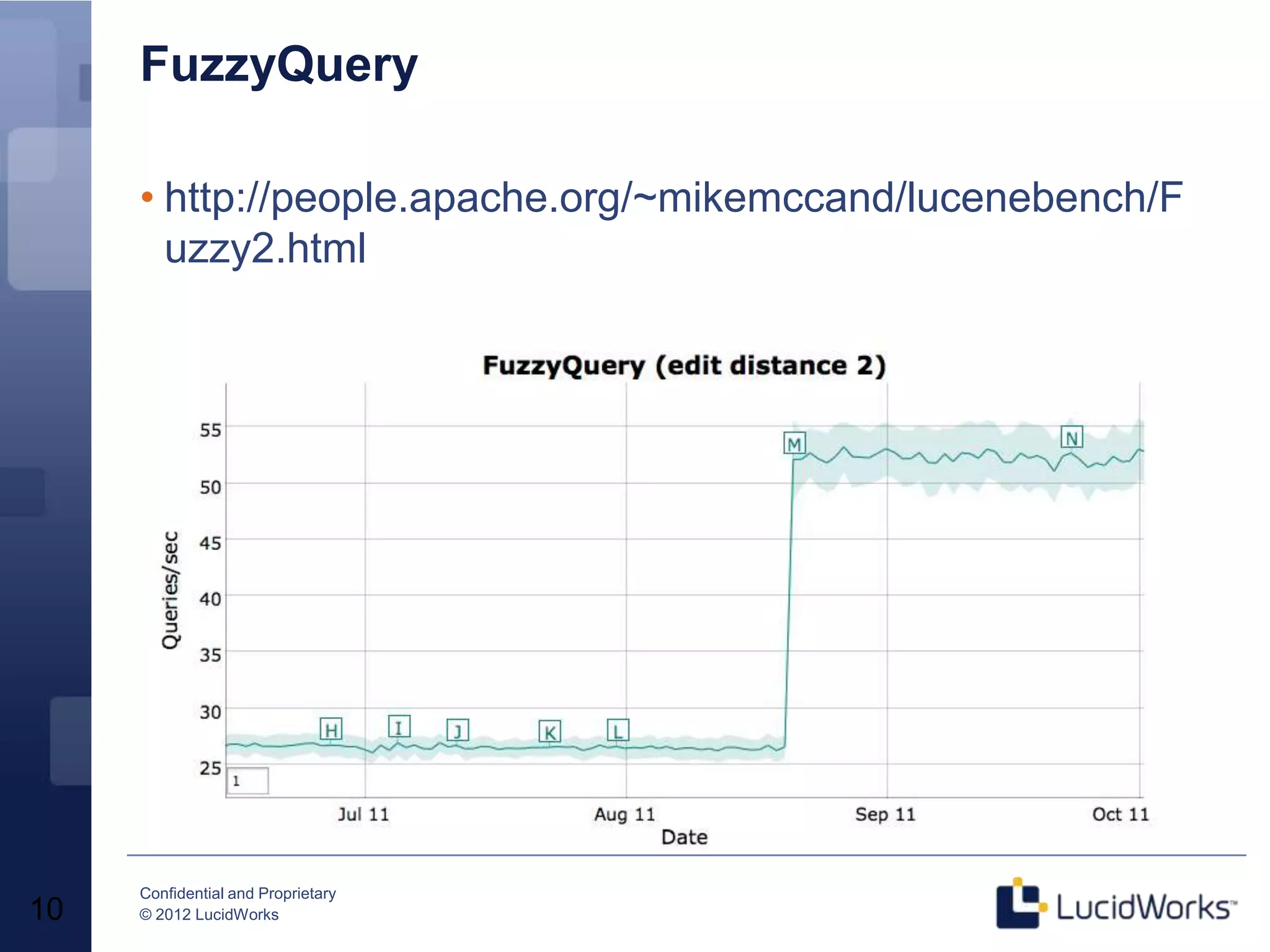
FuzzyQuery

     • http://people.apache.org/~mikemccand/lucenebench/F
       uzzy2.html


     Confidential and Proprietary
10   © 2012 LucidWorks
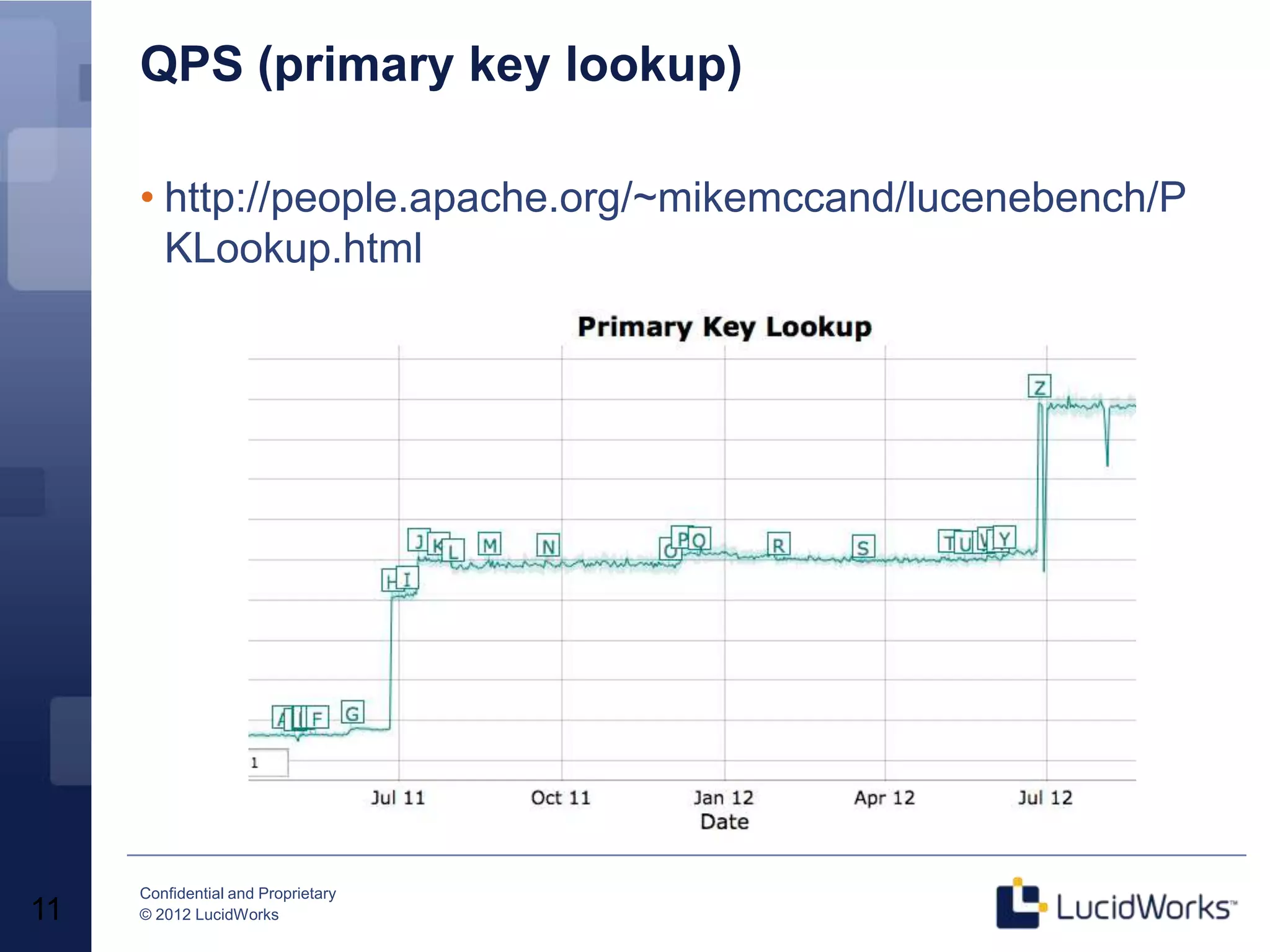
QPS (primary key lookup)

     • http://people.apache.org/~mikemccand/lucenebench/P
       KLookup.html


     Confidential and Proprietary
11   © 2012 LucidWorks
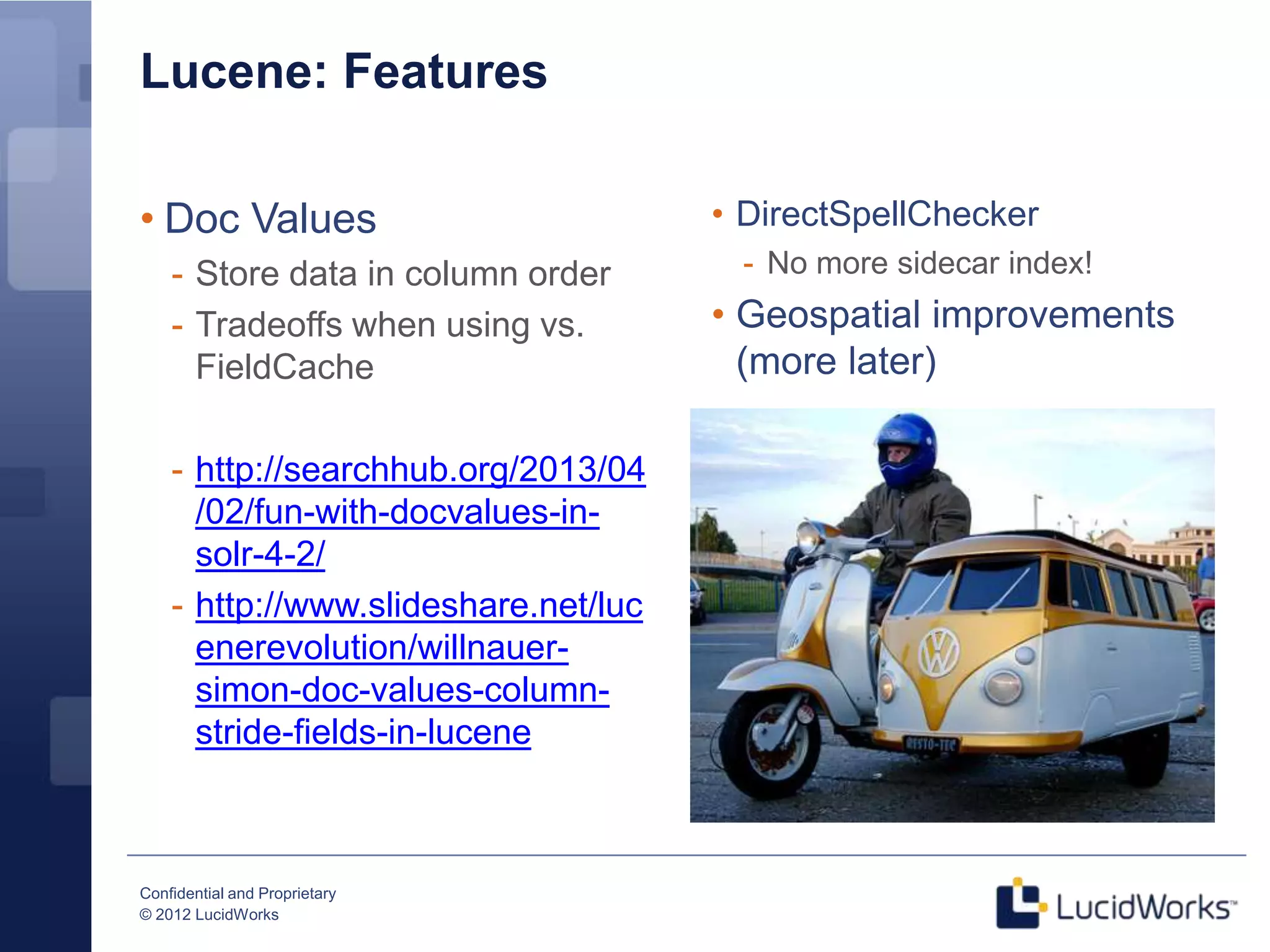
Lucene: Features

• Doc Values                          • DirectSpellChecker
    - Store data in column order       - No more sidecar index!
    - Tradeoffs when using vs.        • Geospatial improvements
      FieldCache                        (more later)

    - http://searchhub.org/2013/04
      /02/fun-with-docvalues-in-
      solr-4-2/
    - http://www.slideshare.net/luc
      enerevolution/willnauer-
      simon-doc-values-column-
      stride-fields-in-lucene


Confidential and Proprietary
© 2012 LucidWorks
Solr 4


Confidential © Copyright 2012
Solr 4: Features

• Search/Faceting/Relevance
    -   New Relevance Function Queries (tf, df, others)
    -   Pivot Faceting
    -   Pseudo-join
    -   DirectSpellChecker support
    -   Improved Spatial (more later)
• Indexing
    - New Update Processors, including scripting option
    - NRT
• Other
    - DocTransformer pluggability
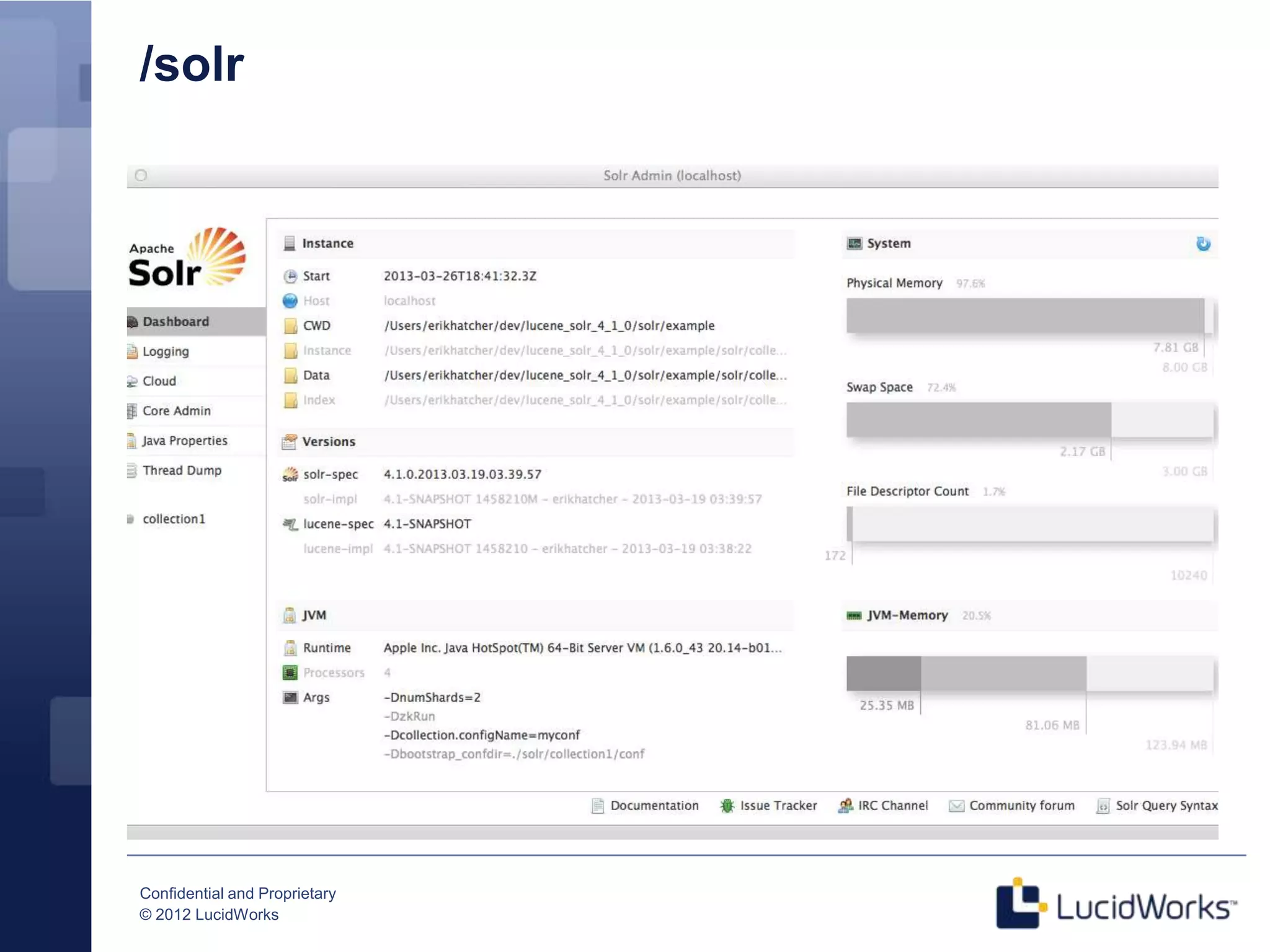
    - New Admin UI


Confidential and Proprietary
© 2012 LucidWorks
Geospatial improvements

• Multiple values per field
• Index shapes other than points (circles, polygons, etc)
• More complex interactions than point in a circle

• Indexing:
    - "geo”:”43.17614,-90.57341”
    - “geo”:”Circle(4.56,1.23 d=0.0710)”
    - “geo”:”POLYGON((-10 30, -40 40, -10 -20, 40 20, 0 0, -10 30))”
• Searching:
    - fq=geo:"Intersects(-74.093 41.042 -69.347 44.558)"
    - fq=geo:"Intersects(POLYGON((-10 30, -40 40, -10 -20, 40 20, 0
      0, -10 30)))”

Confidential and Proprietary
© 2012 LucidWorks
/solr


Confidential and Proprietary
© 2012 LucidWorks
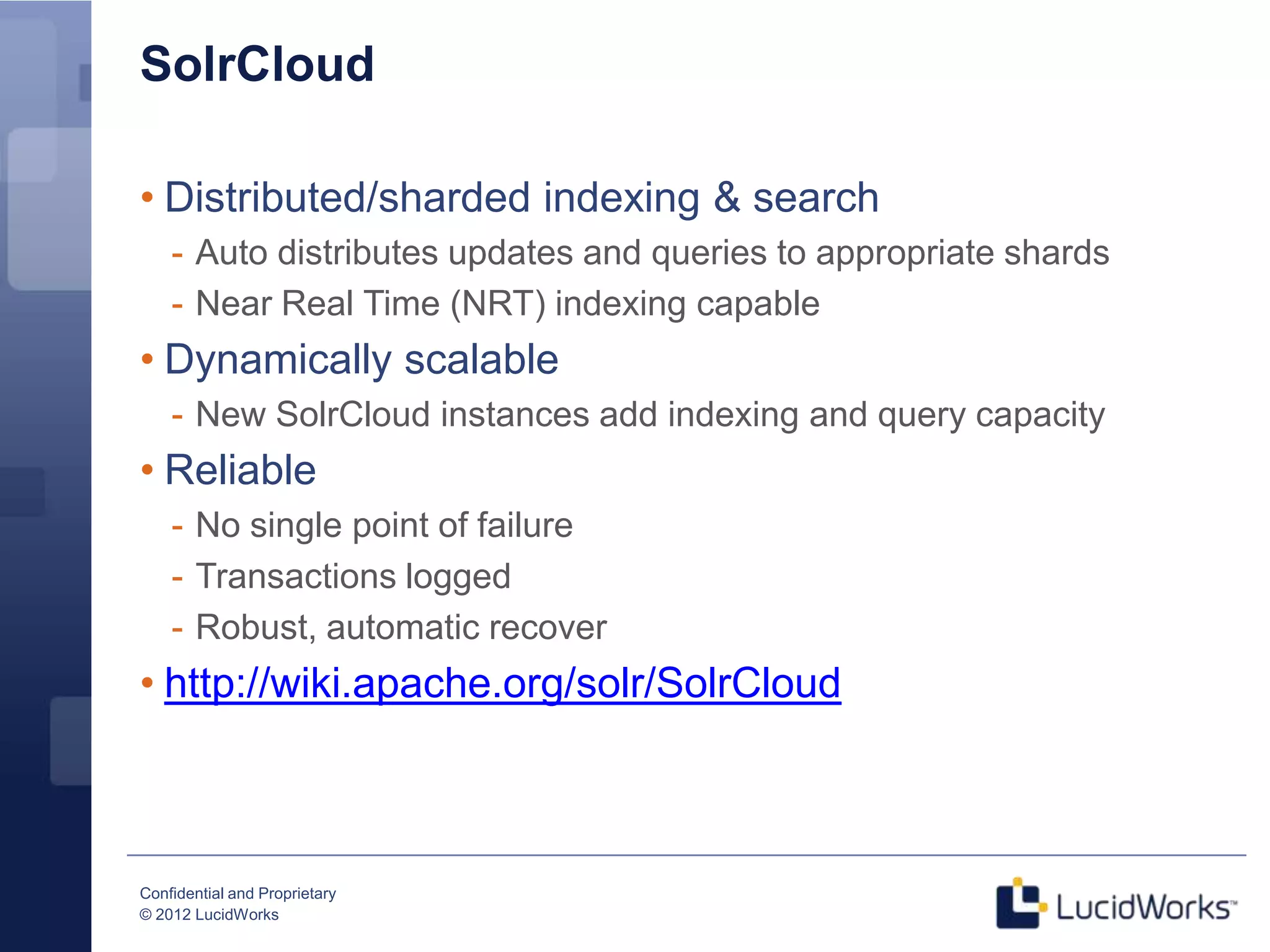
SolrCloud

• Distributed/sharded indexing & search
    - Auto distributes updates and queries to appropriate shards
    - Near Real Time (NRT) indexing capable
• Dynamically scalable
    - New SolrCloud instances add indexing and query capacity
• Reliable
    - No single point of failure
    - Transactions logged
    - Robust, automatic recover
• http://wiki.apache.org/solr/SolrCloud


Confidential and Proprietary
© 2012 LucidWorks
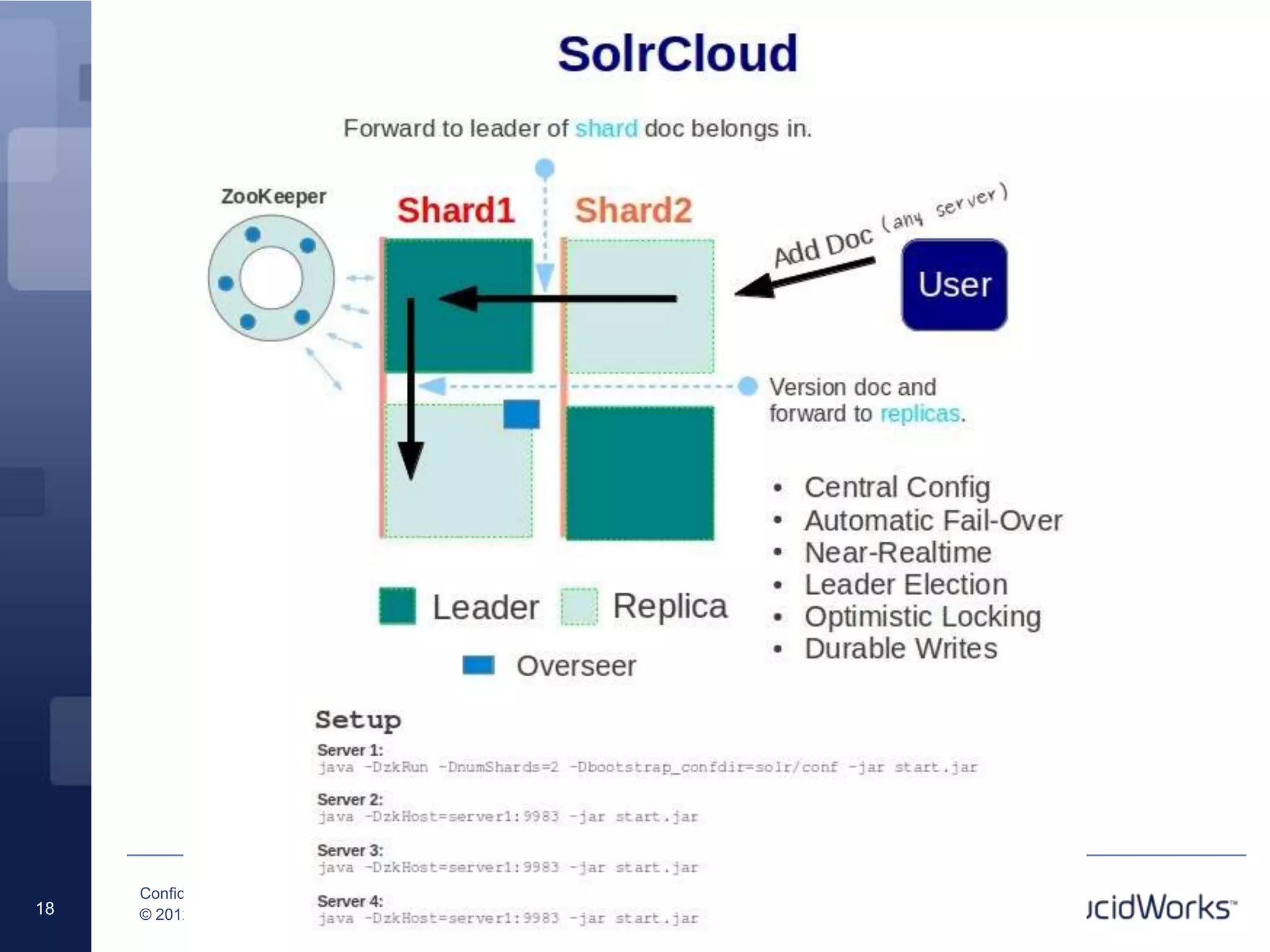
Confidential and Proprietary
18   © 2012 LucidWorks
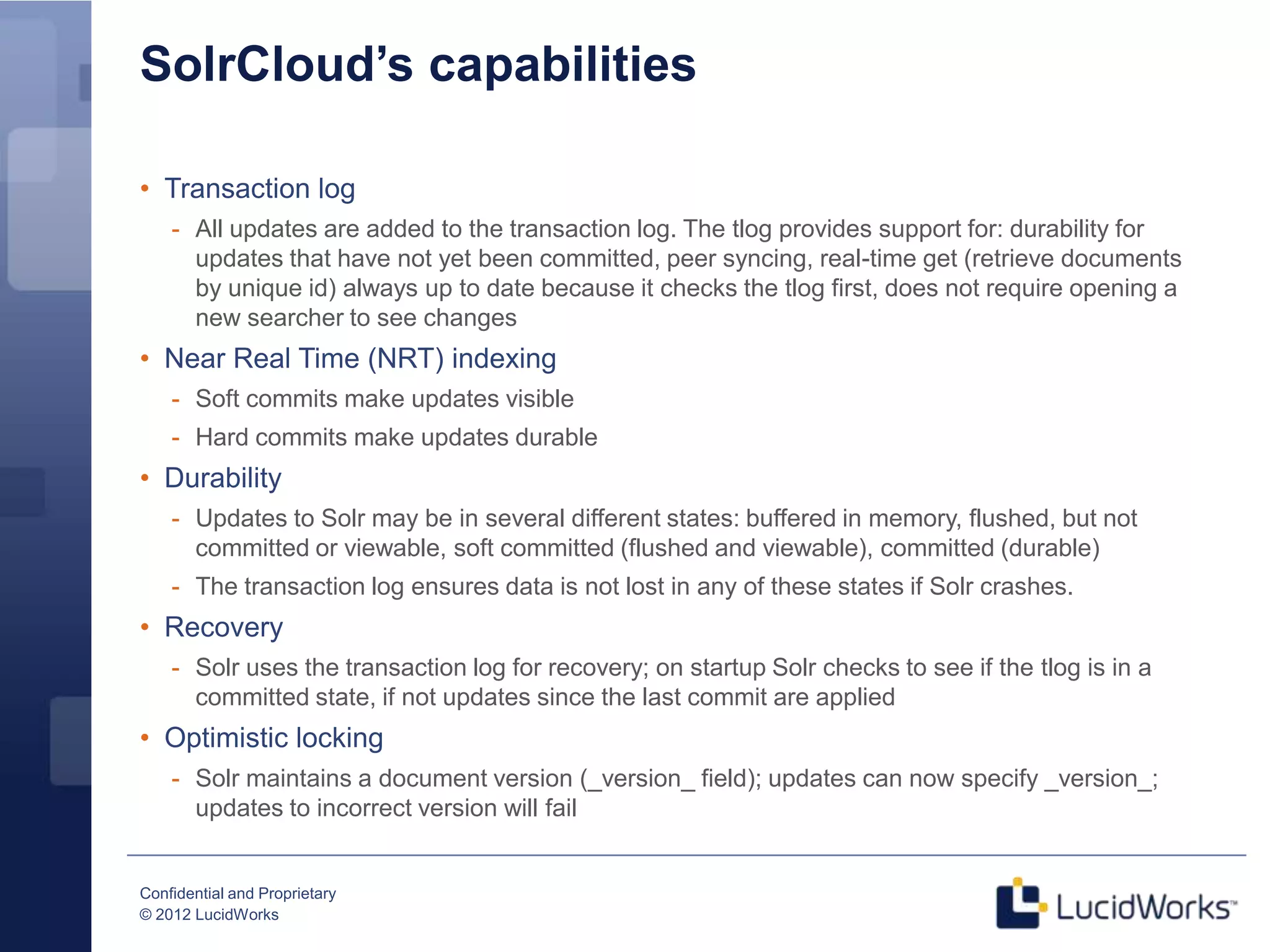
SolrCloud’s capabilities

• Transaction log
    - All updates are added to the transaction log. The tlog provides support for: durability for
      updates that have not yet been committed, peer syncing, real-time get (retrieve documents
      by unique id) always up to date because it checks the tlog first, does not require opening a
      new searcher to see changes
• Near Real Time (NRT) indexing
    - Soft commits make updates visible
    - Hard commits make updates durable
• Durability
    - Updates to Solr may be in several different states: buffered in memory, flushed, but not
      committed or viewable, soft committed (flushed and viewable), committed (durable)
    - The transaction log ensures data is not lost in any of these states if Solr crashes.
• Recovery
    - Solr uses the transaction log for recovery; on startup Solr checks to see if the tlog is in a
      committed state, if not updates since the last commit are applied
• Optimistic locking
    - Solr maintains a document version (_version_ field); updates can now specify _version_;
      updates to incorrect version will fail


Confidential and Proprietary
© 2012 LucidWorks
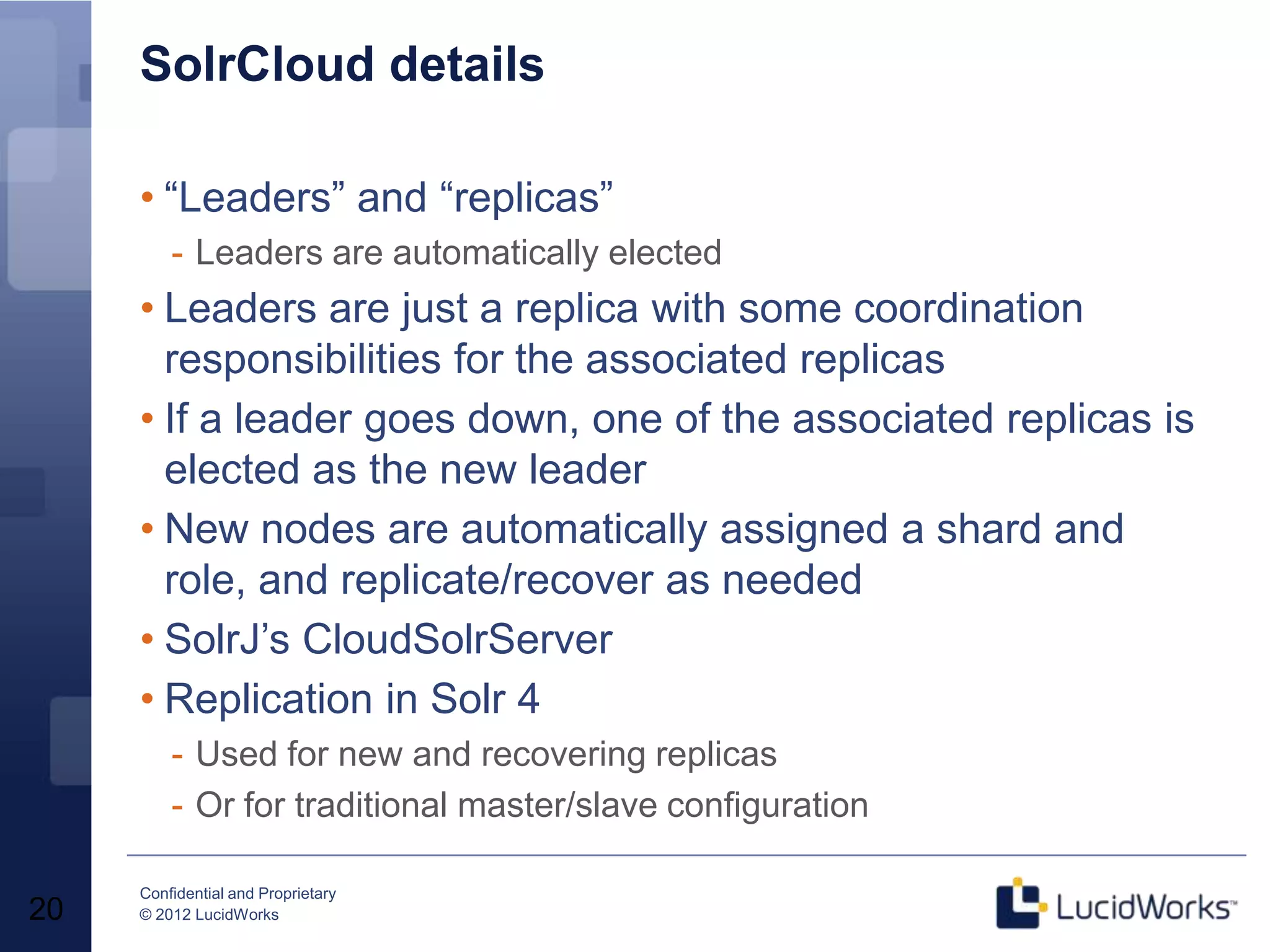
SolrCloud details

     • “Leaders” and “replicas”
         - Leaders are automatically elected
     • Leaders are just a replica with some coordination
       responsibilities for the associated replicas
     • If a leader goes down, one of the associated replicas is
       elected as the new leader
     • New nodes are automatically assigned a shard and
       role, and replicate/recover as needed
     • SolrJ’s CloudSolrServer
     • Replication in Solr 4
         - Used for new and recovering replicas
         - Or for traditional master/slave configuration

     Confidential and Proprietary
20   © 2012 LucidWorks
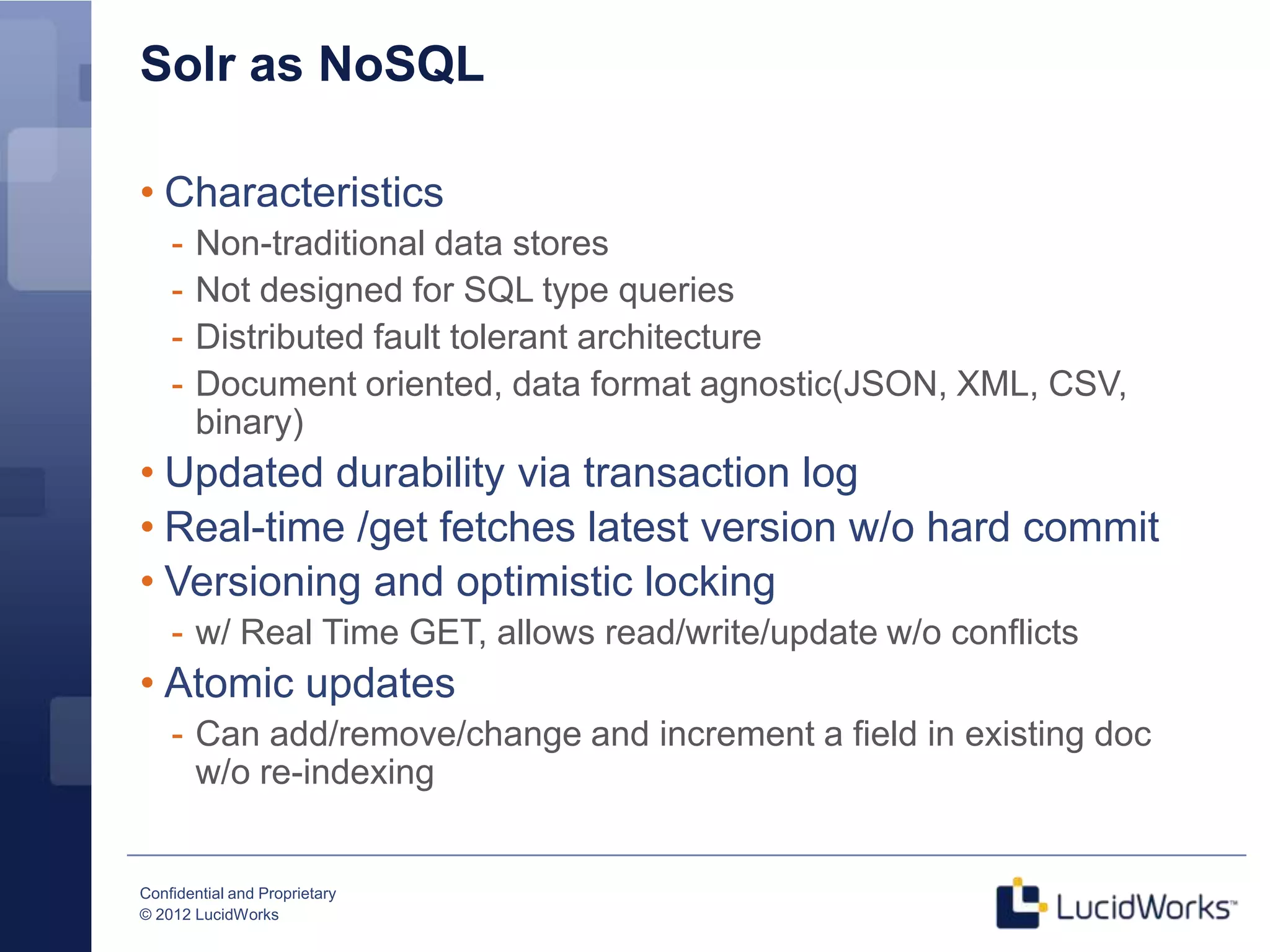
Solr as NoSQL

• Characteristics
    -   Non-traditional data stores
    -   Not designed for SQL type queries
    -   Distributed fault tolerant architecture
    -   Document oriented, data format agnostic(JSON, XML, CSV,
        binary)
• Updated durability via transaction log
• Real-time /get fetches latest version w/o hard commit
• Versioning and optimistic locking
    - w/ Real Time GET, allows read/write/update w/o conflicts
• Atomic updates
    - Can add/remove/change and increment a field in existing doc
      w/o re-indexing


Confidential and Proprietary
© 2012 LucidWorks
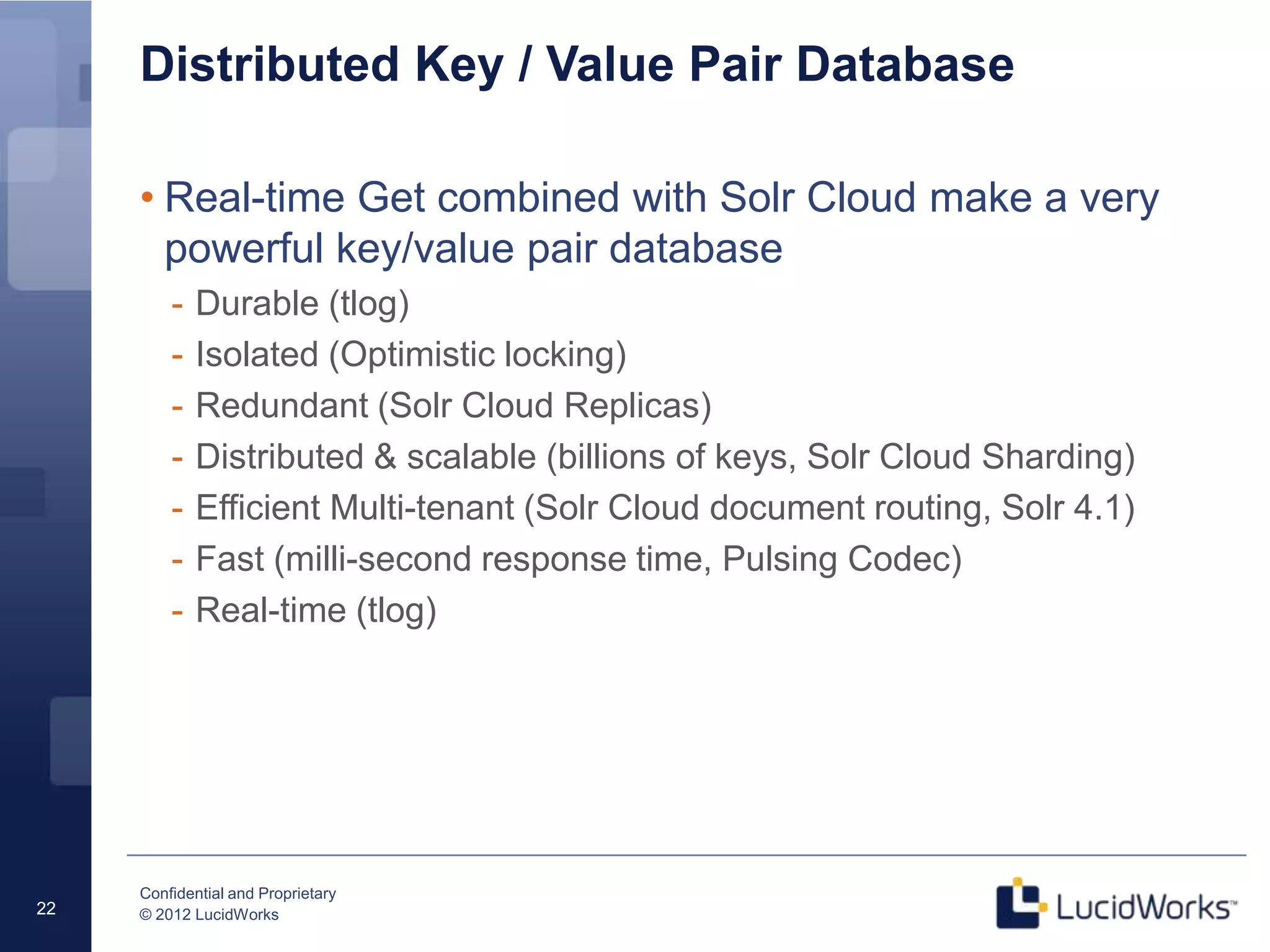
Distributed Key / Value Pair Database

     • Real-time Get combined with Solr Cloud make a very
       powerful key/value pair database
         -   Durable (tlog)
         -   Isolated (Optimistic locking)
         -   Redundant (Solr Cloud Replicas)
         -   Distributed & scalable (billions of keys, Solr Cloud Sharding)
         -   Efficient Multi-tenant (Solr Cloud document routing, Solr 4.1)
         -   Fast (milli-second response time, Pulsing Codec)
         -   Real-time (tlog)


     Confidential and Proprietary
22   © 2012 LucidWorks
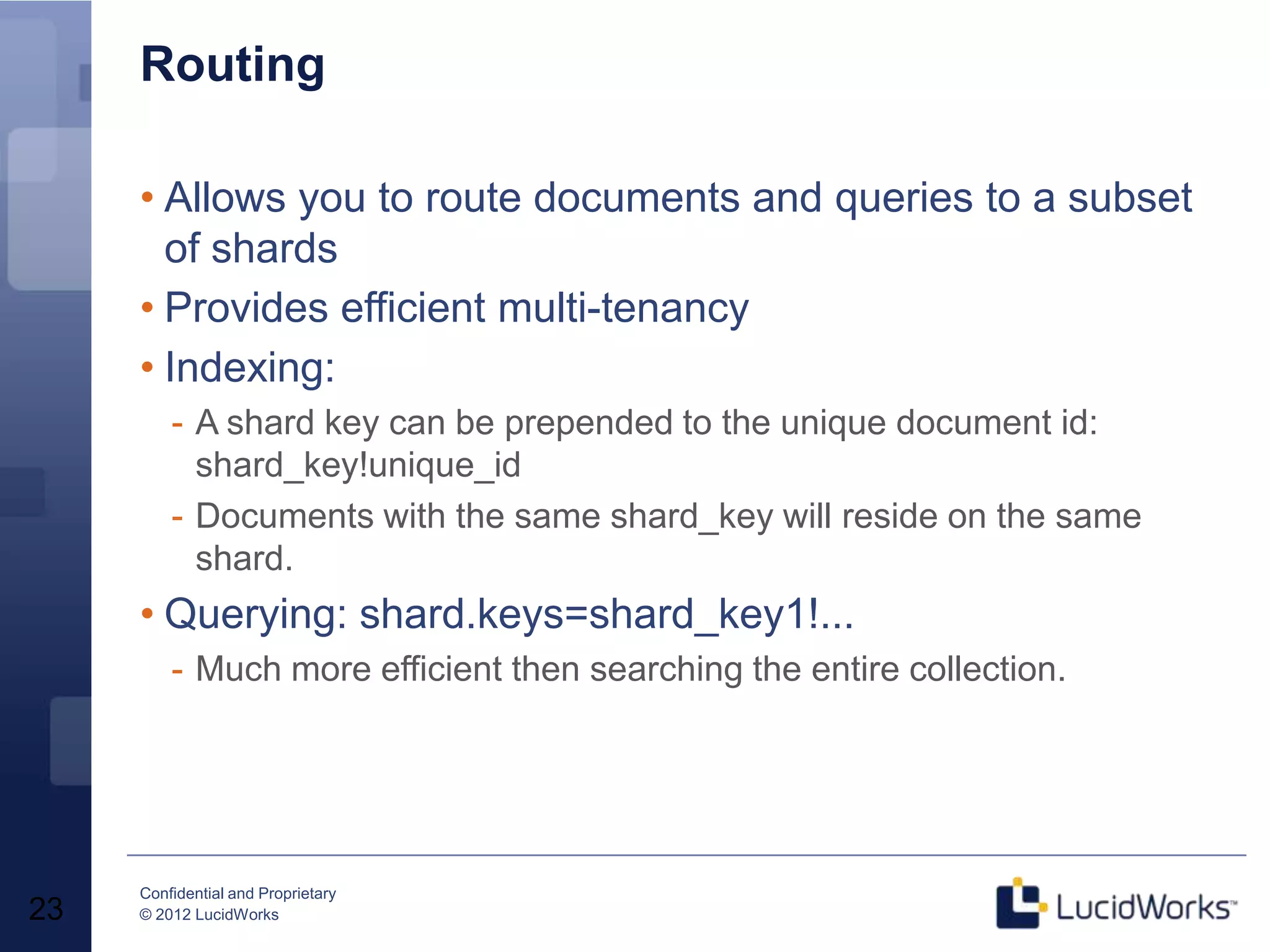
Routing

     • Allows you to route documents and queries to a subset
       of shards
     • Provides efficient multi-tenancy
     • Indexing:
         - A shard key can be prepended to the unique document id:
           shard_key!unique_id
         - Documents with the same shard_key will reside on the same
           shard.
     • Querying: shard.keys=shard_key1!...
         - Much more efficient then searching the entire collection.


     Confidential and Proprietary
23   © 2012 LucidWorks
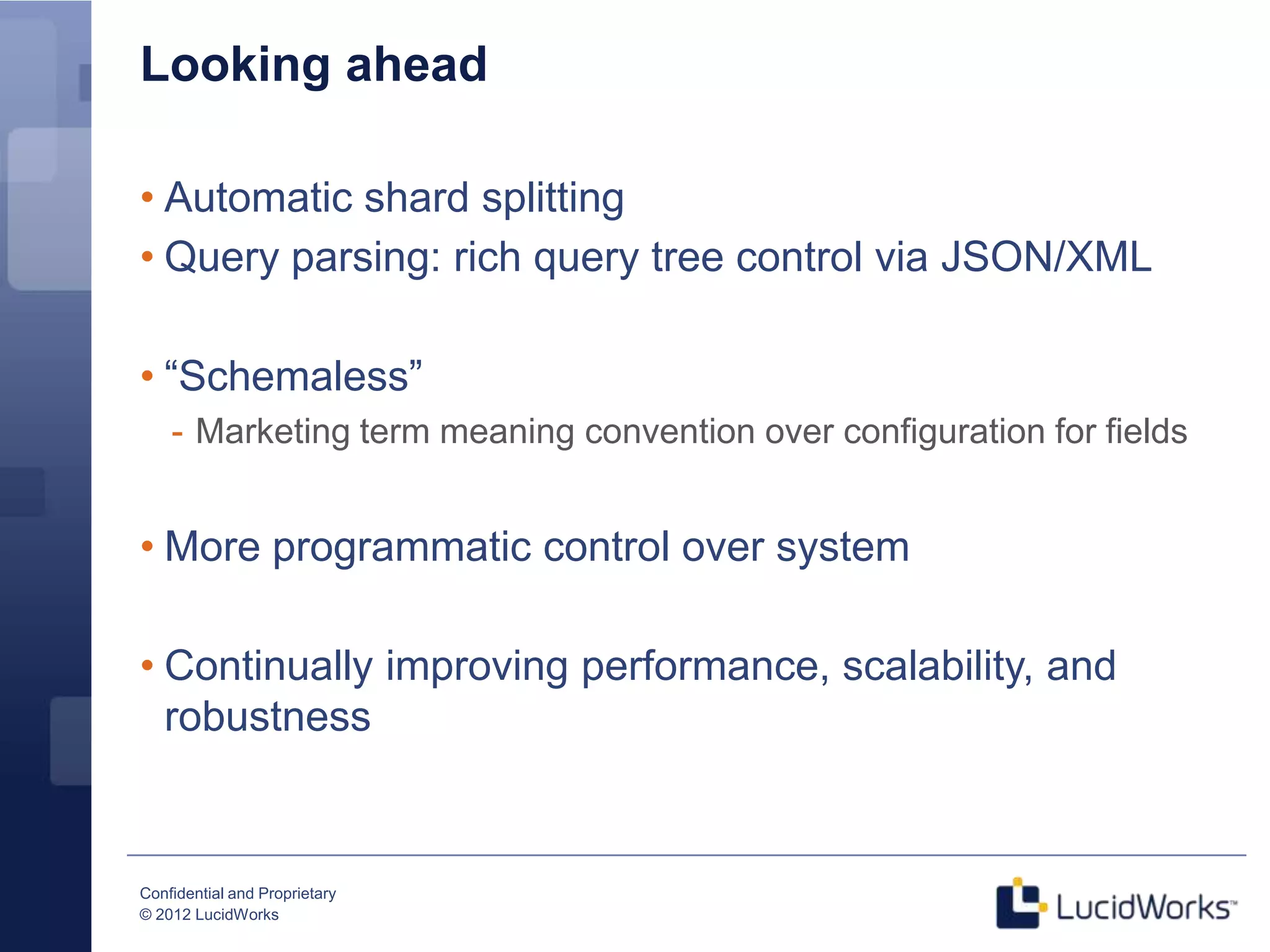
Looking ahead

• Automatic shard splitting
• Query parsing: rich query tree control via JSON/XML

• “Schemaless”
    - Marketing term meaning convention over configuration for fields


• More programmatic control over system

• Continually improving performance, scalability, and
  robustness


Confidential and Proprietary
© 2012 LucidWorks
• Want to learn more?

     • Join us in San Diego April 29 – May 2, 2013

     • http://lucenerevolution.org/

     • http://lucenerevolution.org/2013/agenda


     Confidential and Proprietary
25   © 2012 LucidWorks
Resources

• Lucene/Solr
    - http://lucene.apache.org


• Me
    - @gsingers, grant@lucidworks.com
    - http://www.manning.com/ingersoll


• Company
    - http://www.lucidworks.com
    - http://www.searchhub.org
    - Products, Support, Training on and around Lucene and Solr


Confidential and Proprietary
© 2012 LucidWorks

What's new in Lucene and Solr 4.x

  • 1.
    luceneSolr = new LuceneSolr(4.x) Grant Ingersoll CTO, LucidWorks Confidential © Copyright 2012
  • 2.
    Search is dead,long live search • Embrace fuzziness! • Search is a system building block • If the algorithms fit, use them! • Search use leads to search abuse - Denormalization frees your mind - Scoring is just a sparse matrix multiply http://cheezburger.com/5243950080 • Scoring features are everywhere Confidential and Proprietary 2 © 2012 LucidWorks
  • 3.
    Search (R)evolution • “T’ain’tyour father’s search engine” - Non free text usages abound • NoSQL before NoSQL was cool - Many DB-like features • Flexibility during indexing and scoring • Finite State Transducers FTW! • Scale Confidential and Proprietary © 2012 LucidWorks
  • 4.
    Agenda • What’s newIn Lucene 4? • What’s new in Solr 4? • Sneak Peek: what’s ahead? Confidential and Proprietary © 2012 LucidWorks
  • 5.
  • 6.
    Up and tothe Right • http://people.apache.org/~mikemccand/lucenebench/in dexing.html Confidential and Proprietary 6 © 2012 LucidWorks
  • 7.
    Lucene: Flexibility • FlexibleIndex Formats - New posting list codecs: Block, Simple Text, Append (HDFS..), etc - Pulsing codec: improves performance of primary key searches, inlining docs, positions, and payloads, saves disk seeks • Pluggable Scoring - Decoupled from TF/IDF - Built in alternatives include BM25 & DFR » http://en.wikipedia.org/wiki/Okapi_BM25 » http://terrier.org/docs/v3.5/dfr_description.html Confidential and Proprietary © 2012 LucidWorks
  • 8.
    Lucene: Speed andMemory • Native Near Real Time (NRT) support - Per segment - FieldCache can be controlled to only load new segments • Soft commit - Faster without fsync, allows quicker update visibility • DWPT (Document Writer per Thread) - Faster more consistent index speed • Faster fuzzy & wildcard query processing - Higher performance searching • String -> BytesRef - Much improved data structure - … means less memory and less garbage collection effort Confidential and Proprietary © 2012 LucidWorks
  • 9.
    BytesRef memory managementimprovements • On a Wikipedia index (11M documents) - Time to perform the first query with sorting (no warmup queries) Solr 3x: 13 seconds, Solr 4: 6 seconds. - Memory consumption Solr 3x: 1,040M, Solr 4: 366M. - Number of objects on the heap. Solr 3x: 19.4M, Solr 4: 80K. No, that’s not a typo. - http://searchhub.org/2012/04/06/memory-comparisons-between- solr-3x-and-trunk/ Confidential and Proprietary 9 © 2012 LucidWorks
  • 10.
    FuzzyQuery • http://people.apache.org/~mikemccand/lucenebench/F uzzy2.html Confidential and Proprietary 10 © 2012 LucidWorks
  • 11.
    QPS (primary keylookup) • http://people.apache.org/~mikemccand/lucenebench/P KLookup.html Confidential and Proprietary 11 © 2012 LucidWorks
  • 12.
    Lucene: Features • DocValues • DirectSpellChecker - Store data in column order - No more sidecar index! - Tradeoffs when using vs. • Geospatial improvements FieldCache (more later) - http://searchhub.org/2013/04 /02/fun-with-docvalues-in- solr-4-2/ - http://www.slideshare.net/luc enerevolution/willnauer- simon-doc-values-column- stride-fields-in-lucene Confidential and Proprietary © 2012 LucidWorks
  • 13.
    Solr 4 Confidential ©Copyright 2012
  • 14.
    Solr 4: Features •Search/Faceting/Relevance - New Relevance Function Queries (tf, df, others) - Pivot Faceting - Pseudo-join - DirectSpellChecker support - Improved Spatial (more later) • Indexing - New Update Processors, including scripting option - NRT • Other - DocTransformer pluggability - New Admin UI Confidential and Proprietary © 2012 LucidWorks
  • 15.
    Geospatial improvements • Multiplevalues per field • Index shapes other than points (circles, polygons, etc) • More complex interactions than point in a circle • Indexing: - "geo”:”43.17614,-90.57341” - “geo”:”Circle(4.56,1.23 d=0.0710)” - “geo”:”POLYGON((-10 30, -40 40, -10 -20, 40 20, 0 0, -10 30))” • Searching: - fq=geo:"Intersects(-74.093 41.042 -69.347 44.558)" - fq=geo:"Intersects(POLYGON((-10 30, -40 40, -10 -20, 40 20, 0 0, -10 30)))” Confidential and Proprietary © 2012 LucidWorks
  • 16.
  • 17.
    SolrCloud • Distributed/sharded indexing& search - Auto distributes updates and queries to appropriate shards - Near Real Time (NRT) indexing capable • Dynamically scalable - New SolrCloud instances add indexing and query capacity • Reliable - No single point of failure - Transactions logged - Robust, automatic recover • http://wiki.apache.org/solr/SolrCloud Confidential and Proprietary © 2012 LucidWorks
  • 18.
  • 19.
    SolrCloud’s capabilities • Transactionlog - All updates are added to the transaction log. The tlog provides support for: durability for updates that have not yet been committed, peer syncing, real-time get (retrieve documents by unique id) always up to date because it checks the tlog first, does not require opening a new searcher to see changes • Near Real Time (NRT) indexing - Soft commits make updates visible - Hard commits make updates durable • Durability - Updates to Solr may be in several different states: buffered in memory, flushed, but not committed or viewable, soft committed (flushed and viewable), committed (durable) - The transaction log ensures data is not lost in any of these states if Solr crashes. • Recovery - Solr uses the transaction log for recovery; on startup Solr checks to see if the tlog is in a committed state, if not updates since the last commit are applied • Optimistic locking - Solr maintains a document version (_version_ field); updates can now specify _version_; updates to incorrect version will fail Confidential and Proprietary © 2012 LucidWorks
  • 20.
    SolrCloud details • “Leaders” and “replicas” - Leaders are automatically elected • Leaders are just a replica with some coordination responsibilities for the associated replicas • If a leader goes down, one of the associated replicas is elected as the new leader • New nodes are automatically assigned a shard and role, and replicate/recover as needed • SolrJ’s CloudSolrServer • Replication in Solr 4 - Used for new and recovering replicas - Or for traditional master/slave configuration Confidential and Proprietary 20 © 2012 LucidWorks
  • 21.
    Solr as NoSQL •Characteristics - Non-traditional data stores - Not designed for SQL type queries - Distributed fault tolerant architecture - Document oriented, data format agnostic(JSON, XML, CSV, binary) • Updated durability via transaction log • Real-time /get fetches latest version w/o hard commit • Versioning and optimistic locking - w/ Real Time GET, allows read/write/update w/o conflicts • Atomic updates - Can add/remove/change and increment a field in existing doc w/o re-indexing Confidential and Proprietary © 2012 LucidWorks
  • 22.
    Distributed Key /Value Pair Database • Real-time Get combined with Solr Cloud make a very powerful key/value pair database - Durable (tlog) - Isolated (Optimistic locking) - Redundant (Solr Cloud Replicas) - Distributed & scalable (billions of keys, Solr Cloud Sharding) - Efficient Multi-tenant (Solr Cloud document routing, Solr 4.1) - Fast (milli-second response time, Pulsing Codec) - Real-time (tlog) Confidential and Proprietary 22 © 2012 LucidWorks
  • 23.
    Routing • Allows you to route documents and queries to a subset of shards • Provides efficient multi-tenancy • Indexing: - A shard key can be prepended to the unique document id: shard_key!unique_id - Documents with the same shard_key will reside on the same shard. • Querying: shard.keys=shard_key1!... - Much more efficient then searching the entire collection. Confidential and Proprietary 23 © 2012 LucidWorks
  • 24.
    Looking ahead • Automaticshard splitting • Query parsing: rich query tree control via JSON/XML • “Schemaless” - Marketing term meaning convention over configuration for fields • More programmatic control over system • Continually improving performance, scalability, and robustness Confidential and Proprietary © 2012 LucidWorks
  • 25.
    • Want tolearn more? • Join us in San Diego April 29 – May 2, 2013 • http://lucenerevolution.org/ • http://lucenerevolution.org/2013/agenda Confidential and Proprietary 25 © 2012 LucidWorks
  • 26.
    Resources • Lucene/Solr - http://lucene.apache.org • Me - @gsingers, grant@lucidworks.com - http://www.manning.com/ingersoll • Company - http://www.lucidworks.com - http://www.searchhub.org - Products, Support, Training on and around Lucene and Solr Confidential and Proprietary © 2012 LucidWorks

Editor's Notes

  • #3 Search Abuse Can discuss how I started just doing free text, but then a curious thing happened, started to see people using the engine for things like: key/value, denormalized DBs, browsing engines, plagiarism detection, teaching languages, record linkage and much, much more
  • #4 Search has added more DB features over the yearsTED: We need to introduce the idea of *REVOLUTION* somewhere in here.
  • #13 Okapi BM25 & DFR divergence from randomness
  • #18 Power users are often more likely to recoverTools for recovery:Auto-suggest, related searches, spelling suggestions
  • #22 CharacteristicsConflicts from other clients
  • #25 Power users are often more likely to recoverTools for recovery:Auto-suggest, related searches, spelling suggestions
  • #26 Thanks, LinkedIn for sponsoring!