Promoters are regions of DNA located near gene transcription start sites that initiate gene transcription. There are two main types of promoters based on their CG content: high CG content promoters associated with constitutively expressed genes, and low CG content promoters associated with tissue-specific genes. Bidirectional promoters simultaneously control pairs of genes on opposite DNA strands that are coexpressed. Promoters can be constitutive and initiate transcription in all tissues, inducible and require biotic/abiotic factors, or tissue-specific and active only in certain tissues.
Introduction of Fawad Kaleem and presentation title.
Promoters initiate gene transcription; types include bidirectional, core, and regulatory elements.Core promoters and regulatory sequences like enhancers and silencers; their roles in transcription control.
High CpG (HCG) promoters vs. average genome promoters; methylation effects on transcription regulation.
Genes controlled by bidirectional promoters; coexpression; lack of length-expression correlation.
Includes constitutive, inducible, tissue-specific, and synthetic promoters with examples and functions.
General descriptionof promoters ( structure,
function)
types of promoters based on CG content
Bidirectional promoters
General types of Promoters
3.
a promoteris a region of DNA that initiates transcription of a
particular gene.
Promoters are located near the transcription start sites of
genes, on the same strand and upstream on the DNA
(towards the 5' region of the sense strand).
Promoters can be about 100–1000 base pairs long
5.
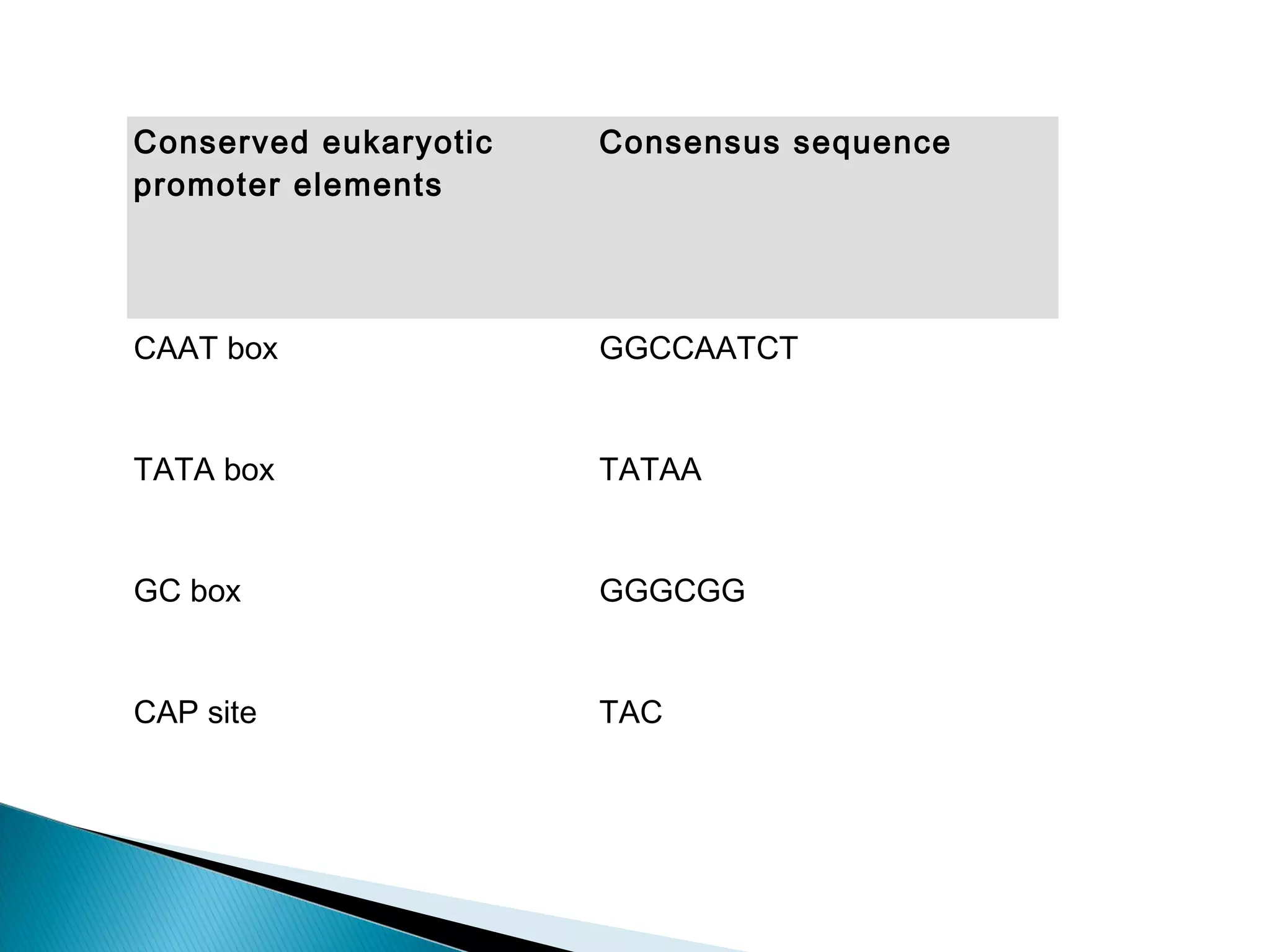
Conserved eukaryotic
promoterelements
Consensus sequence
CAAT box GGCCAATCT
TATA box TATAA
GC box GGGCGG
CAP site TAC
6.
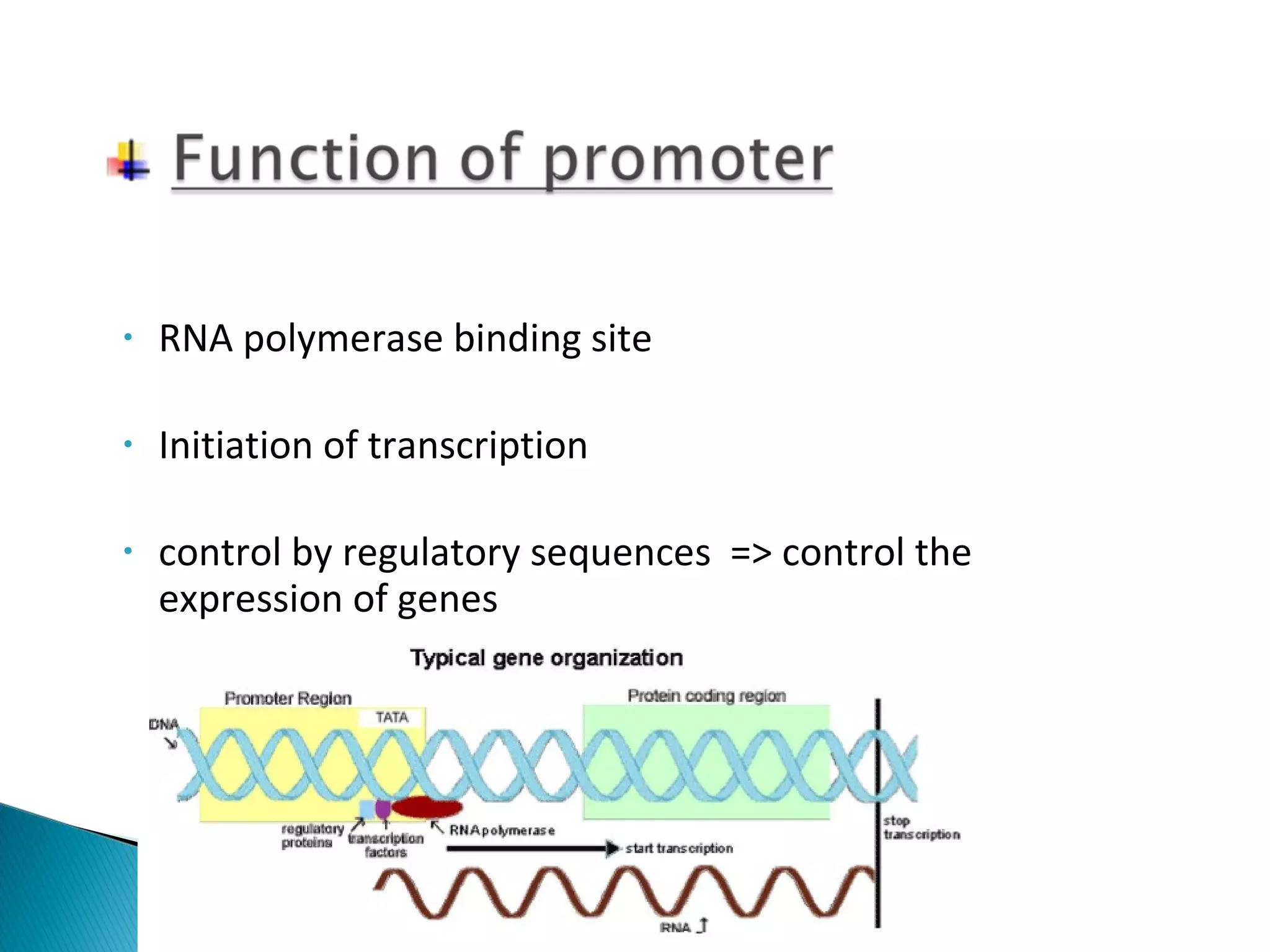
• RNA polymerasebinding site
• Initiation of transcription
• control by regulatory sequences => control the
expression of genes
7.
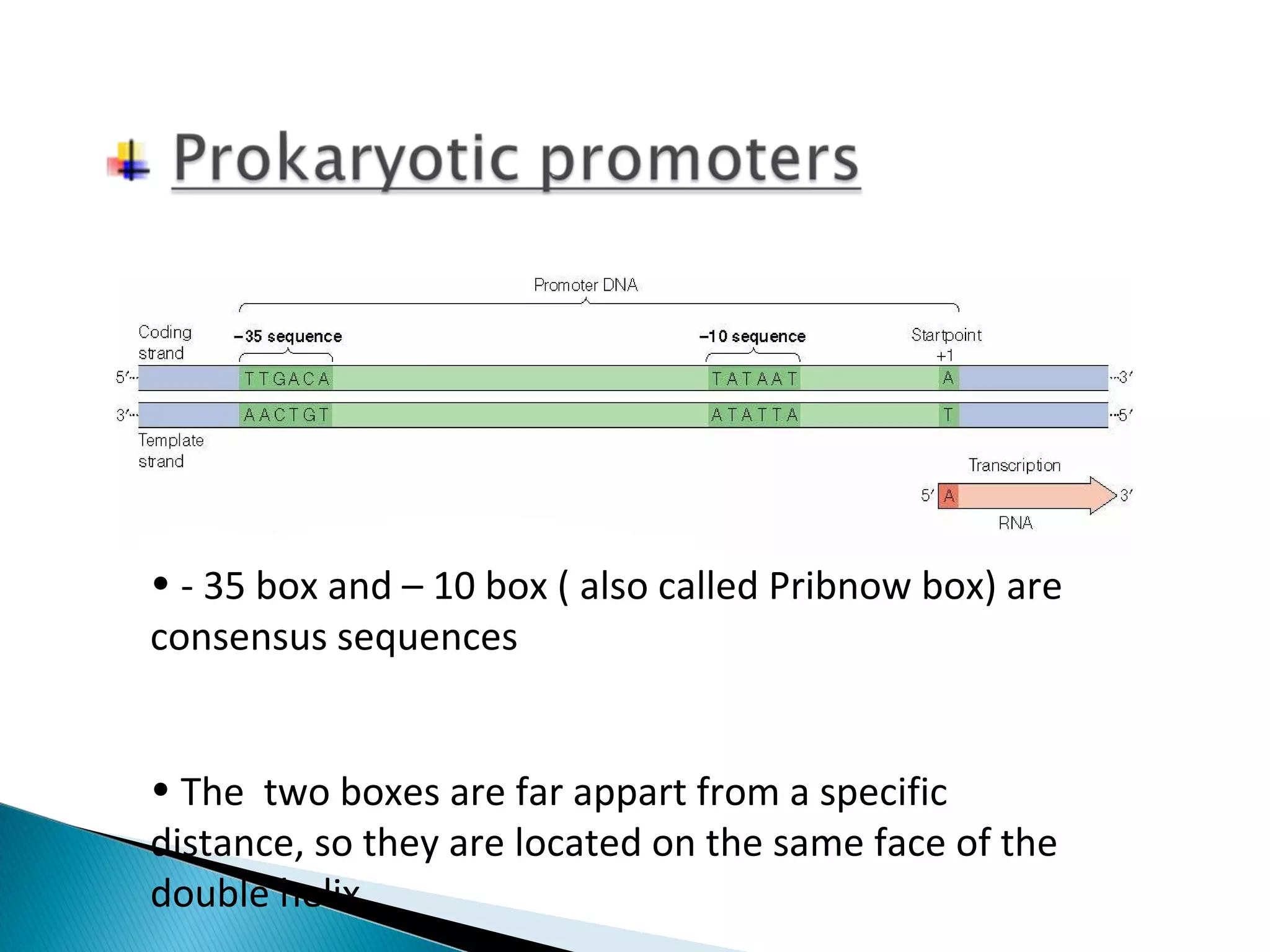
• - 35box and – 10 box ( also called Pribnow box) are
consensus sequences
• The two boxes are far appart from a specific
distance, so they are located on the same face of the
double helix.
8.
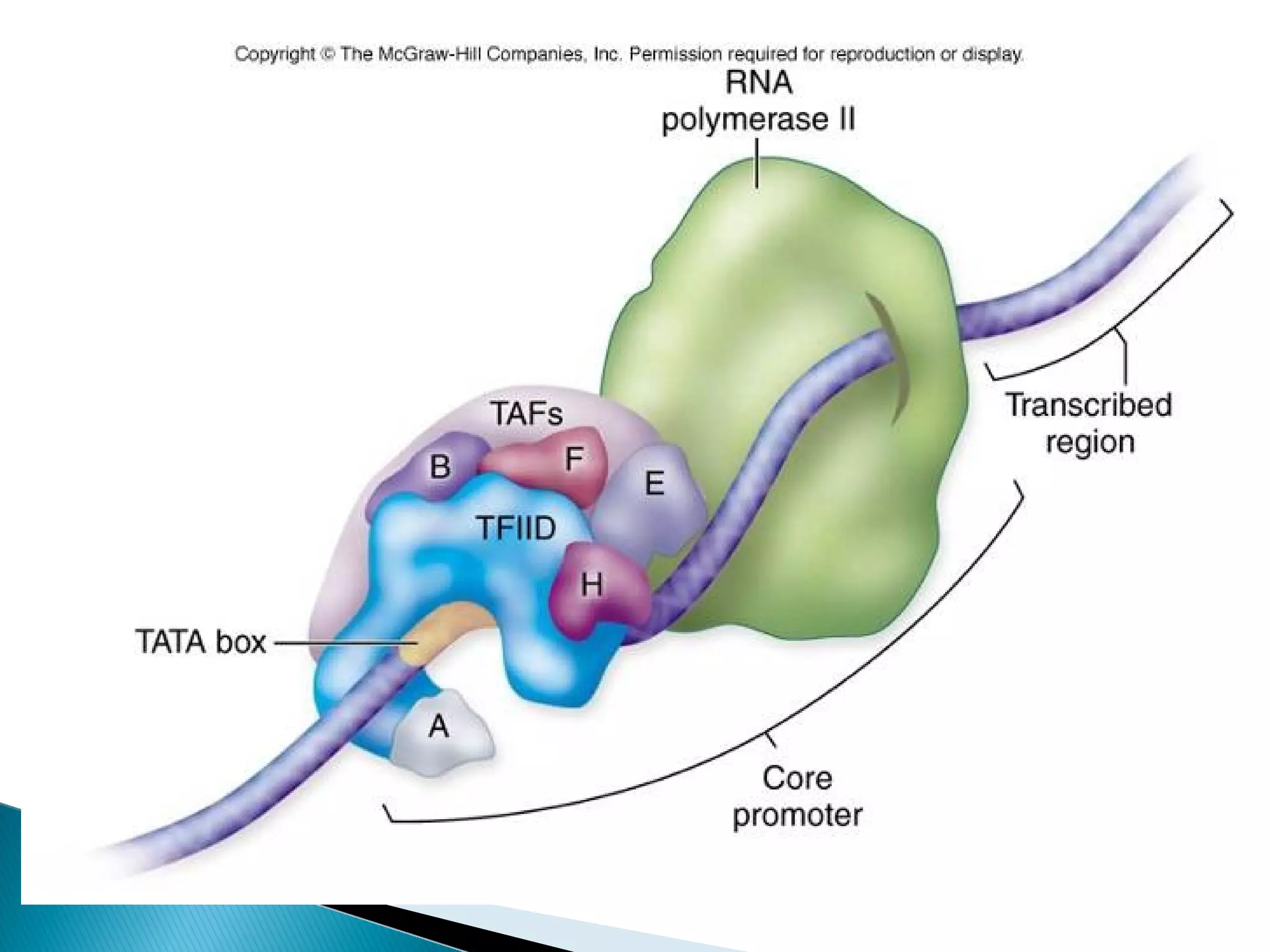
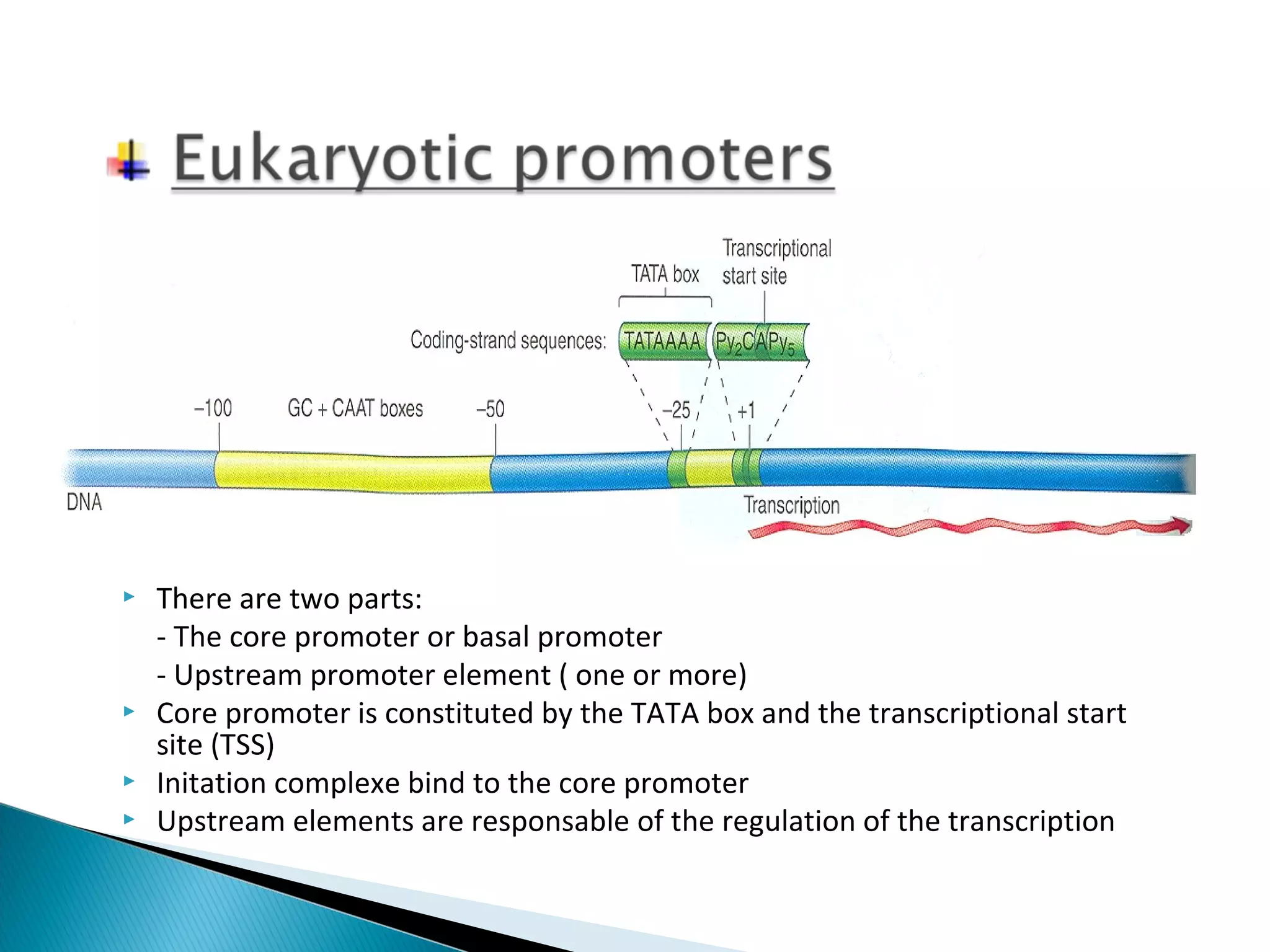
There aretwo parts:
- The core promoter or basal promoter
- Upstream promoter element ( one or more)
Core promoter is constituted by the TATA box and the transcriptional start
site (TSS)
Initation complexe bind to the core promoter
Upstream elements are responsable of the regulation of the transcription
9.
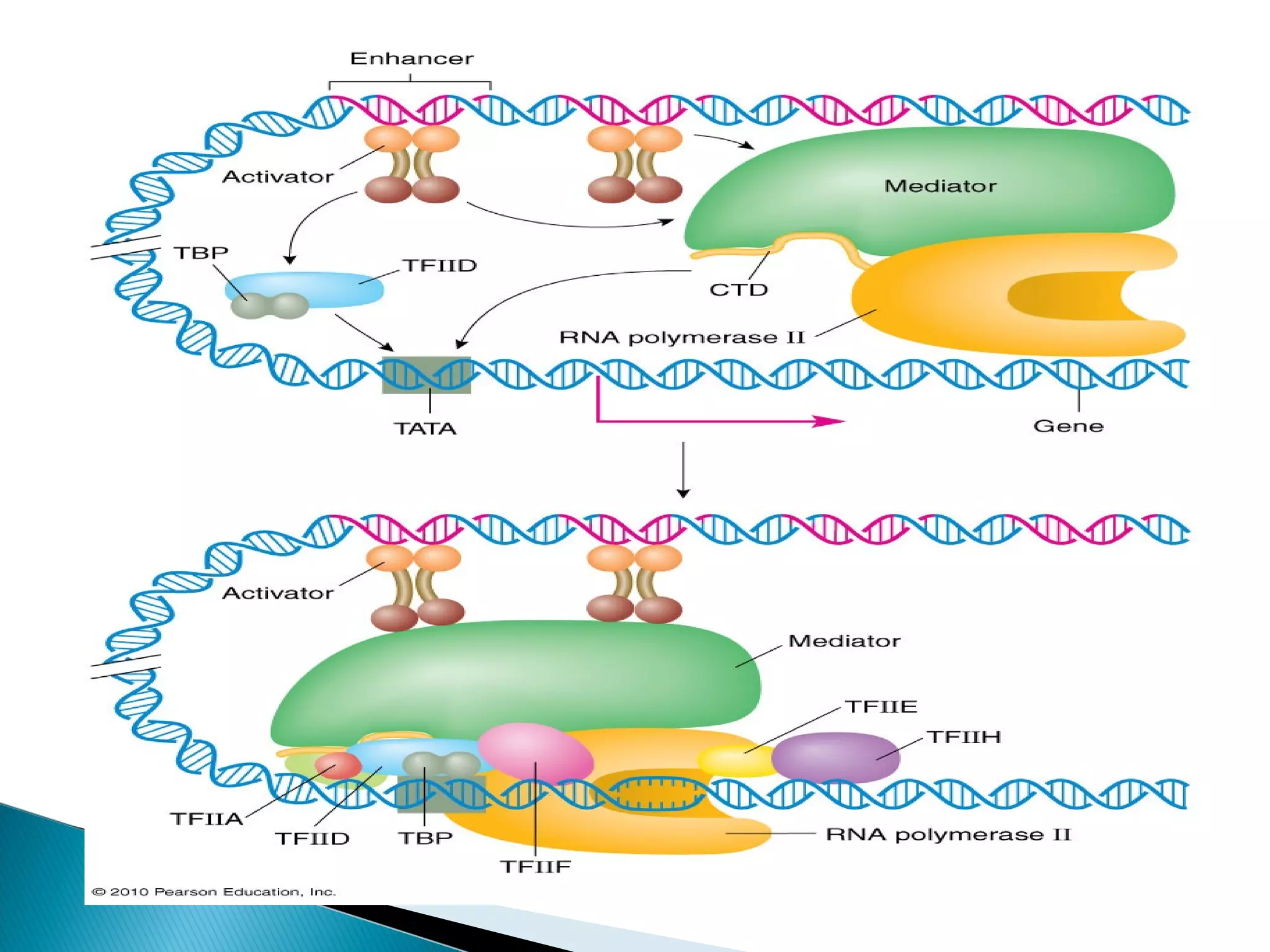
• Two categoriesof regulatory sequences:
- Activating sequences= Enhancers
- Repressing sequences = Silencers
• In Prokaryotes, regulatory sequences are located around the
promoter
• In Eukaryotes, regulatory sequences are often upstream the
promoter at about 100 bp away, but sometime they are far away
(several thousand nucleotides) or they can also be dowstream
from the promoter
11.
CpG =Cytosine followed by a Guanine ( linked together by a phosphate)
CpG island = regions of the DNA which have a high concentration of CpG
Based on CpG content, there are two types of promoters:
- with high CpG content ( called HCG) = 72%
- CpG content characteristic of averall genome = 28%
In HCG, the CpG region is symetric and peaks aroud the core promoter
(specially around the TSS).
12.
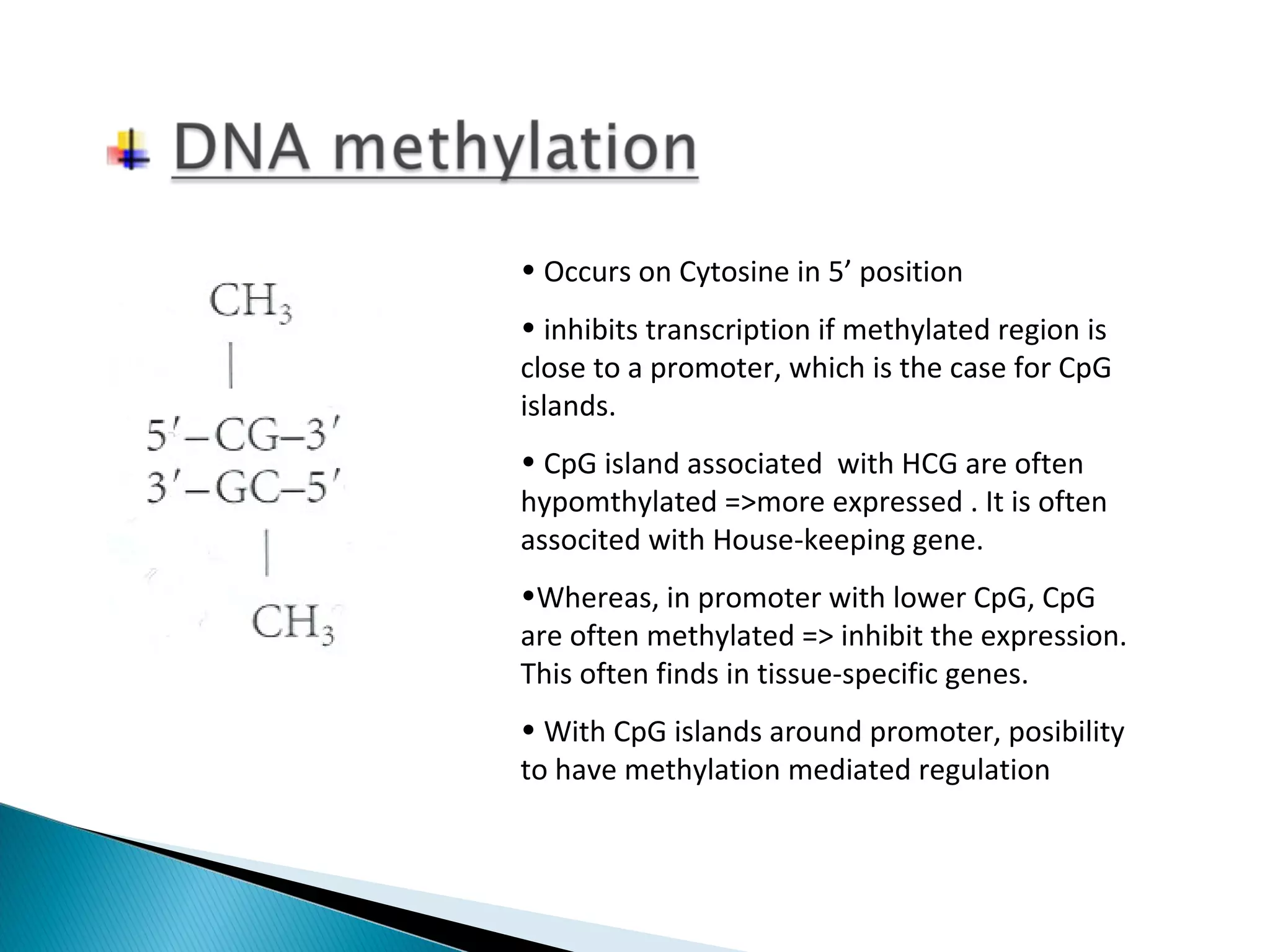
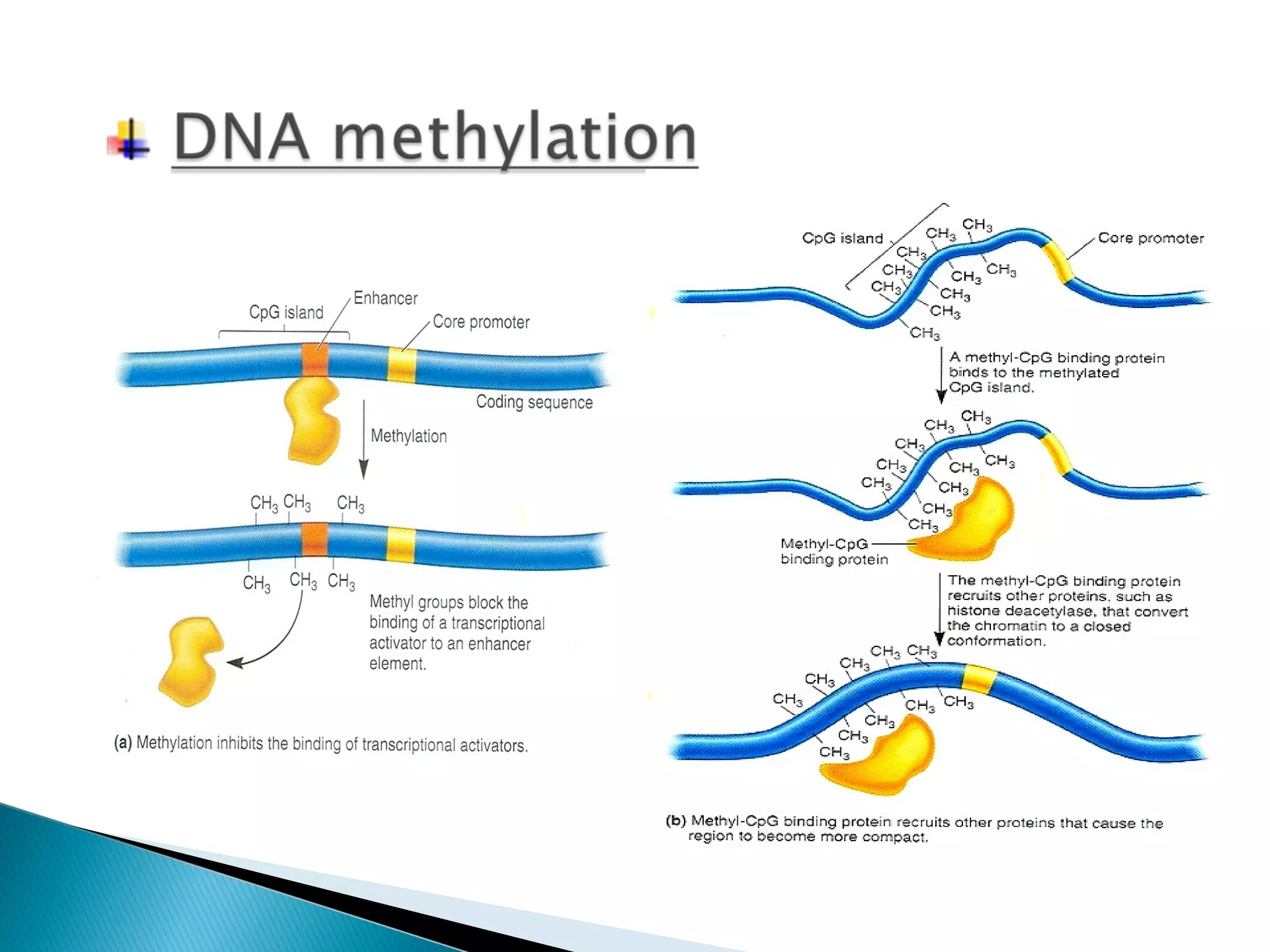
• Occurs onCytosine in 5’ position
• inhibits transcription if methylated region is
close to a promoter, which is the case for CpG
islands.
• CpG island associated with HCG are often
hypomthylated =>more expressed . It is often
associted with House-keeping gene.
•Whereas, in promoter with lower CpG, CpG
are often methylated => inhibit the expression.
This often finds in tissue-specific genes.
• With CpG islands around promoter, posibility
to have methylation mediated regulation
14.
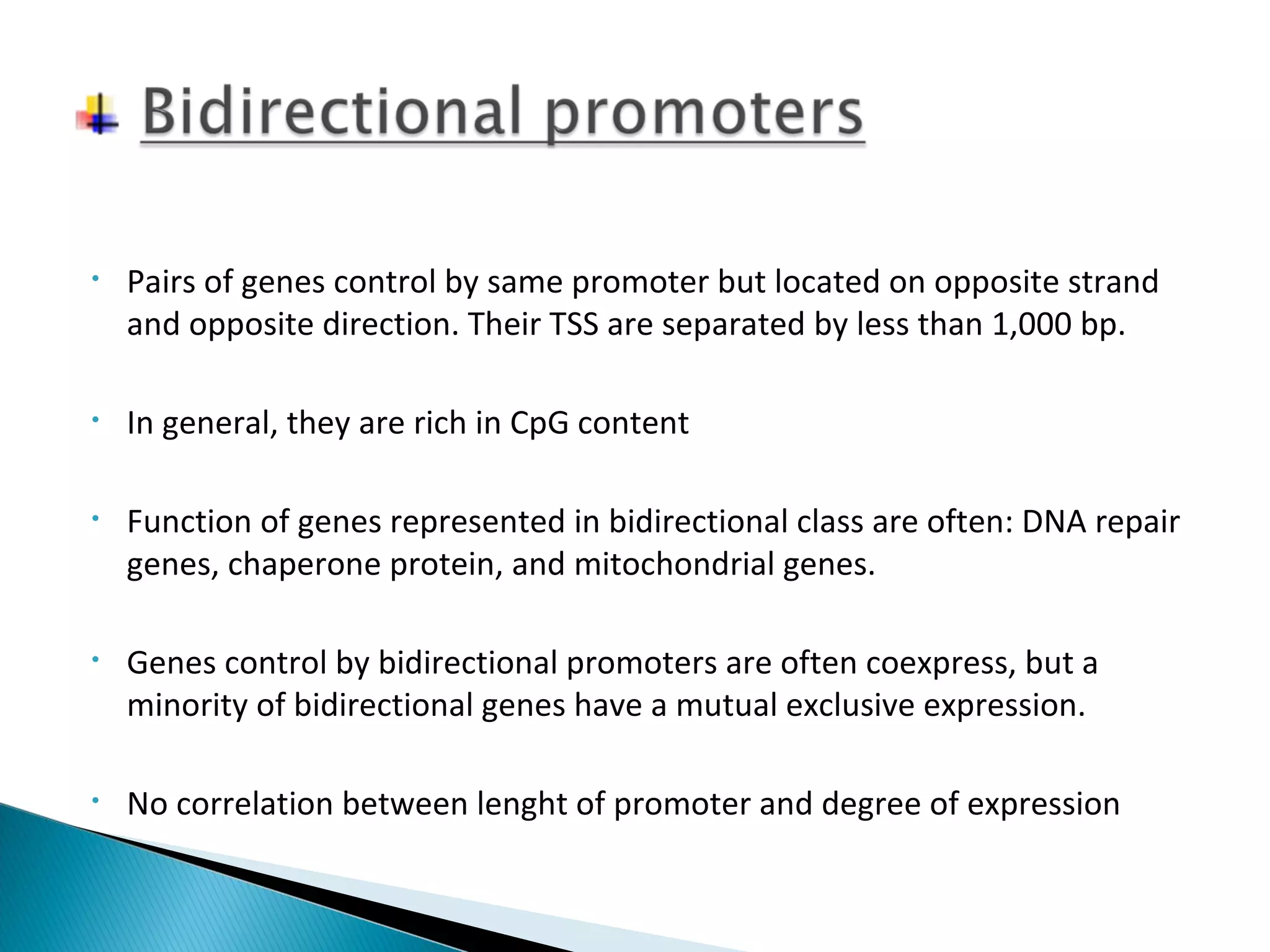
• Pairs ofgenes control by same promoter but located on opposite strand
and opposite direction. Their TSS are separated by less than 1,000 bp.
• In general, they are rich in CpG content
• Function of genes represented in bidirectional class are often: DNA repair
genes, chaperone protein, and mitochondrial genes.
• Genes control by bidirectional promoters are often coexpress, but a
minority of bidirectional genes have a mutual exclusive expression.
• No correlation between lenght of promoter and degree of expression
15.
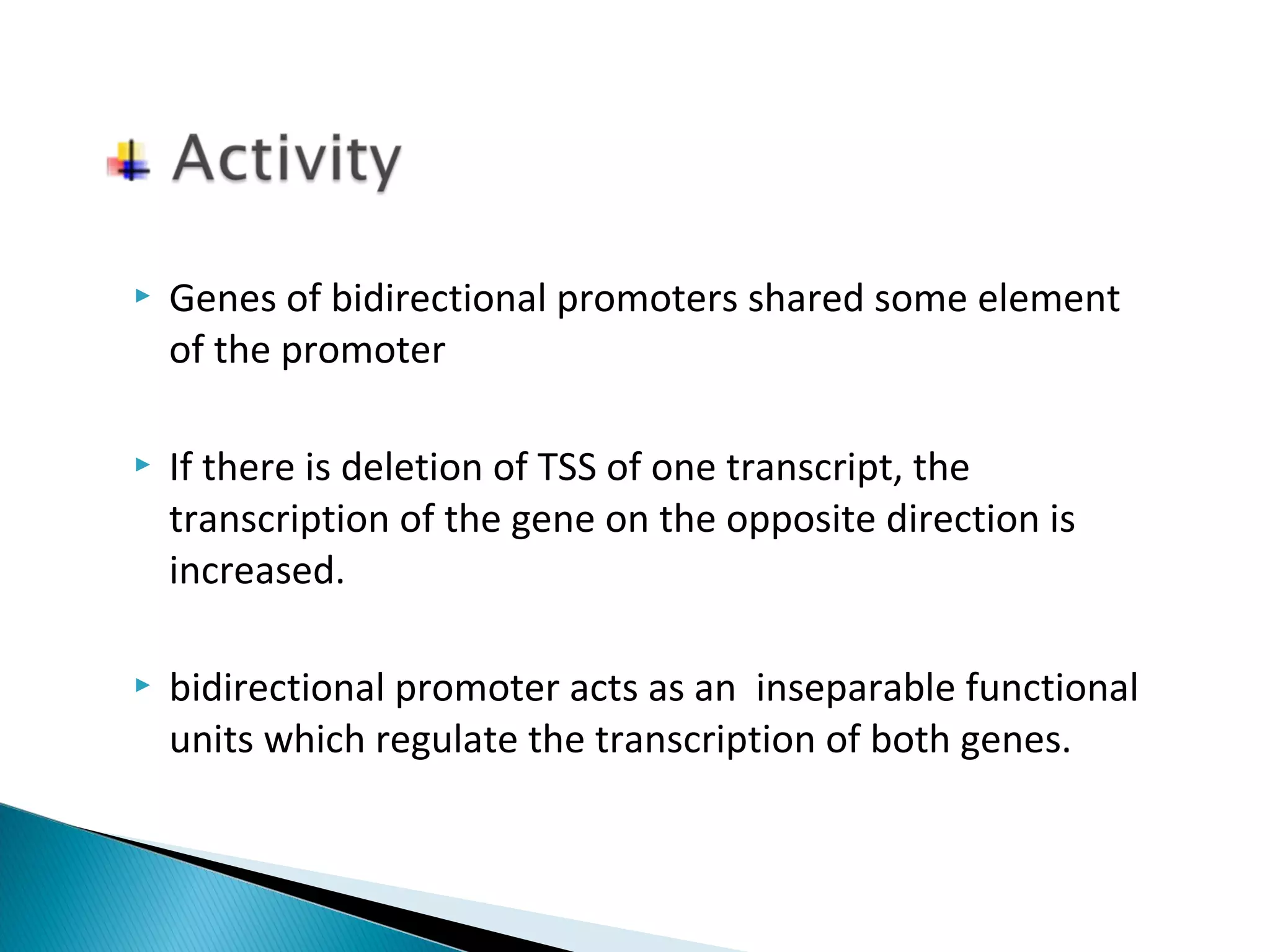
Genes ofbidirectional promoters shared some element
of the promoter
If there is deletion of TSS of one transcript, the
transcription of the gene on the opposite direction is
increased.
bidirectional promoter acts as an inseparable functional
units which regulate the transcription of both genes.
Induce theexpression of the downstream-located coding
region in all tissues irrespective of environmental or
developmental factors.
e.g: plant pathogen promoters(CaMV 35S promoter)
18.
the activityof these promoters is induced by the presence or
absence of biotic or abiotic factors.
inducible promoters are grouped as:
1. Chemically-regulated promoters
2. Physically-regulated promoters
19.
Operate inparticular tissues and at certain developmental
stages
may be induced by endogenous and exogenous factors.
e.g: tomato pz7 and pz130 gene promoters (for ovary gene
expression)
20.
comprise consensusDNA sequences of common elements of
natural promoter regions.
maize ubiquitin 1 gene (Ubi-1) core promoter.
cytomegalovirus (CMV) promoter.
CAG promoter(cmv,actin,globin)



![Transcriptional regulation [autosaved]](https://cdn.slidesharecdn.com/ss_thumbnails/transcriptionalregulationautosaved-210320110055-thumbnail.jpg?width=640&height=640&fit=bounds)


