Web 2.0:  Creating value through social media and virtual worlds November 2008 Dr. Robin Teigland Stockholm School of Economics [email_address] www.knowledgenetworking.org www.slideshare.net/eteigland  1-
Introduction to social media and networks  Why the interest? What are networks? What about performance? Leveraging social media and networks Why are they of interest for organizations? Are there any benefits or is it all hype? What are some challenges? An introduction to virtual worlds Today’s discussion
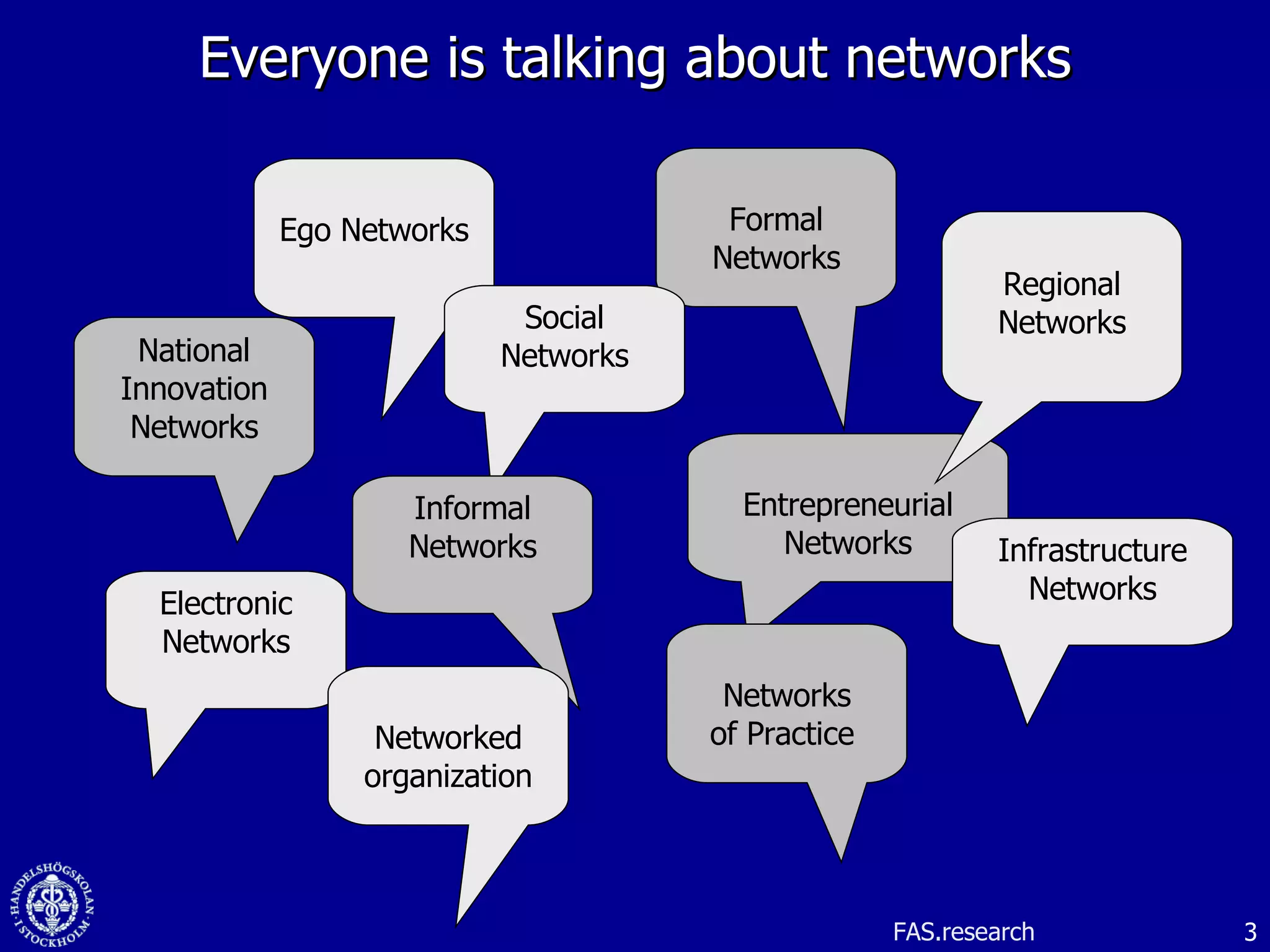
Everyone is talking about networks National Innovation Networks Formal Networks Entrepreneurial Networks Ego Networks Regional Networks Infrastructure Networks Social Networks FAS.research Electronic Networks Informal Networks Networks of Practice  Networked organization
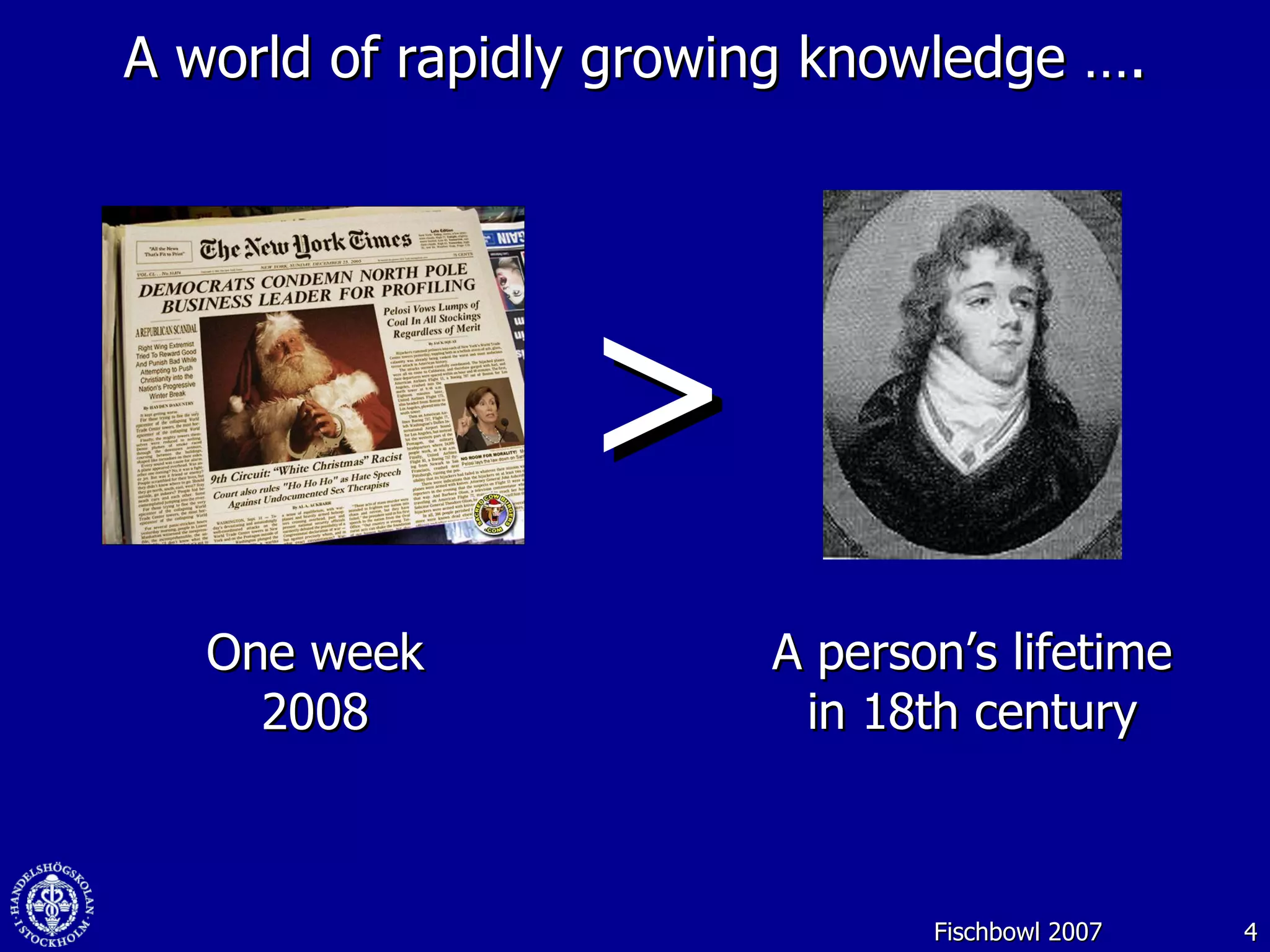
A world of rapidly growing knowledge …. > A person’s lifetime in 18th century One week 2008 Fischbowl 2007
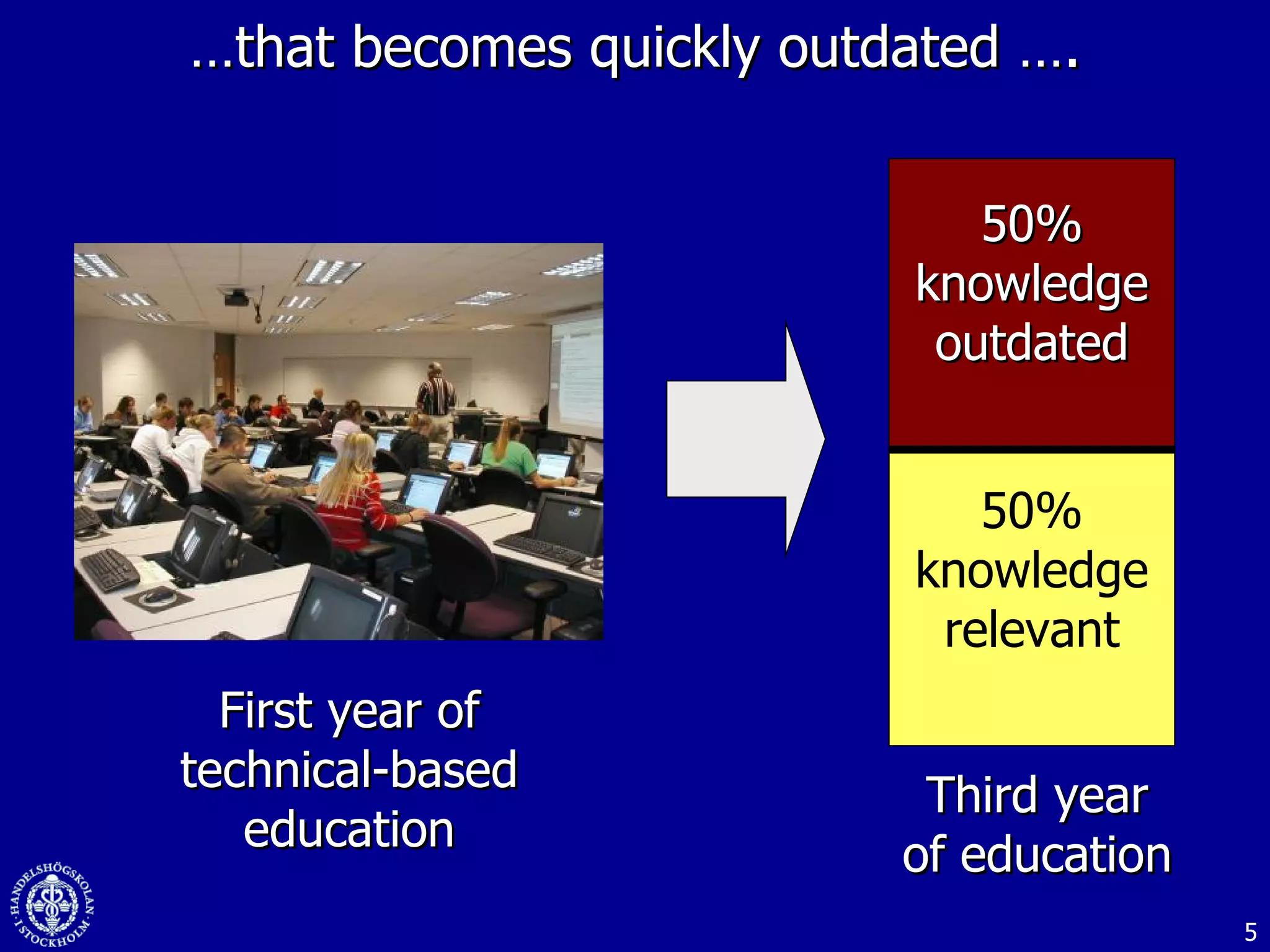
… that becomes quickly outdated …. 50% knowledge relevant 50% knowledge outdated First year of technical-based education Third year of education
Did You Know: Shift Happens http://www.youtube.com/watch?v=pMcfrLYDm2U Which pressures for change are presented? Which pressures are affecting your organization?
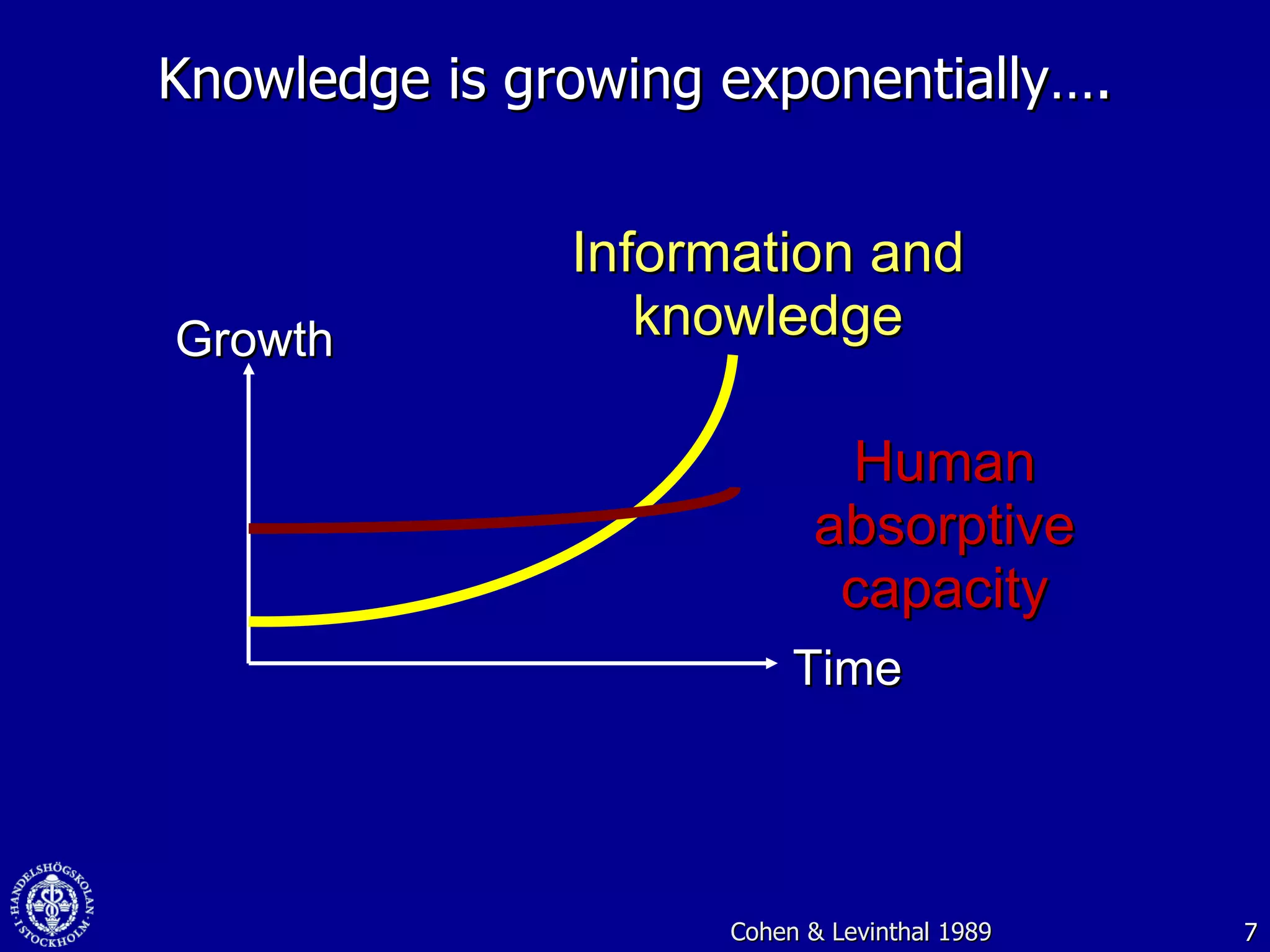
Knowledge is growing exponentially…. Cohen & Levinthal 1989 Growth Time Information and knowledge Human  absorptive capacity
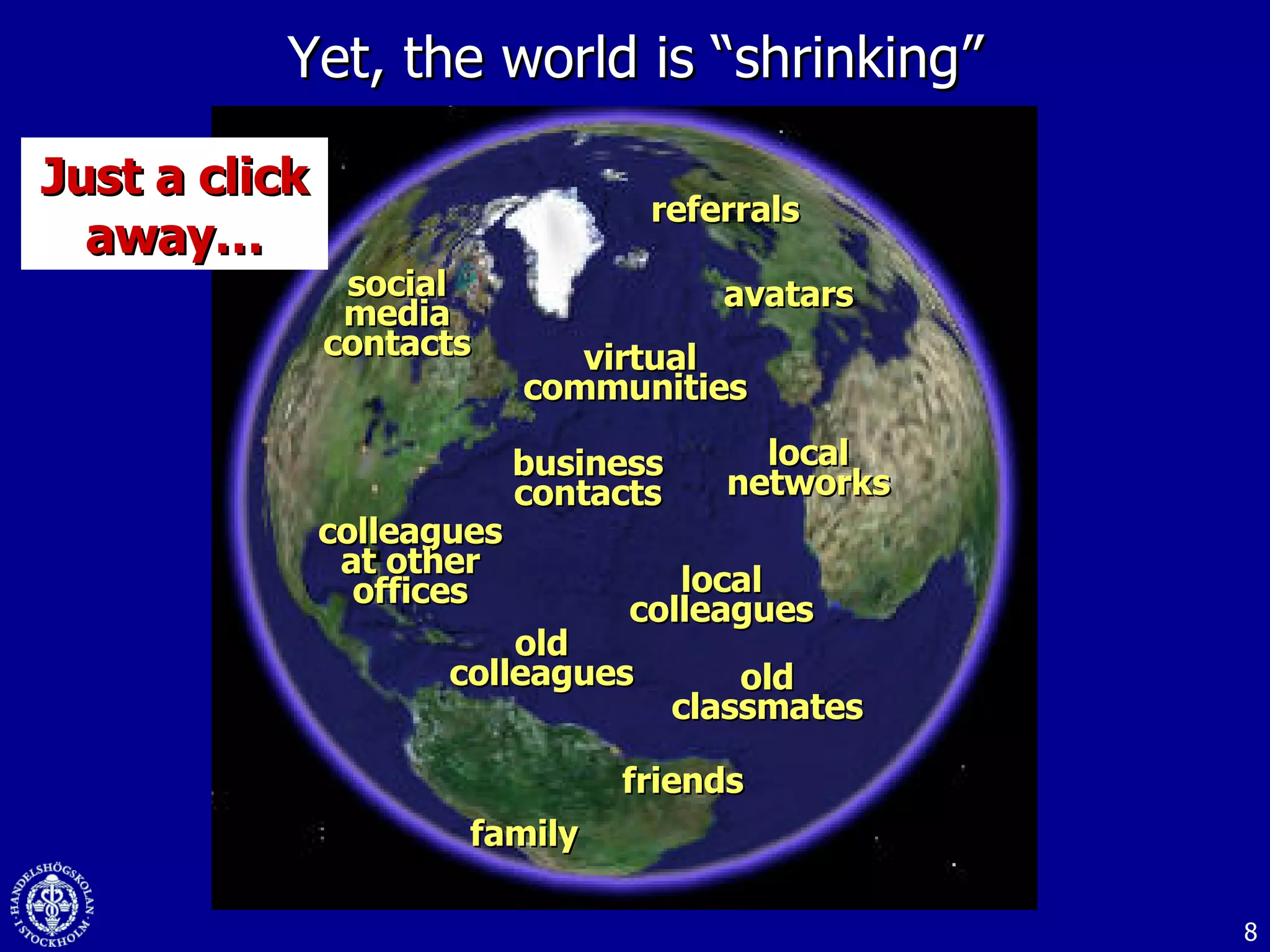
Yet, the world is “shrinking” family local colleagues friends old colleagues colleagues at other offices Just a click away… virtual communities  local networks old classmates avatars business contacts social media contacts referrals
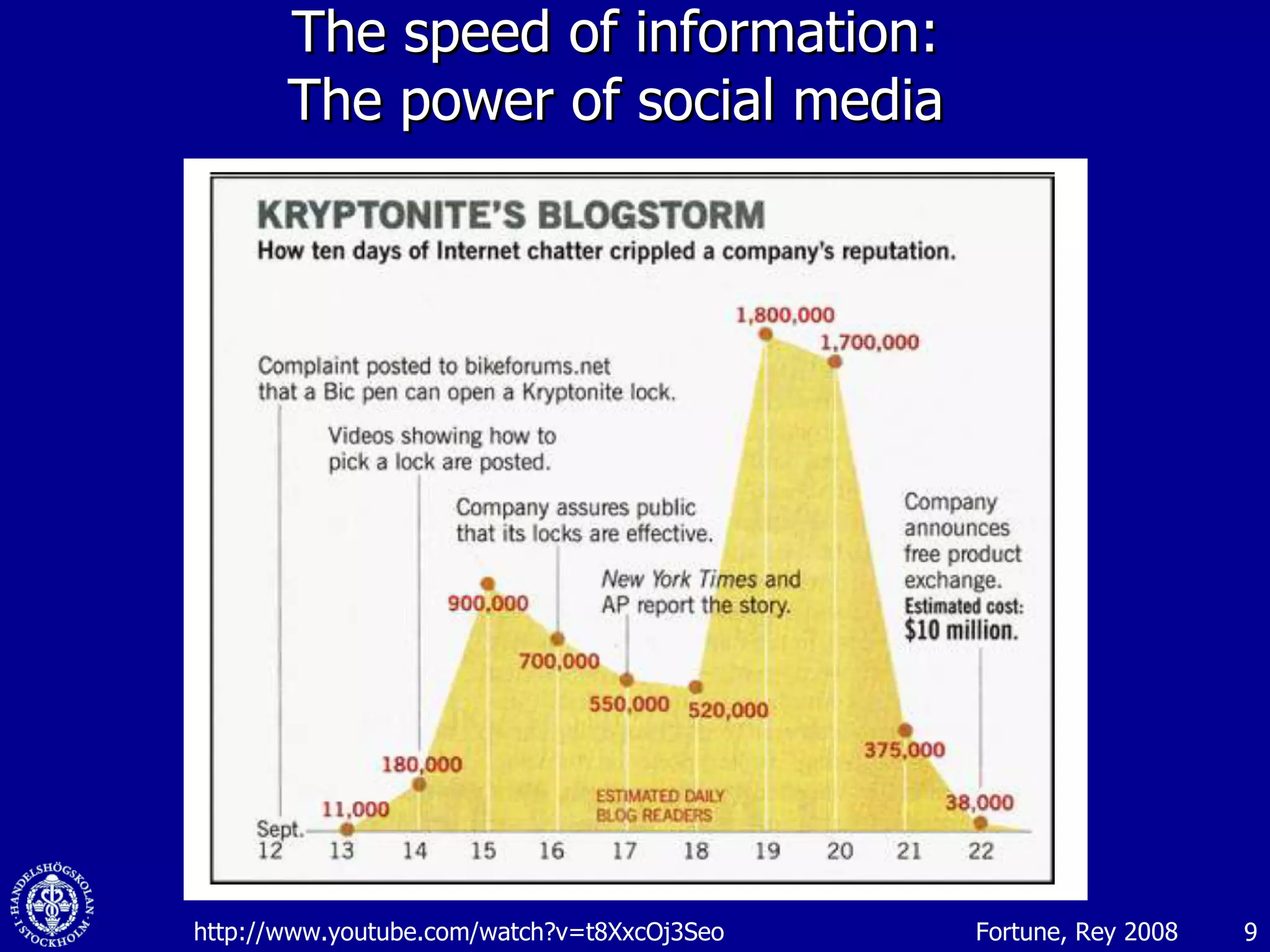
The speed of information:  The power of social media  http://www.youtube.com/watch?v=t8XxcOj3Seo Fortune, Rey 2008
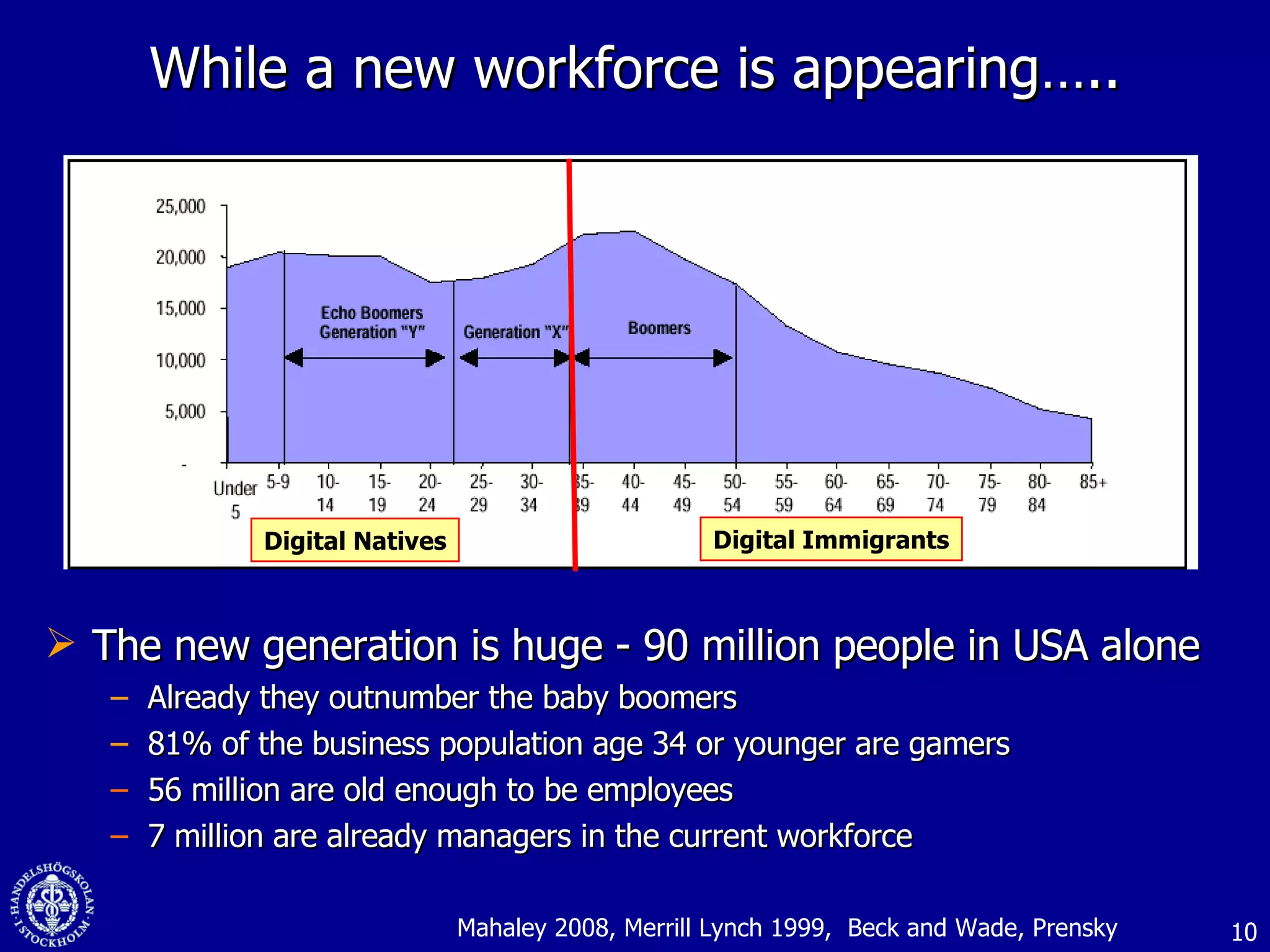
While a new workforce is appearing….. The new generation is huge - 90 million people in USA alone Already they outnumber the baby boomers 81% of the business population age 34 or younger are gamers 56 million are old enough to be employees 7 million are already managers in the current workforce  Mahaley 2008, Merrill Lynch 1999,  Beck and Wade, Prensky Digital Immigrants Digital Natives
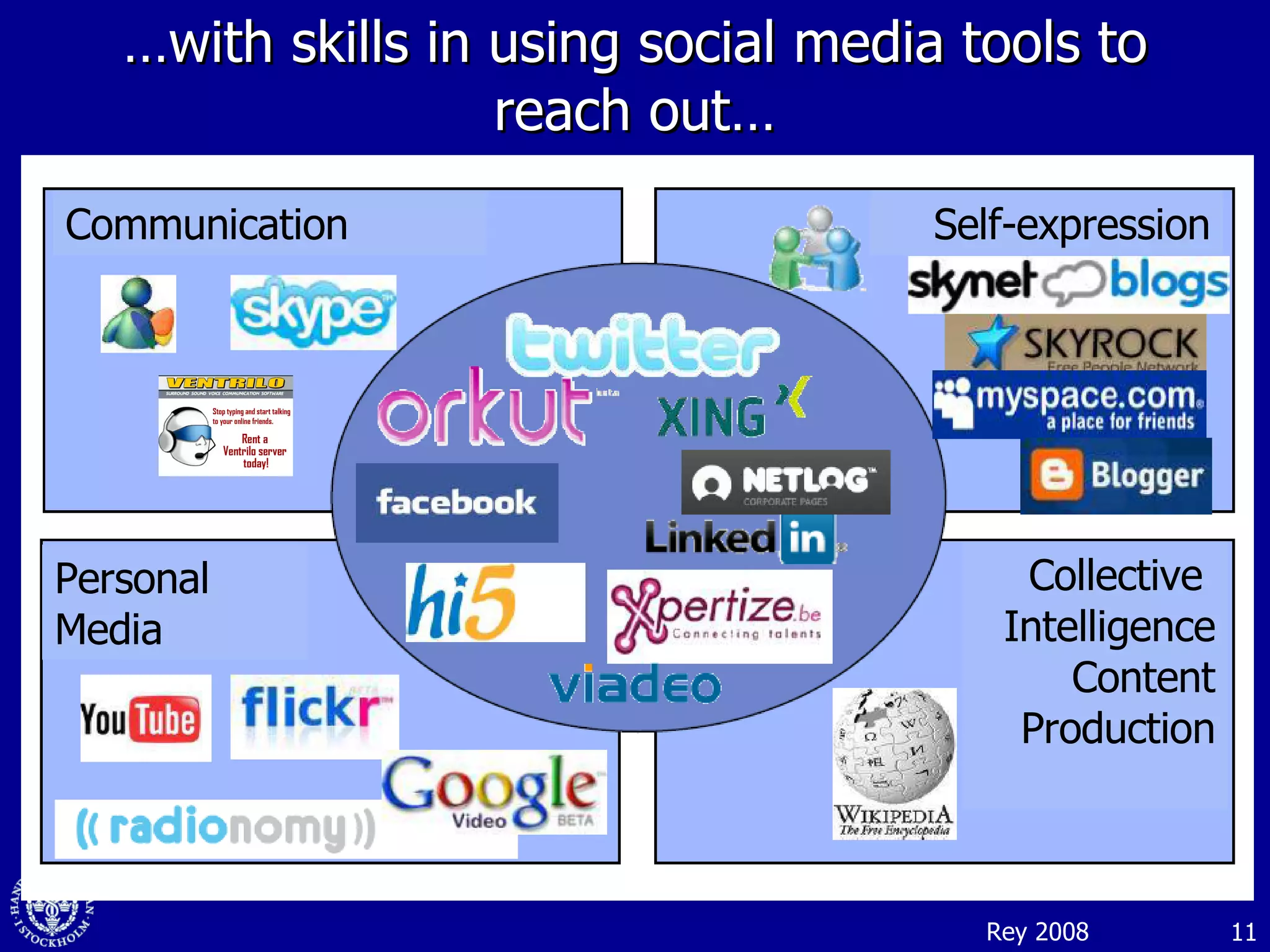
… with skills in using social media tools to reach out… Rey 2008 Communication  Personal  Media Self-expression Collective  Intelligence Content Production
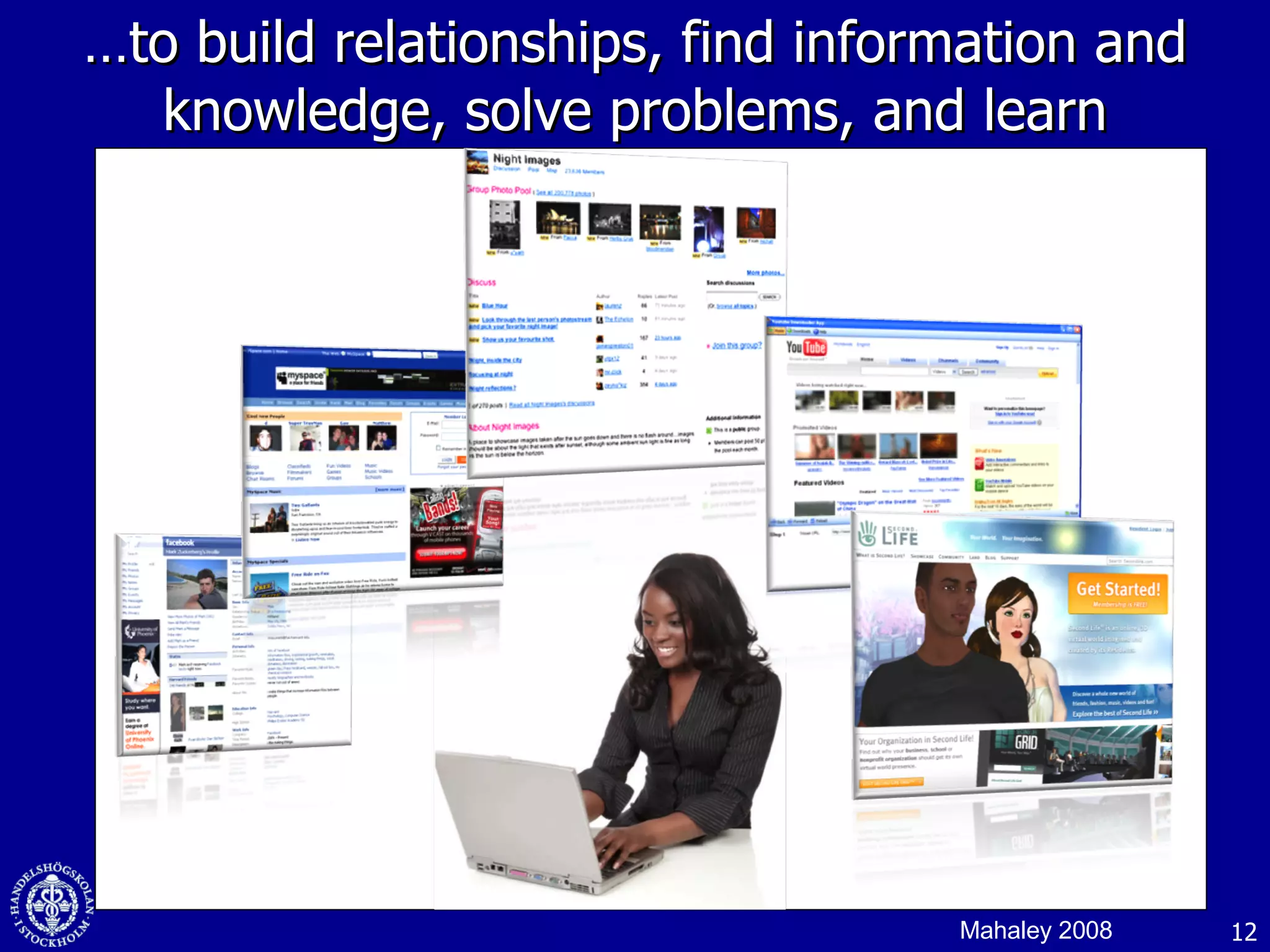
… to build relationships, find information and knowledge, solve problems, and learn Mahaley 2008
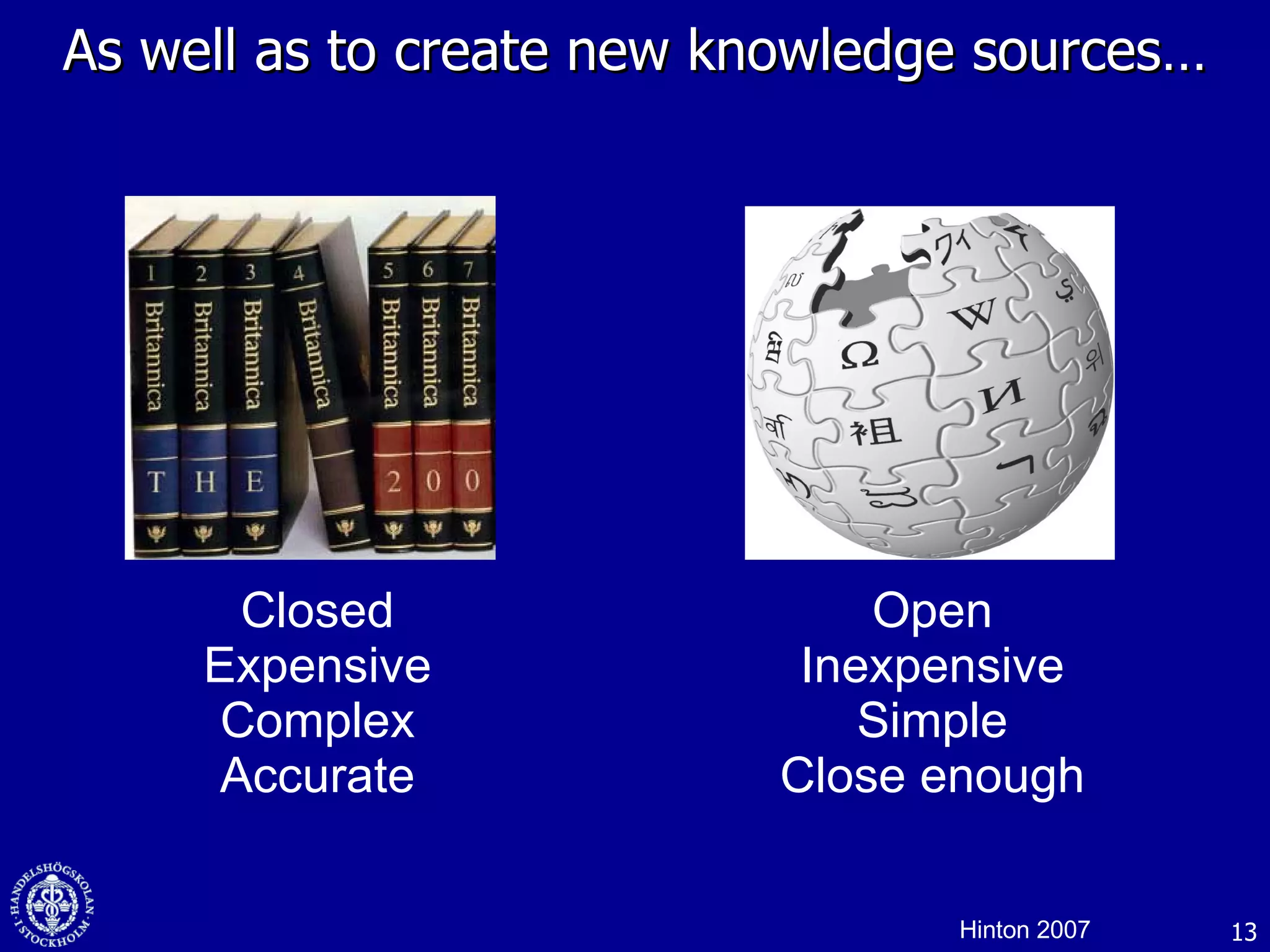
As well as to create new knowledge sources… Closed Expensive Complex Accurate Open Inexpensive Simple Close enough Hinton 2007
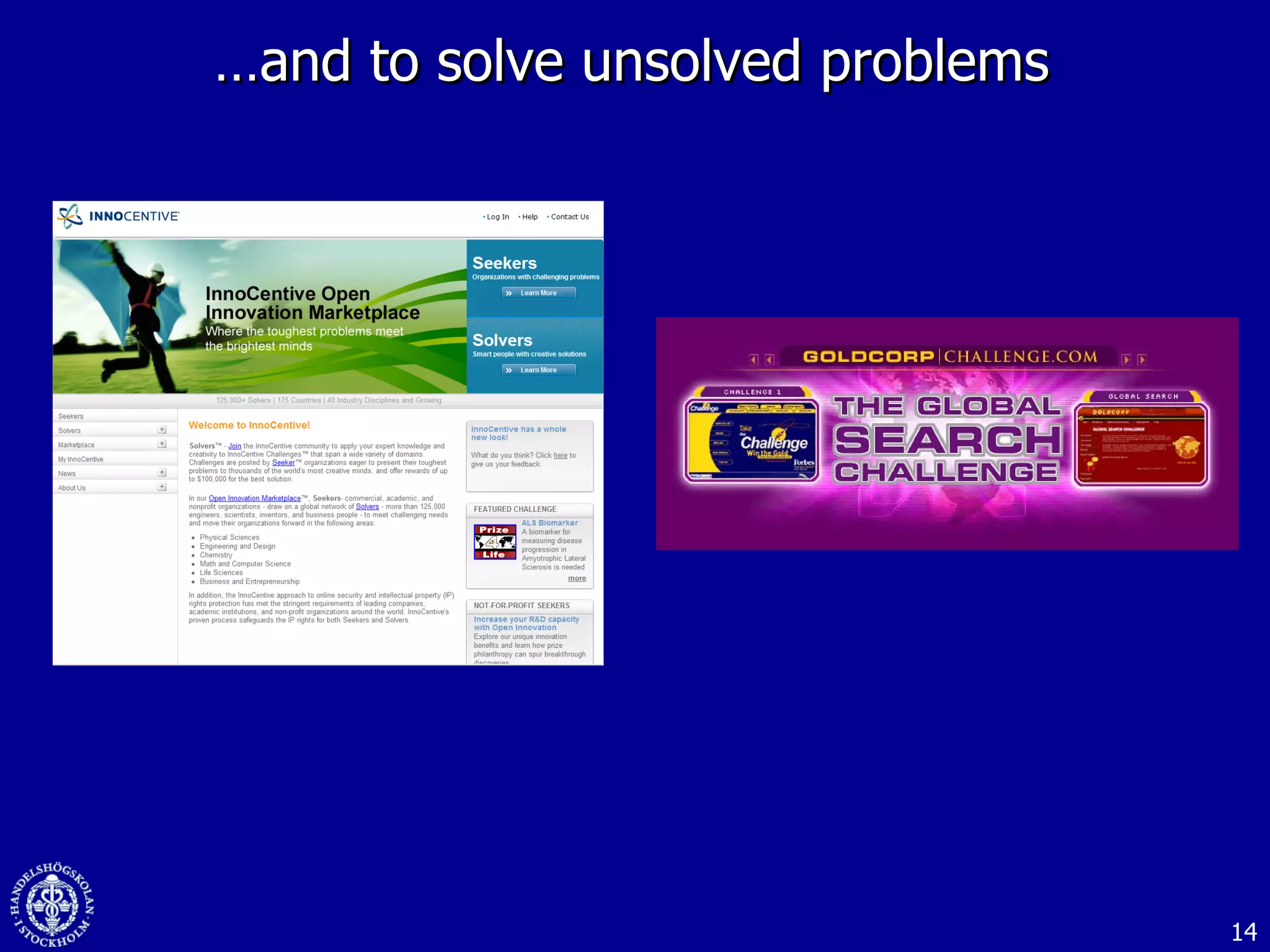
… and to solve unsolved problems
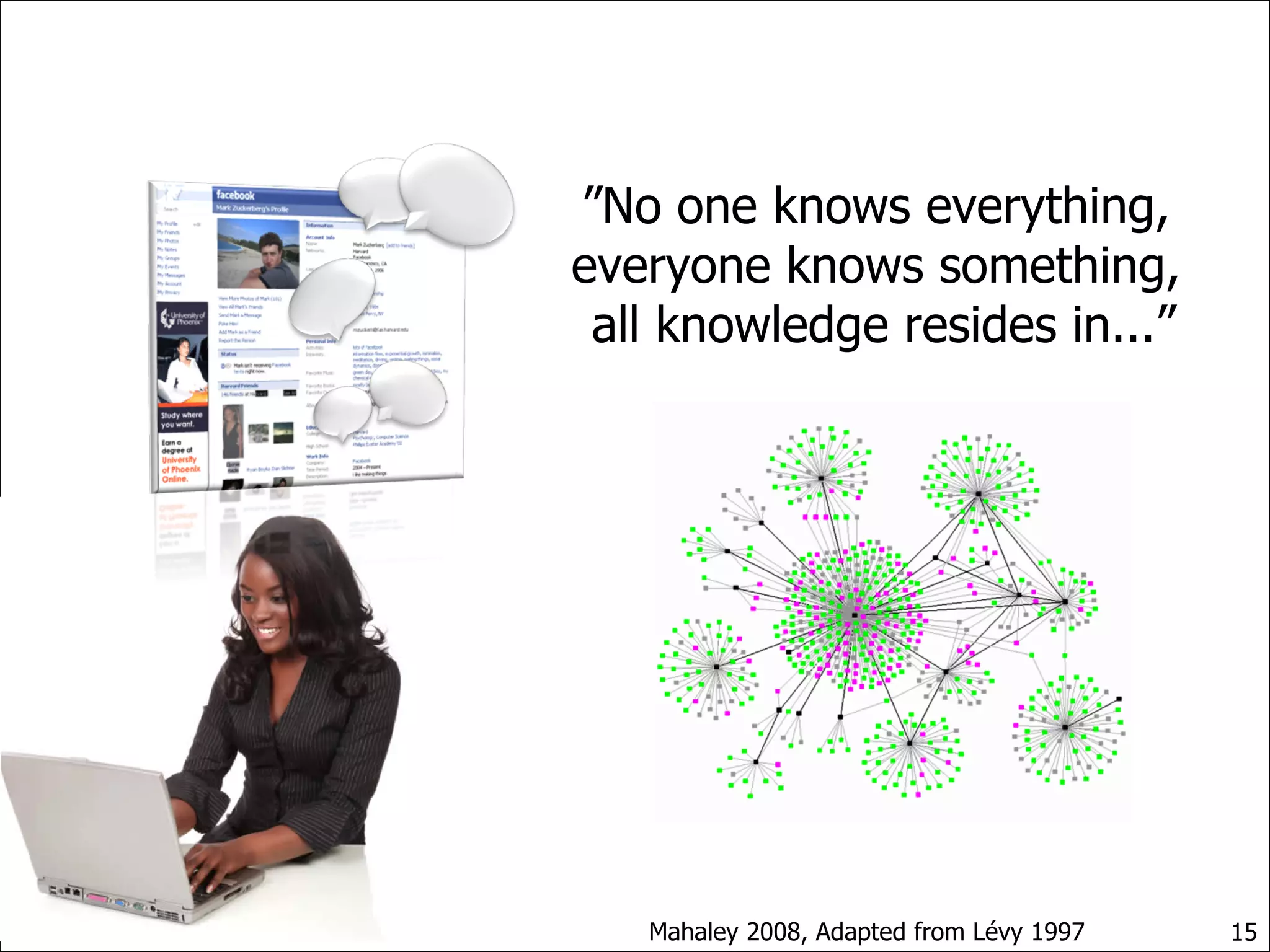
” No one knows everything,  everyone knows something,  all knowledge resides in...” Mahaley 2008, Adapted from Lévy 1997
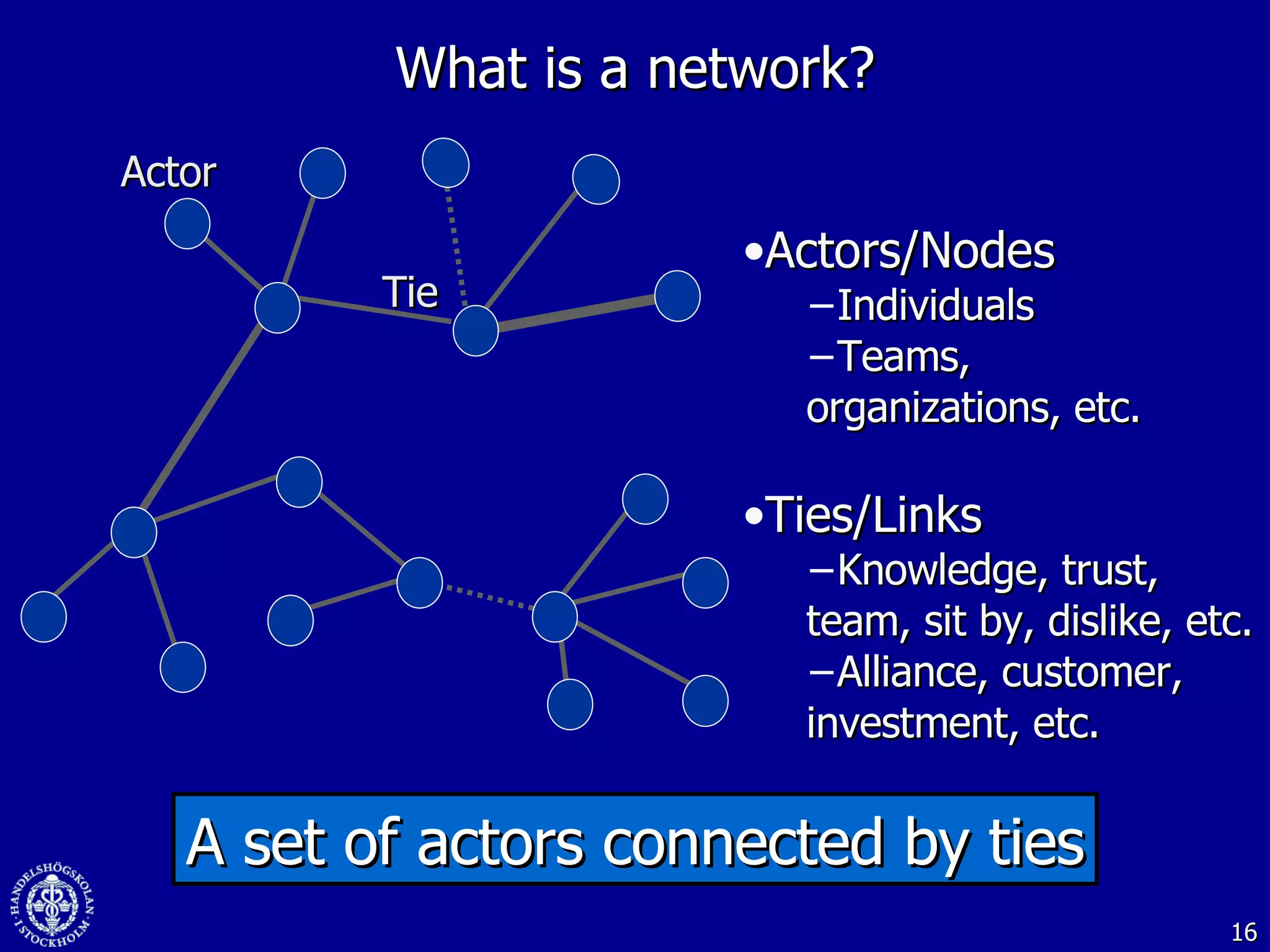
What is a network? A set of actors connected by ties Ties/Links Knowledge, trust, team, sit by, dislike, etc. Alliance, customer, investment, etc. Tie Actors/Nodes Individuals Teams, organizations, etc. Actor
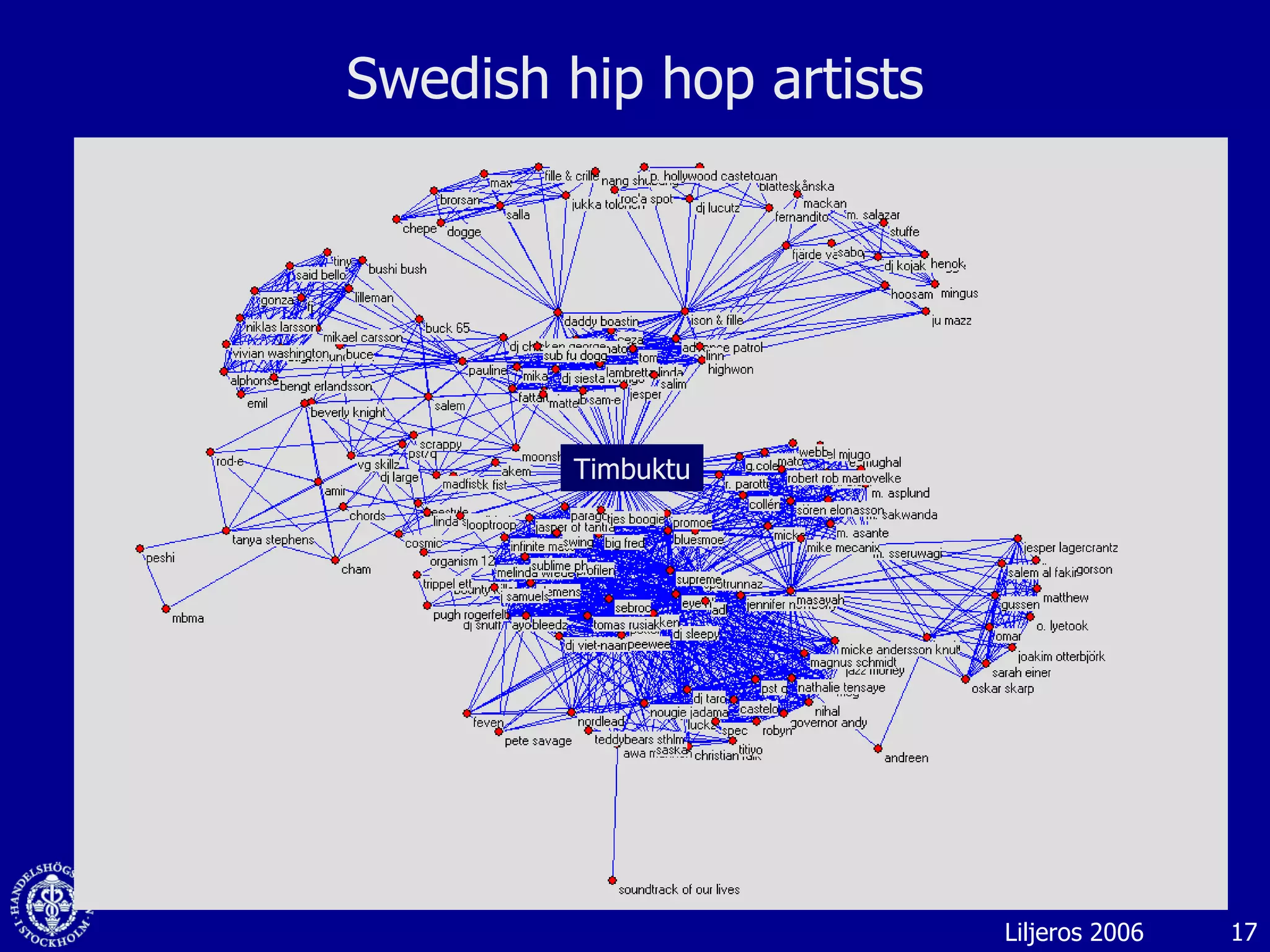
Swedish hip hop artists Liljeros 2006 ?? Timbuktu
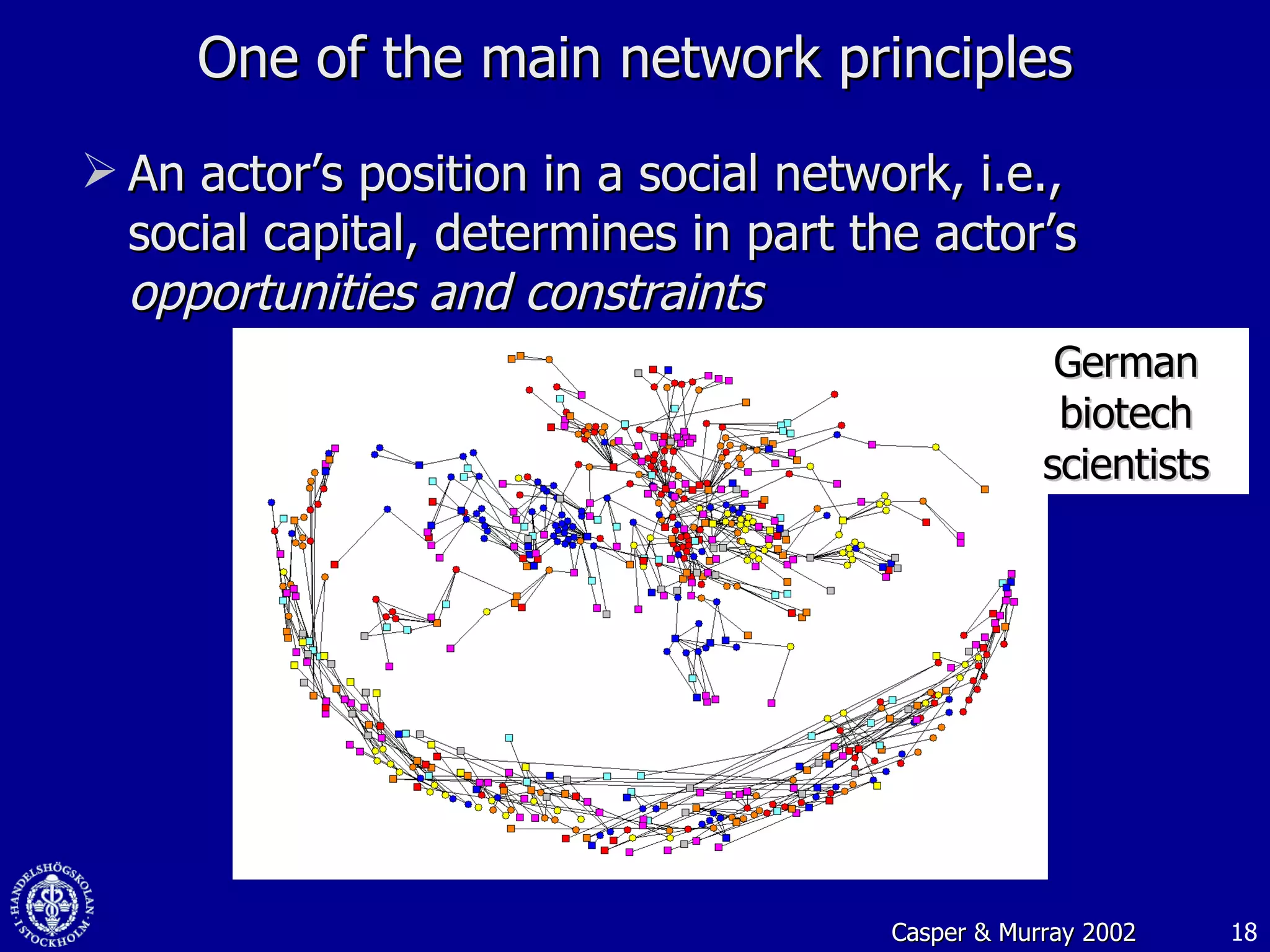
One of the main network principles An actor’s position in a social network, i.e., social capital, determines in part the actor’s  opportunities and constraints Casper & Murray 2002 German biotech scientists
What about the relationship between networks and performance?
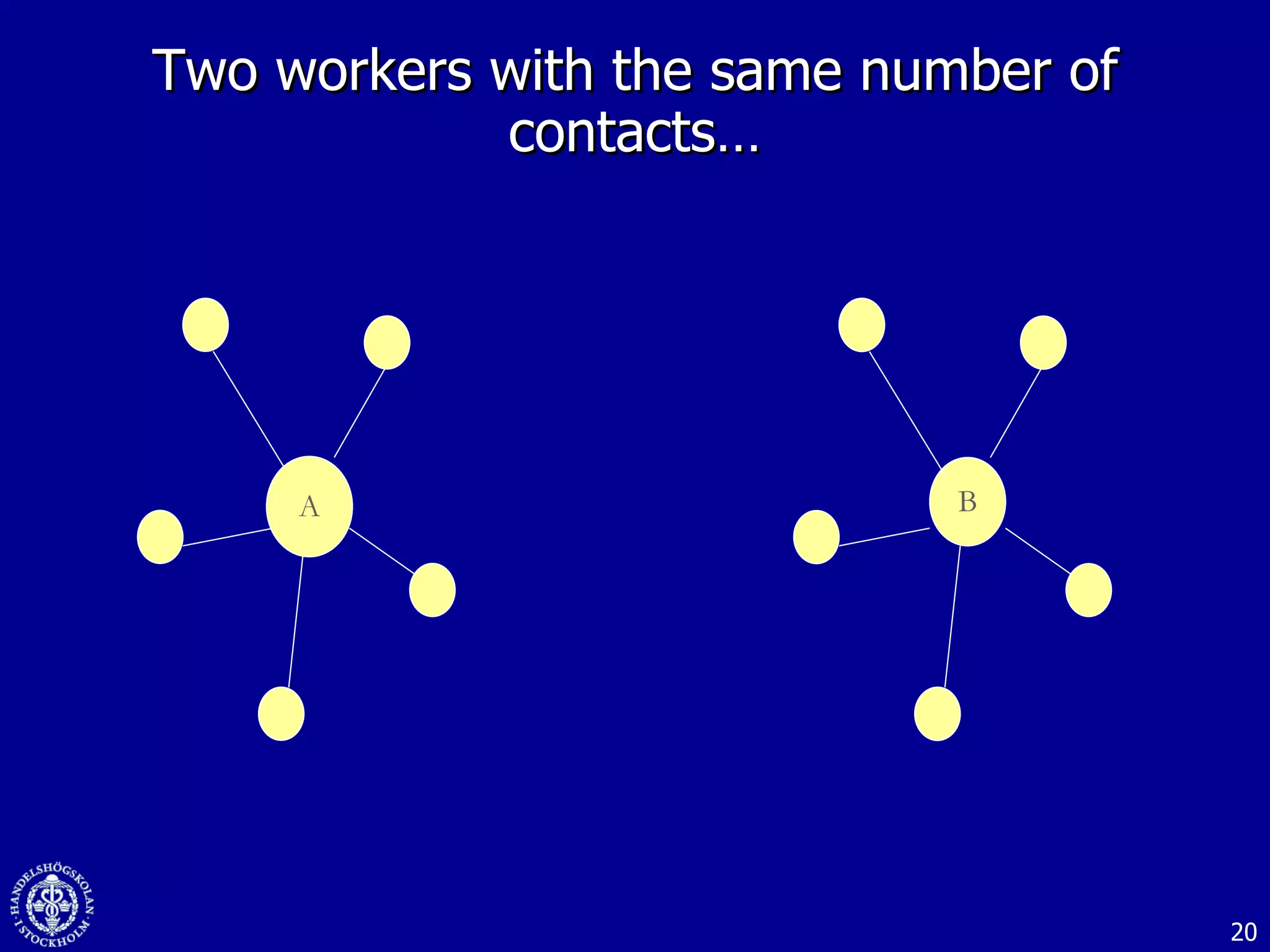
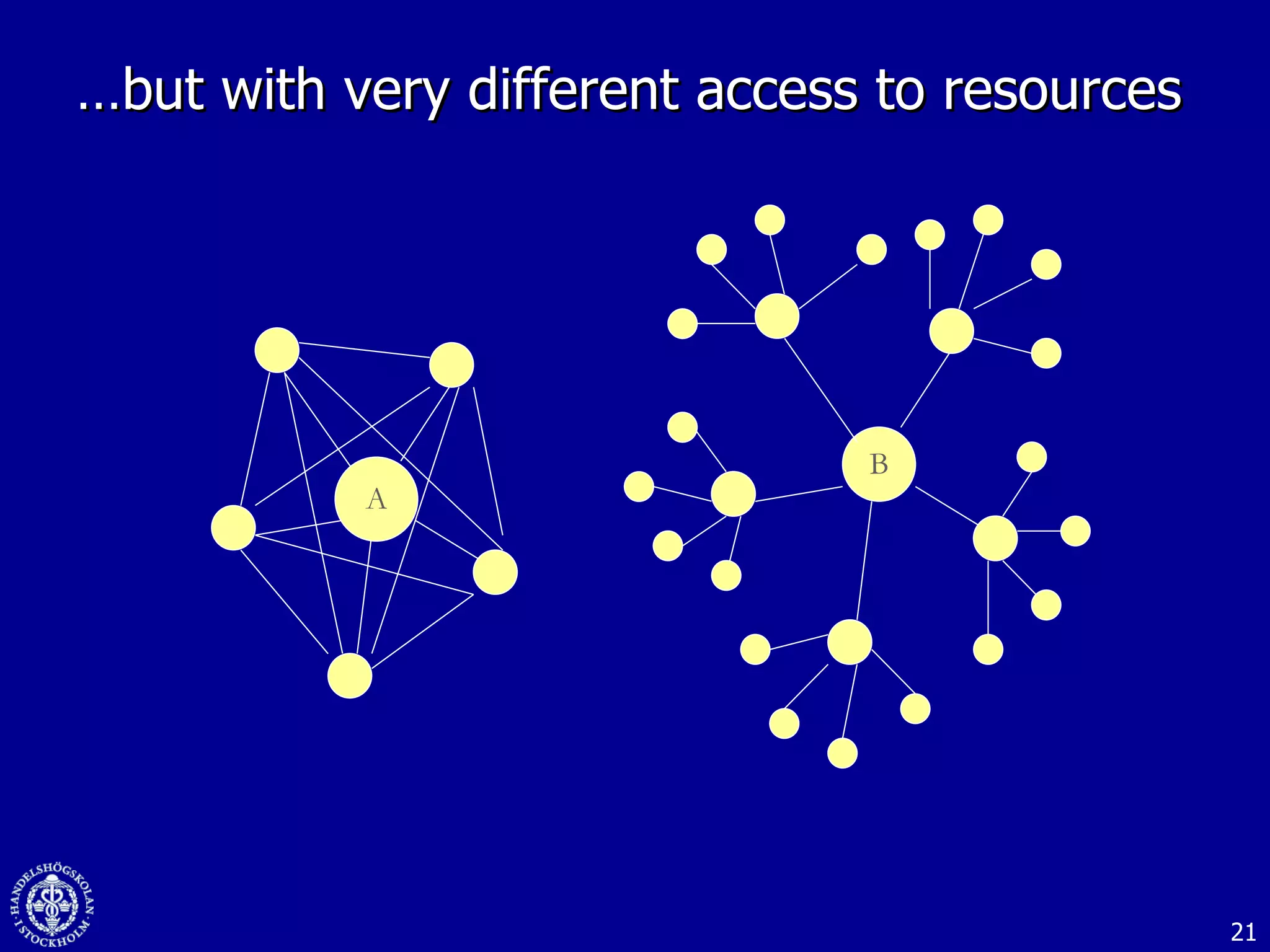
Two workers with the same number of contacts… B A
… but with very different access to resources B A
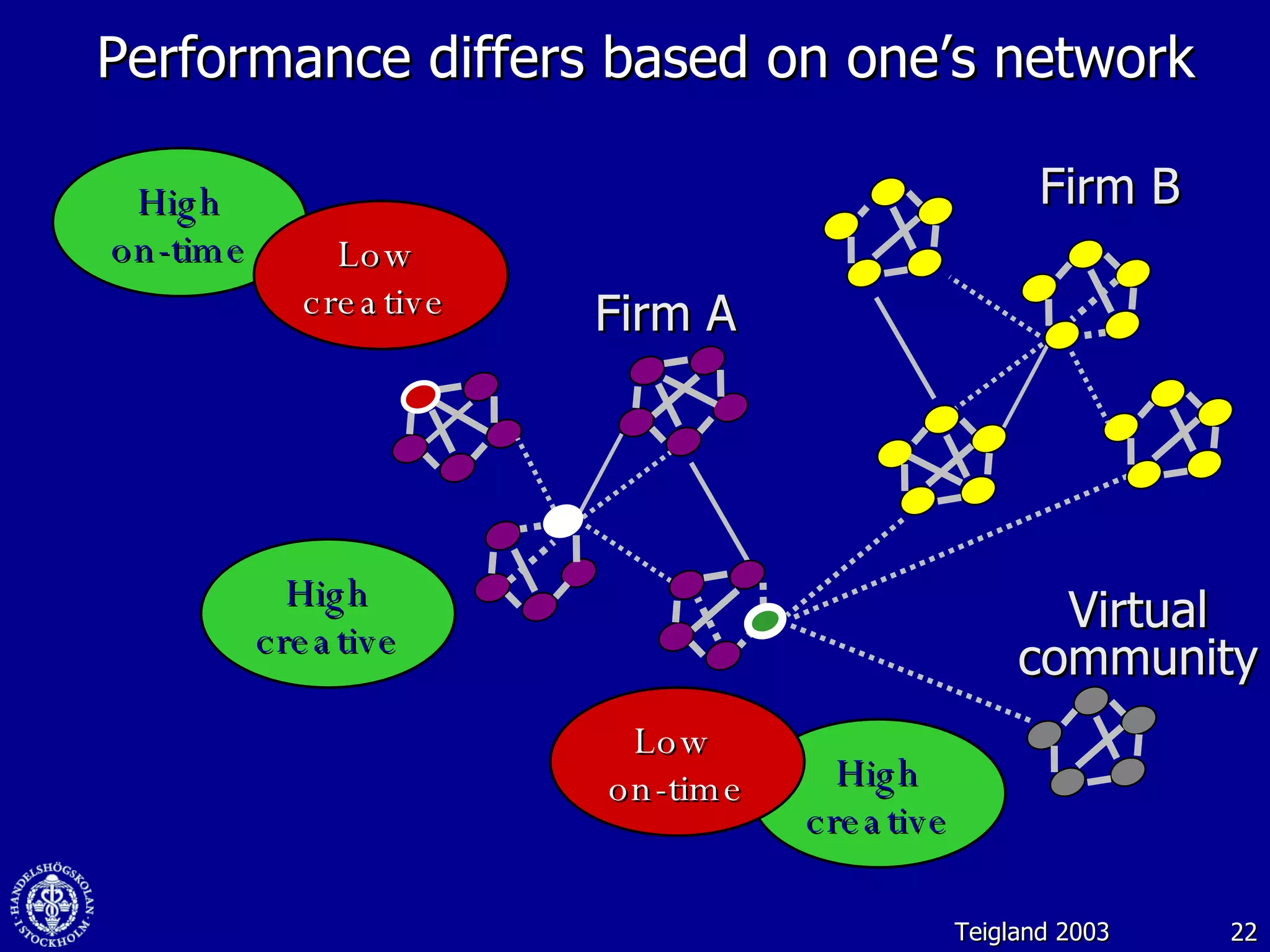
Performance differs based on one’s network Firm A High creative Low  on-time High on-time Low  creative  Teigland 2003 High creative Virtual community Firm B
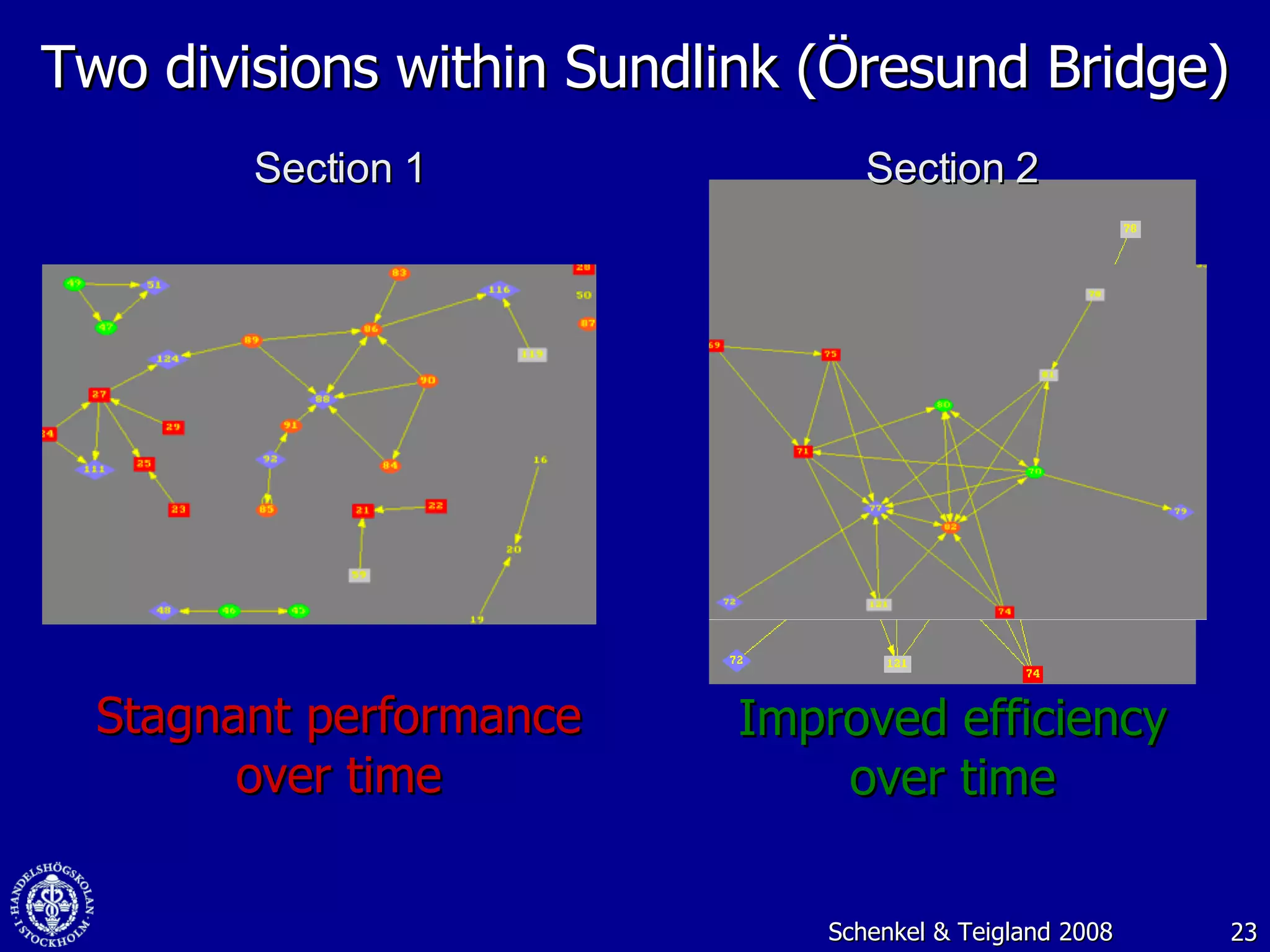
Two divisions within Sundlink (Öresund Bridge) Section 1 Section 2 Improved efficiency over time Stagnant performance over time Schenkel & Teigland 2008
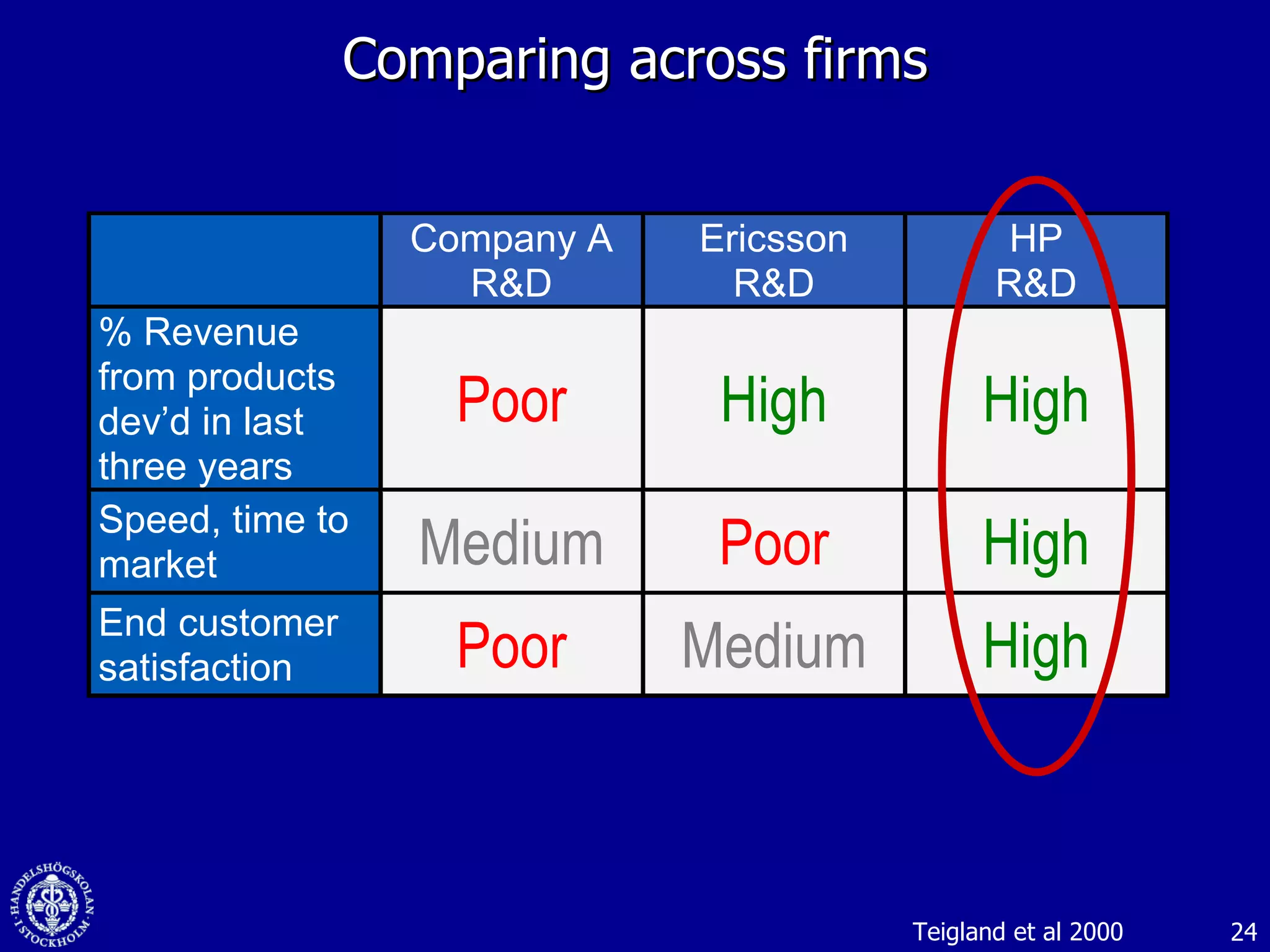
Comparing across firms Teigland et al 2000
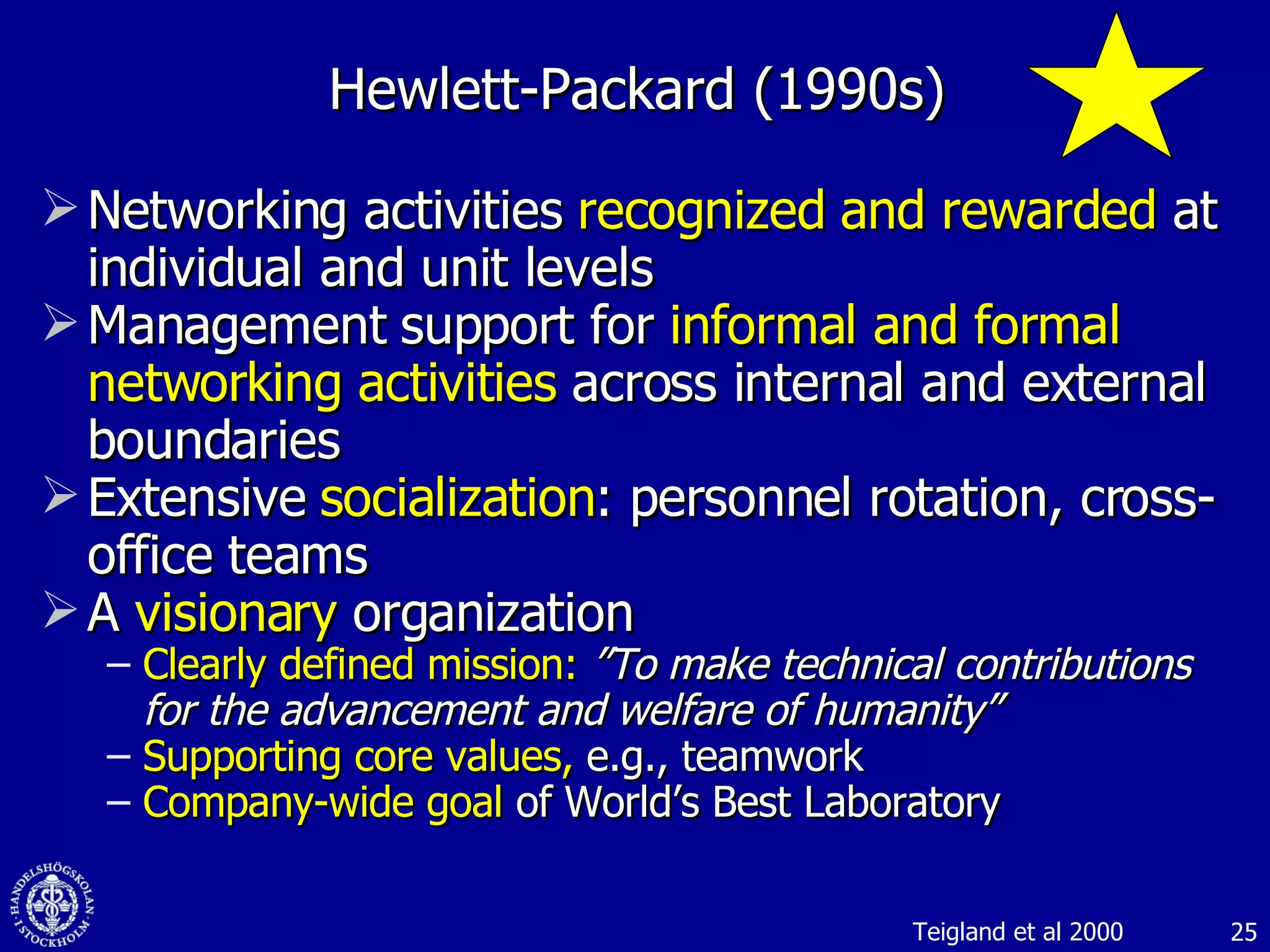
Hewlett-Packard (1990s) Networking activities  recognized and rewarded  at individual and unit levels Management support for  informal and formal   networking activities  across internal and external boundaries Extensive   socialization : personnel rotation, cross-office teams A  visionary  organization  Clearly defined mission:   ”To make technical contributions for the advancement and welfare of humanity” Supporting core values,  e.g., teamwork Company-wide goal  of World’s Best Laboratory  Teigland et al 2000
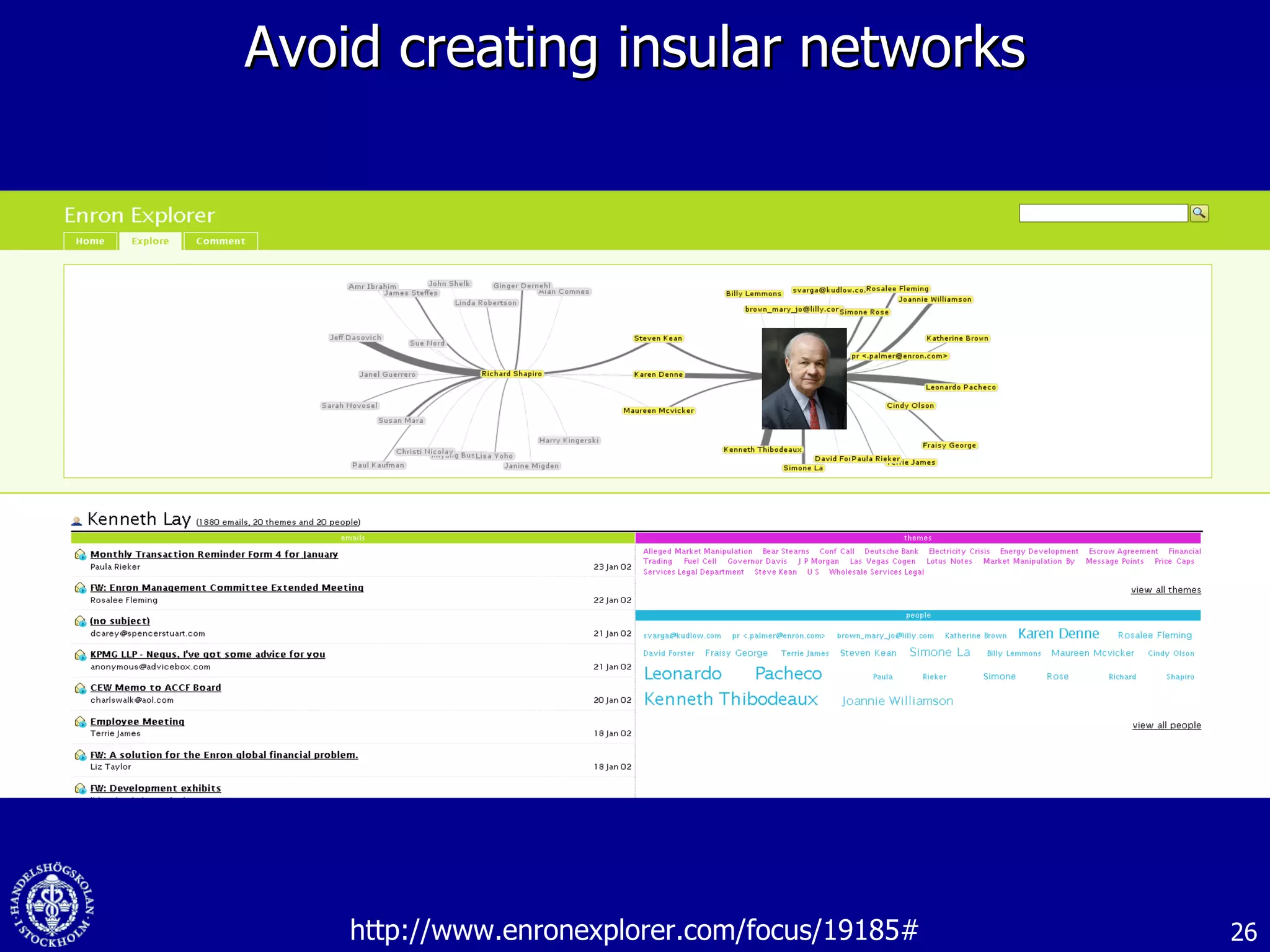
Avoid creating insular networks http://www.enronexplorer.com/focus/19185#
Introduction to social media and networks  Why the interest? What are networks? What about performance? Leveraging social media and networks Why are they of interest for organizations? Are there any benefits or is it all hype? What are some challenges? An introduction to virtual worlds Today’s discussion
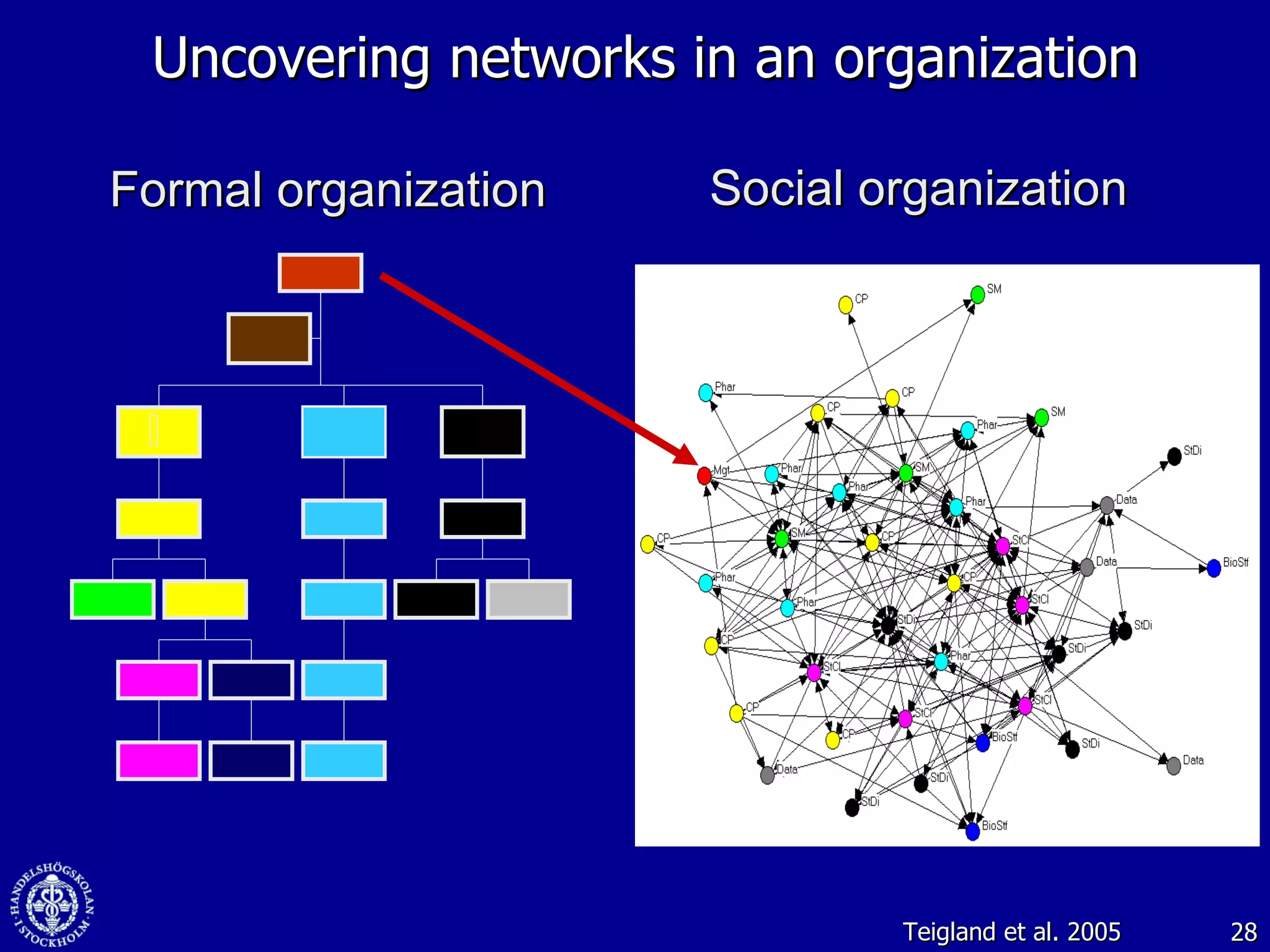
Uncovering networks in an organization Formal organization Teigland et al. 2005 Social organization
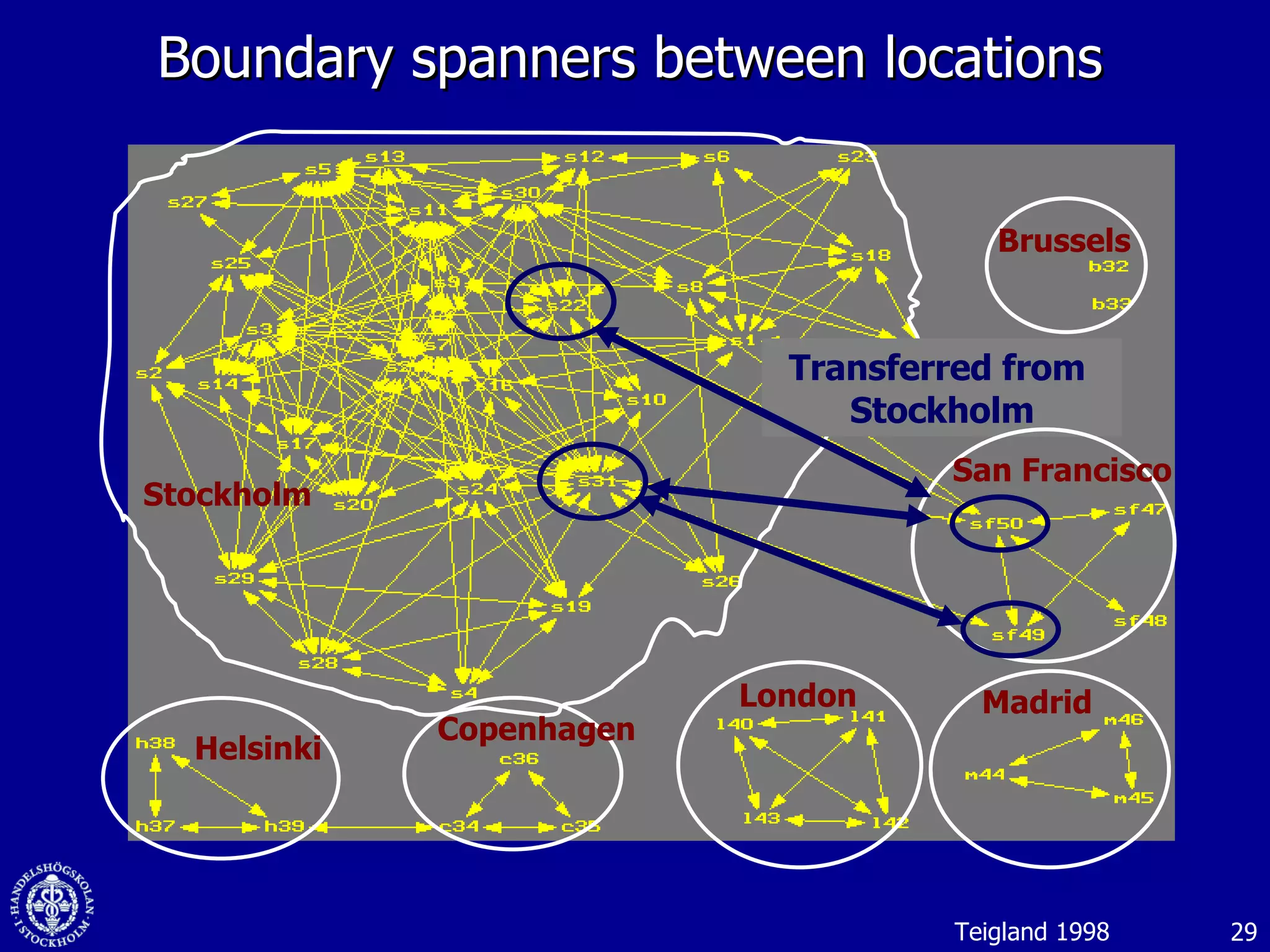
Boundary spanners between locations Stockholm London Brussels Helsinki Madrid Copenhagen Transferred from  Stockholm Teigland 1998 San Francisco
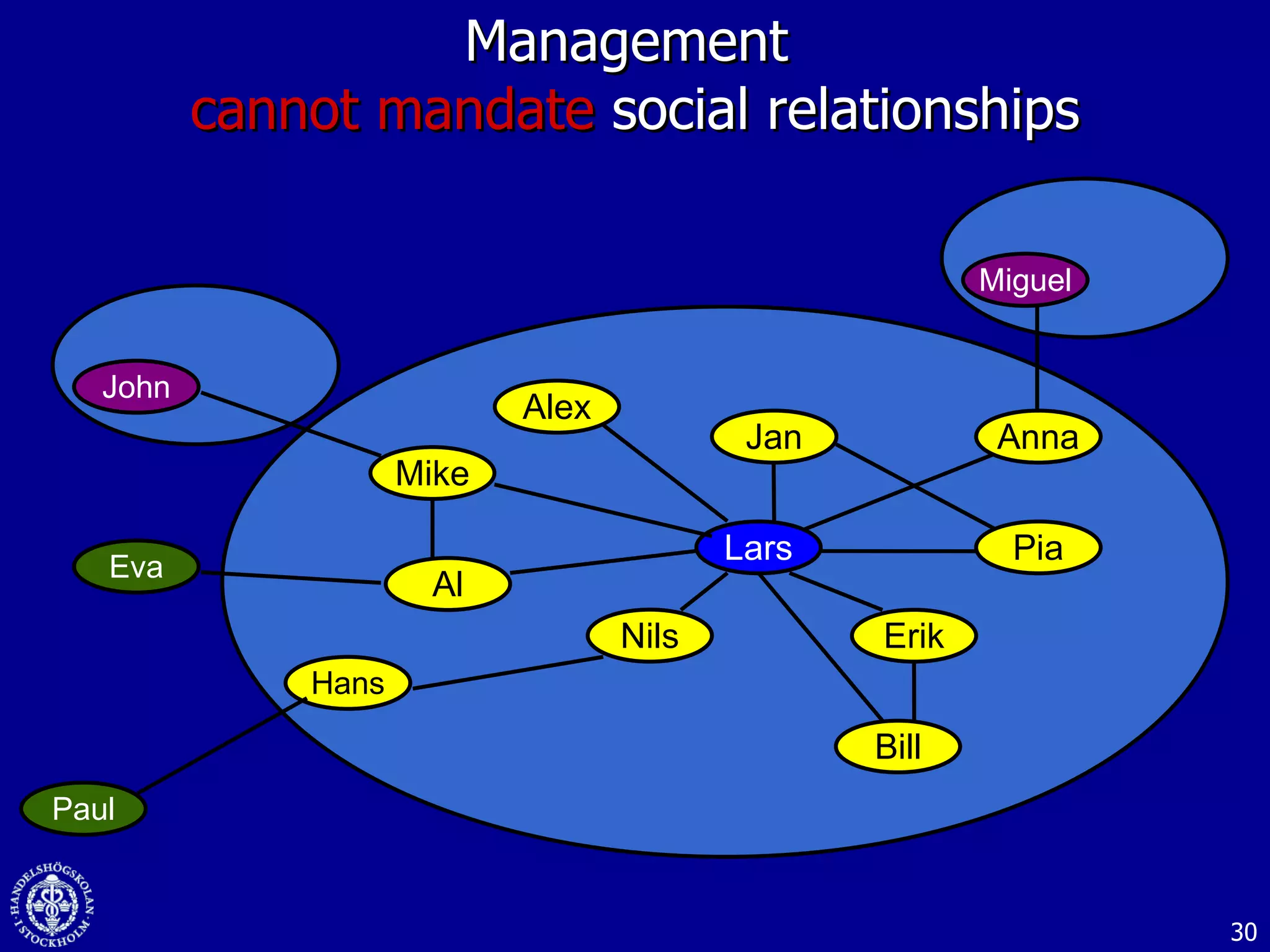
Management  cannot mandate  social relationships John Eva Hans Miguel Paul Jan Lars Pia Anna Nils Bill Erik Mike Al Alex
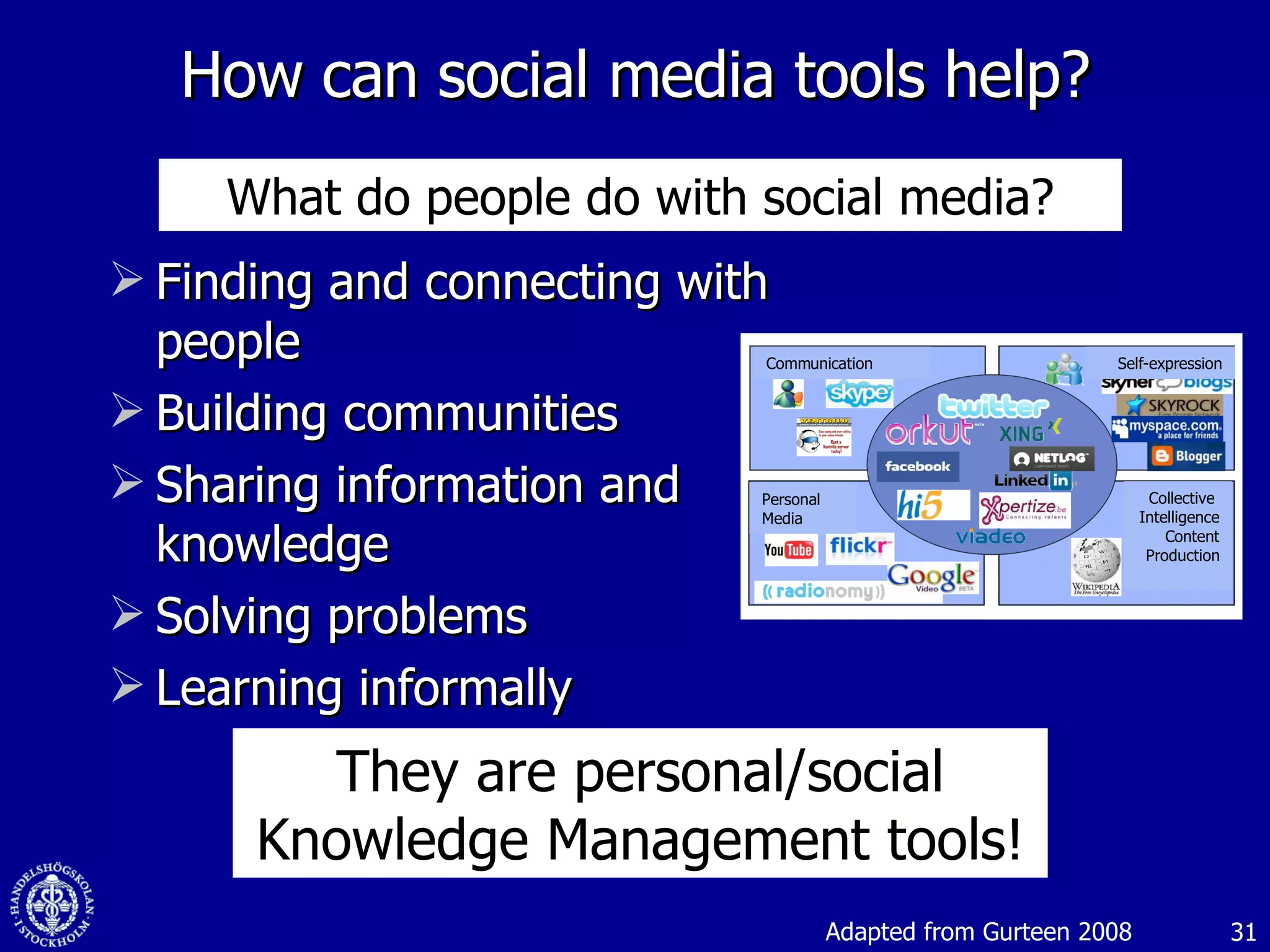
How can social media tools help? Finding and connecting with people Building communities Sharing information and knowledge Solving problems Learning informally Adapted from Gurteen 2008 They are personal/social Knowledge Management tools! What do people do with social media? Communication  Personal  Media Self-expression Collective  Intelligence Content Production
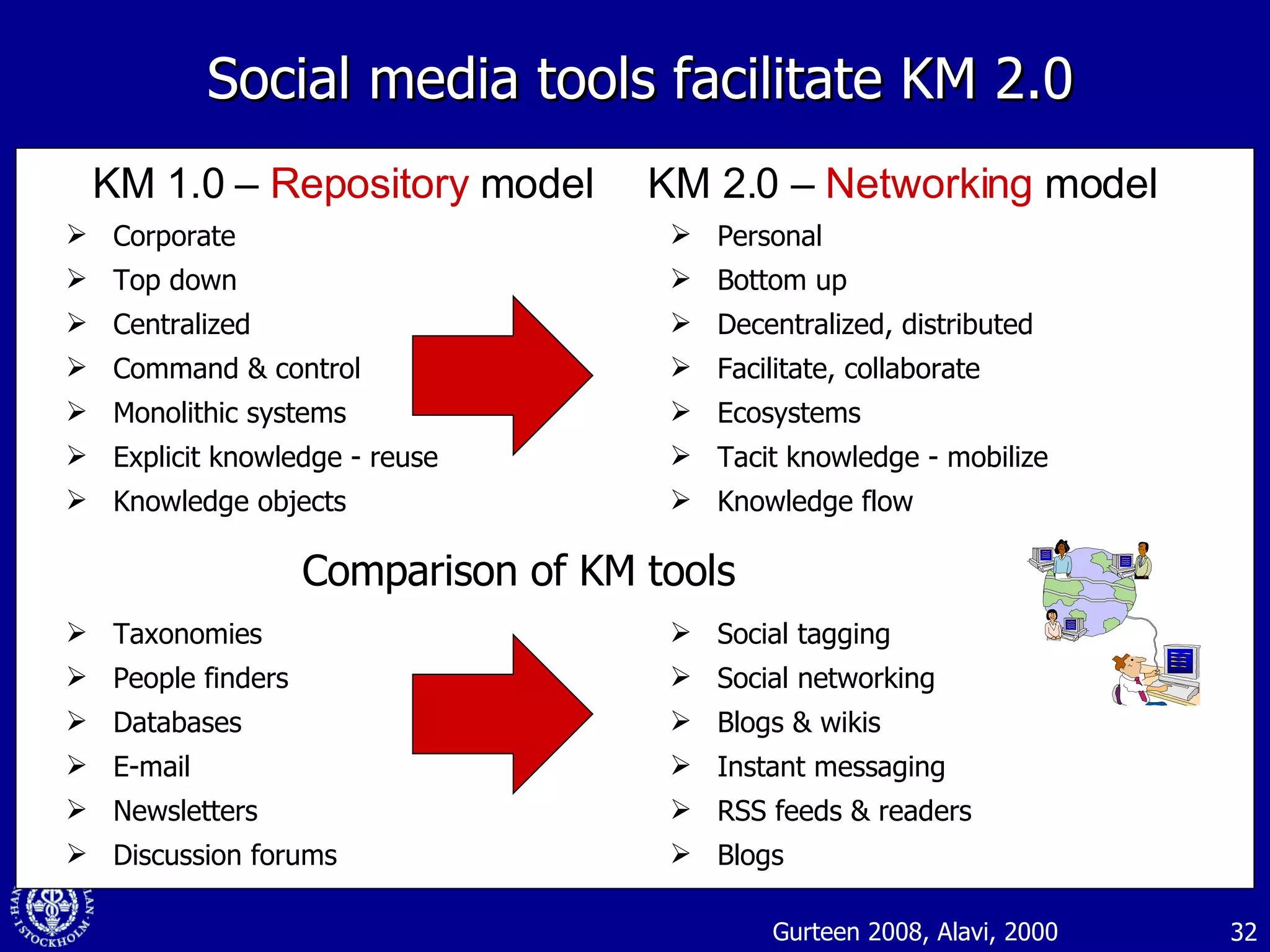
Corporate Top down Centralized Command & control Monolithic systems Explicit knowledge - reuse Knowledge objects Taxonomies People finders Databases E-mail Newsletters Discussion forums Personal Bottom up Decentralized, distributed Facilitate, collaborate Ecosystems Tacit knowledge - mobilize Knowledge flow Social tagging Social networking Blogs & wikis Instant messaging RSS feeds & readers Blogs Social media tools facilitate KM 2.0 KM 1.0 –  Repository  model KM 2.0 –  Networking  model Gurteen 2008, Alavi, 2000 Comparison of KM tools
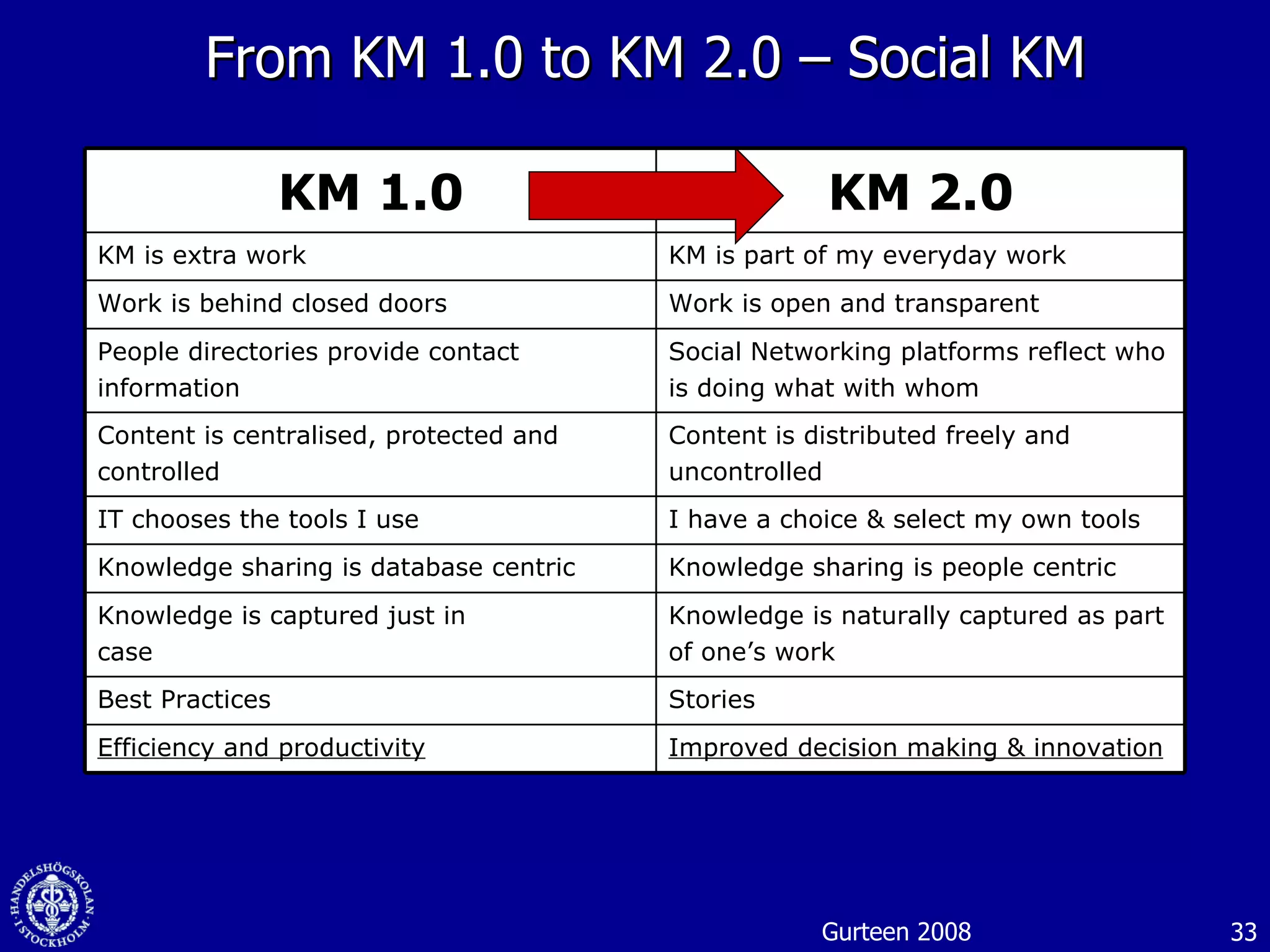
From KM 1.0 to KM 2.0  –  Social KM Gurteen 2008 KM 1.0 KM 2.0 KM is extra work KM is part of my everyday work Work is behind closed doors Work is open and transparent People directories provide contact information Social Networking platforms reflect who is doing what with whom Content is centralised, protected and controlled Content is distributed freely and uncontrolled IT chooses the tools I use I have a choice & select my own tools Knowledge sharing is database centric Knowledge sharing is people centric Knowledge is captured just in case Knowledge is naturally captured as part of one’s work Best Practices Stories Efficiency and productivity Improved decision making & innovation
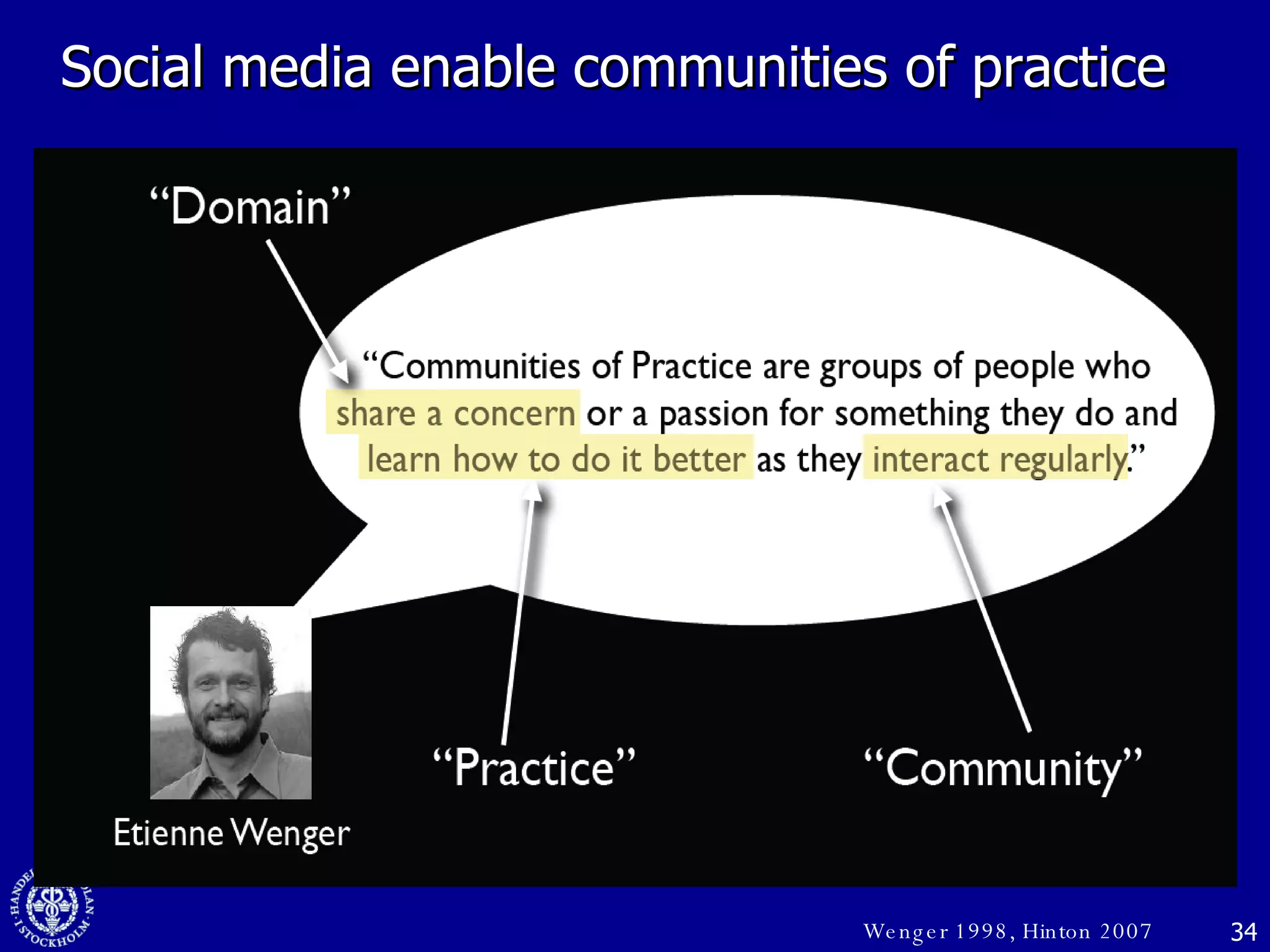
Wenger 1998, Hinton 2007 Social media enable communities of practice
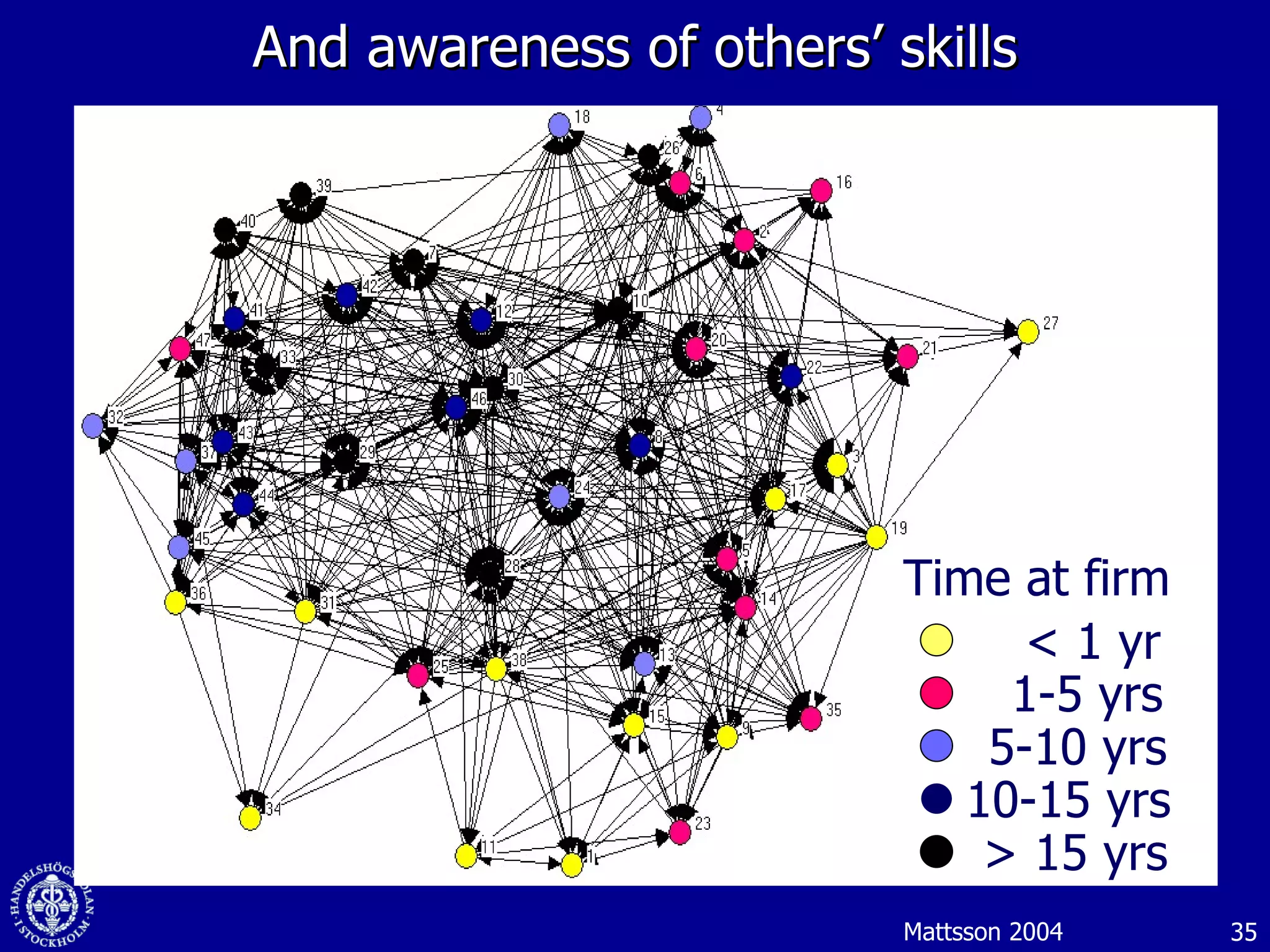
And awareness of others’ skills Mattsson 2004 < 1 yr 1-5 yrs 5-10 yrs 10-15 yrs > 15 yrs Time at firm
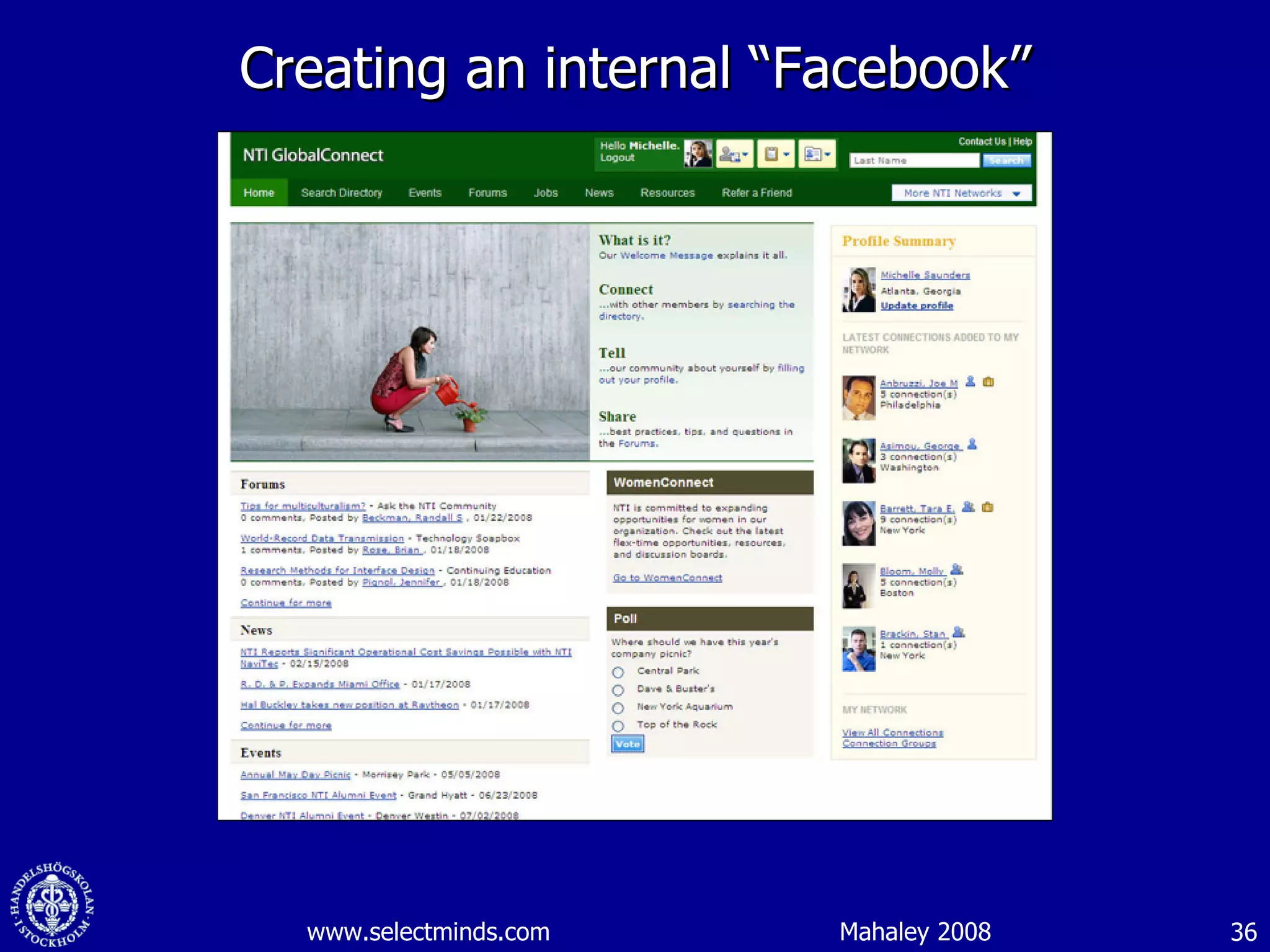
Creating an internal “Facebook” Mahaley 2008 www.selectminds.com
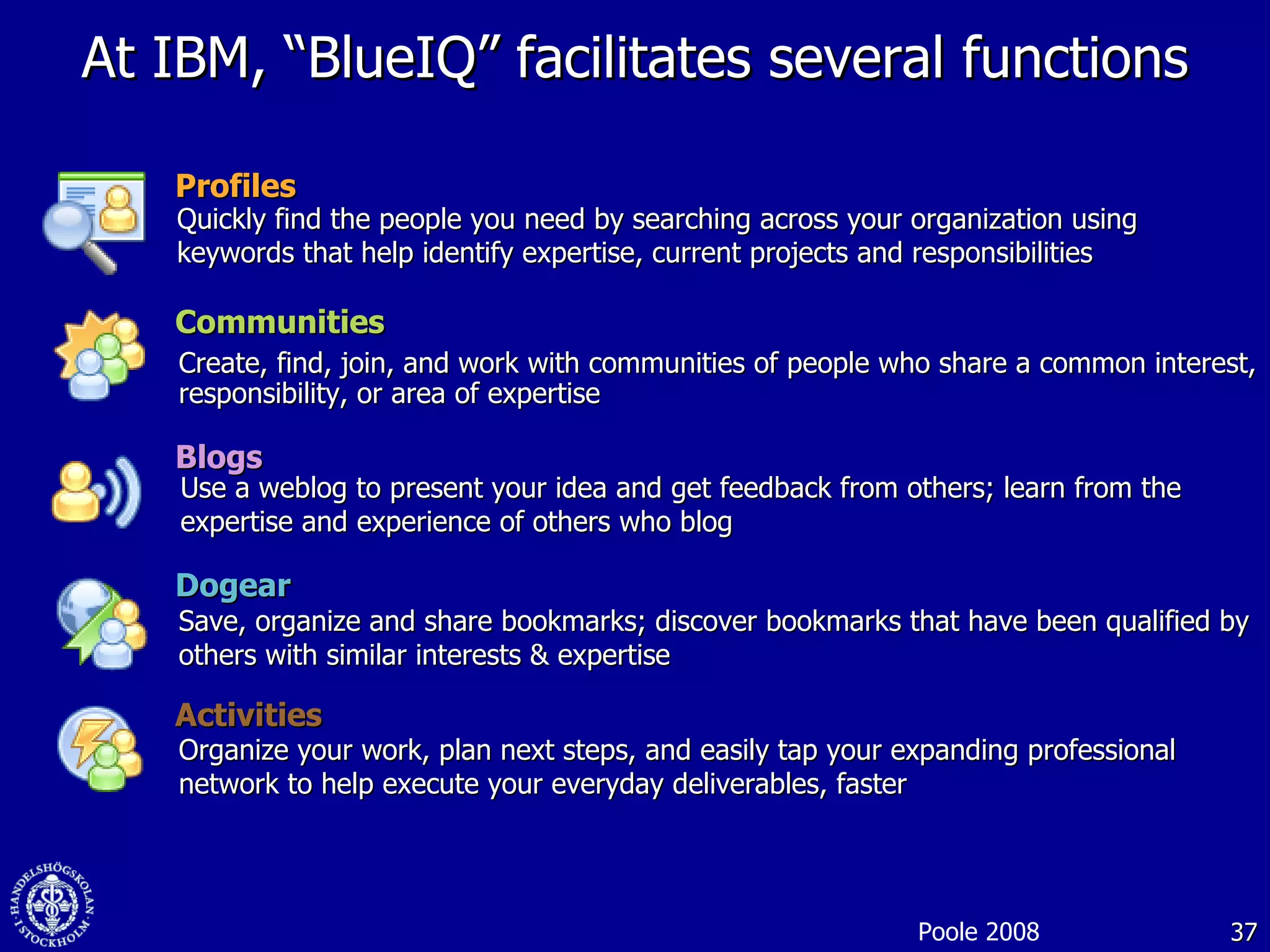
At IBM, “BlueIQ” facilitates several functions Communities Create, find, join, and work with communities of people who share a common interest, responsibility, or area of expertise Blogs Use a weblog to present your idea and get feedback from others; learn from the expertise and experience of others who blog Dogear Save, organize and share bookmarks; discover bookmarks that have been qualified by others with similar interests & expertise Activities Organize your work, plan next steps, and easily tap your expanding professional network to help execute your everyday deliverables, faster Profiles Quickly find the people you need by searching across your organization using keywords that help identify expertise, current projects and responsibilities Poole 2008
Trust & reciprocity are essential for knowledge exchange in networks
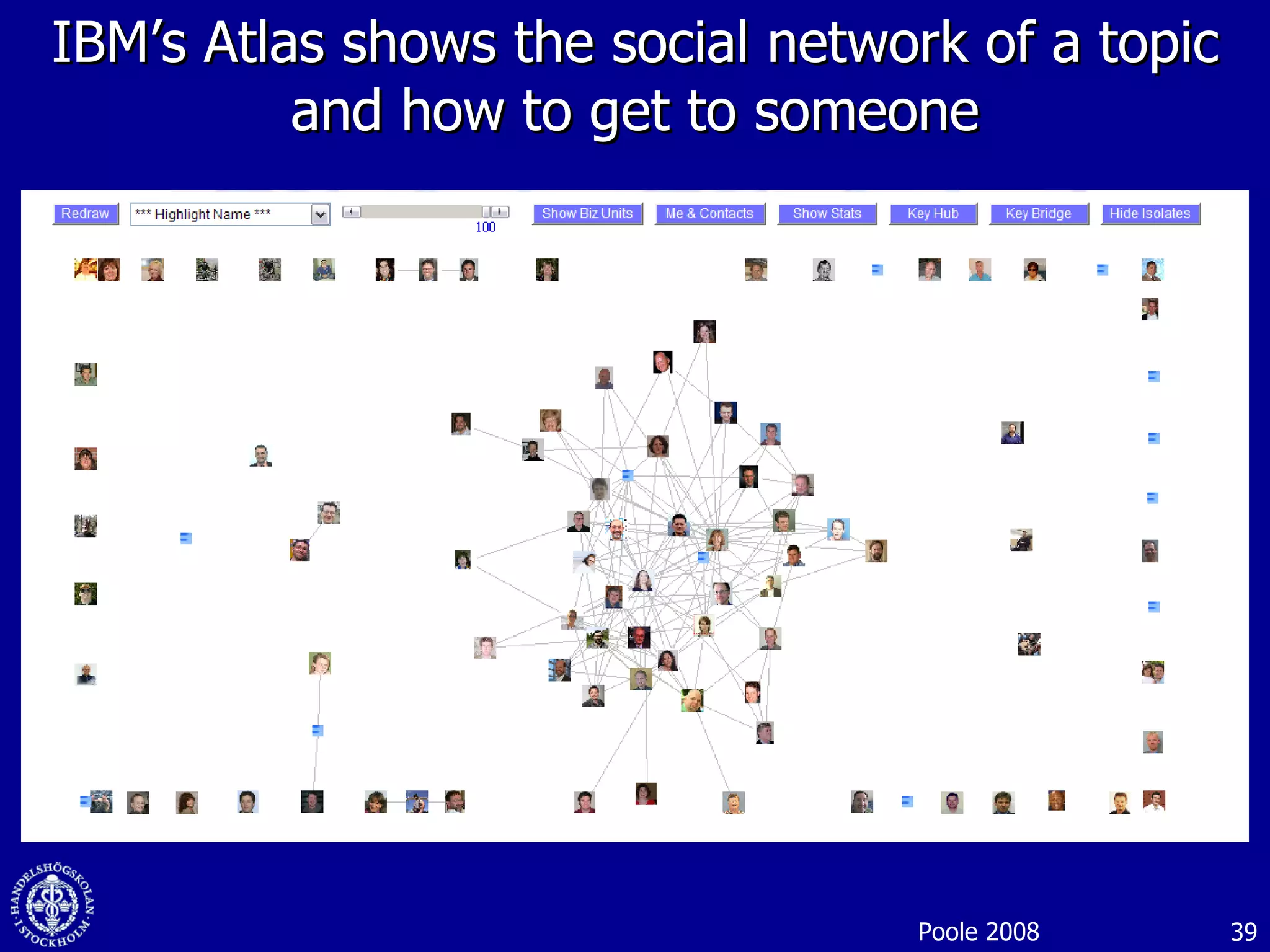
IBM’s Atlas shows the social network of a topic and how to get to someone Poole 2008
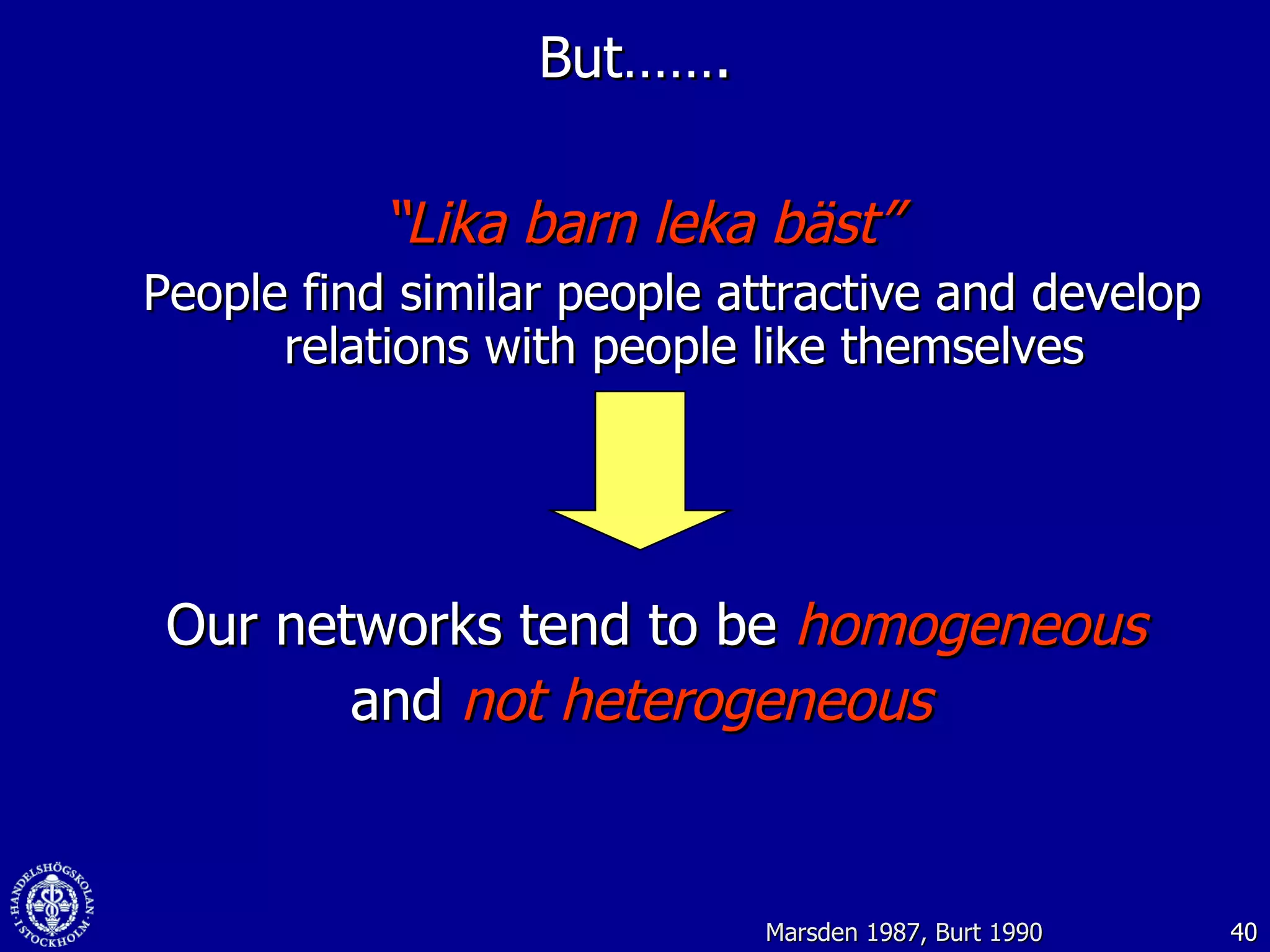
But……. “ Lika barn leka bäst” People find similar people attractive and develop relations with people like themselves  Our networks tend to be  homogeneous   and  not heterogeneous Marsden 1987, Burt 1990
Facebook Fridays –  Strengthening external relationships #1 Applications Lifecycle Management (ALM) & business mashup 96 of Fortune 100 as customers 800 employees in 18 countries across globe  One hour every Friday on Facebook to find fun and connect with co-workers, customers, family, and friends Serena Software
When you hire someone,…  … ..you “hire” his or her network.
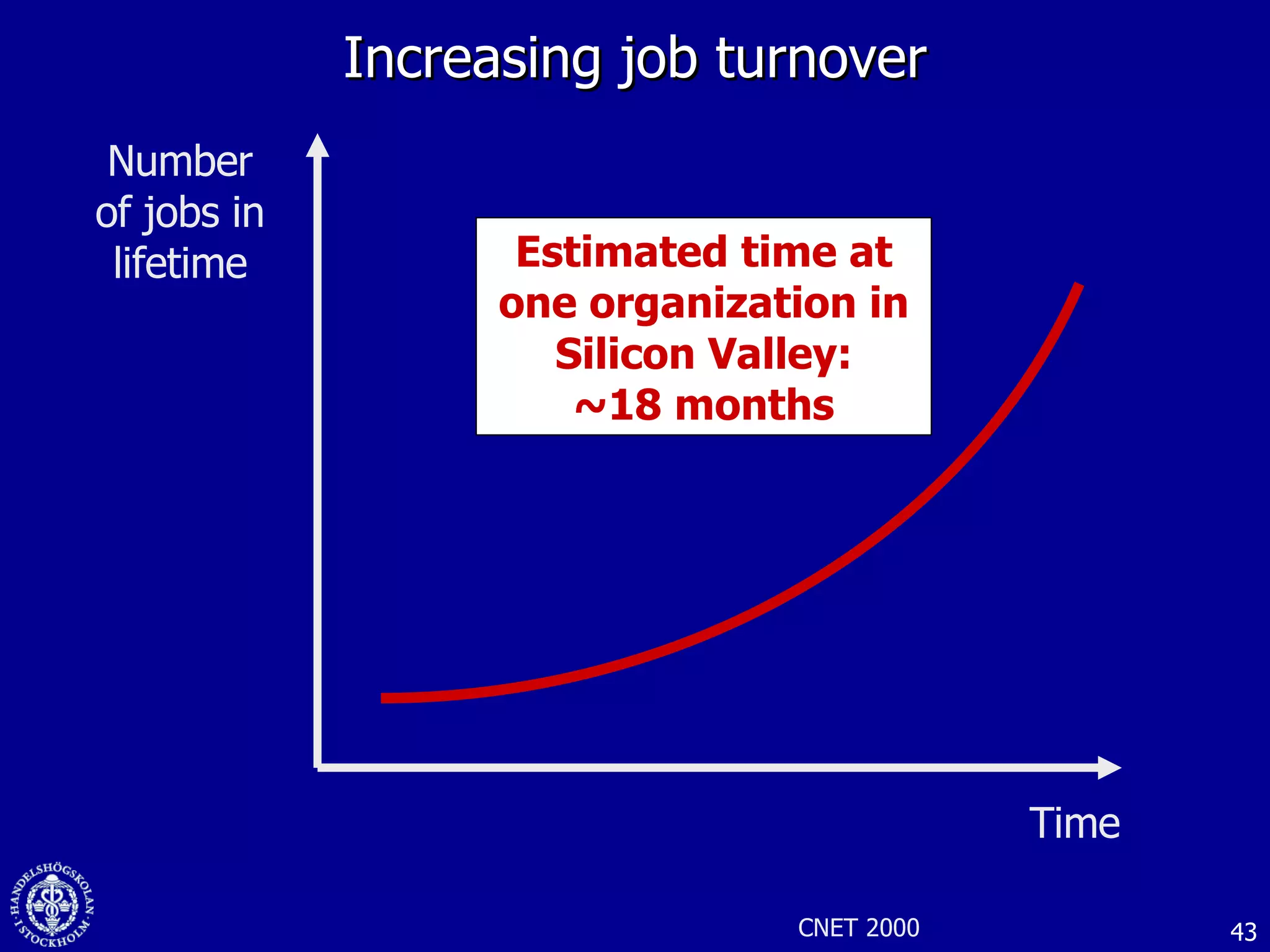
Increasing job turnover Time Number of jobs in lifetime Estimated time at one organization in Silicon Valley: ~18 months CNET 2000
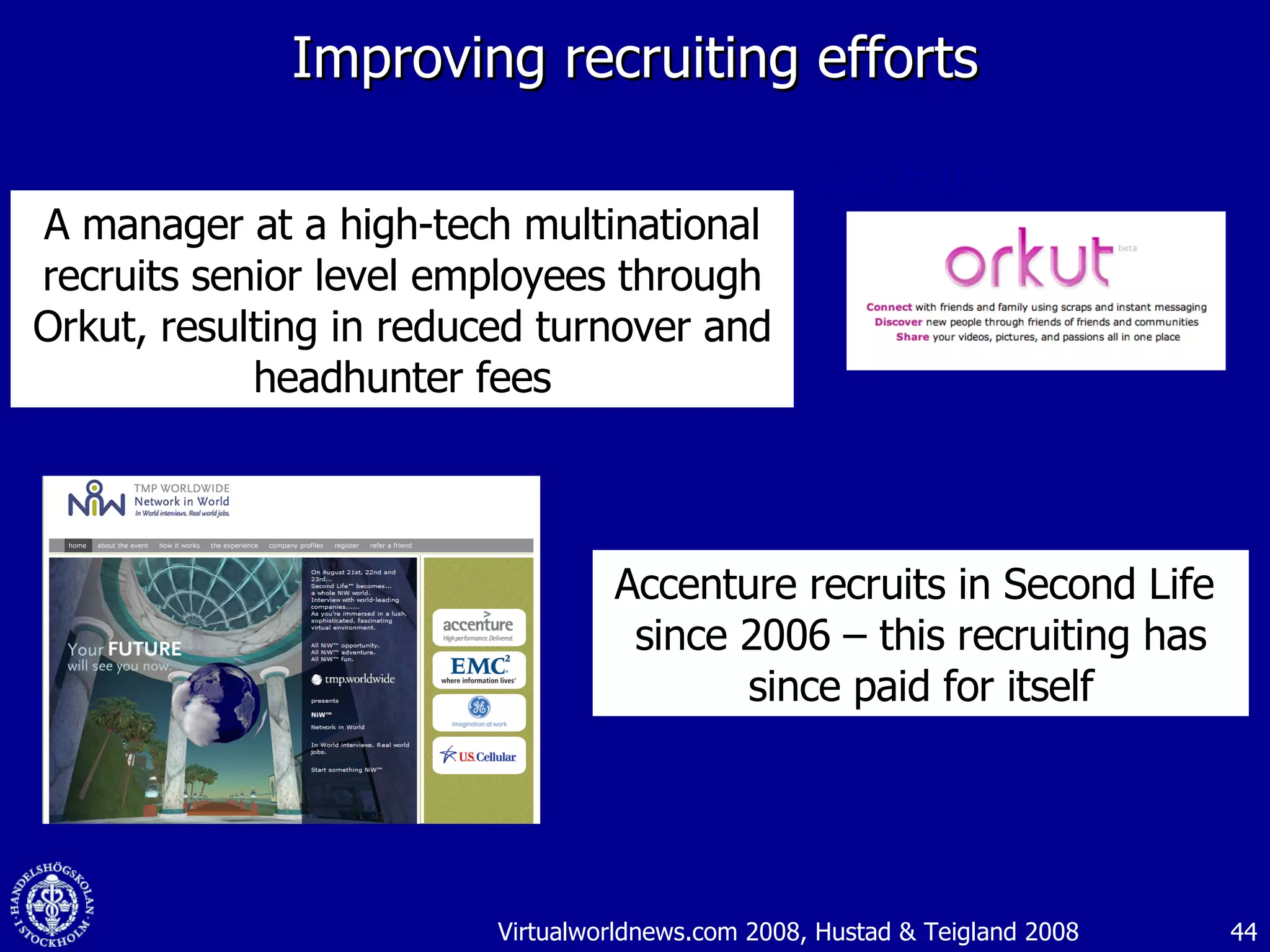
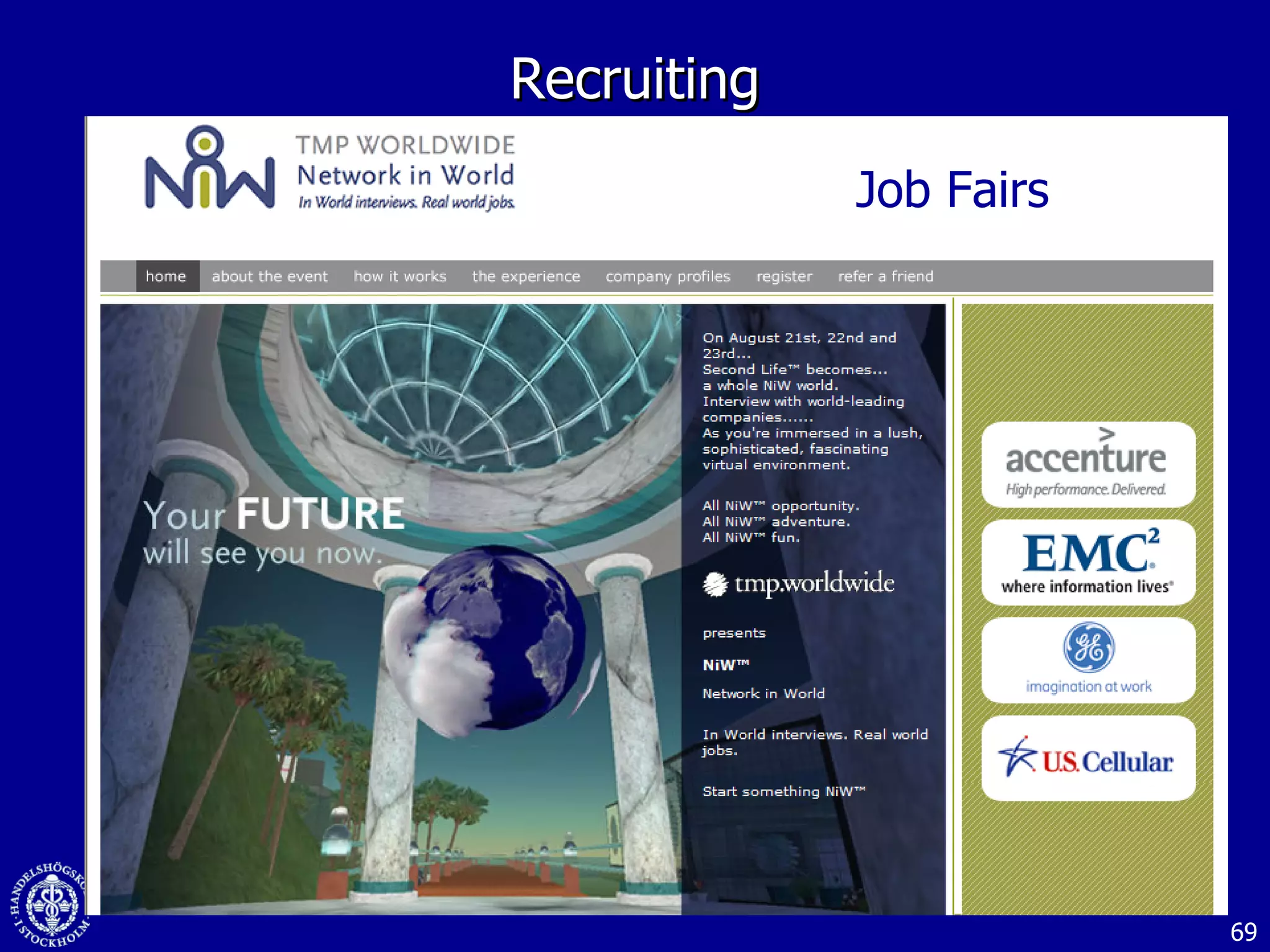
Improving recruiting efforts Job Fairs Accenture recruits in Second Life  since 2006  – this recruiting has since paid for itself A manager at a high-tech multinational recruits senior level employees through Orkut, resulting in reduced turnover and headhunter fees Virtualworldnews.com 2008, Hustad & Teigland 2008
Proximal collaboration When people are more than 50 feet apart, the likelihood of them collaborating more than once a week is less than 10%. Allen 1984
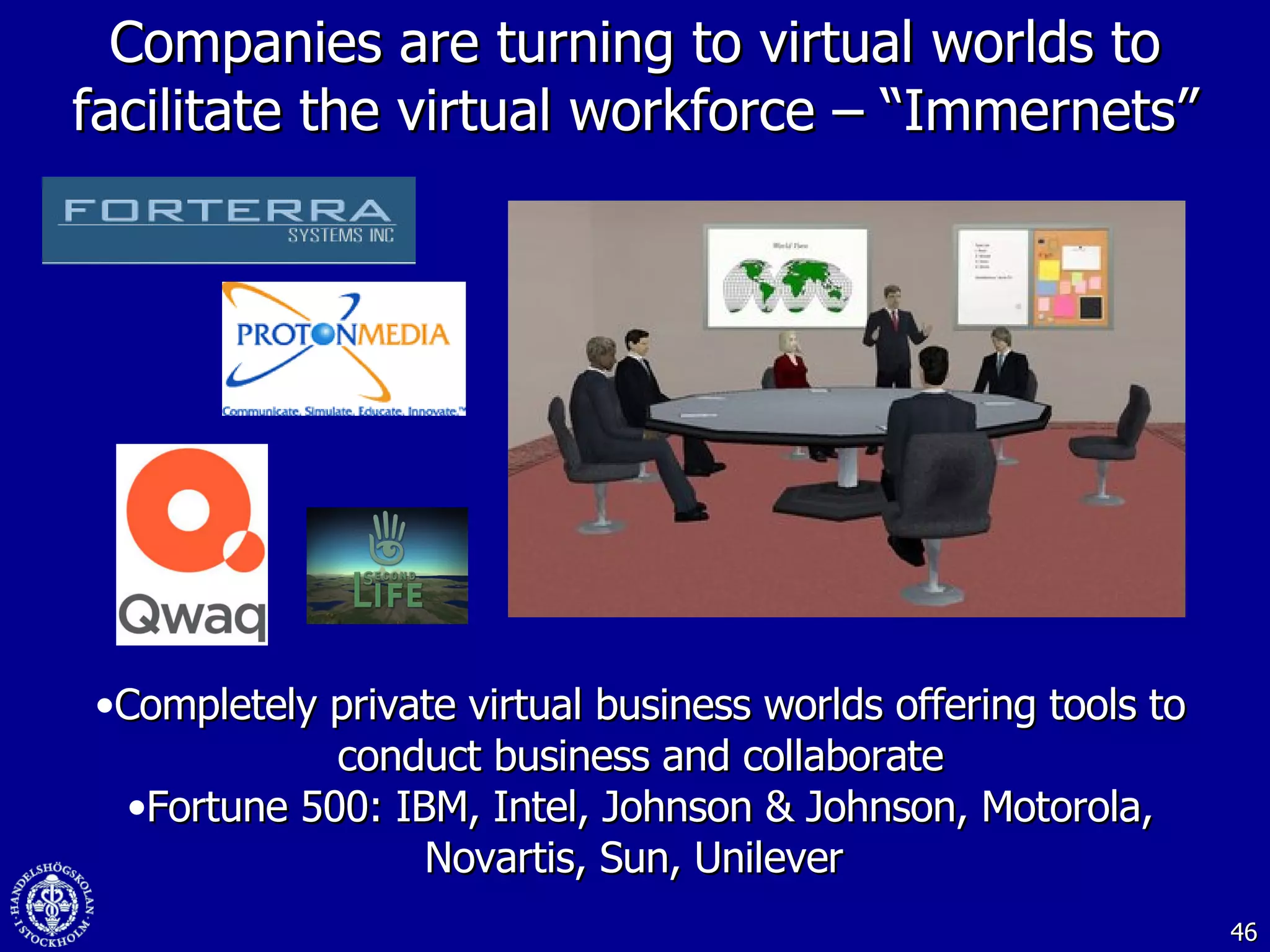
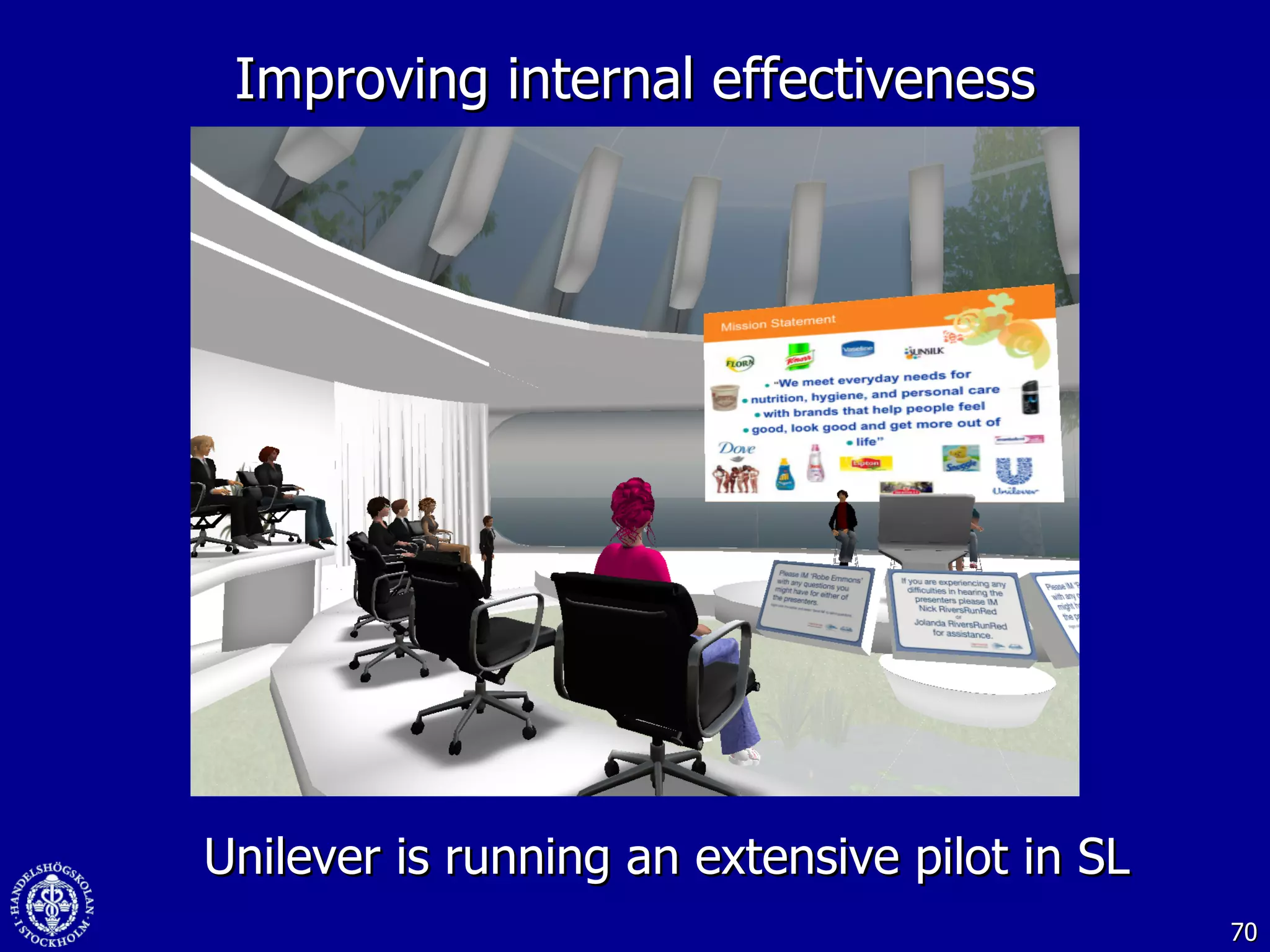
Companies are turning to virtual worlds to facilitate the virtual workforce – “Immernets” Completely private virtual business worlds offering tools to conduct business and collaborate Fortune 500: IBM, Intel, Johnson & Johnson, Motorola, Novartis, Sun, Unilever
And to promote an open innovation attitude Not all the smart people work for us.  We need to work with smart people inside and outside the company. The smart people in our field work for us. If you create the most and the best ideas in the industry, you will win. If you make the best use of internal and external ideas, you will win. Closed attitude Open attitude Chesborough 2003
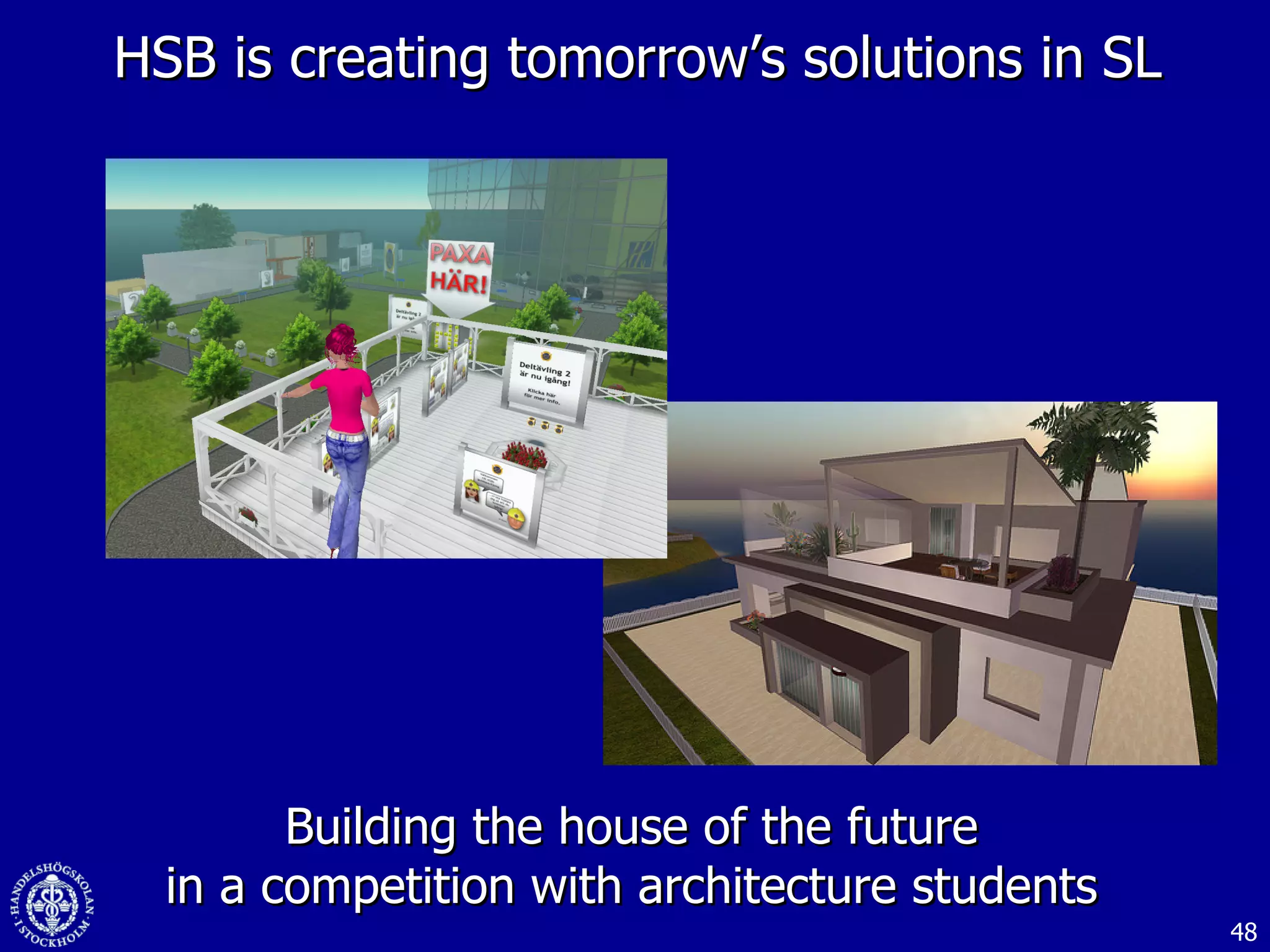
HSB is creating tomorrow’s solutions in SL Building the house of the future in a competition with architecture students
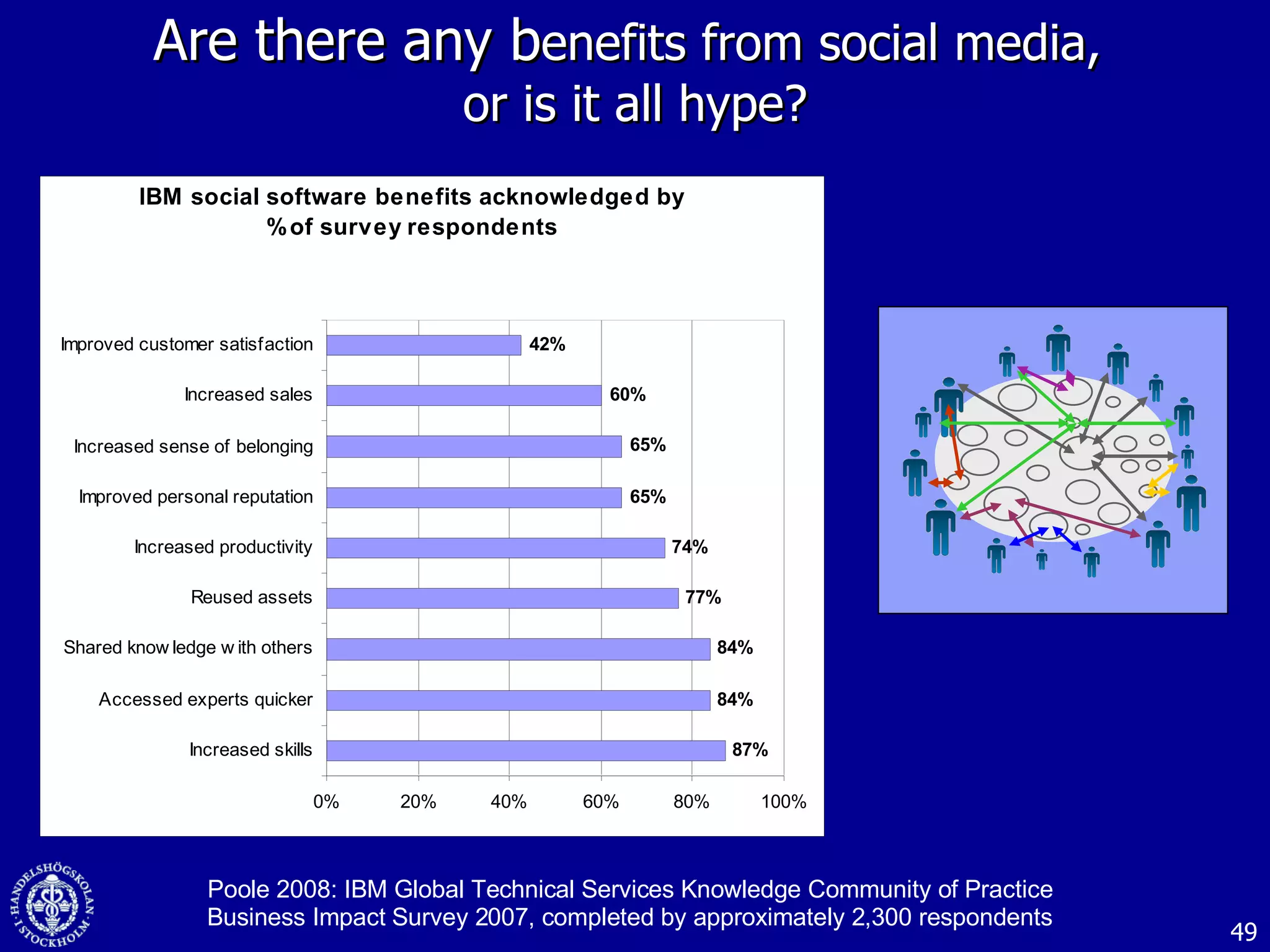
Are there any b enefits from social media,  or is it all hype? Poole 2008: IBM Global Technical Services Knowledge Community of Practice Business Impact Survey 2007, completed by approximately 2,300 respondents
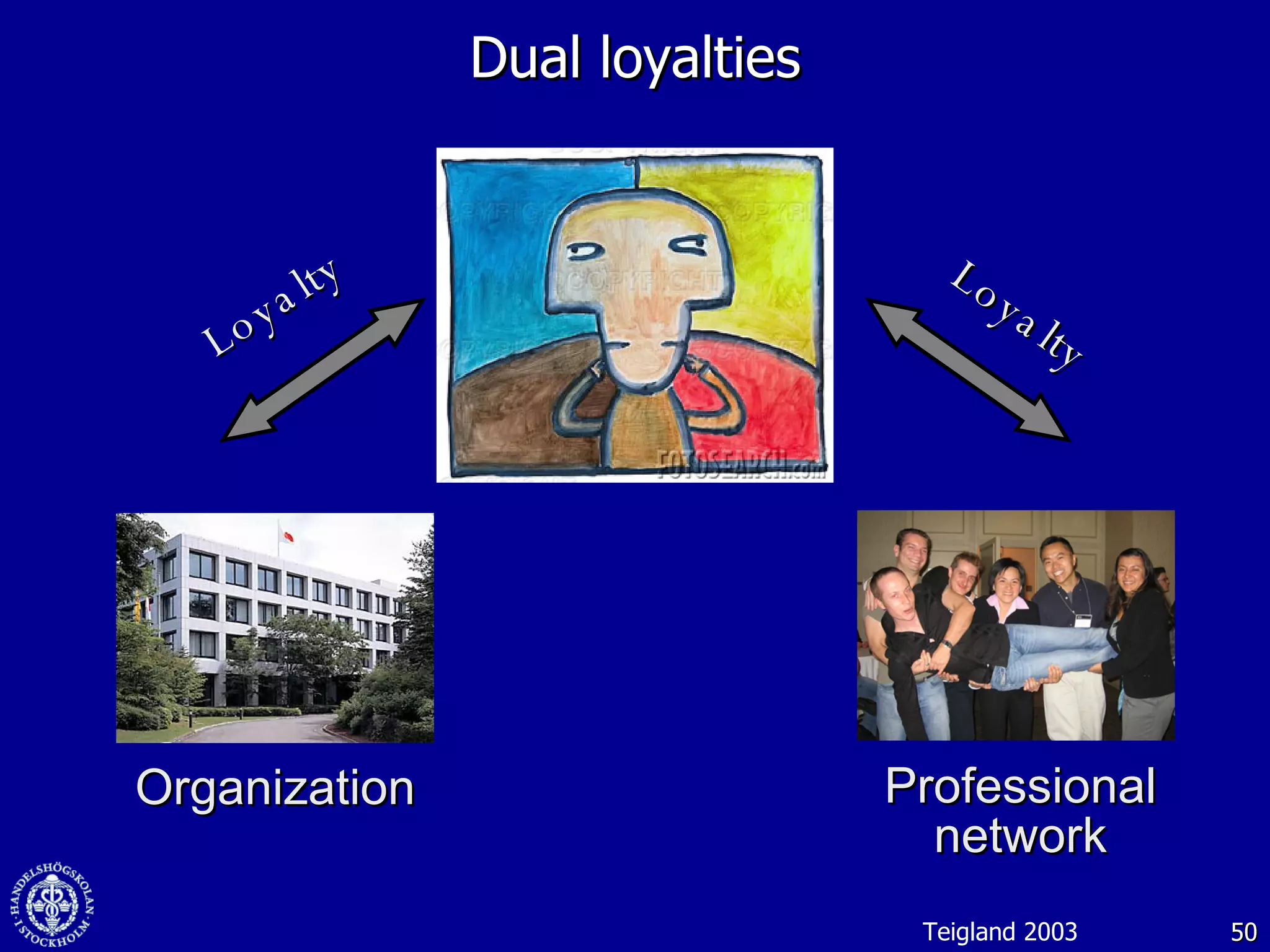
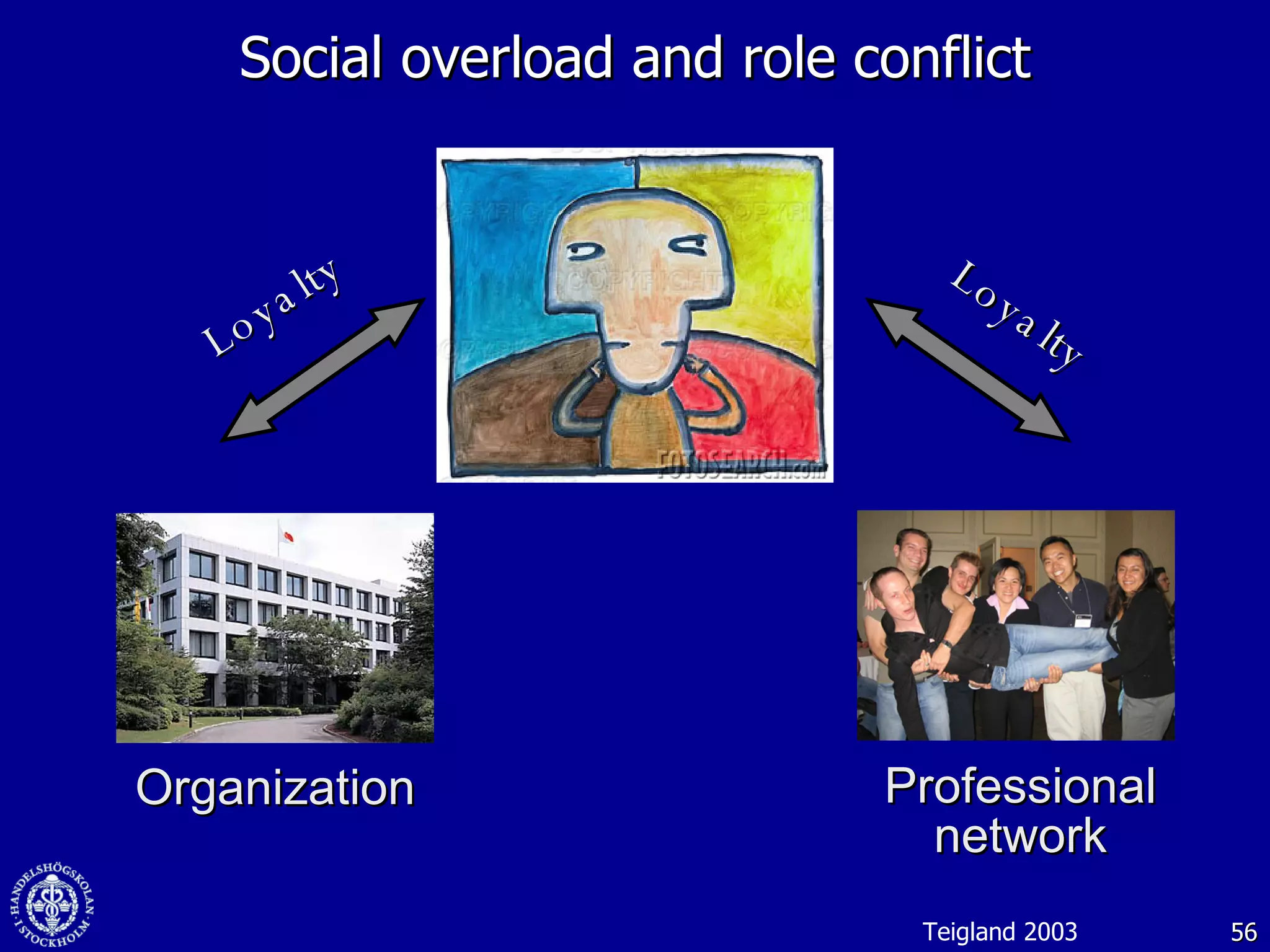
Dual loyalties Loyalty Loyalty Organization Professional network Teigland 2003
What about business results? Driving  innovation  into products faster Enabling employees to be  more productive, more knowledgeable,  faster Harnessing the  knowledge of the wise , before they retire Being  more responsive  to customers, with knowledge from subject experts you may or  may not  know Poole 2008
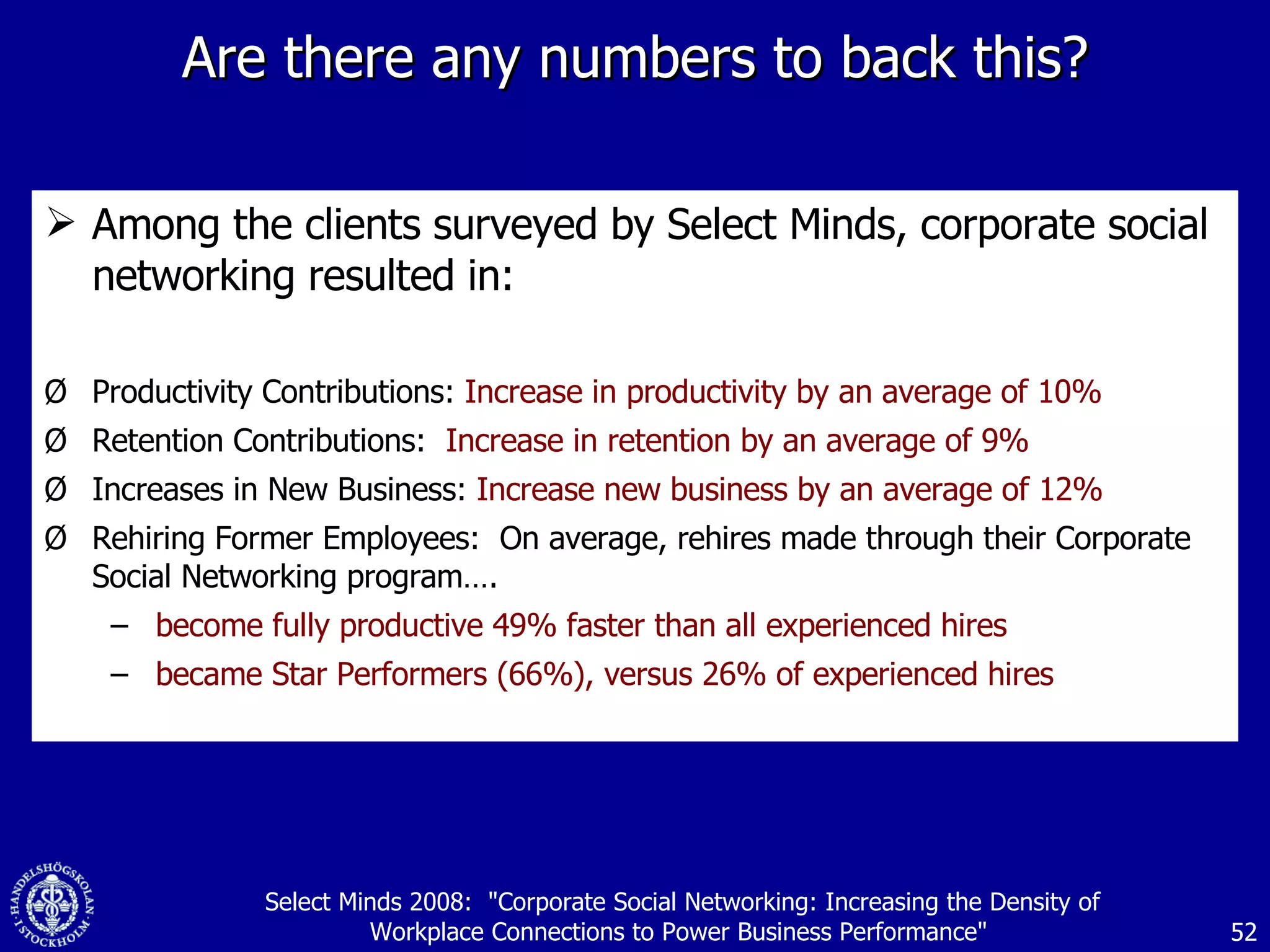
Are there any numbers to back this? Among the clients surveyed by Select Minds, corporate social networking resulted in: Productivity Contributions:  Increase in productivity by an average of 10% Retention Contributions:  Increase in retention by an average of 9% Increases in New Business:  Increase new business by an average of 12% Rehiring Former Employees:  On average, rehires made through their Corporate Social Networking program…. become fully productive 49% faster than all experienced hires  became Star Performers (66%), versus 26% of experienced hires Select Minds 2008:  &quot;Corporate Social Networking: Increasing the Density of Workplace Connections to Power Business Performance&quot;
However, there are challenges…. Resistance from top management Difficulty to measure and validate value of web 2.0 Knowledge trading and leakage outside of firm Social overload and role conflict Poor organizational stewardship Web 2.0 and social networking are typically of a more grassroots nature – their implementation in more traditional hierarchical organizations may result in tension between employees and management Hustad & Teigland 2008
Is knowledge trading good or bad for a firm? We pass over the nondisclosure agreements of different companies and trade company secrets all the time.  Teigland 2003
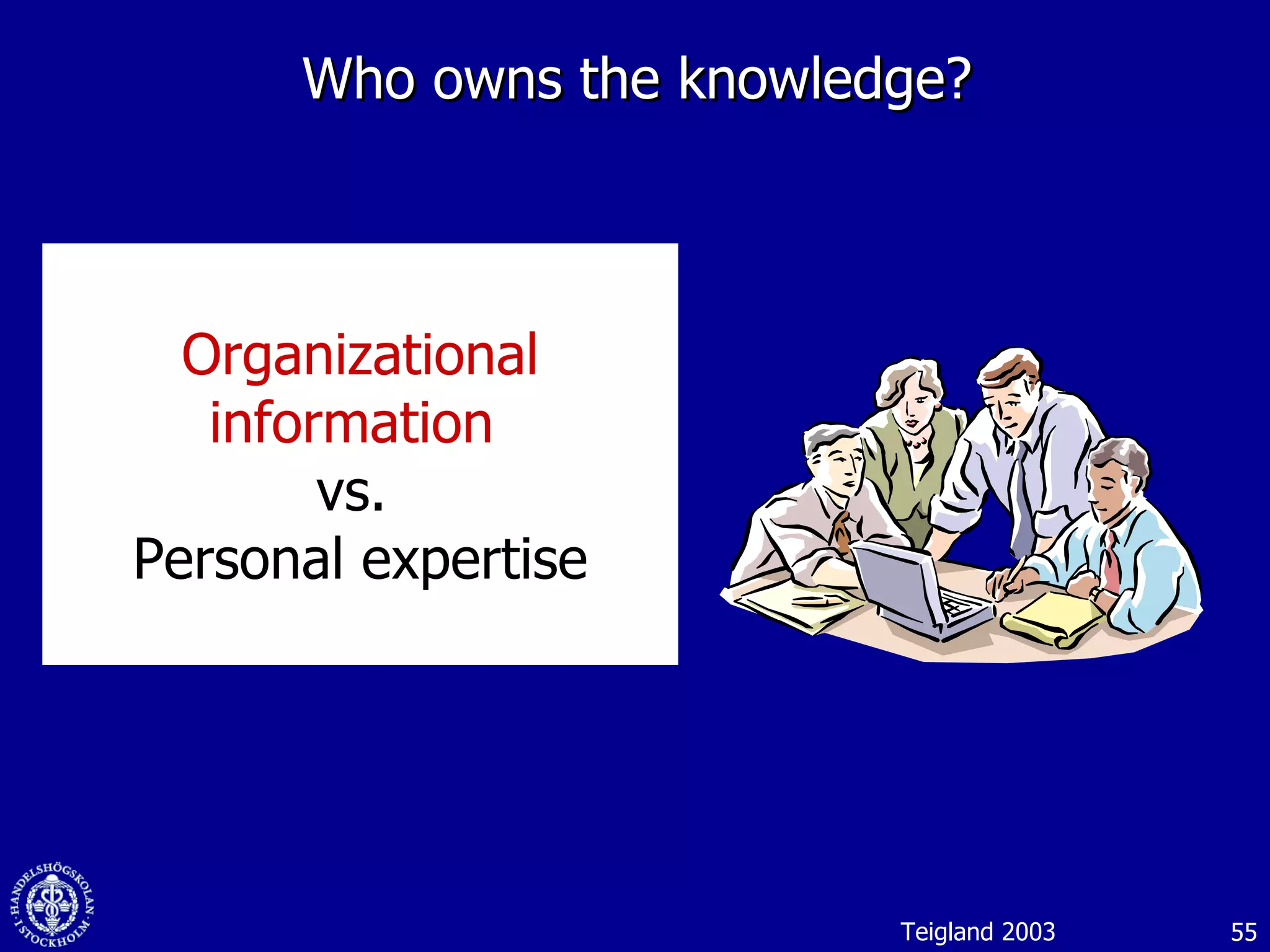
Who owns the knowledge? Organizational information   vs.  Personal expertise Teigland 2003
Social overload and role conflict Loyalty Loyalty Organization Professional network Teigland 2003
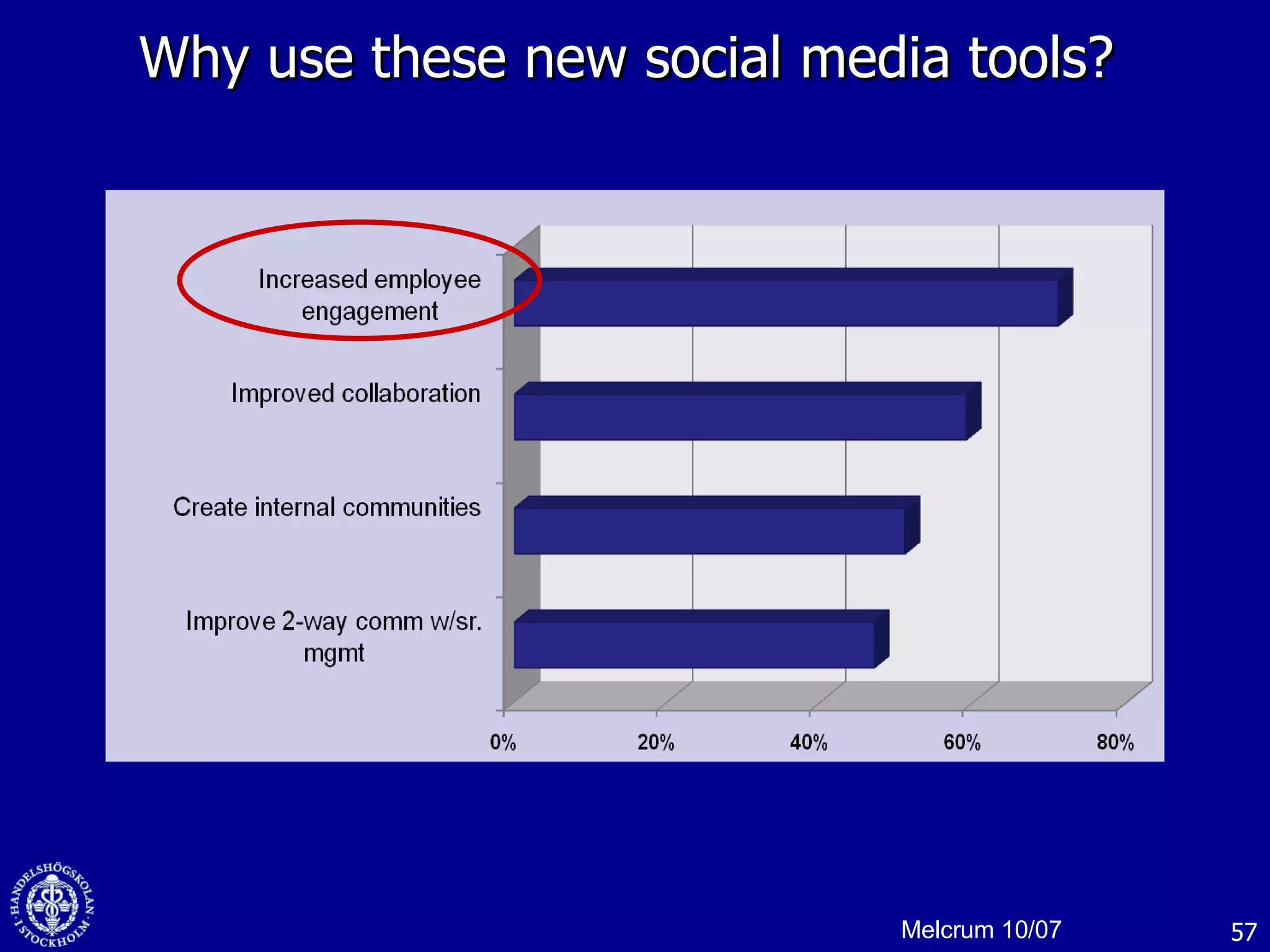
Why use these new social media tools?  Melcrum 10/07
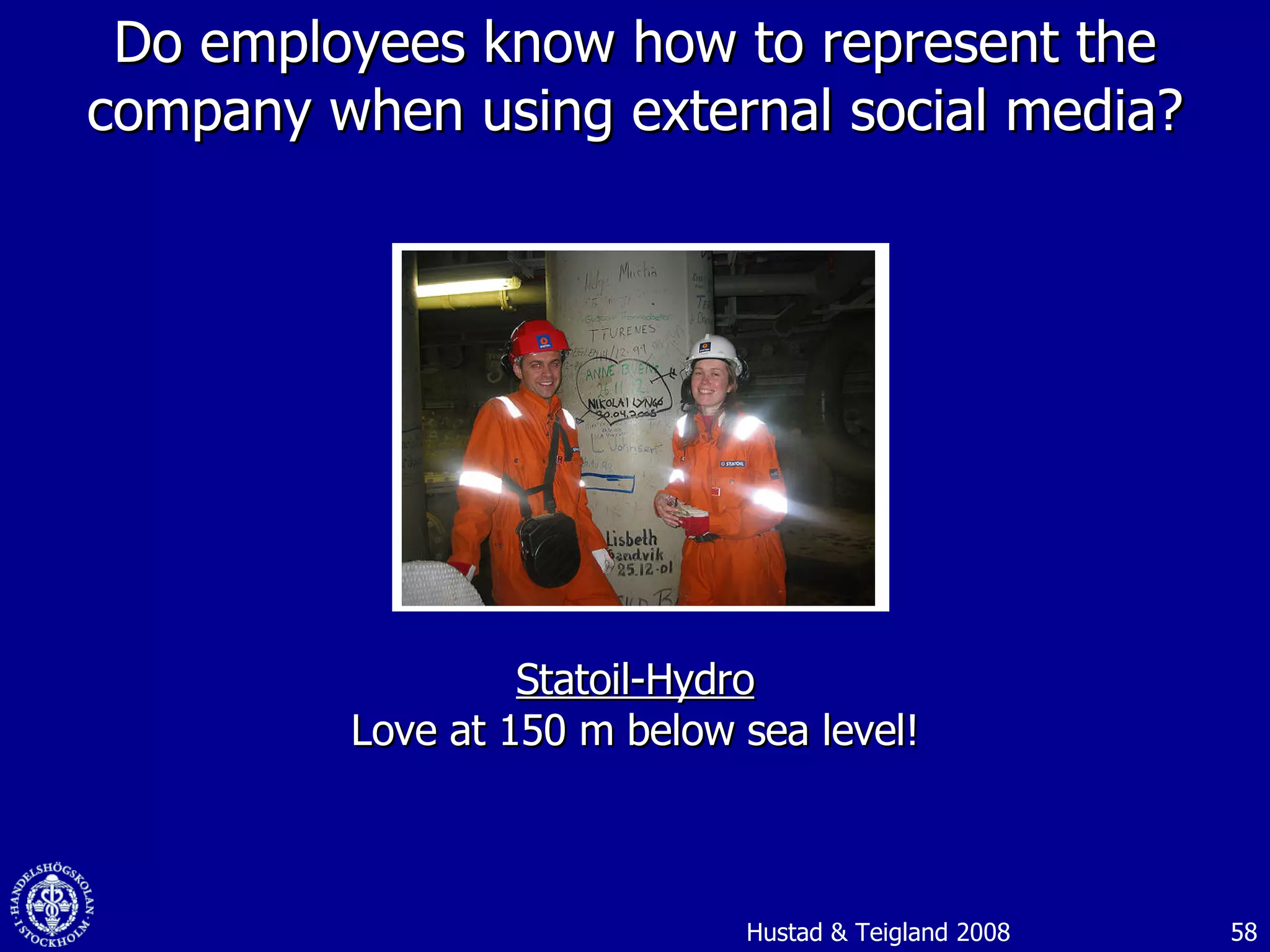
Do employees know how to represent the company when using external social media? Statoil-Hydro Love at 150 m below sea level! Hustad & Teigland 2008
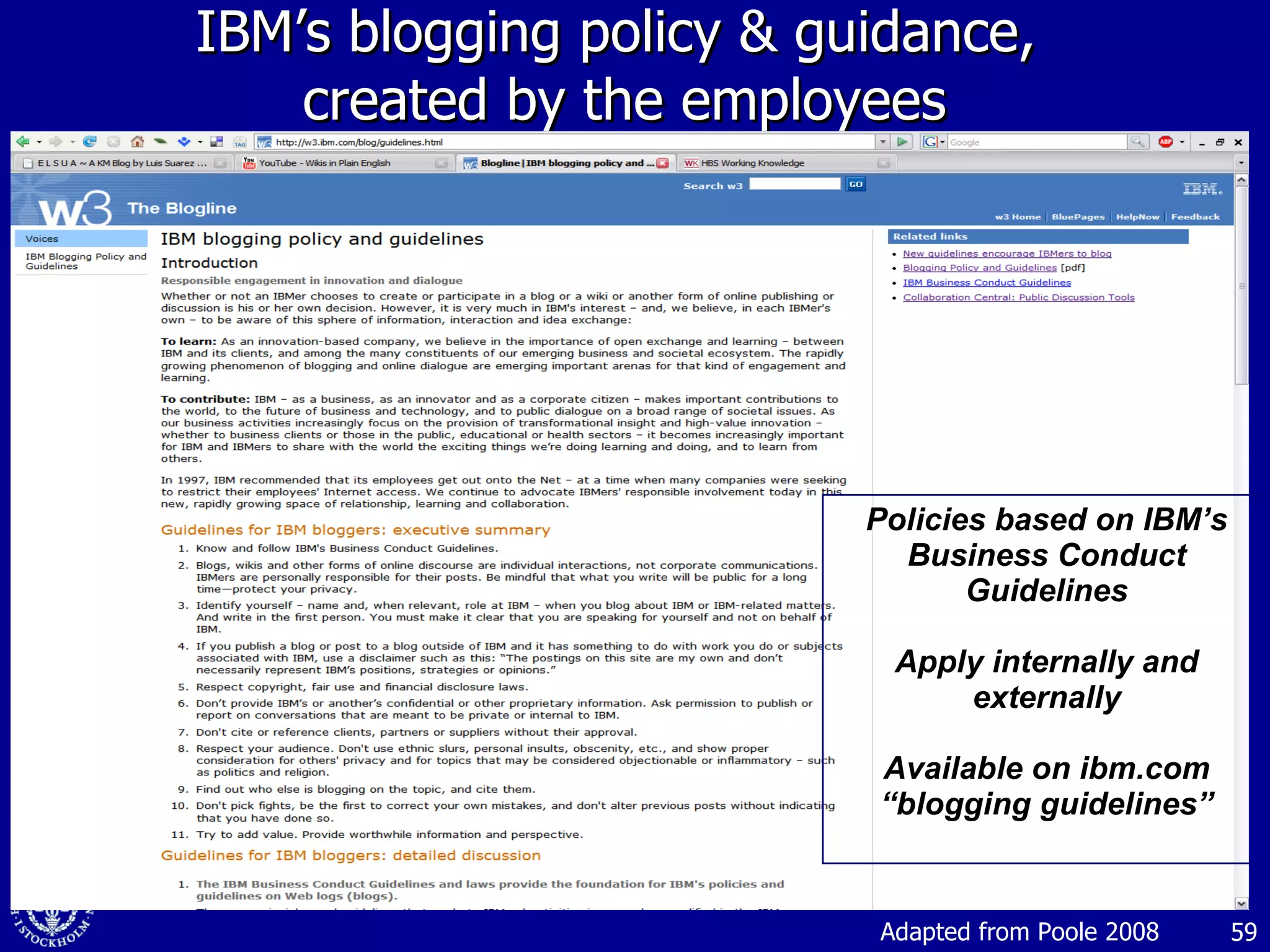
IBM’s blogging policy & guidance,  created by the employees Policies based on IBM’s Business Conduct Guidelines Apply internally and externally Available on ibm.com “ blogging guidelines” Adapted from Poole 2008
Develop company guidelines for using social media internally and externally Trust your employees, and don’t ban social media Use wikis to enable employees to create the company guidelines, eg IBM Yahoo’s best practice guidelines for blogging (http://jeremy.zawodny.com/yahoo/yahoo-blog-guidelines.pdf) Be respectful of your colleagues Get your facts straight Provide context to your argument Engage in private feedback When trusted, employees feel empowered to do the right thing!
Introduction to social media and networks  Why the interest? What are networks? What about performance? Leveraging social media and networks Why are they of interest for organizations? Are there any benefits or is it all hype? What are some challenges? An introduction to virtual worlds Today’s discussion
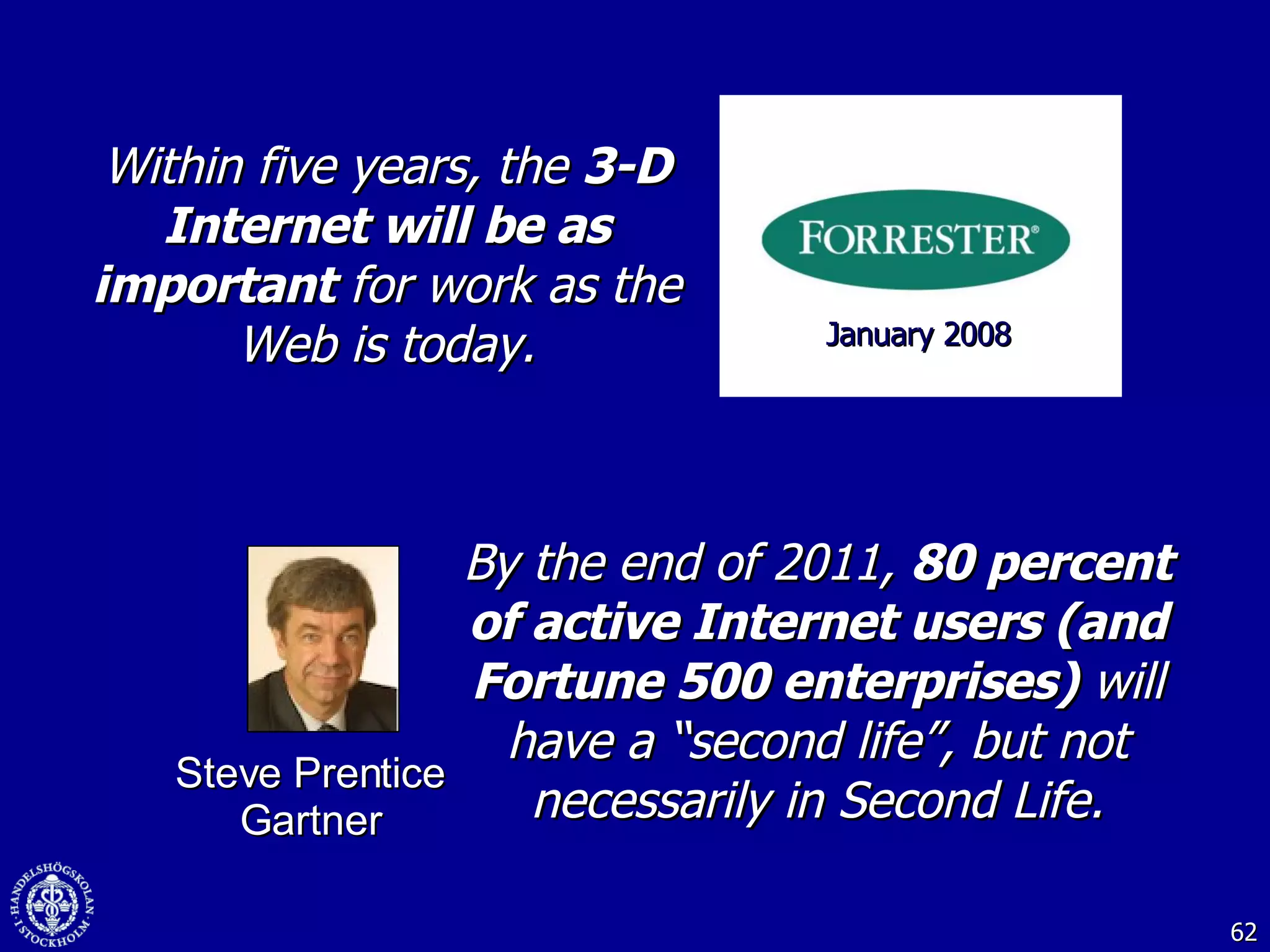
Within five years, the  3-D Internet will be as important  for work as the Web is today. January 2008 By the end of 2011,  80 percent of active Internet users (and Fortune 500 enterprises)  will have a “second life”, but not necessarily in Second Life. Steve Prentice Gartner
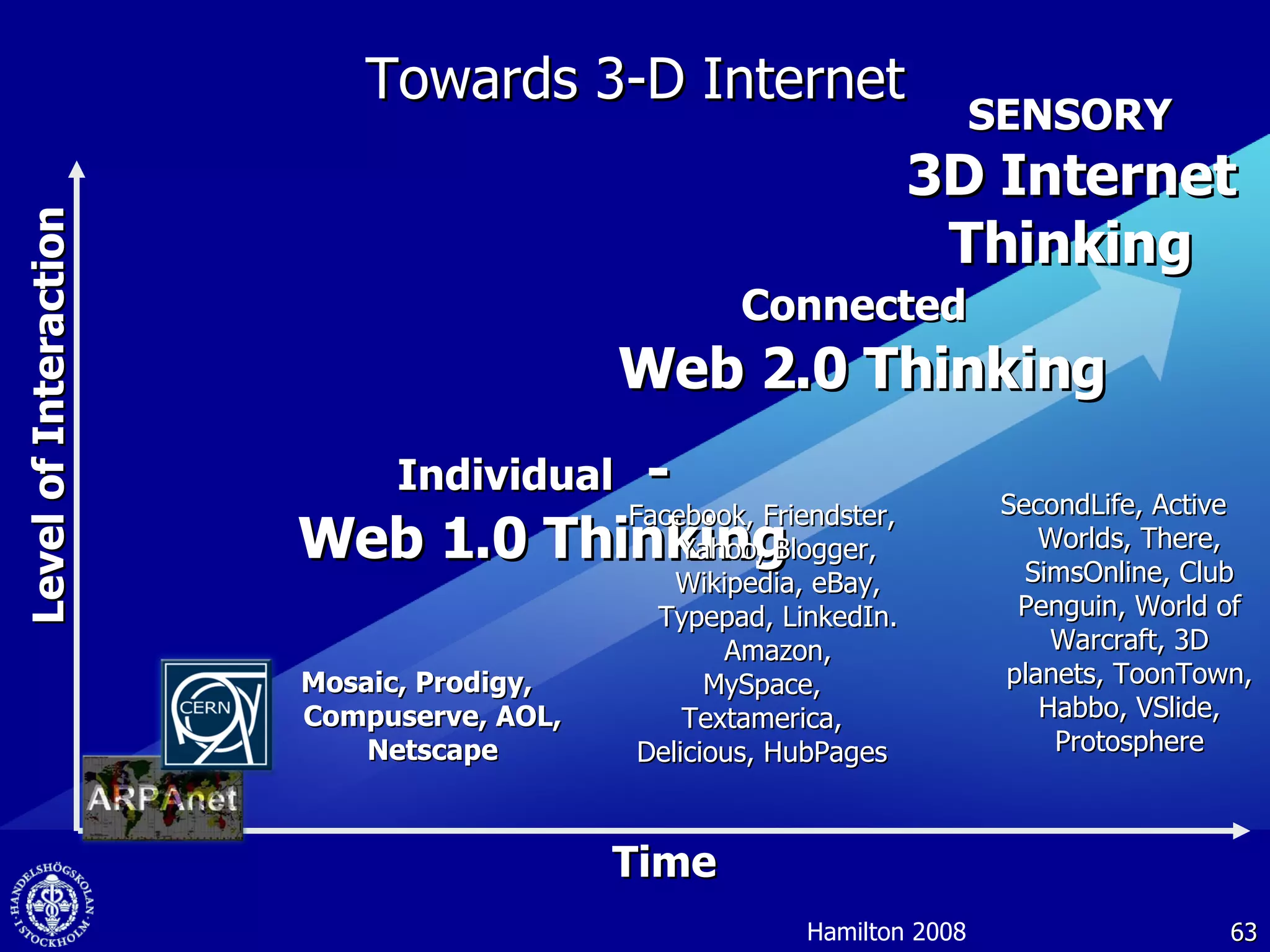
Towards 3-D Internet Level of Interaction Time Hamilton 2008 Individual   -  Web 1.0 Thinking Mosaic, Prodigy, Compuserve, AOL, Netscape Connected   Web 2.0 Thinking Facebook, Friendster, Yahoo, Blogger, Wikipedia, eBay, Typepad, LinkedIn. Amazon, MySpace, Textamerica, Delicious, HubPages SENSORY 3D Internet Thinking SecondLife, Active Worlds, There, SimsOnline, Club Penguin, World of Warcraft, 3D planets, ToonTown, Habbo, VSlide, Protosphere
The number of virtual worlds is growing Wonderland
Second Life – one example of a virtual world Machinama film by Duke CE on SSE MBA http://www.youtube.com/watch?v=Bi5i3UwVvbg
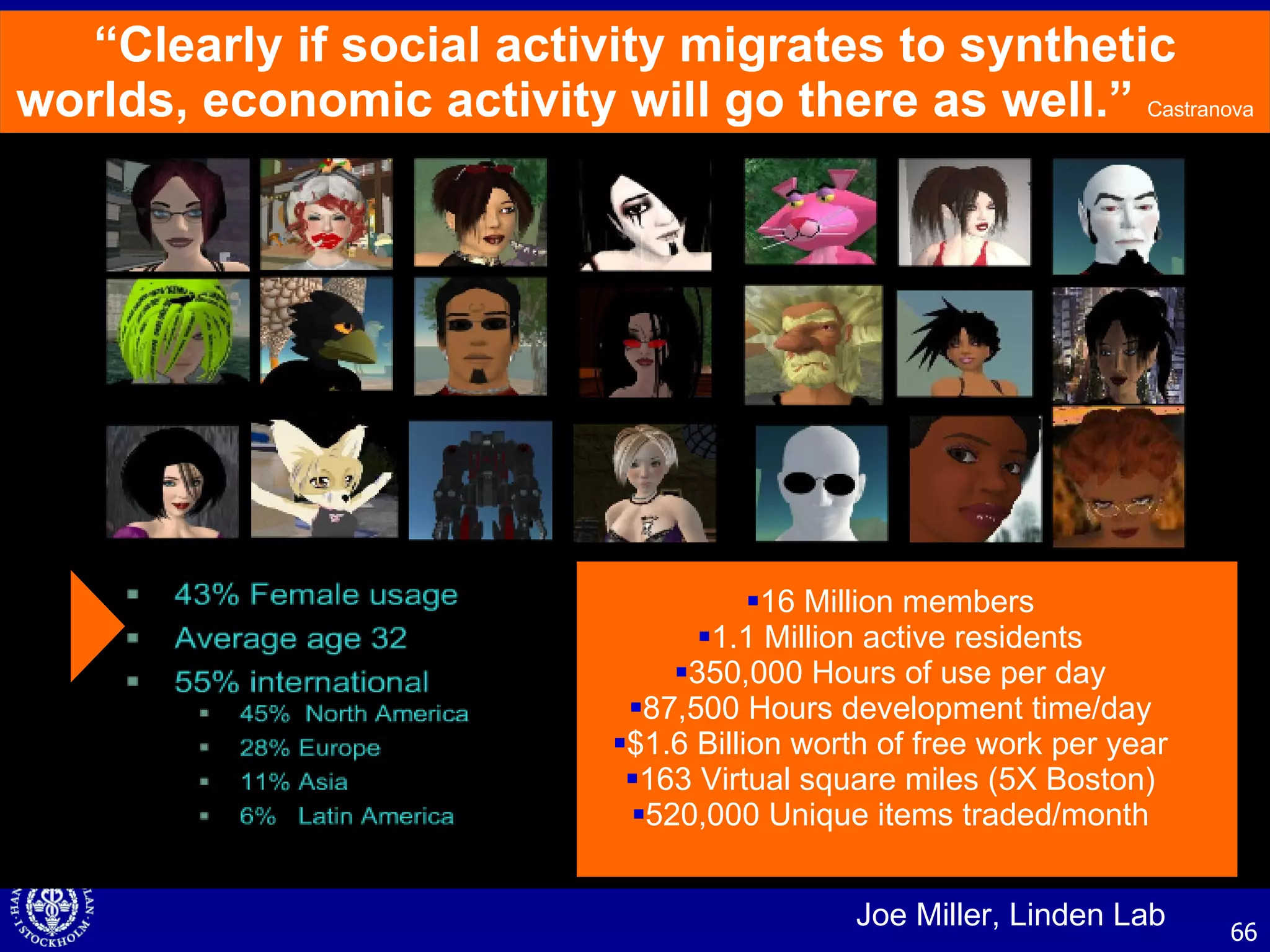
“ Clearly if social activity migrates to synthetic worlds, economic activity will go there as well.”  Castranova Joe Miller, Linden Lab  16 Million members 1.1 Million active residents 350,000 Hours of use per day 87,500 Hours development time/day $1.6 Billion worth of free work per year 163 Virtual square miles (5X Boston) 520,000 Unique items traded/month
“ We think it has potential as a way of doing business. We’re just experimenting with it ourselves but we see  massive potential  in the  human interaction  you can bring. It’s a big browsing environment in many ways.” - IBM Director
Recruiting Job Fairs
Improving internal effectiveness Unilever is running an extensive pilot in SL
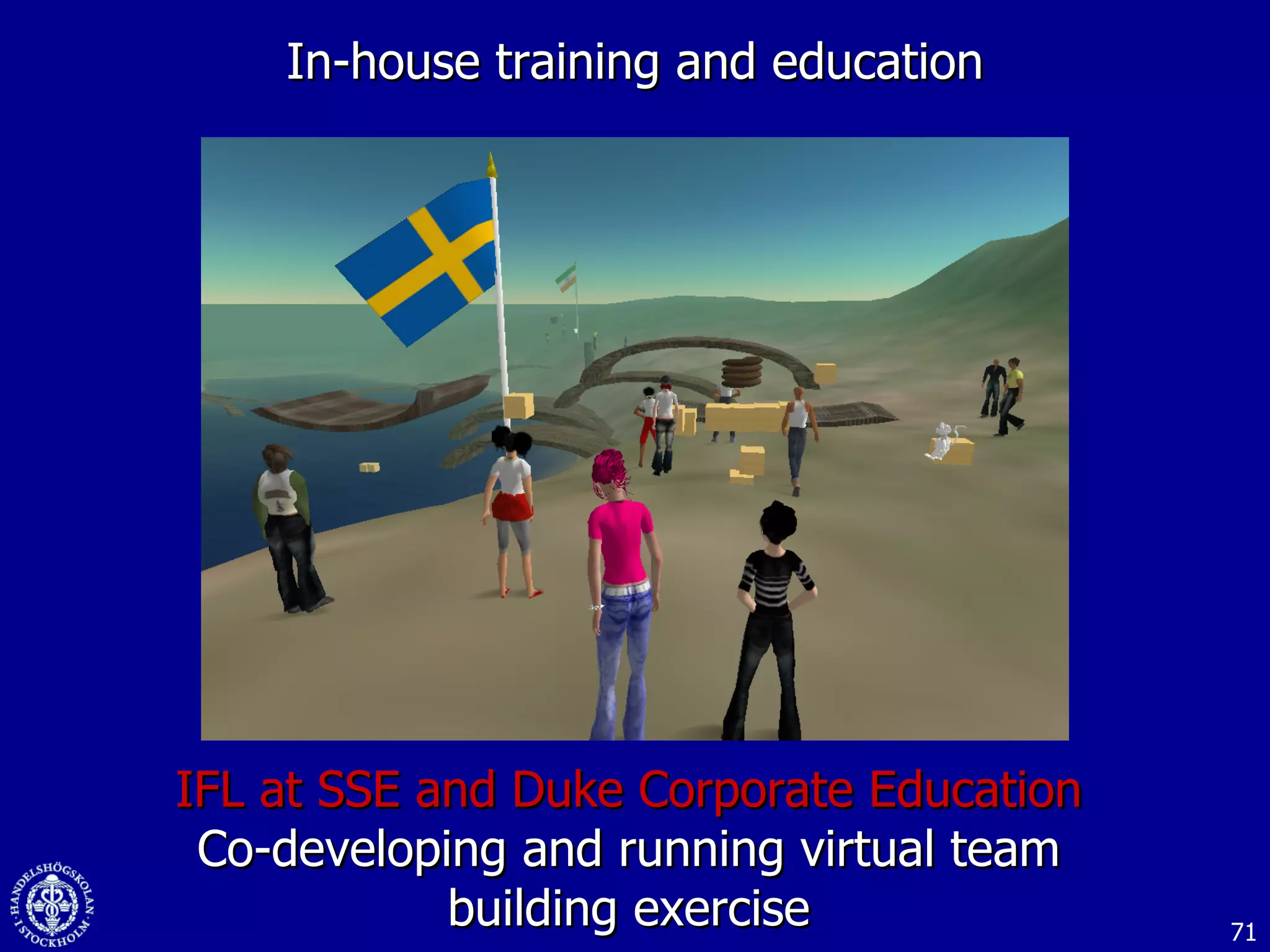
In-house training and education IFL at SSE and Duke Corporate Education Co-developing and running virtual team building exercise
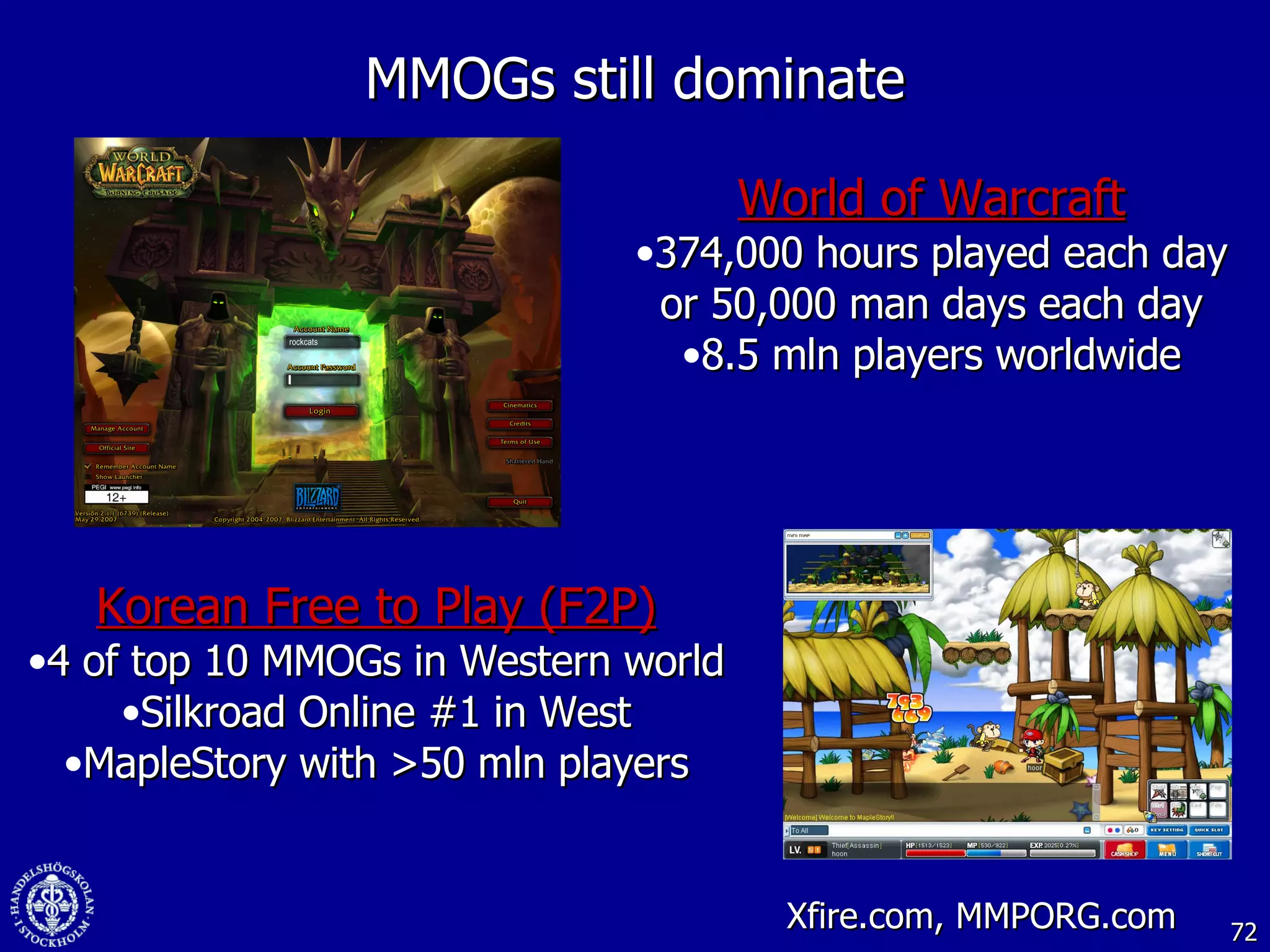
MMOGs still dominate World of Warcraft 374,000 hours played each day or 50,000 man days each day 8.5 mln players worldwide Xfire.com, MMPORG.com Korean Free to Play (F2P) 4 of top 10 MMOGs in Western world Silkroad Online #1 in West MapleStory with >50 mln players
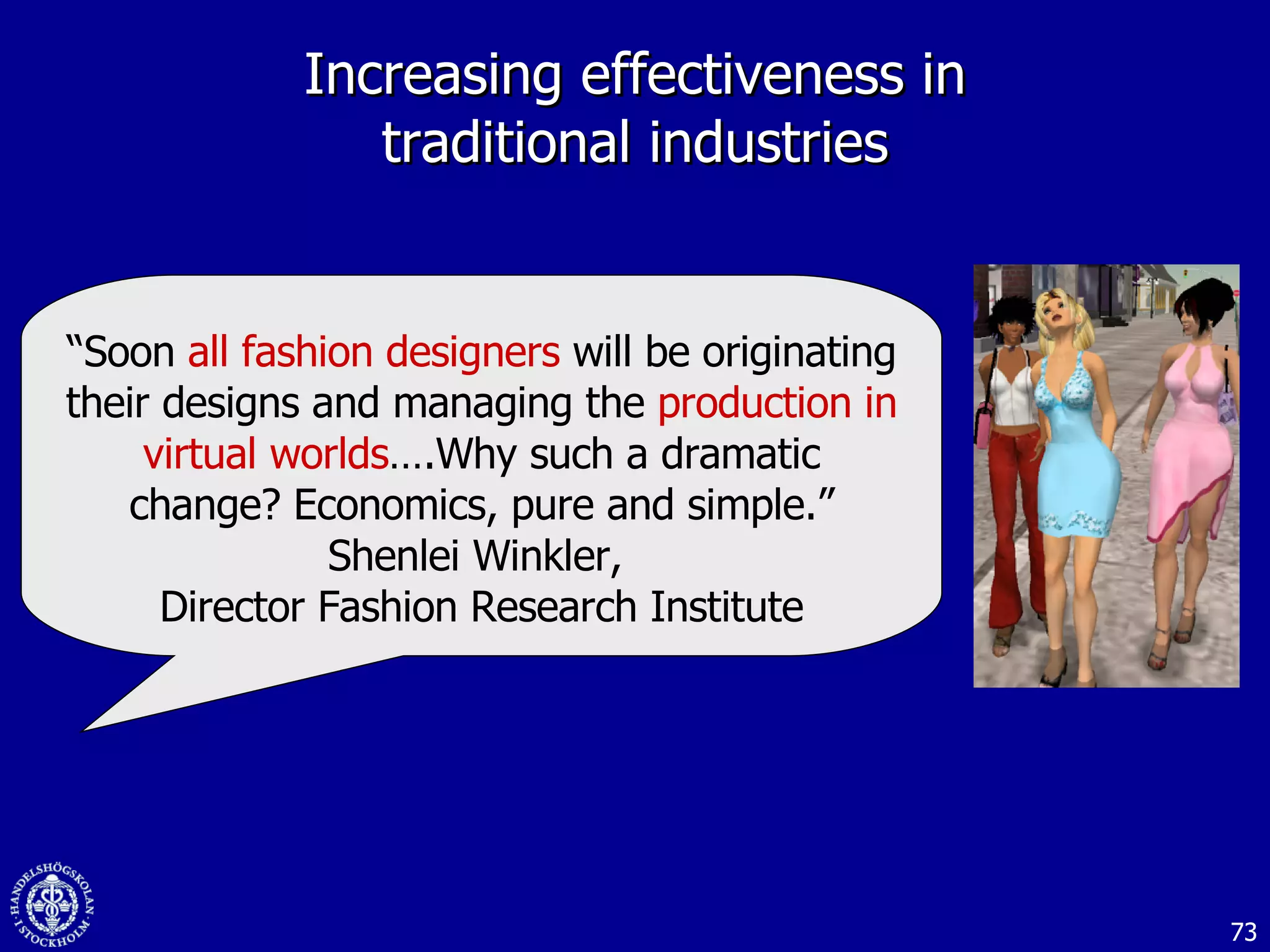
Increasing effectiveness in traditional industries “ Soon  all fashion designers  will be originating their designs and managing the  production in virtual worlds ….Why such a dramatic change? Economics, pure and simple .” Shenlei Winkler,  Director Fashion Research Institute
Improving national competitiveness China’s “virtual world where millions will work,  communicate, and be in love” 7 mln local + 150 mln overseas Chinese Five virtual banking licenses  auctioned for $404,000 May 2007 Financial Times , June 2007
The opportunities are endless……. http://static.flickr.com/47/110109290_2189217cee.jpg
Where are we  today  with virtual worlds? Business opportunities limited? Many real world firms have virtual world presence, but difficulty turning it into an effective, profitable sales channel No RoI success stories for real world firms yet - disconnect between real world companies/products and SL fantasy avatars? Multinationals now turning to internal focus, i.e., how can VWs be used to improve effectiveness (intraverses)? IBM signs agreement with Linden Lab Limited number of individual success stories ~150 other individuals making >$5000 per month “ Trapped” in real world activities? But educational and internal communication uses are taking off! Organizations across the globe are experimenting across all disciplines
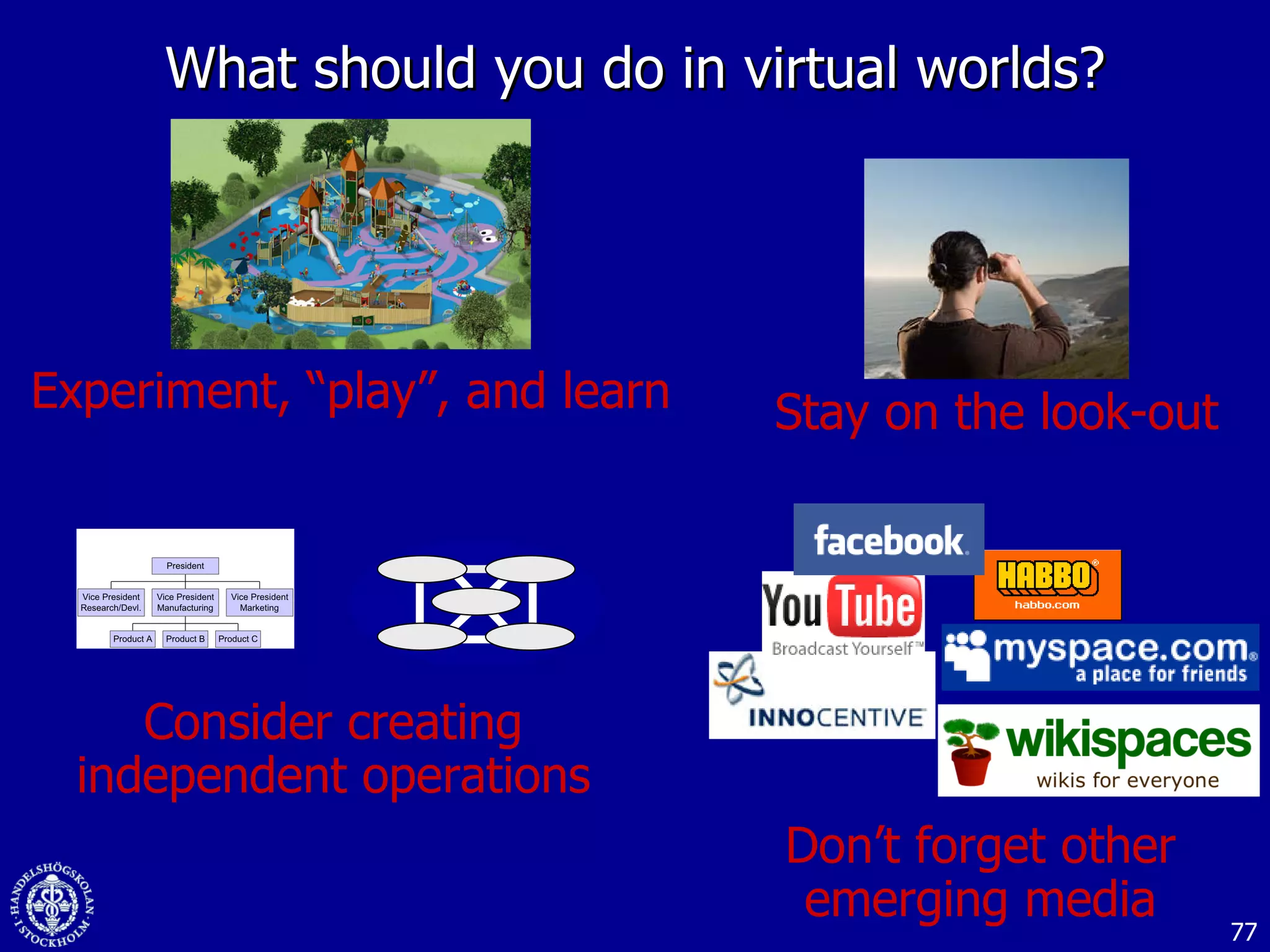
What should you do in virtual worlds? Experiment, “play”, and learn Stay on the look-out Consider creating independent operations Don’t forget other emerging media
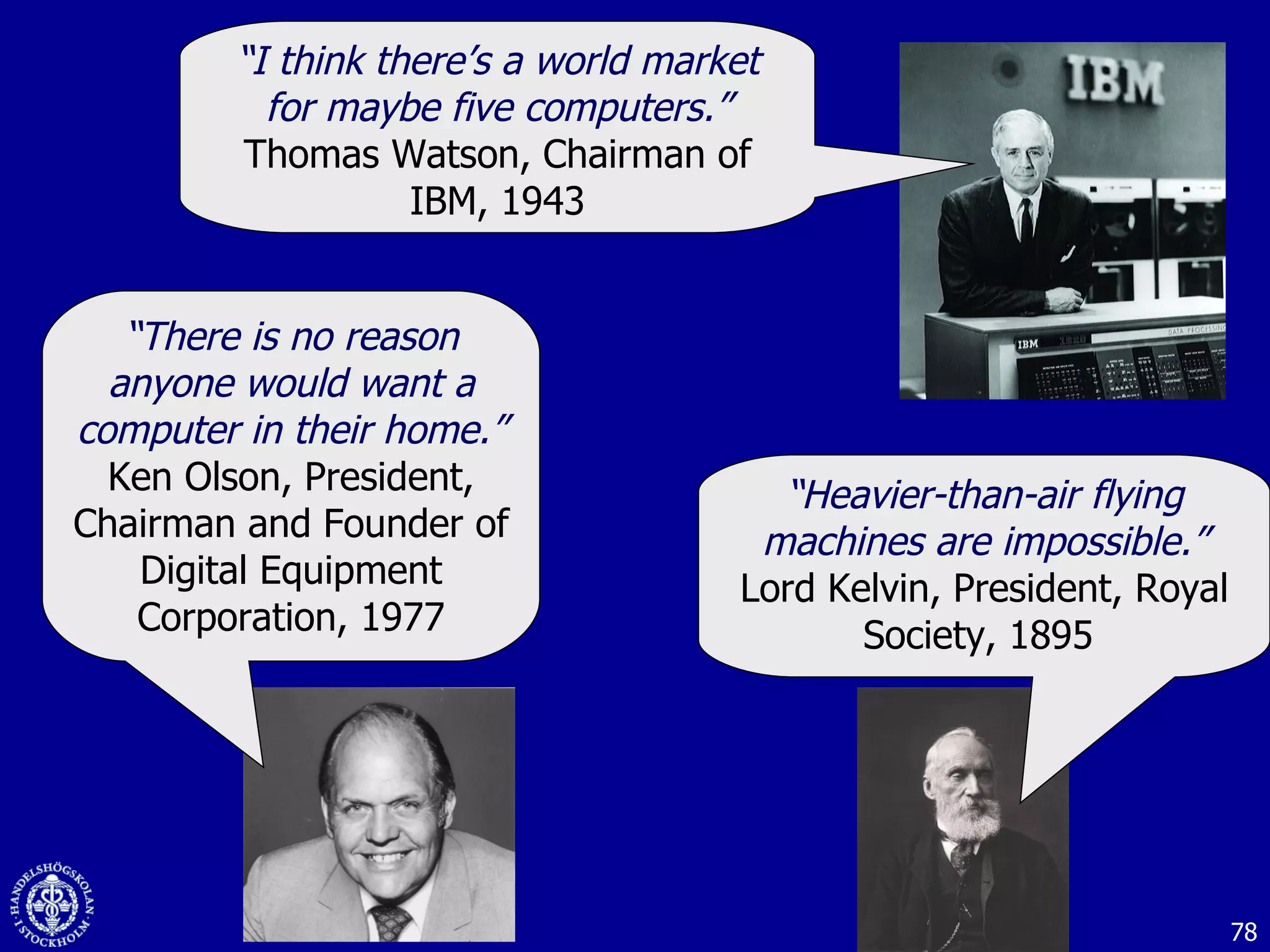
“ I think there’s a world market for maybe five computers.” Thomas Watson, Chairman of IBM, 1943 “ There is no reason anyone would want a computer in their home.” Ken Olson, President, Chairman and Founder of Digital Equipment Corporation, 1977 “ Heavier-than-air flying machines are impossible.” Lord Kelvin, President, Royal Society, 1895
We digitized audio and video, why can’t we just digitize,  you know, Earth”  Philip Rosedale, CEO Linden Lab
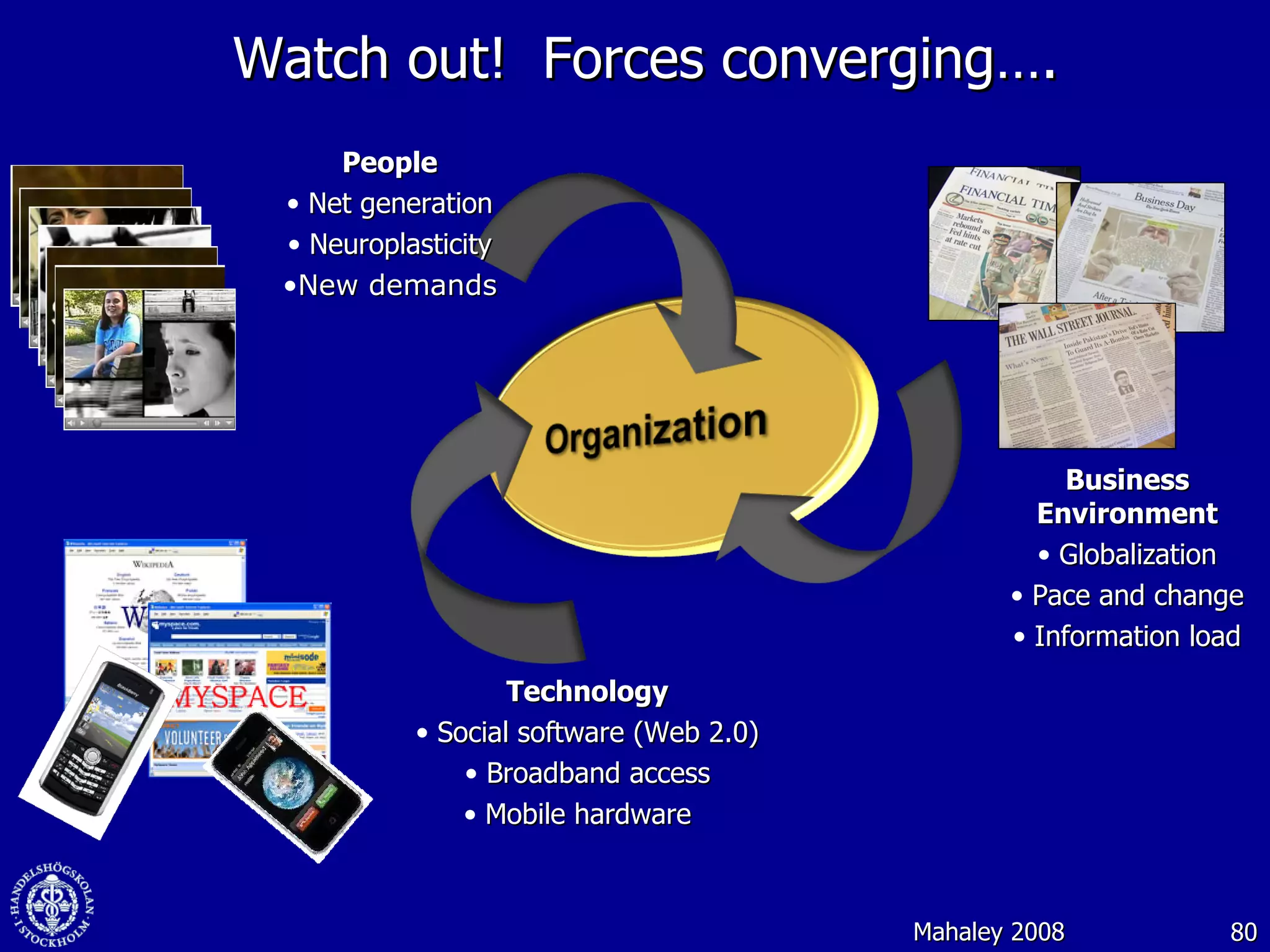
Watch out!  Forces converging…. People Net generation Neuroplasticity New demands Technology Social software (Web 2.0) Broadband access Mobile hardware   Business Environment Globalization Pace and change Information load Mahaley 2008
And if you are still on the fence… By the end of 2008 At least 70% of companies without  official  support for blogs and wikis will have  multiple unofficial deployments Enterprise social software will be the biggest new workplace technology success story of this decade Young people “demand” to have collaboration/social media - they will not want to work there otherwise Gartner: “Predicts 2007:Web 2.0 and Consumerization Forge Into Enterprise” “Wikis and Social Software, 2007”
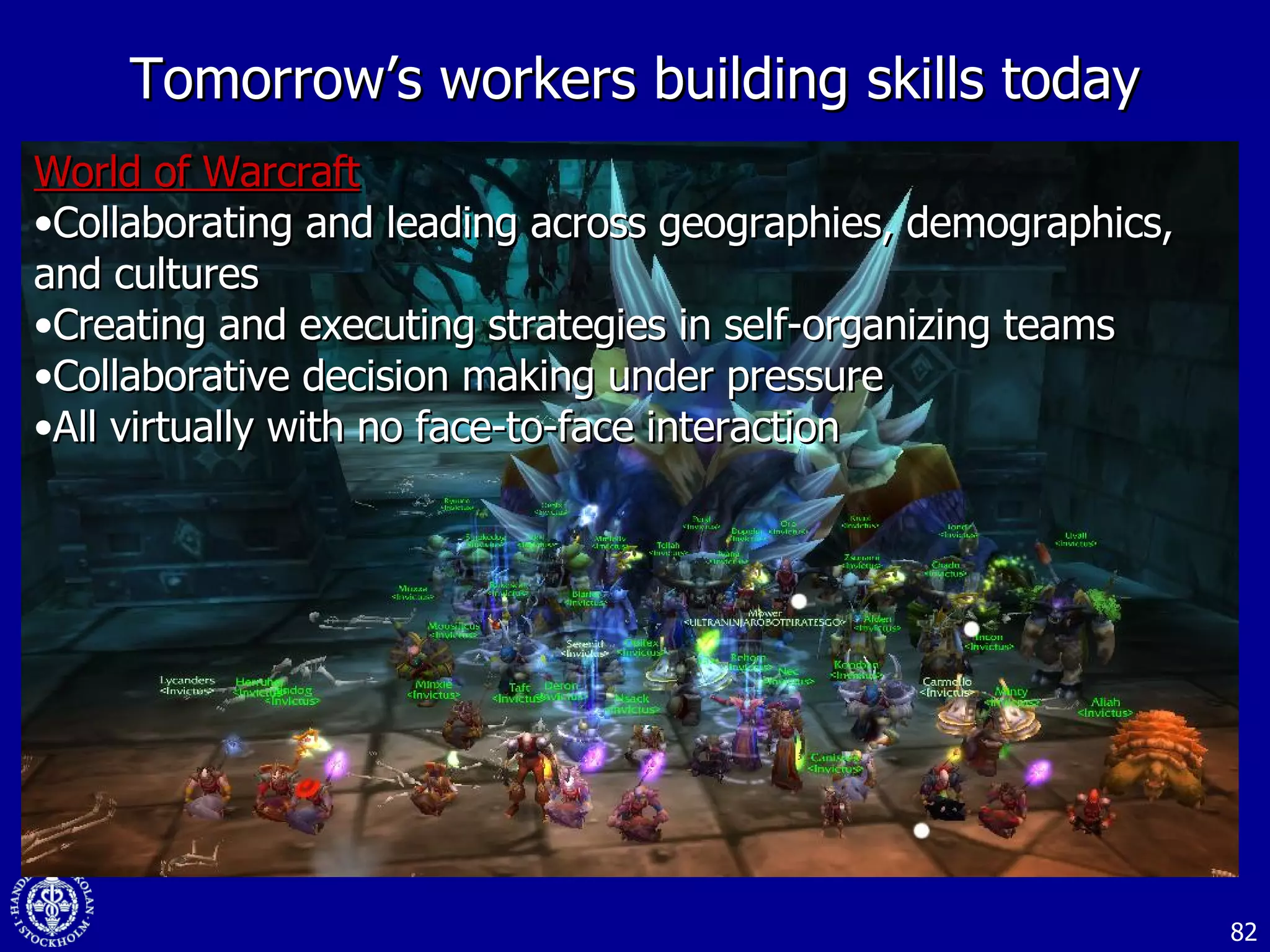
Tomorrow’s workers building skills today World of Warcraft Collaborating and leading across geographies, demographics, and cultures Creating and executing strategies in self-organizing teams Collaborative decision making under pressure All virtually with no face-to-face interaction
What one listener emailed me after….  When I got home last night, my 17 year old son was doing what he usually does – sitting at the computer online with his friends…But after hearing this presentation, I couldn’t help but be interested in what he really was doing. So, when I looked more closely, I saw that he was involved in three separate conversations - all at the same time, and not only that, he was also following the discussions on one of the school’s forums.  Then he said, “Mom, you grown-ups are sooooo behind…..think how much you could get done if you worked like this!”
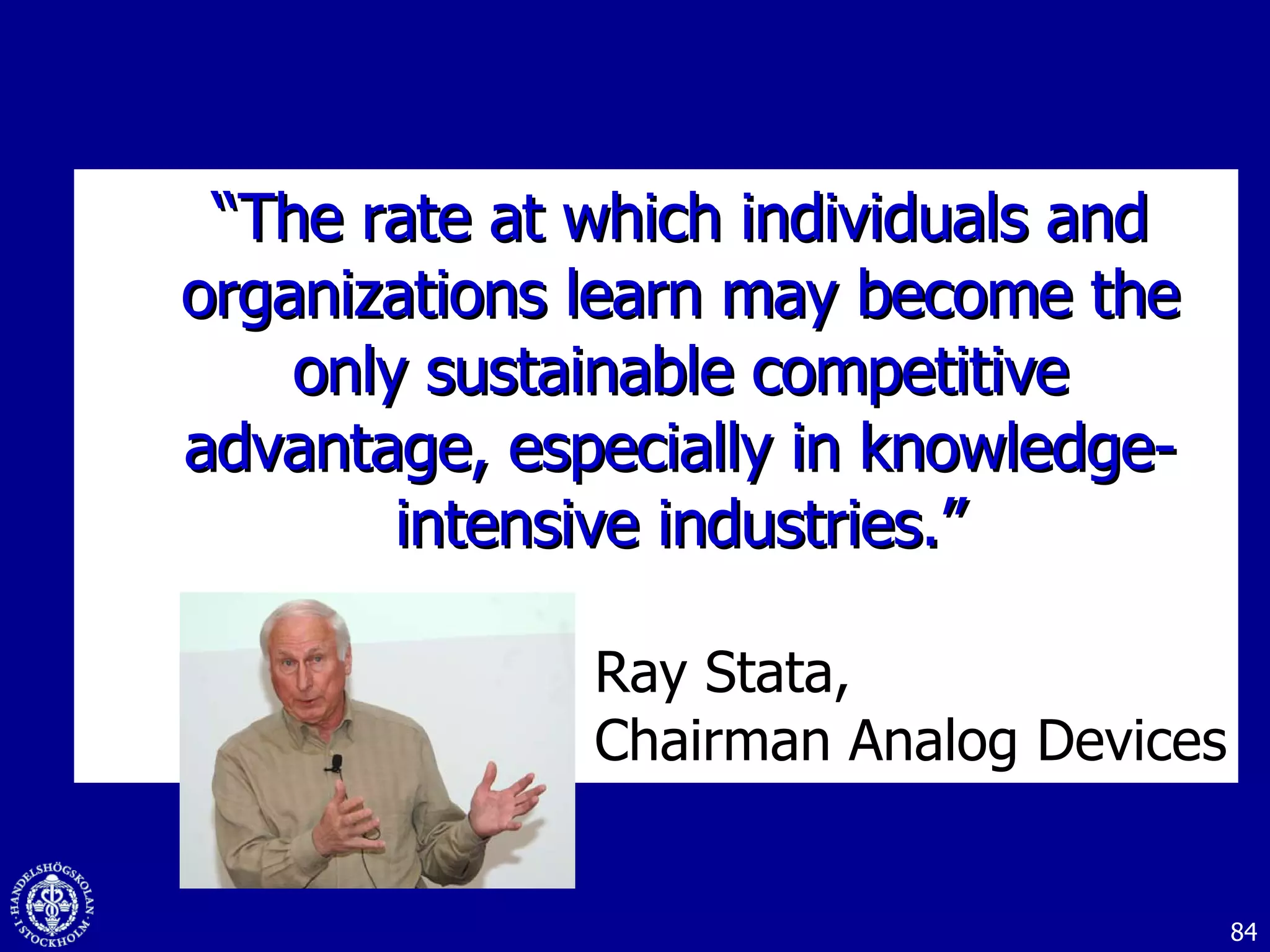
“ The rate at which individuals and organizations learn may become the only sustainable competitive advantage, especially in knowledge-intensive industries.” Ray Stata, Chairman Analog Devices
Introduction to social media and networks  Why the interest? What are networks? What about performance? Leveraging social media and networks Why are they of interest for organizations? Are there any benefits or is it all hype? What are some challenges? An introduction to virtual worlds Today’s discussion
Thanks and  see you in world! Karinda Rhode aka Robin Teigland [email_address] www.knowledgenetworking.org www.slideshare.net/eteigland
Sources and acknowledgements Books Barabási,  Linked: The New Science of Networks . Perseus, 2002 Burt,  Structural Holes, 1992 Castells,  The Rise of the Network Society . Blackwell, 2000 Cross & Parker,  The Hidden Power of Social Networks . Harvard Business School, 2004 Gladwell,  The Tipping Point . Abacus, 2001 Scott,  Social Network Analysis .   Sage, 2000 Teigland,  Knowledge Networking , SSE, 2003 Teten & Allen,  The Virtual Handshake . American Management Assoc., 2007 Homepages  Wayne Baker, webuser.bus.umich.edu/wayneb/ Stephen Bird, people.bu.edu/sbird Steve Borgatti, www.socialnetworkanalysis.com Rob Cross, www.robcross.org International Network for Social Network Analysis http://www.insna.org/ David Krackhardt, www.andrew.cmu.edu/user/krack/index.shtml Valdis Krebs, www.orgnet.com Fredrik Liljeros, www.sociology.su.se/home/Liljeros/index.html Steve Mahaley, www.dukece.com James Moody, www.soc.duke.edu/~jmoody77/presentations/index.htm   Giancarlo Oriani, www.informalorg.eu (In Italian) Barry Wellman, www.chass.utoronto.ca/~wellman/
Sources and acknowledgements (cont’d) Articles and Research Papers Cross, Baker, & Parker, “What creates energy in organizations?”,  Sloan Management Review , Summer 2003. Cross, Parise, & Weiss, “Driving Strategic Change with a Network Perspective”, Network Roundtable working paper, 2006. Kleinbaum, Stuart, Tushman, Communication (and Coordination?) in a Modern, Complex Organization, HBS working paper, http://www.hbs.edu/research/pdf/09-004.pdf Ibarra & Hunter, “How Leaders Create and Use Networks”, HBR, 2007. Coleman, D. Virtual Team Spaces, 2006. Connaughton, SL & Daly, JA, “Leading from Afar: Strategies for Effectively Leading Virtual Teams” in  Virtual Collaborative Teams: Process, Technologies, & Practice  (S. H. Godar & S. P. Ferris, Eds.). Lipnack, J. & Stamps,  Virtual Teams:  Reaching Across Space, Time, and Organizations with Technology .  John Wiley & Sons, Inc.:  New York, 1997. Maznevski, M. High performance from global virtual teams, 2001. Ruuska, I. & Teigland, R. 2009 (Forthcoming). “Ensuring Project Success through Collective Competence and Conflict Management in Public-private Partnerships: A Case Study of a Swedish Triple Helix e-government Initiative”.  International Journal of Project Management . Schermerhorn, Jr., J.,  Management , 2004.
Sources and acknowledgements (cont’d) Presentations Gurteen, Online Information 2007: KM goes Social, http://www.slideshare.net/dgurteen/km-goes-social-194717 Poole, IBM: Web 2.0 goes to work, http://www.slideshare.net/jward5519/ibm-web-2-0-goes-to-work-presentation’

Web 2.0 Creating Value Through Social Networks And Virtual Worlds

  • 1.
    Web 2.0: Creating value through social media and virtual worlds November 2008 Dr. Robin Teigland Stockholm School of Economics [email_address] www.knowledgenetworking.org www.slideshare.net/eteigland 1-
  • 2.
    Introduction to socialmedia and networks Why the interest? What are networks? What about performance? Leveraging social media and networks Why are they of interest for organizations? Are there any benefits or is it all hype? What are some challenges? An introduction to virtual worlds Today’s discussion
  • 3.
    Everyone is talkingabout networks National Innovation Networks Formal Networks Entrepreneurial Networks Ego Networks Regional Networks Infrastructure Networks Social Networks FAS.research Electronic Networks Informal Networks Networks of Practice Networked organization
  • 4.
    A world ofrapidly growing knowledge …. > A person’s lifetime in 18th century One week 2008 Fischbowl 2007
  • 5.
    … that becomesquickly outdated …. 50% knowledge relevant 50% knowledge outdated First year of technical-based education Third year of education
  • 6.
    Did You Know:Shift Happens http://www.youtube.com/watch?v=pMcfrLYDm2U Which pressures for change are presented? Which pressures are affecting your organization?
  • 7.
    Knowledge is growingexponentially…. Cohen & Levinthal 1989 Growth Time Information and knowledge Human absorptive capacity
  • 8.
    Yet, the worldis “shrinking” family local colleagues friends old colleagues colleagues at other offices Just a click away… virtual communities local networks old classmates avatars business contacts social media contacts referrals
  • 9.
    The speed ofinformation: The power of social media http://www.youtube.com/watch?v=t8XxcOj3Seo Fortune, Rey 2008
  • 10.
    While a newworkforce is appearing….. The new generation is huge - 90 million people in USA alone Already they outnumber the baby boomers 81% of the business population age 34 or younger are gamers 56 million are old enough to be employees 7 million are already managers in the current workforce Mahaley 2008, Merrill Lynch 1999, Beck and Wade, Prensky Digital Immigrants Digital Natives
  • 11.
    … with skillsin using social media tools to reach out… Rey 2008 Communication Personal Media Self-expression Collective Intelligence Content Production
  • 12.
    … to buildrelationships, find information and knowledge, solve problems, and learn Mahaley 2008
  • 13.
    As well asto create new knowledge sources… Closed Expensive Complex Accurate Open Inexpensive Simple Close enough Hinton 2007
  • 14.
    … and tosolve unsolved problems
  • 15.
    ” No oneknows everything, everyone knows something, all knowledge resides in...” Mahaley 2008, Adapted from Lévy 1997
  • 16.
    What is anetwork? A set of actors connected by ties Ties/Links Knowledge, trust, team, sit by, dislike, etc. Alliance, customer, investment, etc. Tie Actors/Nodes Individuals Teams, organizations, etc. Actor
  • 17.
    Swedish hip hopartists Liljeros 2006 ?? Timbuktu
  • 18.
    One of themain network principles An actor’s position in a social network, i.e., social capital, determines in part the actor’s opportunities and constraints Casper & Murray 2002 German biotech scientists
  • 19.
    What about therelationship between networks and performance?
  • 20.
    Two workers withthe same number of contacts… B A
  • 21.
    … but withvery different access to resources B A
  • 22.
    Performance differs basedon one’s network Firm A High creative Low on-time High on-time Low creative Teigland 2003 High creative Virtual community Firm B
  • 23.
    Two divisions withinSundlink (Öresund Bridge) Section 1 Section 2 Improved efficiency over time Stagnant performance over time Schenkel & Teigland 2008
  • 24.
    Comparing across firmsTeigland et al 2000
  • 25.
    Hewlett-Packard (1990s) Networkingactivities recognized and rewarded at individual and unit levels Management support for informal and formal networking activities across internal and external boundaries Extensive socialization : personnel rotation, cross-office teams A visionary organization Clearly defined mission: ”To make technical contributions for the advancement and welfare of humanity” Supporting core values, e.g., teamwork Company-wide goal of World’s Best Laboratory Teigland et al 2000
  • 26.
    Avoid creating insularnetworks http://www.enronexplorer.com/focus/19185#
  • 27.
    Introduction to socialmedia and networks Why the interest? What are networks? What about performance? Leveraging social media and networks Why are they of interest for organizations? Are there any benefits or is it all hype? What are some challenges? An introduction to virtual worlds Today’s discussion
  • 28.
    Uncovering networks inan organization Formal organization Teigland et al. 2005 Social organization
  • 29.
    Boundary spanners betweenlocations Stockholm London Brussels Helsinki Madrid Copenhagen Transferred from Stockholm Teigland 1998 San Francisco
  • 30.
    Management cannotmandate social relationships John Eva Hans Miguel Paul Jan Lars Pia Anna Nils Bill Erik Mike Al Alex
  • 31.
    How can socialmedia tools help? Finding and connecting with people Building communities Sharing information and knowledge Solving problems Learning informally Adapted from Gurteen 2008 They are personal/social Knowledge Management tools! What do people do with social media? Communication Personal Media Self-expression Collective Intelligence Content Production
  • 32.
    Corporate Top downCentralized Command & control Monolithic systems Explicit knowledge - reuse Knowledge objects Taxonomies People finders Databases E-mail Newsletters Discussion forums Personal Bottom up Decentralized, distributed Facilitate, collaborate Ecosystems Tacit knowledge - mobilize Knowledge flow Social tagging Social networking Blogs & wikis Instant messaging RSS feeds & readers Blogs Social media tools facilitate KM 2.0 KM 1.0 – Repository model KM 2.0 – Networking model Gurteen 2008, Alavi, 2000 Comparison of KM tools
  • 33.
    From KM 1.0to KM 2.0 – Social KM Gurteen 2008 KM 1.0 KM 2.0 KM is extra work KM is part of my everyday work Work is behind closed doors Work is open and transparent People directories provide contact information Social Networking platforms reflect who is doing what with whom Content is centralised, protected and controlled Content is distributed freely and uncontrolled IT chooses the tools I use I have a choice & select my own tools Knowledge sharing is database centric Knowledge sharing is people centric Knowledge is captured just in case Knowledge is naturally captured as part of one’s work Best Practices Stories Efficiency and productivity Improved decision making & innovation
  • 34.
    Wenger 1998, Hinton2007 Social media enable communities of practice
  • 35.
    And awareness ofothers’ skills Mattsson 2004 < 1 yr 1-5 yrs 5-10 yrs 10-15 yrs > 15 yrs Time at firm
  • 36.
    Creating an internal“Facebook” Mahaley 2008 www.selectminds.com
  • 37.
    At IBM, “BlueIQ”facilitates several functions Communities Create, find, join, and work with communities of people who share a common interest, responsibility, or area of expertise Blogs Use a weblog to present your idea and get feedback from others; learn from the expertise and experience of others who blog Dogear Save, organize and share bookmarks; discover bookmarks that have been qualified by others with similar interests & expertise Activities Organize your work, plan next steps, and easily tap your expanding professional network to help execute your everyday deliverables, faster Profiles Quickly find the people you need by searching across your organization using keywords that help identify expertise, current projects and responsibilities Poole 2008
  • 38.
    Trust & reciprocityare essential for knowledge exchange in networks
  • 39.
    IBM’s Atlas showsthe social network of a topic and how to get to someone Poole 2008
  • 40.
    But……. “ Likabarn leka bäst” People find similar people attractive and develop relations with people like themselves Our networks tend to be homogeneous and not heterogeneous Marsden 1987, Burt 1990
  • 41.
    Facebook Fridays – Strengthening external relationships #1 Applications Lifecycle Management (ALM) & business mashup 96 of Fortune 100 as customers 800 employees in 18 countries across globe One hour every Friday on Facebook to find fun and connect with co-workers, customers, family, and friends Serena Software
  • 42.
    When you hiresomeone,… … ..you “hire” his or her network.
  • 43.
    Increasing job turnoverTime Number of jobs in lifetime Estimated time at one organization in Silicon Valley: ~18 months CNET 2000
  • 44.
    Improving recruiting effortsJob Fairs Accenture recruits in Second Life since 2006 – this recruiting has since paid for itself A manager at a high-tech multinational recruits senior level employees through Orkut, resulting in reduced turnover and headhunter fees Virtualworldnews.com 2008, Hustad & Teigland 2008
  • 45.
    Proximal collaboration Whenpeople are more than 50 feet apart, the likelihood of them collaborating more than once a week is less than 10%. Allen 1984
  • 46.
    Companies are turningto virtual worlds to facilitate the virtual workforce – “Immernets” Completely private virtual business worlds offering tools to conduct business and collaborate Fortune 500: IBM, Intel, Johnson & Johnson, Motorola, Novartis, Sun, Unilever
  • 47.
    And to promotean open innovation attitude Not all the smart people work for us. We need to work with smart people inside and outside the company. The smart people in our field work for us. If you create the most and the best ideas in the industry, you will win. If you make the best use of internal and external ideas, you will win. Closed attitude Open attitude Chesborough 2003
  • 48.
    HSB is creatingtomorrow’s solutions in SL Building the house of the future in a competition with architecture students
  • 49.
    Are there anyb enefits from social media, or is it all hype? Poole 2008: IBM Global Technical Services Knowledge Community of Practice Business Impact Survey 2007, completed by approximately 2,300 respondents
  • 50.
    Dual loyalties LoyaltyLoyalty Organization Professional network Teigland 2003
  • 51.
    What about businessresults? Driving innovation into products faster Enabling employees to be more productive, more knowledgeable, faster Harnessing the knowledge of the wise , before they retire Being more responsive to customers, with knowledge from subject experts you may or may not know Poole 2008
  • 52.
    Are there anynumbers to back this? Among the clients surveyed by Select Minds, corporate social networking resulted in: Productivity Contributions: Increase in productivity by an average of 10% Retention Contributions: Increase in retention by an average of 9% Increases in New Business: Increase new business by an average of 12% Rehiring Former Employees: On average, rehires made through their Corporate Social Networking program…. become fully productive 49% faster than all experienced hires became Star Performers (66%), versus 26% of experienced hires Select Minds 2008: &quot;Corporate Social Networking: Increasing the Density of Workplace Connections to Power Business Performance&quot;
  • 53.
    However, there arechallenges…. Resistance from top management Difficulty to measure and validate value of web 2.0 Knowledge trading and leakage outside of firm Social overload and role conflict Poor organizational stewardship Web 2.0 and social networking are typically of a more grassroots nature – their implementation in more traditional hierarchical organizations may result in tension between employees and management Hustad & Teigland 2008
  • 54.
    Is knowledge tradinggood or bad for a firm? We pass over the nondisclosure agreements of different companies and trade company secrets all the time. Teigland 2003
  • 55.
    Who owns theknowledge? Organizational information vs. Personal expertise Teigland 2003
  • 56.
    Social overload androle conflict Loyalty Loyalty Organization Professional network Teigland 2003
  • 57.
    Why use thesenew social media tools? Melcrum 10/07
  • 58.
    Do employees knowhow to represent the company when using external social media? Statoil-Hydro Love at 150 m below sea level! Hustad & Teigland 2008
  • 59.
    IBM’s blogging policy& guidance, created by the employees Policies based on IBM’s Business Conduct Guidelines Apply internally and externally Available on ibm.com “ blogging guidelines” Adapted from Poole 2008
  • 60.
    Develop company guidelinesfor using social media internally and externally Trust your employees, and don’t ban social media Use wikis to enable employees to create the company guidelines, eg IBM Yahoo’s best practice guidelines for blogging (http://jeremy.zawodny.com/yahoo/yahoo-blog-guidelines.pdf) Be respectful of your colleagues Get your facts straight Provide context to your argument Engage in private feedback When trusted, employees feel empowered to do the right thing!
  • 61.
    Introduction to socialmedia and networks Why the interest? What are networks? What about performance? Leveraging social media and networks Why are they of interest for organizations? Are there any benefits or is it all hype? What are some challenges? An introduction to virtual worlds Today’s discussion
  • 62.
    Within five years,the 3-D Internet will be as important for work as the Web is today. January 2008 By the end of 2011, 80 percent of active Internet users (and Fortune 500 enterprises) will have a “second life”, but not necessarily in Second Life. Steve Prentice Gartner
  • 63.
    Towards 3-D InternetLevel of Interaction Time Hamilton 2008 Individual - Web 1.0 Thinking Mosaic, Prodigy, Compuserve, AOL, Netscape Connected Web 2.0 Thinking Facebook, Friendster, Yahoo, Blogger, Wikipedia, eBay, Typepad, LinkedIn. Amazon, MySpace, Textamerica, Delicious, HubPages SENSORY 3D Internet Thinking SecondLife, Active Worlds, There, SimsOnline, Club Penguin, World of Warcraft, 3D planets, ToonTown, Habbo, VSlide, Protosphere
  • 64.
    The number ofvirtual worlds is growing Wonderland
  • 65.
    Second Life –one example of a virtual world Machinama film by Duke CE on SSE MBA http://www.youtube.com/watch?v=Bi5i3UwVvbg
  • 66.
    “ Clearly ifsocial activity migrates to synthetic worlds, economic activity will go there as well.” Castranova Joe Miller, Linden Lab 16 Million members 1.1 Million active residents 350,000 Hours of use per day 87,500 Hours development time/day $1.6 Billion worth of free work per year 163 Virtual square miles (5X Boston) 520,000 Unique items traded/month
  • 68.
    “ We thinkit has potential as a way of doing business. We’re just experimenting with it ourselves but we see massive potential in the human interaction you can bring. It’s a big browsing environment in many ways.” - IBM Director
  • 69.
  • 70.
    Improving internal effectivenessUnilever is running an extensive pilot in SL
  • 71.
    In-house training andeducation IFL at SSE and Duke Corporate Education Co-developing and running virtual team building exercise
  • 72.
    MMOGs still dominateWorld of Warcraft 374,000 hours played each day or 50,000 man days each day 8.5 mln players worldwide Xfire.com, MMPORG.com Korean Free to Play (F2P) 4 of top 10 MMOGs in Western world Silkroad Online #1 in West MapleStory with >50 mln players
  • 73.
    Increasing effectiveness intraditional industries “ Soon all fashion designers will be originating their designs and managing the production in virtual worlds ….Why such a dramatic change? Economics, pure and simple .” Shenlei Winkler, Director Fashion Research Institute
  • 74.
    Improving national competitivenessChina’s “virtual world where millions will work, communicate, and be in love” 7 mln local + 150 mln overseas Chinese Five virtual banking licenses auctioned for $404,000 May 2007 Financial Times , June 2007
  • 75.
    The opportunities areendless……. http://static.flickr.com/47/110109290_2189217cee.jpg
  • 76.
    Where are we today with virtual worlds? Business opportunities limited? Many real world firms have virtual world presence, but difficulty turning it into an effective, profitable sales channel No RoI success stories for real world firms yet - disconnect between real world companies/products and SL fantasy avatars? Multinationals now turning to internal focus, i.e., how can VWs be used to improve effectiveness (intraverses)? IBM signs agreement with Linden Lab Limited number of individual success stories ~150 other individuals making >$5000 per month “ Trapped” in real world activities? But educational and internal communication uses are taking off! Organizations across the globe are experimenting across all disciplines
  • 77.
    What should youdo in virtual worlds? Experiment, “play”, and learn Stay on the look-out Consider creating independent operations Don’t forget other emerging media
  • 78.
    “ I thinkthere’s a world market for maybe five computers.” Thomas Watson, Chairman of IBM, 1943 “ There is no reason anyone would want a computer in their home.” Ken Olson, President, Chairman and Founder of Digital Equipment Corporation, 1977 “ Heavier-than-air flying machines are impossible.” Lord Kelvin, President, Royal Society, 1895
  • 79.
    We digitized audioand video, why can’t we just digitize, you know, Earth” Philip Rosedale, CEO Linden Lab
  • 80.
    Watch out! Forces converging…. People Net generation Neuroplasticity New demands Technology Social software (Web 2.0) Broadband access Mobile hardware Business Environment Globalization Pace and change Information load Mahaley 2008
  • 81.
    And if youare still on the fence… By the end of 2008 At least 70% of companies without official support for blogs and wikis will have multiple unofficial deployments Enterprise social software will be the biggest new workplace technology success story of this decade Young people “demand” to have collaboration/social media - they will not want to work there otherwise Gartner: “Predicts 2007:Web 2.0 and Consumerization Forge Into Enterprise” “Wikis and Social Software, 2007”
  • 82.
    Tomorrow’s workers buildingskills today World of Warcraft Collaborating and leading across geographies, demographics, and cultures Creating and executing strategies in self-organizing teams Collaborative decision making under pressure All virtually with no face-to-face interaction
  • 83.
    What one listeneremailed me after…. When I got home last night, my 17 year old son was doing what he usually does – sitting at the computer online with his friends…But after hearing this presentation, I couldn’t help but be interested in what he really was doing. So, when I looked more closely, I saw that he was involved in three separate conversations - all at the same time, and not only that, he was also following the discussions on one of the school’s forums. Then he said, “Mom, you grown-ups are sooooo behind…..think how much you could get done if you worked like this!”
  • 84.
    “ The rateat which individuals and organizations learn may become the only sustainable competitive advantage, especially in knowledge-intensive industries.” Ray Stata, Chairman Analog Devices
  • 85.
    Introduction to socialmedia and networks Why the interest? What are networks? What about performance? Leveraging social media and networks Why are they of interest for organizations? Are there any benefits or is it all hype? What are some challenges? An introduction to virtual worlds Today’s discussion
  • 86.
    Thanks and see you in world! Karinda Rhode aka Robin Teigland [email_address] www.knowledgenetworking.org www.slideshare.net/eteigland
  • 87.
    Sources and acknowledgementsBooks Barabási, Linked: The New Science of Networks . Perseus, 2002 Burt, Structural Holes, 1992 Castells, The Rise of the Network Society . Blackwell, 2000 Cross & Parker, The Hidden Power of Social Networks . Harvard Business School, 2004 Gladwell, The Tipping Point . Abacus, 2001 Scott, Social Network Analysis . Sage, 2000 Teigland, Knowledge Networking , SSE, 2003 Teten & Allen, The Virtual Handshake . American Management Assoc., 2007 Homepages Wayne Baker, webuser.bus.umich.edu/wayneb/ Stephen Bird, people.bu.edu/sbird Steve Borgatti, www.socialnetworkanalysis.com Rob Cross, www.robcross.org International Network for Social Network Analysis http://www.insna.org/ David Krackhardt, www.andrew.cmu.edu/user/krack/index.shtml Valdis Krebs, www.orgnet.com Fredrik Liljeros, www.sociology.su.se/home/Liljeros/index.html Steve Mahaley, www.dukece.com James Moody, www.soc.duke.edu/~jmoody77/presentations/index.htm Giancarlo Oriani, www.informalorg.eu (In Italian) Barry Wellman, www.chass.utoronto.ca/~wellman/
  • 88.
    Sources and acknowledgements(cont’d) Articles and Research Papers Cross, Baker, & Parker, “What creates energy in organizations?”, Sloan Management Review , Summer 2003. Cross, Parise, & Weiss, “Driving Strategic Change with a Network Perspective”, Network Roundtable working paper, 2006. Kleinbaum, Stuart, Tushman, Communication (and Coordination?) in a Modern, Complex Organization, HBS working paper, http://www.hbs.edu/research/pdf/09-004.pdf Ibarra & Hunter, “How Leaders Create and Use Networks”, HBR, 2007. Coleman, D. Virtual Team Spaces, 2006. Connaughton, SL & Daly, JA, “Leading from Afar: Strategies for Effectively Leading Virtual Teams” in Virtual Collaborative Teams: Process, Technologies, & Practice (S. H. Godar & S. P. Ferris, Eds.). Lipnack, J. & Stamps, Virtual Teams: Reaching Across Space, Time, and Organizations with Technology . John Wiley & Sons, Inc.: New York, 1997. Maznevski, M. High performance from global virtual teams, 2001. Ruuska, I. & Teigland, R. 2009 (Forthcoming). “Ensuring Project Success through Collective Competence and Conflict Management in Public-private Partnerships: A Case Study of a Swedish Triple Helix e-government Initiative”. International Journal of Project Management . Schermerhorn, Jr., J., Management , 2004.
  • 89.
    Sources and acknowledgements(cont’d) Presentations Gurteen, Online Information 2007: KM goes Social, http://www.slideshare.net/dgurteen/km-goes-social-194717 Poole, IBM: Web 2.0 goes to work, http://www.slideshare.net/jward5519/ibm-web-2-0-goes-to-work-presentation’

Editor's Notes

  • #2 Great to see so many people interested in networks. I came from Stanford where networking is part of everyday of life Started my PhD research over ten years ago and one of first things I did was to look at the knowledge flows between the r&amp;D units of three multinationals, HP, Ericsson, and Xerox. At beginning of knowledge management era and companies investing heavily in KM, these companies no exception. Found that top management invested heavily in different intranet applications, thinking understood how individuals worked. So for example, patent, then spoke with one of scientists and found that on one hand did not even access the intranet this application, nahh, just went next door to ask colleague who working with this. Much easier, faster, and better information. This got me started on my journey of looking into networks. Very much management not understanding the way work gets done and now with knowledge work, thinking can manage knowledge in same way managed physical resources of organization. But not the case… So here today to talk about networks