Leveraging Networks for Results-  A brief look Dr. Robin Teigland Stockholm School of Economics [email_address] www.knowledgenetworking.org www.slideshare.net/eteigland  1- May 2008
Why the interest in networks? What are networks? What about power and performance? What can you do? Today’s discussion www.slideshare.net/eteigland
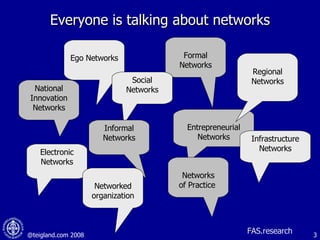
Everyone is talking about networks National Innovation Networks Formal Networks Entrepreneurial Networks Ego Networks Regional Networks Infrastructure Networks Social Networks FAS.research Electronic Networks Informal Networks Networks of Practice  Networked organization
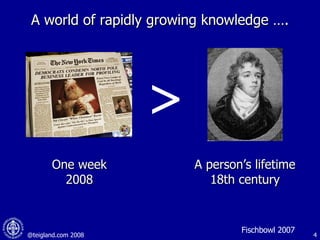
A world of rapidly growing knowledge …. > A person’s lifetime 18th century One week 2008 Fischbowl 2007
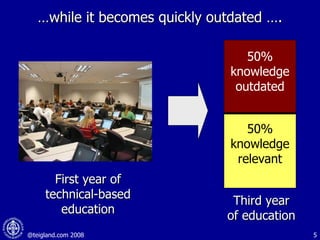
… while it becomes quickly outdated …. 50% knowledge relevant 50% knowledge outdated First year of technical-based education Third year of education
Did You Know: Shift Happens http://www.youtube.com/watch?v=pMcfrLYDm2U How are these trends affecting you and your organization?
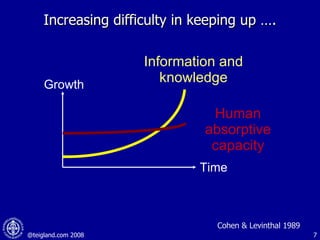
Increasing difficulty in keeping up …. Growth Time Information and knowledge Human  absorptive capacity Cohen & Levinthal 1989
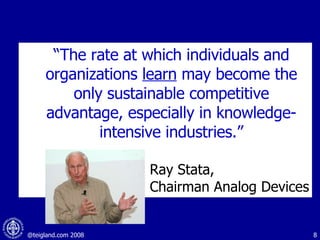
“ The rate at which individuals and organizations  learn  may become the only sustainable competitive advantage, especially in knowledge-intensive industries.” Ray Stata, Chairman Analog Devices
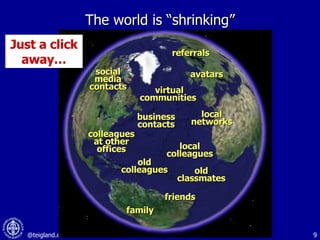
The world is “shrinking” family local colleagues friends old colleagues colleagues at other offices Just a click away… virtual communities  local networks old classmates avatars business contacts social media contacts referrals
” No one knows everything,  everyone knows something,  all knowledge resides in humanity.” networks Adapted from Lévy 1997
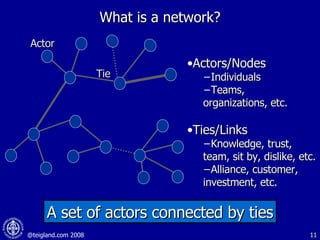
What is a network? A set of actors connected by ties Ties/Links Knowledge, trust, team, sit by, dislike, etc. Alliance, customer, investment, etc. Tie Actors/Nodes Individuals Teams, organizations, etc. Actor
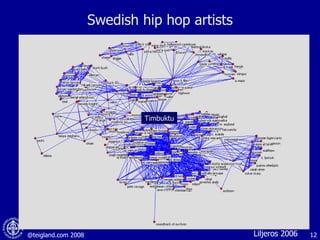
Swedish hip hop artists Liljeros 2006 ?? Timbuktu
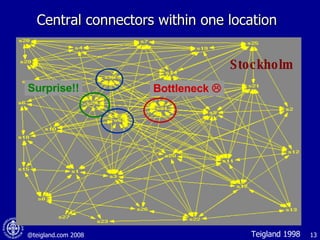
Central connectors within one location Bottleneck   Teigland 1998 Surprise!! Stockholm
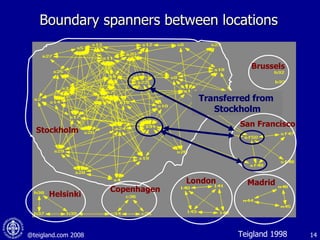
Boundary spanners between locations Stockholm London Brussels Helsinki Madrid Copenhagen Transferred from  Stockholm Teigland 1998 San Francisco
Trust & reciprocity are essential for knowledge exchange in networks
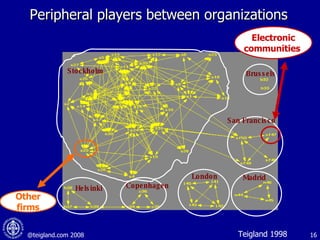
Peripheral players between organizations San Francisco Stockholm London Brussels Helsinki Madrid Copenhagen Teigland 1998 Other firms Electronic communities
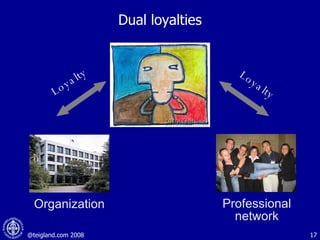
Dual loyalties Loyalty Loyalty Organization Professional network
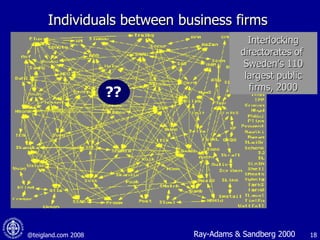
Individuals between business firms  SEB Ray-Adams & Sandberg 2000 Interlocking directorates of  Sweden’s 110 largest public firms, 2000 ??
What is the relationship between networks and power?
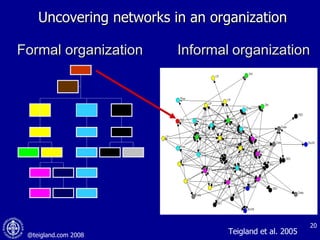
Uncovering networks in an organization Formal organization Teigland et al. 2005 Informal   organization
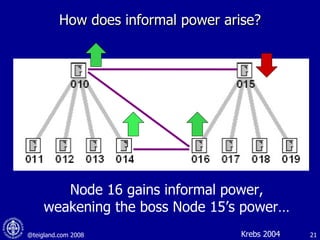
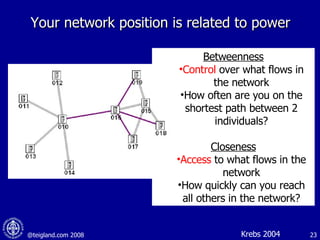
How does informal power arise? Krebs 2004 Node 16 gains informal power, weakening the boss Node 15’s power…
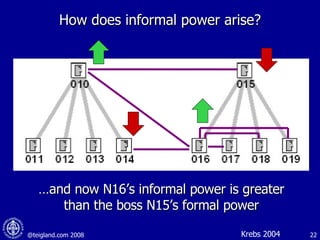
How does informal power arise? Krebs 2004 … and now N16’s informal power is greater than the boss N15’s formal power
Your network position is related to power  Betweenness Control  over what flows in the network How often are you on the shortest path between 2 individuals? Closeness Access  to what flows in the network How quickly can you reach all others in the network? Krebs 2004
Does performance differ based on one’s networks?
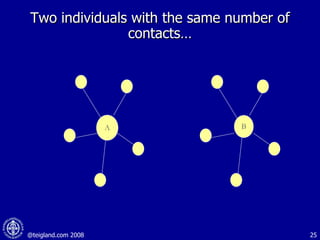
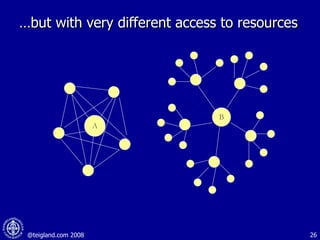
Two individuals with the same number of contacts… B A
… but with very different access to resources B A
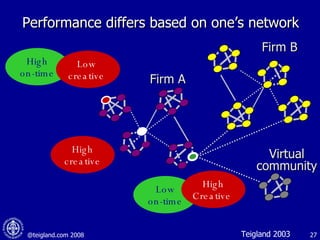
Performance differs based on one’s network Firm A Low on-time High Creative  High on-time Low  creative  Teigland 2003 High creative Virtual community Firm B
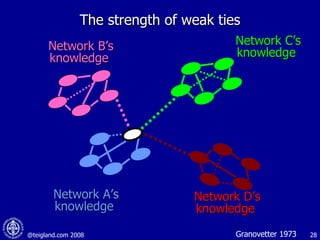
The strength of weak ties Network A’s knowledge  Network D’s knowledge  Network B’s knowledge  Network C’s knowledge  Granovetter 1973
When you hire someone,…  … ..you “hire” his or her network.
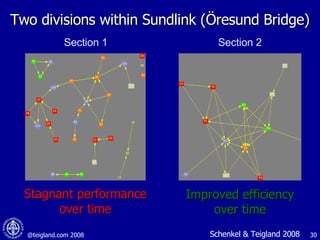
Two divisions within Sundlink (Öresund Bridge) Section 1 Section 2 Improved efficiency over time Stagnant performance over time Schenkel & Teigland 2008
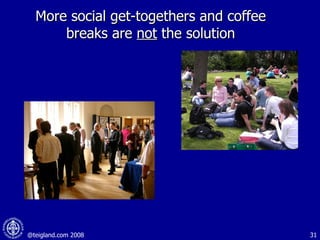
More social get-togethers and coffee  breaks  are  not  the solution
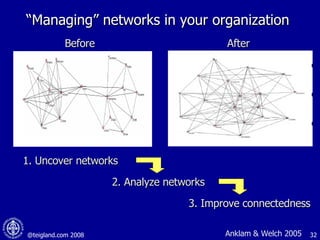
“ Managing” networks in your organization  Before After Anklam & Welch 2005 1. Uncover networks 2. Analyze networks 3. Improve connectedness
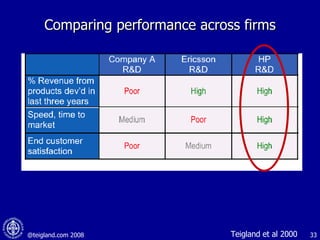
Comparing performance across firms Teigland et al 2000
Hewlett-Packard (1990s) Networking activities  recognized and rewarded  at individual and unit levels Management support for  informal and formal   networking activities  across internal and external boundaries Best practice task group Personal initiatives Extensive   socialization : personnel rotation, cross-office teams A  visionary  organization  Clearly defined mission:   ”To make technical contributions for the advancement and welfare of humanity” Supporting core values,  e.g., teamwork, helpfulness Company-wide goal  of World’s Best Laboratory  Teigland et al 2000
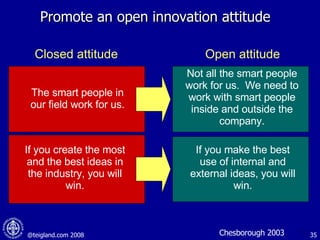
Promote an open innovation attitude Not all the smart people work for us.  We need to work with smart people inside and outside the company. The smart people in our field work for us. If you create the most and the best ideas in the industry, you will win. If you make the best use of internal and external ideas, you will win. Closed attitude Open attitude Chesborough 2003
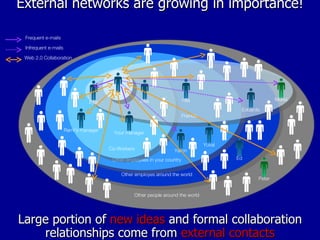
External networks are growing in importance! Other people around the world Other employes around the world Other employees in your country Co-Workers Friends Large portion of  new ideas  and formal collaboration relationships come from  external contacts You Alex Eyal Your manager Rami’s manager Hila Yaron Yuval Eduardo Ed Muriel Peter Frequent e-mails Infrequent e-mails Web 2.0 Collaboration
Facebook Fridays – Embracing social media #1 Applications Lifecycle Management (ALM) & business mashup 96 of Fortune 100 as customers 800 employees in 18 countries across globe  One hour every Friday to Facebook to find fun and connect with co-workers, customers, family, and friends
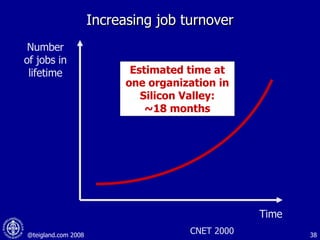
Increasing job turnover Time Number of jobs in lifetime Estimated time at one organization in Silicon Valley: ~18 months CNET 2000
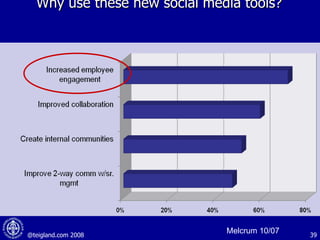
Why use these new social media tools?  Melcrum 10/07
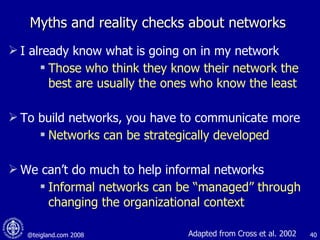
Myths and reality checks about networks I already know what is going on in my network  Those who think they know their network the best are usually the ones who know the least To build networks, you have to communicate more Networks can be strategically developed We can’t do much to help informal networks Informal networks can be “managed” through changing the organizational context Adapted from Cross et al. 2002
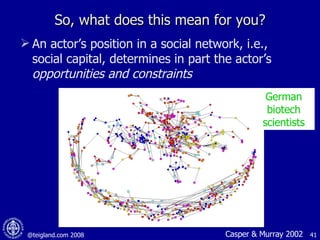
So, what does this mean for you? An actor’s position in a social network, i.e., social capital, determines in part the actor’s  opportunities and constraints Casper & Murray 2002 German biotech scientists
What can you do? What do your networks look like? Where do you sit? With whom do you eat lunch? With whom do you socialize? To which communities, networks do you belong? Build networks before you need them… How are decisions made in your organization? What information flows would you like to be in?  What resources will you need in the future? Whom should you get to know?
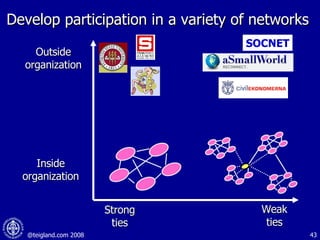
Develop participation in a variety of networks  Strong ties Weak ties Outside organization Inside organization SOCNET
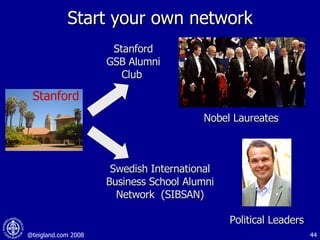
Start your own network Swedish International Business School Alumni Network  (SIBSAN) Stanford GSB Alumni Club  Nobel Laureates  Political Leaders Stanford
But……. “ Lika barn leka bäst” People find similar people attractive and develop relations with people like themselves  Our networks tend to be  homogeneous   and  not heterogeneous Marsden 1987, Burt 1990
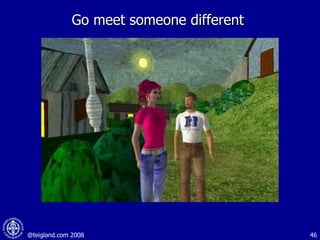
Go meet someone different
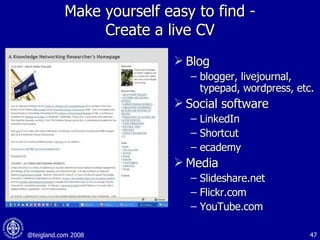
Make yourself easy to find - Create a live CV Blog  blogger, livejournal, typepad, wordpress, etc. Social software LinkedIn Shortcut ecademy Media Slideshare.net Flickr.com YouTube.com
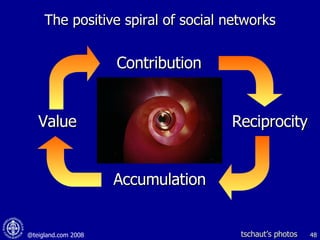
The positive spiral of social networks tschaut’s photos Contribution Reciprocity Accumulation Value
Thanks and  see you in world! Karinda Rhode aka Robin Teigland [email_address] www.knowledgenetworking.org www.slideshare.net/eteigland
References and acknowledgements Books Barabási,  Linked: The New Science of Networks . Perseus, 2002 Castells,  The Rise of the Network Society . Blackwell, 2000 Cross & Parker,  The Hidden Power of Social Networks . Harvard Business School, 2004 Gladwell,  The Tipping Point . Abacus, 2001 Scott,  Social Network Analysis .   Sage, 2000 Teigland,  Knowledge Networking , SSE, 2003 Teten & Allen,  The Virtual Handshake . American Management Assoc., 2007 Homepages  Stephen Bird, people.bu.edu/sbird Steve Borgatti, www.socialnetworkanalysis.com Rob Cross, www.robcross.org International Network for Social Network Analysis http://www.insna.org/ David Krackhardt, www.andrew.cmu.edu/user/krack/index.shtml Valdis Krebs, www.orgnet.com Fredrik Liljeros, www.sociology.su.se/home/Liljeros/index.html James Moody, www.soc.duke.edu/~jmoody77/presentations/index.htm   Giancarlo Oriani, www.informalorg.eu (In Italian) Barry Wellman, www.chass.utoronto.ca/~wellman/

Ifl Womens Network Teigland

  • 1.
    Leveraging Networks forResults- A brief look Dr. Robin Teigland Stockholm School of Economics [email_address] www.knowledgenetworking.org www.slideshare.net/eteigland 1- May 2008
  • 2.
    Why the interestin networks? What are networks? What about power and performance? What can you do? Today’s discussion www.slideshare.net/eteigland
  • 3.
    Everyone is talkingabout networks National Innovation Networks Formal Networks Entrepreneurial Networks Ego Networks Regional Networks Infrastructure Networks Social Networks FAS.research Electronic Networks Informal Networks Networks of Practice Networked organization
  • 4.
    A world ofrapidly growing knowledge …. > A person’s lifetime 18th century One week 2008 Fischbowl 2007
  • 5.
    … while itbecomes quickly outdated …. 50% knowledge relevant 50% knowledge outdated First year of technical-based education Third year of education
  • 6.
    Did You Know:Shift Happens http://www.youtube.com/watch?v=pMcfrLYDm2U How are these trends affecting you and your organization?
  • 7.
    Increasing difficulty inkeeping up …. Growth Time Information and knowledge Human absorptive capacity Cohen & Levinthal 1989
  • 8.
    “ The rateat which individuals and organizations learn may become the only sustainable competitive advantage, especially in knowledge-intensive industries.” Ray Stata, Chairman Analog Devices
  • 9.
    The world is“shrinking” family local colleagues friends old colleagues colleagues at other offices Just a click away… virtual communities local networks old classmates avatars business contacts social media contacts referrals
  • 10.
    ” No oneknows everything, everyone knows something, all knowledge resides in humanity.” networks Adapted from Lévy 1997
  • 11.
    What is anetwork? A set of actors connected by ties Ties/Links Knowledge, trust, team, sit by, dislike, etc. Alliance, customer, investment, etc. Tie Actors/Nodes Individuals Teams, organizations, etc. Actor
  • 12.
    Swedish hip hopartists Liljeros 2006 ?? Timbuktu
  • 13.
    Central connectors withinone location Bottleneck  Teigland 1998 Surprise!! Stockholm
  • 14.
    Boundary spanners betweenlocations Stockholm London Brussels Helsinki Madrid Copenhagen Transferred from Stockholm Teigland 1998 San Francisco
  • 15.
    Trust & reciprocityare essential for knowledge exchange in networks
  • 16.
    Peripheral players betweenorganizations San Francisco Stockholm London Brussels Helsinki Madrid Copenhagen Teigland 1998 Other firms Electronic communities
  • 17.
    Dual loyalties LoyaltyLoyalty Organization Professional network
  • 18.
    Individuals between businessfirms SEB Ray-Adams & Sandberg 2000 Interlocking directorates of Sweden’s 110 largest public firms, 2000 ??
  • 19.
    What is therelationship between networks and power?
  • 20.
    Uncovering networks inan organization Formal organization Teigland et al. 2005 Informal organization
  • 21.
    How does informalpower arise? Krebs 2004 Node 16 gains informal power, weakening the boss Node 15’s power…
  • 22.
    How does informalpower arise? Krebs 2004 … and now N16’s informal power is greater than the boss N15’s formal power
  • 23.
    Your network positionis related to power Betweenness Control over what flows in the network How often are you on the shortest path between 2 individuals? Closeness Access to what flows in the network How quickly can you reach all others in the network? Krebs 2004
  • 24.
    Does performance differbased on one’s networks?
  • 25.
    Two individuals withthe same number of contacts… B A
  • 26.
    … but withvery different access to resources B A
  • 27.
    Performance differs basedon one’s network Firm A Low on-time High Creative High on-time Low creative Teigland 2003 High creative Virtual community Firm B
  • 28.
    The strength ofweak ties Network A’s knowledge Network D’s knowledge Network B’s knowledge Network C’s knowledge Granovetter 1973
  • 29.
    When you hiresomeone,… … ..you “hire” his or her network.
  • 30.
    Two divisions withinSundlink (Öresund Bridge) Section 1 Section 2 Improved efficiency over time Stagnant performance over time Schenkel & Teigland 2008
  • 31.
    More social get-togethersand coffee breaks are not the solution
  • 32.
    “ Managing” networksin your organization Before After Anklam & Welch 2005 1. Uncover networks 2. Analyze networks 3. Improve connectedness
  • 33.
    Comparing performance acrossfirms Teigland et al 2000
  • 34.
    Hewlett-Packard (1990s) Networkingactivities recognized and rewarded at individual and unit levels Management support for informal and formal networking activities across internal and external boundaries Best practice task group Personal initiatives Extensive socialization : personnel rotation, cross-office teams A visionary organization Clearly defined mission: ”To make technical contributions for the advancement and welfare of humanity” Supporting core values, e.g., teamwork, helpfulness Company-wide goal of World’s Best Laboratory Teigland et al 2000
  • 35.
    Promote an openinnovation attitude Not all the smart people work for us. We need to work with smart people inside and outside the company. The smart people in our field work for us. If you create the most and the best ideas in the industry, you will win. If you make the best use of internal and external ideas, you will win. Closed attitude Open attitude Chesborough 2003
  • 36.
    External networks aregrowing in importance! Other people around the world Other employes around the world Other employees in your country Co-Workers Friends Large portion of new ideas and formal collaboration relationships come from external contacts You Alex Eyal Your manager Rami’s manager Hila Yaron Yuval Eduardo Ed Muriel Peter Frequent e-mails Infrequent e-mails Web 2.0 Collaboration
  • 37.
    Facebook Fridays –Embracing social media #1 Applications Lifecycle Management (ALM) & business mashup 96 of Fortune 100 as customers 800 employees in 18 countries across globe One hour every Friday to Facebook to find fun and connect with co-workers, customers, family, and friends
  • 38.
    Increasing job turnoverTime Number of jobs in lifetime Estimated time at one organization in Silicon Valley: ~18 months CNET 2000
  • 39.
    Why use thesenew social media tools? Melcrum 10/07
  • 40.
    Myths and realitychecks about networks I already know what is going on in my network Those who think they know their network the best are usually the ones who know the least To build networks, you have to communicate more Networks can be strategically developed We can’t do much to help informal networks Informal networks can be “managed” through changing the organizational context Adapted from Cross et al. 2002
  • 41.
    So, what doesthis mean for you? An actor’s position in a social network, i.e., social capital, determines in part the actor’s opportunities and constraints Casper & Murray 2002 German biotech scientists
  • 42.
    What can youdo? What do your networks look like? Where do you sit? With whom do you eat lunch? With whom do you socialize? To which communities, networks do you belong? Build networks before you need them… How are decisions made in your organization? What information flows would you like to be in? What resources will you need in the future? Whom should you get to know?
  • 43.
    Develop participation ina variety of networks Strong ties Weak ties Outside organization Inside organization SOCNET
  • 44.
    Start your ownnetwork Swedish International Business School Alumni Network (SIBSAN) Stanford GSB Alumni Club Nobel Laureates Political Leaders Stanford
  • 45.
    But……. “ Likabarn leka bäst” People find similar people attractive and develop relations with people like themselves Our networks tend to be homogeneous and not heterogeneous Marsden 1987, Burt 1990
  • 46.
    Go meet someonedifferent
  • 47.
    Make yourself easyto find - Create a live CV Blog blogger, livejournal, typepad, wordpress, etc. Social software LinkedIn Shortcut ecademy Media Slideshare.net Flickr.com YouTube.com
  • 48.
    The positive spiralof social networks tschaut’s photos Contribution Reciprocity Accumulation Value
  • 49.
    Thanks and see you in world! Karinda Rhode aka Robin Teigland [email_address] www.knowledgenetworking.org www.slideshare.net/eteigland
  • 50.
    References and acknowledgementsBooks Barabási, Linked: The New Science of Networks . Perseus, 2002 Castells, The Rise of the Network Society . Blackwell, 2000 Cross & Parker, The Hidden Power of Social Networks . Harvard Business School, 2004 Gladwell, The Tipping Point . Abacus, 2001 Scott, Social Network Analysis . Sage, 2000 Teigland, Knowledge Networking , SSE, 2003 Teten & Allen, The Virtual Handshake . American Management Assoc., 2007 Homepages Stephen Bird, people.bu.edu/sbird Steve Borgatti, www.socialnetworkanalysis.com Rob Cross, www.robcross.org International Network for Social Network Analysis http://www.insna.org/ David Krackhardt, www.andrew.cmu.edu/user/krack/index.shtml Valdis Krebs, www.orgnet.com Fredrik Liljeros, www.sociology.su.se/home/Liljeros/index.html James Moody, www.soc.duke.edu/~jmoody77/presentations/index.htm Giancarlo Oriani, www.informalorg.eu (In Italian) Barry Wellman, www.chass.utoronto.ca/~wellman/

Editor's Notes

  • #2 Great to see so many people interested in networks. I came from Stanford where networking is part of everyday of life Started my PhD research over ten years ago and one of first things I did was to look at the knowledge flows between the r&D units of three multinationals, HP, Ericsson, and Xerox. At beginning of knowledge management era and companies investing heavily in KM, these companies no exception. Found that top management invested heavily in different intranet applications, thinking understood how individuals worked. So for example, patent, then spoke with one of scientists and found that on one hand did not even access the intranet this application, nahh, just went next door to ask colleague who working with this. Much easier, faster, and better information. This got me started on my journey of looking into networks. Very much management not understanding the way work gets done and now with knowledge work, thinking can manage knowledge in same way managed physical resources of organization. But not the case… So here today to talk about networks