Applied Games,
Learning Analytics and Standards
Ángel Serrano Laguna
The Ideal
Learning Analytics
System
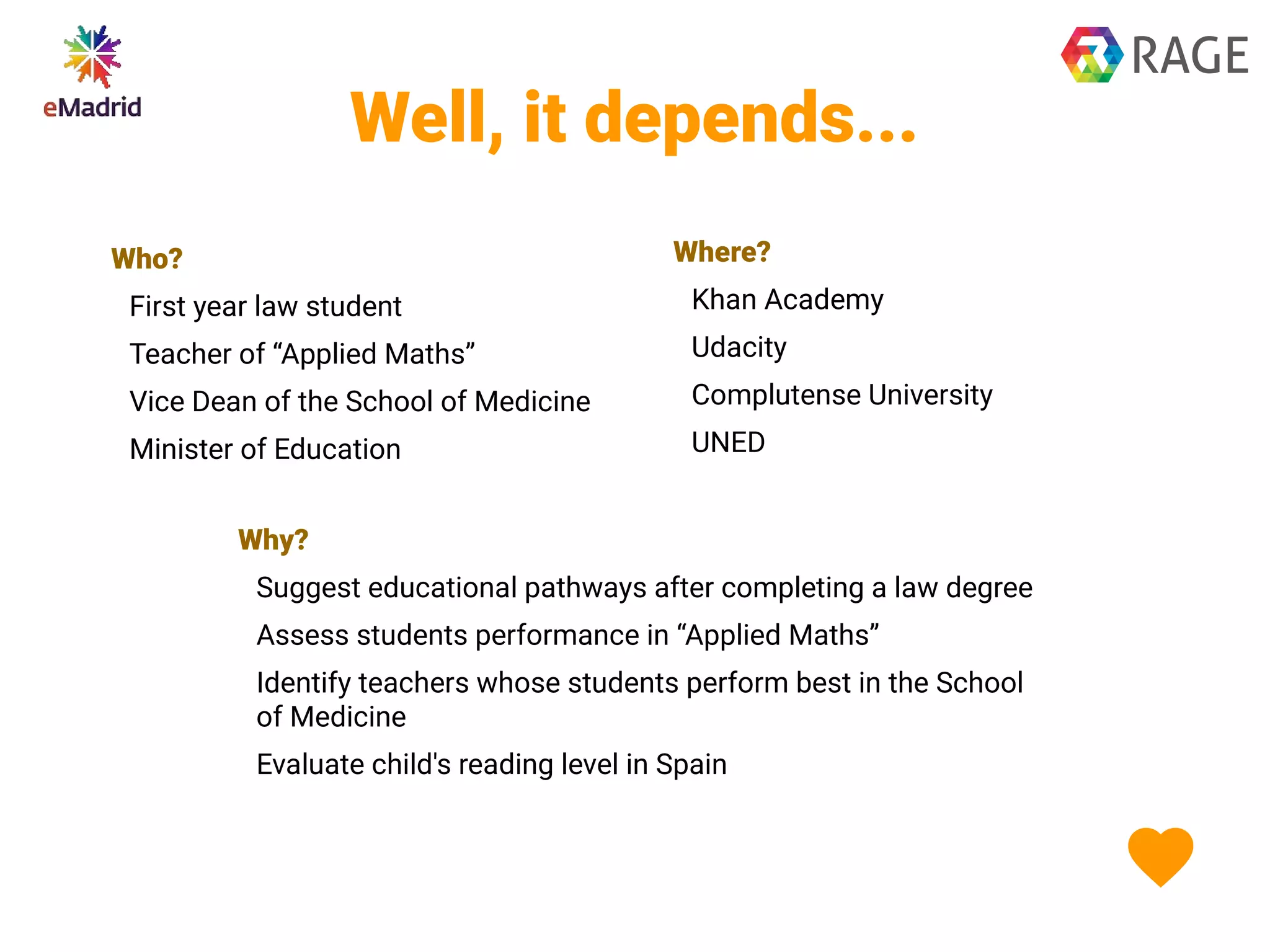
Well, it depends...
Who?
First year law student
Teacher of “Applied Maths”
Vice Dean of the School of Medicine
Minister of Education
Where?
Khan Academy
Udacity
Complutense University
UNED
Why?
Suggest educational pathways after completing a law degree
Assess students performance in “Applied Maths”
Identify teachers whose students perform best in the School
of Medicine
Evaluate child's reading level in Spain
Some ideas
Rich reporting is awesome for research and data
analysts...
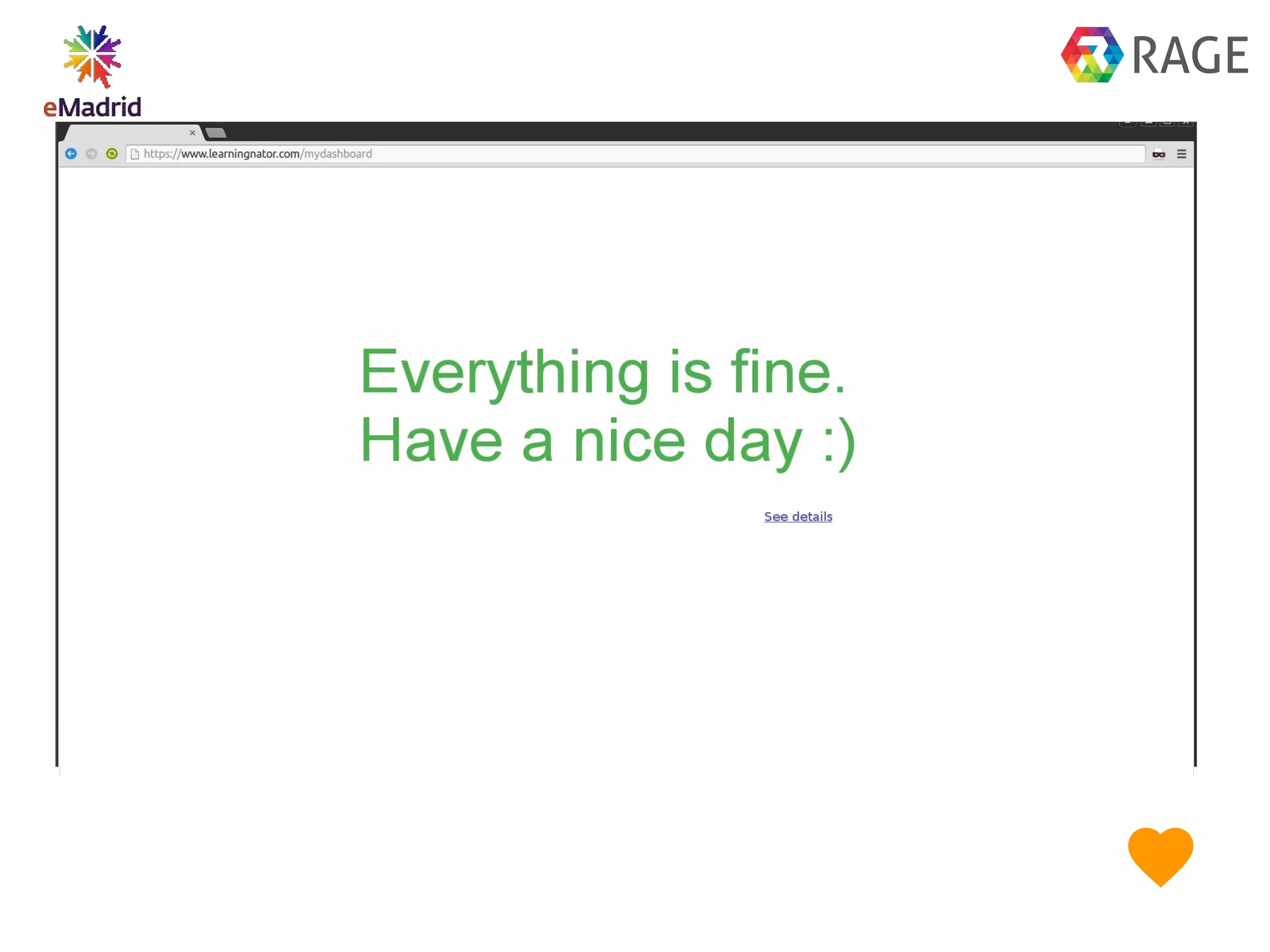
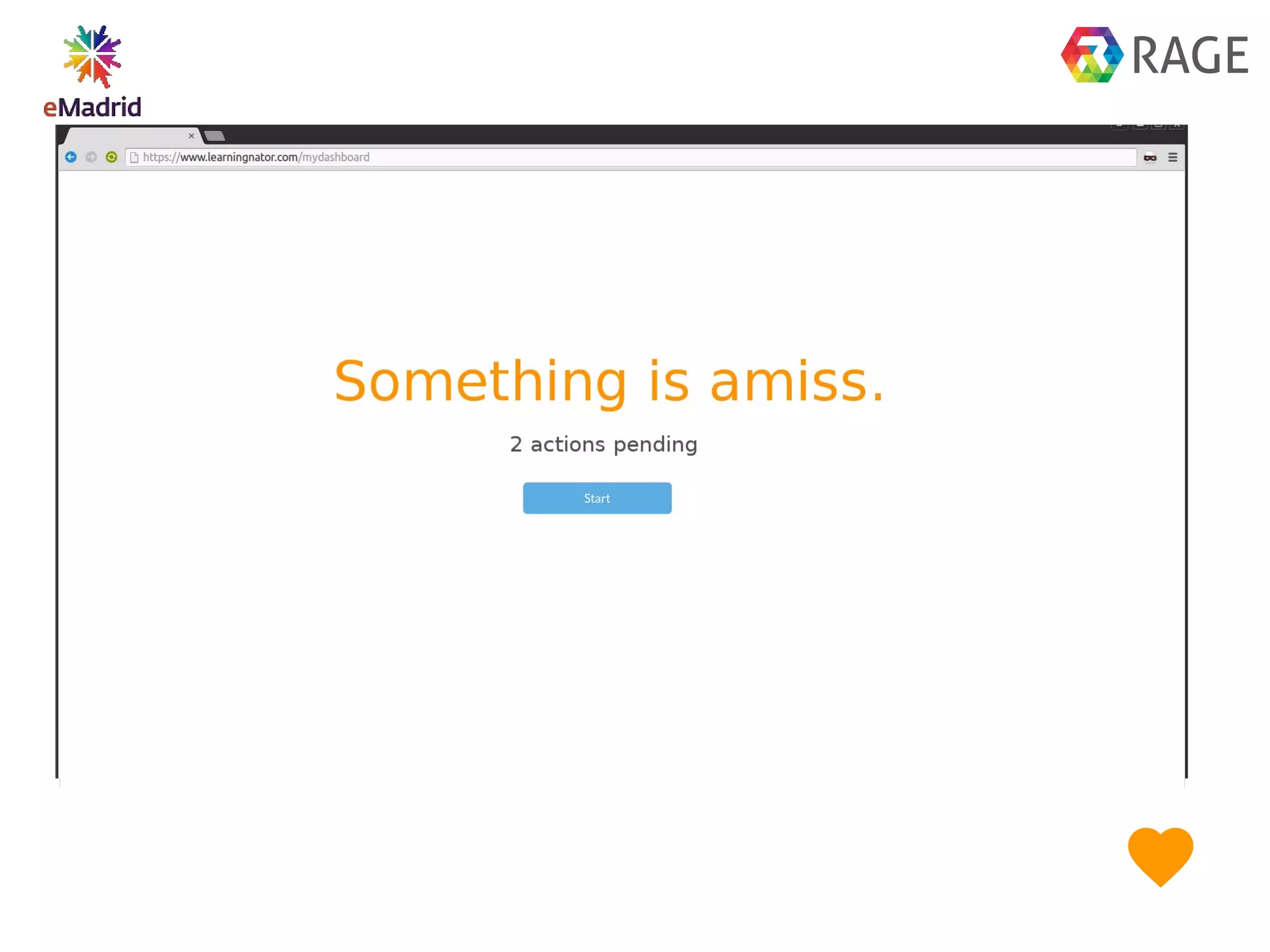
… but not necessarily for most final users.
Largest amount of information in the most concise
representation.
Interventions and actions required by users of the
system's users in the center.
Videogames and
Learning Analytics
Goals
1) Reliable framewok to assess students
performance through educational videogames.
2) All data and information collected by the
framework could be shared with others.
Main challenges
1) The great variability in videogames
Mechanics, genre, aesthetics...
2) Lack of public research in Game Analytics.
Far less in Game Learning Analytics
Public research mostly focused in monetization.
1) Capturing data
2) Analysis
3) Visualizations
4) Sharing
Steps
Modeling and
capturing data from
videogames
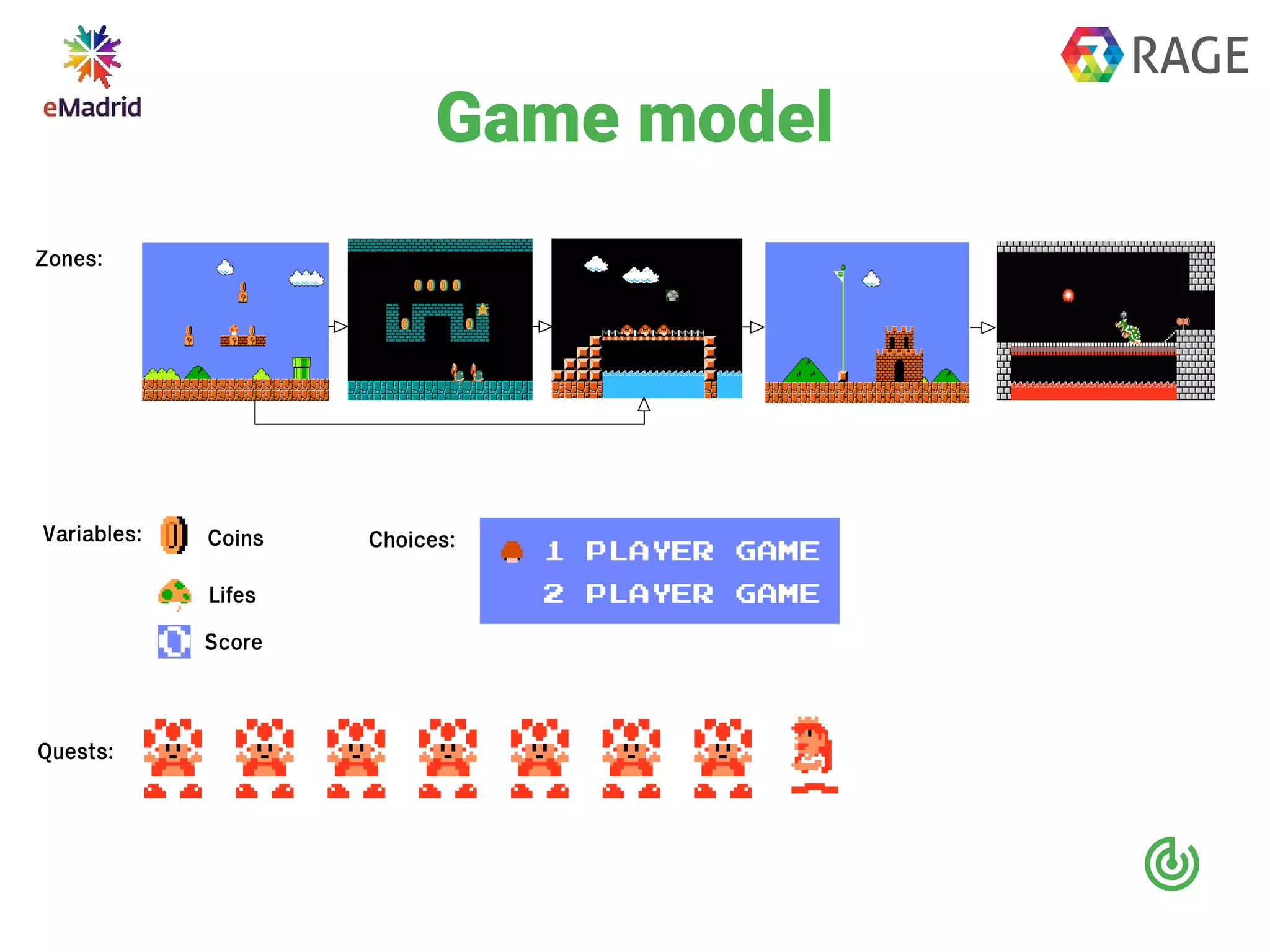
Game model
●
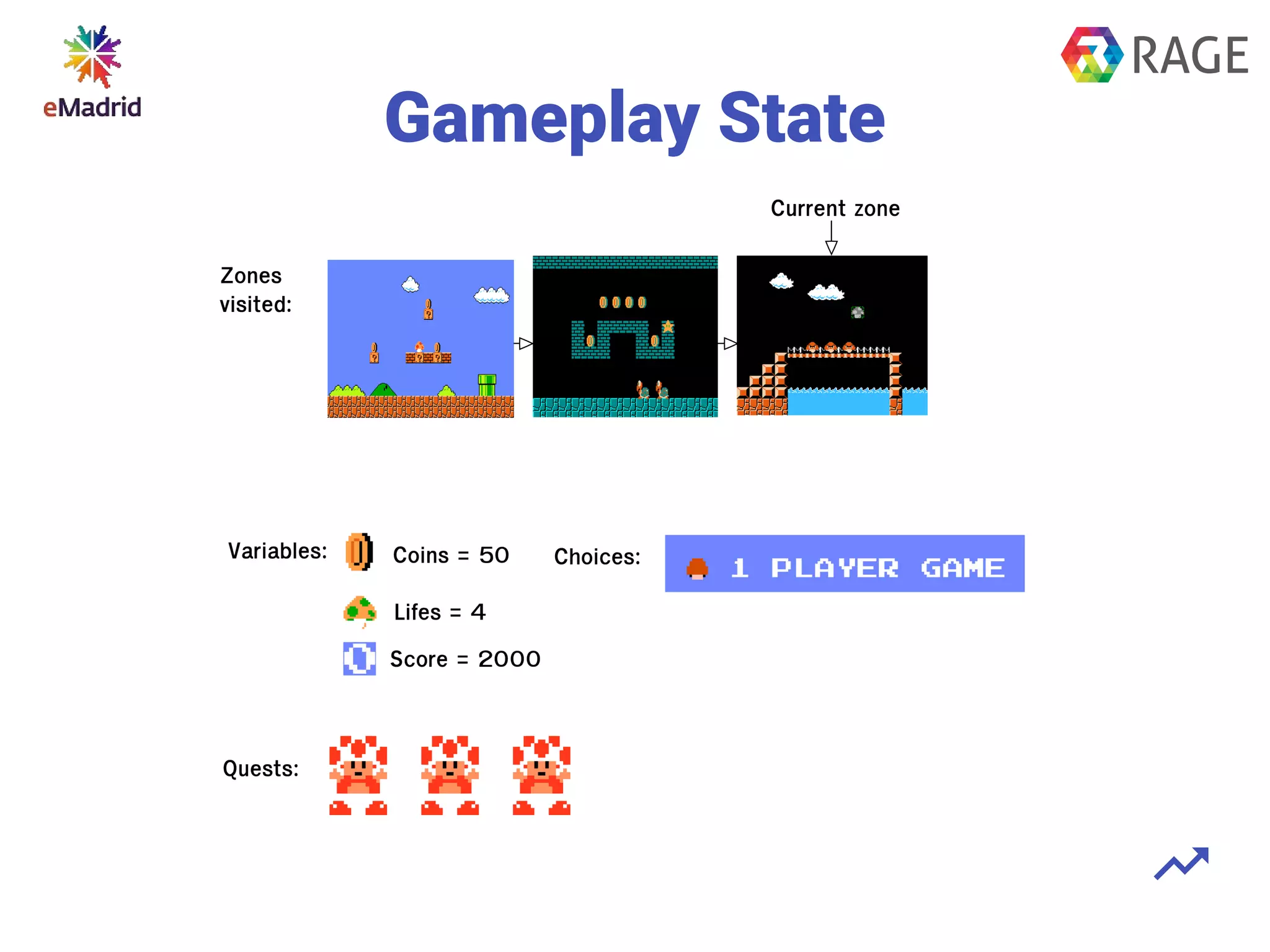
Quests: the current goal of the player, the next
thing he needs to accomplish to advance in the
game
●
Zones, areas, levels...: a virtual area in which the
player can enter or exit
●
Variables: a variable with a meaningful weight
inside the game
●
Choices: a set of options offered to the player,
usually with different consequences
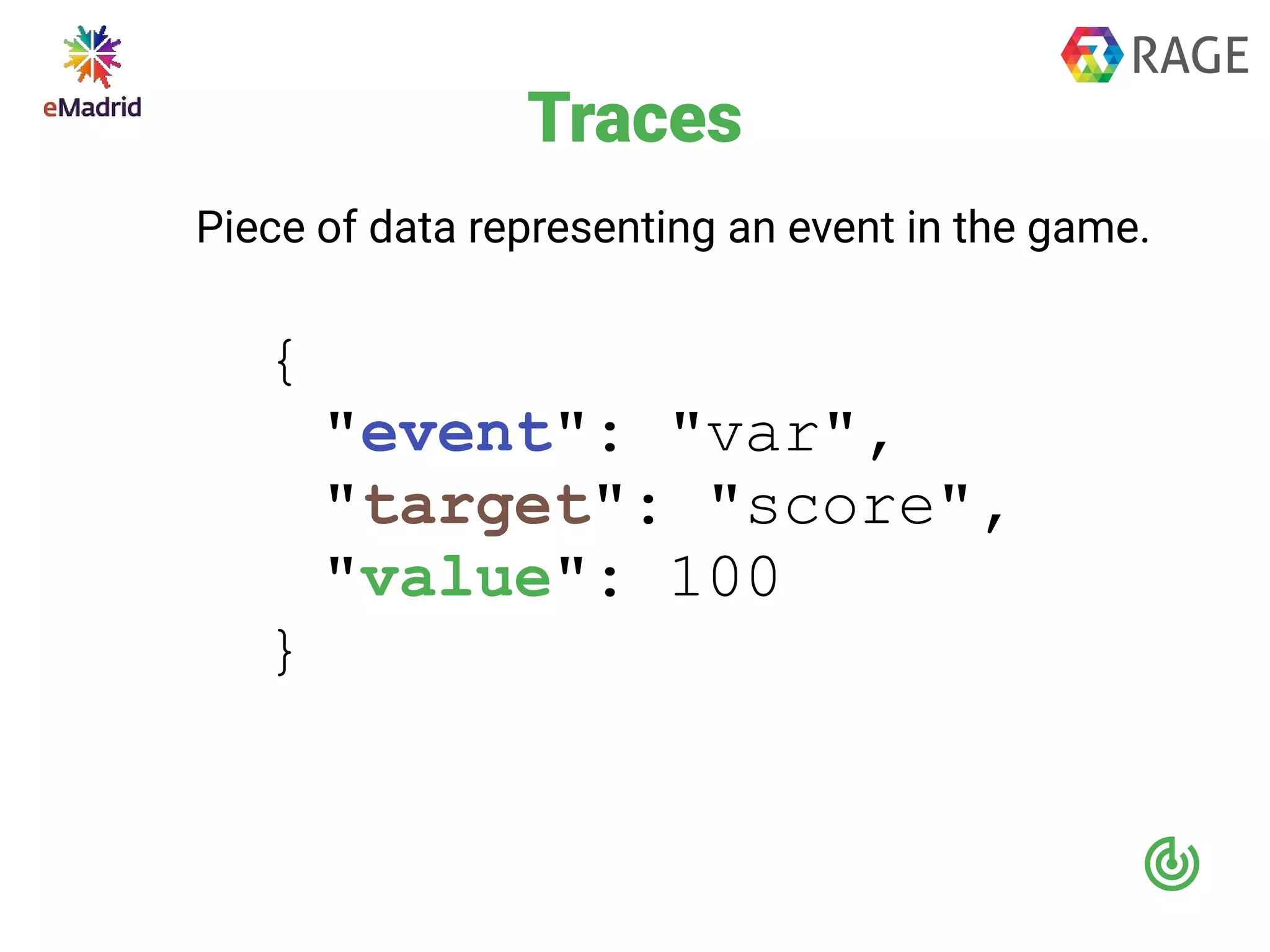
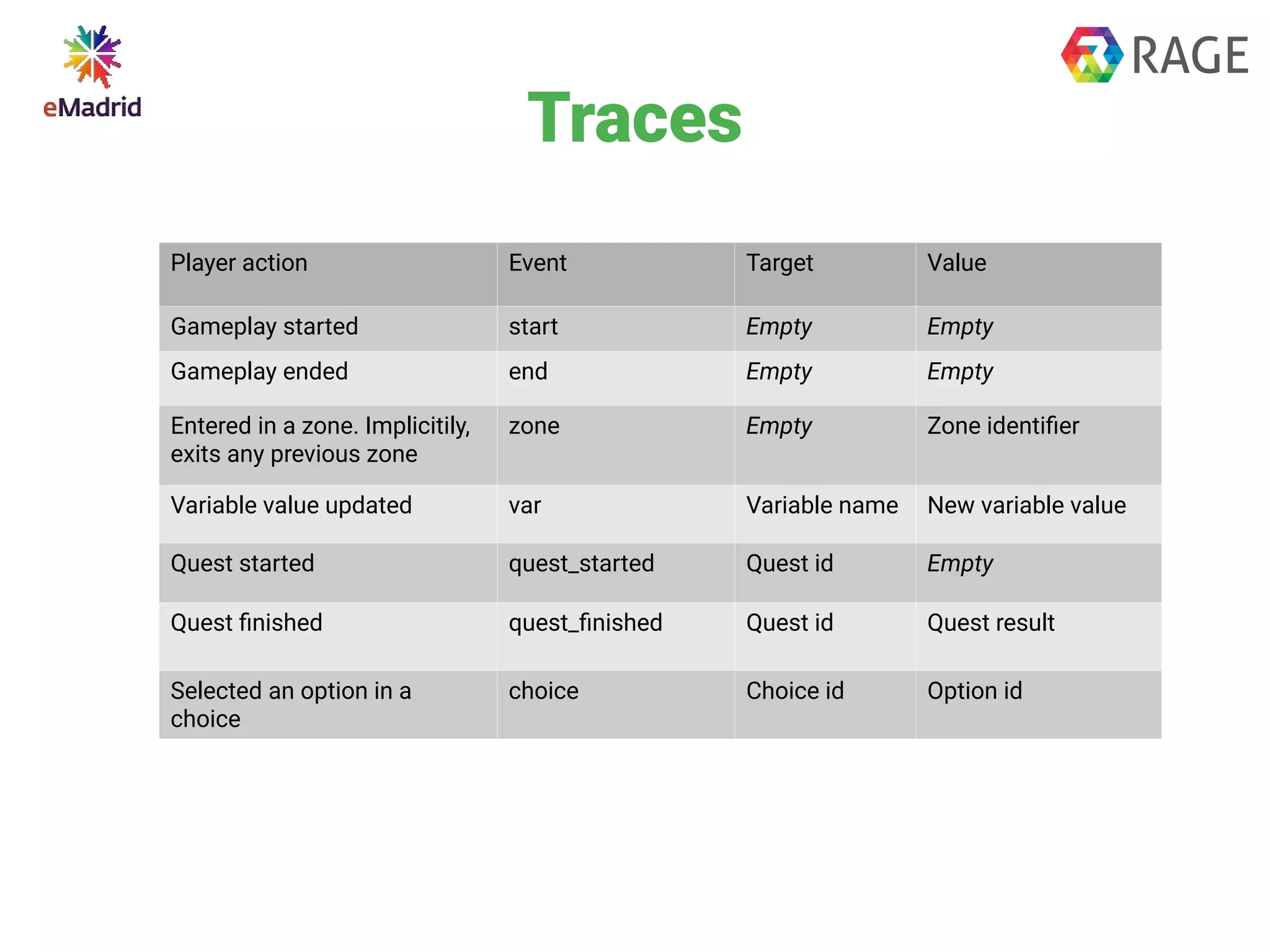
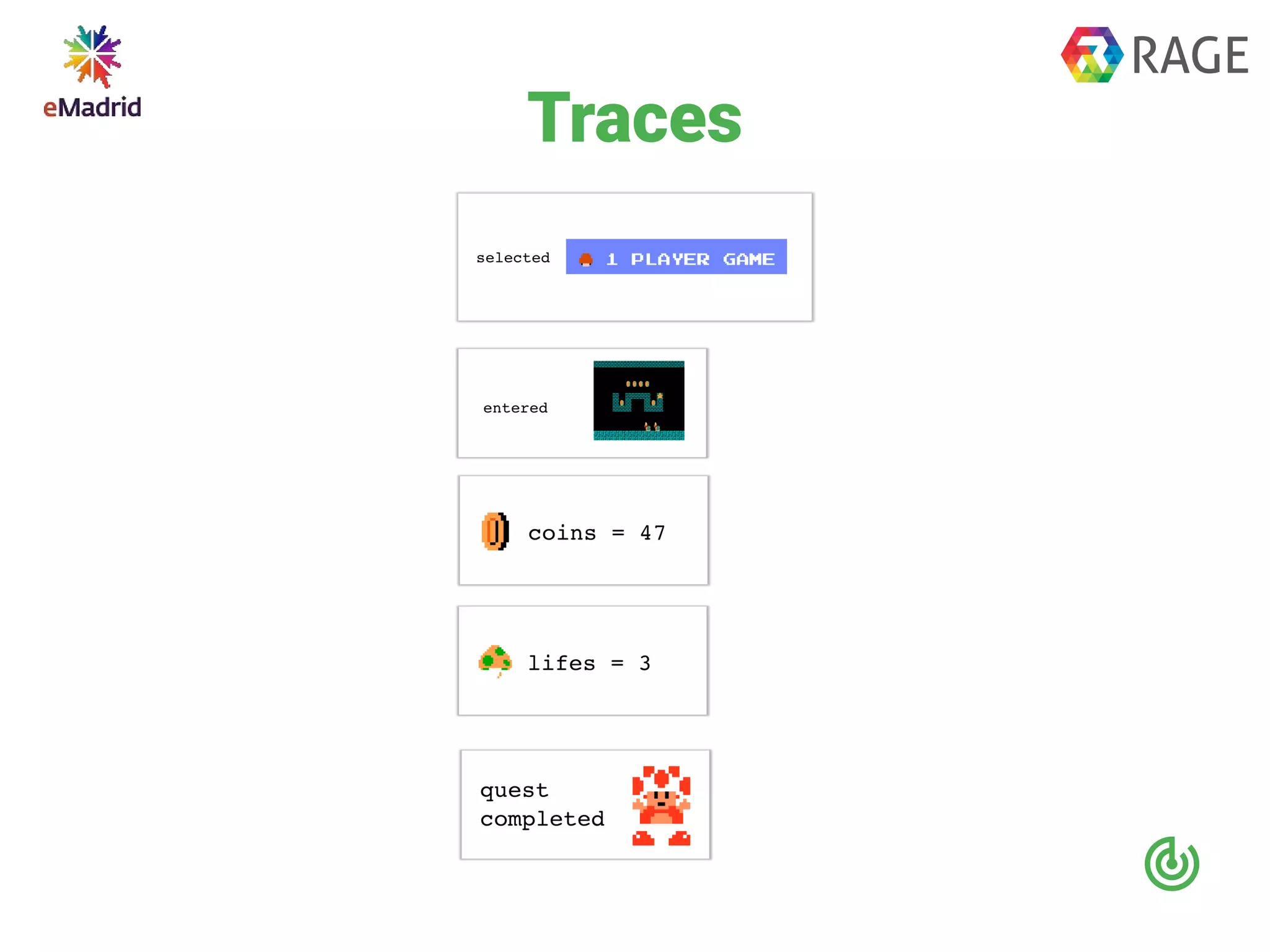
Traces
{
"event": "var",
"target": "score",
"value": 100
}
Piece of data representing an event in the game.
Player action Event Target Value
Gameplay started start Empty Empty
Gameplay ended end Empty Empty
Entered in a zone. Implicitily,
exits any previous zone
zone Empty Zone identifier
Variable value updated var Variable name New variable value
Quest started quest_started Quest id Empty
Quest finished quest_finished Quest id Quest result
Selected an option in a
choice
choice Choice id Option id
Traces
Game model
Traces
Analyzing traces
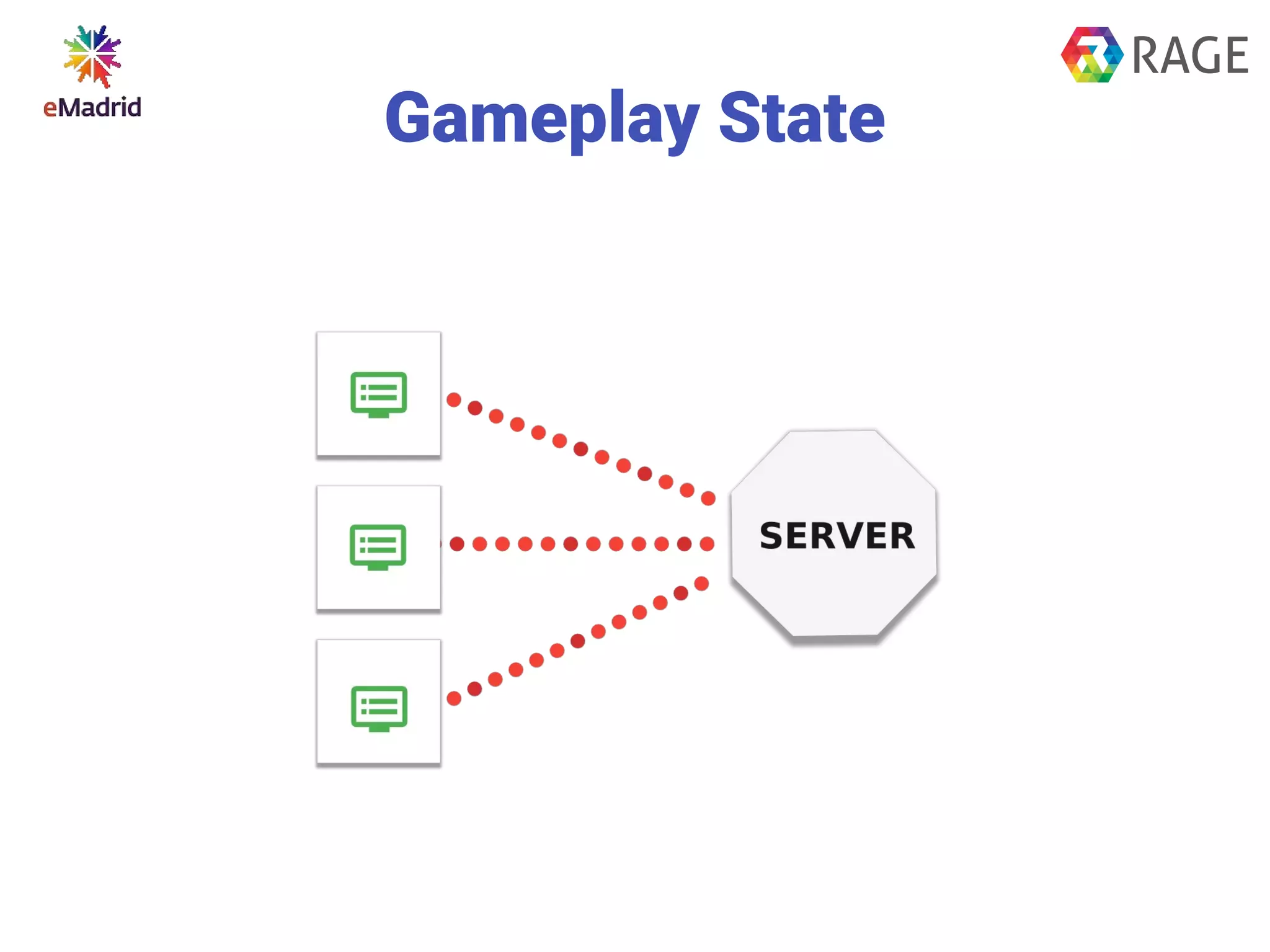
Gameplay State
Gameplay State
{
"zone": "menu"
"vars": {
"score": 100,
},
"quests_finished": ["quest1", "quest2"],
"quests_started": ["quest3", "quest4"],
"choices": {
"players": {
"player1": 1
}
},
"..."
}
Built in real time... (with Apache Storm)
Server holds gameplay state for each indivdual player
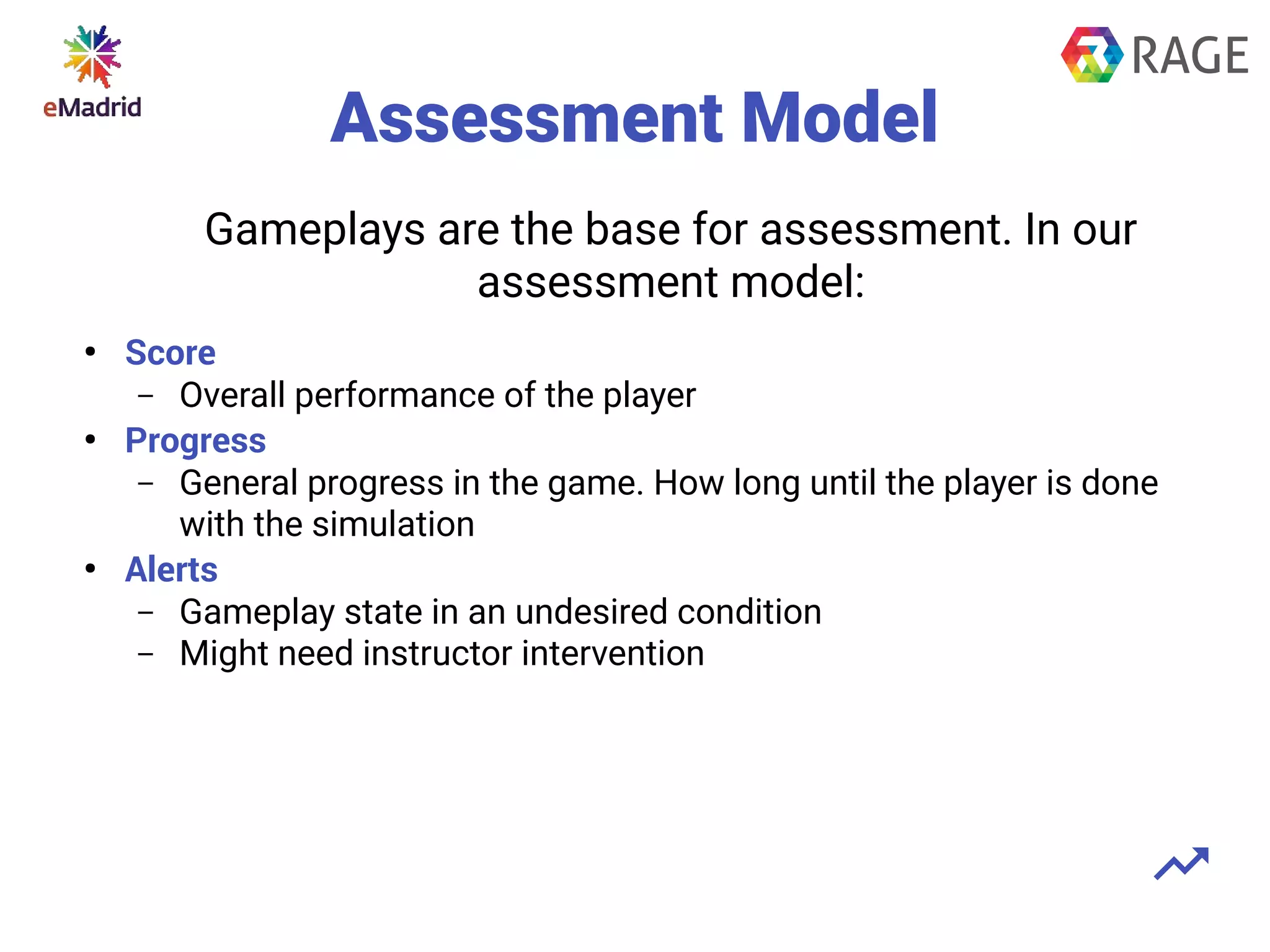
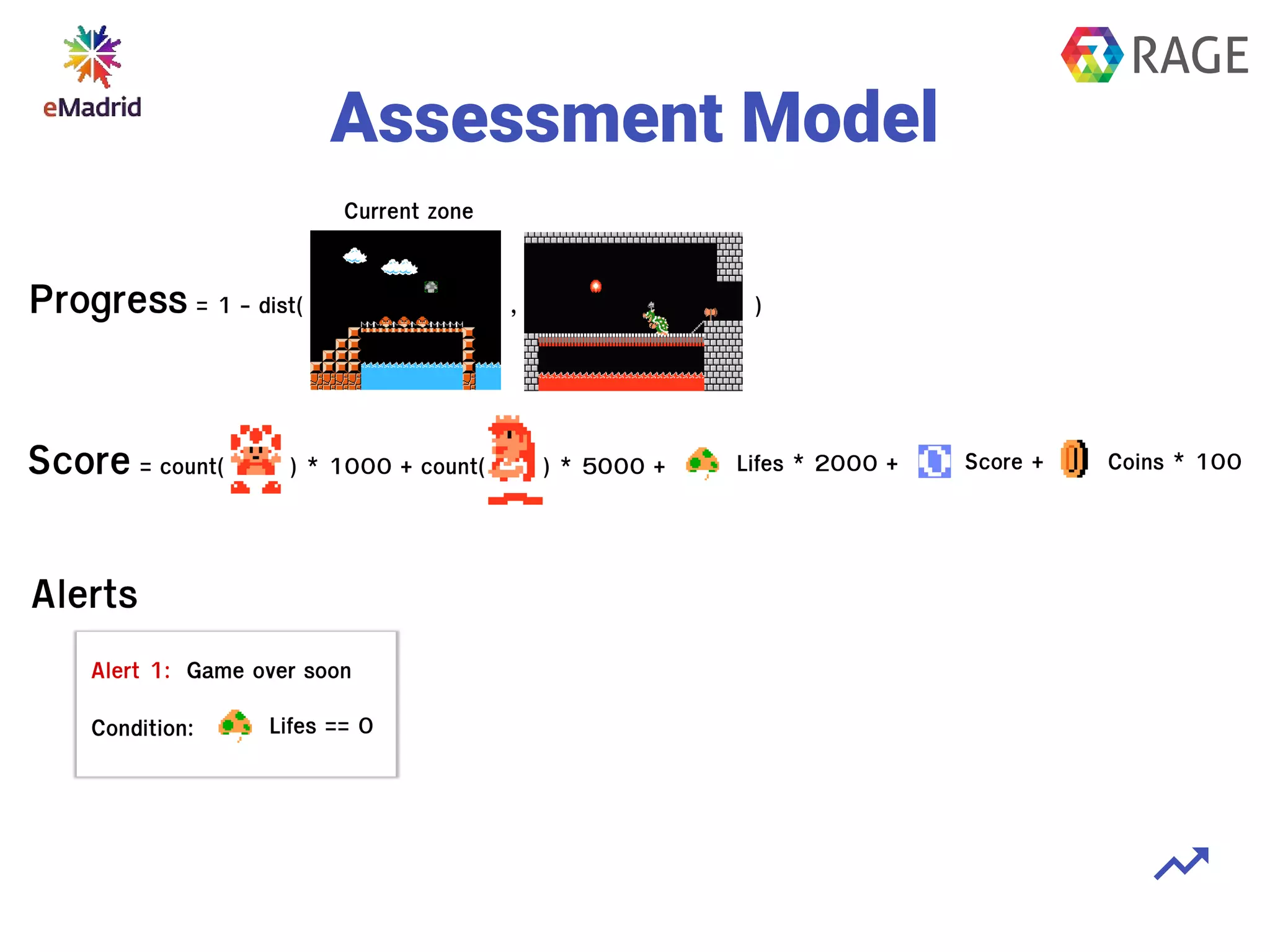
Assessment Model
●
Score
– Overall performance of the player
●
Progress
– General progress in the game. How long until the player is done
with the simulation
●
Alerts
– Gameplay state in an undesired condition
– Might need instructor intervention
Gameplays are the base for assessment. In our
assessment model:
Gameplay State
Assessment Model
Visualizing the
results
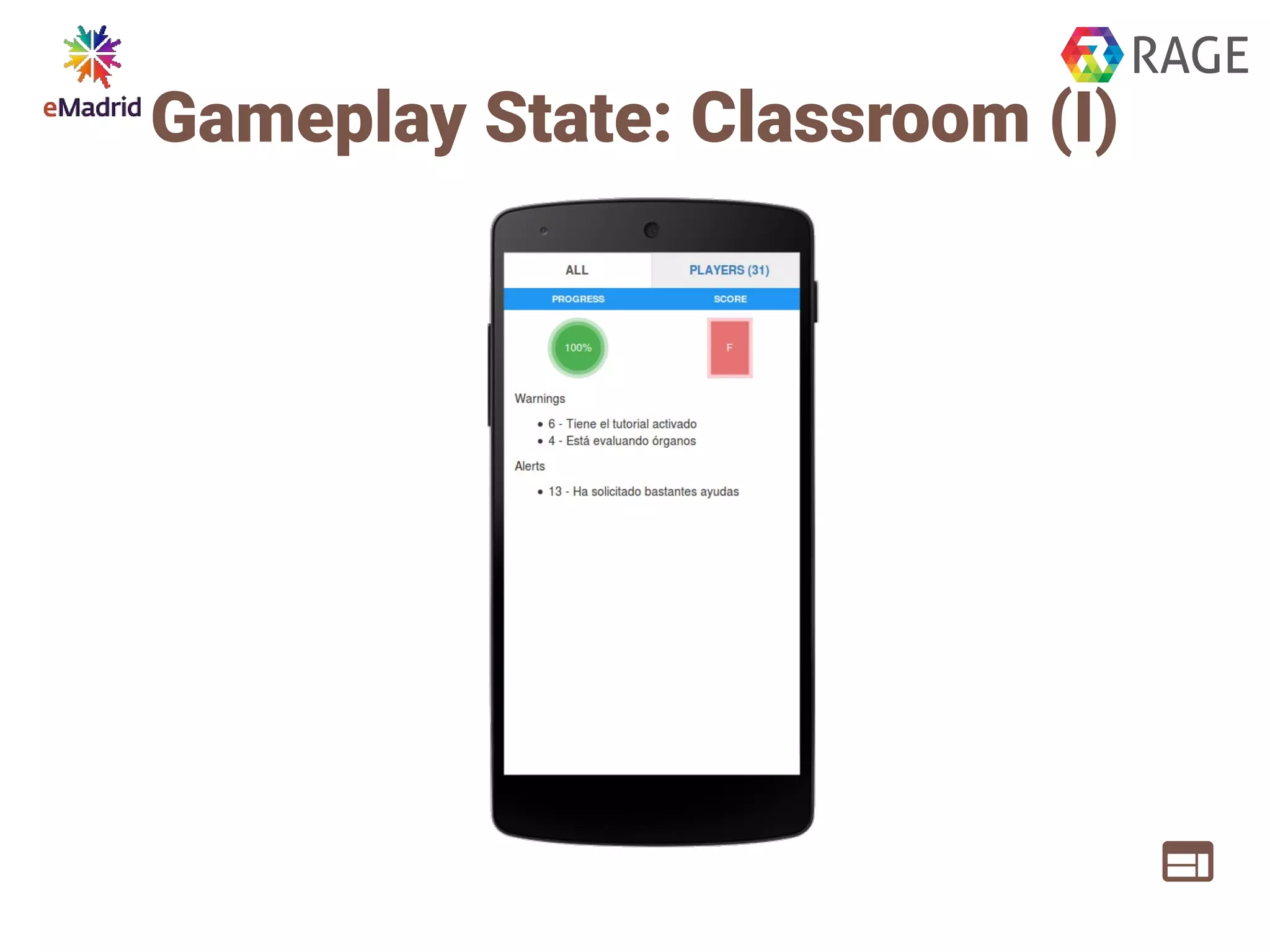
Gameplay State: Classroom (I)
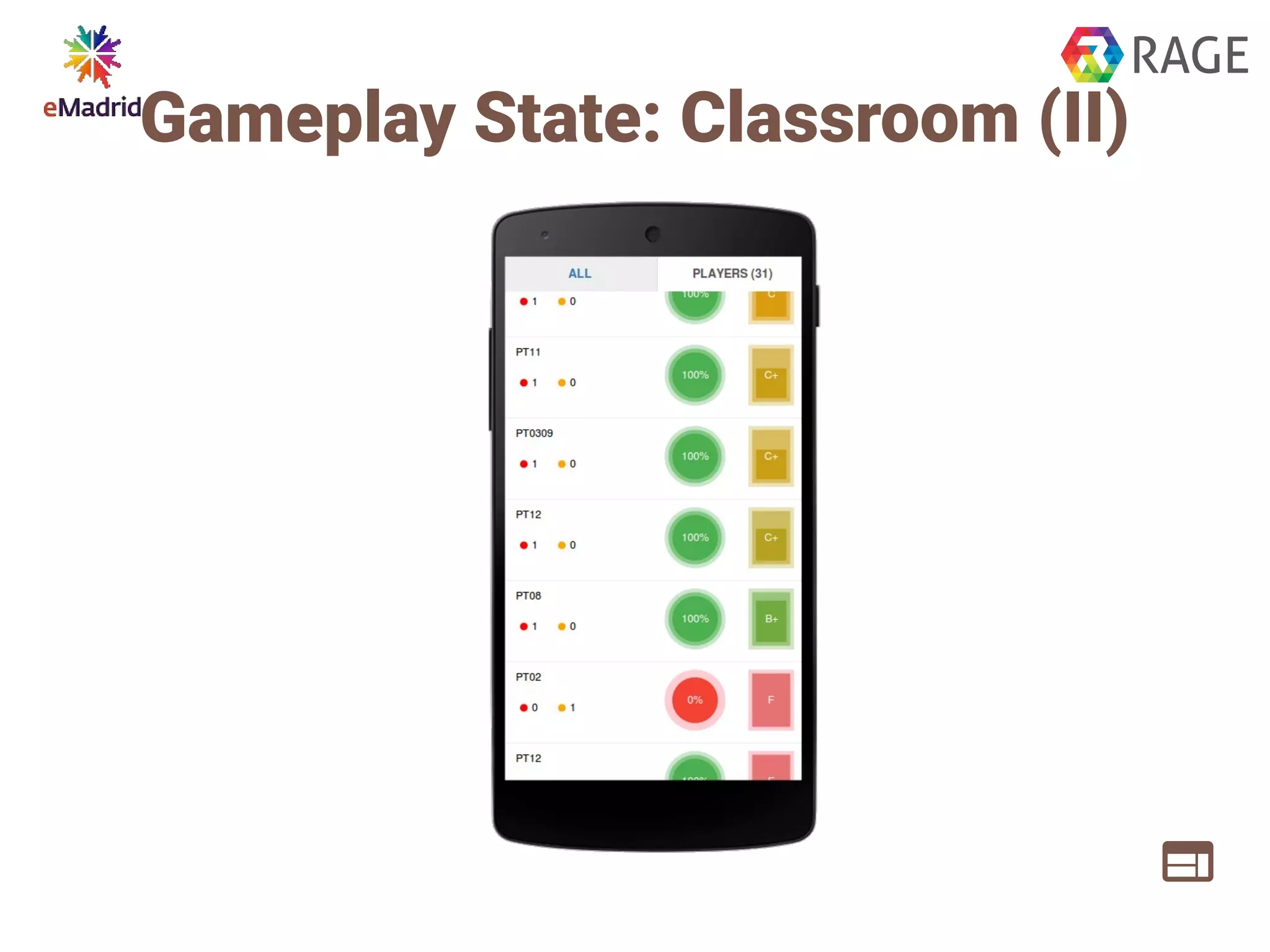
Gameplay State: Classroom (II)
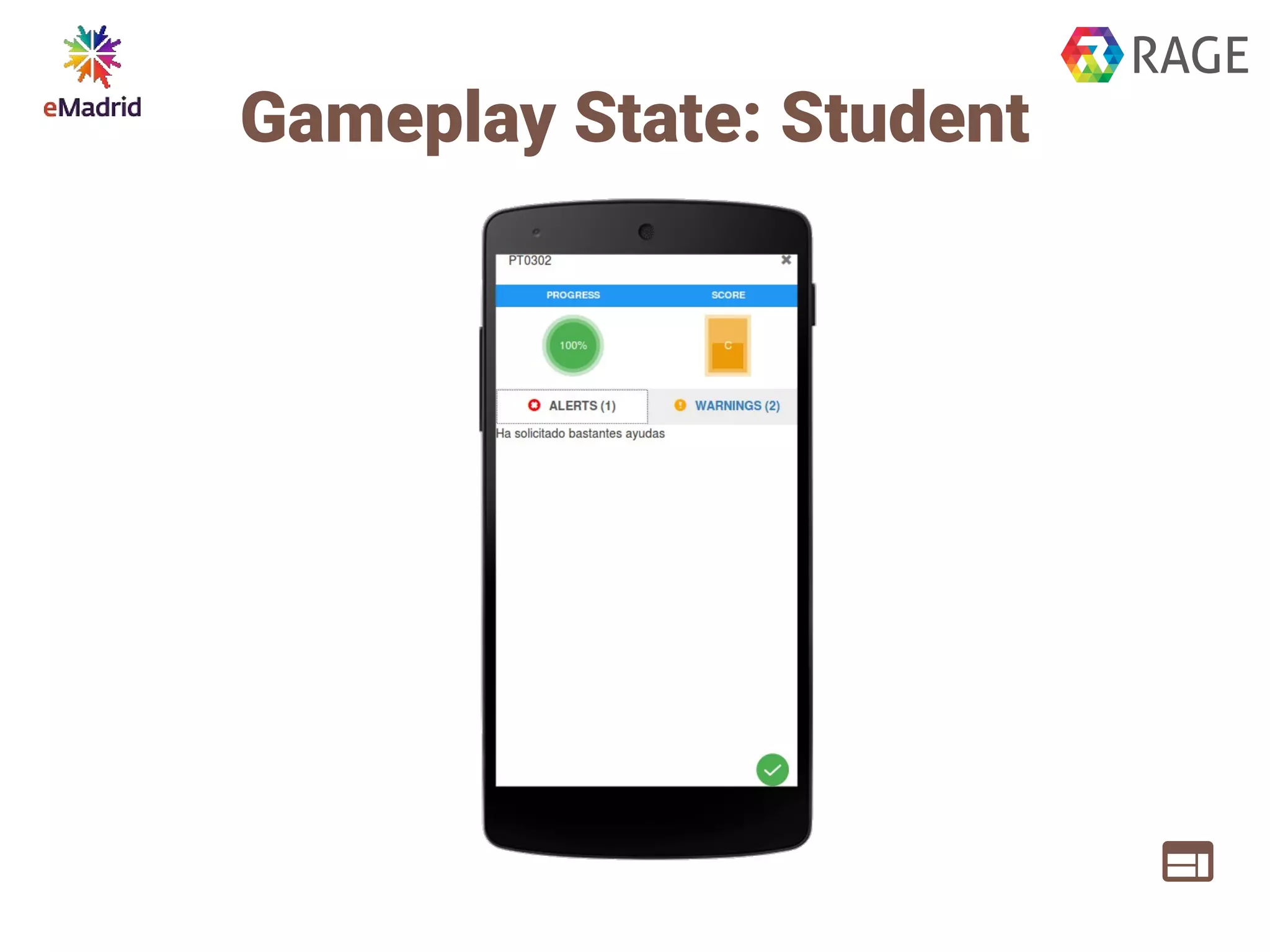
Gameplay State: Student
Sharing through
standards: xAPI
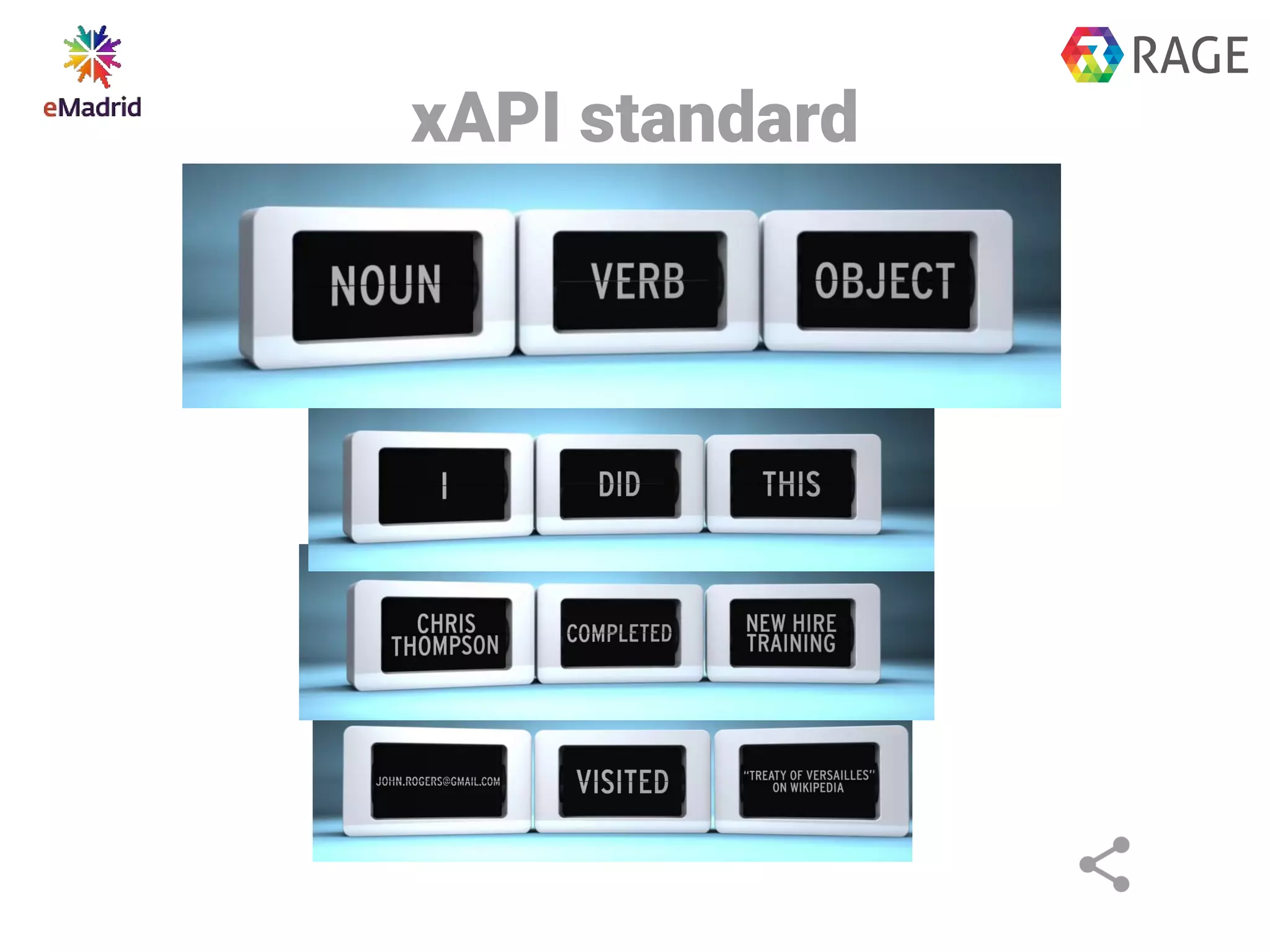
xAPI standard
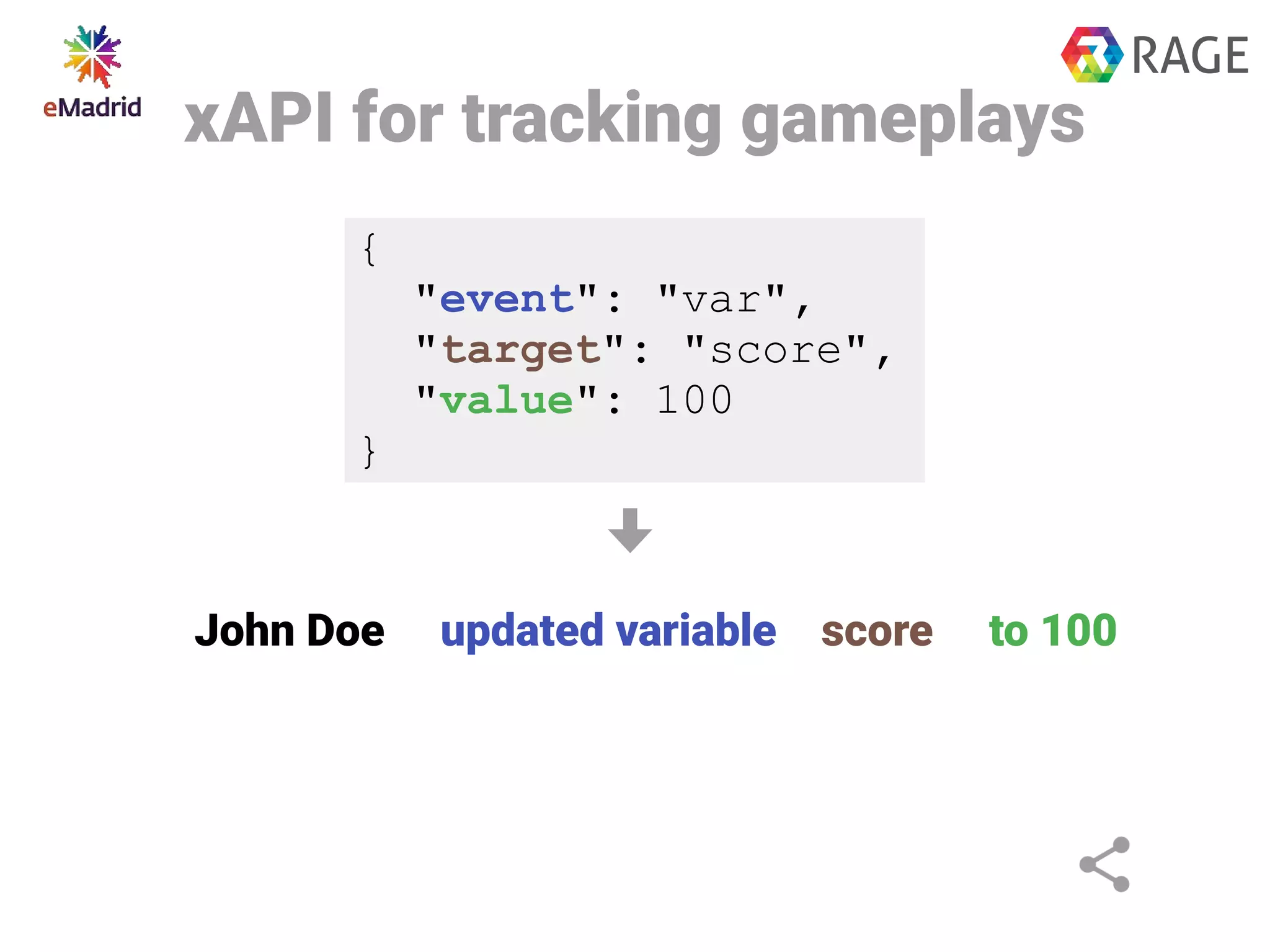
xAPI for tracking gameplays
{
"event": "var",
"target": "score",
"value": 100
}
John Doe updated variable score to 100
xAPI transmiting results
{
"score": 10,
"progress": 1.0
"alerts": []
}
John Doe completed Lost in Space Game with 10
Conclusions
● General Game Model to define games in a
common vocabulary
● Analysis over game states represented as an
aggregation of traces
● Simple visualizations, focused on actions
● xAPI as communication standard
Thanks!

V Jornadas eMadrid sobre “Educación Digital”. Ángel Serrano, Universidad Complutense de Madrid: Applied games, learning analytics and standards