


Gaming Learning Analytics:
Contributing to the Serious Games
Ecosystem
European Conference in Game-Based Learning (ECGBL 2016),
Paisley, Scotland, UK
Baltasar Fernandez-Manjon, balta@fdi.ucm.es , @BaltaFM
e-UCM research group, www.e-ucm.es
http://www.slideshare.net/BaltasarFernandezManjon
Realising an Applied Gaming Eco-System
Cátedra Telefónica-Complutense
Educación Digital y Juegos Serios
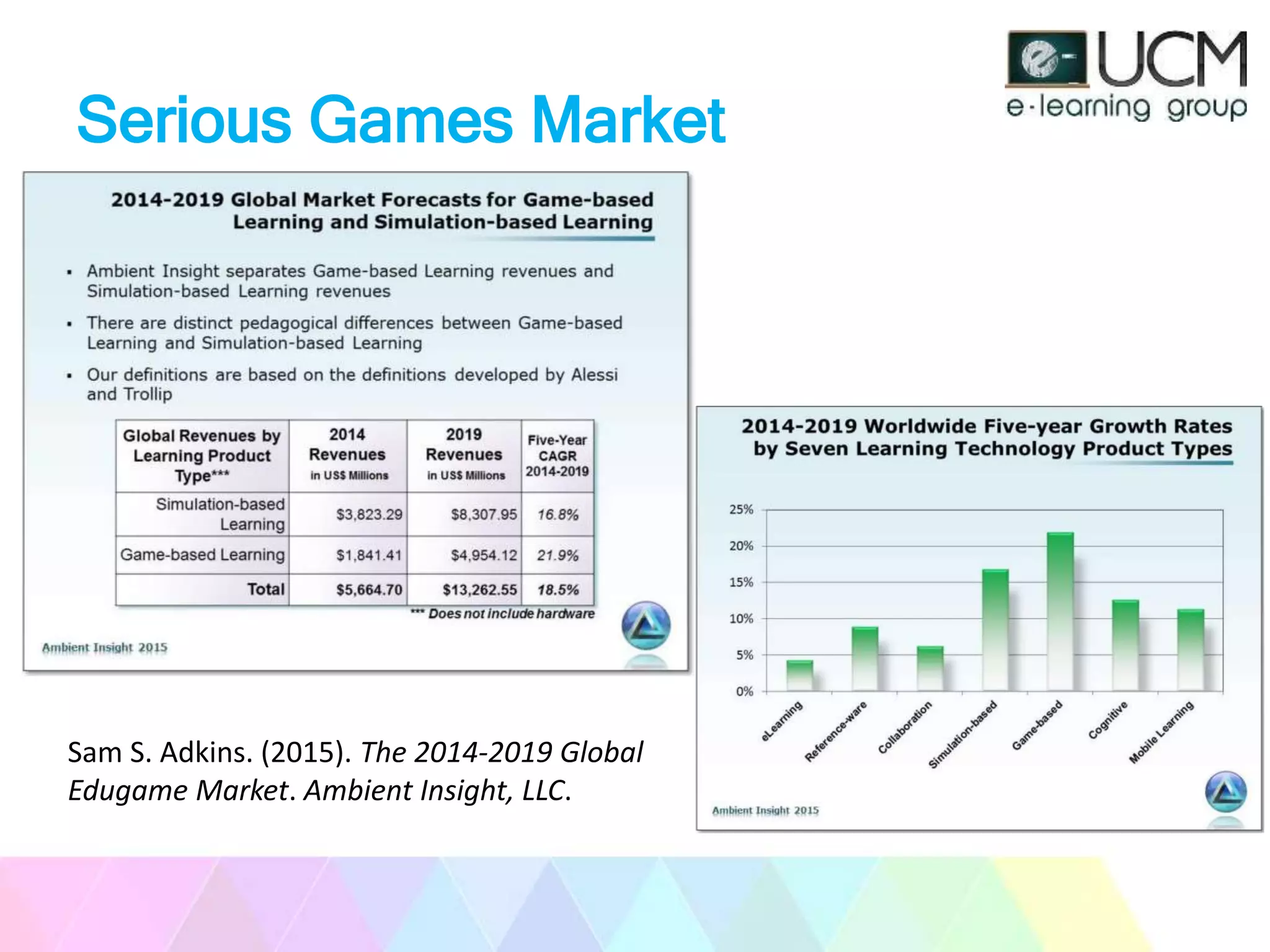
Serious Games Market
Sam S. Adkins. (2015). The 2014-2019 Global
Edugame Market. Ambient Insight, LLC.
06/10/20163 https://www.wired.com/2012/06/dragonbox/
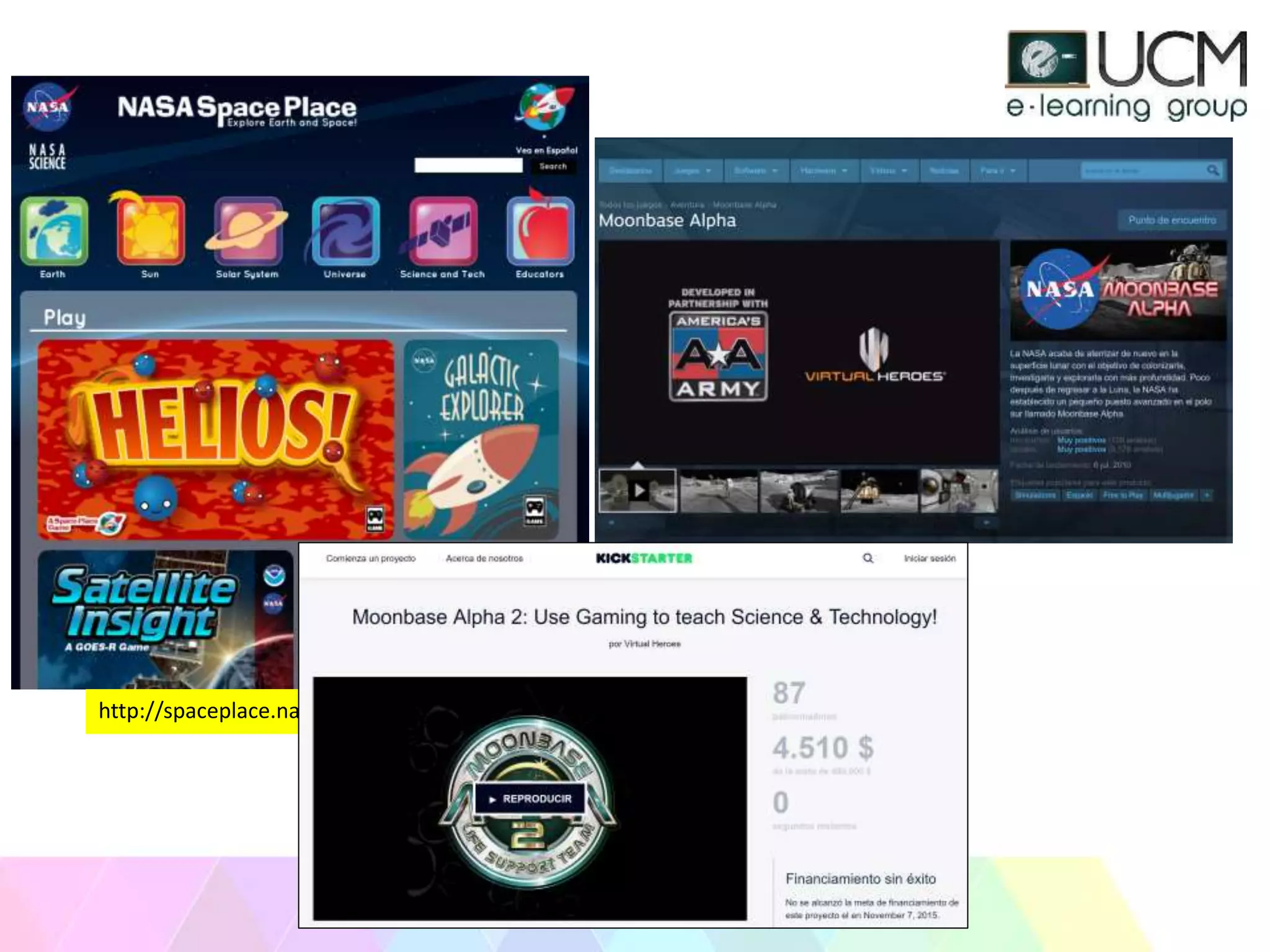
http://spaceplace.nasa.gov/menu/play/
06/10/2016RAGE Project presentation6
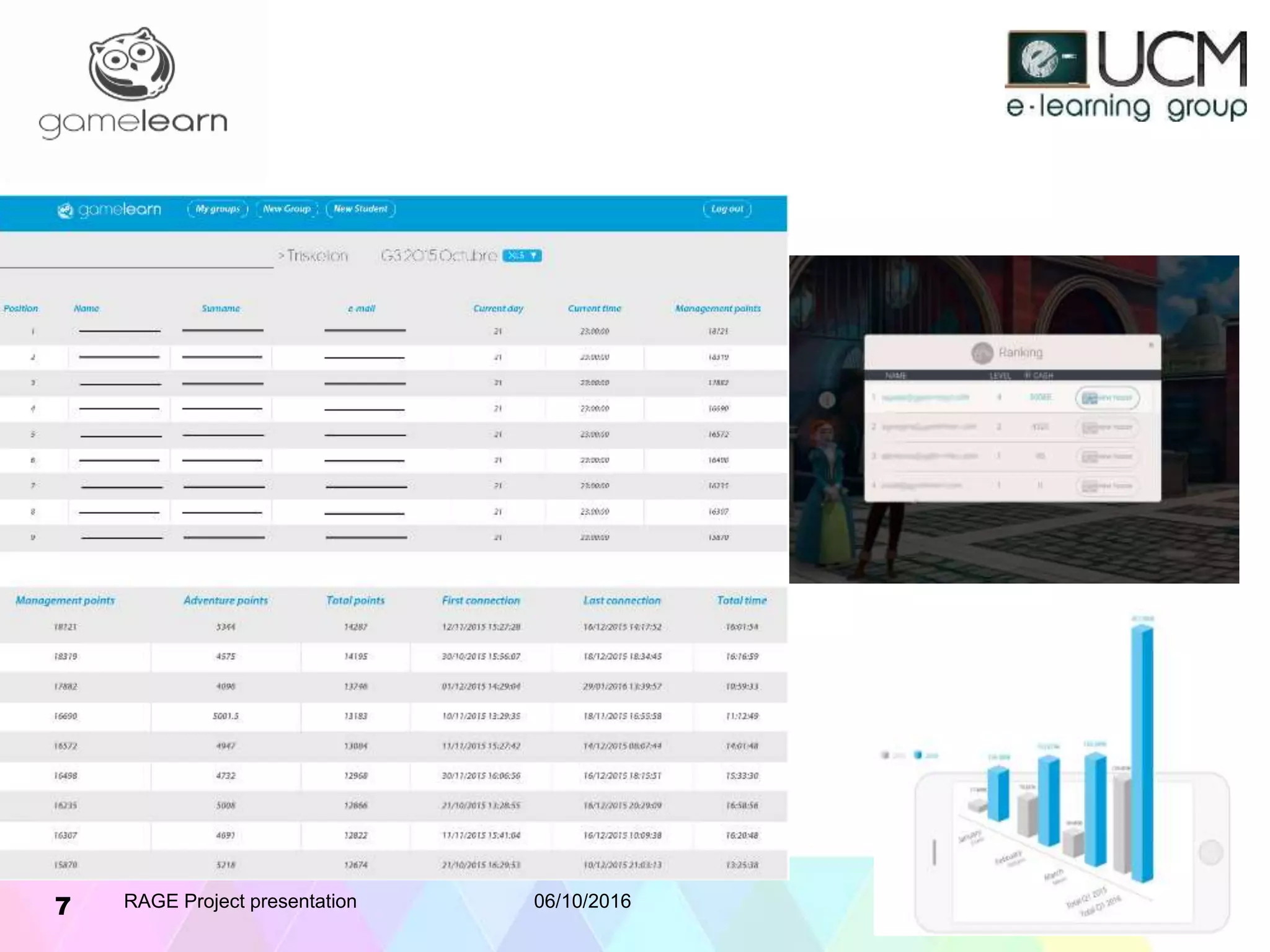
06/10/2016RAGE Project presentation7
Game Learning Analytics
• Learning Analytics Improving education
based on data analysis
– Data driven
– Evidence-based education
• Gaming Learning Analytics is a specific case when all
interaction data is used in serious games for improving
the learning process supported by the games
– Educational games not as “black boxes”
– In games is called Telemetry or Game metrics
• GLA allows for new business models for serious games
– Serious game as a service
06/10/2016RAGE Project presentation8
Manuel Freire, Ángel Serrano-Laguna, Borja Manero, Iván Martínez-Ortiz, Pablo Moreno-Ger, Baltasar Fernández-
Manjón (2016): Game Learning Analytics: Learning Analytics for Serious Games. In Learning, Design, and
Technology (pp. 1–29). Cham: Springer International Publishing. http://doi.org/10.1007/978-3-319-17727-4_21-1.
Uses of Gaming Learning
Analytics in educational games
• Game testing – game analytics
– It is the game realiable?
– How many students finish the game?
– Average time to complete the game?
• Game deployment in the class – tools for teachers
– Real-time information for supporting the teacher
– Knowing what is happening when the game is deployed in the
class
– “Stealth” student evaluation
• Formal Game evaluation
– From pre-post test to evaluation based on game learning
analytics??
It is GLA feasible for a SME?
• Game Learning Analytics imposes new requirement on
already struggling Game developers
– Not many of the SME that develop games are collecting
and exploiting learning analytics data
– GLA requires different technology and expertise
– When done it is very “game dependent”
06/10/2016RAGE Project presentation10
But there are new specifications and
developments that could systematize
the work
H2020 RAGE project
• RAGE will deliver advanced technology and know-
how to support the European Applied Games industry
build-up and job creation
– February 2015, 4 years, 19 partners, 9M
• Creating a new serious games ecosystem by making
available a set of reusable technology components for
developing advance serious games easier, faster and
more cost-effectively
• Open source gaming learning analytics framework
– provide all the required services (e.g. game tracker, learning
analytics server, visualization of analytics information)
– easy inclusion of gaming learning analytics techniques in the
new games
Realising an Applied Gaming Eco-System
User Data Analytics Outline
• Collecting and assessing game-based user data
– the collection and aggregation of data
– the interpretation of the data to support further
intervention
• Solid data protection and authentication procedures
– Data anonymization when possible
• Generalization of the approach
– Applicable to different kind of games
• Use of standards
06/10/2016RAGE Project presentation12
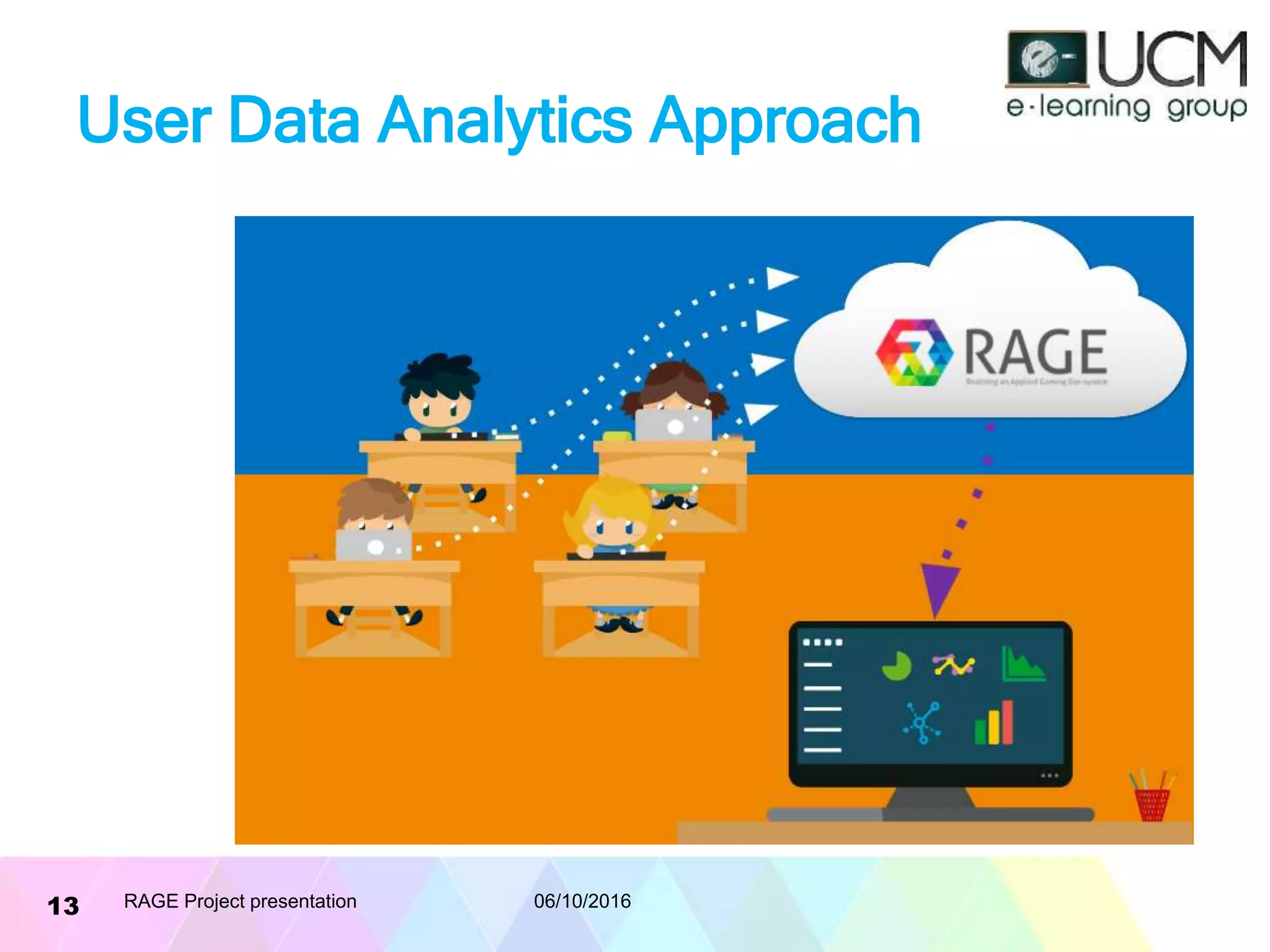
User Data Analytics Approach
06/10/2016RAGE Project presentation13
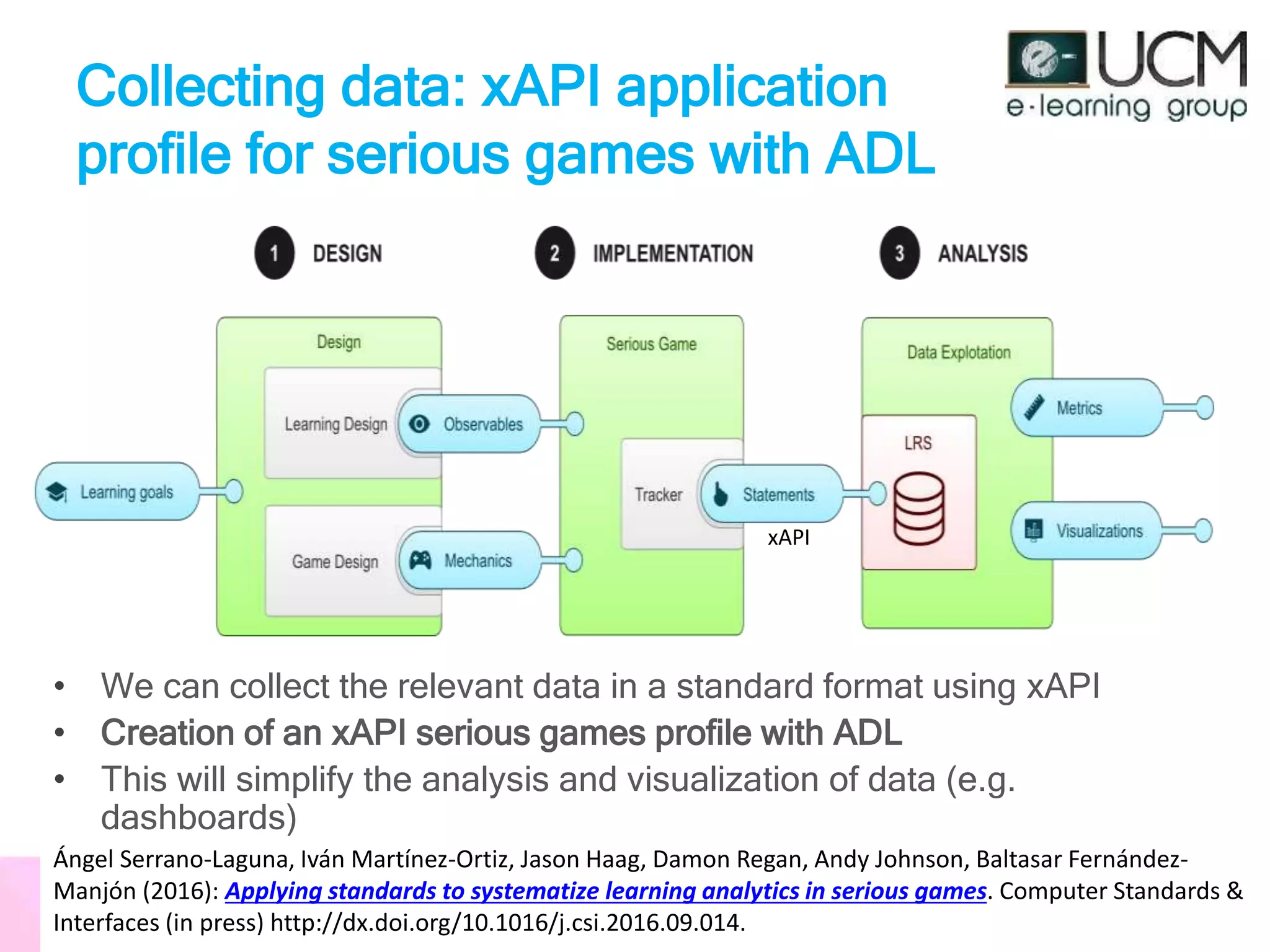
Collecting data: xAPI application
profile for serious games with ADL
• We can collect the relevant data in a standard format using xAPI
• Creation of an xAPI serious games profile with ADL
• This will simplify the analysis and visualization of data (e.g.
dashboards)
xAPI
Ángel Serrano-Laguna, Iván Martínez-Ortiz, Jason Haag, Damon Regan, Andy Johnson, Baltasar Fernández-
Manjón (2016): Applying standards to systematize learning analytics in serious games. Computer Standards &
Interfaces (in press) http://dx.doi.org/10.1016/j.csi.2016.09.014.
xAPI profile for serious games
developed with ADL
• Definition of a general interaction model for appliying
Game Learning Analytics with serious games
– Completion (A level/stage/puzzle or completion percentage)
– In-game choices (player selections in the game)
– Meaningful variables (i.e. Score, Coins …)
– Meaningful actions (i.e. ask for help, …)
– Custom interactions (Game-specific interactions)
• Definition of an xAPI application profile for serious
games
– implementation of our general model in xAPI
06/10/2016RAGE Project presentation15
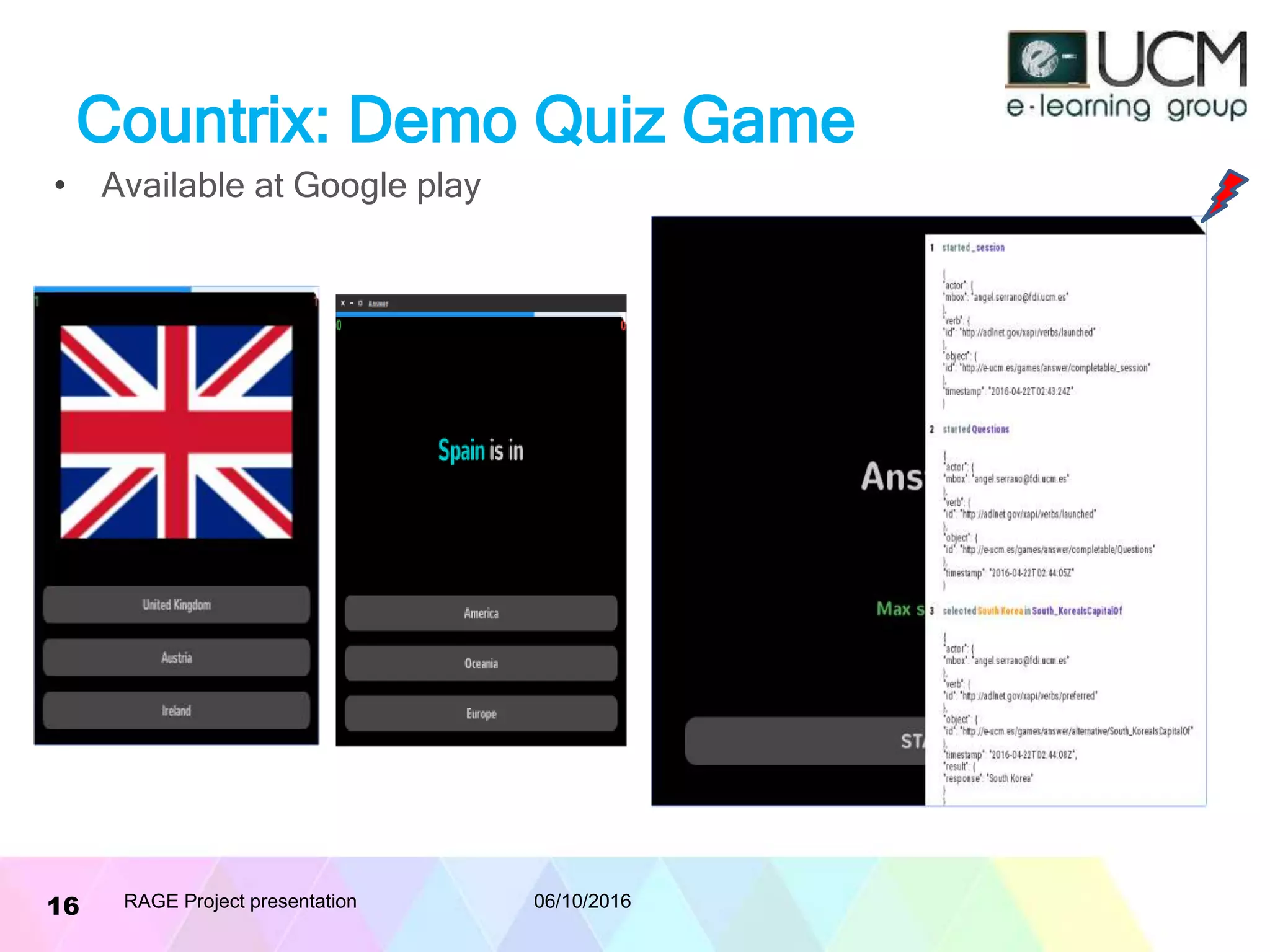
Countrix: Demo Quiz Game
• Available at Google play
06/10/2016RAGE Project presentation16
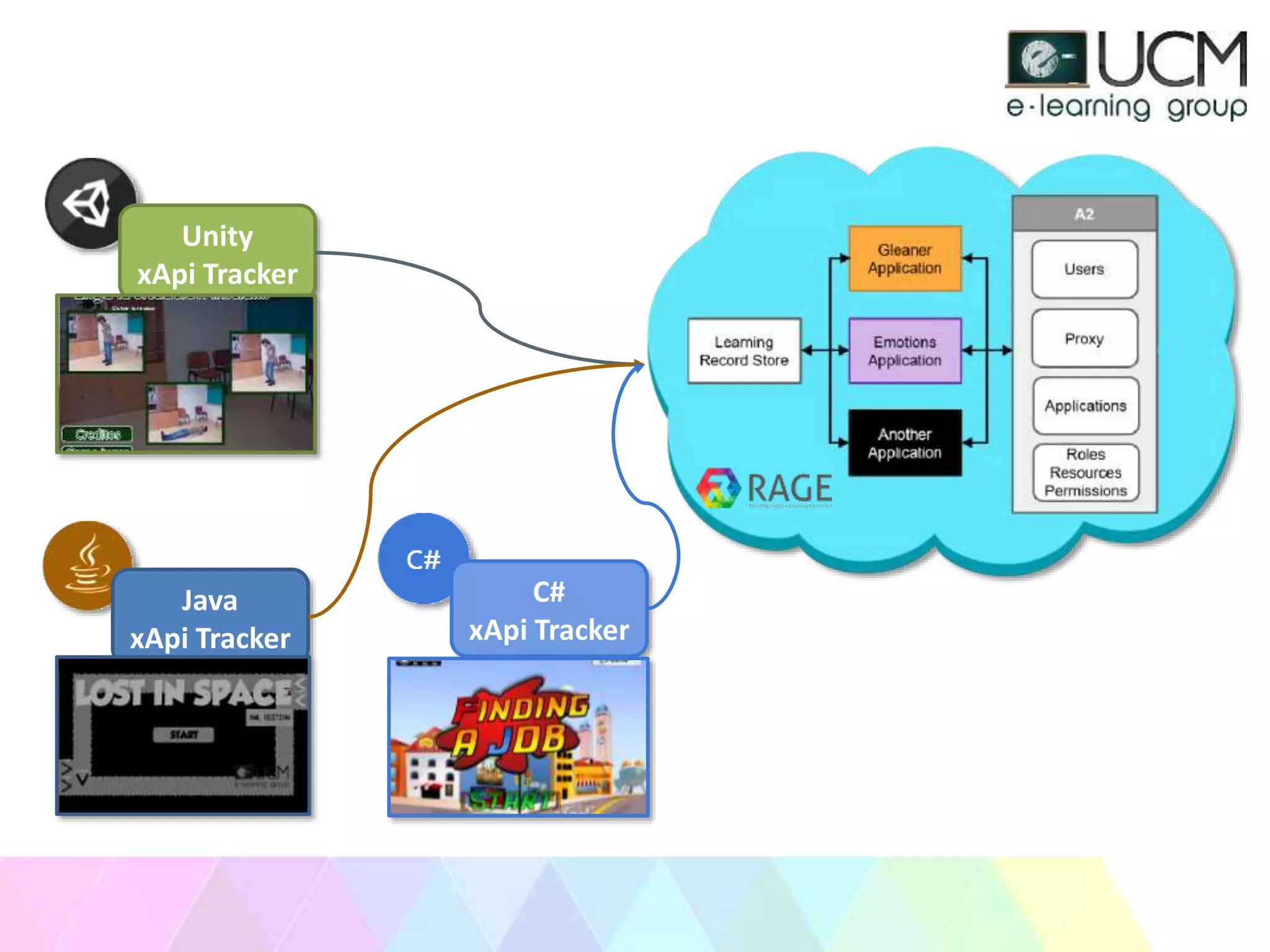
Java
xApi Tracker
Unity
xApi Tracker
C#
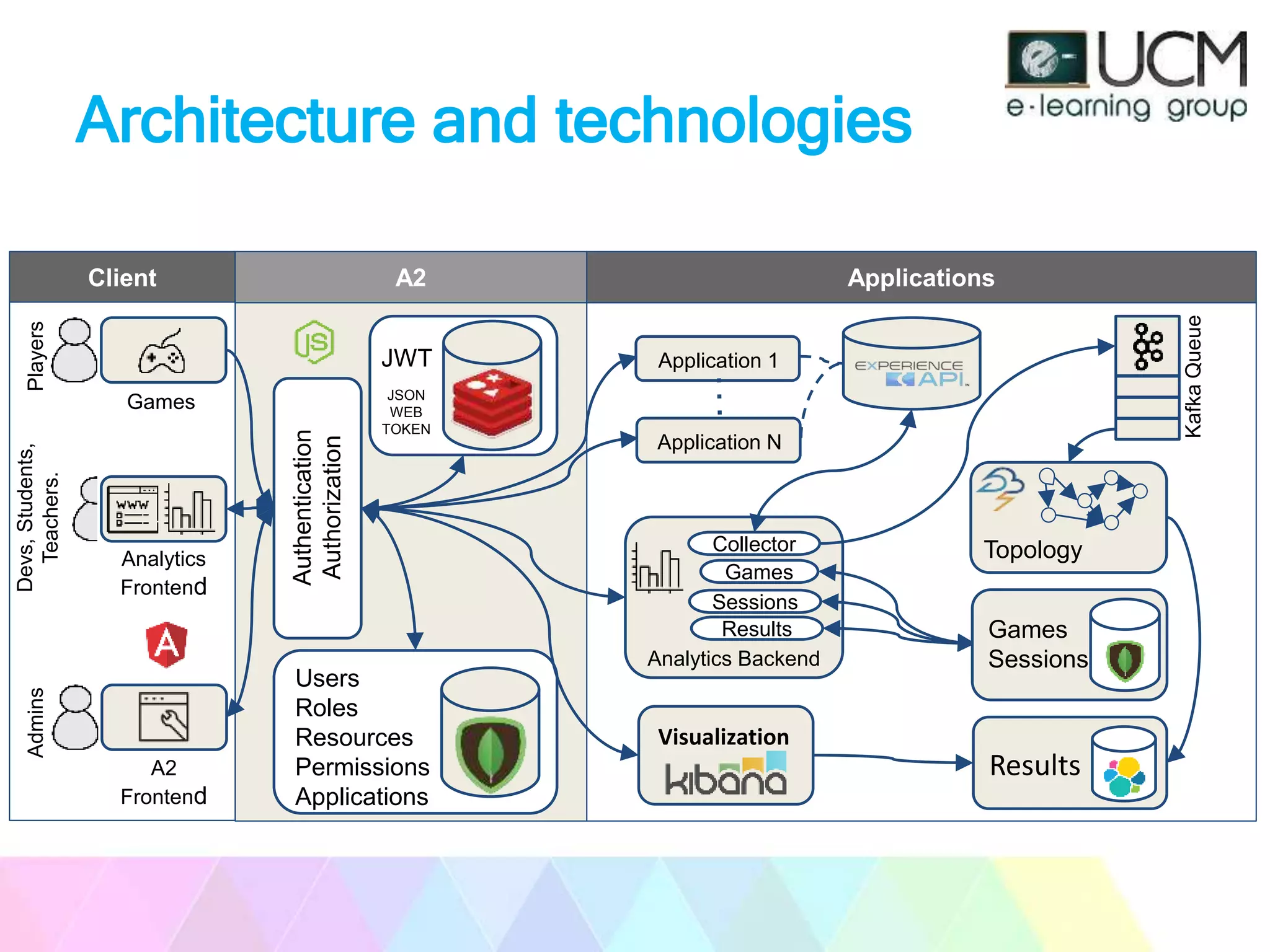
xApi Tracker
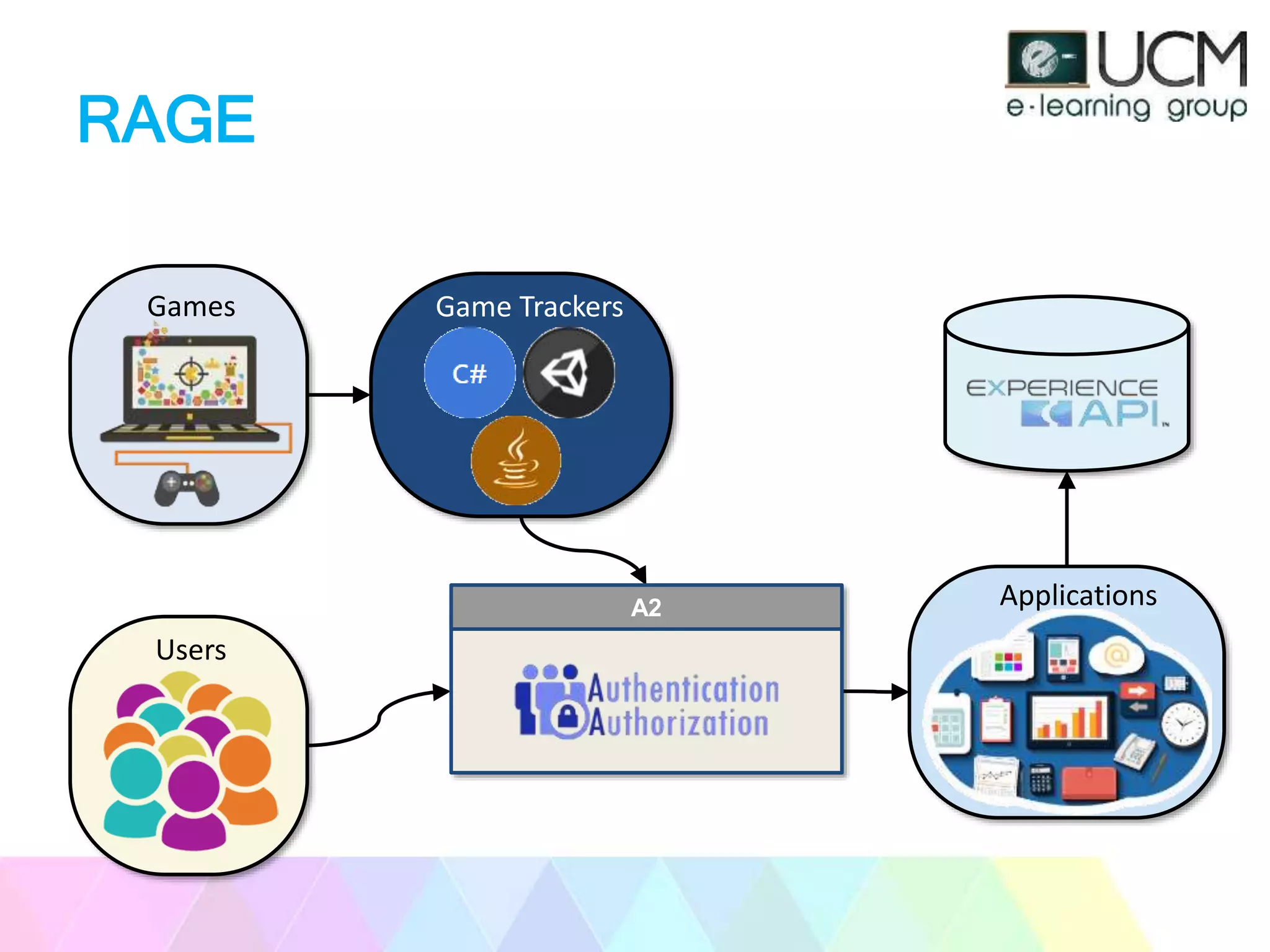
Applications
Game TrackersGames
Users
A2
RAGE
Client A2 Applications
Games
Analytics
Frontend
A2
Frontend
PlayersDevs,Students,
Teachers.
Admins
Users
Roles
Resources
Permissions
Applications
Authentication
Authorization
JWT
JSON
WEB
TOKEN
Topology
Analytics Backend
Games
Sessions
Collector
Results
Application 1
Application N
KafkaQueue
Games
Sessions
Results
Visualization
Architecture and technologies
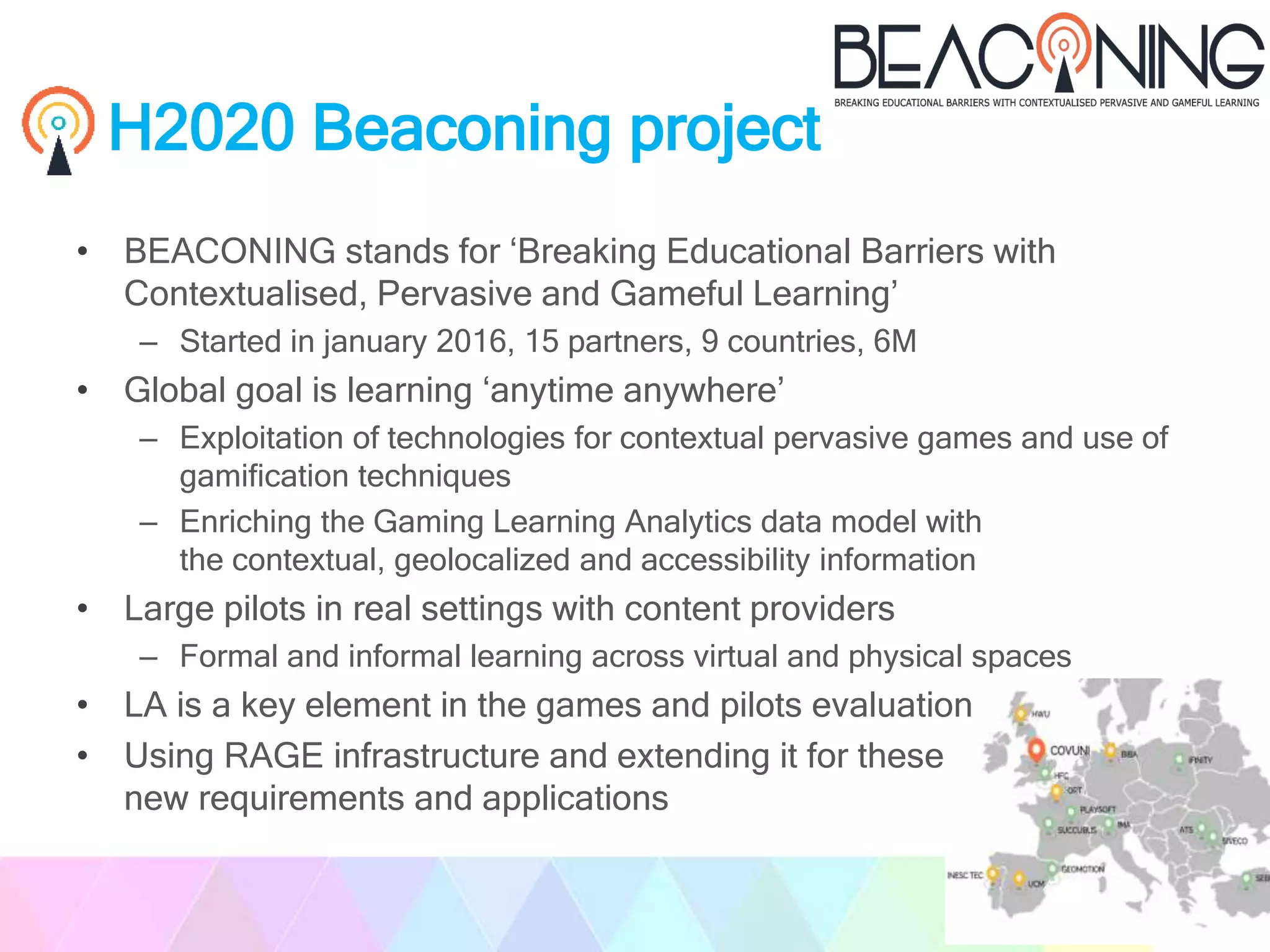
H2020 Beaconing project
• BEACONING stands for ‘Breaking Educational Barriers with
Contextualised, Pervasive and Gameful Learning’
– Started in january 2016, 15 partners, 9 countries, 6M
• Global goal is learning ‘anytime anywhere’
– Exploitation of technologies for contextual pervasive games and use of
gamification techniques
– Enriching the Gaming Learning Analytics data model with
the contextual, geolocalized and accessibility information
• Large pilots in real settings with content providers
– Formal and informal learning across virtual and physical spaces
• LA is a key element in the games and pilots evaluation
• Using RAGE infrastructure and extending it for these
new requirements and applications
Game
Learning Analytics
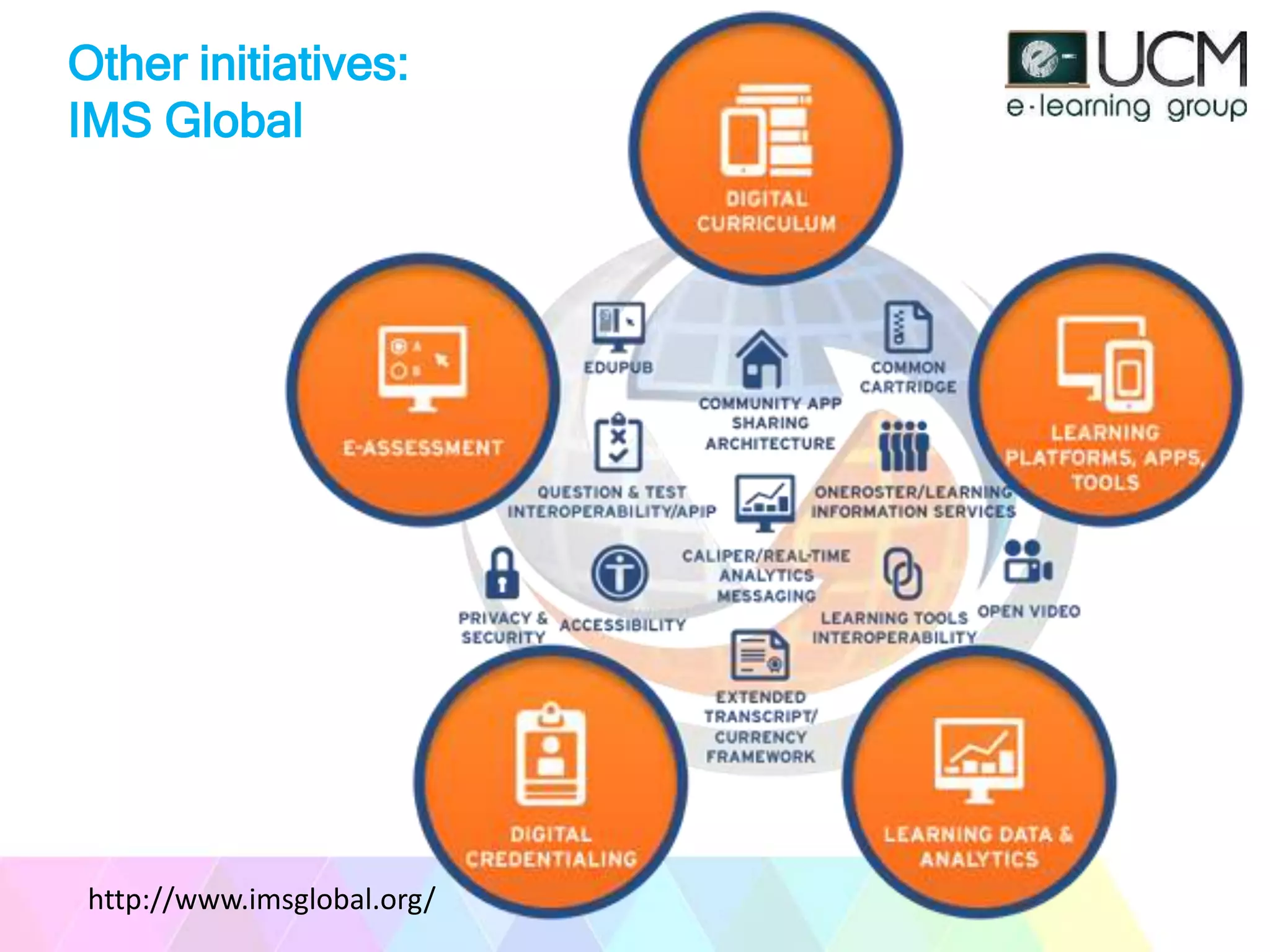
Other initiatives:
IMS Global
http://www.imsglobal.org/
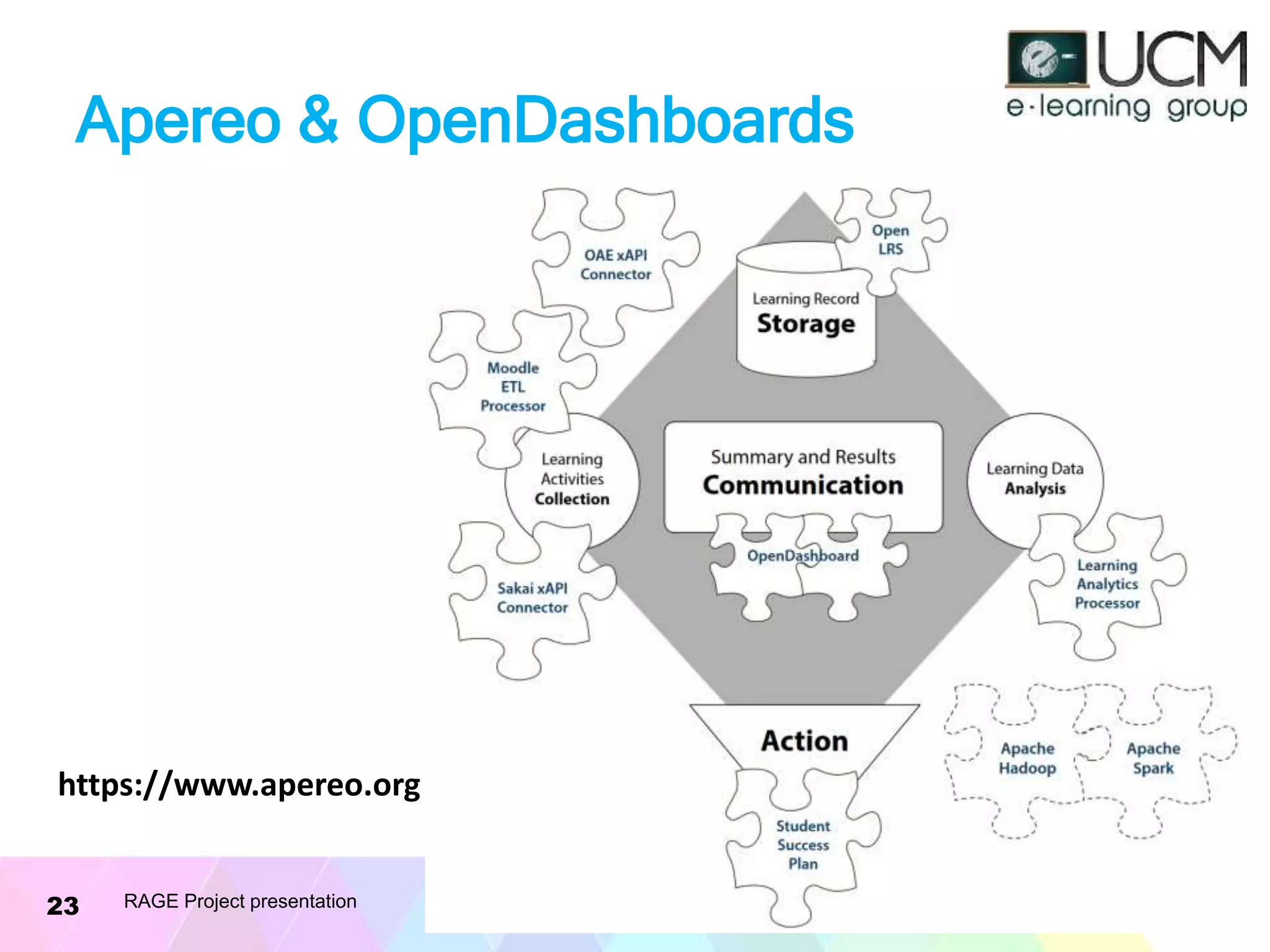
Apereo & OpenDashboards
06/10/2016RAGE Project presentation23
https://www.apereo.org
Testing RAGE Analytics with a
previously existing game
First Aid Game - Proof of concept
Integrated Assets Demo
Game Client Tracker 2.1a,
Server Side interaction storage & analytics 2.1b,
Server Side Authentication & Authorization 2.4a,
Server Side Dashboard & Analytics
06/10/2016RAGE Project presentation24
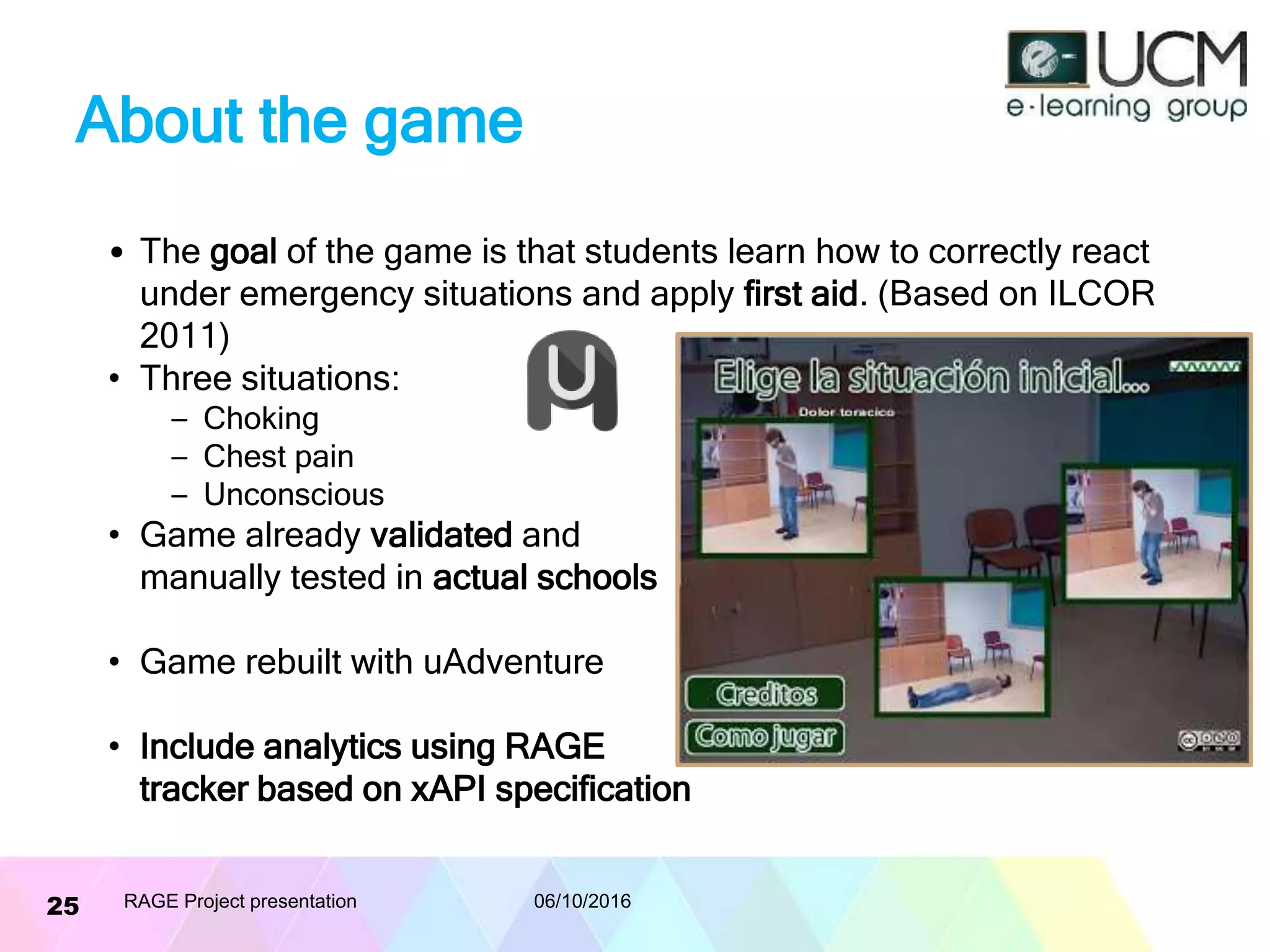
About the game
• The goal of the game is that students learn how to correctly react
under emergency situations and apply first aid. (Based on ILCOR
2011)
• Three situations:
– Choking
– Chest pain
– Unconscious
• Game already validated and
manually tested in actual schools
• Game rebuilt with uAdventure
• Include analytics using RAGE
tracker based on xAPI specification
06/10/2016RAGE Project presentation25
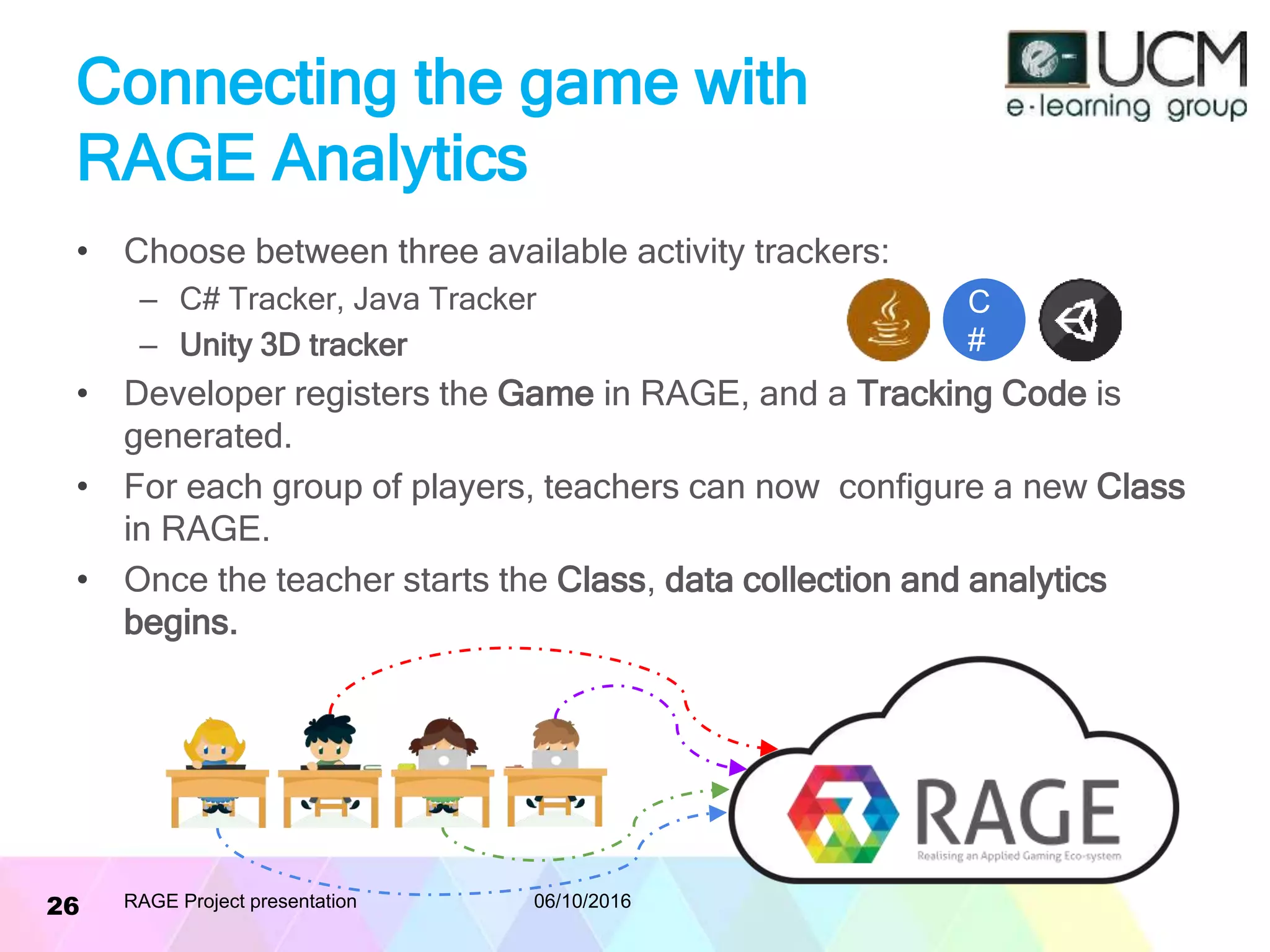
Connecting the game with
RAGE Analytics
• Choose between three available activity trackers:
– C# Tracker, Java Tracker
– Unity 3D tracker
• Developer registers the Game in RAGE, and a Tracking Code is
generated.
• For each group of players, teachers can now configure a new Class
in RAGE.
• Once the teacher starts the Class, data collection and analytics
begins.
06/10/2016RAGE Project presentation26
C
#
Analytics for teachers and
developers
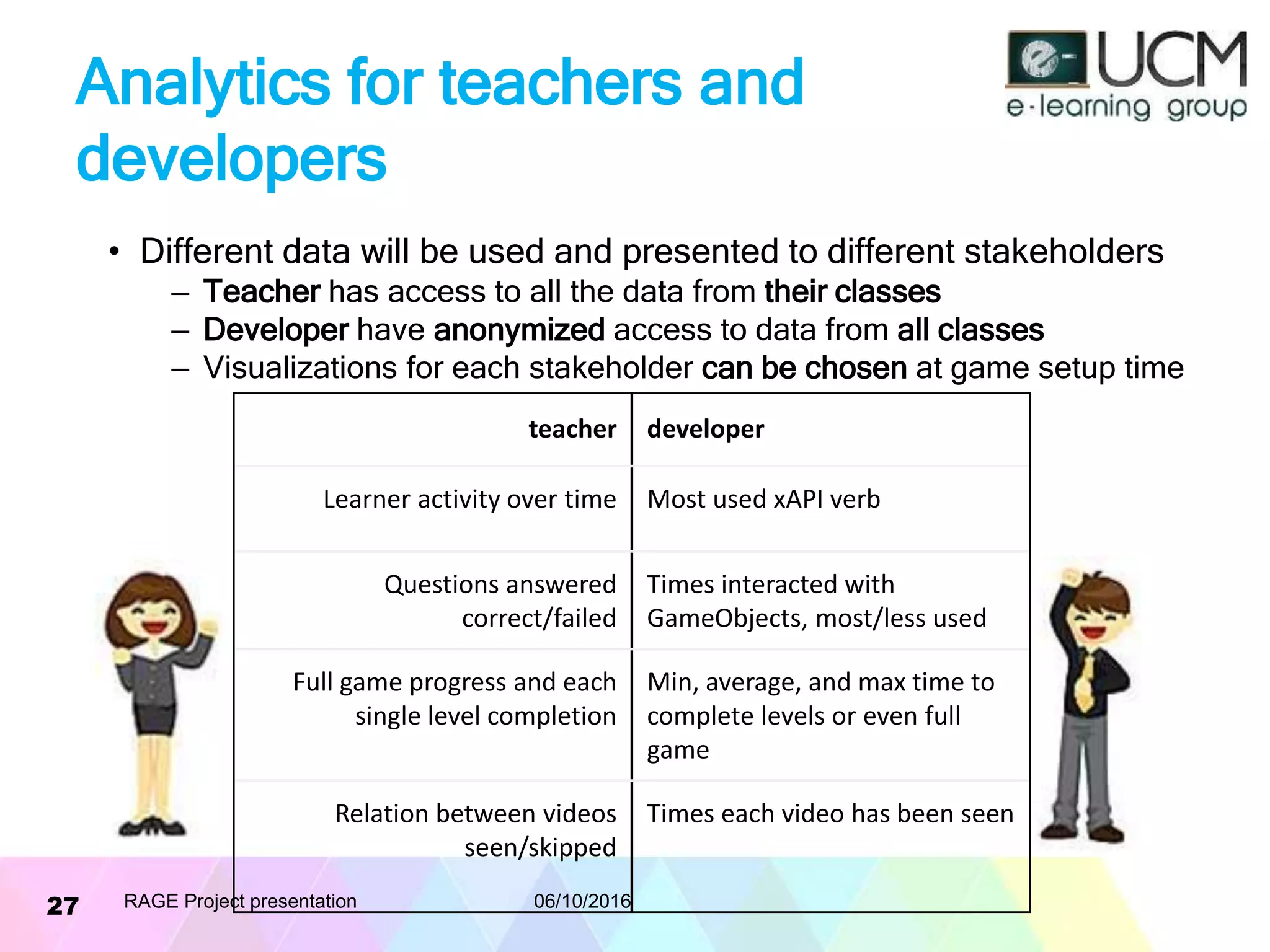
• Different data will be used and presented to different stakeholders
– Teacher has access to all the data from their classes
– Developer have anonymized access to data from all classes
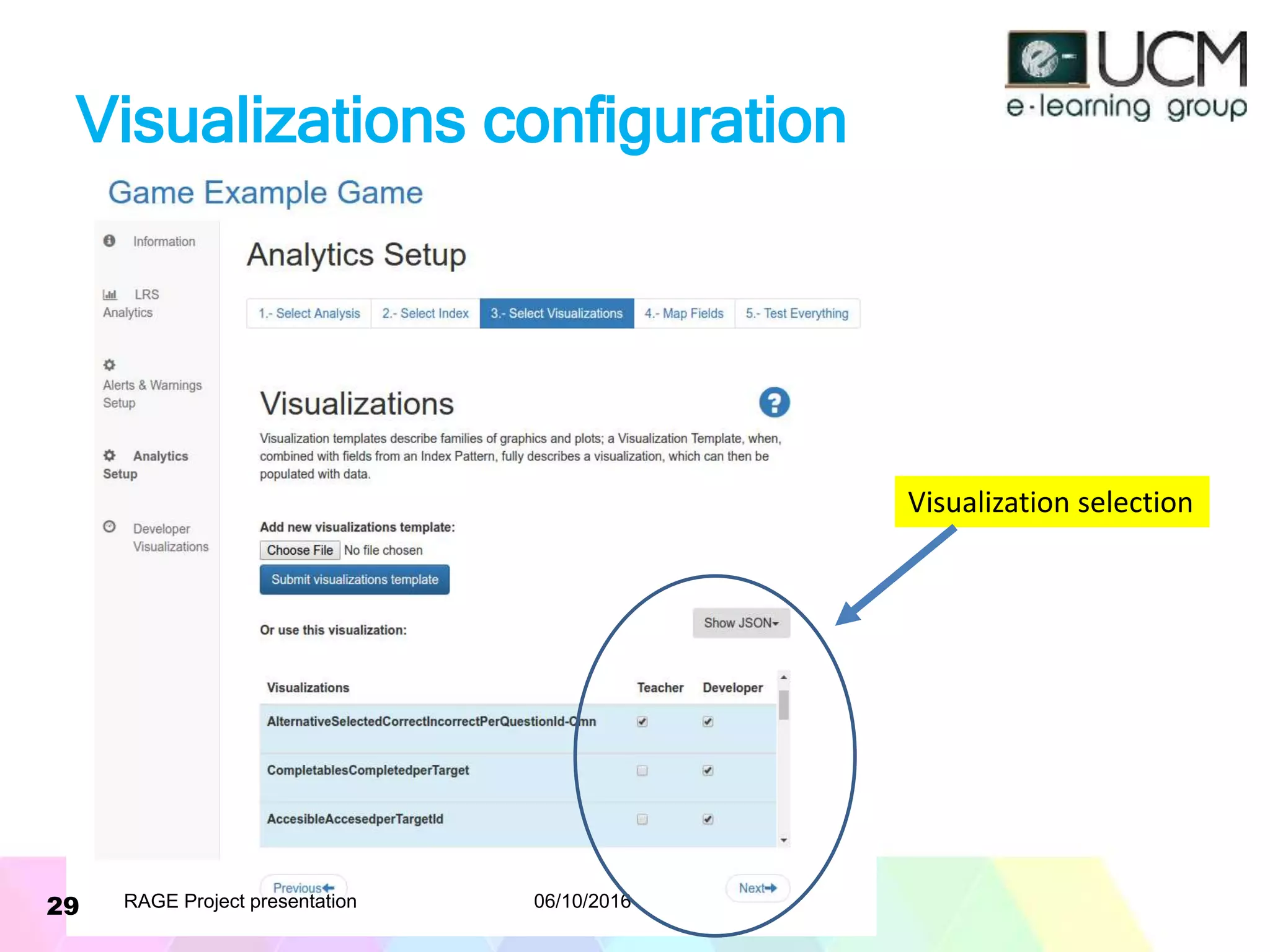
– Visualizations for each stakeholder can be chosen at game setup time
06/10/2016RAGE Project presentation27
teacher developer
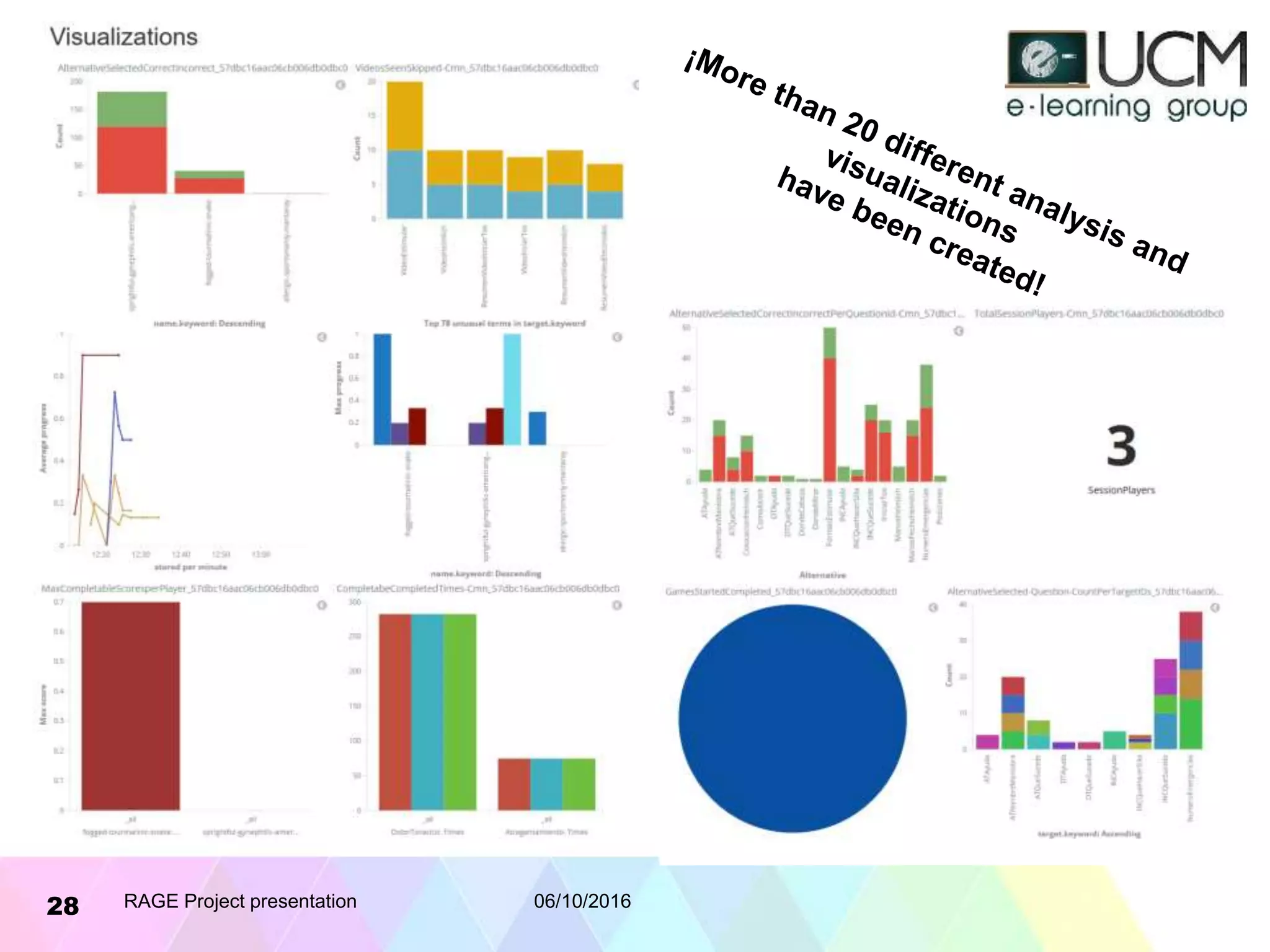
Learner activity over time Most used xAPI verb
Questions answered
correct/failed
Times interacted with
GameObjects, most/less used
Full game progress and each
single level completion
Min, average, and max time to
complete levels or even full
game
Relation between videos
seen/skipped
Times each video has been seen
06/10/2016RAGE Project presentation28
Visualizations configuration
06/10/2016RAGE Project presentation29
Visualization selection
Real-time analytics: Alerts and
Warnings
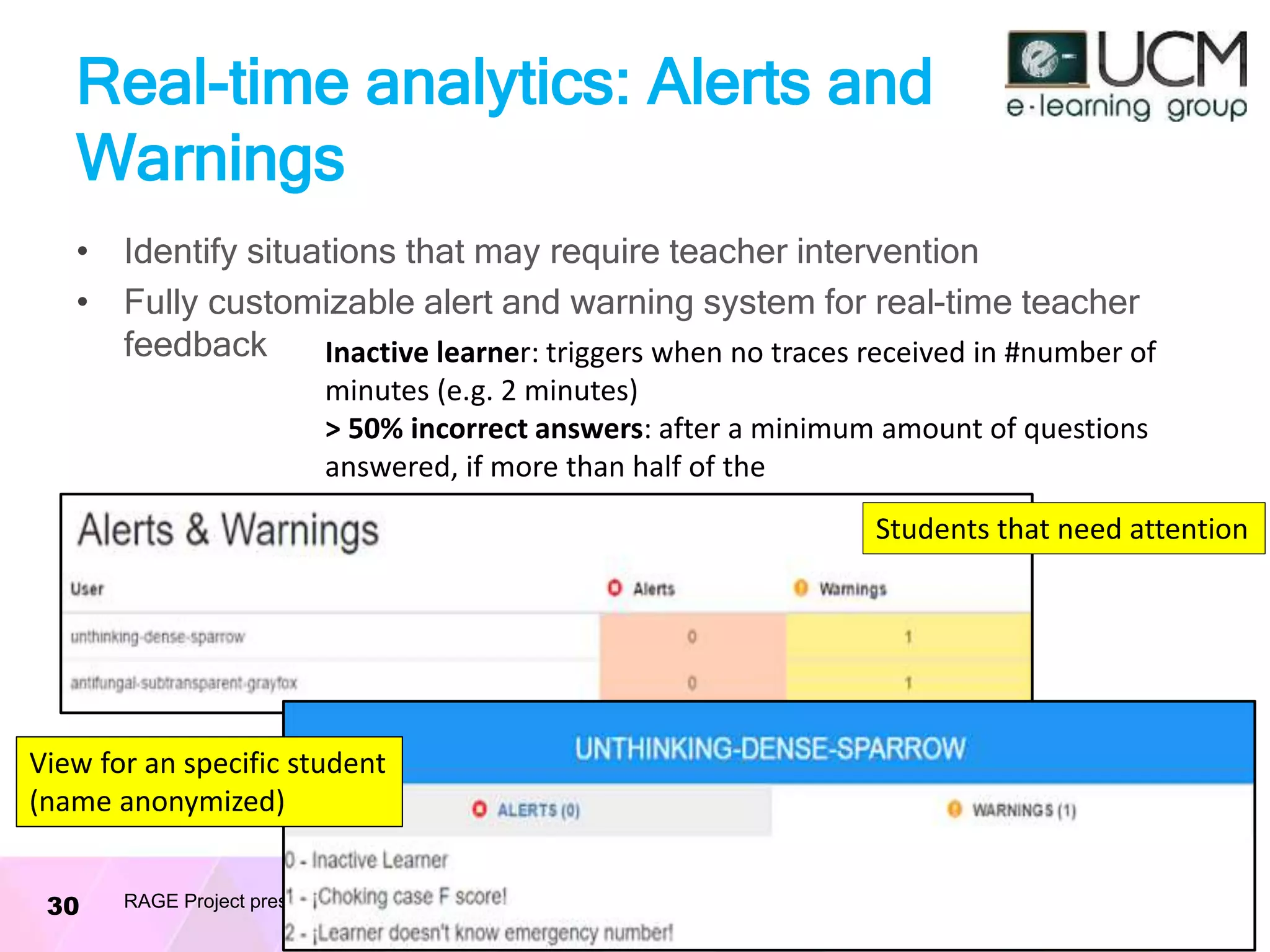
• Identify situations that may require teacher intervention
• Fully customizable alert and warning system for real-time teacher
feedback
06/10/2016RAGE Project presentation30
Inactive learner: triggers when no traces received in #number of
minutes (e.g. 2 minutes)
> 50% incorrect answers: after a minimum amount of questions
answered, if more than half of the
Students that need attention
View for an specific student
(name anonymized)
From RAGE to BEACONING
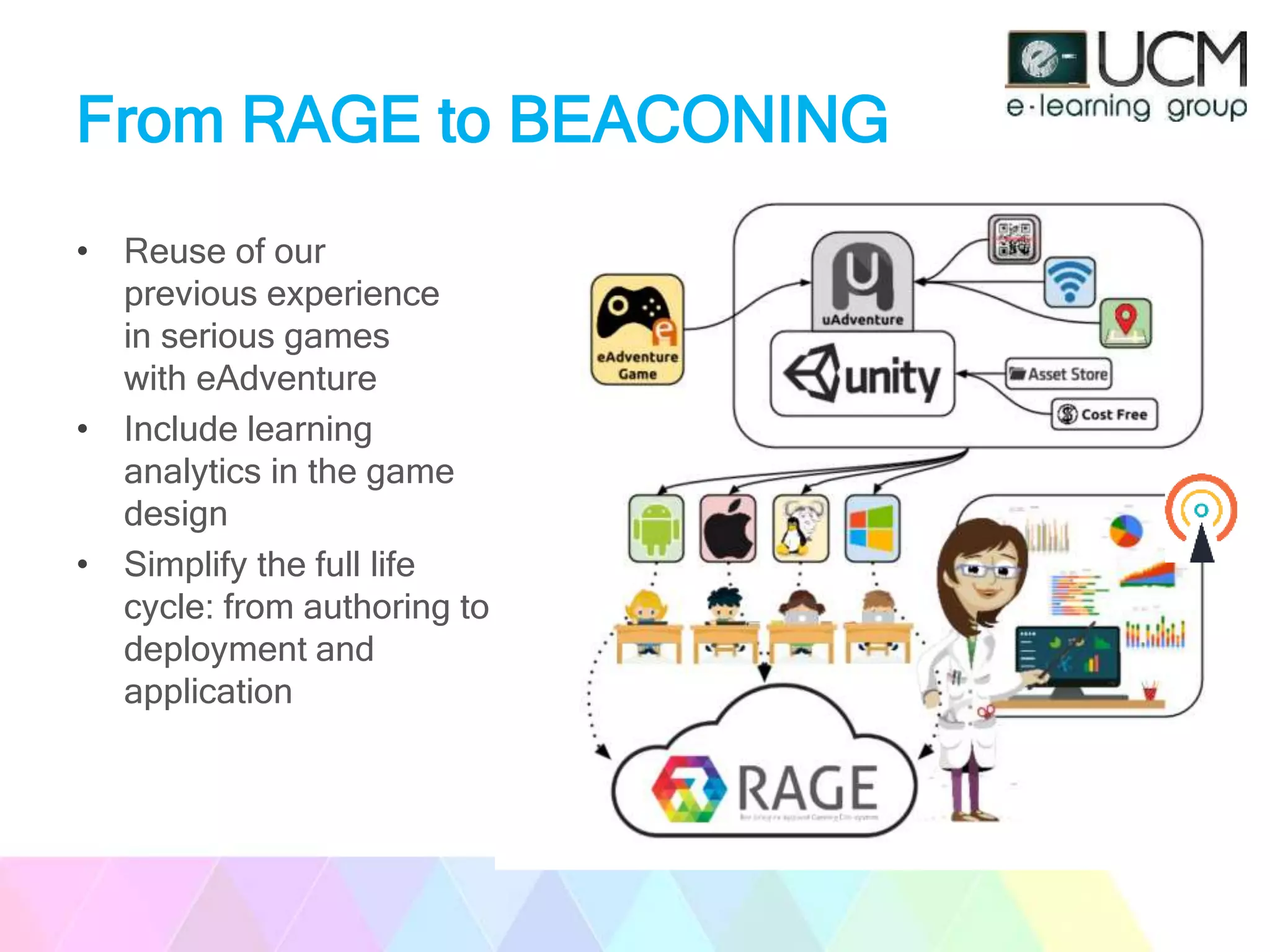
• Reuse of our
previous experience
in serious games
with eAdventure
• Include learning
analytics in the game
design
• Simplify the full life
cycle: from authoring to
deployment and
application
Conclusions
• Game Learning Analytics has a great potential from the
business, application and research perspective
• Still complex to implement GLA in SG
– Increases the (already high) cost of the games
– Requires expertise not always present in SME
• New standards specifications and open software
development could greatly simplify GLA implementation
and adoption
32
Thank you!
33
REFERENCES
• Manuel Freire, Ángel Serrano-Laguna, Borja Manero, Iván Martínez-Ortiz, Pablo
Moreno-Ger, Baltasar Fernández-Manjón (2016): Game Learning Analytics: Learning
Analytics for Serious Games. In Learning, Design, and Technology (pp. 1–29). Cham:
Springer International Publishing. http://doi.org/10.1007/978-3-319-17727-4_21-1.
• Ángel Serrano-Laguna, Iván Martínez-Ortiz, Jason Haag, Damon Regan, Andy Johnson,
Baltasar Fernández-Manjón (2016): Applying standards to systematize learning
analytics in serious games. Computer Standards & Interfaces (in press)
http://dx.doi.org/10.1016/j.csi.2016.09.014.

Gaming Learning Analytics Contributing to the serious games ecosystem

  • 1.
    Gaming Learning Analytics: Contributingto the Serious Games Ecosystem European Conference in Game-Based Learning (ECGBL 2016), Paisley, Scotland, UK Baltasar Fernandez-Manjon, balta@fdi.ucm.es , @BaltaFM e-UCM research group, www.e-ucm.es http://www.slideshare.net/BaltasarFernandezManjon Realising an Applied Gaming Eco-System Cátedra Telefónica-Complutense Educación Digital y Juegos Serios
  • 2.
    Serious Games Market SamS. Adkins. (2015). The 2014-2019 Global Edugame Market. Ambient Insight, LLC.
  • 3.
  • 5.
  • 6.
  • 7.
  • 8.
    Game Learning Analytics •Learning Analytics Improving education based on data analysis – Data driven – Evidence-based education • Gaming Learning Analytics is a specific case when all interaction data is used in serious games for improving the learning process supported by the games – Educational games not as “black boxes” – In games is called Telemetry or Game metrics • GLA allows for new business models for serious games – Serious game as a service 06/10/2016RAGE Project presentation8 Manuel Freire, Ángel Serrano-Laguna, Borja Manero, Iván Martínez-Ortiz, Pablo Moreno-Ger, Baltasar Fernández- Manjón (2016): Game Learning Analytics: Learning Analytics for Serious Games. In Learning, Design, and Technology (pp. 1–29). Cham: Springer International Publishing. http://doi.org/10.1007/978-3-319-17727-4_21-1.
  • 9.
    Uses of GamingLearning Analytics in educational games • Game testing – game analytics – It is the game realiable? – How many students finish the game? – Average time to complete the game? • Game deployment in the class – tools for teachers – Real-time information for supporting the teacher – Knowing what is happening when the game is deployed in the class – “Stealth” student evaluation • Formal Game evaluation – From pre-post test to evaluation based on game learning analytics??
  • 10.
    It is GLAfeasible for a SME? • Game Learning Analytics imposes new requirement on already struggling Game developers – Not many of the SME that develop games are collecting and exploiting learning analytics data – GLA requires different technology and expertise – When done it is very “game dependent” 06/10/2016RAGE Project presentation10 But there are new specifications and developments that could systematize the work
  • 11.
    H2020 RAGE project •RAGE will deliver advanced technology and know- how to support the European Applied Games industry build-up and job creation – February 2015, 4 years, 19 partners, 9M • Creating a new serious games ecosystem by making available a set of reusable technology components for developing advance serious games easier, faster and more cost-effectively • Open source gaming learning analytics framework – provide all the required services (e.g. game tracker, learning analytics server, visualization of analytics information) – easy inclusion of gaming learning analytics techniques in the new games Realising an Applied Gaming Eco-System
  • 12.
    User Data AnalyticsOutline • Collecting and assessing game-based user data – the collection and aggregation of data – the interpretation of the data to support further intervention • Solid data protection and authentication procedures – Data anonymization when possible • Generalization of the approach – Applicable to different kind of games • Use of standards 06/10/2016RAGE Project presentation12
  • 13.
    User Data AnalyticsApproach 06/10/2016RAGE Project presentation13
  • 14.
    Collecting data: xAPIapplication profile for serious games with ADL • We can collect the relevant data in a standard format using xAPI • Creation of an xAPI serious games profile with ADL • This will simplify the analysis and visualization of data (e.g. dashboards) xAPI Ángel Serrano-Laguna, Iván Martínez-Ortiz, Jason Haag, Damon Regan, Andy Johnson, Baltasar Fernández- Manjón (2016): Applying standards to systematize learning analytics in serious games. Computer Standards & Interfaces (in press) http://dx.doi.org/10.1016/j.csi.2016.09.014.
  • 15.
    xAPI profile forserious games developed with ADL • Definition of a general interaction model for appliying Game Learning Analytics with serious games – Completion (A level/stage/puzzle or completion percentage) – In-game choices (player selections in the game) – Meaningful variables (i.e. Score, Coins …) – Meaningful actions (i.e. ask for help, …) – Custom interactions (Game-specific interactions) • Definition of an xAPI application profile for serious games – implementation of our general model in xAPI 06/10/2016RAGE Project presentation15
  • 16.
    Countrix: Demo QuizGame • Available at Google play 06/10/2016RAGE Project presentation16
  • 17.
  • 18.
  • 19.
    Client A2 Applications Games Analytics Frontend A2 Frontend PlayersDevs,Students, Teachers. Admins Users Roles Resources Permissions Applications Authentication Authorization JWT JSON WEB TOKEN Topology AnalyticsBackend Games Sessions Collector Results Application 1 Application N KafkaQueue Games Sessions Results Visualization Architecture and technologies
  • 20.
    H2020 Beaconing project •BEACONING stands for ‘Breaking Educational Barriers with Contextualised, Pervasive and Gameful Learning’ – Started in january 2016, 15 partners, 9 countries, 6M • Global goal is learning ‘anytime anywhere’ – Exploitation of technologies for contextual pervasive games and use of gamification techniques – Enriching the Gaming Learning Analytics data model with the contextual, geolocalized and accessibility information • Large pilots in real settings with content providers – Formal and informal learning across virtual and physical spaces • LA is a key element in the games and pilots evaluation • Using RAGE infrastructure and extending it for these new requirements and applications
  • 21.
  • 22.
  • 23.
    Apereo & OpenDashboards 06/10/2016RAGEProject presentation23 https://www.apereo.org
  • 24.
    Testing RAGE Analyticswith a previously existing game First Aid Game - Proof of concept Integrated Assets Demo Game Client Tracker 2.1a, Server Side interaction storage & analytics 2.1b, Server Side Authentication & Authorization 2.4a, Server Side Dashboard & Analytics 06/10/2016RAGE Project presentation24
  • 25.
    About the game •The goal of the game is that students learn how to correctly react under emergency situations and apply first aid. (Based on ILCOR 2011) • Three situations: – Choking – Chest pain – Unconscious • Game already validated and manually tested in actual schools • Game rebuilt with uAdventure • Include analytics using RAGE tracker based on xAPI specification 06/10/2016RAGE Project presentation25
  • 26.
    Connecting the gamewith RAGE Analytics • Choose between three available activity trackers: – C# Tracker, Java Tracker – Unity 3D tracker • Developer registers the Game in RAGE, and a Tracking Code is generated. • For each group of players, teachers can now configure a new Class in RAGE. • Once the teacher starts the Class, data collection and analytics begins. 06/10/2016RAGE Project presentation26 C #
  • 27.
    Analytics for teachersand developers • Different data will be used and presented to different stakeholders – Teacher has access to all the data from their classes – Developer have anonymized access to data from all classes – Visualizations for each stakeholder can be chosen at game setup time 06/10/2016RAGE Project presentation27 teacher developer Learner activity over time Most used xAPI verb Questions answered correct/failed Times interacted with GameObjects, most/less used Full game progress and each single level completion Min, average, and max time to complete levels or even full game Relation between videos seen/skipped Times each video has been seen
  • 28.
  • 29.
    Visualizations configuration 06/10/2016RAGE Projectpresentation29 Visualization selection
  • 30.
    Real-time analytics: Alertsand Warnings • Identify situations that may require teacher intervention • Fully customizable alert and warning system for real-time teacher feedback 06/10/2016RAGE Project presentation30 Inactive learner: triggers when no traces received in #number of minutes (e.g. 2 minutes) > 50% incorrect answers: after a minimum amount of questions answered, if more than half of the Students that need attention View for an specific student (name anonymized)
  • 31.
    From RAGE toBEACONING • Reuse of our previous experience in serious games with eAdventure • Include learning analytics in the game design • Simplify the full life cycle: from authoring to deployment and application
  • 32.
    Conclusions • Game LearningAnalytics has a great potential from the business, application and research perspective • Still complex to implement GLA in SG – Increases the (already high) cost of the games – Requires expertise not always present in SME • New standards specifications and open software development could greatly simplify GLA implementation and adoption 32
  • 33.
    Thank you! 33 REFERENCES • ManuelFreire, Ángel Serrano-Laguna, Borja Manero, Iván Martínez-Ortiz, Pablo Moreno-Ger, Baltasar Fernández-Manjón (2016): Game Learning Analytics: Learning Analytics for Serious Games. In Learning, Design, and Technology (pp. 1–29). Cham: Springer International Publishing. http://doi.org/10.1007/978-3-319-17727-4_21-1. • Ángel Serrano-Laguna, Iván Martínez-Ortiz, Jason Haag, Damon Regan, Andy Johnson, Baltasar Fernández-Manjón (2016): Applying standards to systematize learning analytics in serious games. Computer Standards & Interfaces (in press) http://dx.doi.org/10.1016/j.csi.2016.09.014.