Improving serious games analyzing
learning analytics data:
lessons learned
Cristina Alonso-Fernández, Iván Pérez-Colado, Manuel Freire Morán,
Iván Martínez-Ortiz and Baltasar Fernández-Manjón
Games and Alliance Conference (GALA Conf)
December 7th 2018, Palermo, Italy
Introduction
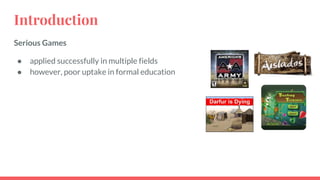
Serious Games
● applied successfully in multiple fields
● however, poor uptake in formal education
Introduction
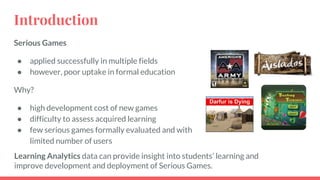
Serious Games
● applied successfully in multiple fields
● however, poor uptake in formal education
Why?
● high development cost of new games
● difficulty to assess acquired learning
● few serious games formally evaluated and with
limited number of users
Learning Analytics data can provide insight into students’ learning and
improve development and deployment of Serious Games.
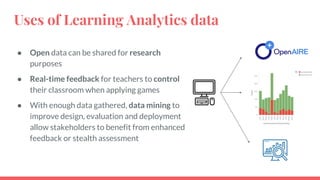
Uses of Learning Analytics data
● Open data can be shared for research
purposes
● Real-time feedback for teachers to control
their classroom when applying games
● With enough data gathered, data mining to
improve design, evaluation and deployment
allow stakeholders to benefit from enhanced
feedback or stealth assessment
In-game user interaction data
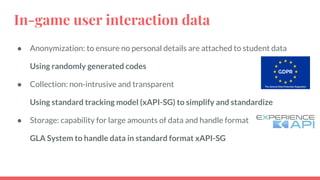
● Anonymization: to ensure no personal details are attached to student data
● Collection: non-intrusive and transparent
● Storage: capability for large amounts of data and handle format
In-game user interaction data
● Anonymization: to ensure no personal details are attached to student data
Using randomly generated codes
● Collection: non-intrusive and transparent
Using standard tracking model (xAPI-SG) to simplify and standardize
● Storage: capability for large amounts of data and handle format
GLA System to handle data in standard format xAPI-SG
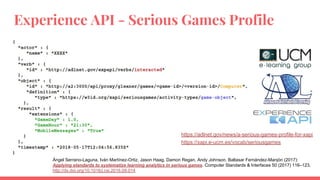
Experience API - Serious Games Profile
https://adlnet.gov/news/a-serious-games-profile-for-xapi
https://xapi.e-ucm.es/vocab/seriousgames
Ángel Serrano-Laguna, Iván Martínez-Ortiz, Jason Haag, Damon Regan, Andy Johnson, Baltasar Fernández-Manjón (2017):
Applying standards to systematize learning analytics in serious games. Computer Standards & Interfaces 50 (2017) 116–123,
http://dx.doi.org/10.1016/j.csi.2016.09.014
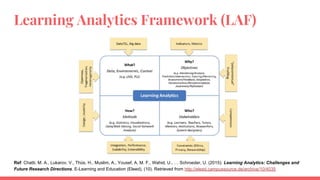
Learning Analytics Framework (LAF)
Ref: Chatti, M. A., Lukarov, V., Thüs, H., Muslim, A., Yousef, A. M. F., Wahid, U., … Schroeder, U. (2015). Learning Analytics: Challenges and
Future Research Directions. E-Learning and Education (Eleed), (10). Retrieved from http://eleed.campussource.de/archive/10/4035
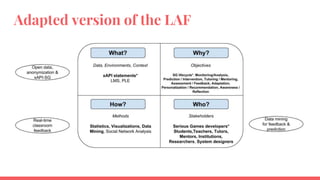
Adapted version of the LAF
Real-time applications: teachers
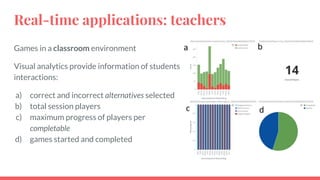
Games in a classroom environment
Visual analytics provide information of students’
interactions:
a) correct and incorrect alternatives selected
b) total session players
c) maximum progress of players per
completable
d) games started and completed
Real-time applications: teachers
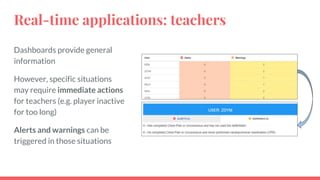
Dashboards provide general
information
However, specific situations
may require immediate actions
for teachers (e.g. player inactive
for too long)
Alerts and warnings can be
triggered in those situations
Real-time applications: students
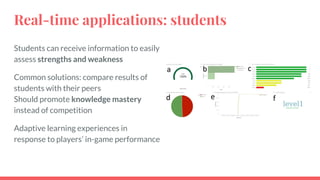
Students can receive information to easily
assess strengths and weakness
Common solutions: compare results of
students with their peers
Should promote knowledge mastery
instead of competition
Adaptive learning experiences in
response to players’ in-game performance
Offline data analysis
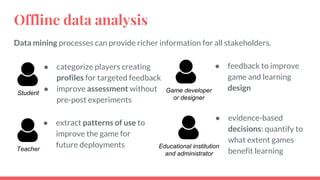
Data mining processes can provide richer information for all stakeholders.
● evidence-based
decisions: quantify to
what extent games
benefit learning
Game developer
or designer
Student
Educational institution
and administrator
● feedback to improve
game and learning
design
● categorize players creating
profiles for targeted feedback
● improve assessment without
pre-post experiments
● extract patterns of use to
improve the game for
future deploymentsTeacher
Offline data analysis
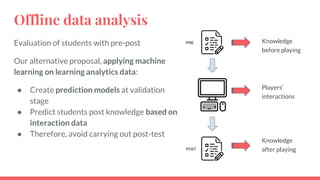
Evaluation of students with pre-post
Our alternative proposal, applying machine
learning on learning analytics data:
● Create prediction models at validation
stage
● Predict students post knowledge based on
interaction data
● Therefore, avoid carrying out post-test
Knowledge
before playing
Players’
interactions
Knowledge
after playing
Conclusions
Great variety of applications of Learning Analytics data to Serious Games:
● Improve all steps of full games lifecycle
● Benefits for all stakeholders involved
Both in real-time scenarios & after enough data has been collected (mining)
Increase and improve adoption of games in schools with a general game LA system
that standardizes data tracking, collection, analysis and visualizations.
Data-driven solutions that use game LA are key to guide the future of SGs.
Improving serious games analyzing
learning analytics data:
lessons learned
Cristina Alonso-Fernández, Iván Pérez-Colado, Manuel Freire Morán,
Iván Martínez-Ortiz and Baltasar Fernández-Manjón
Games and Alliance Conference (GALA Conf)
December 7th 2018, Palermo, Italy
calonsofernandez@ucm.es

Gala Conference 2018 Presentation

  • 1.
    Improving serious gamesanalyzing learning analytics data: lessons learned Cristina Alonso-Fernández, Iván Pérez-Colado, Manuel Freire Morán, Iván Martínez-Ortiz and Baltasar Fernández-Manjón Games and Alliance Conference (GALA Conf) December 7th 2018, Palermo, Italy
  • 2.
    Introduction Serious Games ● appliedsuccessfully in multiple fields ● however, poor uptake in formal education
  • 3.
    Introduction Serious Games ● appliedsuccessfully in multiple fields ● however, poor uptake in formal education Why? ● high development cost of new games ● difficulty to assess acquired learning ● few serious games formally evaluated and with limited number of users Learning Analytics data can provide insight into students’ learning and improve development and deployment of Serious Games.
  • 4.
    Uses of LearningAnalytics data ● Open data can be shared for research purposes ● Real-time feedback for teachers to control their classroom when applying games ● With enough data gathered, data mining to improve design, evaluation and deployment allow stakeholders to benefit from enhanced feedback or stealth assessment
  • 5.
    In-game user interactiondata ● Anonymization: to ensure no personal details are attached to student data ● Collection: non-intrusive and transparent ● Storage: capability for large amounts of data and handle format
  • 6.
    In-game user interactiondata ● Anonymization: to ensure no personal details are attached to student data Using randomly generated codes ● Collection: non-intrusive and transparent Using standard tracking model (xAPI-SG) to simplify and standardize ● Storage: capability for large amounts of data and handle format GLA System to handle data in standard format xAPI-SG
  • 7.
    Experience API -Serious Games Profile https://adlnet.gov/news/a-serious-games-profile-for-xapi https://xapi.e-ucm.es/vocab/seriousgames Ángel Serrano-Laguna, Iván Martínez-Ortiz, Jason Haag, Damon Regan, Andy Johnson, Baltasar Fernández-Manjón (2017): Applying standards to systematize learning analytics in serious games. Computer Standards & Interfaces 50 (2017) 116–123, http://dx.doi.org/10.1016/j.csi.2016.09.014
  • 8.
    Learning Analytics Framework(LAF) Ref: Chatti, M. A., Lukarov, V., Thüs, H., Muslim, A., Yousef, A. M. F., Wahid, U., … Schroeder, U. (2015). Learning Analytics: Challenges and Future Research Directions. E-Learning and Education (Eleed), (10). Retrieved from http://eleed.campussource.de/archive/10/4035
  • 9.
  • 10.
    Real-time applications: teachers Gamesin a classroom environment Visual analytics provide information of students’ interactions: a) correct and incorrect alternatives selected b) total session players c) maximum progress of players per completable d) games started and completed
  • 11.
    Real-time applications: teachers Dashboardsprovide general information However, specific situations may require immediate actions for teachers (e.g. player inactive for too long) Alerts and warnings can be triggered in those situations
  • 12.
    Real-time applications: students Studentscan receive information to easily assess strengths and weakness Common solutions: compare results of students with their peers Should promote knowledge mastery instead of competition Adaptive learning experiences in response to players’ in-game performance
  • 13.
    Offline data analysis Datamining processes can provide richer information for all stakeholders. ● evidence-based decisions: quantify to what extent games benefit learning Game developer or designer Student Educational institution and administrator ● feedback to improve game and learning design ● categorize players creating profiles for targeted feedback ● improve assessment without pre-post experiments ● extract patterns of use to improve the game for future deploymentsTeacher
  • 14.
    Offline data analysis Evaluationof students with pre-post Our alternative proposal, applying machine learning on learning analytics data: ● Create prediction models at validation stage ● Predict students post knowledge based on interaction data ● Therefore, avoid carrying out post-test Knowledge before playing Players’ interactions Knowledge after playing
  • 15.
    Conclusions Great variety ofapplications of Learning Analytics data to Serious Games: ● Improve all steps of full games lifecycle ● Benefits for all stakeholders involved Both in real-time scenarios & after enough data has been collected (mining) Increase and improve adoption of games in schools with a general game LA system that standardizes data tracking, collection, analysis and visualizations. Data-driven solutions that use game LA are key to guide the future of SGs.
  • 16.
    Improving serious gamesanalyzing learning analytics data: lessons learned Cristina Alonso-Fernández, Iván Pérez-Colado, Manuel Freire Morán, Iván Martínez-Ortiz and Baltasar Fernández-Manjón Games and Alliance Conference (GALA Conf) December 7th 2018, Palermo, Italy calonsofernandez@ucm.es