PID
Control
Dheeraj Upadhyay
M.Tech .
Faculty of Engineering
D.E.I, Agra
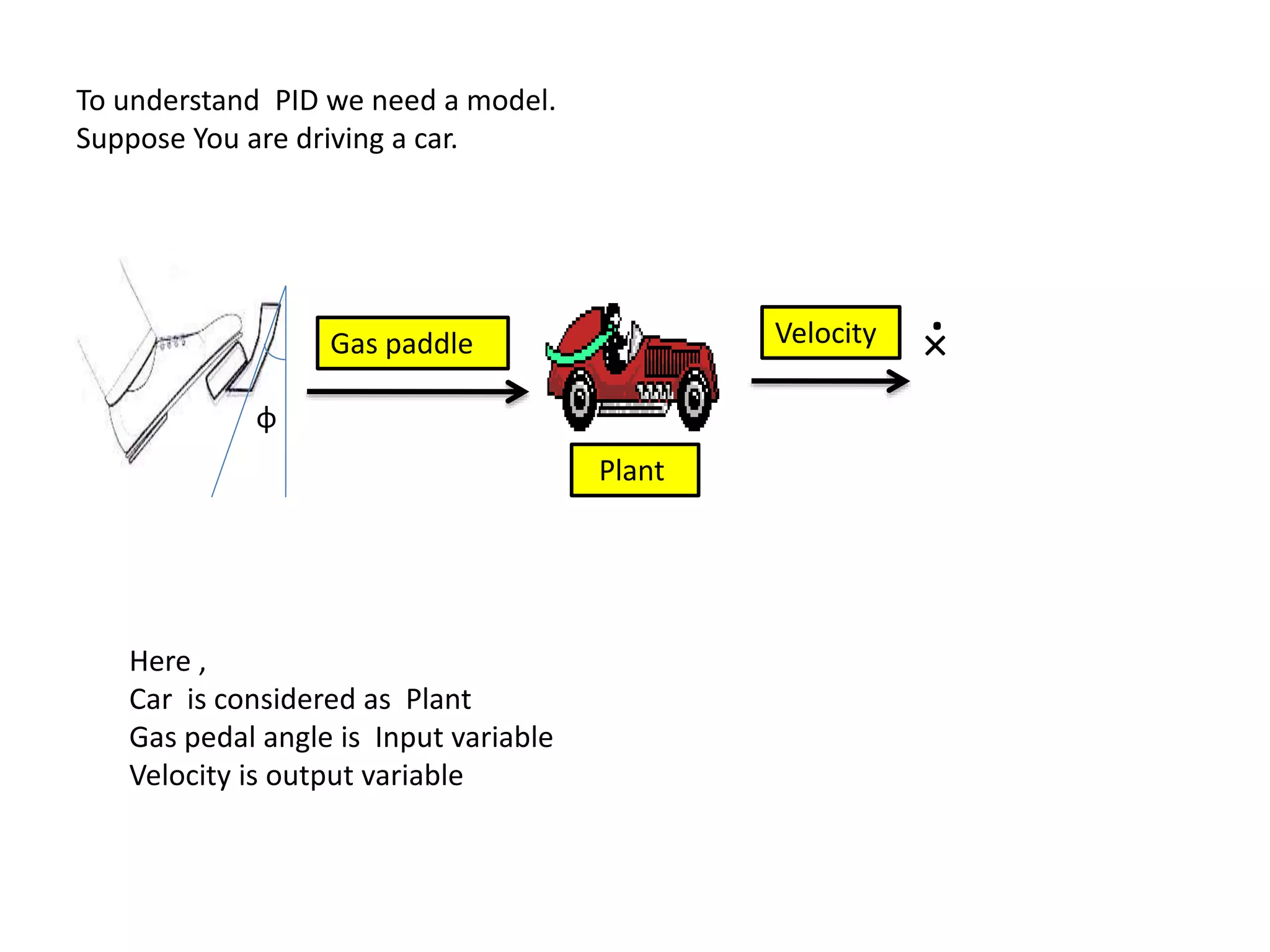
Plant
VelocityGas paddle
ɸ
×
.
Here ,
Car is considered as Plant
Gas pedal angle is Input variable
Velocity is output variable
To understand PID we need a model.
Suppose You are driving a car.
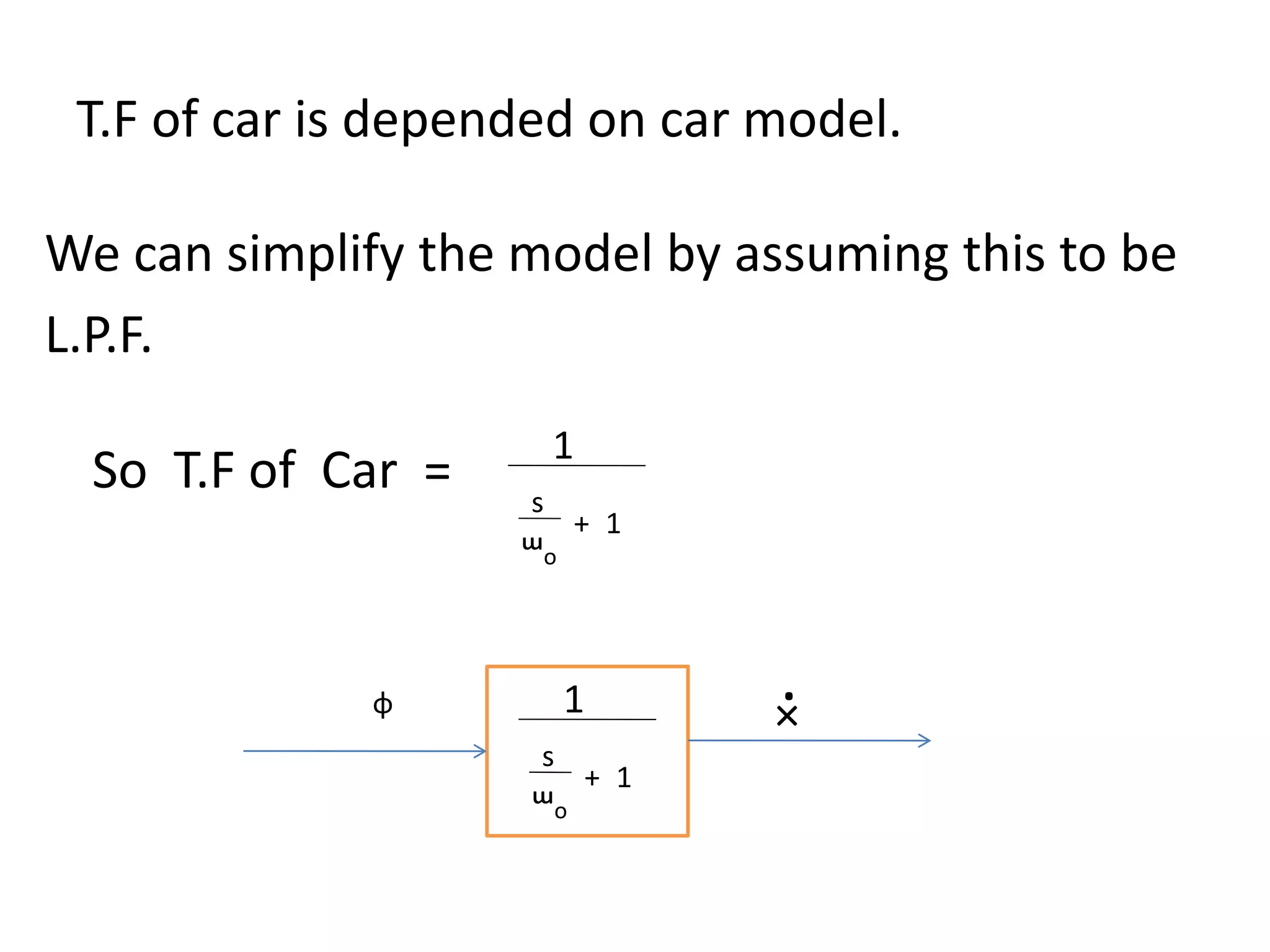
T.F of car is depended on car model.
We can simplify the model by assuming this to be
L.P.F.
So T.F of Car =
1
s
ᵚo
+ 1
1
s
ᵚo
+ 1
ɸ
×
.
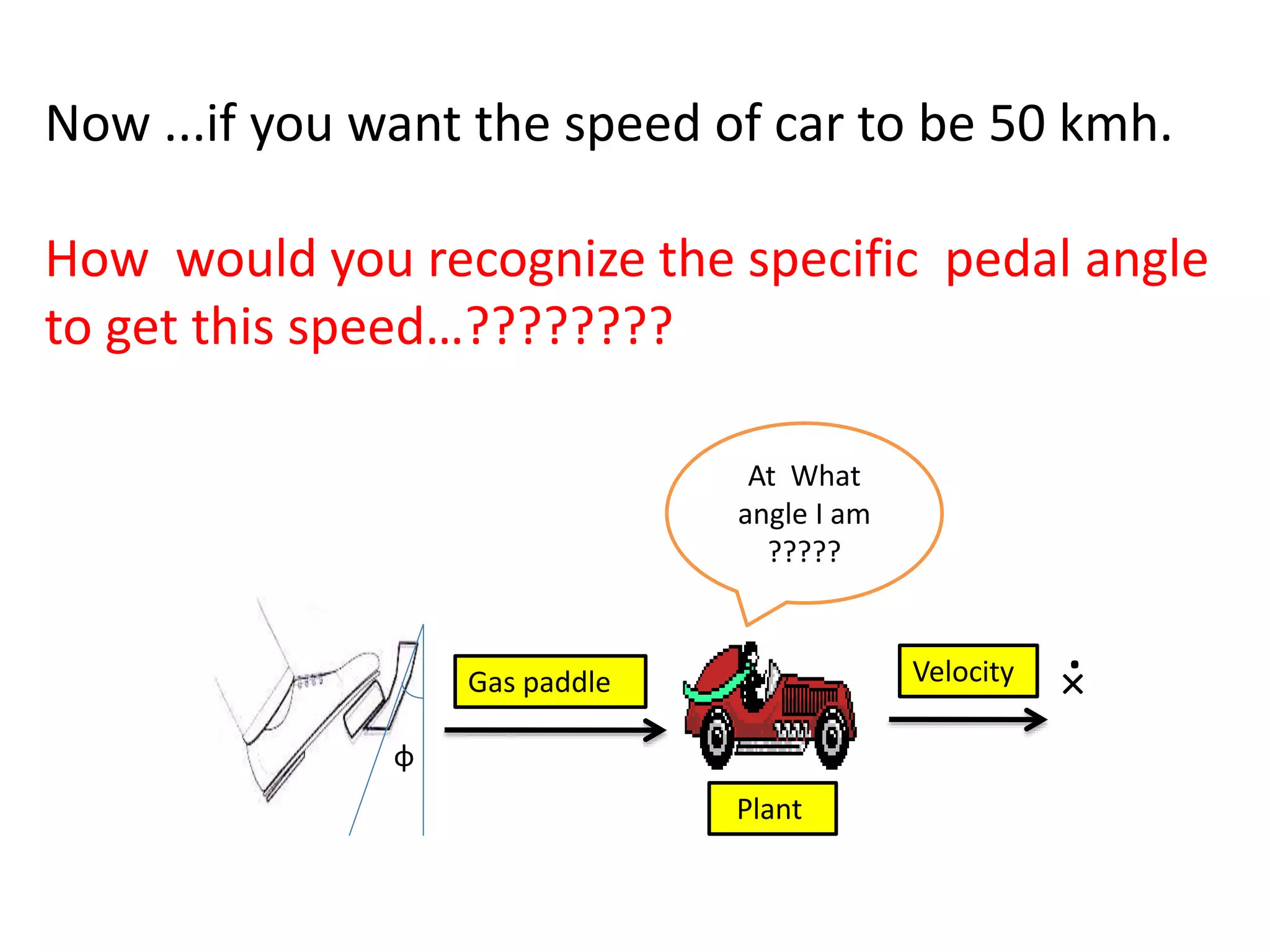
Now ...if you want the speed of car to be 50 kmh.
How would you recognize the specific pedal angle
to get this speed…????????
Plant
VelocityGas paddle
ɸ
×
.
At What
angle I am
?????
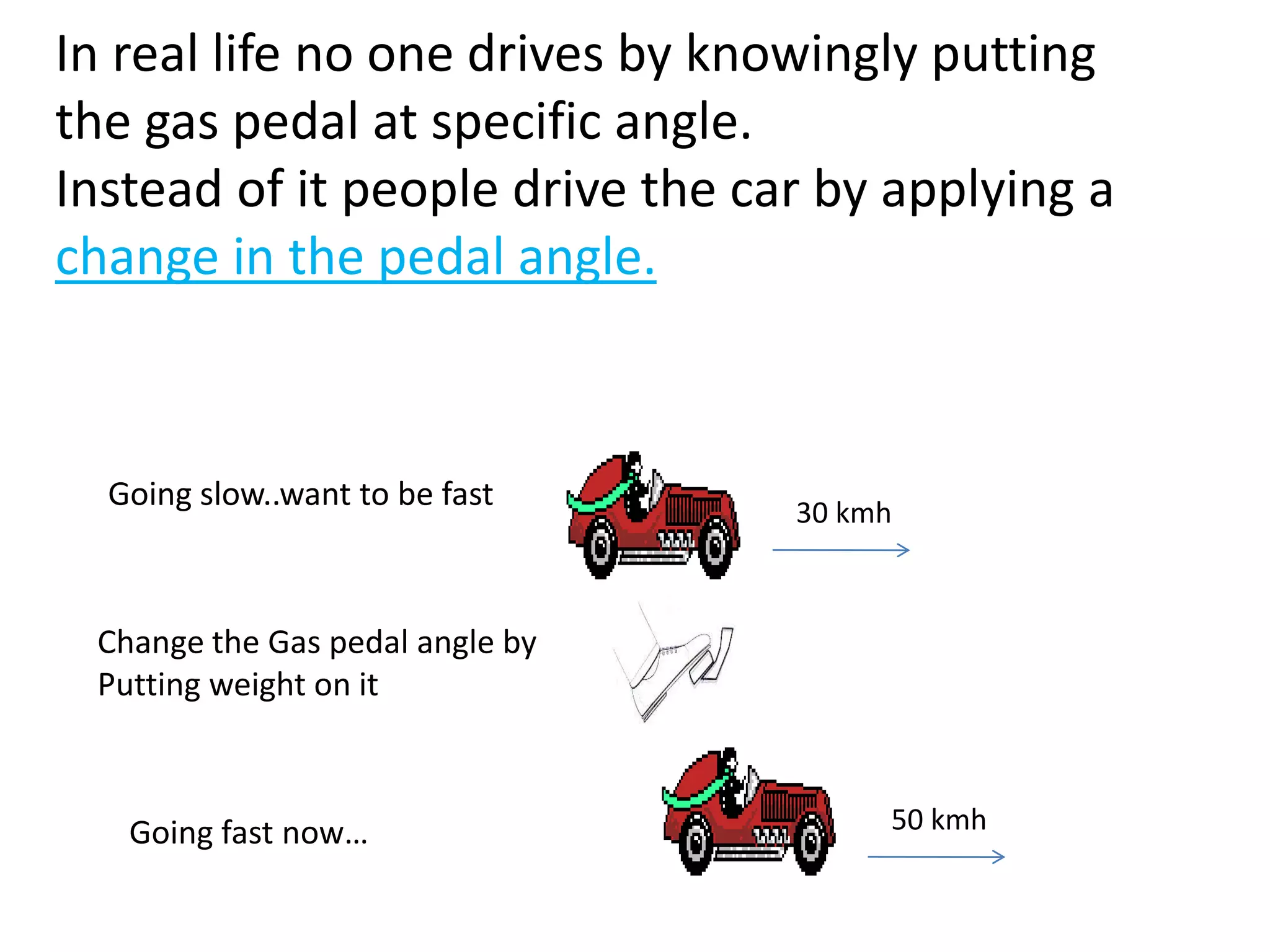
In real life no one drives by knowingly putting
the gas pedal at specific angle.
Instead of it people drive the car by applying a
change in the pedal angle.
30 kmh
Going slow..want to be fast
Change the Gas pedal angle by
Putting weight on it
50 kmhGoing fast now…
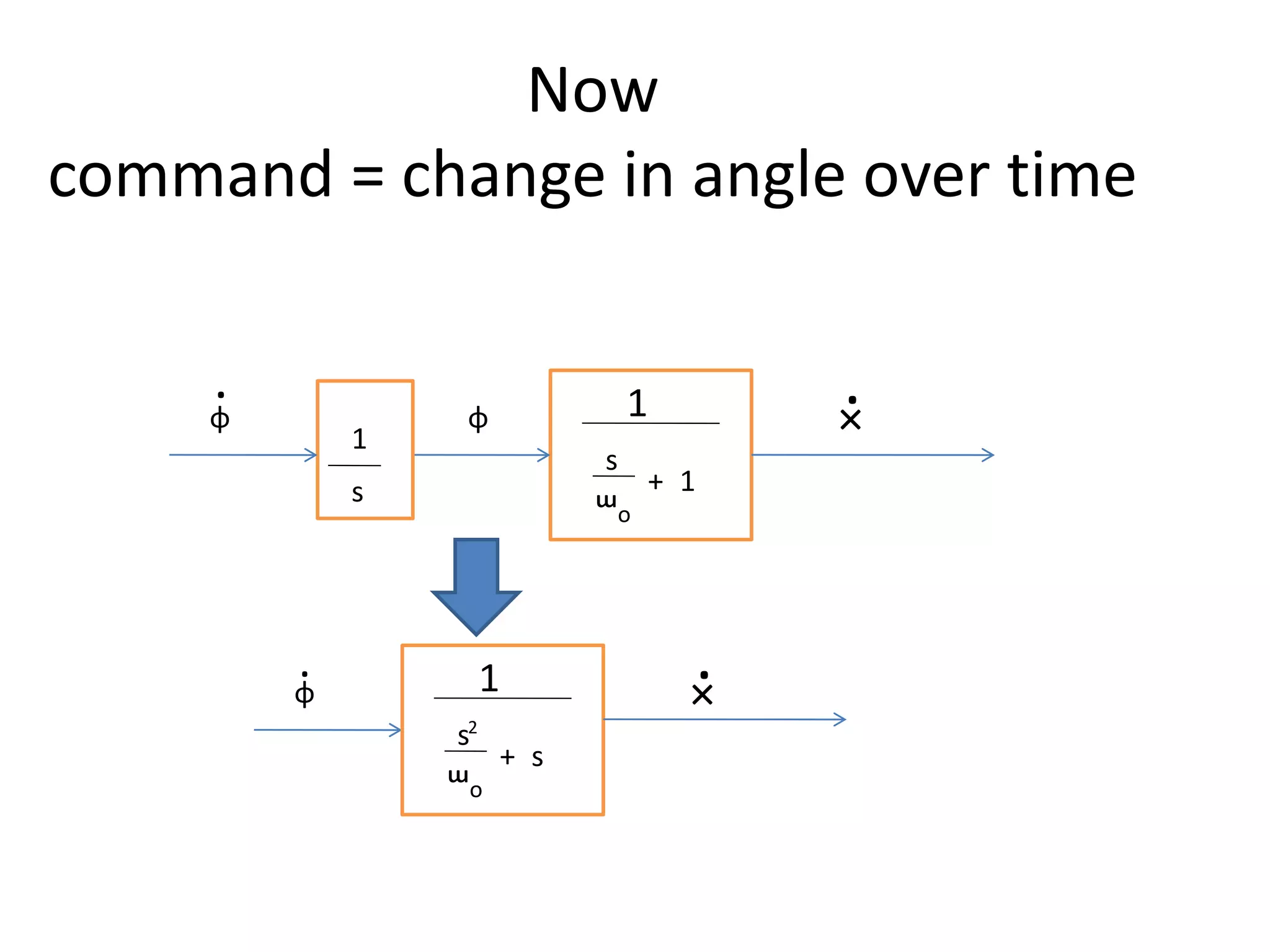
Now
command = change in angle over time
1
s
ᵚo
+ 1
ɸ ×
.
1
s
ɸ
.
ɸ
. 1
s
ᵚo
+ s
×
.
2
.
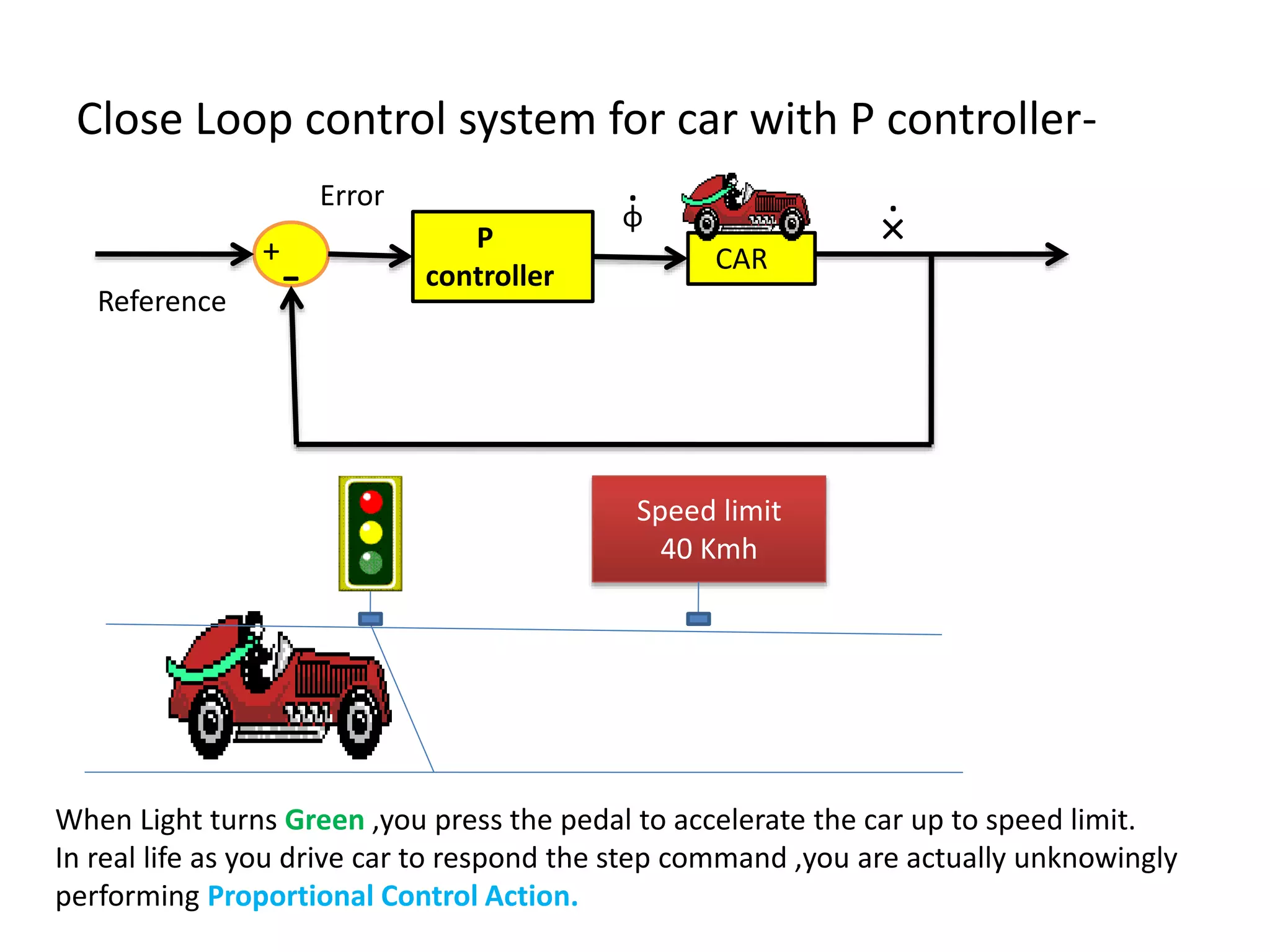
Close Loop control system for car with P controller-
CAR
P
controller-Reference
Error
×ɸ
. .
+
Speed limit
40 Kmh
When Light turns Green ,you press the pedal to accelerate the car up to speed limit.
In real life as you drive car to respond the step command ,you are actually unknowingly
performing Proportional Control Action.
Speed limit
40 Kmh
Velocity
Time
Time
Time
Error
ɸ
.
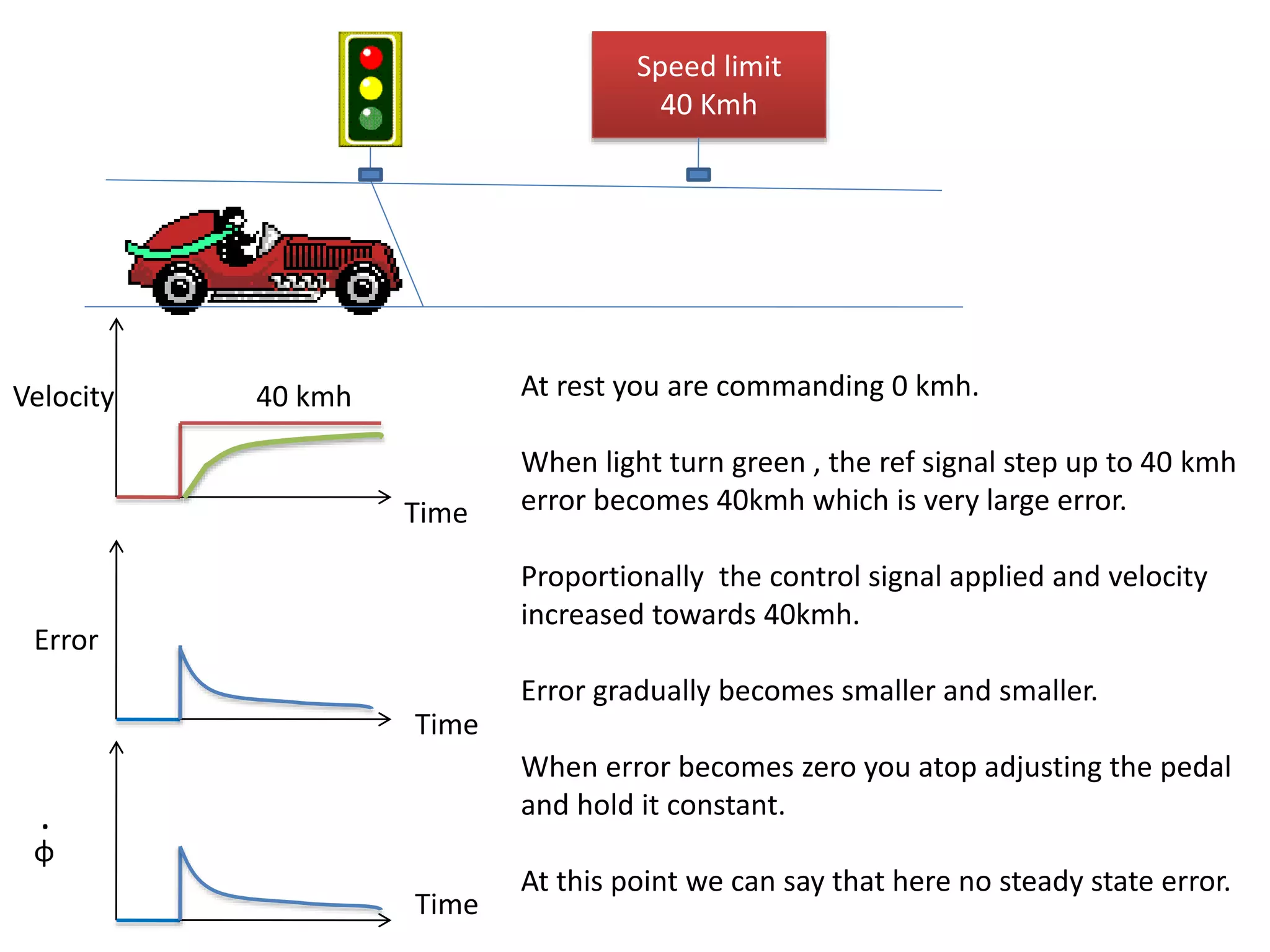
At rest you are commanding 0 kmh.
When light turn green , the ref signal step up to 40 kmh
error becomes 40kmh which is very large error.
Proportionally the control signal applied and velocity
increased towards 40kmh.
Error gradually becomes smaller and smaller.
When error becomes zero you atop adjusting the pedal
and hold it constant.
At this point we can say that here no steady state error.
40 kmh
Velocity
Time
Time
Time
Error
ɸ
.
40 kmh
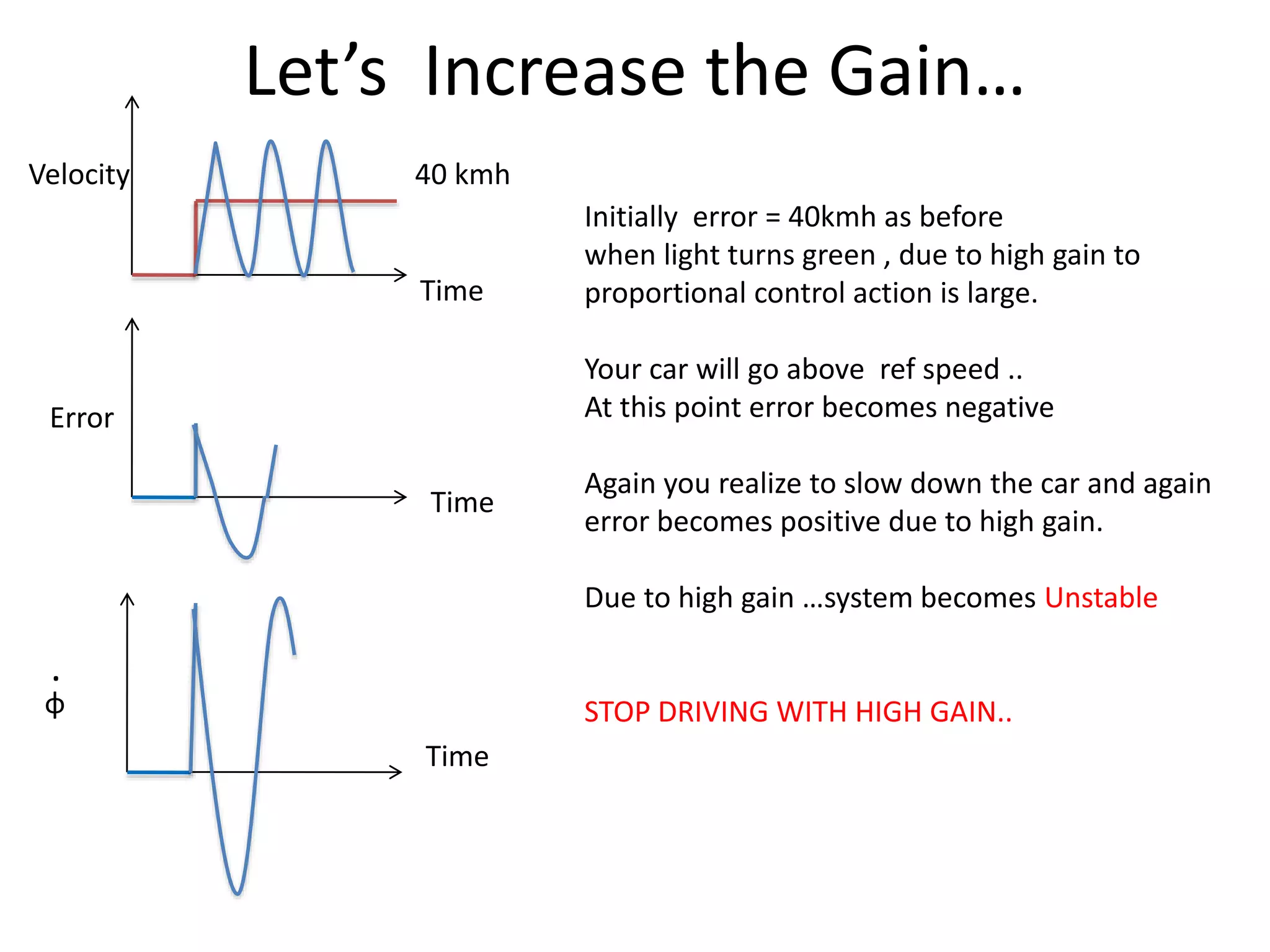
Initially error = 40kmh as before
when light turns green , due to high gain to
proportional control action is large.
Your car will go above ref speed ..
At this point error becomes negative
Again you realize to slow down the car and again
error becomes positive due to high gain.
Due to high gain …system becomes Unstable
STOP DRIVING WITH HIGH GAIN..
Let’s Increase the Gain…
Proportional-only control
Offset
Offset
Process variable
Deviation
Set value
Set value
Deviation
time
time
Low Gain
High gain
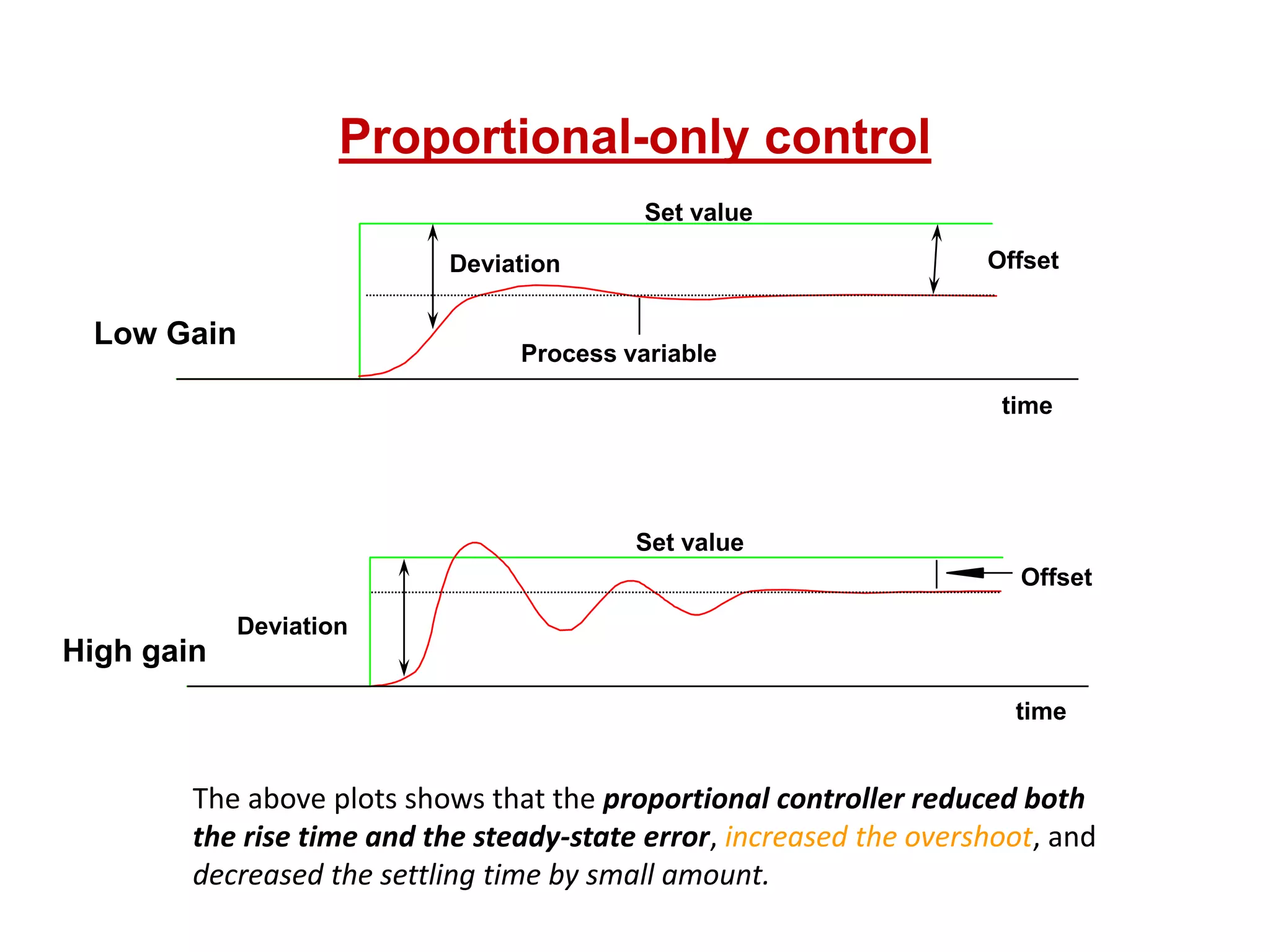
The above plots shows that the proportional controller reduced both
the rise time and the steady-state error, increased the overshoot, and
decreased the settling time by small amount.
Proportional + Derivative
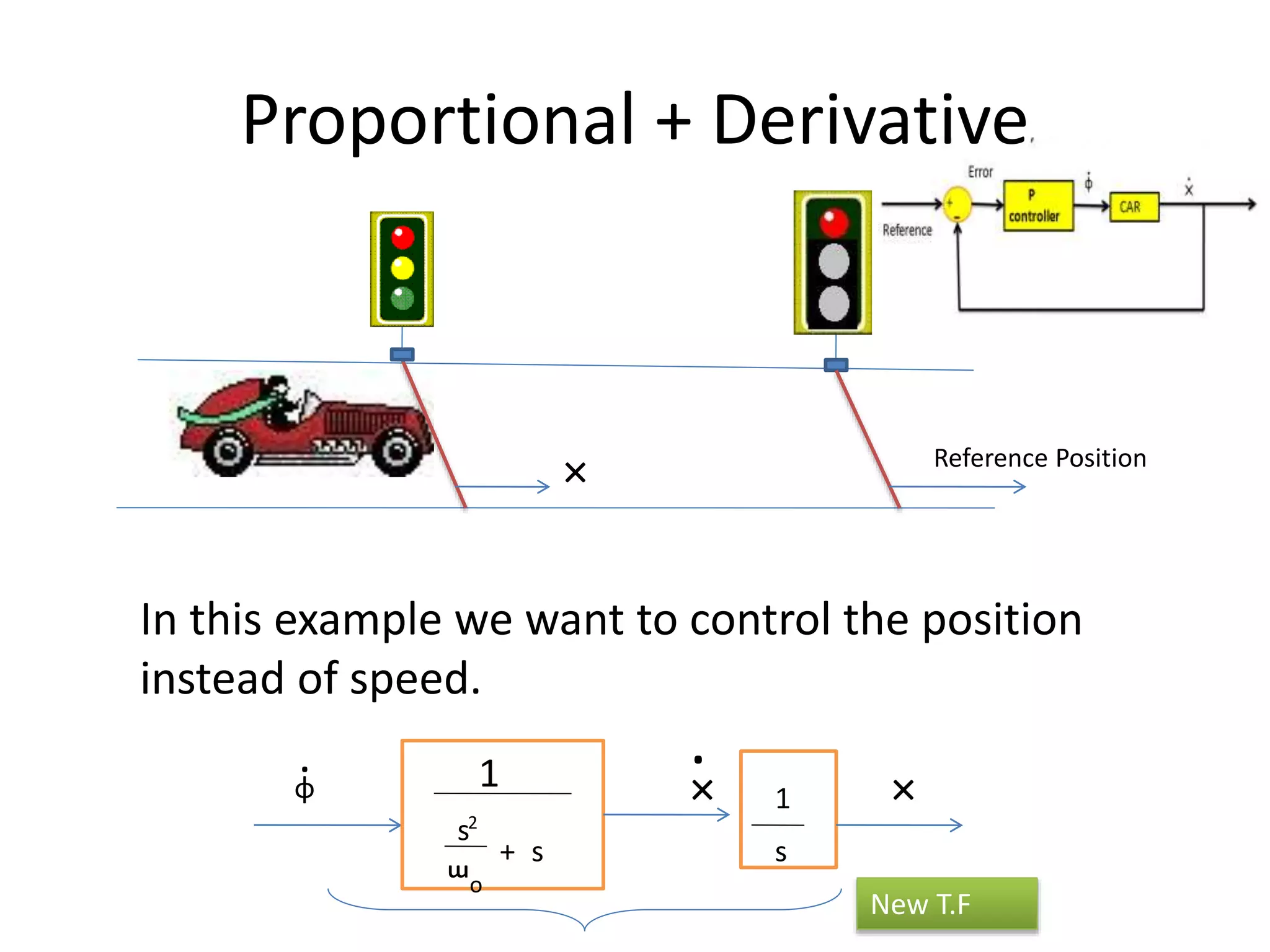
In this example we want to control the position
instead of speed.
ɸ
. 1
s
ᵚo
+ s
×
.
2
.
1
s
×
New T.F
× Reference Position
Proportional + Derivative
× Reference Position
Time
Time
Error
position
2nd Stoplight
Zero Error
Start releasing pedal
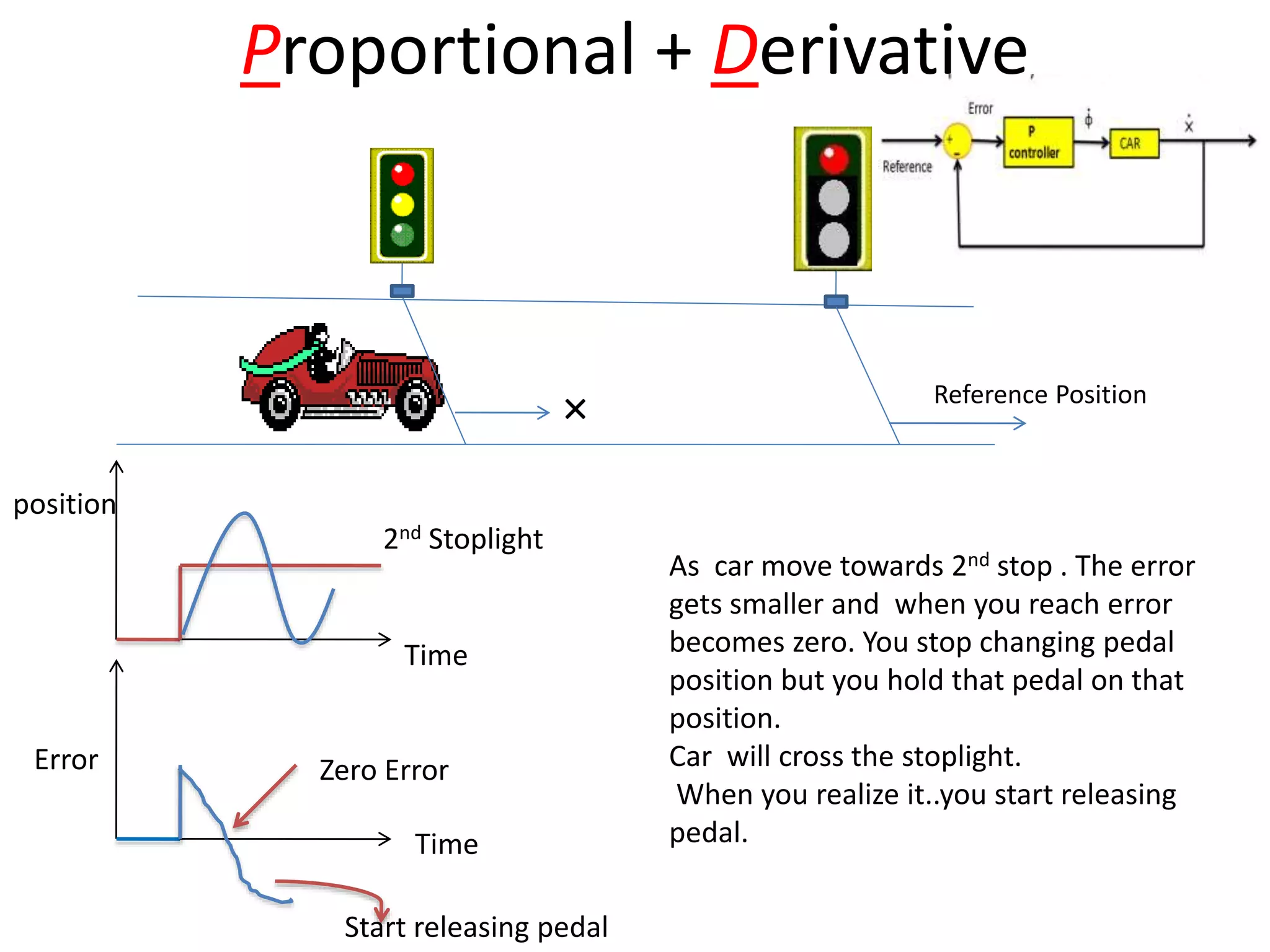
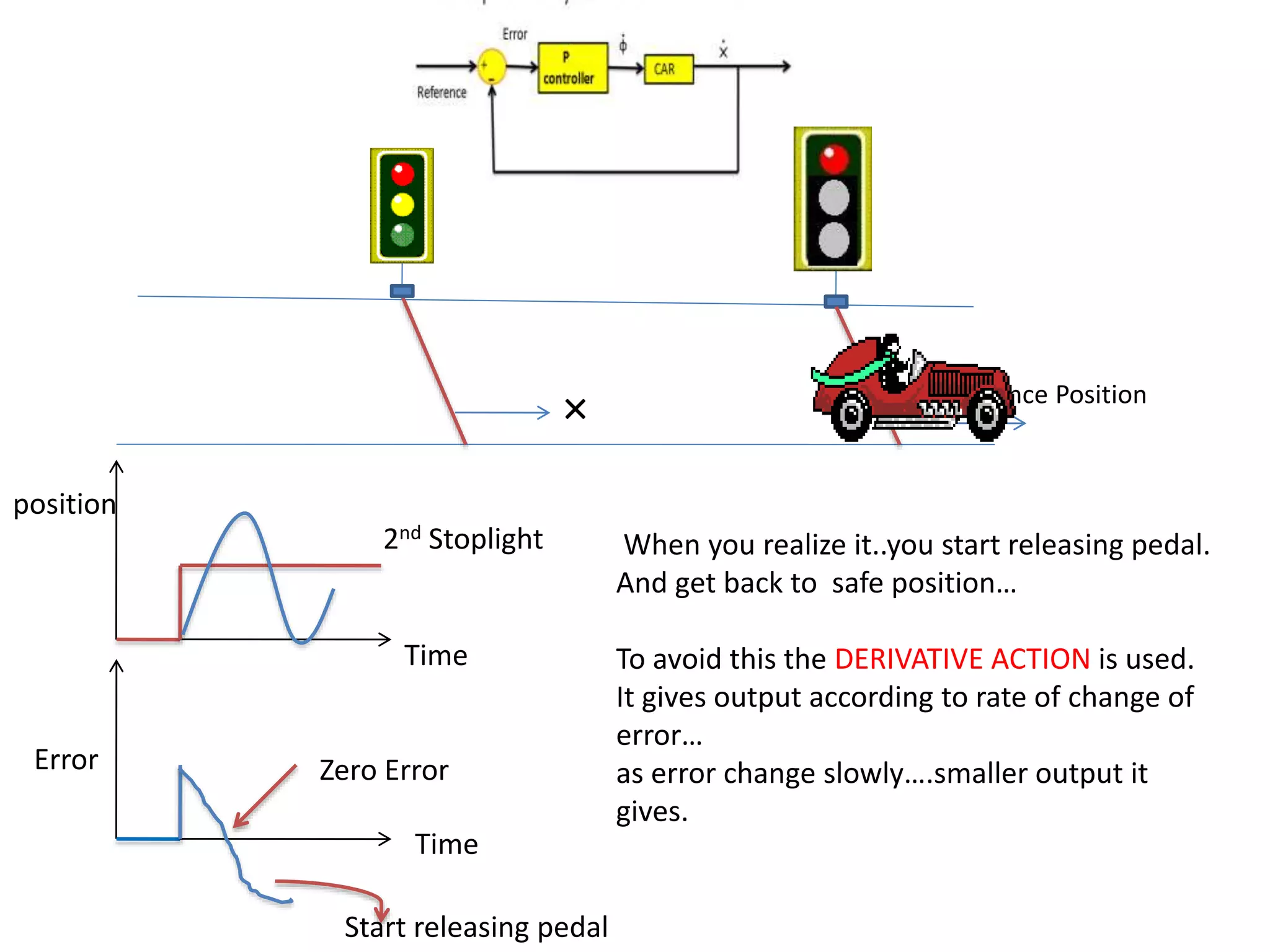
As car move towards 2nd stop . The error
gets smaller and when you reach error
becomes zero. You stop changing pedal
position but you hold that pedal on that
position.
Car will cross the stoplight.
When you realize it..you start releasing
pedal.
× Reference Position
Time
Time
Error
position
2nd Stoplight
Zero Error
Start releasing pedal
When you realize it..you start releasing pedal.
And get back to safe position…
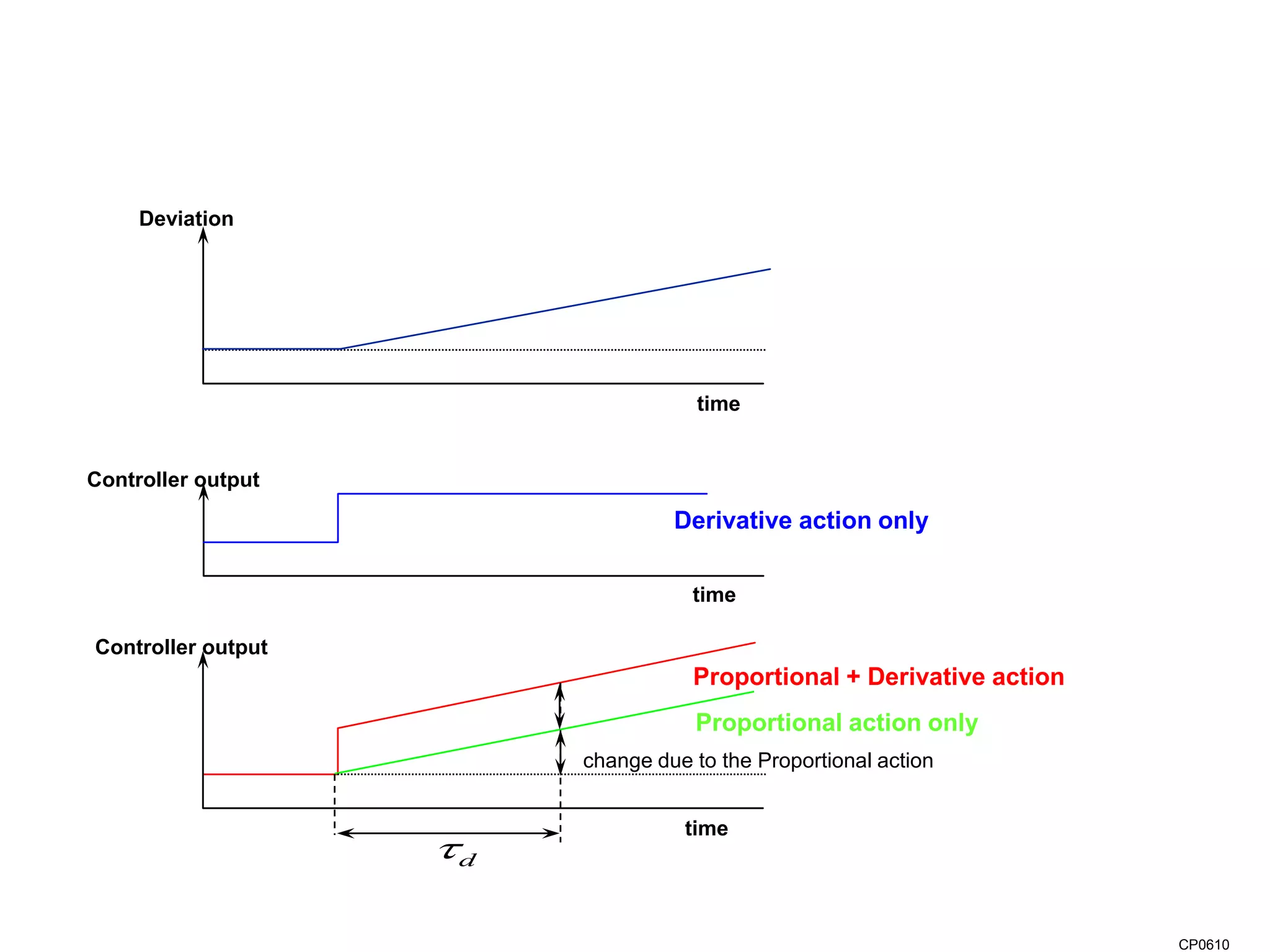
To avoid this the DERIVATIVE ACTION is used.
It gives output according to rate of change of
error…
as error change slowly….smaller output it
gives.
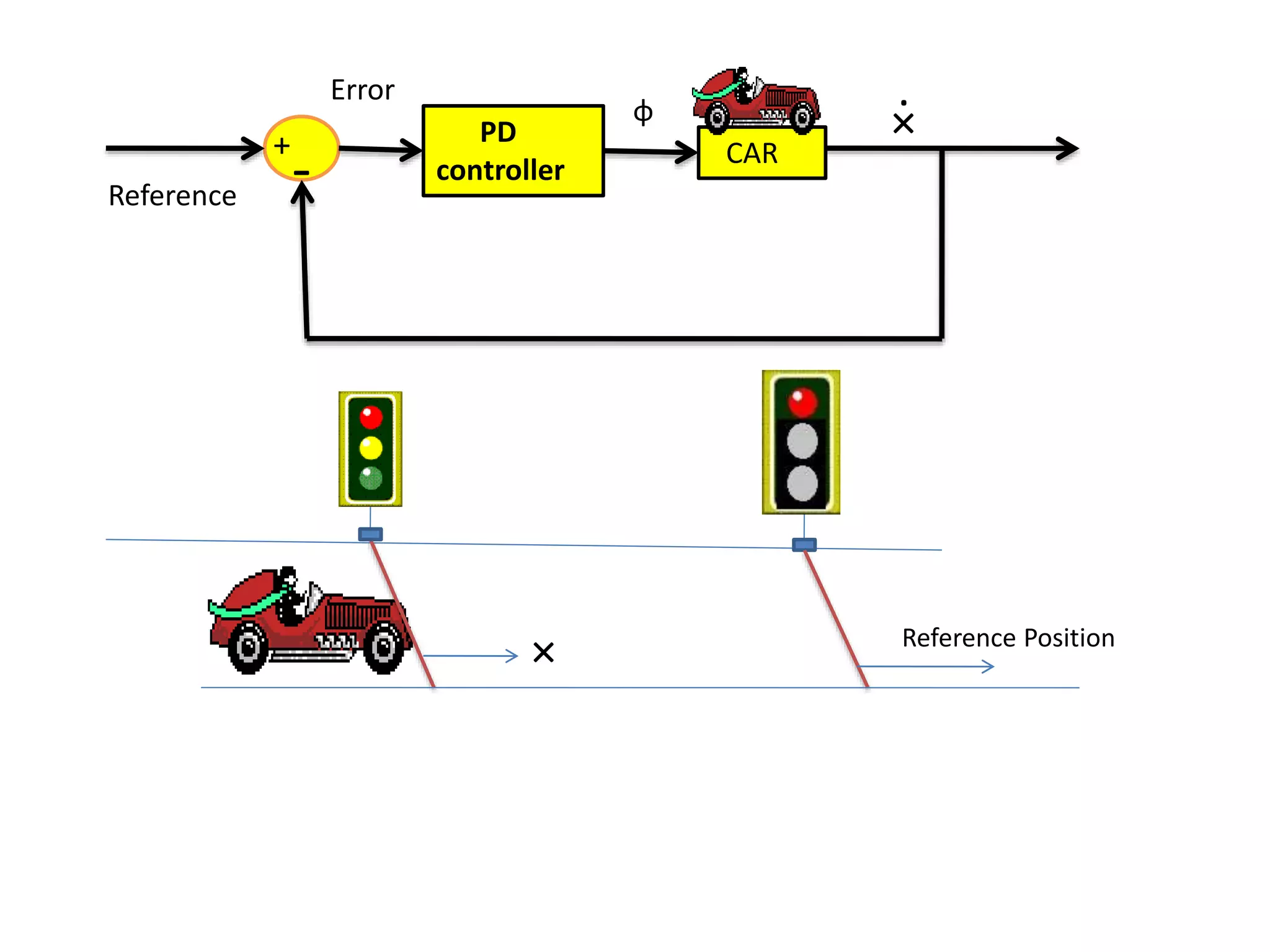
CAR
PD
controller-Reference
Error
×ɸ .
+
× Reference Position
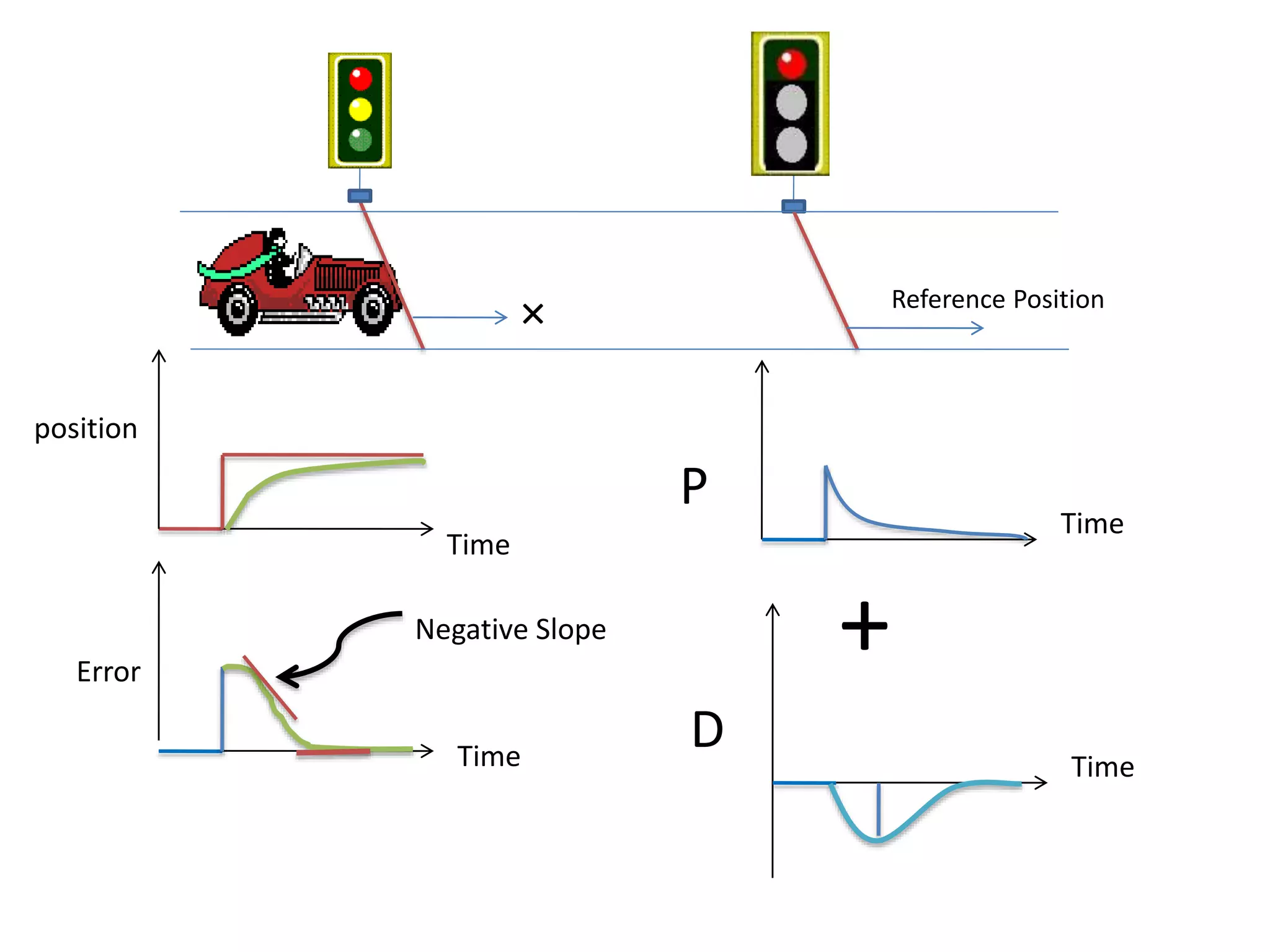
position
Time
Time
Error
Time
P
Time
D
Negative Slope
+
× Reference Position
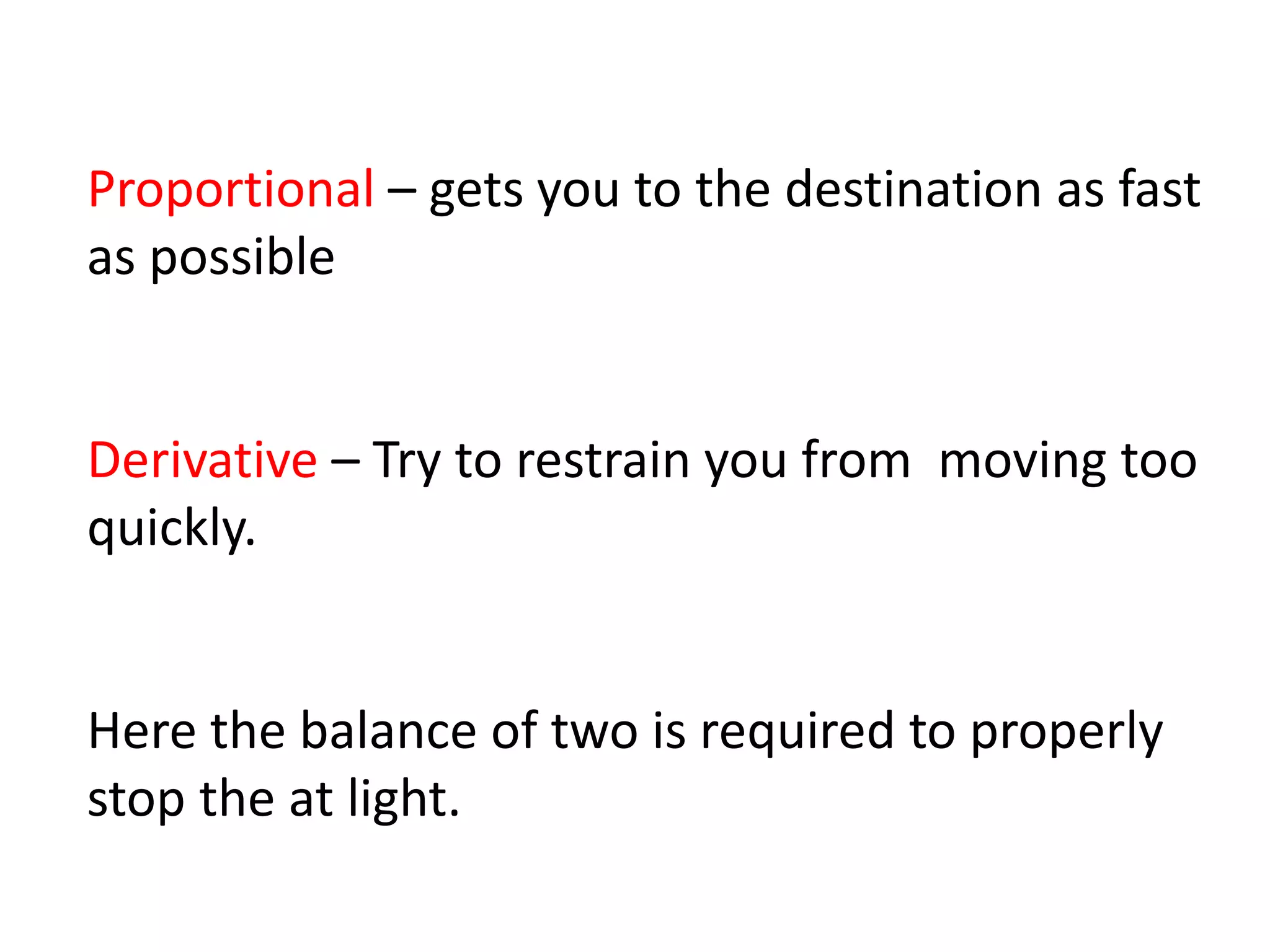
Proportional – gets you to the destination as fast
as possible
Derivative – Try to restrain you from moving too
quickly.
Here the balance of two is required to properly
stop the at light.
CP0610
time
Controller output
Derivative action only
Deviation
time
d
time
Proportional + Derivative action
Controller output
Proportional action only
change due to the Proportional action
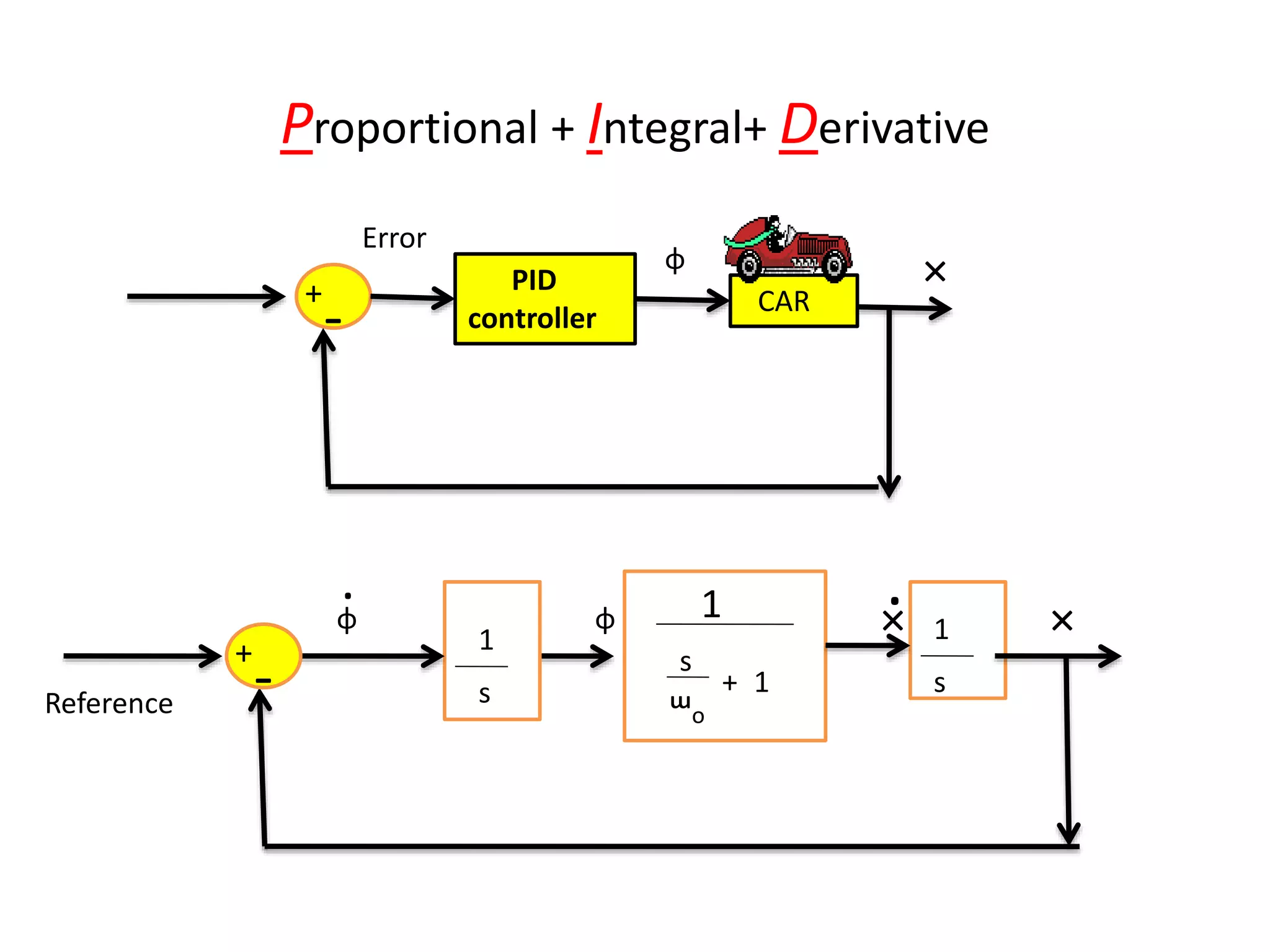
Proportional + Integral+ Derivative
CAR
PID
controller-
Reference
Error
×ɸ
+
1
s
ᵚo
+ 1
ɸ
1
s
ɸ
.
-
+
× 1
s
×
.
No one drives the car by commanding gas pedal
angle, rather they drive by change in the
command angle.
In this example I will command the gas pedal
angle and try to show you….why this is not a
good idea..??
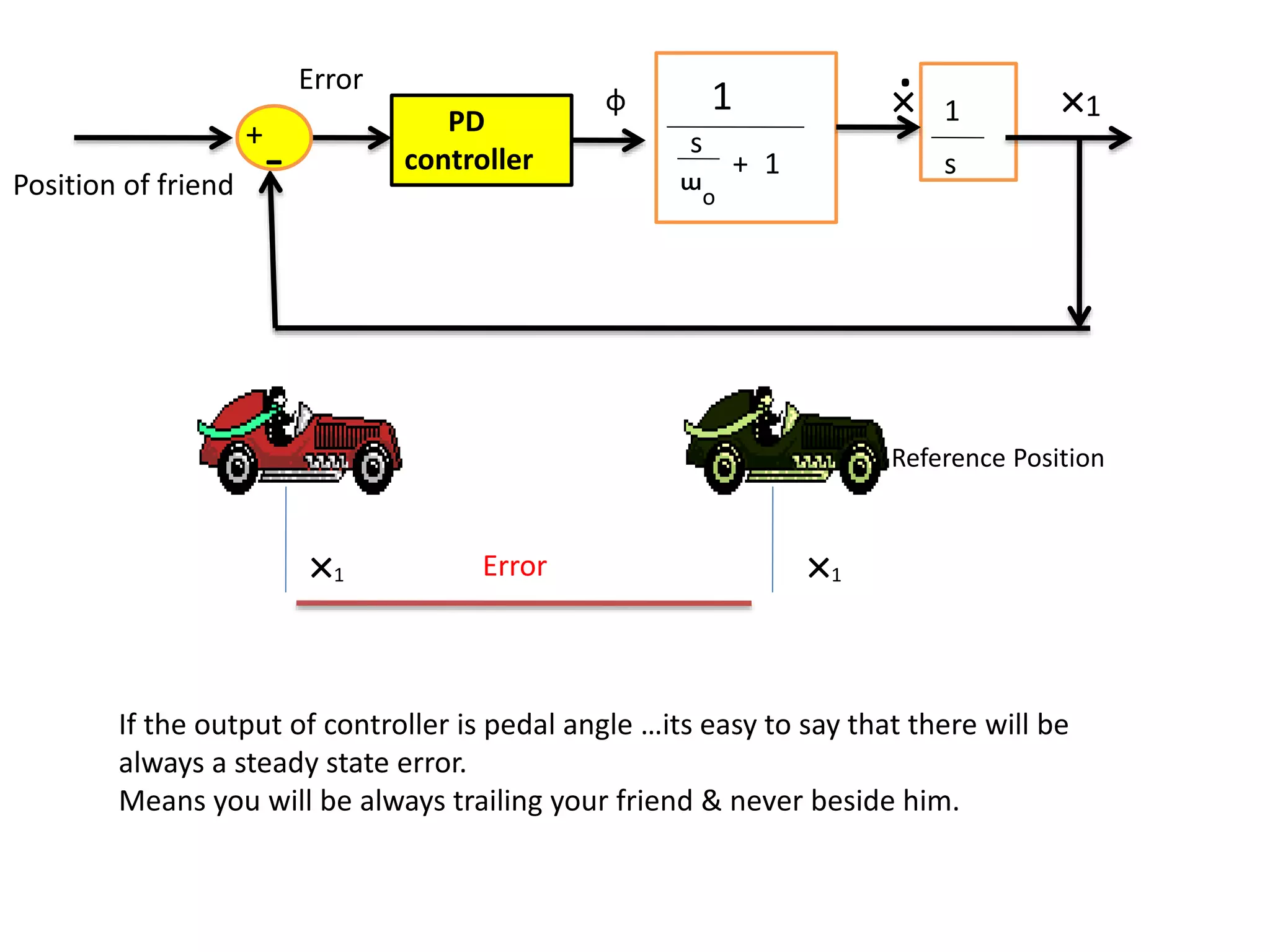
×1
Reference Position
×1
Position of friend
1
s
ᵚo
+ 1
ɸ
-
+
× 1
s
×1
.
PD
controller
Error
Error
If the output of controller is pedal angle …its easy to say that there will be
always a steady state error.
Means you will be always trailing your friend & never beside him.
×1
Reference Position
×1Error
Time
Error
Time
ɸ
Proportional
Derivative
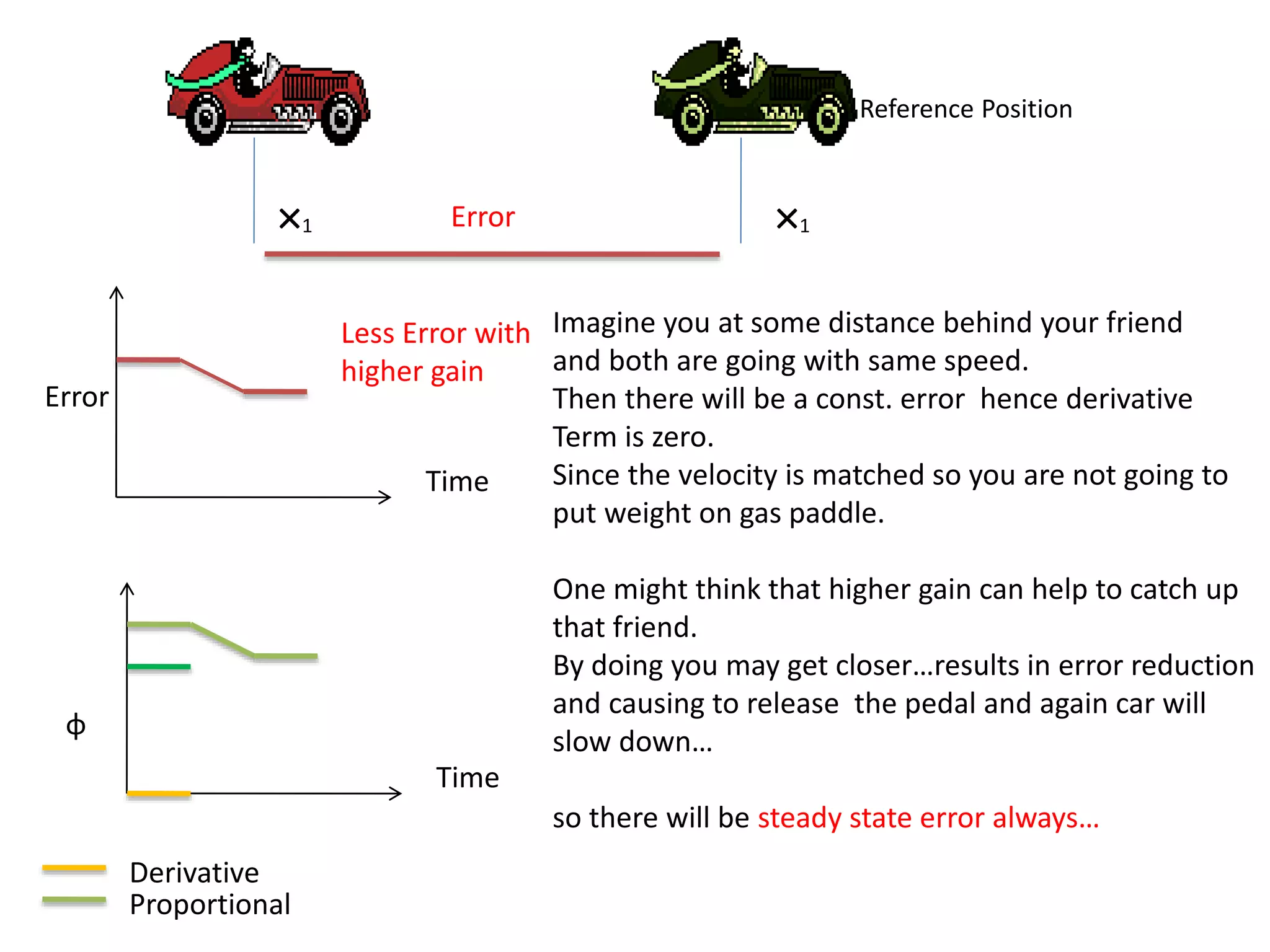
Less Error with
higher gain
Imagine you at some distance behind your friend
and both are going with same speed.
Then there will be a const. error hence derivative
Term is zero.
Since the velocity is matched so you are not going to
put weight on gas paddle.
One might think that higher gain can help to catch up
that friend.
By doing you may get closer…results in error reduction
and causing to release the pedal and again car will
slow down…
so there will be steady state error always…
×1
Reference Position
×1Error
Time
Error
Time
ɸ
Proportional
Derivative
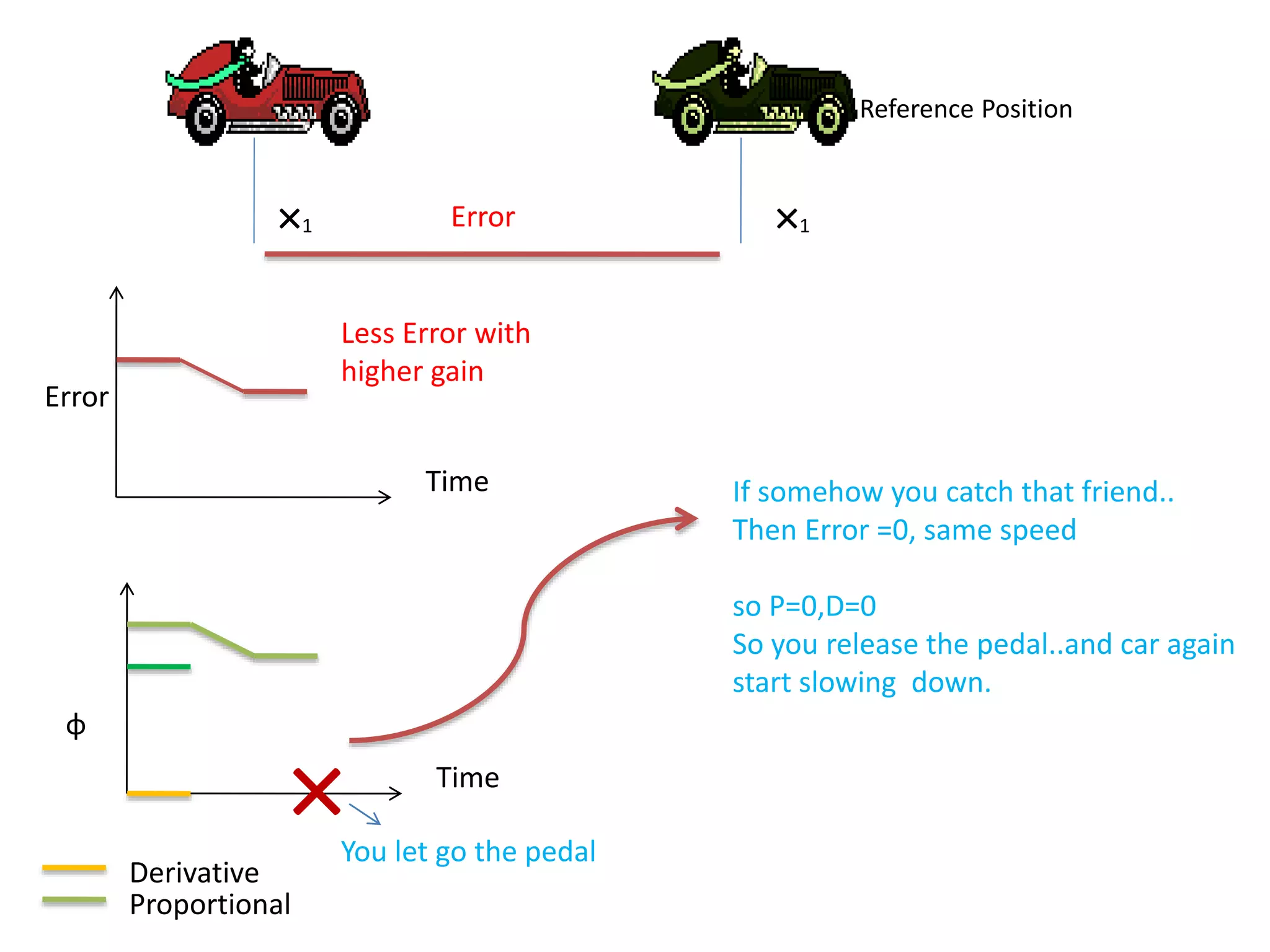
Less Error with
higher gain
×You let go the pedal
If somehow you catch that friend..
Then Error =0, same speed
so P=0,D=0
So you release the pedal..and car again
start slowing down.
So by Controlling pedal position and
using PD controller you are not going
to achieve steady state error to be
zero.
Now the Integral Part is going to solve
this problem..
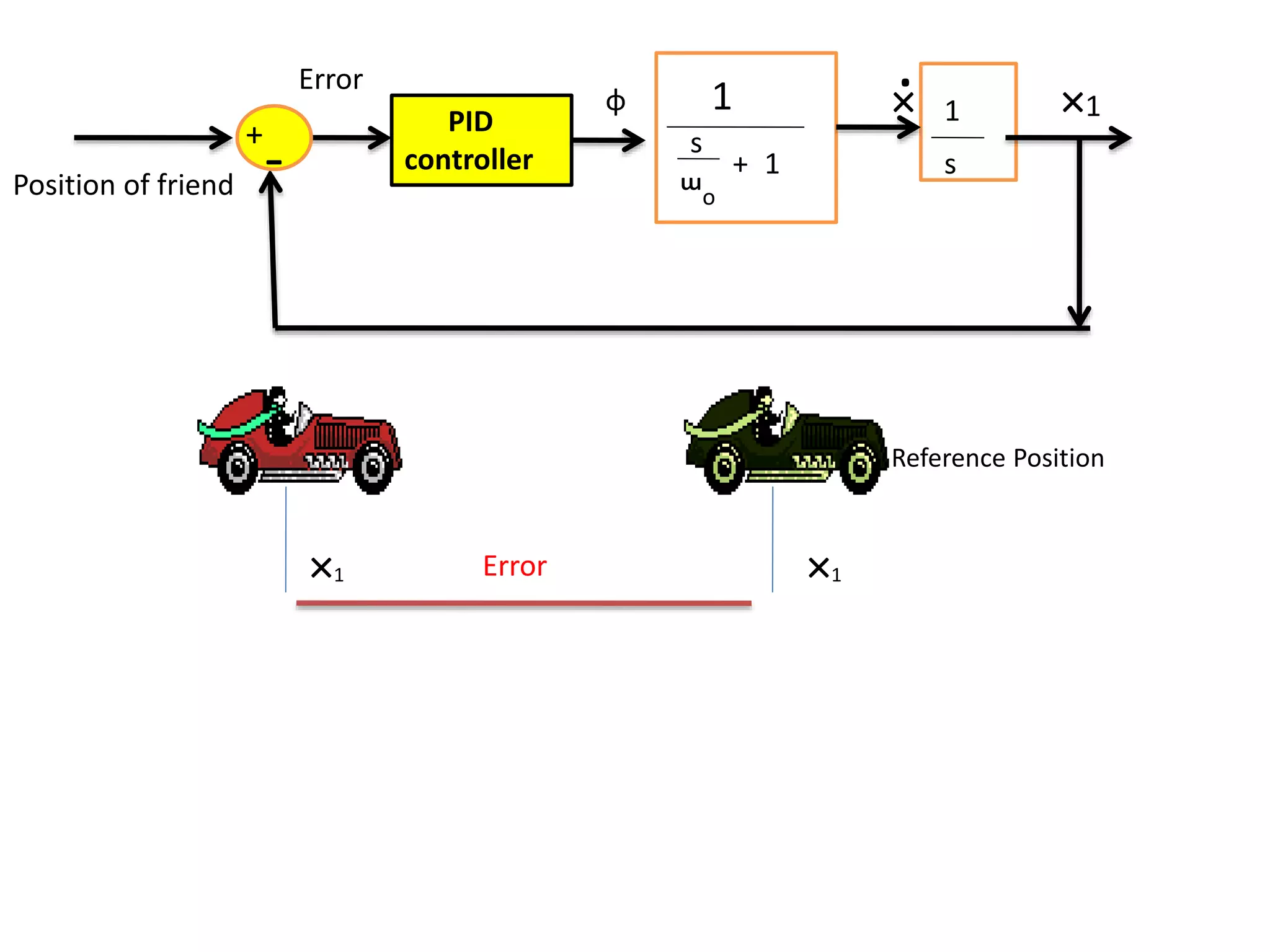
×1
Reference Position
×1
1
s
ᵚo
+ 1
ɸ
-
+
× 1
s
×1
.
PID
controller
Error
Error
Position of friend
×1
Reference Position
×1Error
Time
Time
ɸ
Error
P
Time
D
Time
Time
I
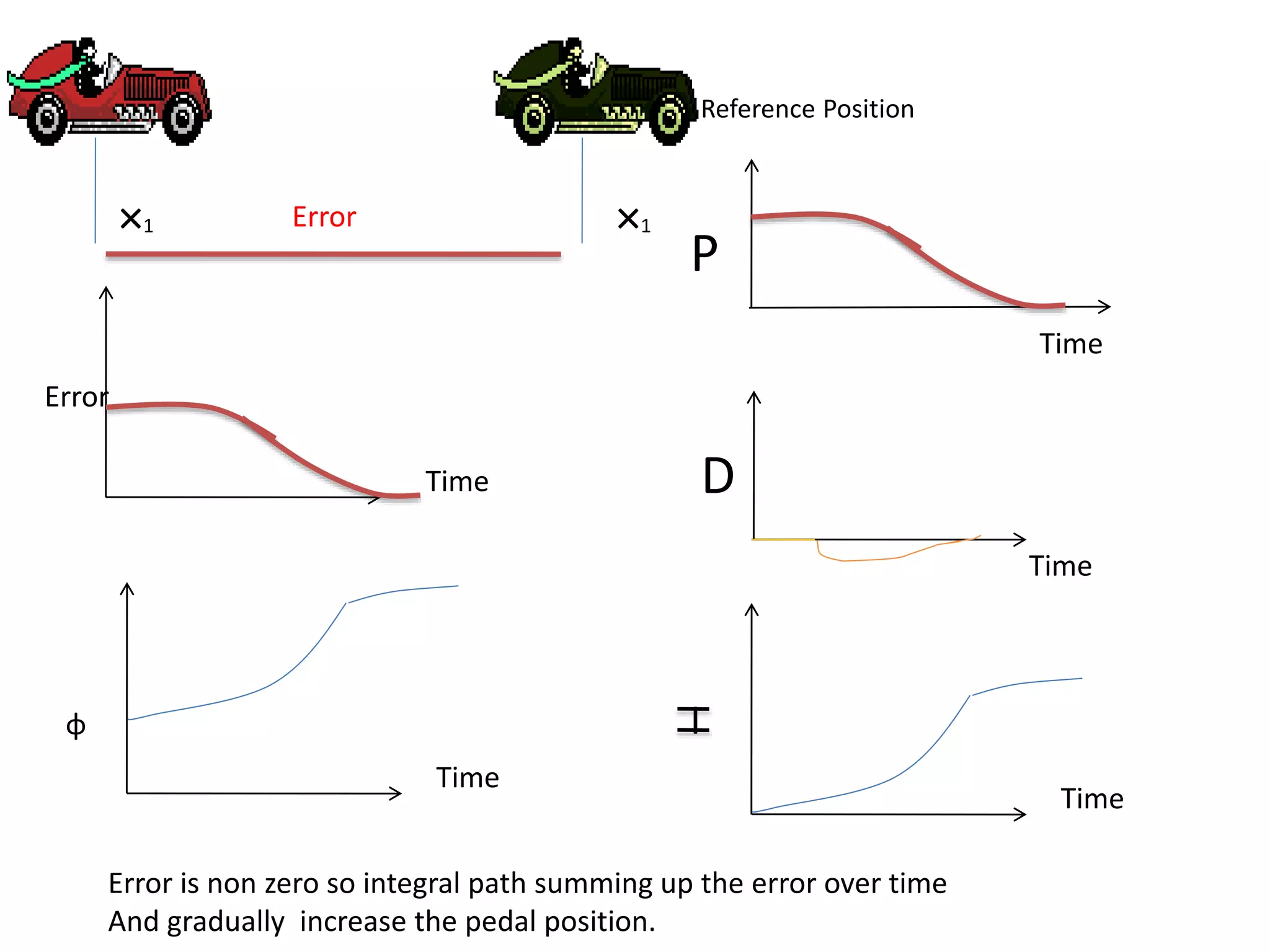
Error is non zero so integral path summing up the error over time
And gradually increase the pedal position.
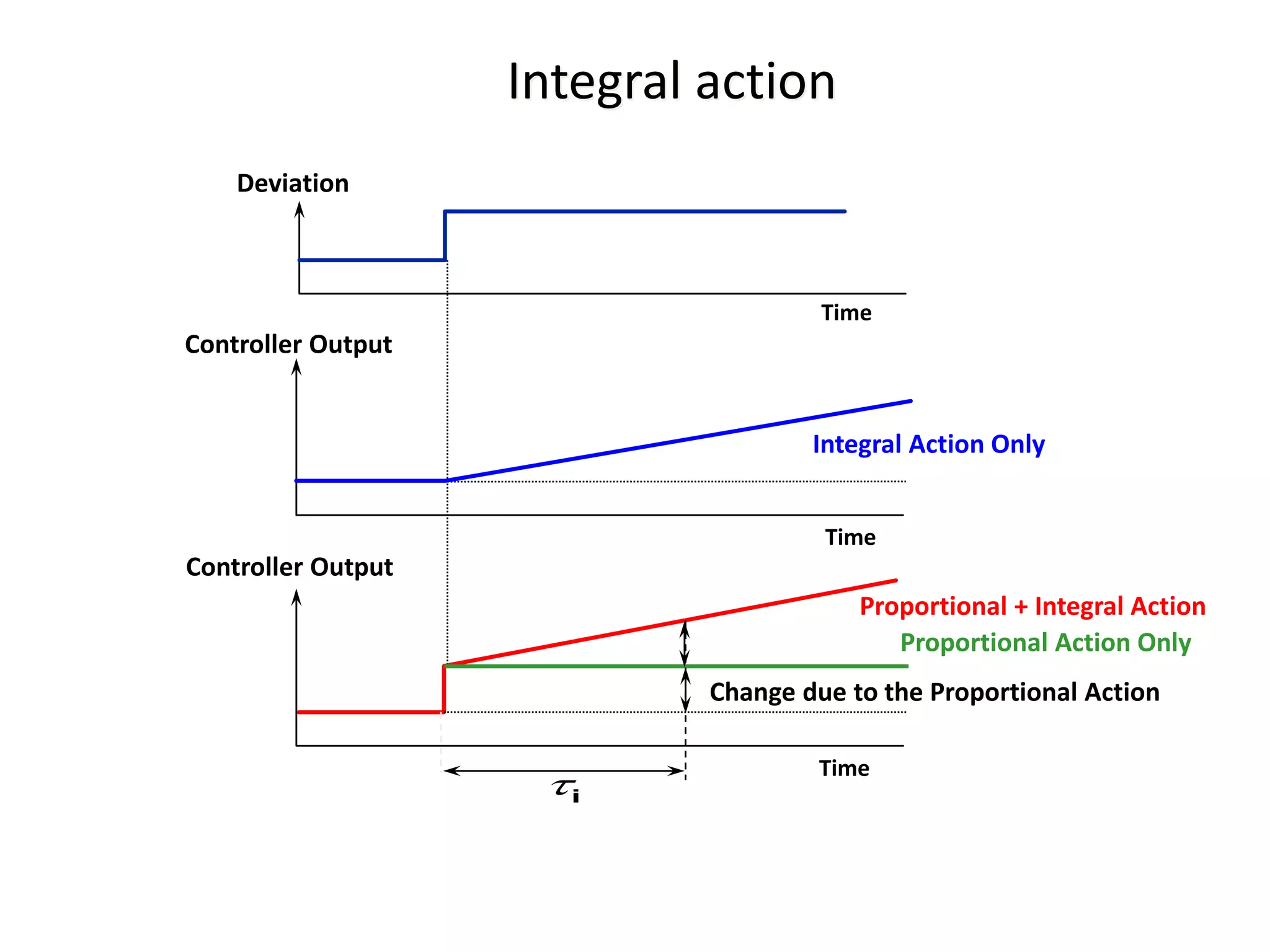
Integral action
Deviation
Time
Controller Output
Integral Action Only
Time
Proportional + Integral Action
Controller Output
Proportional Action Only
Change due to the Proportional Action
i
Time
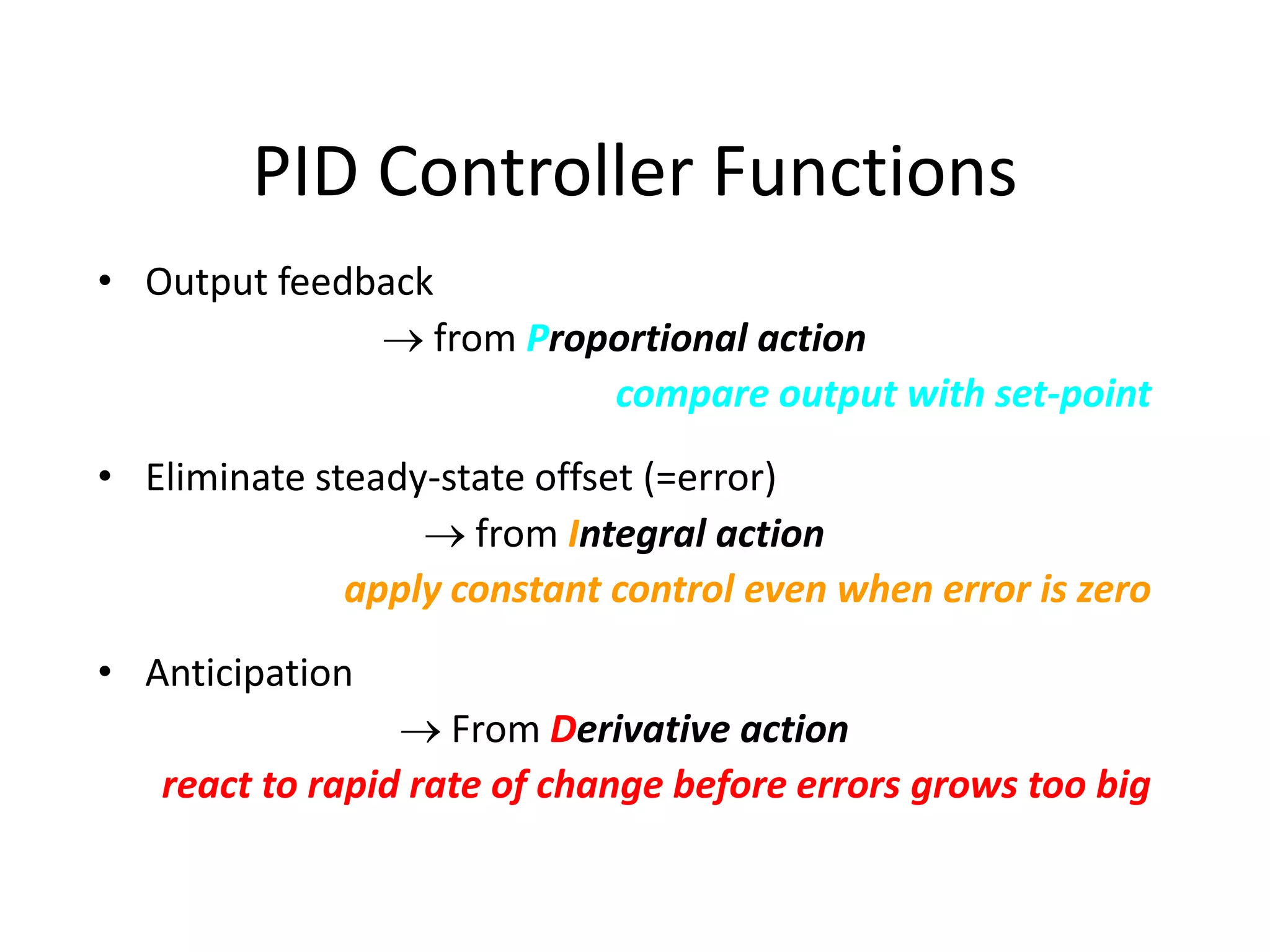
PID Controller Functions
• Output feedback
 from Proportional action
compare output with set-point
• Eliminate steady-state offset (=error)
 from Integral action
apply constant control even when error is zero
• Anticipation
 From Derivative action
react to rapid rate of change before errors grows too big
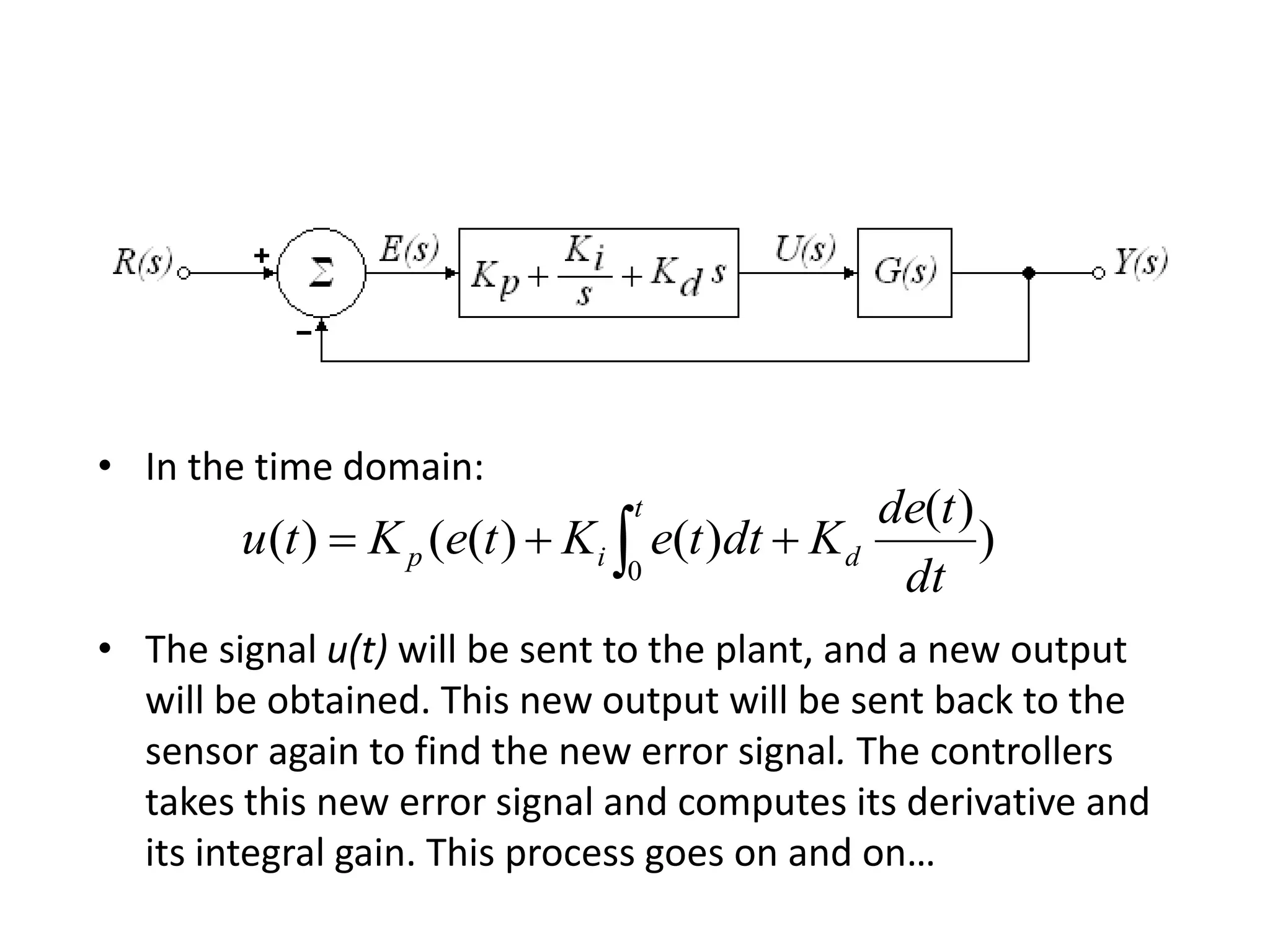
• In the time domain:
• The signal u(t) will be sent to the plant, and a new output
will be obtained. This new output will be sent back to the
sensor again to find the new error signal. The controllers
takes this new error signal and computes its derivative and
its integral gain. This process goes on and on…
)
)(
)()(()(
0 dt
tde
KdtteKteKtu d
t
ip  
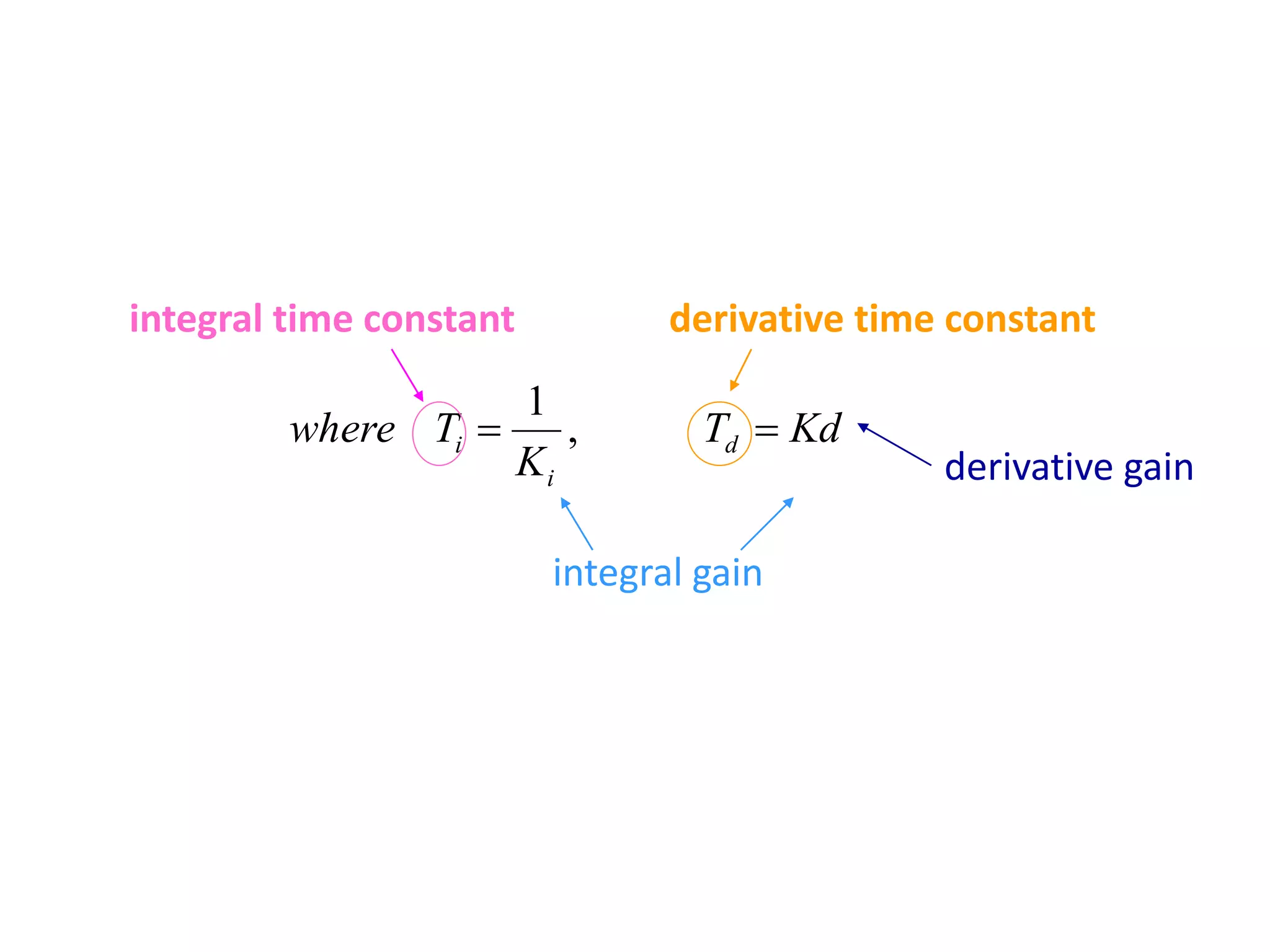
KdT
K
Twhere d
i
i  ,
1
integral gain
derivative gain
derivative time constantintegral time constant
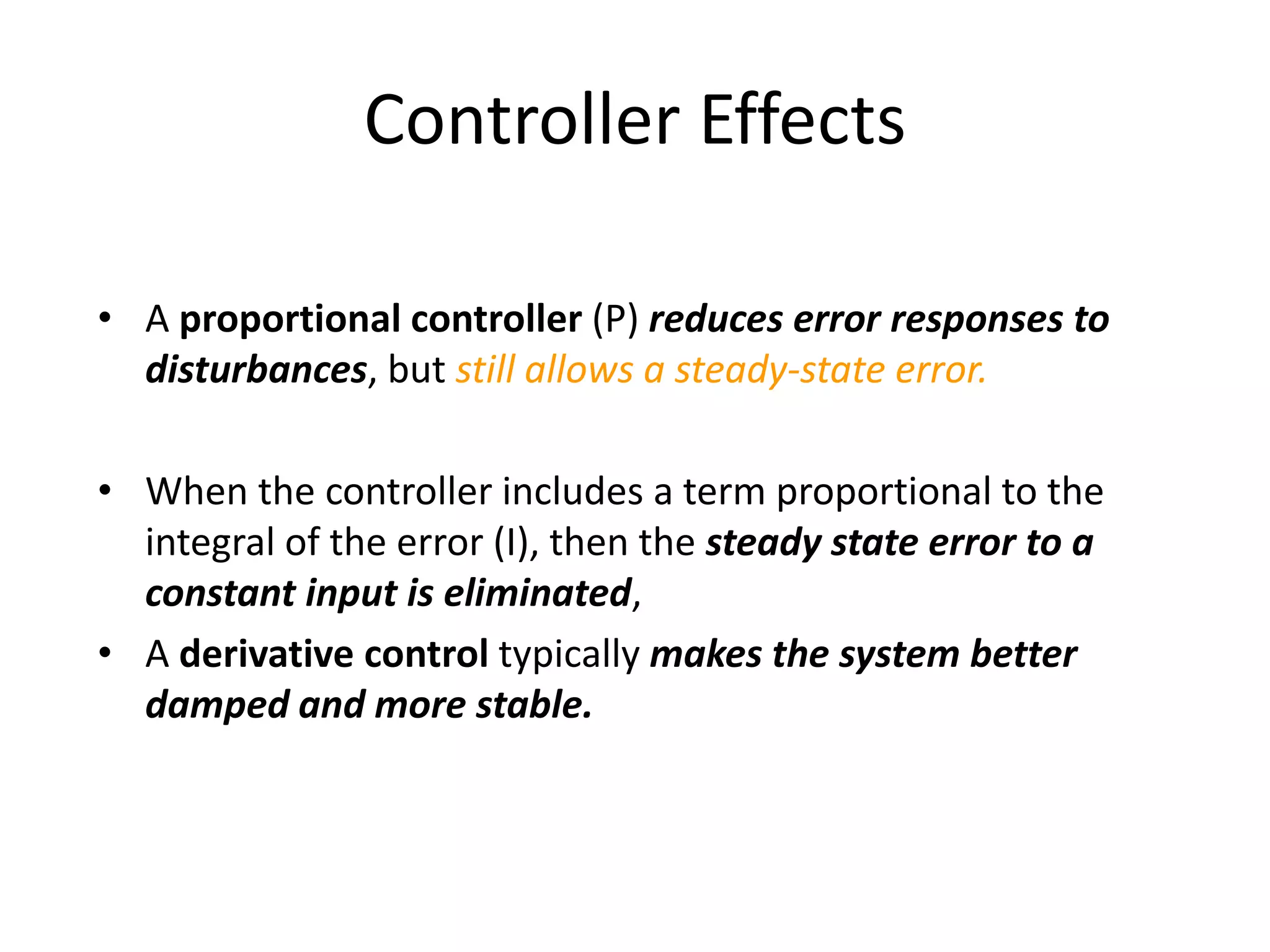
Controller Effects
• A proportional controller (P) reduces error responses to
disturbances, but still allows a steady-state error.
• When the controller includes a term proportional to the
integral of the error (I), then the steady state error to a
constant input is eliminated,
• A derivative control typically makes the system better
damped and more stable.
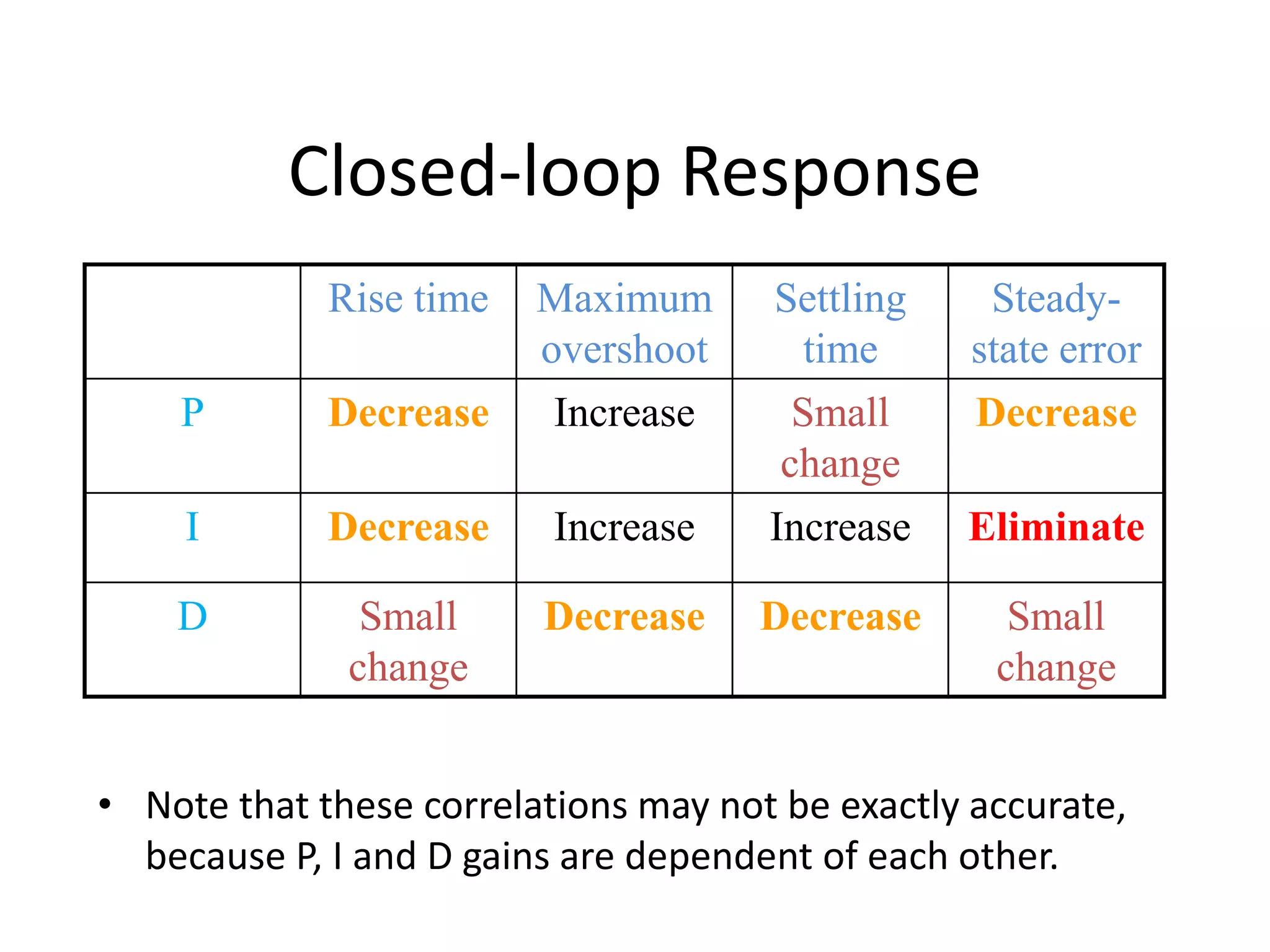
Closed-loop Response
Rise time Maximum
overshoot
Settling
time
Steady-
state error
P Decrease Increase Small
change
Decrease
I Decrease Increase Increase Eliminate
D Small
change
Decrease Decrease Small
change
• Note that these correlations may not be exactly accurate,
because P, I and D gains are dependent of each other.
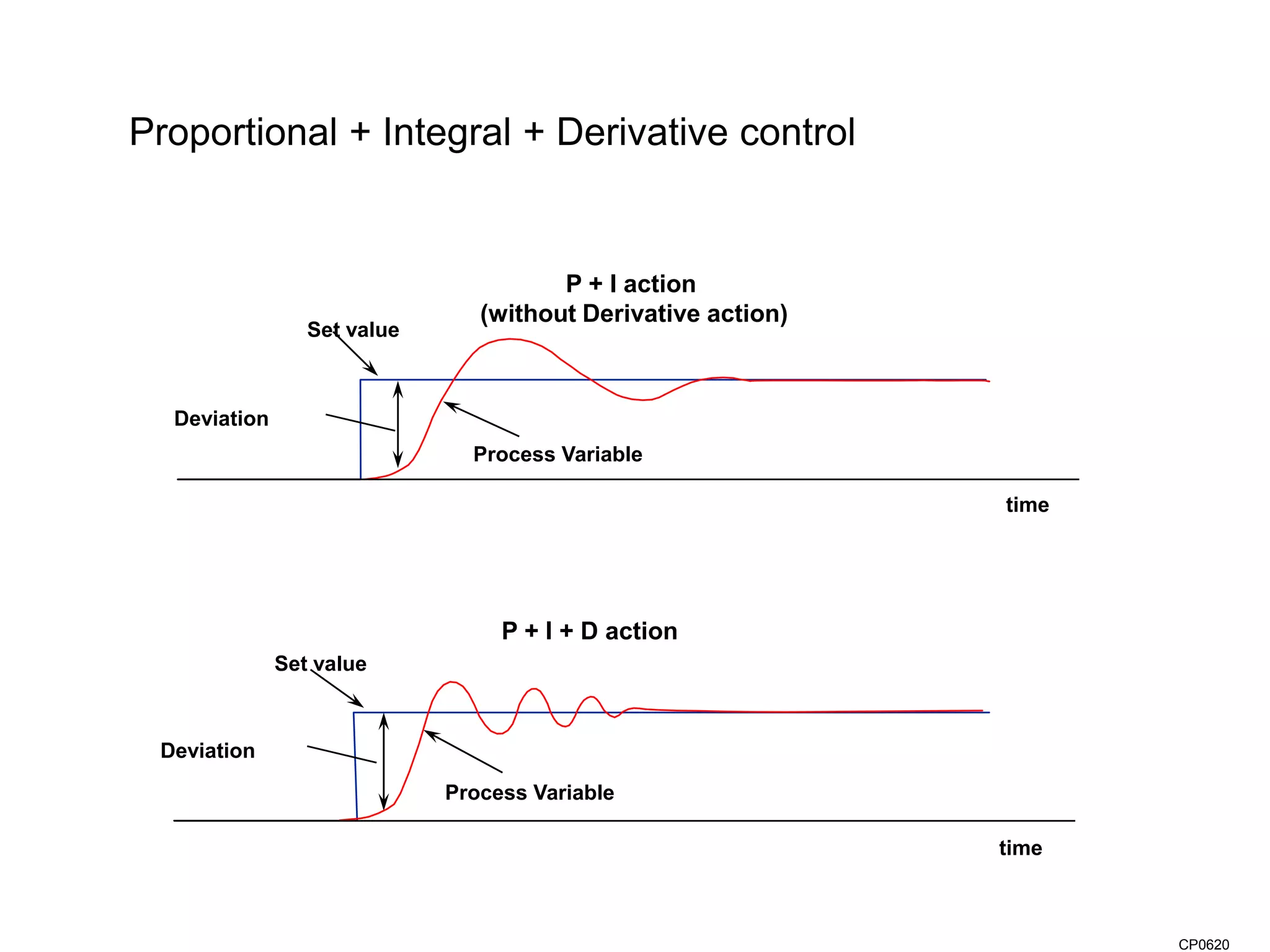
Proportional + Integral + Derivative control
CP0620
Process Variable
Deviation
Set value
time
P + I + D action
Set value
Deviation
time
P + I action
(without Derivative action)
Process Variable
Conclusions
• Proportional action gives an output signal proportional to the size of the
error .Increasing the proportional feedback gain reduces steady-state
errors, but high gains almost always destabilize the system.
• Integral action gives a signal which magnitude depends on the time the
error has been there. Integral control provides robust reduction in
steady-state errors, but often makes the system less stable.
• Derivative action gives a signal proportional to the change in the Error.
It gives sort of “anticipatory” control .Derivative control usually
increases damping and improves stability, but has almost no effect on
the steady state error
• These 3 kinds of control combined from the classical PID controller

PID Control

  • 1.
  • 2.
    Plant VelocityGas paddle ɸ × . Here , Caris considered as Plant Gas pedal angle is Input variable Velocity is output variable To understand PID we need a model. Suppose You are driving a car.
  • 3.
    T.F of caris depended on car model. We can simplify the model by assuming this to be L.P.F. So T.F of Car = 1 s ᵚo + 1 1 s ᵚo + 1 ɸ × .
  • 4.
    Now ...if youwant the speed of car to be 50 kmh. How would you recognize the specific pedal angle to get this speed…???????? Plant VelocityGas paddle ɸ × . At What angle I am ?????
  • 5.
    In real lifeno one drives by knowingly putting the gas pedal at specific angle. Instead of it people drive the car by applying a change in the pedal angle. 30 kmh Going slow..want to be fast Change the Gas pedal angle by Putting weight on it 50 kmhGoing fast now…
  • 6.
    Now command = changein angle over time 1 s ᵚo + 1 ɸ × . 1 s ɸ . ɸ . 1 s ᵚo + s × . 2 .
  • 7.
    Close Loop controlsystem for car with P controller- CAR P controller-Reference Error ×ɸ . . + Speed limit 40 Kmh When Light turns Green ,you press the pedal to accelerate the car up to speed limit. In real life as you drive car to respond the step command ,you are actually unknowingly performing Proportional Control Action.
  • 8.
    Speed limit 40 Kmh Velocity Time Time Time Error ɸ . Atrest you are commanding 0 kmh. When light turn green , the ref signal step up to 40 kmh error becomes 40kmh which is very large error. Proportionally the control signal applied and velocity increased towards 40kmh. Error gradually becomes smaller and smaller. When error becomes zero you atop adjusting the pedal and hold it constant. At this point we can say that here no steady state error. 40 kmh
  • 9.
    Velocity Time Time Time Error ɸ . 40 kmh Initially error= 40kmh as before when light turns green , due to high gain to proportional control action is large. Your car will go above ref speed .. At this point error becomes negative Again you realize to slow down the car and again error becomes positive due to high gain. Due to high gain …system becomes Unstable STOP DRIVING WITH HIGH GAIN.. Let’s Increase the Gain…
  • 10.
    Proportional-only control Offset Offset Process variable Deviation Setvalue Set value Deviation time time Low Gain High gain The above plots shows that the proportional controller reduced both the rise time and the steady-state error, increased the overshoot, and decreased the settling time by small amount.
  • 11.
    Proportional + Derivative Inthis example we want to control the position instead of speed. ɸ . 1 s ᵚo + s × . 2 . 1 s × New T.F × Reference Position
  • 12.
    Proportional + Derivative ×Reference Position Time Time Error position 2nd Stoplight Zero Error Start releasing pedal As car move towards 2nd stop . The error gets smaller and when you reach error becomes zero. You stop changing pedal position but you hold that pedal on that position. Car will cross the stoplight. When you realize it..you start releasing pedal.
  • 13.
    × Reference Position Time Time Error position 2ndStoplight Zero Error Start releasing pedal When you realize it..you start releasing pedal. And get back to safe position… To avoid this the DERIVATIVE ACTION is used. It gives output according to rate of change of error… as error change slowly….smaller output it gives.
  • 14.
  • 15.
  • 16.
    Proportional – getsyou to the destination as fast as possible Derivative – Try to restrain you from moving too quickly. Here the balance of two is required to properly stop the at light.
  • 17.
    CP0610 time Controller output Derivative actiononly Deviation time d time Proportional + Derivative action Controller output Proportional action only change due to the Proportional action
  • 18.
    Proportional + Integral+Derivative CAR PID controller- Reference Error ×ɸ + 1 s ᵚo + 1 ɸ 1 s ɸ . - + × 1 s × .
  • 19.
    No one drivesthe car by commanding gas pedal angle, rather they drive by change in the command angle. In this example I will command the gas pedal angle and try to show you….why this is not a good idea..??
  • 20.
    ×1 Reference Position ×1 Position offriend 1 s ᵚo + 1 ɸ - + × 1 s ×1 . PD controller Error Error If the output of controller is pedal angle …its easy to say that there will be always a steady state error. Means you will be always trailing your friend & never beside him.
  • 21.
    ×1 Reference Position ×1Error Time Error Time ɸ Proportional Derivative Less Errorwith higher gain Imagine you at some distance behind your friend and both are going with same speed. Then there will be a const. error hence derivative Term is zero. Since the velocity is matched so you are not going to put weight on gas paddle. One might think that higher gain can help to catch up that friend. By doing you may get closer…results in error reduction and causing to release the pedal and again car will slow down… so there will be steady state error always…
  • 22.
    ×1 Reference Position ×1Error Time Error Time ɸ Proportional Derivative Less Errorwith higher gain ×You let go the pedal If somehow you catch that friend.. Then Error =0, same speed so P=0,D=0 So you release the pedal..and car again start slowing down.
  • 23.
    So by Controllingpedal position and using PD controller you are not going to achieve steady state error to be zero. Now the Integral Part is going to solve this problem..
  • 24.
    ×1 Reference Position ×1 1 s ᵚo + 1 ɸ - + ×1 s ×1 . PID controller Error Error Position of friend
  • 25.
    ×1 Reference Position ×1Error Time Time ɸ Error P Time D Time Time I Error isnon zero so integral path summing up the error over time And gradually increase the pedal position.
  • 26.
    Integral action Deviation Time Controller Output IntegralAction Only Time Proportional + Integral Action Controller Output Proportional Action Only Change due to the Proportional Action i Time
  • 27.
    PID Controller Functions •Output feedback  from Proportional action compare output with set-point • Eliminate steady-state offset (=error)  from Integral action apply constant control even when error is zero • Anticipation  From Derivative action react to rapid rate of change before errors grows too big
  • 28.
    • In thetime domain: • The signal u(t) will be sent to the plant, and a new output will be obtained. This new output will be sent back to the sensor again to find the new error signal. The controllers takes this new error signal and computes its derivative and its integral gain. This process goes on and on… ) )( )()(()( 0 dt tde KdtteKteKtu d t ip  
  • 29.
    KdT K Twhere d i i , 1 integral gain derivative gain derivative time constantintegral time constant
  • 30.
    Controller Effects • Aproportional controller (P) reduces error responses to disturbances, but still allows a steady-state error. • When the controller includes a term proportional to the integral of the error (I), then the steady state error to a constant input is eliminated, • A derivative control typically makes the system better damped and more stable.
  • 31.
    Closed-loop Response Rise timeMaximum overshoot Settling time Steady- state error P Decrease Increase Small change Decrease I Decrease Increase Increase Eliminate D Small change Decrease Decrease Small change • Note that these correlations may not be exactly accurate, because P, I and D gains are dependent of each other.
  • 32.
    Proportional + Integral+ Derivative control CP0620 Process Variable Deviation Set value time P + I + D action Set value Deviation time P + I action (without Derivative action) Process Variable
  • 33.
    Conclusions • Proportional actiongives an output signal proportional to the size of the error .Increasing the proportional feedback gain reduces steady-state errors, but high gains almost always destabilize the system. • Integral action gives a signal which magnitude depends on the time the error has been there. Integral control provides robust reduction in steady-state errors, but often makes the system less stable. • Derivative action gives a signal proportional to the change in the Error. It gives sort of “anticipatory” control .Derivative control usually increases damping and improves stability, but has almost no effect on the steady state error • These 3 kinds of control combined from the classical PID controller