Introduction to
PID Controllers
Fundamentals, Formulas, and Applications
Introduction
PID controllers are essential in automation, providing precise control for various processes. This
presentation explores the fundamentals, key components, and applications of PID controllers in
different industries. By understanding the Proportional, Integral, and Derivative terms, professionals
can effectively implement and optimize control strategies. The aim is to enhance audience
comprehension of PID systems and encourage practical exploration.
Topic 1:
Fundamentals of
PID Controllers
01
Definition and Key Roles
A PID (Proportional-Integral-Derivative) controller continuously calculates the error between a
setpoint and a process variable. This system adjusts outputs to minimize that error.
Key roles include:
- **Proportional**: Provides immediate correction based on current error magnitude.
- **Integral**: Accumulates past errors, eliminating steady-state offset.
- **Derivative**: Anticipates future errors, smoothing system response.
Structure and Formula
Overview
The structure of a PID controller includes a block diagram visually
representing input, PID calculations, and output feedback.
The formula for the PID controller is:
𝑢( ) = ( ) + (0 to ) ( ) + ( )/
𝑡 𝐾𝑃𝑒 𝑡 𝐾𝐼 ∫ 𝑡 𝑒 𝜏 𝑑𝜏 𝐾𝐷 𝑑𝑒 𝑡 𝑑𝑡
This equation illustrates the contributions of each term in adjusting
the control output, essential for achieving desired system
performance.
Individual Terms: P, I, D Explained
The PID controller consists of three essential components:
- **Proportional (P)**: This term provides immediate feedback proportional to the current error,
allowing for quick adjustments.
- **Integral (I)**: This component accumulates past errors, correcting any residual steady-state error
and ensuring the output stabilizes.
- **Derivative (D)**: Anticipating future error trends, the derivative term adjusts the output based on
the rate of change of the error, promoting stability and reducing overshoot.
Topic 2:
Applications and
Tuning
02
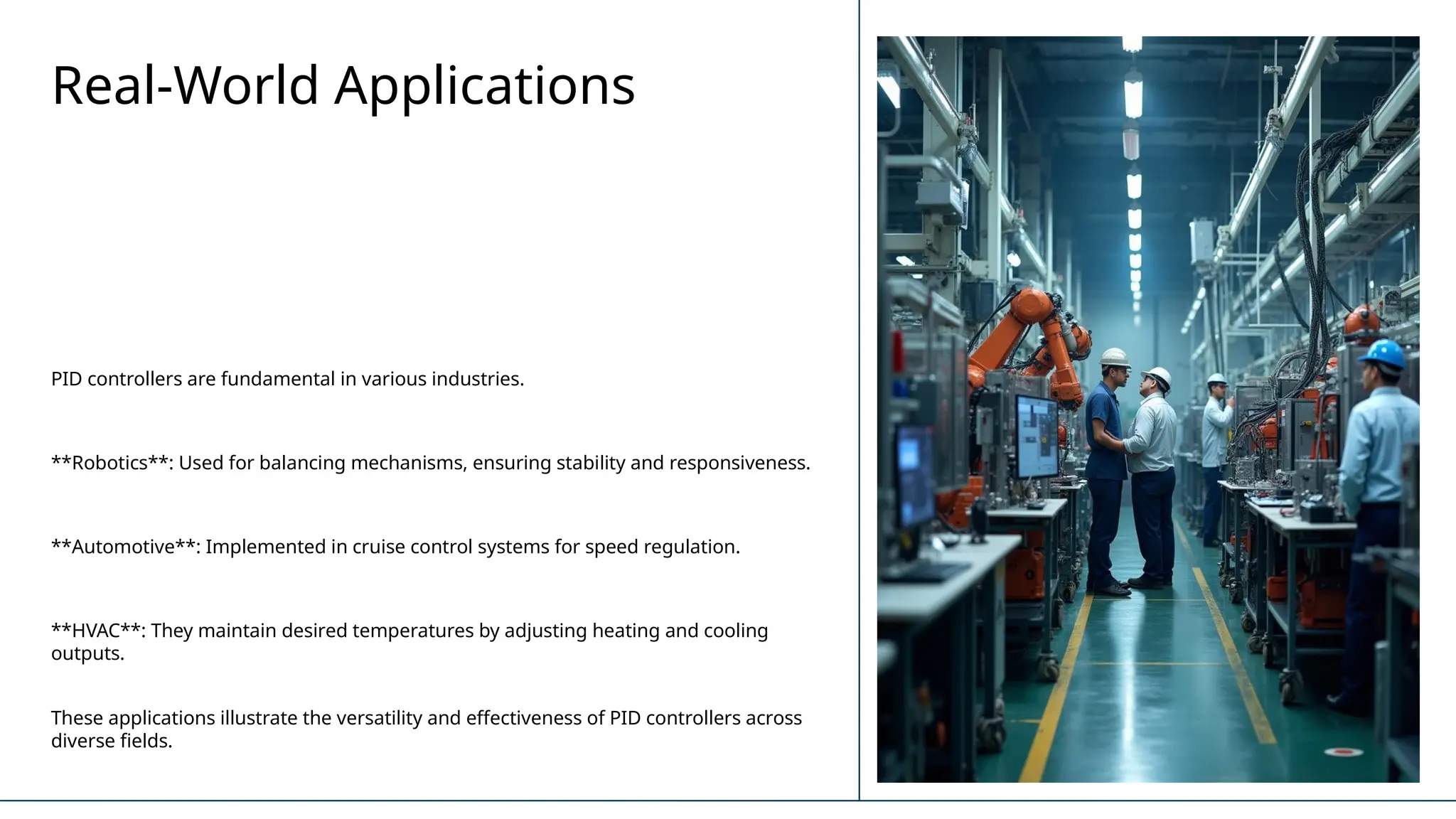
Real-World Applications
PID controllers are fundamental in various industries.
**Robotics**: Used for balancing mechanisms, ensuring stability and responsiveness.
**Automotive**: Implemented in cruise control systems for speed regulation.
**HVAC**: They maintain desired temperatures by adjusting heating and cooling
outputs.
These applications illustrate the versatility and effectiveness of PID controllers across
diverse fields.
Tuning Methods and Trade-offs
Tuning a PID controller effectively is crucial for optimal performance.
Common methods include:
- **Ziegler–Nichols**: A heuristic method providing a straightforward approach to tuning based on system
response.
- **Cohen–Coon**: Another strategy focused on process dynamics for quicker stability.
- **Trial-and-error**: Involves manual adjustments and observing system behavior to fine-tune parameters.
Trade-offs often arise; for instance, a high proportional gain results in faster responses but may lead to
overshooting, while high integral gain helps eliminate bias but can introduce oscillations.
Importance of Effective Tuning
Effective tuning is vital for achieving desired responses in control systems. A well-tuned PID controller
ensures:
- Optimal performance: Smoother system response with minimal overshoot.
- Stability: Reduced oscillations and improved reliability in control applications.
- Flexibility: Better adaptation to changes in system dynamics.
Understanding the significance of tuning allows engineers to enhance system efficiencies and overall
performance.
Conclusions
In summary, PID controllers are essential tools in automation,
characterized by their Proportional, Integral, and Derivative
components.
Effective understanding and tuning of these controllers lead to
enhanced performance and reliability across various applications.
Encouraging further exploration and practical experimentation
will enable better familiarity with PID systems, leading to
innovative solutions in control engineering.
CREDITS: This presentation template was created by Slidesgo,
and includes icons, infographics & images by Freepik
Thank you!
Do you have any questions?
+00 000 000 000

Introduction to PID Controllers in Control Systems.pptx

  • 1.
  • 2.
    Introduction PID controllers areessential in automation, providing precise control for various processes. This presentation explores the fundamentals, key components, and applications of PID controllers in different industries. By understanding the Proportional, Integral, and Derivative terms, professionals can effectively implement and optimize control strategies. The aim is to enhance audience comprehension of PID systems and encourage practical exploration.
  • 3.
  • 4.
    Definition and KeyRoles A PID (Proportional-Integral-Derivative) controller continuously calculates the error between a setpoint and a process variable. This system adjusts outputs to minimize that error. Key roles include: - **Proportional**: Provides immediate correction based on current error magnitude. - **Integral**: Accumulates past errors, eliminating steady-state offset. - **Derivative**: Anticipates future errors, smoothing system response.
  • 5.
    Structure and Formula Overview Thestructure of a PID controller includes a block diagram visually representing input, PID calculations, and output feedback. The formula for the PID controller is: 𝑢( ) = ( ) + (0 to ) ( ) + ( )/ 𝑡 𝐾𝑃𝑒 𝑡 𝐾𝐼 ∫ 𝑡 𝑒 𝜏 𝑑𝜏 𝐾𝐷 𝑑𝑒 𝑡 𝑑𝑡 This equation illustrates the contributions of each term in adjusting the control output, essential for achieving desired system performance.
  • 6.
    Individual Terms: P,I, D Explained The PID controller consists of three essential components: - **Proportional (P)**: This term provides immediate feedback proportional to the current error, allowing for quick adjustments. - **Integral (I)**: This component accumulates past errors, correcting any residual steady-state error and ensuring the output stabilizes. - **Derivative (D)**: Anticipating future error trends, the derivative term adjusts the output based on the rate of change of the error, promoting stability and reducing overshoot.
  • 7.
  • 8.
    Real-World Applications PID controllersare fundamental in various industries. **Robotics**: Used for balancing mechanisms, ensuring stability and responsiveness. **Automotive**: Implemented in cruise control systems for speed regulation. **HVAC**: They maintain desired temperatures by adjusting heating and cooling outputs. These applications illustrate the versatility and effectiveness of PID controllers across diverse fields.
  • 9.
    Tuning Methods andTrade-offs Tuning a PID controller effectively is crucial for optimal performance. Common methods include: - **Ziegler–Nichols**: A heuristic method providing a straightforward approach to tuning based on system response. - **Cohen–Coon**: Another strategy focused on process dynamics for quicker stability. - **Trial-and-error**: Involves manual adjustments and observing system behavior to fine-tune parameters. Trade-offs often arise; for instance, a high proportional gain results in faster responses but may lead to overshooting, while high integral gain helps eliminate bias but can introduce oscillations.
  • 10.
    Importance of EffectiveTuning Effective tuning is vital for achieving desired responses in control systems. A well-tuned PID controller ensures: - Optimal performance: Smoother system response with minimal overshoot. - Stability: Reduced oscillations and improved reliability in control applications. - Flexibility: Better adaptation to changes in system dynamics. Understanding the significance of tuning allows engineers to enhance system efficiencies and overall performance.
  • 11.
    Conclusions In summary, PIDcontrollers are essential tools in automation, characterized by their Proportional, Integral, and Derivative components. Effective understanding and tuning of these controllers lead to enhanced performance and reliability across various applications. Encouraging further exploration and practical experimentation will enable better familiarity with PID systems, leading to innovative solutions in control engineering.
  • 12.
    CREDITS: This presentationtemplate was created by Slidesgo, and includes icons, infographics & images by Freepik Thank you! Do you have any questions? +00 000 000 000