Judgment and Decision Making:
   Psychological Perspectives
        Dr David Hardman
   London Metropolitan University
Lecture overview
• General approach taken to judgment &
  decision making by psychologists
• Heuristics & biases
• Dynamic decision making
• Decisions in groups and teams
• Taking advice
General psychological approach
• Limited capacity information processors
• Bounded rationality (Simon, 1955; 1956)
• Use of heuristics (Kahneman, Slovic, & Tversky,
  1982), often associated with biases
• Ecological vs. normative rationality
  (Gigerenzer, Czerlinski, & Martignon, 2002)
• Intuitive vs. Reflective thinking
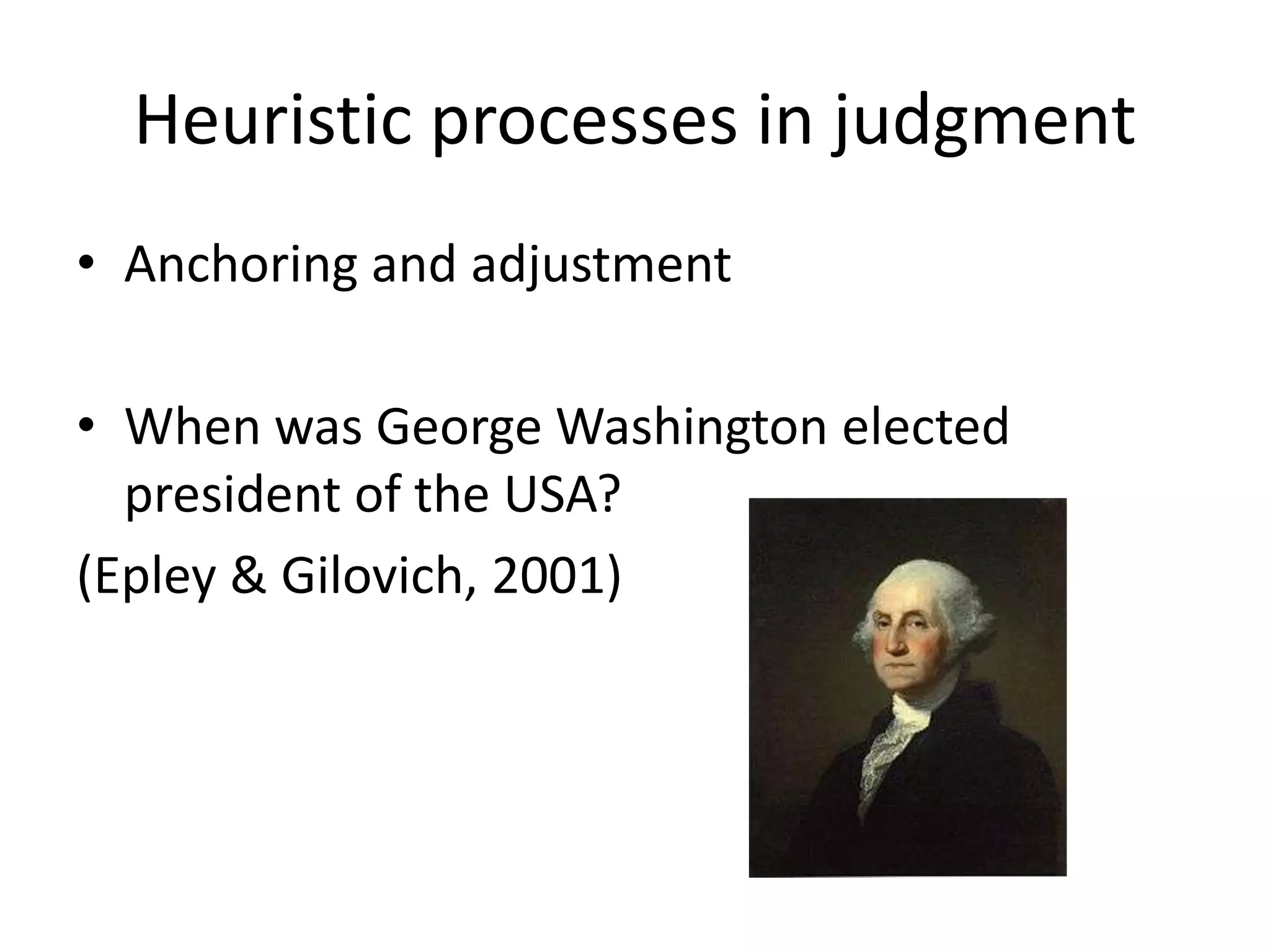
Heuristic processes in judgment
• Anchoring and adjustment

• When was George Washington elected
  president of the USA?
(Epley & Gilovich, 2001)
Clinical versus actuarial prediction
• Linear models are better predictors than
  human judges
• E.g. Einhorn (1972), predicting survival time
  following a diagnosis of Hodgkin’s Disease
• Interviews are poor predictors of future
  performance (e.g. DeVaul et al, 1987)
Clinical versus actuarial prediction
Why are statistical models better?
• Always applied consistently (e.g. people experience fatigue or boredom)
• People sometimes focus on information that has little or no relevance
• People may select appropriate information but weight it inappropriately
• When given additional information people often identify individual cases
  as exceptions to the rule
• People may be exposed to skewed samples
• People are subject to the fundamental attribution error in interview
  situations
• Prompt accurate feedback is not always available to people
• People may be unduly influenced by recent experience or irrelevant
  variations in task description
Biases in decision making
• Framing effects (e.g. Tversky & Kahneman,
  1981)
• Sunk costs (e.g. Arkes & Blumer, 1985)

(There are many other biases!)
Framing effects
Imagine that the US is preparing for the outbreak of an
unusual Asian disease that is expected to kill 600 people. Two
alternative programs to combat the disease have been
proposed. Assume that the exact scientific consequences of
the programs are as follows.

Program A. If Program A is adopted 200 people will be saved.
[72%]
Program B. If Program B is adopted there is a 1/3 probability
that 600 people will be saved and a 2/3 probability that no
people will be saved. [28%]

Which of the two programs would you favour?
Framing effects
Imagine that the US is preparing for the outbreak of an
unusual Asian disease that is expected to kill 600 people. Two
alternative programs to combat the disease have been
proposed. Assume that the exact scientific consequences of
the programs are as follows.

Program C. If Program C is adopted 400 people will die. [22%]
Program D. If Program D is adopted there is a 1/3 probability
that nobody will die and a 2/3 probability that 600 people will
die. [78%]

Which of the two programs would you favour?
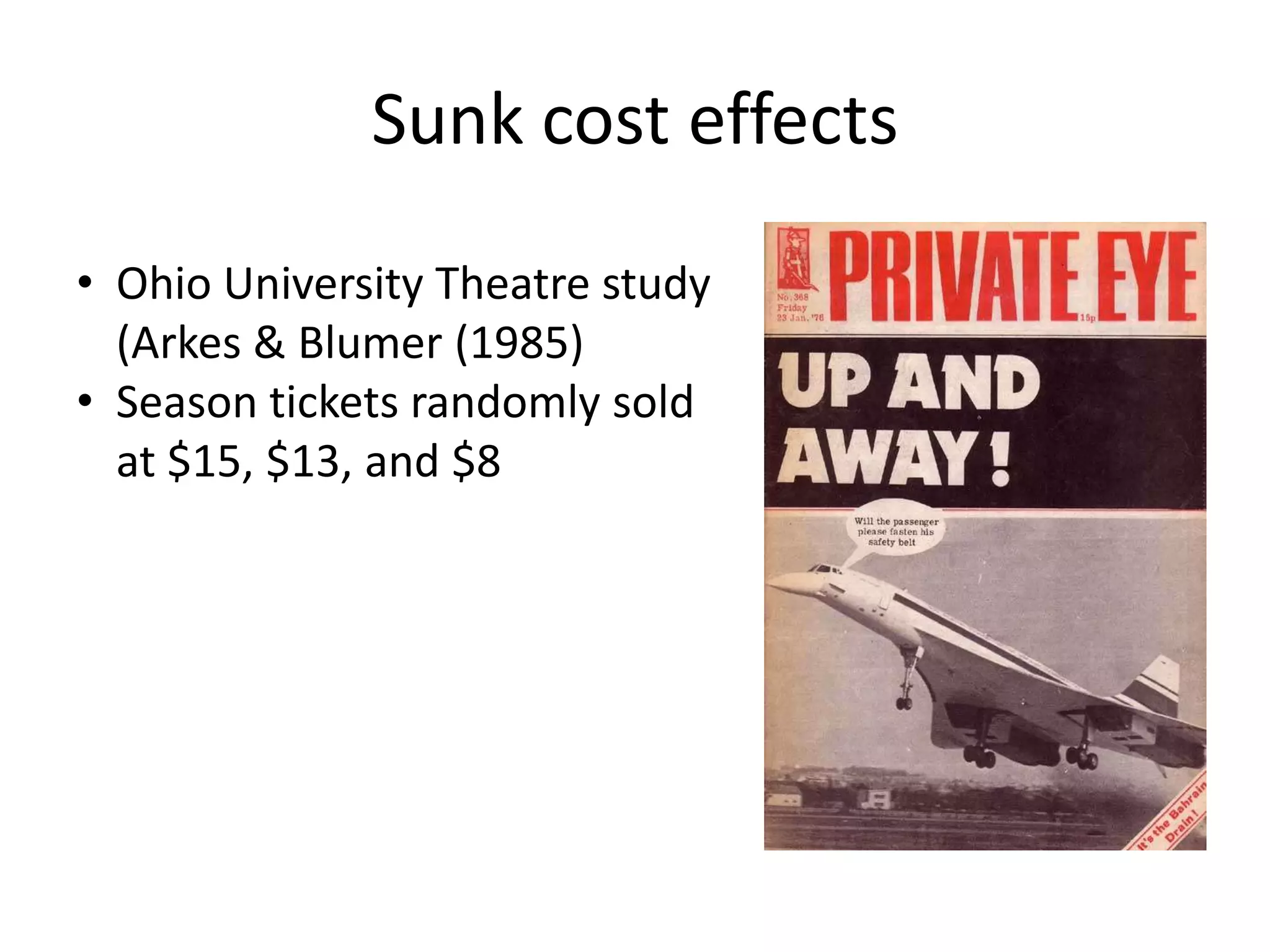
Sunk cost effects
• Ohio University Theatre study
  (Arkes & Blumer (1985)
• Season tickets randomly sold
  at $15, $13, and $8
Dynamic Decisions
The Beer Distribution Game
(Sterman, 1989)
• Four players: manufacturer,
   distributor, wholesaler,
   retailer. Each begins the
   game with 12 cases of beer.
1. Retailer turns over
    “demand card”, places
    order with wholesaler.
2. Wholesaler orders from
    distributor.
3. Distributor orders from
    manufacturer.
Complicating factors in the Beer Distribution
Game:
• Time delay between ordering and receiving
  beer.
• There is a charge of $0.50 for each case of
  beer held in inventory.
• If a player runs out of beer there is a $1 fine
  for each case currently being demanded.
Pattern of ordering in the Beer Distribution
Game:
• The first four weeks (trials) are practice only.
• In the first three weeks everyone is directed to
  order four cases. From week four they can
  order what they like.
• In week 5 the retailer’s demand card jumps to
  eight cases and remains there for the rest of
  the game.
Behaviour in the Beer Distribution Game
• Oscillatory patterns between over-ordering
  and under-ordering. Costly cycles of boom
  and bust.
“Many participants are quite
shocked when the actual
pattern of customer orders is
revealed; some voice strong
disbelief. Few ever suggest
that their own decisions were
the cause of the behaviour
they experienced. Fewer still
explain the pattern of
oscillation in terms of the
feedback structure, time
delays, or stock and flow
structure of the game”
(Sterman, 1989, p.336)
Dynamic Decisions
• On other tasks,            • Longer feedback delays
  performance is typically     are associated with
  sub-optimal (though          worse performance
  not necessarily a cyclical   (Diehl & Sterman, 1995)
  pattern)
• Learning tends to be
  implicit (Berry &
  Broadbent, 1984)
• Learning tends to be
  local
Individual differences in dynamic
             decision making
Intelligence                        Decision styles
• In DDM higher cognitive           • Evidence is rather weak
   ability is associated with (a)   • Different studies claim to
   less use of heuristics and (b)     identify different styles
   better performance (e.g.         • Though intuition vs
   Gonzalez, 2004)                    reflection are often
• IQ is a better predictor of         identified
   job performance than any         • Can “styles” be
   other known factor                 distinguished from
• Though see also Stanovich           “ability”?
   & West (2008)                    • Few studies investigate real-
                                      world performance (but see
                                      Scott & Bruce, 1995)
Groups, Teams, and Leadership
Socially cohesive teams   Diverse teams
• More willing to share   • More unique knowledge
  unique information         held by members
• But have less unique    • But may be less willing to
  information to share       share it (problem of hidden
                             profiles)
Decisions in Groups and Teams
Some problems of group decision making:
• Conformity to majority opinion (a problem if
  the majority is wrong)
• Obedience to authority
• Group polarisation
• Groupthink
Possible techniques for improving
            group processes
• Brainstorming? Ineffective.
• Electronic brainstorming. Effective.
• Decision rules:
   - averaging (in the absence of discussion)
   works well for numerical estimates
   - majority rule for decisions appears superior
   (Hastie & Kameda, 2005)
• Systematic procedures: Delphi technique;
  Decision conferencing.
Taking advice
• One of the most robust findings is egocentric advice
  discounting (Bonaccio & Dalal, 2006)
• People weight advice more heavily if they’ve paid for it
• Some advisers have more influence than others
• What should you do if two advisers provide conflicting
  forecasts?
• People often rely on a confidence heuristic (Price &
  Stone, 2004)
• People experiencing feelings of power discount advice
  from both novices and experts (Tost et al, 2012) and
  are more overconfident in their decisions (Fast et al,
  2012)
Summary
• People are imperfect, inconsistent decision
  makers
• Susceptible to various influences, e.g. framing,
  sunk costs
• Suboptimal performance on dynamic
  decisions; implicit learning
• Group decision making isn’t a cure
• Egocentric advice discounting
References
Key reading:
Hardman, D. (2009). Judgment and decision making psychological perspectives.
Chichester, UK: BPS-Blackwell. [see especially chapters 11 and 13]

Selected papers:
Bonaccio, S., & Dalal, R.S. (2006). Advice taking and decision-making:An integrative
literature review, and implications for the organizational sciences. Organizational
Behavior and Human Decision Processes, 101, 127-151.
Diehl, E., & Sterman, J.D. (1995). Effects of feedback complexity on dynamic decision
making. Organizational Behavior and Human Decision Processes, 62 (2), 198-215.
Gonzalez, C. (2004). Learning to make decisions in dynamic environments: Effects of
time constraints and cognitive abilities. Human Factors, 46 (3), 449-460.
Hastie, R., & Kameda, T. (2005). The robust beauty of majority rules in group decisions.
Psychological Review, 112 (2), 494-508.
Sterman, J.D. (1989). Modeling managerial behavior: Misperceptions of feedback in a
dynamic decision making experiment. Management Science, 35 (3), 321-339.

Judgment and decision making

  • 1.
    Judgment and DecisionMaking: Psychological Perspectives Dr David Hardman London Metropolitan University
  • 2.
    Lecture overview • Generalapproach taken to judgment & decision making by psychologists • Heuristics & biases • Dynamic decision making • Decisions in groups and teams • Taking advice
  • 3.
    General psychological approach •Limited capacity information processors • Bounded rationality (Simon, 1955; 1956) • Use of heuristics (Kahneman, Slovic, & Tversky, 1982), often associated with biases • Ecological vs. normative rationality (Gigerenzer, Czerlinski, & Martignon, 2002) • Intuitive vs. Reflective thinking
  • 4.
    Heuristic processes injudgment • Anchoring and adjustment • When was George Washington elected president of the USA? (Epley & Gilovich, 2001)
  • 5.
    Clinical versus actuarialprediction • Linear models are better predictors than human judges • E.g. Einhorn (1972), predicting survival time following a diagnosis of Hodgkin’s Disease • Interviews are poor predictors of future performance (e.g. DeVaul et al, 1987)
  • 6.
    Clinical versus actuarialprediction Why are statistical models better? • Always applied consistently (e.g. people experience fatigue or boredom) • People sometimes focus on information that has little or no relevance • People may select appropriate information but weight it inappropriately • When given additional information people often identify individual cases as exceptions to the rule • People may be exposed to skewed samples • People are subject to the fundamental attribution error in interview situations • Prompt accurate feedback is not always available to people • People may be unduly influenced by recent experience or irrelevant variations in task description
  • 7.
    Biases in decisionmaking • Framing effects (e.g. Tversky & Kahneman, 1981) • Sunk costs (e.g. Arkes & Blumer, 1985) (There are many other biases!)
  • 8.
    Framing effects Imagine thatthe US is preparing for the outbreak of an unusual Asian disease that is expected to kill 600 people. Two alternative programs to combat the disease have been proposed. Assume that the exact scientific consequences of the programs are as follows. Program A. If Program A is adopted 200 people will be saved. [72%] Program B. If Program B is adopted there is a 1/3 probability that 600 people will be saved and a 2/3 probability that no people will be saved. [28%] Which of the two programs would you favour?
  • 9.
    Framing effects Imagine thatthe US is preparing for the outbreak of an unusual Asian disease that is expected to kill 600 people. Two alternative programs to combat the disease have been proposed. Assume that the exact scientific consequences of the programs are as follows. Program C. If Program C is adopted 400 people will die. [22%] Program D. If Program D is adopted there is a 1/3 probability that nobody will die and a 2/3 probability that 600 people will die. [78%] Which of the two programs would you favour?
  • 10.
    Sunk cost effects •Ohio University Theatre study (Arkes & Blumer (1985) • Season tickets randomly sold at $15, $13, and $8
  • 11.
    Dynamic Decisions The BeerDistribution Game (Sterman, 1989) • Four players: manufacturer, distributor, wholesaler, retailer. Each begins the game with 12 cases of beer. 1. Retailer turns over “demand card”, places order with wholesaler. 2. Wholesaler orders from distributor. 3. Distributor orders from manufacturer.
  • 12.
    Complicating factors inthe Beer Distribution Game: • Time delay between ordering and receiving beer. • There is a charge of $0.50 for each case of beer held in inventory. • If a player runs out of beer there is a $1 fine for each case currently being demanded.
  • 13.
    Pattern of orderingin the Beer Distribution Game: • The first four weeks (trials) are practice only. • In the first three weeks everyone is directed to order four cases. From week four they can order what they like. • In week 5 the retailer’s demand card jumps to eight cases and remains there for the rest of the game.
  • 14.
    Behaviour in theBeer Distribution Game • Oscillatory patterns between over-ordering and under-ordering. Costly cycles of boom and bust.
  • 15.
    “Many participants arequite shocked when the actual pattern of customer orders is revealed; some voice strong disbelief. Few ever suggest that their own decisions were the cause of the behaviour they experienced. Fewer still explain the pattern of oscillation in terms of the feedback structure, time delays, or stock and flow structure of the game” (Sterman, 1989, p.336)
  • 16.
    Dynamic Decisions • Onother tasks, • Longer feedback delays performance is typically are associated with sub-optimal (though worse performance not necessarily a cyclical (Diehl & Sterman, 1995) pattern) • Learning tends to be implicit (Berry & Broadbent, 1984) • Learning tends to be local
  • 17.
    Individual differences indynamic decision making Intelligence Decision styles • In DDM higher cognitive • Evidence is rather weak ability is associated with (a) • Different studies claim to less use of heuristics and (b) identify different styles better performance (e.g. • Though intuition vs Gonzalez, 2004) reflection are often • IQ is a better predictor of identified job performance than any • Can “styles” be other known factor distinguished from • Though see also Stanovich “ability”? & West (2008) • Few studies investigate real- world performance (but see Scott & Bruce, 1995)
  • 18.
    Groups, Teams, andLeadership Socially cohesive teams Diverse teams • More willing to share • More unique knowledge unique information held by members • But have less unique • But may be less willing to information to share share it (problem of hidden profiles)
  • 19.
    Decisions in Groupsand Teams Some problems of group decision making: • Conformity to majority opinion (a problem if the majority is wrong) • Obedience to authority • Group polarisation • Groupthink
  • 20.
    Possible techniques forimproving group processes • Brainstorming? Ineffective. • Electronic brainstorming. Effective. • Decision rules: - averaging (in the absence of discussion) works well for numerical estimates - majority rule for decisions appears superior (Hastie & Kameda, 2005) • Systematic procedures: Delphi technique; Decision conferencing.
  • 21.
    Taking advice • Oneof the most robust findings is egocentric advice discounting (Bonaccio & Dalal, 2006) • People weight advice more heavily if they’ve paid for it • Some advisers have more influence than others • What should you do if two advisers provide conflicting forecasts? • People often rely on a confidence heuristic (Price & Stone, 2004) • People experiencing feelings of power discount advice from both novices and experts (Tost et al, 2012) and are more overconfident in their decisions (Fast et al, 2012)
  • 22.
    Summary • People areimperfect, inconsistent decision makers • Susceptible to various influences, e.g. framing, sunk costs • Suboptimal performance on dynamic decisions; implicit learning • Group decision making isn’t a cure • Egocentric advice discounting
  • 23.
    References Key reading: Hardman, D.(2009). Judgment and decision making psychological perspectives. Chichester, UK: BPS-Blackwell. [see especially chapters 11 and 13] Selected papers: Bonaccio, S., & Dalal, R.S. (2006). Advice taking and decision-making:An integrative literature review, and implications for the organizational sciences. Organizational Behavior and Human Decision Processes, 101, 127-151. Diehl, E., & Sterman, J.D. (1995). Effects of feedback complexity on dynamic decision making. Organizational Behavior and Human Decision Processes, 62 (2), 198-215. Gonzalez, C. (2004). Learning to make decisions in dynamic environments: Effects of time constraints and cognitive abilities. Human Factors, 46 (3), 449-460. Hastie, R., & Kameda, T. (2005). The robust beauty of majority rules in group decisions. Psychological Review, 112 (2), 494-508. Sterman, J.D. (1989). Modeling managerial behavior: Misperceptions of feedback in a dynamic decision making experiment. Management Science, 35 (3), 321-339.

Editor's Notes

  • #15 Participants appear to anchor on a recent pattern of orders and inventory levels.Participants believe they are at the mercy of forces beyond their control, believing that customer demand was oscillatory.
  • #22 Bonaccio & Dalal (2006). Egocentric advice discounting – judges overweight their own opinion relative to that of advisers and only shift their position a token amount towards the adviser’s recommendation.People give more weight to advice from experts, older people, and those perceived to have greater life experience and wisdom.People weight advice more if they paid for it.