Why is open licensing
important for OGP?
Open Government Partnership
Civil Society Day workshop
Why do need legal standards and open
licensing in the first place?
● Legal clarity
● Or else! chilling effects
● Legal problems = huge timesuck
● Make it invisible
● Posting online not enough
● Put in PD or attach open license
● Machine-readable license
● It’s not so difficult!
What is enabled by clarifying legal standards?
● Efficient reuse by all, esp gov’
t
● Effective gov’t spending;
maximize investments
● Citizen participation,
collaboration, transparency
● Promote creativity,
innovation, unexpected uses
and applications
● Spur economic activity
● Example: Europeana - http:
//pro.europeana.eu/casestudies-edm
What is Creative Commons and how
does it work?
● CC licenses built on traditional copyright law
● works within existing system by allowing
movement from “all rights reserved” to
“some rights reserved”
● CC gives creators a choice about which
freedoms to grant and which rights to keep
● CC minimizes transaction costs by granting
the public certain permissions beforehand
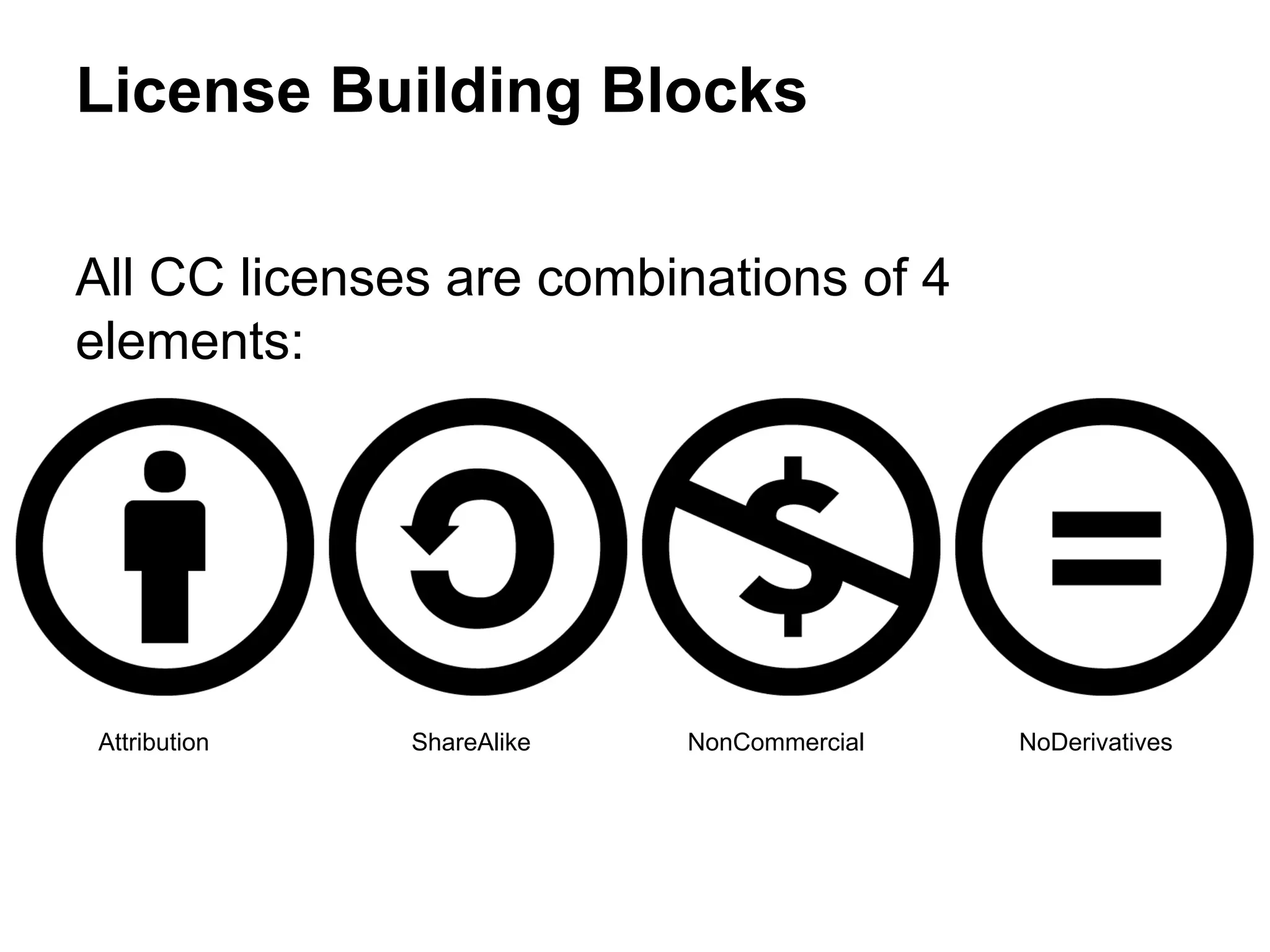
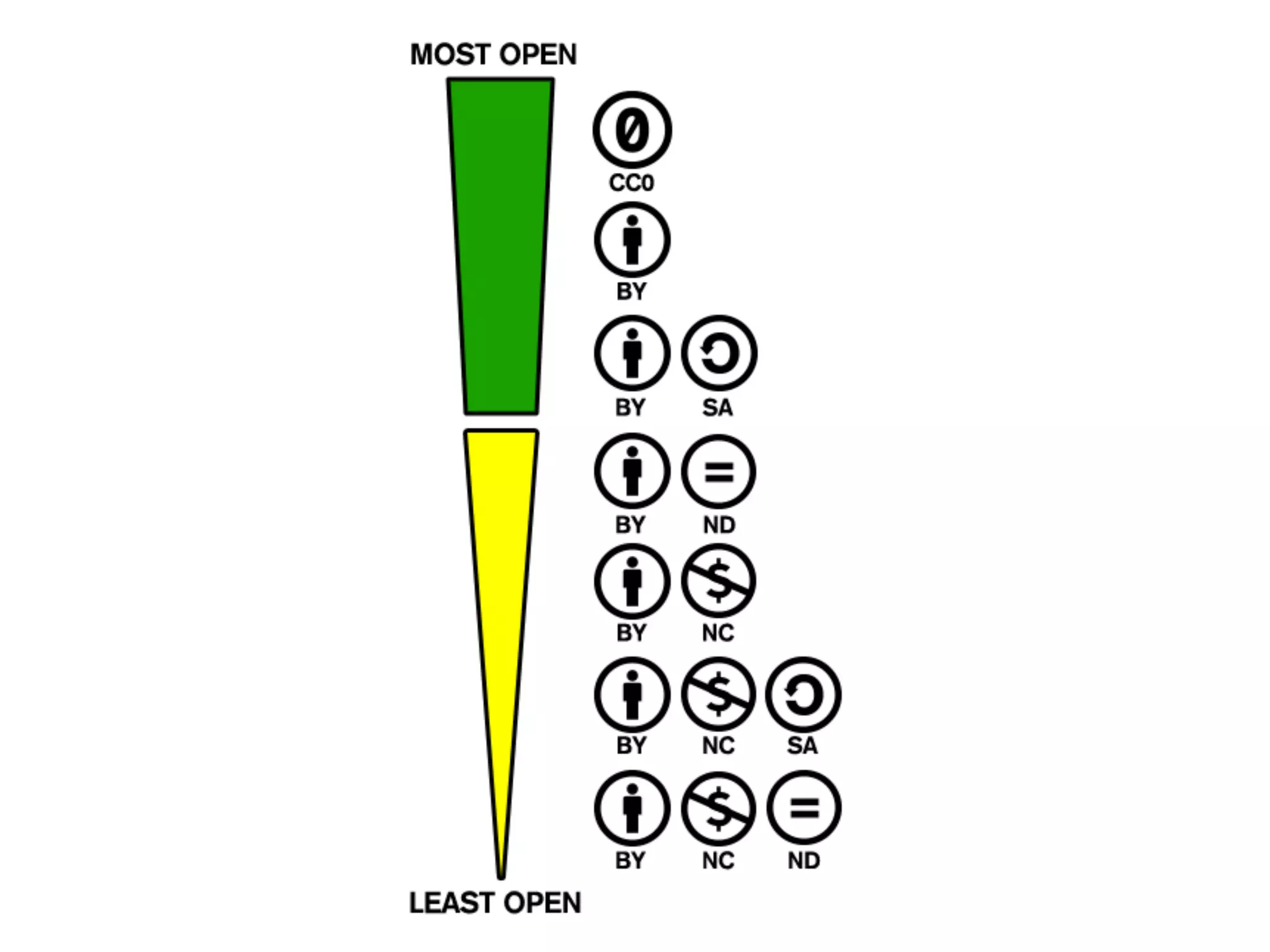
License Building Blocks
All CC licenses are combinations of 4
elements:

Attribution

ShareAlike

NonCommercial

NoDerivatives
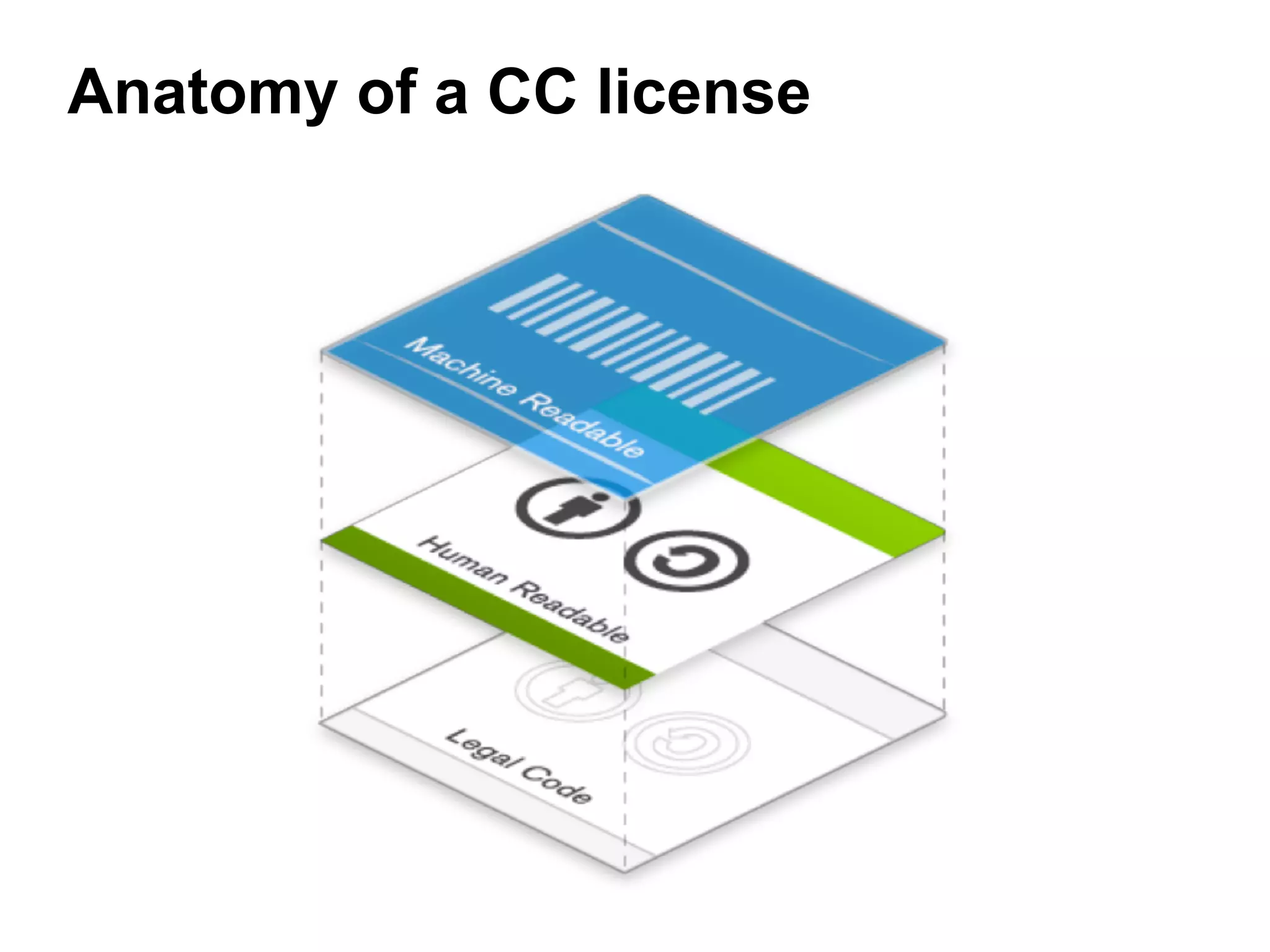
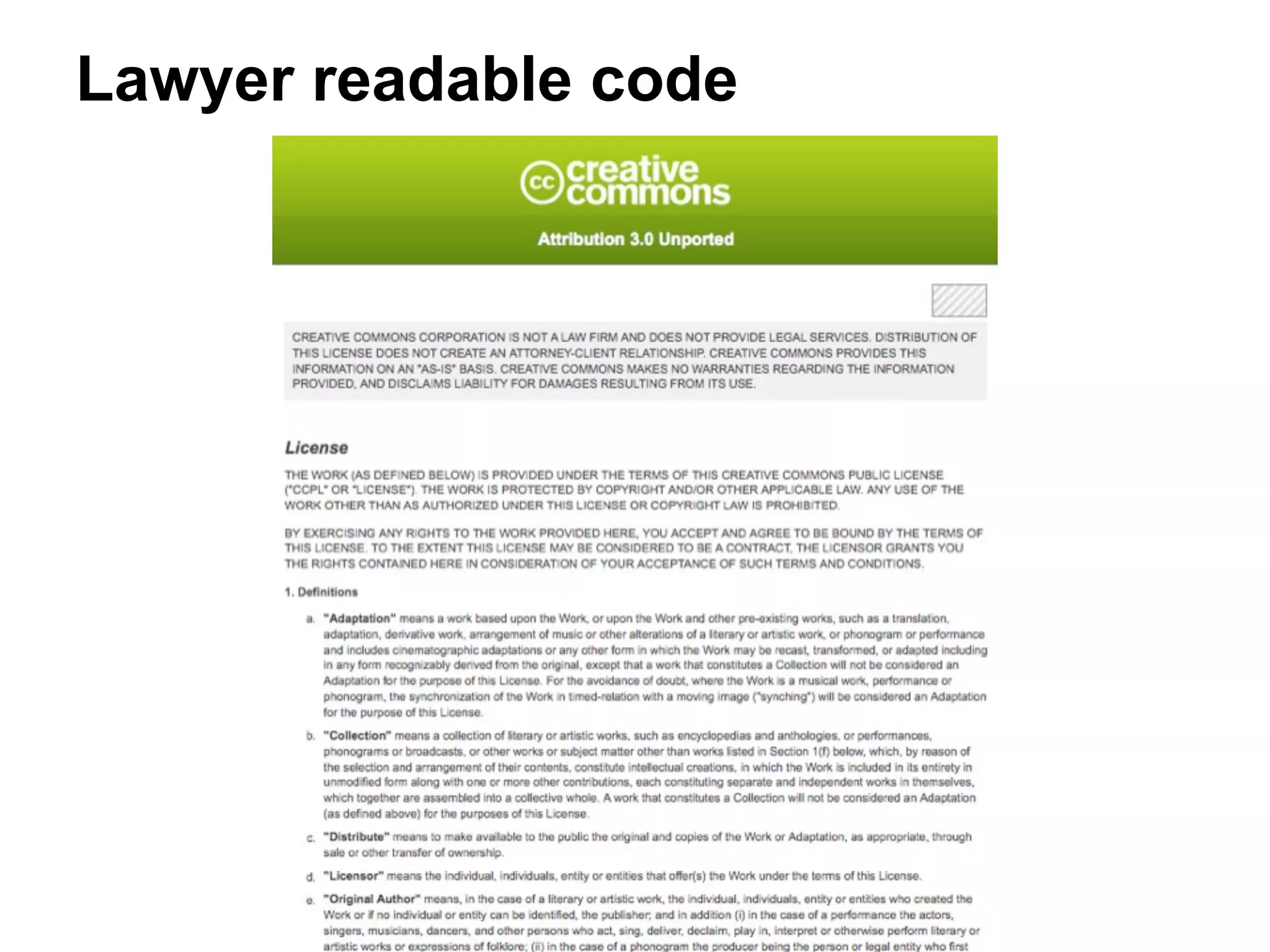
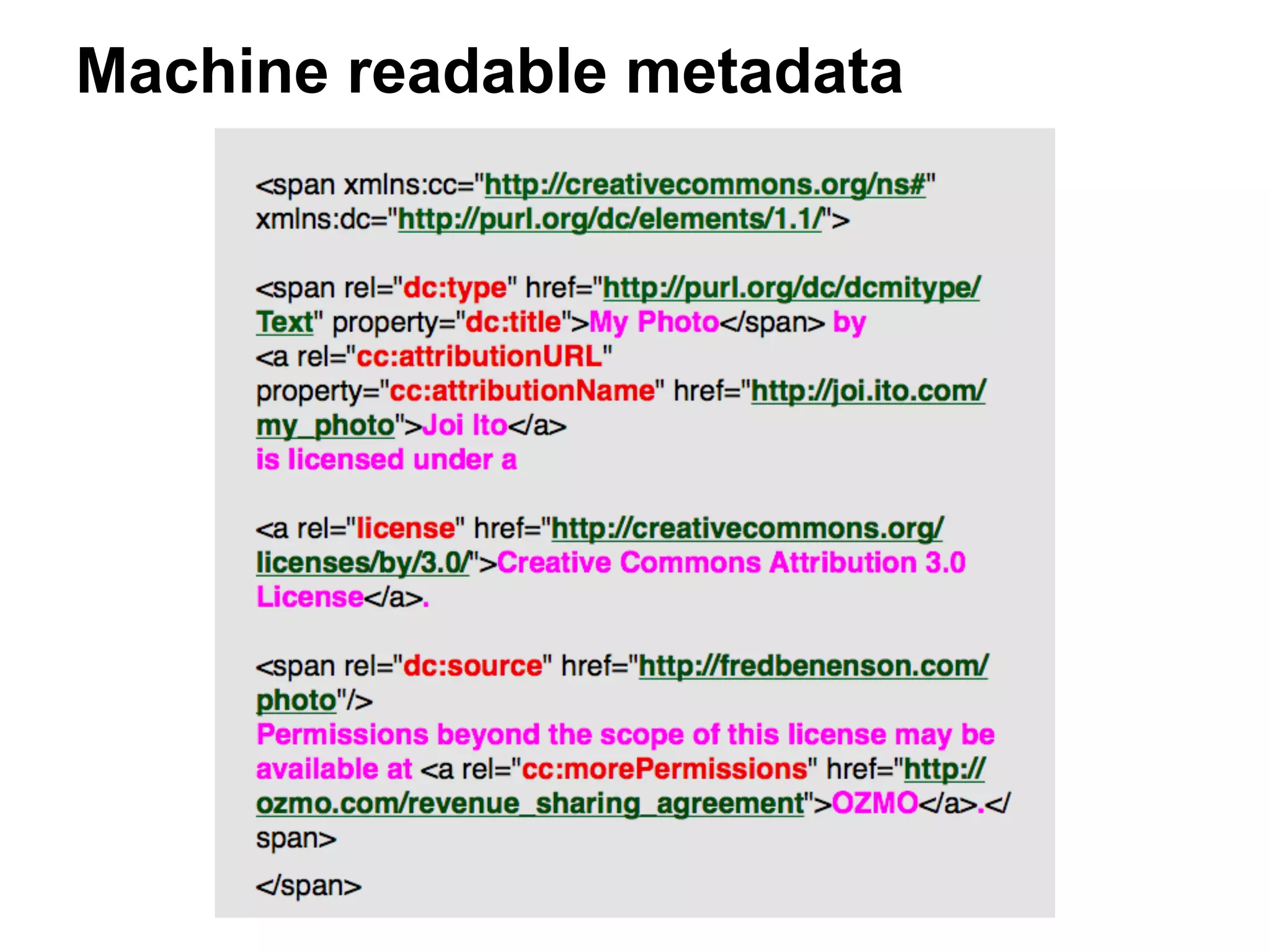
Anatomy of a CC license
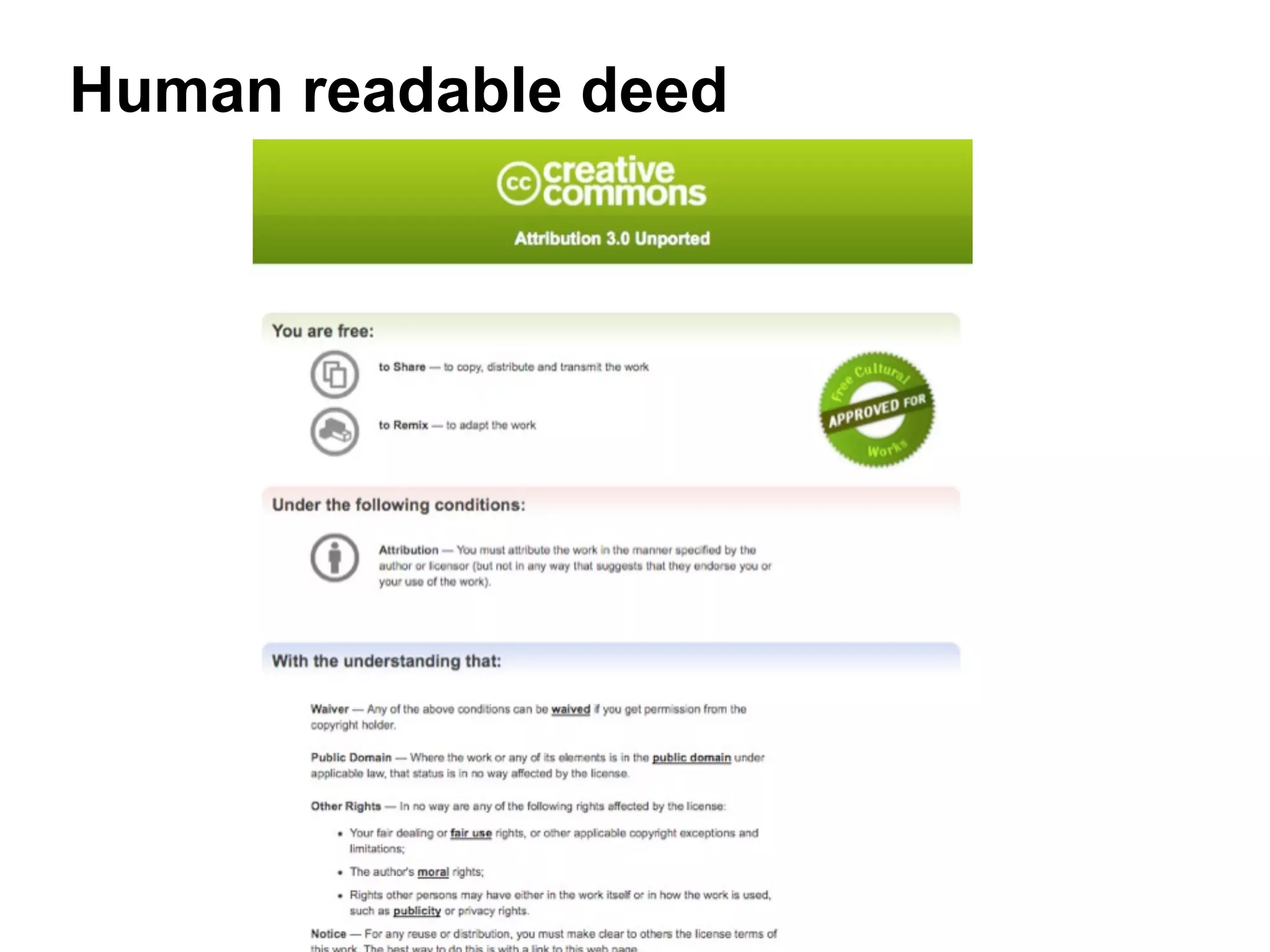
Human readable deed
Lawyer readable code
Machine readable metadata
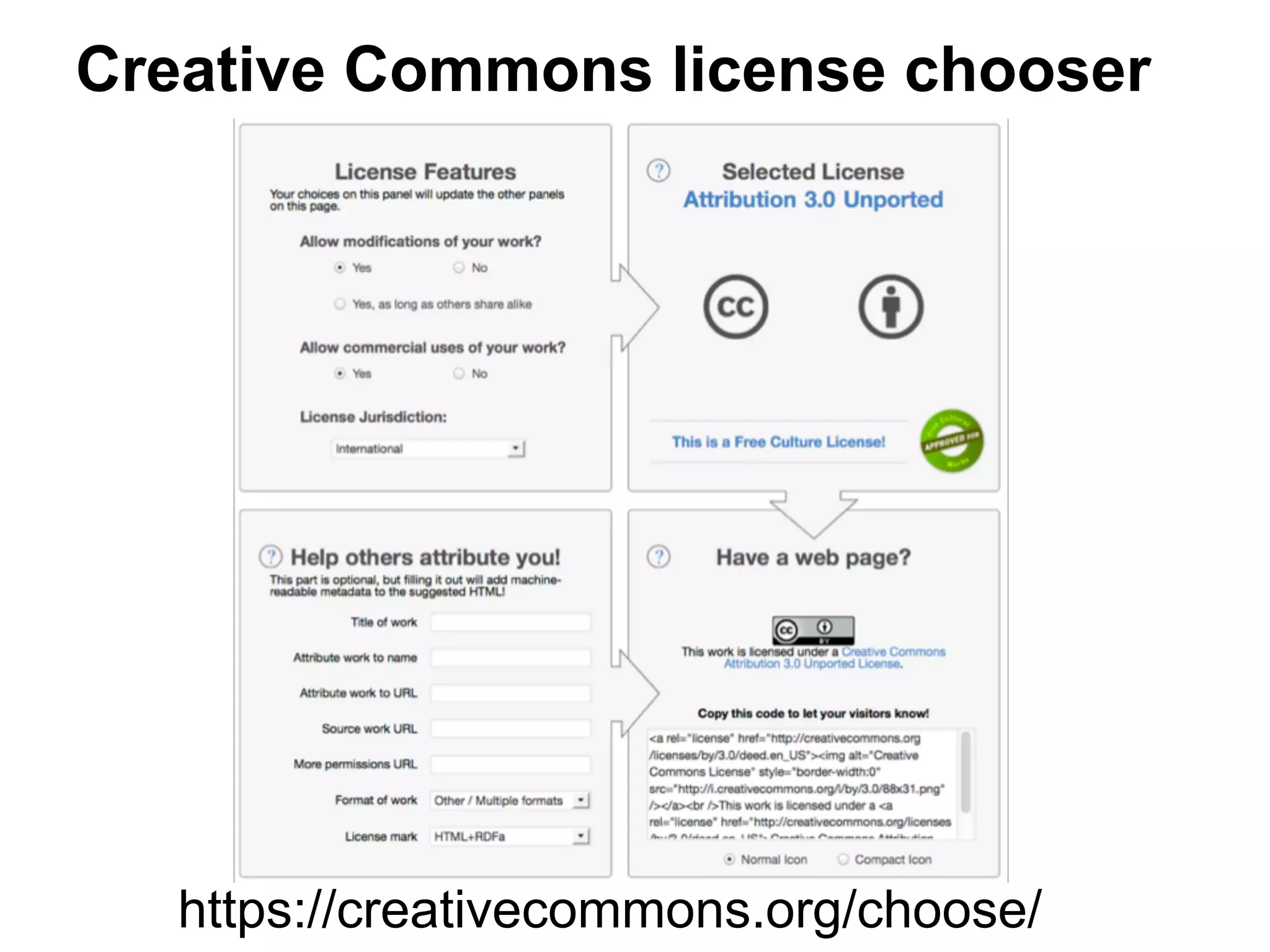
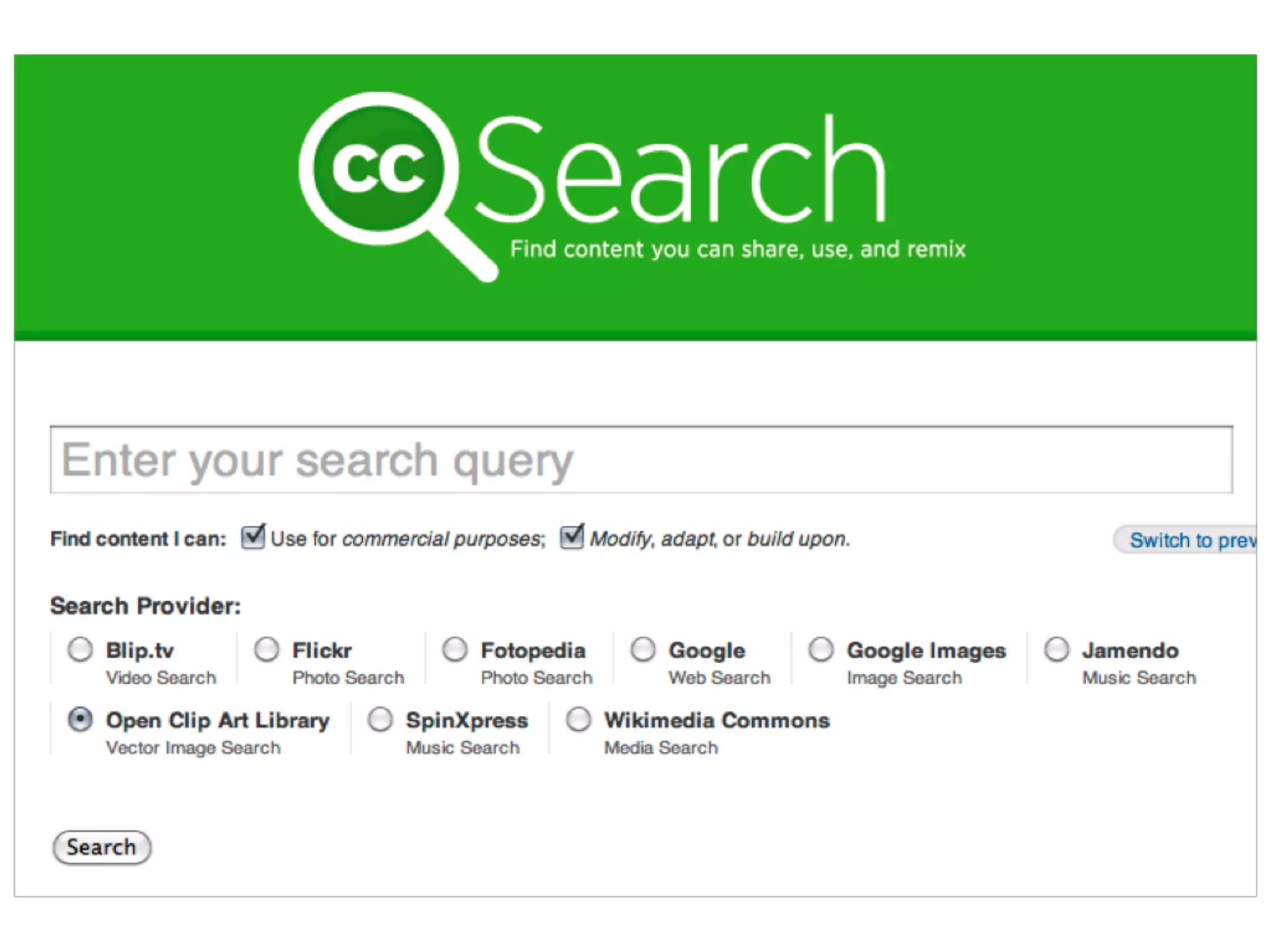
Creative Commons license chooser

https://creativecommons.org/choose/
Important License Attributes 1
●
●
●
●

Scope is copyright and related rights
All are non-exclusive, irrevocable licenses
All require attribution
All permit reuse for at least noncommercial
purposes in unmodified form
● Do not contract away user rights
(exceptions/limitations)
● CC licensor enters into separate license
agreement with each user
Important License Attributes 2
● License runs with the work; recipient may
not apply technological measures or
conditions that limit another recipient’s rights
under the license, e.g. no DRM
● no warranties
● license terminates immediately upon breach
● CC is not a party to the license
CC0 Public Domain Dedication
● read “CC Zero”
● universal waiver, permanently surrenders
copyright and related rights, placing the work
as nearly as possible into the worldwide
public domain
Public Domain Mark
● not legally operative, but a label to be used
by those with knowledge that a work is
already in the public domain
● useful for very old works where we know it is
in the public domain
● only intended for use with works in
worldwide public domain
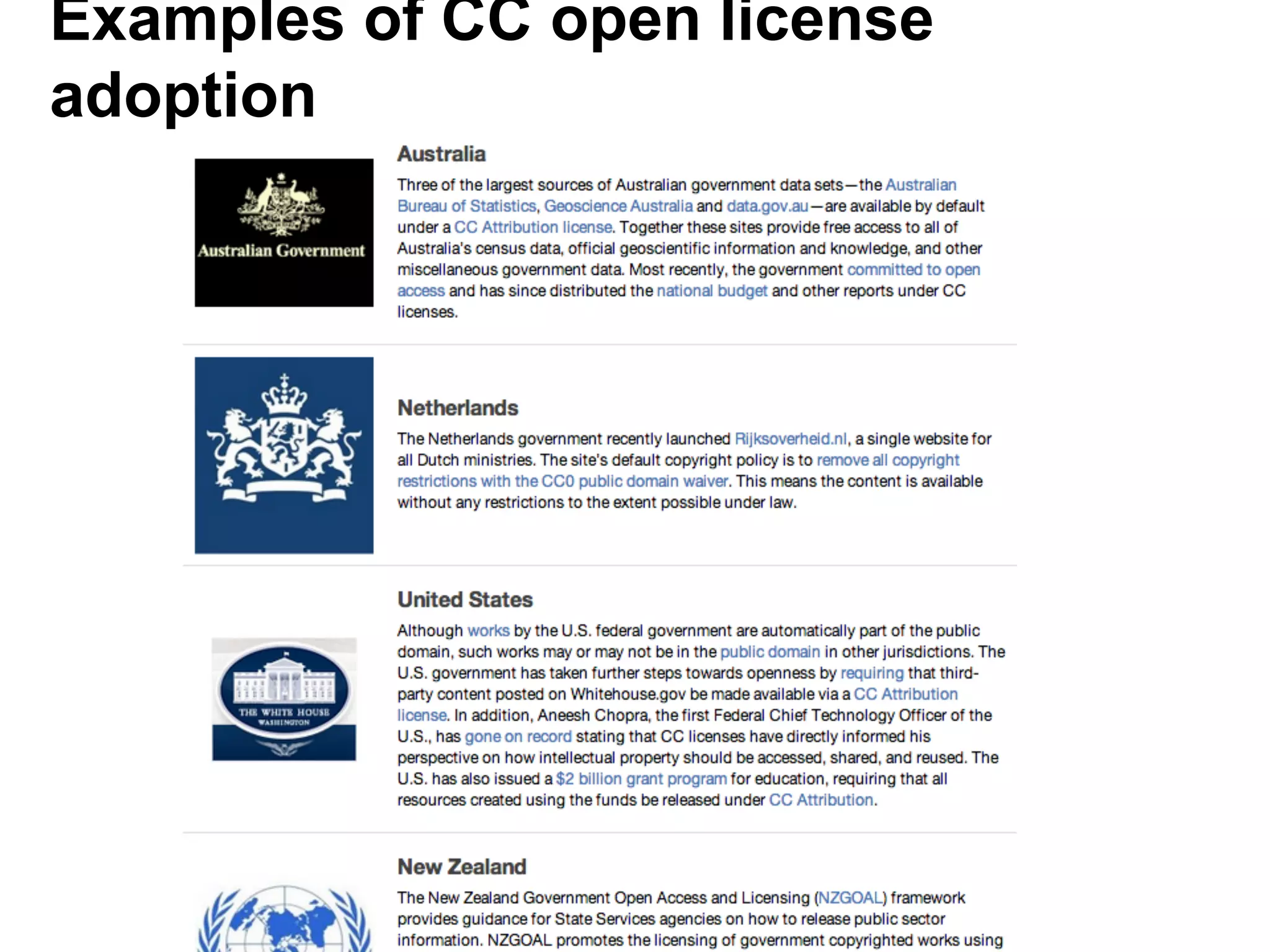
Examples of CC open license
adoption
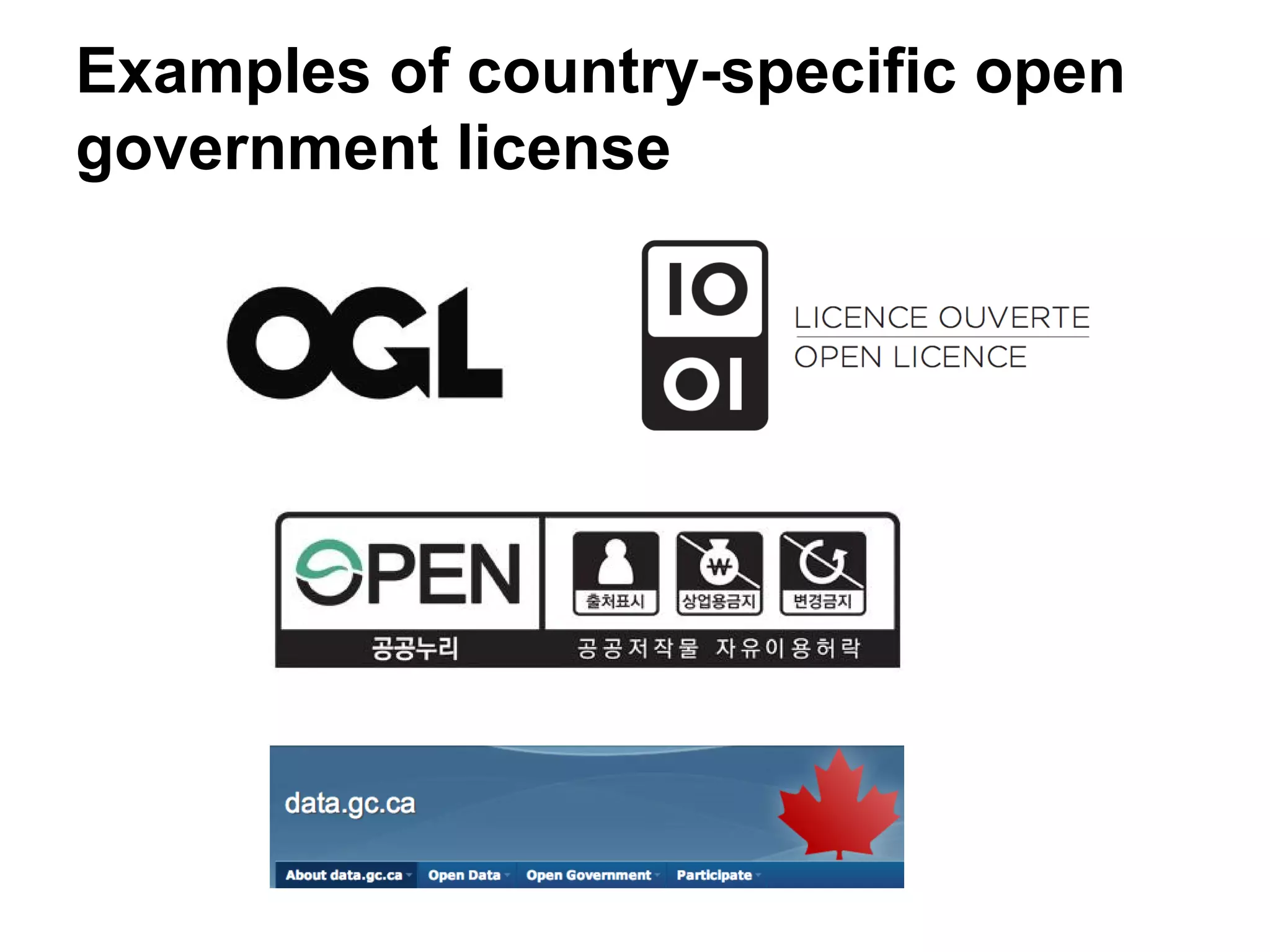
Examples of country-specific open
government license
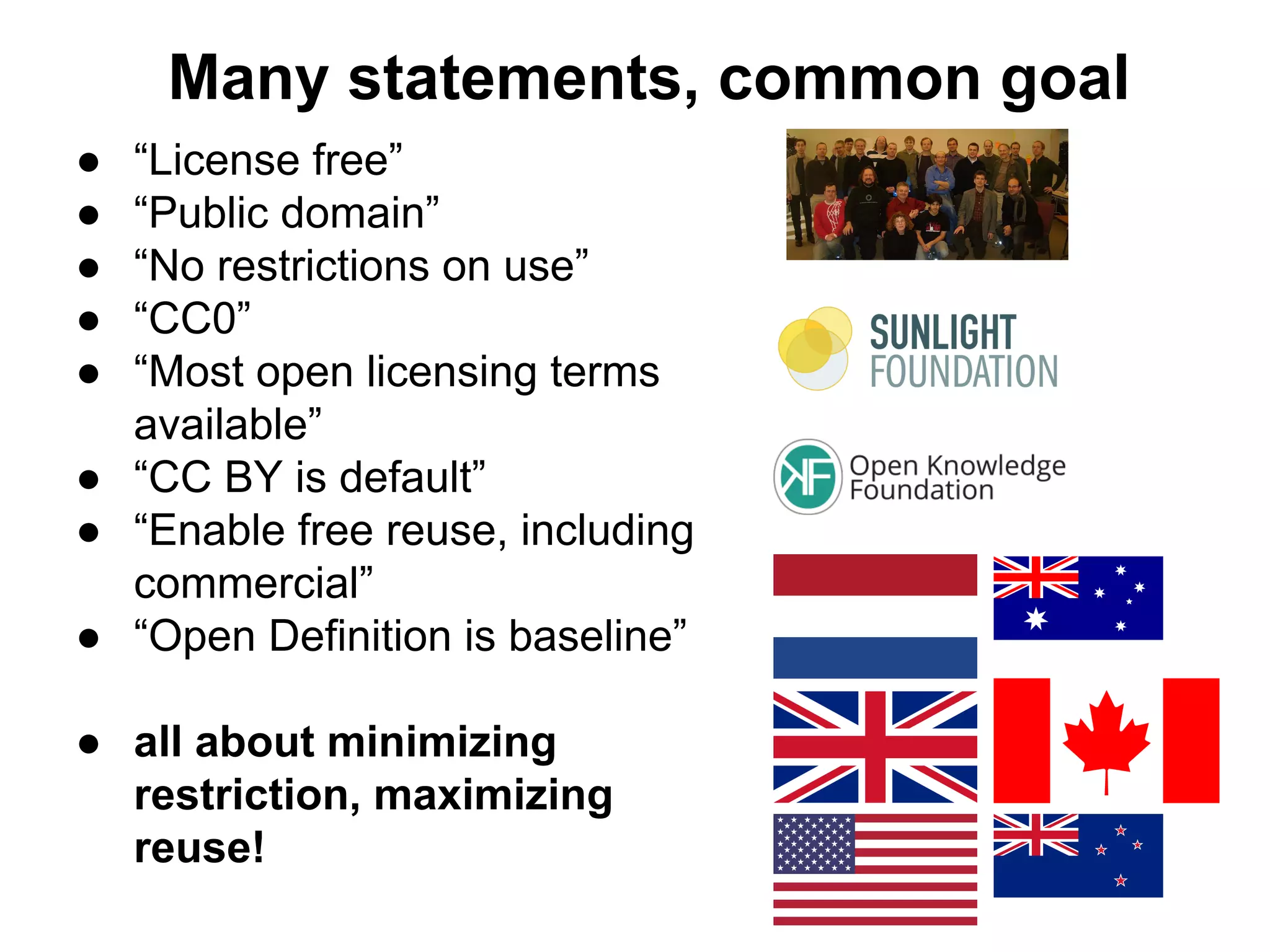
Many statements, common goal
●
●
●
●
●

“License free”
“Public domain”
“No restrictions on use”
“CC0”
“Most open licensing terms
available”
● “CC BY is default”
● “Enable free reuse, including
commercial”
● “Open Definition is baseline”
● all about minimizing
restriction, maximizing
reuse!
Challenges
● Public domain = problems solved
● Even better: harmonize limitations &
exceptions
● Ongoing “license envy”
● So be it, but keep out “poison” clauses
that kill interoperability
● Example: OGL 2.0
● Good moves: Open Definition WG,
LAPSI 2.0
So what should we use?
● Codify & harmonize limitations and
exceptions to copyright!
● CC0 to waive copyright worldwide
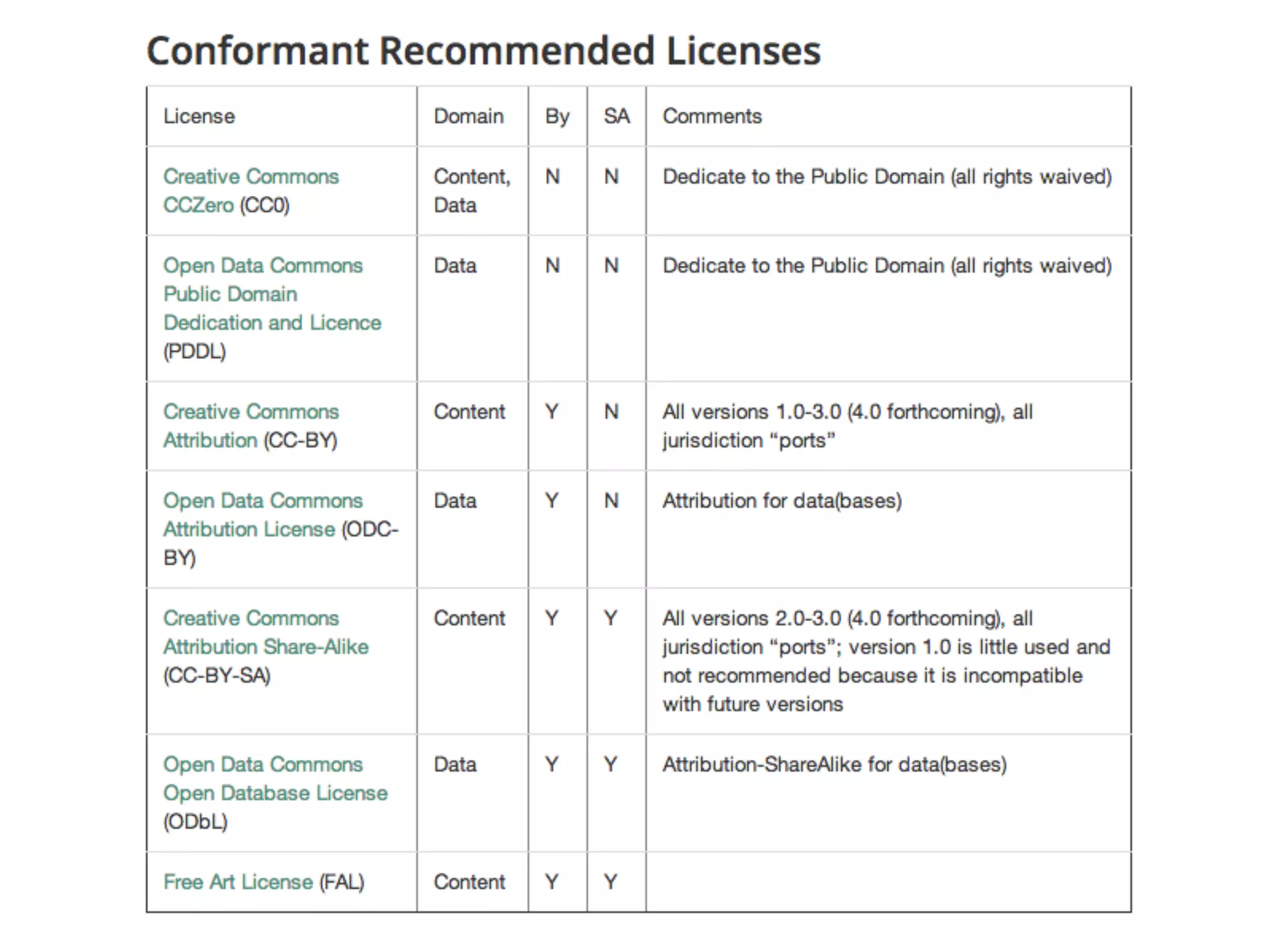
● Open Definition as baseline
○ means, reuse for any purpose (even commercial),
with at most requirement to attribute and sharealike
○ conformant licenses = http://opendefinition.
org/licenses/

● Push for most progressive policies, as fewer
restrictions leads to increased reuse
Resources and getting involved
● Open data handbook - http:
//opendatahandbook.org/
● LAPSI project - http://www.lapsi-project.eu/
● EC consultation on PSI Directive - http://bit.
ly/14JyJ8K
● CC affiliates in your country - http://wiki.
creativecommons.org/CC_Affiliate_Network

● OKFN, GODI, Sunlight Foundation
● Open Definition Working group
This work is dedicated to the public domain.
https://creativecommons.org/publicdomain/zero/1.0/.
Attribution is optional, but if desired, please attribute to Creative Commons.

Graphics
Credits
● Policy Icon - by The Noun Project - Public Domain
● Question Icon - by Rémy Médard, from The Noun Project - CC BY
● Stamp Icon - by Marino Cagnina, from The Noun Project - CC BY
● Big Idea Icon - Public Domain
● Puzzle Icon - by John O’Shea, from the Noun Project - CC BY

Open licensing workshop at OGP Civil Society Day

  • 1.
    Why is openlicensing important for OGP? Open Government Partnership Civil Society Day workshop
  • 2.
    Why do needlegal standards and open licensing in the first place? ● Legal clarity ● Or else! chilling effects ● Legal problems = huge timesuck ● Make it invisible ● Posting online not enough ● Put in PD or attach open license ● Machine-readable license ● It’s not so difficult!
  • 3.
    What is enabledby clarifying legal standards? ● Efficient reuse by all, esp gov’ t ● Effective gov’t spending; maximize investments ● Citizen participation, collaboration, transparency ● Promote creativity, innovation, unexpected uses and applications ● Spur economic activity ● Example: Europeana - http: //pro.europeana.eu/casestudies-edm
  • 4.
    What is CreativeCommons and how does it work? ● CC licenses built on traditional copyright law ● works within existing system by allowing movement from “all rights reserved” to “some rights reserved” ● CC gives creators a choice about which freedoms to grant and which rights to keep ● CC minimizes transaction costs by granting the public certain permissions beforehand
  • 5.
    License Building Blocks AllCC licenses are combinations of 4 elements: Attribution ShareAlike NonCommercial NoDerivatives
  • 7.
    Anatomy of aCC license
  • 8.
  • 9.
  • 10.
  • 11.
    Creative Commons licensechooser https://creativecommons.org/choose/
  • 13.
    Important License Attributes1 ● ● ● ● Scope is copyright and related rights All are non-exclusive, irrevocable licenses All require attribution All permit reuse for at least noncommercial purposes in unmodified form ● Do not contract away user rights (exceptions/limitations) ● CC licensor enters into separate license agreement with each user
  • 14.
    Important License Attributes2 ● License runs with the work; recipient may not apply technological measures or conditions that limit another recipient’s rights under the license, e.g. no DRM ● no warranties ● license terminates immediately upon breach ● CC is not a party to the license
  • 15.
    CC0 Public DomainDedication ● read “CC Zero” ● universal waiver, permanently surrenders copyright and related rights, placing the work as nearly as possible into the worldwide public domain
  • 16.
    Public Domain Mark ●not legally operative, but a label to be used by those with knowledge that a work is already in the public domain ● useful for very old works where we know it is in the public domain ● only intended for use with works in worldwide public domain
  • 17.
    Examples of CCopen license adoption
  • 18.
    Examples of country-specificopen government license
  • 19.
    Many statements, commongoal ● ● ● ● ● “License free” “Public domain” “No restrictions on use” “CC0” “Most open licensing terms available” ● “CC BY is default” ● “Enable free reuse, including commercial” ● “Open Definition is baseline” ● all about minimizing restriction, maximizing reuse!
  • 20.
    Challenges ● Public domain= problems solved ● Even better: harmonize limitations & exceptions ● Ongoing “license envy” ● So be it, but keep out “poison” clauses that kill interoperability ● Example: OGL 2.0 ● Good moves: Open Definition WG, LAPSI 2.0
  • 21.
    So what shouldwe use? ● Codify & harmonize limitations and exceptions to copyright! ● CC0 to waive copyright worldwide ● Open Definition as baseline ○ means, reuse for any purpose (even commercial), with at most requirement to attribute and sharealike ○ conformant licenses = http://opendefinition. org/licenses/ ● Push for most progressive policies, as fewer restrictions leads to increased reuse
  • 23.
    Resources and gettinginvolved ● Open data handbook - http: //opendatahandbook.org/ ● LAPSI project - http://www.lapsi-project.eu/ ● EC consultation on PSI Directive - http://bit. ly/14JyJ8K ● CC affiliates in your country - http://wiki. creativecommons.org/CC_Affiliate_Network ● OKFN, GODI, Sunlight Foundation ● Open Definition Working group
  • 24.
    This work isdedicated to the public domain. https://creativecommons.org/publicdomain/zero/1.0/. Attribution is optional, but if desired, please attribute to Creative Commons. Graphics Credits ● Policy Icon - by The Noun Project - Public Domain ● Question Icon - by Rémy Médard, from The Noun Project - CC BY ● Stamp Icon - by Marino Cagnina, from The Noun Project - CC BY ● Big Idea Icon - Public Domain ● Puzzle Icon - by John O’Shea, from the Noun Project - CC BY