Standardization and License
Interoperability: a Glocal Perspective


            Open Public Sector Information: Time for a New Paradigm
                      Aula Magna dell'Univeristà di Torino
                                 July 9-10, 2012


                                                                       federico.morando@gmail.com

         Nexa Center for Internet & Society, Politecnico di Torino – DAUIN (http://nexa.polito.it)
LAPSI - The European Thematic Network on Legal Aspects of PSI (http://www.lapsi-project.eu/)

      these slides available under a CC0 waiver/license http://creativecommons.org/publicdomain/zero/1.0/
foreword


    as long as a public sector body makes its
   (relevant) data available online in machine
 readable format and with a license allowing for
commercial re-use, it has my blessing as an open
                   data activist
foreword


    as long as a public sector body makes its
   (relevant) data available online in machine
 readable format and with a license allowing for
commercial re-use, it has my blessing as an open
                   data activist

         but you can always do better!
legal interoperability

possibility of (legally) mixing data coming from
different sources (e.g. government data, UGC,
                  corporate data)
legal interoperability

 possibility of (legally) mixing data coming from
 different sources (e.g. government data, UGC,
                   corporate data)
and using them within a broad range of projects
      and business (and community) models
agenda
1) why (do we care)?
2) © law → open data need “licenses”
3) (hence) legal interoperability (is an issue)
4) a bird's-eye view on license interop.
5) best practices and missed opportunities
6) conclusion
the ultimate goal


mix data, re-use them in unexpected ways, be
       able to experiment and be quick
              and (legally) certain
perceived legal interoperability

 it's not just a matter of theoretical possibilities

 people (and software developers in particular)
   need to be sure about legal interoperability
          without asking their lawyers
(and, ideally, without reading too many licenses)
perceived legal interoperability

 it's not just a matter of theoretical possibilities

 people (and software developers in particular)
   need to be sure about legal interoperability
          without asking their lawyers
(and, ideally, without reading too many licenses)

(and, ideally, almost without reading any license,
because search engines and pieces of software
                  can assist them)
we don't want people to read many licenses, so...

          is no-license a good license?
the legal background


“copyright” default rule = all rights reserved
    (“copyright” in a broad sense: ≈ droit d'auteur &
       including sui generis database right, etc.)
the legal background


  “copyright” default rule = all rights reserved
       (“copyright” in a broad sense: ≈ droit d'auteur &
          including sui generis database right, etc.)

(without a clear statement → locked data or legal uncertainty)
the legal background


  “copyright” default rule = all rights reserved
       (“copyright” in a broad sense: ≈ droit d'auteur &
          including sui generis database right, etc.)

(without a clear statement → locked data or legal uncertainty)

            open data → open “license”
          (including dedications, waivers or notices
             e.g. CC0 or the PublicDomainMark)
so, to avoid prohibitive transaction costs,
we have to deal with “copyright” “licenses”
so, to avoid prohibitive transaction costs,
   we have to deal with “copyright” “licenses”

         “copyright” = copyright-like rights
“license” = statements/notices with legal meaning
the Commission continues to argue that no-
       license is a potentially good option

   theoretically, it may be the case (in certain
countries or for certain PSB), but we want a clear
perception of perfect legal interoperability, so this
                    is not helping

if you want to go this way, do as the US did with
 Federal PSI: put it in the public domain by law!
(data) licensing landscape
●   (FLOSS licenses used for data)
●   Creative Commons Licenses
    ●   standard general purpose CC licenses
         –    BY; (SA); [NC]; {ND}
         –    3.0 EU licenses (waiving sui generis database right)
                                                                               used by/
    ●


    ●
        CC0 waiver (with fallback clauses → broad license)
        Public Domain Mark (notice of PD status)
                                                                           {   developed with
                                                                               Europeana
●   Open Data Commons Licenses
    ●   for (open) data only
         –    PD dedication (with license fallback), BY or SA (first to be produced, targeting communities)
●   National (open government) data licenses
    ●   UK: OGL (BY +)
    ●   FR: License Ouverte (BY +)
    ●   IT: IODL (beta ver.: BY-SA-NC +; 1.0: BY-SA +; 2.0: BY +)
    ●   ...
the “+”s: national licenses &
               standard worries
●   UK OGL, Italian Open Data License (IODL),
    etc.
    ●   ensure [or “take all reasonable steps so”] that you
        do not use the Information in a way that suggests
        any official status...
    ●   ensure that you do not mislead others or
        misrepresent the Information or its source...
    ●   ensure that your use of the Information does not
        breach the Data Protection Act...
a view on
    license interoperability complexity
●   preliminary attempt
    ●   given the original license
        –   on the lines
    ●   can I use a given standard license for a “derivative” work/DB?
        –   on the columns
zooming on
license interoperability complexity
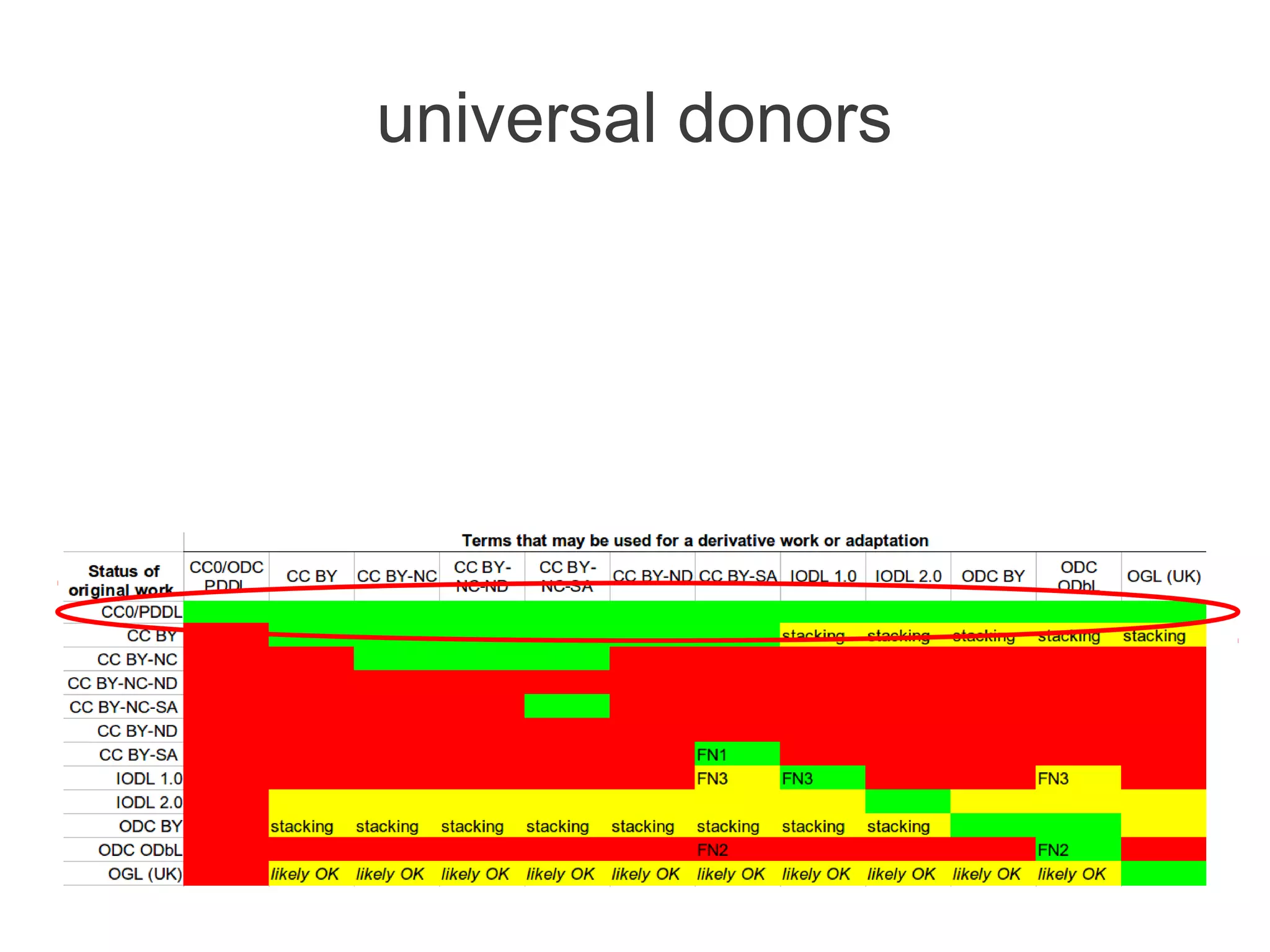
universal donors
universal donors
universal donors
●   Creative Commons Zero (CC0)
●   Public Domain Dedication or License (PDDL)
●   tagging of public domain content with the PDMark
do we have universal receivers?
●   strictly speaking, no
    ●   (rectius: keeping the data within you firm's secret
        datacenter)
●   amongst open licenses, CC BY-SA is the best
    candidate
    ●   could safely be used to publish derivative works of any
        Public Domain or Attribution waiver/license
    ●   considering the amount of available data is the first
        candidate for any “interoperability clause” in other SA
        licenses
        –   GNU FDL (temporary) interop.; IODL 1.0
various approaches
                 to interoperability
●   OGL FAQs
    ●   information can be mixed and re-purposed easily with
        other licence models requiring attribution in that the
        terms of the Open Government Licence should
        not present any barriers
●   LO
    ●   interoperability clause in the main text
●   IODL
    ●   1.0 (SA): interoperability clause in the main text
    ●   2.0 (BY): OGL-like solution (FAQs)
a best practice
●   New Zealand Government Open Access and
    Licensing (NZGOAL) framework
    ●   “NZGOAL seeks to standardise the licensing of
        government copyright works for re-use using
        Creative Commons [Attribution] New Zealand law
        licences and recommends the use of ‘no-known
        rights’ statements for non-copyright material.”
another best practice
●   the French LO adopts an interesting solution
    about several national “standard worries”
●   section “About the Open Licence” at the end of
    the document
    ●   description of relevant “facts” (instead of clauses)
        –   that “re-use is subject to compliance with French privacy
            protection legislation” is one of these facts
●   this would be a perfect solution, if only the list of
    facts was clearly outside of the copyright
    license (and withing a broader framework)
some implications
                    for license stewards
●   beware of license vanity
●   work to merge share-alike licenses (or make them compatible)
    ●   don't create new ones!
●   you may facilitate (©)interoperability if you address non-©
    worries with other tools
    ●   standard © licenses do not cover non-© aspects (e.g. privacy,
        publicity, trademarks, cultural heritage protection laws)
         –   notices or non-© licenses satisfying any taste (e.g. privacy notices)
         –   soft law could substitute several disclaimers
●   if you advise a (public sector) information holder
    ●   don't produce a custom license, but a custom licensing framework
         –   one page making reference to a standard © license (e.g. reproducing the CC
             Commons Deed) my be enough
to be sure


those who really want to create their own “local”
 copyright license, should at least make sure to
    use a simple “attribution” license, with a
  “reasonable attribution” clause avoiding the
                 “stacking” issue
missed opportunities
●   the internal market is witnessing more and
    more Member States creating their own
    national license
    ●   (small) attrition in the re-use mechanism
●   the UK led by example (in the wrong direction?)
    ●   by accident, since they wanted to use CC licenses,
        but they did not find an answer for some
        “European” needs (e.g. licensing the sui generis
        database right)
conclusion (open opportunities)
●   it's a learning process and we already learned quite a lot
    ●   this is why I did not talk again about Non-Commercial clauses...
●   the 4.0 version of CC licenses will address the issues that led to
    the non-adoption by the UK government
    ●   non-copyright issues are not addressed in CC licenses
    ●   a “licensing framework” clarifying privacy and other non-copyright
        concerns may be appropriate
         –   without breaking (copyright) license interoperability
●   the Commission may draft a European licensing framework,
    customizable at the local level (even by municipalities), but
    adopting the most standard and widespread copyright licenses
    (or waivers or notices/marks)

Legal interoperability: glocal perspective (LAPSI, Torino)

  • 1.
    Standardization and License Interoperability:a Glocal Perspective Open Public Sector Information: Time for a New Paradigm Aula Magna dell'Univeristà di Torino July 9-10, 2012 federico.morando@gmail.com Nexa Center for Internet & Society, Politecnico di Torino – DAUIN (http://nexa.polito.it) LAPSI - The European Thematic Network on Legal Aspects of PSI (http://www.lapsi-project.eu/) these slides available under a CC0 waiver/license http://creativecommons.org/publicdomain/zero/1.0/
  • 2.
    foreword as long as a public sector body makes its (relevant) data available online in machine readable format and with a license allowing for commercial re-use, it has my blessing as an open data activist
  • 3.
    foreword as long as a public sector body makes its (relevant) data available online in machine readable format and with a license allowing for commercial re-use, it has my blessing as an open data activist but you can always do better!
  • 4.
    legal interoperability possibility of(legally) mixing data coming from different sources (e.g. government data, UGC, corporate data)
  • 5.
    legal interoperability possibilityof (legally) mixing data coming from different sources (e.g. government data, UGC, corporate data) and using them within a broad range of projects and business (and community) models
  • 6.
    agenda 1) why (dowe care)? 2) © law → open data need “licenses” 3) (hence) legal interoperability (is an issue) 4) a bird's-eye view on license interop. 5) best practices and missed opportunities 6) conclusion
  • 7.
    the ultimate goal mixdata, re-use them in unexpected ways, be able to experiment and be quick and (legally) certain
  • 8.
    perceived legal interoperability it's not just a matter of theoretical possibilities people (and software developers in particular) need to be sure about legal interoperability without asking their lawyers (and, ideally, without reading too many licenses)
  • 9.
    perceived legal interoperability it's not just a matter of theoretical possibilities people (and software developers in particular) need to be sure about legal interoperability without asking their lawyers (and, ideally, without reading too many licenses) (and, ideally, almost without reading any license, because search engines and pieces of software can assist them)
  • 10.
    we don't wantpeople to read many licenses, so... is no-license a good license?
  • 11.
    the legal background “copyright”default rule = all rights reserved (“copyright” in a broad sense: ≈ droit d'auteur & including sui generis database right, etc.)
  • 12.
    the legal background “copyright” default rule = all rights reserved (“copyright” in a broad sense: ≈ droit d'auteur & including sui generis database right, etc.) (without a clear statement → locked data or legal uncertainty)
  • 13.
    the legal background “copyright” default rule = all rights reserved (“copyright” in a broad sense: ≈ droit d'auteur & including sui generis database right, etc.) (without a clear statement → locked data or legal uncertainty) open data → open “license” (including dedications, waivers or notices e.g. CC0 or the PublicDomainMark)
  • 14.
    so, to avoidprohibitive transaction costs, we have to deal with “copyright” “licenses”
  • 15.
    so, to avoidprohibitive transaction costs, we have to deal with “copyright” “licenses” “copyright” = copyright-like rights “license” = statements/notices with legal meaning
  • 16.
    the Commission continuesto argue that no- license is a potentially good option theoretically, it may be the case (in certain countries or for certain PSB), but we want a clear perception of perfect legal interoperability, so this is not helping if you want to go this way, do as the US did with Federal PSI: put it in the public domain by law!
  • 17.
    (data) licensing landscape ● (FLOSS licenses used for data) ● Creative Commons Licenses ● standard general purpose CC licenses – BY; (SA); [NC]; {ND} – 3.0 EU licenses (waiving sui generis database right) used by/ ● ● CC0 waiver (with fallback clauses → broad license) Public Domain Mark (notice of PD status) { developed with Europeana ● Open Data Commons Licenses ● for (open) data only – PD dedication (with license fallback), BY or SA (first to be produced, targeting communities) ● National (open government) data licenses ● UK: OGL (BY +) ● FR: License Ouverte (BY +) ● IT: IODL (beta ver.: BY-SA-NC +; 1.0: BY-SA +; 2.0: BY +) ● ...
  • 18.
    the “+”s: nationallicenses & standard worries ● UK OGL, Italian Open Data License (IODL), etc. ● ensure [or “take all reasonable steps so”] that you do not use the Information in a way that suggests any official status... ● ensure that you do not mislead others or misrepresent the Information or its source... ● ensure that your use of the Information does not breach the Data Protection Act...
  • 19.
    a view on license interoperability complexity ● preliminary attempt ● given the original license – on the lines ● can I use a given standard license for a “derivative” work/DB? – on the columns
  • 20.
  • 21.
  • 22.
  • 23.
    universal donors ● Creative Commons Zero (CC0) ● Public Domain Dedication or License (PDDL) ● tagging of public domain content with the PDMark
  • 24.
    do we haveuniversal receivers? ● strictly speaking, no ● (rectius: keeping the data within you firm's secret datacenter) ● amongst open licenses, CC BY-SA is the best candidate ● could safely be used to publish derivative works of any Public Domain or Attribution waiver/license ● considering the amount of available data is the first candidate for any “interoperability clause” in other SA licenses – GNU FDL (temporary) interop.; IODL 1.0
  • 25.
    various approaches to interoperability ● OGL FAQs ● information can be mixed and re-purposed easily with other licence models requiring attribution in that the terms of the Open Government Licence should not present any barriers ● LO ● interoperability clause in the main text ● IODL ● 1.0 (SA): interoperability clause in the main text ● 2.0 (BY): OGL-like solution (FAQs)
  • 26.
    a best practice ● New Zealand Government Open Access and Licensing (NZGOAL) framework ● “NZGOAL seeks to standardise the licensing of government copyright works for re-use using Creative Commons [Attribution] New Zealand law licences and recommends the use of ‘no-known rights’ statements for non-copyright material.”
  • 27.
    another best practice ● the French LO adopts an interesting solution about several national “standard worries” ● section “About the Open Licence” at the end of the document ● description of relevant “facts” (instead of clauses) – that “re-use is subject to compliance with French privacy protection legislation” is one of these facts ● this would be a perfect solution, if only the list of facts was clearly outside of the copyright license (and withing a broader framework)
  • 28.
    some implications for license stewards ● beware of license vanity ● work to merge share-alike licenses (or make them compatible) ● don't create new ones! ● you may facilitate (©)interoperability if you address non-© worries with other tools ● standard © licenses do not cover non-© aspects (e.g. privacy, publicity, trademarks, cultural heritage protection laws) – notices or non-© licenses satisfying any taste (e.g. privacy notices) – soft law could substitute several disclaimers ● if you advise a (public sector) information holder ● don't produce a custom license, but a custom licensing framework – one page making reference to a standard © license (e.g. reproducing the CC Commons Deed) my be enough
  • 29.
    to be sure thosewho really want to create their own “local” copyright license, should at least make sure to use a simple “attribution” license, with a “reasonable attribution” clause avoiding the “stacking” issue
  • 30.
    missed opportunities ● the internal market is witnessing more and more Member States creating their own national license ● (small) attrition in the re-use mechanism ● the UK led by example (in the wrong direction?) ● by accident, since they wanted to use CC licenses, but they did not find an answer for some “European” needs (e.g. licensing the sui generis database right)
  • 31.
    conclusion (open opportunities) ● it's a learning process and we already learned quite a lot ● this is why I did not talk again about Non-Commercial clauses... ● the 4.0 version of CC licenses will address the issues that led to the non-adoption by the UK government ● non-copyright issues are not addressed in CC licenses ● a “licensing framework” clarifying privacy and other non-copyright concerns may be appropriate – without breaking (copyright) license interoperability ● the Commission may draft a European licensing framework, customizable at the local level (even by municipalities), but adopting the most standard and widespread copyright licenses (or waivers or notices/marks)