4th Annual Trends
in Cloud Computing:
Business Impact
Company IT Systems Increasingly Cloud-based
10%
44%
29%
16%
10%
31%
38%
22%
0%… 1%-30% 31%-60% 60%-100% cloud-based
2012 2013
Source: CompTIA’s 4th Annual Trends in Cloud Computing
Base: 501 U.S. IT and business executives (end users)
Confusion Between Cloud/Hosted Models Persists
10%
40%
50%
12%
44%
44%
No differences/Don't know
Minor differences
Major differences
2013
2012
Source: CompTIA’s 4th Annual Trends in Cloud Computing
Base: 500 U.S. IT and business executives (end users)
Benefits Cloud Adopters Have Experienced
25%
29%
32%
33%
34%
35%
35%
38%
38%
40%
42%
43%
Predictable pricing
Reduction in internal IT headcount
Simple/fast implementation
Reduce operational complexity
Creation of new offerings or services
Business units operate more freely
Better model for licensing/upgrades
Add new capabilities or features
Reduce capital expenditures
Modernization of legacy IT
Better option for multiple reasons
Ability to cut costs
Source: CompTIA’s 4th Annual Trends in Cloud Computing
Base: 449 U.S. end users with cloud solutions
Challenges of Using Cloud
24%
26%
26%
28%
30%
35%
39%
40%
49%
Lower availability than expected
Lower performance than expected
Locked in to cloud provider
Painful transition from legacy systems
Defining/justifying ROI
Costs higher than originally estimated
Learning curve for cloud model
Changes to IT policy
Integration with existing systems
Source: 4th Annual Trends in Cloud Computing
Base: 449 U.S. end users with cloud solutions
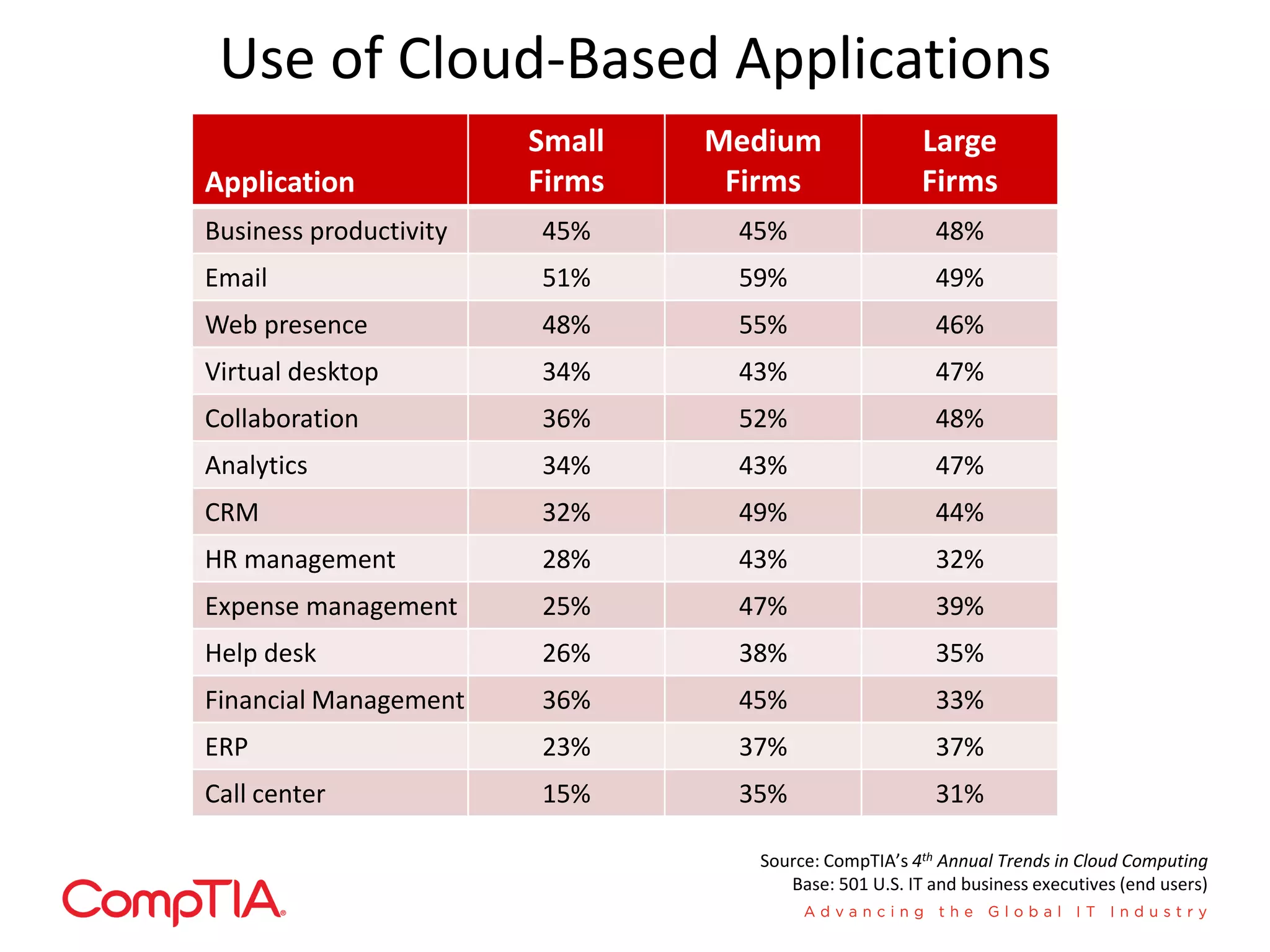
Application
Small
Firms
Medium
Firms
Large
Firms
Business productivity 45% 45% 48%
Email 51% 59% 49%
Web presence 48% 55% 46%
Virtual desktop 34% 43% 47%
Collaboration 36% 52% 48%
Analytics 34% 43% 47%
CRM 32% 49% 44%
HR management 28% 43% 32%
Expense management 25% 47% 39%
Help desk 26% 38% 35%
Financial Management 36% 45% 33%
ERP 23% 37% 37%
Call center 15% 35% 31%
Source: CompTIA’s 4th Annual Trends in Cloud Computing
Base: 501 U.S. IT and business executives (end users)
Use of Cloud-Based Applications
Use of IaaS/PaaS
Currently Using IaaS/PaaS
36%
57%
53%
Small… Medium… Large…
Plan to Use in Next Year
29% 27%
33%
Small… Medium… Large…
Source: CompTIA’s 4th Annual Trends in Cloud Computing
Base: 501 U.S. IT and business executives (end users)
Overall = 48% Overall = 29%
Experiment
Non-critical
Use
Full
Production
Transformed
IT
IaaS | PaaS | SaaS
Private | Hybrid Clouds
Payment Models
Education Transition
Integration
Workflow Change
Customization/
Rearchitecture
Policies/Procedure
s
Proof of concept
Cloud Adoption Progression for End Users
EXPERIMENT: End users will gain
education on cloud providers, the
cloud ecosystem, and cloud business
models. Any testing of cloud systems
will in large part be done in the public
cloud.
NON-CRITICAL USE: End users
will select a system that is not
business critical and does not
contain sensitive data for a cloud
transition. Some end users may
begin building private clouds if the
long-term strategy includes that
model.
FULL PRODUCTION: End users
will securely move business-critical
systems into the cloud. At this
stage, companies will begin moving
architecture and applications
between cloud systems and/or on-
premise systems to find the optimal
mix.
TRANSFORMED IT: End users
will adopt new practices and
policies for cloud-enabled IT.
Applications will be customized or
rebuilt for cloud use, and
processes will reflect greater
flexibility and availability of IT
systems.
Public Clouds
Provider Switching
Security
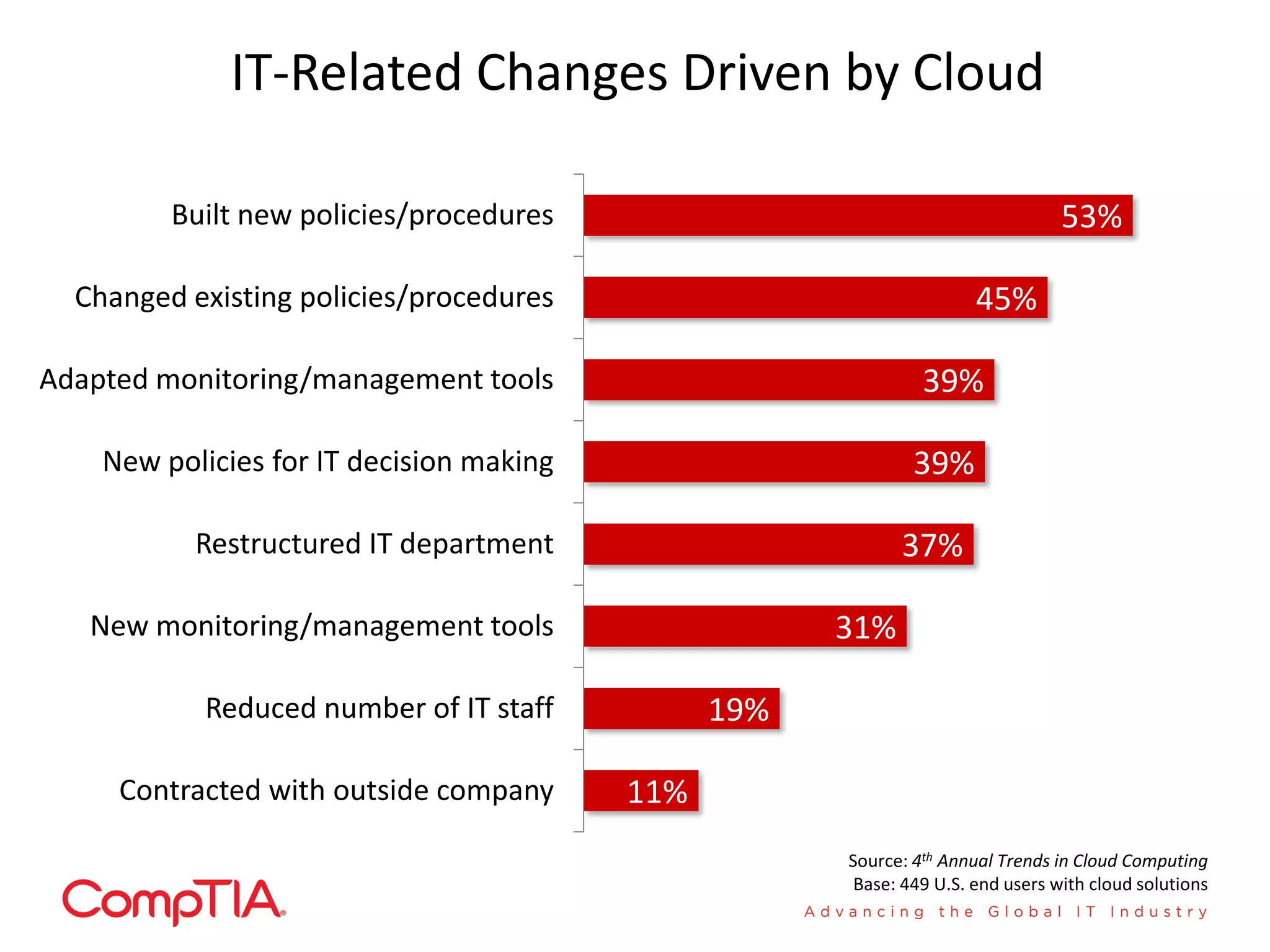
IT-Related Changes Driven by Cloud
11%
19%
31%
37%
39%
39%
45%
53%
Contracted with outside company
Reduced number of IT staff
New monitoring/management tools
Restructured IT department
New policies for IT decision making
Adapted monitoring/management tools
Changed existing policies/procedures
Built new policies/procedures
Source: 4th Annual Trends in Cloud Computing
Base: 449 U.S. end users with cloud solutions
End User Cloud Migration Patterns
Public Cloud
Provider #1
Public Cloud
Provider #2
Private
Cloud
On-premise
System
Company ABC
24%
25%
29%
(Apps)
27% (Infrastructure)
Source: CompTIA’s 4th Annual
Trends in Cloud Computing study
Base: 452 cloud end users
Reasons for Switching Public Cloud Providers
20%
26%
29%
38%
41%
42%
45%
Dissatisfied with customer service
Dissatisfied with terms of service
Outages with original provider
Move to more open standards
Better offerings/features
Costs too high with original provider
Security concerns with original provider
Source: 4th Annual Trends in Cloud Computing
Base: 180 cloud end users that have switched public cloud providers
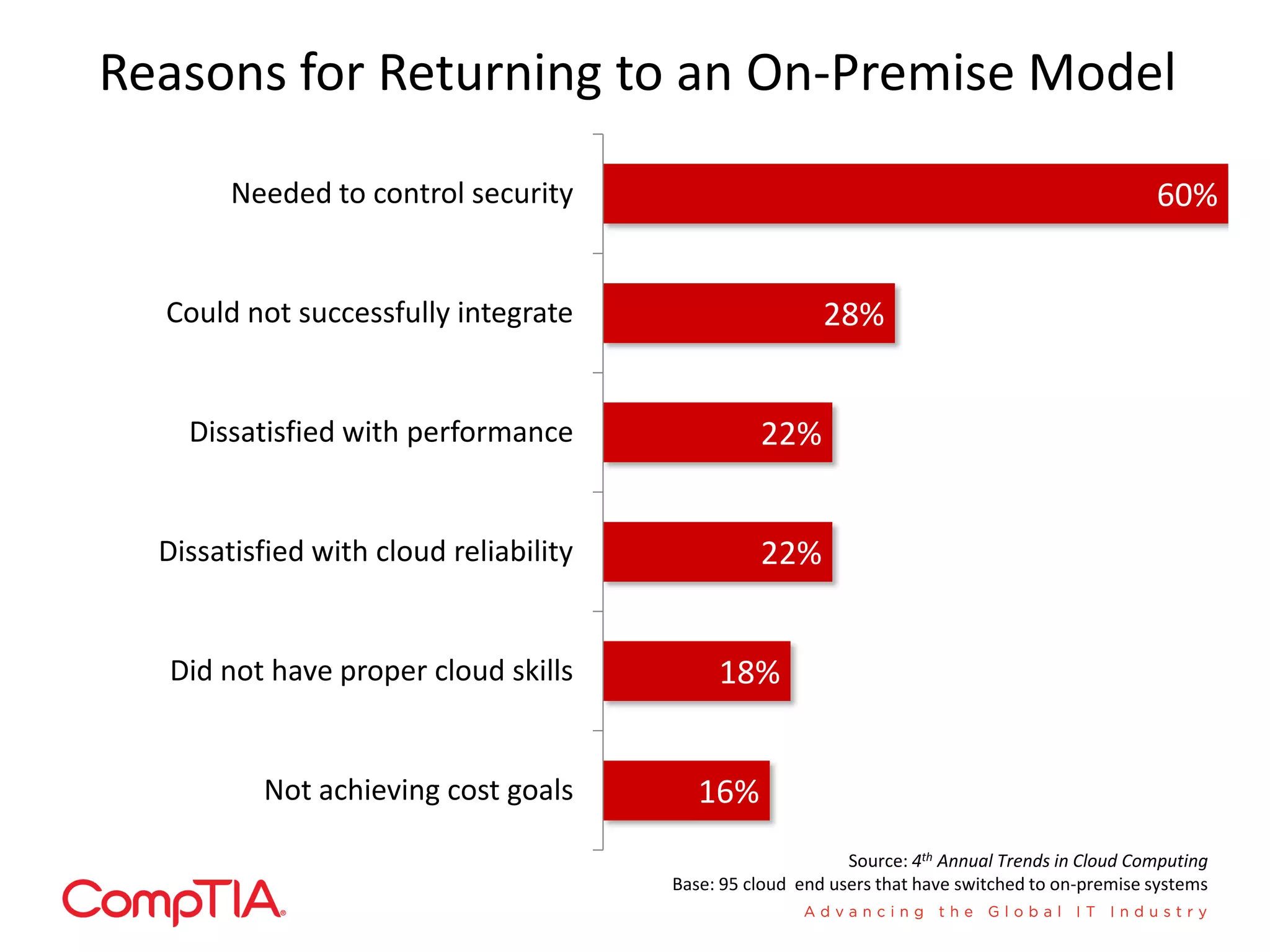
Reasons for Returning to an On-Premise Model
16%
18%
22%
22%
28%
60%
Not achieving cost goals
Did not have proper cloud skills
Dissatisfied with cloud reliability
Dissatisfied with performance
Could not successfully integrate
Needed to control security
Source: 4th Annual Trends in Cloud Computing
Base: 95 cloud end users that have switched to on-premise systems
Effort of Cloud Change vs. Original Transition
8%
21%
28%
38%
5%
2%
21%
47%
26%
6%
Significantly easier
Moderately easier
No difference in effort
Moderately more difficult
Significantly more difficult
Estimate from companies
planning to switch
providers
Assessment from
companies that have
switched providers
Source: CompTIA’s 4th Annual Trends in Cloud Computing study
Base: 180 end users that have switched providers/148 end users planning to switch providers
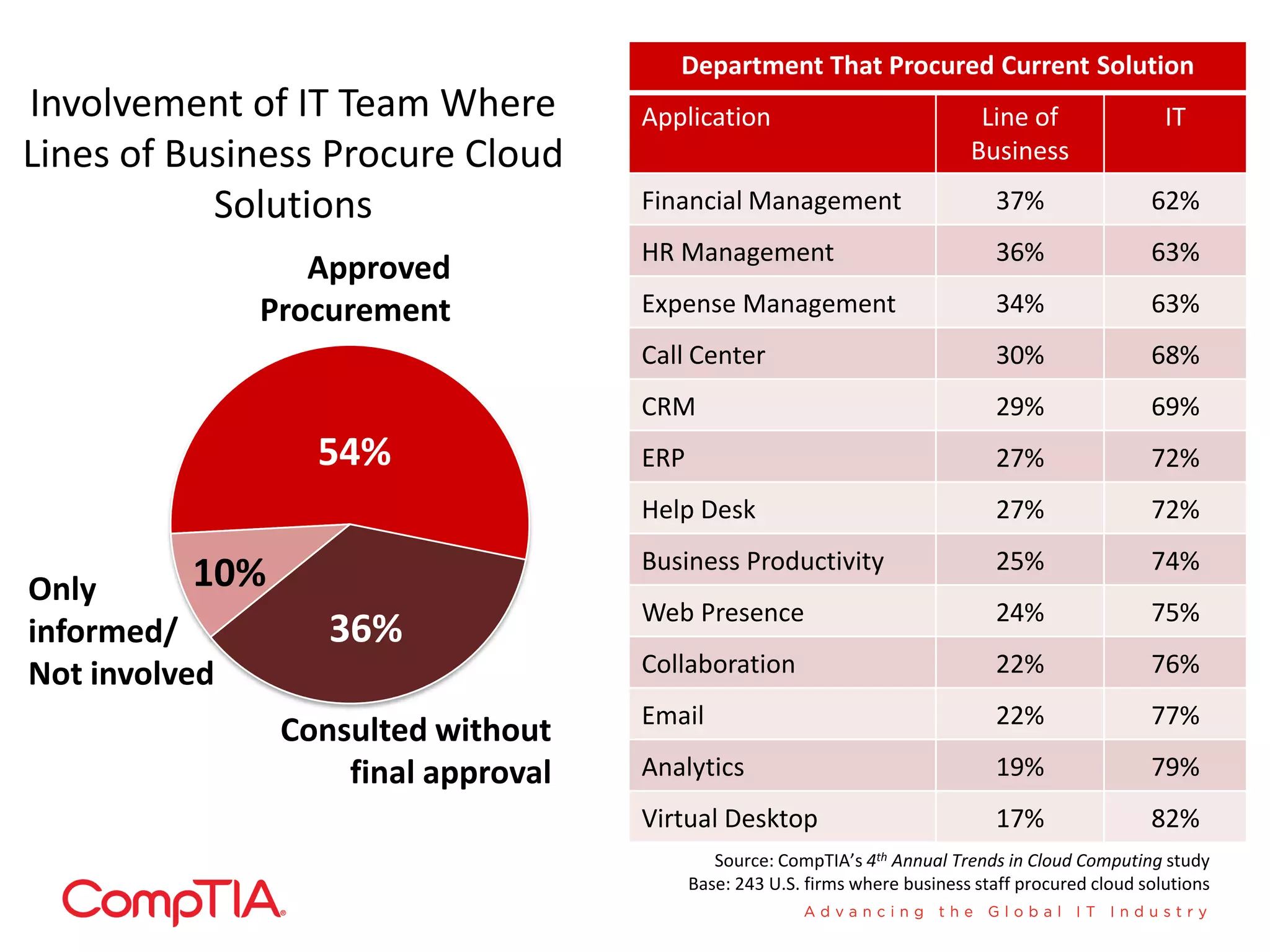
Involvement of IT Team Where
Lines of Business Procure Cloud
Solutions
54%
36%
10%
Approved
Procurement
Only
informed/
Not involved
Source: CompTIA’s 4th Annual Trends in Cloud Computing study
Base: 243 U.S. firms where business staff procured cloud solutions
Consulted without
final approval
Department That Procured Current Solution
Application Line of
Business
IT
Financial Management 37% 62%
HR Management 36% 63%
Expense Management 34% 63%
Call Center 30% 68%
CRM 29% 69%
ERP 27% 72%
Help Desk 27% 72%
Business Productivity 25% 74%
Web Presence 24% 75%
Collaboration 22% 76%
Email 22% 77%
Analytics 19% 79%
Virtual Desktop 17% 82%
comptia.org
Want to know more?
As the voice of the IT industry, CompTIA has hundreds
of tools, market intelligence reports and business
training programs to help IT organizations grow through
education, certification, advocacy and philanthropy.
Check it out at www.comptia.org.
Want to know about our research on the IT workforce?
Visit http://www.comptia.org/research/it-workforce.aspx.

4th Annual Trends in Cloud Computing: Business Impact

  • 1.
    4th Annual Trends inCloud Computing: Business Impact
  • 2.
    Company IT SystemsIncreasingly Cloud-based 10% 44% 29% 16% 10% 31% 38% 22% 0%… 1%-30% 31%-60% 60%-100% cloud-based 2012 2013 Source: CompTIA’s 4th Annual Trends in Cloud Computing Base: 501 U.S. IT and business executives (end users)
  • 3.
    Confusion Between Cloud/HostedModels Persists 10% 40% 50% 12% 44% 44% No differences/Don't know Minor differences Major differences 2013 2012 Source: CompTIA’s 4th Annual Trends in Cloud Computing Base: 500 U.S. IT and business executives (end users)
  • 4.
    Benefits Cloud AdoptersHave Experienced 25% 29% 32% 33% 34% 35% 35% 38% 38% 40% 42% 43% Predictable pricing Reduction in internal IT headcount Simple/fast implementation Reduce operational complexity Creation of new offerings or services Business units operate more freely Better model for licensing/upgrades Add new capabilities or features Reduce capital expenditures Modernization of legacy IT Better option for multiple reasons Ability to cut costs Source: CompTIA’s 4th Annual Trends in Cloud Computing Base: 449 U.S. end users with cloud solutions
  • 5.
    Challenges of UsingCloud 24% 26% 26% 28% 30% 35% 39% 40% 49% Lower availability than expected Lower performance than expected Locked in to cloud provider Painful transition from legacy systems Defining/justifying ROI Costs higher than originally estimated Learning curve for cloud model Changes to IT policy Integration with existing systems Source: 4th Annual Trends in Cloud Computing Base: 449 U.S. end users with cloud solutions
  • 6.
    Application Small Firms Medium Firms Large Firms Business productivity 45%45% 48% Email 51% 59% 49% Web presence 48% 55% 46% Virtual desktop 34% 43% 47% Collaboration 36% 52% 48% Analytics 34% 43% 47% CRM 32% 49% 44% HR management 28% 43% 32% Expense management 25% 47% 39% Help desk 26% 38% 35% Financial Management 36% 45% 33% ERP 23% 37% 37% Call center 15% 35% 31% Source: CompTIA’s 4th Annual Trends in Cloud Computing Base: 501 U.S. IT and business executives (end users) Use of Cloud-Based Applications
  • 7.
    Use of IaaS/PaaS CurrentlyUsing IaaS/PaaS 36% 57% 53% Small… Medium… Large… Plan to Use in Next Year 29% 27% 33% Small… Medium… Large… Source: CompTIA’s 4th Annual Trends in Cloud Computing Base: 501 U.S. IT and business executives (end users) Overall = 48% Overall = 29%
  • 8.
    Experiment Non-critical Use Full Production Transformed IT IaaS | PaaS| SaaS Private | Hybrid Clouds Payment Models Education Transition Integration Workflow Change Customization/ Rearchitecture Policies/Procedure s Proof of concept Cloud Adoption Progression for End Users EXPERIMENT: End users will gain education on cloud providers, the cloud ecosystem, and cloud business models. Any testing of cloud systems will in large part be done in the public cloud. NON-CRITICAL USE: End users will select a system that is not business critical and does not contain sensitive data for a cloud transition. Some end users may begin building private clouds if the long-term strategy includes that model. FULL PRODUCTION: End users will securely move business-critical systems into the cloud. At this stage, companies will begin moving architecture and applications between cloud systems and/or on- premise systems to find the optimal mix. TRANSFORMED IT: End users will adopt new practices and policies for cloud-enabled IT. Applications will be customized or rebuilt for cloud use, and processes will reflect greater flexibility and availability of IT systems. Public Clouds Provider Switching Security
  • 9.
    IT-Related Changes Drivenby Cloud 11% 19% 31% 37% 39% 39% 45% 53% Contracted with outside company Reduced number of IT staff New monitoring/management tools Restructured IT department New policies for IT decision making Adapted monitoring/management tools Changed existing policies/procedures Built new policies/procedures Source: 4th Annual Trends in Cloud Computing Base: 449 U.S. end users with cloud solutions
  • 10.
    End User CloudMigration Patterns Public Cloud Provider #1 Public Cloud Provider #2 Private Cloud On-premise System Company ABC 24% 25% 29% (Apps) 27% (Infrastructure) Source: CompTIA’s 4th Annual Trends in Cloud Computing study Base: 452 cloud end users
  • 11.
    Reasons for SwitchingPublic Cloud Providers 20% 26% 29% 38% 41% 42% 45% Dissatisfied with customer service Dissatisfied with terms of service Outages with original provider Move to more open standards Better offerings/features Costs too high with original provider Security concerns with original provider Source: 4th Annual Trends in Cloud Computing Base: 180 cloud end users that have switched public cloud providers
  • 12.
    Reasons for Returningto an On-Premise Model 16% 18% 22% 22% 28% 60% Not achieving cost goals Did not have proper cloud skills Dissatisfied with cloud reliability Dissatisfied with performance Could not successfully integrate Needed to control security Source: 4th Annual Trends in Cloud Computing Base: 95 cloud end users that have switched to on-premise systems
  • 13.
    Effort of CloudChange vs. Original Transition 8% 21% 28% 38% 5% 2% 21% 47% 26% 6% Significantly easier Moderately easier No difference in effort Moderately more difficult Significantly more difficult Estimate from companies planning to switch providers Assessment from companies that have switched providers Source: CompTIA’s 4th Annual Trends in Cloud Computing study Base: 180 end users that have switched providers/148 end users planning to switch providers
  • 14.
    Involvement of ITTeam Where Lines of Business Procure Cloud Solutions 54% 36% 10% Approved Procurement Only informed/ Not involved Source: CompTIA’s 4th Annual Trends in Cloud Computing study Base: 243 U.S. firms where business staff procured cloud solutions Consulted without final approval Department That Procured Current Solution Application Line of Business IT Financial Management 37% 62% HR Management 36% 63% Expense Management 34% 63% Call Center 30% 68% CRM 29% 69% ERP 27% 72% Help Desk 27% 72% Business Productivity 25% 74% Web Presence 24% 75% Collaboration 22% 76% Email 22% 77% Analytics 19% 79% Virtual Desktop 17% 82%
  • 15.
    comptia.org Want to knowmore? As the voice of the IT industry, CompTIA has hundreds of tools, market intelligence reports and business training programs to help IT organizations grow through education, certification, advocacy and philanthropy. Check it out at www.comptia.org. Want to know about our research on the IT workforce? Visit http://www.comptia.org/research/it-workforce.aspx.

Editor's Notes