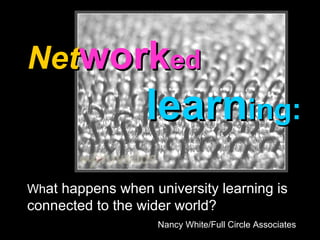
Networked Learningand Wider World Final

Loading...

Flash Player 9 (or above) is needed to view presentations.
We have detected that you do not have it on your computer. To install it, go here.

2 comments

Comments 1 - 2 of 2 previous next Post a comment

  • + choconancy Nancy White 7 months ago
    A video of this presentation is available here: mms://193.40.5.165/2009/e-oppe_kevadkonverents/45_03_04_2009_Nancy_White.wmv
  • + guestd682a70 guestd682a70 7 months ago
    Slide 3 references Evidence Based Decision Making and how data, evidence and knowledge is not enough. You need context.
Post a comment
Embed Video
Edit your comment Cancel

Notes on slide 1

Networked Learning: What happens when university learning is connected to the wider world?

2 Favorites & 1 Group

Networked Learningand Wider World Final - Presentation Transcript

  1. Net work ed learn ing: Wh at happens when university learning is connected to the wider world? Nancy White/Full Circle Associates
  2. What is changing in our world?
    • I’m coming to you online, not in person…
    • People are wondering where will my next job be?
    • We are in a climate/ environmental crisis…
    http://www.flickr.com/photos/azrainman/2047910540/
  3. http://www.plexusinstitute.org/complexity/index.cfm?id=3
    • Creativity Is the New Technology Rob Wall writes, "I think that the 21st century will be a century of creativity in the same way that the 20th was of technology .... Consider this video, brought to my attention by Alec Couros: World Builder from Bruce Branit on Vimeo .... what touched me as I watched this was the story and the people in it. It is a beautifully crafted short film, and I thank Bruce Branit for sharing it." The other thing worth saying is that creativity has been a constant through history (don't miss this exhibit shared by Albert Ip, Along the River During the Ching- ing Festival ) and there are some features - these days supported by technology - that allow it to flourish: portability, diversity, sharing, and expression. Rob Wall , Open Monologue , March 11, 2009 [ Link ] [Tags: Video ] From Stephen Downes – http://www.downes.ca
    • To be collaborative means that you embrace a certain way of life and work ... an openness to the ideas of other people, and in particular to how their ideas and perspectives may mold, change and transform your ideas. The heart of collaboration is openness to the ideas to others, and a stated and acted upon willingness to explore those ideas, rather than assuming that everything you think is right and correct from the get-go.
    • n To be collaborative then, is in essence a human process, that plays out over whatever modality of interaction you use with other people, be that face-to-face, email, a wiki or any other "collaborative technology".
    • Michael Sampson http://www.michaelsampson.net/
  4. What do all these things have in common?
  5. Learning is our BEST HOPE
  6. Learning in and BEYOND the walls of our institutions!!!
  7. What needs to grow beyond the boundaries of formal learning? http://www.flickr.com/photos/dsevilla/189528500/in/set-1368427/
  8. Beyond our curriculum and courses… http://www.flickr.com/photos/stevewall/206426067 / Beyond our “classrooms”… Beyond our institutions…
    • It's definitely unwise to assume anyone or anything is protected. Isolated work, whether it's in a university or in the Civic Space, is simply not a sustainable model . "When the lights go out, they go out for everybody," says Susan Altshuler, Director, Finance and Grants Administration, I-Open. Because of the new unprecedented demands for scalable innovative solutions - hey, the Icebergs  are melting - no one can afford to think in isolation anymore . … we need deep vertical investment in research, but deep knowledge leaders must collaborate with leaders in the Civic Space, the ones on the run who, because they access the thin and wide of this big wave, have the working knowledge of where the next super set of cross discipline innovation opportunity resides. By collaborating with deep research for guidance on the subtleties of a discipline or a quick "you oughta think about that and here's why" we'll be able to survive as a community, as a human race . This is definitely a give and take arrangement as researchers will have new insights from their collaborating colleagues about where to invest their time to generate actionable research.   We create the open spaces for the early conversations to take place and the economic development strategy guidance to bring those ideas quickly to action in a process called , "Strategic Doing."
    From I-Open Education http://tiny.cc/tApHq
    • Social LEARNING
    • Social MEDIA
  9. The buzz part 1 social learning in a networked world
  10.  
  11. http://www.flickr.com/photos/lynetter/653541864/in/set-72057594139269787/ Photo via Flickr CC www.flickr.com/photos/azlijamil01/231592469/  
  12. http://www.flickr.com/photos/ecstaticist/2918198742/in/set-72157603453505459/ Go Solo?
  13. Fly with the flock?
  14. Roam the network?
  15. Many: Networks We: Communities Me: the Individual Personal identity, interest & trajectory Bounded membership; group identity, shared interest Boundaryless; fuzzy, intersecting interests
  16. Many: Networks We: Communities Me: the Individual Individual learning, personal learning environments … Classes, informal learning cohorts, conferences, clubs… Facebook, Twitter, YouTube, Wikipedia, etc…
  17. Informal learning “What happens the rest of the time.” – Marcia Connor http://agelesslearner.com/intros/informal.html
  18. Connectivism – George Siemens Connectivism : A Learning Theory for the Digital Age http://www.elearnspace.org/Articles/connectivism.htm
  19. Rhizomatic Learning Dave Cormier http://innovateonline.info/index.php?view=article&id=550 A rhizomatic plant has no center and no defined boundary ; rather, it is made up of a number of semi-independent nodes, each of which is capable of growing and spreading on its own, bounded only by the limits of its habitat (Cormier 2008 ). …. In the rhizomatic view, knowledge can only be negotiated , and the contextual, collaborative learning experience shared by constructivist and connectivist pedagogies is a social as well as a personal knowledge-creation process with mutable goals and constantly negotiated premises.
    • The rhizome metaphor, which represents a critical leap in coping with the loss of a canon against which to compare, judge, and value knowledge, may be particularly apt as a model for disciplines on the bleeding edge where the canon is fluid and knowledge is a moving target .
            • Thank you, Dave!
  20. http://www.flickr.com/photos/aphrodite/66231929/ The buzz part 2 “Web 2.0”
  21.  
  22. “… it was designed to allow people to work together by combining their knowledge in a web of hypertext documents.” (From Tim Berners-Lee’s Bio)
  23. http://www.flickr.com/photos/lynetter/483849193/in/set-72057594139269787/
  24.  
  25.  
  26. Tech + Social: Technology has fundamentally changed how we can be together
  27. Designed for groups, experienced as individuals Does not imply homogeneity Multimembership Attention Scale
  28. How do we enable people to…
    • discover & appropriate useful technology
    • be in and use communities & networks (people)
    • express their identity
    • find and create content
    • usefully participate
    ? ? ?
  29. http://www.flickr.com/photos/mjaniceryuvallos/1600857189/ Technology Hooks
  30. … meetings … relationships … community cultivation … access to expertise … projects … context … individual participation … content publishing … open-ended conversation Community activities oriented to … Base material from: Digital Habitats: Stewarding technology for communities © 2009 Wenger, White, and Smith
  31. … meetings/ webmeeting … relationships Facebook/etc. … community cultivation/ Facebook … access to expertise LinkedIn/Skype … projects/ wiki … context? Service learning … individual participation/ blogs … content publishing/ blogs, wikis… … open-ended conversation/ forums Community activities oriented to … Base material from: Digital Habitats: Stewarding technology for communities © 2009 Wenger, White, and Smith
  32. People Hooks http://www.flickr.com/photos/micheleryan/418311581/ http://www.flickr.com/photos/qwirksilver/133694322 /
  33. Create paths and patterns of connection DURING a Course
    • Guests
    • Field trips
    • Identification of related groups and networks
  34. TWITTER
  35. So they can continue AFTER a course
    • Participation in related groups and networks
    • Accessing peers, mentors and communities of practice
    • Exposure for job-seeking
  36. Identity Hooks?
    • Profiles
    • Portfolios with meaning outside of a course
    • Reputation
  37. Content Hooks http://www.flickr.com/photos/frankfarm/281433729 /
  38. Multi-format content creation…
  39. Tagging
  40. http://www.flickr.com/photos/cambodia4kidsorg/2312541719/
  41. http://www.flickr.com/photos/bg/3353075544/sizes/l/ Participation hooks
    • Role model and apply tools & processes
    • Experiment, iterate and reflect…
  42. http://www.flickr.com/photos/nicmcphee/418922552/in/set-72157600218310366 / PLAY!
  43.  
  44. Challenges
    • Time
    • Swiftly changing technology
    • Language and Culture
    • Learning preferences
    • Swiftly changing culture and context
  45. Tackling the barriers?
    • Tickling the edge of organizational change
    • Can we take a whole systems approach?
    • Leadership walking the talk
  46. Epilogue Resources http://onlinefacilitation.wikispaces.com/ http://onlinefacilitation.wikispaces.com/netWorked+Learning Contact Nancy White nancyw at fullcirc dot com http://www.fullcirc.com http://www.flickr.com/photos/poagao/527259905/

+ Nancy WhiteNancy White, 7 months ago

custom

1072 views, 2 favs, 3 embeds more stats

Slides for a remote presentation/session for http:/ more

More info about this document

© All Rights Reserved

Go to text version

  • Total Views 1072
    • 1018 on SlideShare
    • 54 from embeds
  • Comments 2
  • Favorites 2
  • Downloads 8
Most viewed embeds
  • 44 views on http://www.fullcirc.com
  • 6 views on http://onlinefacilitation.wikispaces.com
  • 4 views on http://budrisht.blogspot.com

more

All embeds
  • 44 views on http://www.fullcirc.com
  • 6 views on http://onlinefacilitation.wikispaces.com
  • 4 views on http://budrisht.blogspot.com

less

Flagged as inappropriate Flag as inappropriate
Flag as inappropriate

Select your reason for flagging this presentation as inappropriate. If needed, use the feedback form to let us know more details.

Cancel
File a copyright complaint
Having problems? Go to our helpdesk?

Categories