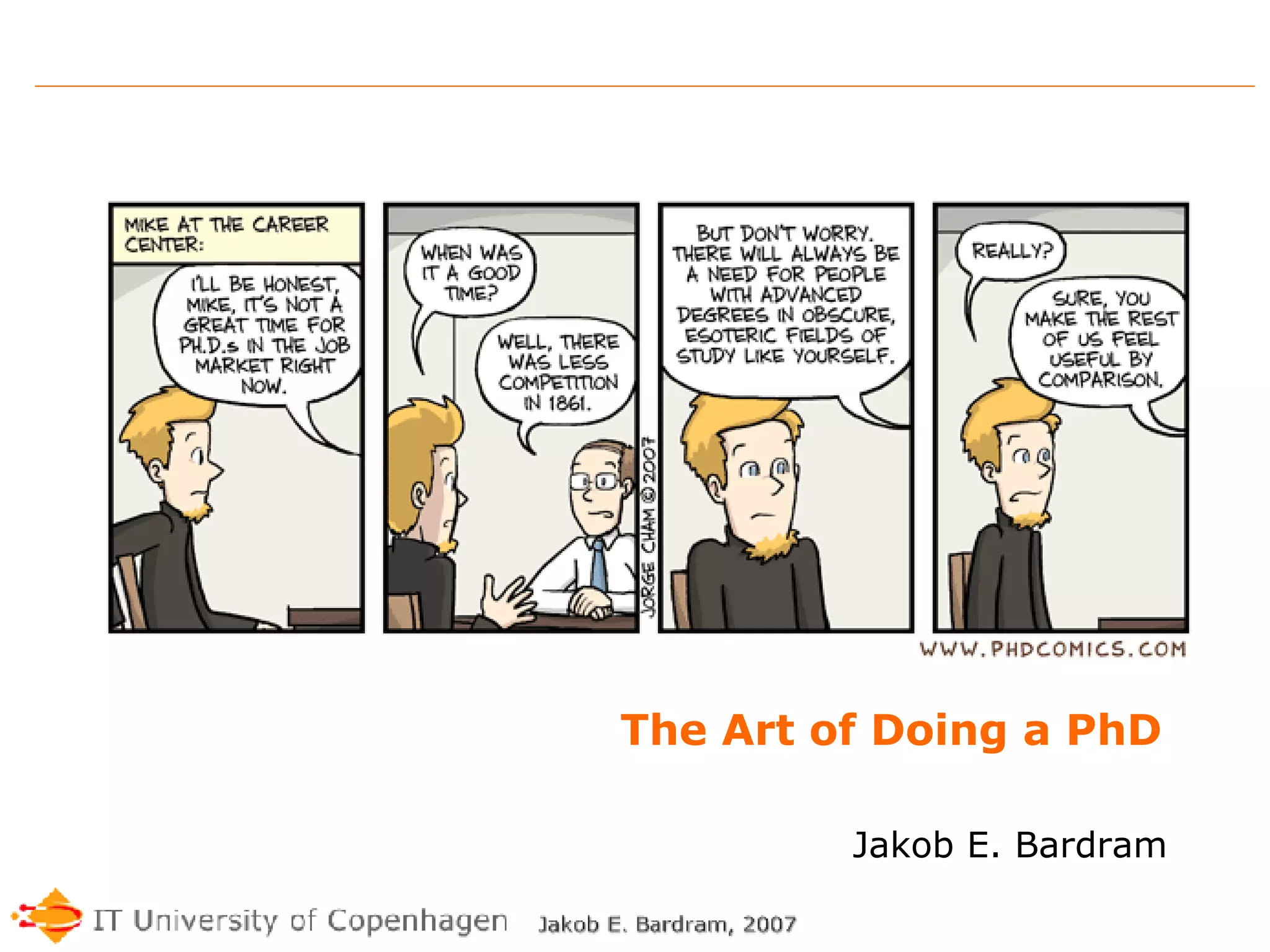
The Art of Doing a PhD

Loading...

Flash Player 9 (or above) is needed to view presentations.
We have detected that you do not have it on your computer. To install it, go here.

1 comments

Comments 1 - 1 of 1 previous next Post a comment

  • + rajeshlal Rajesh Lal 2 years ago
    loved the presentation , very nicely done
Post a comment
Embed Video
Edit your comment Cancel

24 Favorites & 2 Groups

The Art of Doing a PhD - Presentation Transcript

  1. The Art of Doing a PhD Jakob E. Bardram
  2. How hard can it be?
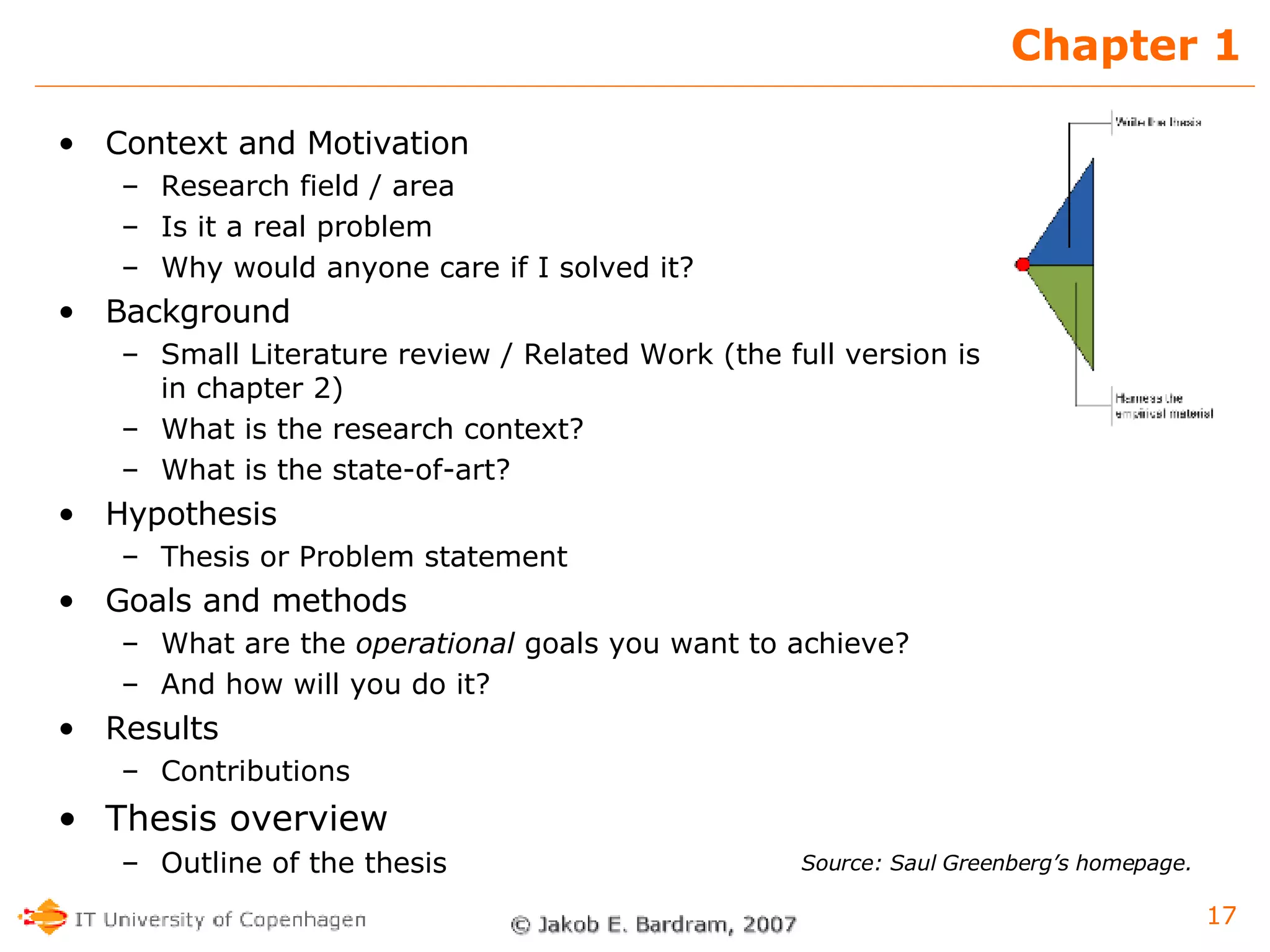
    • The Feynman Problem Solving Algorithm: 1) Write down the problem. 2) Think very hard. 3) Write down the solution.
    • Getting a PhD
      • “ It's like teaching swimming by tossing students into the deep end of the pool and seeing who makes it to the other end alive and who drowns.” [ Ronald T. Azuma]
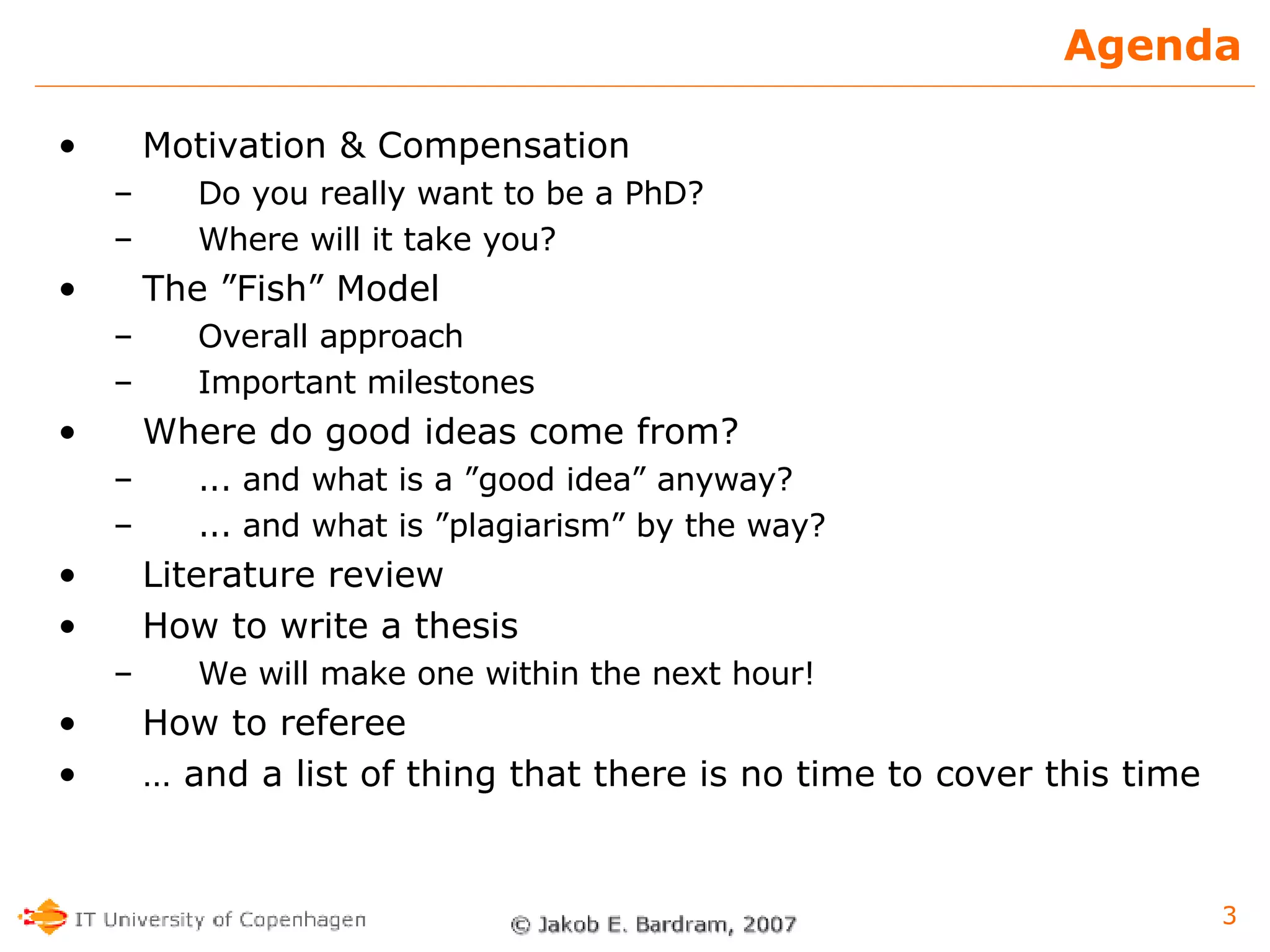
  3. Agenda
    • Motivation & Compensation
      • Do you really want to be a PhD?
      • Where will it take you?
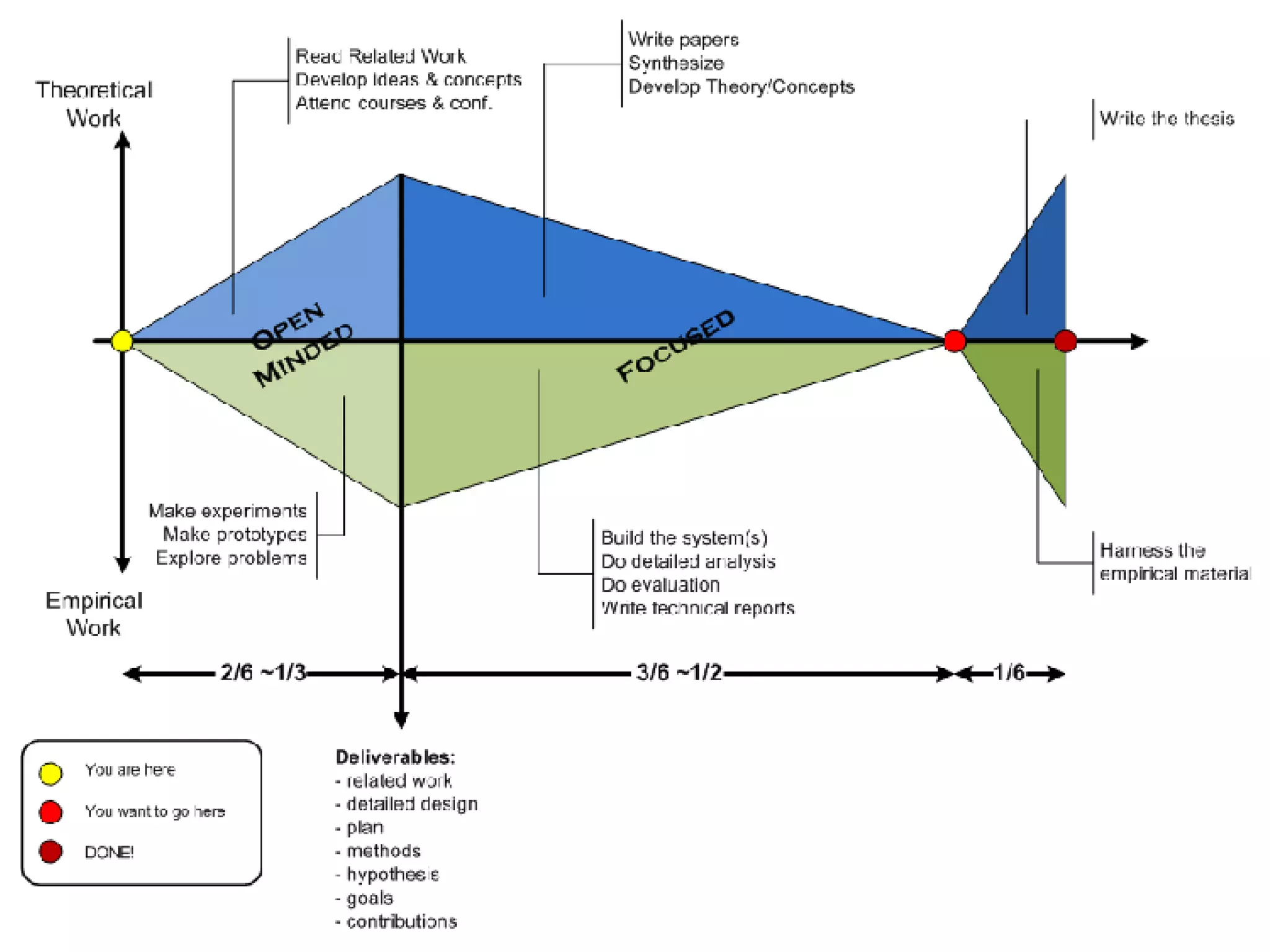
    • The ”Fish” Model
      • Overall approach
      • Important milestones
    • Where do good ideas come from?
      • ... and what is a ”good idea” anyway?
      • ... and what is ”plagiarism” by the way?
    • Literature review
    • How to write a thesis
      • We will make one within the next hour!
    • How to referee
    • … and a list of thing that there is no time to cover this time
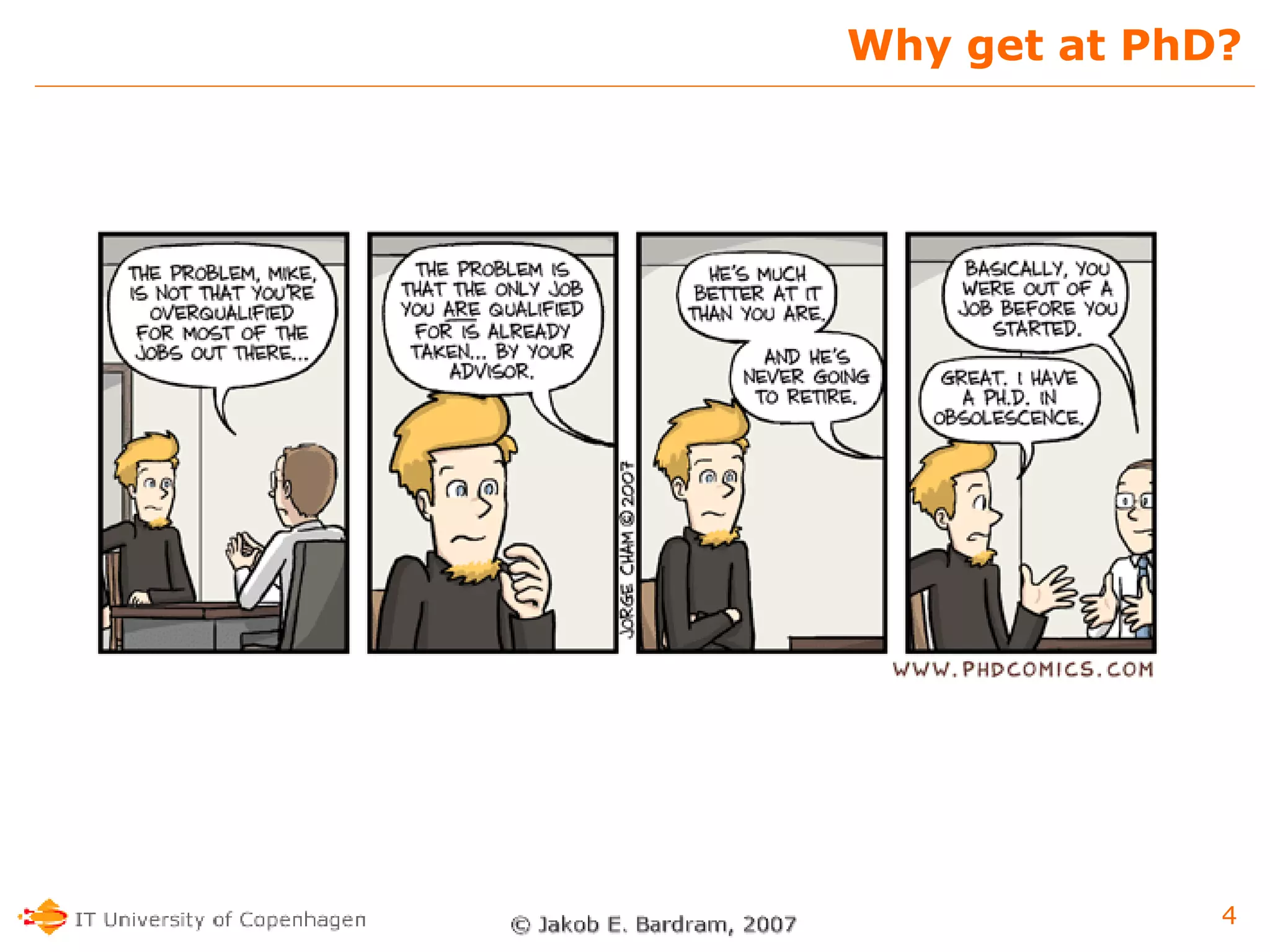
  4. Why get at PhD?
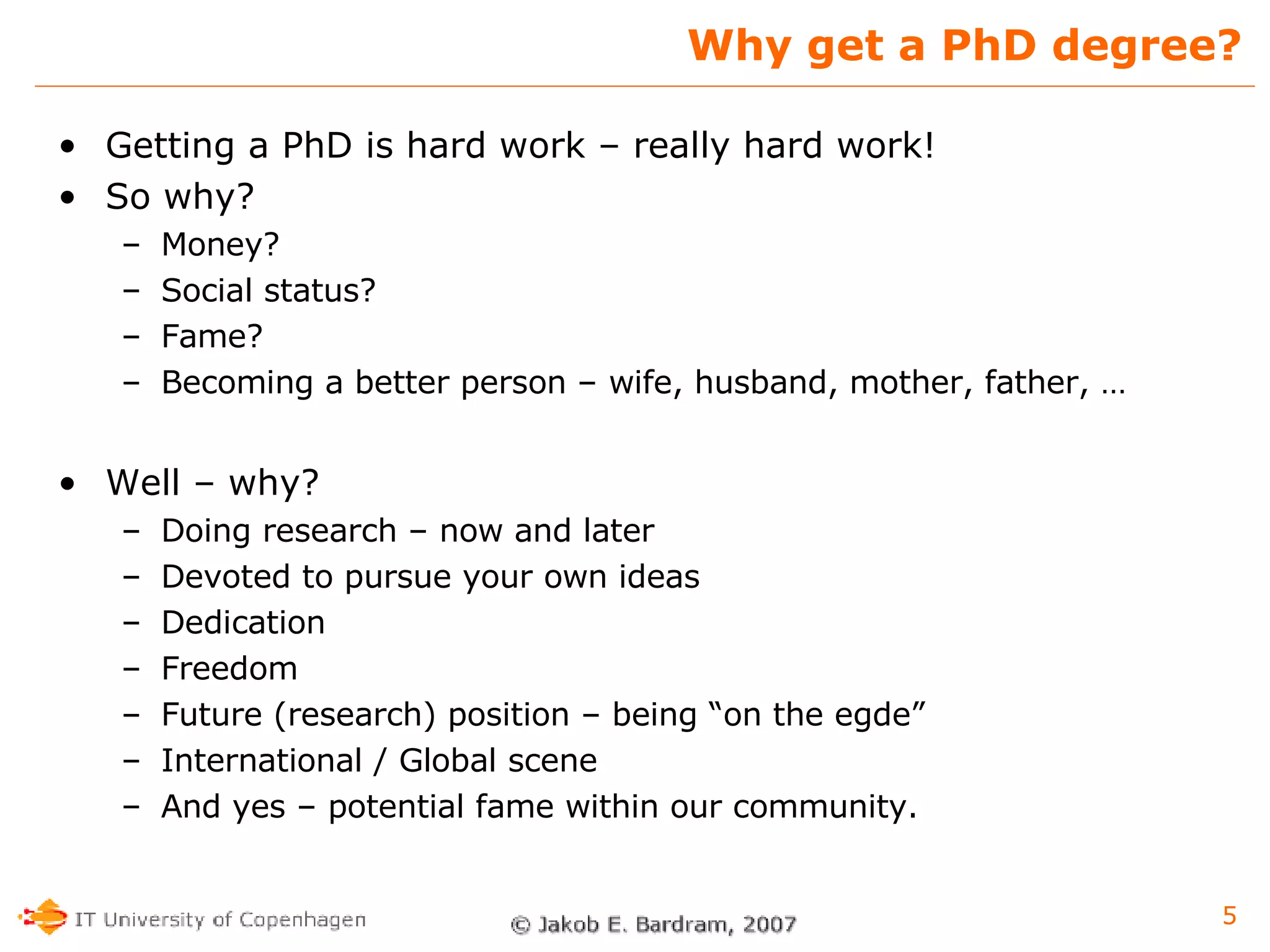
  5. Why get a PhD degree?
    • Getting a PhD is hard work – really hard work!
    • So why?
      • Money?
      • Social status?
      • Fame?
      • Becoming a better person – wife, husband, mother, father, …
    • Well – why?
      • Doing research – now and later
      • Devoted to pursue your own ideas
      • Dedication
      • Freedom
      • Future (research) position – being “on the egde”
      • International / Global scene
      • And yes – potential fame within our community.
  6. Small exercise
    • In pairs:
      • each give the “elevator pitch” of your PhD topic
      • explain why
  7. The Fish Model
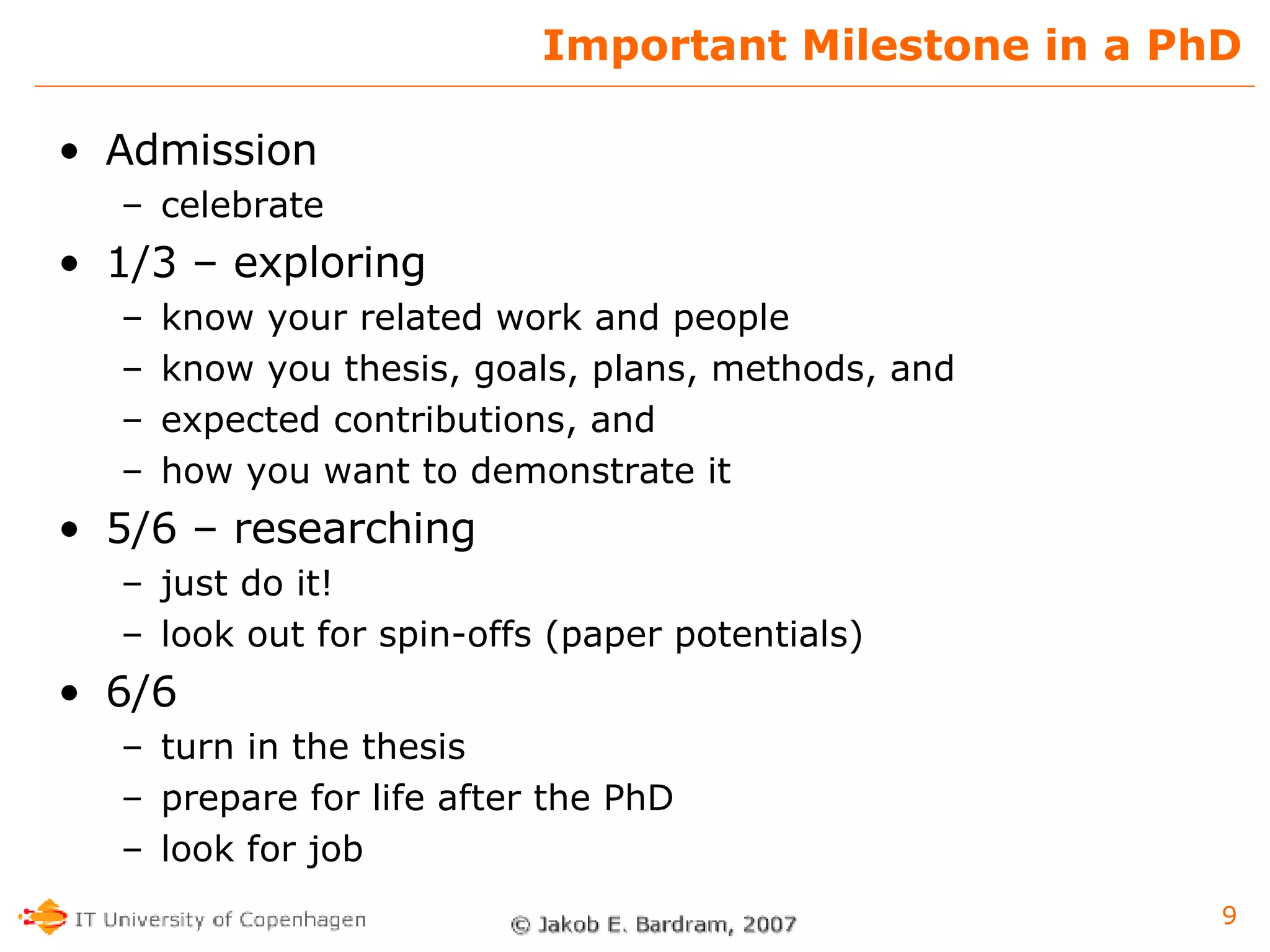
  8. Important Milestone in a PhD
    • Admission
      • celebrate
    • 1/3 – exploring
      • know your related work and people
      • know you thesis, goals, plans, methods, and
      • expected contributions, and
      • how you want to demonstrate it
    • 5/6 – researching
      • just do it!
      • look out for spin-offs (paper potentials)
    • 6/6
      • turn in the thesis
      • prepare for life after the PhD
      • look for job
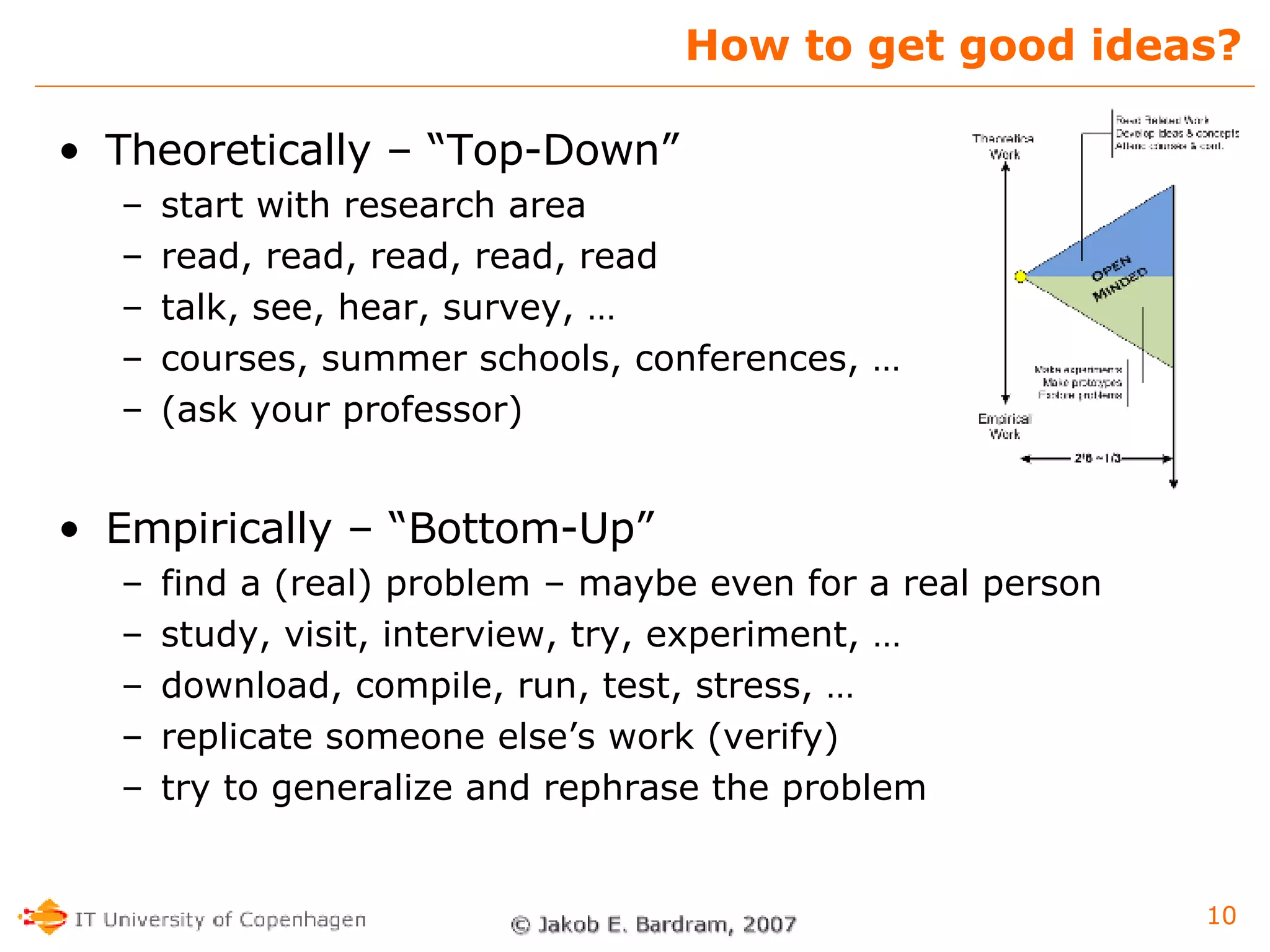
  9. How to get good ideas?
    • Theoretically – “Top-Down”
      • start with research area
      • read, read, read, read, read
      • talk, see, hear, survey, …
      • courses, summer schools, conferences, …
      • (ask your professor)
    • Empirically – “Bottom-Up”
      • find a (real) problem – maybe even for a real person
      • study, visit, interview, try, experiment, …
      • download, compile, run, test, stress, …
      • replicate someone else’s work (verify)
      • try to generalize and rephrase the problem
  10. … a word on plagiarism
    • “ The act of passing off as one's own the ideas or writings of another” [GeorgiaTown Honors Council]
    Copied from Owl online writing lab, owl.english.purdue.edu/handouts/research/r_plagiar.html
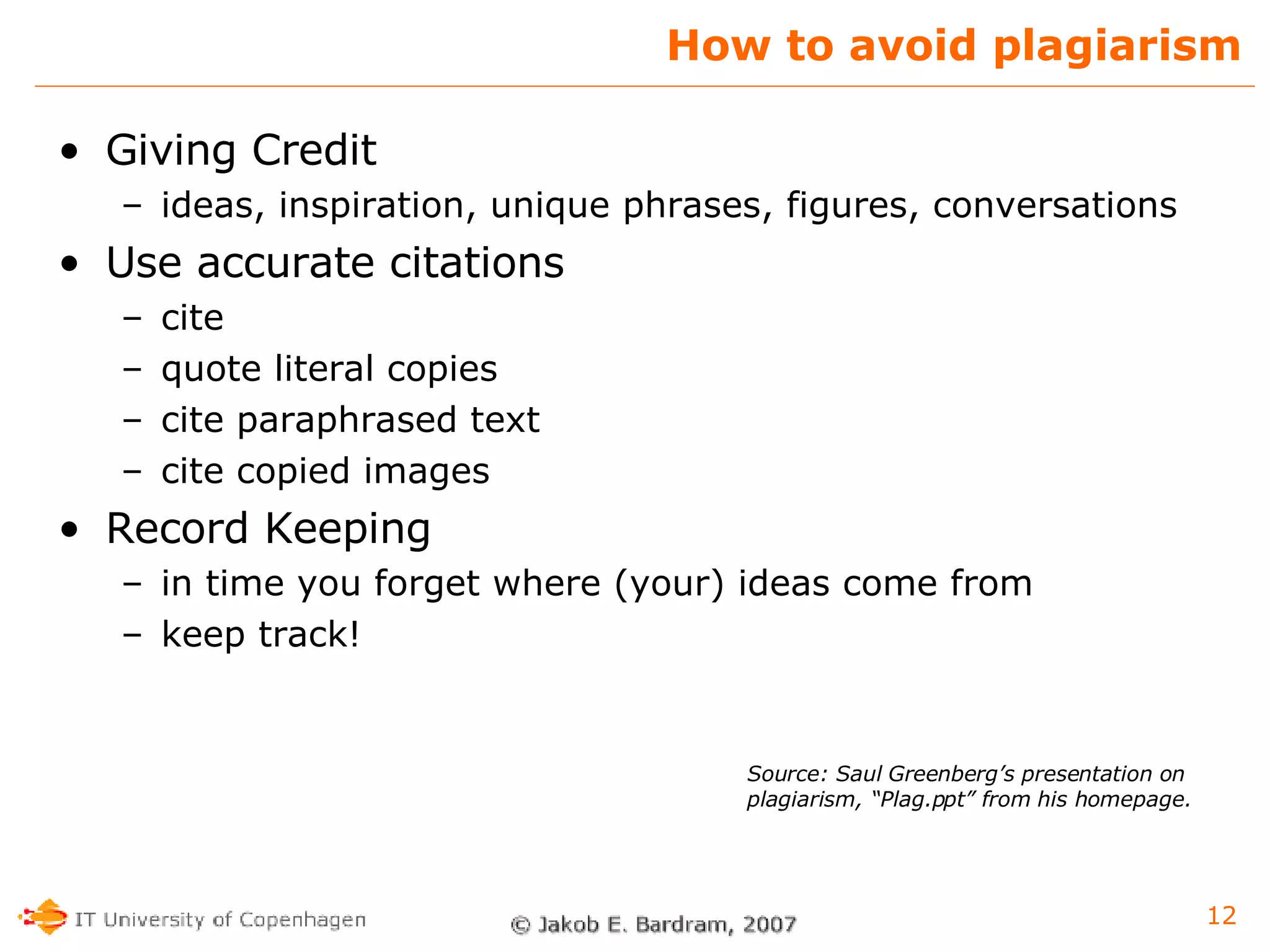
  11. How to avoid plagiarism
    • Giving Credit
      • ideas, inspiration, unique phrases, figures, conversations
    • Use accurate citations
      • cite
      • quote literal copies
      • cite paraphrased text
      • cite copied images
    • Record Keeping
      • in time you forget where (your) ideas come from
      • keep track!
    Source: Saul Greenberg’s presentation on plagiarism, “Plag.ppt” from his homepage.
  12. Literature Review
    • “ A good literature review adds value. It is not just a catalog of papers you have read” [Greenberg]
    • A literature review:
      • Show you know the literature – you must be selective
      • Gives your readers background to understand your work
      • Gives a historical perspective shows how ideas arose and evolved over time
      • Leads into the problem you wish to tackle in your thesis
      • Describes related work
      • Explains why your idea or perspective is new
      • Gives a new view of the problem / solution space
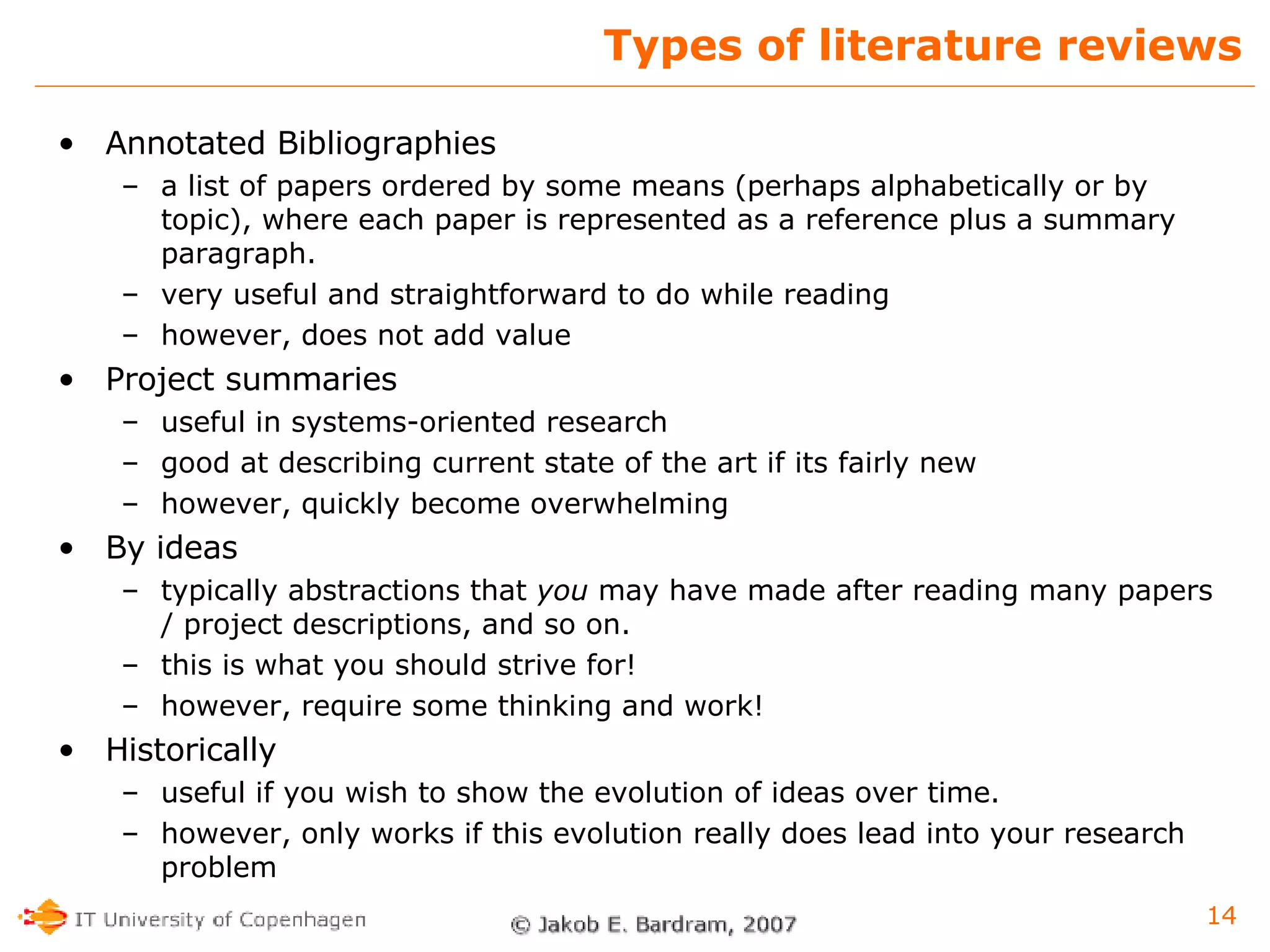
  13. Types of literature reviews
    • Annotated Bibliographies
      • a list of papers ordered by some means (perhaps alphabetically or by topic), where each paper is represented as a reference plus a summary paragraph.
      • very useful and straightforward to do while reading
      • however, does not add value
    • Project summaries
      • useful in systems-oriented research
      • good at describing current state of the art if its fairly new
      • however, quickly become overwhelming
    • By ideas
      • typically abstractions that you may have made after reading many papers / project descriptions, and so on.
      • this is what you should strive for!
      • however, require some thinking and work!
    • Historically
      • useful if you wish to show the evolution of ideas over time.
      • however, only works if this evolution really does lead into your research problem
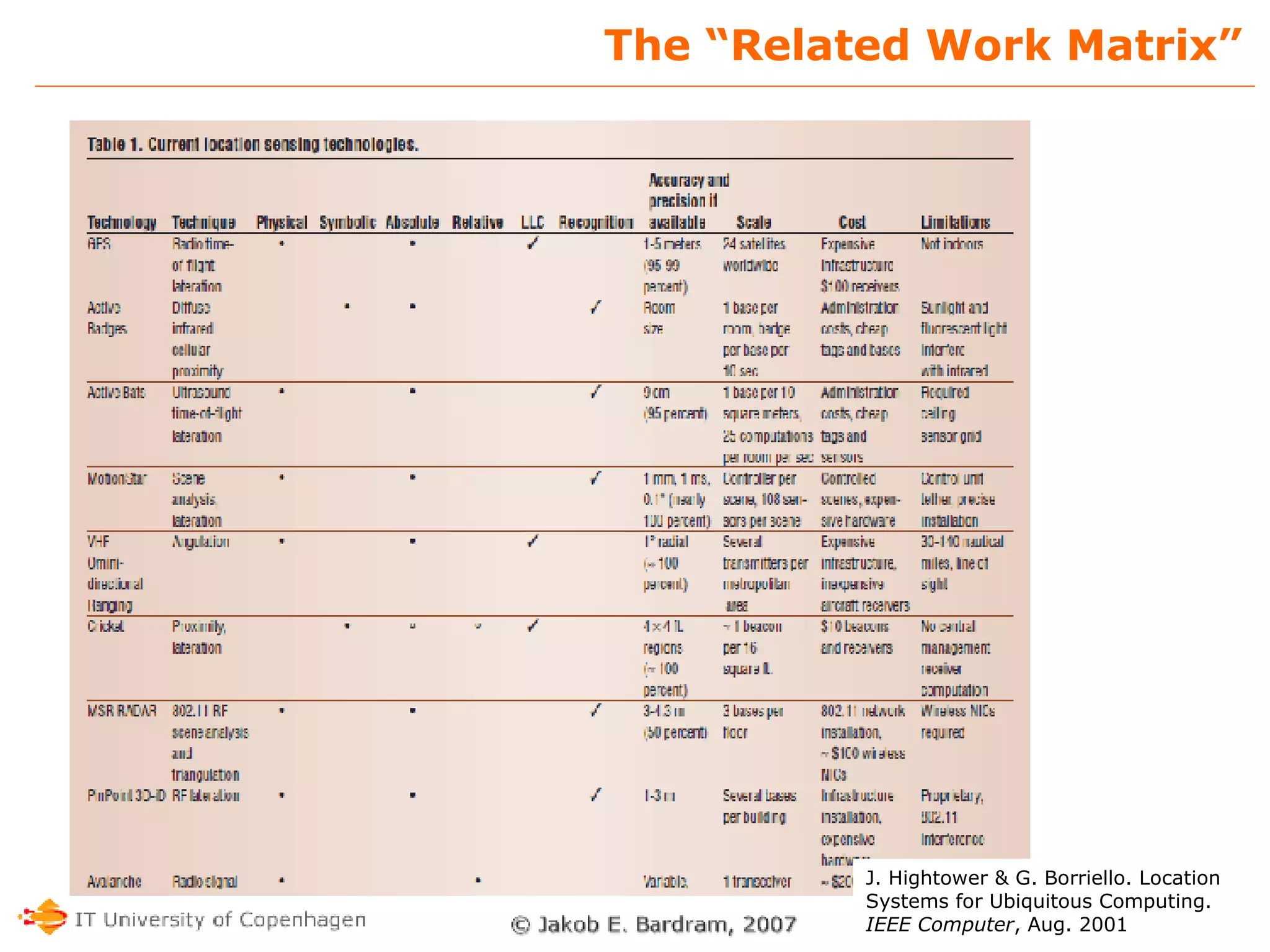
  14. The “Related Work Matrix” J. Hightower & G. Borriello. Location Systems for Ubiquitous Computing. IEEE Computer , Aug. 2001
  15. Chapter 1
    • Context and Motivation
      • Research field / area
      • Is it a real problem
      • Why would anyone care if I solved it?
    • Background
      • Small Literature review / Related Work (the full version is in chapter 2)
      • What is the research context?
      • What is the state-of-art?
    • Hypothesis
      • Thesis or Problem statement
    • Goals and methods
      • What are the operational goals you want to achieve?
      • And how will you do it?
    • Results
      • Contributions
    • Thesis overview
      • Outline of the thesis
    Source: Saul Greenberg’s homepage.
  16. Exercise Try to outline chapter 1 of your thesis
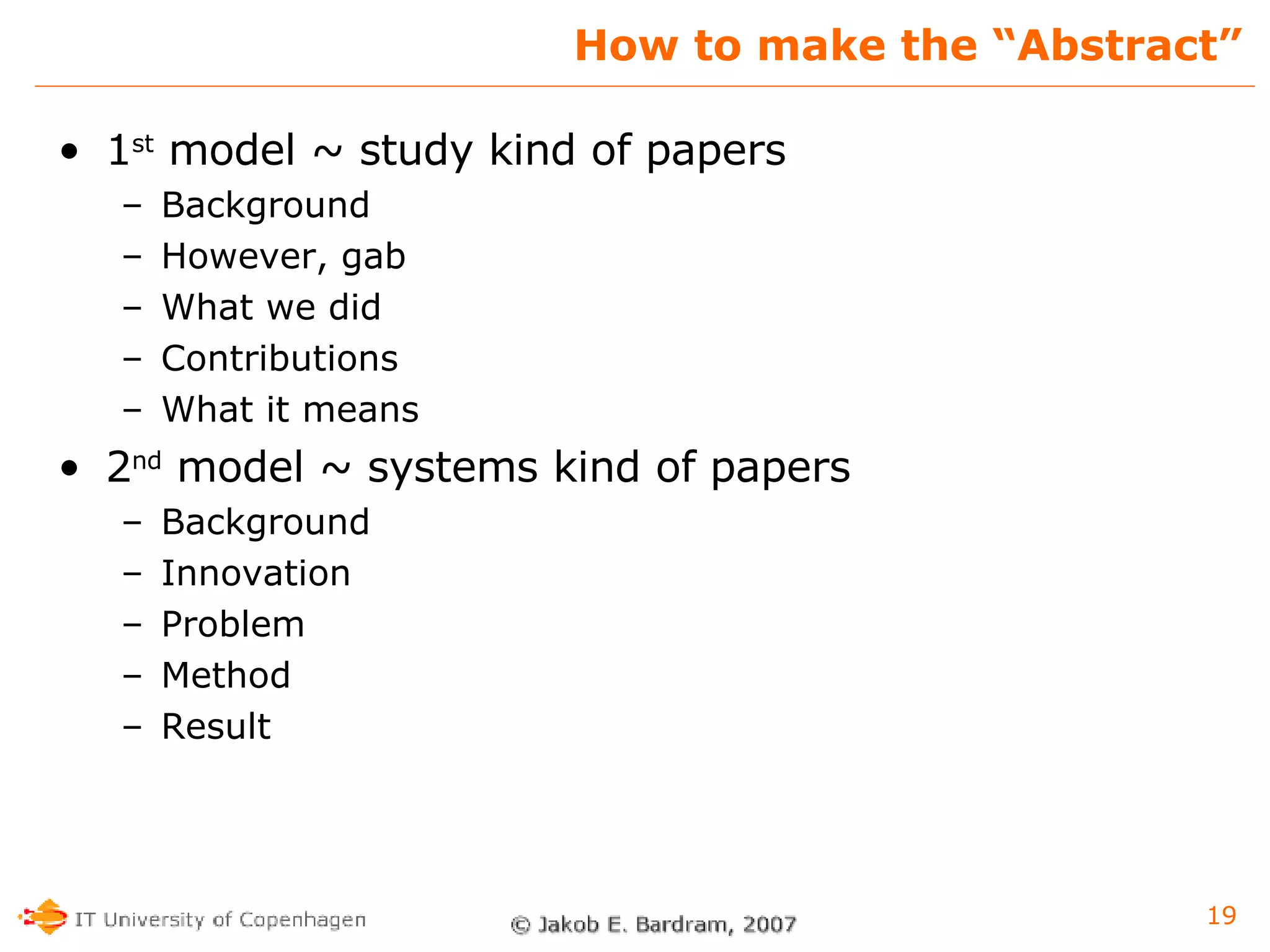
  17. How to make the “Abstract”
    • 1 st model ~ study kind of papers
      • Background
      • However, gab
      • What we did
      • Contributions
      • What it means
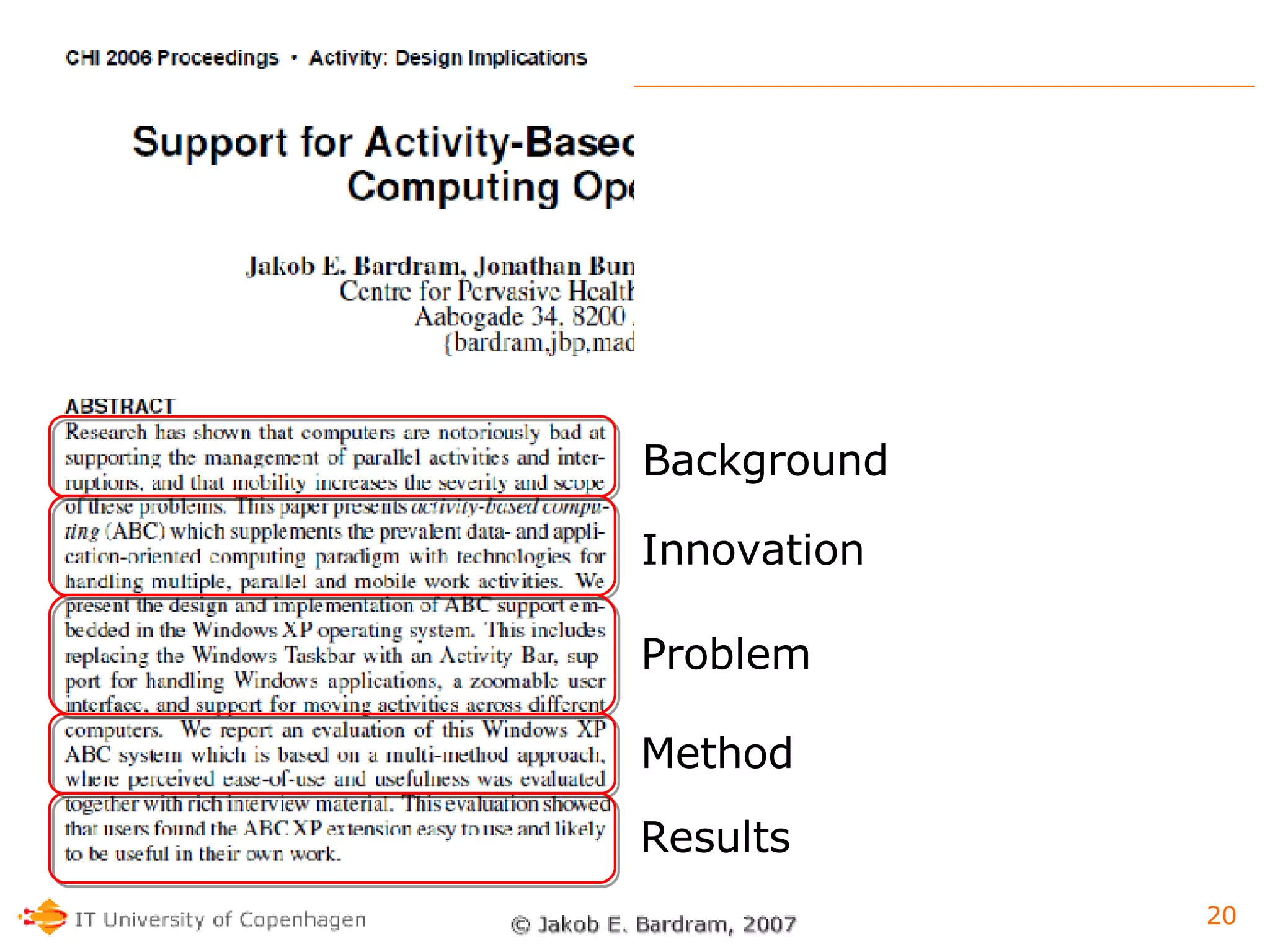
    • 2 nd model ~ systems kind of papers
      • Background
      • Innovation
      • Problem
      • Method
      • Result
  18. Background Innovation Problem Method Results
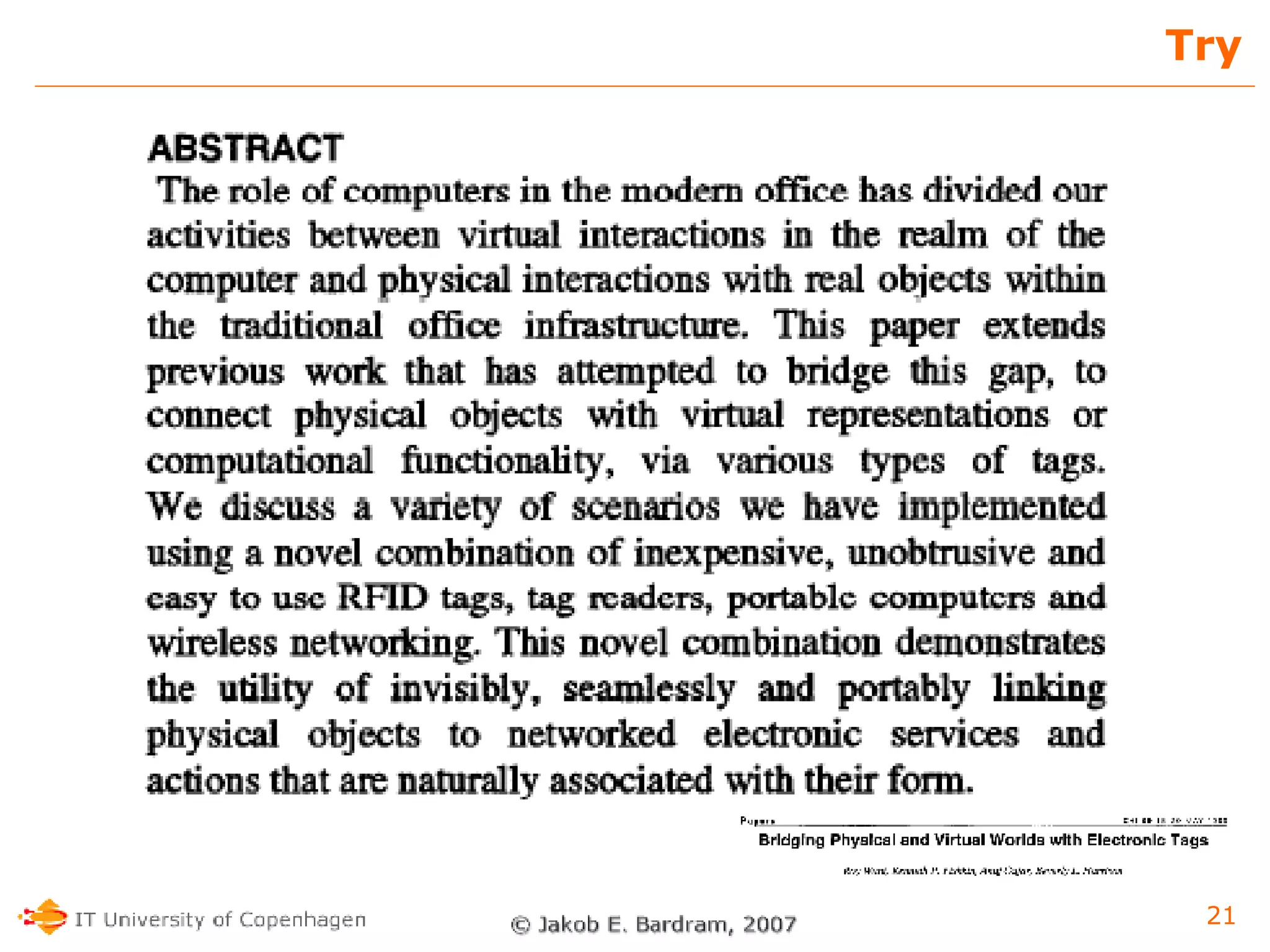
  19. Try
  20. Exercise Try to write an abstract for a paper describing the invention of the paper clip
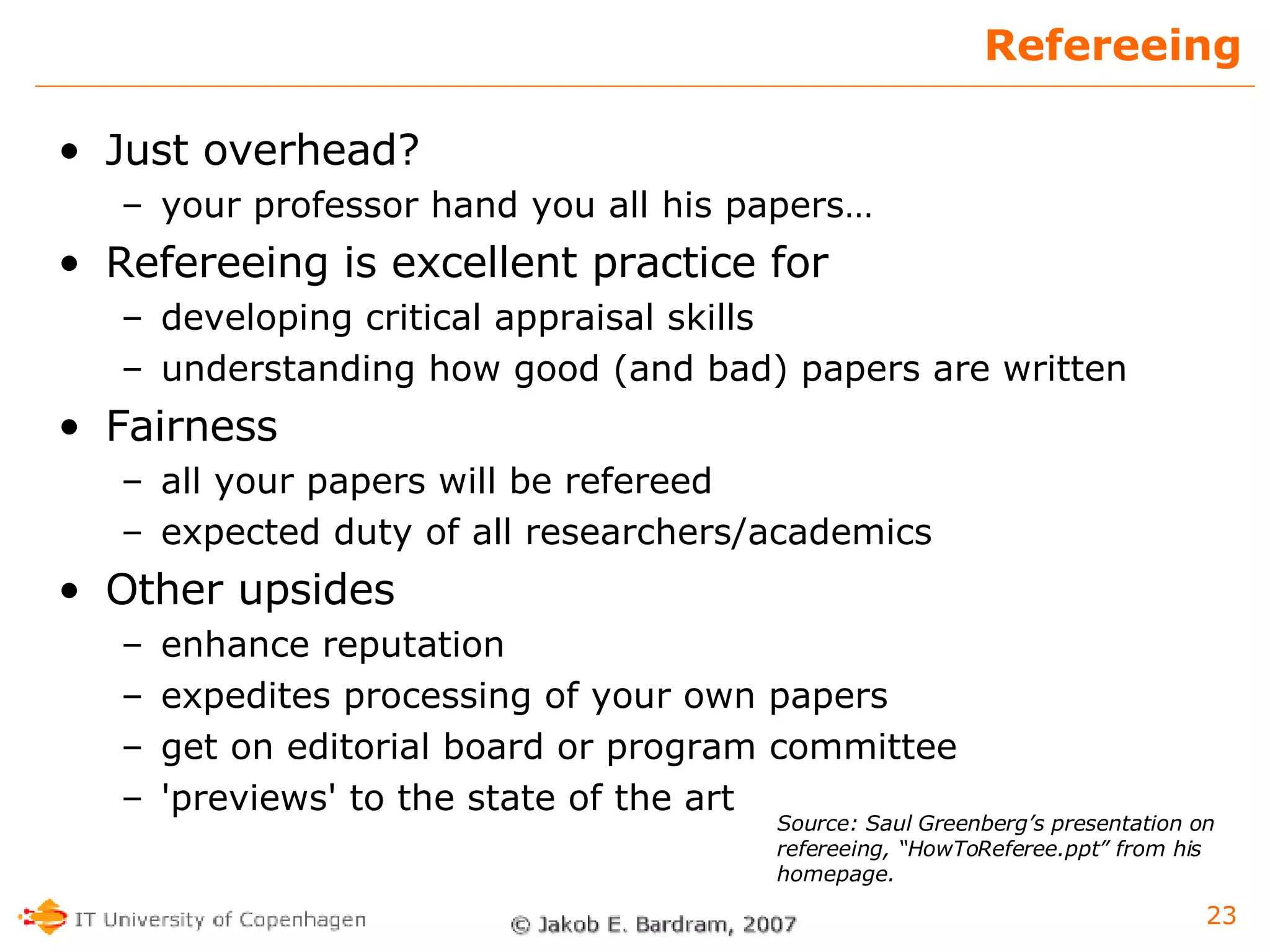
  21. Refereeing
    • Just overhead?
      • your professor hand you all his papers…
    • Refereeing is excellent practice for
      • developing critical appraisal skills
      • understanding how good (and bad) papers are written
    • Fairness
      • all your papers will be refereed
      • expected duty of all researchers/academics
    • Other upsides
      • enhance reputation
      • expedites processing of your own papers
      • get on editorial board or program committee
      • 'previews' to the state of the art
    Source: Saul Greenberg’s presentation on refereeing, “HowToReferee.ppt” from his homepage.
  22. A Template for Reviewing
    • Meta information
      • paper title, author (if not ann.), manuscript id, …
    • The review
      • brief summary (2-3 lines)
      • “ If you can’t, there is probably something wrong with the paper” [ACM CHI FAQ]
      • Contribution
        • what is new? is it significant? (novelty/contribution)
        • would it stimulate further work? (impact)
        • how relevant is it to the community? (relevance)
      • Quality of the research
        • how sound is the work?
        • how appropriate/reliable are the methods used?
        • how reasonable are the interpretations?
        • how does it relate to existing work?
        • can an experienced practitioner in the field duplicate the results?
      • Quality of the writing
        • outline, language, spelling, grammar, figures, …
      • Recommend acceptance / rejection
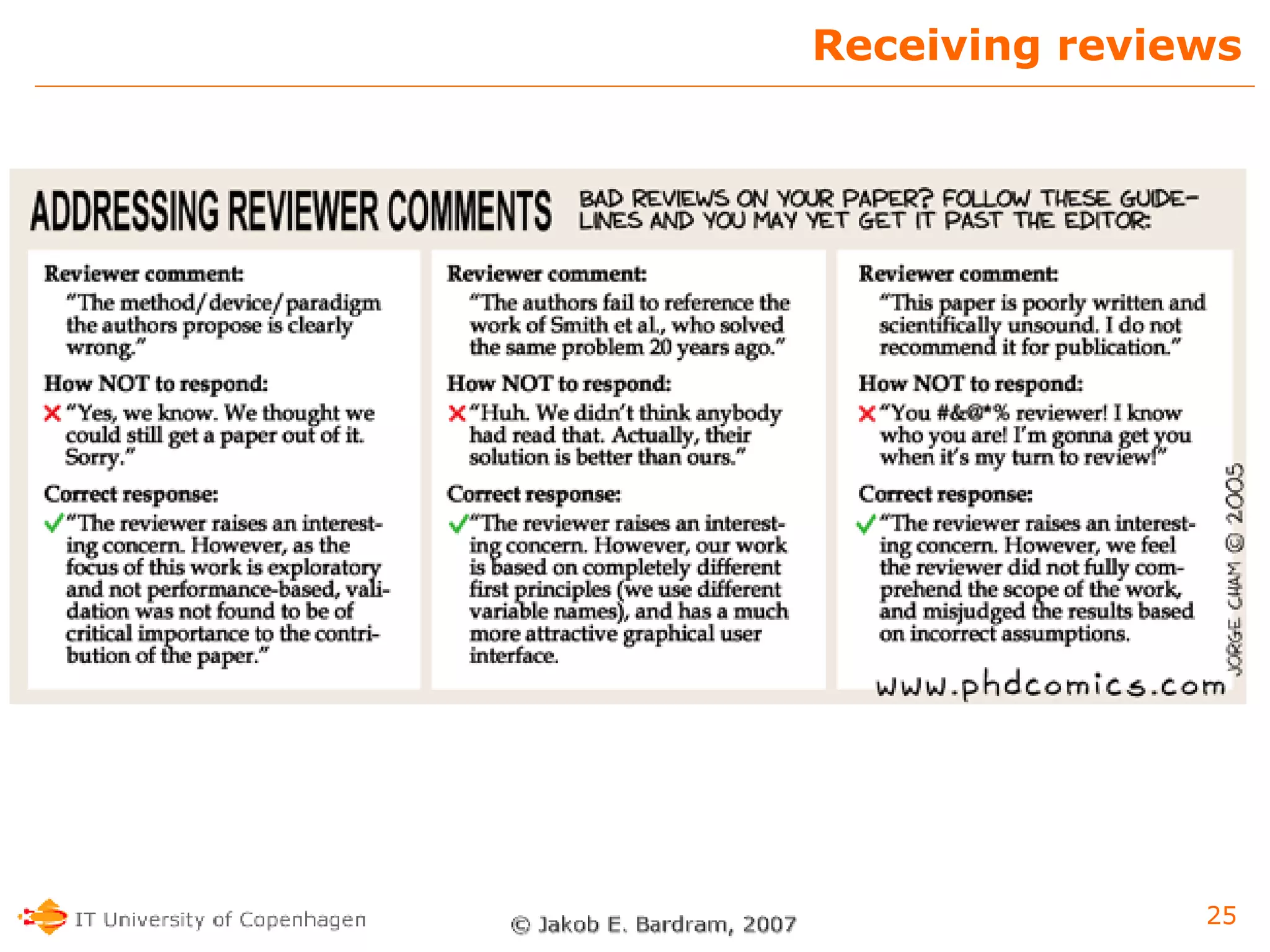
  23. Receiving reviews
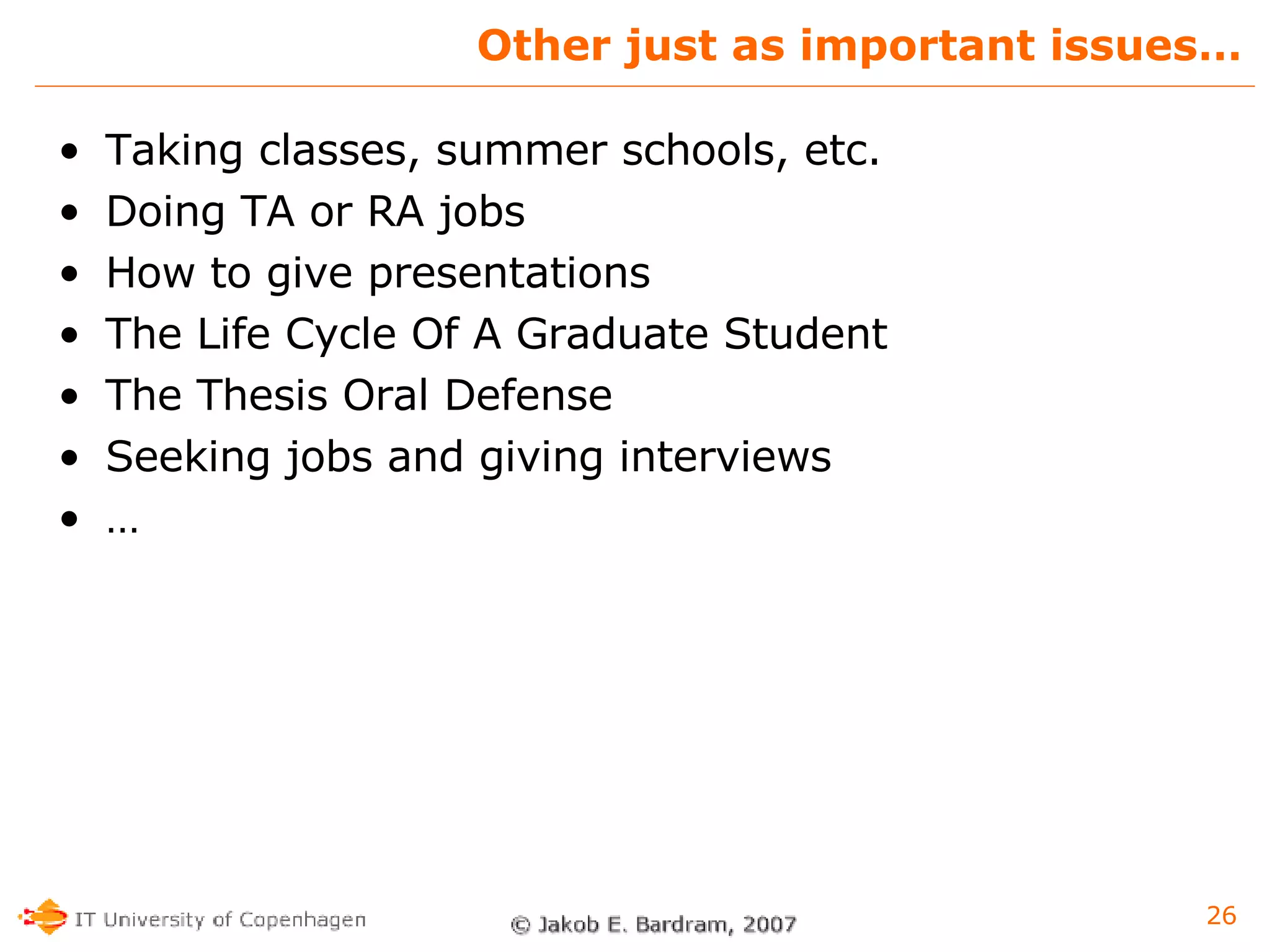
  24. Other just as important issues…
    • Taking classes, summer schools, etc.
    • Doing TA or RA jobs
    • How to give presentations
    • The Life Cycle Of A Graduate Student
    • The Thesis Oral Defense
    • Seeking jobs and giving interviews
  25. … and all the other issues
    • Academia is business
      • fundraising, TA, RA, …
      • a very competitive market
      • you (as a PhD student) is a vital resource in this game
    • Academia is a social activity
      • (start) networking
      • find fellow PhD students – they are your brothers in arms and may become your friends for life
      • attend conferences – as a SV – summer schools
      • present your work everywhere – also in the elevator
      • “ Kill your TV” [Randy Pausch, CMU]
      • Planning and organization
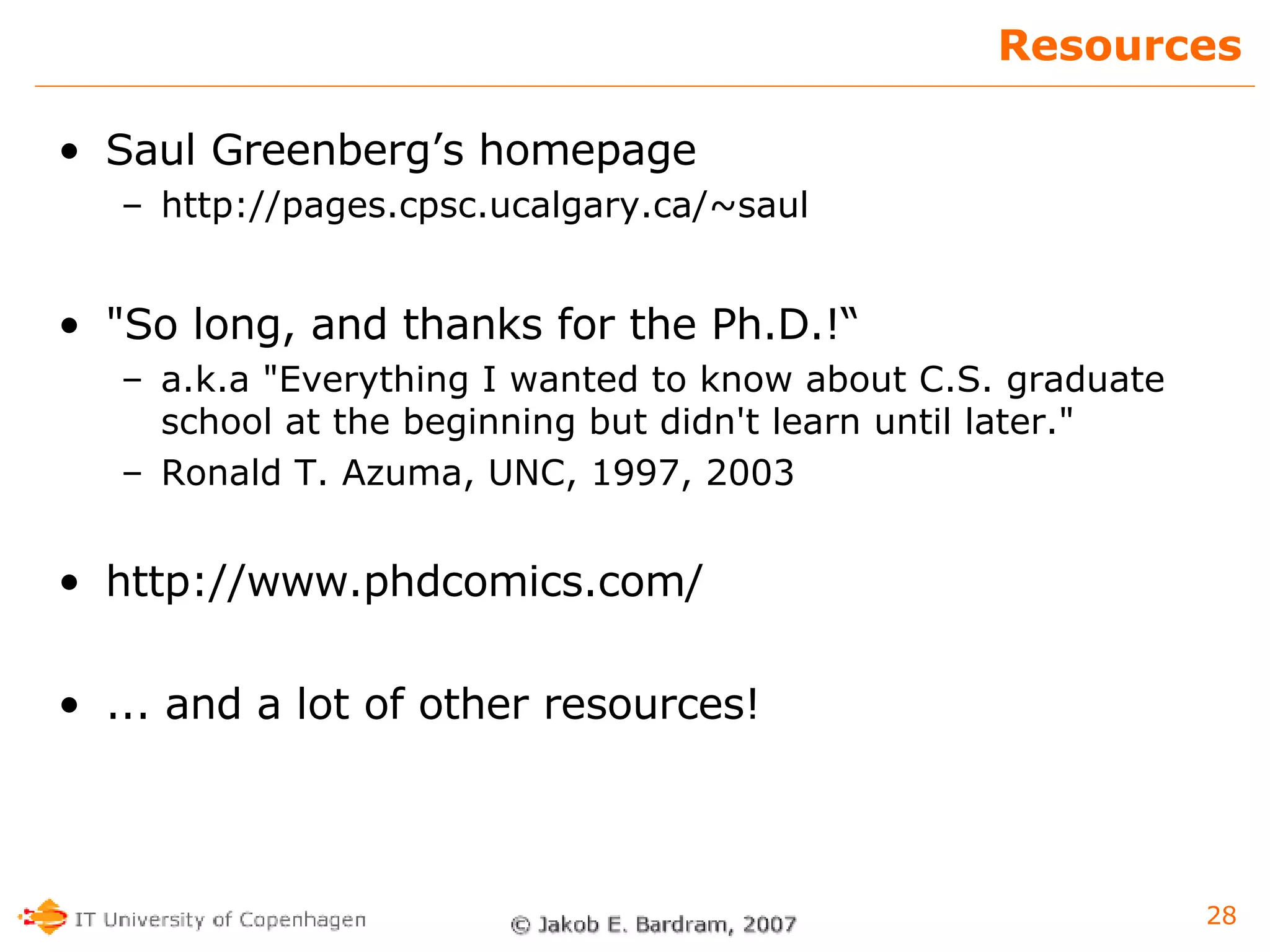
  26. Resources
    • Saul Greenberg’s homepage
      • http://pages.cpsc.ucalgary.ca/~saul
    • "So long, and thanks for the Ph.D.!“
      • a.k.a "Everything I wanted to know about C.S. graduate school at the beginning but didn't learn until later."
      • Ronald T. Azuma, UNC, 1997, 2003
    • http://www.phdcomics.com/
    • ... and a lot of other resources!

+ bardrambardram, 3 years ago

custom

4843 views, 24 favs, 8 embeds more stats

This stack of slides describes my view on how to wo more

More info about this document

© All Rights Reserved

Go to text version

  • Total Views 4843
    • 4764 on SlideShare
    • 79 from embeds
  • Comments 1
  • Favorites 24
  • Downloads 0
Most viewed embeds
  • 38 views on http://scienceforseo.blogspot.com
  • 24 views on http://gumption.typepad.com
  • 10 views on http://teachermimma2.blogspot.com
  • 3 views on http://gowriganesh.blogspot.com
  • 1 views on http://209.85.175.104

more

All embeds
  • 38 views on http://scienceforseo.blogspot.com
  • 24 views on http://gumption.typepad.com
  • 10 views on http://teachermimma2.blogspot.com
  • 3 views on http://gowriganesh.blogspot.com
  • 1 views on http://209.85.175.104
  • 1 views on http://www.blogger.com
  • 1 views on http://www.scienceforseo.blogspot.com
  • 1 views on http://www.russellbeattie.com

less

Flagged as inappropriate Flag as inappropriate
Flag as inappropriate

Select your reason for flagging this presentation as inappropriate. If needed, use the feedback form to let us know more details.

Cancel
File a copyright complaint
Having problems? Go to our helpdesk?

Categories

Groups / Events