Thinking of Doing
a PhD?
Diljit Singh
1
Background
Rationale for presentation
• Many want to do their PhD
• Some start on their PhD ‘journey’, some will not
• Some of those who start on their PhD journey will
succeed, some will not
• Some will enjoy the PhD journey, many will struggle
to complete it
• Aim is to successfully complete your PhD,
and enjoy the journey
2
Background
Rationale for Presentation
• To provide some insights into the PhD ‘journey’ so
that is can be successful and pleasant
• To create an awareness of what lies ahead and
how to prepare yourself can make the journey
easier
3
Aims of Presentation
• To raise awareness about the PhD, and the
requirements for the successful completion of
the degree
4
Target Audience of Presentation
• Those who are thinking of doing a PhD, but
have not started yet
5
Outline of Presentation
• What is a PhD?
• Why Do a PhD?
• Requirements for a PhD
• Considerations in doing a PhD
• Should you do a PhD?
• What’s next?
6
What is a PhD ?
7
What is a PhD?
• What is a PhD?
• 'PhD' comes from Latin term Philiosphiae Doctor
• Translated into English as 'Doctor of Philosophy‘
• A PhD
• is an advanced postgraduate degree involving 3 or more years
of research on an original topic
• is carried out with the support of one or more academic
supervisors
• results in a thesis that makes a significant original contribution to
knowledge
• confers the title ‘Doctor’ upon successful candidates
• is the highest academic degree a student can achieve and [in
many cases] is considered the entrance qualification for a
university teaching position
https://www.findaphd.com/advice/finding/what-is-a-phd.aspx8
What is a PhD?
• What is a PhD?
• the highest academic qualification that a student
can achieve
• practically speaking, it is a 3-4 year individual
research project involving advanced scholarship
focusing on a specific area, and which makes an
original contribution to knowledge
Adapted from
https://www2.warwick.ac.uk/fac/soc/philosophy/studywithus/pgrstudy/what-
is-a-phd/
9
What is a PhD?
• What is a PhD?
• … a prestigious qualification that demonstrates
talent, academic excellence and a thirst for
knowledge
• over a registration period, you investigate a
research topic and develop your research skills,
culminating in the completion, submission and
defence via an oral examination of a 100,000 word
doctoral thesis to the satisfaction of the examiners
Adapted from
The Open University http://www.open.ac.uk/postgraduate/research-
degrees/degrees-we-offer/doctor-of-philosophy-phd
10
What is a PhD?
• So, what is a PhD?
• The highest academic qualification
• Usually completed in 3 – 5 years (but may take more)
• Based on a research project
• That makes an original contribution to the body of
knowledge or understanding in a specific field
• Provides
• in-depth knowledge on a specific subject
• training to become an independent researcher
• Entitles you to use Dr. before your name
• Is a pathway to an academic career or a research-
based career
11
What is a PhD?
• Types of Doctorates
• Research-based doctoral degrees
• PhD, Ed.D., D.B.A., etc.
• Professional practice doctoral degrees
• M.D., J.D.
• Honorary Doctorates
• Others (depends on national education system)
• PhD is the more common type of doctorate
12
Why do a PhD?
13
Why Do a PhD?
• Personal motivation
• To achieve something
• Thirst for new knowledge
• Love for research / Develop research skills
• Looking for a career change
• Seeking an academic career
• Enjoy academic freedom
• Becoming an ‘expert’ in a selected area
14
Why Do a PhD?
• Institutional factors
• Encouragement / requirement from institution
• Opportunities
• Scholarship
• New institutional opening
15
Why Do a PhD?
• Benefits of doing a PhD
• Opportunity to pursue something you are
passionate about
• Freedom to explore / push the boundaries of
knowledge
• Opportunities for international travel (presenting
work at conferences and workshops)
• You join the world specialists in your subject area
• Well respected by employers
16
Why Do a PhD?
• Who does a PhD, and why?
• Those genuinely wanting to enter academia
• Those seeking progress in their career
• Age, socio-economic status, previous examination
results, etc. are not a barrier to seeking a PhD
17
Why Do a PhD?
• Wrong reasons to do a PhD
• Continuation of Bachelor’s / Master’s degree
• The grandeur of academia
• Fulfilling others’ ambitions
• Avoiding the real world
• Financial gain / Higher income
• Peer pressure
• ‘Easy life’
• Prestige
• A way to impress your family, friends, community,
[potential] spouse, …
18
Requirements for a PhD
19
Requirements for a PhD
• What is involved in doing a PhD?
• Generally
• The conduct of a major research project that leads to a
contribution to knowledge
• Requirements may vary
• From country to country, from university to university,
and even between departments
• Some may involve a period of residency, taking certain
courses, passing a comprehensive examination, defense
of proposal, requirements to publish, etc.
20
Requirements for a PhD
• What is involved in doing a PhD?
• Generally,
• Obtaining admission to a PhD program
• Preparing a research proposal
• Registering for an MPhil / PhD
• [Taking certain courses]
• Conducting a comprehensive literature review
• Conducting the research
• [Completing the MPhil to PhD upgrade]
• Writing your dissertation
• Having the dissertation examined
• Defending your research at an oral viva voce examination
21
Requirements for Doing a PhD
• What is required to be successful in doing a PhD?
• Good foundation in your subject area
• Knowledge of the research process
• including ethics in research
• Communication skills
• Personal management skills
• time management, prioritization
22
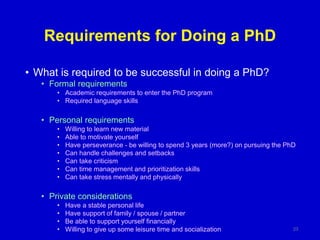
Requirements for Doing a PhD
• What is required to be successful in doing a PhD?
• Formal requirements
• Academic requirements to enter the PhD program
• Required language skills
• Personal requirements
• Willing to learn new material
• Able to motivate yourself
• Have perseverance - be willing to spend 3 years (more?) on pursuing the PhD
• Can handle challenges and setbacks
• Can take criticism
• Can time management and prioritization skills
• Can take stress mentally and physically
• Private considerations
• Have a stable personal life
• Have support of family / spouse / partner
• Be able to support yourself financially
• Willing to give up some leisure time and socialization 23
Considerations in Doing a PhD
24
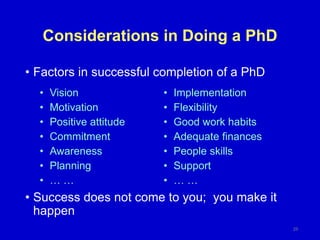
Considerations in Doing a PhD
• Factors in successful completion of a PhD
• Success does not come to you; you make it
happen
25
• Vision
• Motivation
• Positive attitude
• Commitment
• Awareness
• Planning
• … …
• Implementation
• Flexibility
• Good work habits
• Adequate finances
• People skills
• Support
• … …
Considerations in Doing a PhD
26
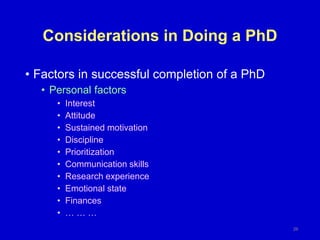
• Factors in successful completion of a PhD
• Personal factors
• Interest
• Attitude
• Sustained motivation
• Discipline
• Prioritization
• Communication skills
• Research experience
• Emotional state
• Finances
• … … …
Considerations in Doing a PhD
27
• Factors in successful completion of a PhD
• Institutional factors
• University / Departmental requirements
• University environment
• Research environment
• Research topic
• Supervisor / Supervision
• Access to resources (library, labs, technology)
• …
Considerations in Doing a PhD
28
• Factors in successful completion of a PhD
• Social factors
• Home circumstances
• Family support
• Peer support
• …
Considerations in Doing a PhD
• Challenges in doing a PhD
• Often you’ll work very long hours
• You may work alone
• Can sometimes be frustrating
• Ultimately you are responsible for the success of
your project
• A PhD may mean you are over-qualified for some
positions
29
Considerations in Doing a PhD
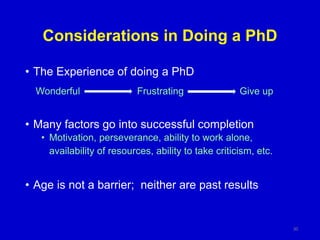
• The Experience of doing a PhD
• Many factors go into successful completion
• Motivation, perseverance, ability to work alone,
availability of resources, ability to take criticism, etc.
• Age is not a barrier; neither are past results
Wonderful Frustrating Give up
30
Should You Do a PhD?
- Self-Assessment
• Am I qualified?
• Easy to answer – yes/no
• Am I ready?
• Difficult to answer; many factors involved
31
Should You Do a PhD?
- Self-Assessment
• Know yourself
• Do a personal SWOT analysis
• Be clear as to your reasons for wanting to do a PhD
• Do you have the support?
perseverance?
resources?
• Know what it involves – the PhD journey
Ultimately, you have to decide
32
Resources for Further Information
• Find out as much as you can about the PhD
• Books
• Journals
• Websites
• Blogs
• University that you are aiming for
• Professors
• Alumni
• Current students
33
Questions?
Comments? Suggestions?
34
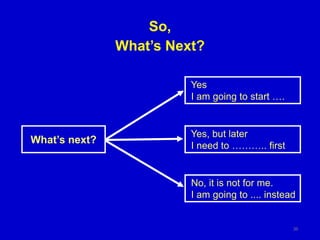
So,
What’s Next?
Yes
I am going to start ….
What’s next?
Yes, but later
I need to ……….. first
No, it is not for me.
I am going to .... instead
35
Good luck!
36

Thinking of Doing a PhD?

  • 1.
    Thinking of Doing aPhD? Diljit Singh 1
  • 2.
    Background Rationale for presentation •Many want to do their PhD • Some start on their PhD ‘journey’, some will not • Some of those who start on their PhD journey will succeed, some will not • Some will enjoy the PhD journey, many will struggle to complete it • Aim is to successfully complete your PhD, and enjoy the journey 2
  • 3.
    Background Rationale for Presentation •To provide some insights into the PhD ‘journey’ so that is can be successful and pleasant • To create an awareness of what lies ahead and how to prepare yourself can make the journey easier 3
  • 4.
    Aims of Presentation •To raise awareness about the PhD, and the requirements for the successful completion of the degree 4
  • 5.
    Target Audience ofPresentation • Those who are thinking of doing a PhD, but have not started yet 5
  • 6.
    Outline of Presentation •What is a PhD? • Why Do a PhD? • Requirements for a PhD • Considerations in doing a PhD • Should you do a PhD? • What’s next? 6
  • 7.
    What is aPhD ? 7
  • 8.
    What is aPhD? • What is a PhD? • 'PhD' comes from Latin term Philiosphiae Doctor • Translated into English as 'Doctor of Philosophy‘ • A PhD • is an advanced postgraduate degree involving 3 or more years of research on an original topic • is carried out with the support of one or more academic supervisors • results in a thesis that makes a significant original contribution to knowledge • confers the title ‘Doctor’ upon successful candidates • is the highest academic degree a student can achieve and [in many cases] is considered the entrance qualification for a university teaching position https://www.findaphd.com/advice/finding/what-is-a-phd.aspx8
  • 9.
    What is aPhD? • What is a PhD? • the highest academic qualification that a student can achieve • practically speaking, it is a 3-4 year individual research project involving advanced scholarship focusing on a specific area, and which makes an original contribution to knowledge Adapted from https://www2.warwick.ac.uk/fac/soc/philosophy/studywithus/pgrstudy/what- is-a-phd/ 9
  • 10.
    What is aPhD? • What is a PhD? • … a prestigious qualification that demonstrates talent, academic excellence and a thirst for knowledge • over a registration period, you investigate a research topic and develop your research skills, culminating in the completion, submission and defence via an oral examination of a 100,000 word doctoral thesis to the satisfaction of the examiners Adapted from The Open University http://www.open.ac.uk/postgraduate/research- degrees/degrees-we-offer/doctor-of-philosophy-phd 10
  • 11.
    What is aPhD? • So, what is a PhD? • The highest academic qualification • Usually completed in 3 – 5 years (but may take more) • Based on a research project • That makes an original contribution to the body of knowledge or understanding in a specific field • Provides • in-depth knowledge on a specific subject • training to become an independent researcher • Entitles you to use Dr. before your name • Is a pathway to an academic career or a research- based career 11
  • 12.
    What is aPhD? • Types of Doctorates • Research-based doctoral degrees • PhD, Ed.D., D.B.A., etc. • Professional practice doctoral degrees • M.D., J.D. • Honorary Doctorates • Others (depends on national education system) • PhD is the more common type of doctorate 12
  • 13.
    Why do aPhD? 13
  • 14.
    Why Do aPhD? • Personal motivation • To achieve something • Thirst for new knowledge • Love for research / Develop research skills • Looking for a career change • Seeking an academic career • Enjoy academic freedom • Becoming an ‘expert’ in a selected area 14
  • 15.
    Why Do aPhD? • Institutional factors • Encouragement / requirement from institution • Opportunities • Scholarship • New institutional opening 15
  • 16.
    Why Do aPhD? • Benefits of doing a PhD • Opportunity to pursue something you are passionate about • Freedom to explore / push the boundaries of knowledge • Opportunities for international travel (presenting work at conferences and workshops) • You join the world specialists in your subject area • Well respected by employers 16
  • 17.
    Why Do aPhD? • Who does a PhD, and why? • Those genuinely wanting to enter academia • Those seeking progress in their career • Age, socio-economic status, previous examination results, etc. are not a barrier to seeking a PhD 17
  • 18.
    Why Do aPhD? • Wrong reasons to do a PhD • Continuation of Bachelor’s / Master’s degree • The grandeur of academia • Fulfilling others’ ambitions • Avoiding the real world • Financial gain / Higher income • Peer pressure • ‘Easy life’ • Prestige • A way to impress your family, friends, community, [potential] spouse, … 18
  • 19.
  • 20.
    Requirements for aPhD • What is involved in doing a PhD? • Generally • The conduct of a major research project that leads to a contribution to knowledge • Requirements may vary • From country to country, from university to university, and even between departments • Some may involve a period of residency, taking certain courses, passing a comprehensive examination, defense of proposal, requirements to publish, etc. 20
  • 21.
    Requirements for aPhD • What is involved in doing a PhD? • Generally, • Obtaining admission to a PhD program • Preparing a research proposal • Registering for an MPhil / PhD • [Taking certain courses] • Conducting a comprehensive literature review • Conducting the research • [Completing the MPhil to PhD upgrade] • Writing your dissertation • Having the dissertation examined • Defending your research at an oral viva voce examination 21
  • 22.
    Requirements for Doinga PhD • What is required to be successful in doing a PhD? • Good foundation in your subject area • Knowledge of the research process • including ethics in research • Communication skills • Personal management skills • time management, prioritization 22
  • 23.
    Requirements for Doinga PhD • What is required to be successful in doing a PhD? • Formal requirements • Academic requirements to enter the PhD program • Required language skills • Personal requirements • Willing to learn new material • Able to motivate yourself • Have perseverance - be willing to spend 3 years (more?) on pursuing the PhD • Can handle challenges and setbacks • Can take criticism • Can time management and prioritization skills • Can take stress mentally and physically • Private considerations • Have a stable personal life • Have support of family / spouse / partner • Be able to support yourself financially • Willing to give up some leisure time and socialization 23
  • 24.
  • 25.
    Considerations in Doinga PhD • Factors in successful completion of a PhD • Success does not come to you; you make it happen 25 • Vision • Motivation • Positive attitude • Commitment • Awareness • Planning • … … • Implementation • Flexibility • Good work habits • Adequate finances • People skills • Support • … …
  • 26.
    Considerations in Doinga PhD 26 • Factors in successful completion of a PhD • Personal factors • Interest • Attitude • Sustained motivation • Discipline • Prioritization • Communication skills • Research experience • Emotional state • Finances • … … …
  • 27.
    Considerations in Doinga PhD 27 • Factors in successful completion of a PhD • Institutional factors • University / Departmental requirements • University environment • Research environment • Research topic • Supervisor / Supervision • Access to resources (library, labs, technology) • …
  • 28.
    Considerations in Doinga PhD 28 • Factors in successful completion of a PhD • Social factors • Home circumstances • Family support • Peer support • …
  • 29.
    Considerations in Doinga PhD • Challenges in doing a PhD • Often you’ll work very long hours • You may work alone • Can sometimes be frustrating • Ultimately you are responsible for the success of your project • A PhD may mean you are over-qualified for some positions 29
  • 30.
    Considerations in Doinga PhD • The Experience of doing a PhD • Many factors go into successful completion • Motivation, perseverance, ability to work alone, availability of resources, ability to take criticism, etc. • Age is not a barrier; neither are past results Wonderful Frustrating Give up 30
  • 31.
    Should You Doa PhD? - Self-Assessment • Am I qualified? • Easy to answer – yes/no • Am I ready? • Difficult to answer; many factors involved 31
  • 32.
    Should You Doa PhD? - Self-Assessment • Know yourself • Do a personal SWOT analysis • Be clear as to your reasons for wanting to do a PhD • Do you have the support? perseverance? resources? • Know what it involves – the PhD journey Ultimately, you have to decide 32
  • 33.
    Resources for FurtherInformation • Find out as much as you can about the PhD • Books • Journals • Websites • Blogs • University that you are aiming for • Professors • Alumni • Current students 33
  • 34.
  • 35.
    So, What’s Next? Yes I amgoing to start …. What’s next? Yes, but later I need to ……….. first No, it is not for me. I am going to .... instead 35
  • 36.