API Design: When to buck the trend
Netflix API case study with Daniel Jacobson


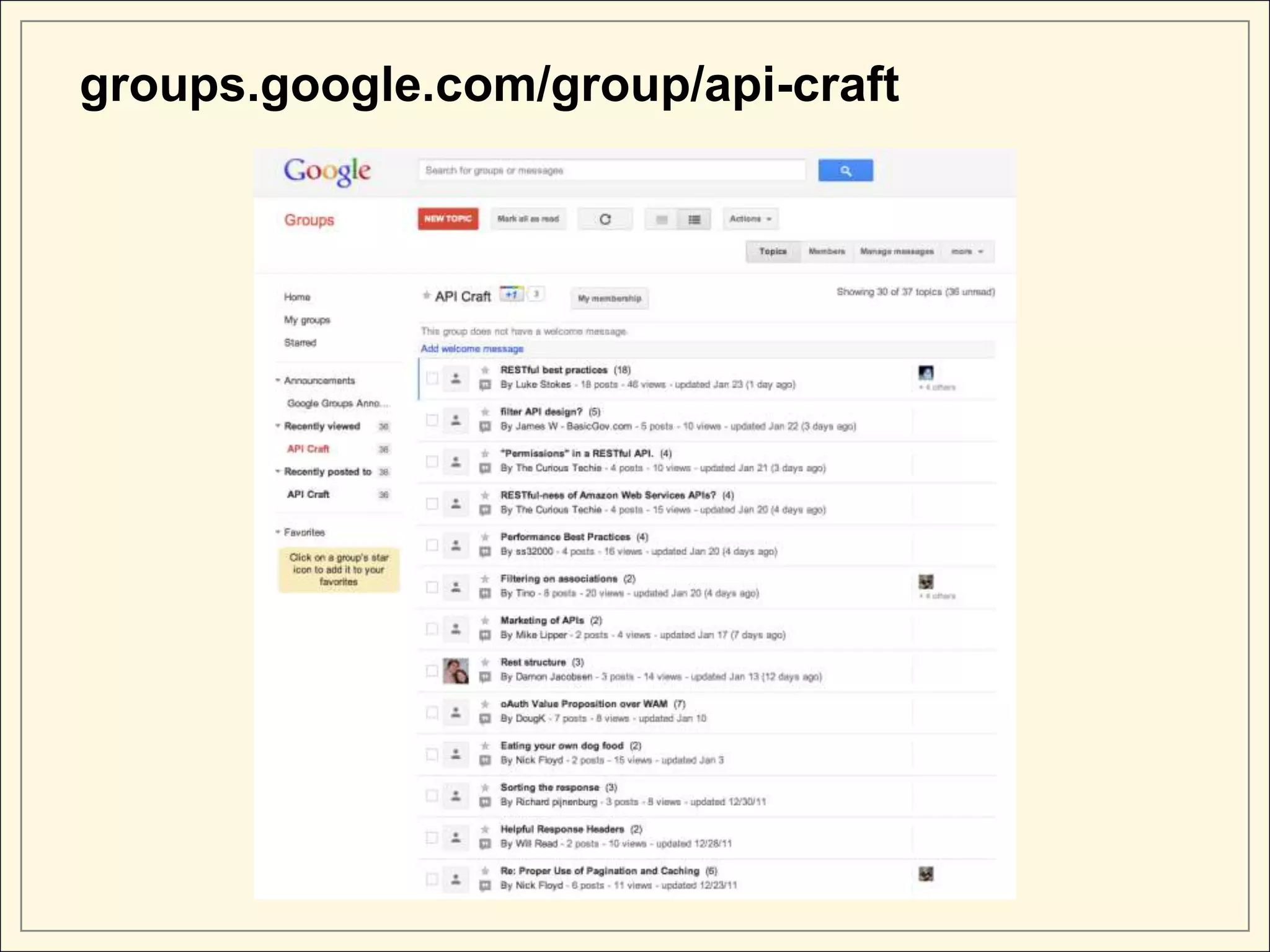
groups.google.com/group/api-craft

Daniel Jacobson             Greg Brail
Netflix                     Apigee
@daniel_jacobson            @gbrail
groups.google.com/group/api-craft
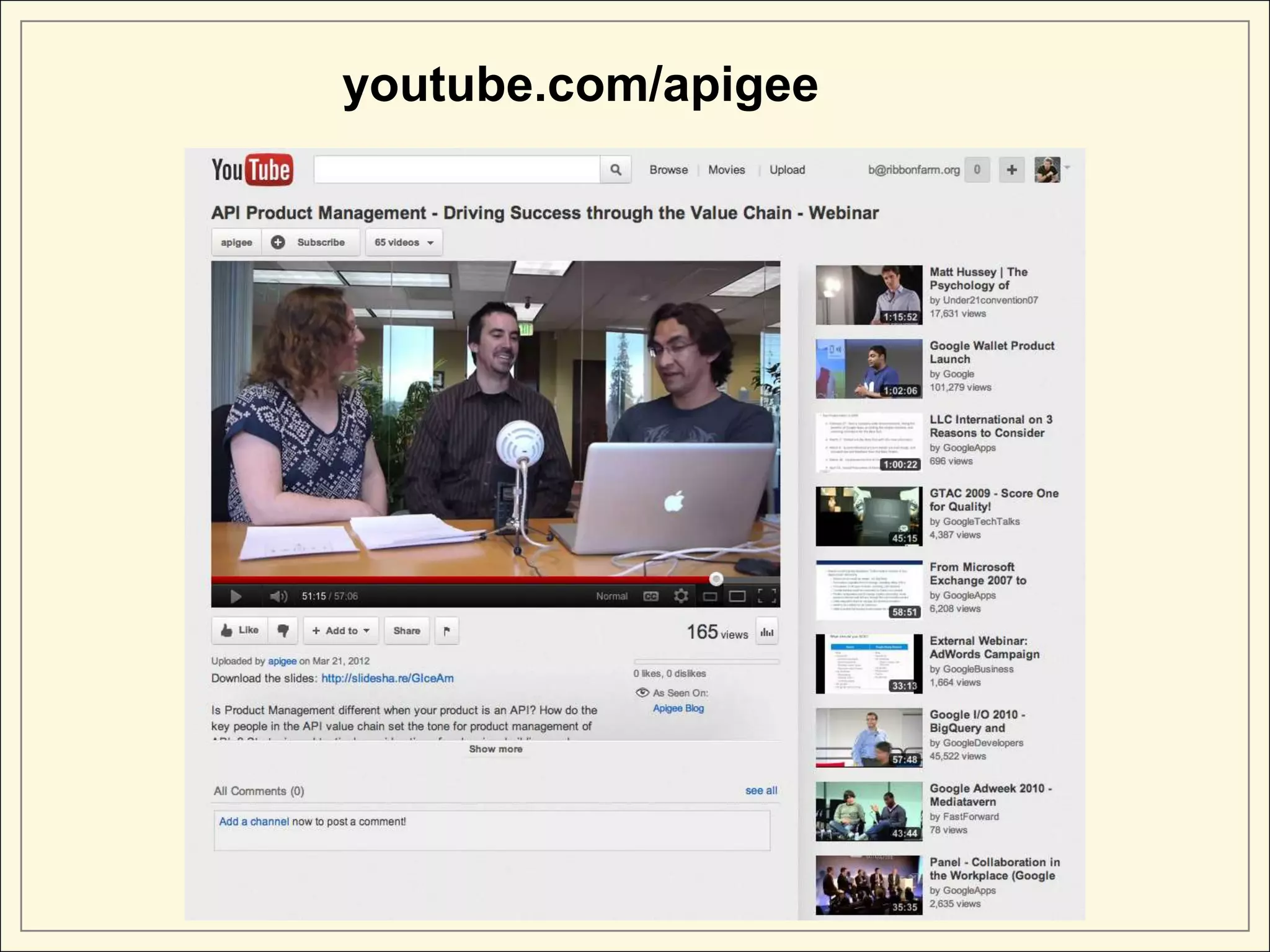
youtube.com/apigee
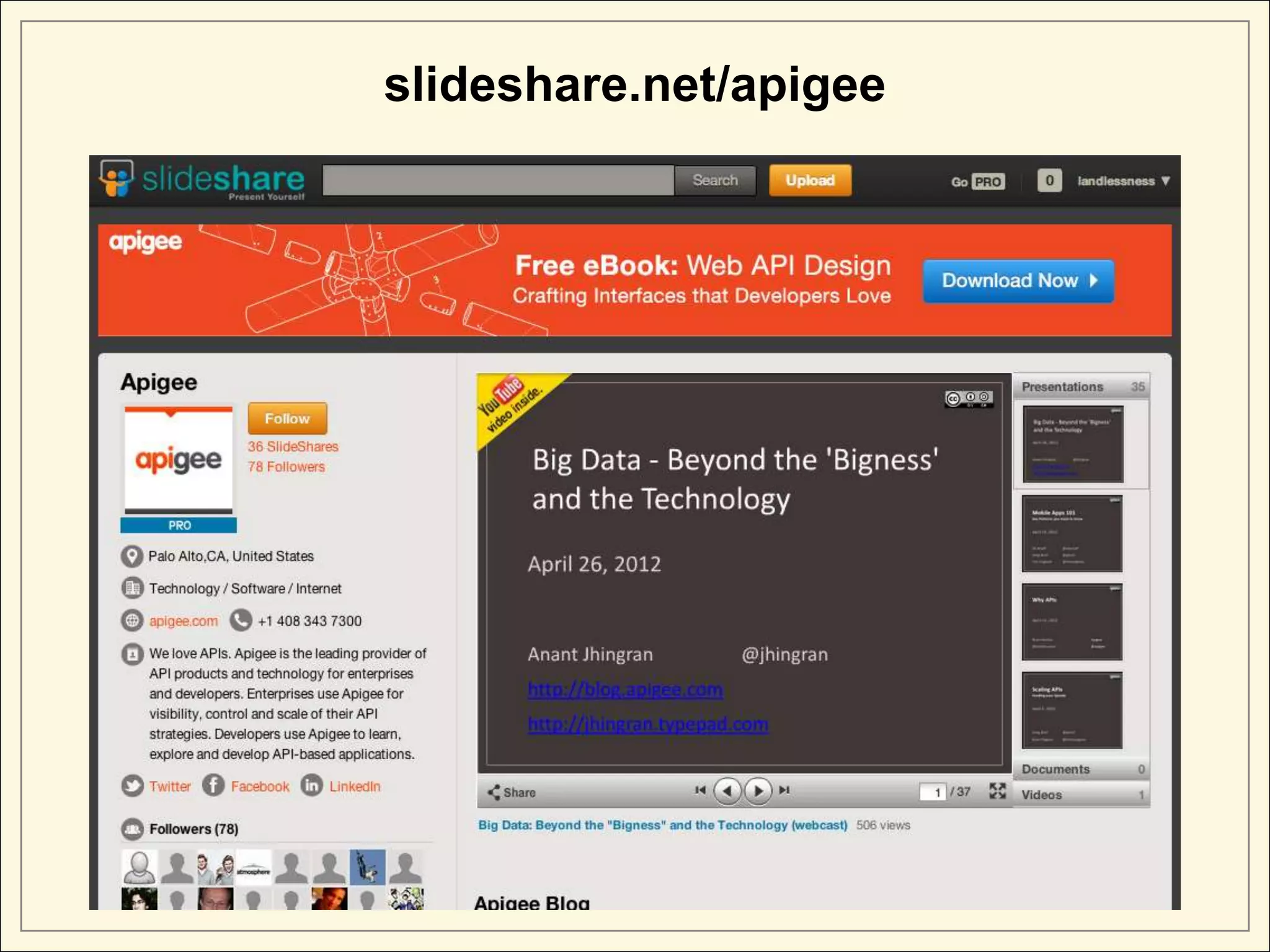
slideshare.net/apigee
http://tinyurl.com/api-strategy-book
@daniel_jacobson    @gbrail
 Daniel Jacobson   Greg Brail
What’s the trend?


Pragmatic REST style

One size fits all

JSON

OAuth

API versioning in the URI
Trend:
PRAGMATIC REST
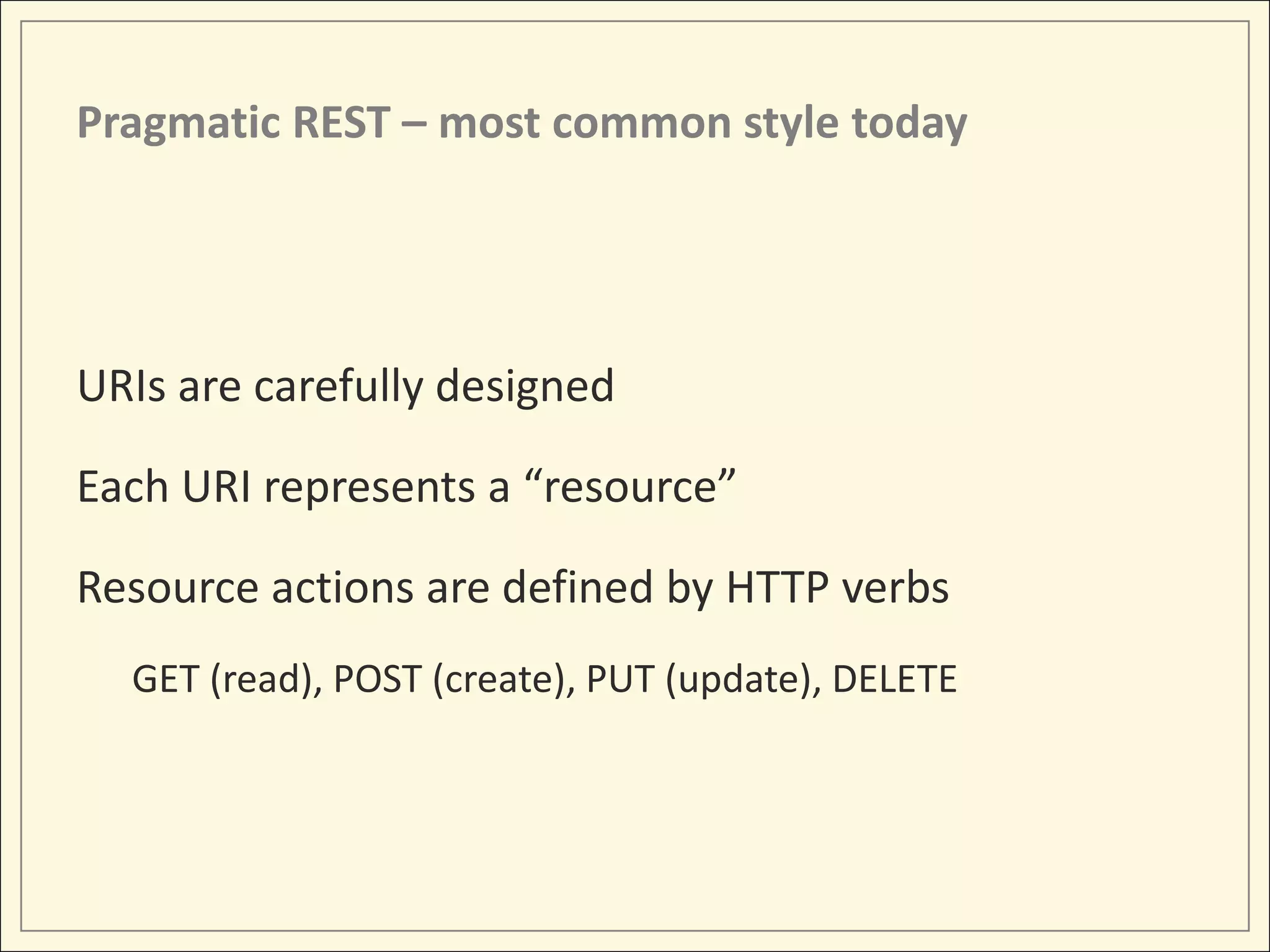
Pragmatic REST – most common style today


URIs are carefully designed

Each URI represents a “resource”

Resource actions are defined by HTTP verbs
  GET (read), POST (create), PUT (update), DELETE
Pragmatic REST alternatives


Pure REST

Ad-hoc XML / JSON over HTTP

SOAP
Alternative: pure REST


Quick definition:

  A REST API as defined by Roy Fielding
  http://en.wikipedia.org/wiki/REST
  and followers
  http://martinfowler.com/articles/richardsonMaturityModel.html
Alternative: pure REST


Flexible, powerful, and evolvable over decades…

Slow, hard to program, and rare
So who cares about REST?
Most APIs that call themselves “REST” are not actually
REST by the pure definition

So pure REST APIs buck the trend. Why?
  The server implementation can change URIs
  The URI structure is not documented – clients follow
  links
  So, the server implementation can change the whole
  structure of the API

In theory, the API can evolve forever without ever being
“incompatible”
Trend:
ONE SIZE FITS ALL
One size fits all


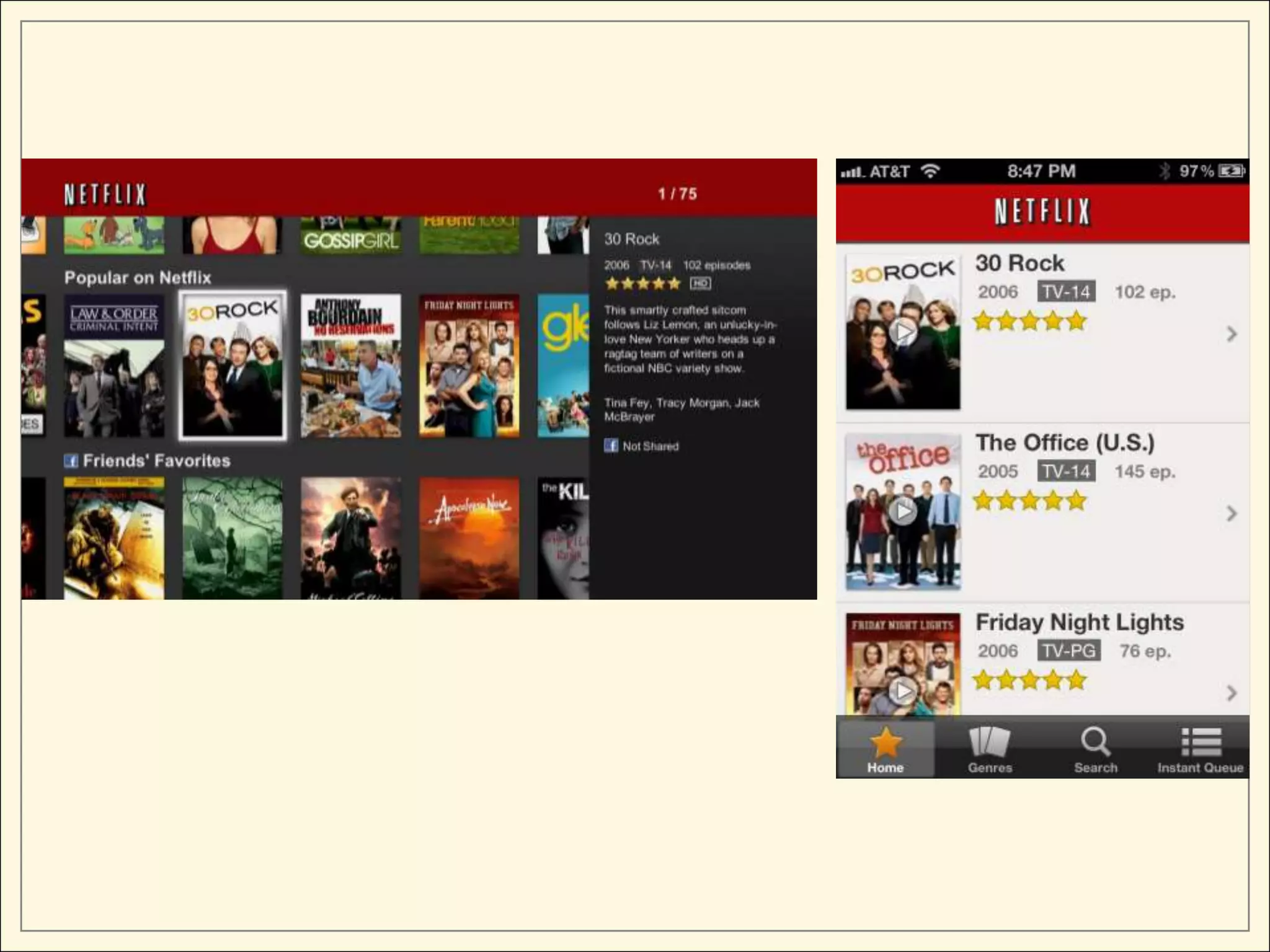
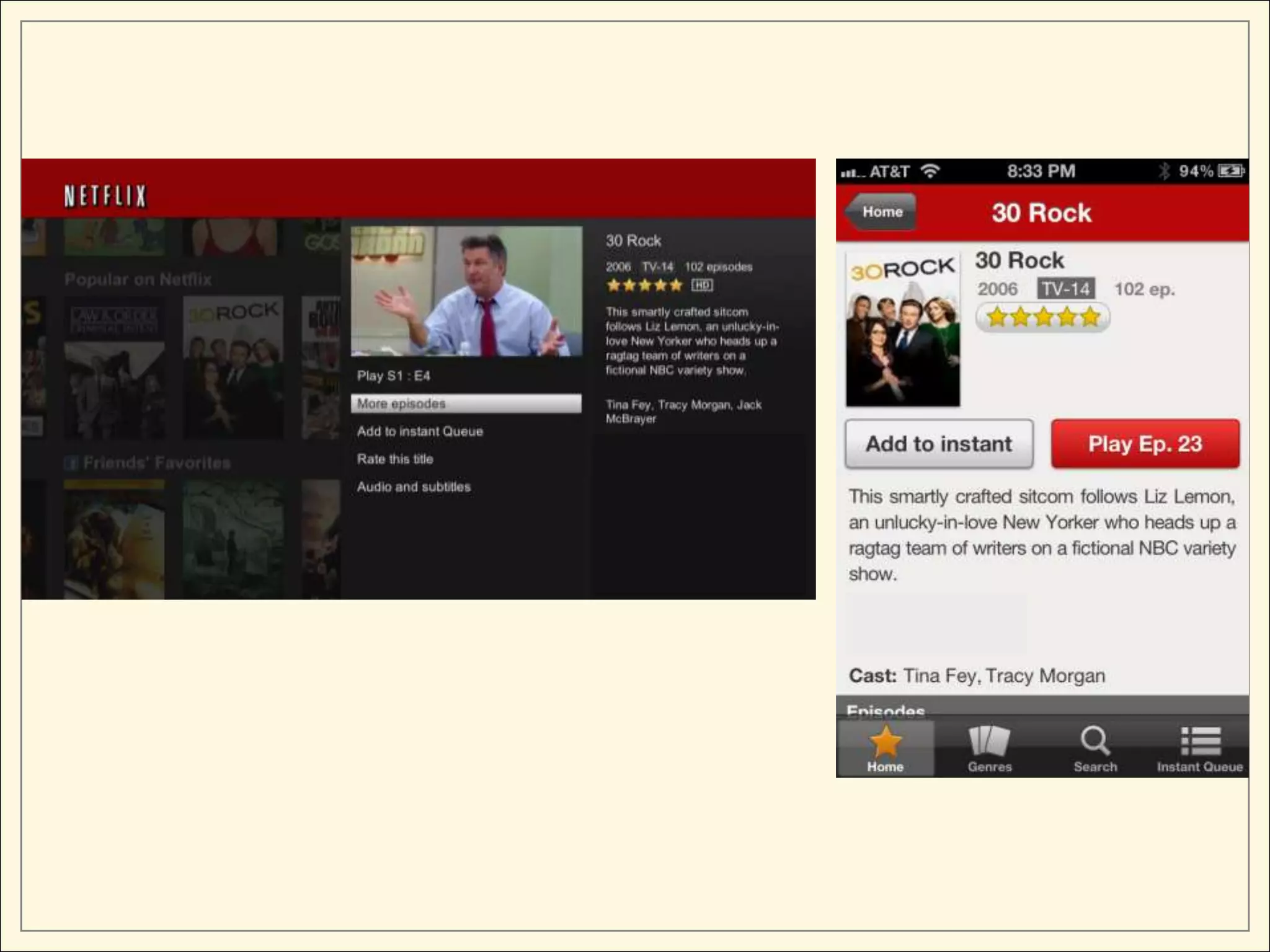
Does it make sense to have the same API for all
developers?
One size fits all – why yes?


API team can focus on one precise, well-documented API

Reduce training costs across development teams

Can support an unlimited number of known and unknown
developers
One size fits all – why not?


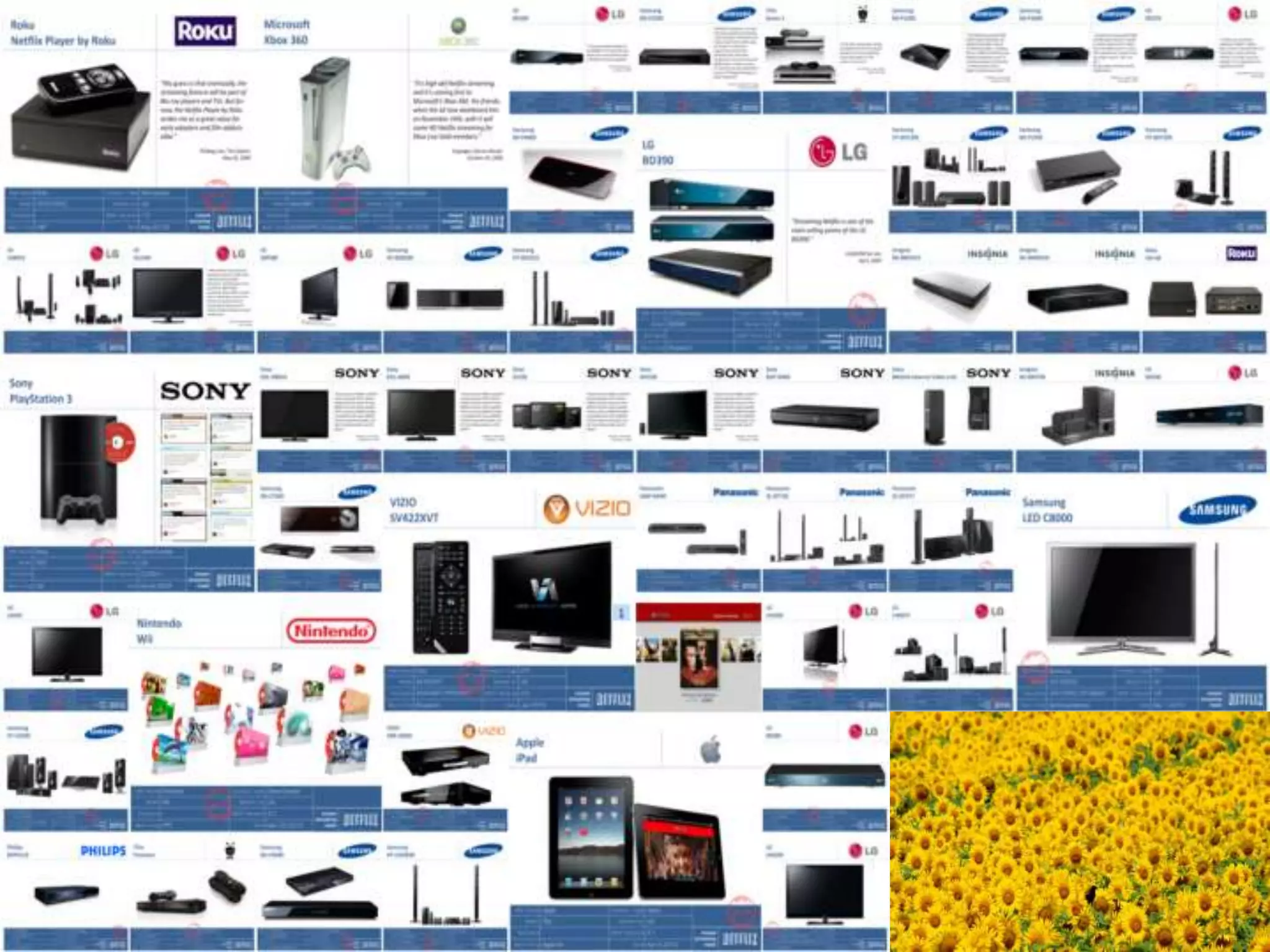
Treats all clients generically, so optimized for none

API team becomes bottleneck for UI development

One size fits all – why not?

Some of the many client differences:
   Memory capacity
   Distinct markup types (XML, JSON)
   Flat vs. Hierarchical document models
   Screen real estate
   Document delivery
   User interaction models
How do you know if your company is ready to consider
alternatives to the one-size-fits-all API model?

Small number of targeted API consumers is the top priority

Very close relationships between these API consumers and the
API team

Increasing divergence of needs across the top priority API
consumers

Strong desire by the API consumers for more optimized
interactions with the API

High value proposition for the API provider to make these API
consumers as effective as possible
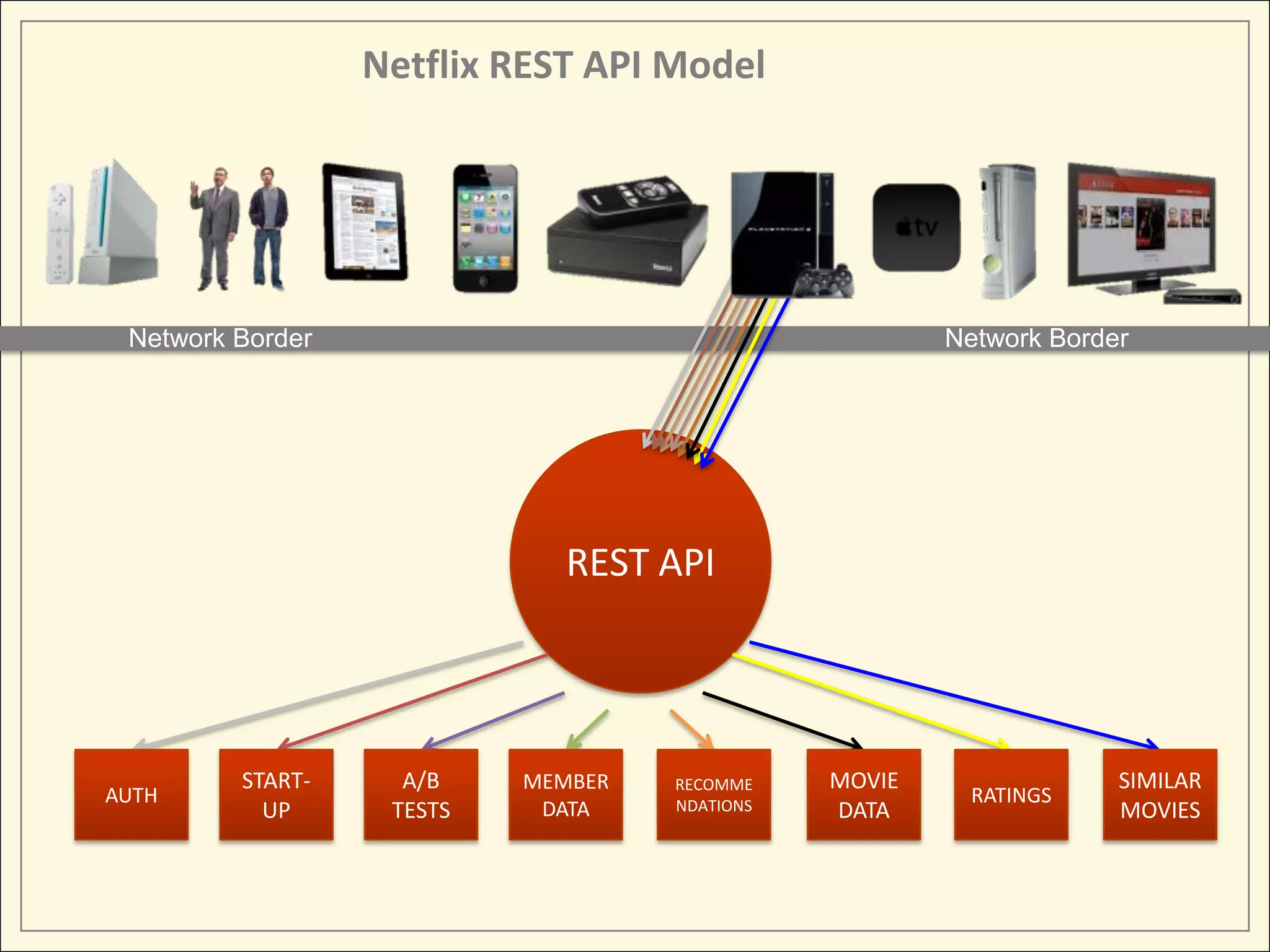
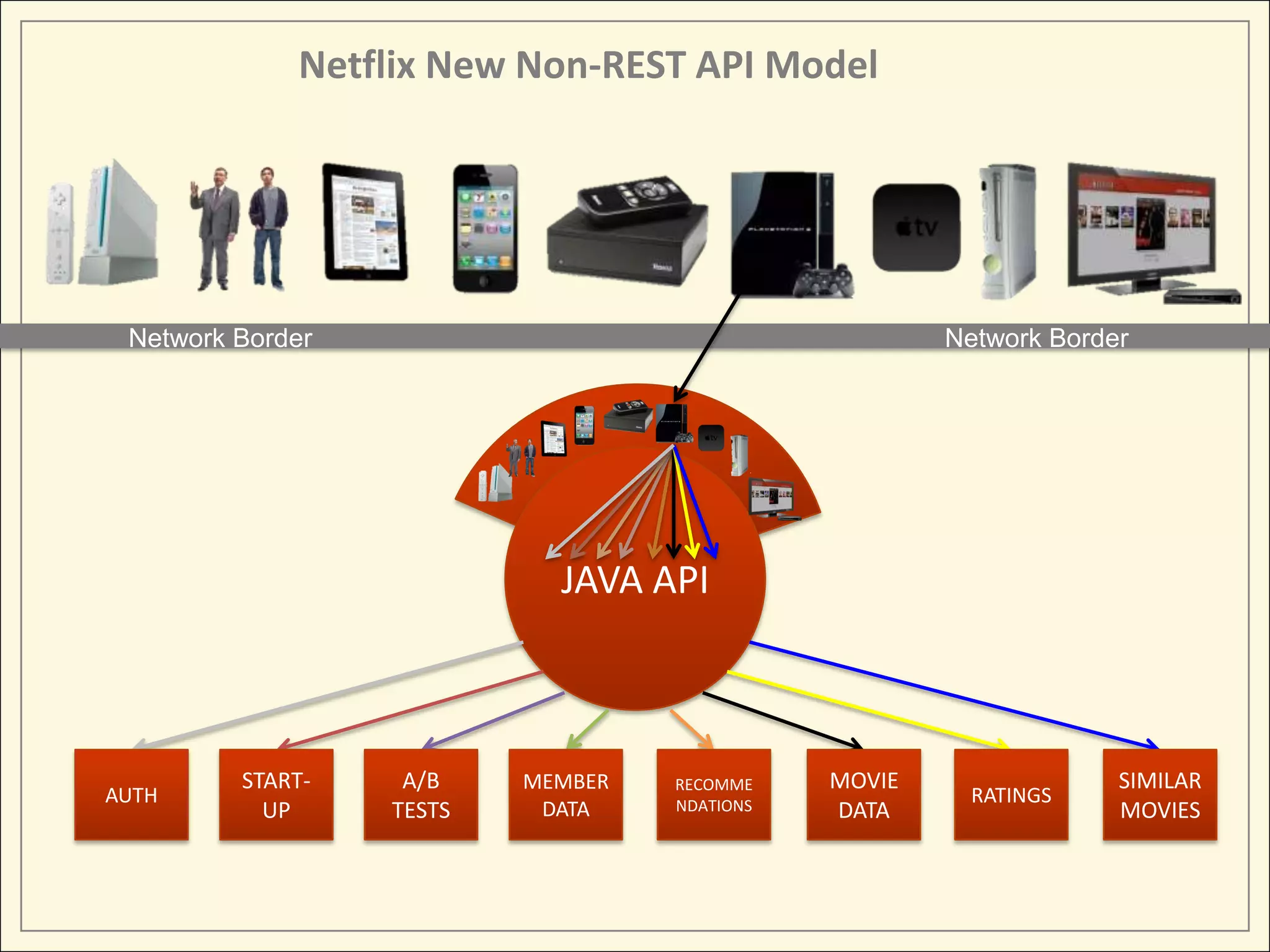
Netflix’s approach against one-size-fits-all API

Embrace the differences of the devices

Separate content gathering from content formatting
and delivery

Redefine the border between client and server

Distribute innovation
Netflix REST API Model


 Network Border                                        Network Border


                              REST API


         START-     A/B    MEMBER   RECOMME    MOVIE                SIMILAR
AUTH                                NDATIONS
                                                         RATINGS
           UP      TESTS    DATA               DATA                 MOVIES
Netflix New Non-REST API Model


 Network Border                                       Network Border


                            JAVA API


         START-    A/B    MEMBER   RECOMME    MOVIE                SIMILAR
AUTH                               NDATIONS
                                                        RATINGS
           UP     TESTS    DATA               DATA                 MOVIES
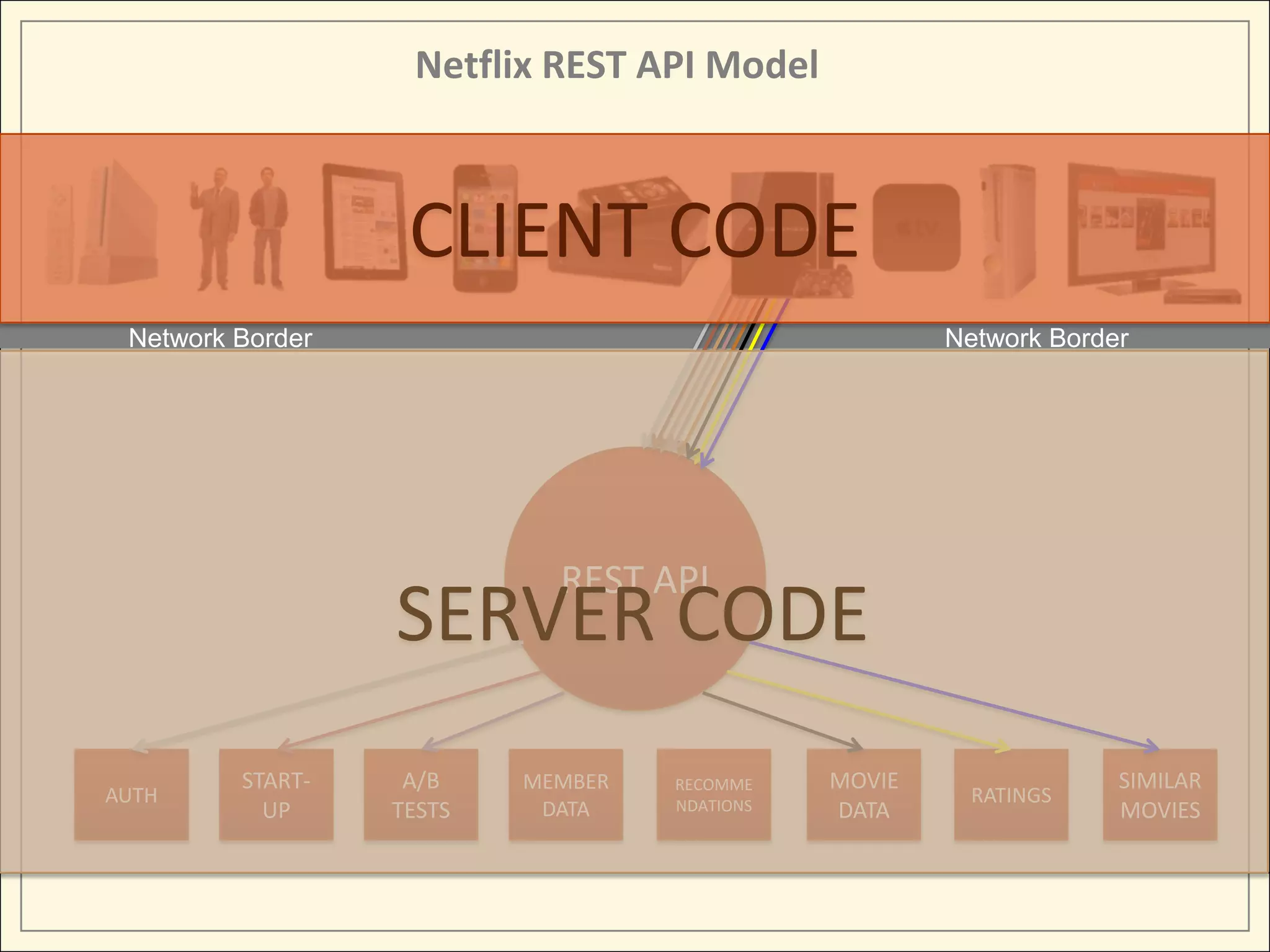
Netflix REST API Model


                   CLIENT CODE
 Network Border                                       Network Border


                            REST API
                  SERVER CODE
         START-    A/B    MEMBER   RECOMME    MOVIE                SIMILAR
AUTH                               NDATIONS
                                                        RATINGS
           UP     TESTS    DATA               DATA                 MOVIES
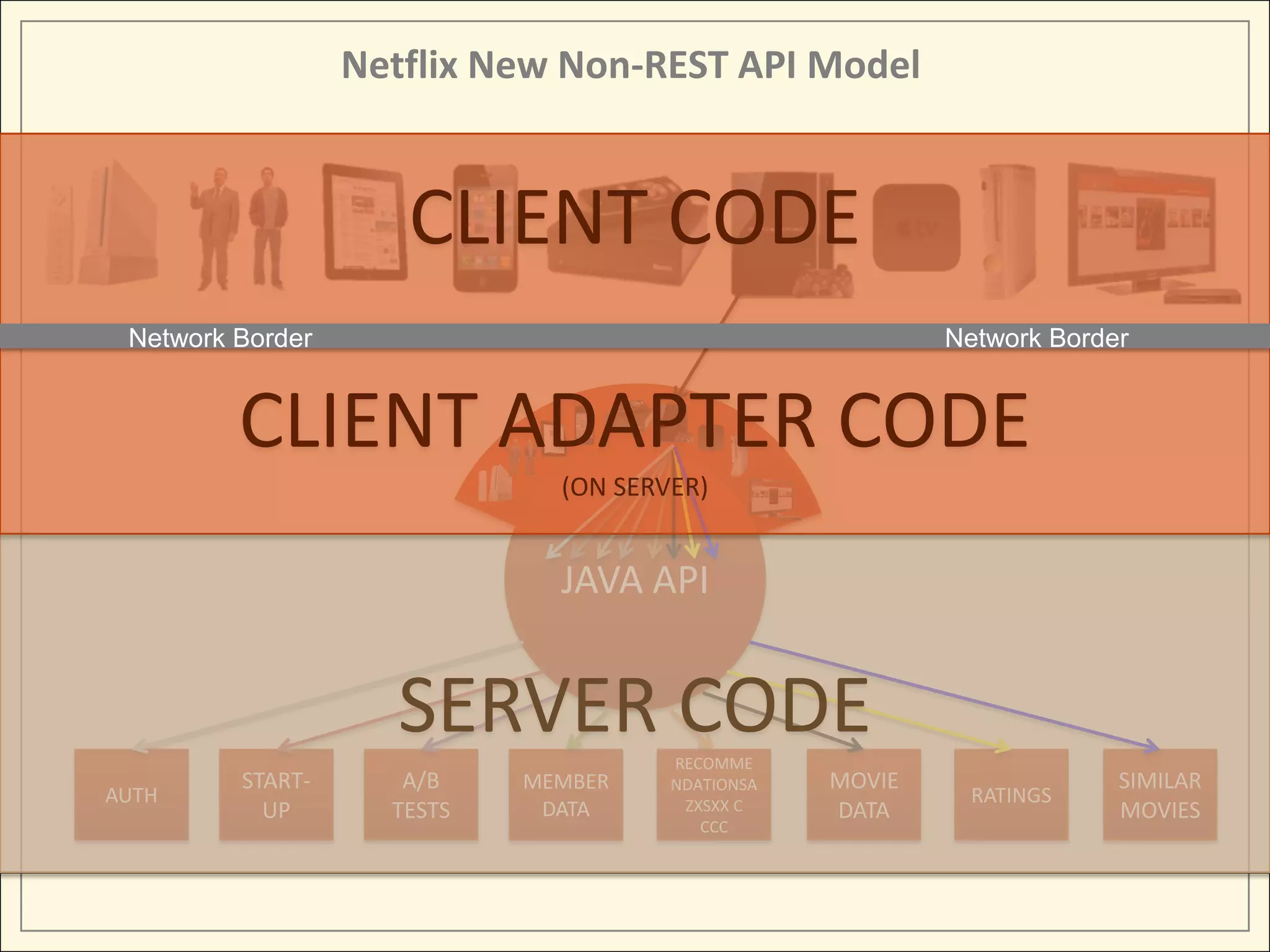
Netflix New Non-REST API Model


                     CLIENT CODE
 Network Border                                           Network Border


         CLIENT ADAPTER CODE
                              (ON SERVER)


                              JAVA API


                    SERVER CODE       RECOMME
         START-      A/B    MEMBER    NDATIONSA   MOVIE                SIMILAR
AUTH                                   ZXSXX C
                                                            RATINGS
           UP       TESTS    DATA                 DATA                 MOVIES
                                         CCC
One size fits all – other alternatives


Why not have both?

Layer the different APIs over a common API
One size fits all – other alternatives


Other alternatives provide greater flexibility
            but still have server teams dictate rules

Doesn’t alleviate server team bottleneck issue
Trend:
JSON
JSON Conventional Wisdom


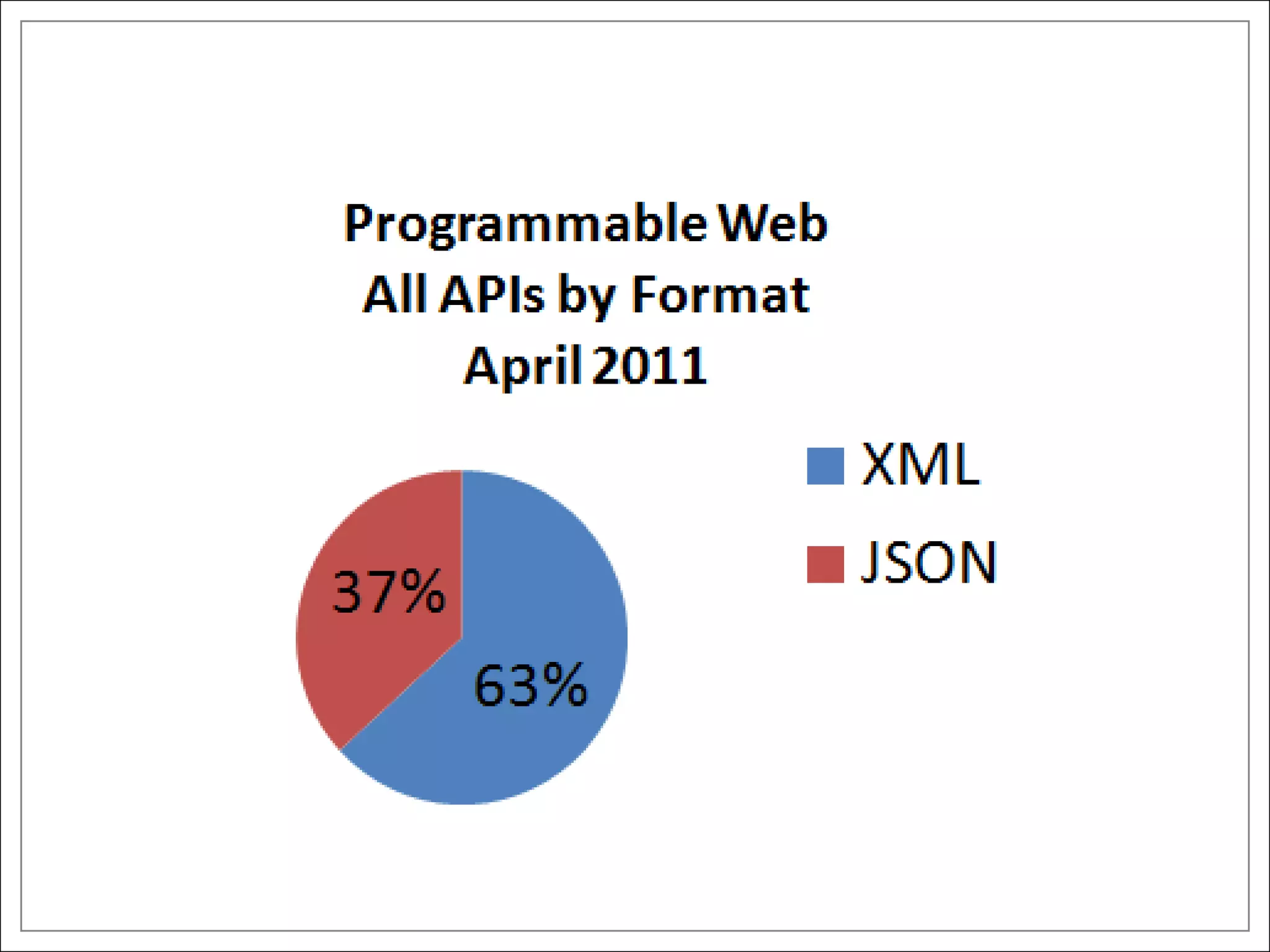
JSON and XML are exactly the same

JSON is always smaller than XML

JSON is always faster to parse than XML

All clients can parse JSON

All servers can produce JSON
JSON considerations
Not all devices support JSON out of the box

Different devices may require different XML schemas

Some devices prefer full document delivery and others
prefer streaming bits

XML and JSON aren’t all that different in size once you
compress them

XML has a different data model than JSON
More JSON considerations


There are many more tools built around XML today
than there are built around JSON

XML offers more semantic context than JSON

Saying XML or JSON is not enough – both can support
very different document models
JSON advice

Design the guts of the API to separate data gathering
from data formatting

Add a mediation layer (in your code our outside) to
render the right format

If in doubt, support JSON internally, and support
conversion to other formats as a wrapper
  JSON -> XML is easier than XML -> JSON
Trend:
OAUTH
OAuth – super-big trend in APIs


Essential for
  APIs that authenticate end users

  Unknown (to you) developers

  Mobile and native clients
OAuth alternatives


Cookies
  Netflix’s new approach

  Great for apps that are based on browsers

  Great if API consumers are very close to API team
OAuth alternatives


HTTP Basic Auth + SSL
Two-way SSL

  Both are great for server-to-server APIs
OAuth alternatives


API keys only

  “Two-legged” access when there is no “user”
Trend:
API VERSIONING IN URI
Versioning

Many APIs include a version number in the
  URI (like api.foo.com/v1)
  Hostname (v1.api.foo.com)
  Query parameter (api.foo.com/v1/bar?version=1)
  Content-type header

The version number represents the interface version

The number changes, although rarely
Can an API call have NO version?

If you can achieve it, maintenance will be MUCH
simpler

If you cannot, it instills better practices
   Reduces lazy programming
   Results in fewer versions
   Results in a cleaner, less brittle system


And keep in mind, adding new features typically does
not require a new version…
   Schematic or structural changes, however, do
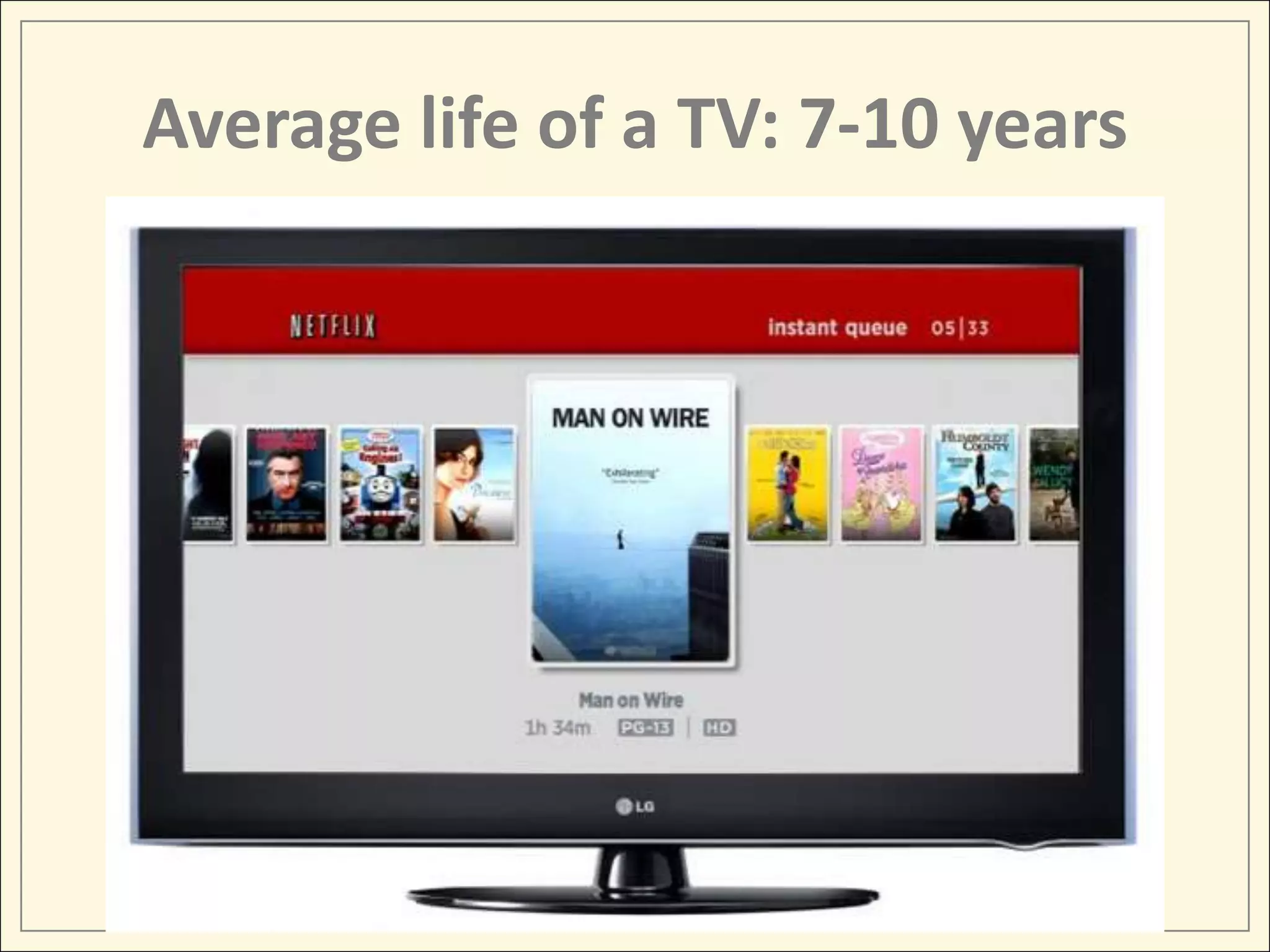
Average life of a TV: 7-10 years
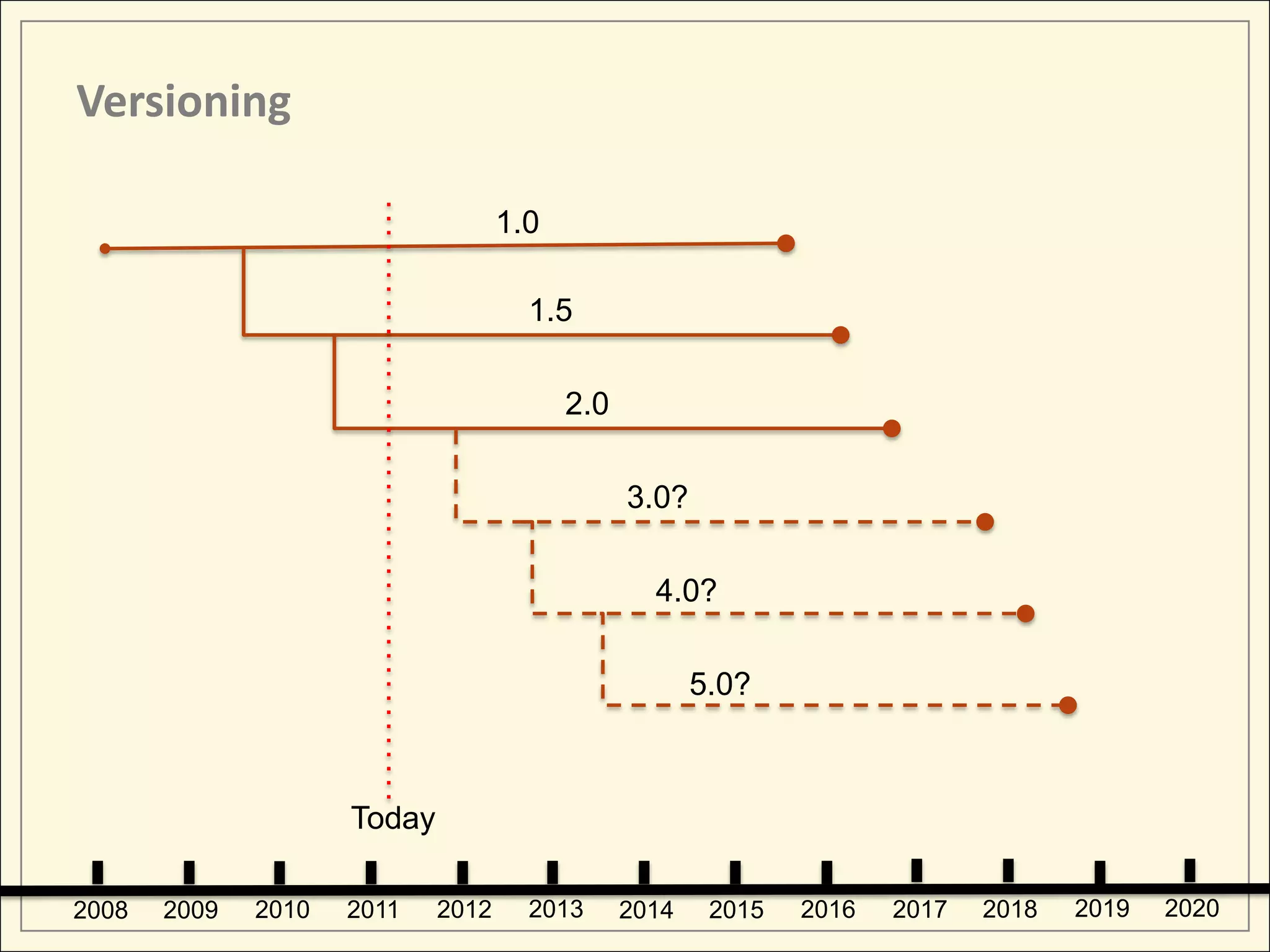
Versioning

                                    1.0

                                      1.5

                                          2.0

                                                3.0?

                                                  4.0?

                                                       5.0?


                     Today

2008   2009   2010   2011    2012     2013      2014    2015   2016   2017   2018   2019   2020
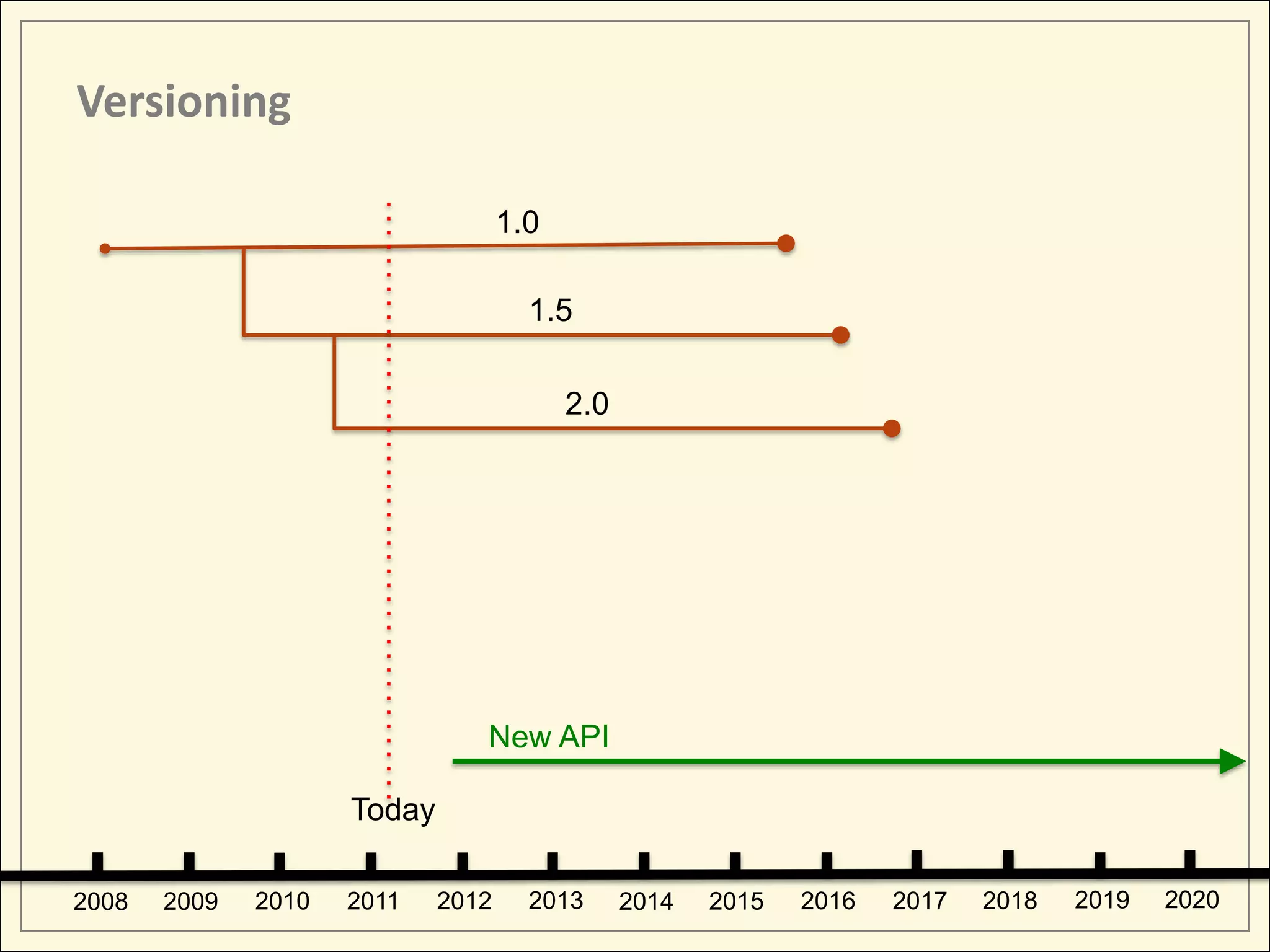
Versioning

                                    1.0

                                      1.5

                                          2.0


                                New API

                     Today

2008   2009   2010   2011    2012     2013      2014   2015   2016   2017   2018   2019   2020
groups.google.com/group/api-craft
THANK YOU
Questions and ideas to:
@gbrail
@daniel_jacobson

groups.google.com/group/api-craft

API Design - When to buck the trend (Webcast)

  • 1.
    API Design: Whento buck the trend Netflix API case study with Daniel Jacobson groups.google.com/group/api-craft Daniel Jacobson Greg Brail Netflix Apigee @daniel_jacobson @gbrail
  • 2.
  • 3.
  • 4.
  • 5.
  • 6.
    @daniel_jacobson @gbrail Daniel Jacobson Greg Brail
  • 7.
    What’s the trend? PragmaticREST style One size fits all JSON OAuth API versioning in the URI
  • 8.
  • 9.
    Pragmatic REST –most common style today URIs are carefully designed Each URI represents a “resource” Resource actions are defined by HTTP verbs GET (read), POST (create), PUT (update), DELETE
  • 10.
    Pragmatic REST alternatives PureREST Ad-hoc XML / JSON over HTTP SOAP
  • 11.
    Alternative: pure REST Quickdefinition: A REST API as defined by Roy Fielding http://en.wikipedia.org/wiki/REST and followers http://martinfowler.com/articles/richardsonMaturityModel.html
  • 12.
    Alternative: pure REST Flexible,powerful, and evolvable over decades… Slow, hard to program, and rare
  • 13.
    So who caresabout REST? Most APIs that call themselves “REST” are not actually REST by the pure definition So pure REST APIs buck the trend. Why? The server implementation can change URIs The URI structure is not documented – clients follow links So, the server implementation can change the whole structure of the API In theory, the API can evolve forever without ever being “incompatible”
  • 14.
  • 15.
    One size fitsall Does it make sense to have the same API for all developers?
  • 16.
    One size fitsall – why yes? API team can focus on one precise, well-documented API Reduce training costs across development teams Can support an unlimited number of known and unknown developers
  • 17.
    One size fitsall – why not? Treats all clients generically, so optimized for none API team becomes bottleneck for UI development
  • 19.
    One size fitsall – why not? Some of the many client differences: Memory capacity Distinct markup types (XML, JSON) Flat vs. Hierarchical document models Screen real estate Document delivery User interaction models
  • 22.
    How do youknow if your company is ready to consider alternatives to the one-size-fits-all API model? Small number of targeted API consumers is the top priority Very close relationships between these API consumers and the API team Increasing divergence of needs across the top priority API consumers Strong desire by the API consumers for more optimized interactions with the API High value proposition for the API provider to make these API consumers as effective as possible
  • 23.
    Netflix’s approach againstone-size-fits-all API Embrace the differences of the devices Separate content gathering from content formatting and delivery Redefine the border between client and server Distribute innovation
  • 24.
    Netflix REST APIModel Network Border Network Border REST API START- A/B MEMBER RECOMME MOVIE SIMILAR AUTH NDATIONS RATINGS UP TESTS DATA DATA MOVIES
  • 25.
    Netflix New Non-RESTAPI Model Network Border Network Border JAVA API START- A/B MEMBER RECOMME MOVIE SIMILAR AUTH NDATIONS RATINGS UP TESTS DATA DATA MOVIES
  • 26.
    Netflix REST APIModel CLIENT CODE Network Border Network Border REST API SERVER CODE START- A/B MEMBER RECOMME MOVIE SIMILAR AUTH NDATIONS RATINGS UP TESTS DATA DATA MOVIES
  • 27.
    Netflix New Non-RESTAPI Model CLIENT CODE Network Border Network Border CLIENT ADAPTER CODE (ON SERVER) JAVA API SERVER CODE RECOMME START- A/B MEMBER NDATIONSA MOVIE SIMILAR AUTH ZXSXX C RATINGS UP TESTS DATA DATA MOVIES CCC
  • 28.
    One size fitsall – other alternatives Why not have both? Layer the different APIs over a common API
  • 29.
    One size fitsall – other alternatives
  • 30.
    One size fitsall – other alternatives Other alternatives provide greater flexibility but still have server teams dictate rules Doesn’t alleviate server team bottleneck issue
  • 31.
  • 33.
    JSON Conventional Wisdom JSONand XML are exactly the same JSON is always smaller than XML JSON is always faster to parse than XML All clients can parse JSON All servers can produce JSON
  • 34.
    JSON considerations Not alldevices support JSON out of the box Different devices may require different XML schemas Some devices prefer full document delivery and others prefer streaming bits XML and JSON aren’t all that different in size once you compress them XML has a different data model than JSON
  • 35.
    More JSON considerations Thereare many more tools built around XML today than there are built around JSON XML offers more semantic context than JSON Saying XML or JSON is not enough – both can support very different document models
  • 36.
    JSON advice Design theguts of the API to separate data gathering from data formatting Add a mediation layer (in your code our outside) to render the right format If in doubt, support JSON internally, and support conversion to other formats as a wrapper JSON -> XML is easier than XML -> JSON
  • 37.
  • 38.
    OAuth – super-bigtrend in APIs Essential for APIs that authenticate end users Unknown (to you) developers Mobile and native clients
  • 39.
    OAuth alternatives Cookies Netflix’s new approach Great for apps that are based on browsers Great if API consumers are very close to API team
  • 40.
    OAuth alternatives HTTP BasicAuth + SSL Two-way SSL Both are great for server-to-server APIs
  • 41.
    OAuth alternatives API keysonly “Two-legged” access when there is no “user”
  • 42.
  • 43.
    Versioning Many APIs includea version number in the URI (like api.foo.com/v1) Hostname (v1.api.foo.com) Query parameter (api.foo.com/v1/bar?version=1) Content-type header The version number represents the interface version The number changes, although rarely
  • 44.
    Can an APIcall have NO version? If you can achieve it, maintenance will be MUCH simpler If you cannot, it instills better practices Reduces lazy programming Results in fewer versions Results in a cleaner, less brittle system And keep in mind, adding new features typically does not require a new version… Schematic or structural changes, however, do
  • 45.
    Average life ofa TV: 7-10 years
  • 46.
    Versioning 1.0 1.5 2.0 3.0? 4.0? 5.0? Today 2008 2009 2010 2011 2012 2013 2014 2015 2016 2017 2018 2019 2020
  • 47.
    Versioning 1.0 1.5 2.0 New API Today 2008 2009 2010 2011 2012 2013 2014 2015 2016 2017 2018 2019 2020
  • 48.
  • 49.
    THANK YOU Questions andideas to: @gbrail @daniel_jacobson groups.google.com/group/api-craft