
Copyright2016JacquesLedoux
jcq@ledx.com
What’s an API ?!?
The What, Why, Who, How, Where and When…
But Remember That...
Series about technologies explained in plain, non-geek language.
Copyright2016JacquesLedoux
jcq@ledx.com
What’s an API?
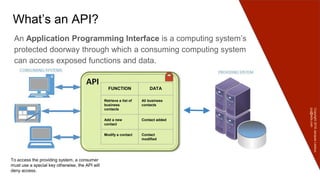
An Application Programming Interface is a computing system’s
protected doorway through which a consuming computing system
can access exposed functions and data.
To access the providing system, a consumer
must use a special key otherwise, the API will
deny access.
FUNCTION DATA
Retrieve a list of
business
contacts
All business
contacts
Add a new
contact
Contact added
Modify a contact Contact
modified
Copyright2016JacquesLedoux
jcq@ledx.com
Why...
Do one creates an API?: API facilitates system’s interoperability
which decreases functional and data redundancy. For example,
one system that needs the contact information can simply ask
the Contact master system to provide it.
Do one consumes an API?: Interoperability provides a faster
time to market as it is more efficient to reuse a functional
capability that already exists in a system than to rebuild or
duplicate that functionality in a new system. It also increase
data quality by decreasing data redundancy across systems
which is a major cause of dirty / stale information.
Copyright2016JacquesLedoux
jcq@ledx.com
Who...
Creates and owns an API: the providing system owner creates
the API. The system owner may elect to publicly expose and
monetize its API such as large API providers like Google and
Amazon. Cloud computing is a great enabler for such business
model (eg: API economy).
Consumes an API: these could be the organization’s internal
systems or any external systems to which the API owner grants
access, either freely or at a cost.
Copyright2016JacquesLedoux
jcq@ledx.com
How to...
Build and expose an API: technical skills are required such as
API analysis and design, networking, programming, securing,
deploying, monitoring, monetizing, and other similar
competences.
Consume an API: technical skills are also required but an API is
typically much easier to consume than to build. It mostly
requires analytical and programming skills to adapt the
consuming system to use the API.
Copyright2016JacquesLedoux
jcq@ledx.com
Where are API’s
Private API’s: these are exposed on an organization’s closed
network and can only be accessed by internal authorized
systems.
Shared API’s: these are exposed on an organization’s open*
network and can only be accessed by internal and external
authorized systems.
Public API’s: these are exposed on the Web and are accessible
to any systems for which an authorization key is granted either
freely or at a cost.
*Open network are securely accessible from outside an organization through the Internet or VPNs
Copyright2016JacquesLedoux
jcq@ledx.com
When to...
Build an API: when you realize that the functionalities of a given
system could be reused by other internal or external systems,
whether privately or publicly.
Consume an API: when you realize that functionalities you need
are readily available from other private or public systems that
provides an accessible API.
Copyright2016JacquesLedoux
jcq@ledx.com
But remember that...
An API is not an obscure backdoor. It is knowingly exposed and
documented so the consumers know how to use it.
An API does not have to expose all the functions and data of its
underlying system.
An API can evolve over time (adding, modifying, removing
functions).
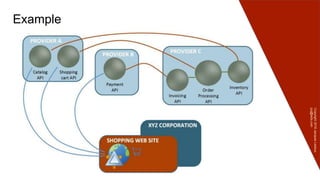
API’s from various providers can be used to build a whole system
by itself or integrated to an existing system.
Copyright2016JacquesLedoux
jcq@ledx.com
Example
Copyright2016JacquesLedoux
jcq@ledx.com
Jacques Ledoux
Executive advisor for enterprises seeking their path through
the maze of modern technologies
I am:
● Business & System Architect (Enterprise / Solution).
● Executive Advisor for Cloud, Mobile, Social medias,
Big Data, Internet of Things and API's/Open Source
alternatives.
LinkedIn: https://ca.linkedin.com/in/jacquesledoux

What's an api

  • 1.
    Copyright2016JacquesLedoux jcq@ledx.com What’s an API?!? The What, Why, Who, How, Where and When… But Remember That... Series about technologies explained in plain, non-geek language.
  • 2.
    Copyright2016JacquesLedoux jcq@ledx.com What’s an API? AnApplication Programming Interface is a computing system’s protected doorway through which a consuming computing system can access exposed functions and data. To access the providing system, a consumer must use a special key otherwise, the API will deny access. FUNCTION DATA Retrieve a list of business contacts All business contacts Add a new contact Contact added Modify a contact Contact modified
  • 3.
    Copyright2016JacquesLedoux jcq@ledx.com Why... Do one createsan API?: API facilitates system’s interoperability which decreases functional and data redundancy. For example, one system that needs the contact information can simply ask the Contact master system to provide it. Do one consumes an API?: Interoperability provides a faster time to market as it is more efficient to reuse a functional capability that already exists in a system than to rebuild or duplicate that functionality in a new system. It also increase data quality by decreasing data redundancy across systems which is a major cause of dirty / stale information.
  • 4.
    Copyright2016JacquesLedoux jcq@ledx.com Who... Creates and ownsan API: the providing system owner creates the API. The system owner may elect to publicly expose and monetize its API such as large API providers like Google and Amazon. Cloud computing is a great enabler for such business model (eg: API economy). Consumes an API: these could be the organization’s internal systems or any external systems to which the API owner grants access, either freely or at a cost.
  • 5.
    Copyright2016JacquesLedoux jcq@ledx.com How to... Build andexpose an API: technical skills are required such as API analysis and design, networking, programming, securing, deploying, monitoring, monetizing, and other similar competences. Consume an API: technical skills are also required but an API is typically much easier to consume than to build. It mostly requires analytical and programming skills to adapt the consuming system to use the API.
  • 6.
    Copyright2016JacquesLedoux jcq@ledx.com Where are API’s PrivateAPI’s: these are exposed on an organization’s closed network and can only be accessed by internal authorized systems. Shared API’s: these are exposed on an organization’s open* network and can only be accessed by internal and external authorized systems. Public API’s: these are exposed on the Web and are accessible to any systems for which an authorization key is granted either freely or at a cost. *Open network are securely accessible from outside an organization through the Internet or VPNs
  • 7.
    Copyright2016JacquesLedoux jcq@ledx.com When to... Build anAPI: when you realize that the functionalities of a given system could be reused by other internal or external systems, whether privately or publicly. Consume an API: when you realize that functionalities you need are readily available from other private or public systems that provides an accessible API.
  • 8.
    Copyright2016JacquesLedoux jcq@ledx.com But remember that... AnAPI is not an obscure backdoor. It is knowingly exposed and documented so the consumers know how to use it. An API does not have to expose all the functions and data of its underlying system. An API can evolve over time (adding, modifying, removing functions). API’s from various providers can be used to build a whole system by itself or integrated to an existing system.
  • 9.
  • 10.
    Copyright2016JacquesLedoux jcq@ledx.com Jacques Ledoux Executive advisorfor enterprises seeking their path through the maze of modern technologies I am: ● Business & System Architect (Enterprise / Solution). ● Executive Advisor for Cloud, Mobile, Social medias, Big Data, Internet of Things and API's/Open Source alternatives. LinkedIn: https://ca.linkedin.com/in/jacquesledoux