CACHE MEMORY


                               Maninder Kaur
                             professormaninder@gmail.com


1   www.eazynotes.com                        24-Nov-2010
What is Cache Memory?
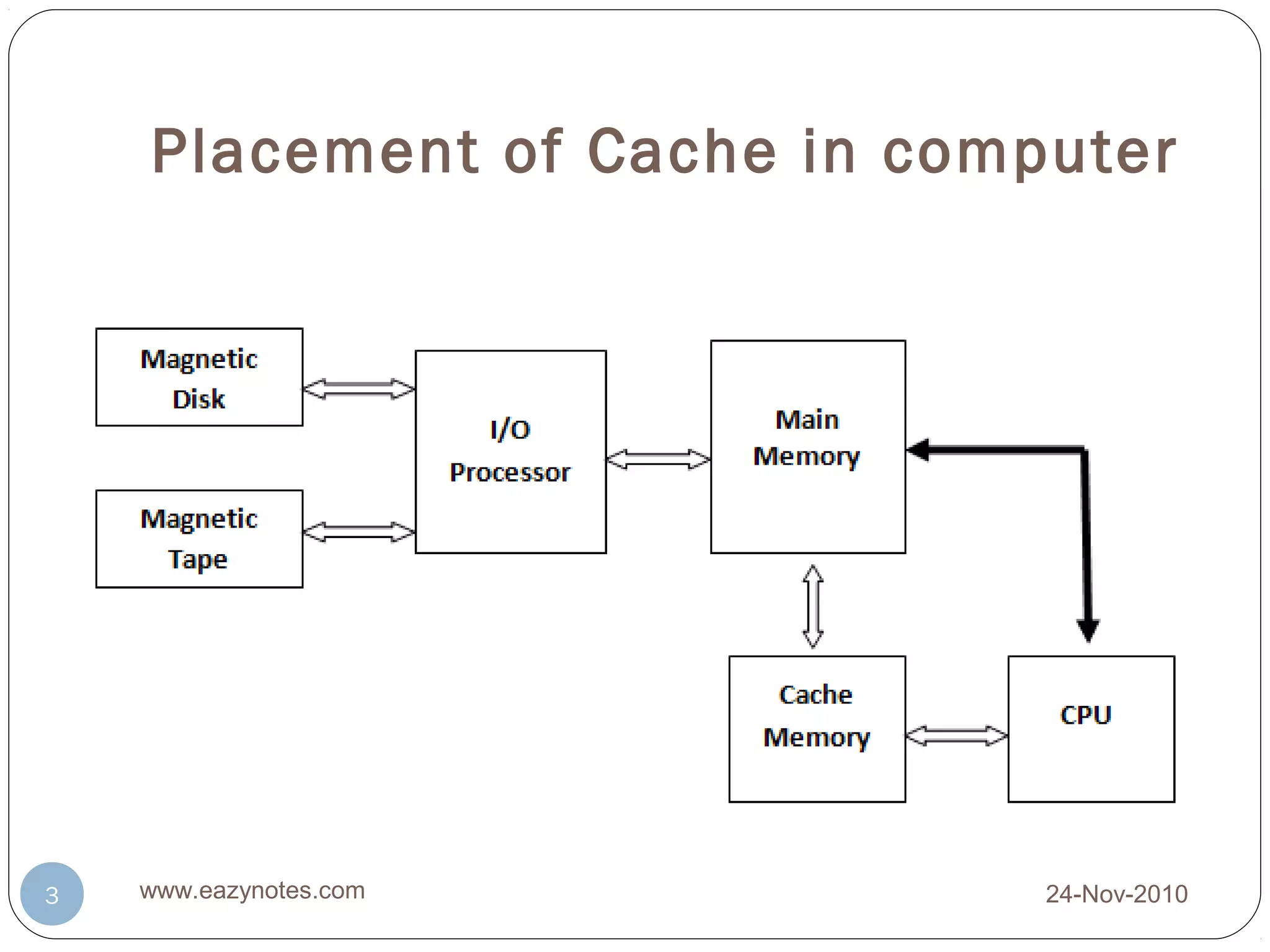
    Cache memory is a small, high-speed RAM buffer located
      between the CPU and main memory.

    Cache memory holds a copy of the instructions (instruction
      cache) or data (operand or data cache) currently being used
      by the CPU.

    The main purpose of a cache is to accelerate your computer
      while keeping the price of the computer low.


2   www.eazynotes.com                                     24-Nov-2010
Placement of Cache in computer


3   www.eazynotes.com         24-Nov-2010
Hit Ratio
    The ratio of the total number of hits divided by the total
      CPU accesses to memory (i.e. hits plus misses) is called Hit
      Ratio.

    Hit Ratio = Total Number of Hits / (Total
                        Number of Hits + Total Number of
                                                      Miss)


4   www.eazynotes.com                                      24-Nov-2010
Example
    A system with 512 x 12 cache and 32 K x 12 of
    main memory.


5     www.eazynotes.com                      24-Nov-2010
Types of Cache Mapping

        1.     Direct Mapping

        2.     Associative Mapping

        3.     Set Associative Mapping


6   www.eazynotes.com                    24-Nov-2010
1. Direct Mapping
     The direct mapping technique is simple and inexpensive to implement.

     When the CPU wants to access data from memory, it places a address. The
       index field of CPU address is used to access address.
     The tag field of CPU address is compared with the associated tag in the word
       read from the cache.
     If the tag-bits of CPU address is matched with the tag-bits of cache, then there
       is a hit and the required data word is read from cache.
     If there is no match, then there is a miss and the required data word is stored in
       main memory. It is then transferred from main memory to cache memory with
       the new tag.


7   www.eazynotes.com                                                        24-Nov-2010
1. Direct Mapping


8   www.eazynotes.com                  24-Nov-2010
1. Direct Mapping


9   www.eazynotes.com                  24-Nov-2010
2. Associative Mapping
     An associative mapping uses an associative memory.

     This memory is being accessed using its contents.

     Each line of cache memory will accommodate the address
       (main memory) and the contents of that address from the
       main memory.
     That is why this memory is also called Content Addressable
       Memory (CAM). It allows each block of main memory to be
       stored in the cache.


10   www.eazynotes.com                                     24-Nov-2010
2. Associative Mapping


11   www.eazynotes.com             24-Nov-2010
3. Set Associative Mapping
     That is the easy control of the direct mapping cache and the
       more flexible mapping of the fully associative cache.
      In set associative mapping, each cache location can have
       more than one pair of tag + data items.
     That is more than one pair of tag and data are residing at the
       same location of cache memory. If one cache location is
       holding two pair of tag + data items, that is called 2-way set
       associative mapping.


12   www.eazynotes.com                                         24-Nov-2010
3. Two-Way Set Associative
                    Mapping


13   www.eazynotes.com              24-Nov-2010
Replacement Algorithms of
                  Cache Memory
      Replacement algorithms are used when there are no available space in a cache in which
       to place a data. Four of the most common cache replacement algorithms are described
       below:
      Least Recently Used (LRU):
         The LRU algorithm selects for replacement the item that has been least recently used by
           the CPU.

      First-In-First-Out (FIFO):
         The FIFO algorithm selects for replacement the item that has been in the cache from the
           longest time.

      Least Frequently Used (LRU):
         The LRU algorithm selects for replacement the item that has been least frequently used
           by the CPU.

      Random:
         The random algorithm selects for replacement the item randomly.


14   www.eazynotes.com                                                               24-Nov-2010
Writing into Cache
     When memory write operations are performed, CPU first
       writes into the cache memory. These modifications made by
       CPU during a write operations, on the data saved in cache,
       need to be written back to main memory or to auxiliary
       memory.

     These two popular cache write policies (schemes) are:
        Write-Through
        Write-Back


15   www.eazynotes.com                                   24-Nov-2010
Write-Through
     In a write through cache, the main memory is updated each
       time the CPU writes into cache.

     The advantage of the write-through cache is that the main
       memory always contains the same data as the cache contains.

     This characteristic is desirable in a system which uses direct
       memory access scheme of data transfer. The I/O devices
       communicating through DMA receive the most recent data.


16   www.eazynotes.com                                       24-Nov-2010
Write-Back
     In a write back scheme, only the cache memory is updated
       during a write operation.

     The updated locations in the cache memory are marked by a
       flag so that later on, when the word is removed from the
       cache, it is copied into the main memory.

     The words are removed from the cache time to time to make
       room for a new block of words.


17   www.eazynotes.com                                    24-Nov-2010
18   Jan 26, 2013   www.eazynotes.com

Cache memory

  • 1.
    CACHE MEMORY Maninder Kaur professormaninder@gmail.com 1 www.eazynotes.com 24-Nov-2010
  • 2.
    What is CacheMemory? Cache memory is a small, high-speed RAM buffer located between the CPU and main memory. Cache memory holds a copy of the instructions (instruction cache) or data (operand or data cache) currently being used by the CPU. The main purpose of a cache is to accelerate your computer while keeping the price of the computer low. 2 www.eazynotes.com 24-Nov-2010
  • 3.
    Placement of Cachein computer 3 www.eazynotes.com 24-Nov-2010
  • 4.
    Hit Ratio The ratio of the total number of hits divided by the total CPU accesses to memory (i.e. hits plus misses) is called Hit Ratio. Hit Ratio = Total Number of Hits / (Total Number of Hits + Total Number of Miss) 4 www.eazynotes.com 24-Nov-2010
  • 5.
    Example A system with 512 x 12 cache and 32 K x 12 of main memory. 5 www.eazynotes.com 24-Nov-2010
  • 6.
    Types of CacheMapping 1. Direct Mapping 2. Associative Mapping 3. Set Associative Mapping 6 www.eazynotes.com 24-Nov-2010
  • 7.
    1. Direct Mapping  The direct mapping technique is simple and inexpensive to implement.  When the CPU wants to access data from memory, it places a address. The index field of CPU address is used to access address.  The tag field of CPU address is compared with the associated tag in the word read from the cache.  If the tag-bits of CPU address is matched with the tag-bits of cache, then there is a hit and the required data word is read from cache.  If there is no match, then there is a miss and the required data word is stored in main memory. It is then transferred from main memory to cache memory with the new tag. 7 www.eazynotes.com 24-Nov-2010
  • 8.
    1. Direct Mapping 8 www.eazynotes.com 24-Nov-2010
  • 9.
    1. Direct Mapping 9 www.eazynotes.com 24-Nov-2010
  • 10.
    2. Associative Mapping An associative mapping uses an associative memory. This memory is being accessed using its contents. Each line of cache memory will accommodate the address (main memory) and the contents of that address from the main memory. That is why this memory is also called Content Addressable Memory (CAM). It allows each block of main memory to be stored in the cache. 10 www.eazynotes.com 24-Nov-2010
  • 11.
    2. Associative Mapping 11 www.eazynotes.com 24-Nov-2010
  • 12.
    3. Set AssociativeMapping That is the easy control of the direct mapping cache and the more flexible mapping of the fully associative cache.  In set associative mapping, each cache location can have more than one pair of tag + data items. That is more than one pair of tag and data are residing at the same location of cache memory. If one cache location is holding two pair of tag + data items, that is called 2-way set associative mapping. 12 www.eazynotes.com 24-Nov-2010
  • 13.
    3. Two-Way SetAssociative Mapping 13 www.eazynotes.com 24-Nov-2010
  • 14.
    Replacement Algorithms of Cache Memory  Replacement algorithms are used when there are no available space in a cache in which to place a data. Four of the most common cache replacement algorithms are described below:  Least Recently Used (LRU):  The LRU algorithm selects for replacement the item that has been least recently used by the CPU.  First-In-First-Out (FIFO):  The FIFO algorithm selects for replacement the item that has been in the cache from the longest time.  Least Frequently Used (LRU):  The LRU algorithm selects for replacement the item that has been least frequently used by the CPU.  Random:  The random algorithm selects for replacement the item randomly. 14 www.eazynotes.com 24-Nov-2010
  • 15.
    Writing into Cache When memory write operations are performed, CPU first writes into the cache memory. These modifications made by CPU during a write operations, on the data saved in cache, need to be written back to main memory or to auxiliary memory. These two popular cache write policies (schemes) are: Write-Through Write-Back 15 www.eazynotes.com 24-Nov-2010
  • 16.
    Write-Through In a write through cache, the main memory is updated each time the CPU writes into cache. The advantage of the write-through cache is that the main memory always contains the same data as the cache contains. This characteristic is desirable in a system which uses direct memory access scheme of data transfer. The I/O devices communicating through DMA receive the most recent data. 16 www.eazynotes.com 24-Nov-2010
  • 17.
    Write-Back In a write back scheme, only the cache memory is updated during a write operation. The updated locations in the cache memory are marked by a flag so that later on, when the word is removed from the cache, it is copied into the main memory. The words are removed from the cache time to time to make room for a new block of words. 17 www.eazynotes.com 24-Nov-2010
  • 18.
    18 Jan 26, 2013 www.eazynotes.com