Lecture-36
Introduction of Memory
Organization
Memory
• An electronic circuitry that allows data to be
stored and retrieved when required is known
as memory.
• Memory unit that communicates directly with
the CPU is known as main memory.
• The storage devices that provide backup
storage is called auxiliary memory.
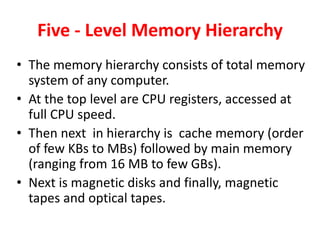
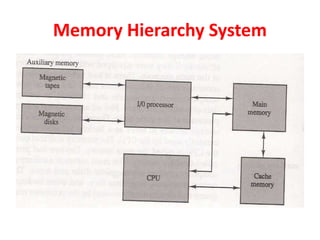
Five - Level Memory Hierarchy
• The memory hierarchy consists of total memory
system of any computer.
• At the top level are CPU registers, accessed at
full CPU speed.
• Then next in hierarchy is cache memory (order
of few KBs to MBs) followed by main memory
(ranging from 16 MB to few GBs).
• Next is magnetic disks and finally, magnetic
tapes and optical tapes.
Memory Hierarchy System
Three Key Parameters
• Access Time
• Storage Capacity
• Cost
**The overall goal of using a memory hierarchy
is to obtain the highest possible average
speed while minimizing the total cost of the
entire memory system.
Main Memory
• Random Access Memory (RAM)
 Static RAM: stores binary information in internal flip-
flops and stored information remains valid as long as
power is applied to the unit.
 Dynamic RAM: stores binary information in the form of
electric charges that are applied to capacitors.
 RAM is used for storing bulk of programs and data that
are subject to change
• Read Only Memory (ROM)
 ROM is used for storing programs that are
permanently stored in computer and for tables of
constants that do not change in value once the
production of the computer is completed.
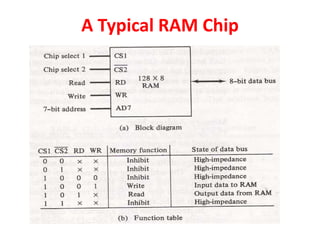
A Typical RAM Chip
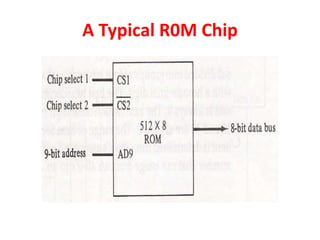
A Typical R0M Chip
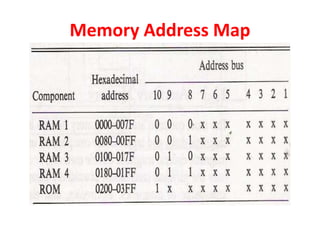
Memory Address Map
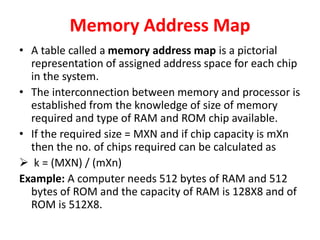
• A table called a memory address map is a pictorial
representation of assigned address space for each chip
in the system.
• The interconnection between memory and processor is
established from the knowledge of size of memory
required and type of RAM and ROM chip available.
• If the required size = MXN and if chip capacity is mXn
then the no. of chips required can be calculated as
 k = (MXN) / (mXn)
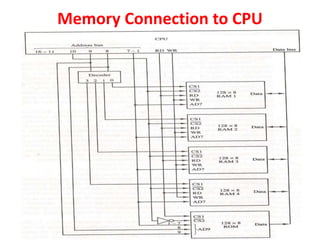
Example: A computer needs 512 bytes of RAM and 512
bytes of ROM and the capacity of RAM is 128X8 and of
ROM is 512X8.
Memory Connection to CPU
Memory Address Map
Lecture-37
Auxiliary Memory
&
Associative Memory
Auxiliary Memory
• The storage device that provide backup storage is
called auxiliary memory.
• They are used for storing system programs, laerge
data files, and other backup information.
• It has large storage capacity.
• It is relatively inexpensive.
• It has low access speed as compared to the main
memory.
• Examples: Magnetic Disks and Tapes.
Associative Memory
• A memory unit accessed by content is called an
associative memory or content addressable
memory (CAM).
• When a word is written on an associative
memory, no address is given.
• The memory is capable of finding an empty
location to store the word.
• When a word is to be read from the memory, the
content or part of the word is specified.
• The memory locates all words which match the
specified content and marks them for reading.
Block Diagram
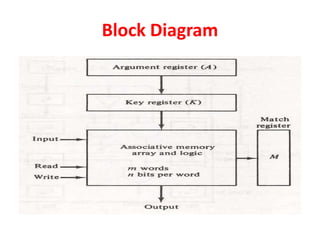
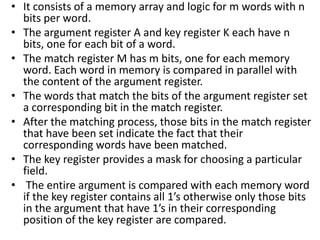
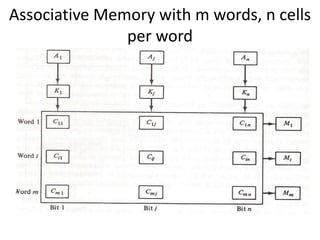
• It consists of a memory array and logic for m words with n
bits per word.
• The argument register A and key register K each have n
bits, one for each bit of a word.
• The match register M has m bits, one for each memory
word. Each word in memory is compared in parallel with
the content of the argument register.
• The words that match the bits of the argument register set
a corresponding bit in the match register.
• After the matching process, those bits in the match register
that have been set indicate the fact that their
corresponding words have been matched.
• The key register provides a mask for choosing a particular
field.
• The entire argument is compared with each memory word
if the key register contains all 1’s otherwise only those bits
in the argument that have 1’s in their corresponding
position of the key register are compared.
Associative Memory with m words, n cells
per word
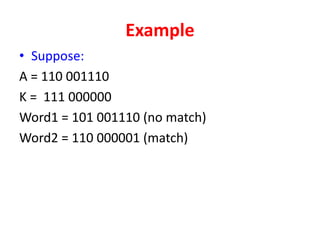
Example
• Suppose:
A = 110 001110
K = 111 000000
Word1 = 101 001110 (no match)
Word2 = 110 000001 (match)
Disadvantage and Application Area
• CAM is more expensive than RAM as it have
additional logic circuits for matching purpose.
• The associative memory is used where the
search time is very critical and must be short.
Lecture-38 and 39
Cache Memory
Cache Memory
• Cache memory is defined as a very high speed memory
that is used in computer system to compensate the
speed differential between main memory access time
and processor logic.
• It is placed between the CPU and the main memory.
• The Cache memory access time is less than the access
time of main memory by a factor of 5 to 10.
• It is used for storing program segments currently being
executed in the CPU and the data frequently used in
the present calculations.
“The cache is only a small fraction of the size of main
memory a large fraction of memory requests will be
found in the fast cache memory because of the locality
of reference property of programs”
Basic Operation
• When the CPU needs to access memory the
cache is examined.
• If the word is found in the cache, it is read from
the fast memory.
• If the word addressed by the CPU is not found in
the cache, the main memory is accessed to read
the word.
• A block of words containing the one just accessed
is then transferred from main memory to cache
memory.
• The block size may vary from one word to about
16 words adjacent to the one just accessed.
Performance of Cache Memory
• The performance of cache memory is frequently
measured in terms of a quantity called hit ratio.
• When the CPU refers to memory and finds the
word in cache, it is said to produce a hit.
• If the word is not found in cache it is in main
memory and it counts as a miss.
• The ratio of the number of hits divided by the
total CPU references to memory (hits plus
misses) is the hit ratio.
• If the hit ratio is high enough so that most of
the time the CPU accesses the cache instead of
main memory, the average access time is closer
to the access time of the fast cache memory.
Performance (contd…)
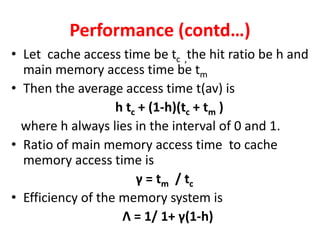
• Let cache access time be tc ,the hit ratio be h and
main memory access time be tm
• Then the average access time t(av) is
h tc + (1-h)(tc + tm )
where h always lies in the interval of 0 and 1.
• Ratio of main memory access time to cache
memory access time is
γ = tm / tc
• Efficiency of the memory system is
Λ = 1/ 1+ γ(1-h)
Mapping Process
• The transformation of data from main
memory to cache memory is referred to as a
mapping process.
• Three types of mapping procedure:
Associative mapping
Direct - Mapping
Set - Associative mapping
Associative Mapping
• In associative mapping method, both the address
and content (data) of the memory word are stored
in cache.
• The address bits sent by the CPU to search are
matched with addresses stored in the cache
memory.
• If any address is matched, the corresponding word
is fetched from the cache and sent to the CPU.
• If no match occurs, the word along with address is
copied from main memory into cache.
• If the cache is full, an address-data pair must be
displaced using cache replacement policy.
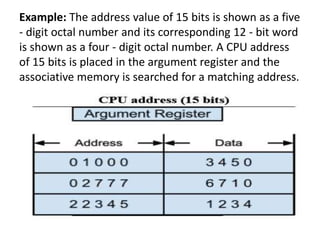
Example: The address value of 15 bits is shown as a five
- digit octal number and its corresponding 12 - bit word
is shown as a four - digit octal number. A CPU address
of 15 bits is placed in the argument register and the
associative memory is searched for a matching address.
Direct Mapping
• The direct mapping cache organization uses the n-bit
address to access the main memory and k-bit index to
access the cache.
• Each word in cache consists of the data word and its
associated tag.
• When a new word is first brought into the cache the
tag bits are stored alongside the data bits.
• When CPU generates a memory request the index field
is used for the address to access the cache.
• The tag field of the CPU address is compared with the
tag in the word read from the cache.
• If the two tag match, there is a hit.
• if there is no match, there is a miss and required word
is read from main memory.
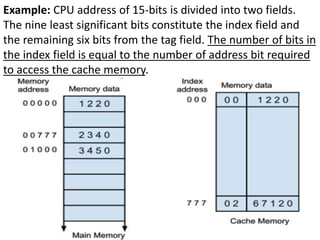
Example: CPU address of 15-bits is divided into two fields.
The nine least significant bits constitute the index field and
the remaining six bits from the tag field. The number of bits in
the index field is equal to the number of address bit required
to access the cache memory.
Disadvantage of Direct Mapping
• The disadvantage of direct mapping is that the
hit ratio can drop considerably if two or more
words whose address have the same index but
different tags are accessed repeatedly.
Set-Associative Mapping
• Set Associative mapping is organization in which
each word of cache can store two or more words
of memory under the same index address.
• Each data word is stored together with its tag and
the number of tag data items in one word of
cache is said to form a set.
• An index address of nine bits can accommodate
512 words. Thus, the size of cache memory is 512
* 36.
• It accommodates 1024 words of main memory
since each word of cache contains two data
words.
• When a miss occurs in a set -associative cache
and the set is full, it is necessary to replace one of
the tag-data items with a new value.
Writing into Cache
• When the CPU finds a word in cache during a
read operation the main memory is not
involved in the transfer.
• If the operation is a write there are two ways
that the system can precede.
1. Write -through
2. Write –back
Write - Through
• In this main memory is updated with every
memory write operation.
• The cache memory being updated in parallel if it
contains the word at the specified address.
• This is called the write through method.
Advantage:
The main memory always contains the same data as
the cache.
Write – Back
• In this method. only cache location is updated
during a write operation.
• The location is then marked by a flag.
• Later when the word is removed from the
cache, it is copies into main memory.
• The reason for the write back method is that
during the time a word resides in the cache, it
may be updated several times.
Cache Initialization
• The cache is initialized when power is applied to
the computer or when the main memory is
loaded with a complete set of programs from
auxiliary memory.
• After initialization the cache is considered to be
empty, but in effect it contains some no valid
data.
• It is customary to include with each word in cache
a valid bit to indicate whether or not the word
contains valid data.
Lecture-40
Virtual Memory
Virtual Memory
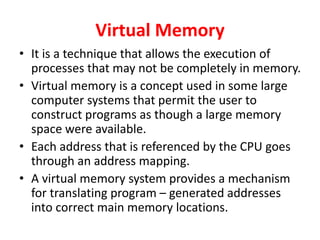
• It is a technique that allows the execution of
processes that may not be completely in memory.
• Virtual memory is a concept used in some large
computer systems that permit the user to
construct programs as though a large memory
space were available.
• Each address that is referenced by the CPU goes
through an address mapping.
• A virtual memory system provides a mechanism
for translating program – generated addresses
into correct main memory locations.
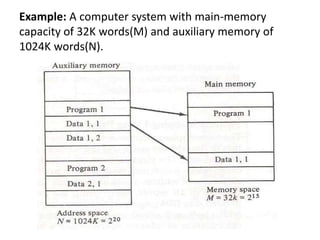
Address Space And Memory Space
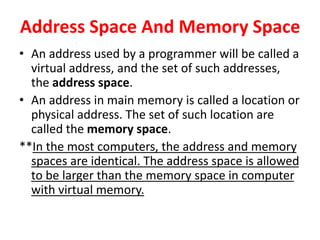
• An address used by a programmer will be called a
virtual address, and the set of such addresses,
the address space.
• An address in main memory is called a location or
physical address. The set of such location are
called the memory space.
**In the most computers, the address and memory
spaces are identical. The address space is allowed
to be larger than the memory space in computer
with virtual memory.
Example: A computer system with main-memory
capacity of 32K words(M) and auxiliary memory of
1024K words(N).
Address Mapping Using Pages
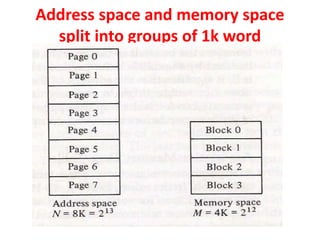
• The information in the address space and memory
space are each divided into groups of fixed size.
• The physical memory is broken down into groups,
which may range from 64 to 4096 words each.
• The term page refers to groups of address space of
same size.
• A page refers to the organization of address space
while a block refers to the organization of memory
space.
• Partitions of programs are moved from auxiliary
memory to main memory is records equal to the size of
a page.
• The term page frame is sometimes used to denote a
block
Address space and memory space
split into groups of 1k word
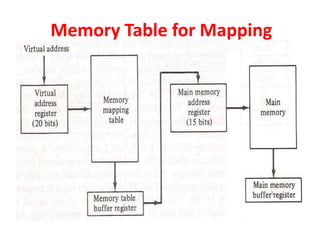
Memory Table for Mapping
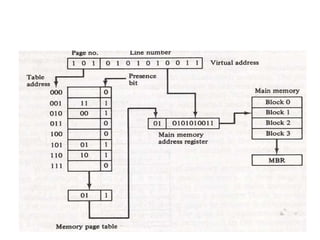
• The organization of the memory mapping table in a paged
system is consists of eight words one for each page.
• The address in the page table denotes the page number
and the content of the word gives the block number where
that page is stored in main memory.
• The table shows that pages 1, 2, 5 and 6 are now available
in main memory in blocks 3, 0 1 and 2.
• A presence bit in each location indicates whether the page
has been transferred from auxiliary memory into main
memory.
• The CPU references a word in memory with a virtual
address of 13 bits.
• The three high order bits of the virtual address specify a
page number and also an address for the memory – page
table.
• The content of the word in the memory page at the page
number address is read out into the memory table buffer
register.
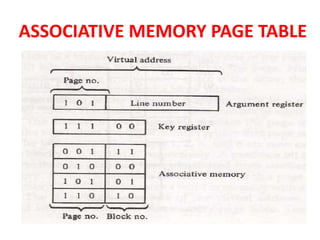
ASSOCIATIVE MEMORY PAGE TABLE
Page Replacement
• The hardware mapping mechanism and the memory
management software together constitute the
architecture of a virtual memory.
• The memory management software system handles all
the software operations for the efficient utilization of
memory space. It must decide-
(1) Which page in main memory ought to be removed to
make room for a new page.
(2) When a new page is to be transferred from auxiliary
memory to main memory.
(3) Where the page is to be loaded in main memory.
Page Fault
• When a program starts execution, one or more
pages are transferred into main memory and the
page table is set to indicate their position.
• The program is executed from main memory until
it attempts to reference a page that is still in
auxiliary memory. This condition is called page
fault.
• When page fault occurs, the execution of the
present program is suspended until the required
page is brought into main memory.
• This task is assigned to the I/O processor.
• In the meantime, control is transferred to the
next program in memory.
Replacement Algorithms
• First – in – first – out (FIFO)
 Each time a page is loaded into memory, its identification number
is pushed into a FIFO stack.
 When FIFO will be full , the page least recently brought in is
removed to enter new page.
 The page to be removed is easily determined because its
identification number is at the top of the FIFO stack.
 Easy to implement, but under certain circumstances pages are
removed and loaded from memory to frequently.
• Least recently used (LRU)
 The LRU algorithm can be implemented by associating a counter
with every page that is in main memory.
 When a page is referenced, its associated counter is set to zero.
 At fixed intervals of time, the counters associated with all pages
presently in memory are incremented by 1.
 The least recently used page is the page with the highest count.
 Difficult to implement.
Lecture-41 and 42
Memory Management
Memory Management System
• A memory management system is a collection of
hardware and software procedures for managing the
various programs residing in memory.
• The basic components of a memory management unit
are:
1. A facility for dynamic storage relocation that maps
logical memory references into physical memory
address.
2. A provision of sharing common programs stored in
memory by different users
3. Protection of information against unauthorized access
between users and preventing users from changing
operating system functions.
Memory Management System (contd…)
• Segment: A Segment is a set of logically related
instructions or data elements associated with a
given name.
Example : subroutines, array of data ,a table of
symbols and user program
• Logical address: The address generated by a
segment program is called logical address. Logical
address are similar to a virtual address except
that logical address space is associated with
variable length segments rather than fixed length
pages.
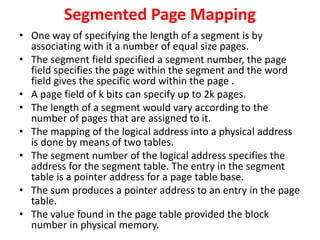
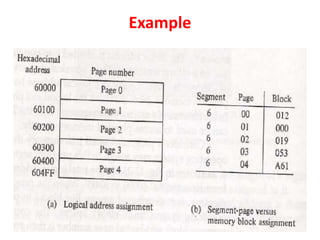
Segmented Page Mapping
• One way of specifying the length of a segment is by
associating with it a number of equal size pages.
• The segment field specified a segment number, the page
field specifies the page within the segment and the word
field gives the specific word within the page .
• A page field of k bits can specify up to 2k pages.
• The length of a segment would vary according to the
number of pages that are assigned to it.
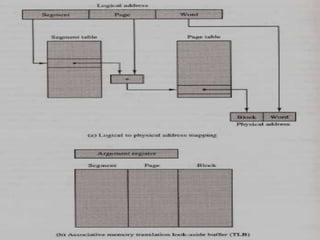
• The mapping of the logical address into a physical address
is done by means of two tables.
• The segment number of the logical address specifies the
address for the segment table. The entry in the segment
table is a pointer address for a page table base.
• The sum produces a pointer address to an entry in the page
table.
• The value found in the page table provided the block
number in physical memory.
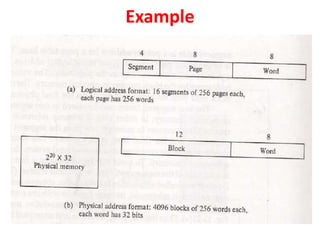
Example
Example

Computer Organisation and Architecture (COA)

  • 1.
  • 2.
    Memory • An electroniccircuitry that allows data to be stored and retrieved when required is known as memory. • Memory unit that communicates directly with the CPU is known as main memory. • The storage devices that provide backup storage is called auxiliary memory.
  • 3.
    Five - LevelMemory Hierarchy • The memory hierarchy consists of total memory system of any computer. • At the top level are CPU registers, accessed at full CPU speed. • Then next in hierarchy is cache memory (order of few KBs to MBs) followed by main memory (ranging from 16 MB to few GBs). • Next is magnetic disks and finally, magnetic tapes and optical tapes.
  • 4.
  • 5.
    Three Key Parameters •Access Time • Storage Capacity • Cost **The overall goal of using a memory hierarchy is to obtain the highest possible average speed while minimizing the total cost of the entire memory system.
  • 6.
    Main Memory • RandomAccess Memory (RAM)  Static RAM: stores binary information in internal flip- flops and stored information remains valid as long as power is applied to the unit.  Dynamic RAM: stores binary information in the form of electric charges that are applied to capacitors.  RAM is used for storing bulk of programs and data that are subject to change • Read Only Memory (ROM)  ROM is used for storing programs that are permanently stored in computer and for tables of constants that do not change in value once the production of the computer is completed.
  • 7.
  • 8.
  • 9.
    Memory Address Map •A table called a memory address map is a pictorial representation of assigned address space for each chip in the system. • The interconnection between memory and processor is established from the knowledge of size of memory required and type of RAM and ROM chip available. • If the required size = MXN and if chip capacity is mXn then the no. of chips required can be calculated as  k = (MXN) / (mXn) Example: A computer needs 512 bytes of RAM and 512 bytes of ROM and the capacity of RAM is 128X8 and of ROM is 512X8.
  • 10.
  • 11.
  • 12.
  • 13.
    Auxiliary Memory • Thestorage device that provide backup storage is called auxiliary memory. • They are used for storing system programs, laerge data files, and other backup information. • It has large storage capacity. • It is relatively inexpensive. • It has low access speed as compared to the main memory. • Examples: Magnetic Disks and Tapes.
  • 14.
    Associative Memory • Amemory unit accessed by content is called an associative memory or content addressable memory (CAM). • When a word is written on an associative memory, no address is given. • The memory is capable of finding an empty location to store the word. • When a word is to be read from the memory, the content or part of the word is specified. • The memory locates all words which match the specified content and marks them for reading.
  • 15.
  • 16.
    • It consistsof a memory array and logic for m words with n bits per word. • The argument register A and key register K each have n bits, one for each bit of a word. • The match register M has m bits, one for each memory word. Each word in memory is compared in parallel with the content of the argument register. • The words that match the bits of the argument register set a corresponding bit in the match register. • After the matching process, those bits in the match register that have been set indicate the fact that their corresponding words have been matched. • The key register provides a mask for choosing a particular field. • The entire argument is compared with each memory word if the key register contains all 1’s otherwise only those bits in the argument that have 1’s in their corresponding position of the key register are compared.
  • 17.
    Associative Memory withm words, n cells per word
  • 18.
    Example • Suppose: A =110 001110 K = 111 000000 Word1 = 101 001110 (no match) Word2 = 110 000001 (match)
  • 19.
    Disadvantage and ApplicationArea • CAM is more expensive than RAM as it have additional logic circuits for matching purpose. • The associative memory is used where the search time is very critical and must be short.
  • 20.
  • 21.
    Cache Memory • Cachememory is defined as a very high speed memory that is used in computer system to compensate the speed differential between main memory access time and processor logic. • It is placed between the CPU and the main memory. • The Cache memory access time is less than the access time of main memory by a factor of 5 to 10. • It is used for storing program segments currently being executed in the CPU and the data frequently used in the present calculations. “The cache is only a small fraction of the size of main memory a large fraction of memory requests will be found in the fast cache memory because of the locality of reference property of programs”
  • 22.
    Basic Operation • Whenthe CPU needs to access memory the cache is examined. • If the word is found in the cache, it is read from the fast memory. • If the word addressed by the CPU is not found in the cache, the main memory is accessed to read the word. • A block of words containing the one just accessed is then transferred from main memory to cache memory. • The block size may vary from one word to about 16 words adjacent to the one just accessed.
  • 23.
    Performance of CacheMemory • The performance of cache memory is frequently measured in terms of a quantity called hit ratio. • When the CPU refers to memory and finds the word in cache, it is said to produce a hit. • If the word is not found in cache it is in main memory and it counts as a miss. • The ratio of the number of hits divided by the total CPU references to memory (hits plus misses) is the hit ratio. • If the hit ratio is high enough so that most of the time the CPU accesses the cache instead of main memory, the average access time is closer to the access time of the fast cache memory.
  • 24.
    Performance (contd…) • Letcache access time be tc ,the hit ratio be h and main memory access time be tm • Then the average access time t(av) is h tc + (1-h)(tc + tm ) where h always lies in the interval of 0 and 1. • Ratio of main memory access time to cache memory access time is γ = tm / tc • Efficiency of the memory system is Λ = 1/ 1+ γ(1-h)
  • 25.
    Mapping Process • Thetransformation of data from main memory to cache memory is referred to as a mapping process. • Three types of mapping procedure: Associative mapping Direct - Mapping Set - Associative mapping
  • 26.
    Associative Mapping • Inassociative mapping method, both the address and content (data) of the memory word are stored in cache. • The address bits sent by the CPU to search are matched with addresses stored in the cache memory. • If any address is matched, the corresponding word is fetched from the cache and sent to the CPU. • If no match occurs, the word along with address is copied from main memory into cache. • If the cache is full, an address-data pair must be displaced using cache replacement policy.
  • 27.
    Example: The addressvalue of 15 bits is shown as a five - digit octal number and its corresponding 12 - bit word is shown as a four - digit octal number. A CPU address of 15 bits is placed in the argument register and the associative memory is searched for a matching address.
  • 28.
    Direct Mapping • Thedirect mapping cache organization uses the n-bit address to access the main memory and k-bit index to access the cache. • Each word in cache consists of the data word and its associated tag. • When a new word is first brought into the cache the tag bits are stored alongside the data bits. • When CPU generates a memory request the index field is used for the address to access the cache. • The tag field of the CPU address is compared with the tag in the word read from the cache. • If the two tag match, there is a hit. • if there is no match, there is a miss and required word is read from main memory.
  • 29.
    Example: CPU addressof 15-bits is divided into two fields. The nine least significant bits constitute the index field and the remaining six bits from the tag field. The number of bits in the index field is equal to the number of address bit required to access the cache memory.
  • 30.
    Disadvantage of DirectMapping • The disadvantage of direct mapping is that the hit ratio can drop considerably if two or more words whose address have the same index but different tags are accessed repeatedly.
  • 31.
    Set-Associative Mapping • SetAssociative mapping is organization in which each word of cache can store two or more words of memory under the same index address. • Each data word is stored together with its tag and the number of tag data items in one word of cache is said to form a set. • An index address of nine bits can accommodate 512 words. Thus, the size of cache memory is 512 * 36. • It accommodates 1024 words of main memory since each word of cache contains two data words. • When a miss occurs in a set -associative cache and the set is full, it is necessary to replace one of the tag-data items with a new value.
  • 32.
    Writing into Cache •When the CPU finds a word in cache during a read operation the main memory is not involved in the transfer. • If the operation is a write there are two ways that the system can precede. 1. Write -through 2. Write –back
  • 33.
    Write - Through •In this main memory is updated with every memory write operation. • The cache memory being updated in parallel if it contains the word at the specified address. • This is called the write through method. Advantage: The main memory always contains the same data as the cache.
  • 34.
    Write – Back •In this method. only cache location is updated during a write operation. • The location is then marked by a flag. • Later when the word is removed from the cache, it is copies into main memory. • The reason for the write back method is that during the time a word resides in the cache, it may be updated several times.
  • 35.
    Cache Initialization • Thecache is initialized when power is applied to the computer or when the main memory is loaded with a complete set of programs from auxiliary memory. • After initialization the cache is considered to be empty, but in effect it contains some no valid data. • It is customary to include with each word in cache a valid bit to indicate whether or not the word contains valid data.
  • 36.
  • 37.
    Virtual Memory • Itis a technique that allows the execution of processes that may not be completely in memory. • Virtual memory is a concept used in some large computer systems that permit the user to construct programs as though a large memory space were available. • Each address that is referenced by the CPU goes through an address mapping. • A virtual memory system provides a mechanism for translating program – generated addresses into correct main memory locations.
  • 38.
    Address Space AndMemory Space • An address used by a programmer will be called a virtual address, and the set of such addresses, the address space. • An address in main memory is called a location or physical address. The set of such location are called the memory space. **In the most computers, the address and memory spaces are identical. The address space is allowed to be larger than the memory space in computer with virtual memory.
  • 39.
    Example: A computersystem with main-memory capacity of 32K words(M) and auxiliary memory of 1024K words(N).
  • 40.
    Address Mapping UsingPages • The information in the address space and memory space are each divided into groups of fixed size. • The physical memory is broken down into groups, which may range from 64 to 4096 words each. • The term page refers to groups of address space of same size. • A page refers to the organization of address space while a block refers to the organization of memory space. • Partitions of programs are moved from auxiliary memory to main memory is records equal to the size of a page. • The term page frame is sometimes used to denote a block
  • 41.
    Address space andmemory space split into groups of 1k word
  • 42.
  • 43.
    • The organizationof the memory mapping table in a paged system is consists of eight words one for each page. • The address in the page table denotes the page number and the content of the word gives the block number where that page is stored in main memory. • The table shows that pages 1, 2, 5 and 6 are now available in main memory in blocks 3, 0 1 and 2. • A presence bit in each location indicates whether the page has been transferred from auxiliary memory into main memory. • The CPU references a word in memory with a virtual address of 13 bits. • The three high order bits of the virtual address specify a page number and also an address for the memory – page table. • The content of the word in the memory page at the page number address is read out into the memory table buffer register.
  • 45.
  • 46.
    Page Replacement • Thehardware mapping mechanism and the memory management software together constitute the architecture of a virtual memory. • The memory management software system handles all the software operations for the efficient utilization of memory space. It must decide- (1) Which page in main memory ought to be removed to make room for a new page. (2) When a new page is to be transferred from auxiliary memory to main memory. (3) Where the page is to be loaded in main memory.
  • 47.
    Page Fault • Whena program starts execution, one or more pages are transferred into main memory and the page table is set to indicate their position. • The program is executed from main memory until it attempts to reference a page that is still in auxiliary memory. This condition is called page fault. • When page fault occurs, the execution of the present program is suspended until the required page is brought into main memory. • This task is assigned to the I/O processor. • In the meantime, control is transferred to the next program in memory.
  • 48.
    Replacement Algorithms • First– in – first – out (FIFO)  Each time a page is loaded into memory, its identification number is pushed into a FIFO stack.  When FIFO will be full , the page least recently brought in is removed to enter new page.  The page to be removed is easily determined because its identification number is at the top of the FIFO stack.  Easy to implement, but under certain circumstances pages are removed and loaded from memory to frequently. • Least recently used (LRU)  The LRU algorithm can be implemented by associating a counter with every page that is in main memory.  When a page is referenced, its associated counter is set to zero.  At fixed intervals of time, the counters associated with all pages presently in memory are incremented by 1.  The least recently used page is the page with the highest count.  Difficult to implement.
  • 49.
  • 50.
    Memory Management System •A memory management system is a collection of hardware and software procedures for managing the various programs residing in memory. • The basic components of a memory management unit are: 1. A facility for dynamic storage relocation that maps logical memory references into physical memory address. 2. A provision of sharing common programs stored in memory by different users 3. Protection of information against unauthorized access between users and preventing users from changing operating system functions.
  • 51.
    Memory Management System(contd…) • Segment: A Segment is a set of logically related instructions or data elements associated with a given name. Example : subroutines, array of data ,a table of symbols and user program • Logical address: The address generated by a segment program is called logical address. Logical address are similar to a virtual address except that logical address space is associated with variable length segments rather than fixed length pages.
  • 52.
    Segmented Page Mapping •One way of specifying the length of a segment is by associating with it a number of equal size pages. • The segment field specified a segment number, the page field specifies the page within the segment and the word field gives the specific word within the page . • A page field of k bits can specify up to 2k pages. • The length of a segment would vary according to the number of pages that are assigned to it. • The mapping of the logical address into a physical address is done by means of two tables. • The segment number of the logical address specifies the address for the segment table. The entry in the segment table is a pointer address for a page table base. • The sum produces a pointer address to an entry in the page table. • The value found in the page table provided the block number in physical memory.
  • 54.
  • 55.