GROUP
  ď‚— A group can be defined as two or more individuals
    coming together to accomplish a particular task or goal.

CHARACTERSESTICS OF GROUP
  ď‚— Two or more person

  ď‚— Interaction

  ď‚— Reasonable size

  ď‚— Shared goal interest

  ď‚— Stability

  ď‚— Collective identity
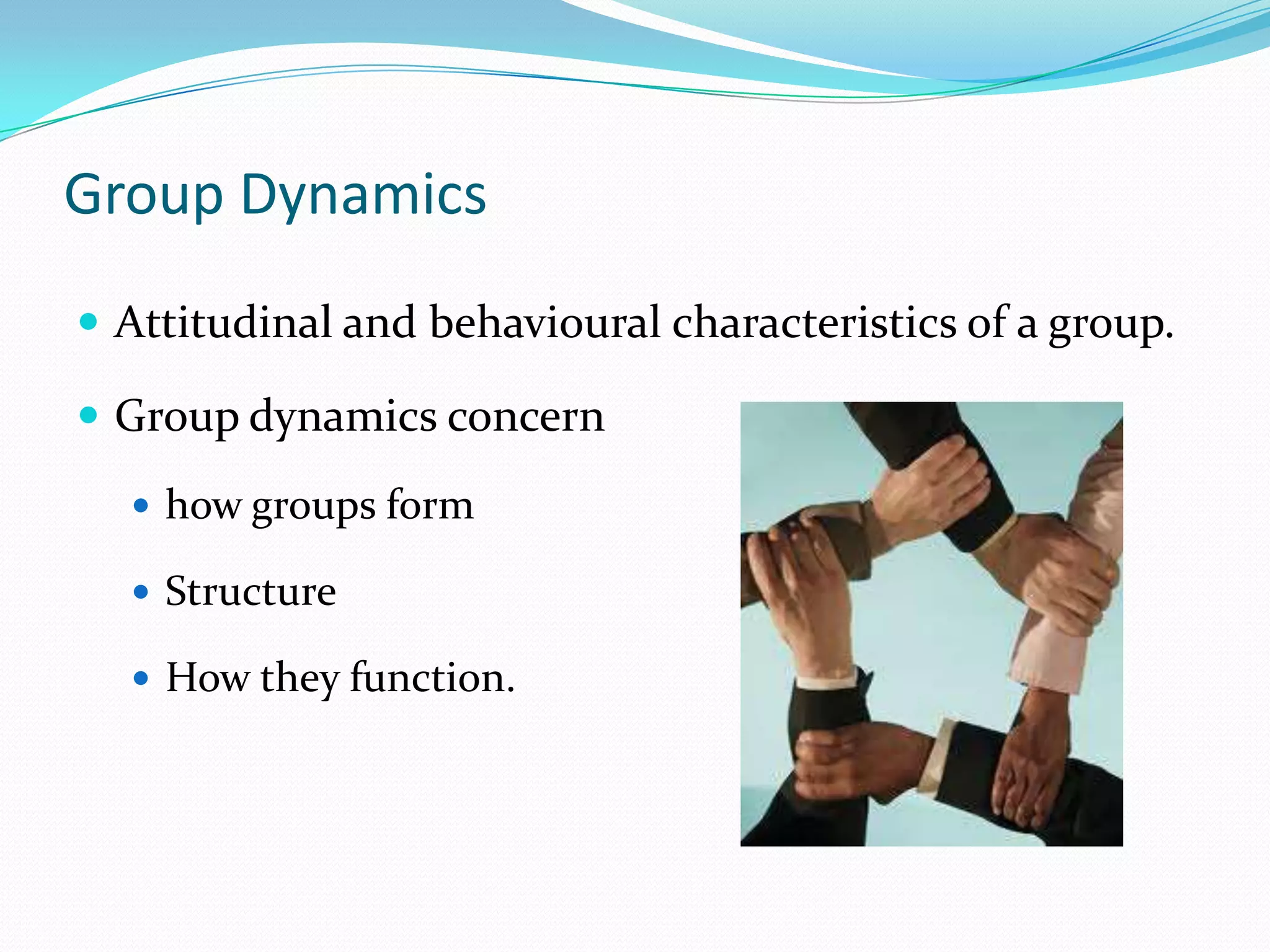
Group Dynamics
ď‚— Attitudinal and behavioural characteristics of a group.

ď‚— Group dynamics concern

  ď‚— how groups form

  ď‚— Structure

  ď‚— How they function.
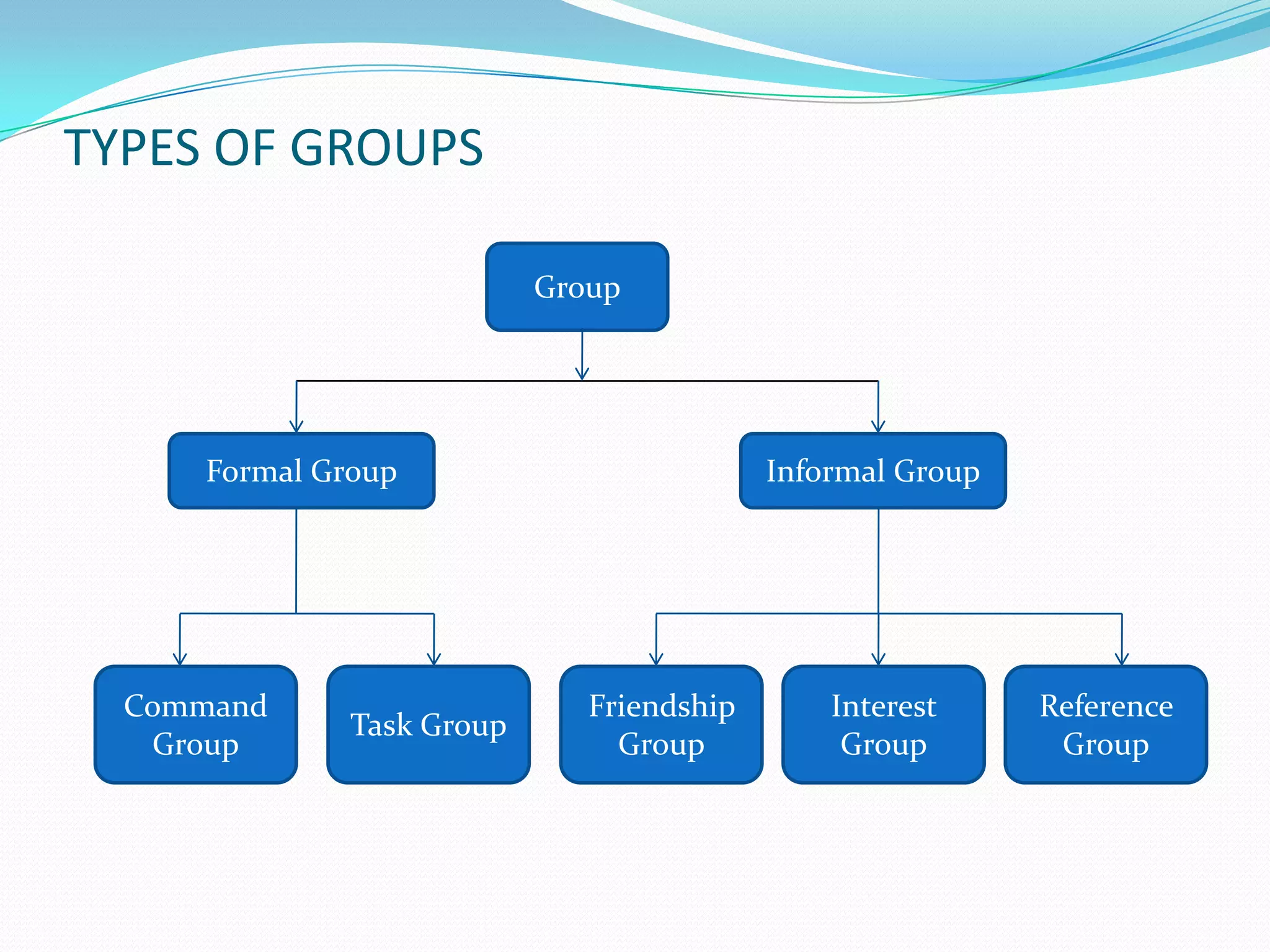
TYPES OF GROUPS

                           Group


     Formal Group                          Informal Group


  Command                     Friendship       Interest     Reference
              Task Group
   Group                        Group           Group        Group
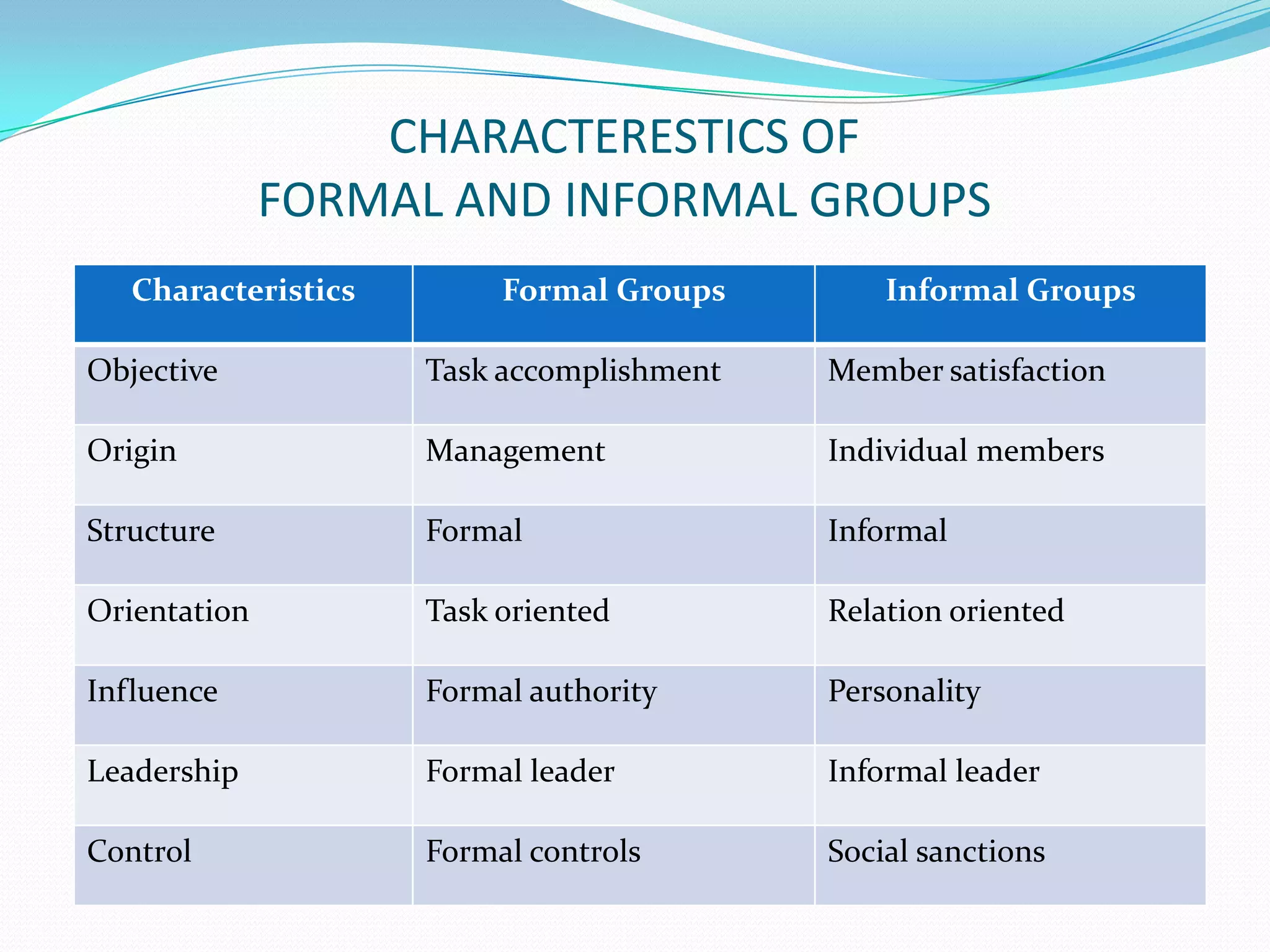
CHARACTERESTICS OF
              FORMAL AND INFORMAL GROUPS
   Characteristics        Formal Groups        Informal Groups

Objective            Task accomplishment   Member satisfaction

Origin               Management            Individual members

Structure            Formal                Informal

Orientation          Task oriented         Relation oriented

Influence            Formal authority      Personality

Leadership           Formal leader         Informal leader

Control              Formal controls       Social sanctions
GROUP PROPERTIES
   ď‚— Role
   ď‚— Norms
   ď‚— Status
   ď‚— Size
   ď‚— Cohesiveness
ď‚— Role
    ď‚—    Set of activities expected from a person occupying a particular
         position in a group.
    ď‚—    Members may have to play multiple roles.
    ď‚—    Roles are impersonal.
ď‚— Norms
    ď‚—    Set of informal rules, beliefs and values that guide members
         behaviour.
    ď‚—    Define the boundaries of acceptable and unacceptable behaviour.
ď‚— Status
    ď‚—    Relative prestige, social position or rank given to groups by others.
    ď‚—    Formal status system-due to official position
    ď‚—    informal status system-due to a particular person
ď‚— Size
    ď‚—    Number of members in a group.
    ď‚—    Smaller groups are faster and effective.
    ď‚—    Larger groups creates free riders and social loafing.


ď‚— Cohesiveness
    ď‚—    Degree to which members are attracted to each other.
    ď‚—    Individuals are motivated to stay in group.
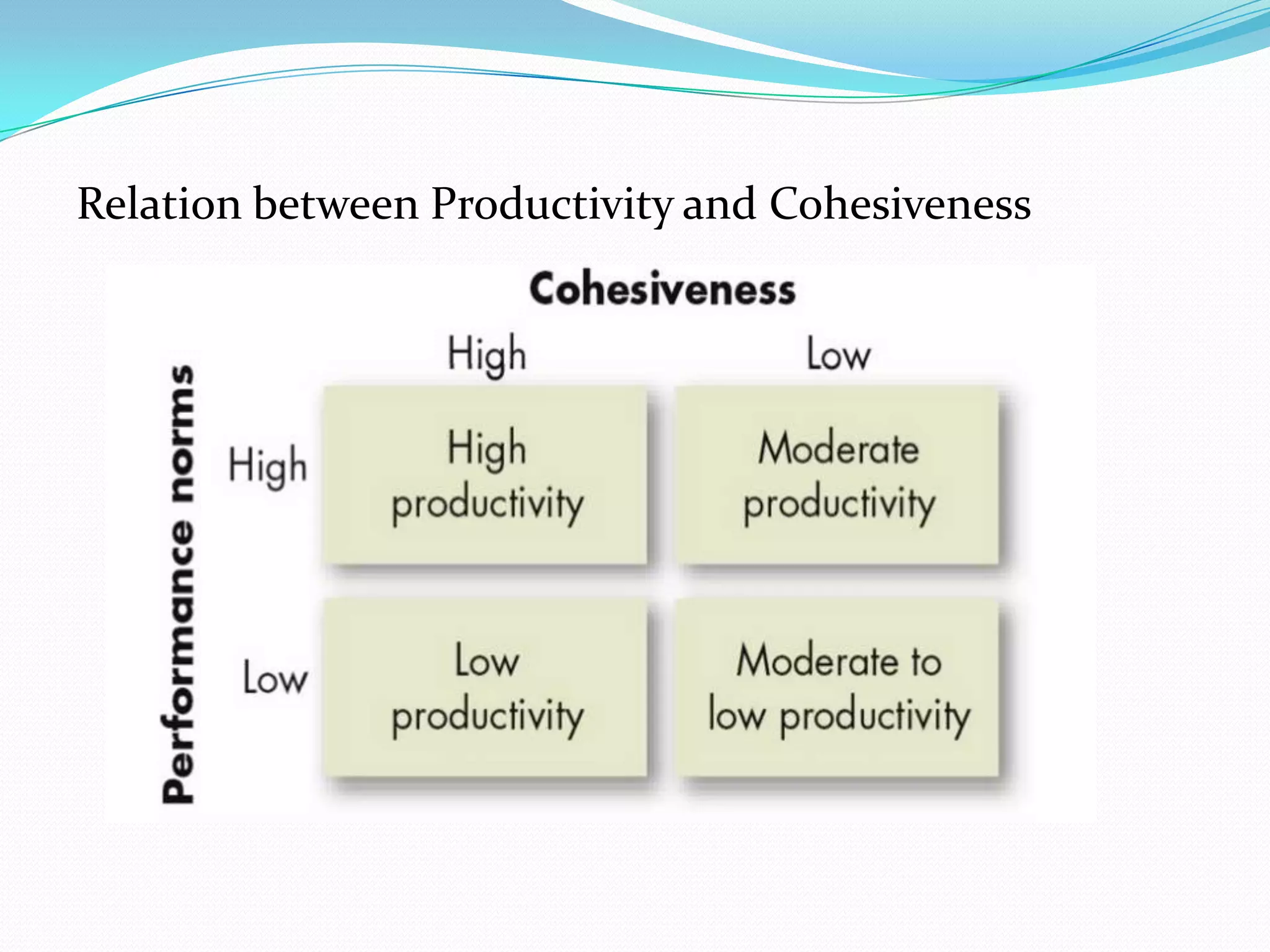
    ď‚—    Relationship between cohesiveness and productivity depends
         on performance norms.
Relation between Productivity and Cohesiveness
GROUP DECISION MAKING
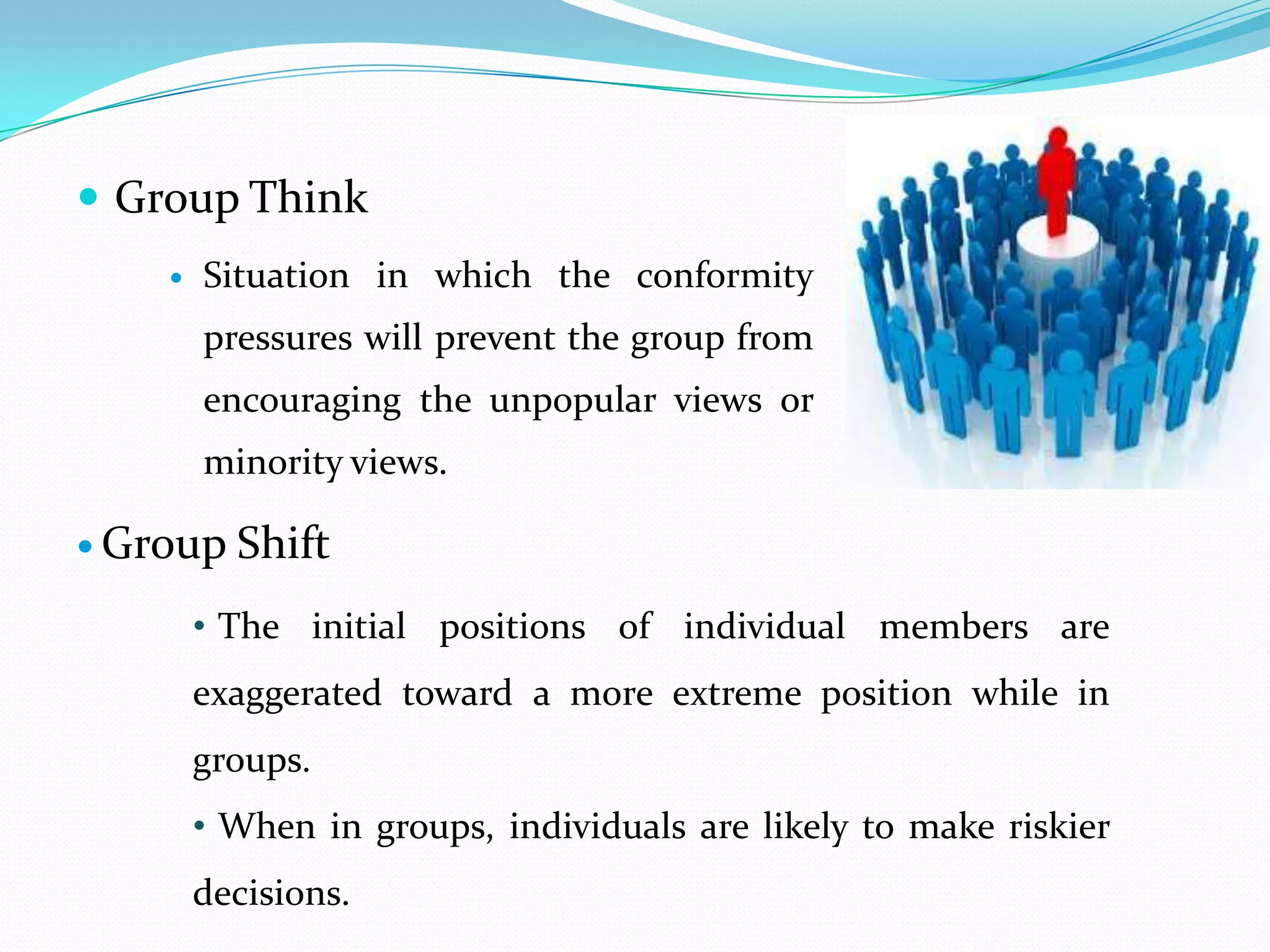
ď‚— Group Think
    ď‚—   Situation in which the conformity
        pressures will prevent the group from
        encouraging the unpopular views or
        minority views.

ď‚— Group   Shift
        • The initial positions of individual members are
        exaggerated toward a more extreme position while in
        groups.
        • When in groups, individuals are likely to make riskier
        decisions.
Group Decision Making Techniques

    ď‚— Ordinary Group Interactions

    ď‚— Brainstorming

    ď‚— Nominal Group Technique

    ď‚— Delphi Technique

    ď‚— Electronic Meeting
ď‚— Ordinary Group Interactions
    ď‚—   Conventional method where the chairman calls the meeting,
        explains the problem and tries to get a result.
    ď‚—   Sub optimal decisions are often reached just to end the meeting.

ď‚— Brainstorming
    ď‚—   Use of brain to storm a problem.
    ď‚—   Group members express themselves freely, regardless of how crazy or
        wild their ideas may appear to others.
    ď‚—   Principles of brain storming
        ď‚—   Deferred judgement- all ideas are encouraged without criticism
            and evaluation.
           Quantity breeds quality- as more ideas come forth, quality one’s
            will be developed.
ď‚— Nominal Group Technique
    ď‚—   Members of the target group are brought forward and
        presented with a problem.

    ď‚—   Each   member      writes   down     his   ideas      silently   and
        independently.

    ď‚—   Each member presents a single idea (best idea) to the
        group, which is written on the blackboard for all to see.

    ď‚—   A discussion is held to clarify and evaluate ideas.

    ď‚—   Meeting concludes with a silent, independent vote on
        priorities through a rank ordering
ď‚— Delphi Technique
    ď‚—   Members are physically dispersed and do not meet face to face.

    ď‚—   Members independently answers a series of questionnaires.

    ď‚—   Suggestions are pooled and feedback report is given by the
        chairperson.

    ď‚—   Second stage questionnaire are sent for reaction and reassessment.

    ď‚—   Members evaluates the feedback report and generates new
        suggestions.

    ď‚—   Process is continued until a clear solution emerges.
ď‚— Electronic Meeting System
    ď‚—   way of conducting meetings supported by computer
        technologies.

Group formation and decision making

  • 2.
    GROUP ď‚—A group can be defined as two or more individuals coming together to accomplish a particular task or goal. CHARACTERSESTICS OF GROUP ď‚— Two or more person ď‚— Interaction ď‚— Reasonable size ď‚— Shared goal interest ď‚— Stability ď‚— Collective identity
  • 3.
    Group Dynamics ď‚— Attitudinaland behavioural characteristics of a group. ď‚— Group dynamics concern ď‚— how groups form ď‚— Structure ď‚— How they function.
  • 4.
    TYPES OF GROUPS Group Formal Group Informal Group Command Friendship Interest Reference Task Group Group Group Group Group
  • 5.
    CHARACTERESTICS OF FORMAL AND INFORMAL GROUPS Characteristics Formal Groups Informal Groups Objective Task accomplishment Member satisfaction Origin Management Individual members Structure Formal Informal Orientation Task oriented Relation oriented Influence Formal authority Personality Leadership Formal leader Informal leader Control Formal controls Social sanctions
  • 6.
    GROUP PROPERTIES ď‚— Role ď‚— Norms ď‚— Status ď‚— Size ď‚— Cohesiveness
  • 7.
    ď‚— Role ď‚— Set of activities expected from a person occupying a particular position in a group. ď‚— Members may have to play multiple roles. ď‚— Roles are impersonal. ď‚— Norms ď‚— Set of informal rules, beliefs and values that guide members behaviour. ď‚— Define the boundaries of acceptable and unacceptable behaviour. ď‚— Status ď‚— Relative prestige, social position or rank given to groups by others. ď‚— Formal status system-due to official position ď‚— informal status system-due to a particular person
  • 8.
    ď‚— Size ď‚— Number of members in a group. ď‚— Smaller groups are faster and effective. ď‚— Larger groups creates free riders and social loafing. ď‚— Cohesiveness ď‚— Degree to which members are attracted to each other. ď‚— Individuals are motivated to stay in group. ď‚— Relationship between cohesiveness and productivity depends on performance norms.
  • 9.
  • 10.
  • 11.
     Group Think  Situation in which the conformity pressures will prevent the group from encouraging the unpopular views or minority views.  Group Shift • The initial positions of individual members are exaggerated toward a more extreme position while in groups. • When in groups, individuals are likely to make riskier decisions.
  • 12.
    Group Decision MakingTechniques ď‚— Ordinary Group Interactions ď‚— Brainstorming ď‚— Nominal Group Technique ď‚— Delphi Technique ď‚— Electronic Meeting
  • 13.
     Ordinary GroupInteractions  Conventional method where the chairman calls the meeting, explains the problem and tries to get a result.  Sub optimal decisions are often reached just to end the meeting.  Brainstorming  Use of brain to storm a problem.  Group members express themselves freely, regardless of how crazy or wild their ideas may appear to others.  Principles of brain storming  Deferred judgement- all ideas are encouraged without criticism and evaluation.  Quantity breeds quality- as more ideas come forth, quality one’s will be developed.
  • 14.
    ď‚— Nominal GroupTechnique ď‚— Members of the target group are brought forward and presented with a problem. ď‚— Each member writes down his ideas silently and independently. ď‚— Each member presents a single idea (best idea) to the group, which is written on the blackboard for all to see. ď‚— A discussion is held to clarify and evaluate ideas. ď‚— Meeting concludes with a silent, independent vote on priorities through a rank ordering
  • 15.
    ď‚— Delphi Technique ď‚— Members are physically dispersed and do not meet face to face. ď‚— Members independently answers a series of questionnaires. ď‚— Suggestions are pooled and feedback report is given by the chairperson. ď‚— Second stage questionnaire are sent for reaction and reassessment. ď‚— Members evaluates the feedback report and generates new suggestions. ď‚— Process is continued until a clear solution emerges.
  • 16.
    ď‚— Electronic MeetingSystem ď‚— way of conducting meetings supported by computer technologies.