Ali Bahu
10/17/2012
APACHE HADOOP
INTRODUCTION
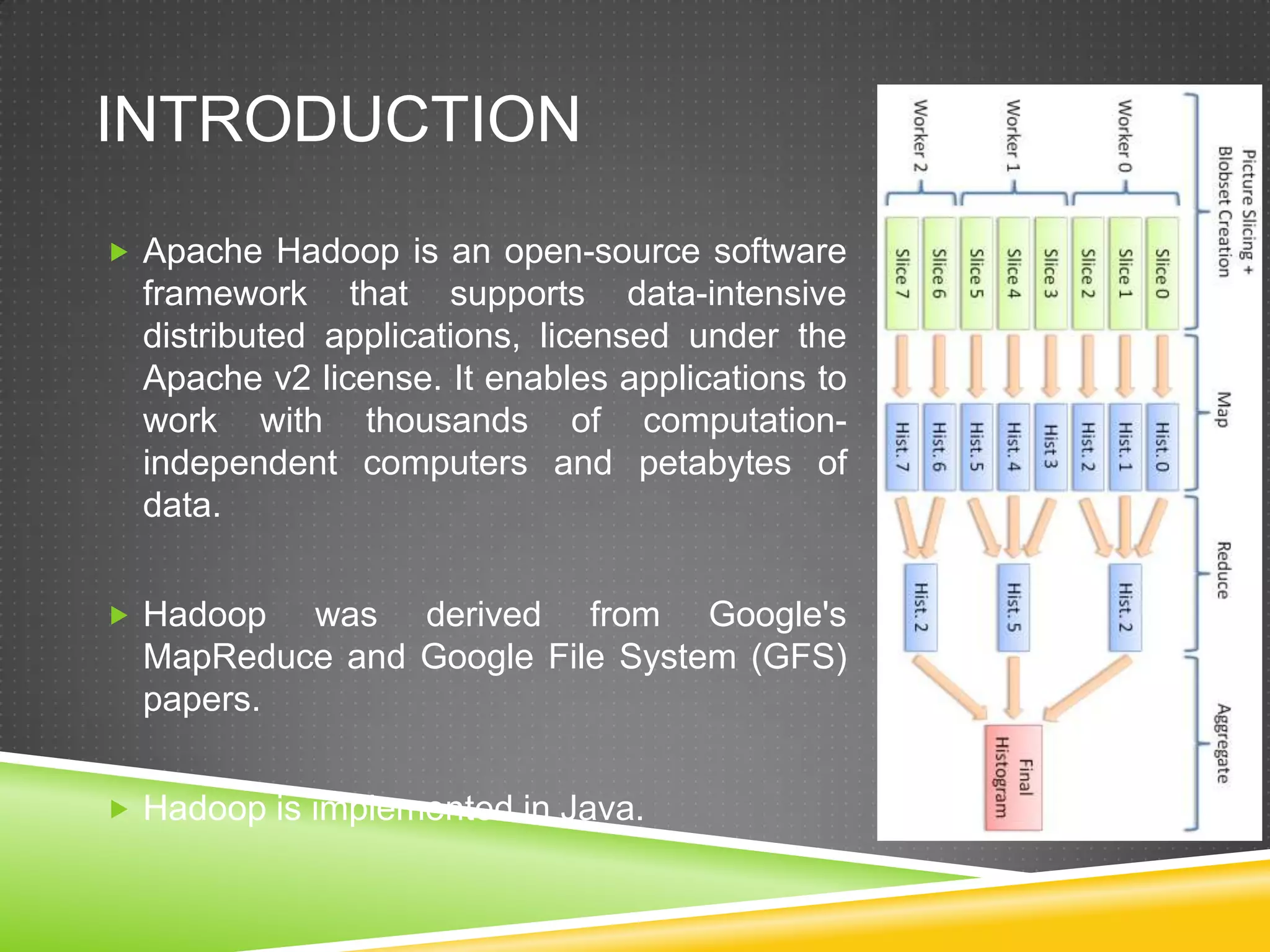
 Apache Hadoop is an open-source software
framework that supports data-intensive
distributed applications, licensed under the
Apache v2 license. It enables applications to
work with thousands of computation-
independent computers and petabytes of
data.
 Hadoop was derived from Google's
MapReduce and Google File System (GFS)
papers.
 Hadoop is implemented in Java.
WHY HADOOP
 Need to process Multi Petabyte Datasets
 It is expensive to build reliability in each application
 Nodes failure is expected and Hadoop can help
 Number of nodes is not constant
 Efficient, reliable, Open Source Apache License
 Workloads are IO bound and not CPU bound
WHO USES HADOOP
 Amazon/A9
 Facebook
 Google
 IBM
 Joost
 Last.fm
 New York Times
 PowerSet
 Veoh
 Yahoo!
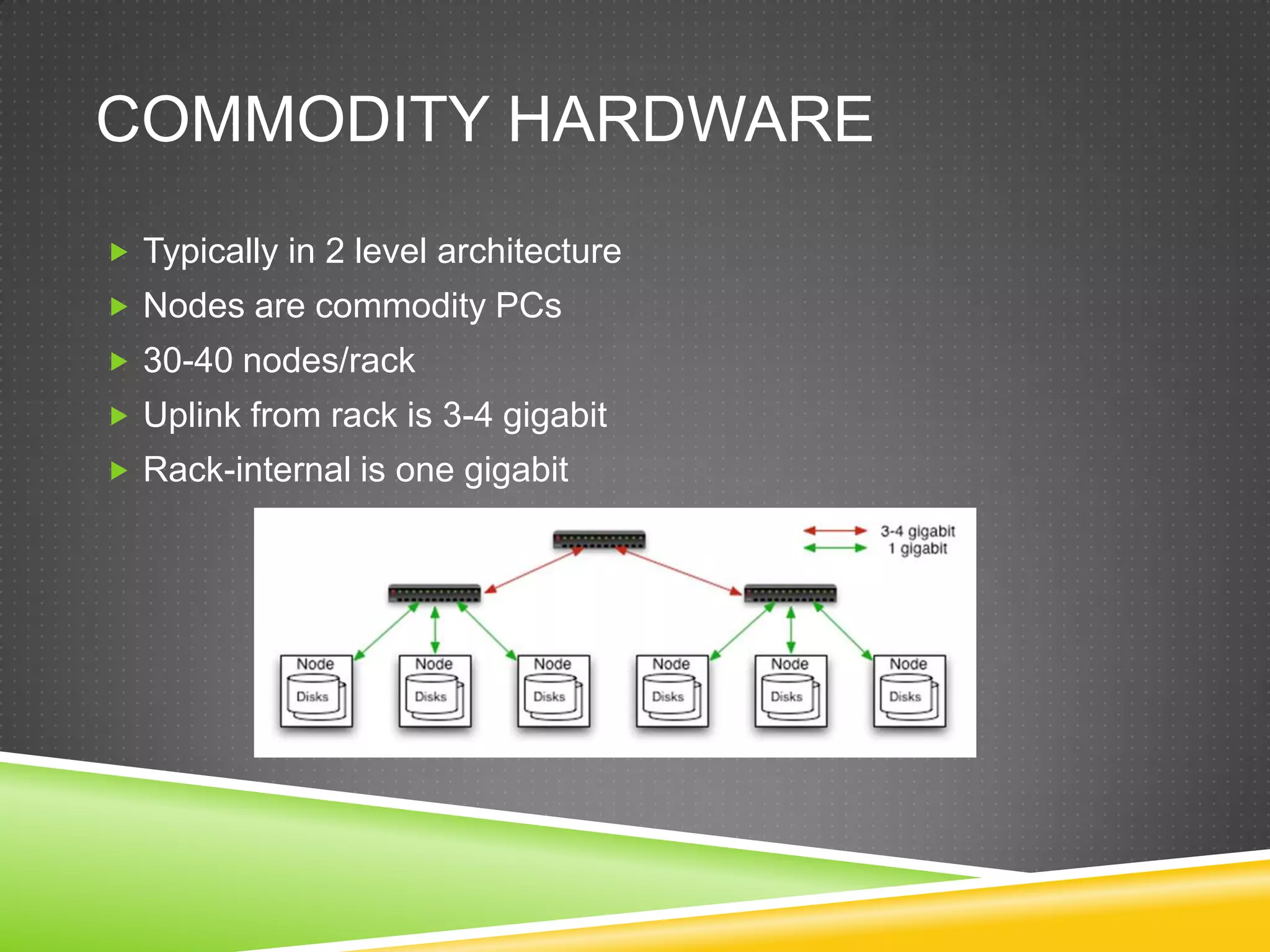
COMMODITY HARDWARE
 Typically in 2 level architecture
 Nodes are commodity PCs
 30-40 nodes/rack
 Uplink from rack is 3-4 gigabit
 Rack-internal is one gigabit
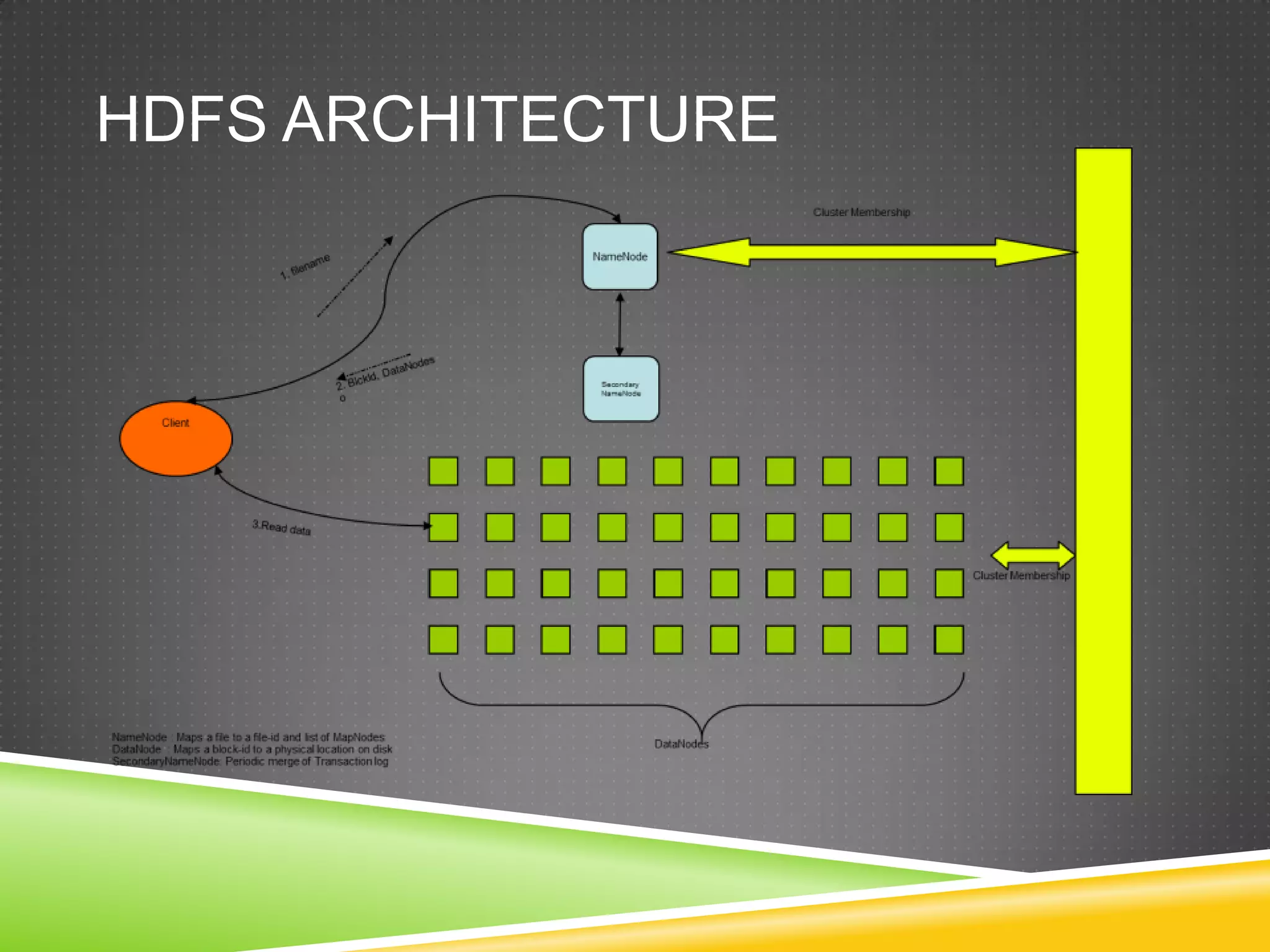
HDFS ARCHITECTURE
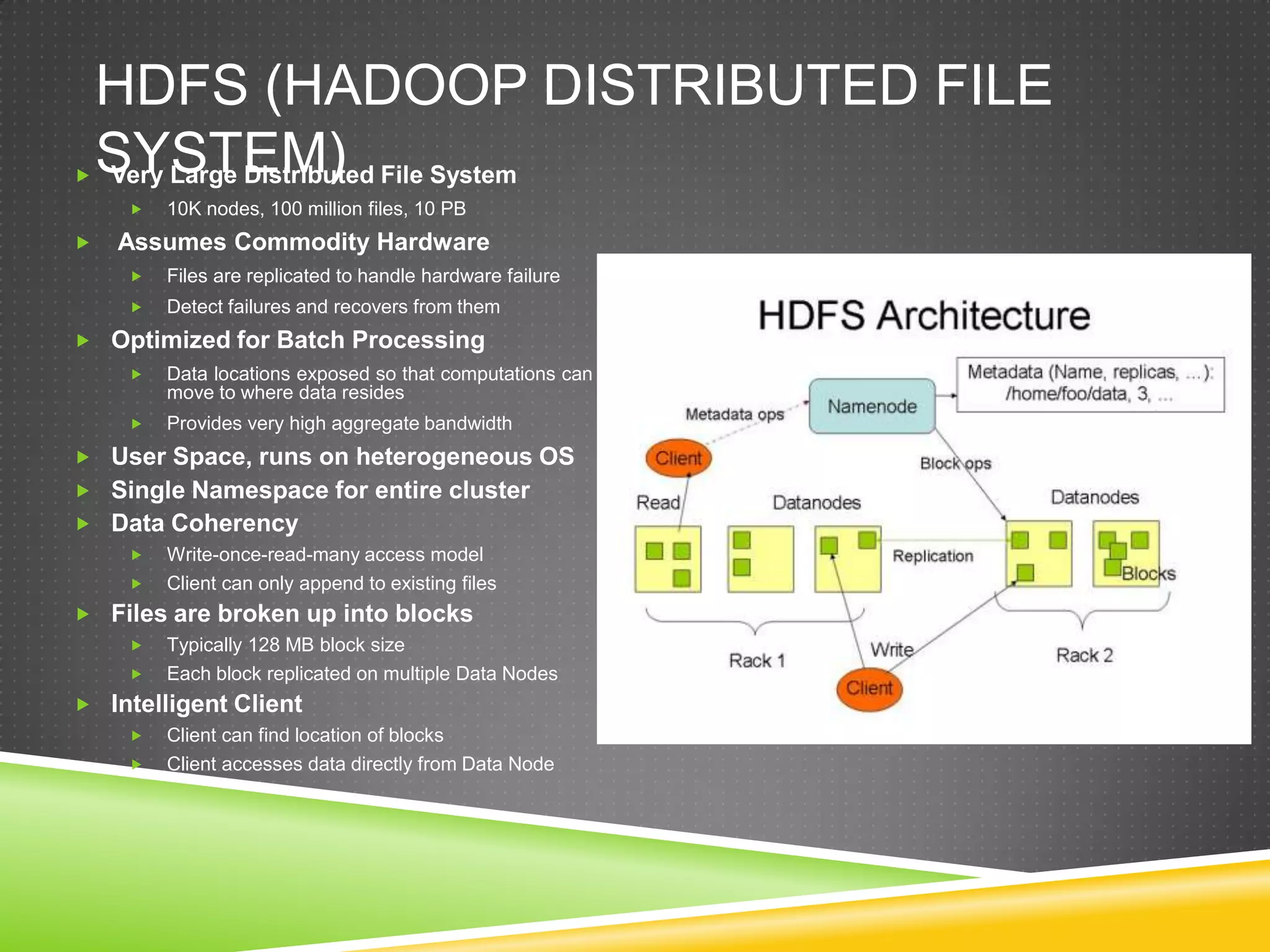
HDFS (HADOOP DISTRIBUTED FILE
SYSTEM) Very Large Distributed File System
 10K nodes, 100 million files, 10 PB
 Assumes Commodity Hardware
 Files are replicated to handle hardware failure
 Detect failures and recovers from them
 Optimized for Batch Processing
 Data locations exposed so that computations can
move to where data resides
 Provides very high aggregate bandwidth
 User Space, runs on heterogeneous OS
 Single Namespace for entire cluster
 Data Coherency
 Write-once-read-many access model
 Client can only append to existing files
 Files are broken up into blocks
 Typically 128 MB block size
 Each block replicated on multiple Data Nodes
 Intelligent Client
 Client can find location of blocks
 Client accesses data directly from Data Node
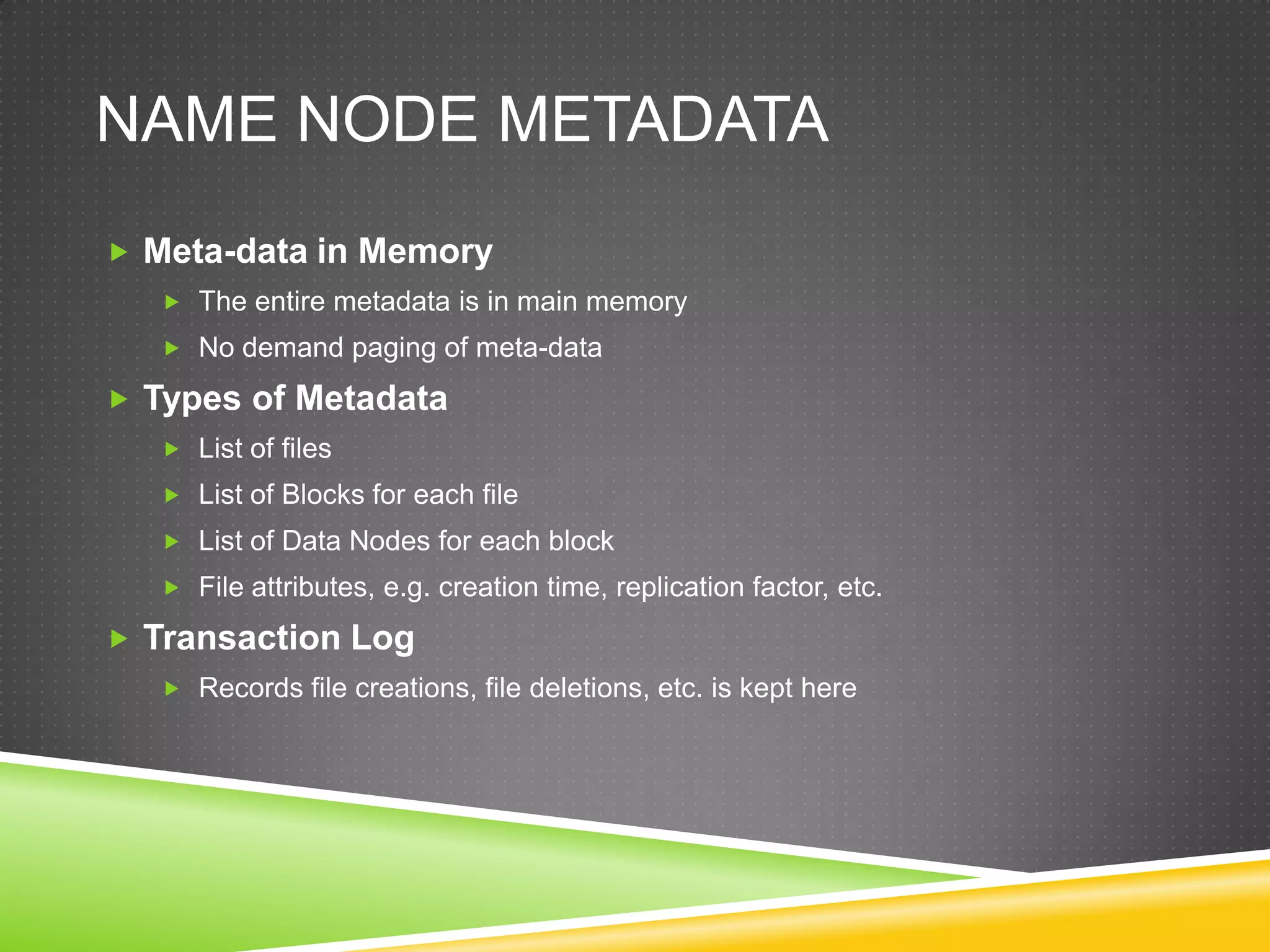
NAME NODE METADATA
 Meta-data in Memory
 The entire metadata is in main memory
 No demand paging of meta-data
 Types of Metadata
 List of files
 List of Blocks for each file
 List of Data Nodes for each block
 File attributes, e.g. creation time, replication factor, etc.
 Transaction Log
 Records file creations, file deletions, etc. is kept here
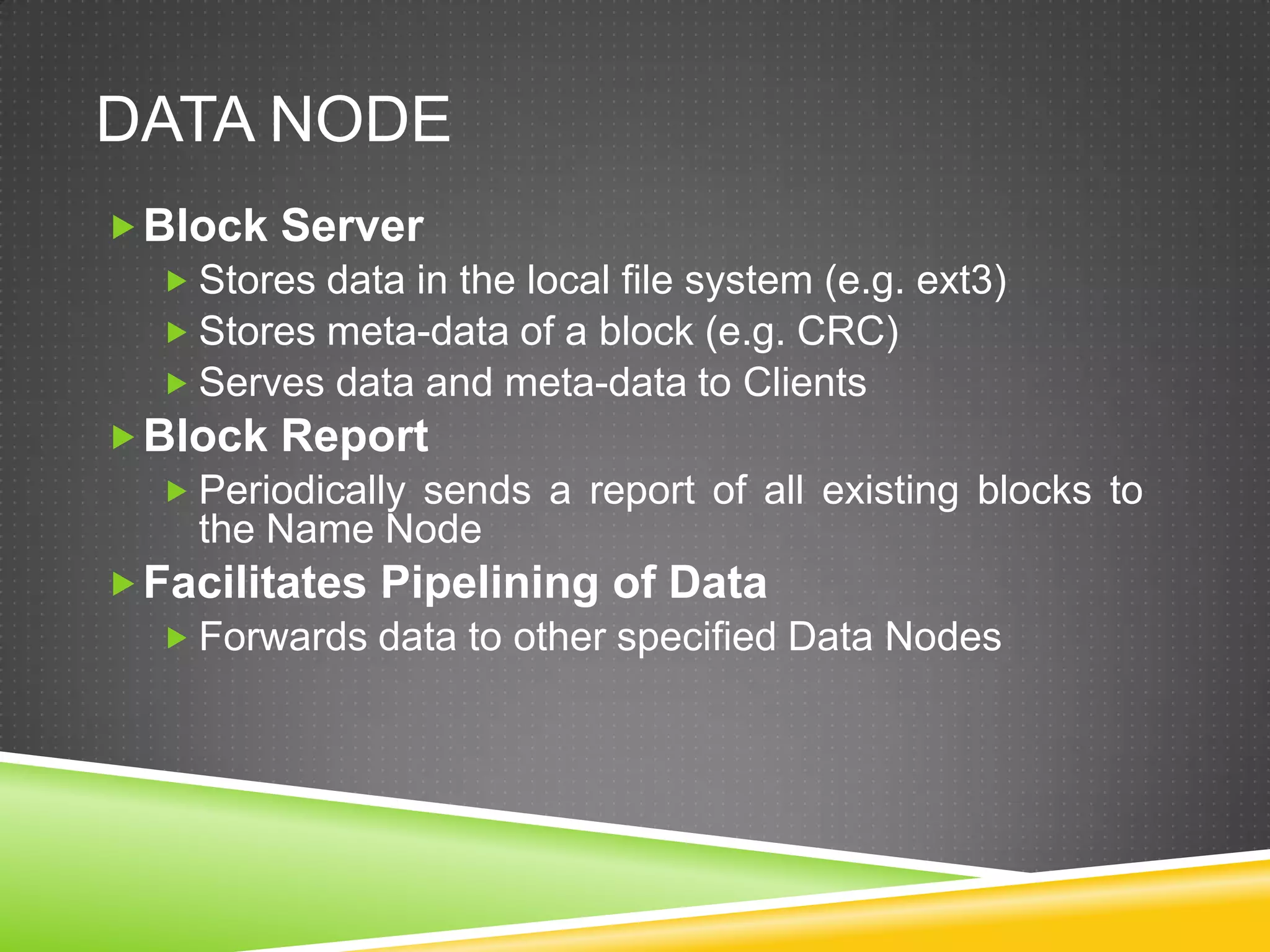
DATA NODE
Block Server
 Stores data in the local file system (e.g. ext3)
 Stores meta-data of a block (e.g. CRC)
 Serves data and meta-data to Clients
Block Report
 Periodically sends a report of all existing blocks to
the Name Node
Facilitates Pipelining of Data
 Forwards data to other specified Data Nodes
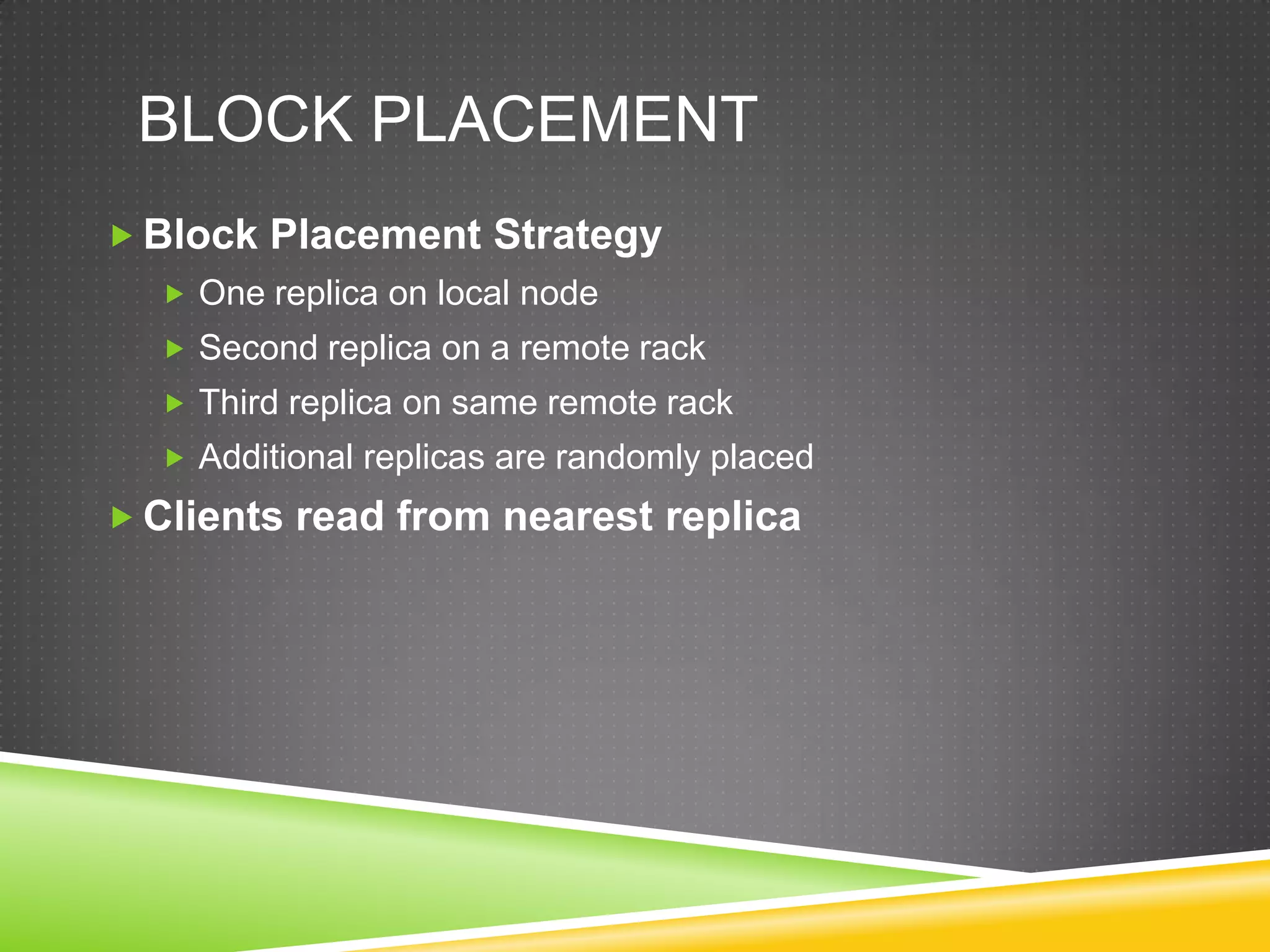
BLOCK PLACEMENT
 Block Placement Strategy
 One replica on local node
 Second replica on a remote rack
 Third replica on same remote rack
 Additional replicas are randomly placed
 Clients read from nearest replica
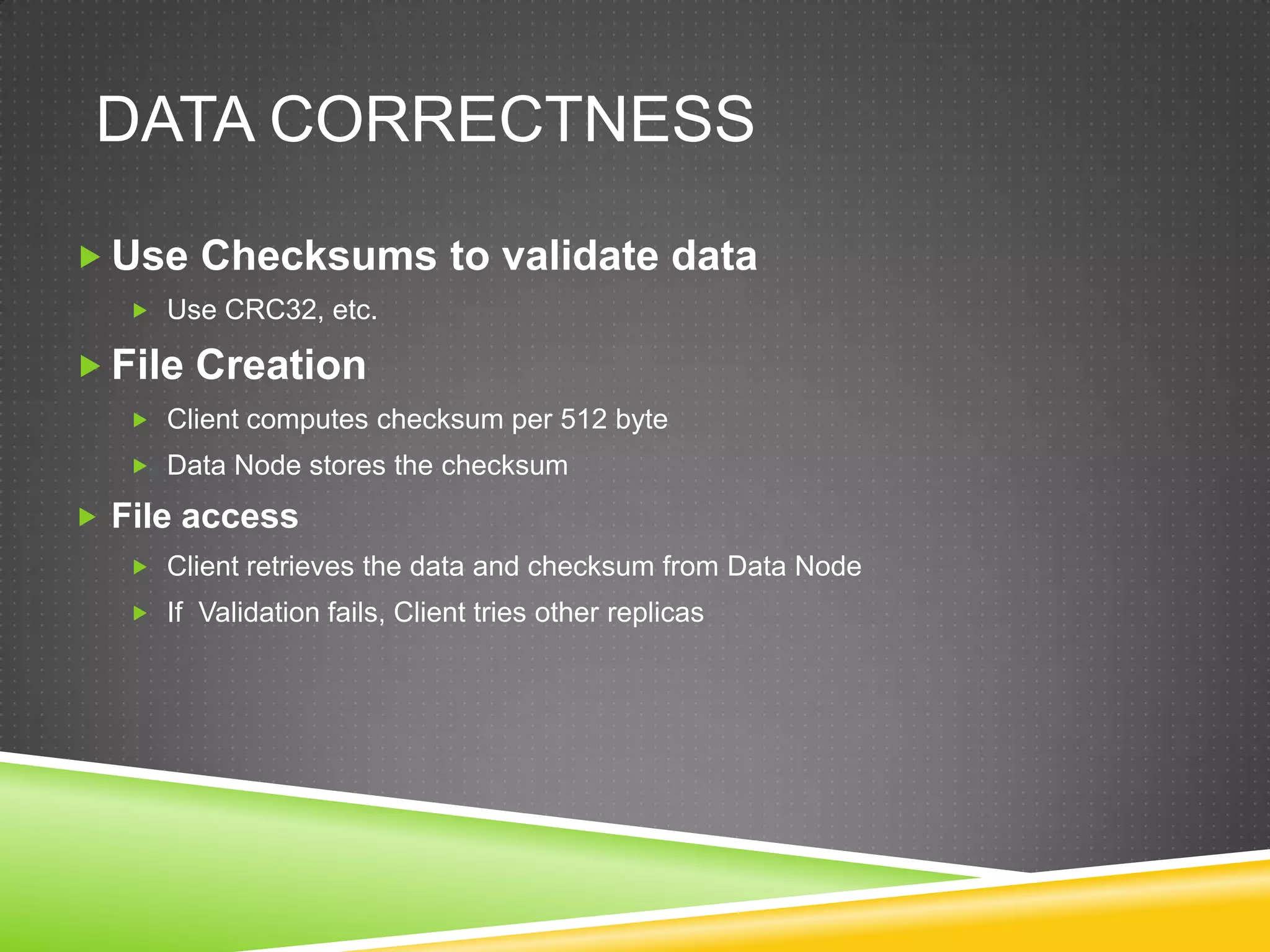
DATA CORRECTNESS
 Use Checksums to validate data
 Use CRC32, etc.
 File Creation
 Client computes checksum per 512 byte
 Data Node stores the checksum
 File access
 Client retrieves the data and checksum from Data Node
 If Validation fails, Client tries other replicas
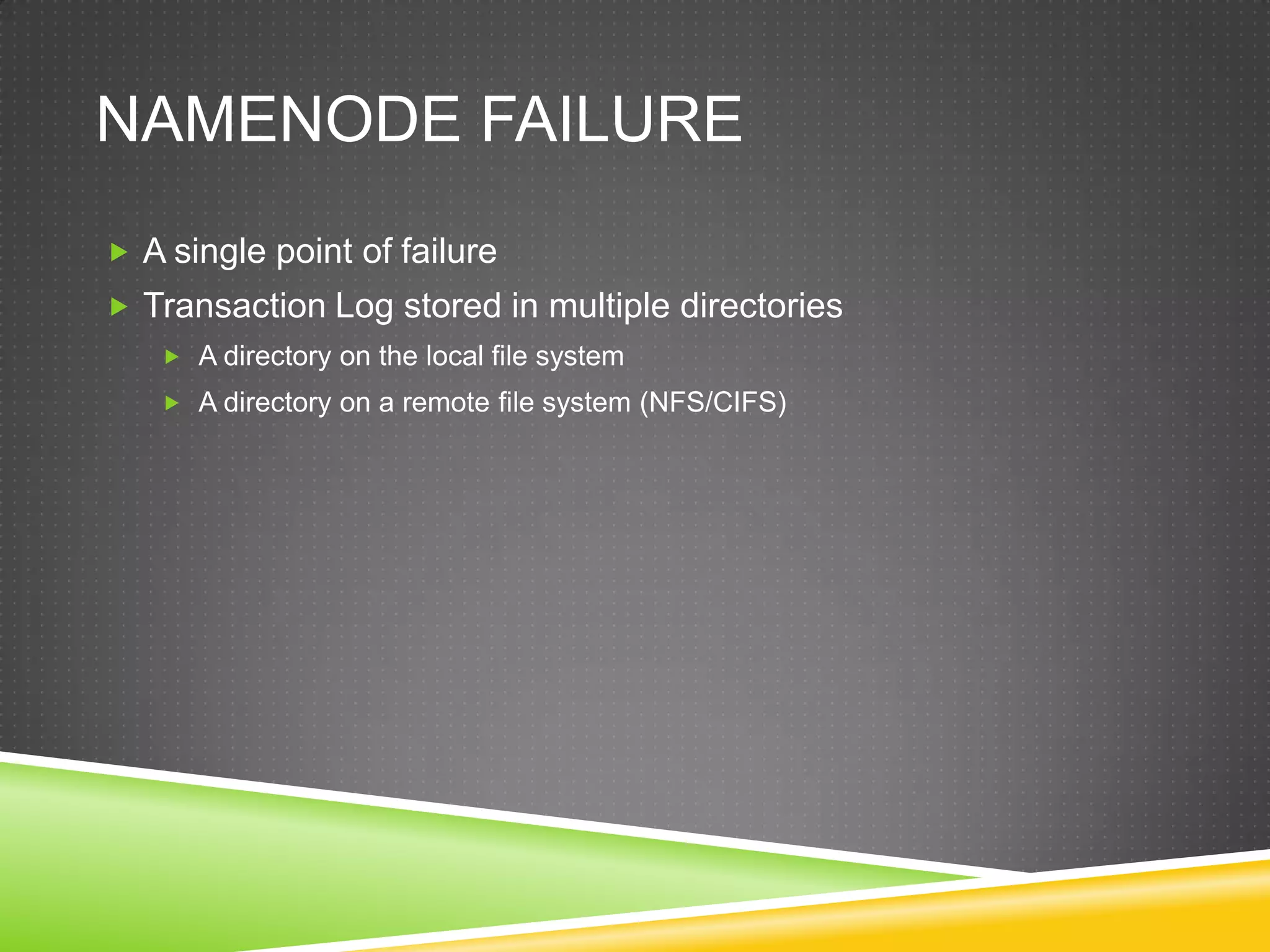
NAMENODE FAILURE
 A single point of failure
 Transaction Log stored in multiple directories
 A directory on the local file system
 A directory on a remote file system (NFS/CIFS)
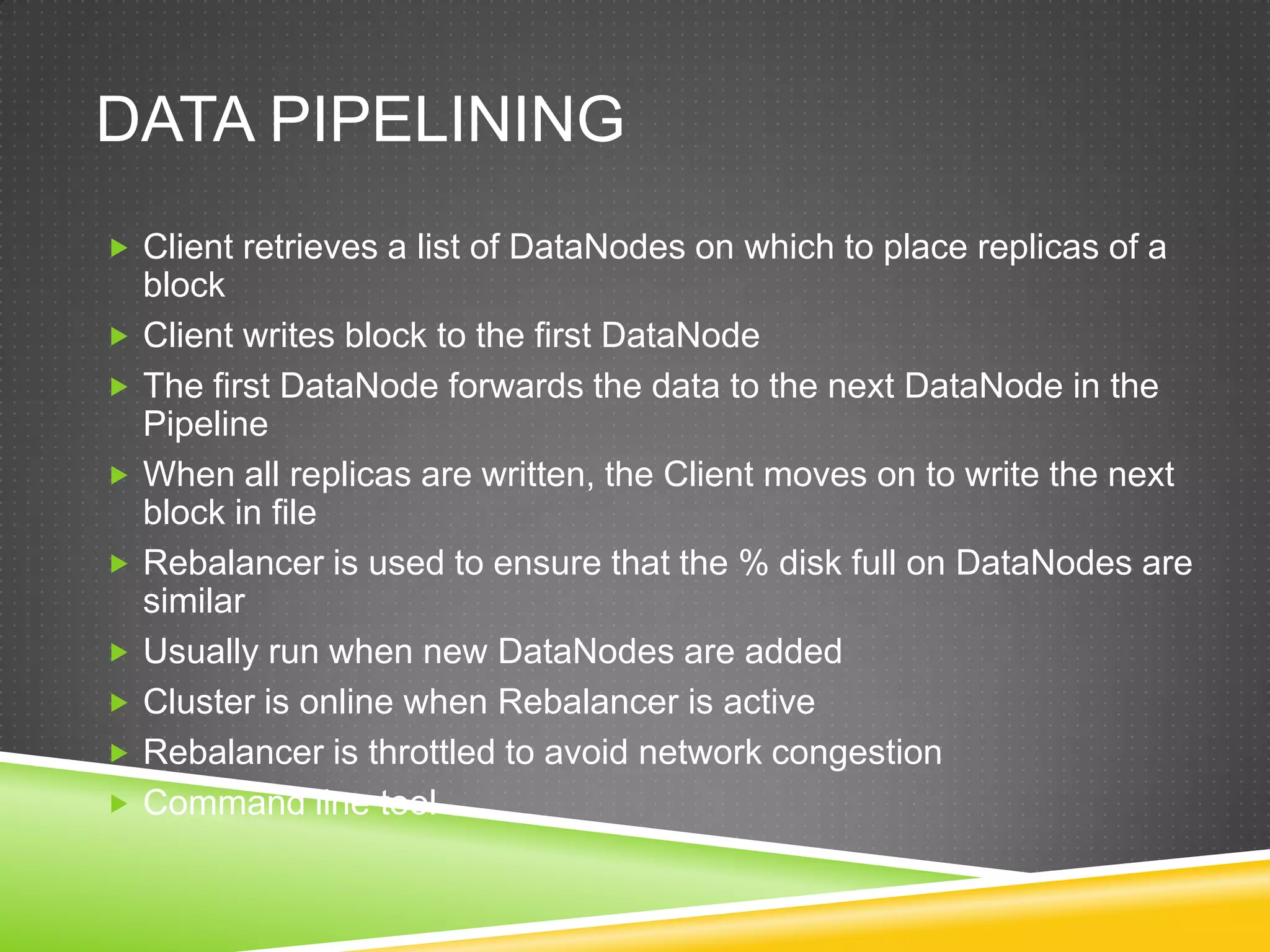
DATA PIPELINING
 Client retrieves a list of DataNodes on which to place replicas of a
block
 Client writes block to the first DataNode
 The first DataNode forwards the data to the next DataNode in the
Pipeline
 When all replicas are written, the Client moves on to write the next
block in file
 Rebalancer is used to ensure that the % disk full on DataNodes are
similar
 Usually run when new DataNodes are added
 Cluster is online when Rebalancer is active
 Rebalancer is throttled to avoid network congestion
 Command line tool
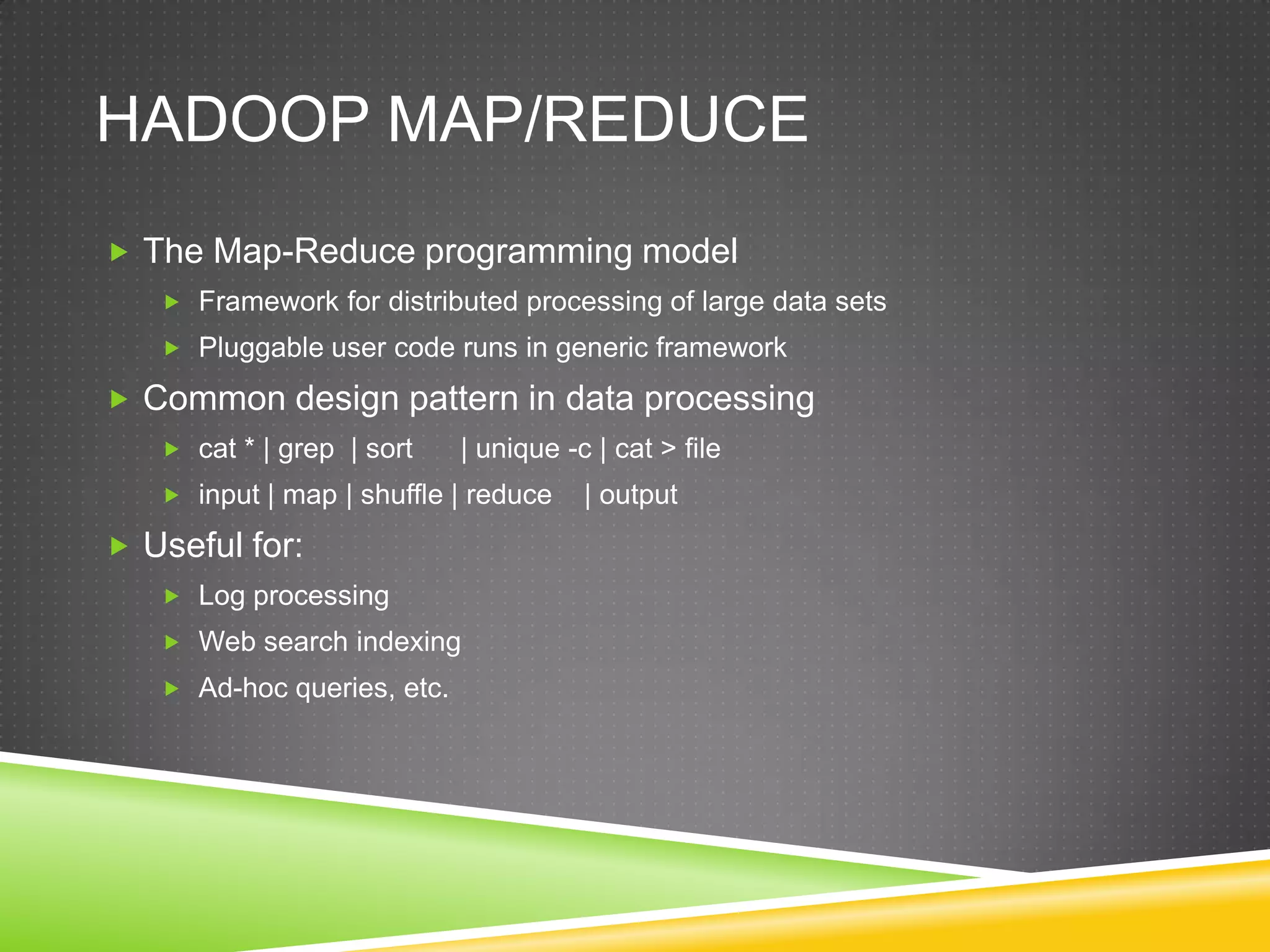
HADOOP MAP/REDUCE
 The Map-Reduce programming model
 Framework for distributed processing of large data sets
 Pluggable user code runs in generic framework
 Common design pattern in data processing
 cat * | grep | sort | unique -c | cat > file
 input | map | shuffle | reduce | output
 Useful for:
 Log processing
 Web search indexing
 Ad-hoc queries, etc.

Hadoop

  • 1.
  • 2.
    INTRODUCTION  Apache Hadoopis an open-source software framework that supports data-intensive distributed applications, licensed under the Apache v2 license. It enables applications to work with thousands of computation- independent computers and petabytes of data.  Hadoop was derived from Google's MapReduce and Google File System (GFS) papers.  Hadoop is implemented in Java.
  • 3.
    WHY HADOOP  Needto process Multi Petabyte Datasets  It is expensive to build reliability in each application  Nodes failure is expected and Hadoop can help  Number of nodes is not constant  Efficient, reliable, Open Source Apache License  Workloads are IO bound and not CPU bound
  • 4.
    WHO USES HADOOP Amazon/A9  Facebook  Google  IBM  Joost  Last.fm  New York Times  PowerSet  Veoh  Yahoo!
  • 5.
    COMMODITY HARDWARE  Typicallyin 2 level architecture  Nodes are commodity PCs  30-40 nodes/rack  Uplink from rack is 3-4 gigabit  Rack-internal is one gigabit
  • 6.
  • 7.
    HDFS (HADOOP DISTRIBUTEDFILE SYSTEM) Very Large Distributed File System  10K nodes, 100 million files, 10 PB  Assumes Commodity Hardware  Files are replicated to handle hardware failure  Detect failures and recovers from them  Optimized for Batch Processing  Data locations exposed so that computations can move to where data resides  Provides very high aggregate bandwidth  User Space, runs on heterogeneous OS  Single Namespace for entire cluster  Data Coherency  Write-once-read-many access model  Client can only append to existing files  Files are broken up into blocks  Typically 128 MB block size  Each block replicated on multiple Data Nodes  Intelligent Client  Client can find location of blocks  Client accesses data directly from Data Node
  • 8.
    NAME NODE METADATA Meta-data in Memory  The entire metadata is in main memory  No demand paging of meta-data  Types of Metadata  List of files  List of Blocks for each file  List of Data Nodes for each block  File attributes, e.g. creation time, replication factor, etc.  Transaction Log  Records file creations, file deletions, etc. is kept here
  • 9.
    DATA NODE Block Server Stores data in the local file system (e.g. ext3)  Stores meta-data of a block (e.g. CRC)  Serves data and meta-data to Clients Block Report  Periodically sends a report of all existing blocks to the Name Node Facilitates Pipelining of Data  Forwards data to other specified Data Nodes
  • 10.
    BLOCK PLACEMENT  BlockPlacement Strategy  One replica on local node  Second replica on a remote rack  Third replica on same remote rack  Additional replicas are randomly placed  Clients read from nearest replica
  • 11.
    DATA CORRECTNESS  UseChecksums to validate data  Use CRC32, etc.  File Creation  Client computes checksum per 512 byte  Data Node stores the checksum  File access  Client retrieves the data and checksum from Data Node  If Validation fails, Client tries other replicas
  • 12.
    NAMENODE FAILURE  Asingle point of failure  Transaction Log stored in multiple directories  A directory on the local file system  A directory on a remote file system (NFS/CIFS)
  • 13.
    DATA PIPELINING  Clientretrieves a list of DataNodes on which to place replicas of a block  Client writes block to the first DataNode  The first DataNode forwards the data to the next DataNode in the Pipeline  When all replicas are written, the Client moves on to write the next block in file  Rebalancer is used to ensure that the % disk full on DataNodes are similar  Usually run when new DataNodes are added  Cluster is online when Rebalancer is active  Rebalancer is throttled to avoid network congestion  Command line tool
  • 14.
    HADOOP MAP/REDUCE  TheMap-Reduce programming model  Framework for distributed processing of large data sets  Pluggable user code runs in generic framework  Common design pattern in data processing  cat * | grep | sort | unique -c | cat > file  input | map | shuffle | reduce | output  Useful for:  Log processing  Web search indexing  Ad-hoc queries, etc.