



Hadoop Fundamentals
Satish Mittal
InMobi
Why Hadoop?
Big Data
• Sources: Server logs, clickstream, machine, sensor, social…
• Use-cases: batch/interactive/real-time
Scalable
o Petabytes of data
Economical
o Use commodity hardware
o Share clusters among many applications
Reliable
o Failure is common when you run thousands of machines. Handle it well in
the SW layer.
Simple programming model
o Applications must be simple to write and maintain
What is needed from a Distributed Platform?
Hadoop is peta-byte scale distributed data storage and data
processing infrastructure
 Based on Google GFS & MR paper
 Contributed mostly by Yahoo! in the initial years and now have a
more widespread developer and user base
 1000s of nodes, PBs of data in storage
What is Hadoop?
• Cheap JBODs for storage
• Move processing to where data is
Location awareness (topology)
• Assume hardware failures to be the norm
• Map & Reduce primitives are fairly simple yet powerful
Most set operations can be performed using these primitives
• Isolation
Hadoop Basics
Hadoop Distributed File System
(HDFS)
Goals:
 Fault tolerant, scalable, distributed storage system
 Designed to reliably store very large files across machines in a
large cluster
Assumptions:
 Files are written once and read several times
 Applications perform large sequential streaming reads
 Not a Unix-like, POSIX file system
 Access via command line or Java API
HDFS
• Data is organized into files and directories
• Files are divided into uniform sized blocks and distributed across
cluster nodes
• Blocks are replicated to handle hardware failure
• Filesystem keeps checksums of data for corruption detection and
recovery
• HDFS exposes block placement so that computes can be migrated
to data
HDFS – Data Model
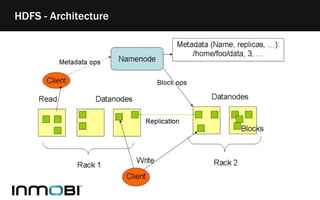
HDFS - Architecture
• Namenode is SPOF (HA for NN is now available in 2.0
Alpha)
• Responsible for managing a list of all active data nodes,
FS name system (files, directories, blocks and their
locations)
• Block placement policy
• Ensuring adequate replicas
• Writing edit logs durably
Namenode
• Service to allow data to be streamed in & out
• Block is the unit of data that data node understands
• Block reports to Namenode periodically
• Checksum checks, disk usage stats are managed by datanode
• Clients talk to datanode for actual data
• As long as there is at least one data node available to service file
blocks, failures in datanodes can be tolerated, albeit at lower
performance.
Datanode
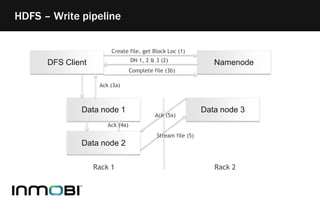
HDFS – Write pipeline
DFS Client Namenode
Data node 1
Data node 2
Data node 3
Rack 2
Create file, get Block Loc (1)
DN 1, 2 & 3 (2)
Stream file (5)
Ack (5a)
Ack (4a)
Ack (3a)
Complete file (3b)
Rack 1
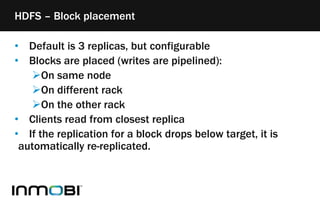
• Default is 3 replicas, but configurable
• Blocks are placed (writes are pipelined):
On same node
On different rack
On the other rack
• Clients read from closest replica
• If the replication for a block drops below target, it is
automatically re-replicated.
HDFS – Block placement
• Data is checked with CRC32
• File Creation
‣ Client computes checksum per block
‣ DataNode stores the checksum
• File access
‣ Client retrieves the data and checksum from DataNode
‣ If Validation fails, Client tries other replicas
HDFS – Data correctness
Simple commands
• hadoop fs -ls, -du, -rm, -rmr, -chown, -chmod
Uploading files
• hadoop fs -put foo mydata/foo
• cat ReallyBigFile | hadoop fs -put - mydata/ReallyBigFile
Downloading files
• hadoop fs -get mydata/foo foo
• hadoop fs -get - mydata/ReallyBigFile | grep “the answer is”
• hadoop fs -cat mydata/foo
Admin
• hadoop dfsadmin –report
• hadoop fsck
Interacting with HDFS
Map-Reduce
Say we have 100s of machines available to us. How do we write
applications on them?
As an example, consider the problem of creating an index for search.
‣ Input: Hundreds of documents
‣ Output: A mapping of word to document IDs
‣ Resources: A few machines
Map-Reduce Application
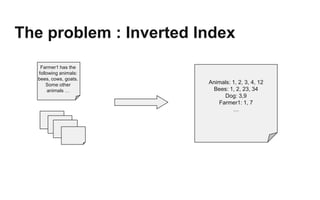
The problem : Inverted Index
Farmer1 has the
following animals:
bees, cows, goats.
Some other
animals …
Animals: 1, 2, 3, 4, 12
Bees: 1, 2, 23, 34
Dog: 3,9
Farmer1: 1, 7
…
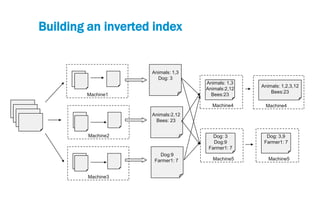
Building an inverted index
Machine1
Machine2
Machine3
Animals: 1,3
Dog: 3
Animals:2,12
Bees: 23
Dog:9
Farmer1: 7
Machine4
Animals: 1,3
Animals:2,12
Bees:23
Machine5
Dog: 3
Dog:9
Farmer1: 7
Machine4
Animals: 1,2,3,12
Bees:23
Machine5
Dog: 3,9
Farmer1: 7
In our example
‣ Map: (doc-num, text) ➝ [(word, doc-num)]
‣ Reduce: (word, [doc1, doc3, ...]) ➝ [(word, “doc1, doc3, …”)]
General form:
‣ Two functions: Map and Reduce
‣ Operate on key and value pairs
‣ Map: (K1, V1) ➝ list(K2, V2)
‣ Reduce: (K2, list(V2)) ➝ (K3, V3)
‣ Primitives present in Lisp and other functional languages
Same principle extended to distributed computing
‣ Map and Reduce tasks run on distributed sets of machines
This is Map-Reduce
Abstracts functionality common to all Map/Reduce applications
‣ Distribute tasks to multiple machines
‣ Sorts, transfers and merges intermediate data from all machines from the Map phase to
the Reduce phase
‣ Monitors task progress
‣ Handles faulty machines, faulty tasks transparently
Provides pluggable APIs and configuration mechanisms for writing applications
‣ Map and Reduce functions
‣ Input formats and splits
‣ Number of tasks, data types, etc…
Provides status about jobs to users
Map-Reduce Framework
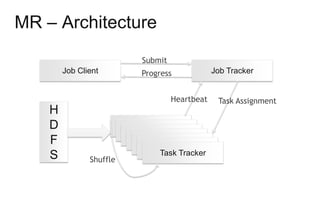
MR – Architecture
Job Client Job Tracker
DFS Client
DFS Client
DFS Client
DFS Client
DFS Client
DFS Client
Task Tracker
Heartbeat Task Assignment
Shuffle
Submit
Progress
H
D
F
S
• All user code runs in isolated JVM
• Client computes splits
• JT just schedules these splits (one mapper per split)
• Mapper, Reducer, Partitioner and Combiner and any custom
Input/OutputFormat runs in user JVM
• Idempotence
Map-Reduce
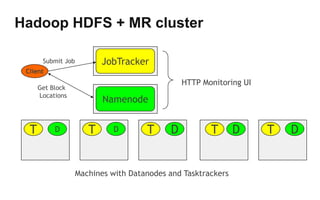
Hadoop HDFS + MR cluster
Machines with Datanodes and Tasktrackers
D D D DTT
JobTracker
Namenode
T T TD
Client
Submit Job
HTTP Monitoring UI
Get Block
Locations
• Input: A bunch of large text files
• Desired Output: Frequencies of Words
WordCount: Hello World of Hadoop
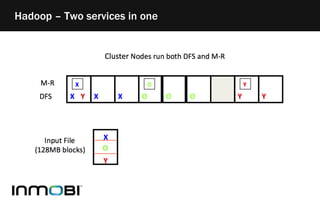
Hadoop – Two services in one
Mapper
‣ Input: value: lines of text of input
‣ Output: key: word, value: 1
Reducer
‣ Input: key: word, value: set of counts
‣ Output: key: word, value: sum
Launching program
‣ Defines the job
‣ Submits job to cluster
Word Count Example
Questions ?
Thank You!
mailto: satish.mittal@inmobi.com

Hadoop Fundamentals

  • 1.
  • 2.
  • 3.
    Big Data • Sources:Server logs, clickstream, machine, sensor, social… • Use-cases: batch/interactive/real-time
  • 4.
    Scalable o Petabytes ofdata Economical o Use commodity hardware o Share clusters among many applications Reliable o Failure is common when you run thousands of machines. Handle it well in the SW layer. Simple programming model o Applications must be simple to write and maintain What is needed from a Distributed Platform?
  • 5.
    Hadoop is peta-bytescale distributed data storage and data processing infrastructure  Based on Google GFS & MR paper  Contributed mostly by Yahoo! in the initial years and now have a more widespread developer and user base  1000s of nodes, PBs of data in storage What is Hadoop?
  • 6.
    • Cheap JBODsfor storage • Move processing to where data is Location awareness (topology) • Assume hardware failures to be the norm • Map & Reduce primitives are fairly simple yet powerful Most set operations can be performed using these primitives • Isolation Hadoop Basics
  • 7.
  • 8.
    Goals:  Fault tolerant,scalable, distributed storage system  Designed to reliably store very large files across machines in a large cluster Assumptions:  Files are written once and read several times  Applications perform large sequential streaming reads  Not a Unix-like, POSIX file system  Access via command line or Java API HDFS
  • 9.
    • Data isorganized into files and directories • Files are divided into uniform sized blocks and distributed across cluster nodes • Blocks are replicated to handle hardware failure • Filesystem keeps checksums of data for corruption detection and recovery • HDFS exposes block placement so that computes can be migrated to data HDFS – Data Model
  • 10.
  • 11.
    • Namenode isSPOF (HA for NN is now available in 2.0 Alpha) • Responsible for managing a list of all active data nodes, FS name system (files, directories, blocks and their locations) • Block placement policy • Ensuring adequate replicas • Writing edit logs durably Namenode
  • 12.
    • Service toallow data to be streamed in & out • Block is the unit of data that data node understands • Block reports to Namenode periodically • Checksum checks, disk usage stats are managed by datanode • Clients talk to datanode for actual data • As long as there is at least one data node available to service file blocks, failures in datanodes can be tolerated, albeit at lower performance. Datanode
  • 13.
    HDFS – Writepipeline DFS Client Namenode Data node 1 Data node 2 Data node 3 Rack 2 Create file, get Block Loc (1) DN 1, 2 & 3 (2) Stream file (5) Ack (5a) Ack (4a) Ack (3a) Complete file (3b) Rack 1
  • 14.
    • Default is3 replicas, but configurable • Blocks are placed (writes are pipelined): On same node On different rack On the other rack • Clients read from closest replica • If the replication for a block drops below target, it is automatically re-replicated. HDFS – Block placement
  • 15.
    • Data ischecked with CRC32 • File Creation ‣ Client computes checksum per block ‣ DataNode stores the checksum • File access ‣ Client retrieves the data and checksum from DataNode ‣ If Validation fails, Client tries other replicas HDFS – Data correctness
  • 16.
    Simple commands • hadoopfs -ls, -du, -rm, -rmr, -chown, -chmod Uploading files • hadoop fs -put foo mydata/foo • cat ReallyBigFile | hadoop fs -put - mydata/ReallyBigFile Downloading files • hadoop fs -get mydata/foo foo • hadoop fs -get - mydata/ReallyBigFile | grep “the answer is” • hadoop fs -cat mydata/foo Admin • hadoop dfsadmin –report • hadoop fsck Interacting with HDFS
  • 17.
  • 18.
    Say we have100s of machines available to us. How do we write applications on them? As an example, consider the problem of creating an index for search. ‣ Input: Hundreds of documents ‣ Output: A mapping of word to document IDs ‣ Resources: A few machines Map-Reduce Application
  • 19.
    The problem :Inverted Index Farmer1 has the following animals: bees, cows, goats. Some other animals … Animals: 1, 2, 3, 4, 12 Bees: 1, 2, 23, 34 Dog: 3,9 Farmer1: 1, 7 …
  • 20.
    Building an invertedindex Machine1 Machine2 Machine3 Animals: 1,3 Dog: 3 Animals:2,12 Bees: 23 Dog:9 Farmer1: 7 Machine4 Animals: 1,3 Animals:2,12 Bees:23 Machine5 Dog: 3 Dog:9 Farmer1: 7 Machine4 Animals: 1,2,3,12 Bees:23 Machine5 Dog: 3,9 Farmer1: 7
  • 21.
    In our example ‣Map: (doc-num, text) ➝ [(word, doc-num)] ‣ Reduce: (word, [doc1, doc3, ...]) ➝ [(word, “doc1, doc3, …”)] General form: ‣ Two functions: Map and Reduce ‣ Operate on key and value pairs ‣ Map: (K1, V1) ➝ list(K2, V2) ‣ Reduce: (K2, list(V2)) ➝ (K3, V3) ‣ Primitives present in Lisp and other functional languages Same principle extended to distributed computing ‣ Map and Reduce tasks run on distributed sets of machines This is Map-Reduce
  • 22.
    Abstracts functionality commonto all Map/Reduce applications ‣ Distribute tasks to multiple machines ‣ Sorts, transfers and merges intermediate data from all machines from the Map phase to the Reduce phase ‣ Monitors task progress ‣ Handles faulty machines, faulty tasks transparently Provides pluggable APIs and configuration mechanisms for writing applications ‣ Map and Reduce functions ‣ Input formats and splits ‣ Number of tasks, data types, etc… Provides status about jobs to users Map-Reduce Framework
  • 23.
    MR – Architecture JobClient Job Tracker DFS Client DFS Client DFS Client DFS Client DFS Client DFS Client Task Tracker Heartbeat Task Assignment Shuffle Submit Progress H D F S
  • 24.
    • All usercode runs in isolated JVM • Client computes splits • JT just schedules these splits (one mapper per split) • Mapper, Reducer, Partitioner and Combiner and any custom Input/OutputFormat runs in user JVM • Idempotence Map-Reduce
  • 25.
    Hadoop HDFS +MR cluster Machines with Datanodes and Tasktrackers D D D DTT JobTracker Namenode T T TD Client Submit Job HTTP Monitoring UI Get Block Locations
  • 26.
    • Input: Abunch of large text files • Desired Output: Frequencies of Words WordCount: Hello World of Hadoop
  • 27.
    Hadoop – Twoservices in one
  • 28.
    Mapper ‣ Input: value:lines of text of input ‣ Output: key: word, value: 1 Reducer ‣ Input: key: word, value: set of counts ‣ Output: key: word, value: sum Launching program ‣ Defines the job ‣ Submits job to cluster Word Count Example
  • 29.
  • 30.