Geometry and 
Measurement Review 
The SAT doesn’t include: 
• Formal geometric proofs 
• Trigonometry 
• Radian measure
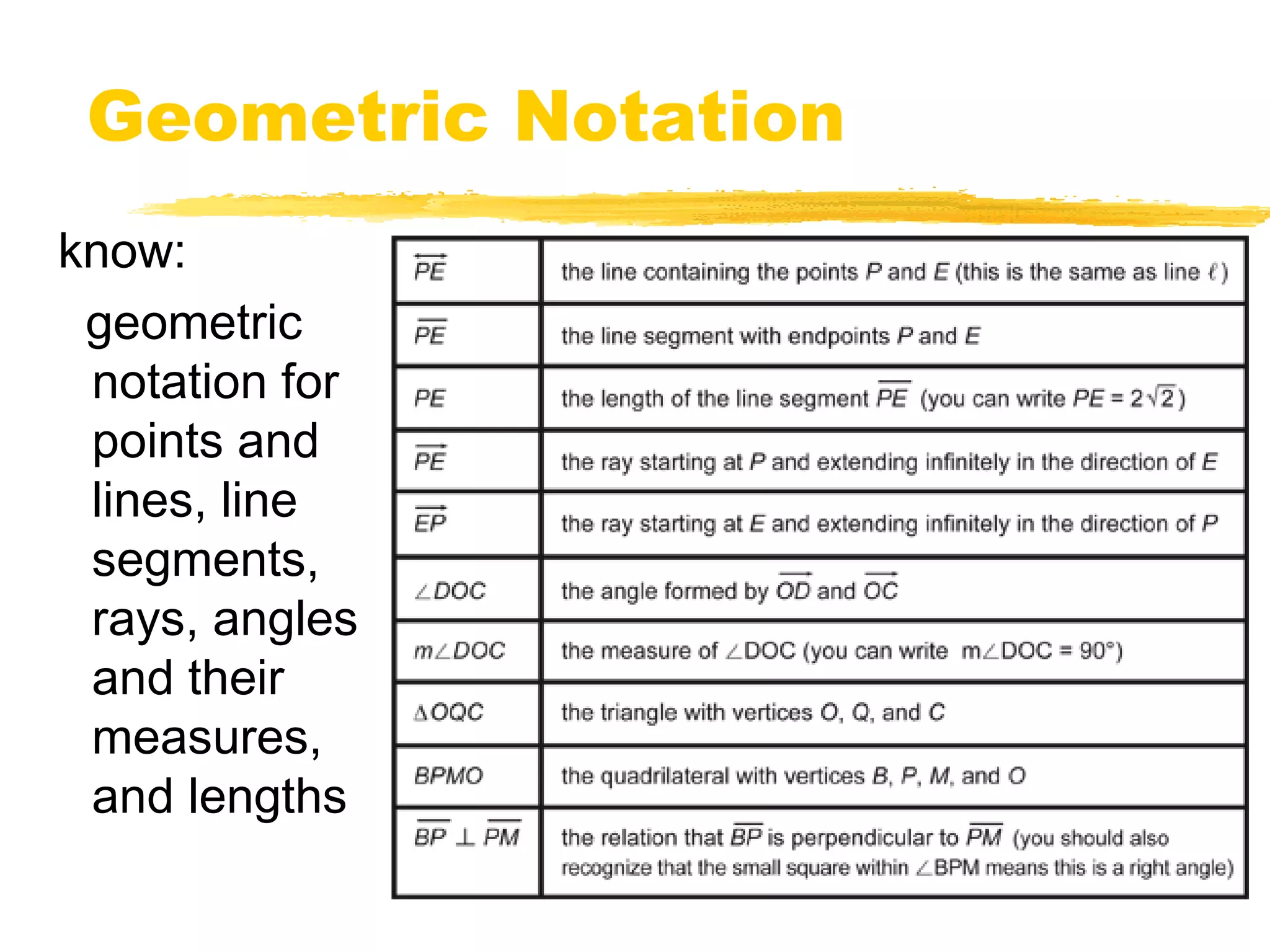
Geometric Notation 
know: 
geometric 
notation for 
points and 
lines, line 
segments, 
rays, angles 
and their 
measures, 
and lengths
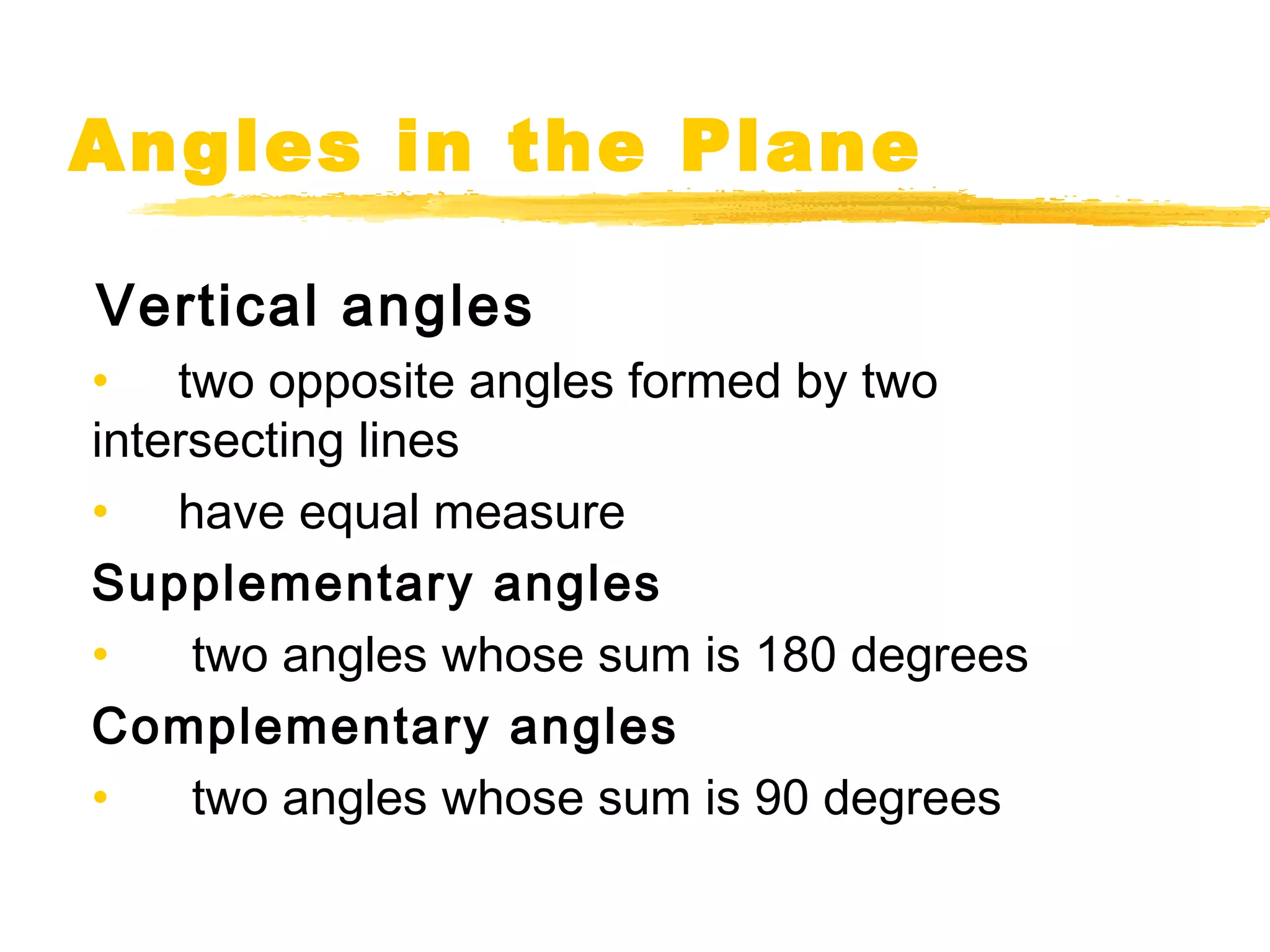
Angles in the Plane 
Vertical angles 
• two opposite angles formed by two 
intersecting lines 
• have equal measure 
Supplementary angles 
• two angles whose sum is 180 degrees 
Complementary angles 
• two angles whose sum is 90 degrees
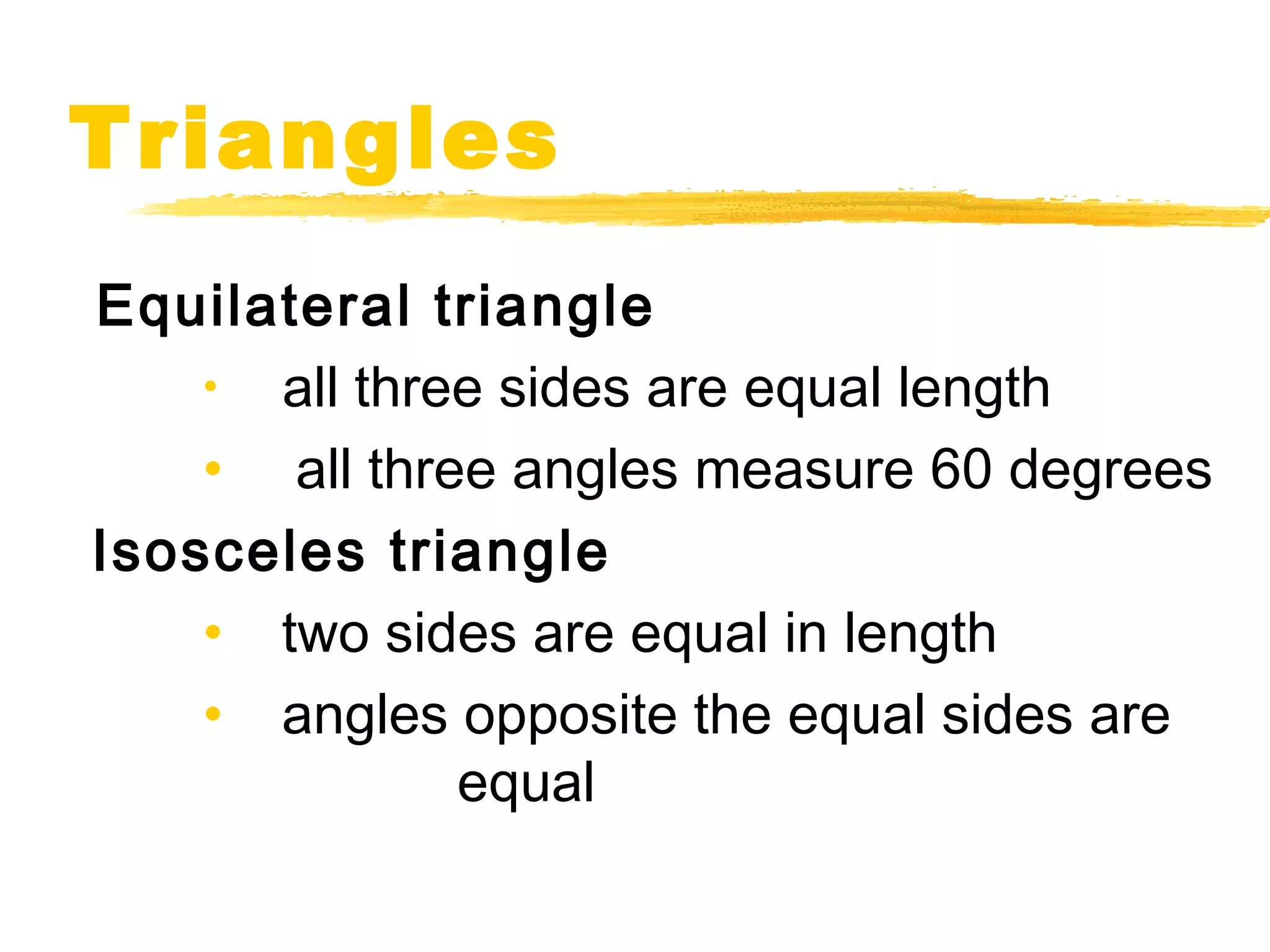
Triangles 
Equilateral triangle 
• all three sides are equal length 
• all three angles measure 60 degrees 
Isosceles triangle 
• two sides are equal in length 
• angles opposite the equal sides are 
equal
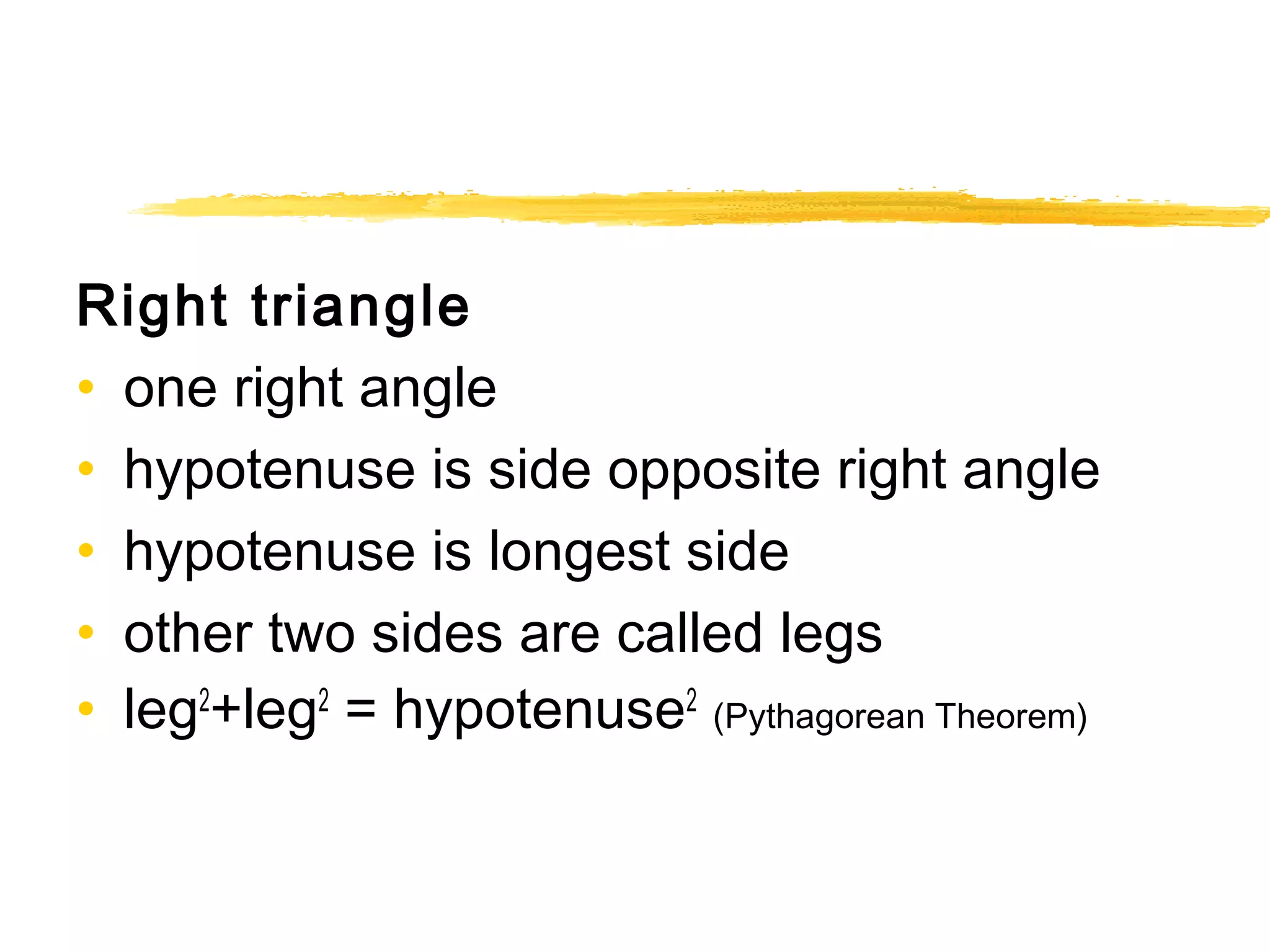
Right triangle 
• one right angle 
• hypotenuse is side opposite right angle 
• hypotenuse is longest side 
• other two sides are called legs 
• leg2+leg2 = hypotenuse2 (Pythagorean Theorem)
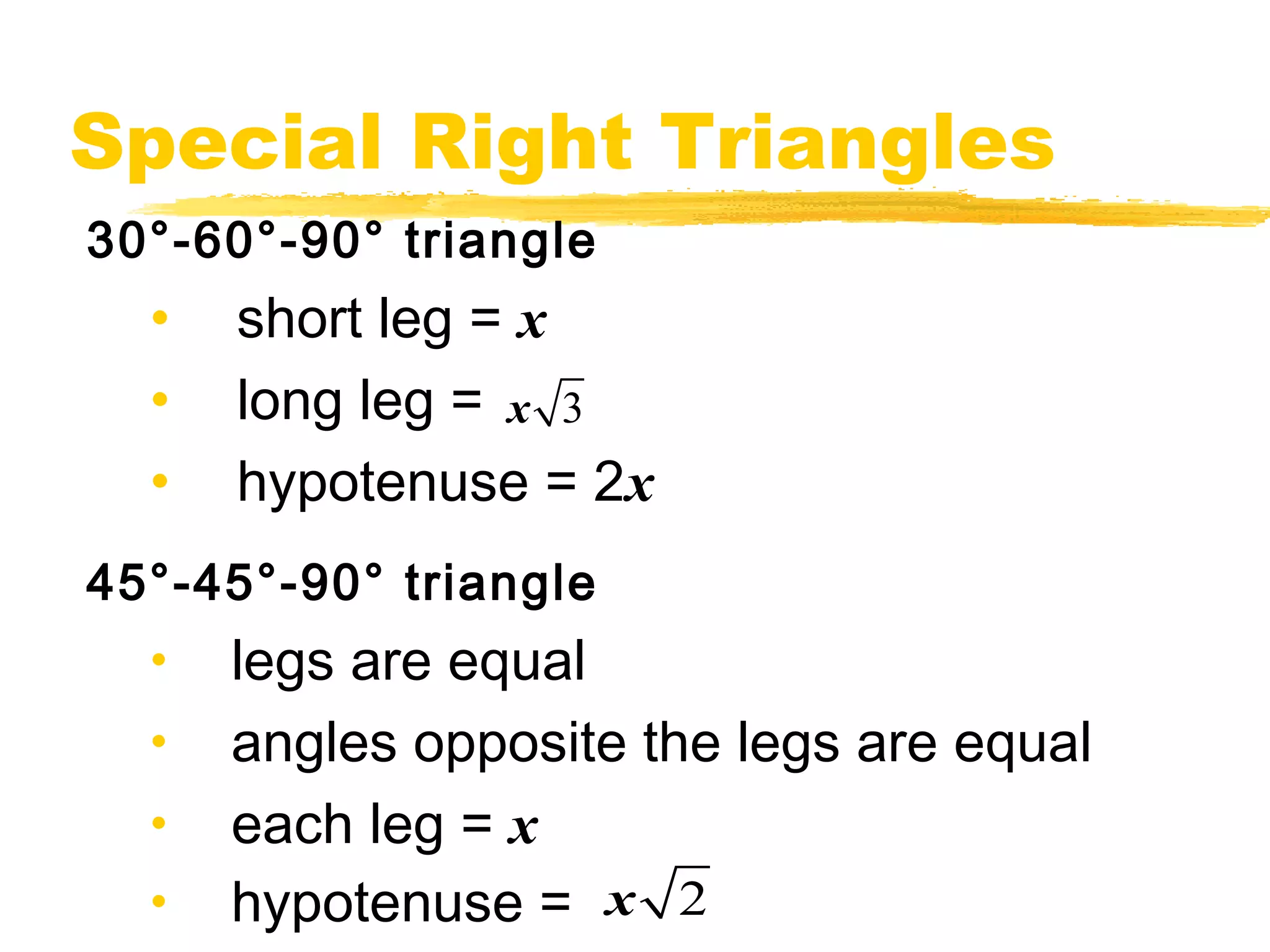
Special Right Triangles 
30°-60°-90° triangle 
• short leg = x 
• long leg = 
x 3 
• hypotenuse = 2x 
45°-45°-90° triangle 
• legs are equal 
• angles opposite the legs are equal 
• each leg = x 
• hypotenuse = 
x 2
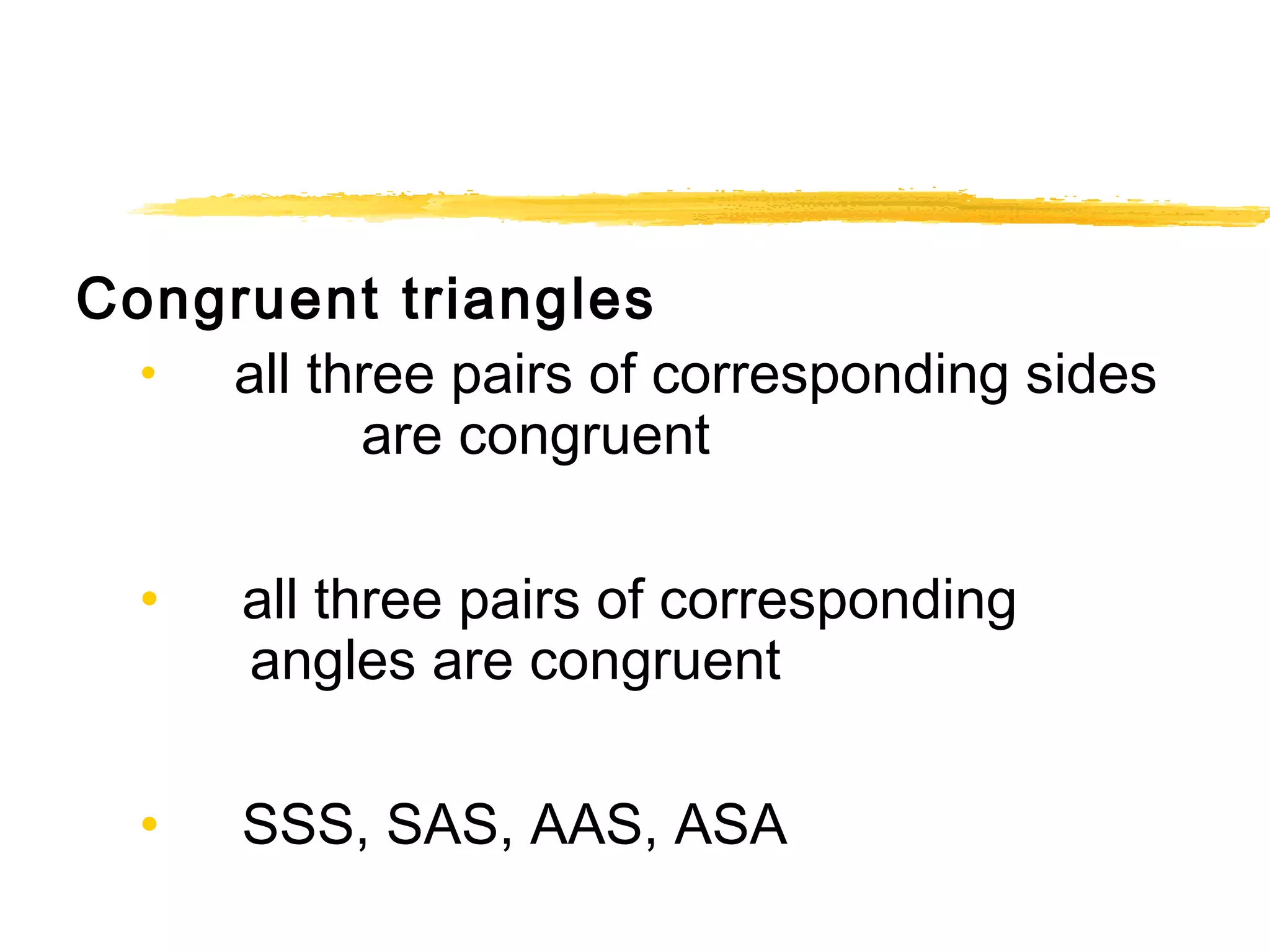
Congruent triangles 
• all three pairs of corresponding sides 
are congruent 
• all three pairs of corresponding 
angles are congruent 
• SSS, SAS, AAS, ASA
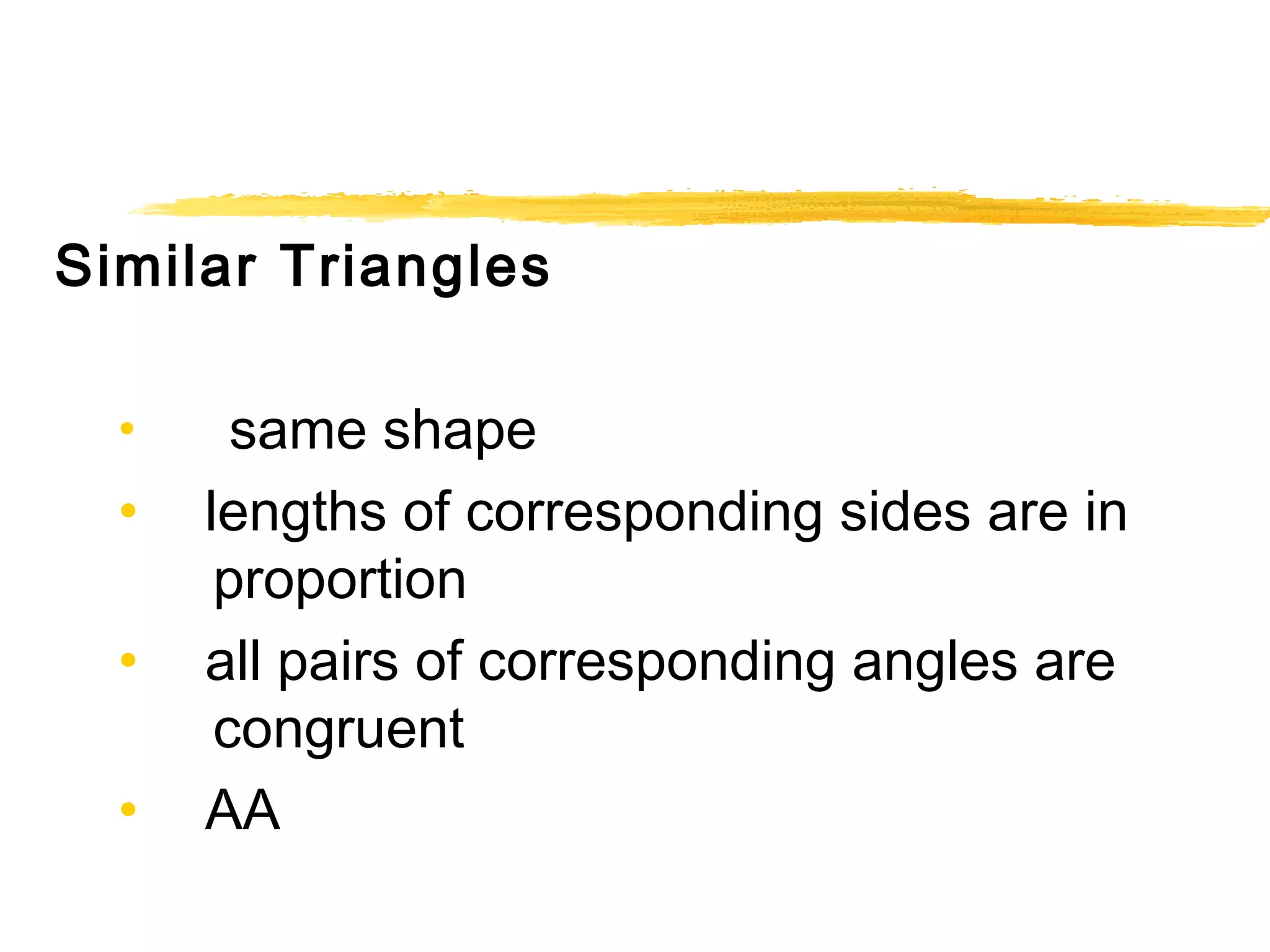
Similar Triangles 
• same shape 
• lengths of corresponding sides are in 
proportion 
• all pairs of corresponding angles are 
congruent 
• AA
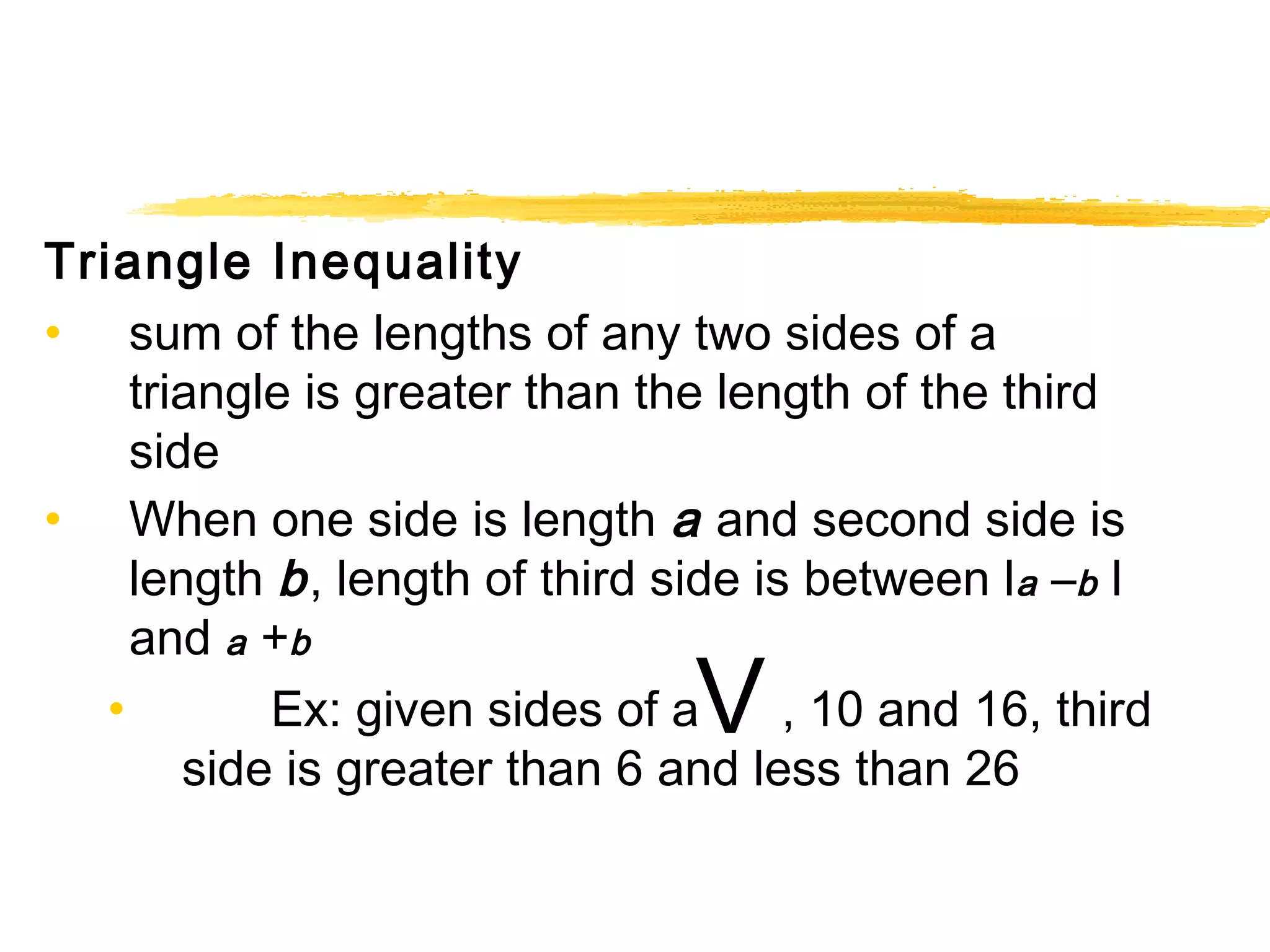
Triangle Inequality 
• sum of the lengths of any two sides of a 
triangle is greater than the length of the third 
side 
• When one side is length a and second side is 
length b , length of third side is between la –b l 
and a +b 
• Ex: given sides of a , 10 and 16, third 
side is greater than 6 and less than 26 V
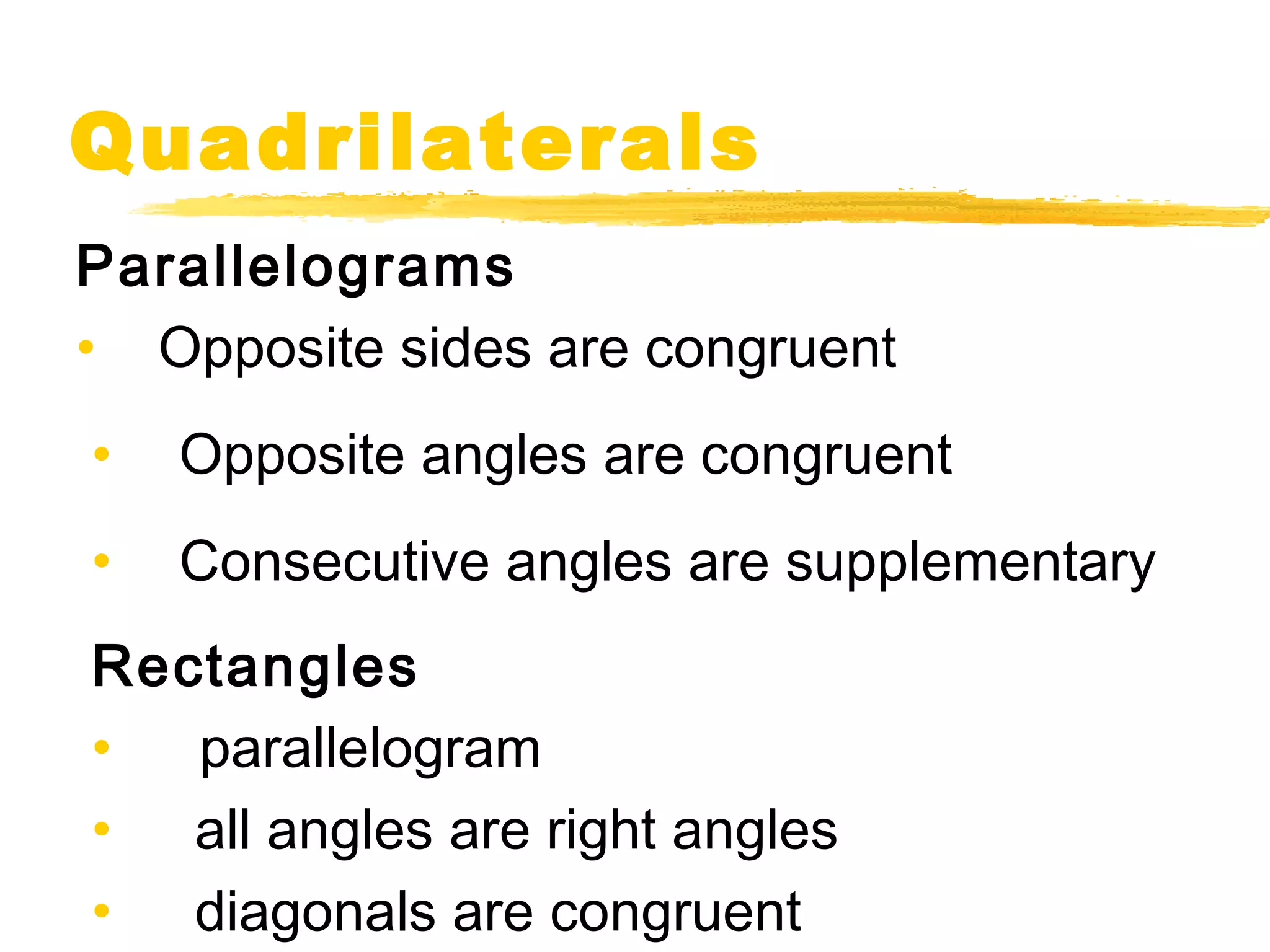
Quadrilaterals 
Parallelograms 
• Opposite sides are congruent 
• Opposite angles are congruent 
• Consecutive angles are supplementary 
Rectangles 
• parallelogram 
• all angles are right angles 
• diagonals are congruent
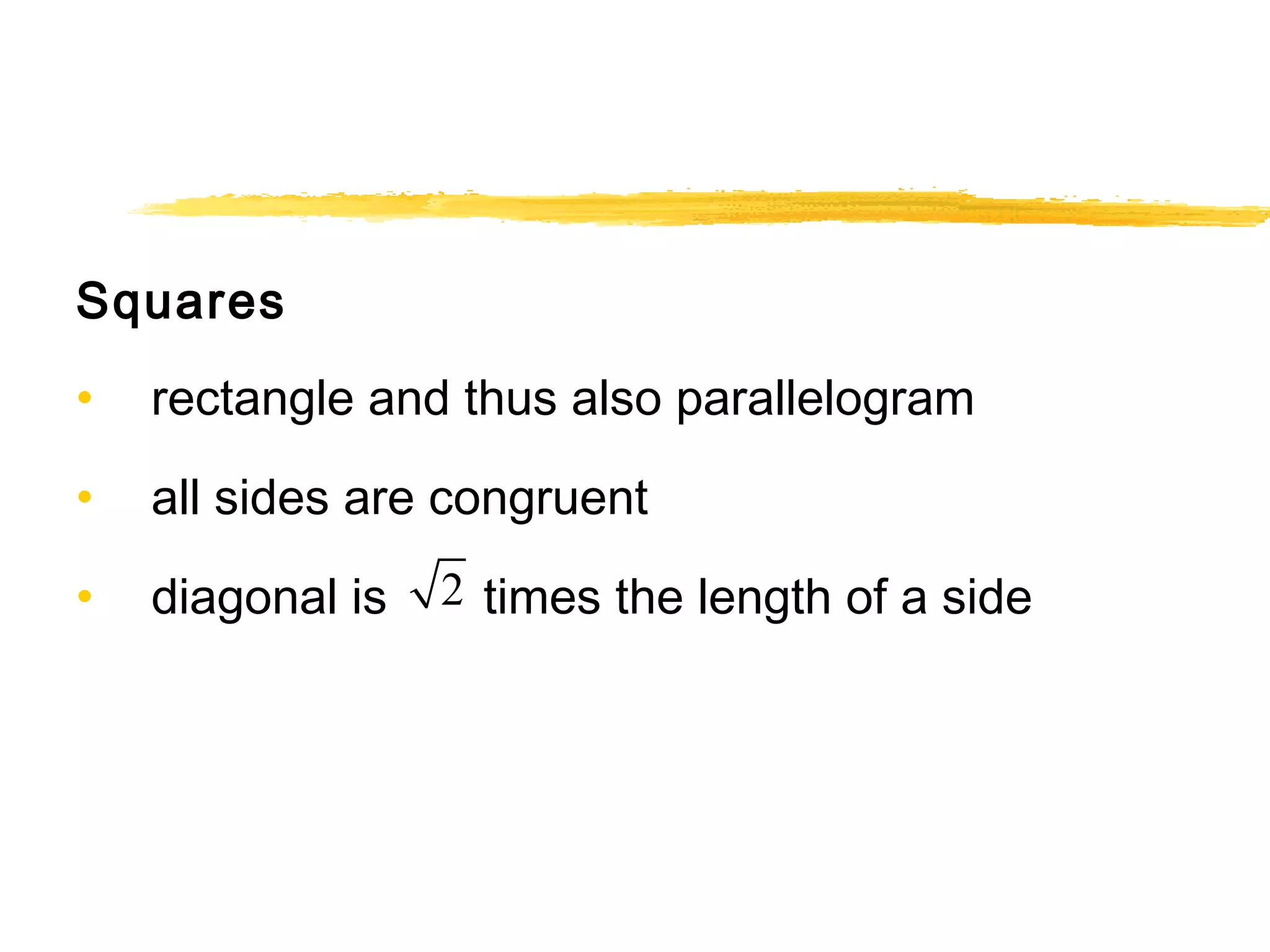
Squares 
• rectangle and thus also parallelogram 
• all sides are congruent 
• diagonal is times 2 the length of a side
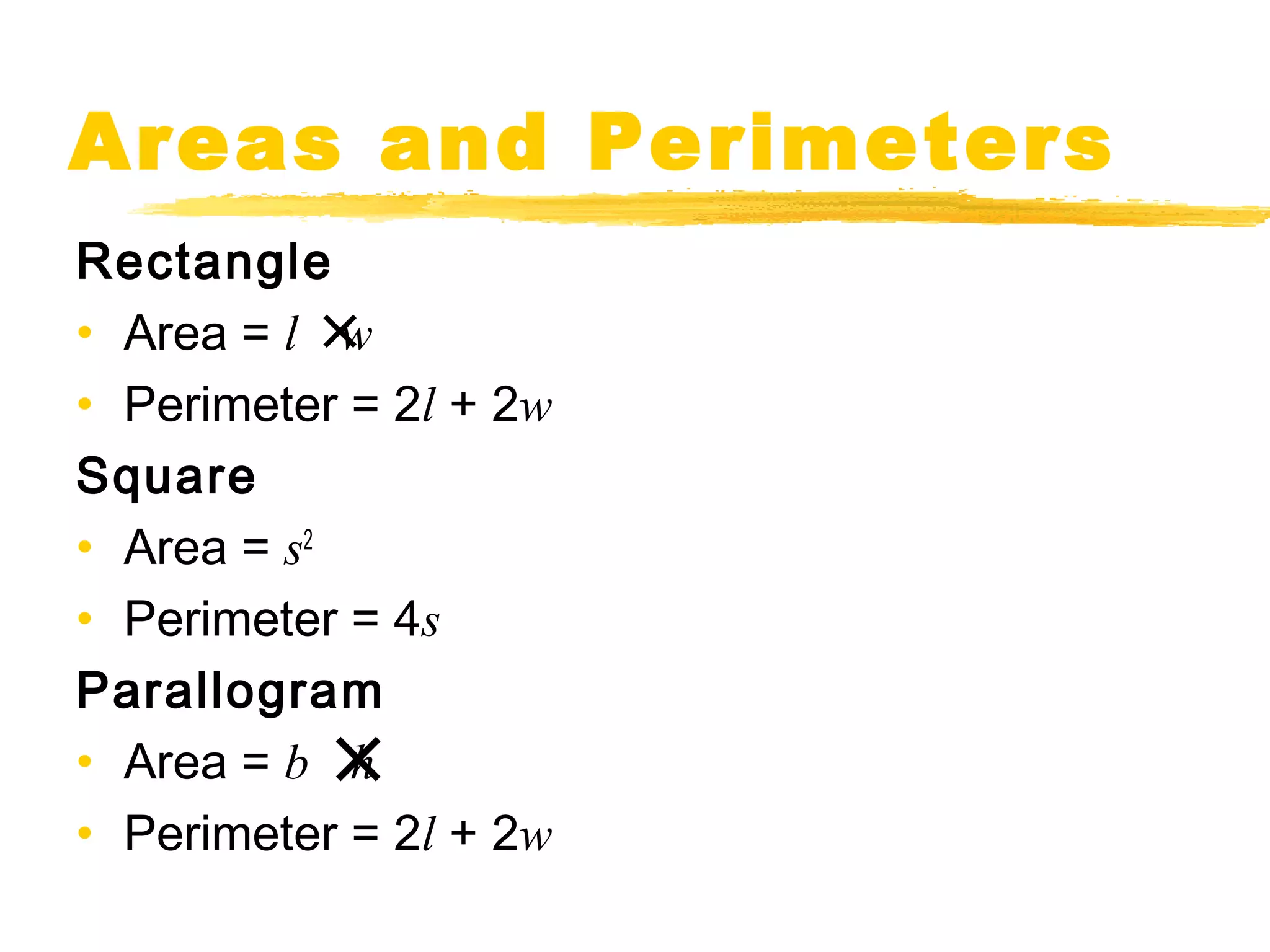
Areas and Perimeters 
Rectangle 
• Area = l ´ 
w 
• Perimeter = 2l + 2w 
Square 
• Area = s2 
• Perimeter = 4s 
Parallogram 
• Area = b ´ 
h 
• Perimeter = 2l + 2w
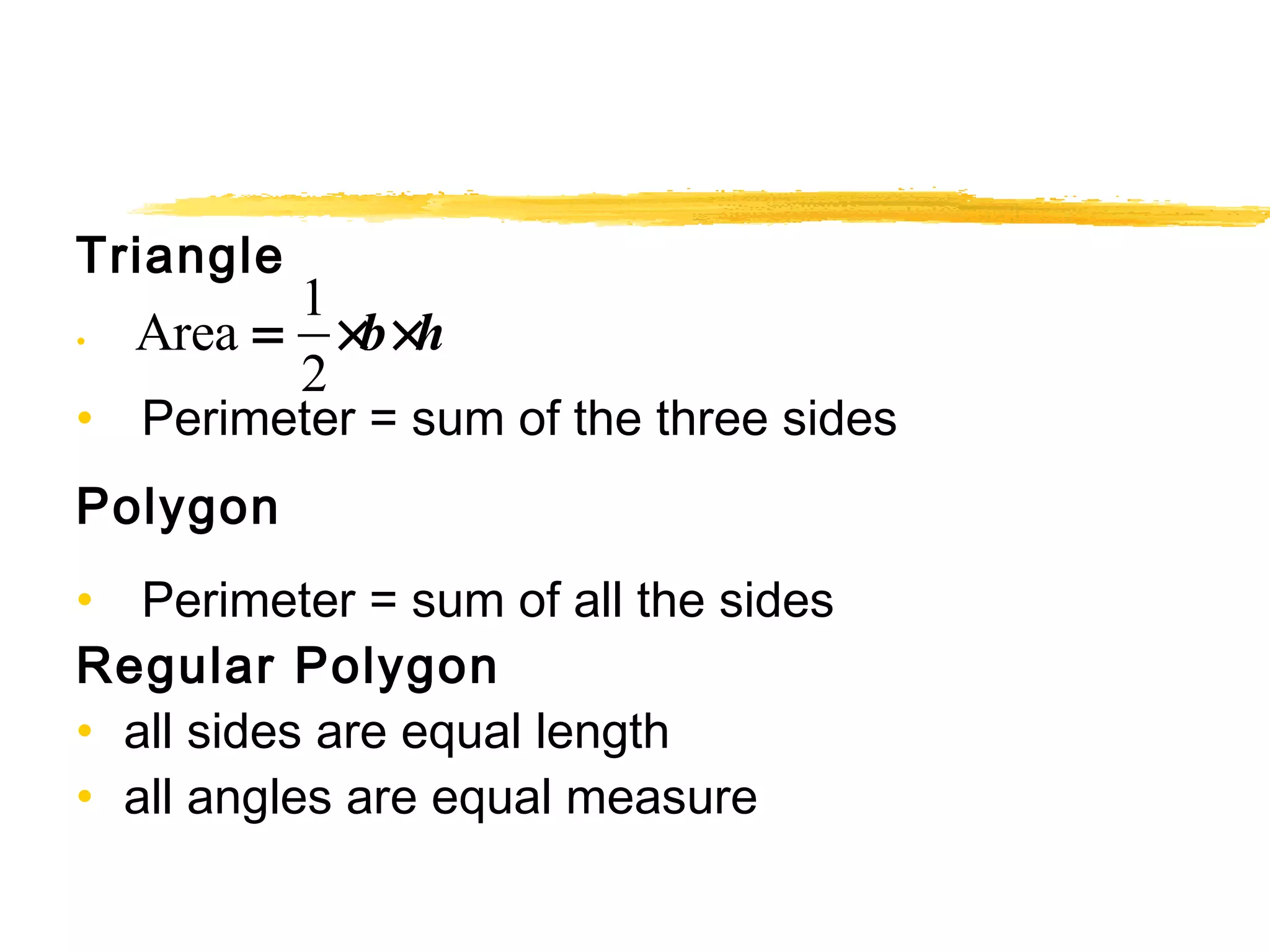
Triangle 
Area = 1 
• 
´b´h 
2 
• Perimeter = sum of the three sides 
Polygon 
• Perimeter = sum of all the sides 
Regular Polygon 
• all sides are equal length 
• all angles are equal measure
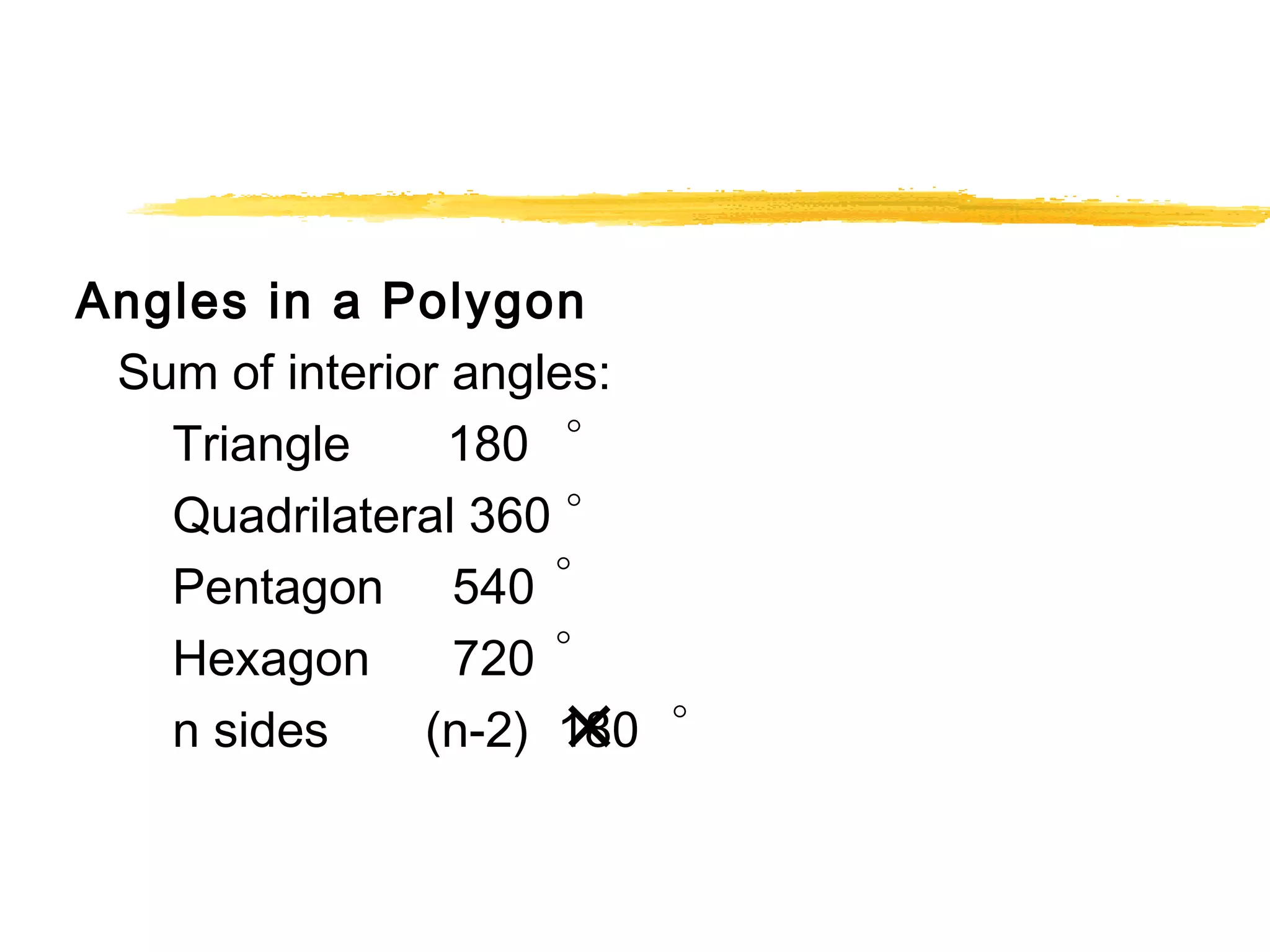
Angles in a Polygon 
Sum of interior angles: 
o 
o 
o 
o 
Triangle 180 
Quadrilateral 360 
Pentagon 540 
Hexagon 720 
n sides (n-2) 1´80 
o
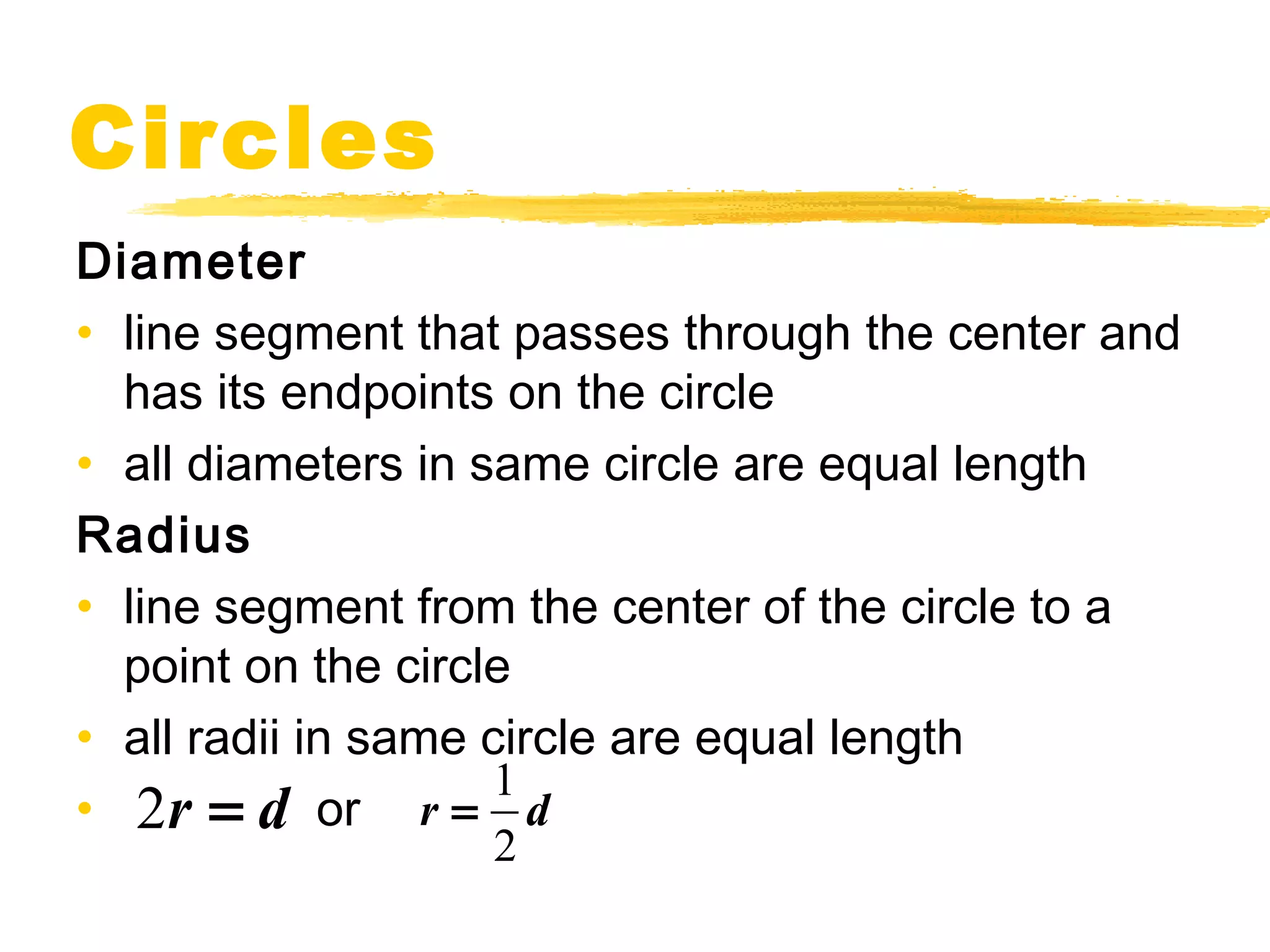
Circles 
Diameter 
• line segment that passes through the center and 
has its endpoints on the circle 
• all diameters in same circle are equal length 
Radius 
• line segment from the center of the circle to a 
point on the circle 
• all radii in same circle are equal length 
• or 1 
2r = d r = d 
2
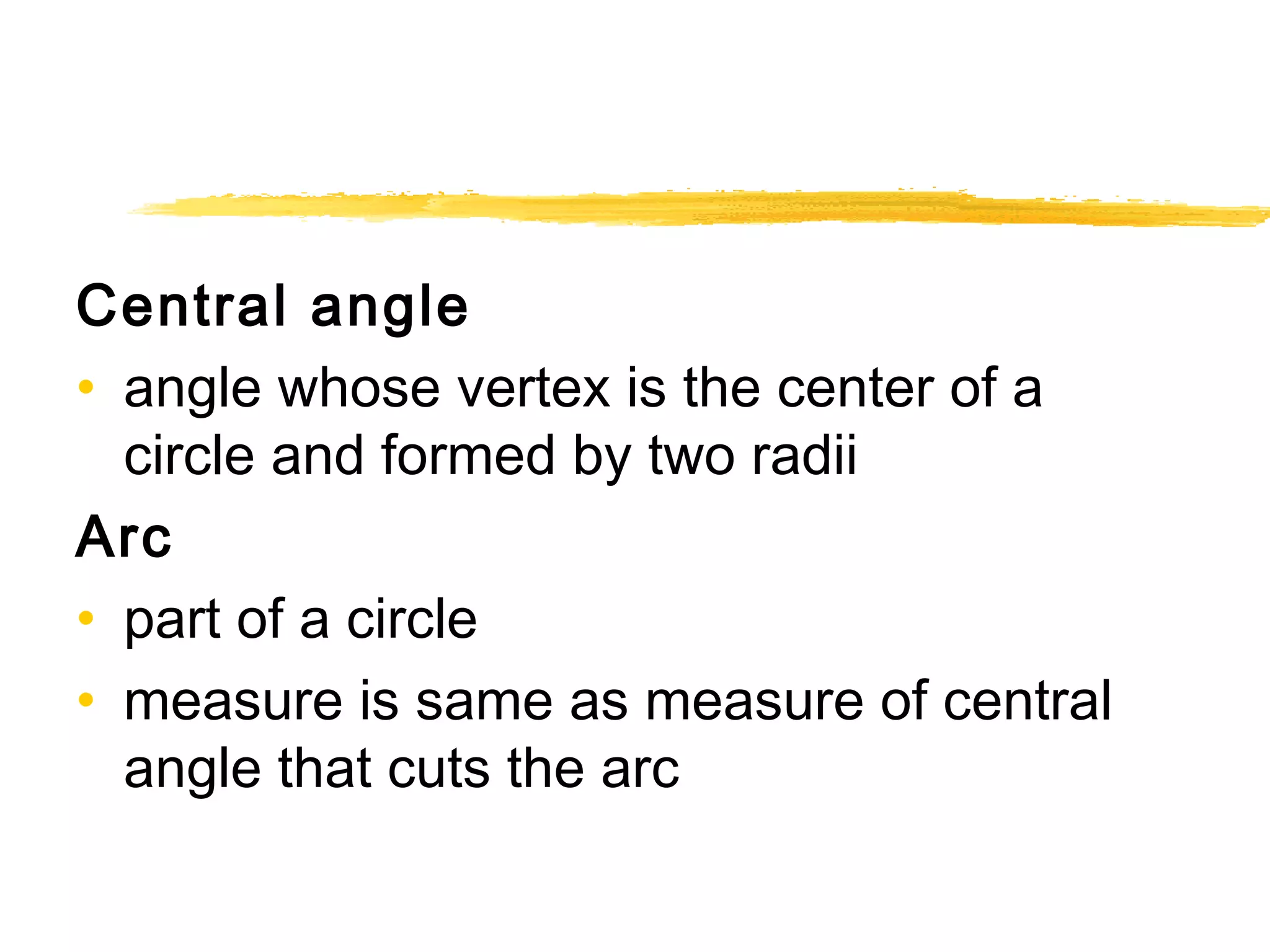
Central angle 
• angle whose vertex is the center of a 
circle and formed by two radii 
Arc 
• part of a circle 
• measure is same as measure of central 
angle that cuts the arc
Tangent to a circle 
• a line that intersects the circle at exactly 
one point 
• perpendicular to the radius at the point of 
tangency
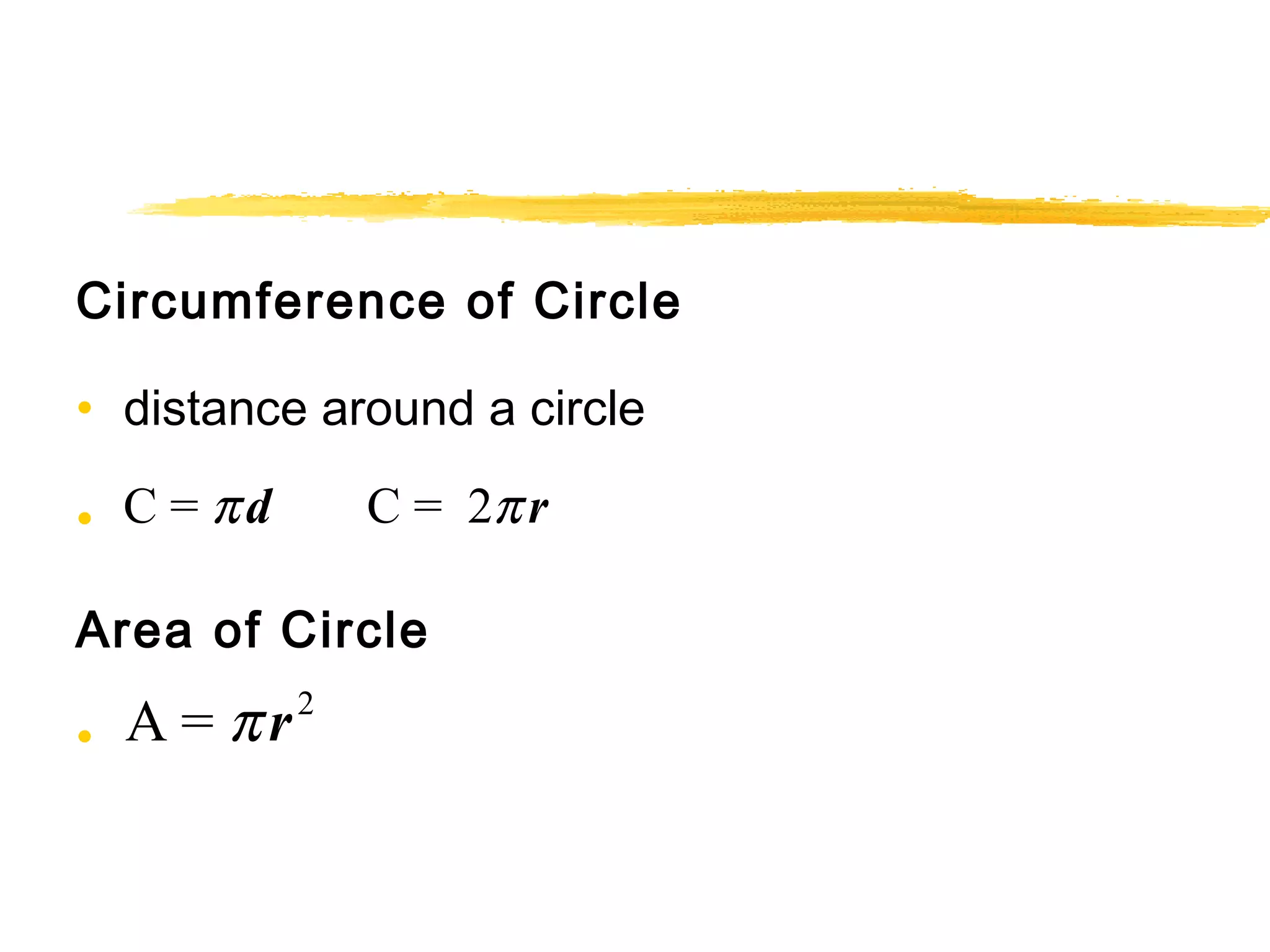
Circumference of Circle 
• distance around a circle 
• 
C = p d C = 2p r 
Area of Circle 
• 
A = p r2
Solid Figures and 
Volumes 
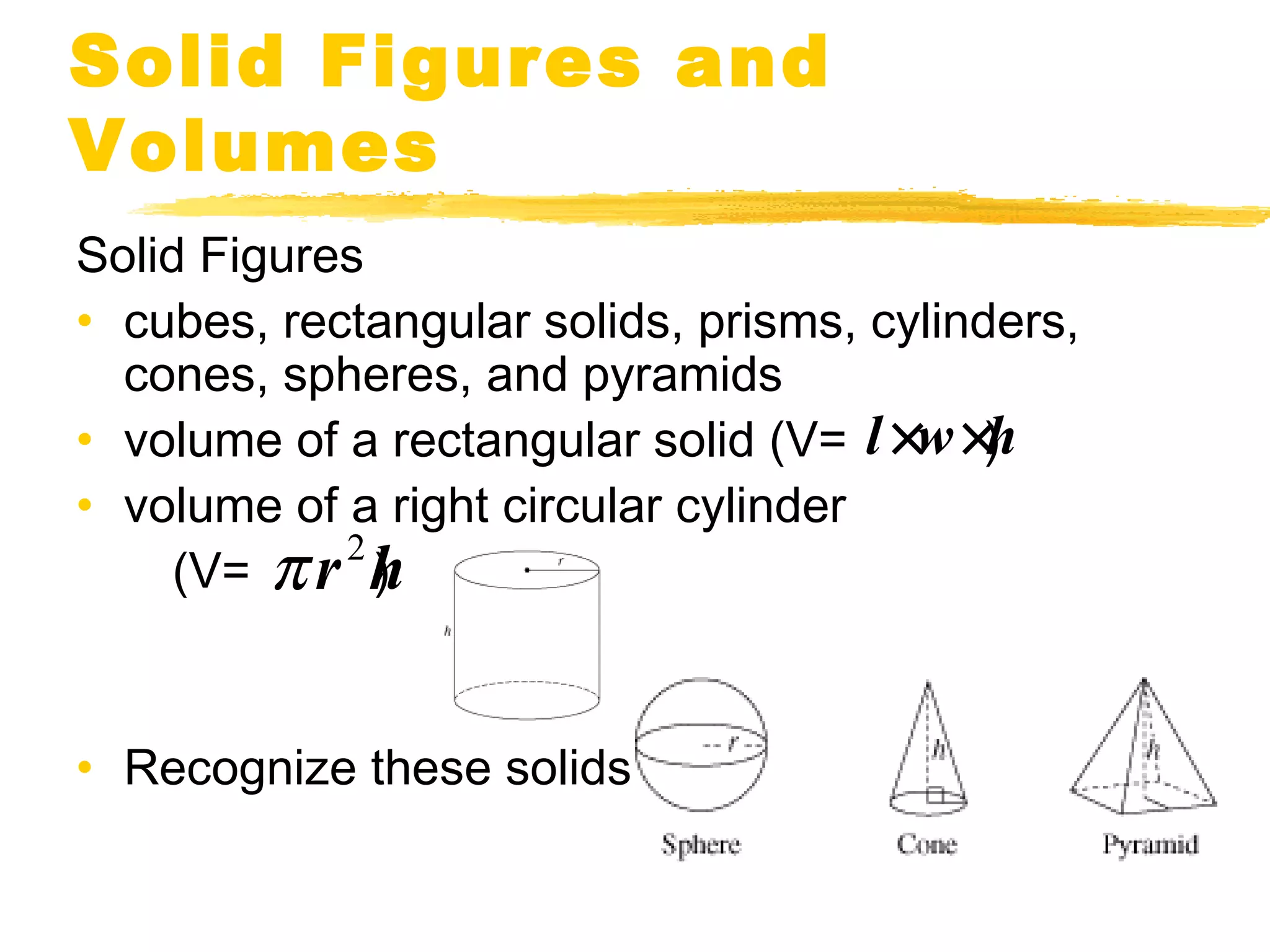
Solid Figures 
• cubes, rectangular solids, prisms, cylinders, 
cones, spheres, and pyramids 
• volume of a rectangular solid (V= ) 
• volume of a right circular cylinder 
p r2h 
(V= ) 
• Recognize these solids 
l ´w´h
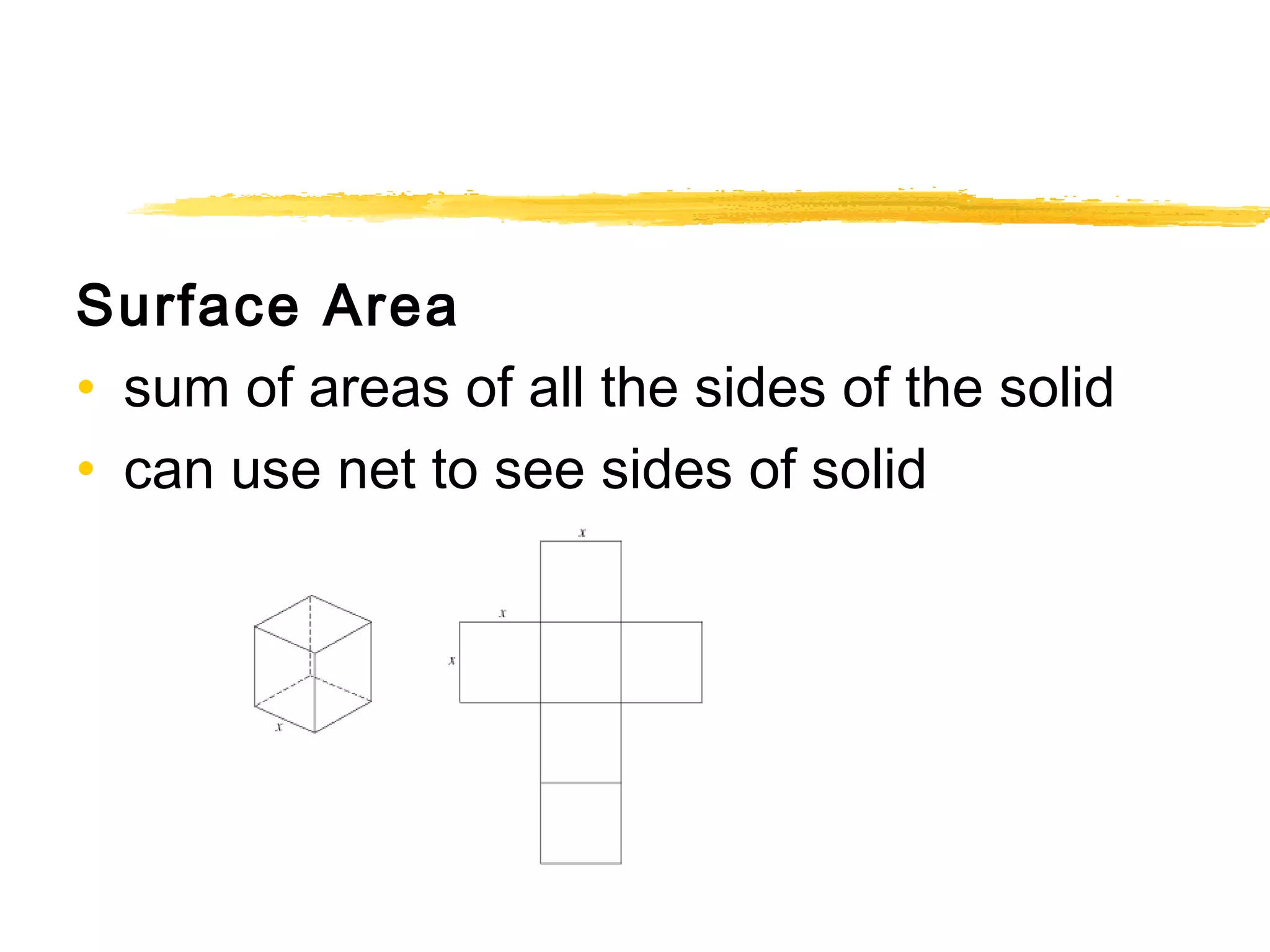
Surface Area 
• sum of areas of all the sides of the solid 
• can use net to see sides of solid
Geometric 
Perception 
Geometric Perception Questions 
• require you to visualize a plane figure 
or a solid from different views 
or orientations 
Example: 
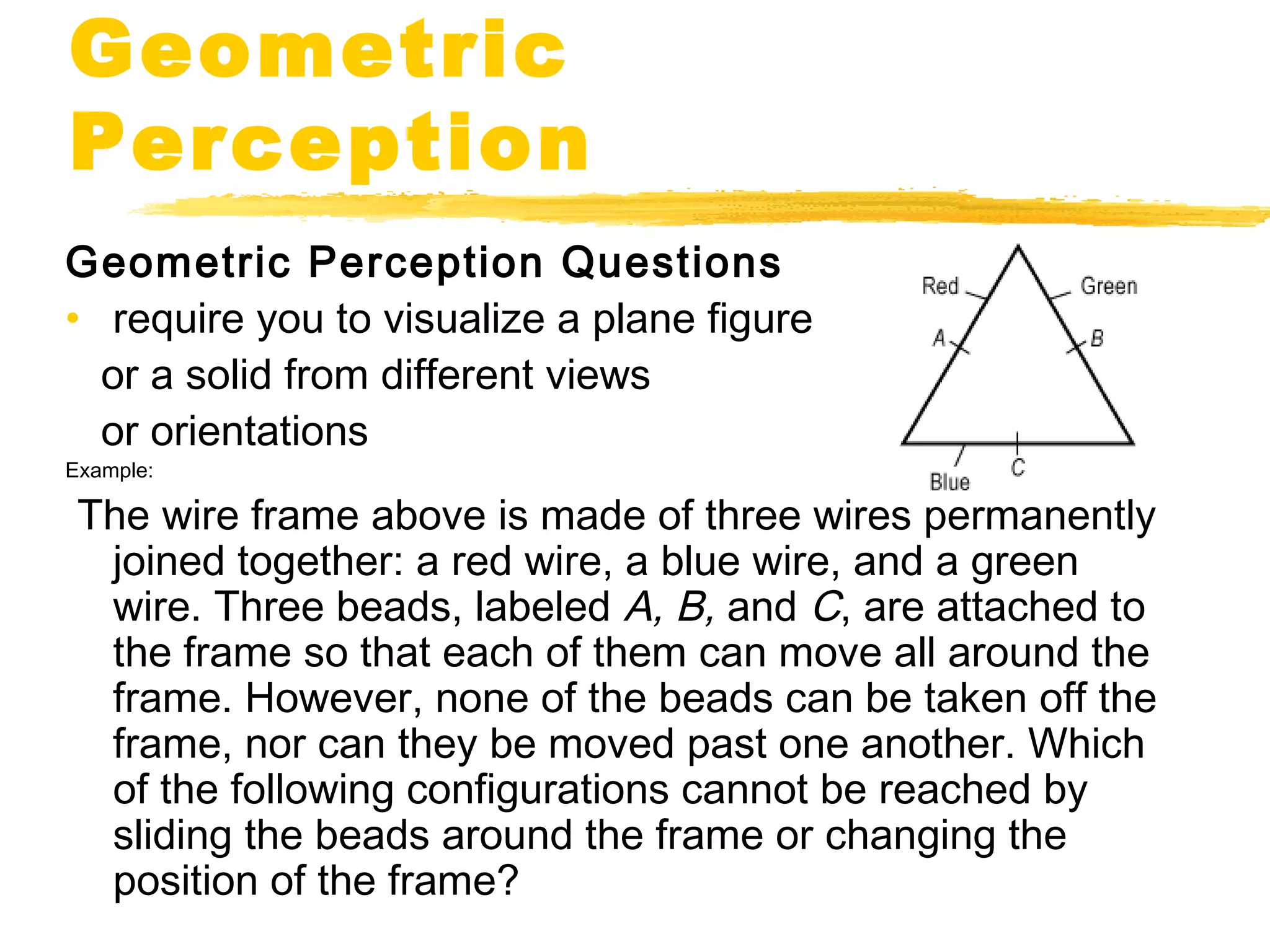
The wire frame above is made of three wires permanently 
joined together: a red wire, a blue wire, and a green 
wire. Three beads, labeled A, B, and C, are attached to 
the frame so that each of them can move all around the 
frame. However, none of the beads can be taken off the 
frame, nor can they be moved past one another. Which 
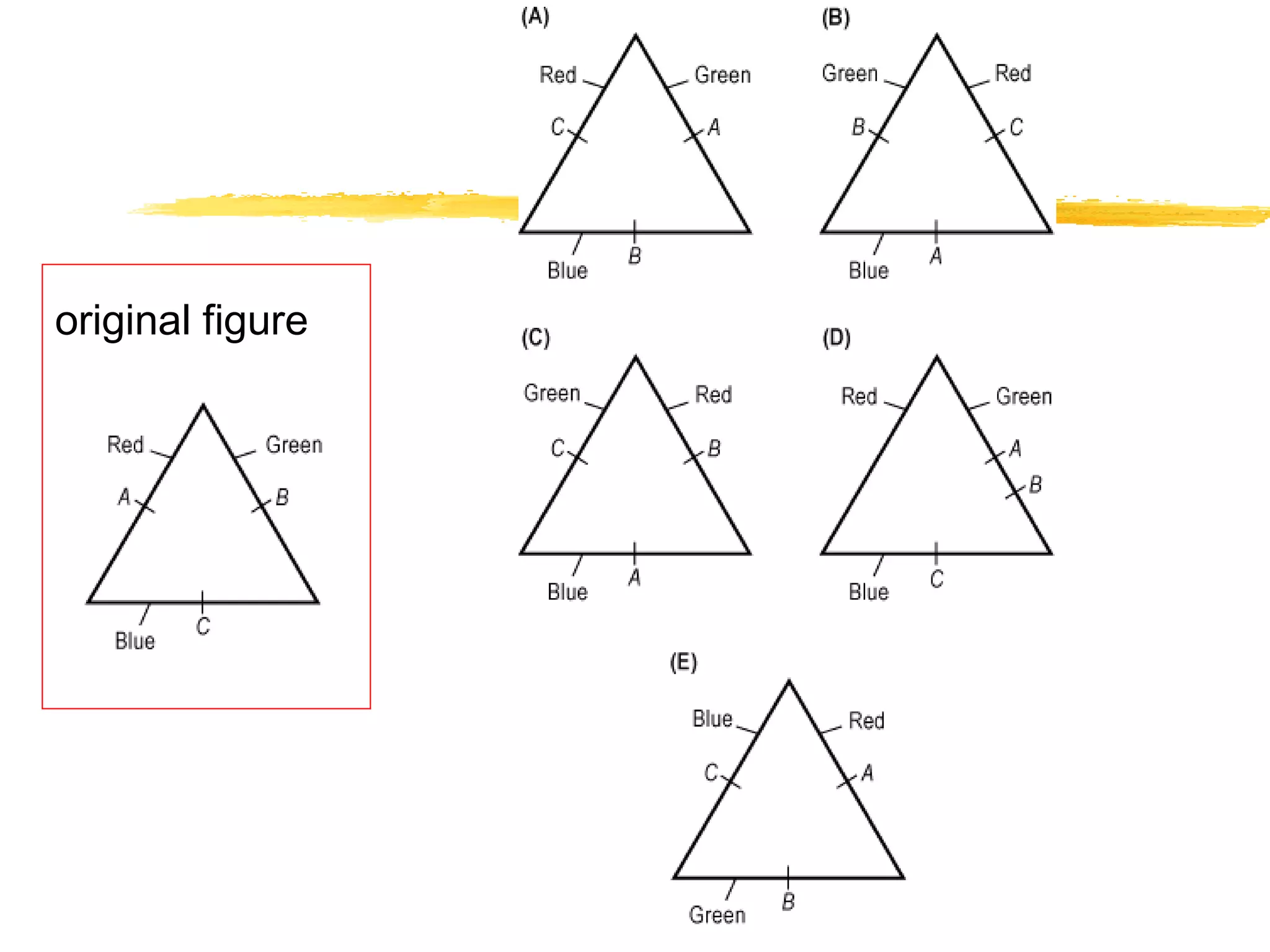
of the following configurations cannot be reached by 
sliding the beads around the frame or changing the 
position of the frame?
original figure
Answer: 
• The configuration in (A) can be reached by sliding 
each bead clockwise to the next wire piece. 
• The configuration in (C) can be reached by sliding 
each bead counterclockwise to the next wire piece 
and then flipping the frame over. 
• The configuration in (D) is reached simply by sliding 
bead A clockwise to the green wire. 
• The configuration in (E) comes from turning the 
wire frame a third of a revolution clockwise. 
• The configuration in (B) cannot be reached no 
matter how you slide the beads or rotate and flip 
the frame. 
• The correct answer is (B).
Coordinate Geometry 
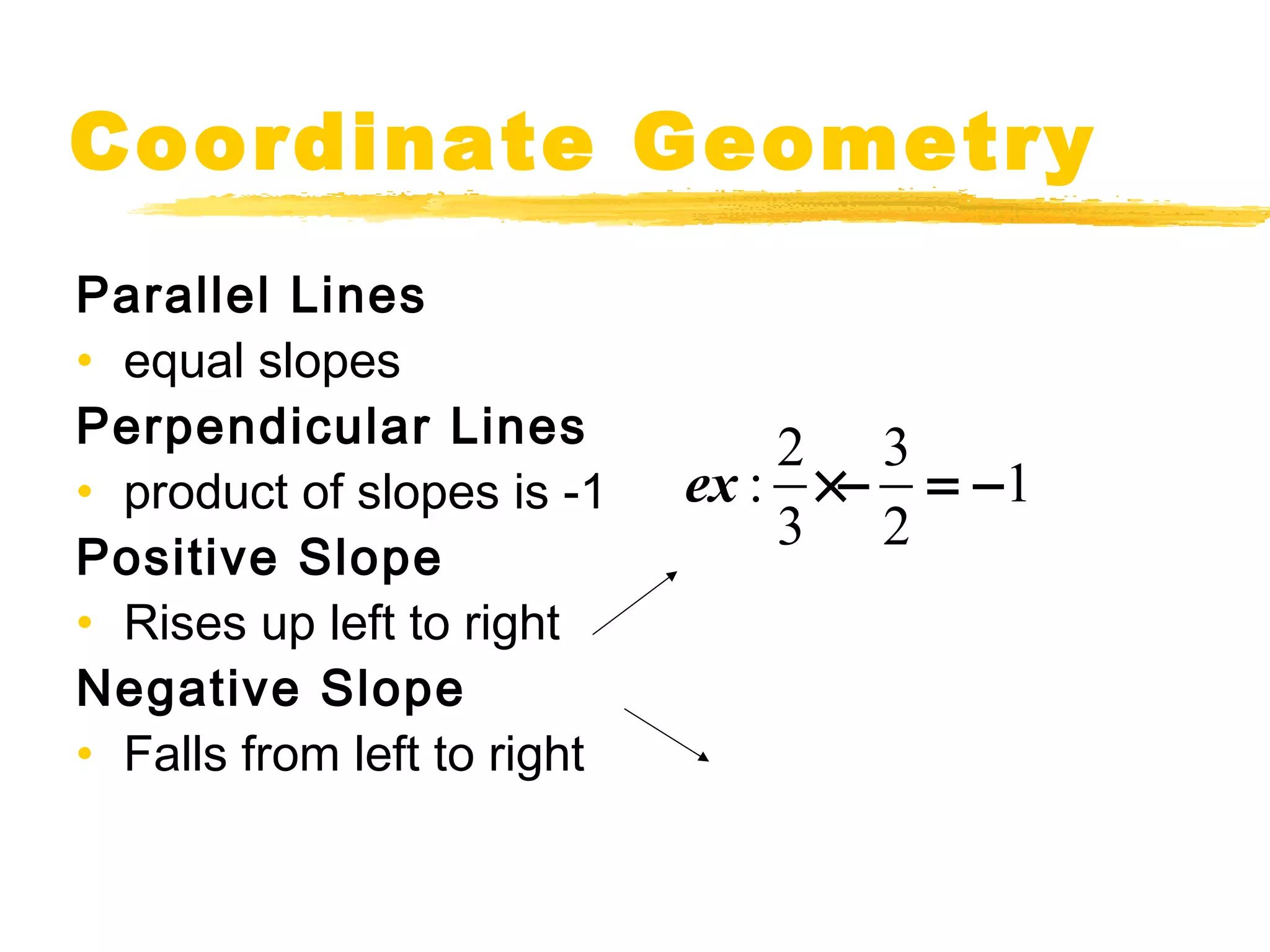
Parallel Lines 
• equal slopes 
Perpendicular Lines 
• product of slopes is -1 
ex : 2 ´- 3 = - 
1 
Positive Slope 
3 2 
• Rises up left to right 
Negative Slope 
• Falls from left to right
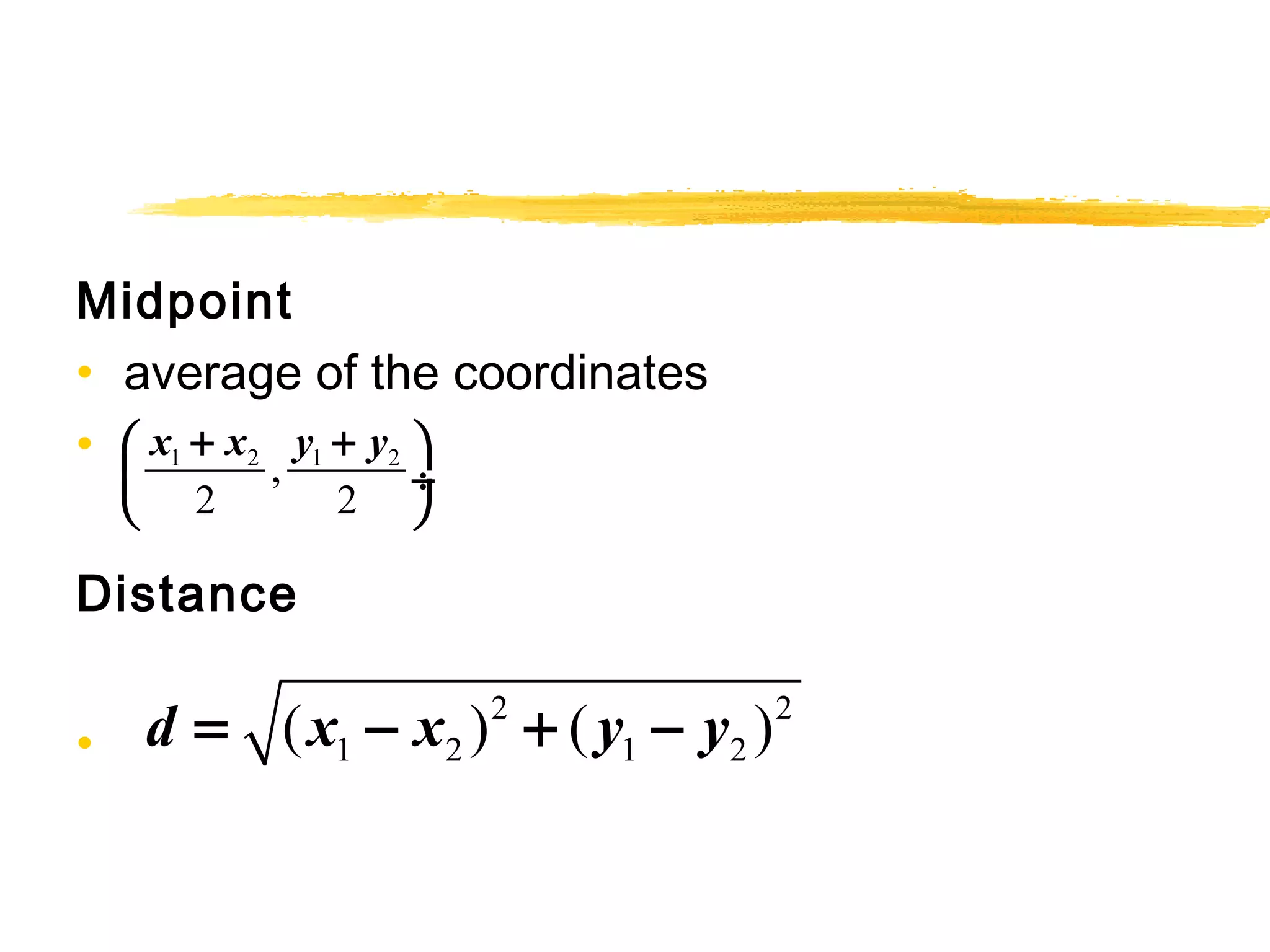
Midpoint 
• average of the coordinates 
• 
æ x + x y + y ö 
çè ø¸ 
Distance 
• 
1 2 , 1 2 
2 2 
1 2 1 2 d = (x - x ) + ( y - y ) 
2 2
Transformations 
Translation 
• moves a shape without any rotation or 
reflection (up, down, left, right) 
Rotation 
• turning an object around a point, called 
the center of rotation 
Reflection 
• mirror image with respect to a line, which 
is called the line of reflection

Geometry and measurement review

  • 1.
    Geometry and MeasurementReview The SAT doesn’t include: • Formal geometric proofs • Trigonometry • Radian measure
  • 2.
    Geometric Notation know: geometric notation for points and lines, line segments, rays, angles and their measures, and lengths
  • 3.
    Angles in thePlane Vertical angles • two opposite angles formed by two intersecting lines • have equal measure Supplementary angles • two angles whose sum is 180 degrees Complementary angles • two angles whose sum is 90 degrees
  • 4.
    Triangles Equilateral triangle • all three sides are equal length • all three angles measure 60 degrees Isosceles triangle • two sides are equal in length • angles opposite the equal sides are equal
  • 5.
    Right triangle •one right angle • hypotenuse is side opposite right angle • hypotenuse is longest side • other two sides are called legs • leg2+leg2 = hypotenuse2 (Pythagorean Theorem)
  • 6.
    Special Right Triangles 30°-60°-90° triangle • short leg = x • long leg = x 3 • hypotenuse = 2x 45°-45°-90° triangle • legs are equal • angles opposite the legs are equal • each leg = x • hypotenuse = x 2
  • 7.
    Congruent triangles •all three pairs of corresponding sides are congruent • all three pairs of corresponding angles are congruent • SSS, SAS, AAS, ASA
  • 8.
    Similar Triangles •same shape • lengths of corresponding sides are in proportion • all pairs of corresponding angles are congruent • AA
  • 9.
    Triangle Inequality •sum of the lengths of any two sides of a triangle is greater than the length of the third side • When one side is length a and second side is length b , length of third side is between la –b l and a +b • Ex: given sides of a , 10 and 16, third side is greater than 6 and less than 26 V
  • 10.
    Quadrilaterals Parallelograms •Opposite sides are congruent • Opposite angles are congruent • Consecutive angles are supplementary Rectangles • parallelogram • all angles are right angles • diagonals are congruent
  • 11.
    Squares • rectangleand thus also parallelogram • all sides are congruent • diagonal is times 2 the length of a side
  • 12.
    Areas and Perimeters Rectangle • Area = l ´ w • Perimeter = 2l + 2w Square • Area = s2 • Perimeter = 4s Parallogram • Area = b ´ h • Perimeter = 2l + 2w
  • 13.
    Triangle Area =1 • ´b´h 2 • Perimeter = sum of the three sides Polygon • Perimeter = sum of all the sides Regular Polygon • all sides are equal length • all angles are equal measure
  • 14.
    Angles in aPolygon Sum of interior angles: o o o o Triangle 180 Quadrilateral 360 Pentagon 540 Hexagon 720 n sides (n-2) 1´80 o
  • 15.
    Circles Diameter •line segment that passes through the center and has its endpoints on the circle • all diameters in same circle are equal length Radius • line segment from the center of the circle to a point on the circle • all radii in same circle are equal length • or 1 2r = d r = d 2
  • 16.
    Central angle •angle whose vertex is the center of a circle and formed by two radii Arc • part of a circle • measure is same as measure of central angle that cuts the arc
  • 17.
    Tangent to acircle • a line that intersects the circle at exactly one point • perpendicular to the radius at the point of tangency
  • 18.
    Circumference of Circle • distance around a circle • C = p d C = 2p r Area of Circle • A = p r2
  • 19.
    Solid Figures and Volumes Solid Figures • cubes, rectangular solids, prisms, cylinders, cones, spheres, and pyramids • volume of a rectangular solid (V= ) • volume of a right circular cylinder p r2h (V= ) • Recognize these solids l ´w´h
  • 20.
    Surface Area •sum of areas of all the sides of the solid • can use net to see sides of solid
  • 21.
    Geometric Perception GeometricPerception Questions • require you to visualize a plane figure or a solid from different views or orientations Example: The wire frame above is made of three wires permanently joined together: a red wire, a blue wire, and a green wire. Three beads, labeled A, B, and C, are attached to the frame so that each of them can move all around the frame. However, none of the beads can be taken off the frame, nor can they be moved past one another. Which of the following configurations cannot be reached by sliding the beads around the frame or changing the position of the frame?
  • 22.
  • 23.
    Answer: • Theconfiguration in (A) can be reached by sliding each bead clockwise to the next wire piece. • The configuration in (C) can be reached by sliding each bead counterclockwise to the next wire piece and then flipping the frame over. • The configuration in (D) is reached simply by sliding bead A clockwise to the green wire. • The configuration in (E) comes from turning the wire frame a third of a revolution clockwise. • The configuration in (B) cannot be reached no matter how you slide the beads or rotate and flip the frame. • The correct answer is (B).
  • 24.
    Coordinate Geometry ParallelLines • equal slopes Perpendicular Lines • product of slopes is -1 ex : 2 ´- 3 = - 1 Positive Slope 3 2 • Rises up left to right Negative Slope • Falls from left to right
  • 25.
    Midpoint • averageof the coordinates • æ x + x y + y ö çè ø¸ Distance • 1 2 , 1 2 2 2 1 2 1 2 d = (x - x ) + ( y - y ) 2 2
  • 26.
    Transformations Translation •moves a shape without any rotation or reflection (up, down, left, right) Rotation • turning an object around a point, called the center of rotation Reflection • mirror image with respect to a line, which is called the line of reflection