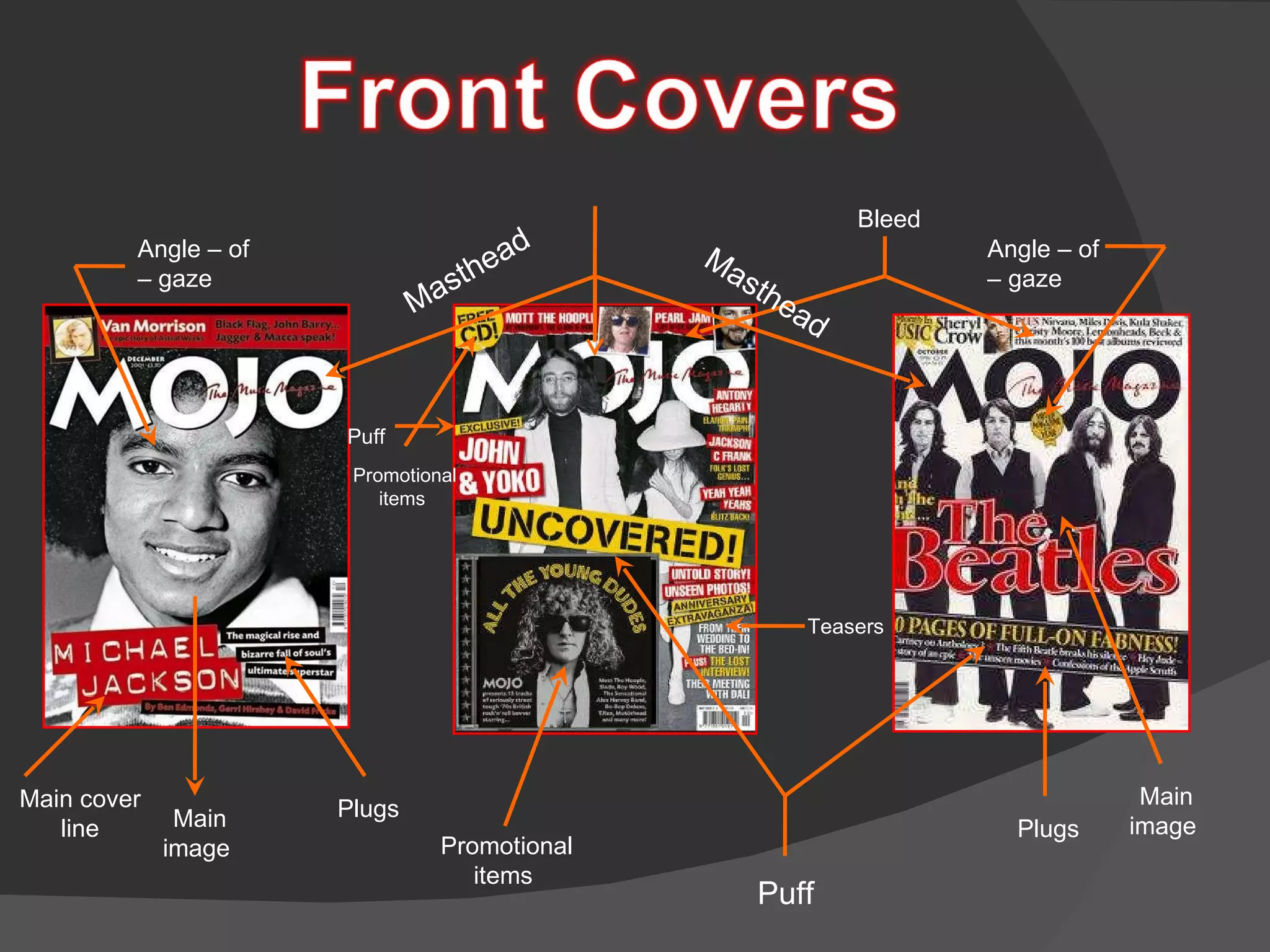
Masthead Puff Promotional items  Puff Bleed Teasers Plugs Plugs Angle – of  –  gaze  Angle – of  –  gaze  Main cover line Main image  Promotional items  Masthead Main image
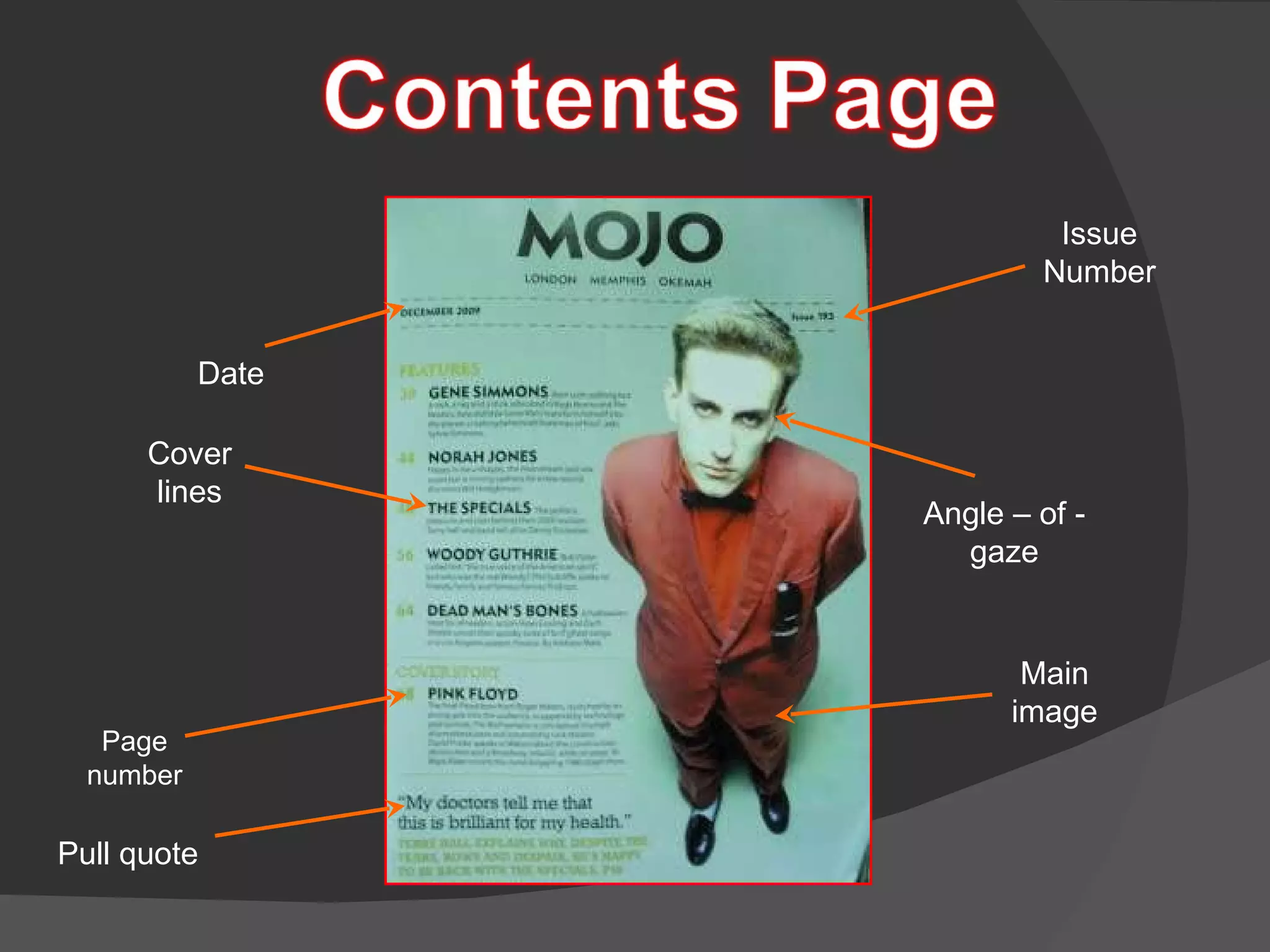
Pull quote Issue Number Main image Date Cover lines Angle – of - gaze Page number
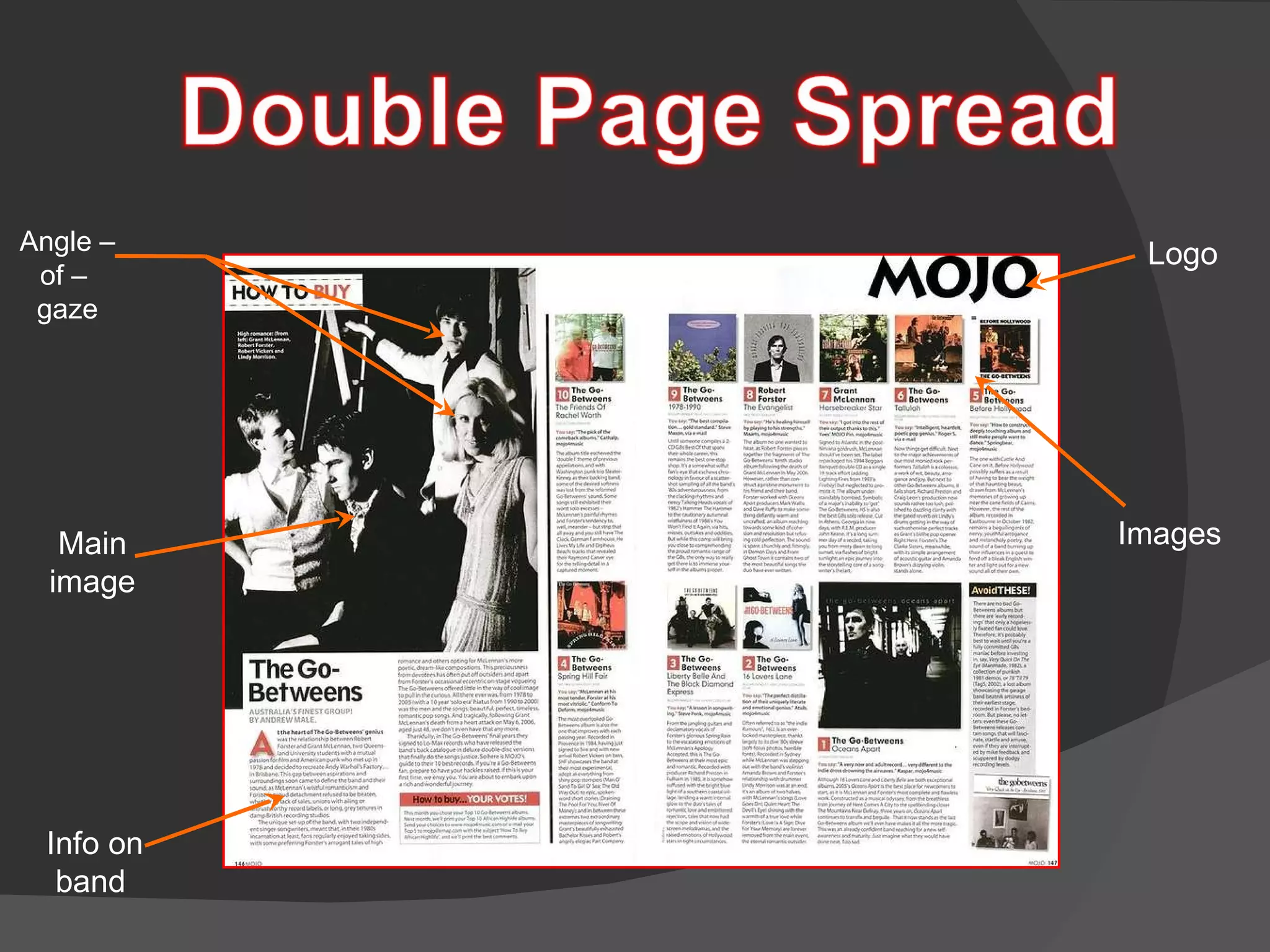
Main image Logo Angle – of –  gaze Info on band  Images
Magazine first published on 15 th  October 1993 by a British media company called  EMAP ;  Launch editor :  Paul Du Noyer since 2008 publishing was taken over by  Bauer (Europe’s largest privately owned publishing group)  Editor-in-cheif :  Paul Alexander Magazine distributed throughout the UK Can be purchased on Mojo website
The front covers are quite similar. The pictures in all the covers are white and black. The colour scheme used is frequent, consisting of only, red, yellow and black. Furthermore, the masthead is also in either white or black. By looking at the cover, it gives off the impression that its a indie/rock magazine. The barcode is small and placed in the corner. The contents page is rather simple, compared to the covers. It consists of only one image. However, this image is in contrast to the background colour.  It includes the name of the articles, which are included in the magazine, with a bit of detail about it. We know that this is the title of the article, as its all written in capital letters, and in bold, which makes it stand out. The double page spread is based on one particular band,  The Go - Betweens.  Once again, the picture of the band is in black and white, just like the front covers. The colour red is also used on this page, with a bit of yellow in the right hand corner. They have included 10 album covers of the band, as they wanted a public vote of what they think of their albums, counting down 10 – 1. Some images do have colour, whereas the other ones are in black and white again.
MOJO magazine is aimed at people who have a passion for music, whatever the genre may be, and those who want to discover music of any kind, whether its old or new. Attracts audience by involving legendary and revolutionary music makers, such as The Beatles, and celebrates their success.  For the intelligent reader. January – June 2008 - Mojo -  106,367  ( 106,218 ) – per monthly   January – June 2008 - Q  -  113,174  ( 131,330 ) –  per monthly    ( http://dezji.wordpress.com/2008/08/15/uk-music-magazine-circulation-figures-2/  ) July – December 2008 –  100,50 7 copies sold per monthly. ( http://en.wikipedia.org/wiki/Mojo_(magazine)  ) February 2009 – sold an average of  98,484   copies sold  per monthly  (  http://www.guardian.co.uk/media/2010/feb/11/mojo-q-nme-kerrang-abcs  ) First statistics shows that even thoughh  MOJO  and  Q  magazine are from the same company, and are both monthly issues,  Q  magazine seemed to have sold more copies during that specific period. By 2009, the average rate of copies sold monthly decreased.
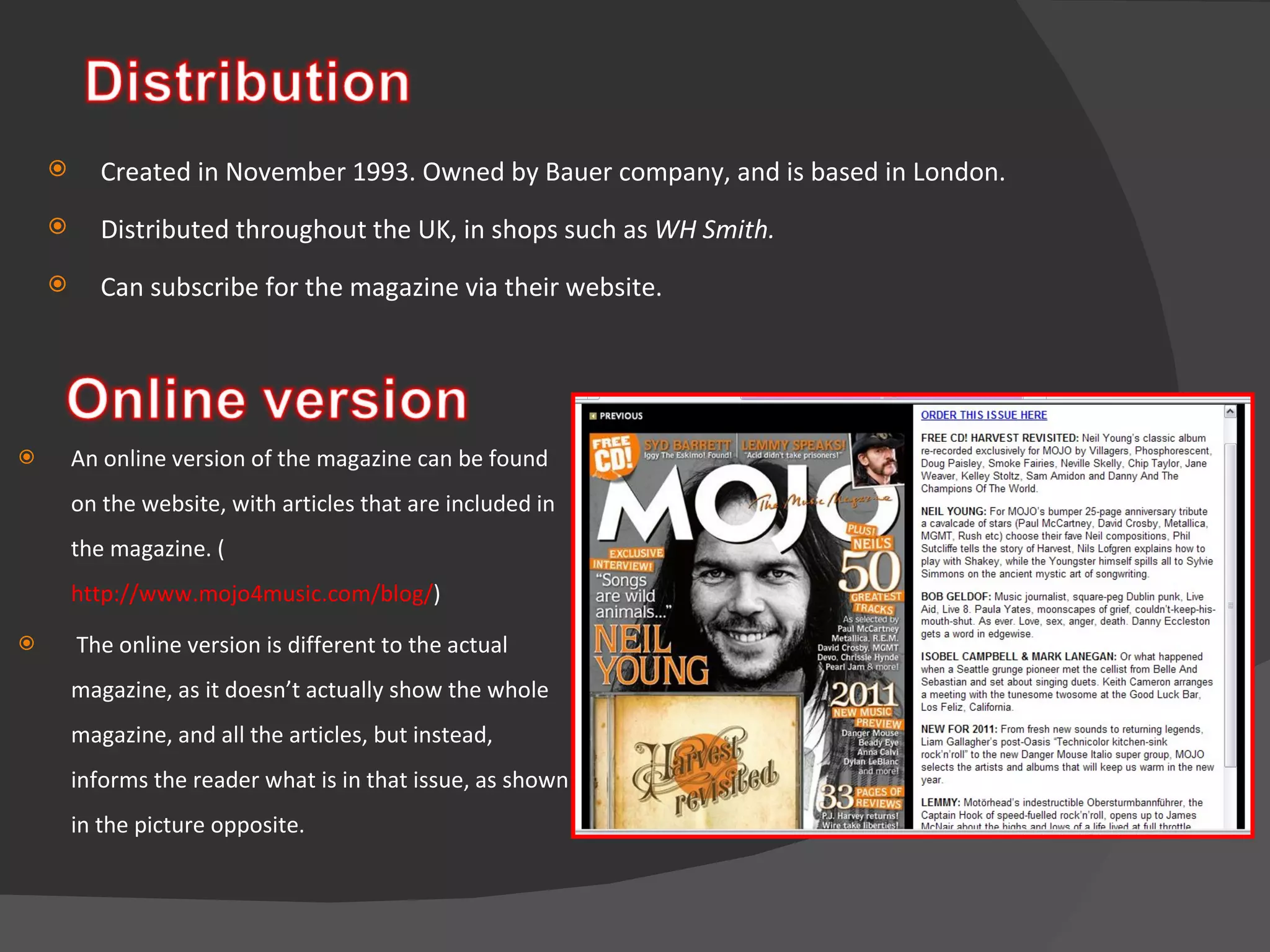
An online version of the magazine can be found on the website, with articles that are included in the magazine. ( http://www.mojo4music.com/blog/ ) The online version is different to the actual magazine, as it doesn’t actually show the whole magazine, and all the articles, but instead, informs the reader what is in that issue, as shown in the picture opposite. Created in November 1993. Owned by Bauer company, and is based in London.  Distributed throughout the UK, in shops such as  WH Smith. Can subscribe for the magazine via their website.
Bauer Company, who owns the magazine, also produced a digital radio station, which was called  MOJO Radio , and was broadcasted on the digital television networks in the UK (Free view channel 721 and Sky Digital channel 0182, though not Virgin Media) and online.  This attracts a larger audience, as its available throughout the day, attracting over  300,000  listeners. ( http://mojoradiolive.com/  ) Apps are available for  ‘MOJO Radio’  and news based on  MOJO  on the iPhone and iPod Touch, which are free. Attract audience by giving out promotional goods with the magazine, such as CD’s, which relates to an article included in the magazine, or a specific theme. Have an online version of the magazine which can be accessed whenever. They also have competitions which can be found in the magazine or online.  Include exclusive interviews  with different artists and bands.

Mojo

  • 1.
  • 2.
    Masthead Puff Promotionalitems Puff Bleed Teasers Plugs Plugs Angle – of – gaze Angle – of – gaze Main cover line Main image Promotional items Masthead Main image
  • 3.
    Pull quote IssueNumber Main image Date Cover lines Angle – of - gaze Page number
  • 4.
    Main image LogoAngle – of – gaze Info on band Images
  • 5.
    Magazine first publishedon 15 th October 1993 by a British media company called EMAP ; Launch editor : Paul Du Noyer since 2008 publishing was taken over by Bauer (Europe’s largest privately owned publishing group) Editor-in-cheif : Paul Alexander Magazine distributed throughout the UK Can be purchased on Mojo website
  • 6.
    The front coversare quite similar. The pictures in all the covers are white and black. The colour scheme used is frequent, consisting of only, red, yellow and black. Furthermore, the masthead is also in either white or black. By looking at the cover, it gives off the impression that its a indie/rock magazine. The barcode is small and placed in the corner. The contents page is rather simple, compared to the covers. It consists of only one image. However, this image is in contrast to the background colour. It includes the name of the articles, which are included in the magazine, with a bit of detail about it. We know that this is the title of the article, as its all written in capital letters, and in bold, which makes it stand out. The double page spread is based on one particular band, The Go - Betweens. Once again, the picture of the band is in black and white, just like the front covers. The colour red is also used on this page, with a bit of yellow in the right hand corner. They have included 10 album covers of the band, as they wanted a public vote of what they think of their albums, counting down 10 – 1. Some images do have colour, whereas the other ones are in black and white again.
  • 7.
    MOJO magazine isaimed at people who have a passion for music, whatever the genre may be, and those who want to discover music of any kind, whether its old or new. Attracts audience by involving legendary and revolutionary music makers, such as The Beatles, and celebrates their success. For the intelligent reader. January – June 2008 - Mojo - 106,367 ( 106,218 ) – per monthly January – June 2008 - Q - 113,174 ( 131,330 ) – per monthly ( http://dezji.wordpress.com/2008/08/15/uk-music-magazine-circulation-figures-2/ ) July – December 2008 – 100,50 7 copies sold per monthly. ( http://en.wikipedia.org/wiki/Mojo_(magazine) ) February 2009 – sold an average of 98,484 copies sold per monthly ( http://www.guardian.co.uk/media/2010/feb/11/mojo-q-nme-kerrang-abcs ) First statistics shows that even thoughh MOJO and Q magazine are from the same company, and are both monthly issues, Q magazine seemed to have sold more copies during that specific period. By 2009, the average rate of copies sold monthly decreased.
  • 8.
    An online versionof the magazine can be found on the website, with articles that are included in the magazine. ( http://www.mojo4music.com/blog/ ) The online version is different to the actual magazine, as it doesn’t actually show the whole magazine, and all the articles, but instead, informs the reader what is in that issue, as shown in the picture opposite. Created in November 1993. Owned by Bauer company, and is based in London. Distributed throughout the UK, in shops such as WH Smith. Can subscribe for the magazine via their website.
  • 9.
    Bauer Company, whoowns the magazine, also produced a digital radio station, which was called MOJO Radio , and was broadcasted on the digital television networks in the UK (Free view channel 721 and Sky Digital channel 0182, though not Virgin Media) and online. This attracts a larger audience, as its available throughout the day, attracting over 300,000 listeners. ( http://mojoradiolive.com/ ) Apps are available for ‘MOJO Radio’ and news based on MOJO on the iPhone and iPod Touch, which are free. Attract audience by giving out promotional goods with the magazine, such as CD’s, which relates to an article included in the magazine, or a specific theme. Have an online version of the magazine which can be accessed whenever. They also have competitions which can be found in the magazine or online. Include exclusive interviews with different artists and bands.