Infix to Postfix Conversion
• Stacks are widely used in the design and implementation of
compilers.
• For example, they are used to convert arithmetic expressions
from infix notation to postfix notation.
• An infix expression is one in which operators are located
between their operands.
• In postfix notation, the operator immediately follows its
operands.
Precedence and Priority
Token Operator

Precedence1 Associativity

()
[]
-> .
-- ++

function call
17
array element
struct or union member
increment, decrement2 16

left-to-right

-- ++
!
-+
&*
sizeof
(type)

decrement, increment3
logical not
one’s complement
unary minus or plus
address or indirection
size (in bytes)
type cast

15

right-to-left

14

right-to-left

*/%

mutiplicative

13

Left-to-right

left-to-right
+-

binary add or subtract

12

left-to-right

<< >>

shift

11

left-to-right

> >=
< <=
== !=

relational

10

left-to-right

equality

9

left-to-right

&

bitwise and

8

left-to-right

^

bitwise exclusive or

7

left-to-right

bitwise or

6

left-to-right

logical and

5

left-to-right

logical or

4

left-to-right

&&
?:

conditional

3

right-to-left

=
+= -= assignment
/= *= %=
<<= >>=
&= ^= 
=

2

right-to-left

,

1

left-to-right

comma
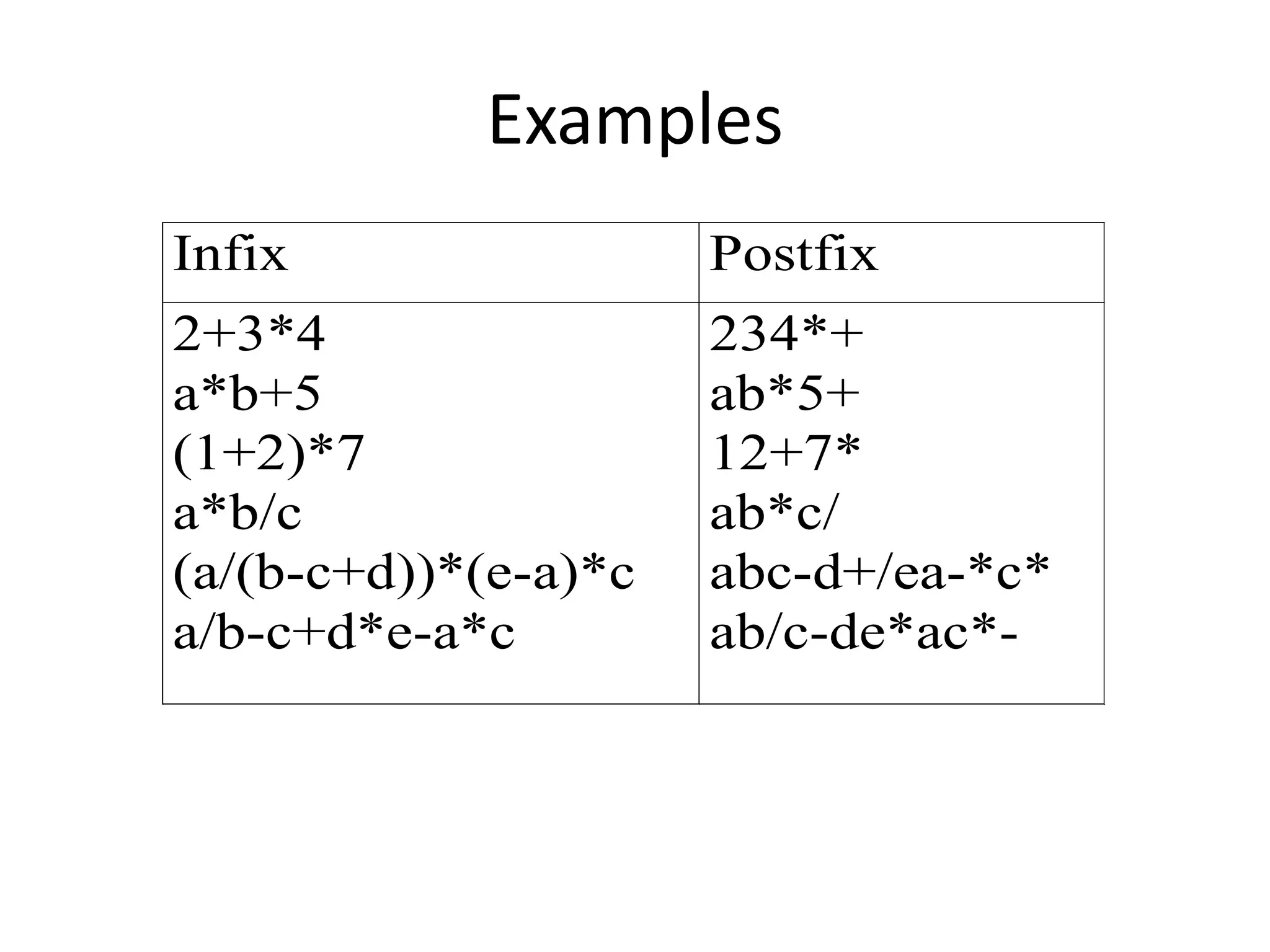
Examples
Infix

Postfix

2+3*4
a*b+5
(1+2)*7
a*b/c
(a/(b-c+d))*(e-a)*c
a/b-c+d*e-a*c

234*+
ab*5+
12+7*
ab*c/
abc-d+/ea-*c*
ab/c-de*ac*-
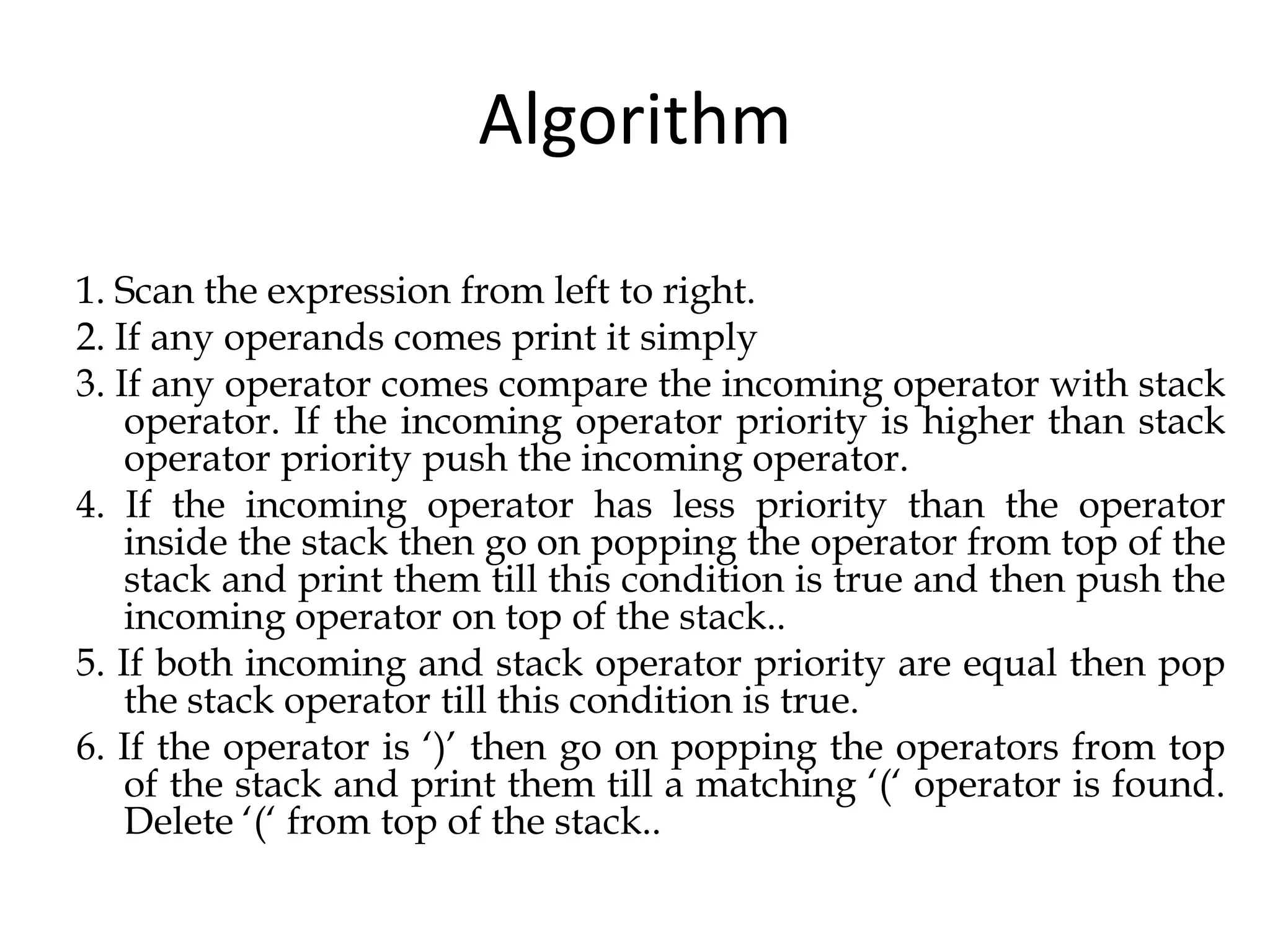
Algorithm
1. Scan the expression from left to right.
2. If any operands comes print it simply
3. If any operator comes compare the incoming operator with stack
operator. If the incoming operator priority is higher than stack
operator priority push the incoming operator.
4. If the incoming operator has less priority than the operator
inside the stack then go on popping the operator from top of the
stack and print them till this condition is true and then push the
incoming operator on top of the stack..
5. If both incoming and stack operator priority are equal then pop
the stack operator till this condition is true.
6. If the operator is ‘)’ then go on popping the operators from top
of the stack and print them till a matching ‘(‘ operator is found.
Delete ‘(‘ from top of the stack..
Suppose we want to convert 2*3/(2-1)+5*3 into Postfix form,
Expression

Stack

Output

2

Empty

2

*

*

2

3

*

23

/

/

23*

(

/(

23*

2

/(

23*2

-

/(-

23*2

1

/(-

23*21

)

/

23*21-

+

+

23*21-/

5
*

+
+*

23*21-/5
23*21-/53

3

+*

23*21-/53

Empty

23*21-/53*+
So, the Postfix Expression is 23*21-/53*+
Postfix Demo: The Equation
Infix: (1 + (2 * ((3 + (4 * 5)) * 6)))

= 277

Postfix: 1 2 3 4 5 * + 6 * * +

= 277

(

1

+

(

2

*

(

(

3

+

(

4

*

5

)

)

*

6

(

1

(

2

(

(

3

(

4

5

)

*

)

+

6

)

*

)

138 6 138
23 532 23
20 ** 120276
4 *++=== 277
276
1

13

2

3

4

5

*

+

6

*

*

+

)

*

)

)

)

+
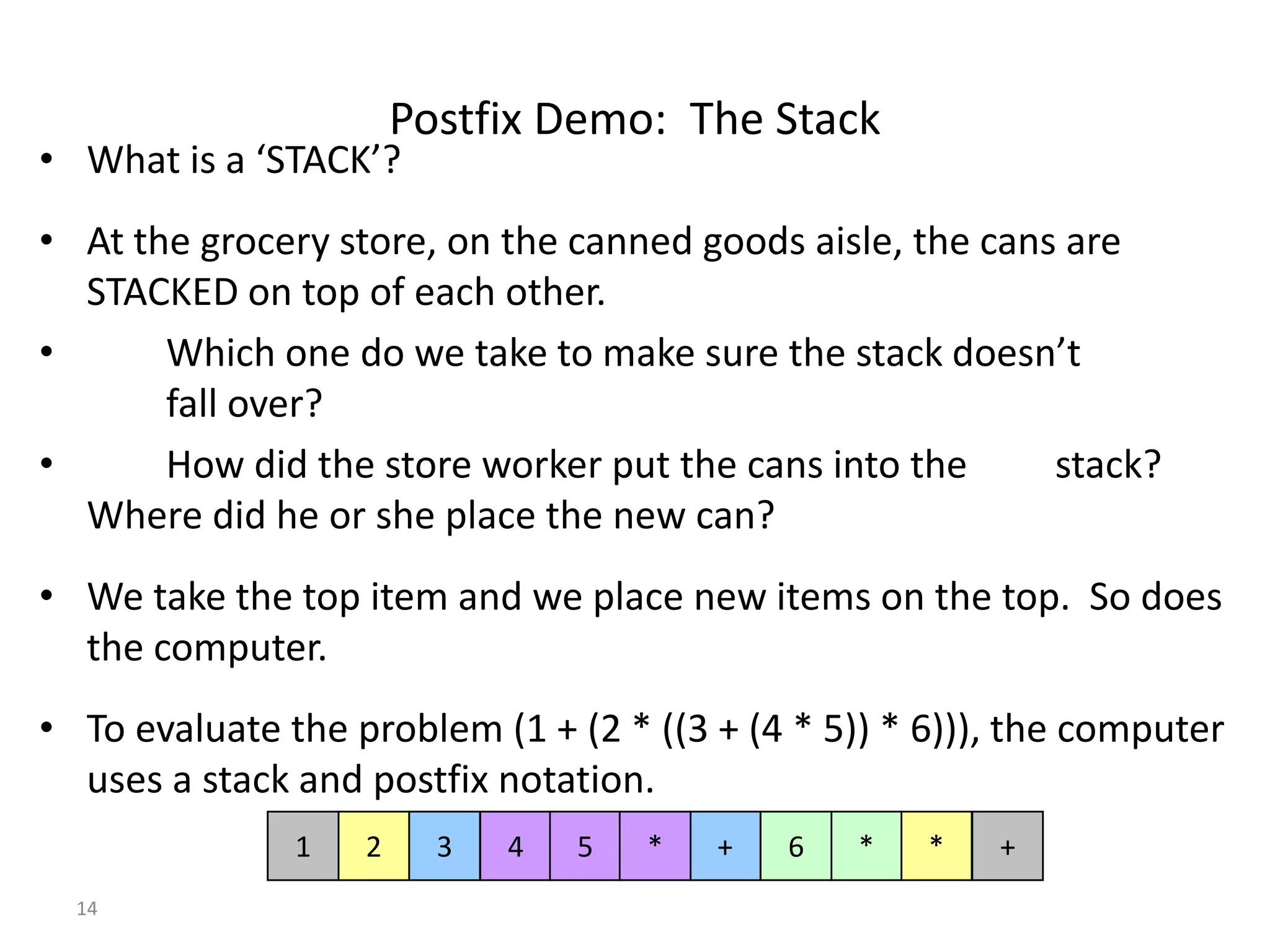
Postfix Demo: The Stack

• What is a ‘STACK’?

• At the grocery store, on the canned goods aisle, the cans are
STACKED on top of each other.
•
Which one do we take to make sure the stack doesn’t
fall over?
•
How did the store worker put the cans into the
stack?
Where did he or she place the new can?
• We take the top item and we place new items on the top. So does
the computer.
• To evaluate the problem (1 + (2 * ((3 + (4 * 5)) * 6))), the computer
uses a stack and postfix notation.
1
14

2

3

4

5

*

+

6

*

*

+
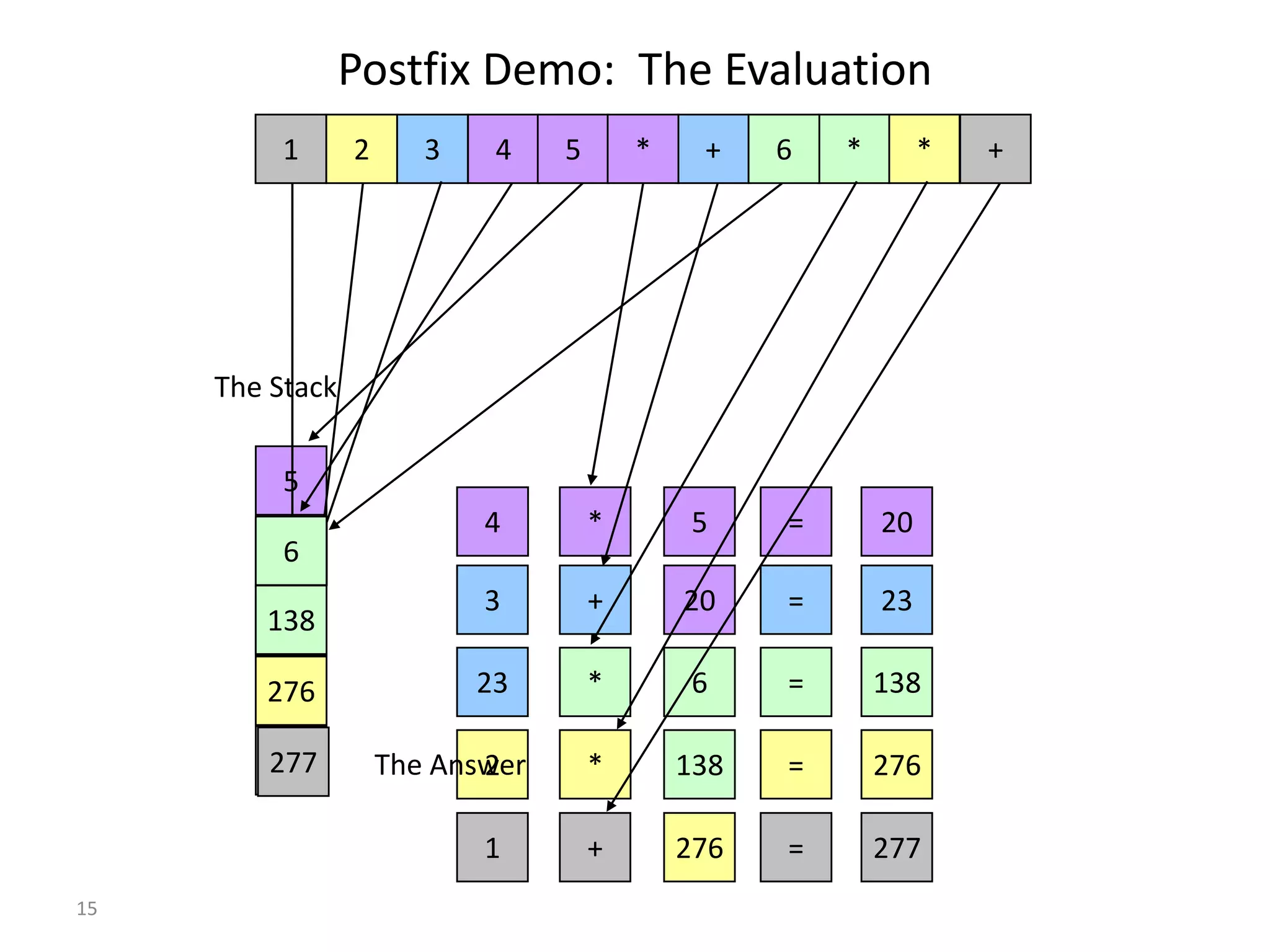
Postfix Demo: The Evaluation
1

2

3

4

5

*

+

6

*

*

The Stack
5
6
4
20
3
138
23
2
276
1
277

4

*

5

=

20

3

+

20

=

23

23

*

6

=

138

*

138

=

276

+

276

=

277

The Answer
2
1

15

+
FPE Infix to Postfix
(((A+B)*(C-E))/(F+G))
• stack: <empty>
• output: []
FPE Infix to Postfix
((A+B)*(C-E))/(F+G))
• stack: (
• output: []
FPE Infix to Postfix
(A+B)*(C-E))/(F+G))
• stack: ( (
• output: []
FPE Infix to Postfix
A+B)*(C-E))/(F+G))
• stack: ( ( (
• output: []
FPE Infix to Postfix
+B)*(C-E))/(F+G))
• stack: ( ( (
• output: [A]
FPE Infix to Postfix
B)*(C-E))/(F+G))
• stack: ( ( ( +
• output: [A]
FPE Infix to Postfix
)*(C-E))/(F+G))
• stack: ( ( ( +
• output: [A B]
FPE Infix to Postfix
*(C-E))/(F+G))
• stack: ( (
• output: [A B + ]
FPE Infix to Postfix
(C-E))/(F+G))
• stack: ( ( *
• output: [A B + ]
FPE Infix to Postfix
C-E))/(F+G))
• stack: ( ( * (
• output: [A B + ]
FPE Infix to Postfix
-E))/(F+G))
• stack: ( ( * (
• output: [A B + C ]
FPE Infix to Postfix
E))/(F+G))
• stack: ( ( * ( • output: [A B + C ]
FPE Infix to Postfix
))/(F+G))
• stack: ( ( * ( • output: [A B + C E ]
FPE Infix to Postfix
)/(F+G))
• stack: ( ( *
• output: [A B + C E - ]
FPE Infix to Postfix
/(F+G))
• stack: (
• output: [A B + C E - * ]
FPE Infix to Postfix
(F+G))
• stack: ( /
• output: [A B + C E - * ]
FPE Infix to Postfix
F+G))
• stack: ( / (
• output: [A B + C E - * ]
FPE Infix to Postfix
+G))
• stack: ( / (
• output: [A B + C E - * F ]
FPE Infix to Postfix
G))
• stack: ( / ( +
• output: [A B + C E - * F ]
FPE Infix to Postfix
))
• stack: ( / ( +
• output: [A B + C E - * F G ]
FPE Infix to Postfix
)
• stack: ( /
• output: [A B + C E - * F G + ]
FPE Infix to Postfix

• stack: <empty>
• output: [A B + C E - * F G + / ]
•
•
•
•
•
•
•
•
•
•
•
•
•
•
•
•
•
•
•
•
•
•
•
•
•
•
•
•
•
•
•
•
•
•
•
•
•
•
•
•
•
•
•
•
•
•
•
•
•
•
•

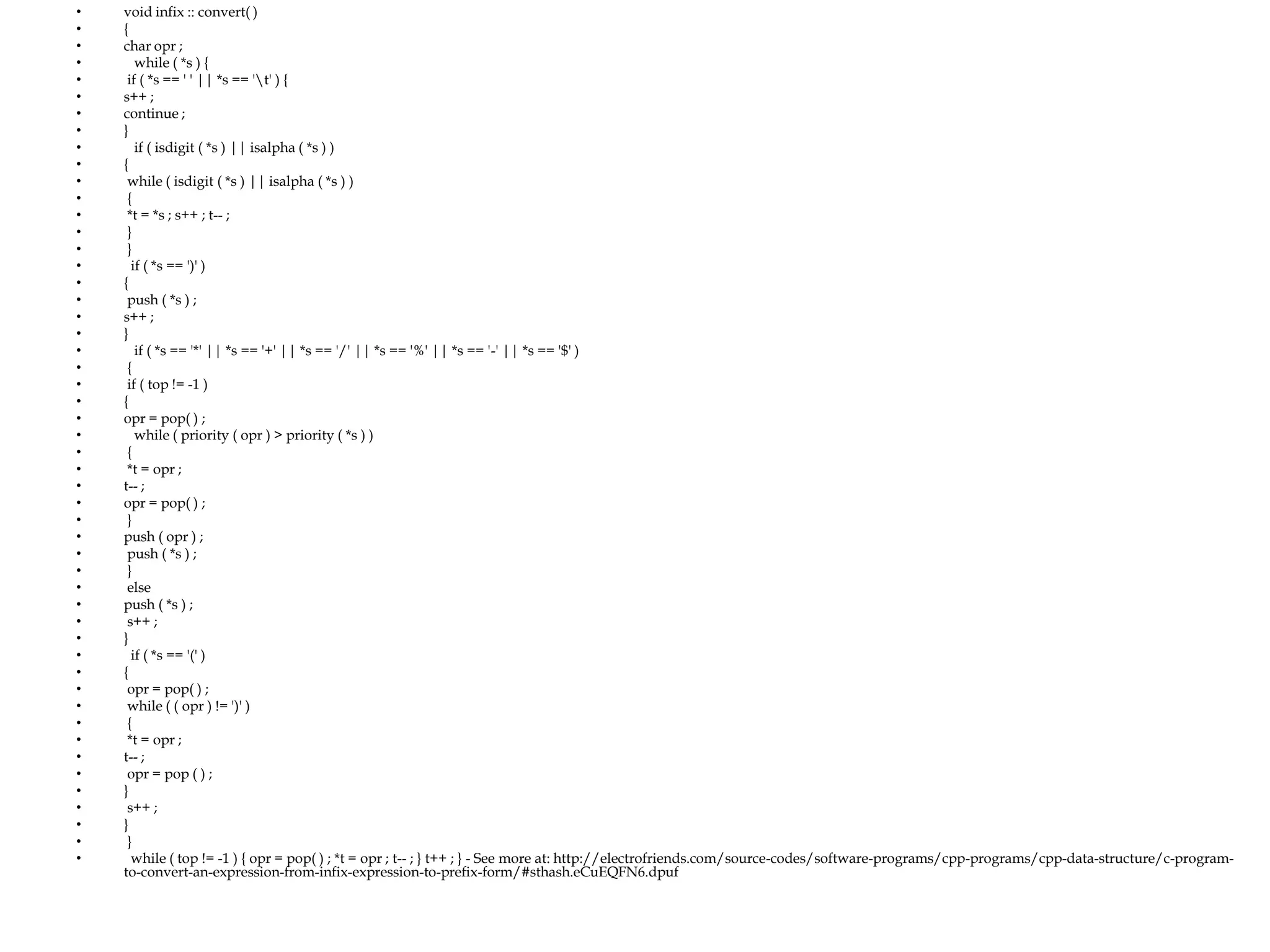
void infix :: convert( )
{
char opr ;
while ( *s ) {
if ( *s == ' ' || *s == 't' ) {
s++ ;
continue ;
}
if ( isdigit ( *s ) || isalpha ( *s ) )
{
while ( isdigit ( *s ) || isalpha ( *s ) )
{
*t = *s ; s++ ; t-- ;
}
}
if ( *s == ')' )
{
push ( *s ) ;
s++ ;
}
if ( *s == '*' || *s == '+' || *s == '/' || *s == '%' || *s == '-' || *s == '$' )
{
if ( top != -1 )
{
opr = pop( ) ;
while ( priority ( opr ) > priority ( *s ) )
{
*t = opr ;
t-- ;
opr = pop( ) ;
}
push ( opr ) ;
push ( *s ) ;
}
else
push ( *s ) ;
s++ ;
}
if ( *s == '(' )
{
opr = pop( ) ;
while ( ( opr ) != ')' )
{
*t = opr ;
t-- ;
opr = pop ( ) ;
}
s++ ;
}
}
while ( top != -1 ) { opr = pop( ) ; *t = opr ; t-- ; } t++ ; } - See more at: http://electrofriends.com/source-codes/software-programs/cpp-programs/cpp-data-structure/c-programto-convert-an-expression-from-infix-expression-to-prefix-form/#sthash.eCuEQFN6.dpuf
My lecture infix-to-postfix

My lecture infix-to-postfix

  • 1.
    Infix to PostfixConversion
  • 2.
    Infix to PostfixConversion • Stacks are widely used in the design and implementation of compilers. • For example, they are used to convert arithmetic expressions from infix notation to postfix notation. • An infix expression is one in which operators are located between their operands. • In postfix notation, the operator immediately follows its operands.
  • 3.
    Precedence and Priority TokenOperator Precedence1 Associativity () [] -> . -- ++ function call 17 array element struct or union member increment, decrement2 16 left-to-right -- ++ ! -+ &* sizeof (type) decrement, increment3 logical not one’s complement unary minus or plus address or indirection size (in bytes) type cast 15 right-to-left 14 right-to-left */% mutiplicative 13 Left-to-right left-to-right
  • 4.
    +- binary add orsubtract 12 left-to-right << >> shift 11 left-to-right > >= < <= == != relational 10 left-to-right equality 9 left-to-right & bitwise and 8 left-to-right ^ bitwise exclusive or 7 left-to-right bitwise or 6 left-to-right logical and 5 left-to-right logical or 4 left-to-right &&
  • 5.
    ?: conditional 3 right-to-left = += -= assignment /=*= %= <<= >>= &= ^=  = 2 right-to-left , 1 left-to-right comma
  • 6.
  • 9.
    Algorithm 1. Scan theexpression from left to right. 2. If any operands comes print it simply 3. If any operator comes compare the incoming operator with stack operator. If the incoming operator priority is higher than stack operator priority push the incoming operator. 4. If the incoming operator has less priority than the operator inside the stack then go on popping the operator from top of the stack and print them till this condition is true and then push the incoming operator on top of the stack.. 5. If both incoming and stack operator priority are equal then pop the stack operator till this condition is true. 6. If the operator is ‘)’ then go on popping the operators from top of the stack and print them till a matching ‘(‘ operator is found. Delete ‘(‘ from top of the stack..
  • 12.
    Suppose we wantto convert 2*3/(2-1)+5*3 into Postfix form, Expression Stack Output 2 Empty 2 * * 2 3 * 23 / / 23* ( /( 23* 2 /( 23*2 - /(- 23*2 1 /(- 23*21 ) / 23*21- + + 23*21-/ 5 * + +* 23*21-/5 23*21-/53 3 +* 23*21-/53 Empty 23*21-/53*+ So, the Postfix Expression is 23*21-/53*+
  • 13.
    Postfix Demo: TheEquation Infix: (1 + (2 * ((3 + (4 * 5)) * 6))) = 277 Postfix: 1 2 3 4 5 * + 6 * * + = 277 ( 1 + ( 2 * ( ( 3 + ( 4 * 5 ) ) * 6 ( 1 ( 2 ( ( 3 ( 4 5 ) * ) + 6 ) * ) 138 6 138 23 532 23 20 ** 120276 4 *++=== 277 276 1 13 2 3 4 5 * + 6 * * + ) * ) ) ) +
  • 14.
    Postfix Demo: TheStack • What is a ‘STACK’? • At the grocery store, on the canned goods aisle, the cans are STACKED on top of each other. • Which one do we take to make sure the stack doesn’t fall over? • How did the store worker put the cans into the stack? Where did he or she place the new can? • We take the top item and we place new items on the top. So does the computer. • To evaluate the problem (1 + (2 * ((3 + (4 * 5)) * 6))), the computer uses a stack and postfix notation. 1 14 2 3 4 5 * + 6 * * +
  • 15.
    Postfix Demo: TheEvaluation 1 2 3 4 5 * + 6 * * The Stack 5 6 4 20 3 138 23 2 276 1 277 4 * 5 = 20 3 + 20 = 23 23 * 6 = 138 * 138 = 276 + 276 = 277 The Answer 2 1 15 +
  • 16.
    FPE Infix toPostfix (((A+B)*(C-E))/(F+G)) • stack: <empty> • output: []
  • 17.
    FPE Infix toPostfix ((A+B)*(C-E))/(F+G)) • stack: ( • output: []
  • 18.
    FPE Infix toPostfix (A+B)*(C-E))/(F+G)) • stack: ( ( • output: []
  • 19.
    FPE Infix toPostfix A+B)*(C-E))/(F+G)) • stack: ( ( ( • output: []
  • 20.
    FPE Infix toPostfix +B)*(C-E))/(F+G)) • stack: ( ( ( • output: [A]
  • 21.
    FPE Infix toPostfix B)*(C-E))/(F+G)) • stack: ( ( ( + • output: [A]
  • 22.
    FPE Infix toPostfix )*(C-E))/(F+G)) • stack: ( ( ( + • output: [A B]
  • 23.
    FPE Infix toPostfix *(C-E))/(F+G)) • stack: ( ( • output: [A B + ]
  • 24.
    FPE Infix toPostfix (C-E))/(F+G)) • stack: ( ( * • output: [A B + ]
  • 25.
    FPE Infix toPostfix C-E))/(F+G)) • stack: ( ( * ( • output: [A B + ]
  • 26.
    FPE Infix toPostfix -E))/(F+G)) • stack: ( ( * ( • output: [A B + C ]
  • 27.
    FPE Infix toPostfix E))/(F+G)) • stack: ( ( * ( • output: [A B + C ]
  • 28.
    FPE Infix toPostfix ))/(F+G)) • stack: ( ( * ( • output: [A B + C E ]
  • 29.
    FPE Infix toPostfix )/(F+G)) • stack: ( ( * • output: [A B + C E - ]
  • 30.
    FPE Infix toPostfix /(F+G)) • stack: ( • output: [A B + C E - * ]
  • 31.
    FPE Infix toPostfix (F+G)) • stack: ( / • output: [A B + C E - * ]
  • 32.
    FPE Infix toPostfix F+G)) • stack: ( / ( • output: [A B + C E - * ]
  • 33.
    FPE Infix toPostfix +G)) • stack: ( / ( • output: [A B + C E - * F ]
  • 34.
    FPE Infix toPostfix G)) • stack: ( / ( + • output: [A B + C E - * F ]
  • 35.
    FPE Infix toPostfix )) • stack: ( / ( + • output: [A B + C E - * F G ]
  • 36.
    FPE Infix toPostfix ) • stack: ( / • output: [A B + C E - * F G + ]
  • 37.
    FPE Infix toPostfix • stack: <empty> • output: [A B + C E - * F G + / ]
  • 38.
    • • • • • • • • • • • • • • • • • • • • • • • • • • • • • • • • • • • • • • • • • • • • • • • • • • • void infix ::convert( ) { char opr ; while ( *s ) { if ( *s == ' ' || *s == 't' ) { s++ ; continue ; } if ( isdigit ( *s ) || isalpha ( *s ) ) { while ( isdigit ( *s ) || isalpha ( *s ) ) { *t = *s ; s++ ; t-- ; } } if ( *s == ')' ) { push ( *s ) ; s++ ; } if ( *s == '*' || *s == '+' || *s == '/' || *s == '%' || *s == '-' || *s == '$' ) { if ( top != -1 ) { opr = pop( ) ; while ( priority ( opr ) > priority ( *s ) ) { *t = opr ; t-- ; opr = pop( ) ; } push ( opr ) ; push ( *s ) ; } else push ( *s ) ; s++ ; } if ( *s == '(' ) { opr = pop( ) ; while ( ( opr ) != ')' ) { *t = opr ; t-- ; opr = pop ( ) ; } s++ ; } } while ( top != -1 ) { opr = pop( ) ; *t = opr ; t-- ; } t++ ; } - See more at: http://electrofriends.com/source-codes/software-programs/cpp-programs/cpp-data-structure/c-programto-convert-an-expression-from-infix-expression-to-prefix-form/#sthash.eCuEQFN6.dpuf