University of Mysore
Dos in Library and Information Science
Seminar Topic:
“Network protocol”
Presented To,
Prof. Chandrashekar M.
Dos in LISc
Presented by,
Swamy nayaka C K
2nd year MLISc
Dos in LISc
Network Protocol
A protocol is a set of rules that governs the
communications between computers on a network.
These rules include guidelines that regulate the
following characteristics of a network: access method,
allowed physical topologies, types of cabling, and
speed of data transfer.
What is a Protocol?
 Protocol is a controlled sequence of messages that
is exchanged between two or more systems to
accomplish a given task.
 Protocol specifications define this sequence
together with the format or layout of the messages
that are exchanged.
Definition
 A communications protocol is a system of digital rules
for message exchange within or between computers.
Communicating systems use well-defined formats for
exchanging messages. Each message has an exact
meaning intended to provoke a particular response of
the receiver. ...
History
 The Internet protocol suite resulted from research and
development conducted by the Defense Advanced
Research Projects Agency (DARPA) in the late 1960s. After
initiating the pioneering ARPANET in 1969, DARPA started
work on a number of other data transmission technologies.
In 1972, Robert E. Kahn joined the DARPA Information
Processing Technology Office, where he worked on both
satellite packet networks and ground-based radio packet
networks, and recognized the value of being able to
communicate across both. In the spring of 1973, Vinton
Cerf, the developer of the existing ARPANET Network
Control Program (NCP) protocol, joined Kahn to work on
open-architecture interconnection models with the goal of
designing the next protocol generation for the ARPANET.
Protocol development
 For communication to take place, protocols have to be
agreed upon. Recall that in digital computing systems,
the rules can be expressed by algorithms and data
structures, raising the opportunity of hardware
independence. Expressing the algorithms in a portable
programming language, makes the protocol software
operating system independent. The source code could
be considered a protocol specification. This form of
specification, however is not suitable for the parties
involved.
Common types of protocols
The Internet Protocol is used in concert with other
protocols within the Internet Protocol Suite.
Prominent members of which include:
 Transmission Control Protocol (TCP)
 User Datagram Protocol (UDP)
 Internet Control Message Protocol (ICMP)
 Hypertext Transfer Protocol (HTTP)
 Post Office Protocol (POP)
 File Transfer Protocol (FTP)
 Internet Message Access Protocol (IMAP)
Types of Network Protocols
 Ethernet
 Local Talk
 Token Ring
 FDDI
 ATM
Ethernet
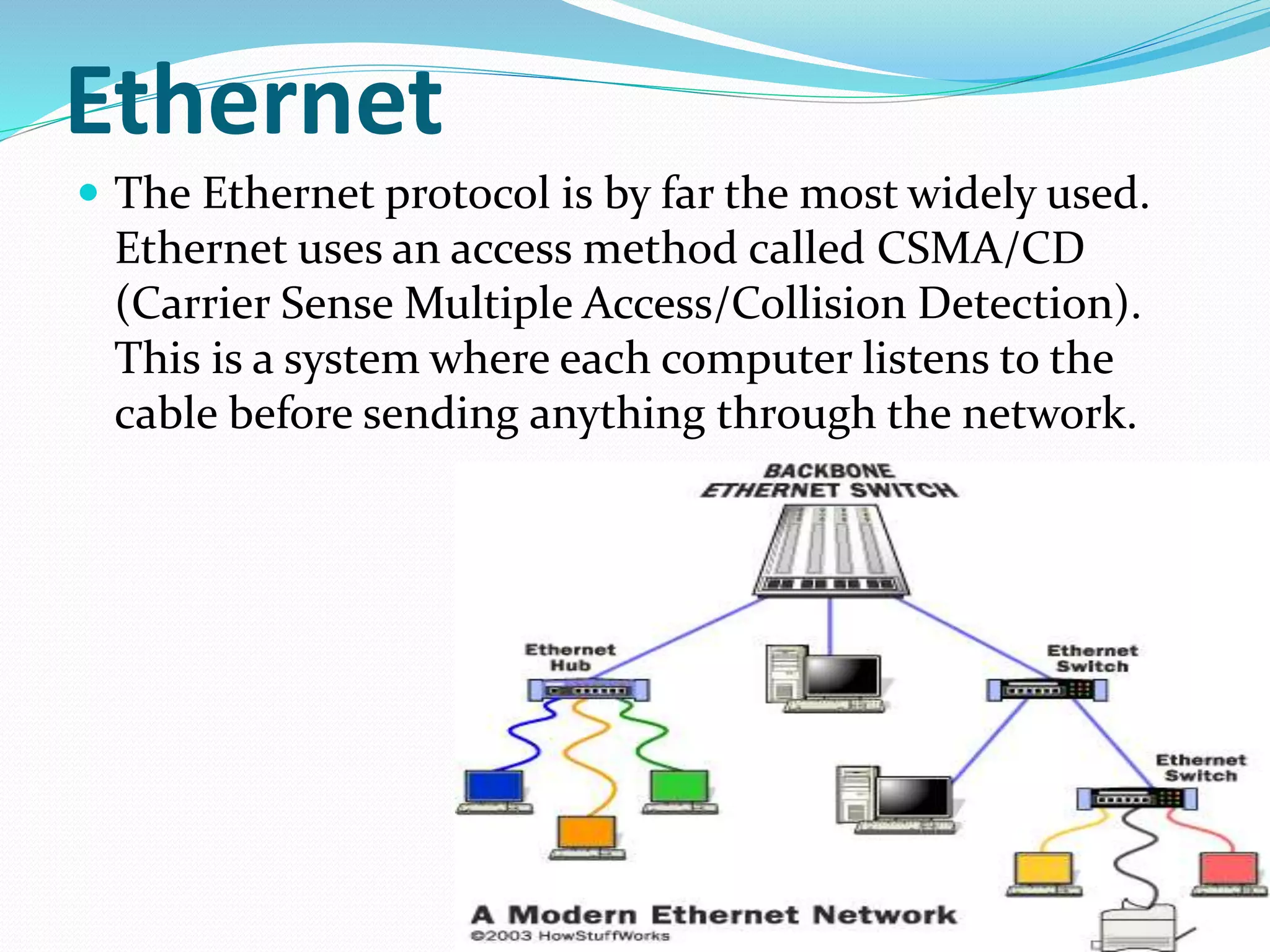
 The Ethernet protocol is by far the most widely used.
Ethernet uses an access method called CSMA/CD
(Carrier Sense Multiple Access/Collision Detection).
This is a system where each computer listens to the
cable before sending anything through the network.
Local Talk
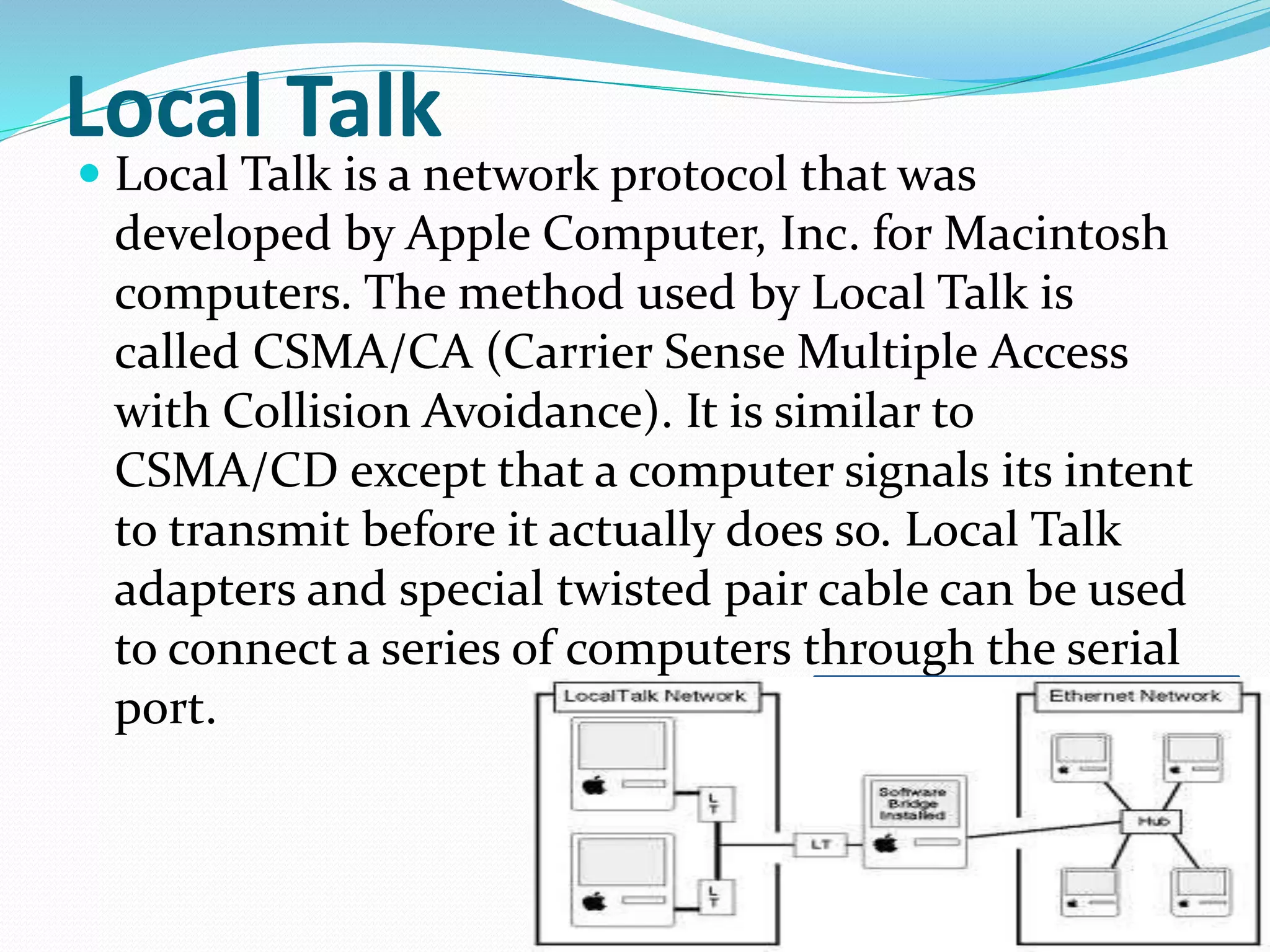
 Local Talk is a network protocol that was
developed by Apple Computer, Inc. for Macintosh
computers. The method used by Local Talk is
called CSMA/CA (Carrier Sense Multiple Access
with Collision Avoidance). It is similar to
CSMA/CD except that a computer signals its intent
to transmit before it actually does so. Local Talk
adapters and special twisted pair cable can be used
to connect a series of computers through the serial
port.
Token Ring
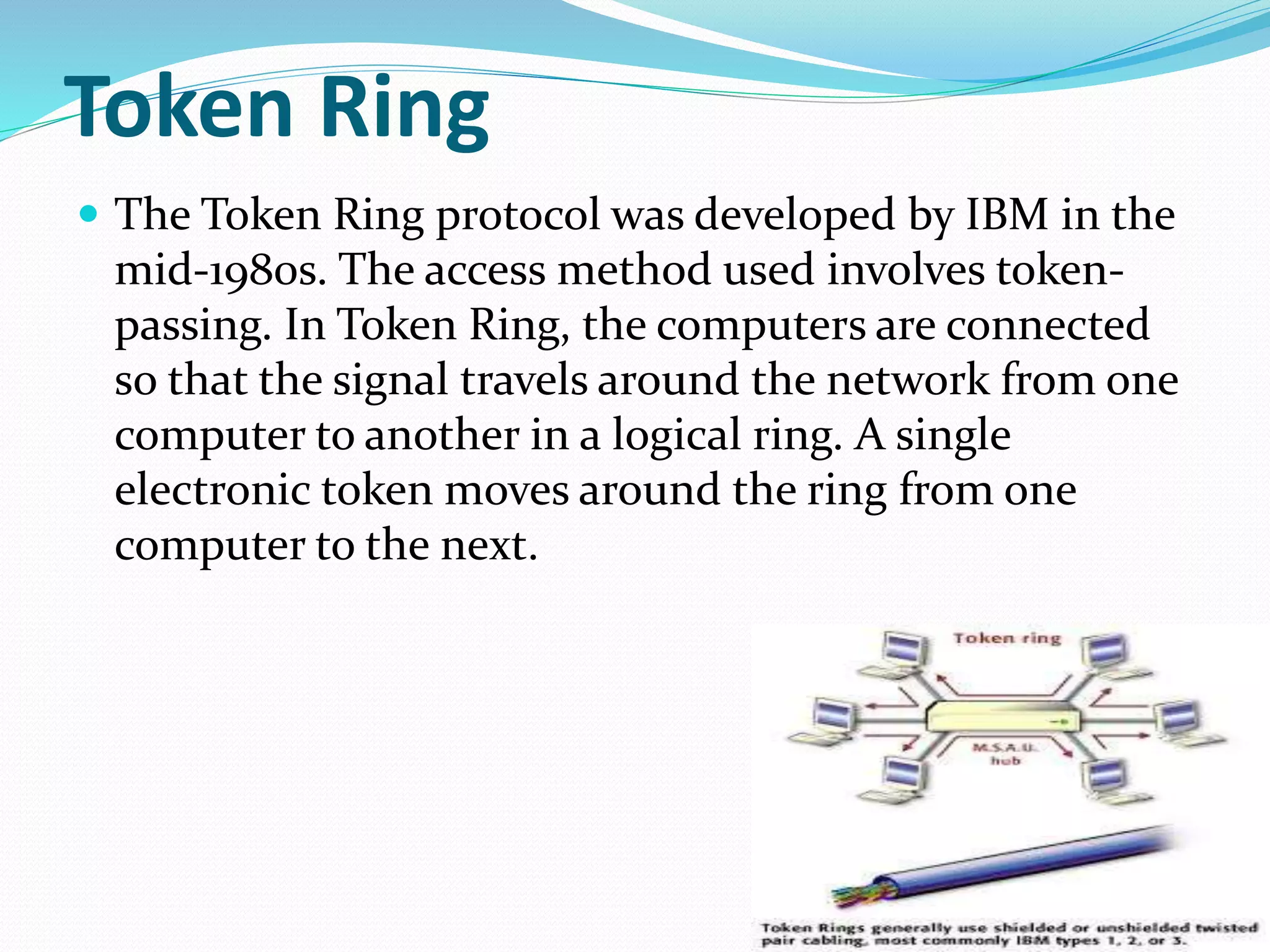
 The Token Ring protocol was developed by IBM in the
mid-1980s. The access method used involves token-
passing. In Token Ring, the computers are connected
so that the signal travels around the network from one
computer to another in a logical ring. A single
electronic token moves around the ring from one
computer to the next.
FDDI
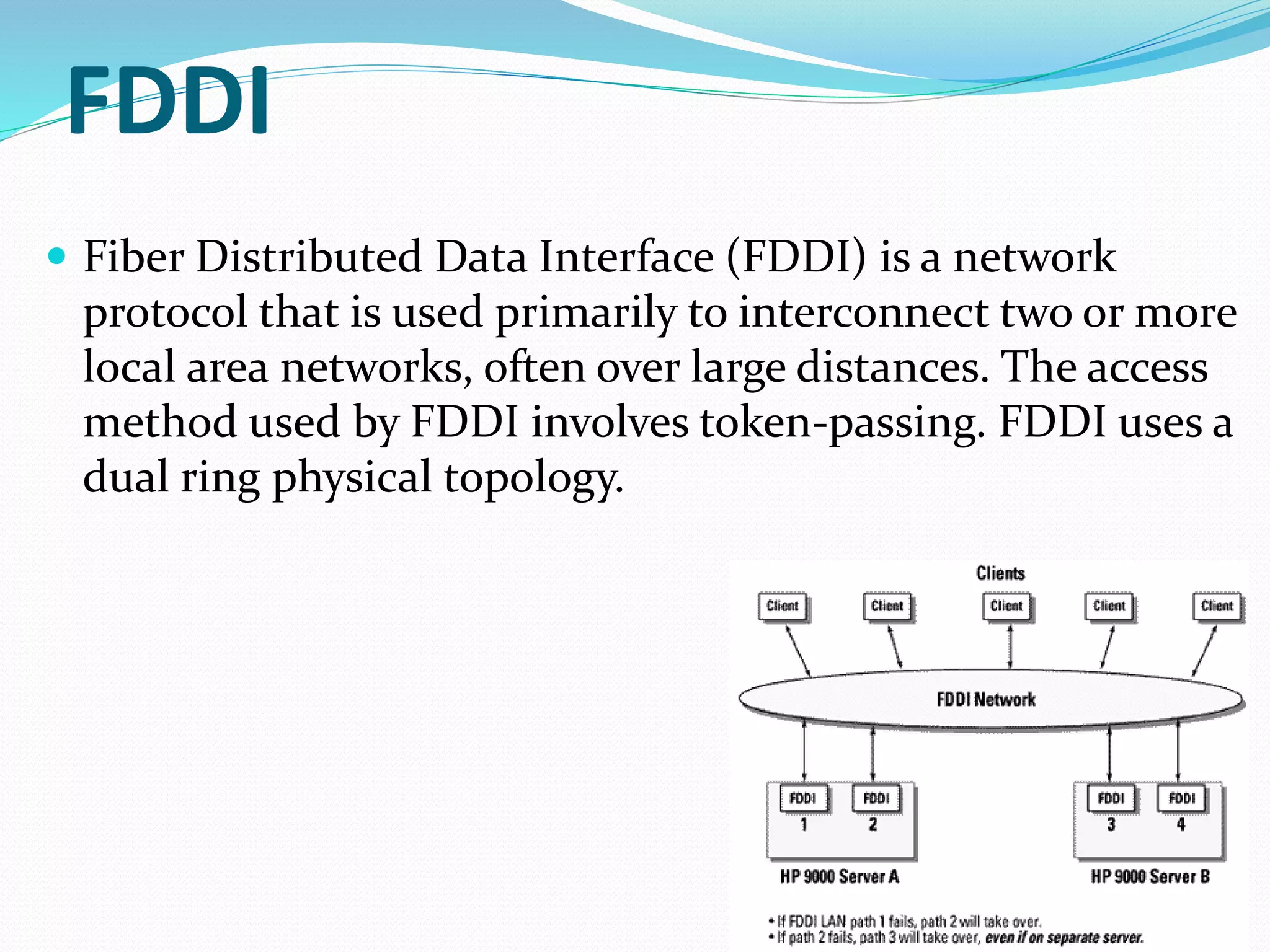
 Fiber Distributed Data Interface (FDDI) is a network
protocol that is used primarily to interconnect two or more
local area networks, often over large distances. The access
method used by FDDI involves token-passing. FDDI uses a
dual ring physical topology.
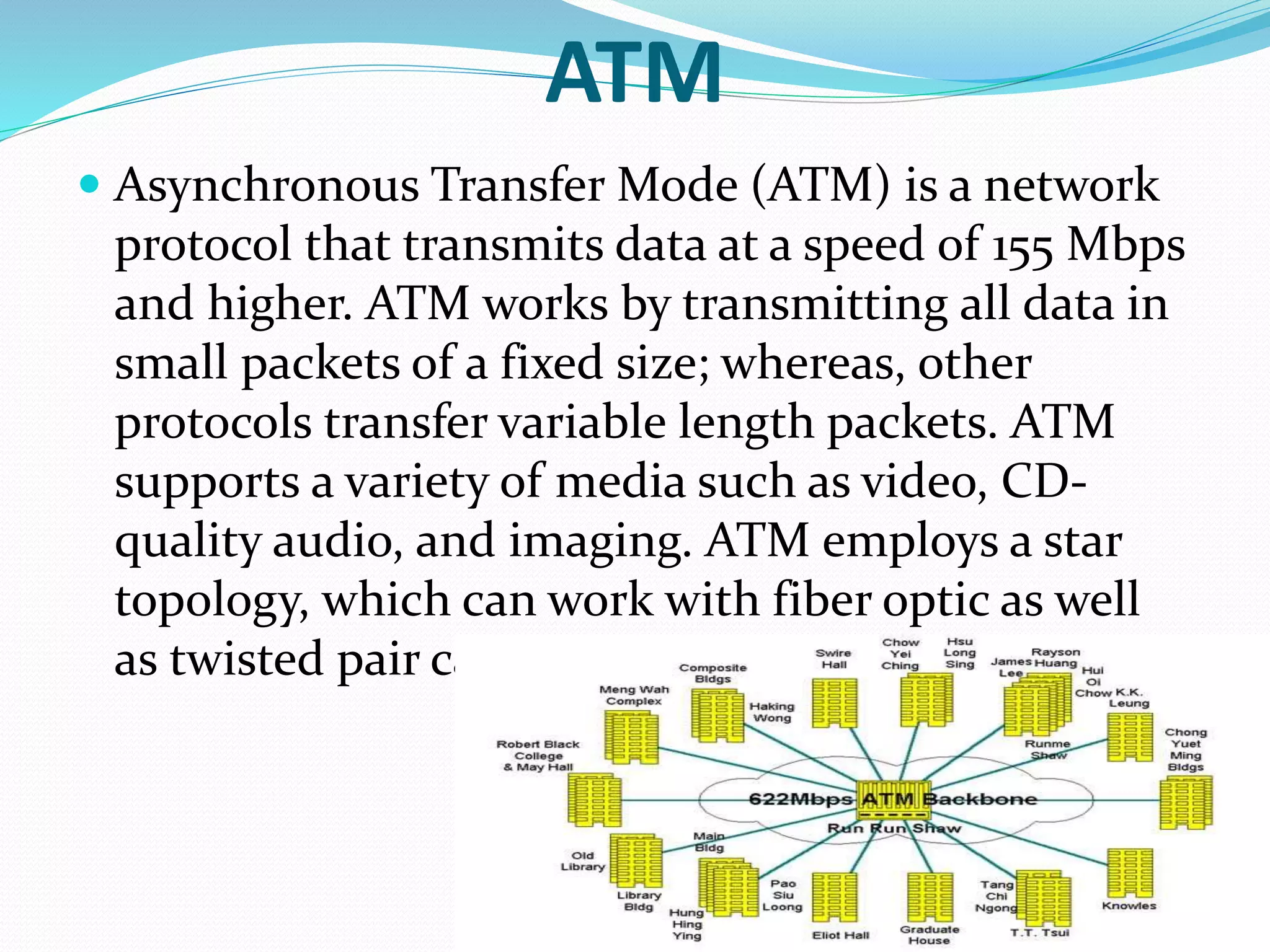
ATM
 Asynchronous Transfer Mode (ATM) is a network
protocol that transmits data at a speed of 155 Mbps
and higher. ATM works by transmitting all data in
small packets of a fixed size; whereas, other
protocols transfer variable length packets. ATM
supports a variety of media such as video, CD-
quality audio, and imaging. ATM employs a star
topology, which can work with fiber optic as well
as twisted pair cable.
Benefits
 Communicating over a network is a complicated task.
Different hardware elements in the network need to be
informed of the process in hand and instructed in their
role. Each element has its own requirements and a set
format for receiving instructions. Both the sender and
receiver must communicate in the same language and all
connecting hardware and software must be able to
exchange control information. The benefits of using
network protocols are that all these tasks have already
been mapped out by someone else, and they have
published their knowledge for others to share.
Needs
 Human intercommunication (in pairs or larger groups)
requires rules of conversation (do not speak if
someone else is speaking) to function effectively.
 Computers are no different. Consider the following
simplistic analogy:
 Therefore, we need regulations and rules to how we
communicate over a computer network. For example
to remote login (telnet), FTP or email.
 The set of rules and regulations is called a Protocol.
Functions
The function of protocols in a network and how each
protocol works in one or more layers of the open
systems interconnection (OSI) model, why protocols
are needed to enable computer communications, and
describe common protocol suites.
Objectives
 Appreciate the role of measurement in building and
maintaining high-performance TCP/IP networks
 Explain the types of tools available for performance
measurement
 Familiarize with freely available performance
measurement and testing tools
 Select an appropriate tool for a given task
Advantages
1. Many computers from all the world can connect
together, because they are using the international
standard.
2. Easier maintenance and installation because you get
used on the standard.
Disadvantages
1. Problems Occur in Standards, it will be international
problem.
2. All companies and manufactures must follow the
standards instead of developing new techniques.
CONCLUSION
While the age-old concept of the network is
foundational in virtually all areas of society, Computer
Networks and Protocols have forever changed the way
humans will work, play, and communicate. Forging
powerfully into areas of our lives that no one had
expected, digital networking is further empowering us
for the future. New protocols and standards will
emerge, new applications will be conceived, and our
lives will be further changed and enhanced.
Network protocol

Network protocol

  • 1.
    University of Mysore Dosin Library and Information Science Seminar Topic: “Network protocol” Presented To, Prof. Chandrashekar M. Dos in LISc Presented by, Swamy nayaka C K 2nd year MLISc Dos in LISc
  • 2.
    Network Protocol A protocolis a set of rules that governs the communications between computers on a network. These rules include guidelines that regulate the following characteristics of a network: access method, allowed physical topologies, types of cabling, and speed of data transfer.
  • 3.
    What is aProtocol?  Protocol is a controlled sequence of messages that is exchanged between two or more systems to accomplish a given task.  Protocol specifications define this sequence together with the format or layout of the messages that are exchanged.
  • 4.
    Definition  A communicationsprotocol is a system of digital rules for message exchange within or between computers. Communicating systems use well-defined formats for exchanging messages. Each message has an exact meaning intended to provoke a particular response of the receiver. ...
  • 5.
    History  The Internetprotocol suite resulted from research and development conducted by the Defense Advanced Research Projects Agency (DARPA) in the late 1960s. After initiating the pioneering ARPANET in 1969, DARPA started work on a number of other data transmission technologies. In 1972, Robert E. Kahn joined the DARPA Information Processing Technology Office, where he worked on both satellite packet networks and ground-based radio packet networks, and recognized the value of being able to communicate across both. In the spring of 1973, Vinton Cerf, the developer of the existing ARPANET Network Control Program (NCP) protocol, joined Kahn to work on open-architecture interconnection models with the goal of designing the next protocol generation for the ARPANET.
  • 6.
    Protocol development  Forcommunication to take place, protocols have to be agreed upon. Recall that in digital computing systems, the rules can be expressed by algorithms and data structures, raising the opportunity of hardware independence. Expressing the algorithms in a portable programming language, makes the protocol software operating system independent. The source code could be considered a protocol specification. This form of specification, however is not suitable for the parties involved.
  • 7.
    Common types ofprotocols The Internet Protocol is used in concert with other protocols within the Internet Protocol Suite. Prominent members of which include:  Transmission Control Protocol (TCP)  User Datagram Protocol (UDP)  Internet Control Message Protocol (ICMP)  Hypertext Transfer Protocol (HTTP)  Post Office Protocol (POP)  File Transfer Protocol (FTP)  Internet Message Access Protocol (IMAP)
  • 8.
    Types of NetworkProtocols  Ethernet  Local Talk  Token Ring  FDDI  ATM
  • 9.
    Ethernet  The Ethernetprotocol is by far the most widely used. Ethernet uses an access method called CSMA/CD (Carrier Sense Multiple Access/Collision Detection). This is a system where each computer listens to the cable before sending anything through the network.
  • 10.
    Local Talk  LocalTalk is a network protocol that was developed by Apple Computer, Inc. for Macintosh computers. The method used by Local Talk is called CSMA/CA (Carrier Sense Multiple Access with Collision Avoidance). It is similar to CSMA/CD except that a computer signals its intent to transmit before it actually does so. Local Talk adapters and special twisted pair cable can be used to connect a series of computers through the serial port.
  • 11.
    Token Ring  TheToken Ring protocol was developed by IBM in the mid-1980s. The access method used involves token- passing. In Token Ring, the computers are connected so that the signal travels around the network from one computer to another in a logical ring. A single electronic token moves around the ring from one computer to the next.
  • 12.
    FDDI  Fiber DistributedData Interface (FDDI) is a network protocol that is used primarily to interconnect two or more local area networks, often over large distances. The access method used by FDDI involves token-passing. FDDI uses a dual ring physical topology.
  • 13.
    ATM  Asynchronous TransferMode (ATM) is a network protocol that transmits data at a speed of 155 Mbps and higher. ATM works by transmitting all data in small packets of a fixed size; whereas, other protocols transfer variable length packets. ATM supports a variety of media such as video, CD- quality audio, and imaging. ATM employs a star topology, which can work with fiber optic as well as twisted pair cable.
  • 14.
    Benefits  Communicating overa network is a complicated task. Different hardware elements in the network need to be informed of the process in hand and instructed in their role. Each element has its own requirements and a set format for receiving instructions. Both the sender and receiver must communicate in the same language and all connecting hardware and software must be able to exchange control information. The benefits of using network protocols are that all these tasks have already been mapped out by someone else, and they have published their knowledge for others to share.
  • 15.
    Needs  Human intercommunication(in pairs or larger groups) requires rules of conversation (do not speak if someone else is speaking) to function effectively.  Computers are no different. Consider the following simplistic analogy:
  • 16.
     Therefore, weneed regulations and rules to how we communicate over a computer network. For example to remote login (telnet), FTP or email.  The set of rules and regulations is called a Protocol.
  • 17.
    Functions The function ofprotocols in a network and how each protocol works in one or more layers of the open systems interconnection (OSI) model, why protocols are needed to enable computer communications, and describe common protocol suites.
  • 18.
    Objectives  Appreciate therole of measurement in building and maintaining high-performance TCP/IP networks  Explain the types of tools available for performance measurement  Familiarize with freely available performance measurement and testing tools  Select an appropriate tool for a given task
  • 19.
    Advantages 1. Many computersfrom all the world can connect together, because they are using the international standard. 2. Easier maintenance and installation because you get used on the standard.
  • 20.
    Disadvantages 1. Problems Occurin Standards, it will be international problem. 2. All companies and manufactures must follow the standards instead of developing new techniques.
  • 21.
    CONCLUSION While the age-oldconcept of the network is foundational in virtually all areas of society, Computer Networks and Protocols have forever changed the way humans will work, play, and communicate. Forging powerfully into areas of our lives that no one had expected, digital networking is further empowering us for the future. New protocols and standards will emerge, new applications will be conceived, and our lives will be further changed and enhanced.