
LEVERS AND ITS TYPES
Prepared By
Ronnith
Nandy
-
Levers are one of basic tools that were probably used in prehistoric times. It
is assumed that in ancient Egypt, constructors used the lever to move and
uplift obelisks weighing more than 100 tons.
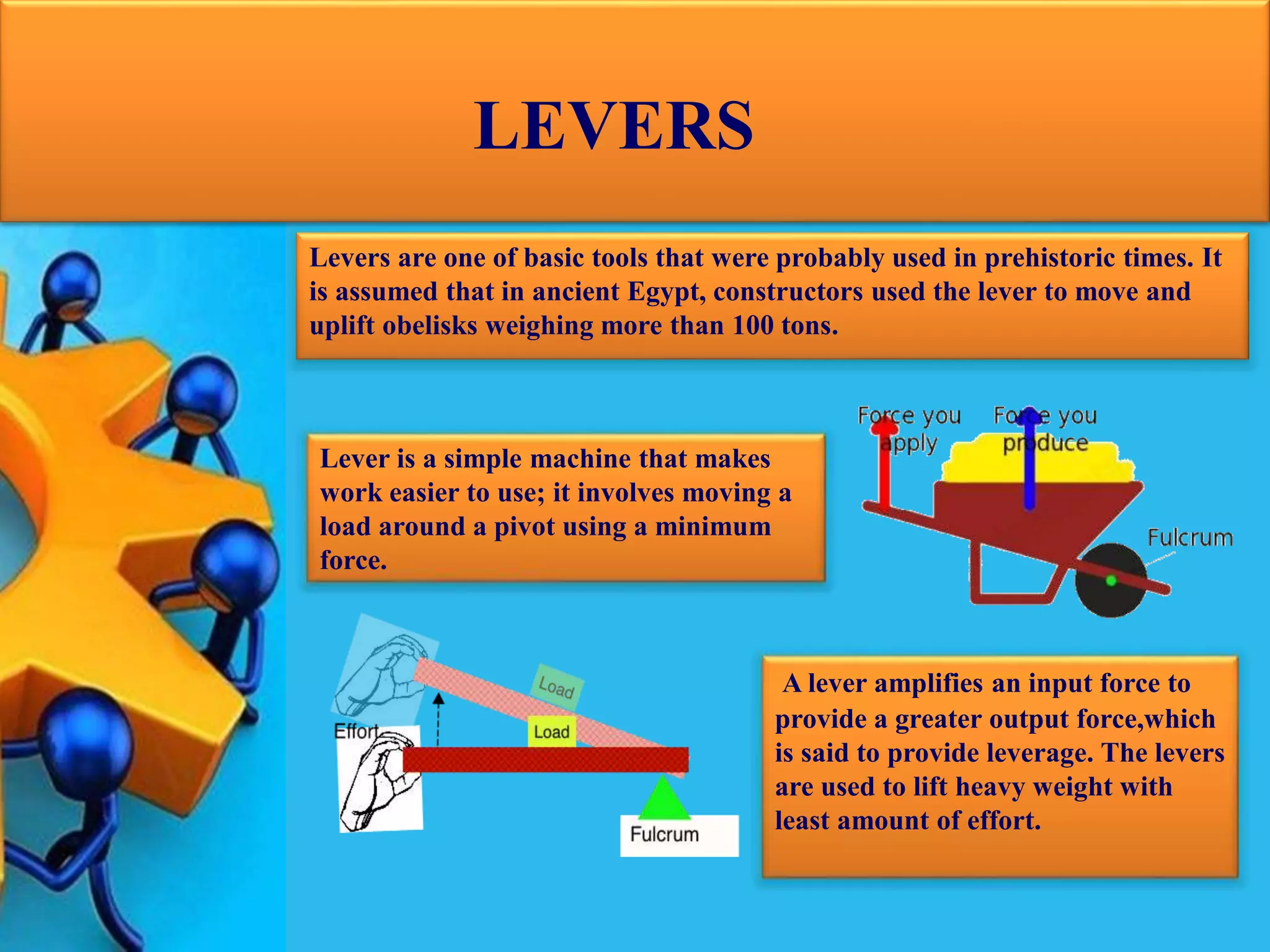
Lever is a simple machine that makes
work easier to use; it involves moving a
load around a pivot using a minimum
force.
A lever amplifies an input force to
provide a greater output force,which
is said to provide leverage. The levers
are used to lift heavy weight with
least amount of effort.
LEVERS
-
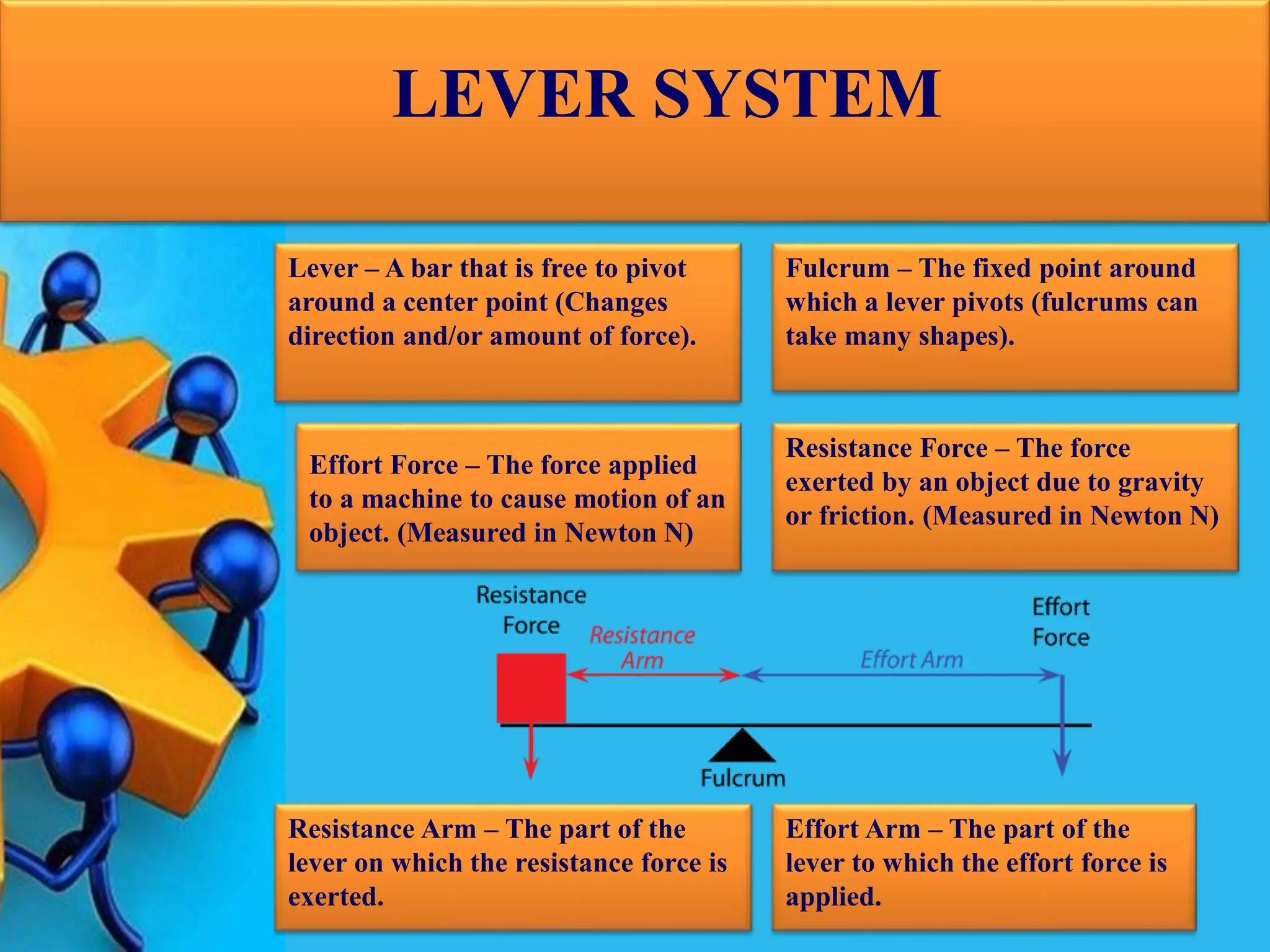
Lever – A bar that is free to pivot
around a center point (Changes
direction and/or amount of force).
Fulcrum – The fixed point around
which a lever pivots (fulcrums can
take many shapes).
Effort Force – The force applied
to a machine to cause motion of an
object. (Measured in Newton N)
Resistance Force – The force
exerted by an object due to gravity
or friction. (Measured in Newton N)
Resistance Arm – The part of the
lever on which the resistance force is
exerted.
Effort Arm – The part of the
lever to which the effort force is
applied.
LEVER SYSTEM
-PRINCIPLE OF LEVER
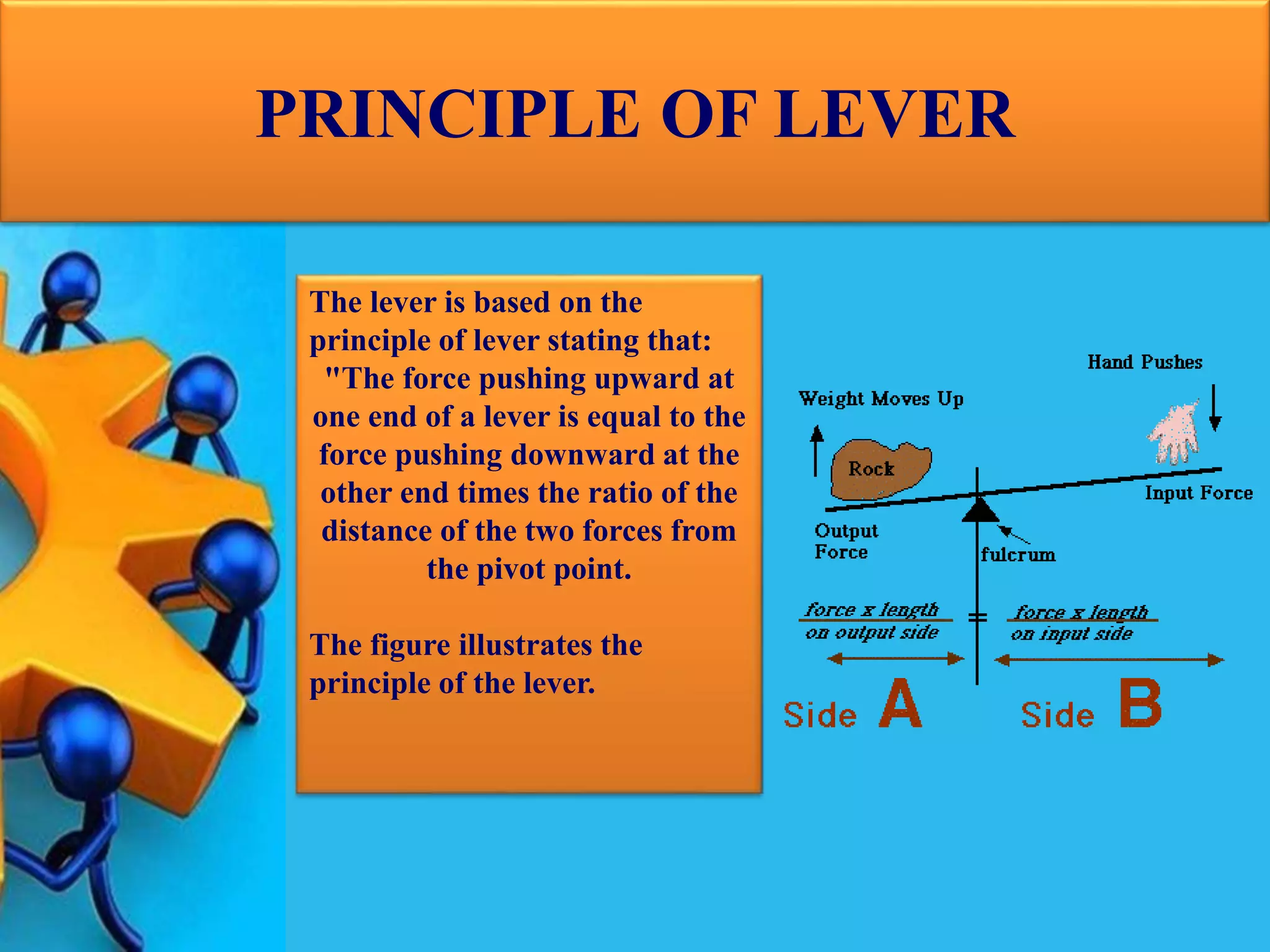
The lever is based on the
principle of lever stating that:
"The force pushing upward at
one end of a lever is equal to the
force pushing downward at the
other end times the ratio of the
distance of the two forces from
the pivot point.
The figure illustrates the
principle of the lever.
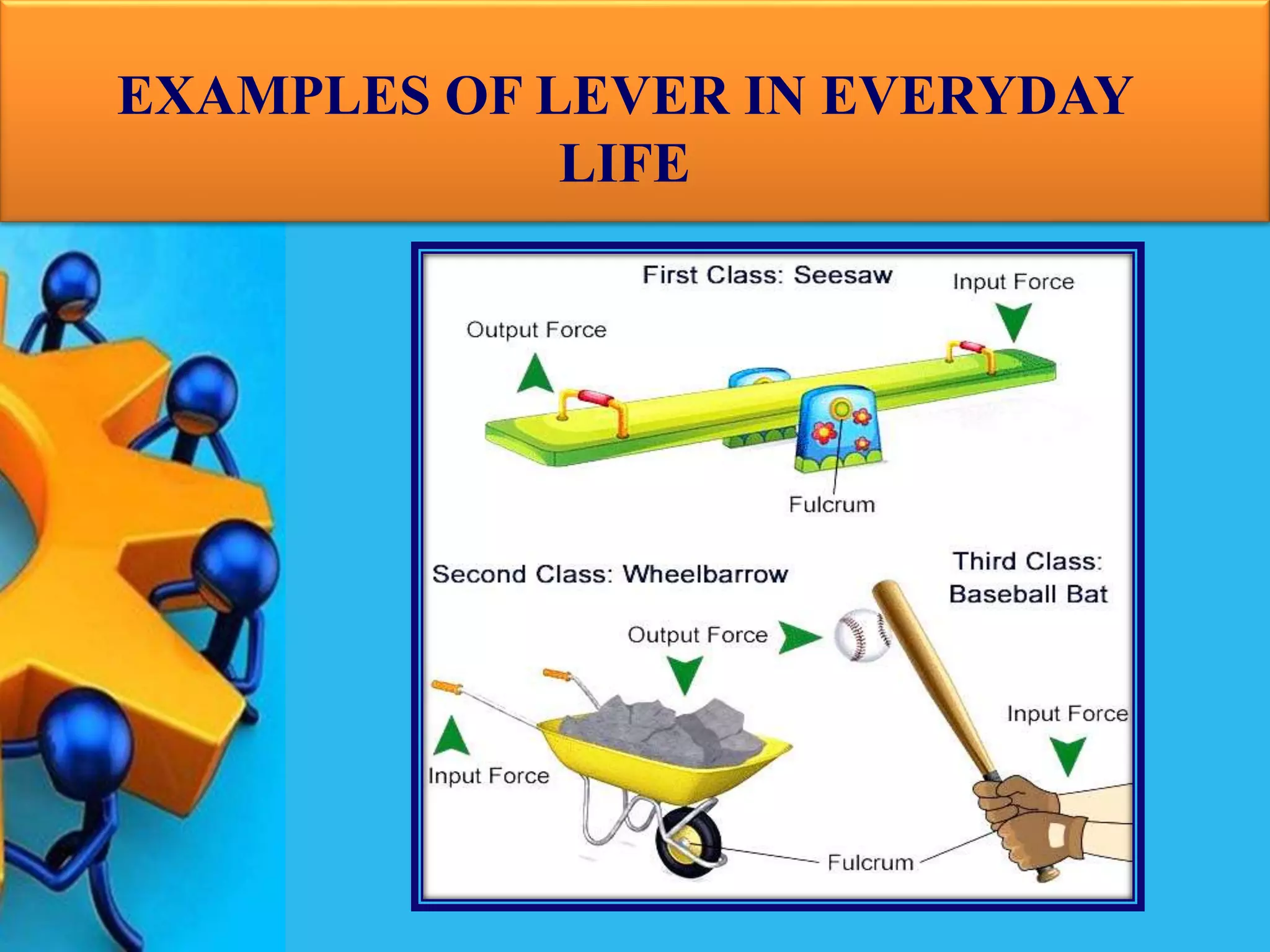
-EXAMPLES OF LEVER IN EVERYDAY
LIFE
-
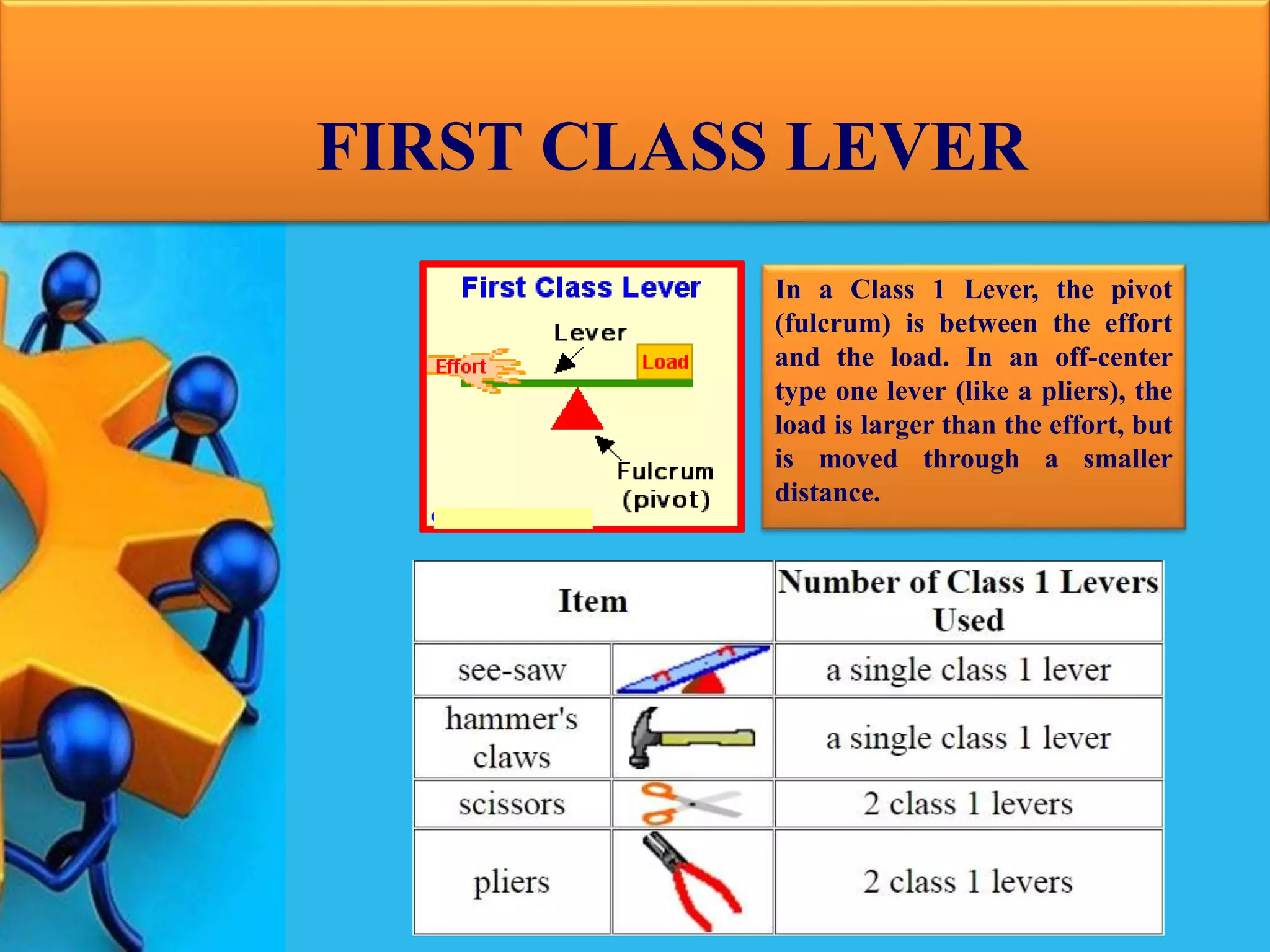
In a Class 1 Lever, the pivot
(fulcrum) is between the effort
and the load. In an off-center
type one lever (like a pliers), the
load is larger than the effort, but
is moved through a smaller
distance.
FIRST CLASS LEVER
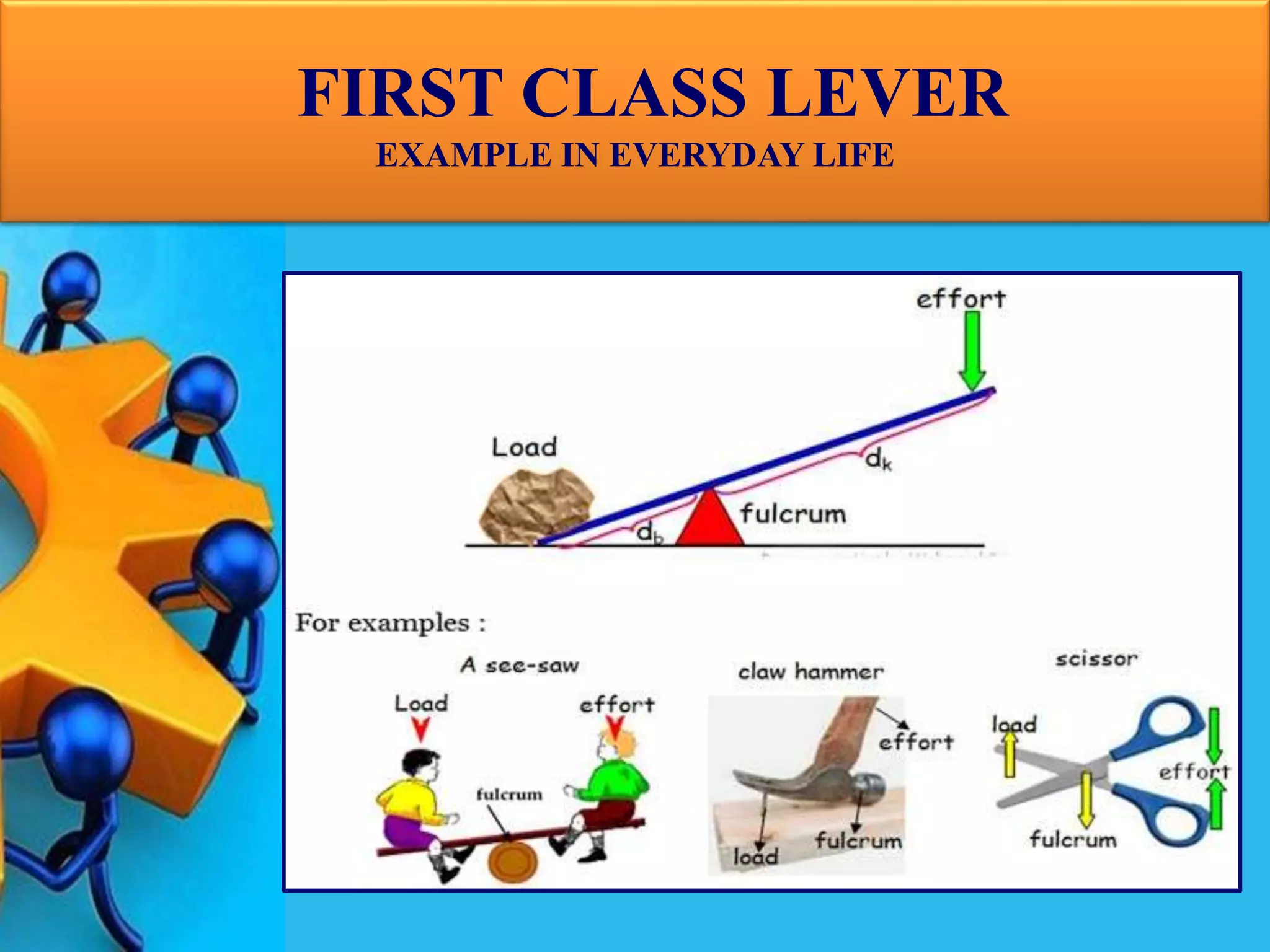
-FIRST CLASS LEVER
EXAMPLE IN EVERYDAY LIFE
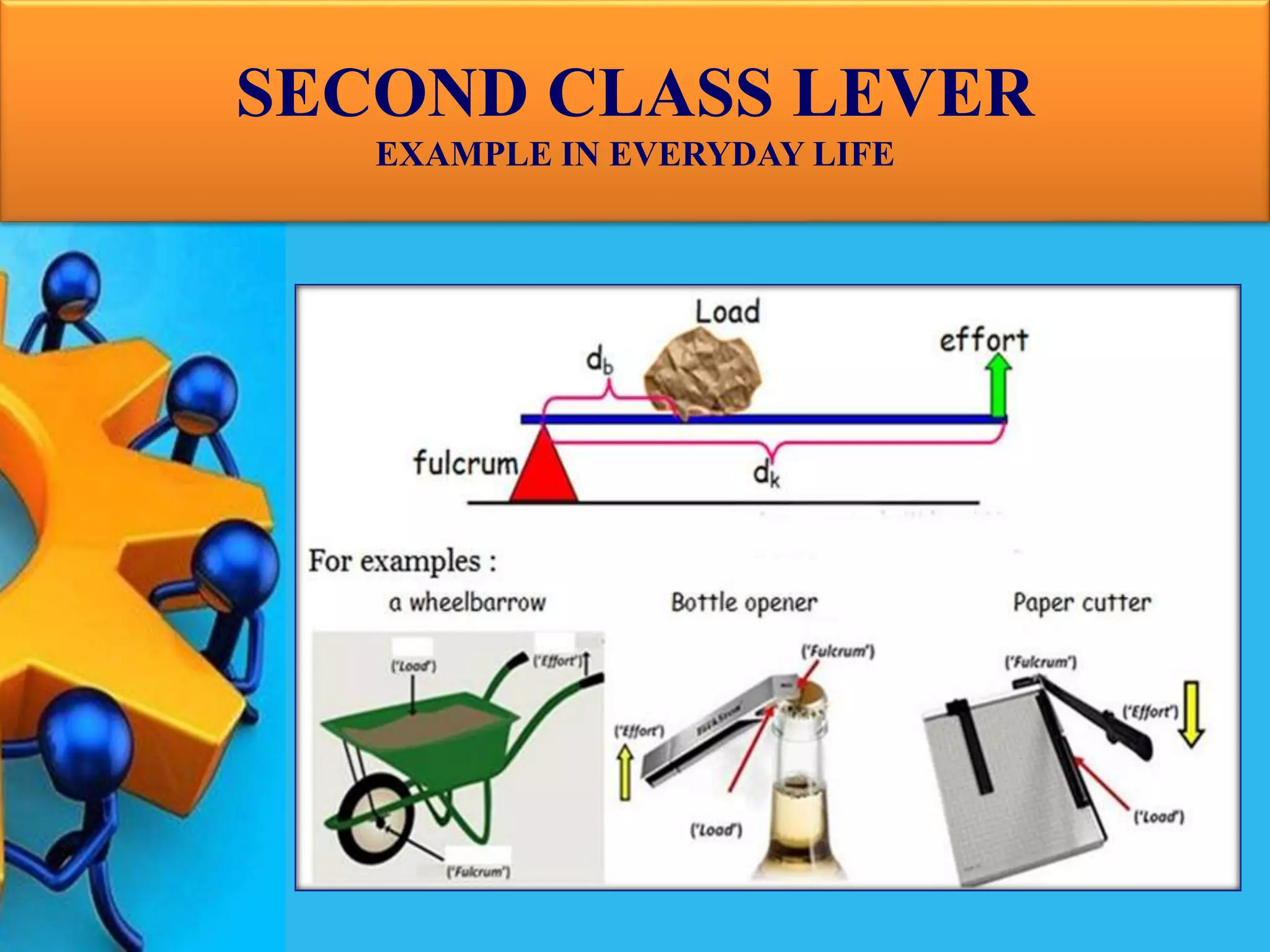
-SECOND-CLASS LEVERS
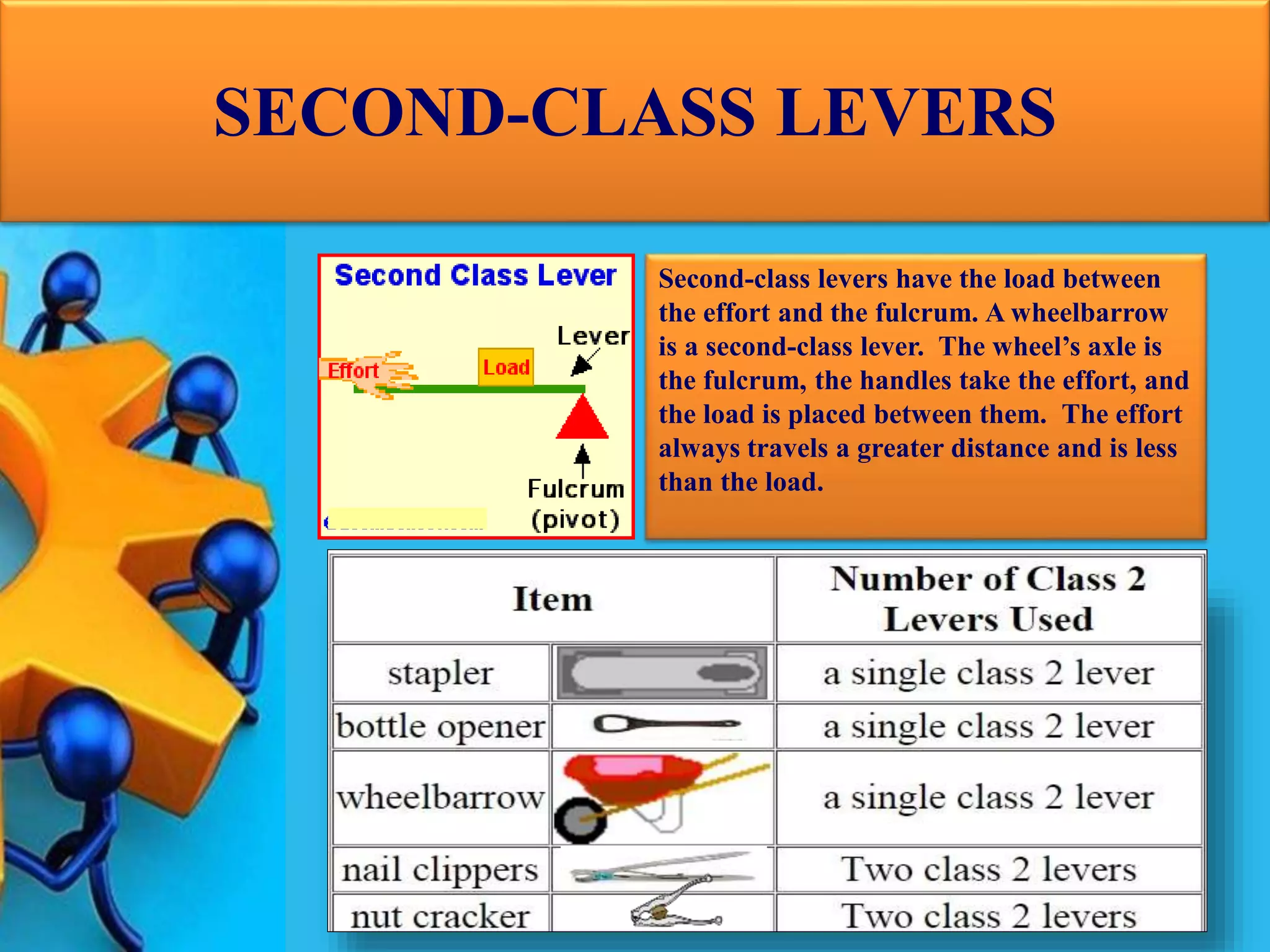
Second-class levers have the load between
the effort and the fulcrum. A wheelbarrow
is a second-class lever. The wheel’s axle is
the fulcrum, the handles take the effort, and
the load is placed between them. The effort
always travels a greater distance and is less
than the load.
-SECOND CLASS LEVER
EXAMPLE IN EVERYDAY LIFE
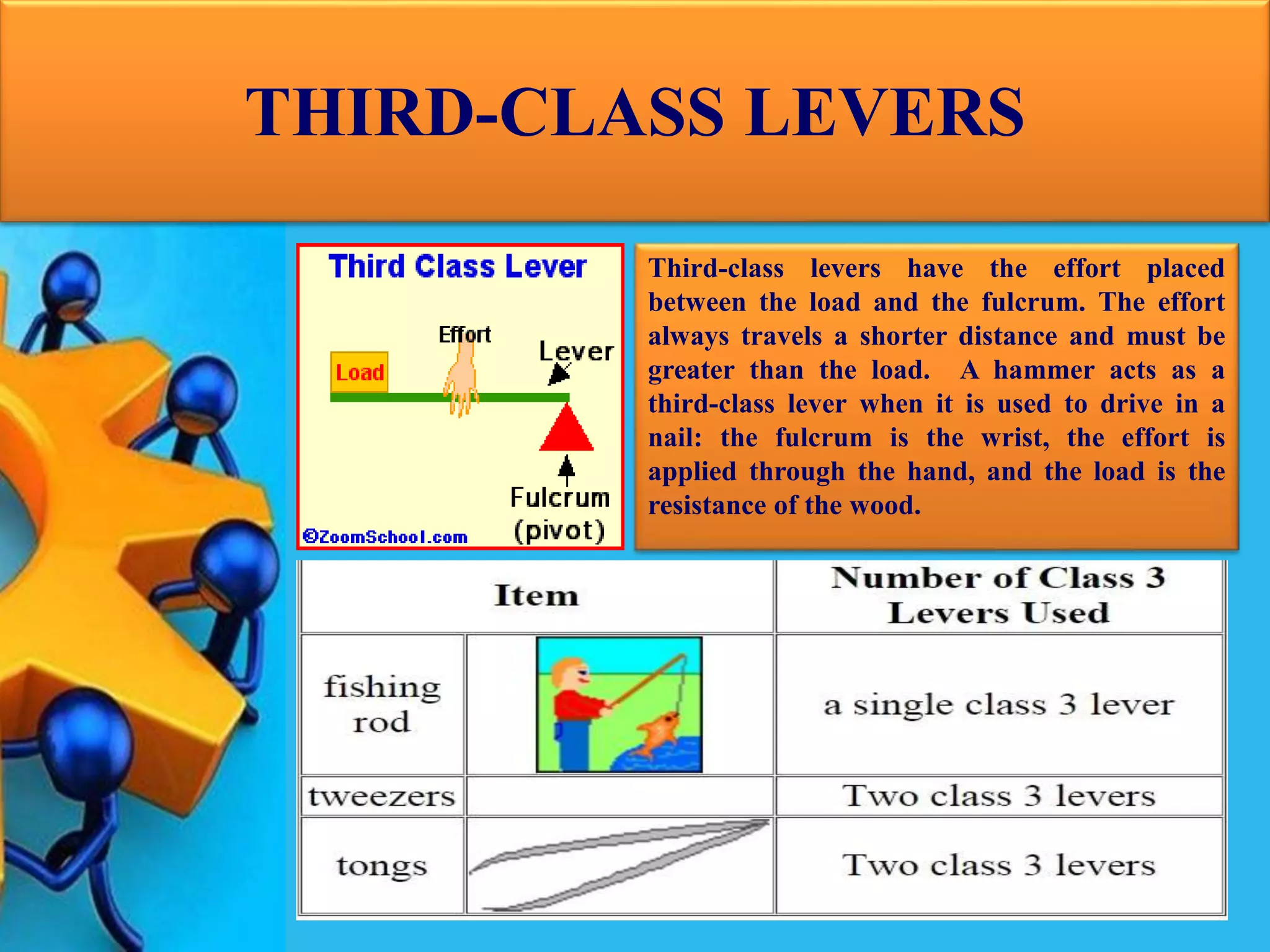
-THIRD-CLASS LEVERS
Third-class levers have the effort placed
between the load and the fulcrum. The effort
always travels a shorter distance and must be
greater than the load. A hammer acts as a
third-class lever when it is used to drive in a
nail: the fulcrum is the wrist, the effort is
applied through the hand, and the load is the
resistance of the wood.
-
THIRD CLASS LEVER
EXAMPLE IN EVERYDAY LIFE
-
THANK YOU

Lever and Its Types

  • 1.
    LEVERS AND ITSTYPES Prepared By Ronnith Nandy
  • 2.
    - Levers are oneof basic tools that were probably used in prehistoric times. It is assumed that in ancient Egypt, constructors used the lever to move and uplift obelisks weighing more than 100 tons. Lever is a simple machine that makes work easier to use; it involves moving a load around a pivot using a minimum force. A lever amplifies an input force to provide a greater output force,which is said to provide leverage. The levers are used to lift heavy weight with least amount of effort. LEVERS
  • 3.
    - Lever – Abar that is free to pivot around a center point (Changes direction and/or amount of force). Fulcrum – The fixed point around which a lever pivots (fulcrums can take many shapes). Effort Force – The force applied to a machine to cause motion of an object. (Measured in Newton N) Resistance Force – The force exerted by an object due to gravity or friction. (Measured in Newton N) Resistance Arm – The part of the lever on which the resistance force is exerted. Effort Arm – The part of the lever to which the effort force is applied. LEVER SYSTEM
  • 4.
    -PRINCIPLE OF LEVER Thelever is based on the principle of lever stating that: "The force pushing upward at one end of a lever is equal to the force pushing downward at the other end times the ratio of the distance of the two forces from the pivot point. The figure illustrates the principle of the lever.
  • 5.
    -EXAMPLES OF LEVERIN EVERYDAY LIFE
  • 6.
    - In a Class1 Lever, the pivot (fulcrum) is between the effort and the load. In an off-center type one lever (like a pliers), the load is larger than the effort, but is moved through a smaller distance. FIRST CLASS LEVER
  • 7.
  • 8.
    -SECOND-CLASS LEVERS Second-class levershave the load between the effort and the fulcrum. A wheelbarrow is a second-class lever. The wheel’s axle is the fulcrum, the handles take the effort, and the load is placed between them. The effort always travels a greater distance and is less than the load.
  • 9.
  • 10.
    -THIRD-CLASS LEVERS Third-class levershave the effort placed between the load and the fulcrum. The effort always travels a shorter distance and must be greater than the load. A hammer acts as a third-class lever when it is used to drive in a nail: the fulcrum is the wrist, the effort is applied through the hand, and the load is the resistance of the wood.
  • 11.
  • 12.