Types of business organisation Organisations fall into 3 different categories: Private  Voluntary State
Private Sector Private sector plays an important role creates goods and services employs millions of people varies in size from Shell and ICI to corner shops driving force for change and improvement
Sole Trader Most common form of business ownership: no complicated legal requirements decisions can be made quickly close contact with customers and employees all profits retained/high satisfaction
Sole Trader Some disadvantages: all decisions are made by owner long hours unlimited liability sourcing finance
Partnership 2-20 people in a partnership partners can share skills/knowledge organisation could provide 24/7 service easier to raise finance
Partnership Some disadvantages disputes unlimited liability (except sleeping partner) difficult to raise large amount of capital decision making process is slower
Partnership Deed Legally binding agreement covers share of profits, salary, drawings, duties and responsibilities, cessation of partnership, death of partner.
Ownership – Question…… Explain the advantages and disadvantages of being a sole trader. (6) Distinguish between operating as a sole trader and a partnership. (4) INTERNET RESEARCH –  PARTNERSHIPS – WHAT IS A LIMITED PARNTERSHIP WHAT HAPPENS WHEN A PARTNER DIES FIND THE BEST RATE OF INTEREST FOR  NEW BUSINESS START-UPS
Solution –  Distinguish between operating as a sole trader and a partnership. A sole trader is run by one person whereas a partnership is run by 2 – 20. A sole trader is able to make quick decisions whereas in a partnership decision making is slower as all partners are consulted. A partnership can raise more capital than a sole trader as all the partners introduce capital. A sole trader may work longer hours whereas in  a partnership the workload is shared.  It may be possible to trade 24/7 whereas this would be impossible in a sole trader.
The Company owned by shareholders - shareholders unlikely to run the company a separate legal body shareholders have limited liability company has to be registered with Companies House Articles of Association and Memorandum of Association must be provided
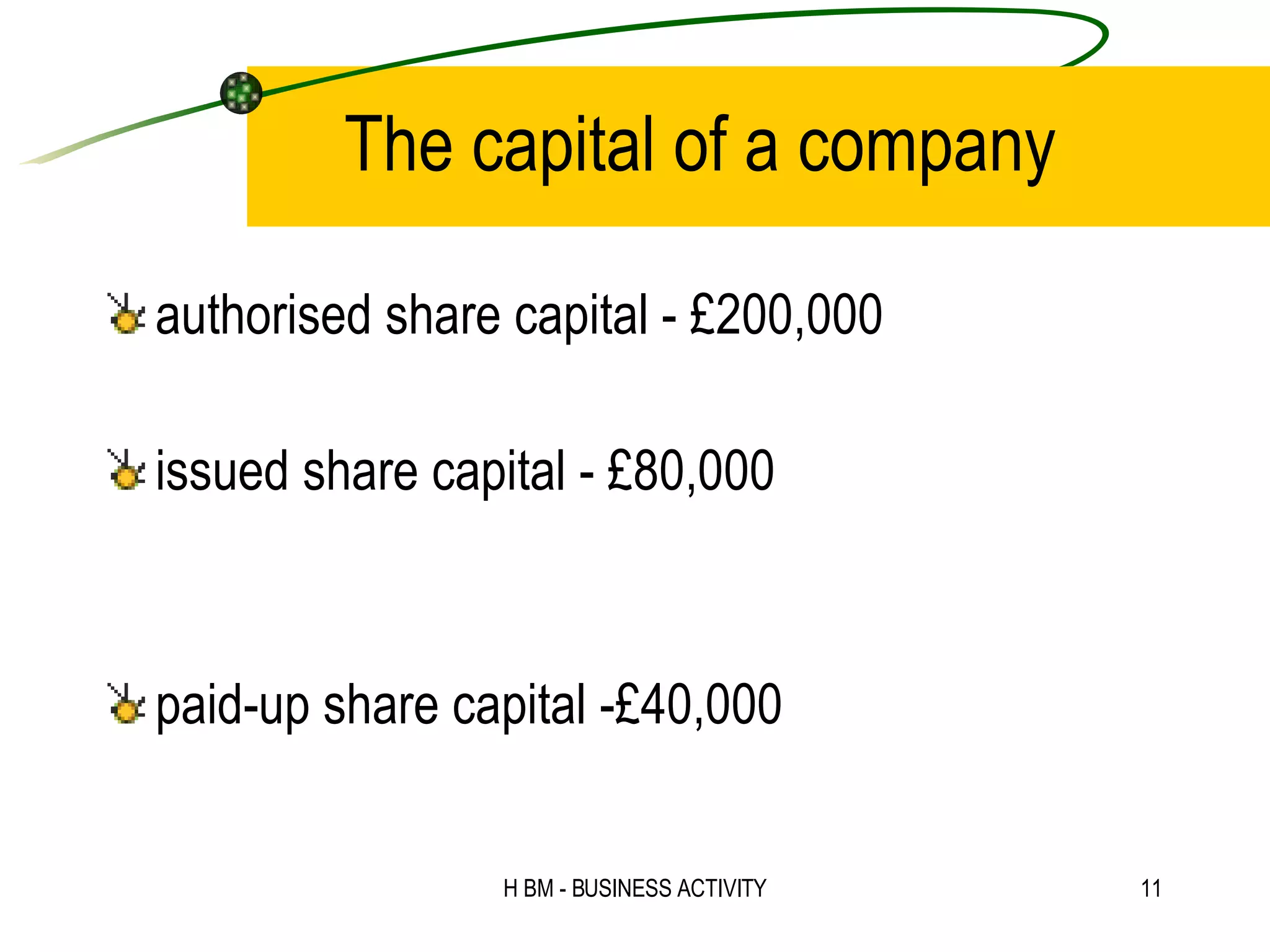
The capital of a company authorised share capital - £200,000 issued share capital - £80,000 paid-up share capital -£40,000
Private company (Ltd) Usually small shareholders 2+ shares  not  traded on Stock Exchange Shareholders are “invited”  - may be family or friends may find it easier to raise finance that unlimited liability organisations
Public company (plc) shares bought and sold in stock exchange large amounts of capital can be raised quickly costly to have shares quoted on SE may not raise all capital required if SE has a bad day original shareholders can lose control
Private Sector Questions Read pages 37 – 42 then complete the following questions in your jotter: Question 1 (page 38) Question 2 (page 39) Summary questions (page 45) “Orange” case study (page 46)
Franchises Growth area - increasingly popular form of ownership Hiring out of a good idea A franchise grants permission to sell a product and trade under a certain name within a defined area
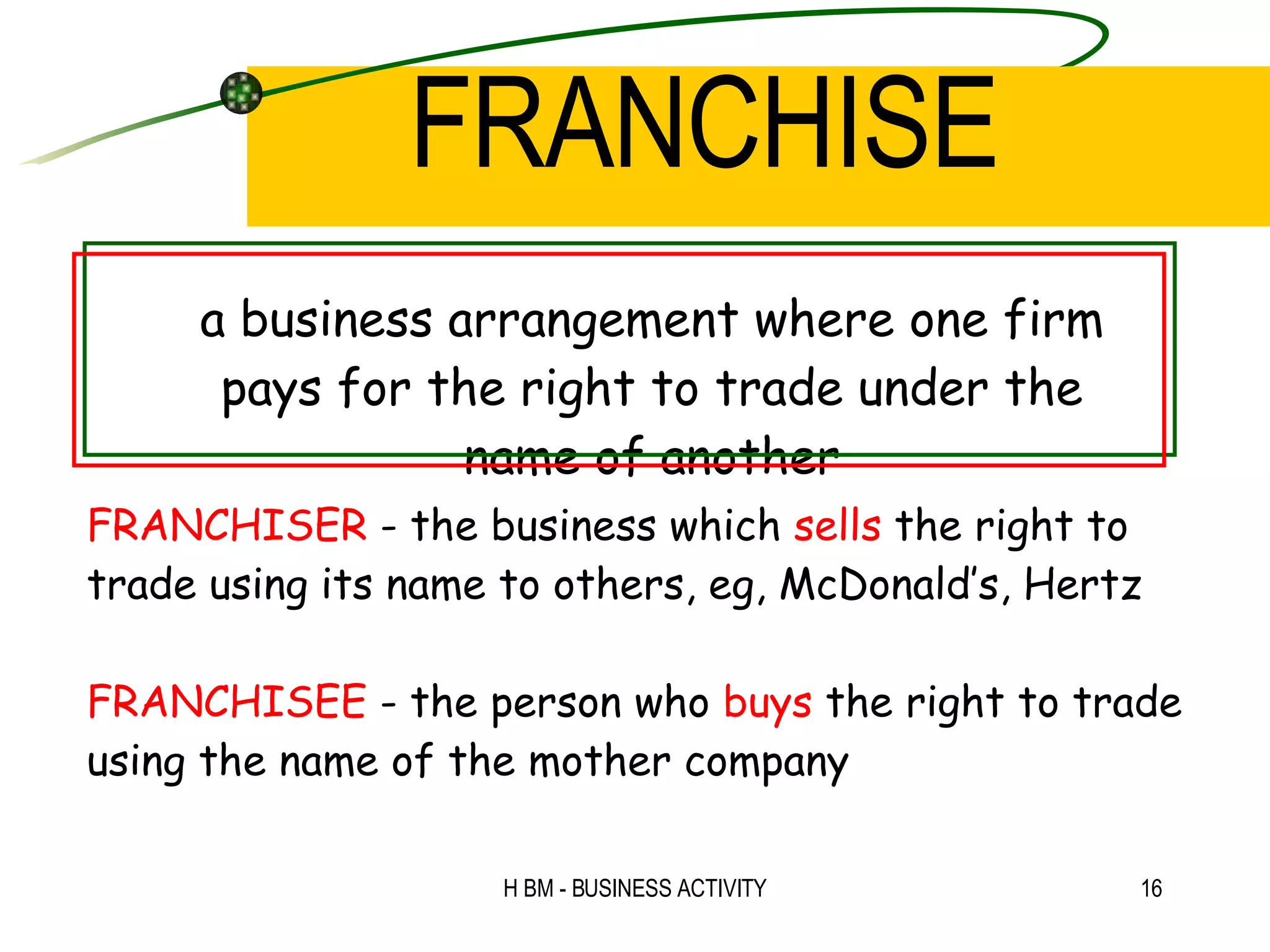
FRANCHISE a business arrangement where one firm pays for the right to trade under the name of another FRANCHISER  - the business which  sells  the right to trade using its name to others, eg, McDonald’s, Hertz  FRANCHISEE  - the person who  buys  the right to trade using the name of the mother company
franchise Franchiser sells the idea Franchisee pays for the franchise Capital has to be found by franchisee Materials/supplies must be bought from franchiser Percentage of profit/turnover returned to franchiser Franchisee has a local monopoly and is trading under a well-known name
Why buy a franchise? existing,  established product  therefore more chance of success cheaper market research and promotional costs may receive help and training from franchiser lower start up costs
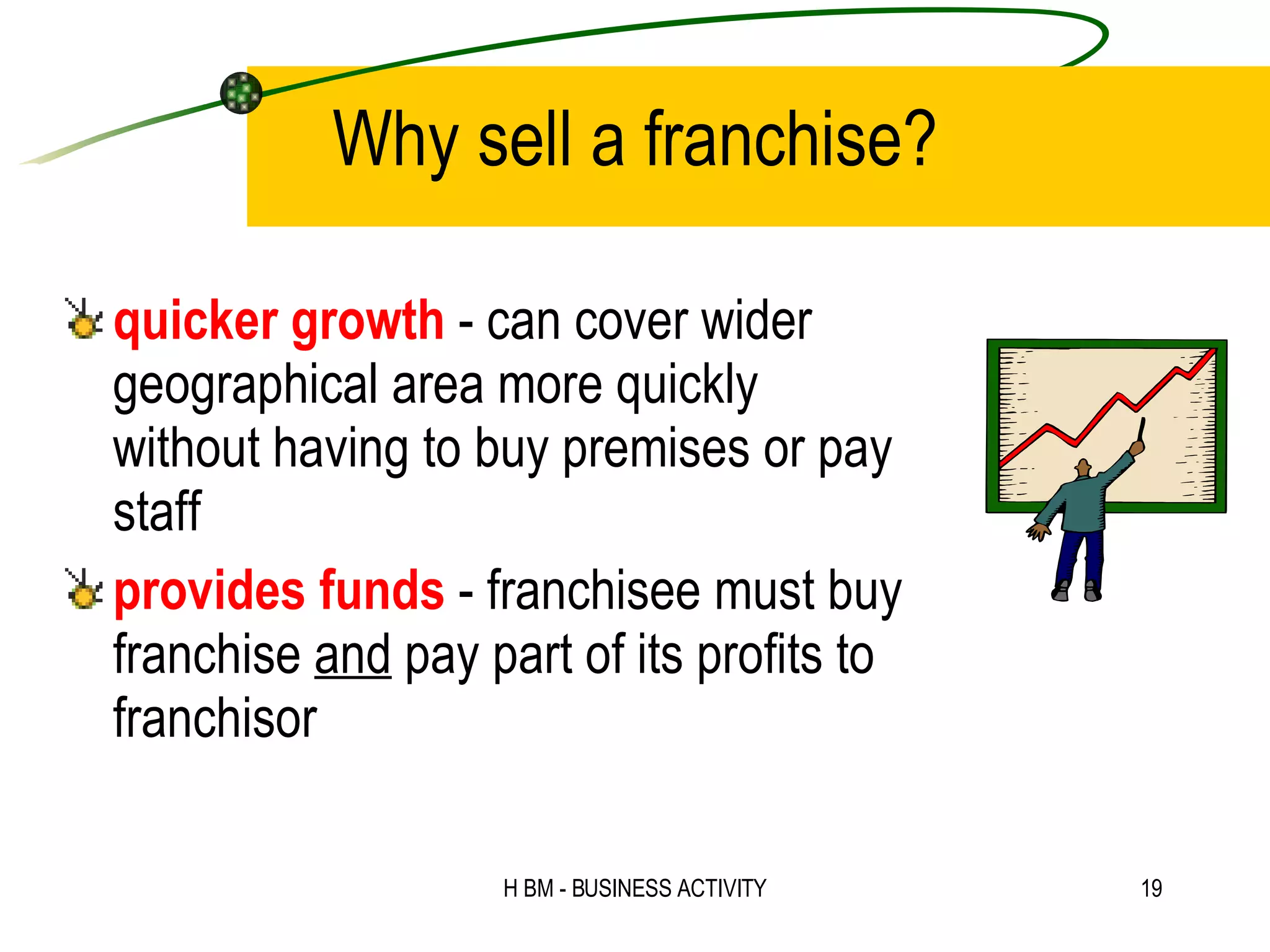
Why sell a franchise? quicker growth  - can cover wider geographical area more quickly without having to buy premises or pay staff provides funds  - franchisee must buy franchise  and  pay part of its profits to franchisor
DISADVANTAGES reputation  of the company/brand depends upon how good the franchisees are franchisees are bound by  contract  which restricts what they do part of  profits/turnover  must be paid to franchiser
Why so popular? 96% of franchises are still in profit after 5 years.(Only 66% of small firms survive the first 3 years) There are some 718 business format franchises in the UK comprising over 35,000 franchisees ­ all with a variety of former careers.  Average investment of £42,700 We all know that McDonalds and Thornton's Confectionary are franchised, but there are many others.
Franchising - Question Explain the costs and benefits of franchising  for: the franchisor The franchisee (8) To answer you  must  ID the cost or benefit  then  explain why it is a cost or a benefit.
Franchising - Question Explain the costs and benefits of franchising  for: the franchisor The franchisee (8) To answer you  must  ID the cost or benefit  then  explain why it is a cost or a cost or benefit. Answer: A benefit of franchising for the franchiser is   the potential to expand quickly .  They can expand quickly because  the franchiser can sell licences over a wide geographical area without having to manage the individual branches.  (1 mark) A cost to the franchiser   is the reputation of the company is outwith their   control .  This is because   the success of the business is dependent on the skills and expertise of individual franchisees   (1 marks)

2 Private Ownership

  • 1.
    Types of businessorganisation Organisations fall into 3 different categories: Private Voluntary State
  • 2.
    Private Sector Privatesector plays an important role creates goods and services employs millions of people varies in size from Shell and ICI to corner shops driving force for change and improvement
  • 3.
    Sole Trader Mostcommon form of business ownership: no complicated legal requirements decisions can be made quickly close contact with customers and employees all profits retained/high satisfaction
  • 4.
    Sole Trader Somedisadvantages: all decisions are made by owner long hours unlimited liability sourcing finance
  • 5.
    Partnership 2-20 peoplein a partnership partners can share skills/knowledge organisation could provide 24/7 service easier to raise finance
  • 6.
    Partnership Some disadvantagesdisputes unlimited liability (except sleeping partner) difficult to raise large amount of capital decision making process is slower
  • 7.
    Partnership Deed Legallybinding agreement covers share of profits, salary, drawings, duties and responsibilities, cessation of partnership, death of partner.
  • 8.
    Ownership – Question……Explain the advantages and disadvantages of being a sole trader. (6) Distinguish between operating as a sole trader and a partnership. (4) INTERNET RESEARCH – PARTNERSHIPS – WHAT IS A LIMITED PARNTERSHIP WHAT HAPPENS WHEN A PARTNER DIES FIND THE BEST RATE OF INTEREST FOR NEW BUSINESS START-UPS
  • 9.
    Solution – Distinguish between operating as a sole trader and a partnership. A sole trader is run by one person whereas a partnership is run by 2 – 20. A sole trader is able to make quick decisions whereas in a partnership decision making is slower as all partners are consulted. A partnership can raise more capital than a sole trader as all the partners introduce capital. A sole trader may work longer hours whereas in a partnership the workload is shared. It may be possible to trade 24/7 whereas this would be impossible in a sole trader.
  • 10.
    The Company ownedby shareholders - shareholders unlikely to run the company a separate legal body shareholders have limited liability company has to be registered with Companies House Articles of Association and Memorandum of Association must be provided
  • 11.
    The capital ofa company authorised share capital - £200,000 issued share capital - £80,000 paid-up share capital -£40,000
  • 12.
    Private company (Ltd)Usually small shareholders 2+ shares not traded on Stock Exchange Shareholders are “invited” - may be family or friends may find it easier to raise finance that unlimited liability organisations
  • 13.
    Public company (plc)shares bought and sold in stock exchange large amounts of capital can be raised quickly costly to have shares quoted on SE may not raise all capital required if SE has a bad day original shareholders can lose control
  • 14.
    Private Sector QuestionsRead pages 37 – 42 then complete the following questions in your jotter: Question 1 (page 38) Question 2 (page 39) Summary questions (page 45) “Orange” case study (page 46)
  • 15.
    Franchises Growth area- increasingly popular form of ownership Hiring out of a good idea A franchise grants permission to sell a product and trade under a certain name within a defined area
  • 16.
    FRANCHISE a businessarrangement where one firm pays for the right to trade under the name of another FRANCHISER - the business which sells the right to trade using its name to others, eg, McDonald’s, Hertz FRANCHISEE - the person who buys the right to trade using the name of the mother company
  • 17.
    franchise Franchiser sellsthe idea Franchisee pays for the franchise Capital has to be found by franchisee Materials/supplies must be bought from franchiser Percentage of profit/turnover returned to franchiser Franchisee has a local monopoly and is trading under a well-known name
  • 18.
    Why buy afranchise? existing, established product therefore more chance of success cheaper market research and promotional costs may receive help and training from franchiser lower start up costs
  • 19.
    Why sell afranchise? quicker growth - can cover wider geographical area more quickly without having to buy premises or pay staff provides funds - franchisee must buy franchise and pay part of its profits to franchisor
  • 20.
    DISADVANTAGES reputation of the company/brand depends upon how good the franchisees are franchisees are bound by contract which restricts what they do part of profits/turnover must be paid to franchiser
  • 21.
    Why so popular?96% of franchises are still in profit after 5 years.(Only 66% of small firms survive the first 3 years) There are some 718 business format franchises in the UK comprising over 35,000 franchisees ­ all with a variety of former careers. Average investment of £42,700 We all know that McDonalds and Thornton's Confectionary are franchised, but there are many others.
  • 22.
    Franchising - QuestionExplain the costs and benefits of franchising for: the franchisor The franchisee (8) To answer you must ID the cost or benefit then explain why it is a cost or a benefit.
  • 23.
    Franchising - QuestionExplain the costs and benefits of franchising for: the franchisor The franchisee (8) To answer you must ID the cost or benefit then explain why it is a cost or a cost or benefit. Answer: A benefit of franchising for the franchiser is the potential to expand quickly . They can expand quickly because the franchiser can sell licences over a wide geographical area without having to manage the individual branches. (1 mark) A cost to the franchiser is the reputation of the company is outwith their control . This is because the success of the business is dependent on the skills and expertise of individual franchisees (1 marks)