Autism and specific language
impairment: diagnostic distinctions

      Dorothy V. M. Bishop
       Dorothy V. M. Bishop
        Dorothy V. M. Bishop
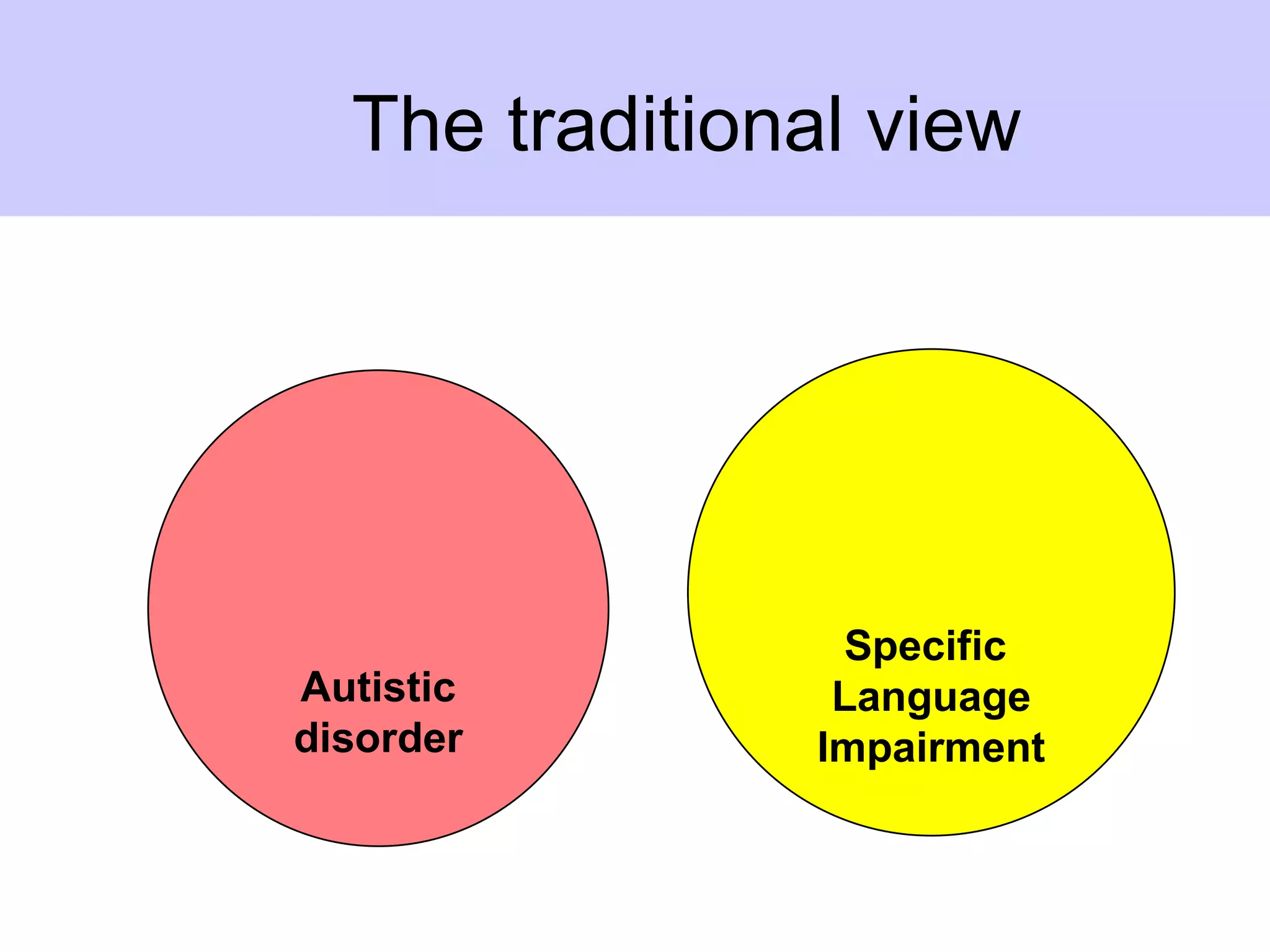
The traditional view


                Specific
Autistic        Language
disorder       Impairment
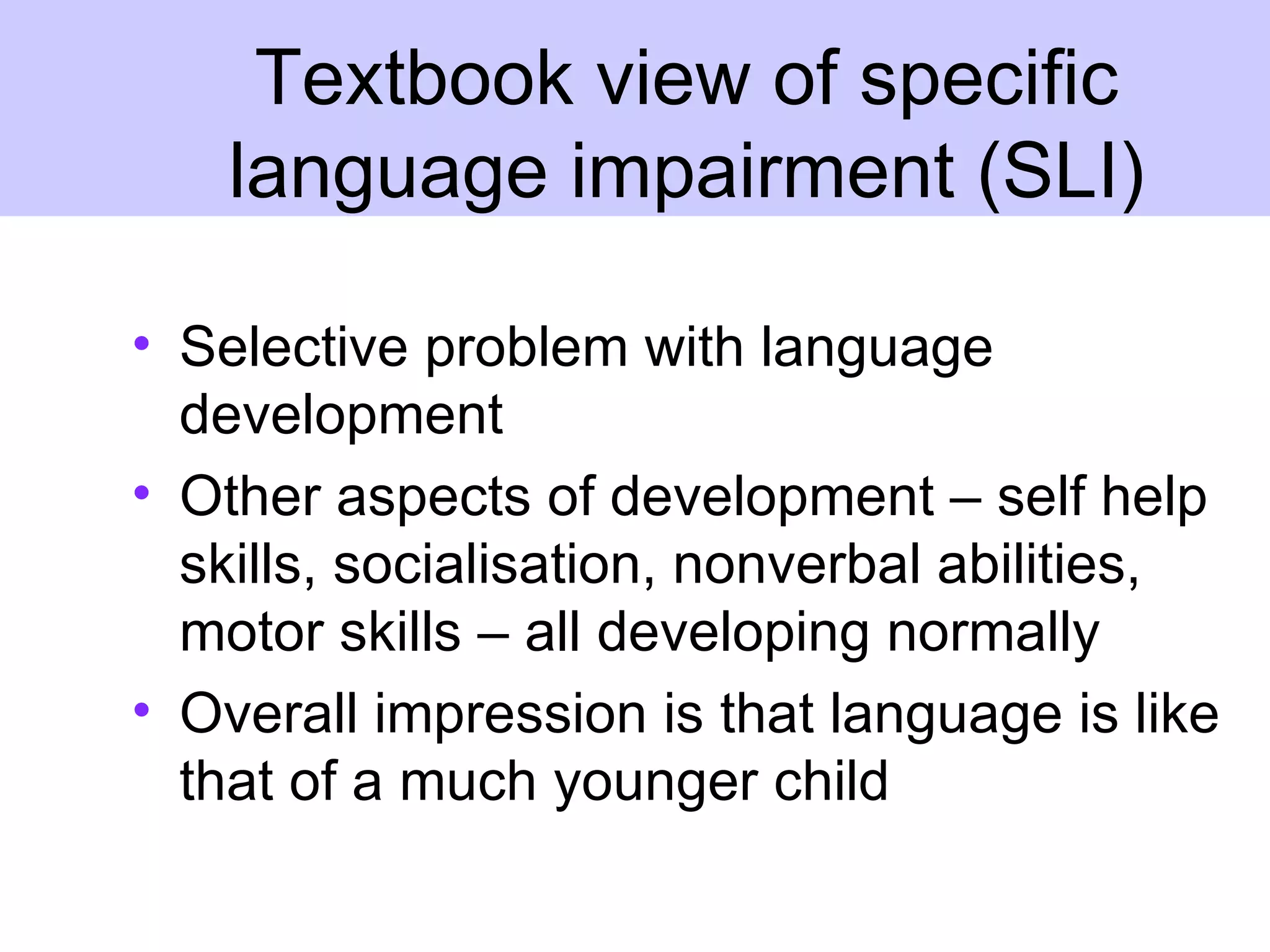
Textbook view of specific
    language impairment (SLI)

• Selective problem with language
  development
• Other aspects of development – self help
  skills, socialisation, nonverbal abilities,
  motor skills – all developing normally
• Overall impression is that language is like
  that of a much younger child
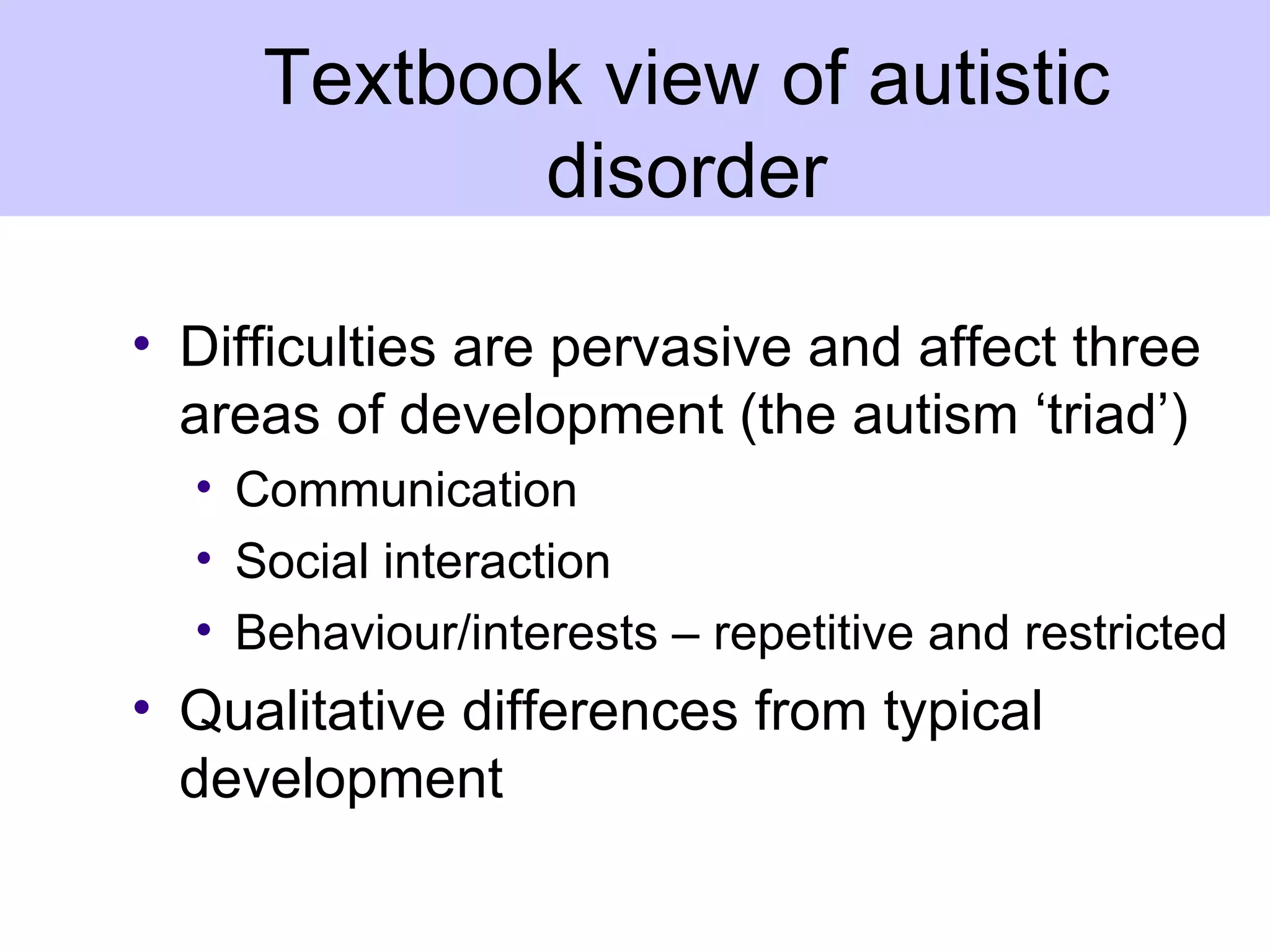
Textbook view of autistic
            disorder

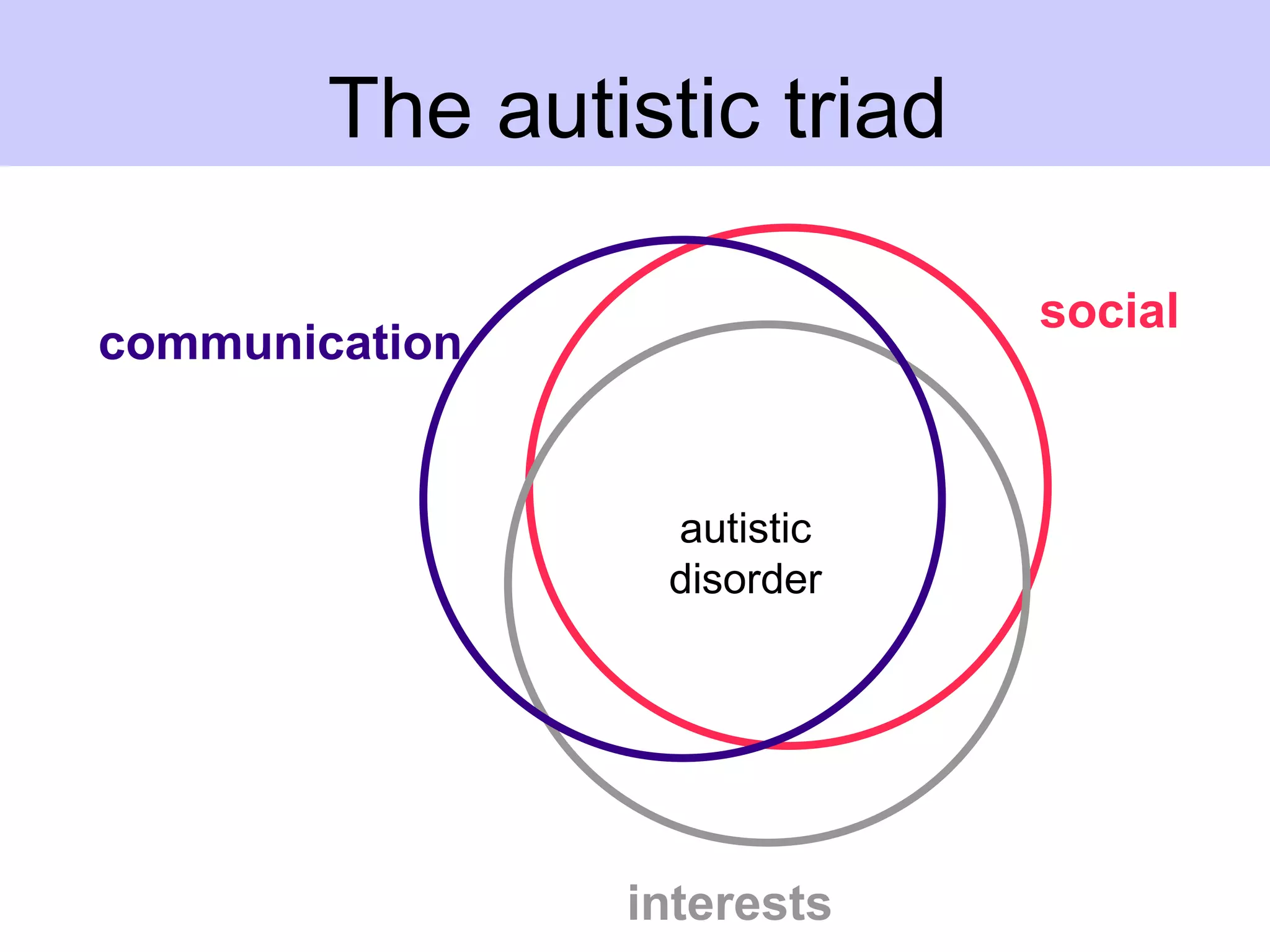
• Difficulties are pervasive and affect three
  areas of development (the autism ‘triad’)
  • Communication
  • Social interaction
  • Behaviour/interests – repetitive and restricted
• Qualitative differences from typical
  development
The autistic triad

                             social
communication


                 autistic
                 disorder


                interests
However!

Some children don’t fit neatly
   into these categories
Evidence for development of autistic
      features in some children with
     receptive language impairments


Bartak, L., Rutter, M., & Cox, A. (1975). A comparative study of infantile
autism and specific developmental receptive language disorder: I. The
children. British Journal of Psychiatry, 126, 127-145.
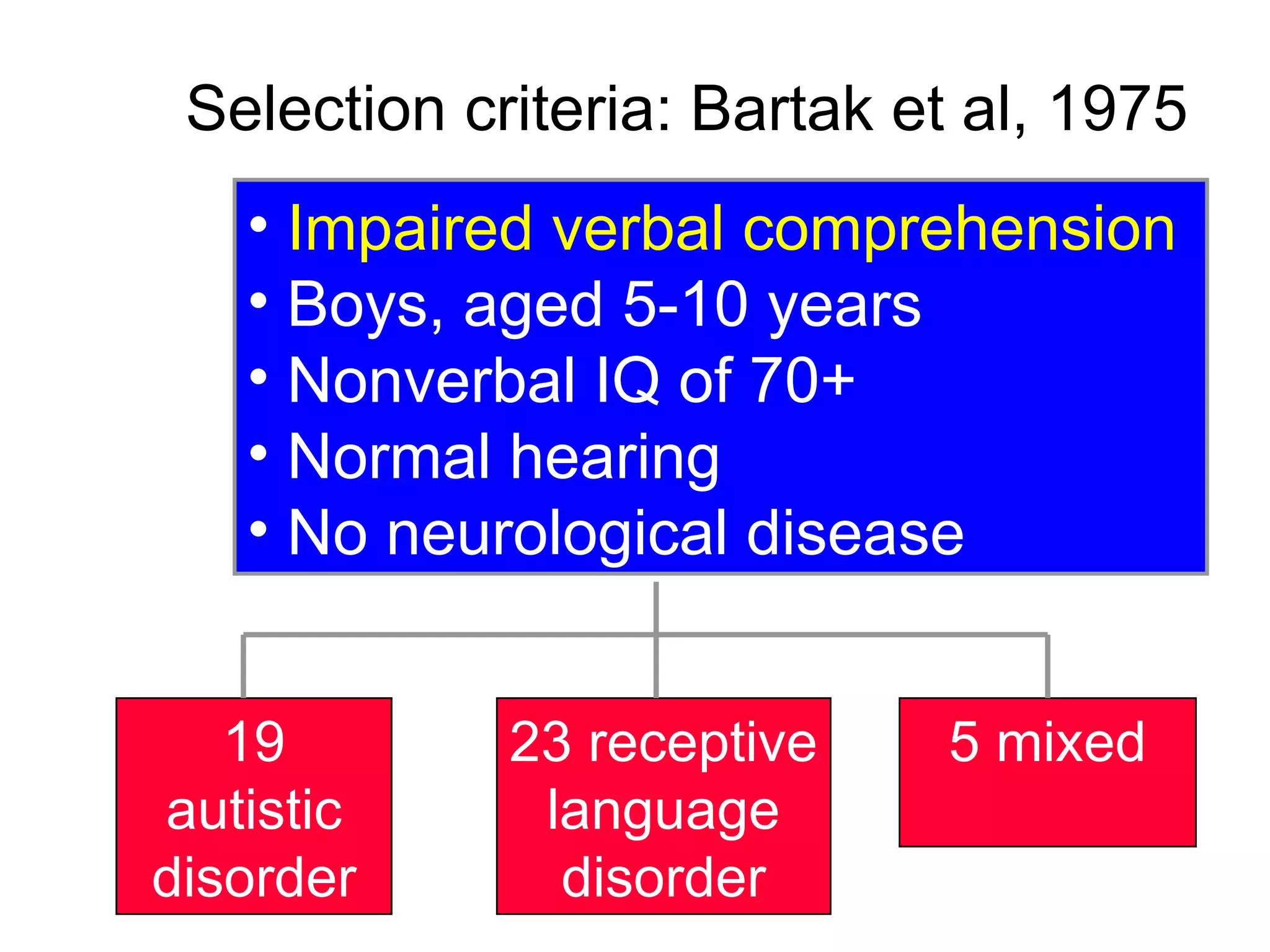
Selection criteria: Bartak et al, 1975
   • Impaired verbal comprehension
   • Boys, aged 5-10 years
   • Nonverbal IQ of 70+
   • Normal hearing
   • No neurological disease


   19        23 receptive    5 mixed
autistic      language
disorder       disorder
proportion
Very similar language findings for autistic and language-impaired
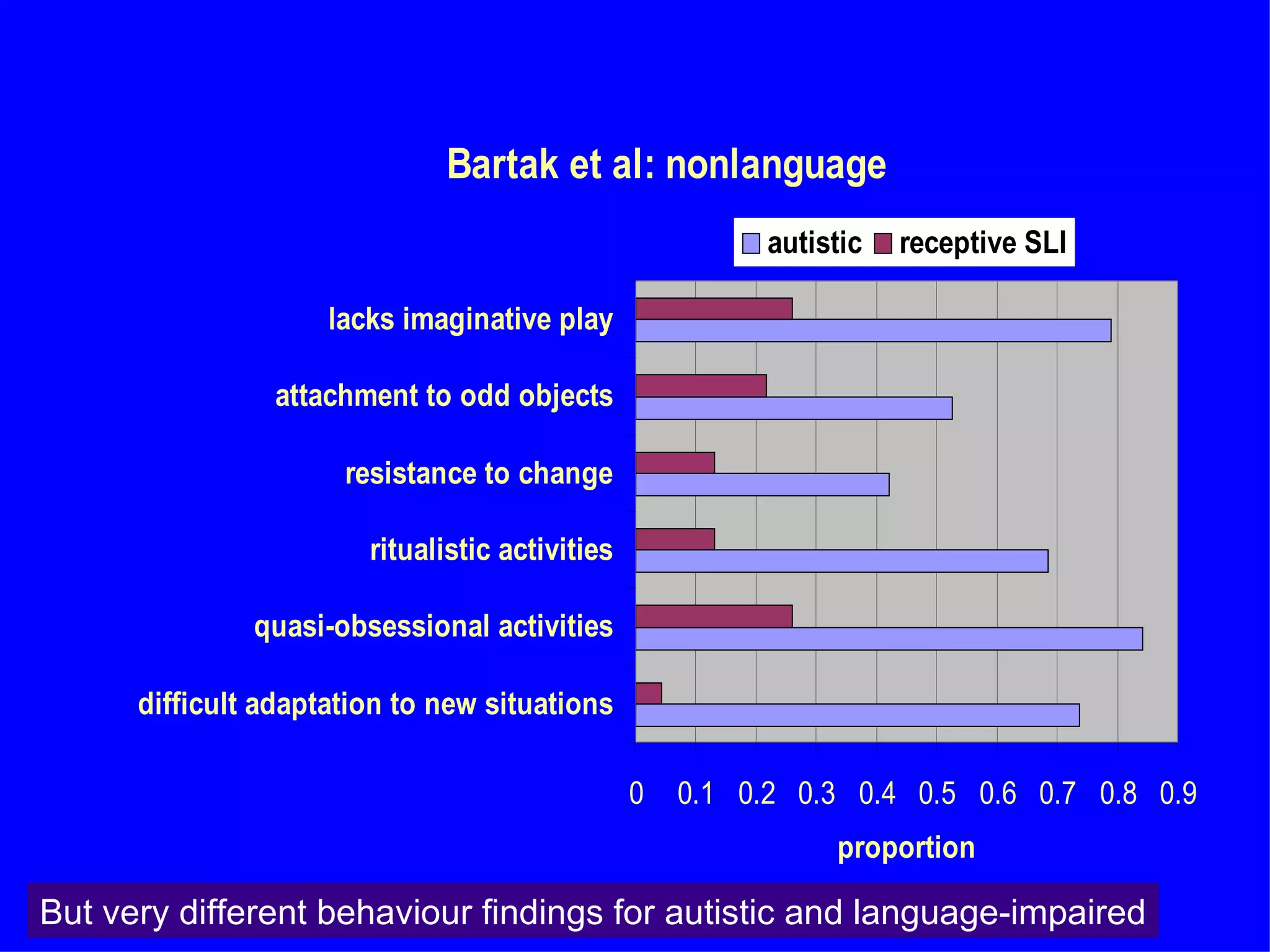
Bartak et al: nonlanguage
                                                           autistic   receptive SLI

                     lacks imaginative play

                attachment to odd objects

                      resistance to change

                        ritualistic activities

               quasi-obsessional activities

      difficult adaptation to new situations

                                                 0   0.1 0.2 0.3 0.4 0.5 0.6 0.7 0.8 0.9
                                                                proportion

But very different behaviour findings for autistic and language-impaired
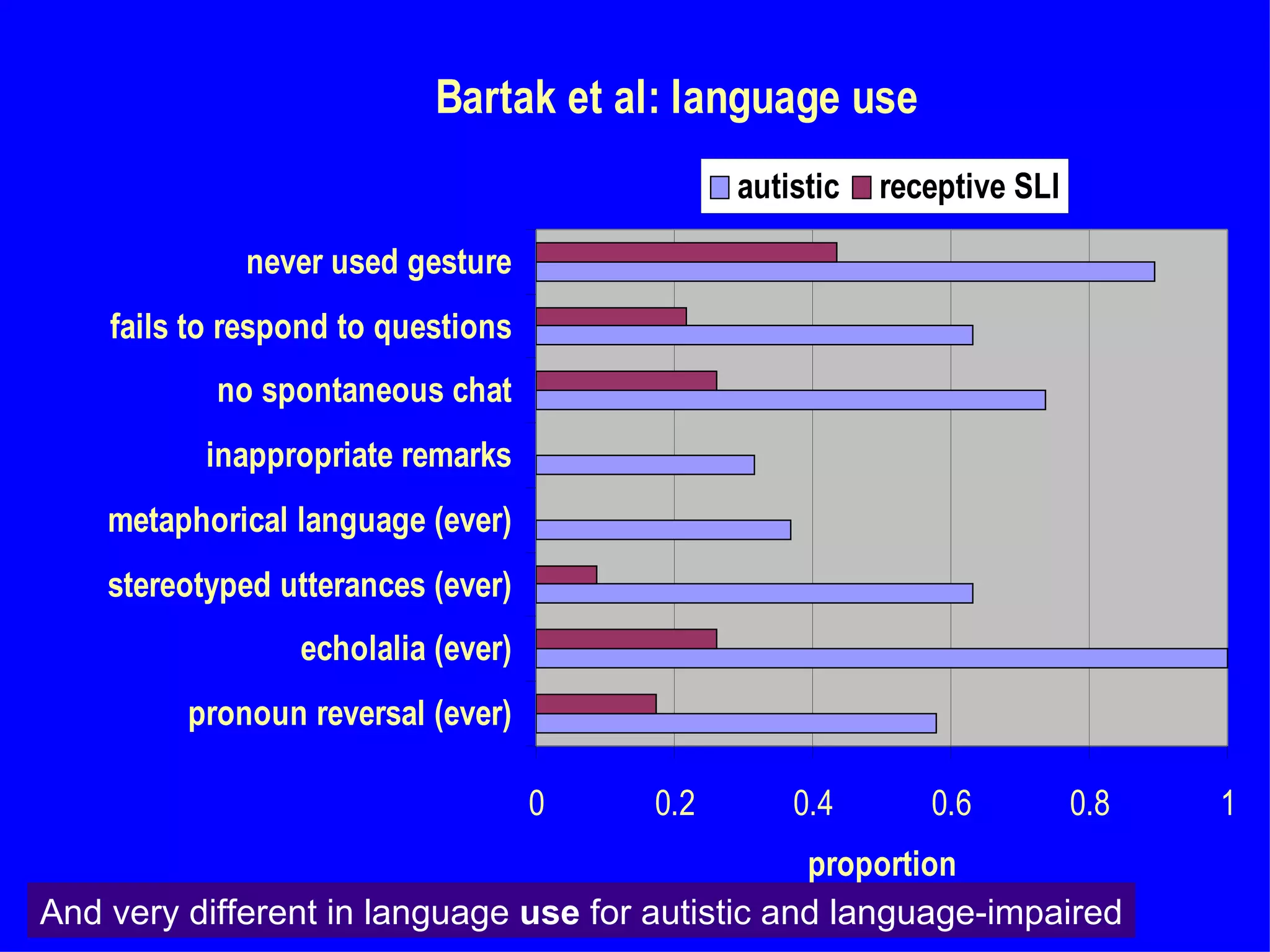
Bartak et al: language use
                                              autistic   receptive SLI

             never used gesture
    fails to respond to questions
           no spontaneous chat
           inappropriate remarks
    metaphorical language (ever)
    stereotyped utterances (ever)
                 echolalia (ever)
         pronoun reversal (ever)

                                    0   0.2       0.4       0.6          0.8   1
                                                  proportion
And very different in language use for autistic and language-impaired
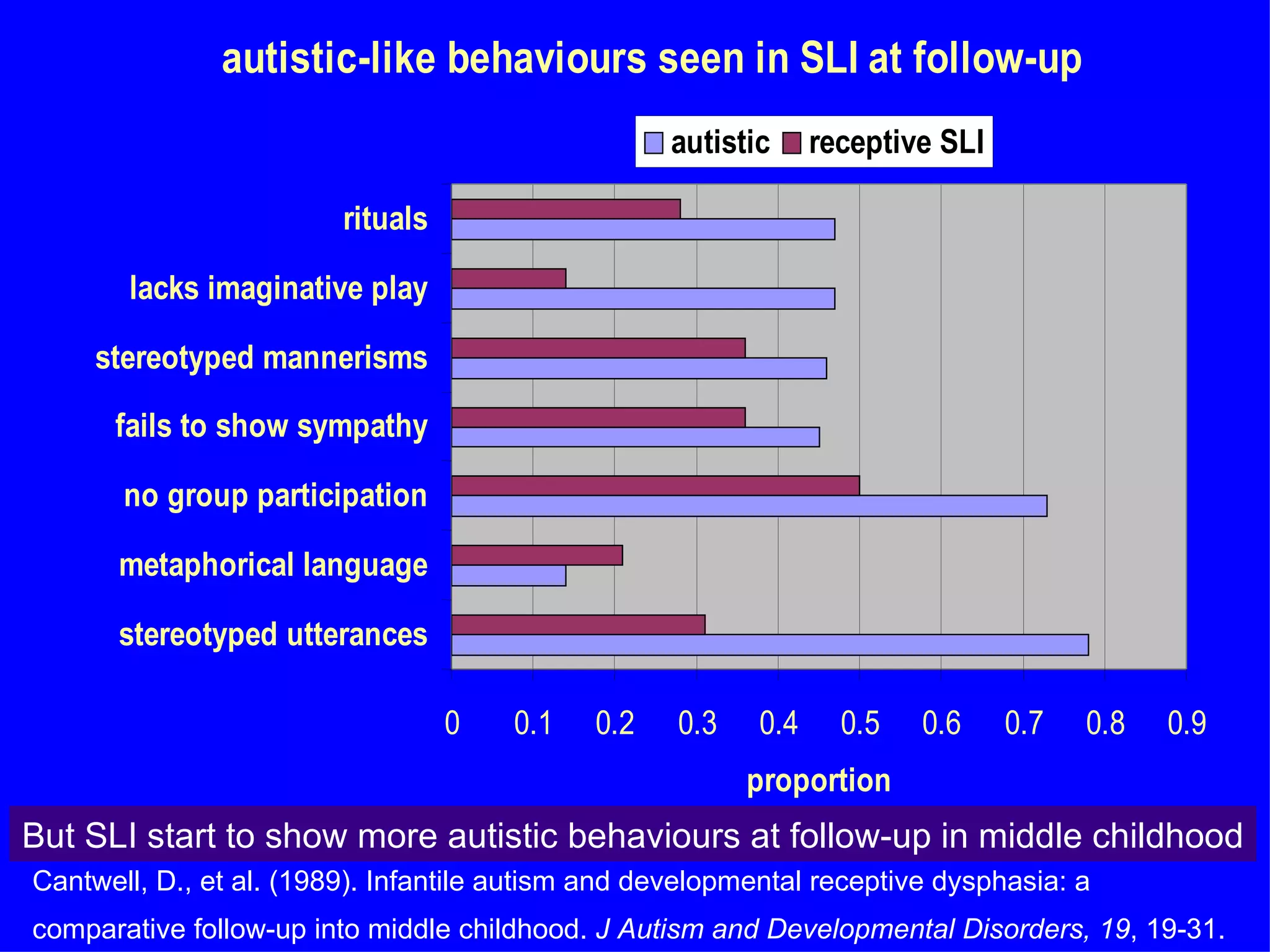
autistic-like behaviours seen in SLI at follow-up
                                                   autistic      receptive SLI

                         rituals

       lacks imaginative play

     stereotyped mannerisms

      fails to show sympathy

       no group participation

       metaphorical language

       stereotyped utterances

                                   0   0.1   0.2    0.3    0.4     0.5   0.6     0.7   0.8   0.9
                                                          proportion
But SLI start to show more autistic behaviours at follow-up in middle childhood
Cantwell, D., et al. (1989). Infantile autism and developmental receptive dysphasia: a
comparative follow-up into middle childhood. J Autism and Developmental Disorders, 19, 19-31.
Howlin et al, 2000
       • Follow-up of original sample into
         adulthood

       • Some of the original language-impaired
         sample show more evidence of social and
         behavioural problems, similar to autism

Howlin, P., Mawhood, L., & Rutter, M. (2000). Autism and developmental receptive
language disorder - a comparative follow-up in early adult life. II. Social, behavioural, and
psychiatric outcomes. Journal of Child Psychology and Psychiatry, 41, 561-578.
Example of man with receptive SLI diagnosis in childhood

"In all aspects of self-care he was entirely independent and
he could use a telephone and manage his finances
himself. Most of his spare time was spent pursuing his
preoccupation with buses and his less intense interest in
CB radio. He spent a lot of time hanging around bus
stations, going on bus journeys when he could afford it,
and looking at bus magazines. His social overtures were
somewhat limited and he would speak if spoken to but
would not make the first move. There were two friends
that he visited regularly; one shared his interest in buses,
the other was interested in CB radio. These relationships
were clearly selective, did involve some apparent pleasure
in each other's company, and some sharing of
confidences, but there was still nonetheless a slightly odd
quality to them because of their restricted range of
interests. He did not appear to be lonely." (p. 384).
Autistic-like impairments in
 communication and social
interaction in some cases of
    language impairment
Bishop & Norbury, 2002

  • Study of children receiving special educational provision
    for language/communication disorders

  • Direct observation, language assessment and parental
    report

  • Significant numbers of children with autistic-like
    language features but who did not meet criteria for
    autism on ‘gold standard’ autism assessments

Bishop, D. V. M., & Norbury, C. F. (2002). Exploring the borderlands of autistic
disorder and specific language impairment: A study using standardised diagnostic
instruments. Journal of Child Psychology and Psychiatry, 43, 917-929.
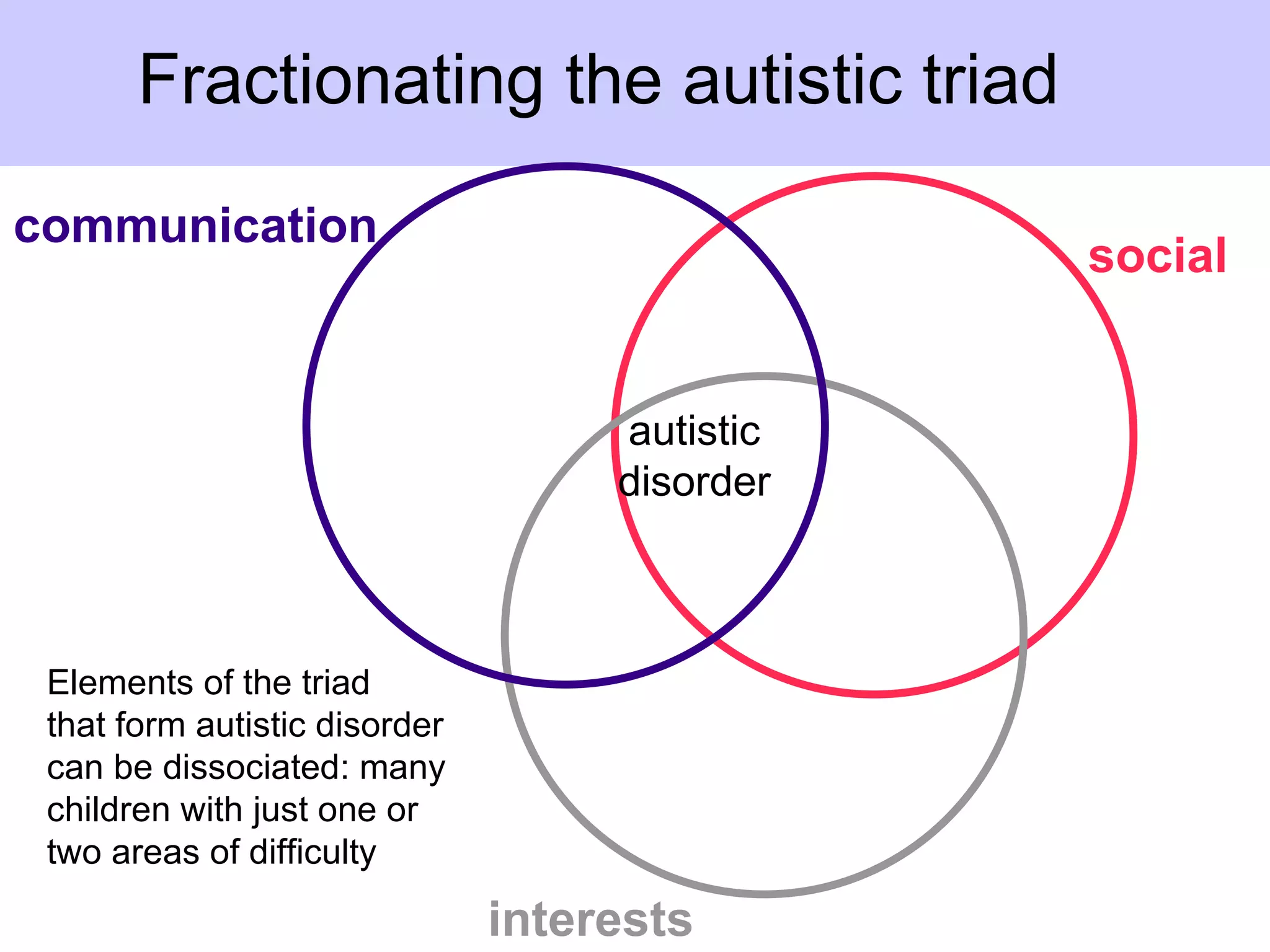
Fractionating the autistic triad
communication
                                               social


                                    autistic
                                    disorder


 Elements of the triad
 that form autistic disorder
 can be dissociated: many
 children with just one or
 two areas of difficulty

                               interests
Diagnostic dilemmas
q   Diagnosis complicated by:

    q   Changing clinical picture with age

    q   Difficulties in evaluating autistic-like
        symptoms in children with receptive
        language problems
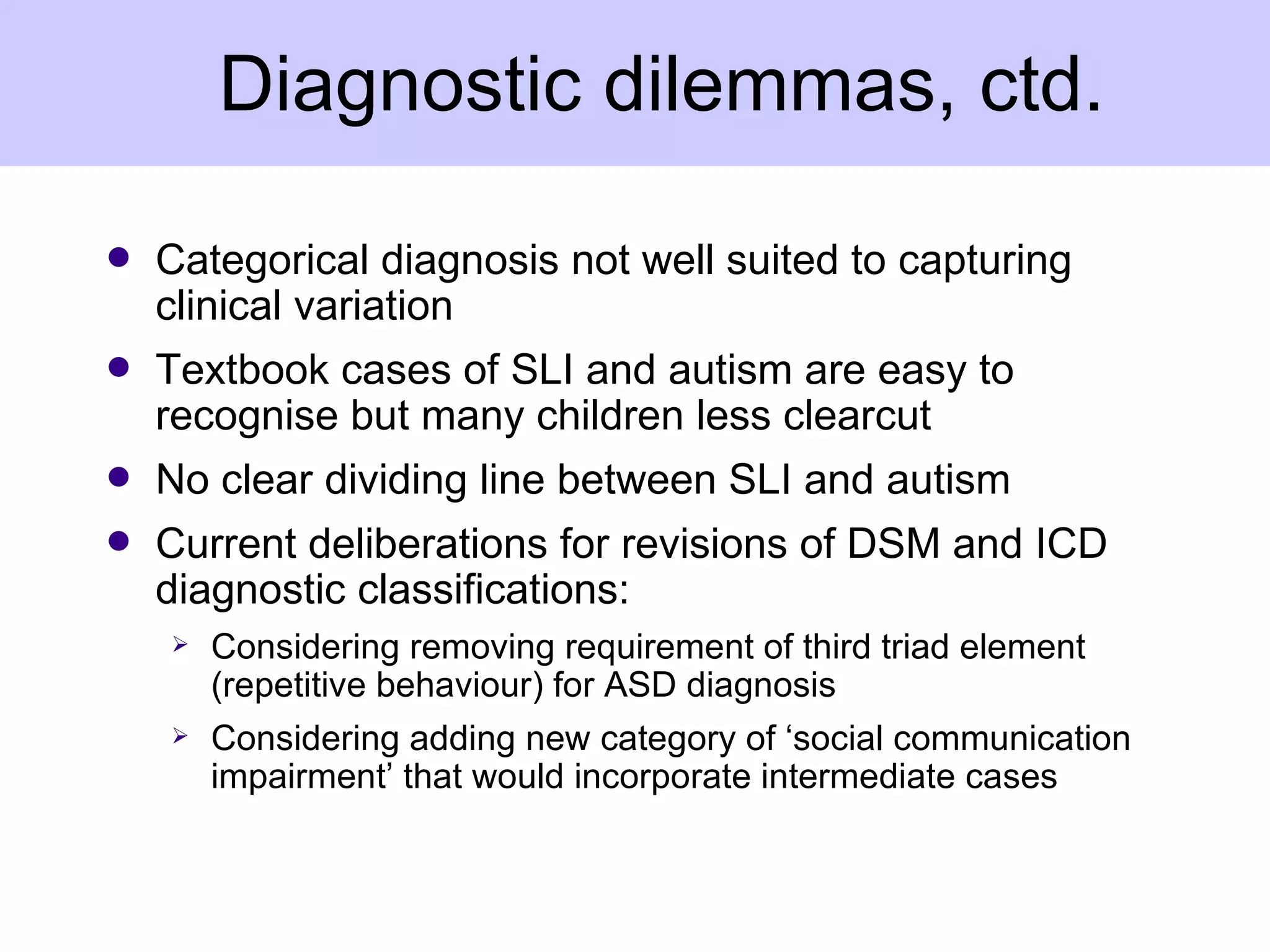
Diagnostic dilemmas, ctd.

q   Categorical diagnosis not well suited to capturing
    clinical variation
q   Textbook cases of SLI and autism are easy to
    recognise but many children less clearcut
q   No clear dividing line between SLI and autism
q   Current deliberations for revisions of DSM and ICD
    diagnostic classifications:
       Considering removing requirement of third triad element
        (repetitive behaviour) for ASD diagnosis
       Considering adding new category of ‘social communication
        impairment’ that would incorporate intermediate cases

SLI and autism.ppt

  • 1.
    Autism and specificlanguage impairment: diagnostic distinctions Dorothy V. M. Bishop Dorothy V. M. Bishop Dorothy V. M. Bishop
  • 2.
    The traditional view Specific Autistic Language disorder Impairment
  • 3.
    Textbook view ofspecific language impairment (SLI) • Selective problem with language development • Other aspects of development – self help skills, socialisation, nonverbal abilities, motor skills – all developing normally • Overall impression is that language is like that of a much younger child
  • 4.
    Textbook view ofautistic disorder • Difficulties are pervasive and affect three areas of development (the autism ‘triad’) • Communication • Social interaction • Behaviour/interests – repetitive and restricted • Qualitative differences from typical development
  • 5.
    The autistic triad social communication autistic disorder interests
  • 6.
    However! Some children don’tfit neatly into these categories
  • 7.
    Evidence for developmentof autistic features in some children with receptive language impairments Bartak, L., Rutter, M., & Cox, A. (1975). A comparative study of infantile autism and specific developmental receptive language disorder: I. The children. British Journal of Psychiatry, 126, 127-145.
  • 8.
    Selection criteria: Bartaket al, 1975 • Impaired verbal comprehension • Boys, aged 5-10 years • Nonverbal IQ of 70+ • Normal hearing • No neurological disease 19 23 receptive 5 mixed autistic language disorder disorder
  • 9.
    proportion Very similar languagefindings for autistic and language-impaired
  • 10.
    Bartak et al:nonlanguage autistic receptive SLI lacks imaginative play attachment to odd objects resistance to change ritualistic activities quasi-obsessional activities difficult adaptation to new situations 0 0.1 0.2 0.3 0.4 0.5 0.6 0.7 0.8 0.9 proportion But very different behaviour findings for autistic and language-impaired
  • 11.
    Bartak et al:language use autistic receptive SLI never used gesture fails to respond to questions no spontaneous chat inappropriate remarks metaphorical language (ever) stereotyped utterances (ever) echolalia (ever) pronoun reversal (ever) 0 0.2 0.4 0.6 0.8 1 proportion And very different in language use for autistic and language-impaired
  • 12.
    autistic-like behaviours seenin SLI at follow-up autistic receptive SLI rituals lacks imaginative play stereotyped mannerisms fails to show sympathy no group participation metaphorical language stereotyped utterances 0 0.1 0.2 0.3 0.4 0.5 0.6 0.7 0.8 0.9 proportion But SLI start to show more autistic behaviours at follow-up in middle childhood Cantwell, D., et al. (1989). Infantile autism and developmental receptive dysphasia: a comparative follow-up into middle childhood. J Autism and Developmental Disorders, 19, 19-31.
  • 13.
    Howlin et al,2000 • Follow-up of original sample into adulthood • Some of the original language-impaired sample show more evidence of social and behavioural problems, similar to autism Howlin, P., Mawhood, L., & Rutter, M. (2000). Autism and developmental receptive language disorder - a comparative follow-up in early adult life. II. Social, behavioural, and psychiatric outcomes. Journal of Child Psychology and Psychiatry, 41, 561-578.
  • 14.
    Example of manwith receptive SLI diagnosis in childhood "In all aspects of self-care he was entirely independent and he could use a telephone and manage his finances himself. Most of his spare time was spent pursuing his preoccupation with buses and his less intense interest in CB radio. He spent a lot of time hanging around bus stations, going on bus journeys when he could afford it, and looking at bus magazines. His social overtures were somewhat limited and he would speak if spoken to but would not make the first move. There were two friends that he visited regularly; one shared his interest in buses, the other was interested in CB radio. These relationships were clearly selective, did involve some apparent pleasure in each other's company, and some sharing of confidences, but there was still nonetheless a slightly odd quality to them because of their restricted range of interests. He did not appear to be lonely." (p. 384).
  • 15.
    Autistic-like impairments in communication and social interaction in some cases of language impairment
  • 16.
    Bishop & Norbury,2002 • Study of children receiving special educational provision for language/communication disorders • Direct observation, language assessment and parental report • Significant numbers of children with autistic-like language features but who did not meet criteria for autism on ‘gold standard’ autism assessments Bishop, D. V. M., & Norbury, C. F. (2002). Exploring the borderlands of autistic disorder and specific language impairment: A study using standardised diagnostic instruments. Journal of Child Psychology and Psychiatry, 43, 917-929.
  • 17.
    Fractionating the autistictriad communication social autistic disorder Elements of the triad that form autistic disorder can be dissociated: many children with just one or two areas of difficulty interests
  • 18.
    Diagnostic dilemmas q Diagnosis complicated by: q Changing clinical picture with age q Difficulties in evaluating autistic-like symptoms in children with receptive language problems
  • 19.
    Diagnostic dilemmas, ctd. q Categorical diagnosis not well suited to capturing clinical variation q Textbook cases of SLI and autism are easy to recognise but many children less clearcut q No clear dividing line between SLI and autism q Current deliberations for revisions of DSM and ICD diagnostic classifications:  Considering removing requirement of third triad element (repetitive behaviour) for ASD diagnosis  Considering adding new category of ‘social communication impairment’ that would incorporate intermediate cases