GOVERNING AS SOCIAL NETWORKING   Lee Rainie – Director Pew Internet Project IRMCO – Cambridge, Maryland April 22, 2009
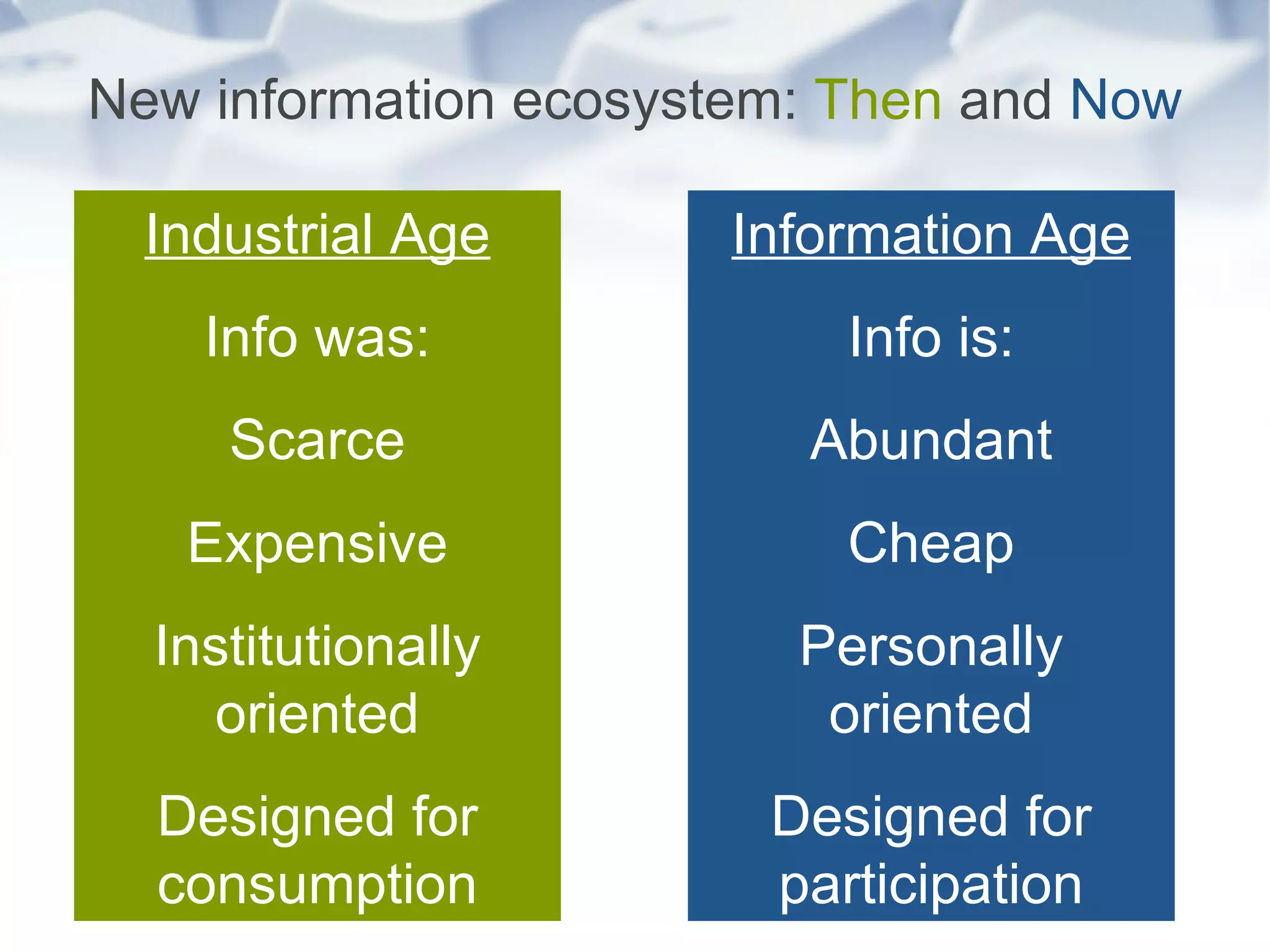
New information ecosystem:  Then   and  Now Industrial Age Info was: Scarce Expensive Institutionally oriented Designed for consumption Information Age Info is: Abundant Cheap Personally oriented Designed for participation
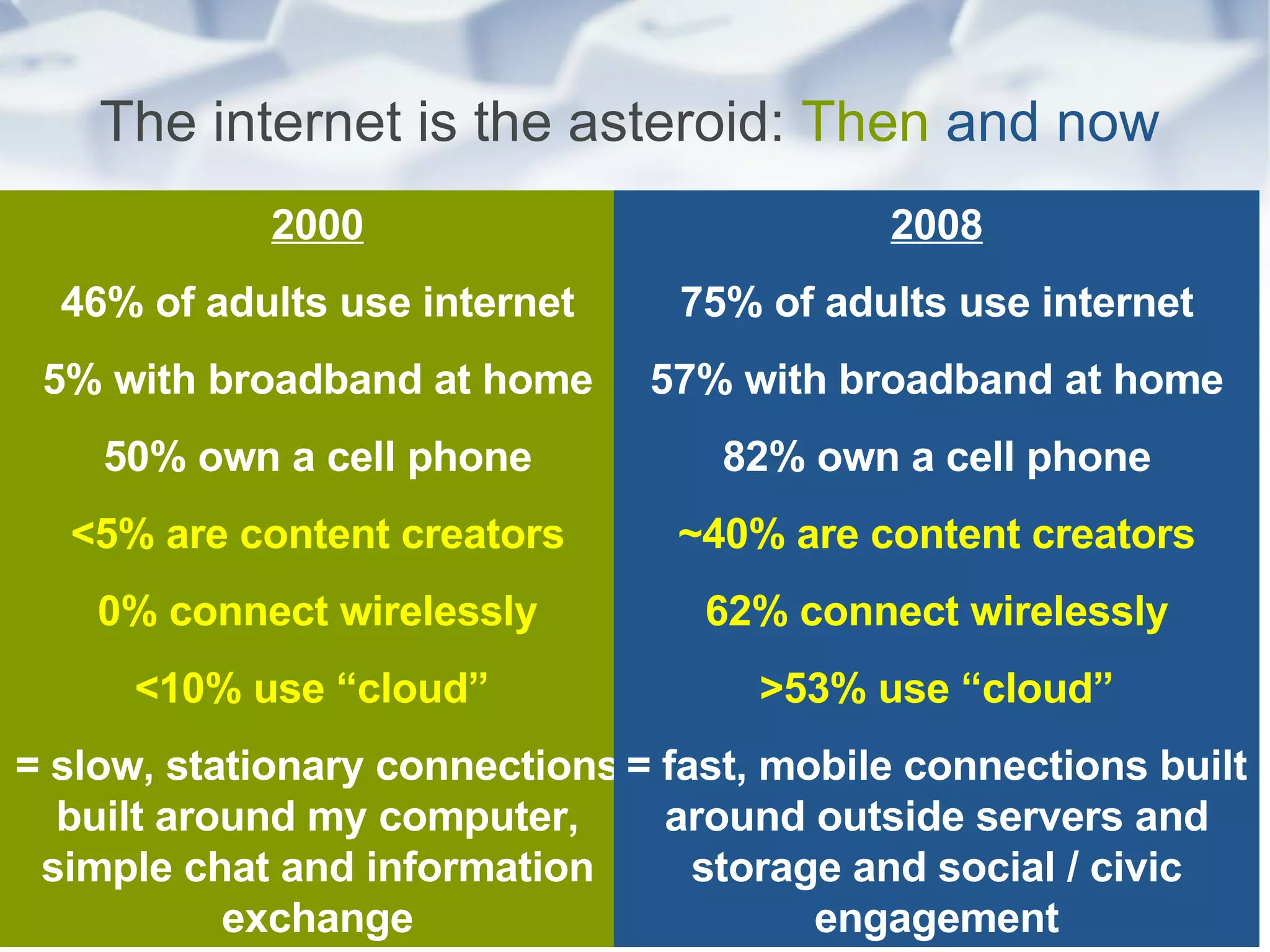
2000 46% of adults use internet 5% with broadband at home 50% own a cell phone <5% are content creators 0% connect wirelessly <10% use “cloud”  = slow, stationary connections built around my computer, simple chat and information exchange The internet is the asteroid:  Then   and now 2008 75% of adults use internet 57% with broadband at home 82% own a cell phone ~40% are content creators 62% connect wirelessly >53% use “cloud” = fast, mobile connections built around outside servers and storage and social / civic engagement
Personal ecosystem changes
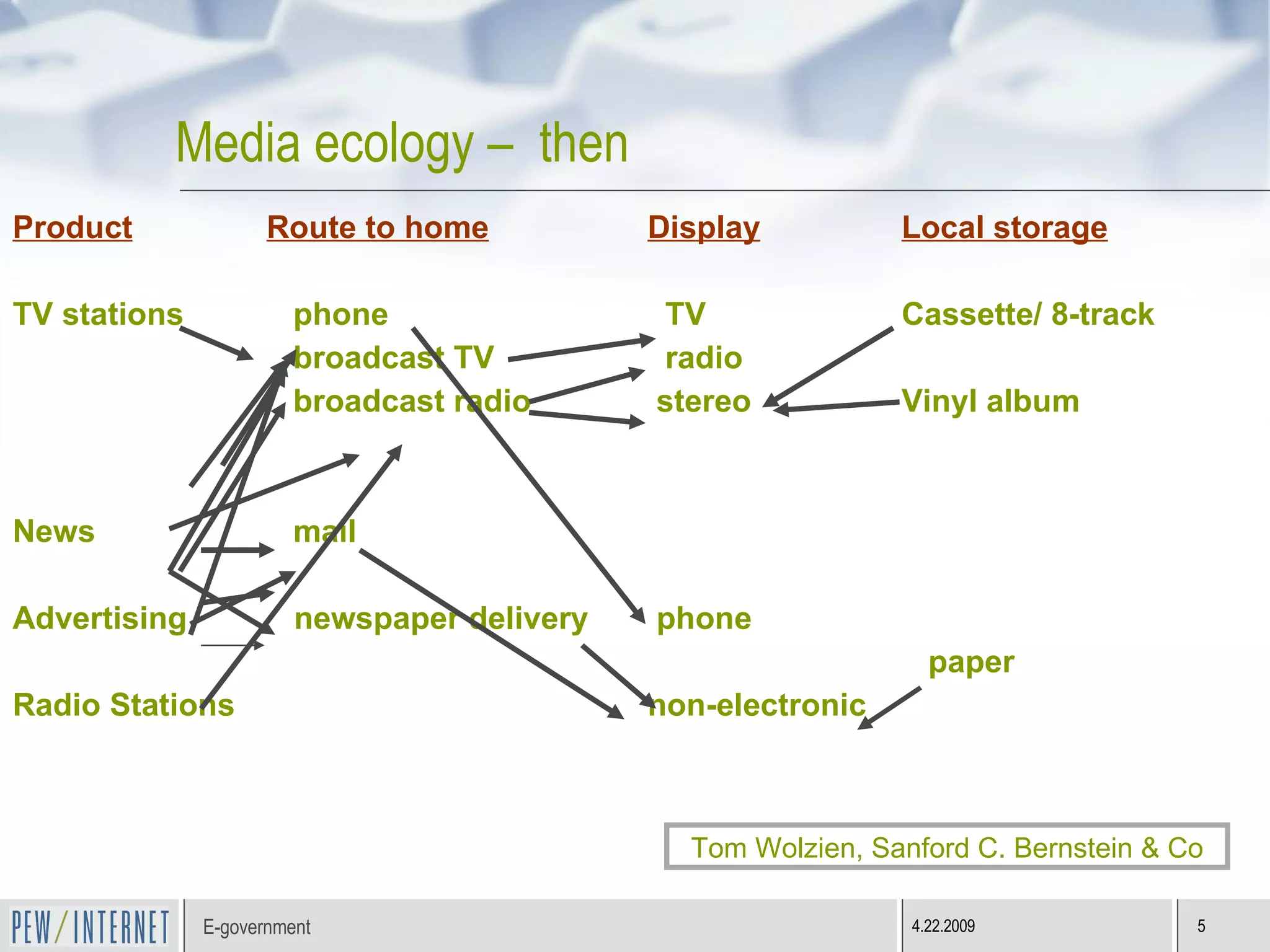
Media ecology –  then Product   Route to home   Display   Local storage TV stations   phone     TV Cassette/ 8-track   broadcast TV   radio   broadcast radio  stereo Vinyl album News   mail Advertising  newspaper delivery  phone   paper Radio Stations non-electronic Tom Wolzien, Sanford C. Bernstein & Co
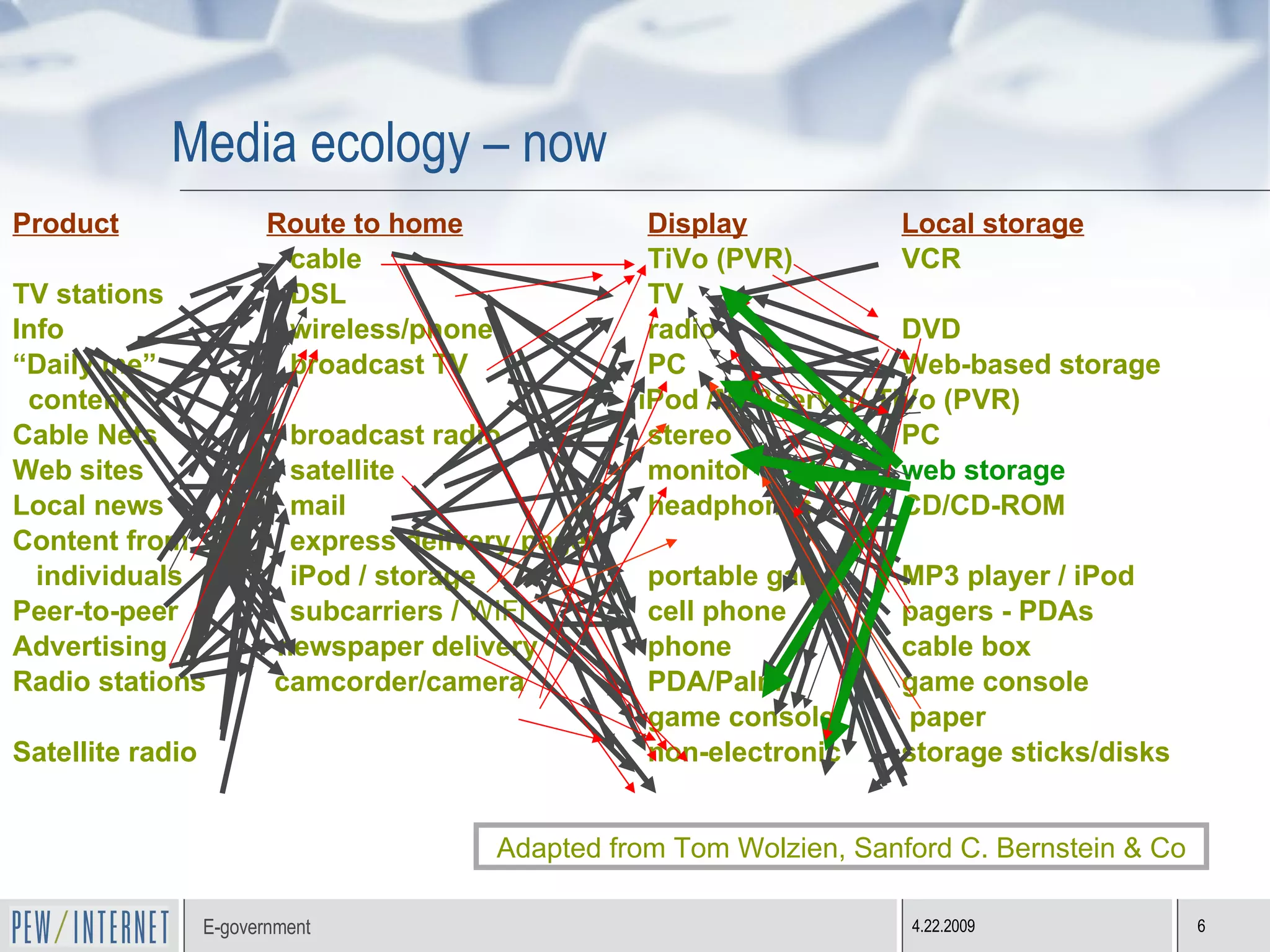
Media ecology – now Product   Route to home   Display   Local storage   cable TiVo (PVR) VCR TV stations   DSL TV Info   wireless/phone radio DVD “ Daily me”    broadcast TV PC Web-based storage content       iPod /MP3 server/ TiVo (PVR) Cable Nets   broadcast radio stereo PC Web sites   satellite monitor web storage Local news   mail headphones CD/CD-ROM Content from   express delivery pager individuals   iPod / storage portable gamer MP3 player / iPod Peer-to-peer   subcarriers /  WIFI cell phone pagers - PDAs Advertising  newspaper delivery phone cable box Radio stations  camcorder/camera PDA/Palm game console game console  paper Satellite radio non-electronic storage sticks/disks Adapted from Tom Wolzien, Sanford C. Bernstein & Co
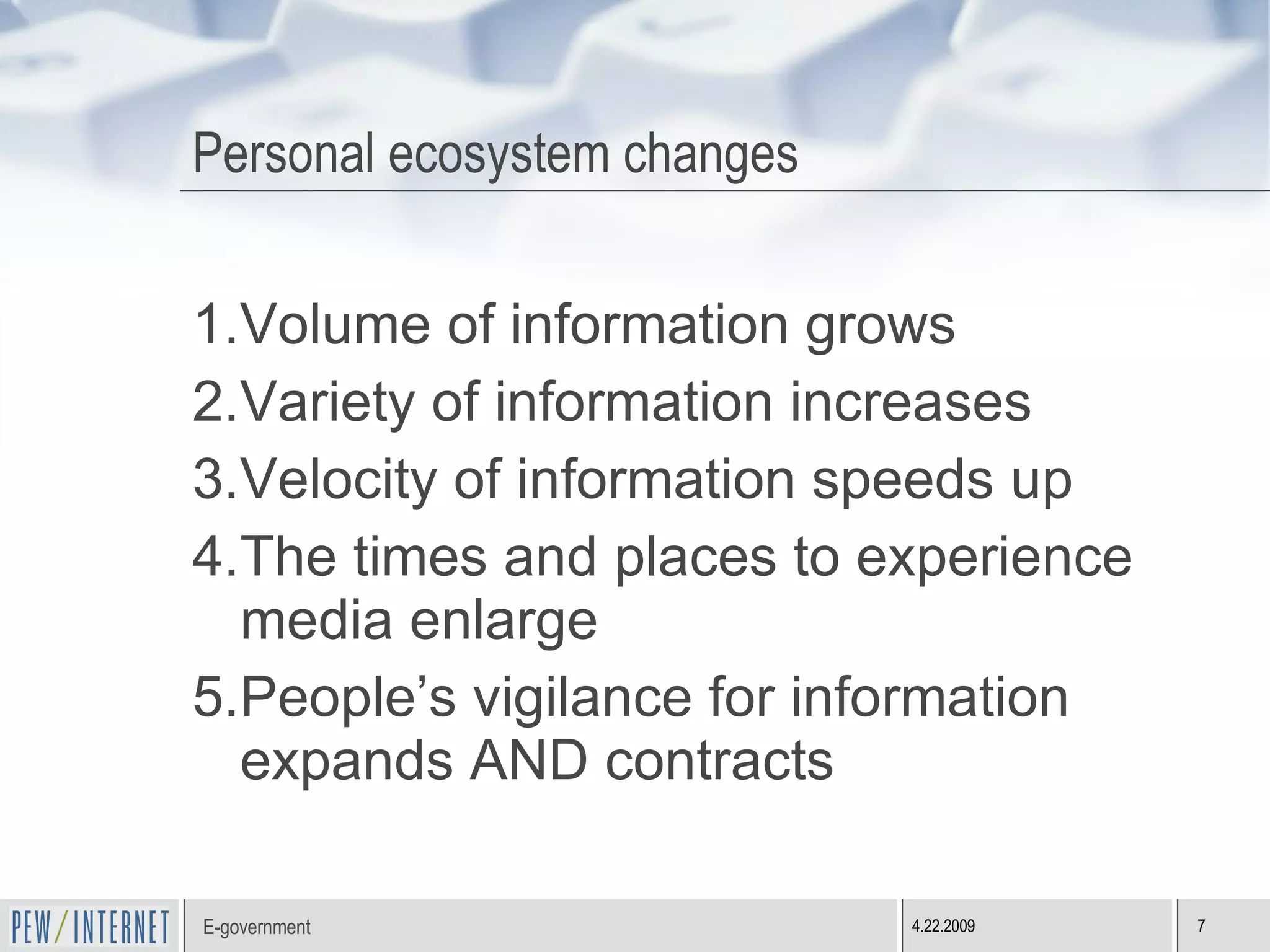
Personal ecosystem changes  Volume of information grows Variety of information increases Velocity of information speeds up The times and places to experience media enlarge People’s vigilance for information expands AND contracts
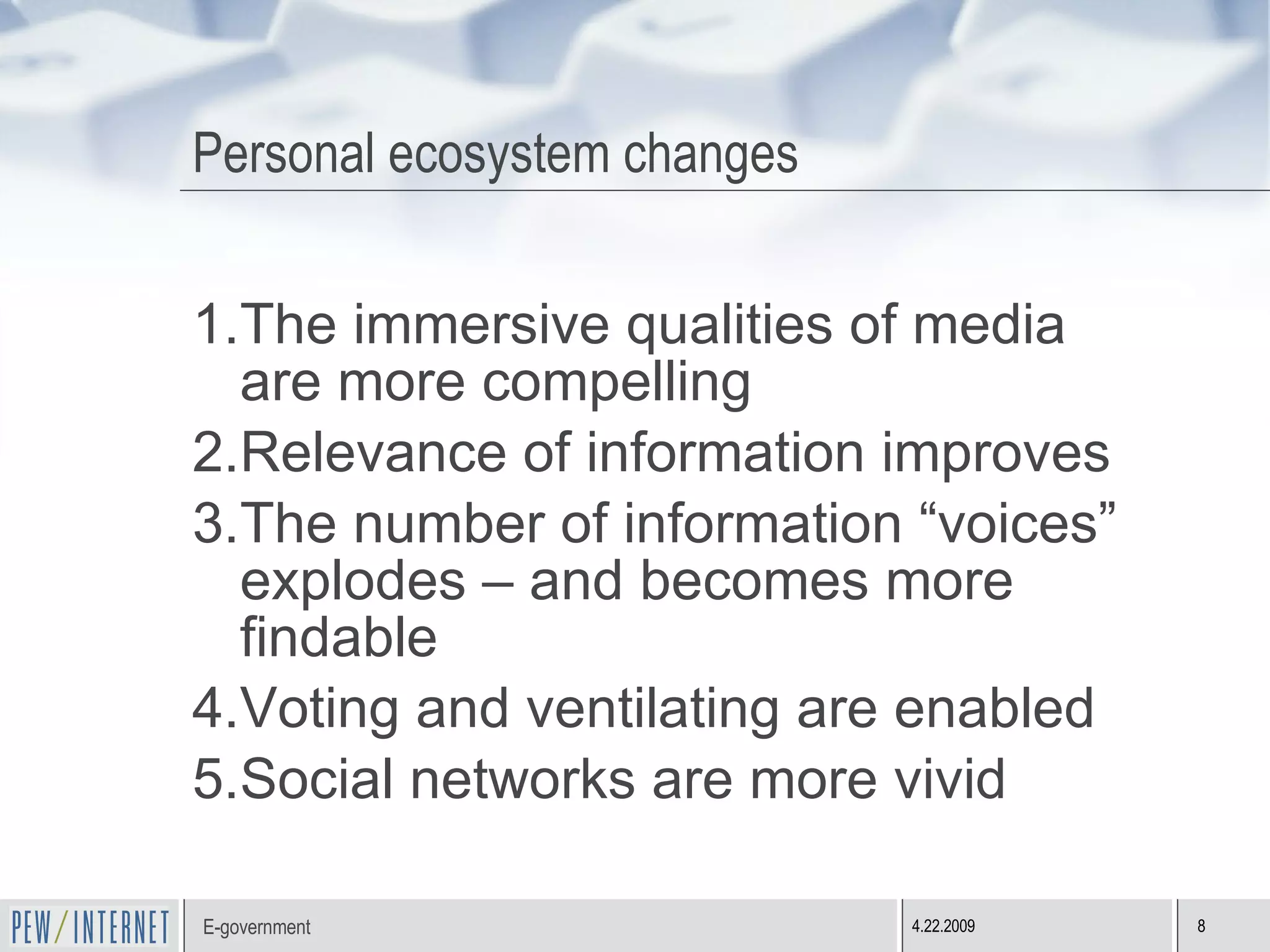
Personal ecosystem changes The immersive qualities of media are more compelling Relevance of information improves The number of information “voices” explodes – and becomes more findable Voting and ventilating are enabled Social networks are more vivid
A different personal ecosystem and a different sense of … Expectation about access to information and people Persistence of the “digital me” and “digital you”  Place … and time … and presence with others Possibilities of conversation and community -- scalability Personal efficacy Boundaries and contexts – public and private Social networking possibilities – new layers, new audiences
News ecosystem changes
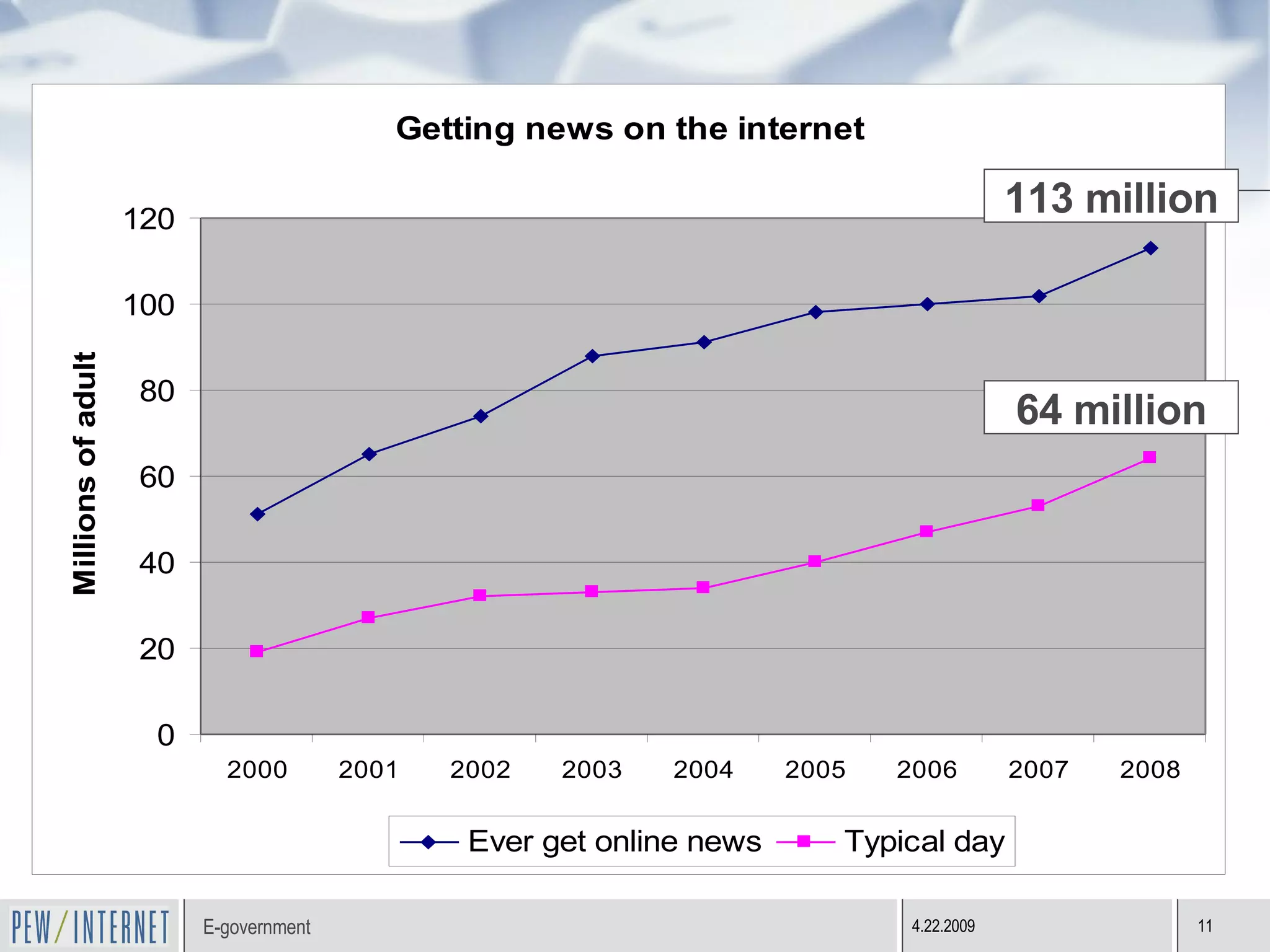
113 million 64 million
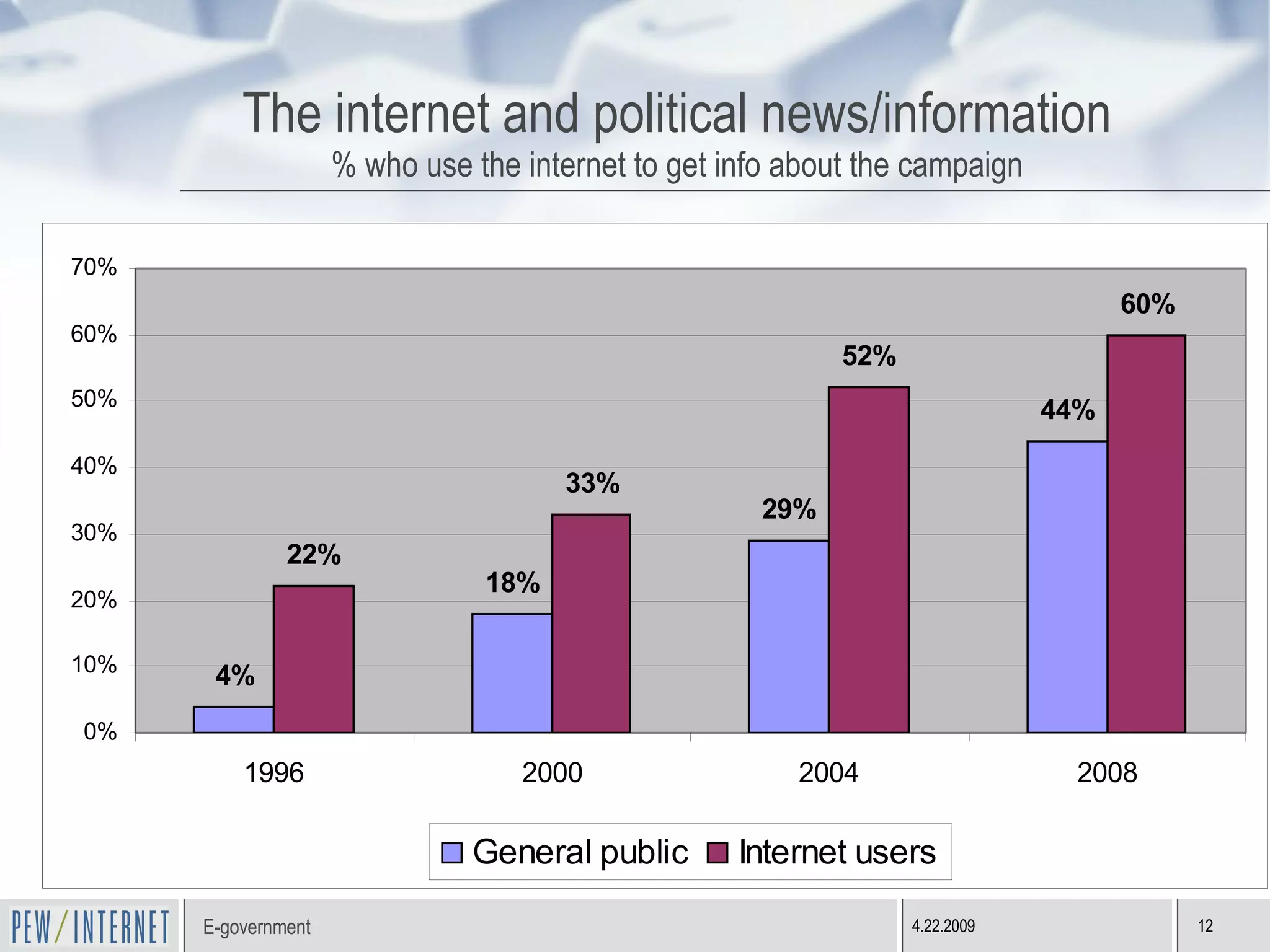
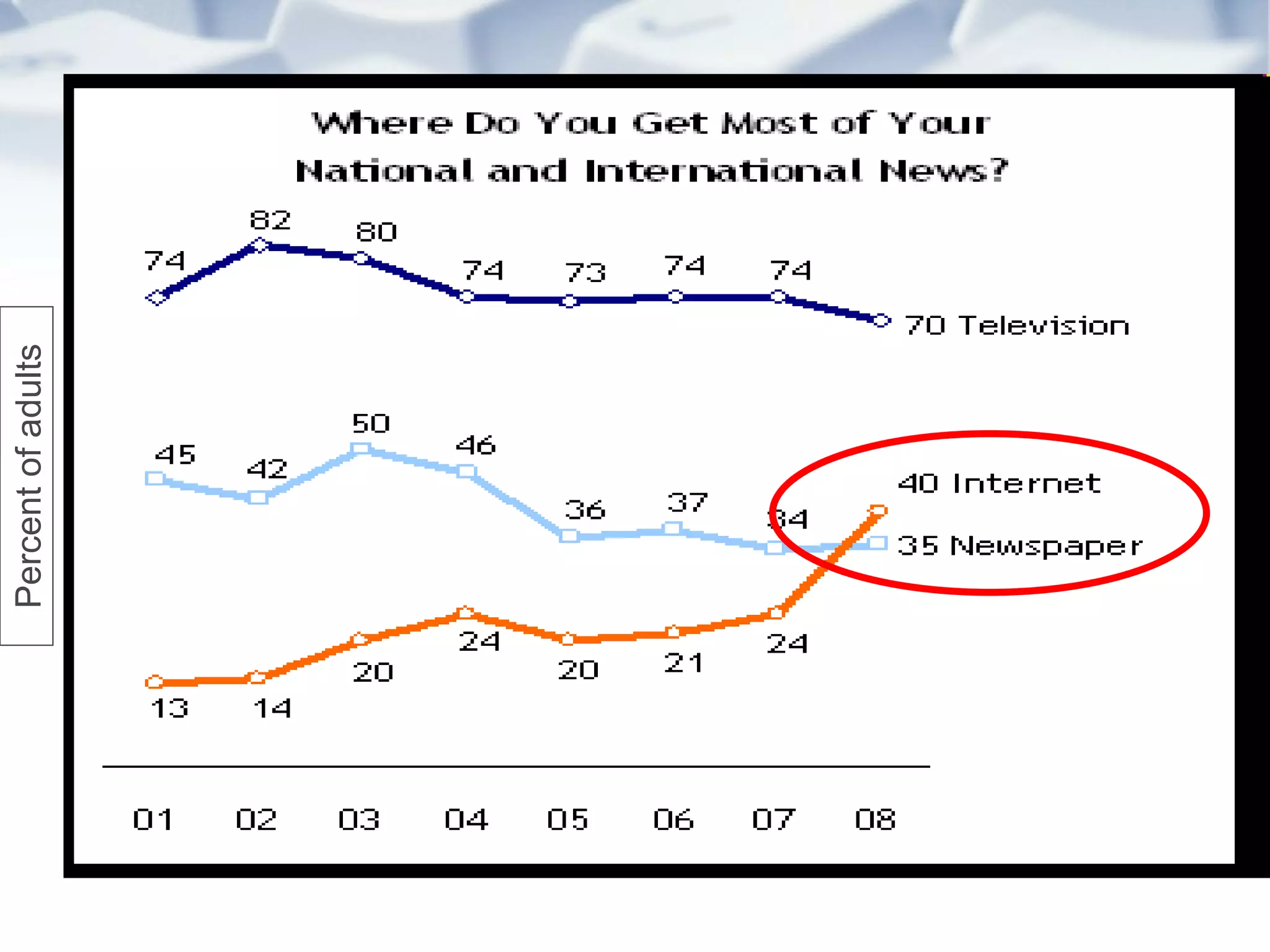
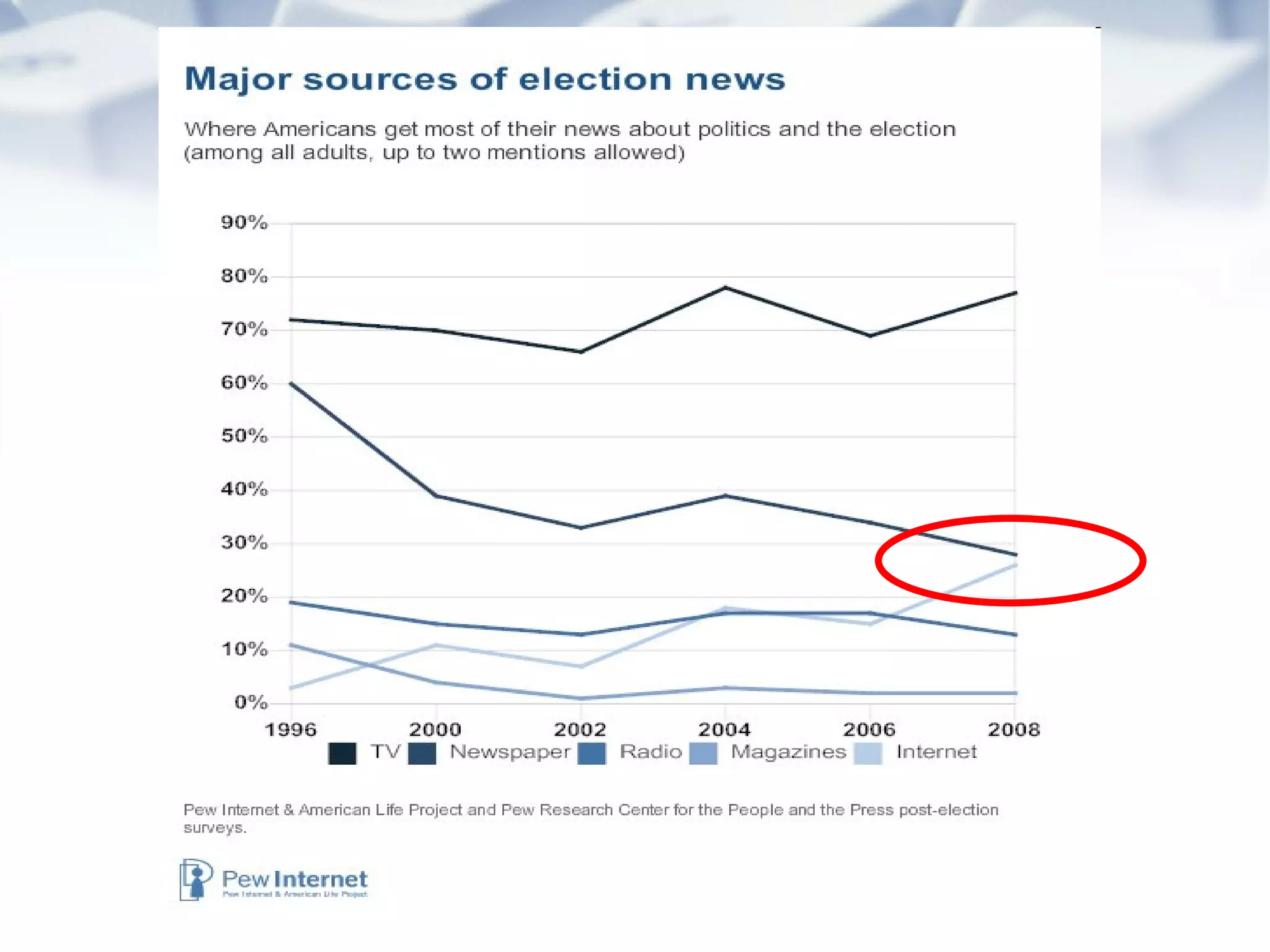
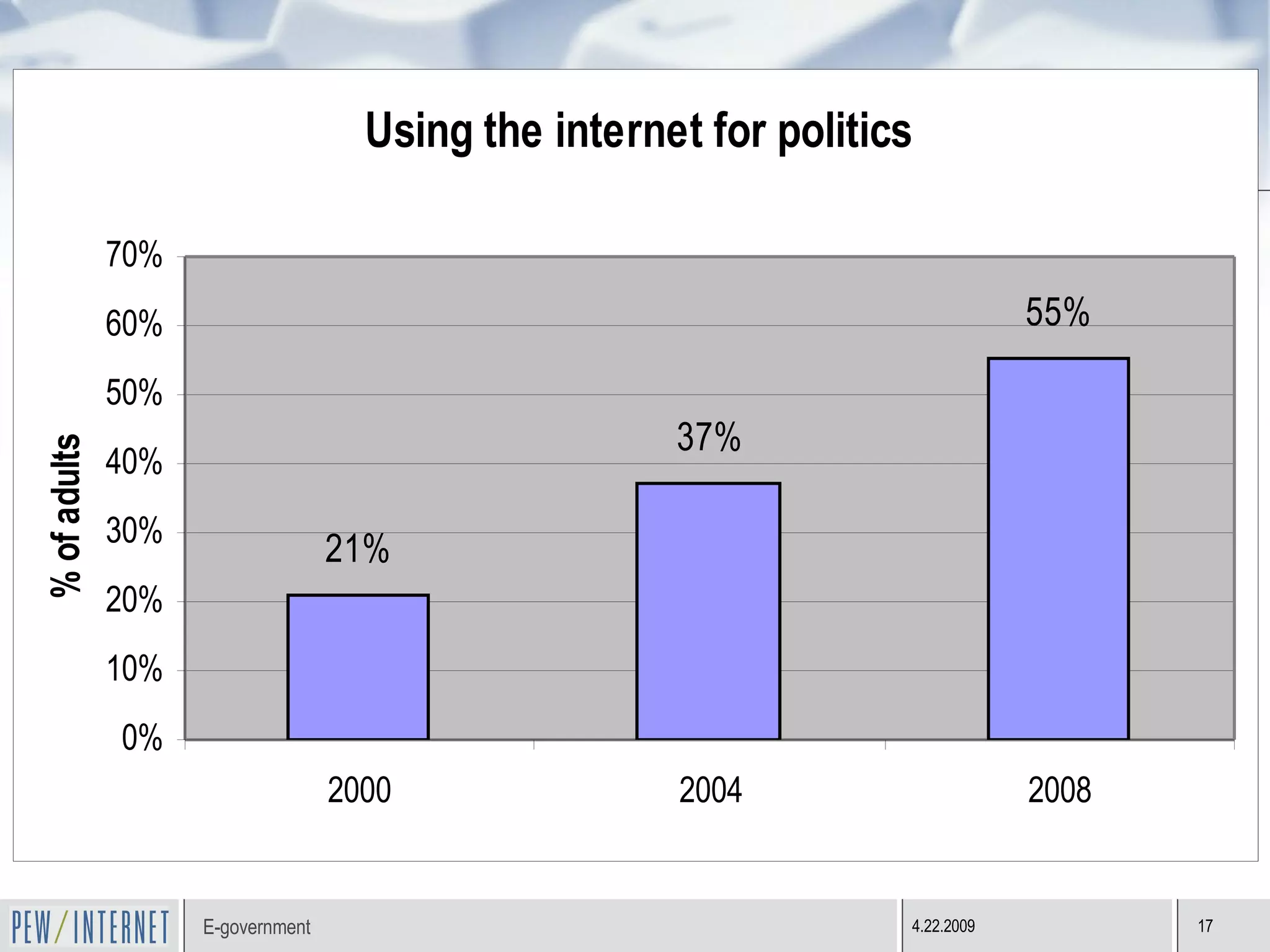
The internet and political news/information % who use the internet to get info about the campaign
Percent of adults
 
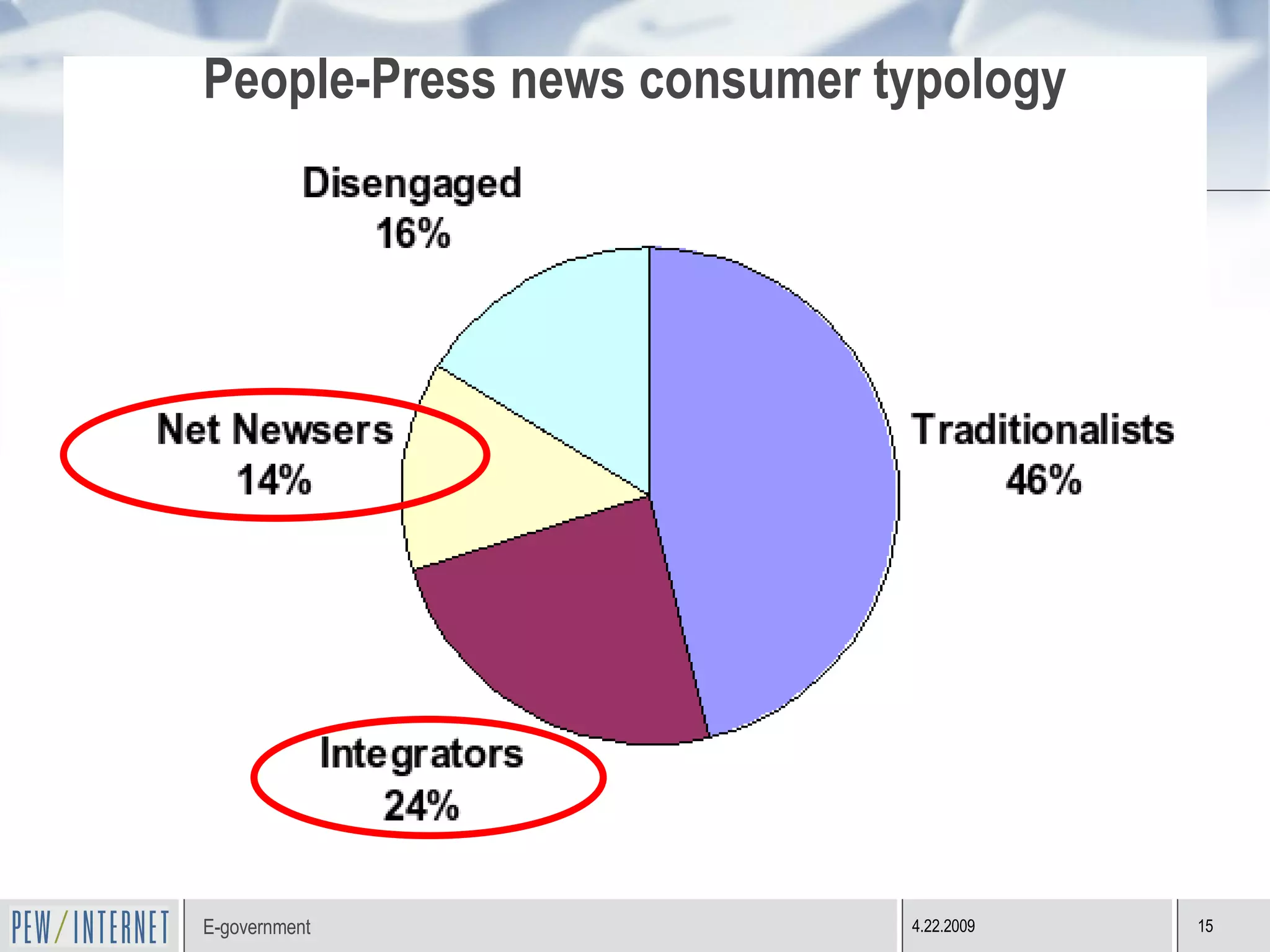
People-Press news consumer typology
Political ecosystem changes
 
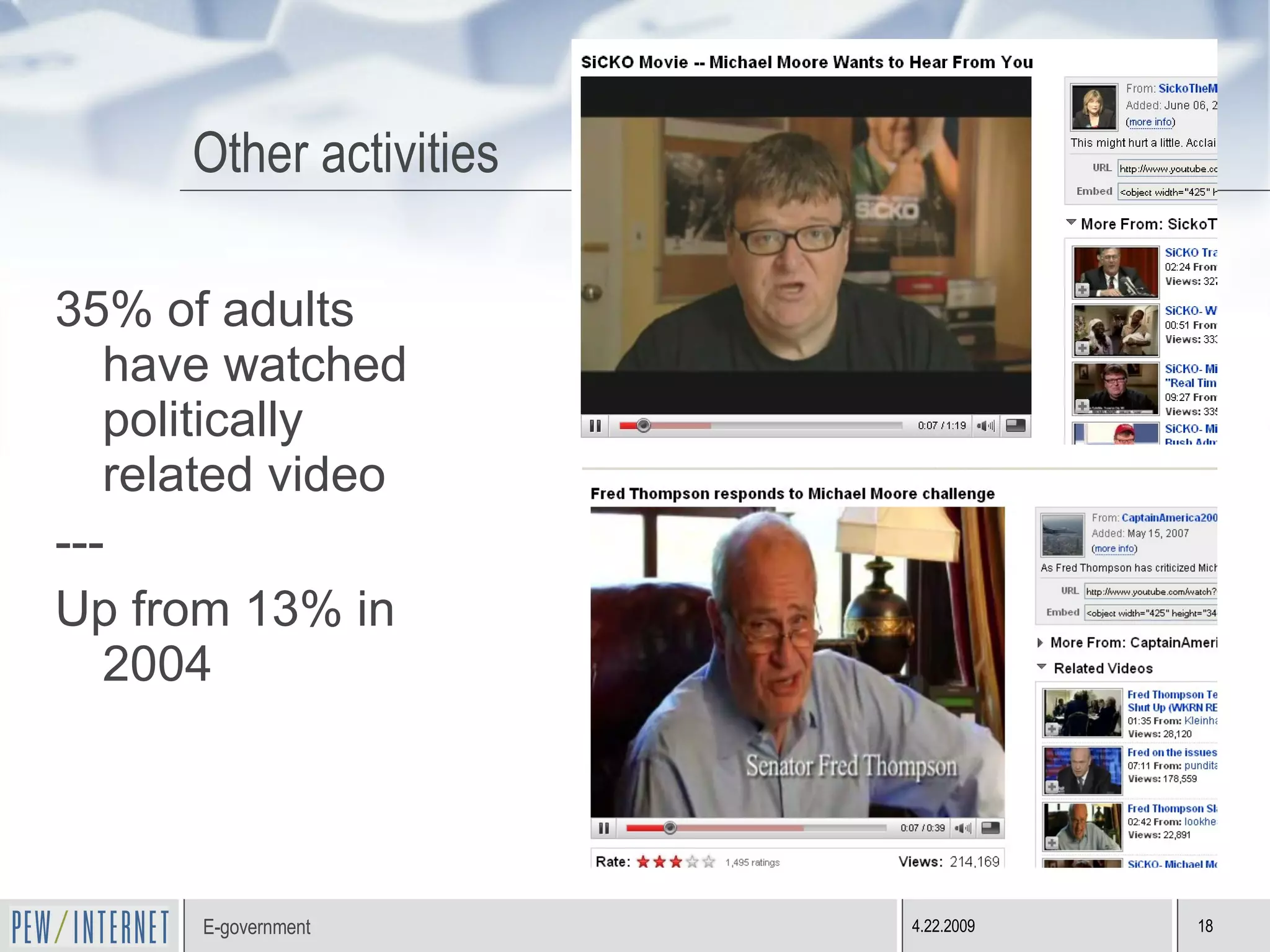
35% of adults have watched politically related video  --- Up from 13% in 2004 Other activities
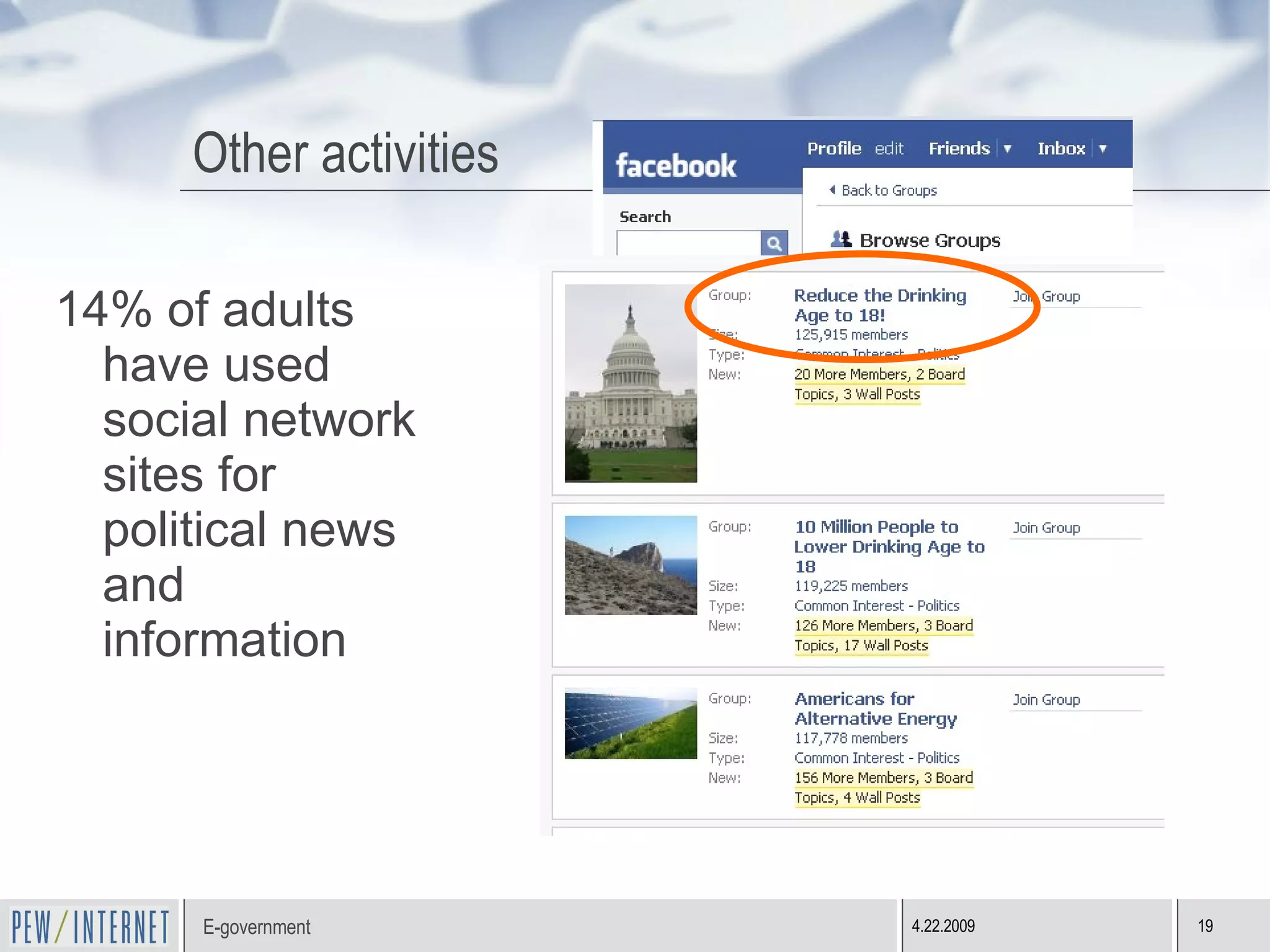
14% of adults have used social network sites for political news and information Other activities
 
The process of citizen decision-making and problem-solving changes
Background of research Institute for Museum and Library Services grant  UIC partnership Government Printing Office query http://www.pewinternet.org/PPF/r/231/report_display.asp
Basic question How do people get information to help them solve problems that could have a government connection or be aided by government resources?
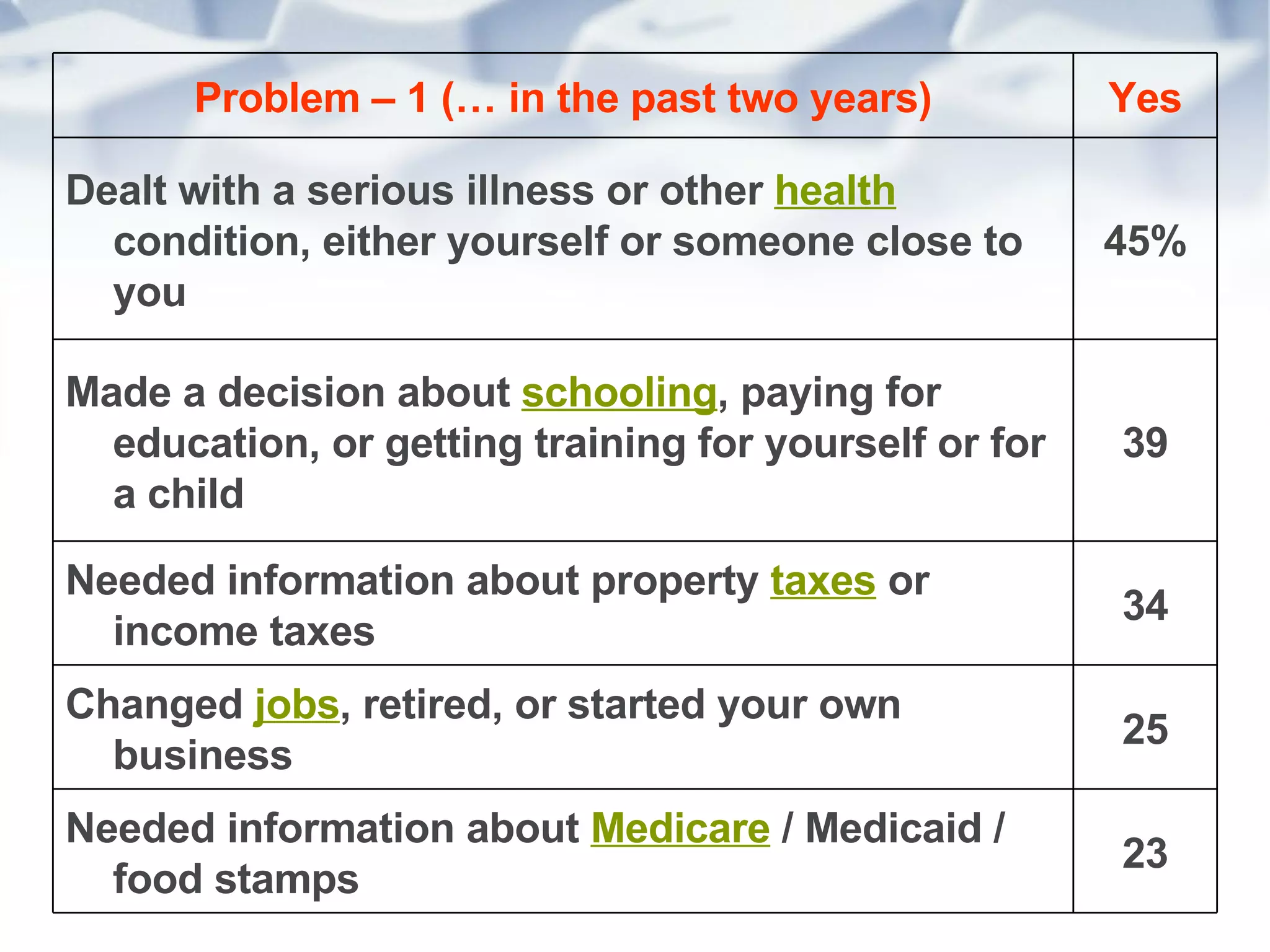
23 Needed information about  Medicare  / Medicaid / food stamps 25 Changed  jobs , retired, or started your own business 34 Needed information about property  taxes  or income taxes 39 Made a decision about  schooling , paying for education, or getting training for yourself or for a child 45% Dealt with a serious illness or other  health  condition, either yourself or someone close to you Yes Problem – 1 (… in the past two years)
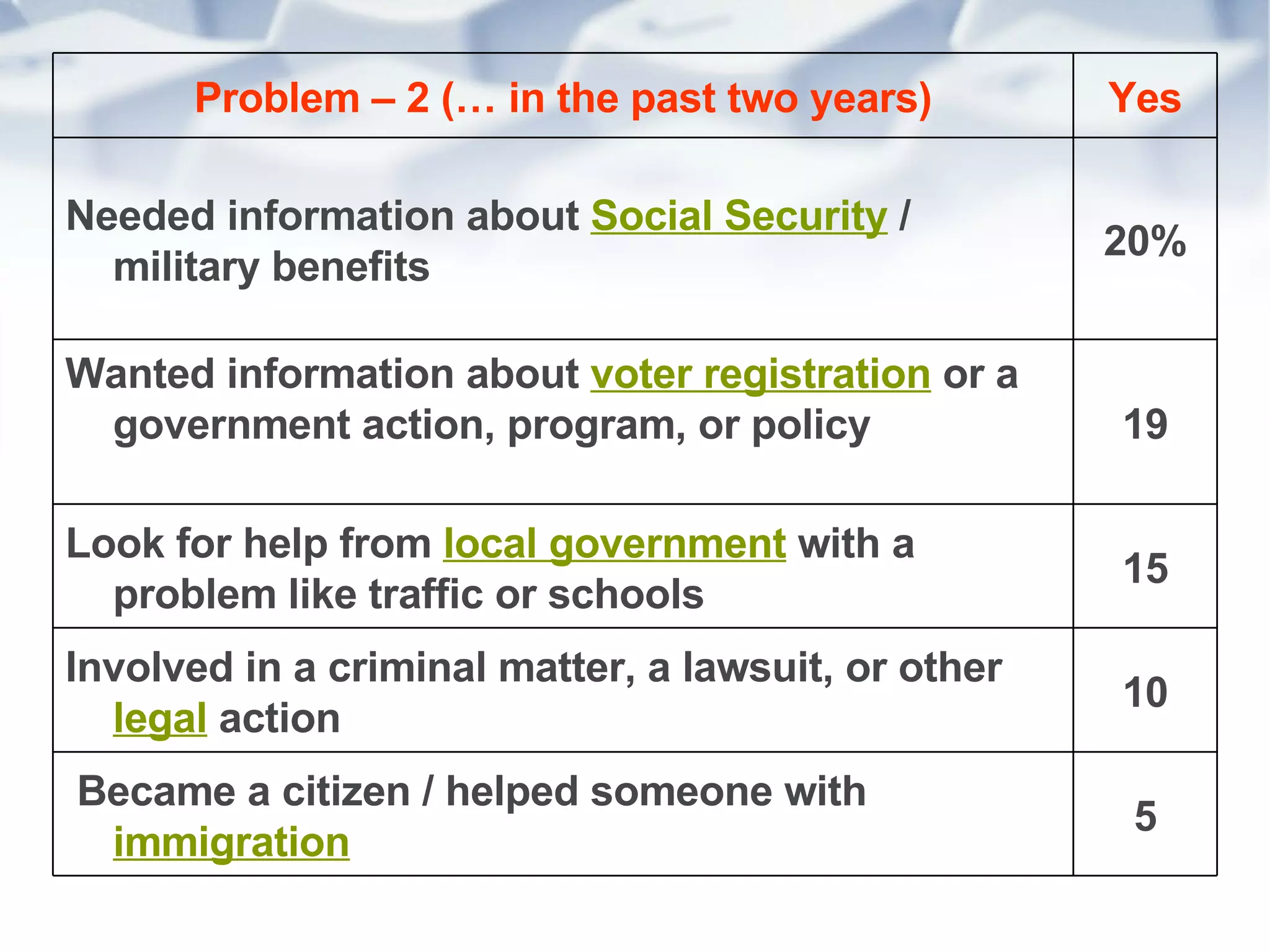
5 Became a citizen / helped someone with  immigration 10 Involved in a criminal matter, a lawsuit, or other  legal  action 15 Look for help from  local government  with a problem like traffic or schools 19 Wanted information about  voter registration  or a government action, program, or policy 20% Needed information about  Social Security  / military benefits Yes Problem – 2 (… in the past two years)
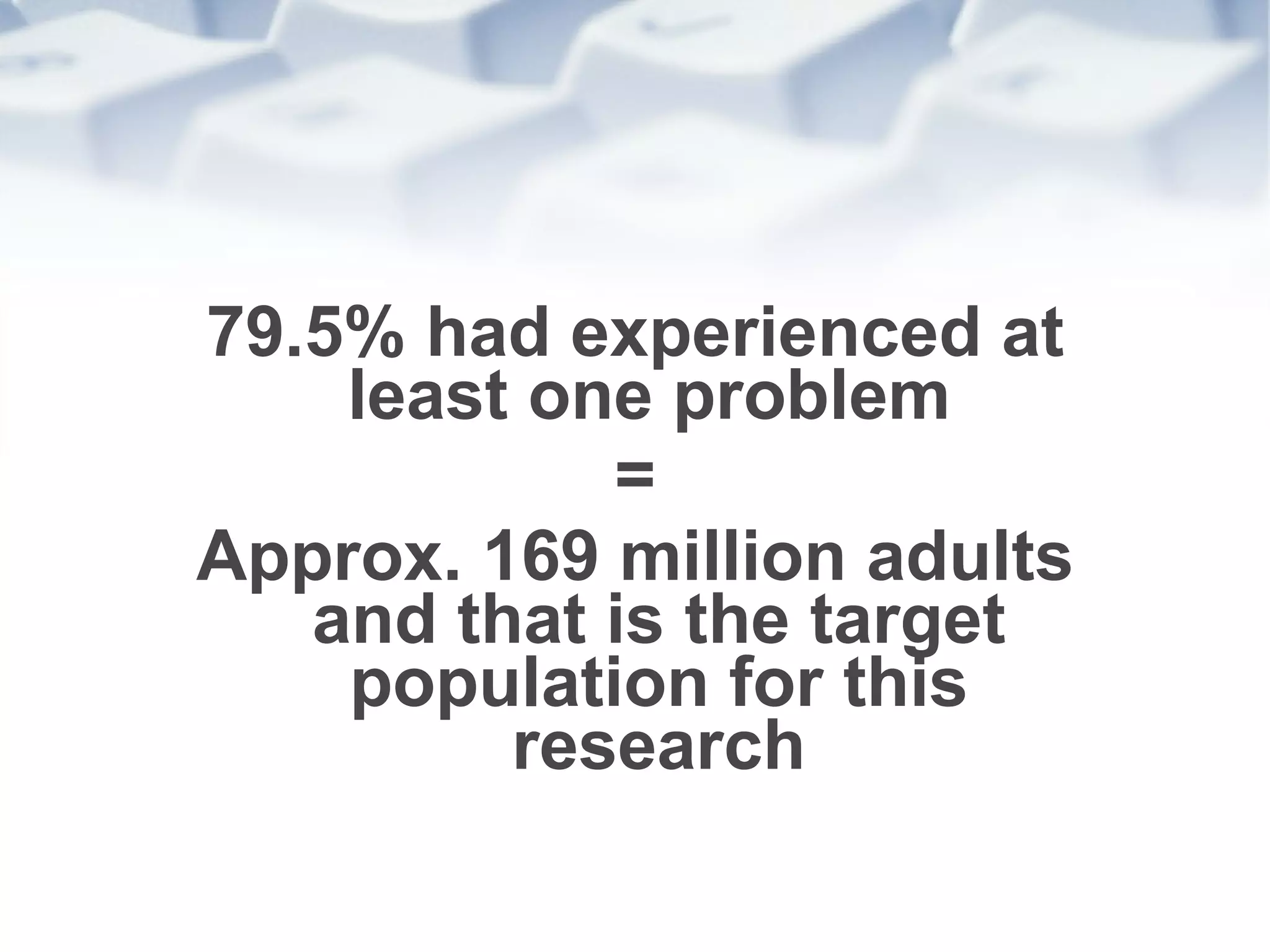
79.5% had experienced at least one problem  = Approx. 169 million adults and that is the target population for this research
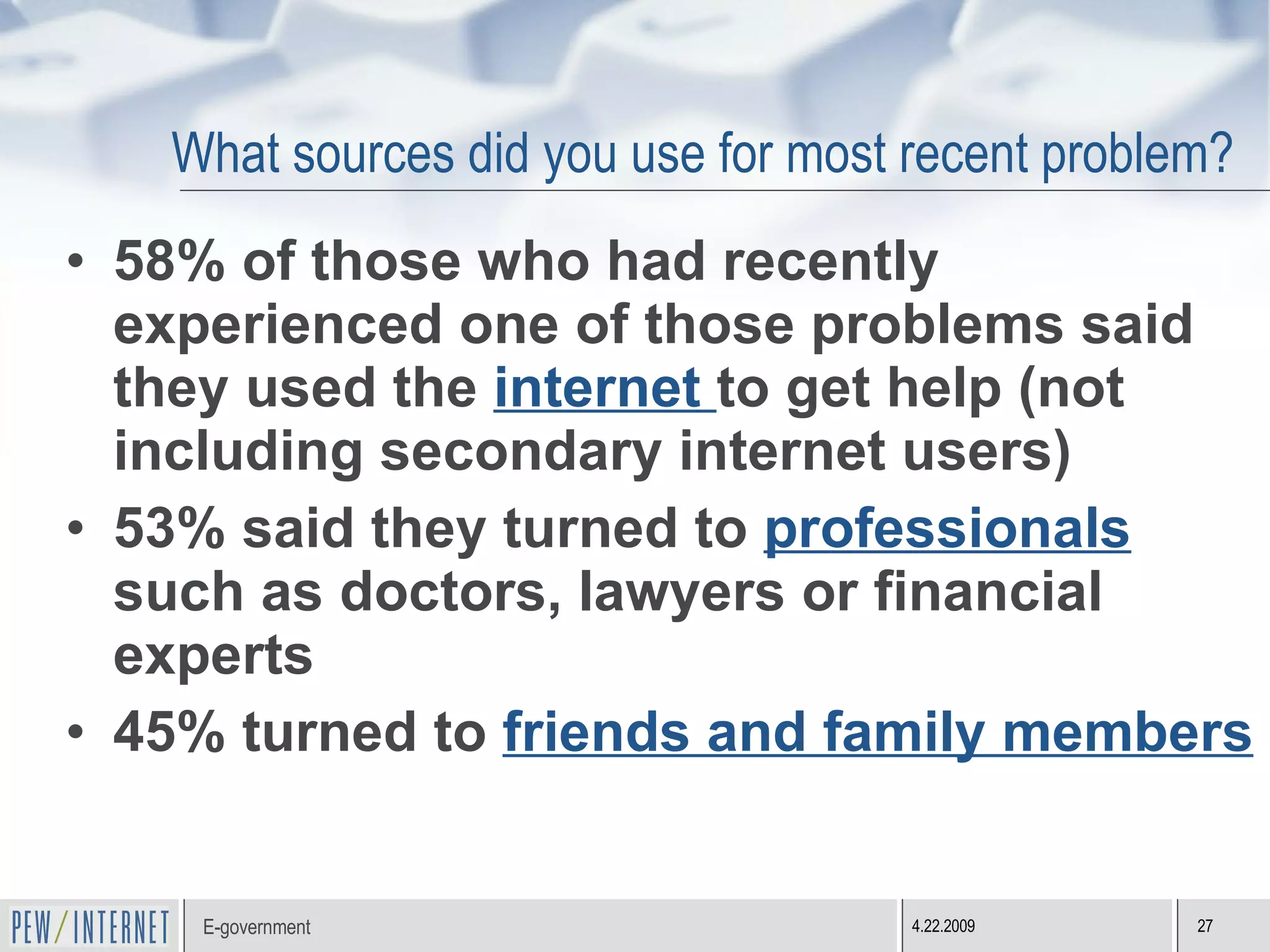
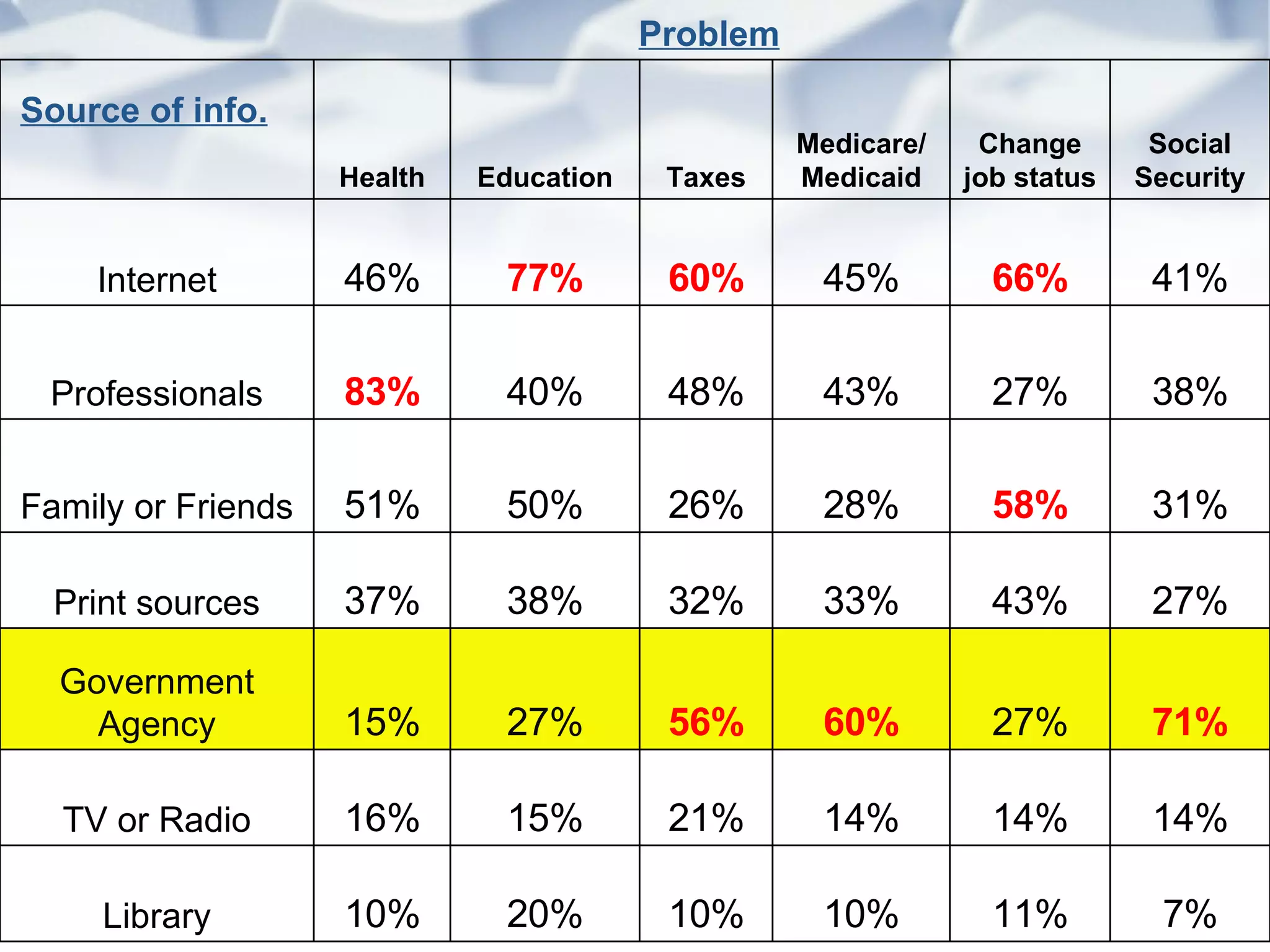
What sources did you use for most recent problem?  58% of those who had recently experienced one of those problems said they used the  internet  to get help (not including secondary internet users) 53% said they turned to  professionals  such as doctors, lawyers or financial experts 45% turned to  friends and family members
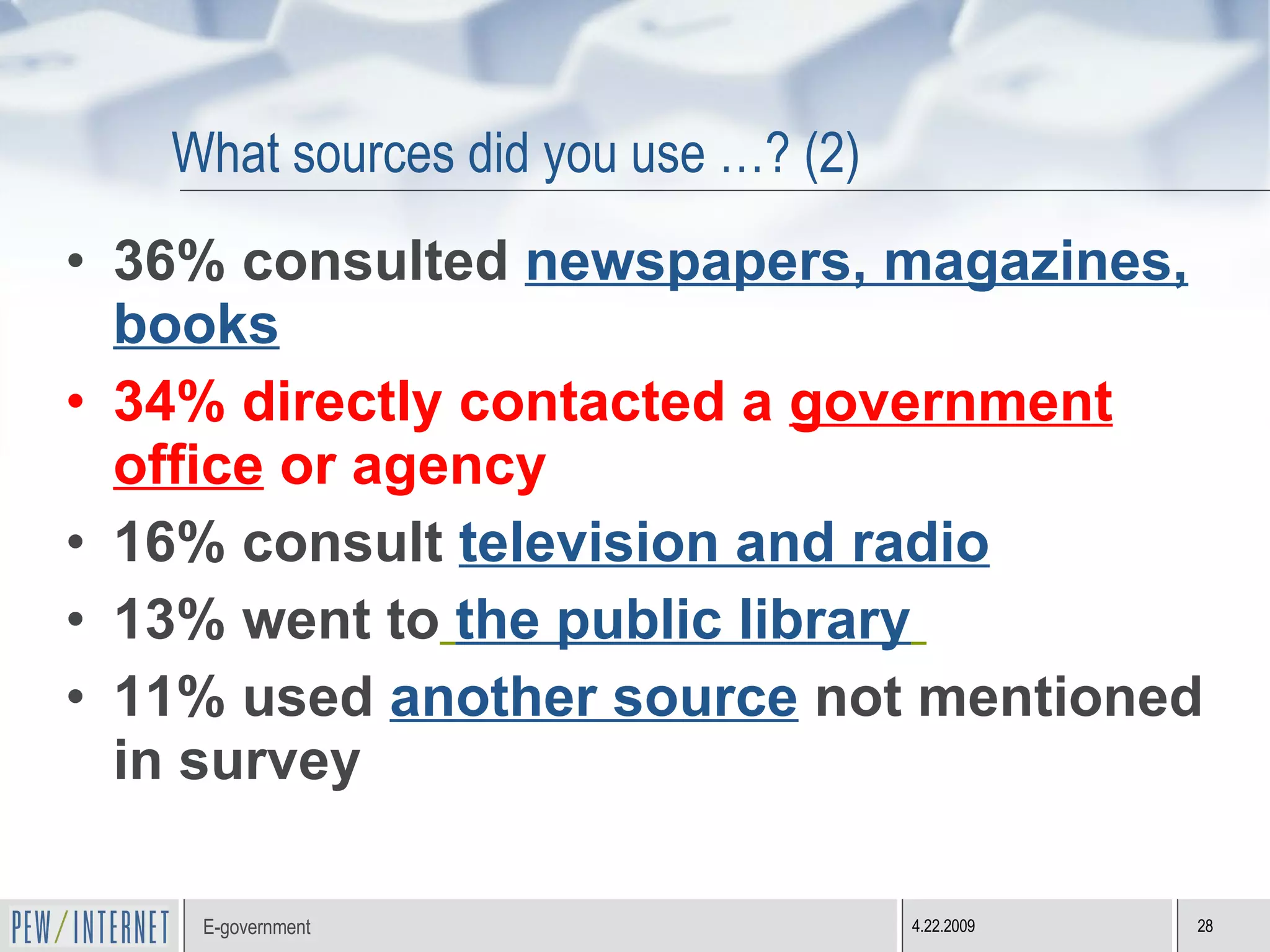
What sources did you use …? (2)  36% consulted  newspapers, magazines, books 34% directly contacted a  government office  or agency  16% consult  television and radio 13% went to   the public library   11% used  another source  not mentioned in survey
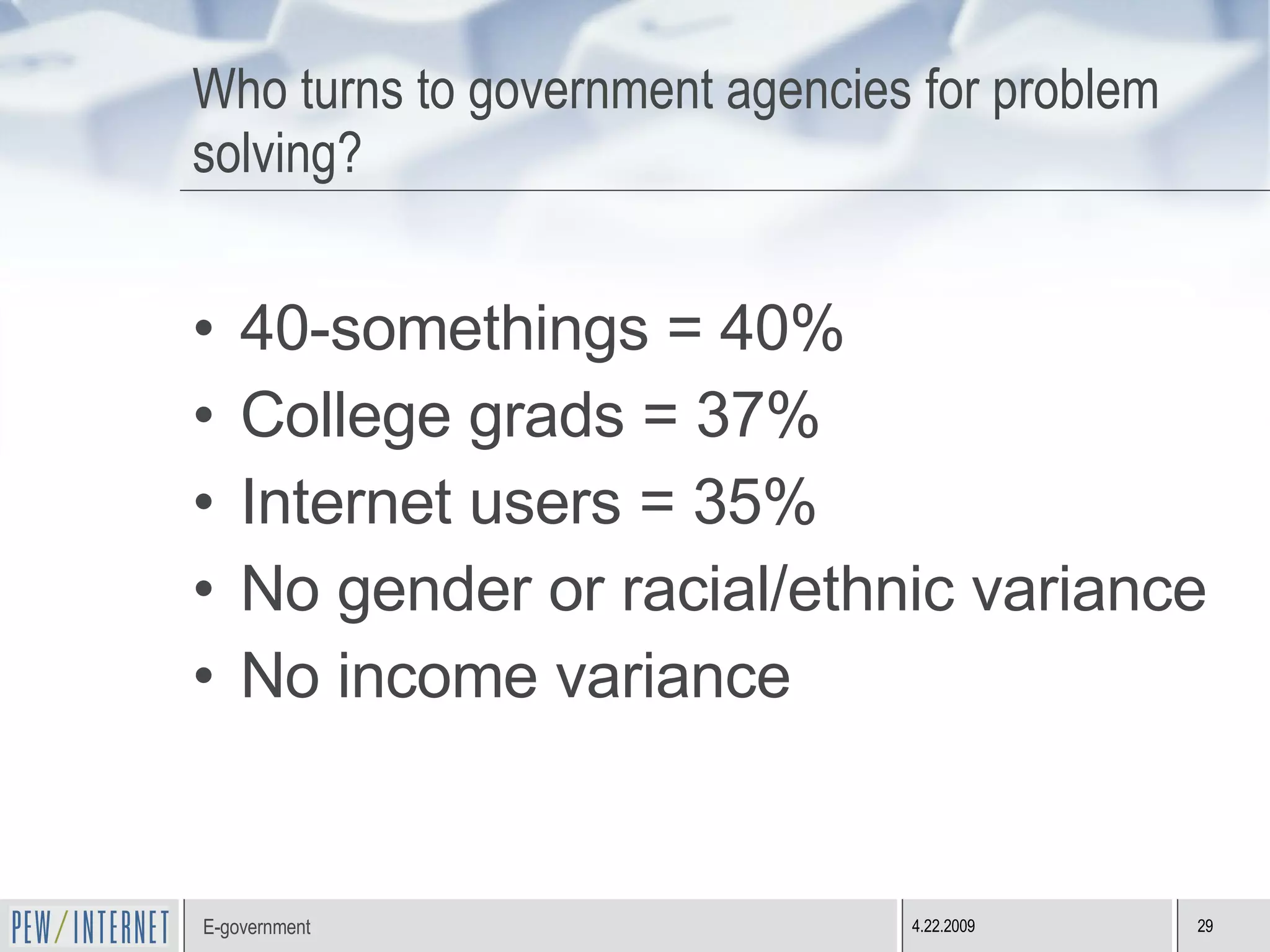
Who turns to government agencies for problem solving? 40-somethings = 40% College grads = 37% Internet users = 35% No gender or racial/ethnic variance No income variance
Problem 7% 11% 10% 10% 20% 10% Library 14% 14% 14% 21% 15% 16% TV or Radio 71% 27% 60% 56% 27% 15% Government Agency 27% 43% 33% 32% 38% 37% Print sources 31% 58% 28% 26% 50% 51% Family or Friends 38% 27% 43% 48% 40% 83% Professionals 41% 66% 45% 60% 77% 46% Internet Social Security Change job status Medicare/ Medicaid Taxes Education Health Source of info.
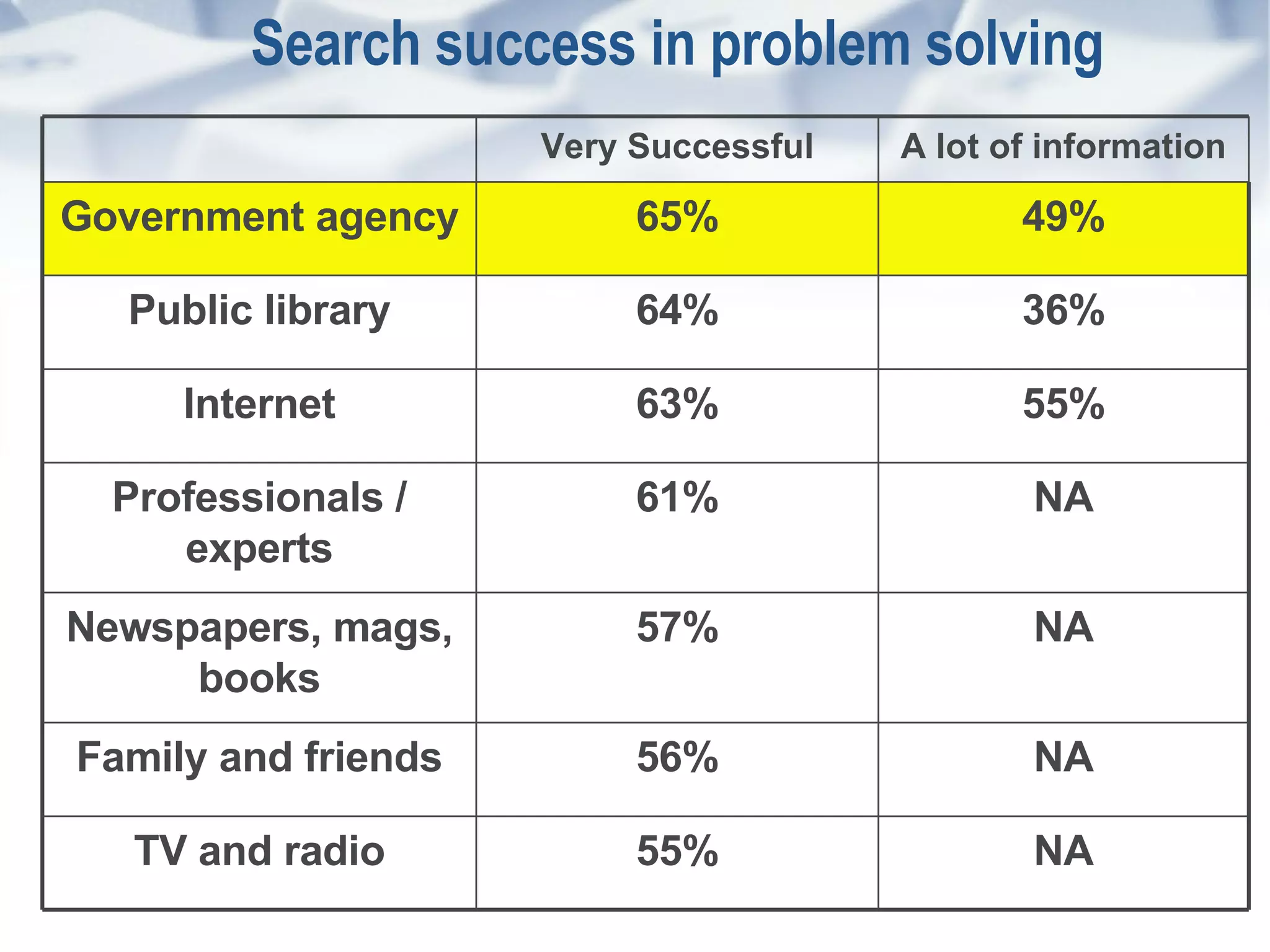
Search success in problem solving NA 55% TV and radio NA 56% Family and friends NA 57% Newspapers, mags, books NA 61% Professionals / experts 55% 63% Internet 36% 64% Public library 49% 65% Government agency  A lot of information Very Successful
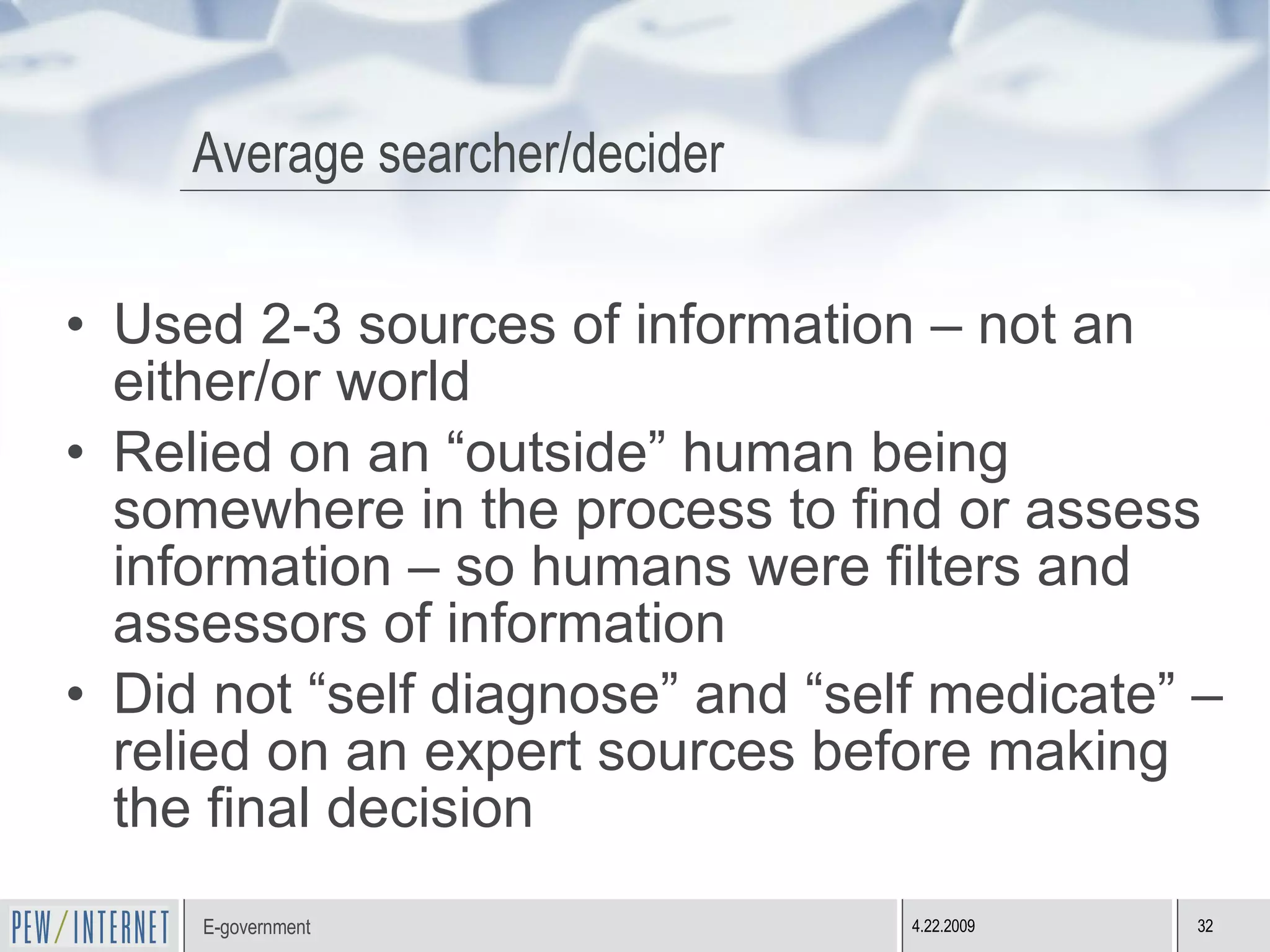
Average searcher/decider Used 2-3 sources of information – not an either/or world Relied on an “outside” human being somewhere in the process to find or assess information – so humans were filters and assessors of information Did not “self diagnose” and “self medicate” – relied on an expert sources before making the final decision
There is a new pattern of communication, influence, and support in a world of networked individuals
The two-step flow of communication has become a four-step “cycle” Attention Acquisition Assessment Action
How do you…. get a citizen’s attention? leverage your traditional platforms be a “news node” - offer alerts, updates, feeds be available in relevant places on his/her terms, not just yours find pathways through his/her social network
How do you…. help a citizen acquire information? be findable in a search-driven, “long tail” world pursue new distribution methods figure out your role in the “link economy” participate in the conversation about your work
How do you…. help a citizen assess information? be transparent be an archivist when you make mistakes, seek forgiveness decide if you can be a trusted aggregator
How do you…. assist a citizen act on information? offer opportunities for feedback offer opportunities for remixing offer opportunities for community building be open to the wisdom of crowds
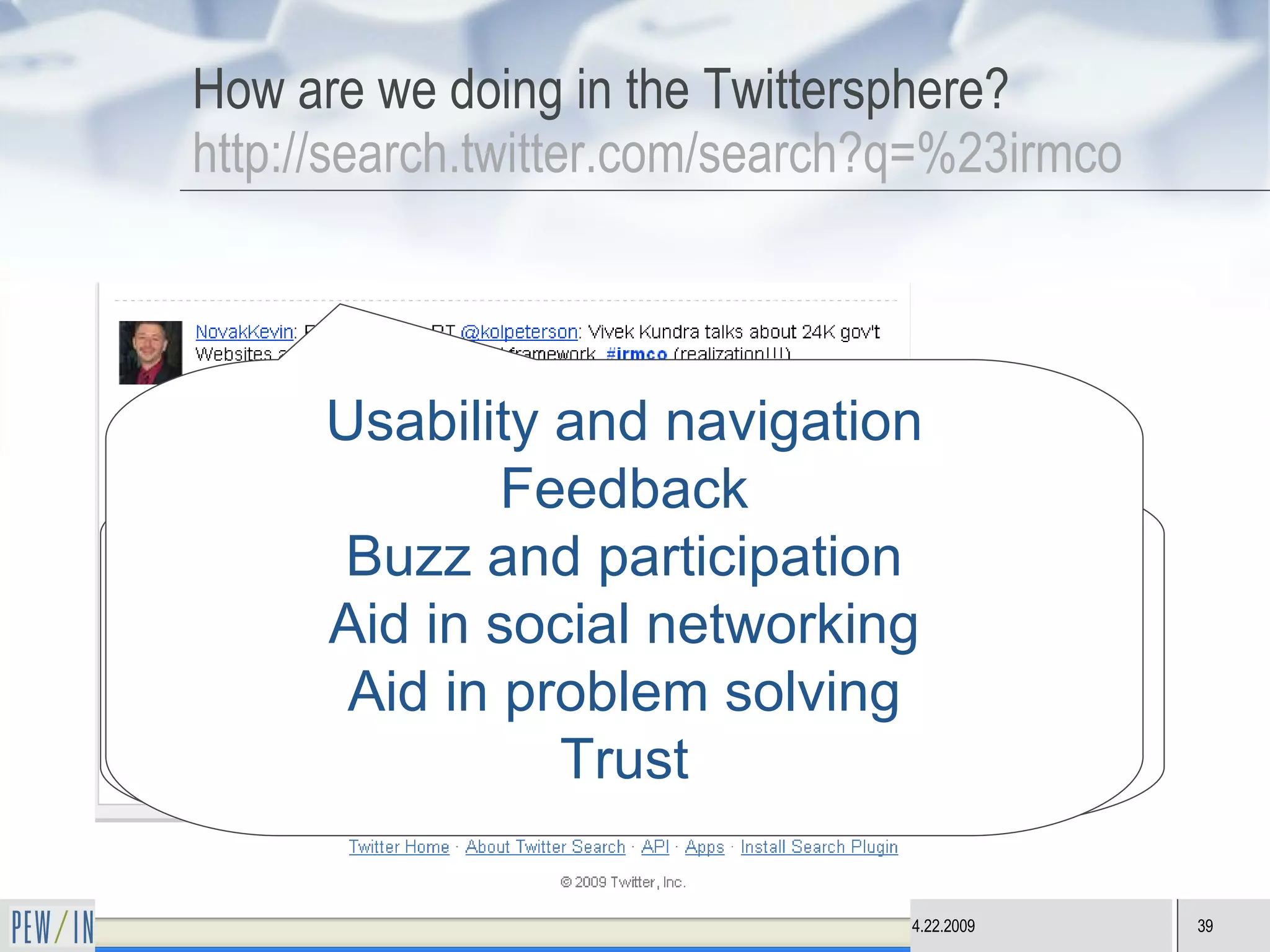
How are we doing in the Twittersphere? http:// search.twitter.com/search?q =%23irmco “ What are the metrics for citizen engagement beyond levels and diversity of participation?” Usability and navigation Feedback Buzz and participation Aid in social networking Aid in problem solving Trust
Thank you! Lee Rainie Director Pew Internet & American Life Project 1615 L Street NW Suite 700 Washington, DC 20036 [email_address] 202-419-4500

Governing as social networking

  • 1.
    GOVERNING AS SOCIALNETWORKING Lee Rainie – Director Pew Internet Project IRMCO – Cambridge, Maryland April 22, 2009
  • 2.
    New information ecosystem: Then and Now Industrial Age Info was: Scarce Expensive Institutionally oriented Designed for consumption Information Age Info is: Abundant Cheap Personally oriented Designed for participation
  • 3.
    2000 46% ofadults use internet 5% with broadband at home 50% own a cell phone <5% are content creators 0% connect wirelessly <10% use “cloud” = slow, stationary connections built around my computer, simple chat and information exchange The internet is the asteroid: Then and now 2008 75% of adults use internet 57% with broadband at home 82% own a cell phone ~40% are content creators 62% connect wirelessly >53% use “cloud” = fast, mobile connections built around outside servers and storage and social / civic engagement
  • 4.
  • 5.
    Media ecology – then Product Route to home Display Local storage TV stations phone TV Cassette/ 8-track broadcast TV radio broadcast radio stereo Vinyl album News mail Advertising newspaper delivery phone paper Radio Stations non-electronic Tom Wolzien, Sanford C. Bernstein & Co
  • 6.
    Media ecology –now Product Route to home Display Local storage cable TiVo (PVR) VCR TV stations DSL TV Info wireless/phone radio DVD “ Daily me” broadcast TV PC Web-based storage content iPod /MP3 server/ TiVo (PVR) Cable Nets broadcast radio stereo PC Web sites satellite monitor web storage Local news mail headphones CD/CD-ROM Content from express delivery pager individuals iPod / storage portable gamer MP3 player / iPod Peer-to-peer subcarriers / WIFI cell phone pagers - PDAs Advertising newspaper delivery phone cable box Radio stations camcorder/camera PDA/Palm game console game console paper Satellite radio non-electronic storage sticks/disks Adapted from Tom Wolzien, Sanford C. Bernstein & Co
  • 7.
    Personal ecosystem changes Volume of information grows Variety of information increases Velocity of information speeds up The times and places to experience media enlarge People’s vigilance for information expands AND contracts
  • 8.
    Personal ecosystem changesThe immersive qualities of media are more compelling Relevance of information improves The number of information “voices” explodes – and becomes more findable Voting and ventilating are enabled Social networks are more vivid
  • 9.
    A different personalecosystem and a different sense of … Expectation about access to information and people Persistence of the “digital me” and “digital you” Place … and time … and presence with others Possibilities of conversation and community -- scalability Personal efficacy Boundaries and contexts – public and private Social networking possibilities – new layers, new audiences
  • 10.
  • 11.
  • 12.
    The internet andpolitical news/information % who use the internet to get info about the campaign
  • 13.
  • 14.
  • 15.
  • 16.
  • 17.
  • 18.
    35% of adultshave watched politically related video --- Up from 13% in 2004 Other activities
  • 19.
    14% of adultshave used social network sites for political news and information Other activities
  • 20.
  • 21.
    The process ofcitizen decision-making and problem-solving changes
  • 22.
    Background of researchInstitute for Museum and Library Services grant UIC partnership Government Printing Office query http://www.pewinternet.org/PPF/r/231/report_display.asp
  • 23.
    Basic question Howdo people get information to help them solve problems that could have a government connection or be aided by government resources?
  • 24.
    23 Needed informationabout Medicare / Medicaid / food stamps 25 Changed jobs , retired, or started your own business 34 Needed information about property taxes or income taxes 39 Made a decision about schooling , paying for education, or getting training for yourself or for a child 45% Dealt with a serious illness or other health condition, either yourself or someone close to you Yes Problem – 1 (… in the past two years)
  • 25.
    5 Became acitizen / helped someone with immigration 10 Involved in a criminal matter, a lawsuit, or other legal action 15 Look for help from local government with a problem like traffic or schools 19 Wanted information about voter registration or a government action, program, or policy 20% Needed information about Social Security / military benefits Yes Problem – 2 (… in the past two years)
  • 26.
    79.5% had experiencedat least one problem = Approx. 169 million adults and that is the target population for this research
  • 27.
    What sources didyou use for most recent problem? 58% of those who had recently experienced one of those problems said they used the internet to get help (not including secondary internet users) 53% said they turned to professionals such as doctors, lawyers or financial experts 45% turned to friends and family members
  • 28.
    What sources didyou use …? (2) 36% consulted newspapers, magazines, books 34% directly contacted a government office or agency 16% consult television and radio 13% went to the public library 11% used another source not mentioned in survey
  • 29.
    Who turns togovernment agencies for problem solving? 40-somethings = 40% College grads = 37% Internet users = 35% No gender or racial/ethnic variance No income variance
  • 30.
    Problem 7% 11%10% 10% 20% 10% Library 14% 14% 14% 21% 15% 16% TV or Radio 71% 27% 60% 56% 27% 15% Government Agency 27% 43% 33% 32% 38% 37% Print sources 31% 58% 28% 26% 50% 51% Family or Friends 38% 27% 43% 48% 40% 83% Professionals 41% 66% 45% 60% 77% 46% Internet Social Security Change job status Medicare/ Medicaid Taxes Education Health Source of info.
  • 31.
    Search success inproblem solving NA 55% TV and radio NA 56% Family and friends NA 57% Newspapers, mags, books NA 61% Professionals / experts 55% 63% Internet 36% 64% Public library 49% 65% Government agency A lot of information Very Successful
  • 32.
    Average searcher/decider Used2-3 sources of information – not an either/or world Relied on an “outside” human being somewhere in the process to find or assess information – so humans were filters and assessors of information Did not “self diagnose” and “self medicate” – relied on an expert sources before making the final decision
  • 33.
    There is anew pattern of communication, influence, and support in a world of networked individuals
  • 34.
    The two-step flowof communication has become a four-step “cycle” Attention Acquisition Assessment Action
  • 35.
    How do you….get a citizen’s attention? leverage your traditional platforms be a “news node” - offer alerts, updates, feeds be available in relevant places on his/her terms, not just yours find pathways through his/her social network
  • 36.
    How do you….help a citizen acquire information? be findable in a search-driven, “long tail” world pursue new distribution methods figure out your role in the “link economy” participate in the conversation about your work
  • 37.
    How do you….help a citizen assess information? be transparent be an archivist when you make mistakes, seek forgiveness decide if you can be a trusted aggregator
  • 38.
    How do you….assist a citizen act on information? offer opportunities for feedback offer opportunities for remixing offer opportunities for community building be open to the wisdom of crowds
  • 39.
    How are wedoing in the Twittersphere? http:// search.twitter.com/search?q =%23irmco “ What are the metrics for citizen engagement beyond levels and diversity of participation?” Usability and navigation Feedback Buzz and participation Aid in social networking Aid in problem solving Trust
  • 40.
    Thank you! LeeRainie Director Pew Internet & American Life Project 1615 L Street NW Suite 700 Washington, DC 20036 [email_address] 202-419-4500

Editor's Notes

  • #2 IRMCO is – Interagency Resources Management Conference Title: Governing as social networking Description: Lee Rainie, Director of the Pew Internet &amp; American Life Project, will discuss the Project’s research about how the internet and cell phones are affecting citizens and how government agencies have new opportunities to plug into citizens’ social networks as they try to solve problems in their lives. He will talk about the reasons people rely more and more on their social networks as they share ideas, learn, and seek support. Government agencies now have the chance to act as “nodes” in those networks. --- The conference web site at www.irmco.gov gives further details on the other policy speakers who will be on hand, from Vivek Kundra, our first Federal CIO, to John Berry, our new Director of the Office of Personnel Management, and a wide range of leaders who will speak to this senior audience, 81% of whom are at the highest management grade, either GS-15&apos;s or Senior Executive Service career public servants.