Pele Oy
Optical Properties in Papermaking
March 2016
Pekka.Komulainen@clarinet.fi
Pele Oy
Paper under light
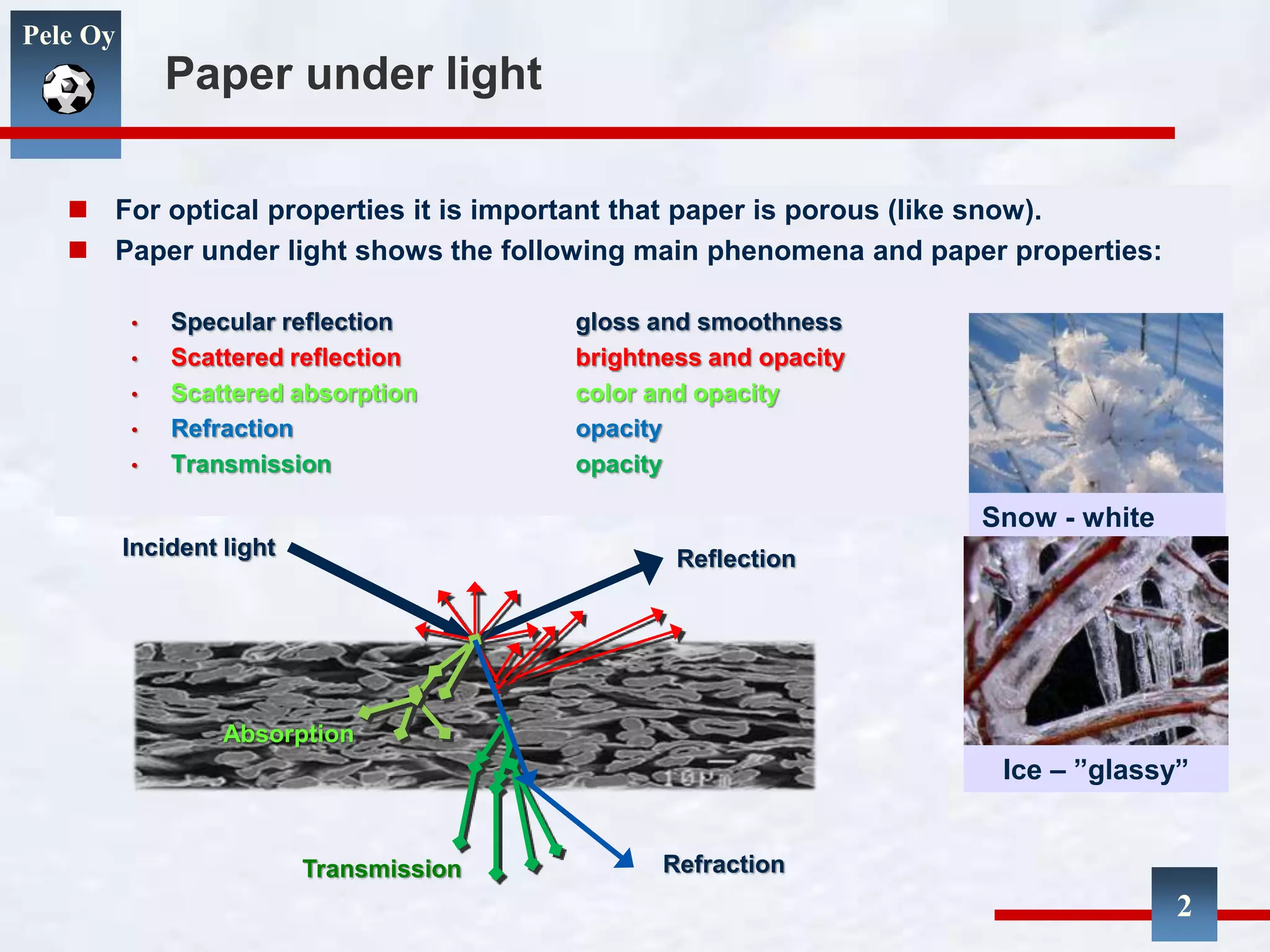
 For optical properties it is important that paper is porous (like snow).
 Paper under light shows the following main phenomena and paper properties:
• Specular reflection gloss and smoothness
• Scattered reflection brightness and opacity
• Scattered absorption color and opacity
• Refraction opacity
• Transmission opacity
2
Snow - white
Ice – ”glassy”
Reflection
Refraction
Absorption
Transmission
Incident light
Pele Oy
3
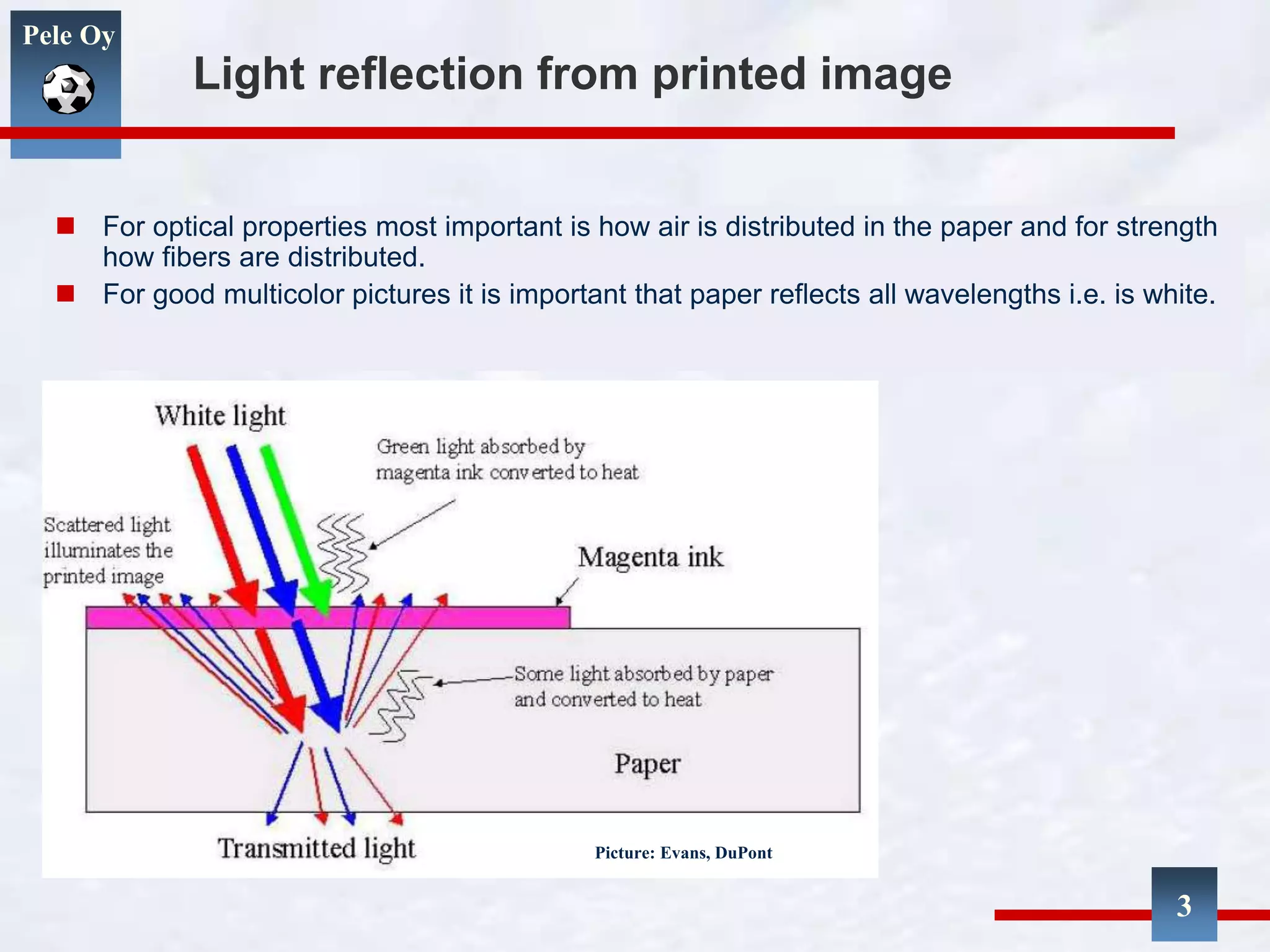
Light reflection from printed image
 For optical properties most important is how air is distributed in the paper and for strength
how fibers are distributed.
 For good multicolor pictures it is important that paper reflects all wavelengths i.e. is white.
Picture: Evans, DuPont
Pele Oy
Kubelka-Munk theory and light scattering
 Paper is rough and porous material. This
means that it reflects scattered light from the
surface but also deeper from the paper.
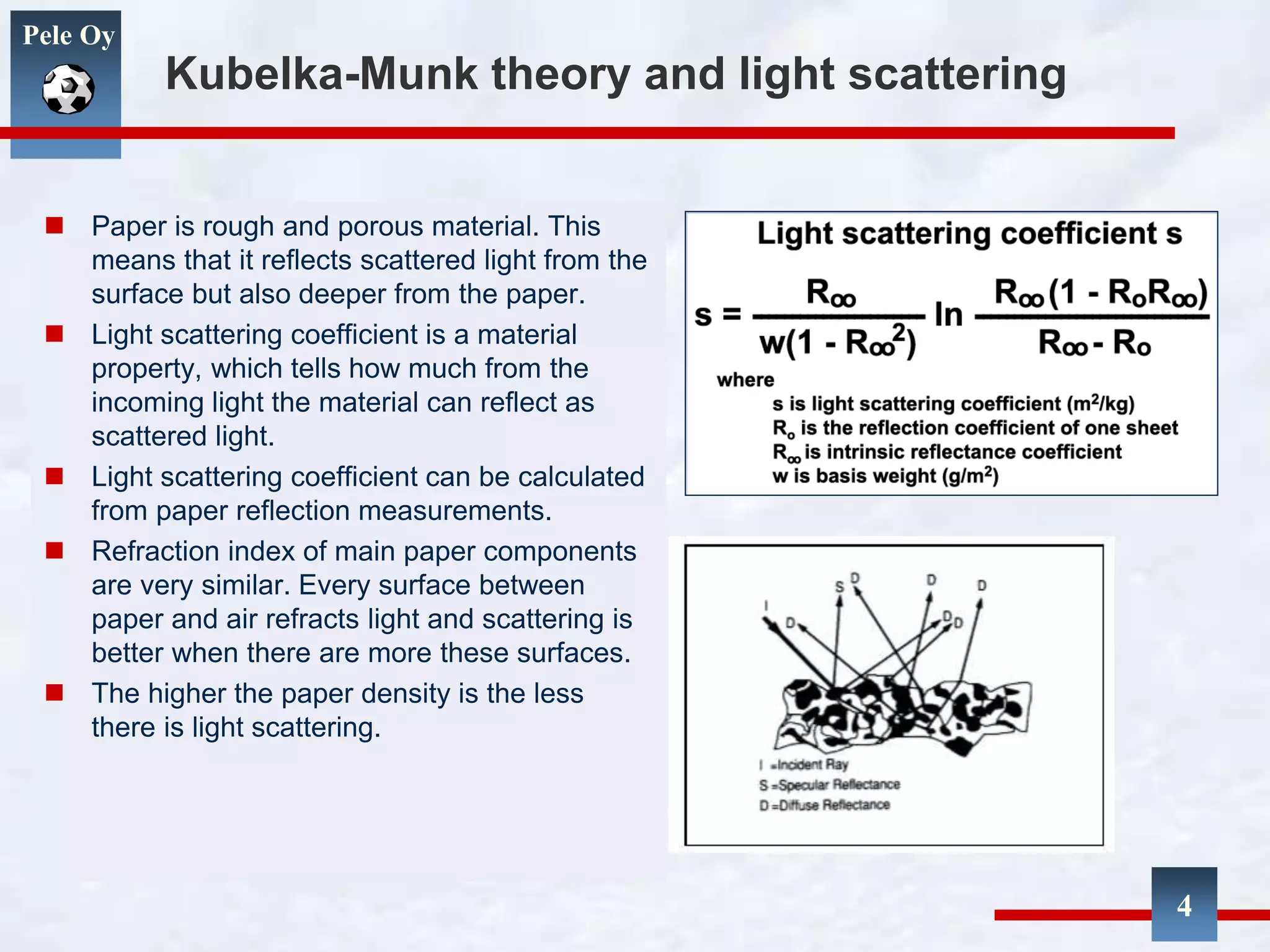
 Light scattering coefficient is a material
property, which tells how much from the
incoming light the material can reflect as
scattered light.
 Light scattering coefficient can be calculated
from paper reflection measurements.
 Refraction index of main paper components
are very similar. Every surface between
paper and air refracts light and scattering is
better when there are more these surfaces.
 The higher the paper density is the less
there is light scattering.
4
Pele Oy
Absorption coefficient
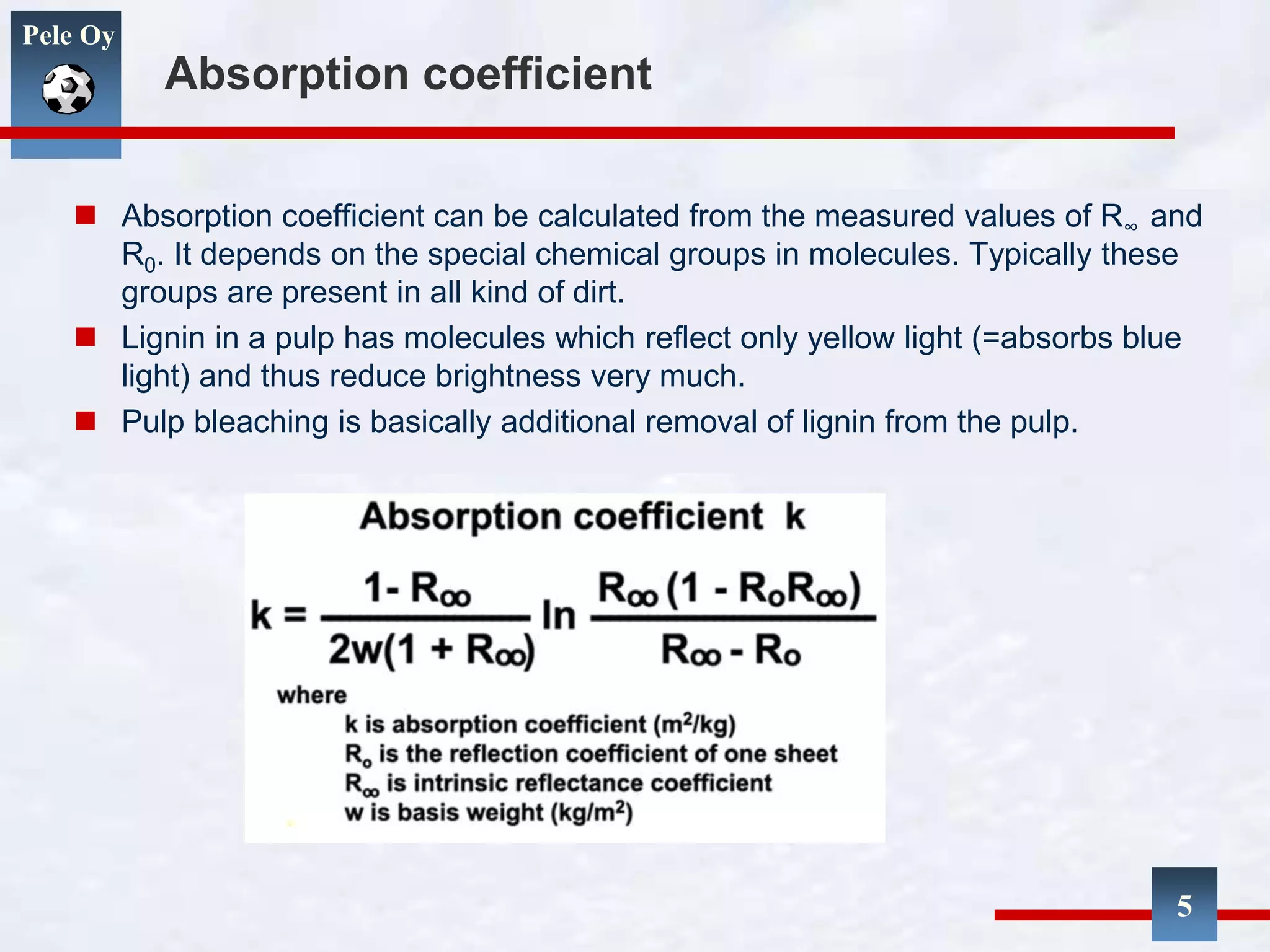
 Absorption coefficient can be calculated from the measured values of R∞ and
R0. It depends on the special chemical groups in molecules. Typically these
groups are present in all kind of dirt.
 Lignin in a pulp has molecules which reflect only yellow light (=absorbs blue
light) and thus reduce brightness very much.
 Pulp bleaching is basically additional removal of lignin from the pulp.
5
Pele Oy
Reflection and transmission
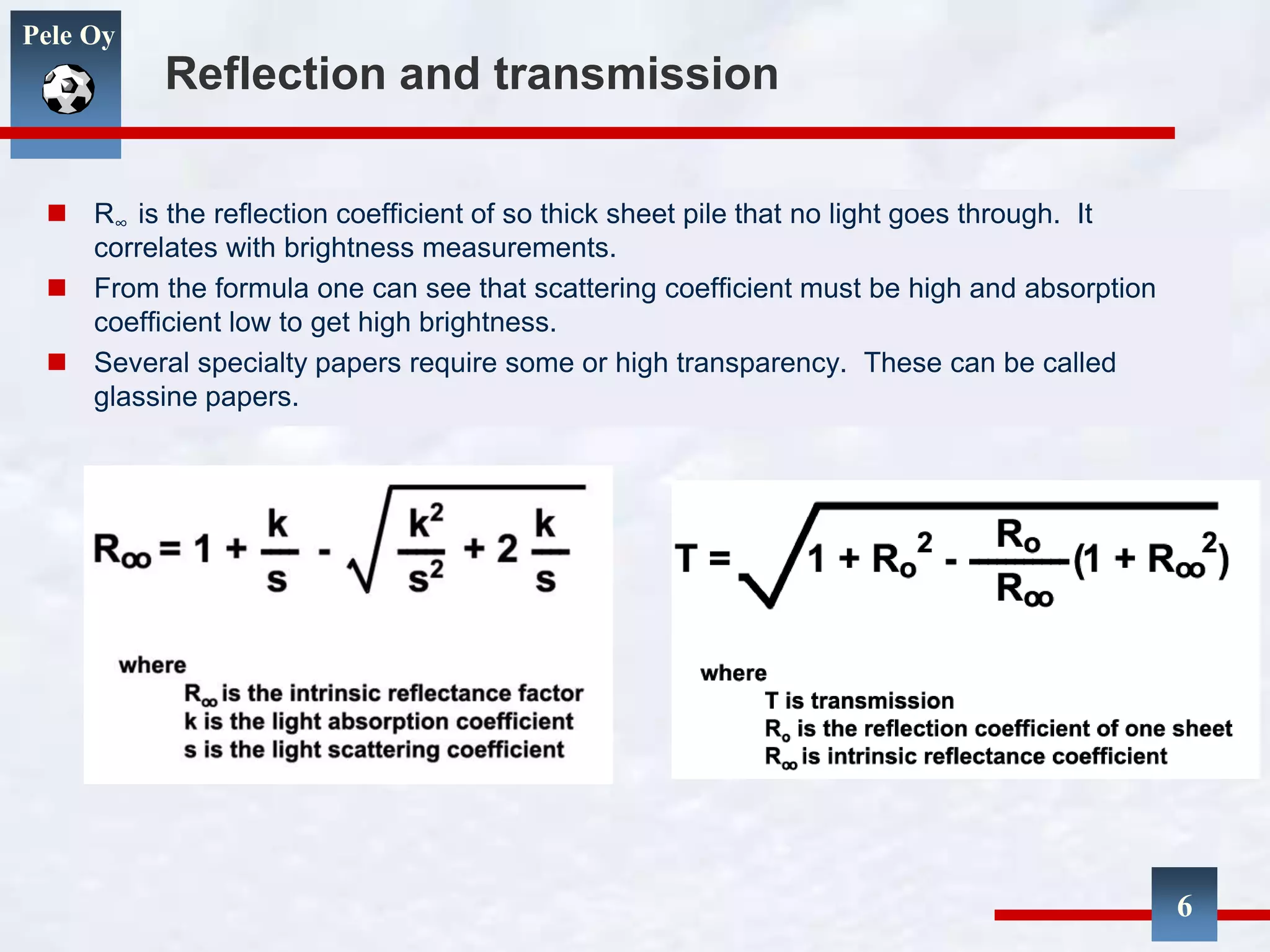
 R∞ is the reflection coefficient of so thick sheet pile that no light goes through. It
correlates with brightness measurements.
 From the formula one can see that scattering coefficient must be high and absorption
coefficient low to get high brightness.
 Several specialty papers require some or high transparency. These can be called
glassine papers.
6
Pele Oy
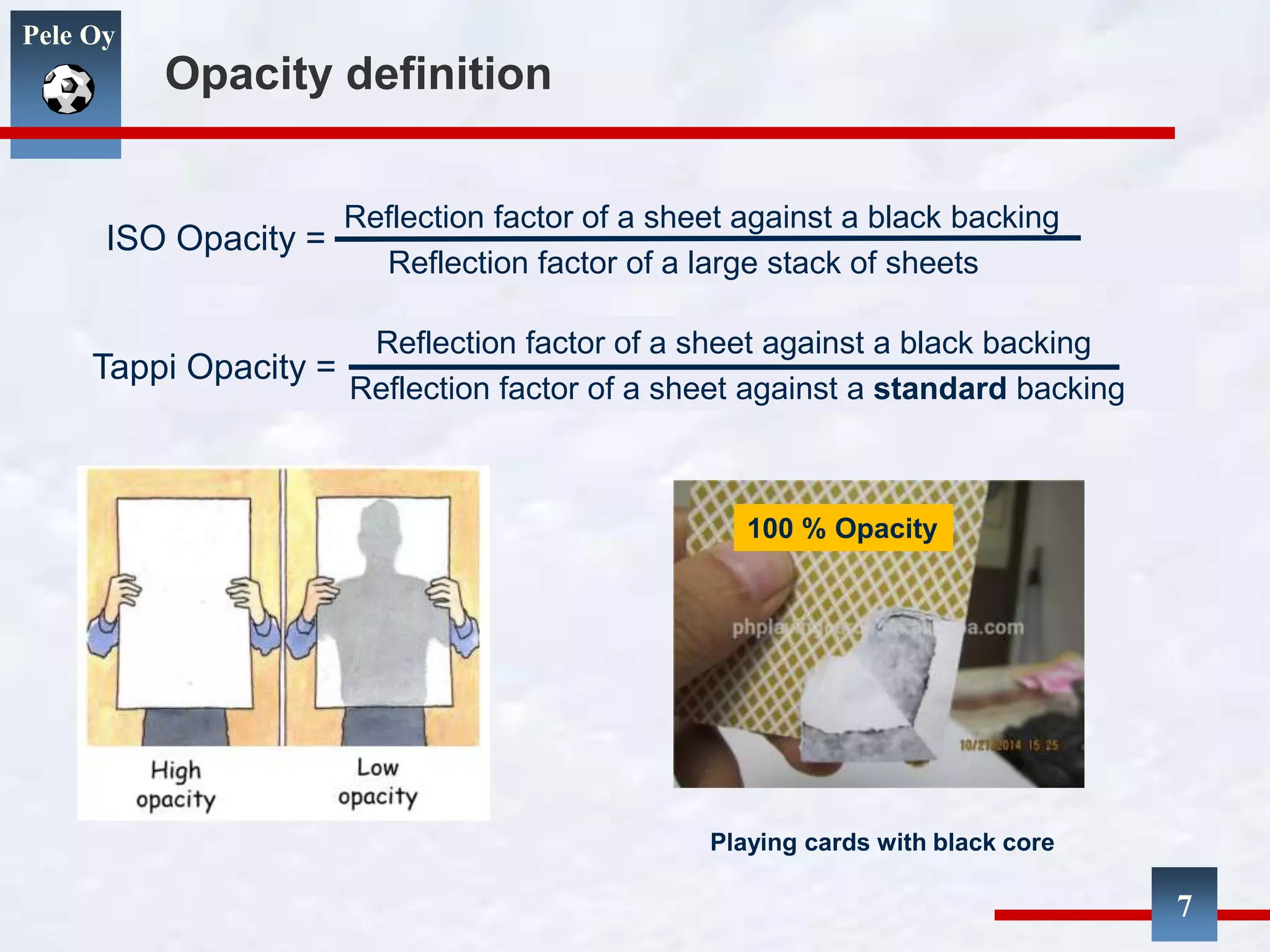
Reflection factor of a sheet against a black backing
Reflection factor of a large stack of sheets
7
Opacity definition
ISO Opacity =
Reflection factor of a sheet against a black backing
Reflection factor of a sheet against a standard backing
Tappi Opacity =
100 % Opacity
Playing cards with black core
Pele Oy
Opacity measurement
8
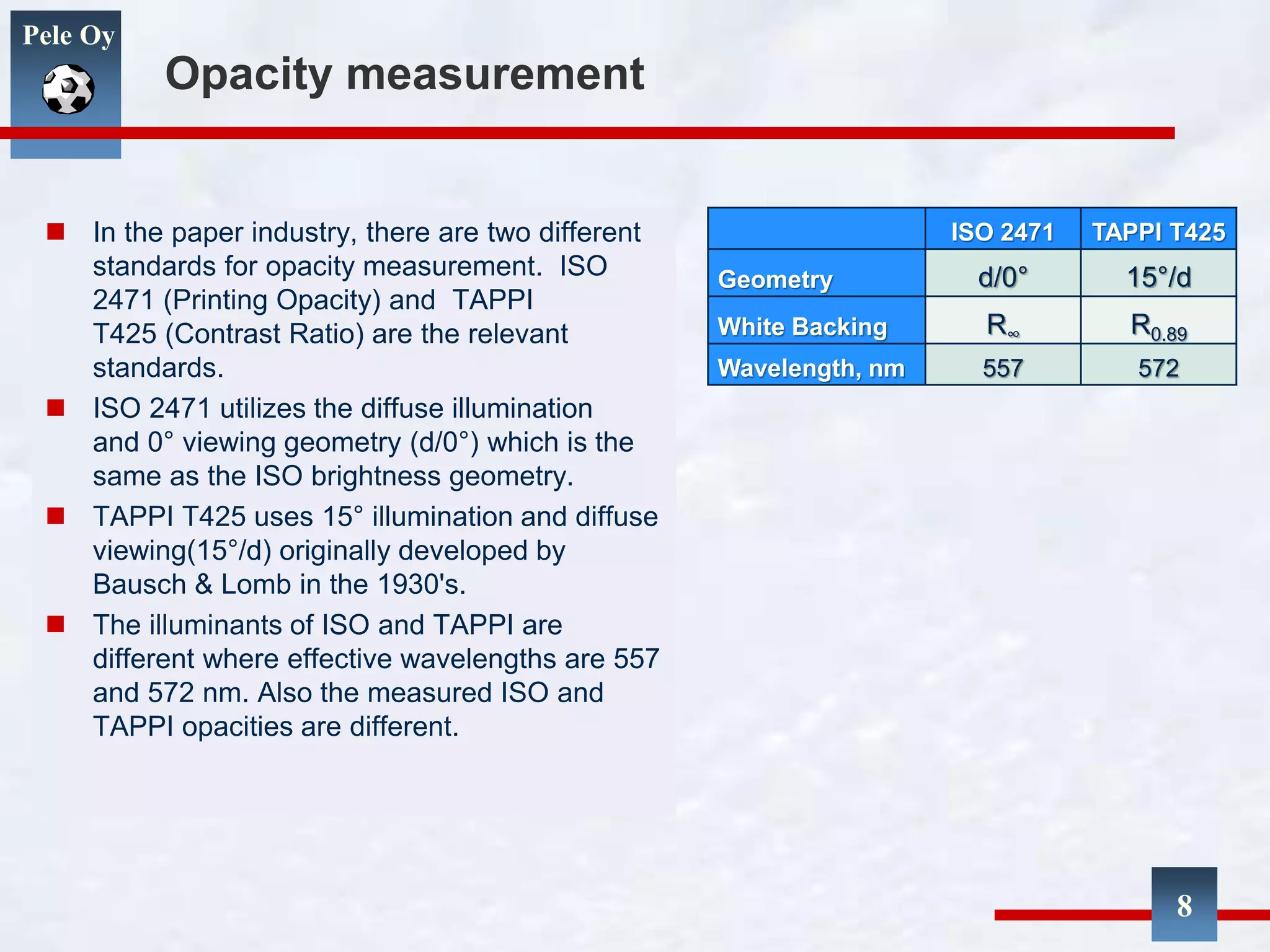
 In the paper industry, there are two different
standards for opacity measurement. ISO
2471 (Printing Opacity) and TAPPI
T425 (Contrast Ratio) are the relevant
standards.
 ISO 2471 utilizes the diffuse illumination
and 0° viewing geometry (d/0°) which is the
same as the ISO brightness geometry.
 TAPPI T425 uses 15° illumination and diffuse
viewing(15°/d) originally developed by
Bausch & Lomb in the 1930's.
 The illuminants of ISO and TAPPI are
different where effective wavelengths are 557
and 572 nm. Also the measured ISO and
TAPPI opacities are different.
ISO 2471 TAPPI T425
Geometry d/0° 15°/d
White Backing R∞ R0.89
Wavelength, nm 557 572
Pele Oy
Opacity and brightness
 Opacity % is 100*R0/R∞. This simple formula
tells that opacity is lower when brightness is
higher.
 It is very difficult to get high opacity when
brightness is high. This is the reason that
newsprint grammage can be about 45 gsm but
copy paper must be about 80 gsm.
 Opacity relates to the show-through of the
printed image from the opposite side of the
sheet, or the sheet under it.
9
Pele Oy
10
Standard illuminants
A = 2856 ºK, “electric lamp”
B = 4874 ºK
C = 6504 ºK, ”indoor daylight”
D65 = 6774 ºK, ”outdoor daylight”D65 = more UV
 D65 is outdoor daylight, where UV is fully included. C is about indoor daylight (less UV).
 Illuminants C and D65 are used for paper measurements. The big difference is that D65
includes more UV light (wavelengths less than 400 nm).
 Optical brighteners (OBA = FWA) convert this UV light to visible blue light thus
increasing brightness values.
Pele Oy
Brightness measurements
 There are two basic types of brightness
measurements: directional and diffuse.
 Directional brightness (TAPPI brightness – TAPPI
452) employs the 45º/0º geometry of the original
GE-Photovolt instrument. It has been the standard
in the U.S. and Japan. Fiber orientation has effect
on the TAPPI brightness measurement.
 Diffuse brightness employs a D/0º geometry where
D indicates diffuse illumination from a sphere,
making it insensitive to sample orientation. Diffuse
brightness is the standard in much of the rest of
the world.
 Two types of diffuse brightness are commonly
discussed, and a standard exists for both of them.
 ISO C Brightness (ISO 2470-1, TAPPI 525) uses
Illuminant C level of UV energy. It simulates
normal office lighting conditions.
 ISO D65 Brightness uses Illuminant D65 (daylight)
according to ISO 2470-2.
11
Sample
Photodetector
Light source
Sample
Photodetector
Light source
Directional
Diffuse
Pele Oy
12
D65 illuminant and measuring slot of brightness
 For brightness measurement a narrow wavelength ”slot” has been standardised. The
dominant wavelength of this slot is 457 nm (blue) and the range is ± 44 nm. If paper is
yellow it reflects less blue light. This measure is effective for bleaching (less lignin less
yellowish).
 D65 illuminant includes lot of UV light, which can be converted to blue light by using optical
brighteners. This increases brightness.
 When measuring and calculating whiteness all wavelength have effect and blue dyes
increase whiteness.
0
20
40
60
80
100
120
350 400 450 500 550 600 650 700
Brightness is measured from the slot
which is under the white curve.
Pele Oy
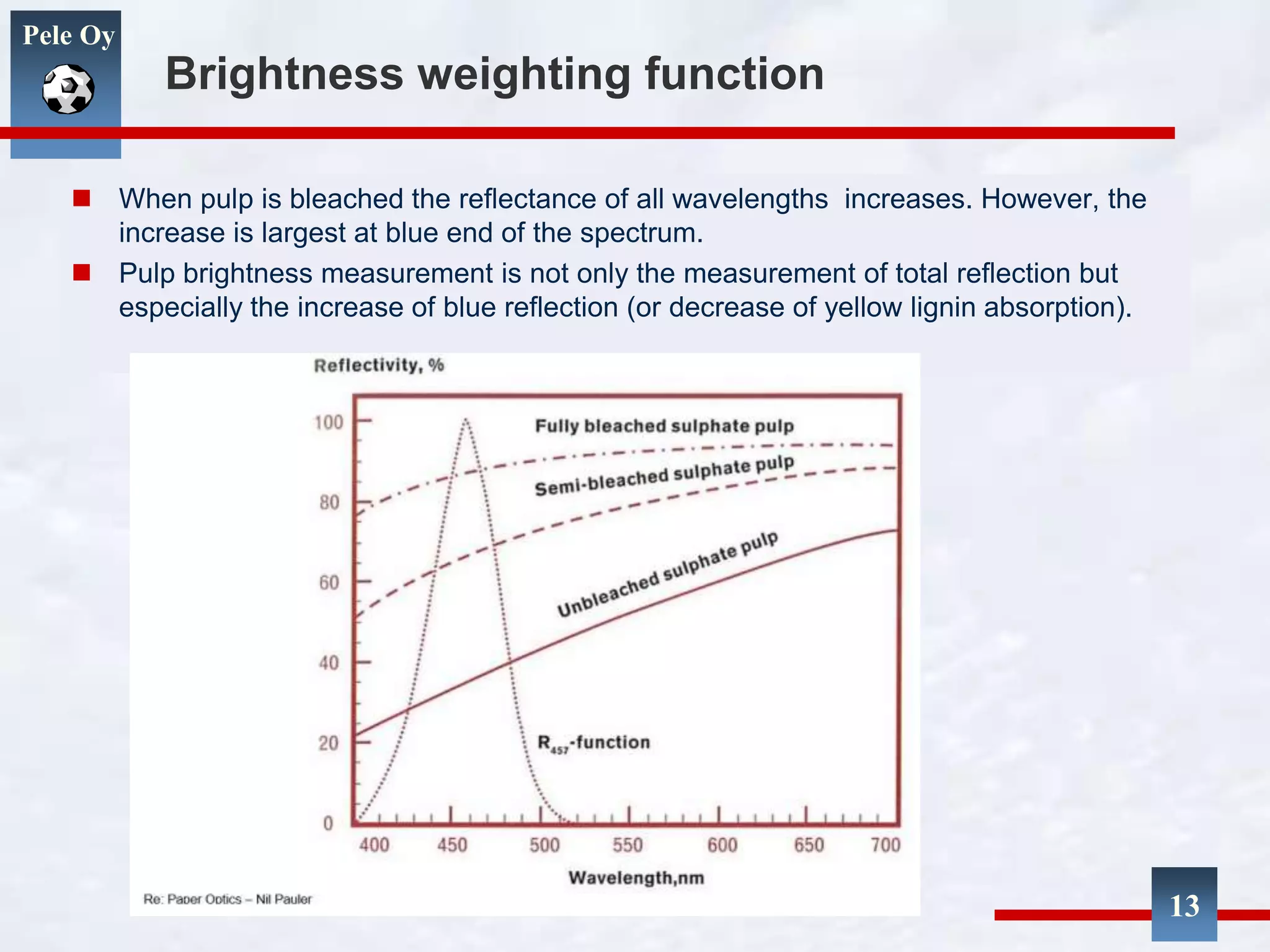
Brightness weighting function
 When pulp is bleached the reflectance of all wavelengths increases. However, the
increase is largest at blue end of the spectrum.
 Pulp brightness measurement is not only the measurement of total reflection but
especially the increase of blue reflection (or decrease of yellow lignin absorption).
13
Pele Oy
14
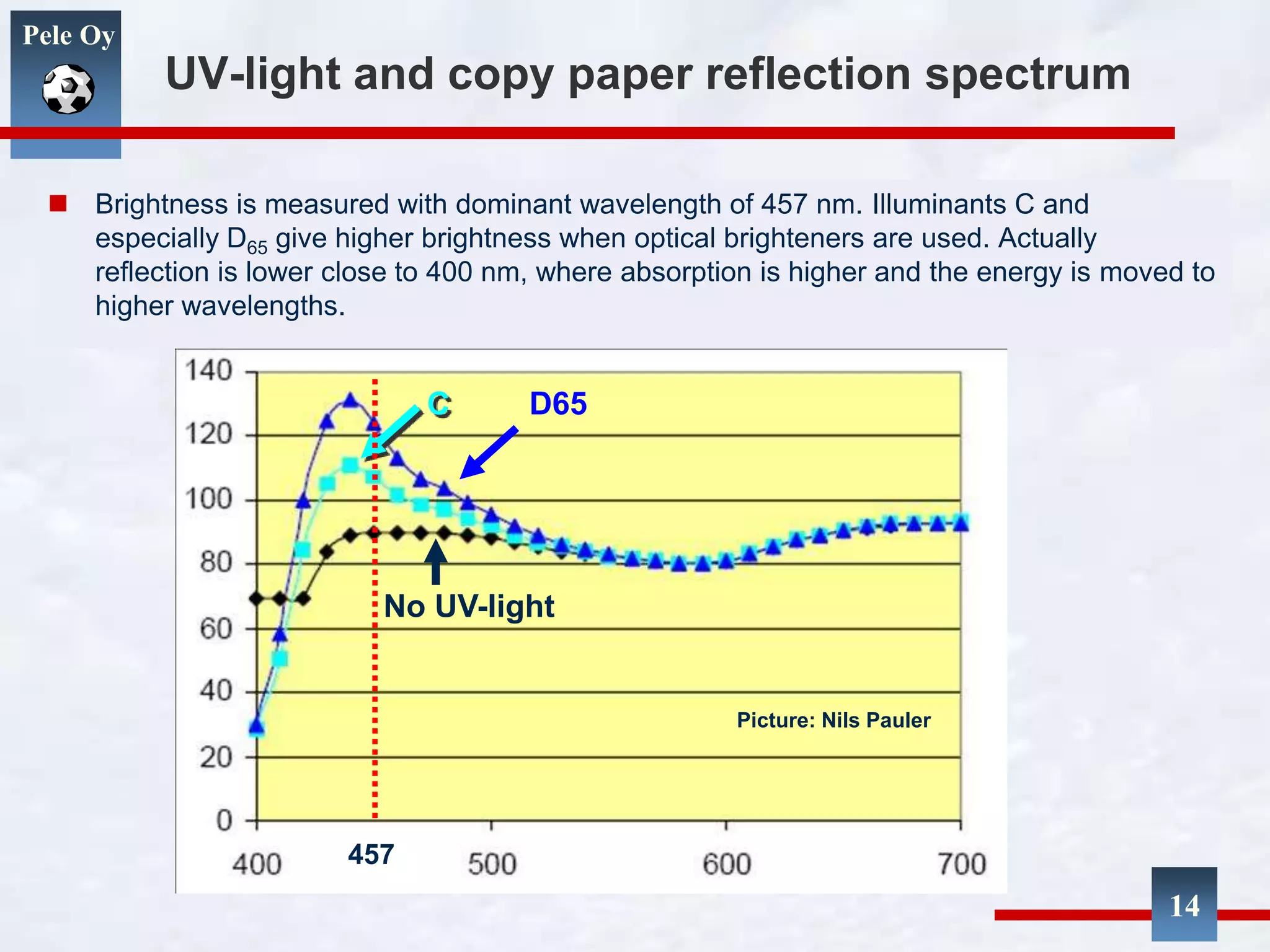
UV-light and copy paper reflection spectrum
 Brightness is measured with dominant wavelength of 457 nm. Illuminants C and
especially D65 give higher brightness when optical brighteners are used. Actually
reflection is lower close to 400 nm, where absorption is higher and the energy is moved to
higher wavelengths.
D65C
No UV-light
Picture: Nils Pauler
457
Pele Oy
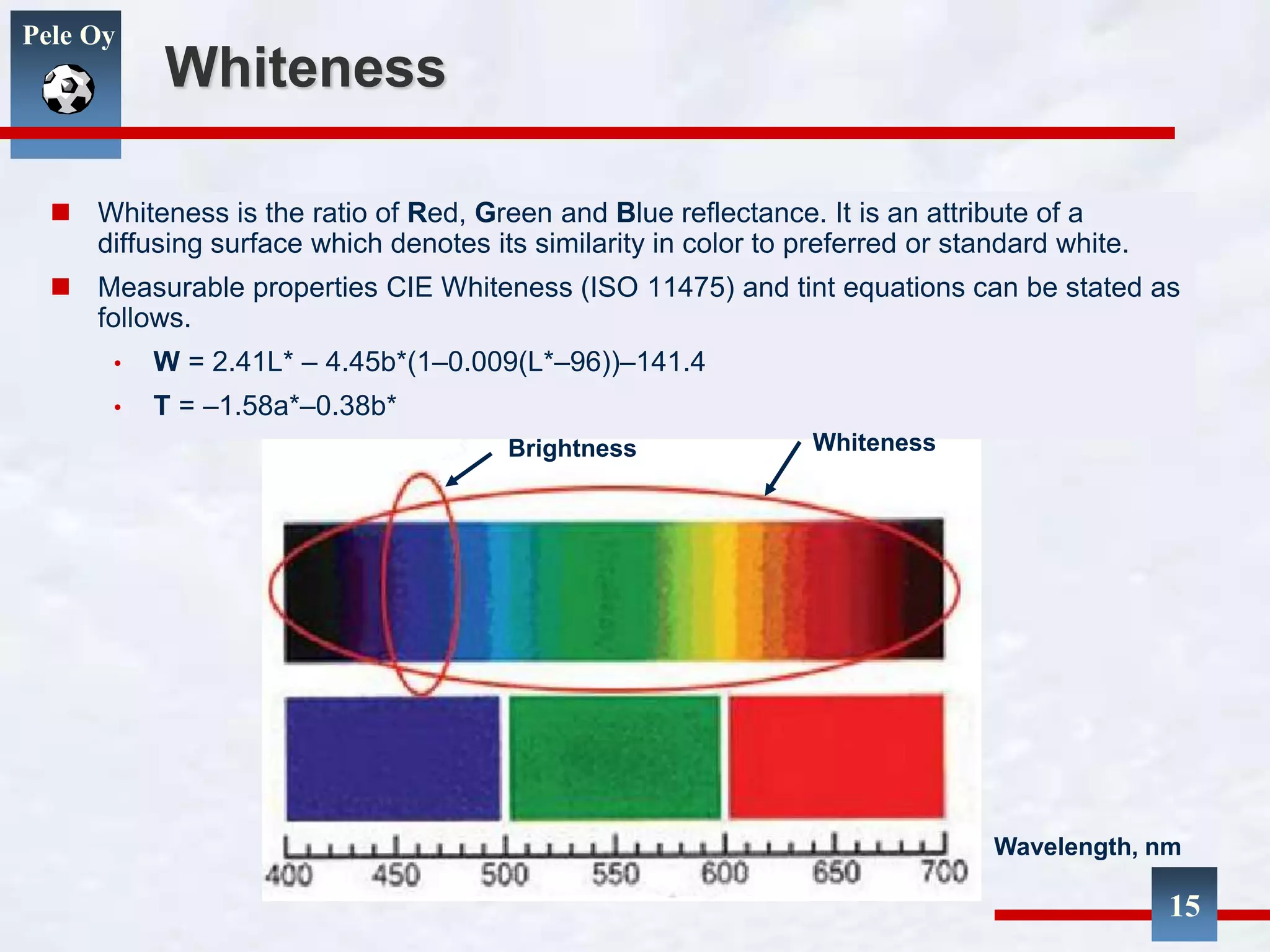
Whiteness
 Whiteness is the ratio of Red, Green and Blue reflectance. It is an attribute of a
diffusing surface which denotes its similarity in color to preferred or standard white.
 Measurable properties CIE Whiteness (ISO 11475) and tint equations can be stated as
follows.
• W = 2.41L* – 4.45b*(1–0.009(L*–96))–141.4
• T = –1.58a*–0.38b*
Wavelength, nm
Brightness Whiteness
15
Pele Oy
16
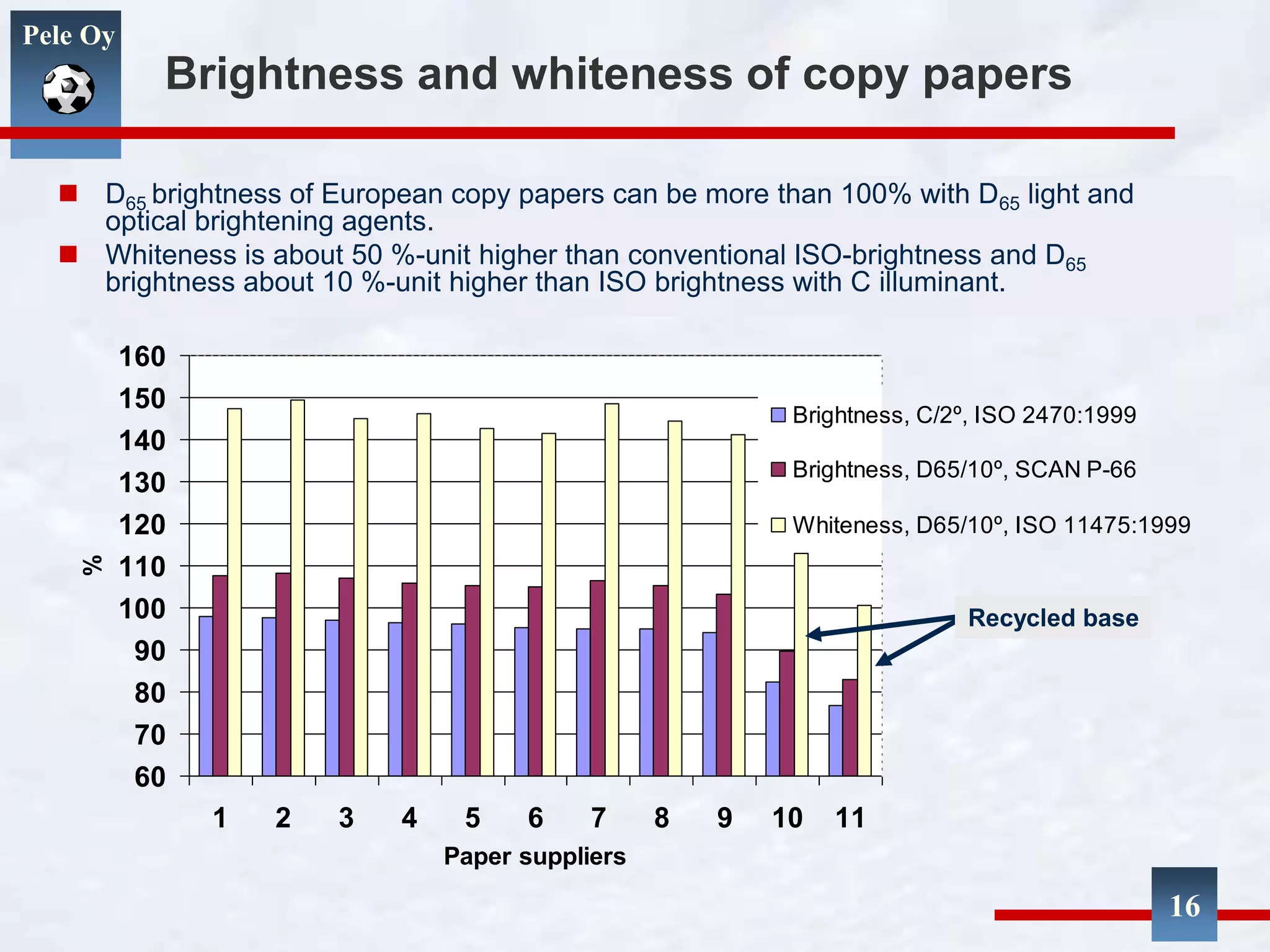
Brightness and whiteness of copy papers
 D65 brightness of European copy papers can be more than 100% with D65 light and
optical brightening agents.
 Whiteness is about 50 %-unit higher than conventional ISO-brightness and D65
brightness about 10 %-unit higher than ISO brightness with C illuminant.
60
70
80
90
100
110
120
130
140
150
160
1 2 3 4 5 6 7 8 9 10 11
Paper suppliers
%
Brightness, C/2º, ISO 2470:1999
Brightness, D65/10º, SCAN P-66
Whiteness, D65/10º, ISO 11475:1999
Recycled base
Pele Oy
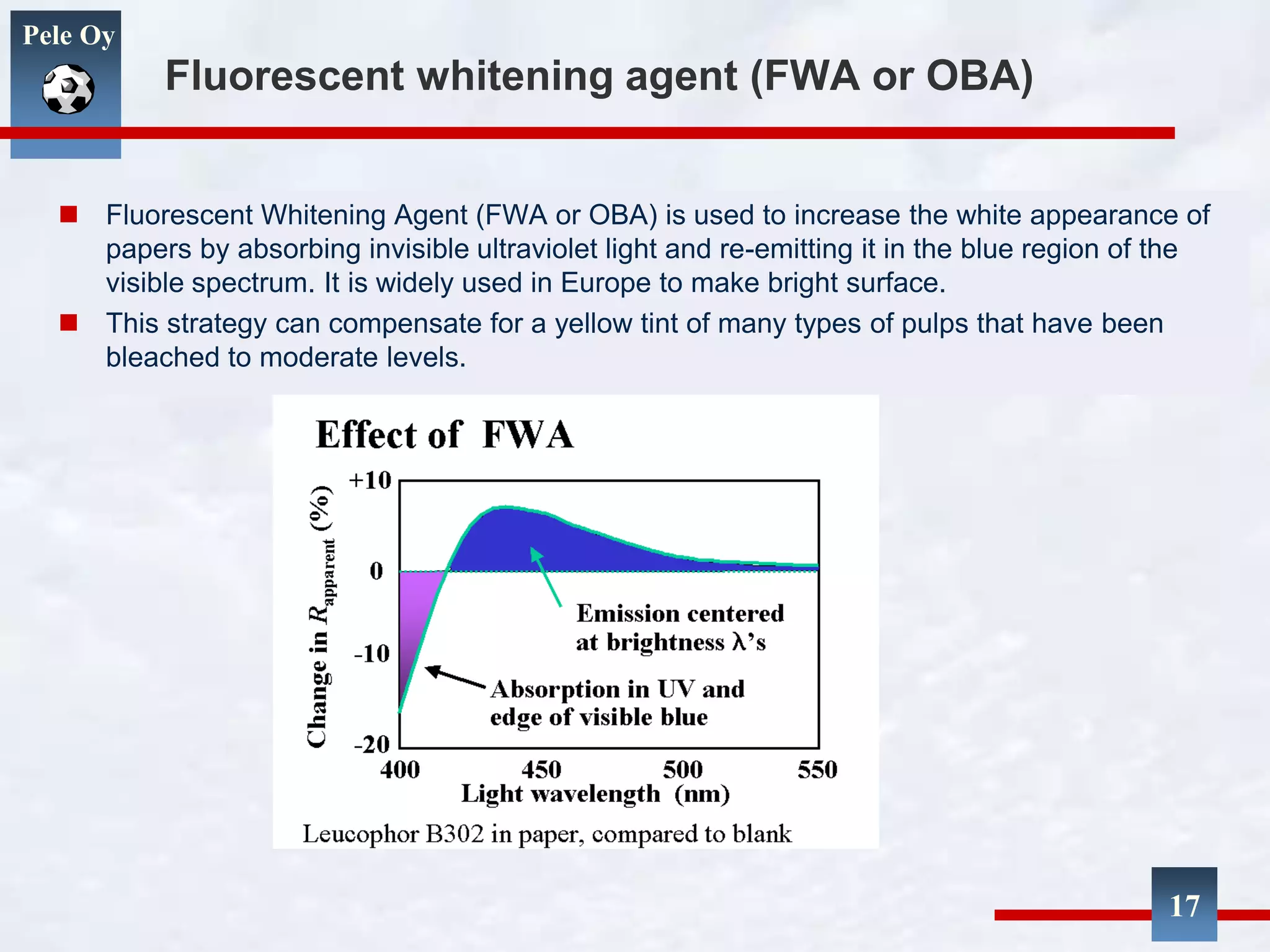
Fluorescent whitening agent (FWA or OBA)
17
 Fluorescent Whitening Agent (FWA or OBA) is used to increase the white appearance of
papers by absorbing invisible ultraviolet light and re-emitting it in the blue region of the
visible spectrum. It is widely used in Europe to make bright surface.
 This strategy can compensate for a yellow tint of many types of pulps that have been
bleached to moderate levels.
Pele Oy
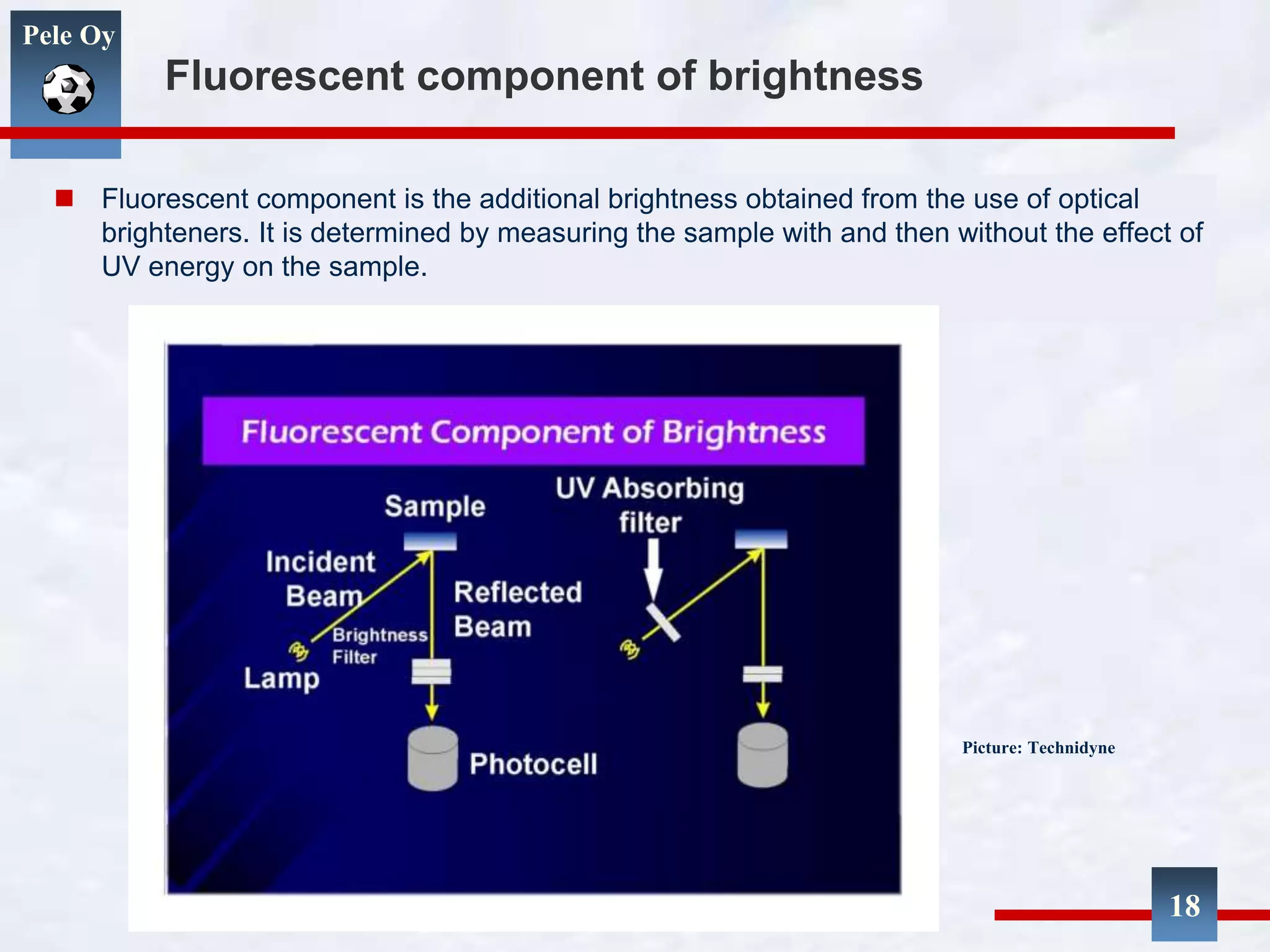
Fluorescent component of brightness
 Fluorescent component is the additional brightness obtained from the use of optical
brighteners. It is determined by measuring the sample with and then without the effect of
UV energy on the sample.
18
Picture: Technidyne
Pele Oy
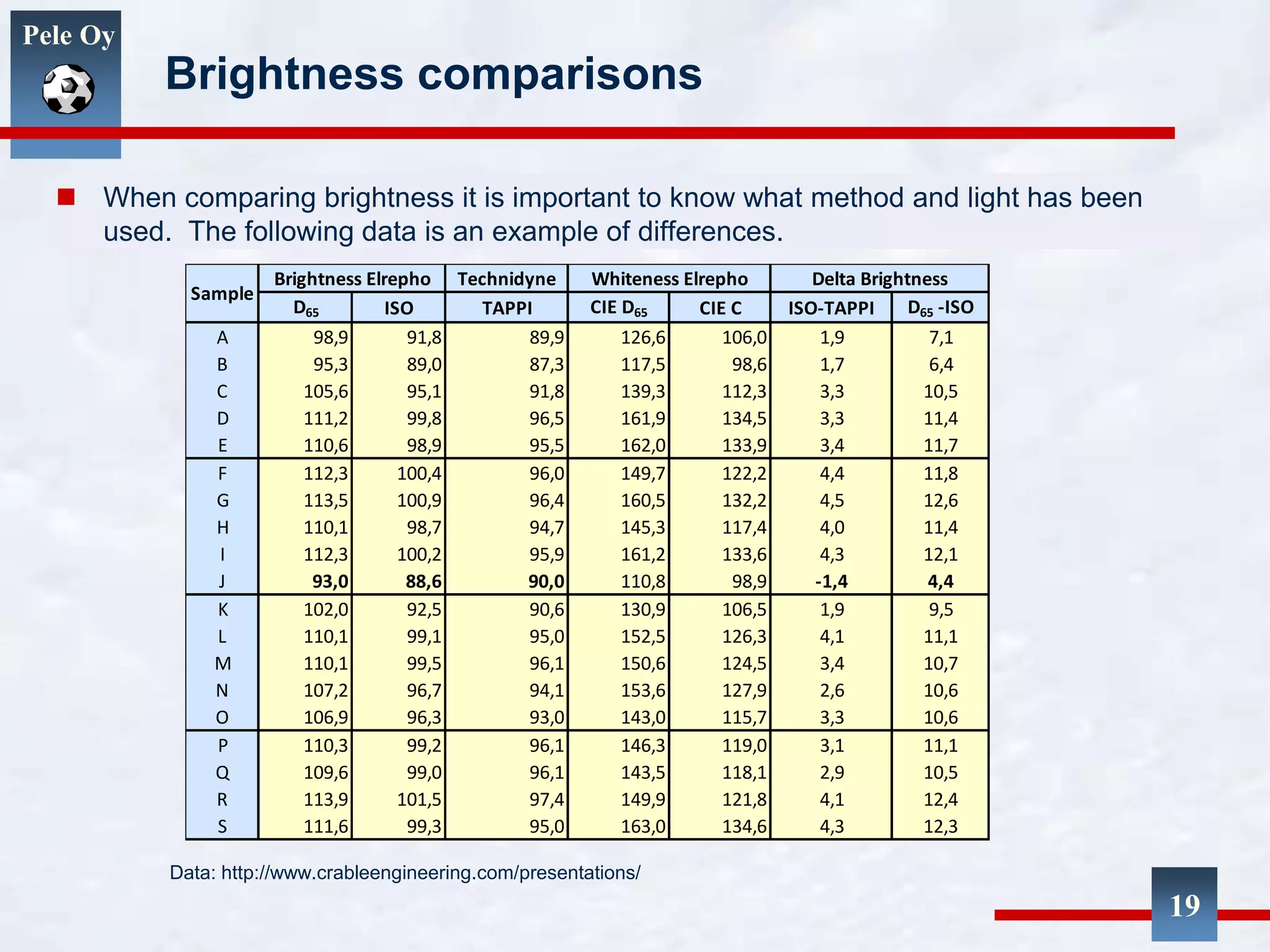
Brightness comparisons
 When comparing brightness it is important to know what method and light has been
used. The following data is an example of differences.
Data: http://www.crableengineering.com/presentations/
Technidyne
D65 ISO TAPPI CIE D65 CIE C ISO-TAPPI D65 -ISO
A 98,9 91,8 89,9 126,6 106,0 1,9 7,1
B 95,3 89,0 87,3 117,5 98,6 1,7 6,4
C 105,6 95,1 91,8 139,3 112,3 3,3 10,5
D 111,2 99,8 96,5 161,9 134,5 3,3 11,4
E 110,6 98,9 95,5 162,0 133,9 3,4 11,7
F 112,3 100,4 96,0 149,7 122,2 4,4 11,8
G 113,5 100,9 96,4 160,5 132,2 4,5 12,6
H 110,1 98,7 94,7 145,3 117,4 4,0 11,4
I 112,3 100,2 95,9 161,2 133,6 4,3 12,1
J 93,0 88,6 90,0 110,8 98,9 -1,4 4,4
K 102,0 92,5 90,6 130,9 106,5 1,9 9,5
L 110,1 99,1 95,0 152,5 126,3 4,1 11,1
M 110,1 99,5 96,1 150,6 124,5 3,4 10,7
N 107,2 96,7 94,1 153,6 127,9 2,6 10,6
O 106,9 96,3 93,0 143,0 115,7 3,3 10,6
P 110,3 99,2 96,1 146,3 119,0 3,1 11,1
Q 109,6 99,0 96,1 143,5 118,1 2,9 10,5
R 113,9 101,5 97,4 149,9 121,8 4,1 12,4
S 111,6 99,3 95,0 163,0 134,6 4,3 12,3
Brightness Elrepho Whiteness Elrepho
Sample
Delta Brightness
19
Pele Oy
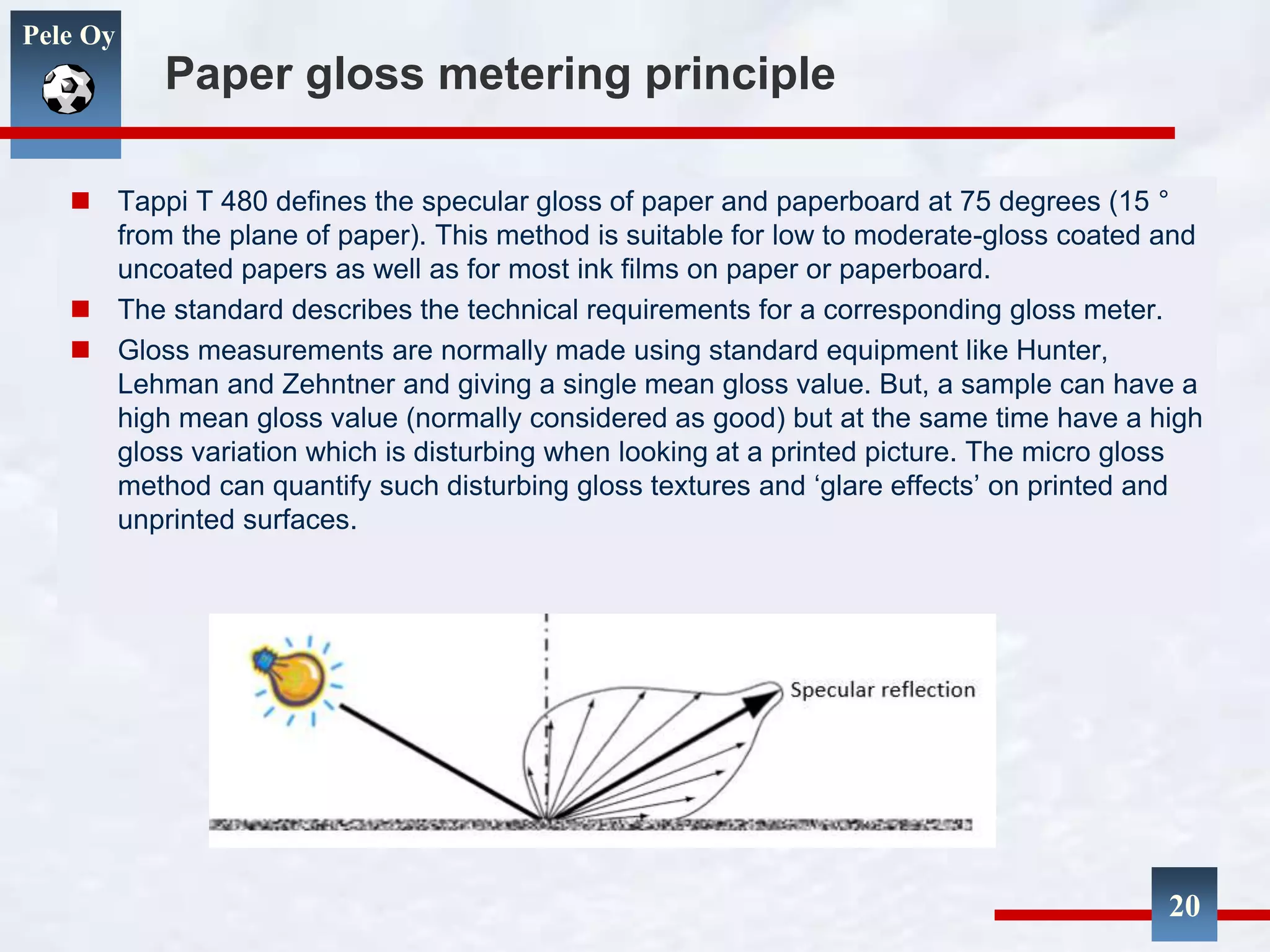
Paper gloss metering principle
 Tappi T 480 defines the specular gloss of paper and paperboard at 75 degrees (15 °
from the plane of paper). This method is suitable for low to moderate-gloss coated and
uncoated papers as well as for most ink films on paper or paperboard.
 The standard describes the technical requirements for a corresponding gloss meter.
 Gloss measurements are normally made using standard equipment like Hunter,
Lehman and Zehntner and giving a single mean gloss value. But, a sample can have a
high mean gloss value (normally considered as good) but at the same time have a high
gloss variation which is disturbing when looking at a printed picture. The micro gloss
method can quantify such disturbing gloss textures and ‘glare effects’ on printed and
unprinted surfaces.
20
Pele Oy
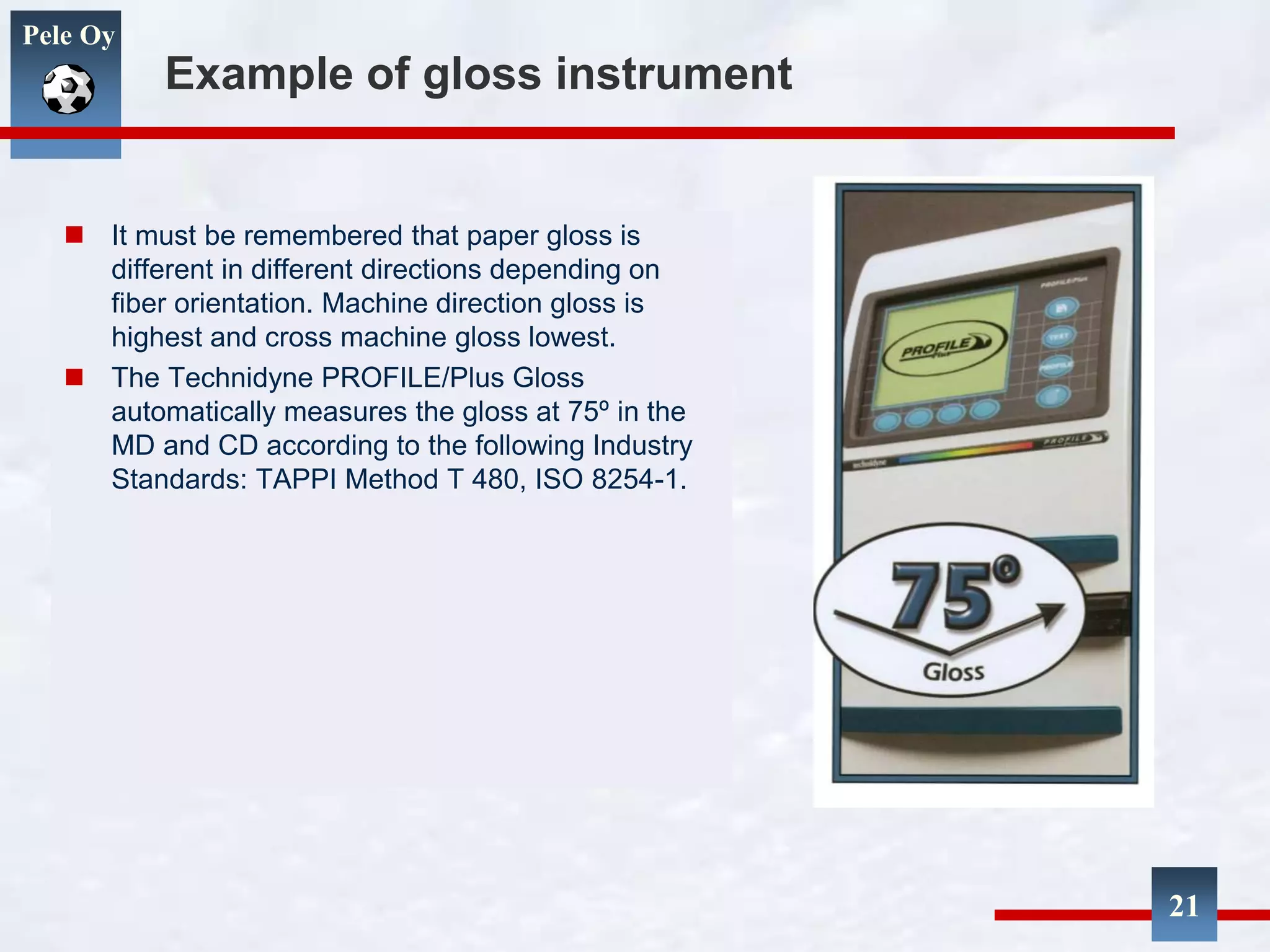
Example of gloss instrument
 It must be remembered that paper gloss is
different in different directions depending on
fiber orientation. Machine direction gloss is
highest and cross machine gloss lowest.
 The Technidyne PROFILE/Plus Gloss
automatically measures the gloss at 75º in the
MD and CD according to the following Industry
Standards: TAPPI Method T 480, ISO 8254-1.
21
Pele Oy
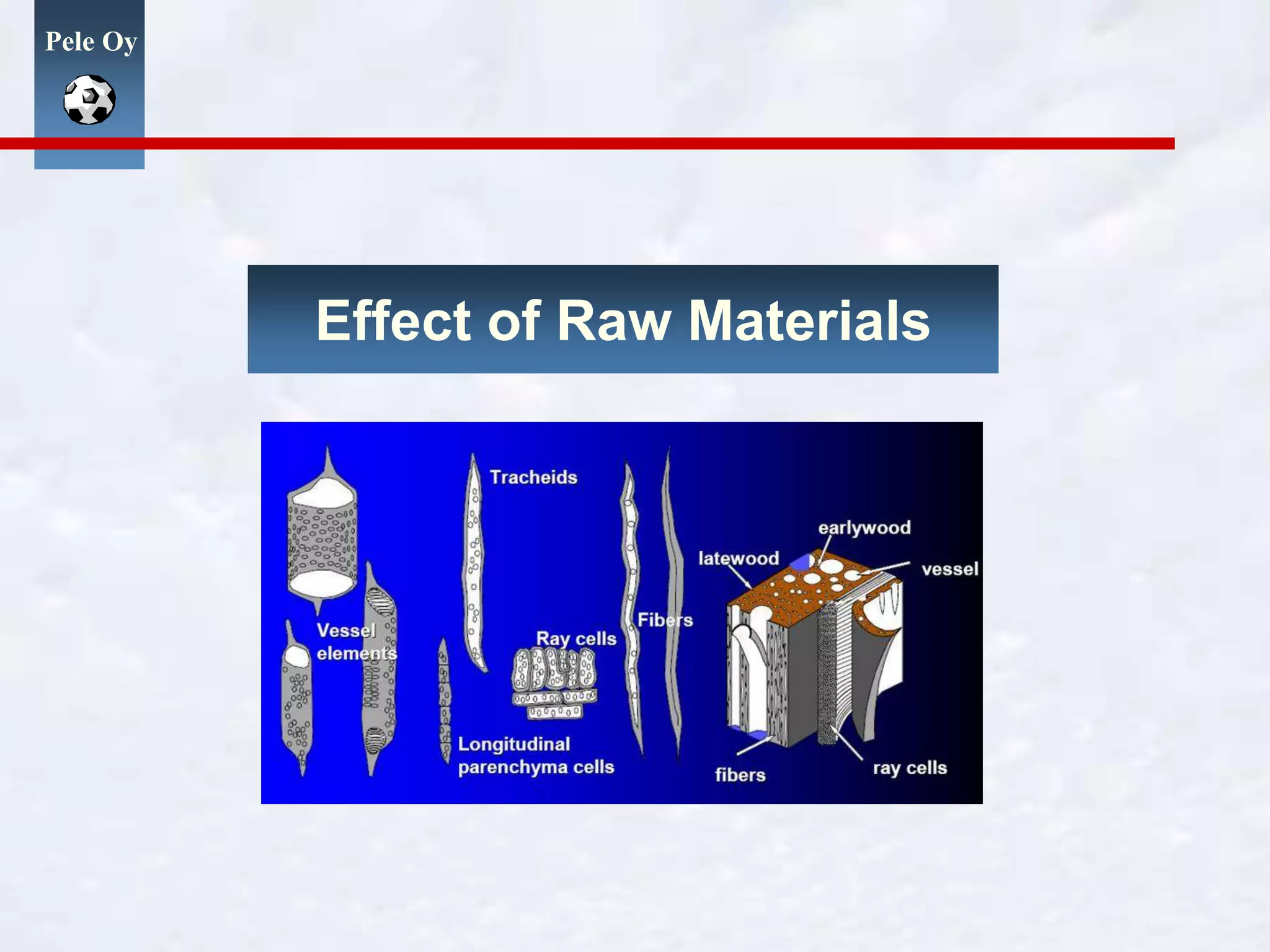
Effect of Raw Materials
Pele Oy
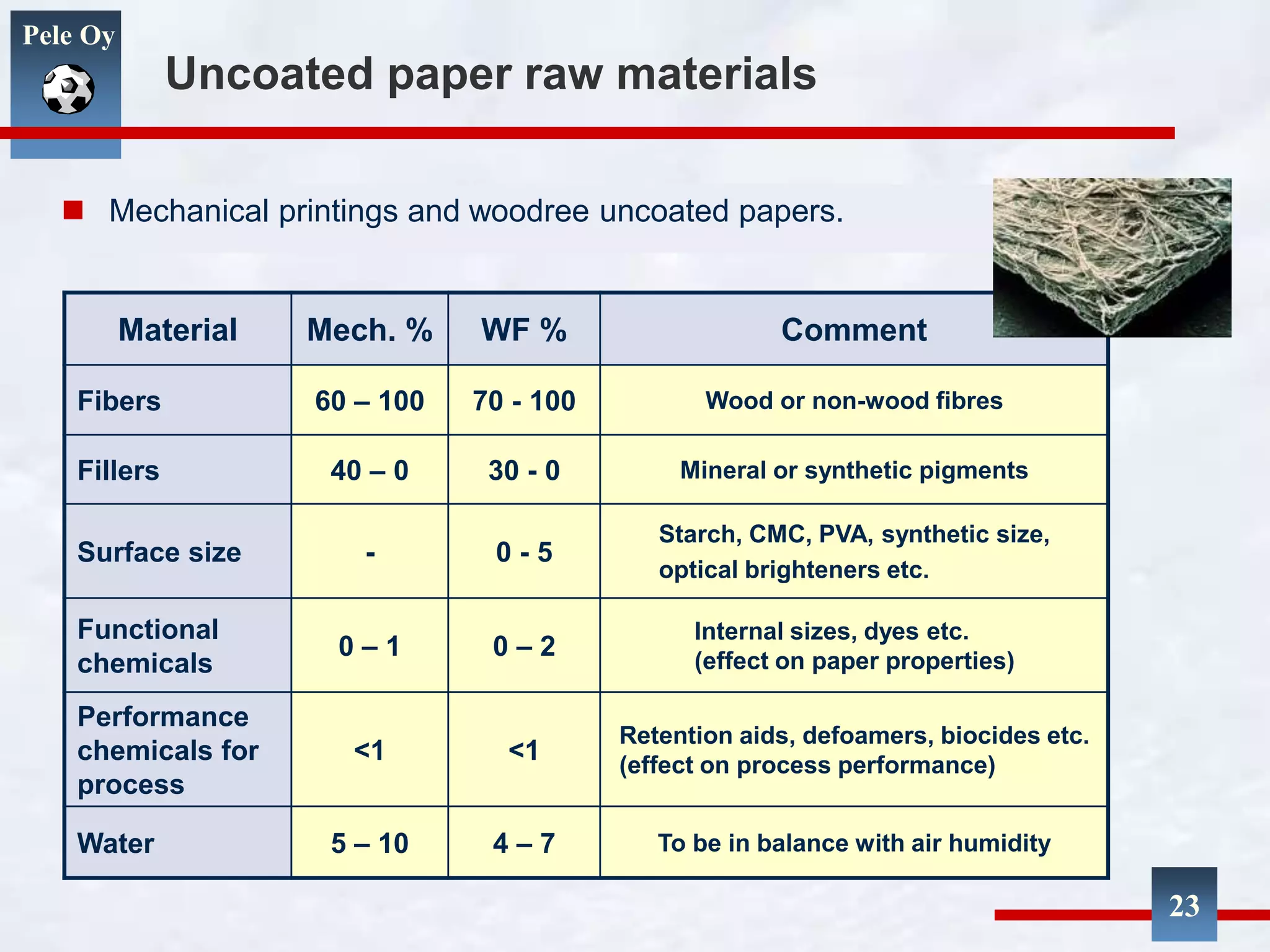
Uncoated paper raw materials
 Mechanical printings and woodree uncoated papers.
23
Material Mech. % WF % Comment
Fibers 60 – 100 70 - 100 Wood or non-wood fibres
Fillers 40 – 0 30 - 0 Mineral or synthetic pigments
Surface size - 0 - 5
Starch, CMC, PVA, synthetic size,
optical brighteners etc.
Functional
chemicals
0 – 1 0 – 2
Internal sizes, dyes etc.
(effect on paper properties)
Performance
chemicals for
process
<1 <1
Retention aids, defoamers, biocides etc.
(effect on process performance)
Water 5 – 10 4 – 7 To be in balance with air humidity
Pele Oy
24
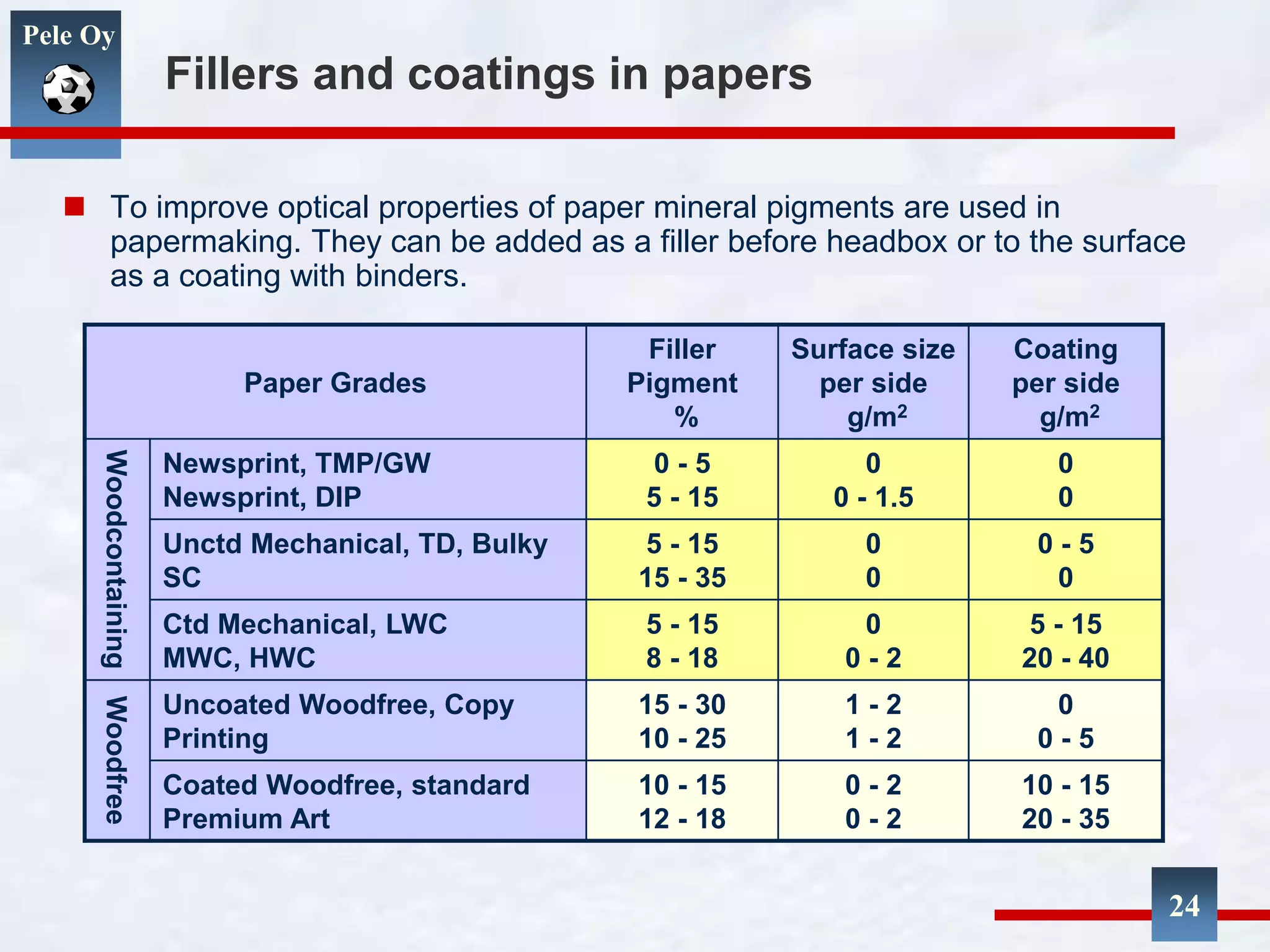
Fillers and coatings in papers
 To improve optical properties of paper mineral pigments are used in
papermaking. They can be added as a filler before headbox or to the surface
as a coating with binders.
Paper Grades
Filler
Pigment
%
Surface size
per side
g/m2
Coating
per side
g/m2
Woodcontaining
Newsprint, TMP/GW
Newsprint, DIP
0 - 5
5 - 15
0
0 - 1.5
0
0
Unctd Mechanical, TD, Bulky
SC
5 - 15
15 - 35
0
0
0 - 5
0
Ctd Mechanical, LWC
MWC, HWC
5 - 15
8 - 18
0
0 - 2
5 - 15
20 - 40
Woodfree
Uncoated Woodfree, Copy
Printing
15 - 30
10 - 25
1 - 2
1 - 2
0
0 - 5
Coated Woodfree, standard
Premium Art
10 - 15
12 - 18
0 - 2
0 - 2
10 - 15
20 - 35
Pele Oy
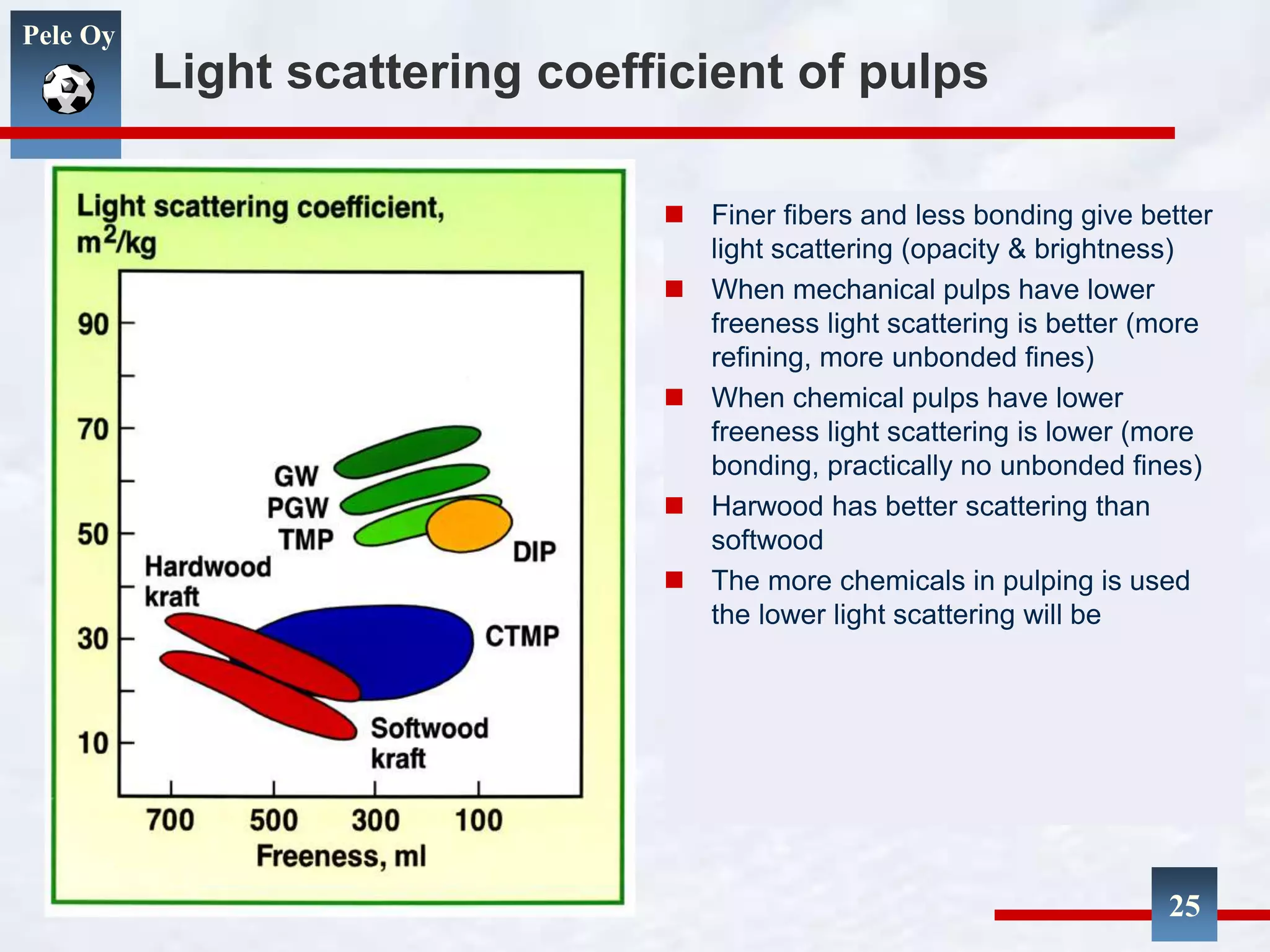
Light scattering coefficient of pulps
 Finer fibers and less bonding give better
light scattering (opacity & brightness)
 When mechanical pulps have lower
freeness light scattering is better (more
refining, more unbonded fines)
 When chemical pulps have lower
freeness light scattering is lower (more
bonding, practically no unbonded fines)
 Harwood has better scattering than
softwood
 The more chemicals in pulping is used
the lower light scattering will be
25
Pele Oy
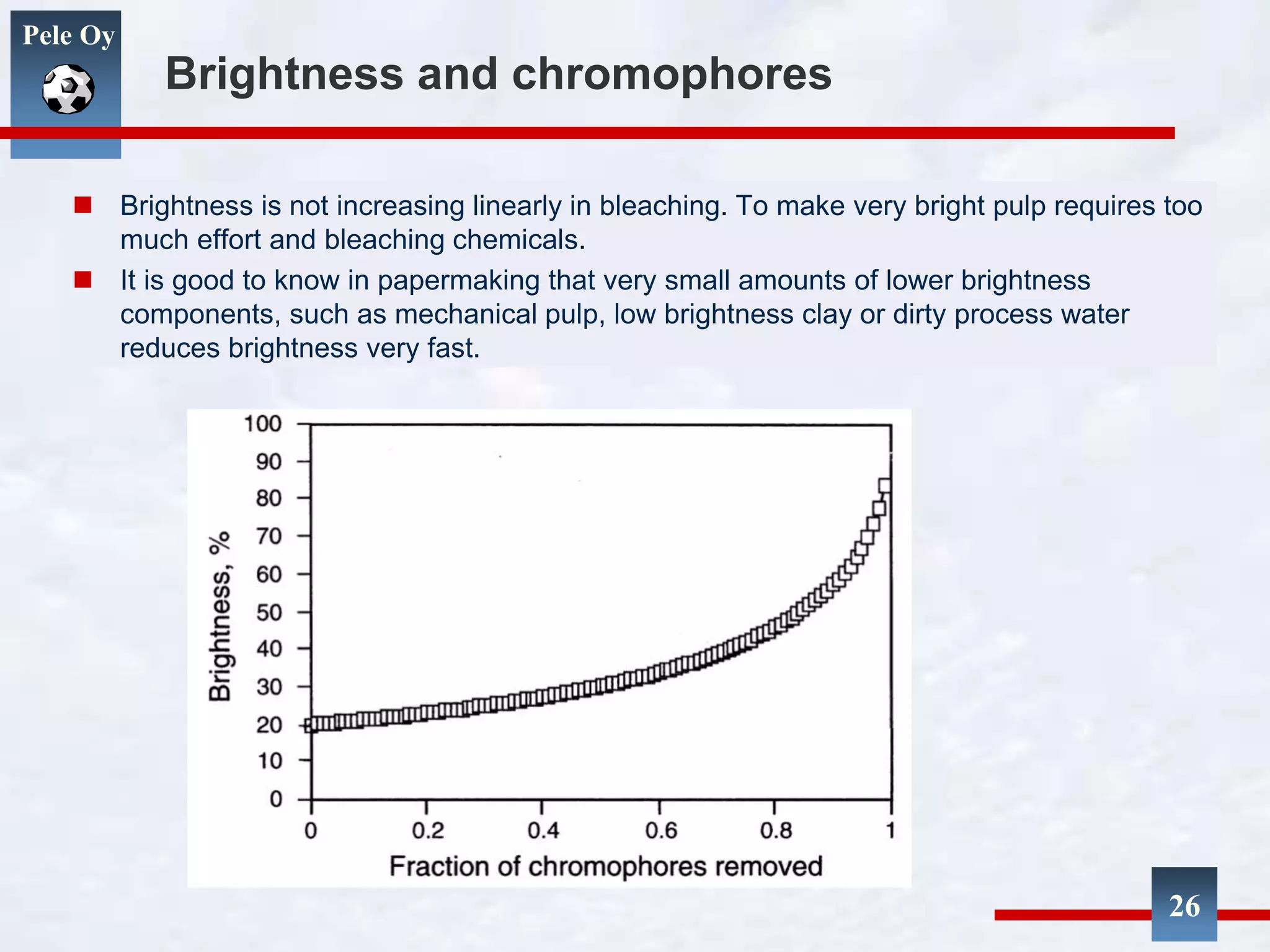
Brightness and chromophores
 Brightness is not increasing linearly in bleaching. To make very bright pulp requires too
much effort and bleaching chemicals.
 It is good to know in papermaking that very small amounts of lower brightness
components, such as mechanical pulp, low brightness clay or dirty process water
reduces brightness very fast.
26
Pele Oy
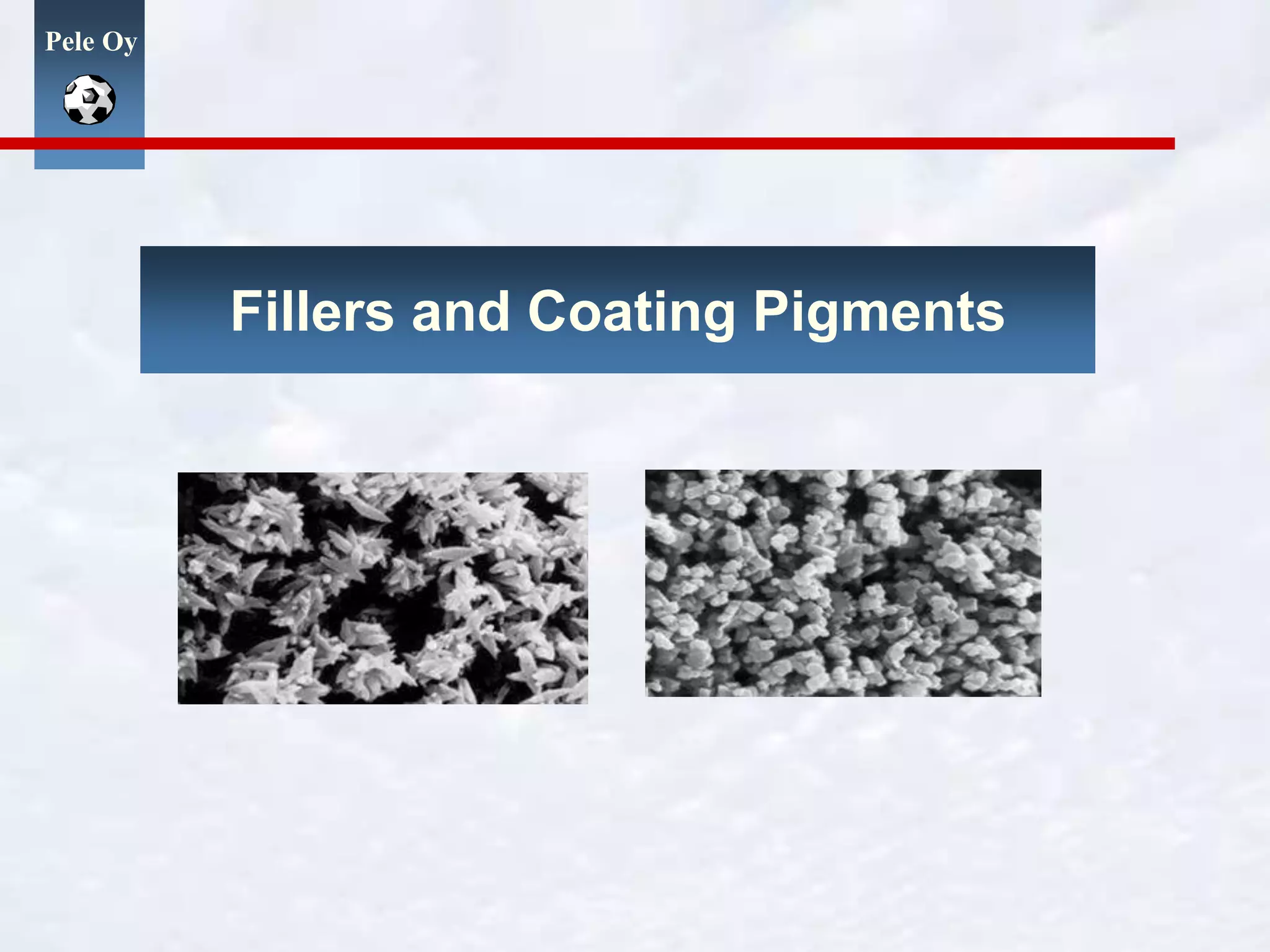
Fillers and Coating Pigments
Pele Oy
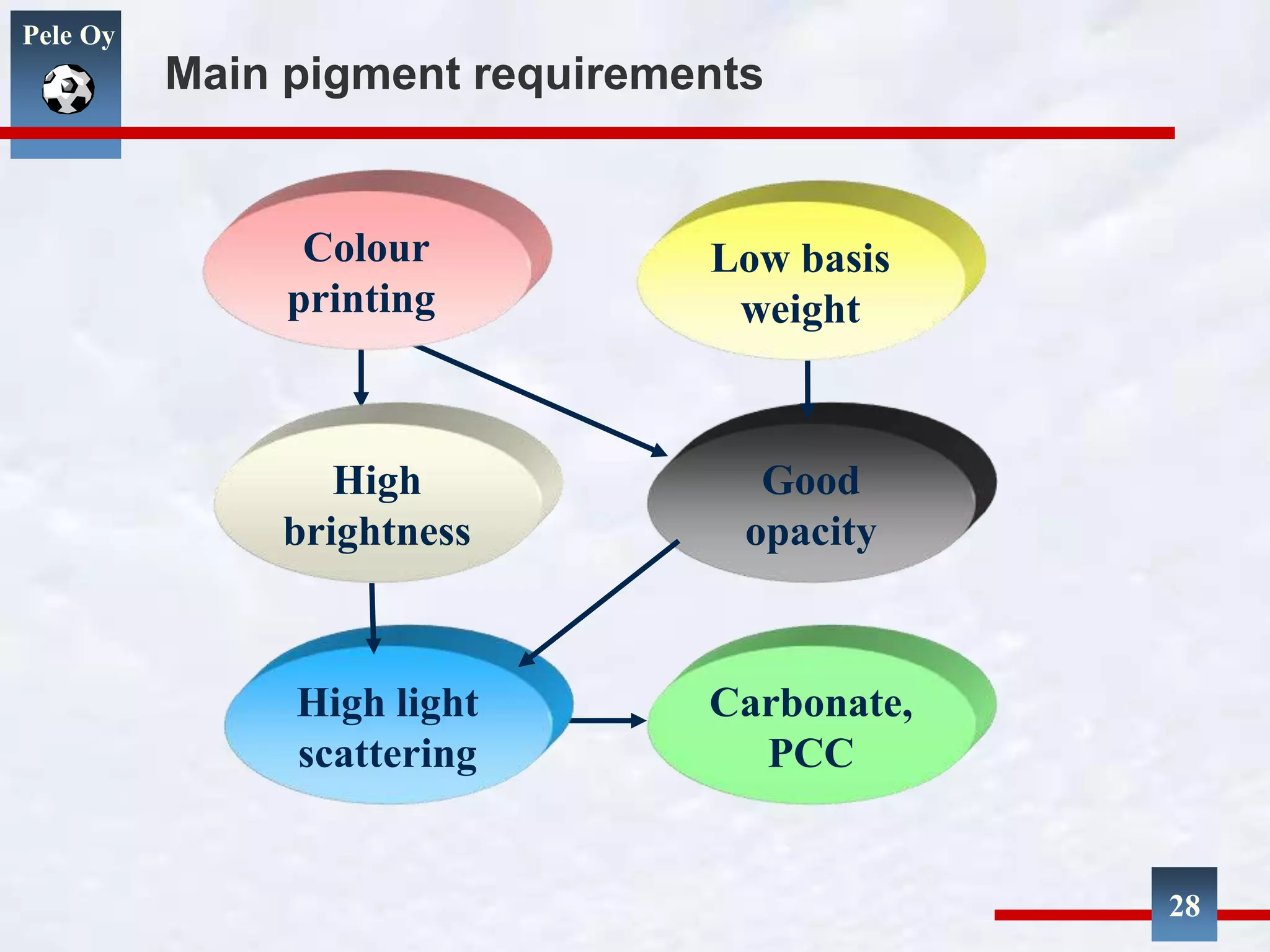
Main pigment requirements
High light
scattering
Carbonate,
PCC
Colour
printing
Low basis
weight
High
brightness
Good
opacity
28
Pele Oy
29
Effects of filler addition
Positive effects
 Water removal 
 Better formation
 Drying shrinkage  dimensional
stability 
 Brightness, opacity and color 
 Ink absorption more uniform
 Smoothness and gloss 
 Costs  and printability 
Negative effects
 All general strength properties
 Surface strength , dusting 
 Internal bond strength 
 Stiffness 
 Carbonate requires > 7 pH
 Runnability 
 Retention , two-sidedness
 Wire, felt and machine wear 
With PCC bulk and porosity can increase, with other fillers they decrease
Pele Oy
30
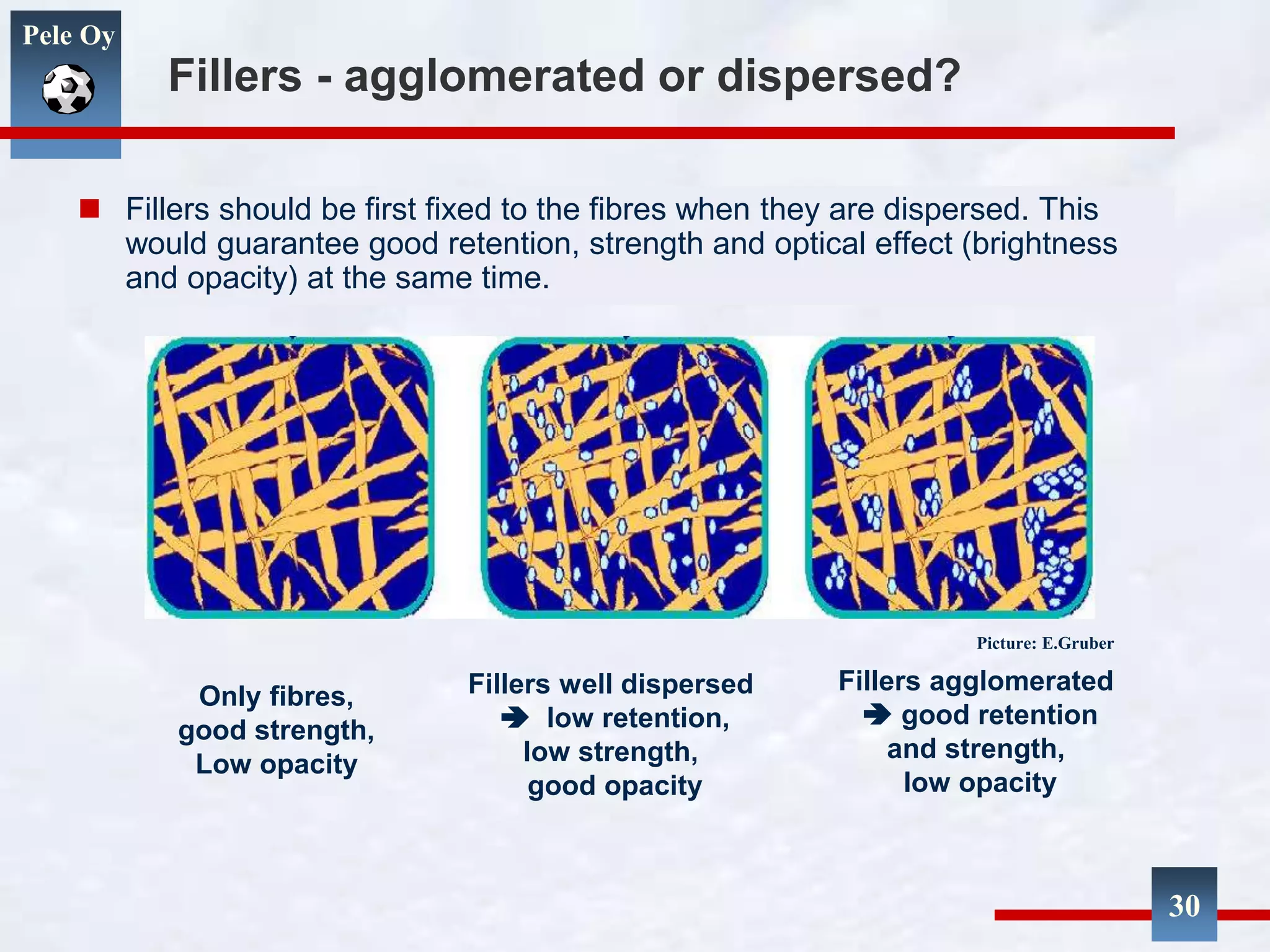
Fillers - agglomerated or dispersed?
 Fillers should be first fixed to the fibres when they are dispersed. This
would guarantee good retention, strength and optical effect (brightness
and opacity) at the same time.
Only fibres,
good strength,
Low opacity
Fillers well dispersed
 low retention,
low strength,
good opacity
Fillers agglomerated
 good retention
and strength,
low opacity
Picture: E.Gruber
Pele Oy
31
Filler distribution
 Filler can either fill paper pores (left) or distribute evenly on fibre surfaces
(right). Even distribution has good optical effect but reduces strength more.
Good filler distributionBad filler distribution
Pictures: Robert A Gill
Pele Oy
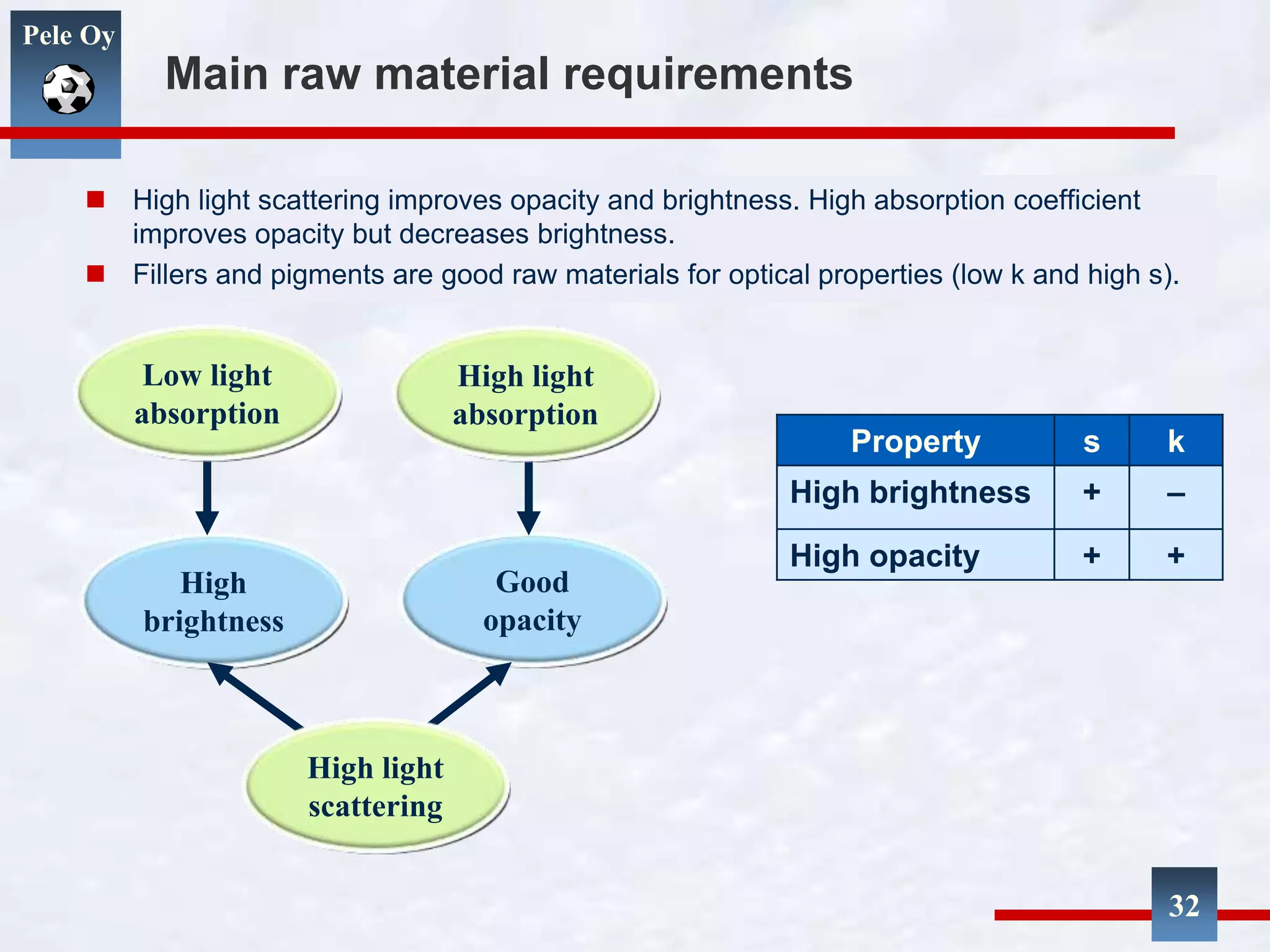
Main raw material requirements
 High light scattering improves opacity and brightness. High absorption coefficient
improves opacity but decreases brightness.
 Fillers and pigments are good raw materials for optical properties (low k and high s).
High
brightness
Good
opacity
High light
scattering
High light
absorption
Low light
absorption
Property s k
High brightness + –
High opacity + +
32
Pele Oy
33
Total mineral content of paper & board
Source: Omya
Pele Oy
Main fillers and coating pigments
 Titanium dioxide is a special filler with high refractive index. It is the only possibility
to improve opacity of impregnated and waxed papers. This is the reason that décor
paper includes titanium dioxide.
 When making opacity and brightness TiO2 is a very expensive filler or coating
pigment. It is used in U.S. for this purpose but not in Europe where brightness and
opacity are made with less expensive means.
 Titanium dioxide price is more than three times pulp price while carbonate filler price
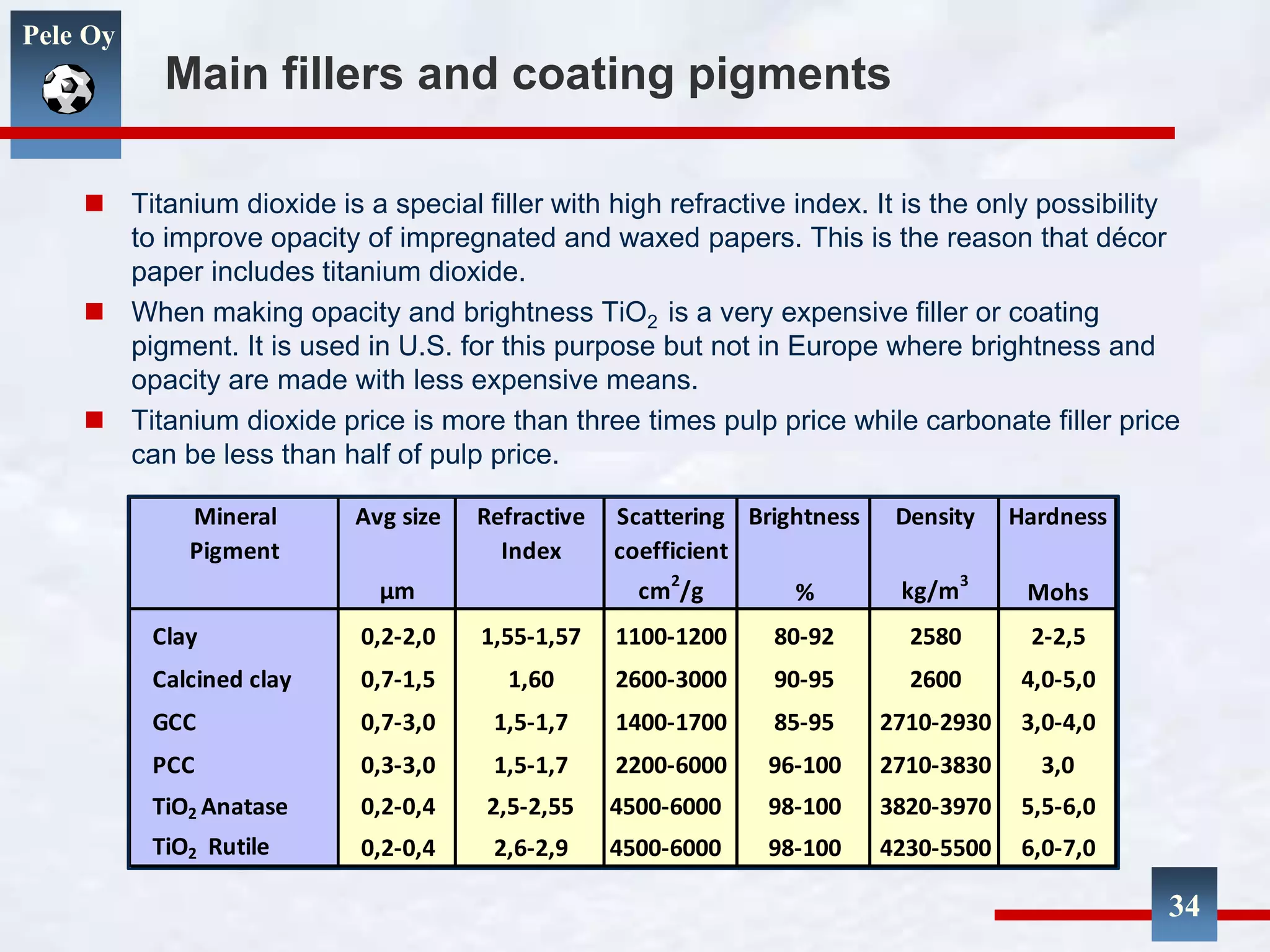
can be less than half of pulp price.
34
Mineral Avg size Refractive Scattering Brightness Density Hardness
Pigment Index coefficient
µm cm
2
/g % kg/m
3
Mohs
Clay 0,2-2,0 1,55-1,57 1100-1200 80-92 2580 2-2,5
Calcined clay 0,7-1,5 1,60 2600-3000 90-95 2600 4,0-5,0
GCC 0,7-3,0 1,5-1,7 1400-1700 85-95 2710-2930 3,0-4,0
PCC 0,3-3,0 1,5-1,7 2200-6000 96-100 2710-3830 3,0
TiO2 Anatase 0,2-0,4 2,5-2,55 4500-6000 98-100 3820-3970 5,5-6,0
TiO2 Rutile 0,2-0,4 2,6-2,9 4500-6000 98-100 4230-5500 6,0-7,0
Pele Oy
35
Effect of filler content on tensile strength
 Dry tensile strength is reduced about 50% when a normal 20% loading is
used. Initial wet strength reduces even more.
 Higher particle size gives better strength but optical effect will be lower
due to lower light scattering.
Täyteainepitoisuus, %
Picture: Robert A Gill
Filler content, %
Tensile,km
Particle size increases
Pele Oy
Critical properties of titanium dioxide
36
Anatase, RI = 2.5
Rutile, RI = 2.7
(more effective)
 Several properties of TiO2 are different compared to other fillers. However, if the effects
are compared at the same level of opacity increase, the detrimental effects with TiO2
are lower than with several other fillers and pigments.
 Even if the price of TiO2 can be up to ten times compared to lowest price fillers, the
cost can be lower because the usage can be only 10% of the use of main filler (1-2% of
paper for printing papers).
 Because the share of TiO2 as a filler is low a good retention is very important.
 TiO2 absorbs UV light and the effect of OBA is reduced with TiO2. OBA is more used in
Europe and TiO2 in North America.
Pele Oy
37
Minerals in papermaking
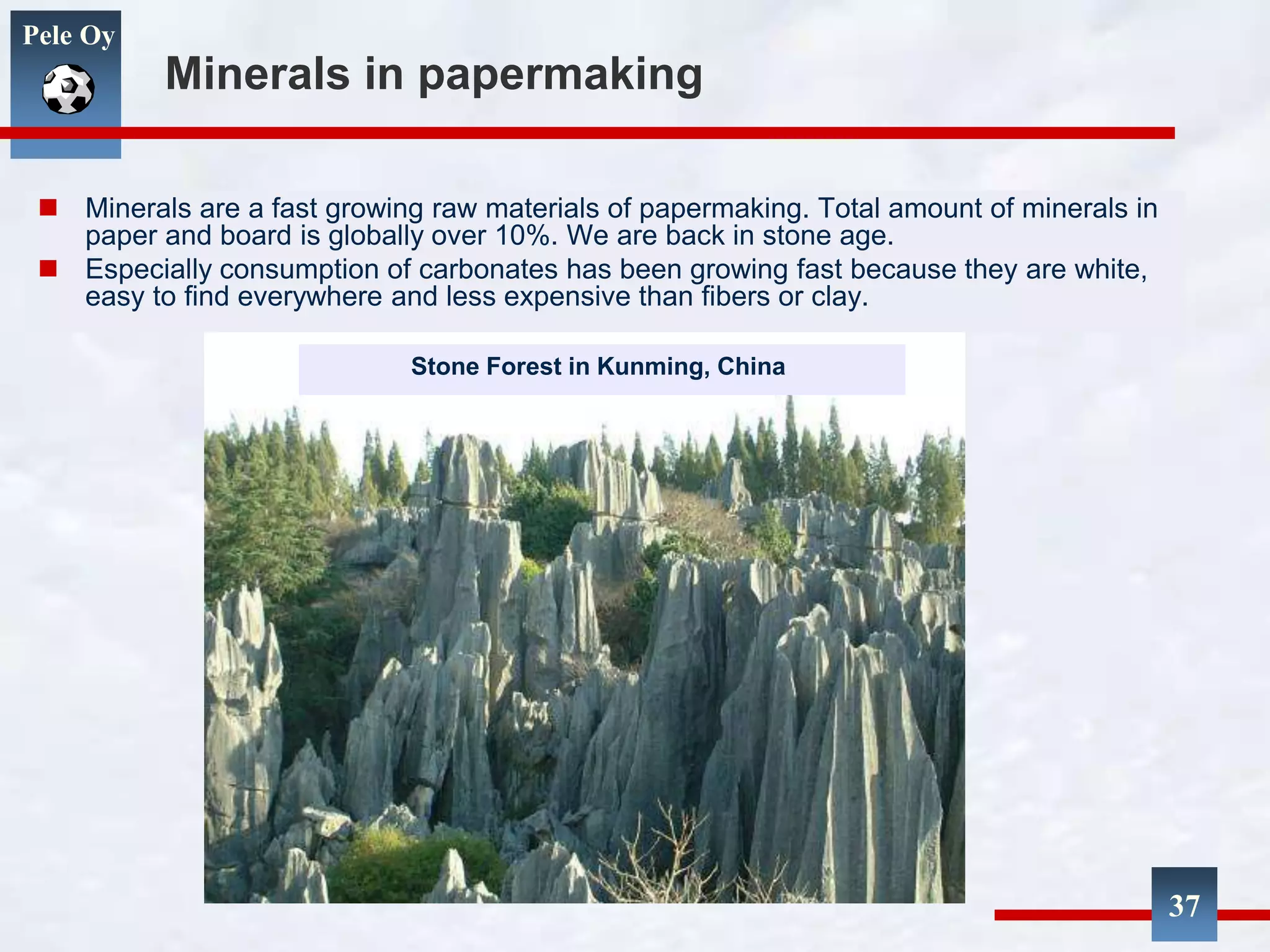
 Minerals are a fast growing raw materials of papermaking. Total amount of minerals in
paper and board is globally over 10%. We are back in stone age.
 Especially consumption of carbonates has been growing fast because they are white,
easy to find everywhere and less expensive than fibers or clay.
Stone Forest in Kunming, China
Pele Oy
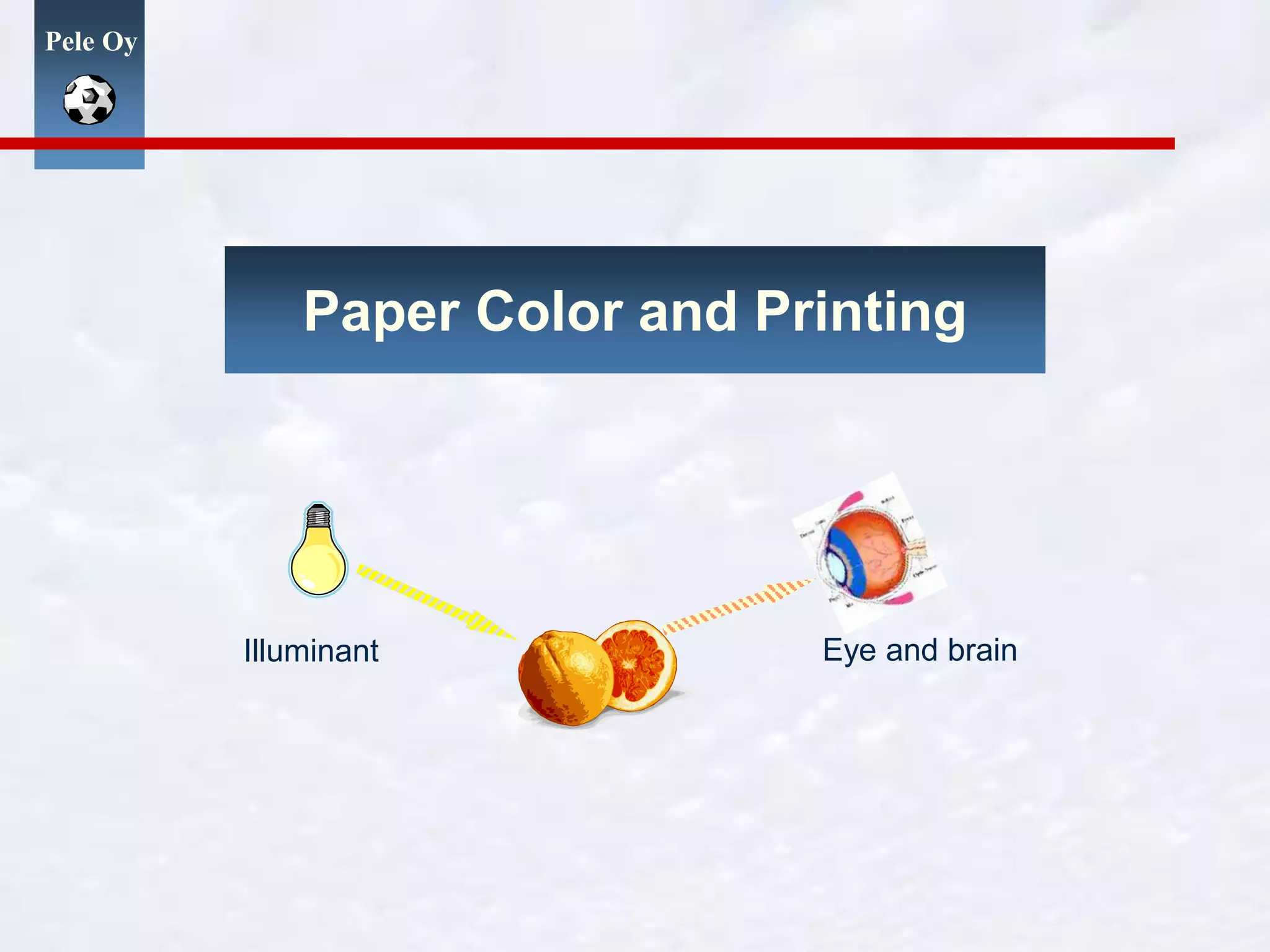
Paper Color and Printing
Illuminant Eye and brain
Pele Oy
Color mixing
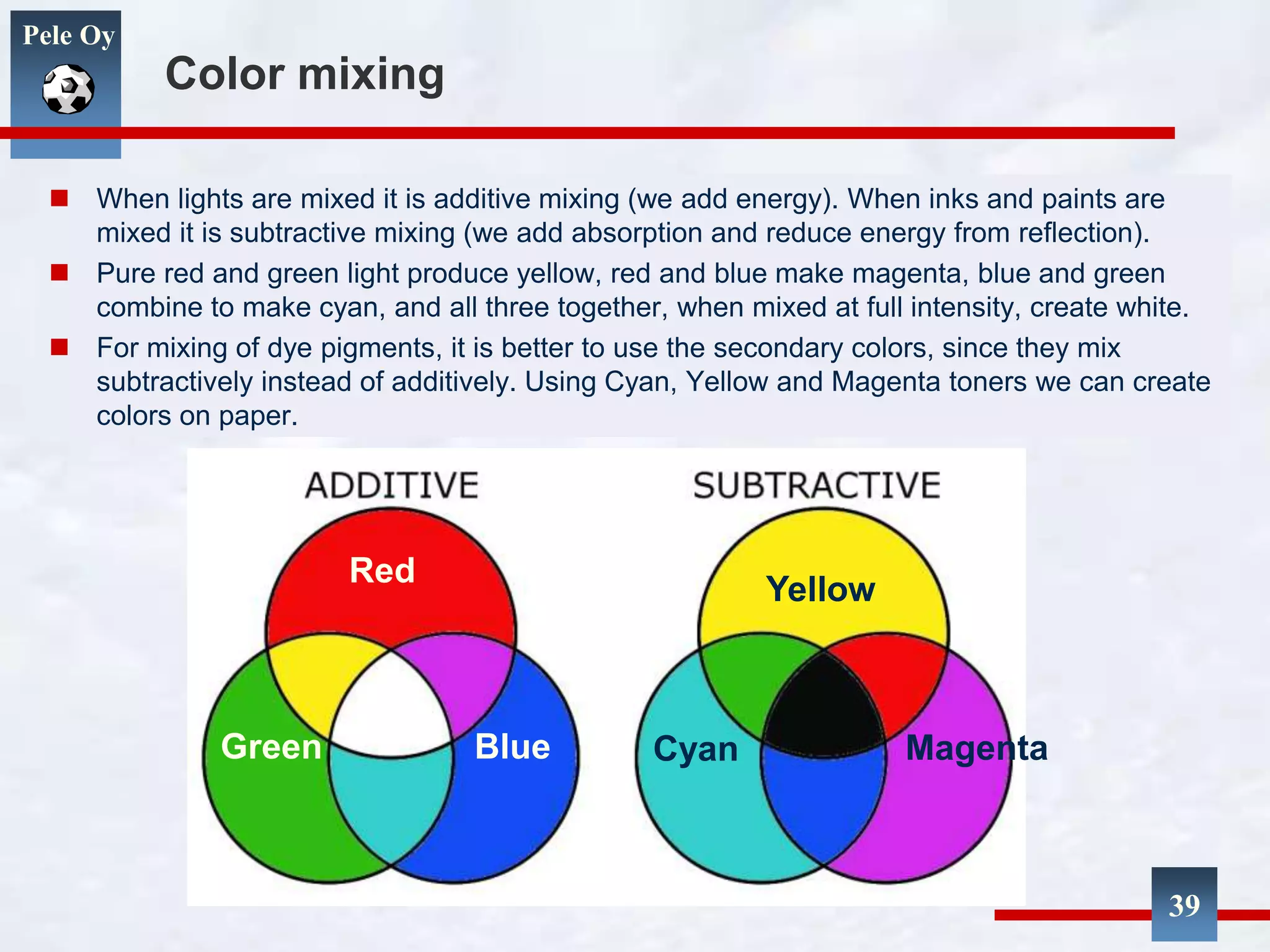
 When lights are mixed it is additive mixing (we add energy). When inks and paints are
mixed it is subtractive mixing (we add absorption and reduce energy from reflection).
 Pure red and green light produce yellow, red and blue make magenta, blue and green
combine to make cyan, and all three together, when mixed at full intensity, create white.
 For mixing of dye pigments, it is better to use the secondary colors, since they mix
subtractively instead of additively. Using Cyan, Yellow and Magenta toners we can create
colors on paper.
39
Red
BlueGreen
Yellow
MagentaCyan
Pele Oy
Color gamut
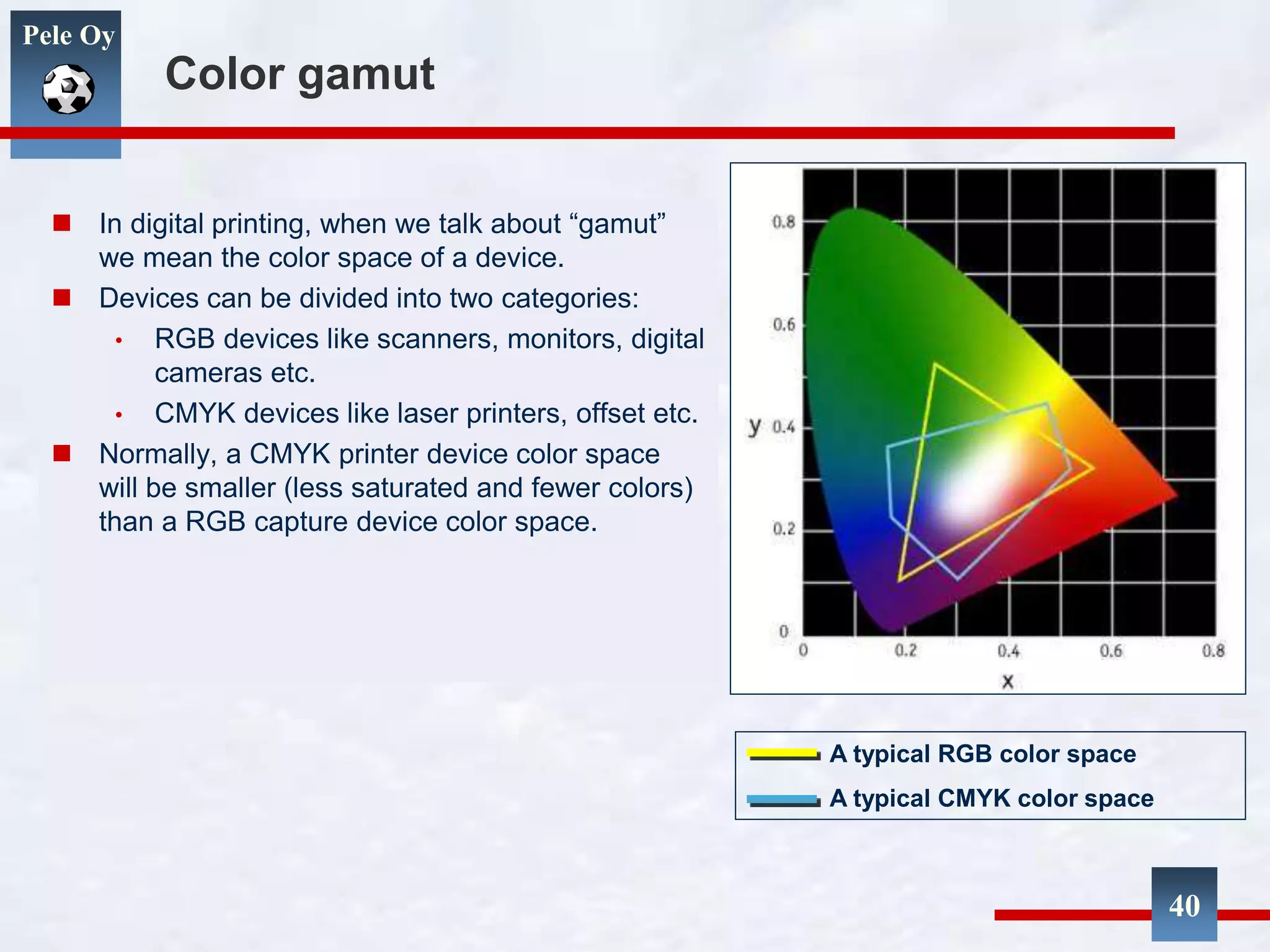
 In digital printing, when we talk about “gamut”
we mean the color space of a device.
 Devices can be divided into two categories:
• RGB devices like scanners, monitors, digital
cameras etc.
• CMYK devices like laser printers, offset etc.
 Normally, a CMYK printer device color space
will be smaller (less saturated and fewer colors)
than a RGB capture device color space.
A typical RGB color space
A typical CMYK color space
40
Pele Oy
RGB color system
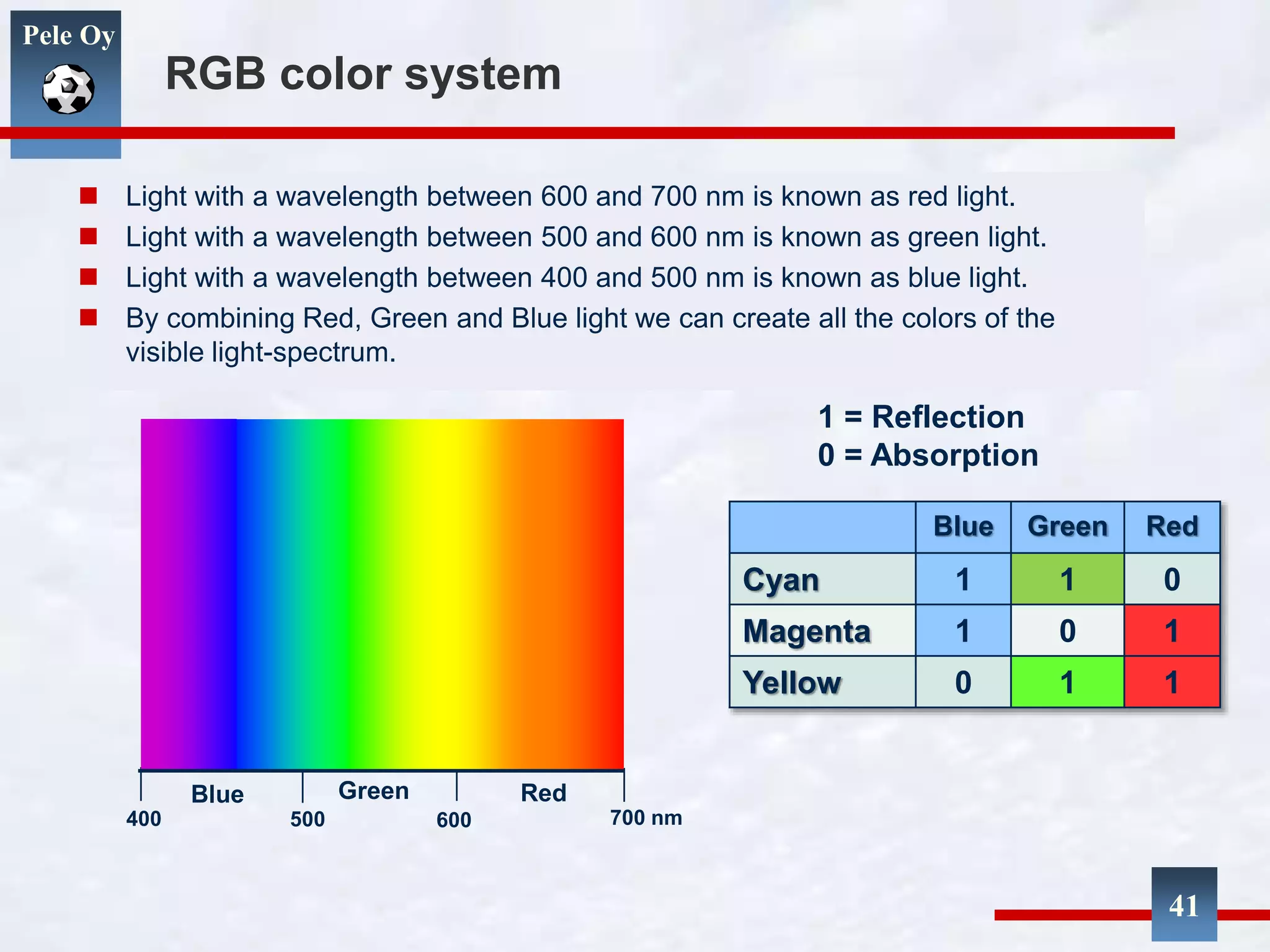
 Light with a wavelength between 600 and 700 nm is known as red light.
 Light with a wavelength between 500 and 600 nm is known as green light.
 Light with a wavelength between 400 and 500 nm is known as blue light.
 By combining Red, Green and Blue light we can create all the colors of the
visible light-spectrum.
400 500 600 700 nm
Blue Green Red
41
Blue Green Red
Cyan 1 1 0
Magenta 1 0 1
Yellow 0 1 1
1 = Reflection
0 = Absorption
Pele Oy
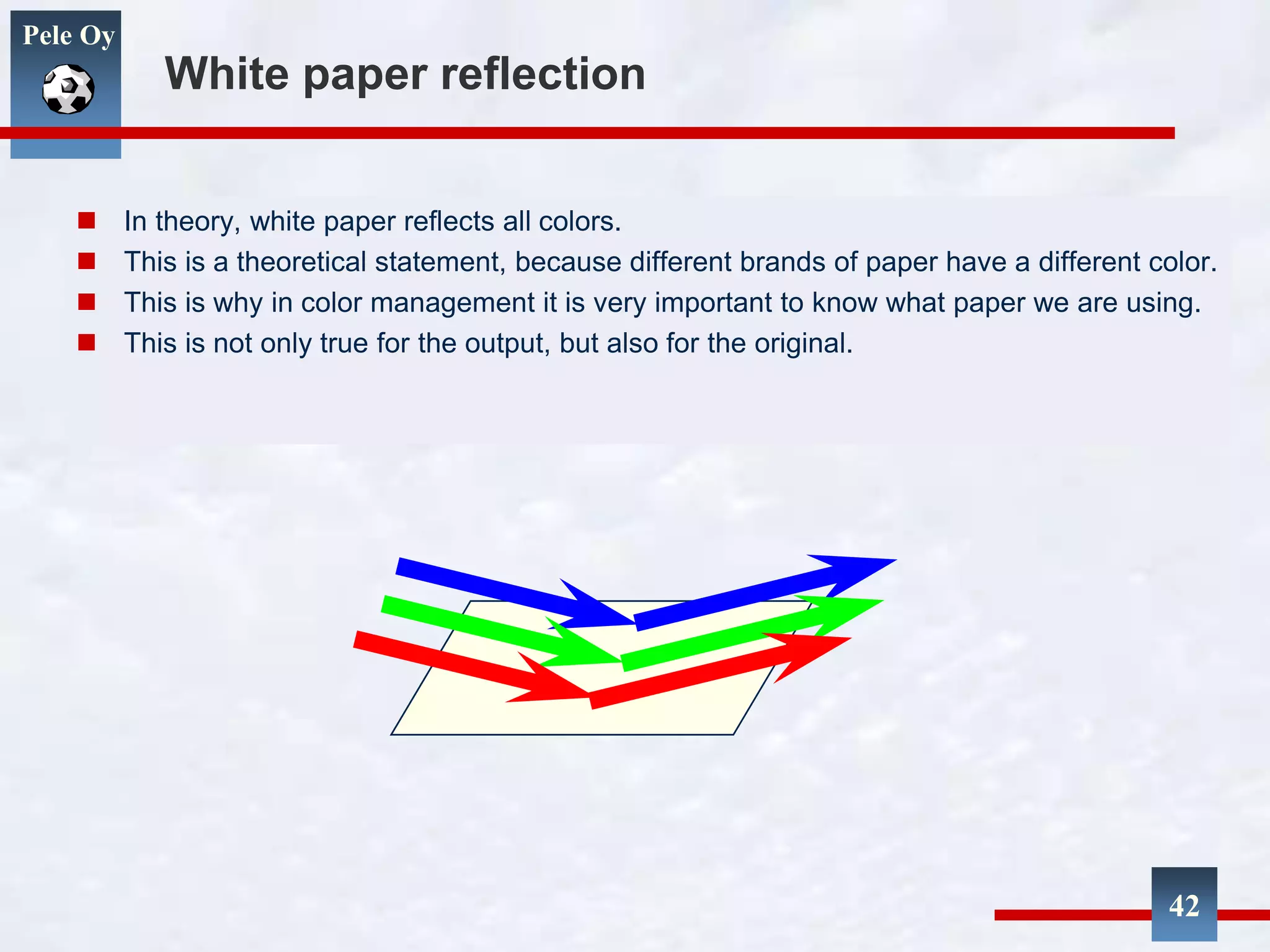
White paper reflection
 In theory, white paper reflects all colors.
 This is a theoretical statement, because different brands of paper have a different color.
 This is why in color management it is very important to know what paper we are using.
 This is not only true for the output, but also for the original.
42
Pele Oy
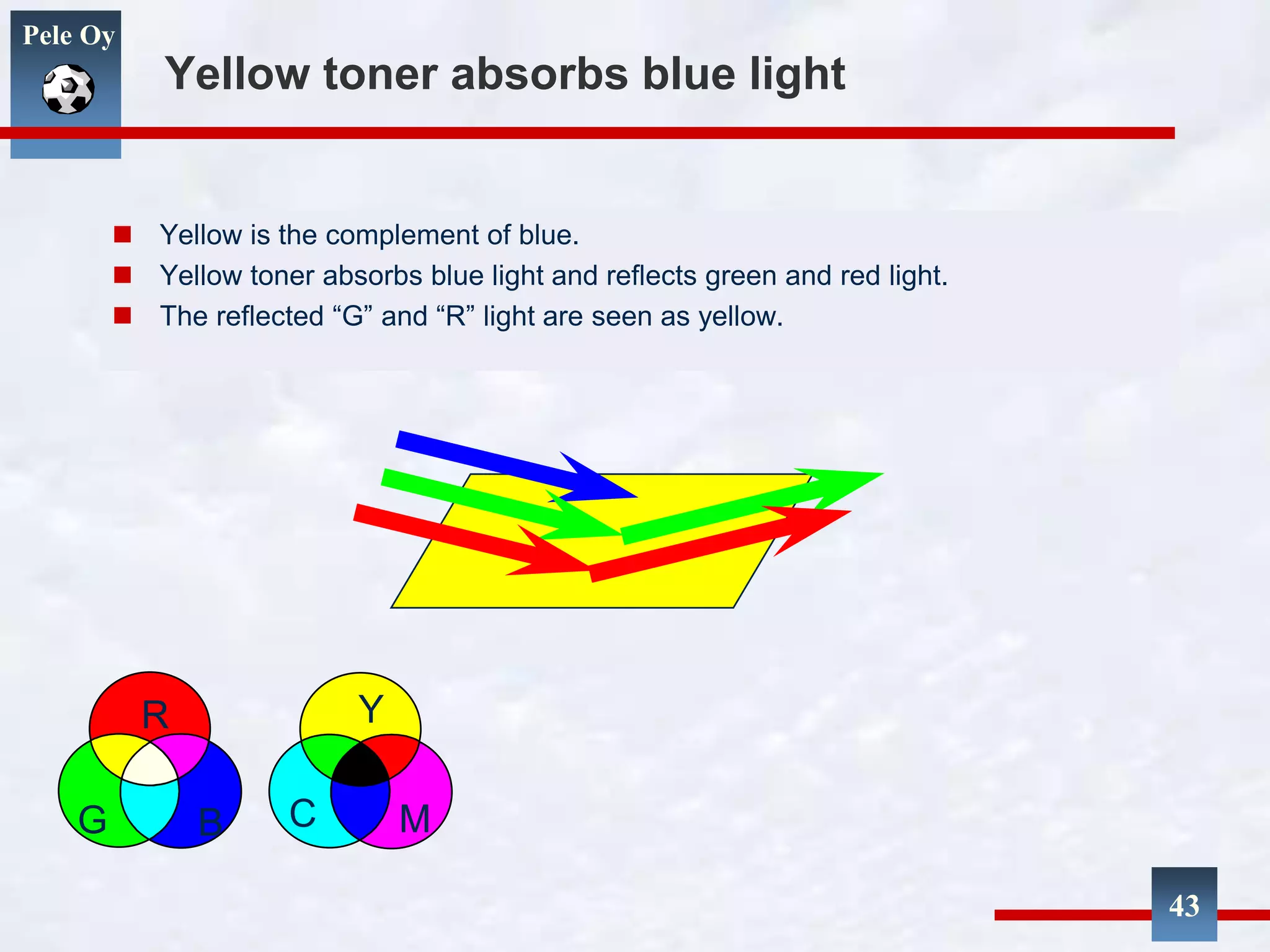
Yellow toner absorbs blue light
 Yellow is the complement of blue.
 Yellow toner absorbs blue light and reflects green and red light.
 The reflected “G” and “R” light are seen as yellow.
R
G B
Y
C M
43
Pele Oy
Magenta toner absorbs green light
 Magenta is the complement of green.
 Magenta toner absorbs green light and reflects blue and red light.
 The reflected “B” and “R” light are seen as magenta.
44
R
G B
Y
C M
Pele Oy
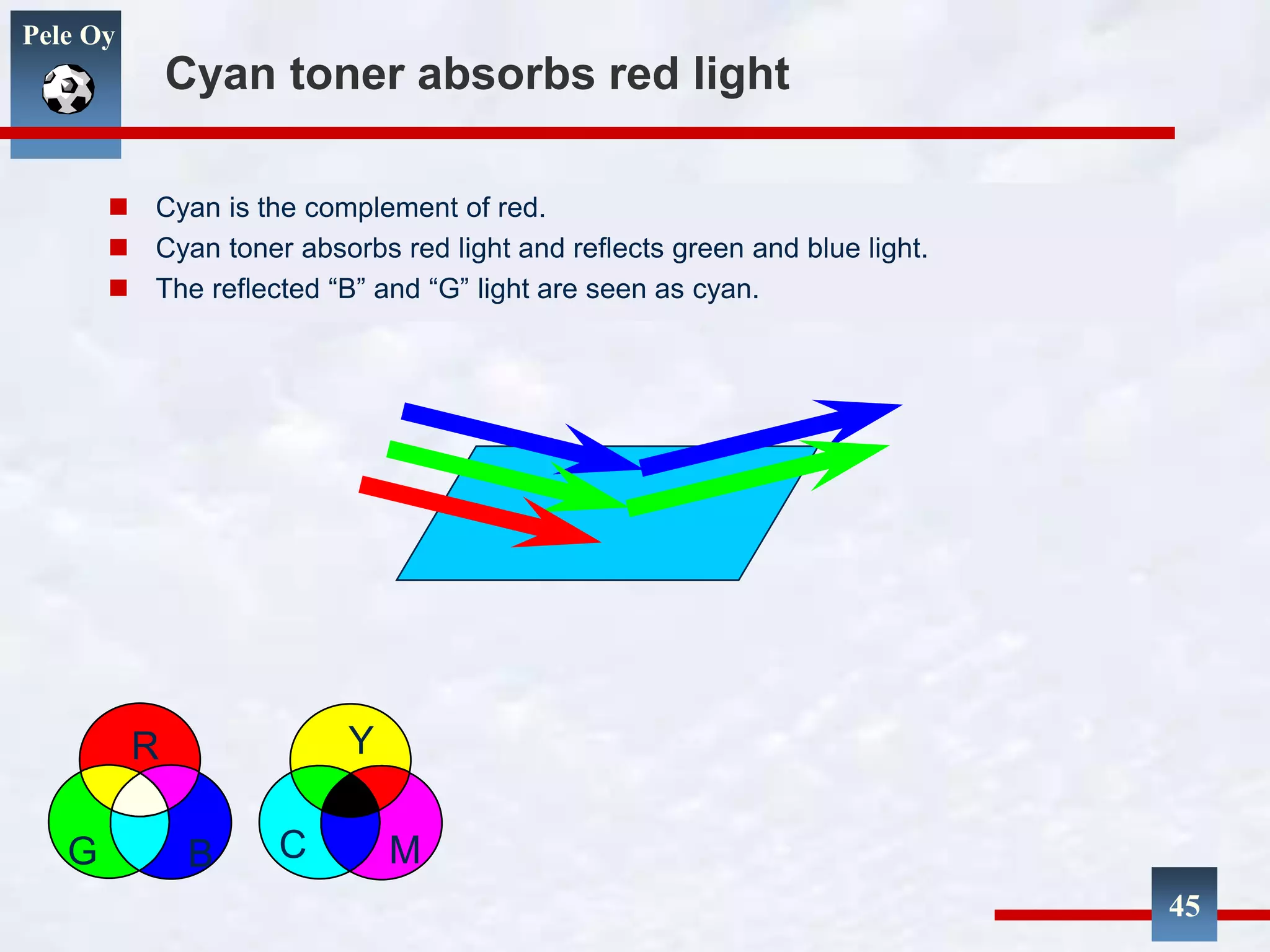
Cyan toner absorbs red light
 Cyan is the complement of red.
 Cyan toner absorbs red light and reflects green and blue light.
 The reflected “B” and “G” light are seen as cyan.
R
G B
Y
C M
45
Pele Oy
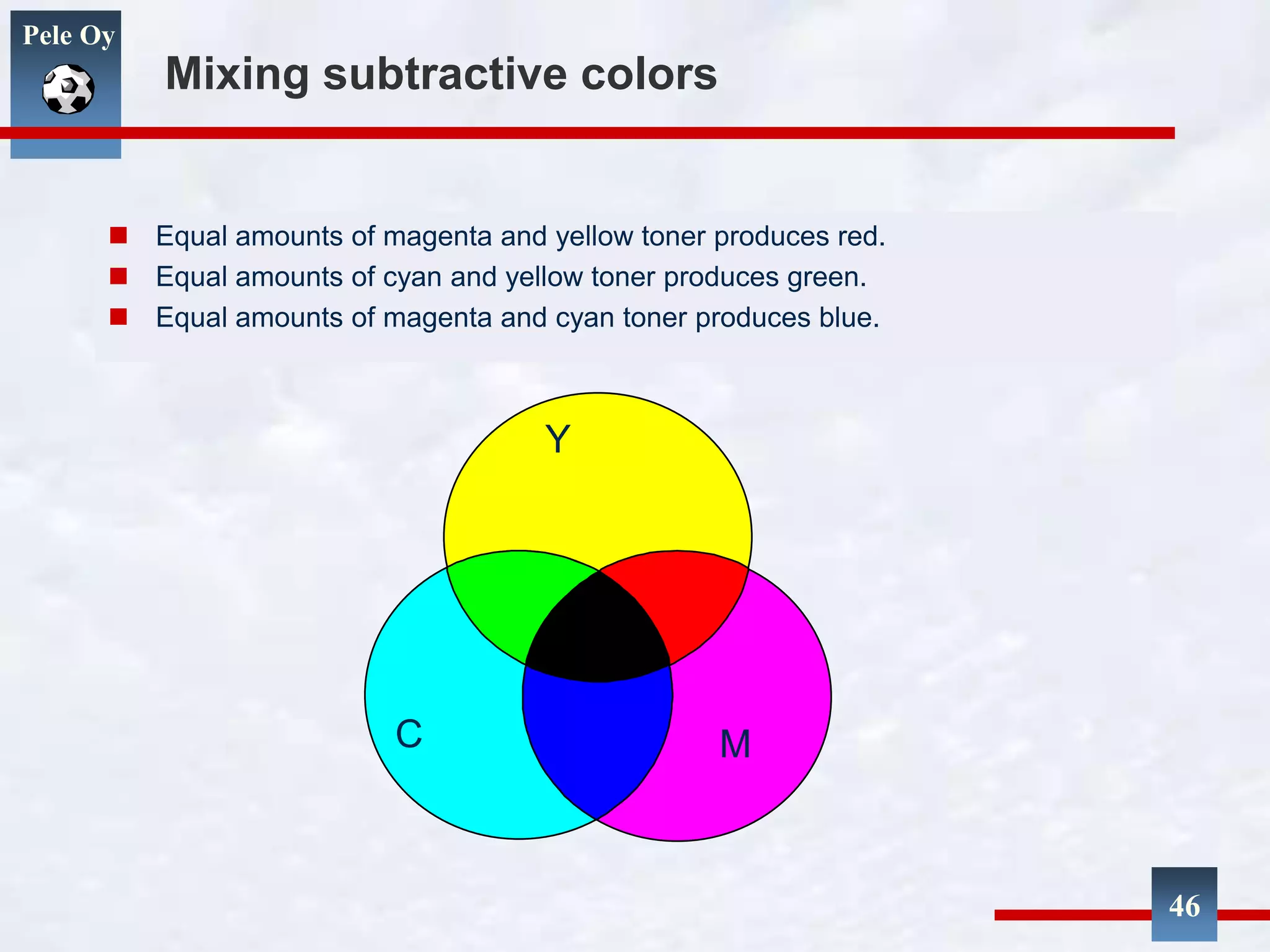
Mixing subtractive colors
 Equal amounts of magenta and yellow toner produces red.
 Equal amounts of cyan and yellow toner produces green.
 Equal amounts of magenta and cyan toner produces blue.
46
Y
C M
Pele Oy
Process black
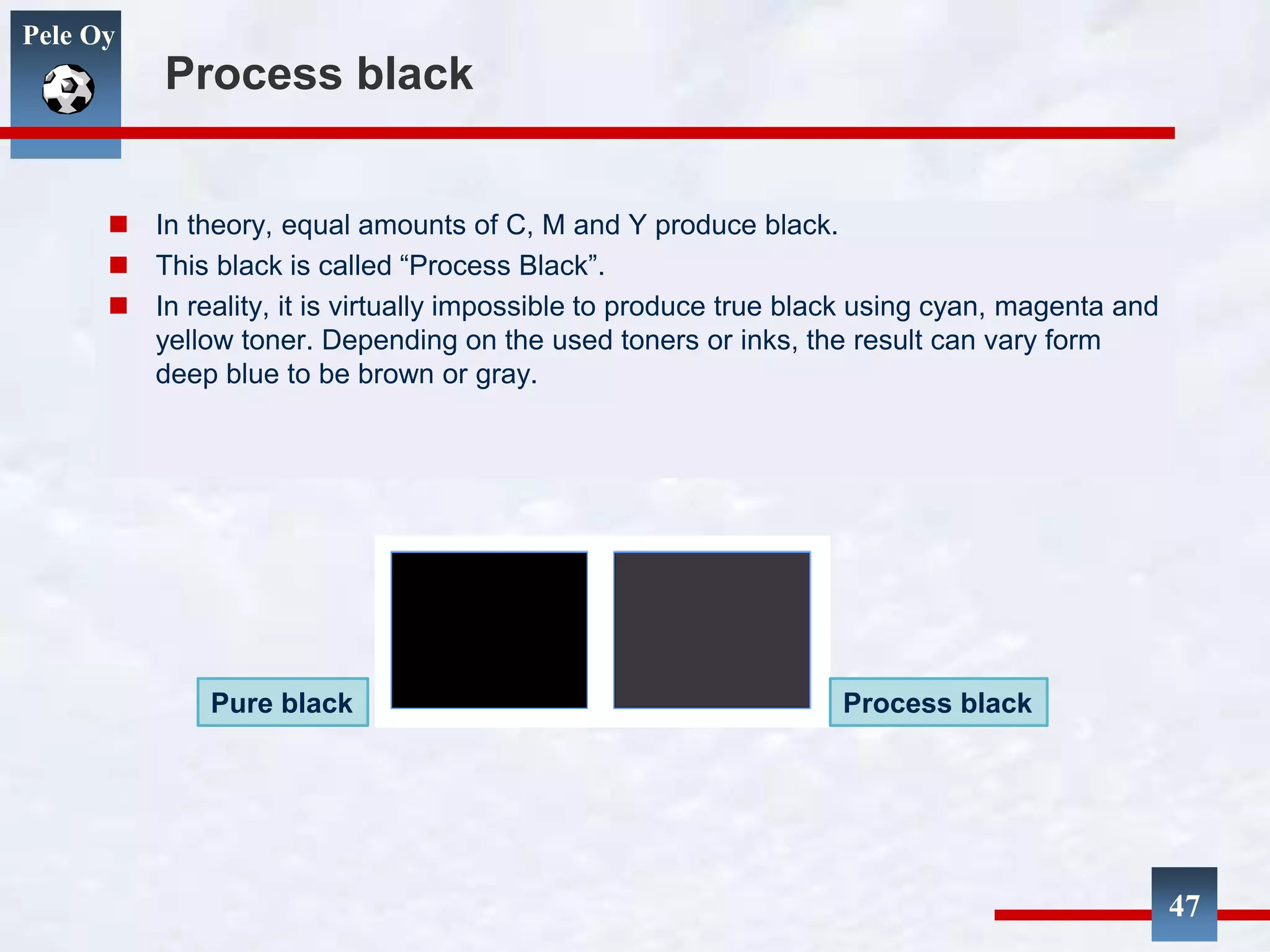
 In theory, equal amounts of C, M and Y produce black.
 This black is called “Process Black”.
 In reality, it is virtually impossible to produce true black using cyan, magenta and
yellow toner. Depending on the used toners or inks, the result can vary form
deep blue to be brown or gray.
47
Pure black Process black
Pele Oy
Yellow school bus
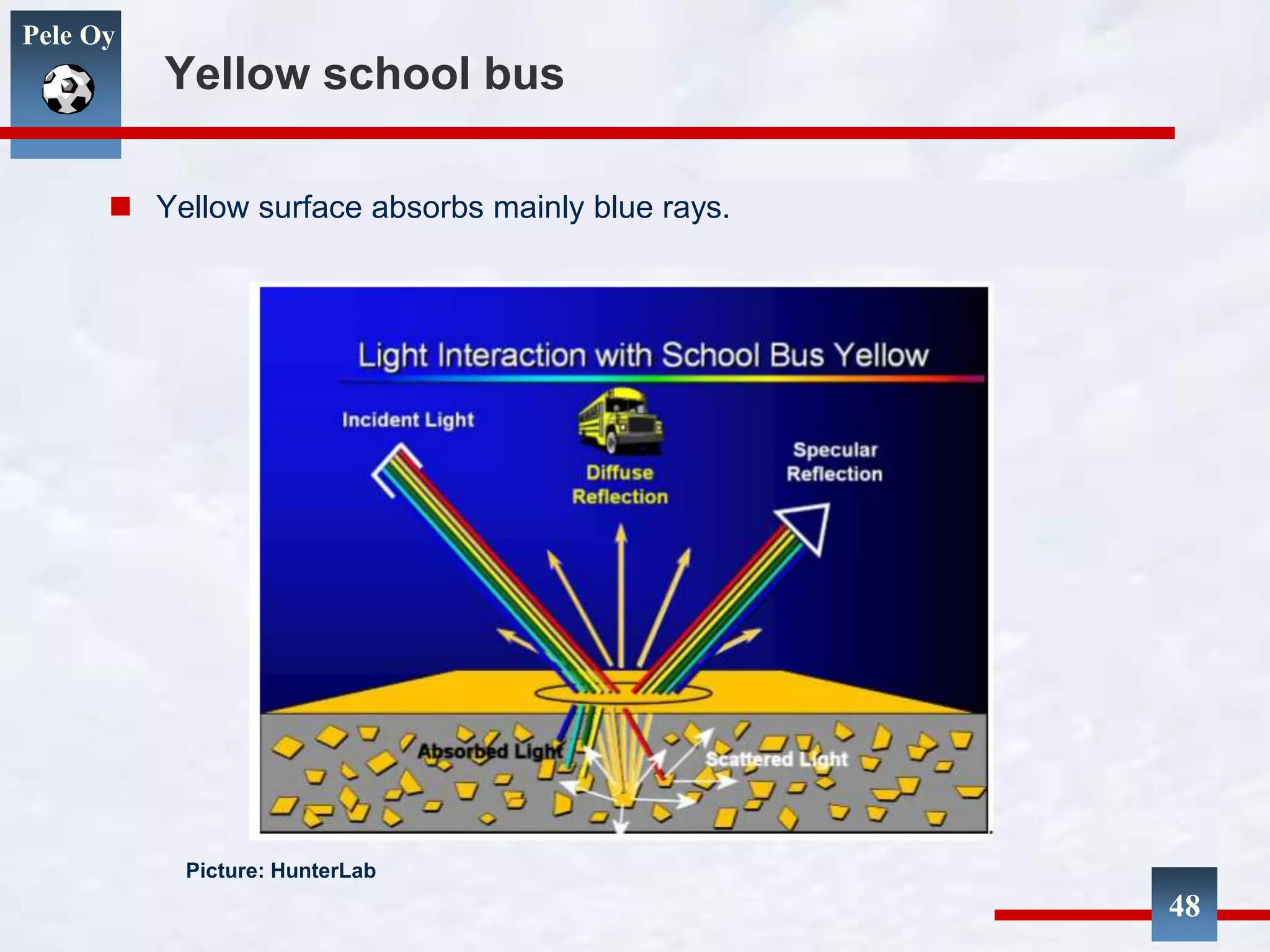
 Yellow surface absorbs mainly blue rays.
48
Picture: HunterLab
Pele Oy
The CIE Lab model
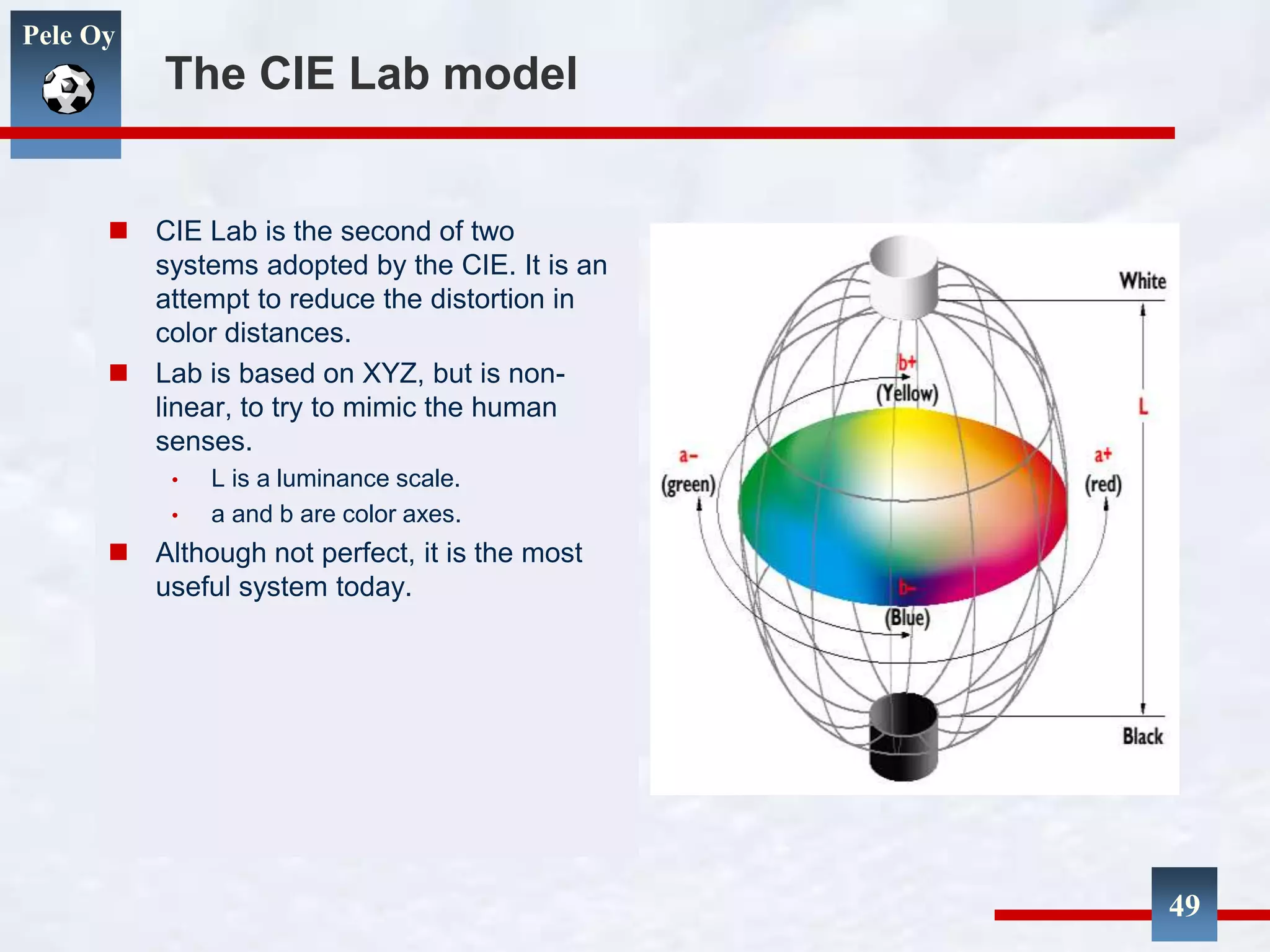
 CIE Lab is the second of two
systems adopted by the CIE. It is an
attempt to reduce the distortion in
color distances.
 Lab is based on XYZ, but is non-
linear, to try to mimic the human
senses.
• L is a luminance scale.
• a and b are color axes.
 Although not perfect, it is the most
useful system today.
49
Pele Oy
50
Lab colour system
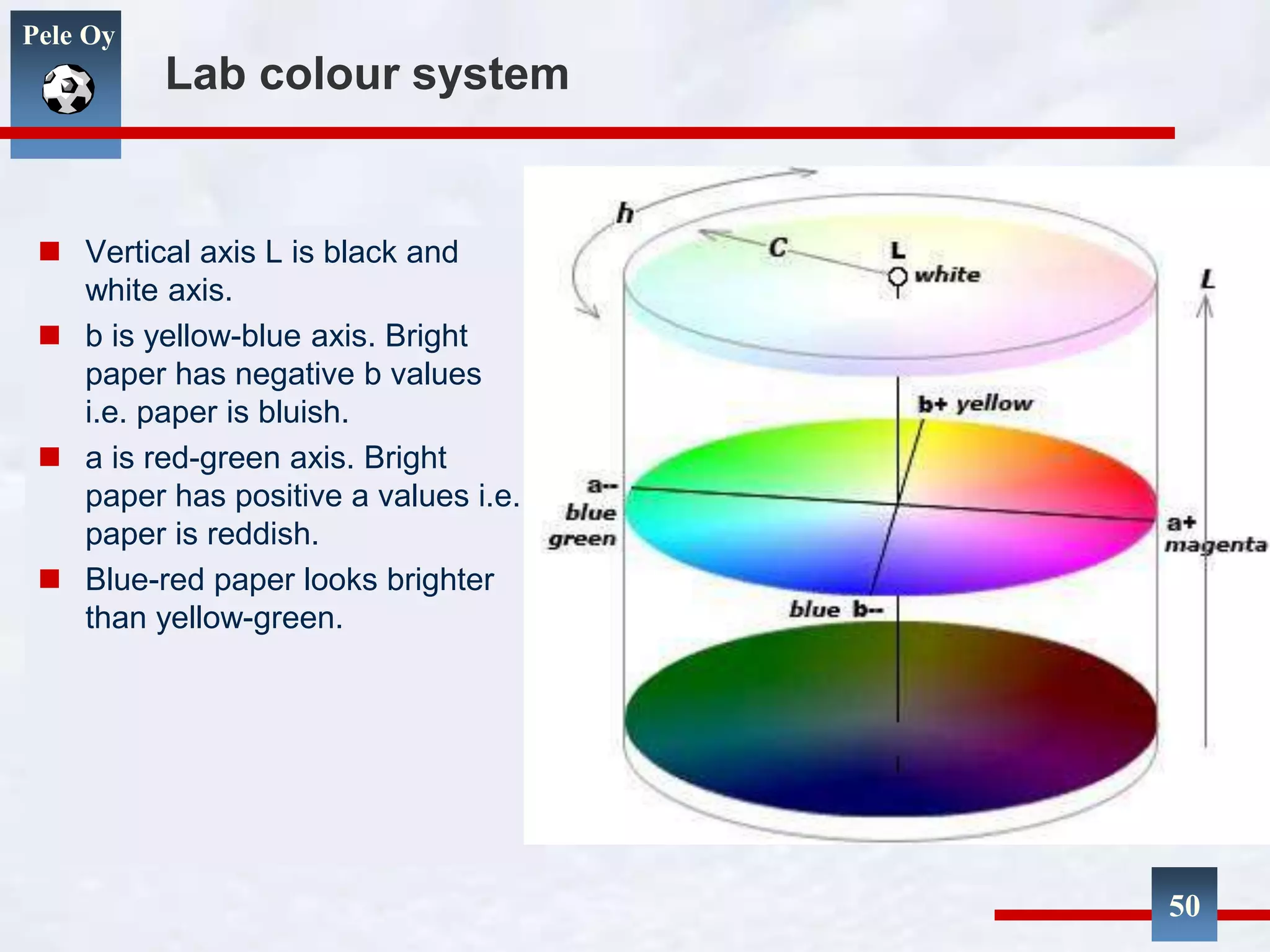
 Vertical axis L is black and
white axis.
 b is yellow-blue axis. Bright
paper has negative b values
i.e. paper is bluish.
 a is red-green axis. Bright
paper has positive a values i.e.
paper is reddish.
 Blue-red paper looks brighter
than yellow-green.
Pele Oy
51
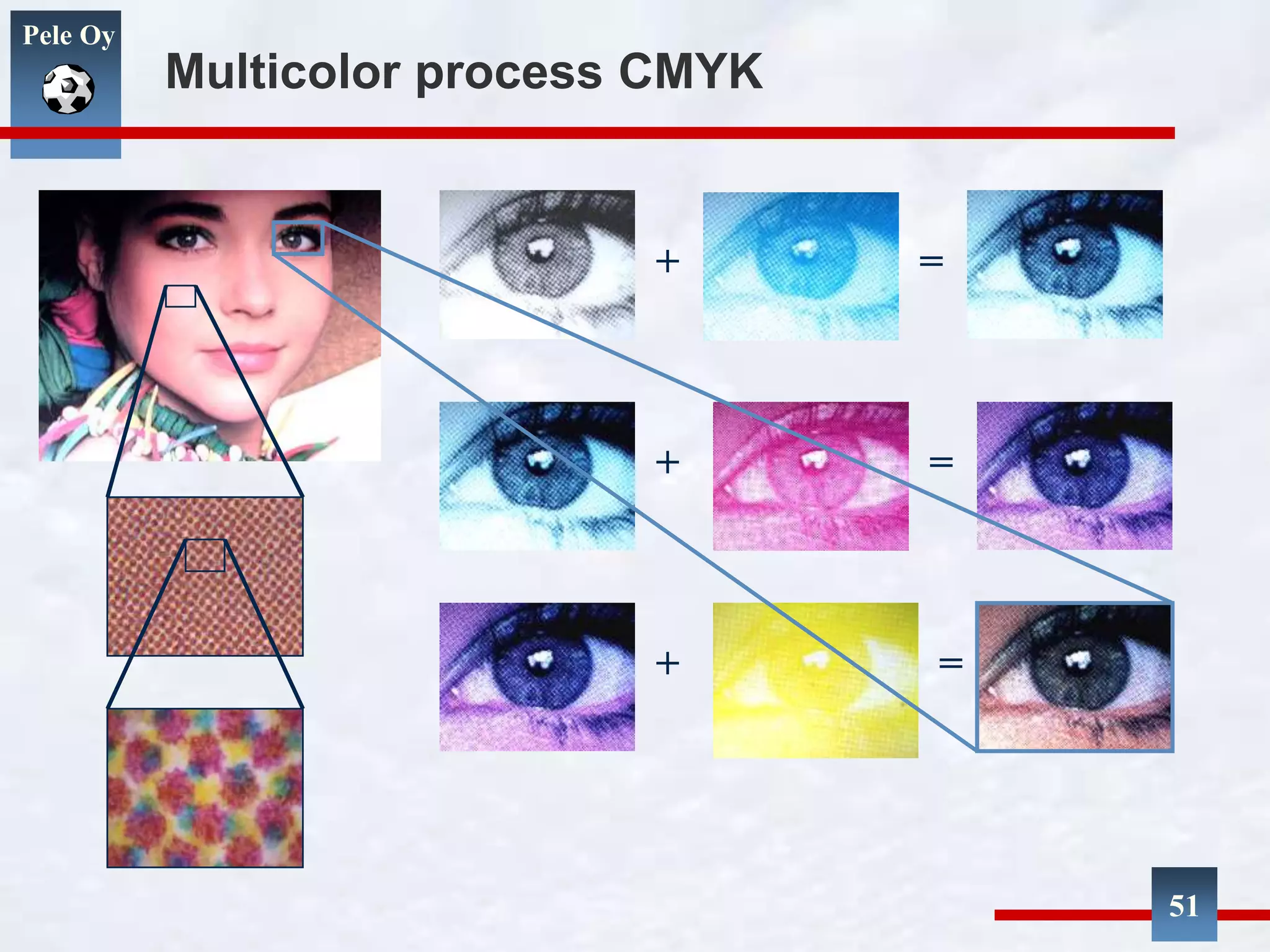
Multicolor process CMYK
+
+
+
=
=
=
Pele Oy
Some Practical Issues
Pele Oy
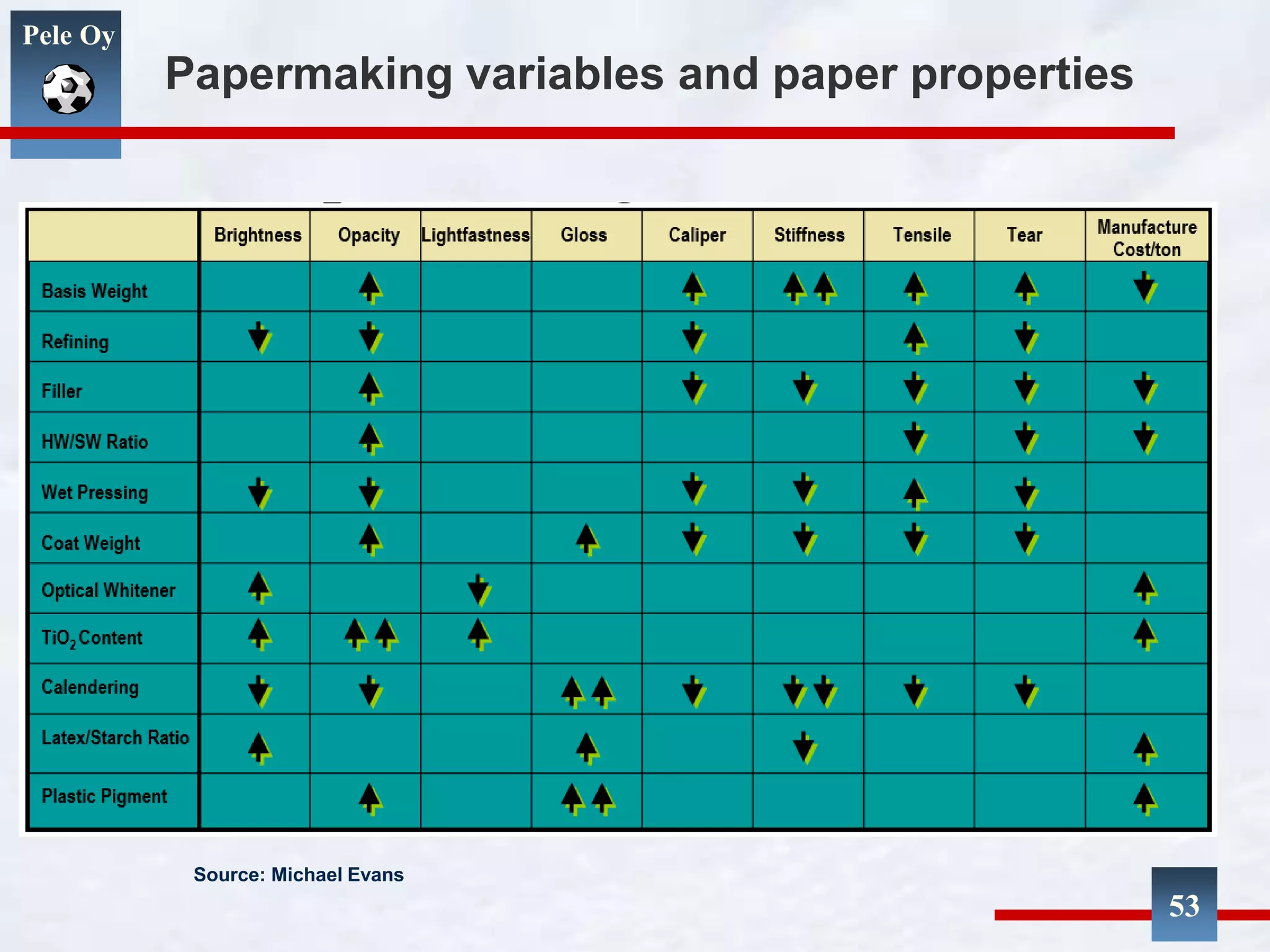
Papermaking variables and paper properties
53
Source: Michael Evans
Pele Oy
54
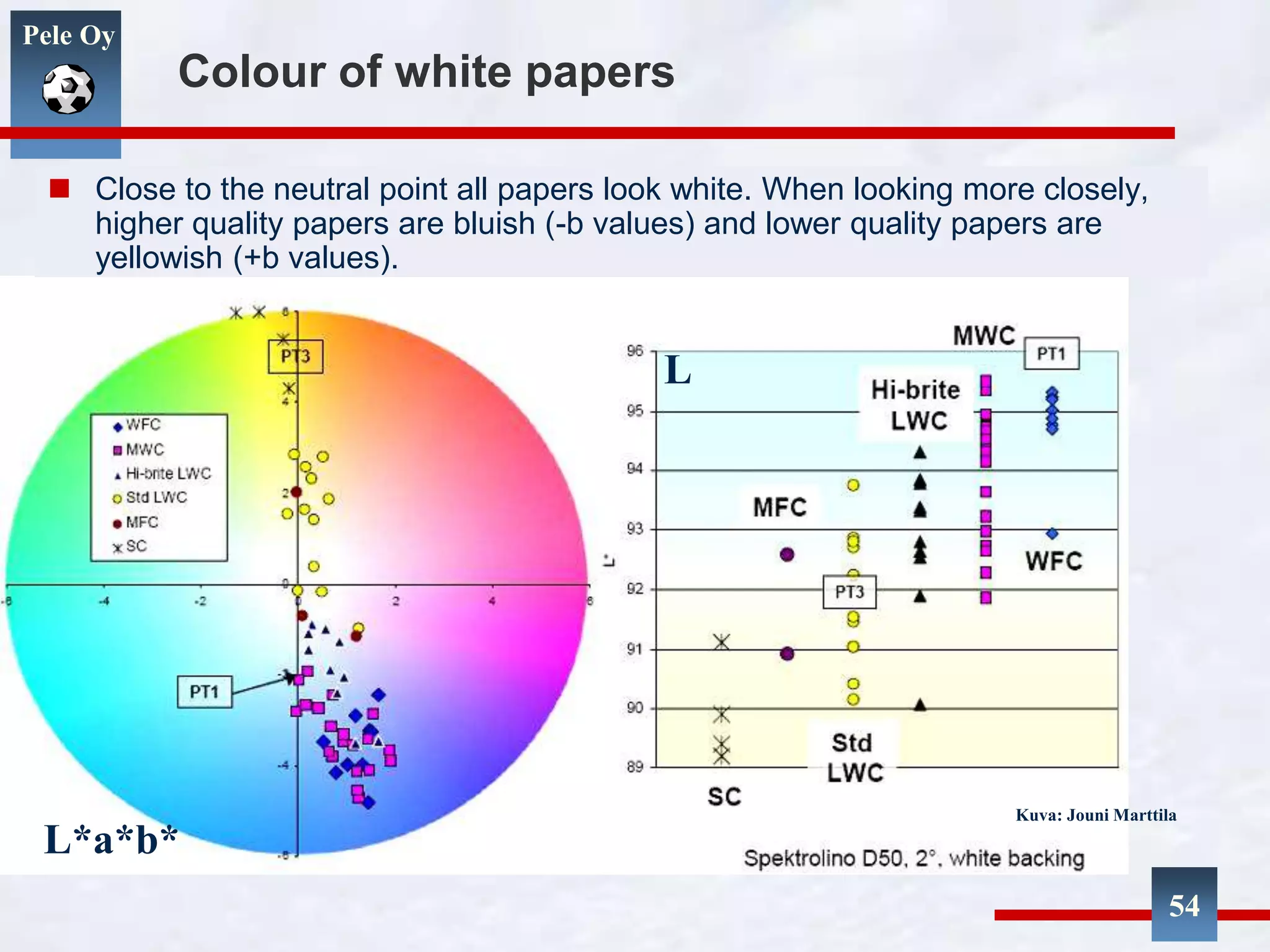
Colour of white papers
Kuva: Jouni Marttila
L*a*b*
L
 Close to the neutral point all papers look white. When looking more closely,
higher quality papers are bluish (-b values) and lower quality papers are
yellowish (+b values).
Pele Oy
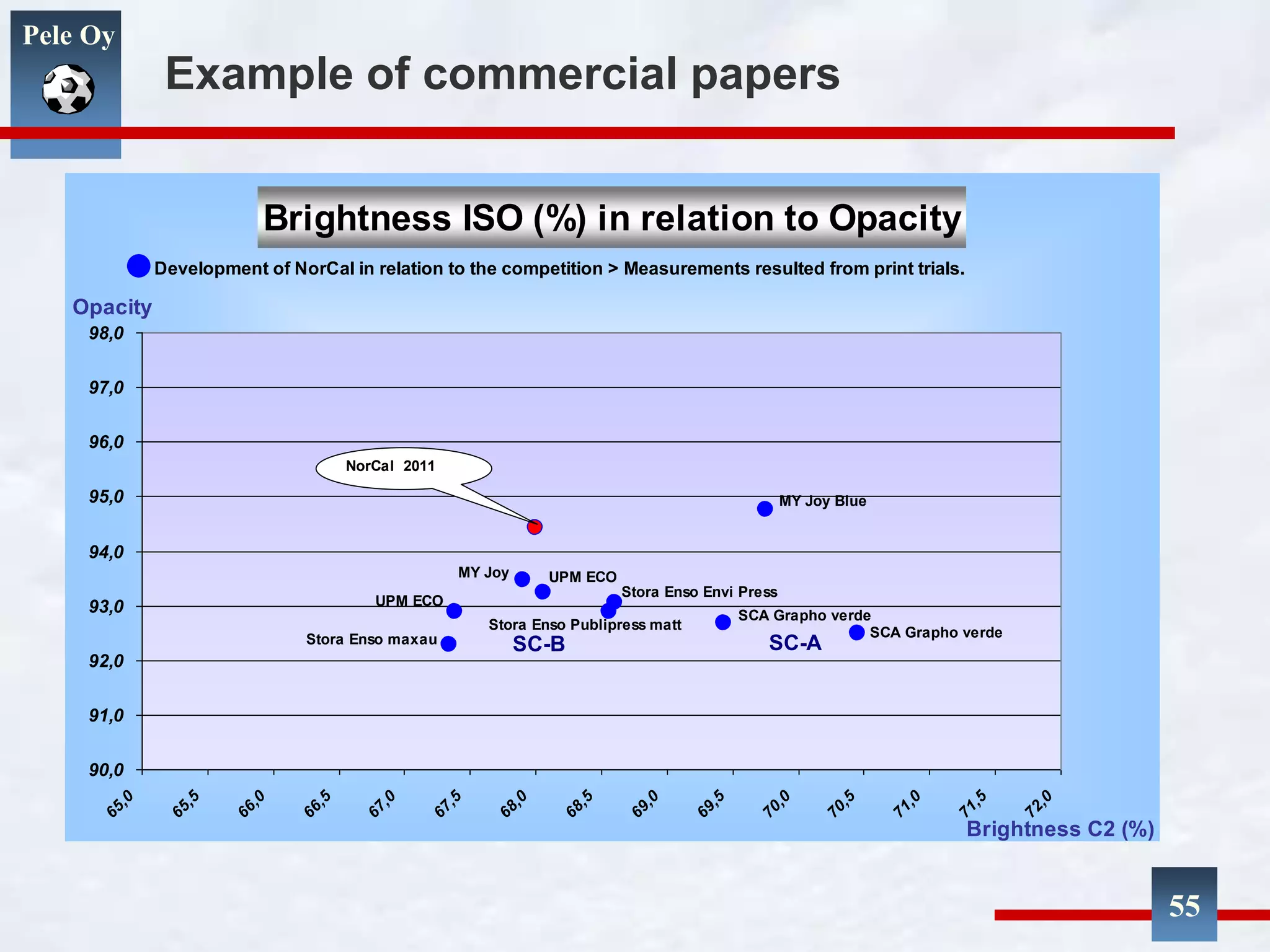
Example of commercial papers
Brightness ISO (%) in relation to Opacity
90,0
91,0
92,0
93,0
94,0
95,0
96,0
97,0
98,0
65,0
65,5
66,0
66,5
67,0
67,5
68,0
68,5
69,0
69,5
70,0
70,5
71,0
71,5
72,0
SC-ASC-B
NorCal 2011
Development of NorCal in relation to the competition > Measurements resulted from print trials.
UPM ECO
Stora Enso Publipress matt
Stora Enso Envi Press
SCA Grapho verde
MY Joy
Stora Enso maxau
SCA Grapho verde
UPM ECO
Brightness C2 (%)
MY Joy Blue
Opacity
(%)
55
Pele Oy
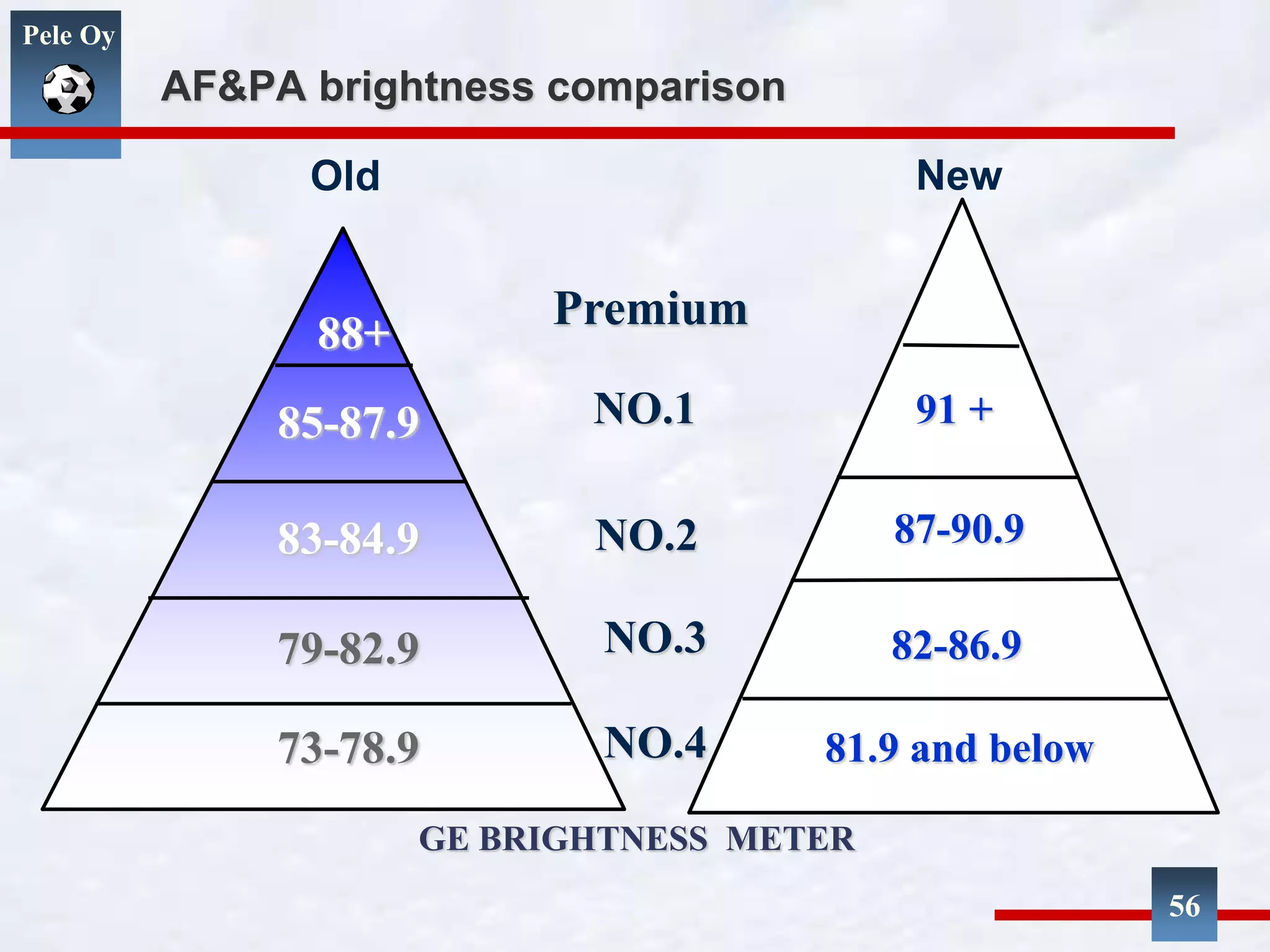
AF&PA brightness comparison
73-78.9
79-82.9
83-84.9
85-87.9
88+
81.9 and below
82-86.9
87-90.9
91 +NO.1
NO.2
NO.3
NO.4
GE BRIGHTNESS METER
Premium
Old New
56
Pele Oy
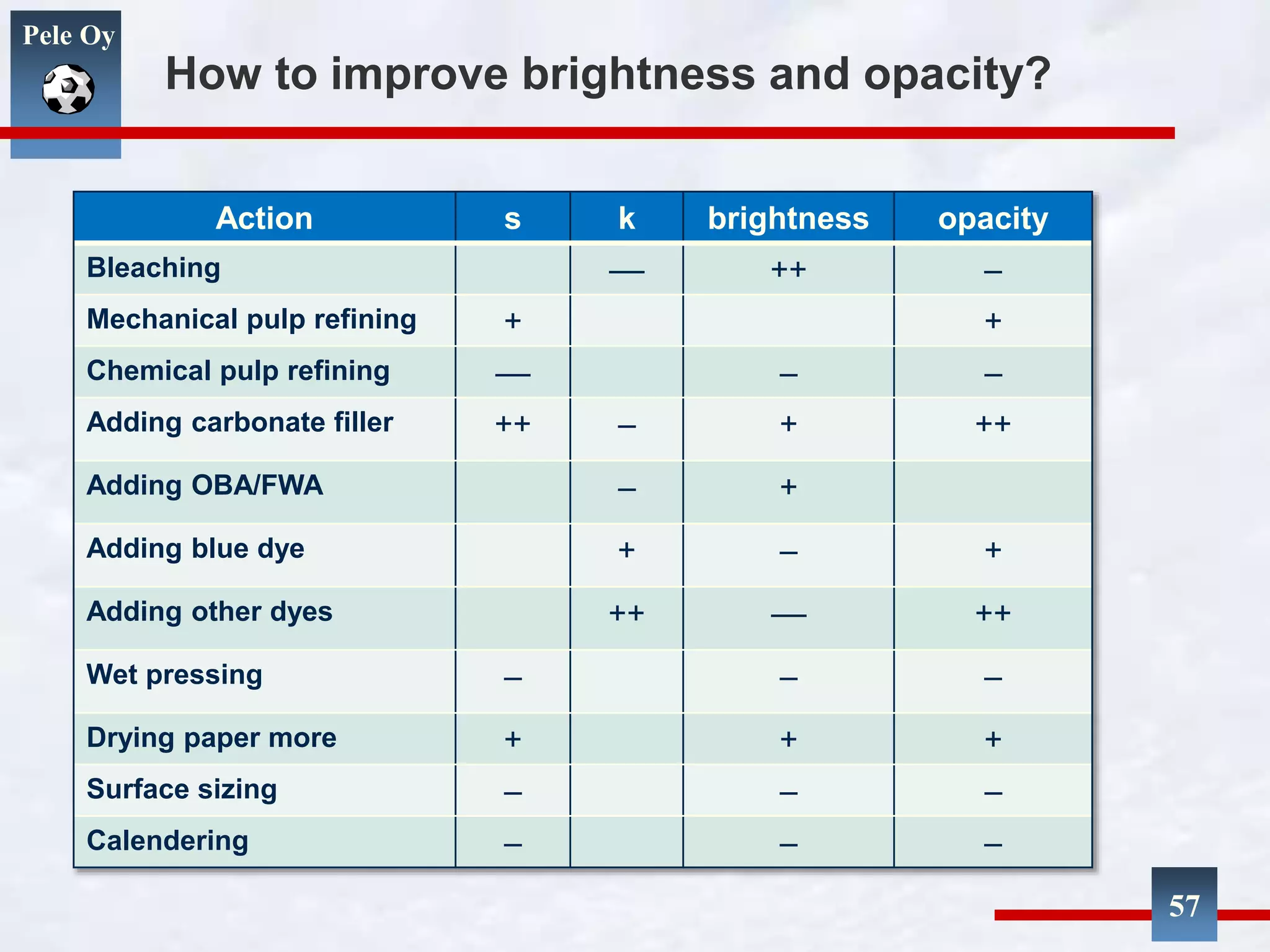
How to improve brightness and opacity?
57
Action s k brightness opacity
Bleaching –– ++ –
Mechanical pulp refining + +
Chemical pulp refining –– – –
Adding carbonate filler ++ – + ++
Adding OBA/FWA – +
Adding blue dye + – +
Adding other dyes ++ –– ++
Wet pressing – – –
Drying paper more + + +
Surface sizing – – –
Calendering – – –
Pele Oy
58
Pele Oy
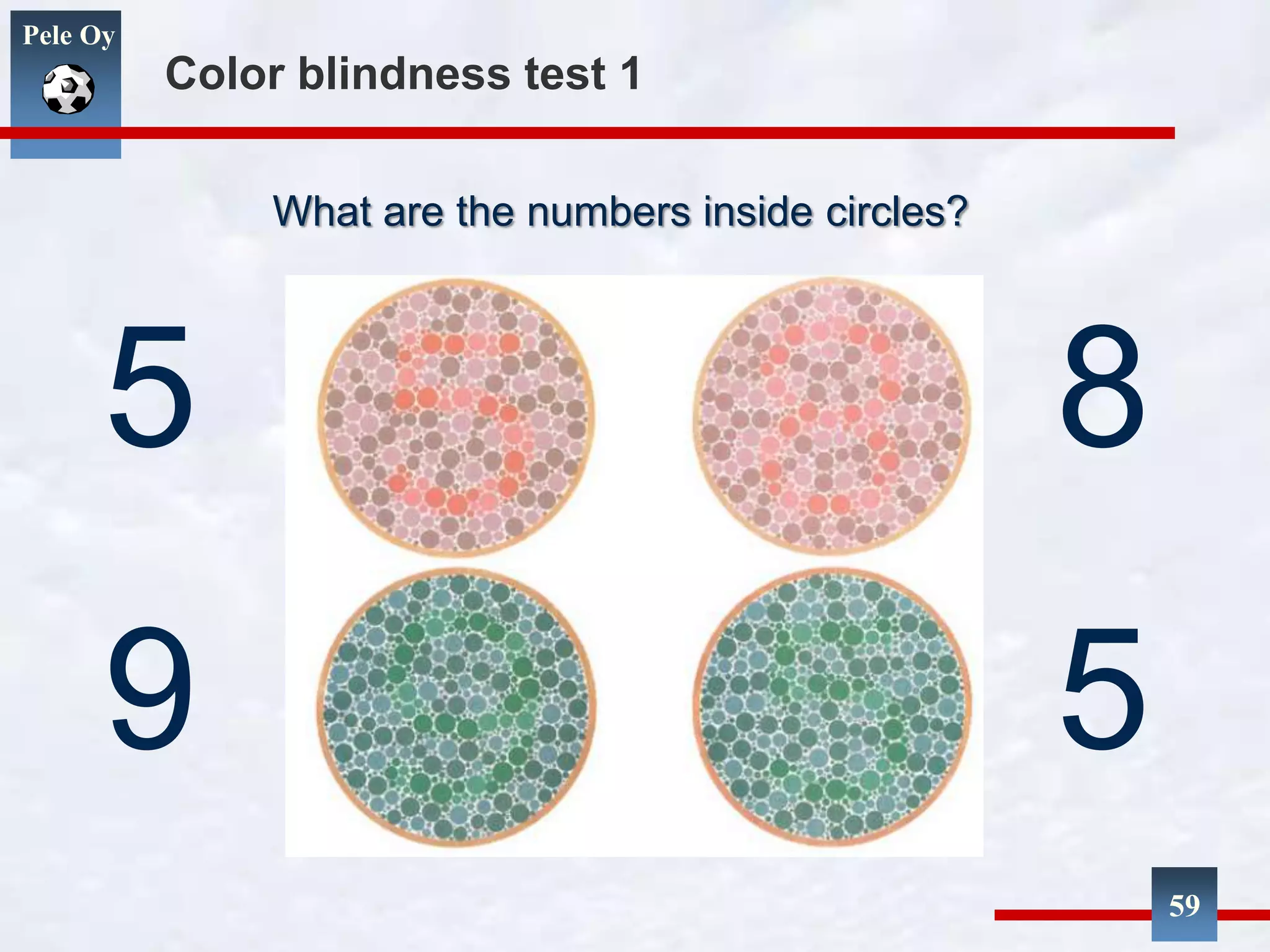
Color blindness test 1
59
5
5
8
9
What are the numbers inside circles?
Pele Oy
60
Color blindness test 2
3
10
5
9
What are the numbers inside circles?

Optical Properties of Paper and Board

  • 1.
    Pele Oy Optical Propertiesin Papermaking March 2016 Pekka.Komulainen@clarinet.fi
  • 2.
    Pele Oy Paper underlight  For optical properties it is important that paper is porous (like snow).  Paper under light shows the following main phenomena and paper properties: • Specular reflection gloss and smoothness • Scattered reflection brightness and opacity • Scattered absorption color and opacity • Refraction opacity • Transmission opacity 2 Snow - white Ice – ”glassy” Reflection Refraction Absorption Transmission Incident light
  • 3.
    Pele Oy 3 Light reflectionfrom printed image  For optical properties most important is how air is distributed in the paper and for strength how fibers are distributed.  For good multicolor pictures it is important that paper reflects all wavelengths i.e. is white. Picture: Evans, DuPont
  • 4.
    Pele Oy Kubelka-Munk theoryand light scattering  Paper is rough and porous material. This means that it reflects scattered light from the surface but also deeper from the paper.  Light scattering coefficient is a material property, which tells how much from the incoming light the material can reflect as scattered light.  Light scattering coefficient can be calculated from paper reflection measurements.  Refraction index of main paper components are very similar. Every surface between paper and air refracts light and scattering is better when there are more these surfaces.  The higher the paper density is the less there is light scattering. 4
  • 5.
    Pele Oy Absorption coefficient Absorption coefficient can be calculated from the measured values of R∞ and R0. It depends on the special chemical groups in molecules. Typically these groups are present in all kind of dirt.  Lignin in a pulp has molecules which reflect only yellow light (=absorbs blue light) and thus reduce brightness very much.  Pulp bleaching is basically additional removal of lignin from the pulp. 5
  • 6.
    Pele Oy Reflection andtransmission  R∞ is the reflection coefficient of so thick sheet pile that no light goes through. It correlates with brightness measurements.  From the formula one can see that scattering coefficient must be high and absorption coefficient low to get high brightness.  Several specialty papers require some or high transparency. These can be called glassine papers. 6
  • 7.
    Pele Oy Reflection factorof a sheet against a black backing Reflection factor of a large stack of sheets 7 Opacity definition ISO Opacity = Reflection factor of a sheet against a black backing Reflection factor of a sheet against a standard backing Tappi Opacity = 100 % Opacity Playing cards with black core
  • 8.
    Pele Oy Opacity measurement 8 In the paper industry, there are two different standards for opacity measurement. ISO 2471 (Printing Opacity) and TAPPI T425 (Contrast Ratio) are the relevant standards.  ISO 2471 utilizes the diffuse illumination and 0° viewing geometry (d/0°) which is the same as the ISO brightness geometry.  TAPPI T425 uses 15° illumination and diffuse viewing(15°/d) originally developed by Bausch & Lomb in the 1930's.  The illuminants of ISO and TAPPI are different where effective wavelengths are 557 and 572 nm. Also the measured ISO and TAPPI opacities are different. ISO 2471 TAPPI T425 Geometry d/0° 15°/d White Backing R∞ R0.89 Wavelength, nm 557 572
  • 9.
    Pele Oy Opacity andbrightness  Opacity % is 100*R0/R∞. This simple formula tells that opacity is lower when brightness is higher.  It is very difficult to get high opacity when brightness is high. This is the reason that newsprint grammage can be about 45 gsm but copy paper must be about 80 gsm.  Opacity relates to the show-through of the printed image from the opposite side of the sheet, or the sheet under it. 9
  • 10.
    Pele Oy 10 Standard illuminants A= 2856 ºK, “electric lamp” B = 4874 ºK C = 6504 ºK, ”indoor daylight” D65 = 6774 ºK, ”outdoor daylight”D65 = more UV  D65 is outdoor daylight, where UV is fully included. C is about indoor daylight (less UV).  Illuminants C and D65 are used for paper measurements. The big difference is that D65 includes more UV light (wavelengths less than 400 nm).  Optical brighteners (OBA = FWA) convert this UV light to visible blue light thus increasing brightness values.
  • 11.
    Pele Oy Brightness measurements There are two basic types of brightness measurements: directional and diffuse.  Directional brightness (TAPPI brightness – TAPPI 452) employs the 45º/0º geometry of the original GE-Photovolt instrument. It has been the standard in the U.S. and Japan. Fiber orientation has effect on the TAPPI brightness measurement.  Diffuse brightness employs a D/0º geometry where D indicates diffuse illumination from a sphere, making it insensitive to sample orientation. Diffuse brightness is the standard in much of the rest of the world.  Two types of diffuse brightness are commonly discussed, and a standard exists for both of them.  ISO C Brightness (ISO 2470-1, TAPPI 525) uses Illuminant C level of UV energy. It simulates normal office lighting conditions.  ISO D65 Brightness uses Illuminant D65 (daylight) according to ISO 2470-2. 11 Sample Photodetector Light source Sample Photodetector Light source Directional Diffuse
  • 12.
    Pele Oy 12 D65 illuminantand measuring slot of brightness  For brightness measurement a narrow wavelength ”slot” has been standardised. The dominant wavelength of this slot is 457 nm (blue) and the range is ± 44 nm. If paper is yellow it reflects less blue light. This measure is effective for bleaching (less lignin less yellowish).  D65 illuminant includes lot of UV light, which can be converted to blue light by using optical brighteners. This increases brightness.  When measuring and calculating whiteness all wavelength have effect and blue dyes increase whiteness. 0 20 40 60 80 100 120 350 400 450 500 550 600 650 700 Brightness is measured from the slot which is under the white curve.
  • 13.
    Pele Oy Brightness weightingfunction  When pulp is bleached the reflectance of all wavelengths increases. However, the increase is largest at blue end of the spectrum.  Pulp brightness measurement is not only the measurement of total reflection but especially the increase of blue reflection (or decrease of yellow lignin absorption). 13
  • 14.
    Pele Oy 14 UV-light andcopy paper reflection spectrum  Brightness is measured with dominant wavelength of 457 nm. Illuminants C and especially D65 give higher brightness when optical brighteners are used. Actually reflection is lower close to 400 nm, where absorption is higher and the energy is moved to higher wavelengths. D65C No UV-light Picture: Nils Pauler 457
  • 15.
    Pele Oy Whiteness  Whitenessis the ratio of Red, Green and Blue reflectance. It is an attribute of a diffusing surface which denotes its similarity in color to preferred or standard white.  Measurable properties CIE Whiteness (ISO 11475) and tint equations can be stated as follows. • W = 2.41L* – 4.45b*(1–0.009(L*–96))–141.4 • T = –1.58a*–0.38b* Wavelength, nm Brightness Whiteness 15
  • 16.
    Pele Oy 16 Brightness andwhiteness of copy papers  D65 brightness of European copy papers can be more than 100% with D65 light and optical brightening agents.  Whiteness is about 50 %-unit higher than conventional ISO-brightness and D65 brightness about 10 %-unit higher than ISO brightness with C illuminant. 60 70 80 90 100 110 120 130 140 150 160 1 2 3 4 5 6 7 8 9 10 11 Paper suppliers % Brightness, C/2º, ISO 2470:1999 Brightness, D65/10º, SCAN P-66 Whiteness, D65/10º, ISO 11475:1999 Recycled base
  • 17.
    Pele Oy Fluorescent whiteningagent (FWA or OBA) 17  Fluorescent Whitening Agent (FWA or OBA) is used to increase the white appearance of papers by absorbing invisible ultraviolet light and re-emitting it in the blue region of the visible spectrum. It is widely used in Europe to make bright surface.  This strategy can compensate for a yellow tint of many types of pulps that have been bleached to moderate levels.
  • 18.
    Pele Oy Fluorescent componentof brightness  Fluorescent component is the additional brightness obtained from the use of optical brighteners. It is determined by measuring the sample with and then without the effect of UV energy on the sample. 18 Picture: Technidyne
  • 19.
    Pele Oy Brightness comparisons When comparing brightness it is important to know what method and light has been used. The following data is an example of differences. Data: http://www.crableengineering.com/presentations/ Technidyne D65 ISO TAPPI CIE D65 CIE C ISO-TAPPI D65 -ISO A 98,9 91,8 89,9 126,6 106,0 1,9 7,1 B 95,3 89,0 87,3 117,5 98,6 1,7 6,4 C 105,6 95,1 91,8 139,3 112,3 3,3 10,5 D 111,2 99,8 96,5 161,9 134,5 3,3 11,4 E 110,6 98,9 95,5 162,0 133,9 3,4 11,7 F 112,3 100,4 96,0 149,7 122,2 4,4 11,8 G 113,5 100,9 96,4 160,5 132,2 4,5 12,6 H 110,1 98,7 94,7 145,3 117,4 4,0 11,4 I 112,3 100,2 95,9 161,2 133,6 4,3 12,1 J 93,0 88,6 90,0 110,8 98,9 -1,4 4,4 K 102,0 92,5 90,6 130,9 106,5 1,9 9,5 L 110,1 99,1 95,0 152,5 126,3 4,1 11,1 M 110,1 99,5 96,1 150,6 124,5 3,4 10,7 N 107,2 96,7 94,1 153,6 127,9 2,6 10,6 O 106,9 96,3 93,0 143,0 115,7 3,3 10,6 P 110,3 99,2 96,1 146,3 119,0 3,1 11,1 Q 109,6 99,0 96,1 143,5 118,1 2,9 10,5 R 113,9 101,5 97,4 149,9 121,8 4,1 12,4 S 111,6 99,3 95,0 163,0 134,6 4,3 12,3 Brightness Elrepho Whiteness Elrepho Sample Delta Brightness 19
  • 20.
    Pele Oy Paper glossmetering principle  Tappi T 480 defines the specular gloss of paper and paperboard at 75 degrees (15 ° from the plane of paper). This method is suitable for low to moderate-gloss coated and uncoated papers as well as for most ink films on paper or paperboard.  The standard describes the technical requirements for a corresponding gloss meter.  Gloss measurements are normally made using standard equipment like Hunter, Lehman and Zehntner and giving a single mean gloss value. But, a sample can have a high mean gloss value (normally considered as good) but at the same time have a high gloss variation which is disturbing when looking at a printed picture. The micro gloss method can quantify such disturbing gloss textures and ‘glare effects’ on printed and unprinted surfaces. 20
  • 21.
    Pele Oy Example ofgloss instrument  It must be remembered that paper gloss is different in different directions depending on fiber orientation. Machine direction gloss is highest and cross machine gloss lowest.  The Technidyne PROFILE/Plus Gloss automatically measures the gloss at 75º in the MD and CD according to the following Industry Standards: TAPPI Method T 480, ISO 8254-1. 21
  • 22.
    Pele Oy Effect ofRaw Materials
  • 23.
    Pele Oy Uncoated paperraw materials  Mechanical printings and woodree uncoated papers. 23 Material Mech. % WF % Comment Fibers 60 – 100 70 - 100 Wood or non-wood fibres Fillers 40 – 0 30 - 0 Mineral or synthetic pigments Surface size - 0 - 5 Starch, CMC, PVA, synthetic size, optical brighteners etc. Functional chemicals 0 – 1 0 – 2 Internal sizes, dyes etc. (effect on paper properties) Performance chemicals for process <1 <1 Retention aids, defoamers, biocides etc. (effect on process performance) Water 5 – 10 4 – 7 To be in balance with air humidity
  • 24.
    Pele Oy 24 Fillers andcoatings in papers  To improve optical properties of paper mineral pigments are used in papermaking. They can be added as a filler before headbox or to the surface as a coating with binders. Paper Grades Filler Pigment % Surface size per side g/m2 Coating per side g/m2 Woodcontaining Newsprint, TMP/GW Newsprint, DIP 0 - 5 5 - 15 0 0 - 1.5 0 0 Unctd Mechanical, TD, Bulky SC 5 - 15 15 - 35 0 0 0 - 5 0 Ctd Mechanical, LWC MWC, HWC 5 - 15 8 - 18 0 0 - 2 5 - 15 20 - 40 Woodfree Uncoated Woodfree, Copy Printing 15 - 30 10 - 25 1 - 2 1 - 2 0 0 - 5 Coated Woodfree, standard Premium Art 10 - 15 12 - 18 0 - 2 0 - 2 10 - 15 20 - 35
  • 25.
    Pele Oy Light scatteringcoefficient of pulps  Finer fibers and less bonding give better light scattering (opacity & brightness)  When mechanical pulps have lower freeness light scattering is better (more refining, more unbonded fines)  When chemical pulps have lower freeness light scattering is lower (more bonding, practically no unbonded fines)  Harwood has better scattering than softwood  The more chemicals in pulping is used the lower light scattering will be 25
  • 26.
    Pele Oy Brightness andchromophores  Brightness is not increasing linearly in bleaching. To make very bright pulp requires too much effort and bleaching chemicals.  It is good to know in papermaking that very small amounts of lower brightness components, such as mechanical pulp, low brightness clay or dirty process water reduces brightness very fast. 26
  • 27.
    Pele Oy Fillers andCoating Pigments
  • 28.
    Pele Oy Main pigmentrequirements High light scattering Carbonate, PCC Colour printing Low basis weight High brightness Good opacity 28
  • 29.
    Pele Oy 29 Effects offiller addition Positive effects  Water removal   Better formation  Drying shrinkage  dimensional stability   Brightness, opacity and color   Ink absorption more uniform  Smoothness and gloss   Costs  and printability  Negative effects  All general strength properties  Surface strength , dusting   Internal bond strength   Stiffness   Carbonate requires > 7 pH  Runnability   Retention , two-sidedness  Wire, felt and machine wear  With PCC bulk and porosity can increase, with other fillers they decrease
  • 30.
    Pele Oy 30 Fillers -agglomerated or dispersed?  Fillers should be first fixed to the fibres when they are dispersed. This would guarantee good retention, strength and optical effect (brightness and opacity) at the same time. Only fibres, good strength, Low opacity Fillers well dispersed  low retention, low strength, good opacity Fillers agglomerated  good retention and strength, low opacity Picture: E.Gruber
  • 31.
    Pele Oy 31 Filler distribution Filler can either fill paper pores (left) or distribute evenly on fibre surfaces (right). Even distribution has good optical effect but reduces strength more. Good filler distributionBad filler distribution Pictures: Robert A Gill
  • 32.
    Pele Oy Main rawmaterial requirements  High light scattering improves opacity and brightness. High absorption coefficient improves opacity but decreases brightness.  Fillers and pigments are good raw materials for optical properties (low k and high s). High brightness Good opacity High light scattering High light absorption Low light absorption Property s k High brightness + – High opacity + + 32
  • 33.
    Pele Oy 33 Total mineralcontent of paper & board Source: Omya
  • 34.
    Pele Oy Main fillersand coating pigments  Titanium dioxide is a special filler with high refractive index. It is the only possibility to improve opacity of impregnated and waxed papers. This is the reason that décor paper includes titanium dioxide.  When making opacity and brightness TiO2 is a very expensive filler or coating pigment. It is used in U.S. for this purpose but not in Europe where brightness and opacity are made with less expensive means.  Titanium dioxide price is more than three times pulp price while carbonate filler price can be less than half of pulp price. 34 Mineral Avg size Refractive Scattering Brightness Density Hardness Pigment Index coefficient µm cm 2 /g % kg/m 3 Mohs Clay 0,2-2,0 1,55-1,57 1100-1200 80-92 2580 2-2,5 Calcined clay 0,7-1,5 1,60 2600-3000 90-95 2600 4,0-5,0 GCC 0,7-3,0 1,5-1,7 1400-1700 85-95 2710-2930 3,0-4,0 PCC 0,3-3,0 1,5-1,7 2200-6000 96-100 2710-3830 3,0 TiO2 Anatase 0,2-0,4 2,5-2,55 4500-6000 98-100 3820-3970 5,5-6,0 TiO2 Rutile 0,2-0,4 2,6-2,9 4500-6000 98-100 4230-5500 6,0-7,0
  • 35.
    Pele Oy 35 Effect offiller content on tensile strength  Dry tensile strength is reduced about 50% when a normal 20% loading is used. Initial wet strength reduces even more.  Higher particle size gives better strength but optical effect will be lower due to lower light scattering. Täyteainepitoisuus, % Picture: Robert A Gill Filler content, % Tensile,km Particle size increases
  • 36.
    Pele Oy Critical propertiesof titanium dioxide 36 Anatase, RI = 2.5 Rutile, RI = 2.7 (more effective)  Several properties of TiO2 are different compared to other fillers. However, if the effects are compared at the same level of opacity increase, the detrimental effects with TiO2 are lower than with several other fillers and pigments.  Even if the price of TiO2 can be up to ten times compared to lowest price fillers, the cost can be lower because the usage can be only 10% of the use of main filler (1-2% of paper for printing papers).  Because the share of TiO2 as a filler is low a good retention is very important.  TiO2 absorbs UV light and the effect of OBA is reduced with TiO2. OBA is more used in Europe and TiO2 in North America.
  • 37.
    Pele Oy 37 Minerals inpapermaking  Minerals are a fast growing raw materials of papermaking. Total amount of minerals in paper and board is globally over 10%. We are back in stone age.  Especially consumption of carbonates has been growing fast because they are white, easy to find everywhere and less expensive than fibers or clay. Stone Forest in Kunming, China
  • 38.
    Pele Oy Paper Colorand Printing Illuminant Eye and brain
  • 39.
    Pele Oy Color mixing When lights are mixed it is additive mixing (we add energy). When inks and paints are mixed it is subtractive mixing (we add absorption and reduce energy from reflection).  Pure red and green light produce yellow, red and blue make magenta, blue and green combine to make cyan, and all three together, when mixed at full intensity, create white.  For mixing of dye pigments, it is better to use the secondary colors, since they mix subtractively instead of additively. Using Cyan, Yellow and Magenta toners we can create colors on paper. 39 Red BlueGreen Yellow MagentaCyan
  • 40.
    Pele Oy Color gamut In digital printing, when we talk about “gamut” we mean the color space of a device.  Devices can be divided into two categories: • RGB devices like scanners, monitors, digital cameras etc. • CMYK devices like laser printers, offset etc.  Normally, a CMYK printer device color space will be smaller (less saturated and fewer colors) than a RGB capture device color space. A typical RGB color space A typical CMYK color space 40
  • 41.
    Pele Oy RGB colorsystem  Light with a wavelength between 600 and 700 nm is known as red light.  Light with a wavelength between 500 and 600 nm is known as green light.  Light with a wavelength between 400 and 500 nm is known as blue light.  By combining Red, Green and Blue light we can create all the colors of the visible light-spectrum. 400 500 600 700 nm Blue Green Red 41 Blue Green Red Cyan 1 1 0 Magenta 1 0 1 Yellow 0 1 1 1 = Reflection 0 = Absorption
  • 42.
    Pele Oy White paperreflection  In theory, white paper reflects all colors.  This is a theoretical statement, because different brands of paper have a different color.  This is why in color management it is very important to know what paper we are using.  This is not only true for the output, but also for the original. 42
  • 43.
    Pele Oy Yellow tonerabsorbs blue light  Yellow is the complement of blue.  Yellow toner absorbs blue light and reflects green and red light.  The reflected “G” and “R” light are seen as yellow. R G B Y C M 43
  • 44.
    Pele Oy Magenta tonerabsorbs green light  Magenta is the complement of green.  Magenta toner absorbs green light and reflects blue and red light.  The reflected “B” and “R” light are seen as magenta. 44 R G B Y C M
  • 45.
    Pele Oy Cyan tonerabsorbs red light  Cyan is the complement of red.  Cyan toner absorbs red light and reflects green and blue light.  The reflected “B” and “G” light are seen as cyan. R G B Y C M 45
  • 46.
    Pele Oy Mixing subtractivecolors  Equal amounts of magenta and yellow toner produces red.  Equal amounts of cyan and yellow toner produces green.  Equal amounts of magenta and cyan toner produces blue. 46 Y C M
  • 47.
    Pele Oy Process black In theory, equal amounts of C, M and Y produce black.  This black is called “Process Black”.  In reality, it is virtually impossible to produce true black using cyan, magenta and yellow toner. Depending on the used toners or inks, the result can vary form deep blue to be brown or gray. 47 Pure black Process black
  • 48.
    Pele Oy Yellow schoolbus  Yellow surface absorbs mainly blue rays. 48 Picture: HunterLab
  • 49.
    Pele Oy The CIELab model  CIE Lab is the second of two systems adopted by the CIE. It is an attempt to reduce the distortion in color distances.  Lab is based on XYZ, but is non- linear, to try to mimic the human senses. • L is a luminance scale. • a and b are color axes.  Although not perfect, it is the most useful system today. 49
  • 50.
    Pele Oy 50 Lab coloursystem  Vertical axis L is black and white axis.  b is yellow-blue axis. Bright paper has negative b values i.e. paper is bluish.  a is red-green axis. Bright paper has positive a values i.e. paper is reddish.  Blue-red paper looks brighter than yellow-green.
  • 51.
  • 52.
  • 53.
    Pele Oy Papermaking variablesand paper properties 53 Source: Michael Evans
  • 54.
    Pele Oy 54 Colour ofwhite papers Kuva: Jouni Marttila L*a*b* L  Close to the neutral point all papers look white. When looking more closely, higher quality papers are bluish (-b values) and lower quality papers are yellowish (+b values).
  • 55.
    Pele Oy Example ofcommercial papers Brightness ISO (%) in relation to Opacity 90,0 91,0 92,0 93,0 94,0 95,0 96,0 97,0 98,0 65,0 65,5 66,0 66,5 67,0 67,5 68,0 68,5 69,0 69,5 70,0 70,5 71,0 71,5 72,0 SC-ASC-B NorCal 2011 Development of NorCal in relation to the competition > Measurements resulted from print trials. UPM ECO Stora Enso Publipress matt Stora Enso Envi Press SCA Grapho verde MY Joy Stora Enso maxau SCA Grapho verde UPM ECO Brightness C2 (%) MY Joy Blue Opacity (%) 55
  • 56.
    Pele Oy AF&PA brightnesscomparison 73-78.9 79-82.9 83-84.9 85-87.9 88+ 81.9 and below 82-86.9 87-90.9 91 +NO.1 NO.2 NO.3 NO.4 GE BRIGHTNESS METER Premium Old New 56
  • 57.
    Pele Oy How toimprove brightness and opacity? 57 Action s k brightness opacity Bleaching –– ++ – Mechanical pulp refining + + Chemical pulp refining –– – – Adding carbonate filler ++ – + ++ Adding OBA/FWA – + Adding blue dye + – + Adding other dyes ++ –– ++ Wet pressing – – – Drying paper more + + + Surface sizing – – – Calendering – – –
  • 58.
  • 59.
    Pele Oy Color blindnesstest 1 59 5 5 8 9 What are the numbers inside circles?
  • 60.
    Pele Oy 60 Color blindnesstest 2 3 10 5 9 What are the numbers inside circles?